
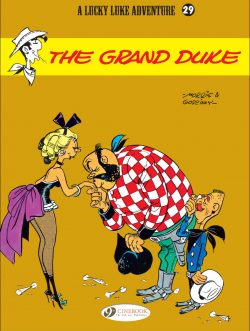
By Morris & Goscinny, translated by Erica Jeffrey (Cinebook)
ISBN: 978-1-84918-083-2 (Album PB) 978-1-84918-819-7 (Digital edition)
This book includes Discriminatory Content produced in less enlightened times. This book also includes Discriminatory Content added for comedic effect.
Time for another Anniversary announcement, non?
Created by Belgian animator, illustrator and cartoonist “Morris” (AKA Maurice de Bévère), Lucky Luke debuted in the summer of 1946, initially riding out in Le Journal de Spirou in mid-summer sans title or banner, and only in the French-language edition of the multinational comic. The Lone Rider’s official launch came in (Christmas Annual) L’Almanach Spirou 1947, before beginning his first official serial – ‘Arizona 1880’ – in 1946’s all-regional, multilingual weekly edition for December 7th.
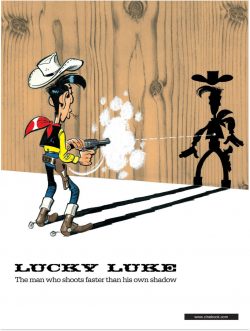
Doughty, dashing, dependable cowboy “good guy” Lucky is a rangy, implacably placid do-gooder able to “draw faster than his own shadow”. He amiably ambles around the mythic Old West, having light-hearted adventures on his petulant and rather sarcastic wonder-horse Jolly Jumper. For 80 years his exploits have made Lucky a top-ranking global comic icon, packing more than 90 individual albums and spin-off series like Kid Lucky & Ran-Tan-Plan, with sales well north of 300 million copies in 30 languages. That renown translates into a merch mountain of toys, games, animated cartoons, TV shows and live-action movies and even commemorative exhibitions. No theme park yet, but you never know…
After a relatively slow start for such a fast gun, Lucky’s global dominance came via a decades-long collaboration with superstar scripter René Goscinny. The official partnership spanned Des rails sur la Prairie/Rails on the Prairie (starting August 25th 1955) to La Ballade des Dalton et autres histoires/The Ballad Of The Daltons And Other Stories in 1986, during which time the sixgun straight-shooter switched teams, transferring to Goscinny’s own magazine Pilote with La Diligenc/The Stagecoach in 1967. Goscinny crafed 45 albums with Morris before his death, after which the artist continued both singly and with other literary pardners, before recruiting a posse of legacy creators including Lo Hartog van Banda, Achdé & Laurent Gerra, Xavier Fauche, Benacquista & Pennac, Jean Léturgie, Jacques Pessis and more, all taking their own shots at the venerable vigilante. Morris continued until his own death in 2001, having drawn fully 70 adventures, plus numerous sidebar and spin-off sagebrush sagas.
His grande idée draws on western history less than movie mythology, but – as here(ish) – our hero regularly met historical figures as well as fictional folk in tales drawn from key themes of classic cowboy lore, lensed through uniquely European notions and interpretations – as also seen here. Our sixgun star is not averse to being a figure of political change and Weapon of Mass Satire, as well as spoofing his own antecedents whilst wallowing in movie schtick to trigger delicious drives down memory lane in the eternal game of cowboys and imbeciles…
In the ‘50’s Goscinny began scripting Lucky uncredited. Morris had spent almost a decade filling nine albums with affectionate sagebrush parody, action and Lucky Laughs, but when Goscinny was fully deputised as lead wordsmith, Luke popped up more often and rapidly attained dizzying heights of super swift superstardom. Moreover, the hits just kept coming. The 40th European album Le Grand Duc was first seen serially in weekly Pilote from January 25th to May 24th 1973 (issues #690 to 707). In 2011, as The Grand Duke, it became Cinebook’s 29th English-language tome of scathing sagebrush satire and horsefeather hijinks.
Morris drew from a deep shared well of visual and cinematic motifs, gilded with historical veracity as Goscinny’s rip-roaring yarn borrowed heavily from an actual Diplomatic “Jolly” enjoyed between 1871 – 1872 by Grand Duke Alexei Alexandrovich, the son of Russian Emperor Alexander II. As the new ambassador to the United States, and alongside living legend Buffalo Bill Cody, Alexei felt it vital that he visit the fabled plains and unfolding frontier, sneering at natives and peasants whilst slaughtering any beast crossing his gunsights…
Here, however, it begins with Lucky once more summoned to Washington DC – this time by the Secretary of State, a big man in need of a little favour. Visiting Russian dignitary Grand Duke Leonid is an enthusiastic fan of James Fenimore Cooper and other modern American authors, and wishes to experience all the grandeur and wildness (such as bandits, cattle-towns, owlhoots, prairies, stage robbers, gold rushes, gunslingers, bar room brawls, ghost towns, varmints, prospectors, Indian attacks and all the rest) of the west, as described in his hobby reads. Despite his often fanciful studies he is not particularly eloquent and most of his communication comes via interpreter/attaché/aide-de-camp His Excellency Colonel Fedor Mikhailovich Boulenkov of His Majety the Czar’s Guard. What they really need is an experienced guide who can inconspicuously double as bodyguard and babysitter. A vital trade treaty depends on our hero keeping the visiting VIP safe and sweet, and of course they will all be utterly incognito…
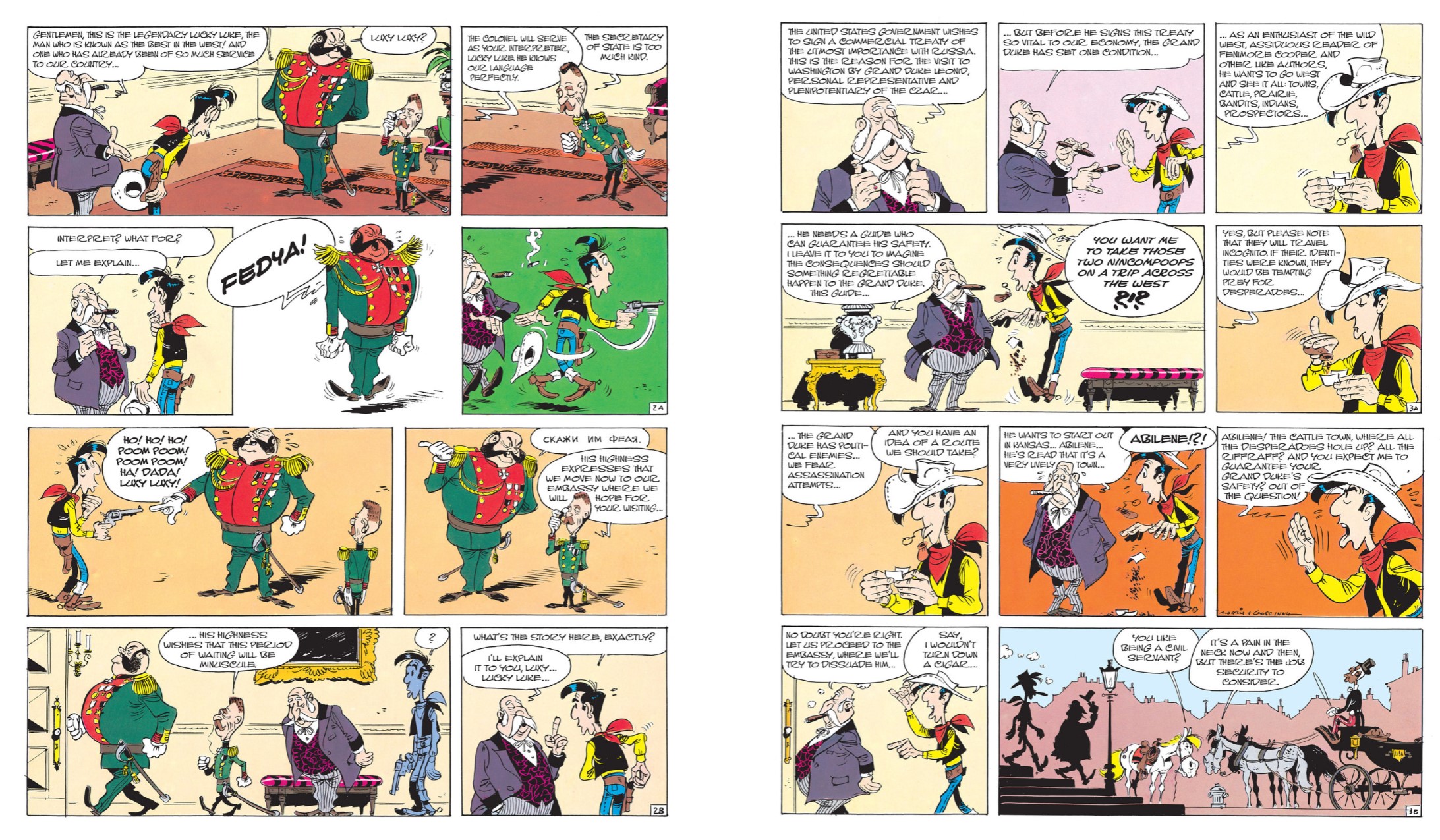
Impatient Leonid demands an immediate start, so they are all aboard a train heading to desperado-plagued cow-town Abilene within the hour, which is bad news for the Russian anarchist/bomber dogging their heels and blowing up all the wrong coaches and vehicles they should have been in…
The tourists have a rather uneventful journey west, but only because they don’t notice Lucky quietly dealing with train robbers, the bomber and even cardsharps set to fleece the coffers of a foreign government. Instead, the Duke in mufti teaches them a game of chance from his homeland… Russian Roulette…
By the time they get to Kansas – on horseback! Not comfortable rail carriage – the voyagers are ready to sample all the hedonistic delights of the bustling flesh exchange (animal and otherwise). Having Americanised his name to “Bob” and still guided by his reading, Grand Duke Leonid is open to all the town offers and heads for the saloon where lovely – albeit rather hardboiled – chanteuse Laura Legs beguiles and breaks hearts. The aristocrat is unaware that Lucky has already vigorously discouraged all the cowboy patrons from taking advantage or making fun of the foreign tenderfoot about to arrive through those swing doors…
Sadly, Laura’s boss, saloon owner Jackson, reads Eastern newspapers and recognises The Duke. He thinks he’s going to be very rich very soon but hasn’t accounted for his target’s low boredom threshold. Finding this Abilene too sedate, Bob insists on a stagecoach ride further into the west, hoping that it might be held up by desperate gunmen. The ever-close anarchist also lays plans and more bombs, but again Luke is anticipating problems and finding solutions. Before anything can happen, the travellers ditch the coach and alter destination, heading off again on horseback and missing anything even remotely resembling action, adventure or attempted assassination…
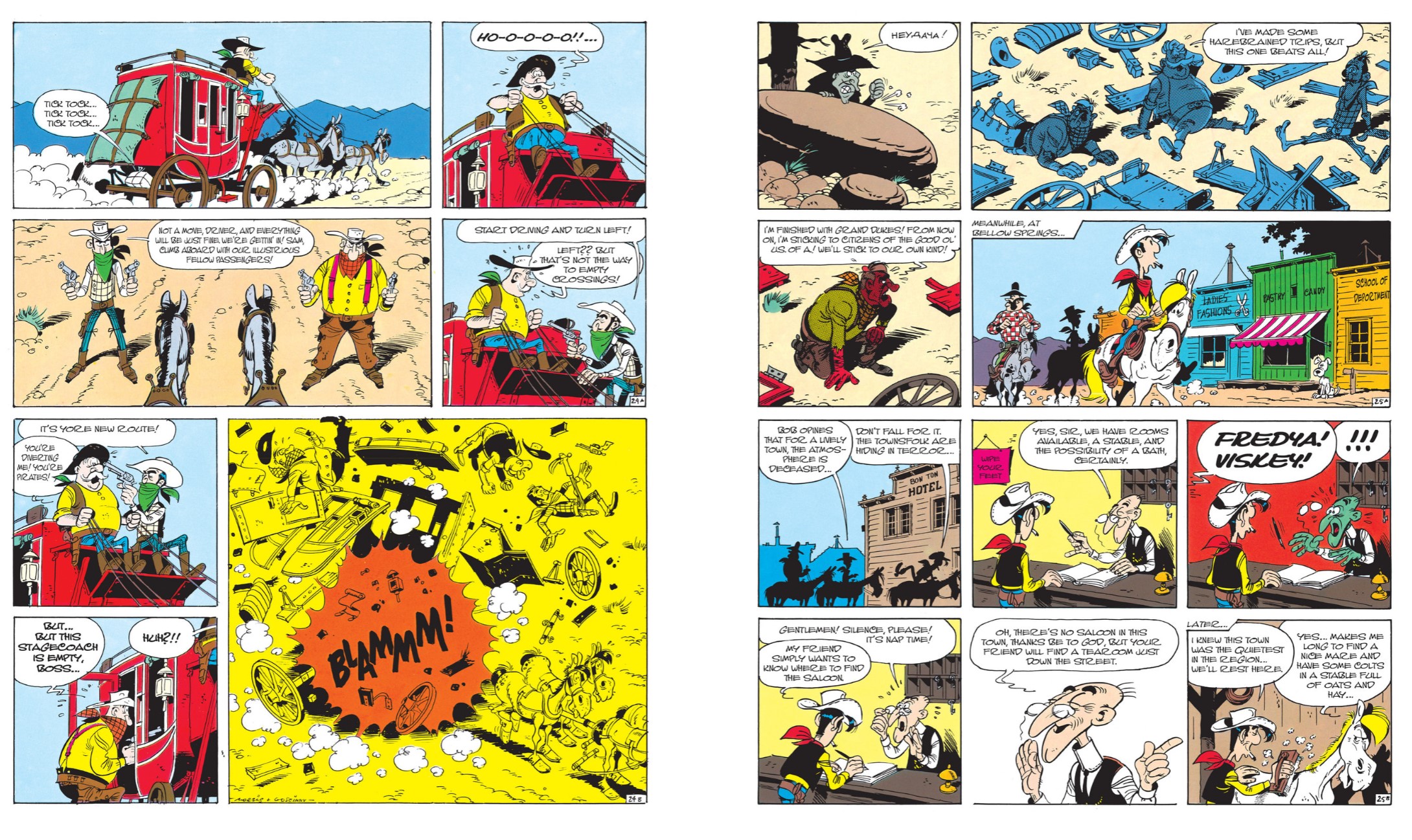
Cunningly steering his charges to sedate enclave Bellow Springs, Lucky hopes for peace, quiet and a nice bath but is frustrated when Bob finds a newspaper trumpeting a manhunt for deadly desperado Texas Ripper and wants to join the posse combing nearby Sioux Hills. With no way out, Luke leads the trio into the brush where they soon meet the monster… with astonishing results….
Then, after subverting the press in Grassy Junction, Luke believes a faux newspaper will lead Bob to a dull, dead ghost town. Ironically, even fake news spreads fast and soon Nugget Town is born again in the heat of another rumour-fuelled gold rush. Sadly the bored Duke has already moved on. Bob is ready to call it a day and heads back to dreary Bellow Springs… where the anarchist is waiting. It’s again in vain as the Duke changes his mind and demands to experience an Indian war before finally retreating east. Sadly, with no natives – outraged or otherwise – to hand, Lucky must requisition the local US cavalry contingent to play the furious feathered aggressors… and as usual nothing goes as it should…
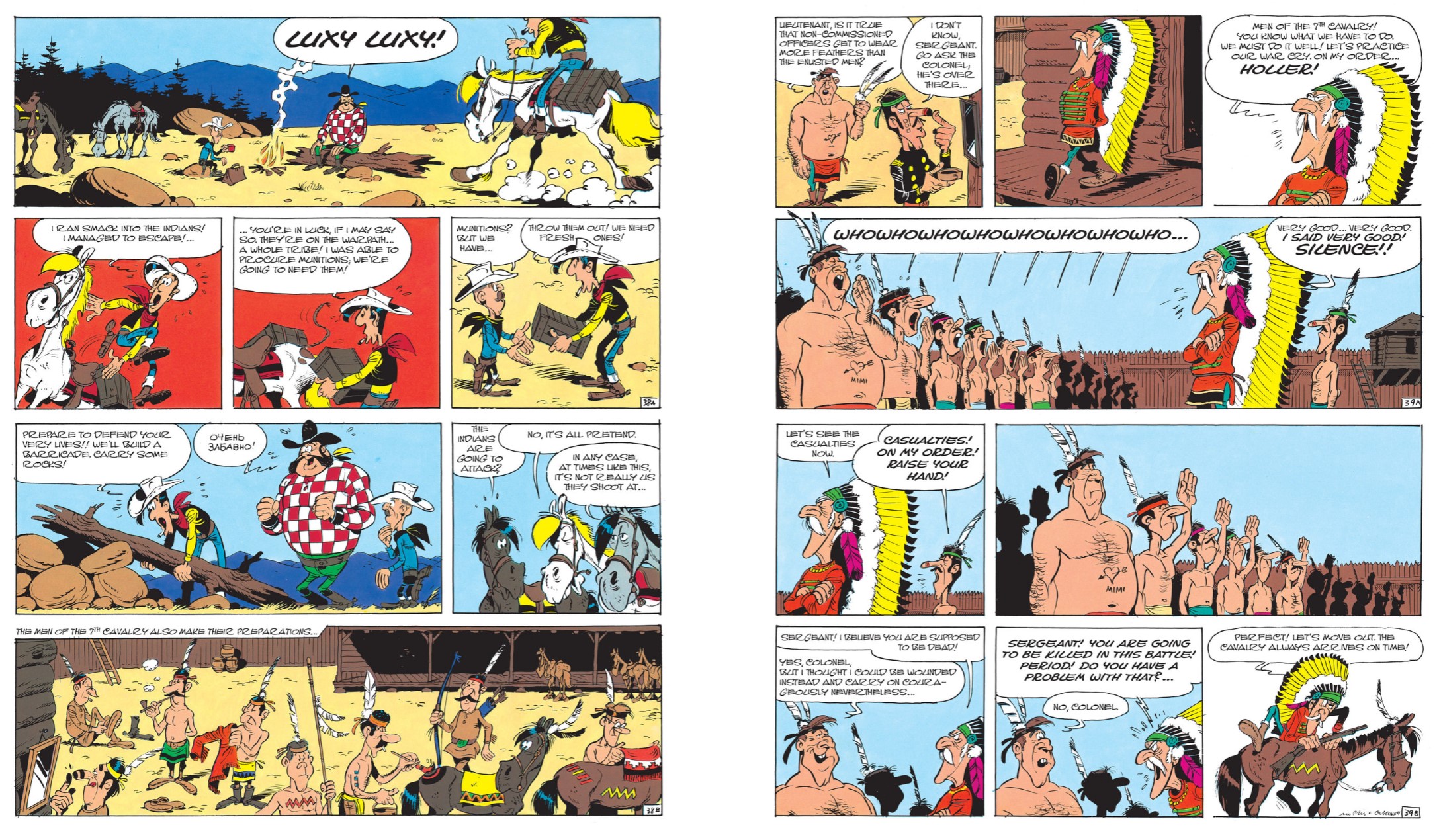
It would have been so much easier if someone had ridden to the next fort and spread the word of the imaginary “uprising” but as always, when the unnecessary reinforcements arrive Lucky thinks as fast as he draws and saves the day, the jaunt and that treaty…
A cunning conception and sly amalgam of deception and surreal slapstick, The Grand Duke is a rowdy romp and raucous antidote to dark realpolitik dramas and mirthless mood-driven melodramas of the mesas. This engaging comedy thriller is ideal for kids tall-to-small with a smidgen of historical perspective and social understanding The action and set pieces – even the Russian Roulette running gag – are no more contentious than any Laurel and Hardy film (understandable as Morris was a huge fan of the duo) and genuinely hilarious. Such foolish forays are a grand old hoot in the tradition of Destry Rides Again or Cat Ballou, superbly executed by master storytellers and a perfect introduction to a unique genre for anyone who might well have missed the romantic allure of the Wild West that never was.
© Dargaud Editeur Paris 1973 by Goscinny and Morris. © Lucky Comics. English translation © 2011 Cinebook Ltd.
Today in 1911 writer/artist Kin Platt (Doc Strange, Happy, The Mask, Captain Future, Mr. & Mrs.) was born, sharing birthdays with British artist Staz Johnson (Catwoman, Rogue Trooper, Robin, Action Force) in 1965; writer Gregg Hurwitz (Foolkiller) in 1973; writer Al Ewing (Judge Dredd, Loki: Agent of Asgard, Ultimates, The Immortal Hulk) in 1977 and editor Alanna Smith in 1990.
Today in 1996 we lost writer/editor Mark Gruenwald (the Omniverse, Captain America, Hawkeye, Squadron Supreme) with Mike Wieringo (Amazing Spider-Man, Impulse, Flash, Tellos, Fantastic Four) passing in 2007 and the irreplaceable Joe Kubert (Sgt Rock, Enemy Ace, Hawkman, Flash, Tarzan, Fax from Sarajevo) in 2012.