
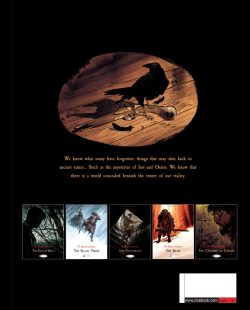
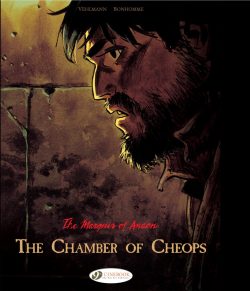
By Vehlmann & Bonhomme: coloured by Delf and translated by Mark Bence (Cinebook)
ISBN: 978-1-84918-295-9 (PB Album) 978-1-84918-725-1 (Digital edition)
This book includes Discriminatory Content included for dramatic effect.
In 1972 Fabien Vehlmann entered the world in Mont-de-Marsan. Raised in Savoie, he studied business management before taking a job with a theatre group. His prodigious canon of pro comics work began in 1998 and soon earned him the soubriquet of “Goscinny of the 21st Century”. In 1996, after entering a writing contest in Le Journal de Spirou, Fabien caught the comics bug and two years later – with illustrative collaborator Denis Bodart – produced mordantly quirky, sophisticated portmanteau period crime comedy Green Manor. From there his triumphs grew to include – amongst many others – Célestin Speculoos for Circus, Nicotine Goudron for L’Écho des Savanes and especially album series Jolies Ténèbres/Beautiful Darkness, Seuls/Alone and a superb stint on global property Spirou and Fantasio…
Scion of an artistic family, Matthieu Bonhomme received his degree in Applied Arts in 1992, before learning the comics trade working in the atelier of western & historical strip specialist Christian Rossi. Spanning 2002-2008, Le Marquis d’Anaon was Bonhomme’s first regular series, after which he began writing as well as illustrating a variety of tales, from L’Age de Raison, Le Voyage d’Esteban, The Man Who Shot Lucky Luke and so much more.
Now, where were we? Imagine The X-Files set in the Age of Enlightenment (circa 1720), played as a solo piece by a young French protagonist reluctantly growing into and accepting the role of crusading troubleshooter. With potent overtones of Jane Eyre, Wuthering Heights, The Fall of the House of Usher and similar gothic romances, it all began in 2001’s L’Isle de Brac: first of 5 albums tracing the development of a true champion against darkness and human venality.
Under-employed, middle-class merchant’s son, scholar and pragmatic philosopher Jean-Baptiste Poulain is an ardent disciple of Cartesian logic and former medical student. Well educated but impoverished, he accepted a post to tutor the son of the mysterious Baron of Brac. It was a career decision that shaped the rest of his life…
On a windswept, storm-battered, extremely isolated island off the Brittany Coast, Poulain experienced fear and outrage, superstition and suspicion before ultimately exposing the appalling secret of the island overlord his serfs called “the Ogre”, bringing justice and finality to all concerned. In the aftermath, Poulain left, but could never outrun the obnoxious title the islanders bestowed upon him in their Bretagne argot: Le Marquis d’Anaon – “the Marquis of Lost Souls”…
Two years later Poulain caught a supposedly demonic but actually faith-based serial killer (The Black Virgin), and after that saved Europe from plague (La Providence) and France and the neighbouring Duchy of Savoy from a nigh-demonic cryptid (The Beast)… all without proper recompense or even some career-enhancing renown…
With this final tale (thus far) the much maligned misanthrope begins a passage of personal growth and fundamental change after he and four other complete strangers jointly inherit the vast fortune of fur trader and eccentric dilettante scholar Umberto Leone. He was – according to the protectorate’s French Consul De Trezancour – eaten by three crocodiles in Egypt…
In Paris, at the reading of the will, Poulain is gripped with doubts and suspicions over the ridiculous situation and overly specific cause of death. He compulsively ponders what really happened and why his apparently quick-tempered and obsessive benefactor was even in Cairo in the first place… especially after viewing radical renovations his departed patron had made to his lavish Parisian apartments immediately before his final visit to the Land of the Pharaohs…
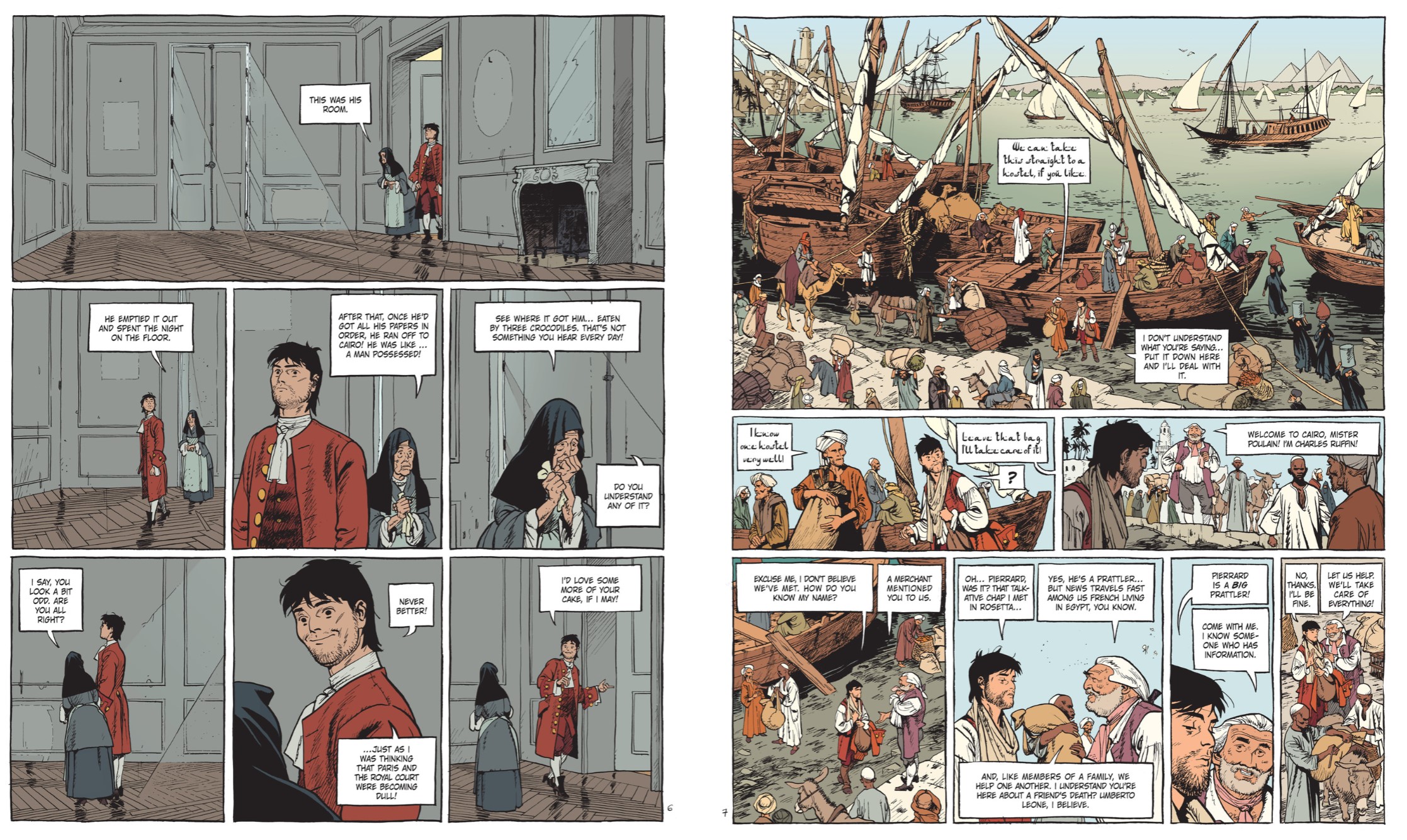
Being rich now, finding out is simple and the Marquis of Anaon takes ship for Cairo, where he sees a thriving, energetic but completely alien culture and is met by unctuous, thoroughly unpleasant fixer/agent Charles Ruffin. In a sprawling city ancient beyond belief but plagued by external conquest and endemic factionalism, it soon becomes clear that his guide and escort is there to steer, manage and spy upon Umberto’s heir for exceedingly greedy and dangerous coffee trader and merchant prince Delambre… who also believes Poulain knows more than he’s letting on…
Stationed in Leone’s former dwelling, with Ruffin’s thugs ceaselessly watching, the inheritor soon learns from Leone’s “Negress” Diénéba, (a live-in “service” included as part of the welcome package, but one that the Marqius immediately places under his complete protection) that everyone knew Leone was searching the Great Pyramid of Cheops for something utterly extraordinary. They all – westerners and Egyptians alike – still believe it is physical treasure, but as Poulain proceeds in his investigations and ruminations he meets fringe scientist Richardson and realises that what Leone discovered was far more profound, spectacular and even perilously miraculous…
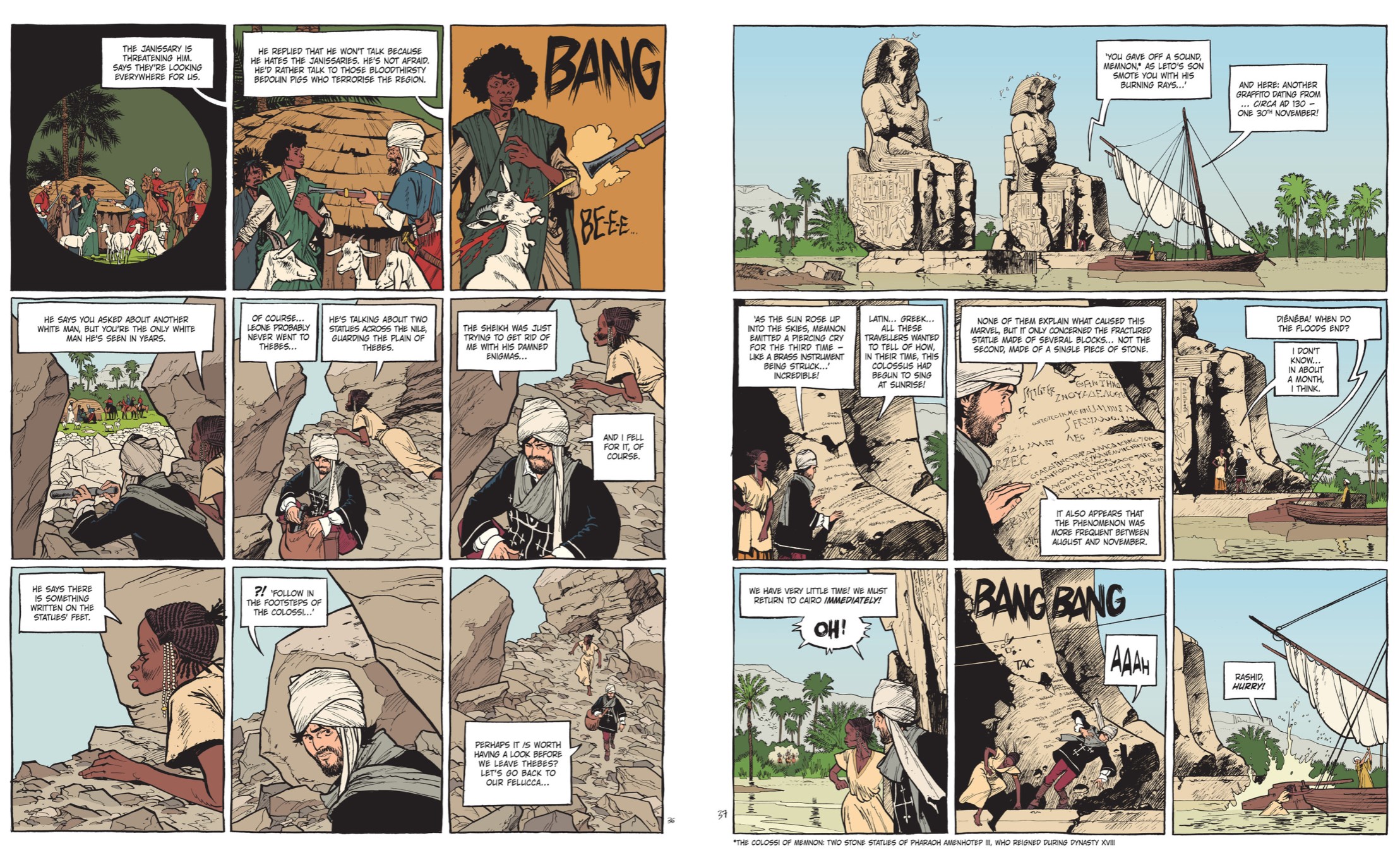
Further adding to the tensions is a febrile political situation, with the largely immune but always interfering French merchant class gleefully stirring unrest among the Egyptians and allowing roaming militias of Janissary “peacekeepers” to beat, plunder and bully at will, just as long as the pleasures and profits keep rolling in. When Poulain’s researches bring him close to Leone’s dream, he is confronted , challenged by and ultimately adopted by one faction – led by cleric Sheikh Luqman – and becomes an unwilling but grateful disciple of the sage. With his own people and the gold-crazed Janissaries seeking his blood, he finds love and solace with Diénéba, and they voyage to the pyramid. In the long hidden Chamber of Cheops Poulain barely survives the true secret of the edifice and uncovers a second astounding fact that could get him killed… but not like Leone was supposed to have been…
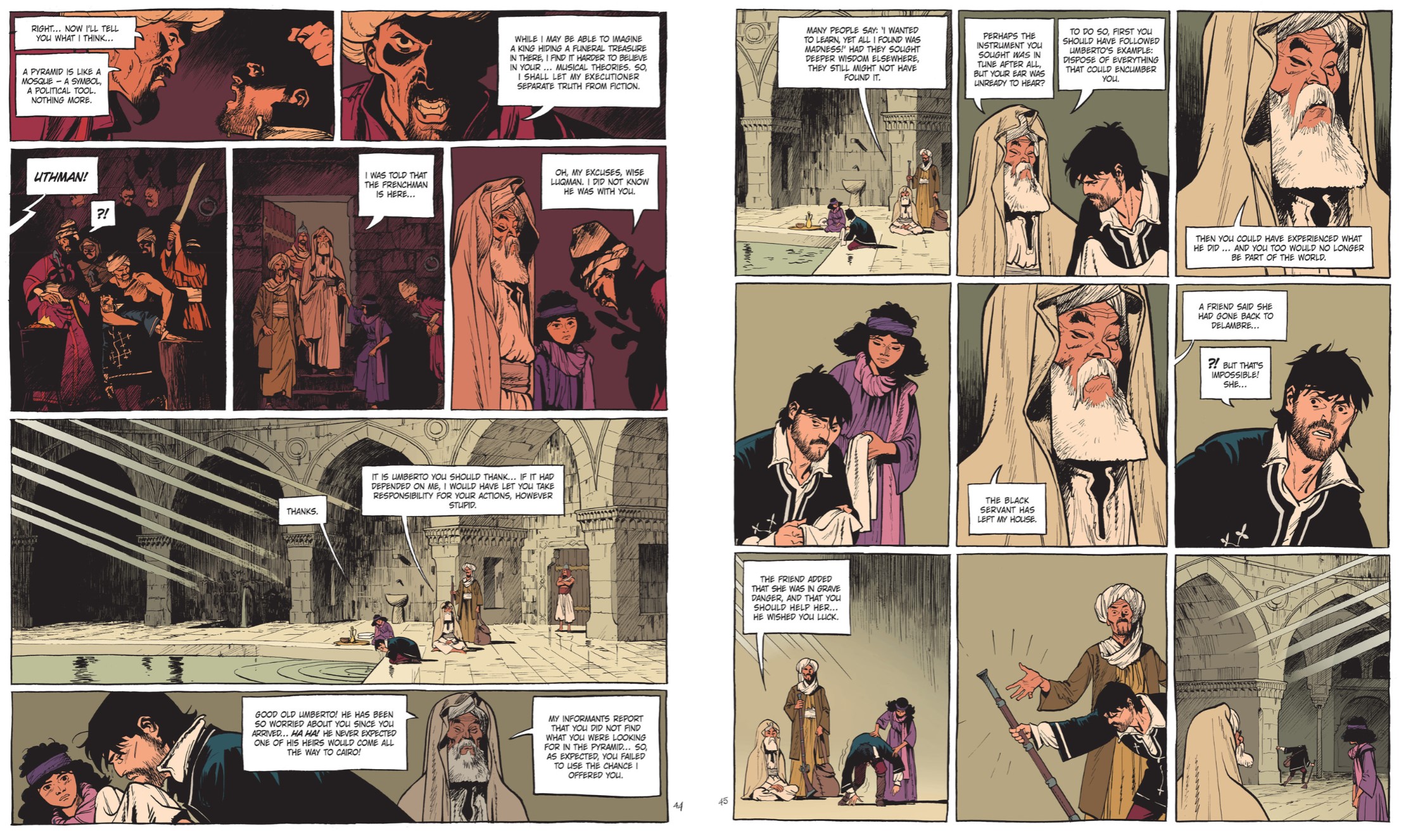
Then after dealing with Delambre it’s a frantic rush to get out of Egypt for the impassioned couple, with a promise of greater magic – and hardship – to come…
This deviously swingeing attack on colonialism and ignorantly fabled “mysteries of the Dark Continent” arrives as another tautly authentic, compellingly scripted saga from Vehlmann, vividly visualised via Bonhomme’s densely informative but never obtrusive illustrated realism. It adds a gripping, utterly enthralling tale of romance and discovery to the canon of a truly superior man’s war against the inherent iniquities of human behaviour. Once again the unsuspected miracles of the natural world and shocking potential of humanity’s creative spark are lensed through the drives and obsessions of an individual at the forefront of religion’s retreat and birth of rationalism, and the result is pure entertainment gold.
This evolution of a self-doubting quester barely holding at bay the notion that all his schooling is pointless and without worth in a world too big for humanity and just one aspect of a universe beyond any one’s grasp is utterly compulsive entertainment, making The Marquis of Anaon’s mystery milestones a joy no thinking fear fan should miss.
Original edition © Dargaud Paris 2008 by Vehlmann & Bonhomme. All rights reserved. English translations © 2016 by Cinebook Ltd.
Today in 1914, Canadian Joe Shuster was born. Three years later British cartoonist Reg Smythe (Andy Capp) followed, as did strip writer (Tank McNamara) turned film critic Jeff Millar in1942. That same year Argentinian art wizard José Antonio Muñoz AKA “Muñoz” (Alack Sinner, Joe’s Bar, Sophie, Billie Holiday) was born, with painter Bob Larkin (Deadly Hands of Kung-Fu, Marvel Preview, Planet of the Apes, Savage Sword of Conan, Doc Savage) arriving in 1949; artist Howard Porter (Justice League, Trials of Shazam!, The Flash) in 1969 and Simone Bianchi (Seven Soldiers: Shining Knight, Original Sin) in1972.
In 1951, creator Dudley Fisher (Myrtle) died as did the stounding Jean-Michel Charlier (Redbeard, Buck Danny, Blueberry, Valhardi, Tanguy et Laverdure) in1989; cartoonist Doug Marlette (Kudzu) in 2007 and Indian artist and humourist Mangesh Tendulkar (Sunday Mood) in 2017.