
By Morris & Goscinny (Cinebook)
ISBN: 978-1-84918-059-7 (Album PB/Digital edition)
This book includes Discriminatory Content produced in less enlightened times. This book also includes Discriminatory Content added for comedic effect.
Time for a big Birthday bash…
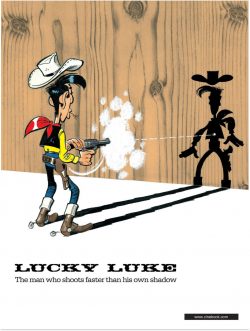
Created by Belgian animator, illustrator and cartoonist “Morris” (AKA Maurice de Bévère), Lucky Luke debuted in the summer of 1946, initially riding out in Le Journal de Spirou in mid-summer sans title or banner, and only in the French-language edition. The Lone Rider’s official launch came in Christmas Annual L’Almanach Spirou 1947, before beginning his first official serial – ‘Arizona 1880’ – in 1946’s multinational weekly issue for December 7th. Doughty, dashing, dependable cowboy “good guy” Lucky is a rangy, implacably placid do-gooder able to “draw faster than his own shadow”. He amiably ambles around the mythic Old West, having light-hearted adventures on his petulant and rather sarcastic wonder-horse Jolly Jumper.
For 80 years (Joyeux anniversaire, Mon Brave!), his exploits have made Lucky a top-ranking global comic icon, filling more than 90 individual albums and spin-off series like Kid Lucky and Ran-Tan-Plan, with sales well north of 300 million copies in 30 languages. That renown translated into a mountain of merchandise, toys, games, animated cartoons, TV shows and live-action movies and even commemorative exhibitions. No theme park yet, but you never know…
After a relatively slow start for such a fast gun, Lucky’s global dominance came via a decades-long collaboration with superstar scripter René Goscinny. The official partnership spanned Des rails sur la Prairie/Rails on the Prairie (beginning August 25th 1955) to La Ballade des Dalton et autres histoires/The Ballad Of The Daltons And Other Stories in 1986, during which time (in 1967) the sixgun straight-shooter switched teams, transferring to Goscinny’s own magazine Pilote with La Diligenc/The Stagecoach.
Goscinny produced 45 albums with Morris before his death, after which Morris continued both singly and with other literary pardners, before recruiting a posse of legacy creators including Lo Hartog van Banda, Achdé & Laurent Gerra, Xavier Fauche, Benacquista & Pennac, Jean Léturgie, Jacques Pessis and more, who all took their own shots at the venerable vigilante. Morris soldiered on until his own death in 2001, having drawn fully 70 adventures, plus numerous sidebar and spin-off sagebrush sagas.
His grande idée draws on western history less than movie mythology, but our heroes still regularly meet historical figures as well as even odder fictional folk in tales drawn from key themes of classic cowboy lore – as well as some uniquely European notions or interpretations such as seen here. As previously hinted, our sixgun star is not averse to being a figure of political change and Weapon of Mass Satire, but here spoofs his own antecedents and wallows in venerated movie schtick for a delicious drive down memory lane and game of cowboys and imbeciles…
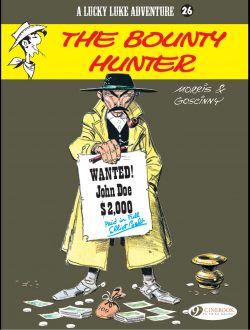
In the ‘50’s Goscinny had started scripting Lucky uncredited. Morris had taken almost a decade to fill nine albums with affectionate sagebrush parody, action and Lucky Laughs, but when Goscinny was deputised as wordsmith, Luke was seen more often and rapidly attained dizzying heights of super swift superstardom. Moreover, his hits just kept coming. Chasseur de primes was the 39th European album, having been seen serially in weekly Pilote from #658 to 679, spanning June 15th to November 8th 1972. In 2010 as The Bounty Hunter, it became Cinebook’s 26th English-language volume of hilarious horsefeather history. As always, Morris drew from a deep shared well of visual and cinematic motifs and here tips his hat to the then-new phenomenon of “spaghetti westerns” as the unmistakable image of Lee Van Cleef makes it onto Lucky’s graphic gallery and most Unwanted list…
More an assemblage of themed and interlinked skits than a full feature, The Bounty Hunter is unsavoury stalker/reward-obsessed killer-without-a-badge Elliot Belt who derives far too much joy from collecting fees and even bigger thrills and obscene jollies from hunting down legalised prey… like anyone he sees on a wanted poster.
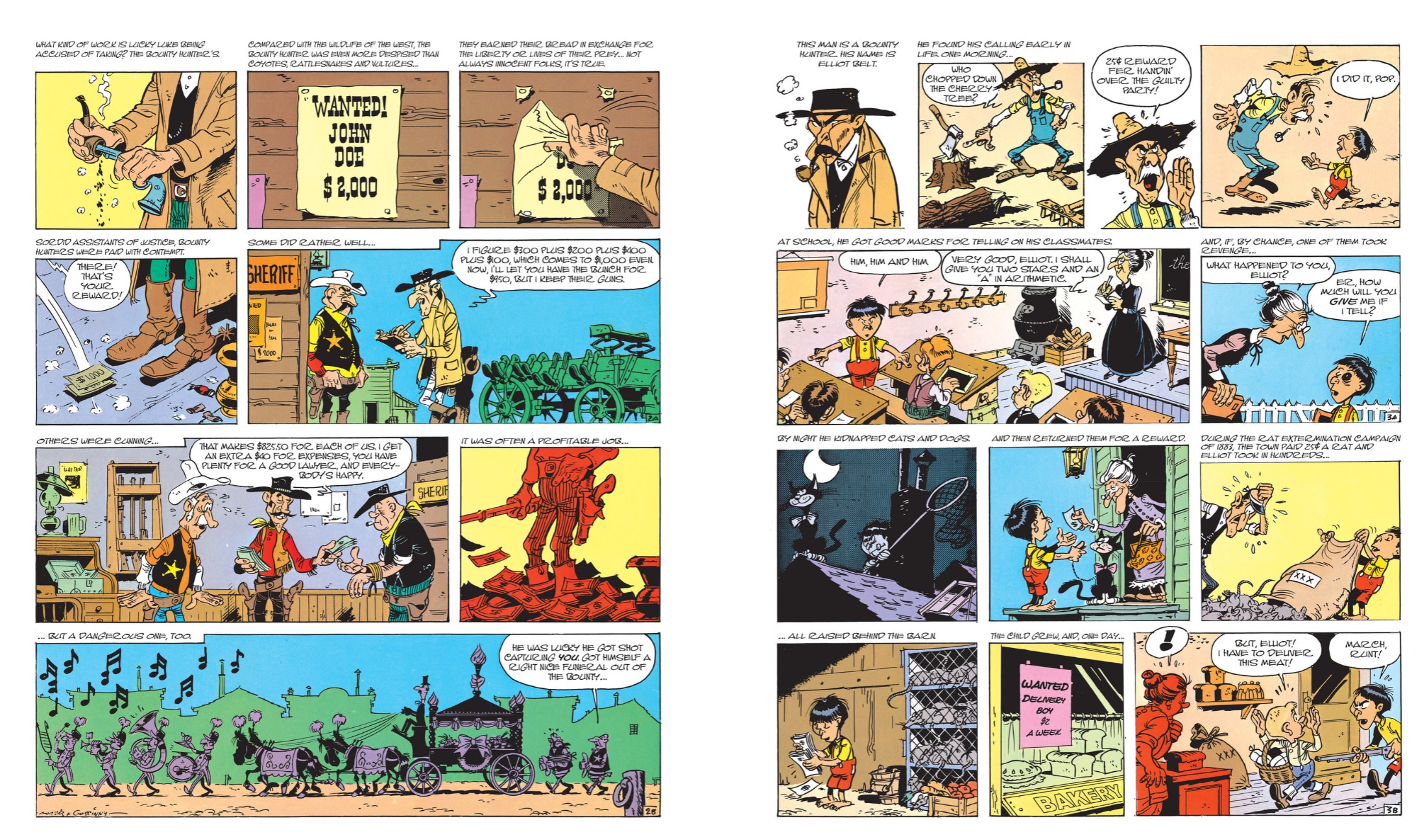
Despised by all and not caring one whit, his life and dark joys are forever spoiled when he arrives in Cheyenne Pass and sees Lucky Luke capturing felons. When the stalwart refuses the reward and gives it to charity, Belt slips into murderous madness after realising his cheery, unsuspecting rival is a better gunslinger than him but refuses to kill anyone…
The intolerable situation worsens when super-rich, horse-mad rancher Bronco Fortworth puts a private $100,000 bounty on the head of his Cheyenne farmhand Wet Blanket, who has gone missing at the same time as the plutocrat’s immensely valuable new stud steed His Highness. Without any evidence or recourse to real lawmen, Fortworth will pay anyone who uses ANY means to bring the missing Cheyenne back to him to personally hang…
After failing to join forces or partner up with Lucky – who is convinced Wet Blanket is innocent and wants to avoid another Indian war – Belt infiltrates the local Reservation to ply the residents with booze and worse in hopes of finding the missing stable hand. They don’t care about any of the white man’s nonsense but can’t get past their highly developed commercial instincts, weird rituals and trashy tourist traps…
Belt does, however, convince entrepreneurial wizard Chief Little Fish Knife to hold Lucky hostage (twice!) and terrorise the town (mostly just the saloon, actually) but Luke is hard to hold and ultimately, when all else fails, Belt grudgingly recruits a small army of other (lesser) bounty hunters, all the while plotting to cheat them out of their fair shares…
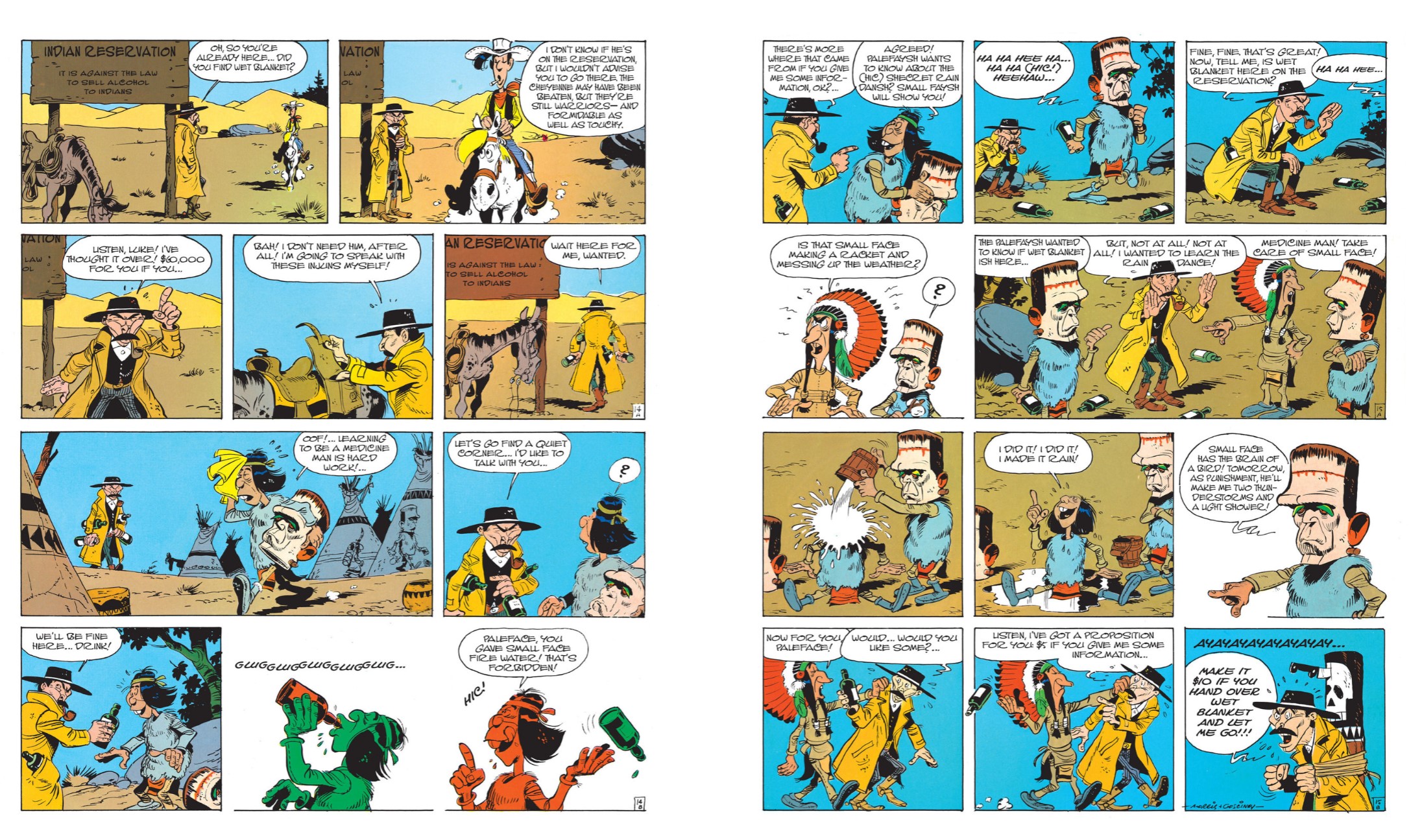
Events are completely out of control when Wet Blanket obliviously returns from his vacation and immediately joins Luke in stopping the bounty hunters-inspired “Indian uprising” just as the never-vigilant US cavalry turn up where they’re not wanted to heap coals on a growing wildfire sparked by Belt and Bronco Fortworth…
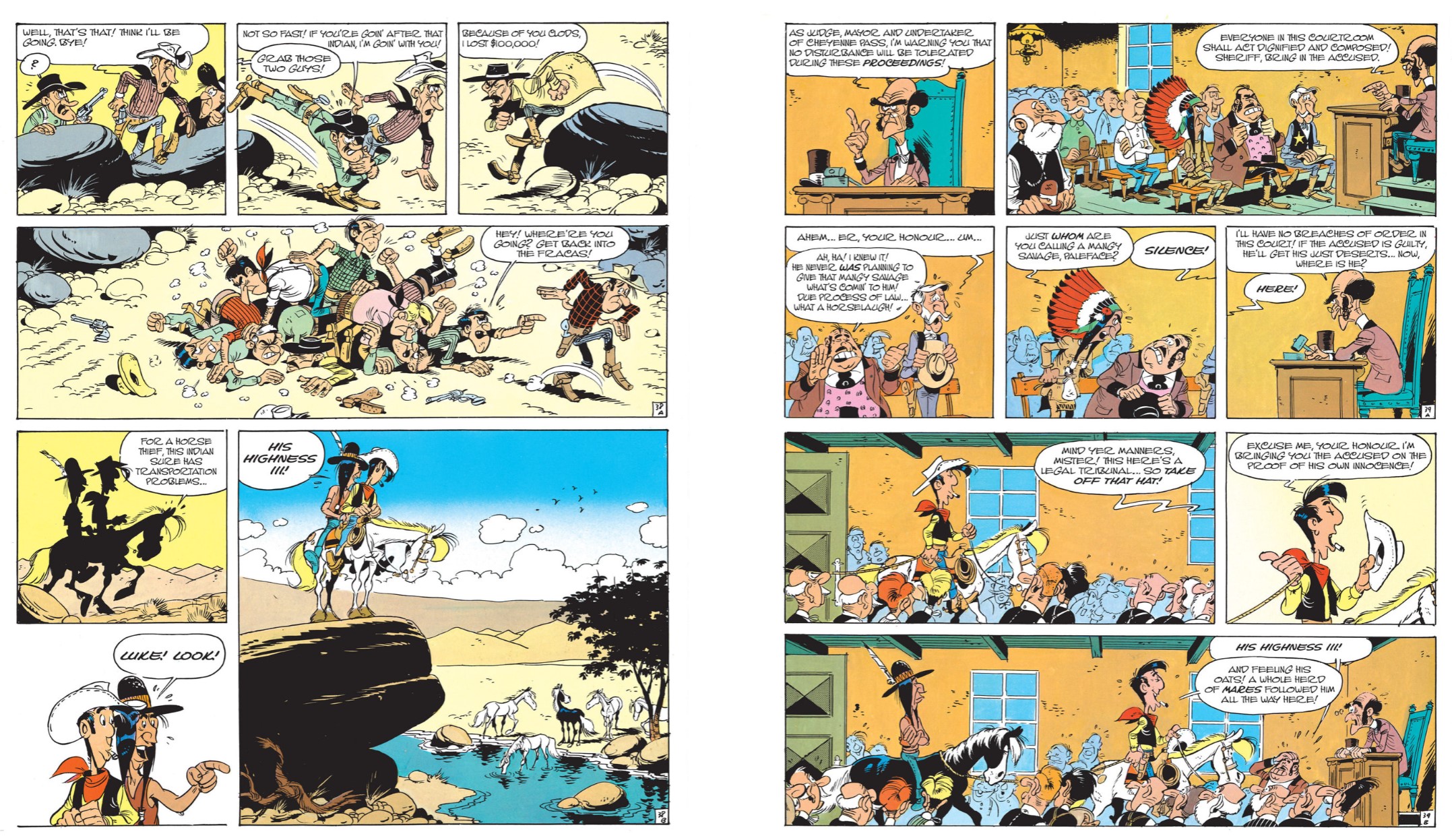
Through deft manipulation Lucky de-escalates the situation and even finagles a proper day in a real court for all concerned. As His Highness is discovered romping with a herd of wild mustangs, what really happened to the so-valuable steed is shockingly revealed by the one person nobody expected to be involved…
Pursued by his betrayed hirelings and “cheated of his rightful reward”, Elliot Belt finally goes too far even for western justice and at last learns what it means to be the face and name on a wanted poster…
As much barbed morality play as rowdy light thriller, this yarn again proves how crucial great villains are to any hero. These tall-to-small tales are perfect for kids with a smidgen of historical perspective and social understanding, although the action and surreal slapstick situations are no more contentious than any Laurel and Hardy film; perfectly understandable as Morris was a huge fan of the duo. These forcefully foolish forays are a grand old hoot in the tradition of Destry Rides Again or Blazing Saddles, superbly executed by master storytellers and a perfect introduction to a unique genre for anyone who might well have missed the romantic allure of the Wild West that never was.
© Dargaud Editeur Paris 1972 by Goscinny and Morris. © Lucky Comics. Published in 2010 by Cinebook Ltd.
Today in 1887, Flemish comics writer Raymundus Joannes de Kremer AKA Jean Ray AKA John Flanders (Malpertuis, Whisky Tales, Ghouls in My Grave) was born, sharing the day with artist Irwin Hasen (Wildcat, Green Lantern, Dondi) in 1918; “father of seinen manga” Shinji Nagashima in 1937; horrorist, author and educator Mort Castle in 1946; Belgian creator Philippe Liégeois AKA Turk (Clifton, Léonard, Robin Dubois) in 1947; illustrator Stan Woch (Airboy, The Sandman, Swamp Thing) in 1959 and Whilce Portacio (X-Factor, Iron Man, Wetworks) in 1963.
The date saw the launch of Alex Graham’s Fred Bassett strip in the UK’s Daily Mail in 1963; the final appearance of the original Buck Rogers strip in 1967 and the deaths of The Katzenjammer Kids creator Harold Knerr in 1949; King Features Editor Sylvan Byck in 1982; Underground Commix pioneer Clay Geerdes (Comix World) in 1997 and Firehair, Captain Wings, Tarzan, Li’l Abner and Long Sam illustrator Bob Lubbers in 2017.