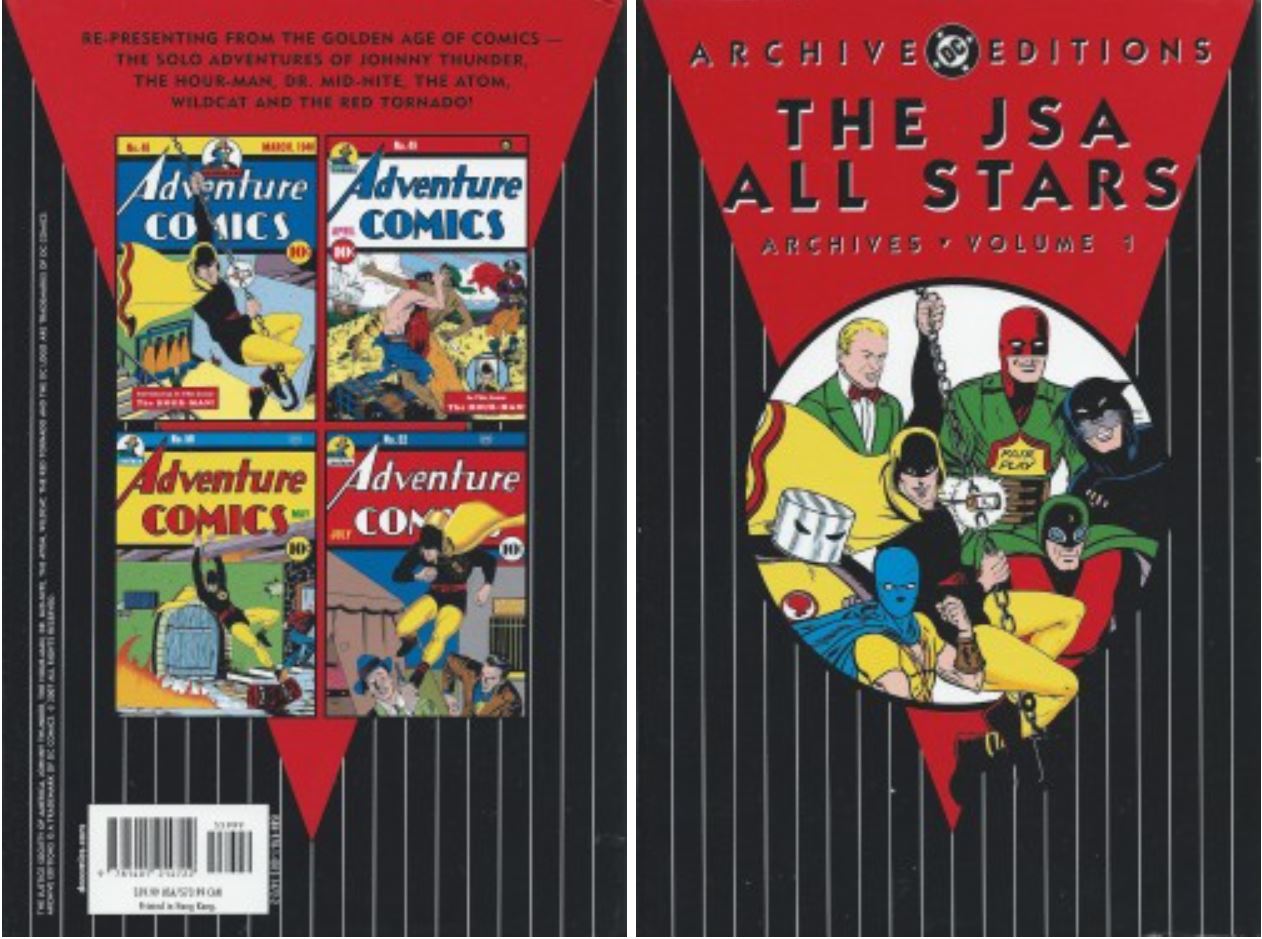
By John Wentworth, Ken Fitch, Bill O’Connor, Sheldon Mayer, Charles Reizenstein, Bill Finger, Stan Aschmeier, Bernard Baily, Ben Flinton & Leonard Sansone, Howard Purcell, Hal Sharp, Irwin Hasen & various (DC Comics)
ISBN: 978-1-4012-1472-2 (HB)
This book includes Discriminatory Content produced in less enlightened times.
Win’s Christmas Gift Recommendation: Golden Aged but Evergreen Enjoyment …8/10
In the JSA’s anniversary year, here’s yet another DC classic collection long overdue for revival and digital return. Until then – and if you can find it – this hardback will make a perfect present for you or yours…
After the actual invention of the comic book superhero – indisputably Action Comics’ debut of Superman in June 1938 – the most significant event in the industry’s history was the combination of individual sales-points into a group. Thus what seems blindingly obvious to us with the benefit of four-colour hindsight was proven: consumers couldn’t get enough of garishly-hued mystery men and combining a multitude of characters inevitably increases readership. Plus, of course, a mob of superheroes is just so much cooler than one… or one-and-a-half if there’s a sidekick involved…
The creation of the Justice Society of America in 1941 (with copies of All-Star Comics #3 going on sale today waaay back then) utterly changed the shape of the budding business. However, before that team could unite they had to be popular enough to qualify, and this superb hardcover sampler gathers the debut adventures of a septet of beloved champions who never quite made it into the first rank but nonetheless scored enough to join the big team and maintain their own solo spots for much of the Golden Age of American Comics.
Whilst most favoured 1940s stalwarts all won their own DC Archive collections (some even making it into digital modern editions this century), this particular tome bundles a bunch of lesser lights – or at least those who never found as much favour with modern fans and revivalists – and features the first 5 appearances of 7 of the JSA‘s “secondary” mystery men: all solid supporting acts in their own anthology homes but who were potentially so much more…
Gathered here are short, sharp, stirring tales from Flash Comics #1-5; Adventure Comics #48-52; All-American Comics #19-29 and Sensation Comics #1-5, collectively spanning January 1940 to May 1942. They are preceded a sparkling, informative and appreciative Foreword by Golden Age aficionado and advocate Roy Thomas… himself enjoying an anniversary today so a very happy 85th birthday to you, sir!
The vintage vim & vigour begins with a character equally adored and reviled in modern times. Johnny Thunderbolt – as he was originally dubbed – was an honest, well-meaning, courageous soul who was also a grade A idiot. However, what he lacked in smarts he made up for with sheer luck, unfailing pluck and the unconscious (at least at first) control of an irresistible magic force.
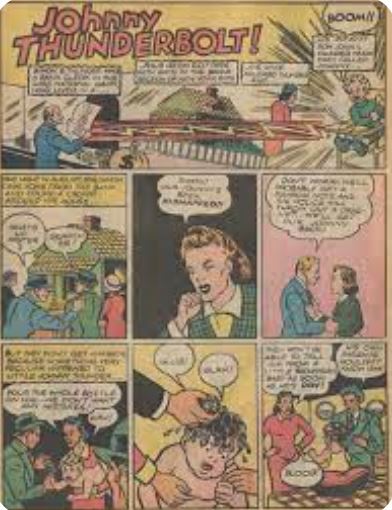
The series was played for action-packed laughs, but there was no getting away from it: Johnny was, quite frankly, a simpleton in oblivious control of an ultimate weapon. At least his electric genie was more plausible than an egomaniacal orange-toned cretin in control of America’s nuclear arsenal…
John Wentworth & Stan Aschmeier introduced the happy sap in ‘The Kidnapping of Johnny Thunder’ from January 1940’s Flash Comics #1: a fantastic origin detailing how, decades previously, the infant seventh son of a seventh son in America was abducted by priests from mystical island Badhnisia. The child was to be raised as the long-foretold wielder of a fantastic magical weapon, all by voicing the eldritch command “Cei-U” – which sounds to western ears awfully like “say, you”…
However, ancient enemies on neighbouring isle Agolea started a war before ceremonial indoctrination could be completed and at age seven the lad, through that incomprehensible luck, returned to his parents to be raised in relative normality of the Bronx. Everything was fine until Johnny’s 17th birthday, when the rite finally came to fruition and – amid bizarre weather conditions – Badhnisians cultists intensified the search for their living weapon.
By the time they tracked him down, he was working in a department store and had recently picked up the habit of blurting out the phrase “say you.” It generally resulted in something very strange happening. One example being a bunch of strange “Asiatics” attacking him and being blown away by a mysterious pink tornado…
Pattern set, each month Johnny looked for gainful employment, stumbled into a crime or crisis where his voluble temperament resulted in an inexplicable unnatural phenomenon that solved the problem but left him no better off. It was a winning theme that lasted until 1947, by which time the Force had resolved into a wisecracking thunderbolt-shaped humanoid genie, while Johnny was ousted from his own strip by sexy new crimebuster Black Canary.
Flash Comics #2 featured ‘Johnny Becomes a Boxer’. Upon stepping in to save a girl from bullies, Johnny somehow convinces vivacious Daisy Darling to be his girlfriend. He then becomes Heavyweight Champion, leading to his implausibly winning a fixed bout in #3’s ‘Johnny versus Gunpowder Glantz’. Only now, Daisy refuses to marry a brute who lives by hitting others. The solution came in ‘Johnny Law’ when kidnappers attempt to abduct Daisy’s dad. Following his sound thrashing of the thugs, and at his babe’s urging, Johnny then joins the FBI. This tantalising taste of times past concludes with ‘G-Man Johnny’ (#5 May 1940) as the kid’s first case involves him in a bank raid and results in his own dad being taken hostage…
Although he eventually joined the JSA, and despite affable, good-hearted bumbling carrying him through the war, shifting peace-time fashions found no room for a hapless hero anymore, and when he encountered a sultry masked female Robin Hood who stole from crooks, the writing was on the wall. Nevertheless, fortuitously imbecilic (and remarkably Millennial in outlook and prospects) Johnny Thunder is fondly regarded by many modern fans, still having much to say and a decidedly different way of saying it…
Ken Fitch & Bernard Baily’s Hourman was a far more serious proposition. He actually had a shot at stardom and began by supplanting The Sandman as cover feature in Adventure Comics #48 (March 1940). Here, his exploits run through #52 (July) establishing the unique and gripping methodology which made him such a favourite of later, more sophisticated fans.
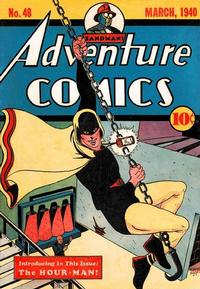
In an era where origins were never as important as action, mood and spectacle, ‘Presenting Tick-Tock Tyler, the Hour-Man’ begins with a strange classified ad offering assistance to any person in need. Chemist Rex Tyler had invented Miraclo: a drug super-energising him for 60 minutes at a time, and his first case sees him help a wife whose man is being dragged back into criminal endeavours by poverty and bad friends. Then ‘The Disappearance of Dr. Drew’ finds Tyler locating a missing scientist kidnapped by thugs before ‘The Dark Horse’ has the Man of the Hour crush a crooked, murderous bookie who swipes both horse and owner before a key race. Mad science and a crazy doctor employing ‘The Wax-Double Killers’ adds scary thrills and supervillain cachet for our timely hero to handle, and ‘The Counterfeit Hour-Man’ concludes the offerings here as he again defeats Dr. Snegg in a scurrilous scheme to frame the hooded hero.
Hourman always looked great and his adventures developed into tight and compulsive affairs, but as simply another strong, fast, tough masked guy, he never caught on and eventually timed out at the beginning of 1943 with Adventure #83.
Our third second string star is Calvin College student Al Pratt: a diminutive but determined kid fed up with being bullied by jocks. Al remade himself by effort and willpower into a pint-sized, two-fisted mystery man ready for anything. One of the longest lasting Golden Age greats, The Mighty Atom was created by writer Bill O’Connor and rendered by Ben Flinton & Leonard Sansone. He debuted in All-American Comics #19 and, after an impressive run there, transferred to Flash Comics in February 1947. The Atom sporadically appeared until the last issue – #104, cover-dated February 1949 – and made his final bow in the last JSA tale (All Star Comics #57) in 1951.
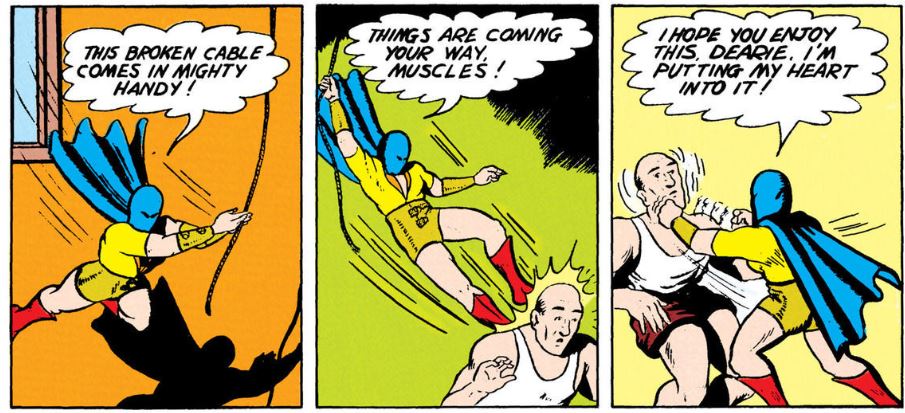
The cases here span AAC #19-23 (October 1940 – February 1941), beginning by ‘Introducing the Mighty Atom’ as the bullied scholar hooks up with down-&-out trainer Joe Morgan, whose radical methods soon have the kid at the very peak of physical condition and well able to take care of himself. However, when Al’s hoped-for girlfriend Mary is kidnapped, the lad eschews fame and potential sporting fortune to bust her loose, thereafter opting for clandestine extracurricular activities….
The Atom sported a costume for his second adventure, going into ‘Action at the College Ball’ to foil a hold-up before tackling ‘The Monsters from the Mine’ – actually enslaved victims of a scientific maniac intent on conquest. The college environment offered plentiful plot opportunities and in ‘Truckers War’ the hero crushes hijackers who bankrupt a fellow student and football star’s father. These episodes conclude with ‘Joe’s Appointment’ as Al’s trainer is framed for spying by enemy agents and needs a little atomic assistance…
Although we think of the Golden Age as a superhero wonderland, the true watchword was variety. Flagship anthology All-American Comics offered everything from slapstick comedy to aviation adventure on its four-colour pages and one of the very best humour strips featured semi-autobiographical exploits of Scribbly Jibbet: a boy who wanted to draw.
Created by actual comics wonderboy Sheldon Mayer, Scribbly: Midget Cartoonist debuted in AAC #1 (April 1939) and built a sterling rep for himself beside star reprint features including Mutt and Jeff and all-new adventure serial Hop Harrigan, Ace of the Airways. However, when contemporary fashions demanded a humorous look at mystery men, in #20 (November 1940) Mayer’s comedy feature evolved into a delicious spoof of the trend as Scribbly’s formidable landlady Ma Hunkel decided to do something about crime in her neighbourhood… so she dressed up as a husky male masked hero.
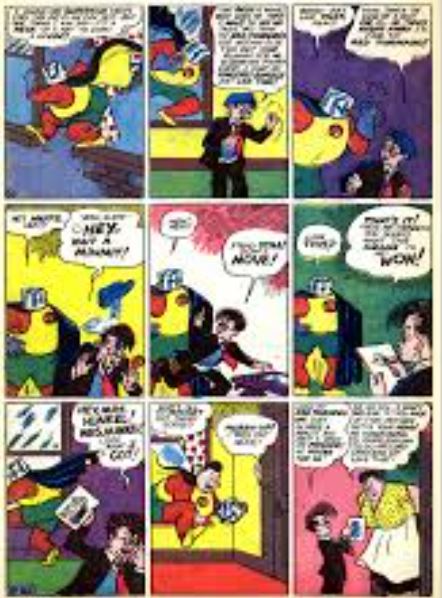
‘The Coming of the Red Tornado’ sees her don cape, woollen longjohns and a saucepan for aN identity-obscuring helmet to crush gangster/kidnapper Tubb Torponi. The mobster had made the mistake of snatching Ma’s terrible nipper Sisty and Scribbly’s little brother Dinky (who would later become her masked sidekicks), so Ma was determined to see justice done…
An ongoing serial rather than specific episodes, the dramedy concluded in ‘The Red Tornado to the Rescue’, with irate, inept cops deciding to pursue the mysterious new vigilante, with the ‘Search for the Red Tornado’ only making them look (more) stupid. With the scene set for outrageous parody ‘The Red Tornado Goes Ape’ pits the parochial masked manhunter against a zoo full of critters before the superb, sublime silly selection ends with ‘Neither Man nor Mouse’ (All-American Comics #24) with the hero apparently retiring and crime resurging – until Dinky & Sisty become crime- crunching duo The Cyclone Kids…
A far more serious and sustainable contender debuted in the next AAC issue, joining the growing horde of grim masked avengers. Delivered by Charles Reizenstein & Aschmeier in All-American Comics #25 (April 1941), ‘Dr. Mid-Nite: How He Began’ reveals how surgeon Charles McNider is blinded by criminals but subsequently discovers he can see perfectly in darkness. Becoming an outspoken criminologist, the maimed medico devises blackout bombs and other night paraphernalia to also wage secret war on gangsters, aided only by his new pet owl Hooty…

After bringing his own assailant to justice, the good doctor smashes river pirates protected by corrupt politicians in ‘The Waterfront Mystery’ and rescues innocent men blackmailed into serving criminals’ sentences in jail in ‘Prisoners by Choice’ (#27, illustrated by Howard Purcell). With Aschmeier’s return, Mid-Nite crushes aerial wreckers using ‘The Mysterious Beacon’ to down bullion planes and then smashes ‘The Menace of King Cobra’: a secret society leader lording it over copper mine workers.
The Master of Darkness also lasted until the era’s end and appeared in that last JSA story. Since his 1960s return he’s become one of the most resilient and mutable characters in DC’s pantheon of Golden Age revivals, whereas the next nearly-star was an almost forgotten man for decades. Of course his nineties reboot successor is a big shot screen star now…
When Sensation Comics launched (on sale from November 5th 1941) all eyes were rightly glued to uniquely eye-catching Wonder Woman who hogged all the covers and unleashed a wealth of unconventional adventures every month. However, like all anthologies of the era, her exploits were balanced by other features. Sensation #1-5 (cover-dates January to May 1942) also featured a pugnacious fighter who was the quintessence of manly prowess and a quiet, sedate fellow problem-solver who was literally a master of all trades.
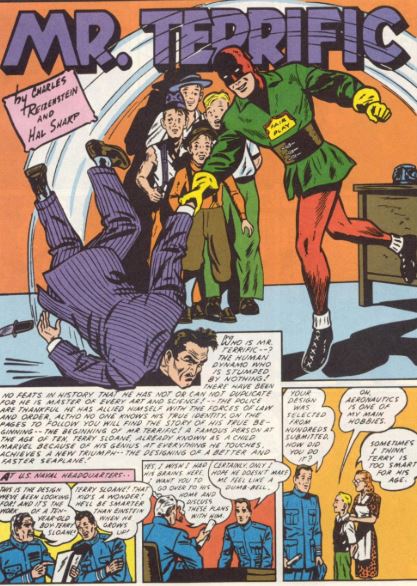
Crafted by Reizenstein & Hal Sharp, ‘Who is Mr. Terrific?’ introduced physical and mental prodigy Terry Sloane who so excelled at everything he touched, that by the time of the opening tale he was planning his own suicide to escape terminal boredom. Happily, on a very high bridge he found Wanda Wilson, a girl with the same idea. By saving her, Sloane found purpose: crushing the kinds of criminals who had driven her to such despair…
Actively seeking out villainy of every sort, he performs ‘The One-Man Benefit Show’ after thugs sabotage performers, travels to the republic of Santa Flora to expose ‘The Phony Presidente’ and helps a rookie cop pinch an “untouchable” gang boss in ‘Dapper Joe’s Comeuppance’. Sloan’s last showing here sees him at his very best, carefully rooting out political corruption and exposing ‘The Two Faces of Caspar Crunch’…
Closing out this stunning hardback extravaganza is another quintet from Sensation #1-5, this time by Bill Finger & Irwin Hasen: already established stars for their work on Batman and Green Lantern.
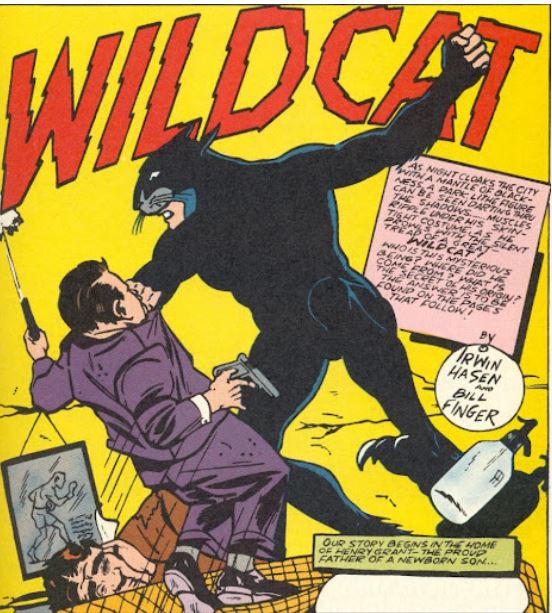
‘This is the Story of Wildcat’ premieres one the era’s most impressive lost treasures and a genuine comic book classic in the tale of Ted Grant: a boxer framed for the murder of his best friend. Inspired by a kid’s hero-worship of Green Lantern, Grant clears his name by donning a feline mask and costume and ferociously stalking the true killers. Finger & Hasen captured everything which made for perfect rollercoaster adventure in their explosive sports-informed yarns. Mystery, drama and action unfolded unabated in sequel ‘Who is Wildcat?’ as Ted retires his masked identity to compete for the vacant world boxing title, but cannot let innocents suffer as crime and corruption befoul the city. ‘The Case of the Phantom Killers’ sees Wildcat stalk mobsters seemingly striking from beyond the grave, before his adventures alter forever with the introduction of hard-hitting hillbilly hayseed ‘Stretch Skinner, Dee-teca-tif!’ He came to the big city to be a private eye and instead became Grant’s foil, manager and crimebusting partner. The capsule comic craziness then concludes for now with a rousing case of mistaken identity and old-fashioned framing, as Wildcat saves his new pal from a murdering gambler in ‘Chips Carder’s Big Fix’…
These eccentric early adventures might not suit some modern fans’ tastes but they stand as an impressive and joyous introduction to the fantastic worlds and exploits of the World’s oldest if not always greatest superheroes. If you have an interest in the way things were or just hanker for simpler times, less complicated and angsty fun, this may well be a book you’ll cherish forever…
© 1940, 1941, 1942, 2007 DC Comics, Inc. All Rights Reserved.
Also Today, in 1901 Roy Crane was born. His Wash Tubbs, Captain Easy and Buz Sawyer all shaped the way comics evolved and deserve your attention. In 1923 Belgian cartoonist Paul (Corentin) Cuvelier was born. You can celebrate the birthday of Marjane Satrapi who joined the world in 1969 by checking out Persepolis – The Story of a Childhood & Persepolis 2 – The Story of a Return or recall the wonders of C.C. Beck who died today in 1989 just by heading to The Shazam! Archives volume 1. Better yet, you could skip my blather and just read the actual books I’m plugging…