
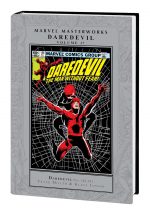
By Frank Miller, Roger McKenzie, Klaus Janson, Terry Austin & various (MARVEL)
ISBN: 978-1-3029-4925-9 (HB/Digital edition)
This book includes Discriminatory Content included for dramatic effect.
Matt Murdock is a lawyer obsessed with saving the innocent. Thanks to a childhood nuclear accident in his Hell’s Kitchen neighbourhood, he lost his sight but discovered his remaining senses were hyper-stimulated to a miraculous degree. This allowed him to become an astonishing acrobat, formidable fighter and living lie-detector. He also developed a kind of biological radar giving him complete awareness of his local environment.
Very much a second-string hero for most of his early years, Daredevil was nonetheless a striking and popular one, due in large part to the captivatingly humanistic art of Gene Colan. DD fought gangsters, super-villains and even the occasional monster or alien invasion (specifically the sight-stealing Queega). He quipped and wise-cracked his way through life and life-threatening combat, but under the auspices of Jim Shooter, Roger McKenzie and finally Frank Miller, the breezy hero morphed into a dark, moody avenger and grim, quasi-religious metaphor of justice and retribution…
This compilation – representing Daredevil #182-191 and spanning May 1982 to February 1983) – sees the Sightless Swashbuckler on top of the comics world as Miller & Klaus Janson continued to reinvent him through increasingly dark, bleakly nihilistic, Noir-stained thrillers, set in an increasingly mythological corner of Manhattan where the streets and towers became part of the tightly woven cast.
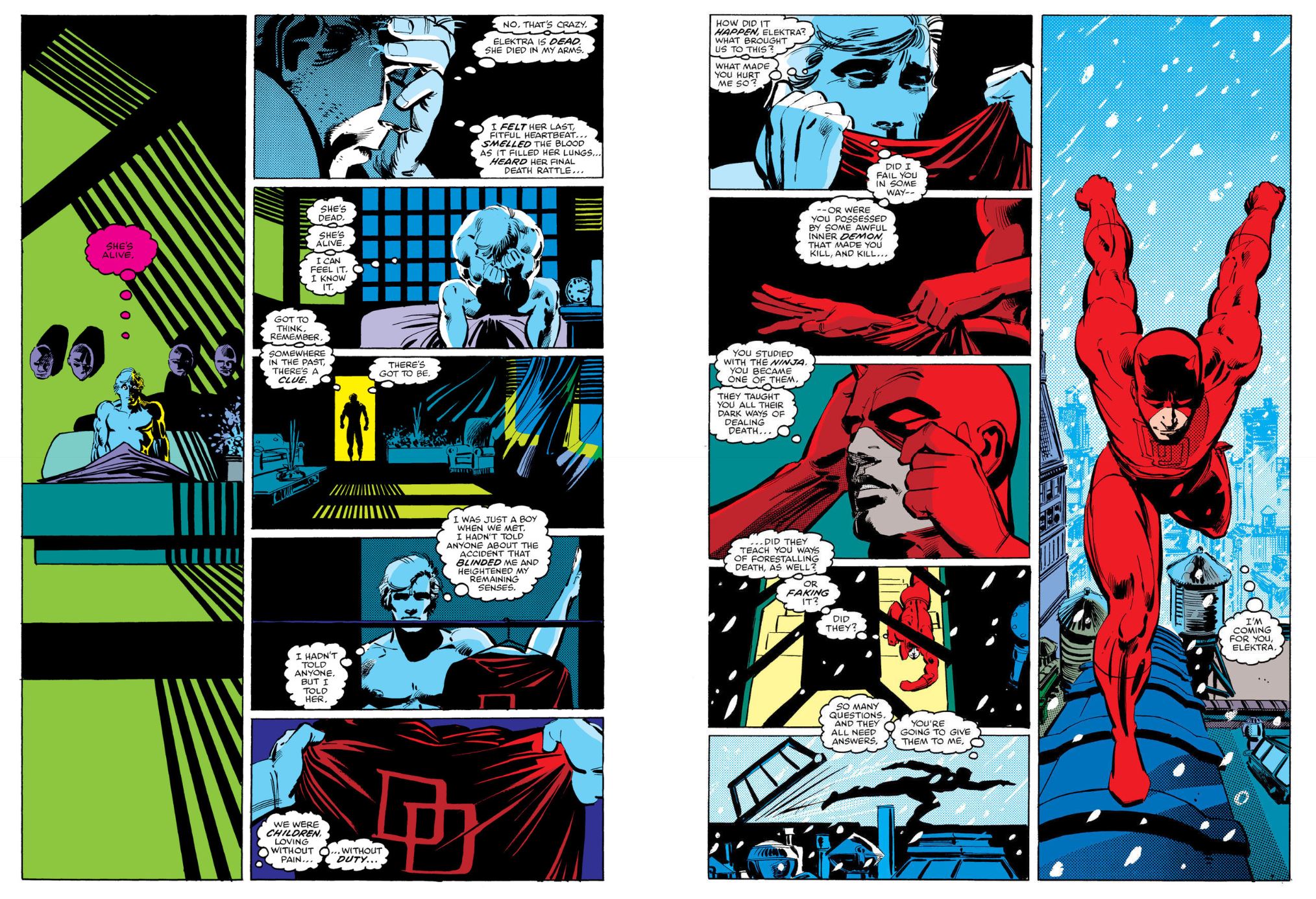
Following an Introduction from Ralph Macchio (with a matching one by Janson at the back, taken from 2001’s Daredevil Visionaries: Frank Miller vol. 3) the action opens with ‘She’s Alive’ as bereft, grieving Murdock seeks to prove his delirious belief that first love Elektra Natchios – recently murdered by Bullseye – is not in her grave. As the Devil rampages through Manhattan, at Ryker’s Island penitentiary, new inmate The Punisher is reducing prison overcrowding his way, until a spook with no official connection to law-enforcement offers a deal: liberty in exchange for certain services…
Frank Castle saw his family gunned down in Central Park after witnessing a mob hit. Dedicating his life to eradicating criminals everywhere, his methods are violent and permanent. It’s intriguing to note that unlike most heroes who debuted as villains (Wolverine, Hawkeye or Black Widow, for example), The Punisher actually became more immoral, anti-social and murderous, not less. It was the buying public that shifted a communal perspective; Castle never toned down or cleaned up his act, nor did his moral compass ever deviate…
Comics gossip goes that Marvel were reluctant to give Punisher a starring vehicle in their standard colour comic-book line, feeling the character’s very nature made him a bad guy and not a good one. Debuting as a deluded villain in Amazing Spider-Man #129 (February 1974), he was created by Gerry Conway, John Romita Sr. & Ross Andru, in response to popular prose anti-heroes such as Don Pendleton’s Mack Bolan: the Executioner and other returning Viet Nam vets who all turned their training and talents to take on organised crime.
Maybe that genre’s due for a revival as sandy GI boots hit US soil in the months to come?
The crazed crime-crusher had previously starred in Marvel Preview #2 (1975) and Marvel Super Action #1 (1976) but these were both monochrome magazines aimed at a far more mature audience. However, in the early 1980s, high profile guest shots in Captain America #241, Amazing Spider-Man Annual #15 and the extended epic here convinced the Powers-That-Be to finally risk a miniseries on the maniac vigilante…
As Murdock finally accepts Elektra is gone, ‘Child’s Play’ (#183) sees Castle clandestinely removed from prison to stop a shipment of drugs the authorities can’t touch. Of course, once he’s killed the Kingpin’s mobsters, Castle refuses to go back to jail. This story, concerning school students using drugs, was started by Roger McKenzie & Miller but shelved for a year due to heavy protests by the Comics Code Authority, before being reworked into a stunningly powerful and unsettling tale once Miller & Janson assumed the full creative chores on the title.
It begins as Murdock visits a High School and is a helpless witness to a little girl going berserk, attacking staff and pupils prior to throwing herself out of a third floor window. She was high on Angel Dust and after the appalled hero vows to track down the dealers he encounters her distraught younger brother Billy, determined to exact his own vengeance. The boy then encounters coldly calculating Castle who has the same idea, far more experience and no shred of mercy. The hunt leads Billy, Punisher – and late-coming DD – to a certain street pusher; and they all find their target at the same moment. After a spectacular clash thoroughly beaten Daredevil is left with only a bullet-ridden corpse with Billy holding a smoking gun…
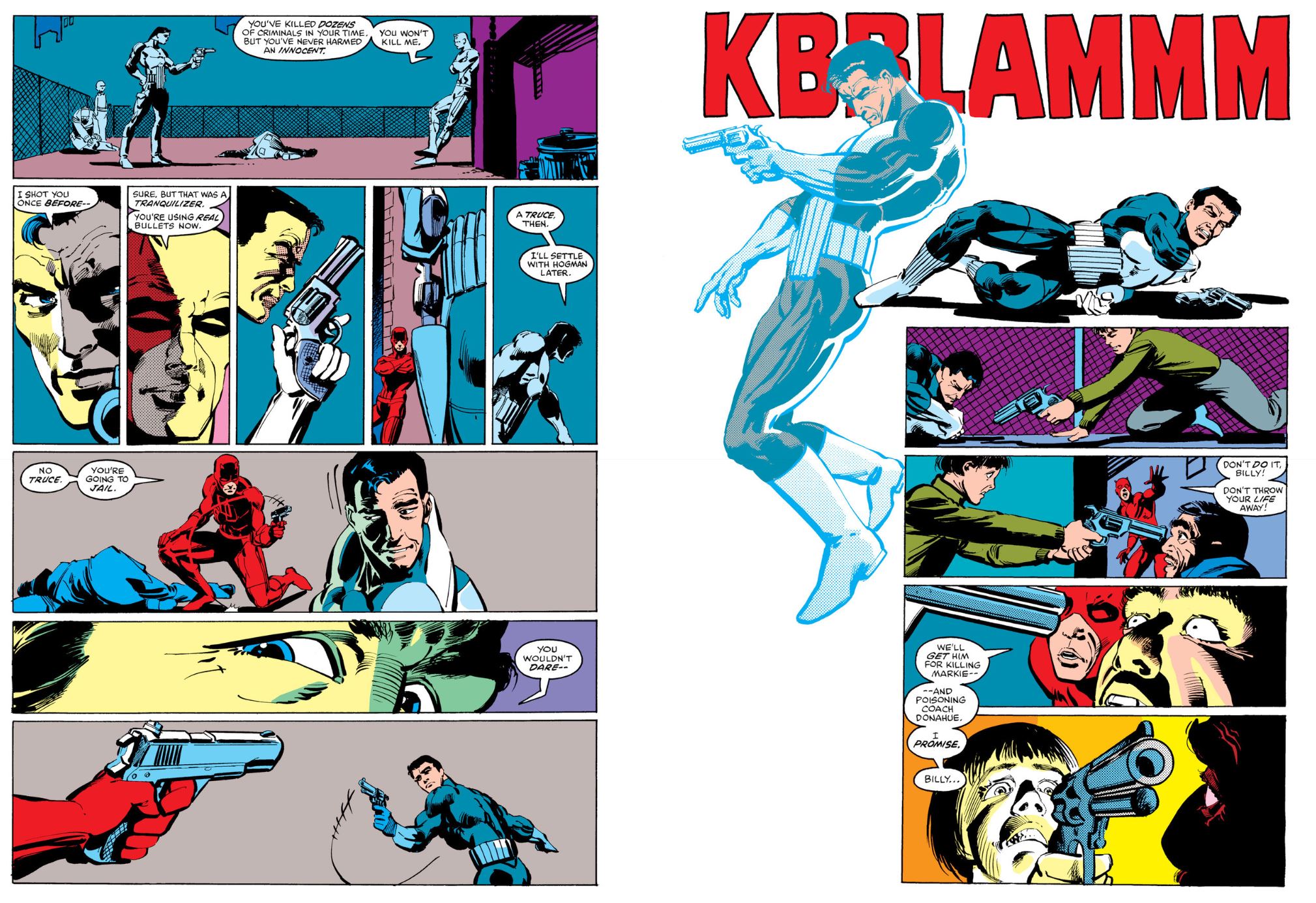
The kid is innocent – and so, this time at least, is Castle – and after Murdock proves it in court, the investigation resumes and focuses on the dead pusher’s boss Hogman. When DD’s super-hearing confirms the scumbag’s claims of innocence, alter ego Murdock successfully defends the vile dealer, only to have the exonerated slimeball gloatingly admit to committing the murder after all. Horrified, shocked, betrayed and determined to have justice, Daredevil eventually finds a connection to a highly-placed member of the school faculty deeply involved with Hogman…
Concluding chapter ‘Good Guys Wear Red’ sees that information come far too late. Castle and Billy have both decided to end the matter Hogman’s way…
Tough, disturbing, beautiful and chillingly plausible, this epic encounter redefined both sides of the heroic coin for decades to come and remains one of the most impressive stories in both character’s canons. It also sparked a wave of reprint mania as the burgeoning comic store explosion supported a wave of expensive archive-trawling reprint collections that publishers were delighted to release for collectors to eagerly scoop up.
Meanwhile back in bread-&-butter periodical publishing, Daredevil #185 hones in on Murdock’s wealthy fiancée Heather Glenn as she battles her own crooked – and potentially murderous – board of directors beside Matt’s best friend Foggy Nelson. When those struggles bring them into contention with the Kingpin, the old reliable DD is on hand to secretly save Heather and ‘Guts’ Nelson – although it does lead to the hero being again exposed to radioactive materials…
An archaic archenemy sort-of steps up in #186 as Stilt-Man is hired to remove Heather. Sadly, what the plotters get is second-rate substitution as ‘Stilts’ sees another sidebar cast member in over his head and utterly unable to deliver, especially after an oddly-off-kilter Man Without Fear joins the party…
DD #187’s ‘Overkill’ reveals how that second radiation bath has amped the Devil’s senses to an uncontrollable, intolerable degree, prompting a desperate hunt for old mentor Stick, just as old flame Natasha Romanoff is facing ninjas who evaporate when defeated. The hunt expands into magical oriental fantasy in #188 wherein ‘Widow’s Bite’ exposes her to mind-altering contamination just as Stick begins the slow laborious process that will rebalance Murdock. The old man is thus exposed as part of ancient warrior sect The Chaste, sworn to contest evil Ninja cult The Hand – sneaky invasive infiltrators with a nasty knack of resurrecting the dead, such as their lethal champion Kirigi – and who are planning something similar with dear departed Elektra…
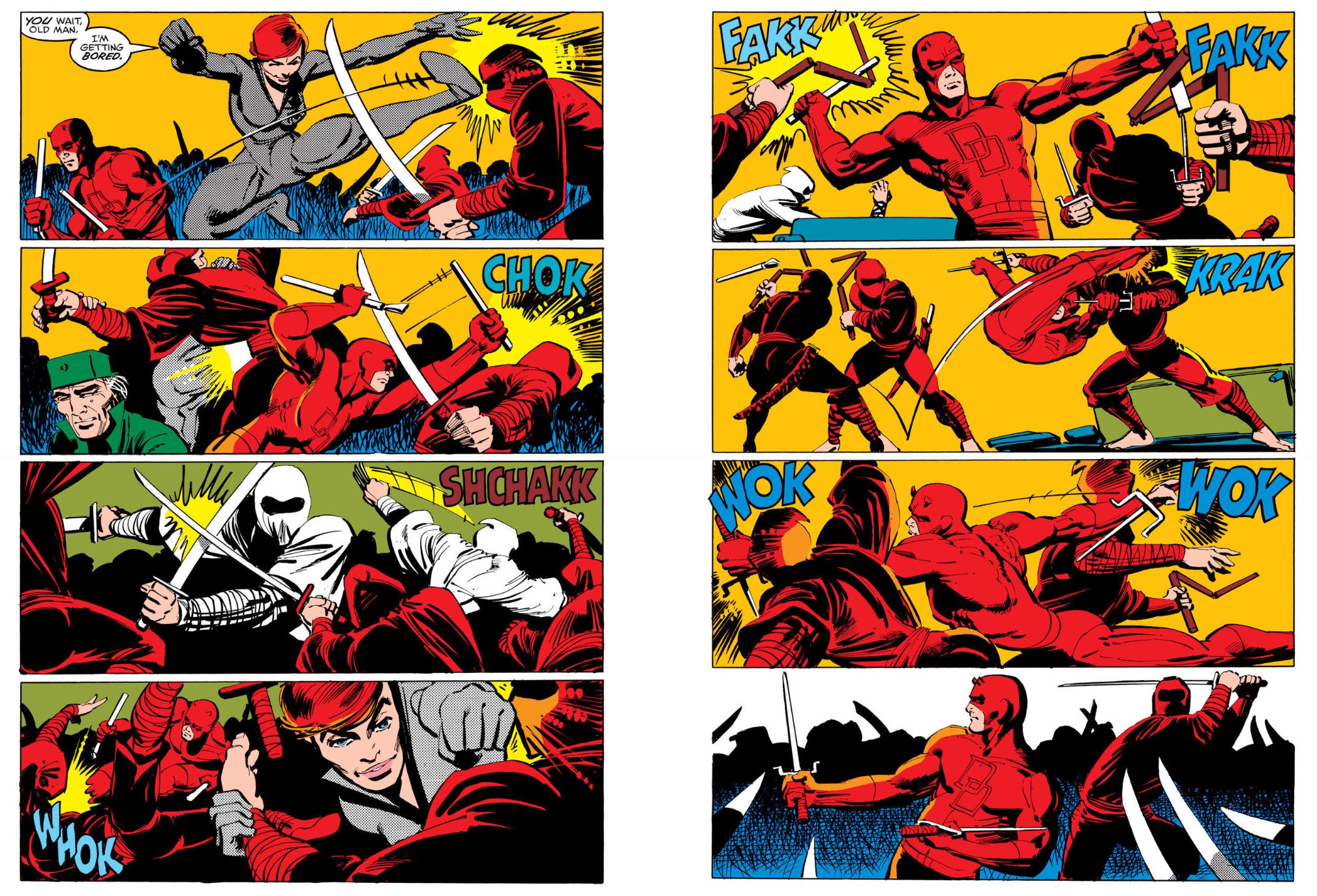
Thankfully in ‘Siege’, Murdock’s expedited cure allows him to join Stick (and Chaste allies Claw, Stone and Shaft) in a costly fightback to save the Black Widow before all the complex double-dealing is brought to light and (mostly) thwarted in #190’s epic climax. This exposes the missing years of Elektra, who – having impatiently abandoned study with The Chaste – joined The Hand in search of vengeance for her assassinated father. However, her death and ‘Resurrection’ costs all concerned far more than they can afford to lose (such as a unwise , far-reaching alliance with Kingpin) but leaves the reborn warrior woman ready for a fresh start…
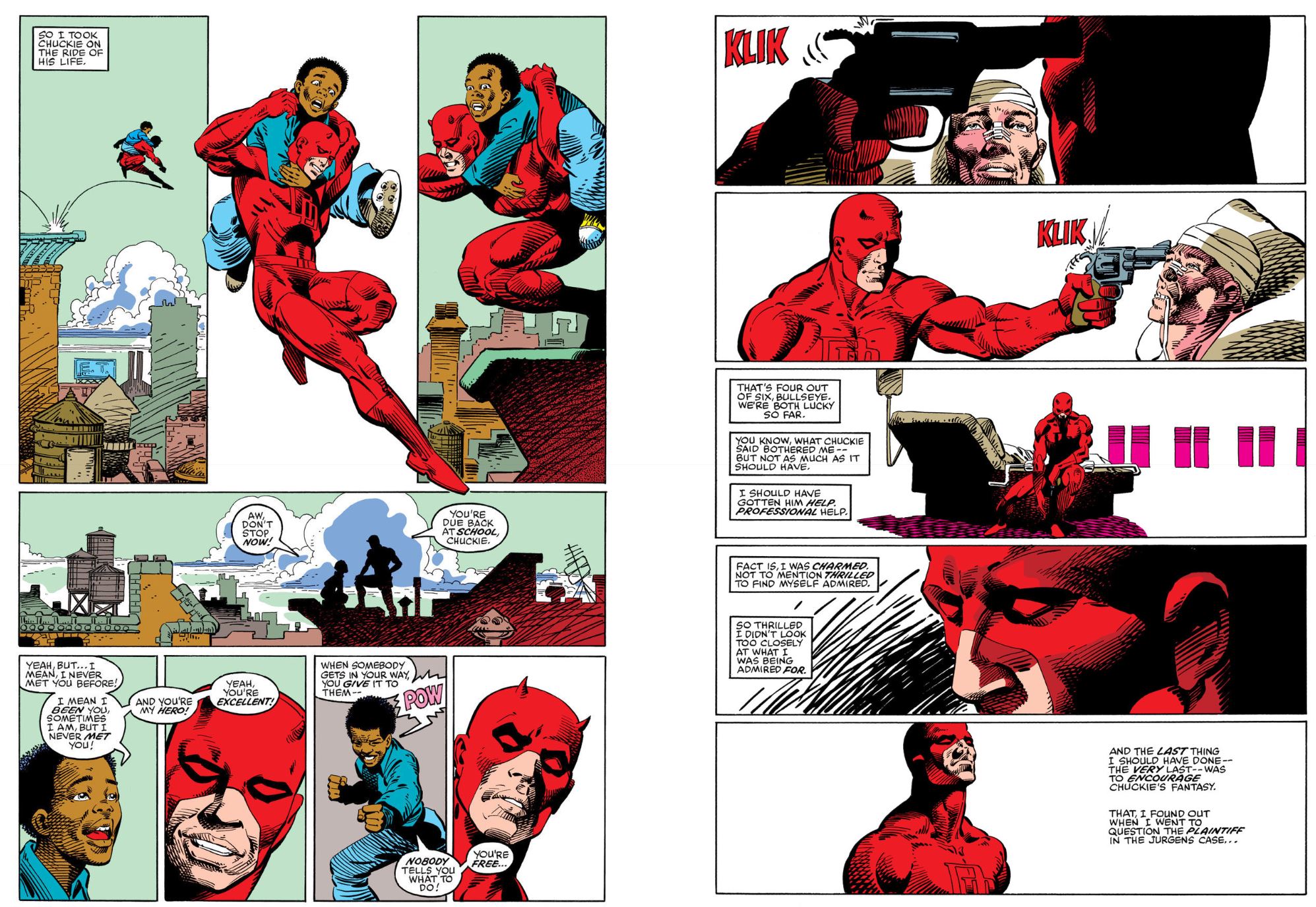
We close for now with the Terry Austin inked Daredevil #191, as a recent case involving innocent kids with crooked parents prompts the unpicking of painful childhood memories for Matt Murdock. These he assuages by visiting the bedside of paraplegic paralysed archfoe Bullseye for some therapeutic psychological torture and a little game of Russian ‘Roulette’ …
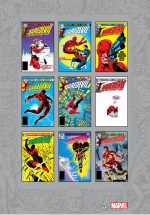
A truly monumental bonus section kicks off with Mark Gruenwald-produced pages from The Official Handbook of The Marvel Universe (1983), and info-briefings of Daredevil; his Apartment and Billy Club; Angar the Screamer; The Ani-Men; Black Widow and her Sting/Line; Bullseye; Death-Stalker; Elektra; Kingpin, Frog-Man; Jester; Man-Bull, Mauler; Mister Fear, The Owl; Paladin; The Plunderer; Punisher; Purple Man; Queega; Silver Samurai; Stilt-Man (with schematics of his Battle-Suit) and Torpedo, backed up by dozens of unused/Comics Code rejected pages by Miller, Janson & Austin and published original art, followed by the layouts, breakdowns and colour guides for DD #190.
Also included are covers and editorial page of reprint Spider-Man and Daredevil Special Edition #1 (March 1984) and pertinent Elektra Saga material from Marvel Age #10 which precedes all of the modified, reformatted and new art from partial reprint series The Elektra Saga #1-4 (1984), as well as its wraparound covers, pinups, frontispieces, biographies and introductions by Mike W. Barr, Jo Duffy & Dennis O’Neil.
The covers of Elektra Magazine #1 & 2 from November & December 1996 by Claudio Castellini are followed by ‘Marvel Press Poster #14’ by Miller & Janson and ‘Daredevil and the Punisher: Child’s Play (1988)’ cover by Geof Darrow and the book provides editorial pages including Forewords by Macchio & Mike Baron; illustrated biographies of Miller & Janson plus Anne Nocenti’s ‘Afterword’ .The bounty concludes with the covers of ‘The Punisher vs. Daredevil #1’ (June 2000) and ‘Marvel Age #127’ (August 1993) by Miller & George Roussos – which became ‘Marvel Press Poster #152’ when painted over by Paul Mounts. Also seen are Miller & Steve Buccellato’s cover to ‘Daredevil Visionaries: Frank Miller vol. 3’ and its ‘Elektra frontispiece by Miller’…
This is pure compulsive comics magic that you must see – before… or even after… you die!
© 2023 MARVEL.
Today in 1926 we all greeted future writer/cartoonist William Overgard (Steve Roper and Mike Nomad, Rudy), jobbing artist/sought after inker Sal Trapani (Nukla, Airboy Comics, Metamorpho) in 1927; Dutch comics artist Martin Lodewijk (Agent 327, Minimum Bug) in 1939 and cartoonist Bill Plympton (Plympton) in 1946.
In 1958 Blondie artist Denis Lebrun came along as did Nat Gertler in 1965. However we lost irreplaceable, nigh-metafictional Belgian star Jean De Mesmaeker – AKA Jidéhem (Sophie, Starter, Ginger, Uhu-man, Spirou et Fantasio, Gaston Lagaffe) in 2017.