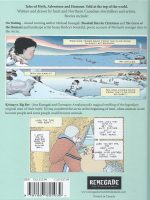

Arctic Comics


By Nicholas Burns, Jose Kusugak, Michael Kusugak, Germaine Arnaktauyok, George Freeman, Susan Shirley & various (Renegade Arts Entertainment)
ISBN: 978-1-98782-503-9

According to the Introduction by project instigator Nicholas Burns, this edition of Arctic Comics has been a long time coming. Springing out of his 1986 prototype comics anthology – created for the World Exposition of that year – the work here was originally intended for its 1992 sequel. Thanks to life and an astounding number of other worthy and worthwhile endeavours, that book now materialises as this superb oversized full-colour hardback album.

It certainly hasn’t suffered for the wait…

Offering a clutch of tales by creators from the far north – most of them of Inuit heritage – this Arctic Comics is a magnificent melange of mirth, murder, mythology, merriment and adventure that feels authentically hale, hearty and welcoming: gathering yarns and entertainments from a land and culture which values the power of stories…

Setting the ball rolling is a smart silent-gag strip starring Sheldon the Sled Dog who endures his own frustrating ‘Hunger Games’ courtesy of Burns before revered author, advocate, scholar and cultural proponent Jose Kusugak unites with noted Inuit printmaker Germaine Arnaktauyok to share their retelling of an Inuit creation myth when ‘Kiviuq meets Big Bee’.

Long ago in the time when men and animals were one, both could change shape and one could never be sure what you were dealing with. Kiviuq was the first man and one day he became circumstantially embroiled in the death of an able man and good provider. The dead man’s grandmother Angakkuq held Kiviuq and all the other village men equally responsible and used her magic to punish them all, luring them out to sea on a seal hunt and smashing them with a storm…

Kiviuq knew many things and survived the assault but it took many years to find his home again. Moreover, every landfall was fraught with peril such as this encounter with the eyelid-stealing woman known as Iguptarjuaq or Big Bee…

That mythological Arctic odyssey is followed by ‘On Waiting’: a poetic paean to childhood at the top of the world from author Michael Kusugak (Baseball Bats for Christmas, The Shaman) and celebrated landscape artist Susan Thurston Shirley. A moving celebration of a childhood packed with everyday delights – hunting, warm clothes, playing soccer under the illumination of the Northern Lights – is coloured with simple acceptance and edged with the pain of early loss…

Sled Dog Sheldon hilariously pops back on a snowy night – aren’t they all? – looking for ‘Any Port in a Storm’, after which Burns displays his pictorial versatility to detail romantic entanglements and sporting pride at war in ‘The Great Softball Massacre’.

Originally entitled ‘The Great Slo-Pitch Massacre’ this mini soap-opera is splendidly reminiscent of cult comedy movie classic Men with Brooms: a tale of young love gone wrong during a municipal slo-pitch tournament between deadly rivals.

In case you’re wondering, slo-pitch is like Softball or Rounders – except in the ways it differs – and is championed by beer leagues and other manful aggregations of inebriates across North America too far gone to indulge in the rigours and dangers of a real sport. It’s not Life and Death: it’s far more serious that that….

Slipping back into his Ligne Clair-informed Hergé style, Burns then introduces RCMP sleuth Constable Puqittuq and her Loyal Sled Dog Vincent in ‘Film Nord’ where the canny Inuk investigator uncovers skulduggery on a tundra movie location. Clearly shot through with weirdoes and probable perps, the long list of suspects dwindles and before long the sagacious peacekeeper discovers the victim’s death is the result of a most uncanny act…

Wrapping up the excitement is a dark and sinister eco-thriller by Burns and Winnipeg-based comicbook veteran George Freeman (Captain Canuck, Batman, Jack of Hearts, Elric: Weird of the White Wolf). ‘Blizzard House: a Future Arctic Adventure’ finds a couple of horny teenagers trapped in a prototype passive-energy wonder-house of tomorrow, even as a murderous energy baron attempts to sabotage and destroy the looming threat to his corporate cash cow…

Enthralling, astounding and beguilingly exotic, this collection of comics treasures offers tantalisingly different visions and voices that will appeal to every funnybook fan who thinks they’ve already seen everything under the sun…
Arctic Comics, the stories, characters, world and designs are copyright their respective writers and artists. This edition © Renegade Arts Canmore Ltd. 2016.

This book is available in English, Inuktitut and French editions.

Spirou & Fantasio volume 10: Virus


By Tome & Janry, translated by Jerome Saincantin (Cinebook)
ISBN: 978-1-84918-297-3

Spirou (which translates as both “squirrel” and “mischievous” in the Walloon language) was created by French cartoonist François Robert Velter under his nom-de-plume Rob-Vel. The inspirational invention at the request of Belgian publisher Éditions Dupuis in direct response to the phenomenal success of Hergé’s Tintin for competing outfit Casterman.

Not long after, soon-to-be legendary weekly comic Spirou launched (on April 21st 1938) with Rob-Vel’s red-headed rascal as the lead of the anthology which bears his name to this day.

The eponymous star was originally a plucky bellboy/lift operator employed by the Moustique Hotel (a wry reference to the publisher’s premier periodical Le Moustique) whose improbable adventures with pet squirrel Spip gradually grew into high-flying, far-reaching and surreal action-comedy dramas.

Spirou and his chums have spearheaded the magazine for most of its life, with a phalanx of truly impressive creators carrying on Velter’s work, beginning with his wife Blanche “Davine” Dumoulin who took over the strip when her husband enlisted in 1939. She was assisted by Belgian artist Luc Lafnet until 1943 when Dupuis purchased all rights to the property, after which comic-strip prodigy Joseph Gillain (“Jijé”) took the helm.

In 1946 Jijé’s assistant André Franquin assumed the creative reins, gradually sidelining the long-established brief, complete gag-vignettes in favour of epic adventure serials, introducing a wide and engaging cast of regulars and eventually creating phenomenally popular magic animal the Marsupilami to the mix.

Franquin continued crafting increasingly fantastic Spirou sagas until his abrupt resignation in 1969 and his tenure is remembered for the wealth of weird and wonderful players and villains he added to the cast. As well as comrade, rival and co-star Fantasio and perennial exotic arch-enemies such as Zorglub and Fantasio’s unsavoury cousin Zantafio, a particular useful favourite was crackpot inventor and modern-day Merlin of mushroom mechanics Pacôme Hégésippe Adélard Ladislas, the Count of Champignac (and sly tribute to an immortal be-whiskered druid dubbed Getafix…)

Franquin was succeeded by Jean-Claude Fournier who updated the feature over the course of nine stirring yarns tapping into the rebellious, relevant zeitgeist of the times: tales of environmental concern, nuclear energy, drug cartels and repressive regimes.

However, by the 1980s the series was looking a tad outdated and directionless. Three different creative teams then alternated on the feature, until it was at last revitalised by Philippe Vandevelde – writing as Tome – and artist Jean-Richard Geurts AKA Janry, who adapted, referenced and in all the best ways returned to the beloved Franquin era.

Their sterling efforts began with the tale under review here and quickly revived the floundering feature’s fortunes. They contributed thirteen more wonderful albums to the canon between 1984 and 1998, and allowed the venerable strip to diversify into parallel strands (Spirou’s Childhood/Little Spirou and guest-creator specials A Spirou Story By…).

Tome & Janry were followed on the core feature by Jean-David Morvan & José-Luis Munuera, and in 2010 Yoann & Vehlmann took over the never-ending procession of astounding escapades…

Cinebook have been publishing Spirou & Fantasio‘s exploits since 2009, alternating between Tome & Janry’s superb reinterpretations of Franquin and earlier triumphs by the great man himself. This tenth release is officially the cartoon crimebusters’ 33rd collected caper.

Originally serialised in Spirou #2305-2321 in 1982 and subsequently released as an album in 1984, this epic episode begins as a shady figure cases an icebreaker just back from the Antarctic. For some reason the HK Glacier has been placed in stringent quarantine and the observer – soon revealed as enquiring reporter Fantasio – discovers why as he trips over a very sick-looking mariner sneaking off the vessel.

It is old enemy and unscrupulous pirate John Helena – AKA “the Moray” – and he has been infected with a highly contagious disease…

In fact, it’s so virulent anyone in close proximity suffers from allergic attacks, even without contracting the primary sickness…

Knowing he’s on to something big, Fantasio rings partner-in-peril Spirou and has his comrade bring down a van to sneak Helena through the cordon of armed government troops. Safely ensconced in a chapel, the Moray tells them of Isola Red, a top-secret lab in the polar wastes where scientists are working with thousands of different viruses and exactly how he got infected with one of them. He completes his tale of woe by demanding that they take him to Count Champignac – the only man alive who can save him… and the world…

The fungal phenomenon is naturally up to the task but his proposed remedy is both complex and risky and involves the dauntless duo infiltrating Isola Red to use the cached toxins there as part of the cure. What the valiant adventurers don’t know is that the chateau is already under covert observation by a thoroughly shady-looking third-party…

Moreover and meanwhile, in a prestigious government building the mastermind behind everything is dispatching his own clean-up team to make the growing problem go away entirely…

Soon Spirou and Fantasio – with the rapidly declining Helena in tow in a hazmat suit – are touching down at Russian base Mirnov-Skaya. Spip is with them but also has to wear an isolation outfit since the vindictive little tyke couldn’t resist taking a bit of the Moray…

The camp is the last official outpost of civilisation and its gregarious commander Captain Sergeiev is delighted to offer every assistance to reach the secret base somewhere deep in the icy interior. After all, the polar explorer is an old friend of the well-travelled inventor Count Champignac…

After a few embarrassing moments of hilarity, the heroes set off as an official rescue party in borrowed snow-cats, with the camp doctor Placebov, hulking guide/driver Nadia Tovarich and even Sergeiev’s action-loving pet seal Vasily along for the ride. The desperate first-responders are sadly unaware that their unknown adversary’s money has bought a traitor who now rides along with them…

Things seem completely hopeless when the mastermind’s clean-up squad explosively ambush the convoy but the killers too are in the dark: they have been followed by yet another interested party…

Although the assassins are soon driven off, it seems they have done enough: the partial cure Spirou was carrying is wrecked and Helena’s suit is breached. They are all now probably exposed to the virus’s full effects…

Back in Europe, Champignac has been making some waves and his efforts, combined with certain journalistic endeavours, have brought low the hidden mastermind and a government official running a clandestine biological weapons plant at the bottom of the world. With the news still breaking, the Count, a military taskforce and a horde of reporters all set off for Antarctica…

In the meantime the doomed heroes have pushed on to Isola Red, in a hopeless attempt to find some miracle cure. What they encounter is truly shocking but does point the way to a solution to all their problems.

Unless of course, the freshly-reinforced mercenary clean-up squad kills them all first…

Blending rambunctious slapstick, riotous chases and gallons of gags with thrills, spills and – wait for it – chills; this is a terrific tale packed with laughs and superb action, deftly wielding a potently satirical anti-war, anti-capitalist message.

Fast-paced and exuberant, Virus is a joyous yet suspenseful romp happily accessible to readers of all ages and drawn with beguiling style and seductively wholesome élan. Catch it if you can…
Original edition © Dupuis, 1984 by Tome & Janry. All rights reserved. English translation 2016 © Cinebook Ltd.

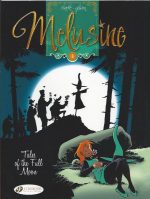
Melusine volume 5: Tales of the Full Moon


By Clarke & Gilson, coloured by Cerise; translated by Jerome Saincantin (Cinebook)
ISBN: 978-1-84918-212-6

Witches – especially cute, sassy and/or teenaged ones – have a splendidly long pedigree in all branches of fiction, and one of the most seductively engaging first appeared in venerable Belgian comics-magazine Spirou in 1992.

Mélusine is actually a sprightly 119-year-old neophyte sorceress diligently studying to perfect her craft at Witches’ School. To make ends meet she spends her off-duty moments days working as au pair and general dogsbody to a most shockingly disreputable family of haunts and horrors inhabiting and infesting a vast, monster-packed, ghost-afflicted chateau at some chronologically adrift, anachronistically awry time in the Middle-ish Ages…

Episodes of the long-running, much-loved feature are presented in every format from one-page gag strips to full-length comedy tales; all riffing wickedly on supernatural themes and detailing Mélusine’s rather fraught existence. Our magic maid’s life is filled with the daily indignities of skivvying, studying, catering to the appalling and outrageous domestic demands of the master and mistress of the castle and – far too occasionally – schmoozing with a large and ever-growing circle of exceedingly peculiar family and friends.

The strip was devised by writer François Gilson (Rebecca, Cactus Club, Garage Isidore) and cartoon humorist Frédéric Seron, AKA Clarke whose numerous features for all-ages Spirou and acerbic adult humour publication Fluide Glacial include Rebecca, Les Cambrioleurs, Durant les Travaux, l’Exposition Continue… and Le Miracle de la Vie.

Under the pseudonym Valda, Seron also created Les Babysitters and as “Bluttwurst” Les Enquêtes de l’Inspecteur Archibaldo Massicotti, Château Montrachet, Mister President and P.38 et Bas Nylo.

A former fashion illustrator and nephew of comics veteran Pierre Seron, Clarke is one of those insufferable guys who just draws non-stop and is unremittingly funny. He also doubles up as a creator of historical and genre pieces such as Cosa Nostra, Les Histoires de France, Luna Almaden and Nocturnes. He has obviously been cursed by some sorceress and can no longer enjoy the surcease of sleep…

Collected Mélusine editions began appearing annually or better from 1995 onwards, with the 24th published in 2015 and another due this year. Thus far five of those have shape-shifted into English translations…

Originally released in October 2002, Contes de la pleine lune was Continentally the tenth groovy grimoire of mystic mirth and is again most welcoming: primarily comprised of single and 2-page gags starring the sassy sorceress which delightfully eschew continuity for the sake of new readers’ instant approbation…

When brittle, moody, over-stressed Melusine isn’t being bullied for her inept cleaning skills by the matriarchal ghost-duchess who runs the castle, ducking cat-eating monster Winston, dodging frisky vampire The Count or avoiding the unwelcome and often hostile attentions of horny peasants and over-zealous witch-hunting priests, our saucy sorceress can usually be found practising her spells or consoling and coaching inept, un-improvable and lethally unskilled classmate Cancrelune.

Unlike Mel, this sorry enchantress-in-training is a real basket case: her transformation spells go awfully awry, she can’t remember incantations and her broomstick-riding makes her a menace to herself, any unfortunate observers and even the terrain and buildings around her…

As the translated title of this (fifth) Cinebook offering suggests, Tales of the Full Moon dwells on demolishing fairy fables and bedevilling bedtime stories but also gives a proper introduction to Mel’s best friend Krapella: a rowdy, roistering, mischievous and disruptive classmate who is the very image of what boys want in a “bad” witch…

This tantalising tome is filled with narrative nostrums featuring the usual melange of slick sight gags and pun-ishing pranks; highlighting how our legerdemainic lass finds a little heart’s ease by picturing how one day she’ll have her very own Prince Charming.

Sadly, every dream ends – usually because there’s a mess that needs cleaning up – but Melusine absolutely draws the line when Cancrelune and even her own sweetness-&-light Fairy cousin Melisande start hijacking her daydreams…

This fusillade of fanciful forays concludes with eponymously titled, extended episode Tales of the Full Moon wherein Melusine is ordered to read a bedtime story to the Count’s cousin’s son: an obnoxiously rambunctious junior vampire named Globule who insists on twisting her lovely lines about princesses and princes into something warped and Gothic… and that’s before Cancrelune starts chipping in with her own weird, wild suggestions and interjections …

Wacky, wry, sly, infinitely inventive and uproariously funny, this compendium of arcane antics is a terrific taste of European comics wonderment: a beguiling delight for all lovers of the cartoonist’s art. Read well before bedtime – or you’ll be up laughing all night …
Original edition © Dupuis, 2002 by Clarke & Gilson. All rights reserved. English translation 2014 © Cinebook Ltd.

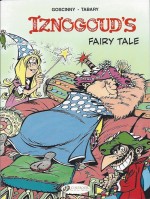
Iznogoud’s Fairy Tale


By Goscinny & Tabary, translated by Jerome Saincantin (Cinebook)
ISBN: 978-1-84918-260-7

For the greater part of his far-too-short lifetime René Goscinny (1926-1977) was one of the world’s most prolific and widely-read writers of comic strips.

He still is.

Amongst his most popular and enduring comic collaborations are Lucky Luke, Le Petit Nicolas, Signor Spaghetti and, of course, Asterix the Gaul, but there were so many others, such as the despicably dark deeds of a dastardly usurper whose dreams of diabolical domination perpetually proved to be ultimately no more than castles in the sand…

In the rueful aftermath of the Suez crisis, the French returned – by way of comics, at least – to the hotly contested Arabian deserts as Goscinny teamed with hugely gifted Swedish émigré Jean Tabary (1930-2011) – who numbered Richard et Charlie, Grabadu et Gabaliouchtou, Totoche, Corinne et Jeannot and Valentin le Vagabond amongst his other hit strips – to deliriously detail the innocuous history of imbecilic Arabian (im)potentate Haroun el-Poussah.

However, as is so often the case, it was the strip’s villainous foil – power-hungry vizier Iznogoud – who stole the show… possibly the conniving little blackguard’s only successful coup.

The first kernel of inspiration came as a piece of background shtick in early 1960s kids’ cartoon book Les Vacances du Petit Nicholas (which we all saw as Nicholas on Holiday). A fuller formation and development came with Les Aventures du Calife Haroun el Poussah, created for Record: debuting in the January 15th issue of 1962.

A petite hit, the feature subsequently jumped ship to Pilote – a new comic created and edited by Goscinny – where it was artfully refashioned into a starring vehicle for the unpleasant little upstart who had been hogging all the laughs and limelight.

The Vile Vizier went from strength to strength. According to the brief introduction in this volume, the unwieldy catchphrase “I want to be Caliph instead of the Caliph!” quickly became part of casual French idiom and, in October 1974, the wee rascal won his own socio-political commentary column in newspaper Journal du Dimanche.

Insidious Iznogoud is Grand Vizier to Haroun Al Plassid, the affable, easy-going Caliph of Ancient Baghdad, but the sneaky little second-in-command has loftier ambitions, or as he is always declaiming “I want to be…”

The retooled rapscallion resurfaced in Pilote in 1968, quickly becoming a massive hit, resulting in 29 albums to date (17 by dream team Goscinny & Tabary), his own solo comic, a computer game, animated film, TV cartoon show and even a live-action movie.

Like all great storytelling, Iznogoud works on two levels: for youngsters it’s a comedic romp with adorably wicked baddies invariably hoisted on their own petards and coming a-cropper, whilst older, wiser heads can revel in pun-filled, witty satires and superbly surreal antics.

Following Goscinny’s death in 1977, Tabary began scripting tales, switching to book-length complete adventures rather than the short, snappy vignettes which typified his collaborations. Upon his own passing, Tabary’s children Stéphane, Muriel and Nicolas took over the franchise.

The deliciously malicious whimsy is resplendent in its manic absurdity, cleverly contemporary cultural critiques, brilliantly delivered creative anachronisms and fourth-wall busting outrages which serve to keep the assorted escapades bizarrely fresh and hilariously inventive.

Le conte de fée d’Iznogoud (Iznogoud’s Fairy Tale) was originally released in 1976; wracking up an even dozen deliciously daft album compilations, and proffering a potent remarkable quartet of trend-setting tales with our ambitious autocrat as ever scheming to seize power from his good but gullible Lord and Master.

Following the aforementioned Introduction and a preface page reintroducing our constant cast, the merry madness kicks off with ‘Fairy Tale’ as extremely inept Fairy Godmother Blunderbell – in search of an impoverished princess to assist – lands instead in the truculent toad’s lap.

Once she’s convinced him that even if her spells don’t go exactly to plan, the recipient of her magic experiences astounding transformations, it’s not long before she’s gulled into making him the Caliph instead of the Caliph.

…At least that was the plan: have we mentioned that Blunderbell’s not the most accurate spell-caster in the world?

Mystic mayhem also abounds in ‘Mirror Image’ as, on the eve of the ten-yearly vote to reaffirm the Caliph as supreme ruler, Iznogoud is accosted by Al Hiss the Genie from the other side of his looking glass. The fantastic land is completely the same as but exactly reversed from home, and Iznogoud’s shenanigans actually succeed in fixing this election. However although the little schemer actually ousts the Caliph, he has forgotten one crucial factor…

Newly arrive tradesman Tremolo has a strong line in enchanted furnishings. After an astonishingly annoying bout of window shopping the Vizier and his foolish flunky Wa’at Alahf take possession of a fearsomely final divan of despatch dubbed ‘The Send-Away Bed’…

Whoever lies in it vanishes forever, but thanks to visiting dignitaries and the world’s worst case of coffee-nerves, the machinations needed to get the normally sleep-loving Caliph to try it out are doomed to failure… as is Iznogoud…

All the rules and much of the internal logic are thrown away for the closing, epic length saga of ‘The Magic Minarets’ as the strips disgruntled fans rise up in revolt, demanding a proper resolution to the Vizier’s schemes.

What they actually get is a madcap metaphysical odyssey as Iznogoud is sucked into a fantastic realm where he must competitively quest for ten wizardly ideals whilst his moral fibre is tested. The prize for success is the granting of his greatest desire…

However, even after cheating his way to victory, fate has a way of upsetting his game…

Such convoluted witty, fast-paced hi-jinks and craftily crafted comedy set pieces have made this addictive series a household name in France where “Iznogoud” is also common parlance for a certain kind of politician: over-ambitious, unscrupulous – and frequently insufficient in inches (or should that be centimetres?).

Desiring to become “Caliph in the Caliph’s place” is a popular condemnation in French, targeting those perceived as overly-ambitious, and, since 1992 the Prix Iznogoud is awarded annually to “a personality who failed to take the Caliph’s place”.

Nominees are chosen from prominent French figures who have endured spectacular defeats in any one year and been given to the likes of Édouard Balladur (1995) and Nicolas Sarkozy (1999). The jury panel is headed by politician André Santini, who gave himself one after failing to become president of Île-de-France in regional elections in 2004.

When first released in Britain during the late 1970s and 1980s (and latterly in 1996 as a periodical comicbook) these tales made little impression on British audiences, but at last this wonderfully beguiling strip has deservedly found an appreciative audience among today’s more internationally aware, politically jaded comics-and-cartoon savvy connoisseurs…
Original edition © 2012 IMAV éditions by Goscinny & Tabary. All rights reserved. English translation © 2015 Cinebook Ltd.

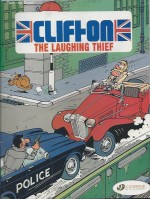
Clifton volume 2: The Laughing Thief


By De Groot & Turk, translated by Luke Spear (Cinebook)
ISBN: 978-1-905460-07-4

For some inexplicable reason most of Europe’s comics cognoscenti – most especially the French and Belgians – seem fascinated with us Brits. Maybe it’s our shared heritage of Empires lost and cultures in transition? An earlier age would have claimed it’s simply a case of “Know your Enemy”…

Whether we look at Anglo air ace Biggles, indomitable adventurers Blake and Mortimer, the Machiavellian machinations of Green Manor or even the further travails of Long John Silver, the serried stalwarts of our Scepter’d Isles cut a dashing swathe through the pages of the Continent’s assorted magazines and albums.

And then there’s Clifton…

Originally devised by child-friendly strip genius Raymond Macherot (Chaminou, Les croquillards, Chlorophylle, Sibylline) for iconic Tintin Magazine, the doughty True Brit troubleshooter first appeared in December 1959. After three albums worth of material – compiled and released between 1959 and 1960 – Macherot left Tintin for arch-rival Spirou and his eccentric comedy crime-fighter sadly floundered until Tintin brought him back at the height of the Swinging London scene, courtesy of Jo-El Azaza & Greg (Michel Régnier).

These strips were subsequently collected as Les lutins diaboliques in French and De duivelse dwergen for Dutch-speakers in 1969.

Then it was back into retirement until the early 1970s when writer Bob De Groot and illustrator Philippe “Turk” Liegeois revived Clifton for the long haul, producing ten tales of which this – Le voleur qui rit – Clifton from 1973 – was their second collaboration.

Thereafter, from 1984 on, artist Bernard Dumont – AKA Bédu – limned De Groot’s scripts before eventually assuming the writing chores as well, until the series ended in 1995. In keeping with its rather haphazard nature and typically undying nature, the Clifton experience resumed once again in 2003, crafted by De Groot and Michel Rodrigue in four further adventures; a grand total of 25 to date.

The setup is deliciously simple: pompous and irascible Colonel Sir Harold Wilberforce Clifton, ex-RAF, former Metropolitan police Constabulary and recently retired from MI5, has a great deal of difficulty dealing with being put out to pasture in rural Puddington. He thus takes every opportunity to get back in the saddle, occasionally assisting the Government or needy individuals as an amateur sleuth.

Sadly for Clifton – as with that other much-underappreciated national treasure Captain Mainwaring in Dad’s Army – he is too keenly aware that he is usually the only truly competent man in a world full of blithering idiots…

In this second translated album – first seen in 2005 – the Gentleman Detective is embroiled in not one but two uncanny incidences, beginning with eponymous epic ‘The Laughing Thief’ wherein the still much-missed lawman rather forcefully inserts himself into a current case baffling Scotland Yard.

London is being wracked by devilishly clever crimes executed with infallible precision by a crack crew of blaggers, but the profits of each caper seem far below what such expert criminals should be bothering with. Moreover, each perfectly executed heist is preceded by a telephone warning from a braying braggart with the most annoying and distinctive laugh imaginable…

The crooks are incredibly bold and arrogant. Even after Clifton intervenes in the second robbery, the scoundrels easily outwit him, leave the dapper sleuth unconscious with dozens of other peculiarly proud and strangely supportive victims…

Moreover, although police “higher-ups” welcome Clifton’s help, officer-in-charge Lieutenant Hardfeeling doesn’t want the show-stealer around and is doing all he can to impede the Colonel’s investigations, despite the protests of his senior colleagues and the bobbies on the beat…

Nevertheless, persistence is its own reward, and when Clifton finally deduces the true reasons for the publicity-seeking crime-spree the resultant confrontation is both spectacularly satisfying and hilariously rewarding…

Being British and an ex-spy, Clifton has hung on to the odd gadget or two, such as an amazingly tricked out umbrella which plays a major part in this volume’s second tale ‘The Mystery of the Running Voice’. A suspenseful spooky yarn, it begins when the unhappy retiree meets old comrade Donald McDonald Muckyduck, who appears to have worn out every vestige of verve and is on the verge of a nervous breakdown…

Close consultation reveals that the former police Inspector is being haunted by a robber ghost; one that has already claimed six victims. However upon viewing the crime scene photos Clifton gains an inkling into how the trick is done and temporarily moves to bucolic village Flatfish-on-Apron, setting himself up as bait for a diabolical genius with a penchant for clever gimmicks…

Visually spoofing Swinging Sixties London and staidly stuffy English Manners with wicked effect, these gentle thrillers are big on laughs but also pack a lot of consequence-free action into their eclectic mix. Delightfully surreal, instantly accessible and doused with daft slapstick à la Jacques Tati and intrigue like Margaret Rutherford as Miss Marple, this brace of romps rattle along in the grand old tradition of Will Hay, Terry-Thomas and Alistair Sim – or Wallace and Gromit if you’re a callow yoof – offering readers a splendid treat and loads of timeless laughs.
Original edition © 1973 Le Lombard (Dargaud-Lombard S. A.) 1988 by De Groot & Turk. English translation © 2005 Cinebook Ltd.

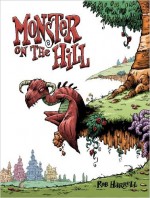
Monster on the Hill


By Rob Harrell (Top Shelf Productions)
ISBN: 978-1-60309-075-9

Once upon a time in England – but not our England – decent, hardworking folk went about their lives in every county-town, their hearts swollen with well-earned civic pride. Content and progressive Victorians one and all, they congratulated themselves upon their achievements and most especially upon the terrifying merits of their local monsters.

By the year of Our Lord 1867 each minor metropolis had for simply ages been twinned with a ferocious giant creature who would occasionally rampage through the municipality, wrecking shops, houses and public works; thereby doing wonders for the local building professions and tourist trade.

Thriving communities would vie with each other for the distinction of being most periodically and ritually terrorised by their assigned Brobdingnagian beast, with the most fearsome of the creatures even being celebrated with local souvenirs and their images engraved on collectible cigarette cards and albums…

Not so the poor, benighted citizens of Stoker-on-Avon. Their monster was something of a disappointment. In fact he was a bit rubbish…

One morning, soon after a properly petrified family returned from a truly frightful encounter with Tentaculor in neighbouring conurbation Billingwood, plucky ragamuffin, town-crier and newsboy Timothy is peddling his papers. The headline is very similar to many previous ones, declaring that it has been 536 days since their monster last appeared…

Thus he’s on hand to overhear firsthand that disgraced mad scientist Dr. Charles Nathaniel Wilkie has been summoned to meet the town fathers. They have bravely offered to reinstate his license and even let him back into his laboratory – despite past embarrassments and misdemeanours – if he can cure, pep up or somehow put some vim back into their monster…

After struggling up the so-very-steep hill from which the formerly ferocious force of nature surveys his neglected domain, the baffled physician discovers his gimcracks and implements have been jettisoned by the stowed-away Timothy, but that’s not really important. Nothing he has bought or built could possibly have helped the colossal winged-but-flightless non-terror known as Rayburn.

The scourge of Stoker-on-Avon is depressed and doesn’t want to perform. He’s lost all confidence and believes he is a failure…

And thus begins a deliciously funny romp – with a generous plenitude of surreal diversions and divertissements – following the classic lines of a coming-of-age road-trip buddy-movie redemption scenario, as the unlikely human team find a perilously peripatetic way to restore Rayburn’s Mojo, which involves getting too close to another town’s terror, humiliating lessons in stomping, smashing and smooshing and the horrifying, shocking and not at all funny revelation of why every town actually has its own monster…

Crafted with verve and supreme slapstick deftness by strip cartoonist Rob Harrell (Big Top, Life of Zarf) this wondrous cartoon fable is joy for fun and fantasy lovers of every stripe and vintage.
Monster on the Hill ™ & © 2013 Rob Harrell. All Rights Reserved.

Small Press Sunday

I started out in this game when marks on paper were considered Cutting Edge, making minicomics, collaborating on fanzines and concocting stripzines with fellow weirdoes, outcasts and comics addicts. Even today, seeing the raw stuff of creativity in hand-crafted paper pamphlets still gets me going in ways that threatens my tired old heart…

With that in mind here’s a selection of tantalising treats that have landed in my review tray recently…

I’ve been collecting comics for more than fifty years now and my biggest regret is that for all the magnificent things I’ve read and enjoyed, only a pitifully fraction of the superb Alternative/Small Press/Self Published stuff I’ve seen has ever been collected in the online or graphic novel boom of this century.

I don’t know how to fix that problem – maybe a communal site where old stuff can be posted for readers to enjoy – but that means finding shy, lost or embarrassed creators and securing permissions and, most distressingly, so many of the creative folk I loved most are dead, vanished or cured now…

I’m not going to let such great material pass un-eulogized though, so whenever I feel like it I’m going to review something ancient, handmade and wonderful, and if the paper gods permit, perhaps you’ll find copies lurking in back-issue bins (do they still exist?) or at conventions or maybe the forgotten ones will re-emerge to take their long-deserved bows.

I’m going to start with a glorious prototype graphic novel compilation far ahead of its time, solely because creator Bob Lynch has already preserved it – and all of his other work – online. Skip my babblings and go right to his site if you wish.

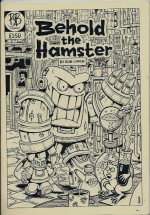
Behold the Hamster

By Bob Lynch (Bob Comics)
No ISBN:

Most British comics devotees first noticed the self-effacing Bob Lynch through his contributions to the wonderfully eclectic self-publishing phenomenon Fast Fiction. From 1981 through 1990 Paul Gravett, Phil Elliott and Ed Pinsent’s Little Creative Co-operative That Could made conventions, comic-marts and monthly meetings of the Society of Strip Illustrators and Comics Creators Guild distractingly fun and bemusingly intoxicating with hand-crafted magazines of tiny print-runs yet immeasurably vast and broad comics entertainment.

Bob’s work first featured in the middle teens of the run (my memory is even more worn out than I am) and Behold the Hamster ran in #19, 20 and 22 – amongst other Bob bits such as Sav Sadness and rhymic slug Samantha – before being collected by your man himself in the book under discussion here and The Whirlpool of Disaster and Sadness in Space.

Lynch’s artwork is deceptively simple and astoundingly stylish, with puckish characterisations rendered in strong, bold black lines (sheer self-defence in an era where paper printing plates and public photocopiers were the acme of affordable reproduction technology for most of us). He was – hopefully still is – also one of the most surreal and simultaneously inviting story-men in the business; incorporating shared cultural icons from all vistas of the TV-watching, pub-going, comics-reading UK public into whacky whimsies and gently barbed observations on the human condition. You know: all the usual stuff…

This little A-5 64-page pamphlet has brightened my day on many occasions since I bought it in 1991, with its mad mash-up of time-travel, Frankensteinian science, detective mystery, true love and daft humour starring a star-crossed hamster named Behold who was brought back from beyond the grave to achieve an incredible destiny and save something or other…

Don’t take my word for it: check out –
https://www.flickr.com/photos/8424687@N08/sets/72157618049179283/

If I’ve piqued your interest you can catch a different flavour of Bob’s fantastic life at http://savsadness.blogspot.co.uk/

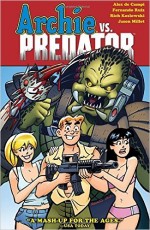
Archie vs. Predator


By Alex de Campi, Fernando Ruiz, Rich Koslowski, Jason Millet & various (Dark Horse Books)
ISBN: 978-1-61655-805-5

For nearly three-quarters of a century Archie Andrews has epitomised good, safe, wholesome fun, but inside the staid and stable company which shepherds his adventures there has always hidden an ingenious and deviously subversive element of mischief.

Family-friendly iterations of superheroes, spooky chills, sci-fi thrills and genre yarns have always been as much a part of the publisher’s varied portfolio as the romantic comedy capers of America’s cleanest-cut teens since they launched as MLJ publications in the Golden Age’s dawning.

As you probably know by now, Archie has been around since 1941, spending most of those seven-plus decades chasing both the gloriously attainable Betty Cooper and wildly out-of-his-league debutante Veronica Lodge whilst best friend Jughead Jones alternately mocked and abetted his romantic endeavours and rival Reggie Mantle sought to scuttle his every move…

As crafted over the decades by a legion of writers and artists who’ve skilfully logged innumerable stories of teenage antics in and around the idyllic, utopian small-town Riverdale, these timeless tales of decent, upstanding, fun-loving kids have captivated successive generations of readers and entertained millions worldwide.

To keep all that accumulated attention riveted, the company has always looked to modern trends with which to expand upon their archetypal brief. In times past they have strengthened and cross-fertilised their stable of stars through a variety of team-ups such as Archie Meets the Punisher, Archie Meets Glee, Archie Meets Vampirella and Archie Meets Kiss, whilst every type of fashion-fad and youth-culture sensation have invariably been accommodated into and explored within the pages of the regular titles.

That willingness to dip traditional toes in unlikely waters led in 2015 to the publishers taking a bold and potentially controversial step which paid huge dividends and created another monster sales sensation…

The genesis of this most unlikely cross-fertilisation of franchises is explained in great detail and with a tremendous sense of “how did we get away with it?” in Roberto Aguirre Sacasa’s ‘Introduction’, but just in case you’re new to the other participant in all this…

Predators are an ancient alien species of trophy-taking sporting types who have visited the hotter parts of Earth for centuries, if not millennia. They are lone hunters who can turn invisible and resort to a terrifying selection of nasty weapons. They particularly like collecting skulls and spinal columns…

Predator was first seen in the eponymous movie from 1987 and started appearing in comic book extensions and continuations published by Dark Horse with the 4-issue miniseries Predator: Concrete Jungle (June 1989 to March 1990). It was followed by 22 further self-contained outings and numerous crossover clashes ranging from Batman and Superman to Judge Dredd and Tarzan, steadily keeping the franchise alive and kicking whilst the movie iteration waxed and waned…

This spectacularly eccentric yarn pulls off the peculiar and miraculous trick of creating a hilarious and scary family-friendly teen-slasher flick which begins ‘When You Wish Upon a Star’ as all the young cast regulars head to Costa Rica for Spring Break and are having the time of their lives, until Betty and Veronica have a particularly vicious spat over Archie which leads to a spooky confrontation and a curse uttered over what might be an actual voodoo dagger.

Science-whiz Dilton is occupied with his telescope watching and everybody is blissfully unaware that they’ve piqued the attention of something patient, invisible and completely alien…

When they all head home they have no conception that some of their number are already trophies on a wall…

With the youngsters back in Riverdale Archie and his companions settle back into their routine but soon realise that something has followed them when a beloved adult is decapitated in plain sight. Soon the community is cut off and they are all waiting ‘To Live and Die in a Small Town’…

Convinced their meddling with the occult has brought on the killing-spree, Betty and Veronica testily consult sorcerous expert Sabrina (the Teenage Witch) but that ends in another welter of scarlet and screaming and the first sighting of the thing from the stars…

Thing get grim and crazy as the rapidly depleting posse of teens meet the Government agents tasked with covertly countering the Predators but continue to fall until Dilton rolls out the weird science and Archie dons a ‘Full Metal Varsity Jacket’…

Soon the beloved cast is down to the barest essentials and the last few resistors face their final curtain in ‘Guess Who’s Coming to Dinner’…

After a surprisingly gripping and gory conclusion that will astonish and delight everyone an ‘Afterword’ by series Editor Brendan Wright gives more insight into the impetus and creative process behind this inspired tale, but there are still plenty of treats in store.

Scripter Alexi de Campi also got to play with others creators’ toys in a series of Bonus Crossovers, which rounded out the comics issues. Here follow quirky, perky little one and two page vignettes such as the eerily satisfying ‘Sabrina Meets Hellboy’ with art and colours by Robert Hack, lettered by Clem Robins, and the fabulously bizarre ‘Li’l Archie and his Pals meet Itty Bitty Mask’ by Art Baltazar.

Philosophical and physical depths are plumbed as ‘Jughead meets Mind MGMT’ (Matt Kindt) and the girls have fun when ‘Josie and the Pussycats meet Finder’ illustrated by Carla Speed McNeil, with colours from Jenn Manley Lee and letters from the ubiquitous de Campi.

By all accounts, when news of this project got out an army of eager professionals clamoured to get involved. The miniseries offered a wealth of covers-&-variants – some scattered about and acting as chapter-breaks by Ruiz, Koslowski, Millet, Dan, Parent, Gisèle, Maria Victoria Robado and Andrew Pepoy. The rest are gathered in a massive Variant Cover Gallery displaying varying degrees of gore, whimsy and humour from Eric Powell, Francesco Francavilla, Colleen Coover, Darick Robertson with Millet, Pepoy with Millet, Dennis Calero, Patrick Spaziante, Robert Hack with Stephen Downer, Dustin Nguyen, Kelley Jones with Michelle Madsen, Paul Pope with Shay Plummer, Faith Erin Hicks with Cris Peter, Joe Quinones, Tim Seeley, Richard P. Clark, Ruiz with Anwar Hanano, Koslowski as full illustrator and even more.

Also on view are samples of ‘Promo Art’ prepared for the comics convention circuit and a large section of Ruiz’s developmental ‘Character Studies’ plus a feature on the ‘Art Process’ from rough pencils through to finished colour pages.

But wait, there’s still more as ‘Unused Covers’ offers eight final tantalising ideas which never made it off the drawing boards of Ruiz, Pepoy, Gisèle and Faith Erin Hicks.

This book is one of those “Pitch hooks” Hollywood producer types thrive by. All you need is the three word title and a graphic acronym to know whether you’ll love this yarn.

Archie Versus Predator….

AVP.

Another Victorious Pairing.

Astounding.
Visual.
Perfection.

Archie vs. Predator © 2015 Archie Comic Publications, Inc. and Twentieth Century Fox Film Corporation. Archie™ and © 2015 Archie Comic Publications, Inc. Predator™ and © 2015 Twentieth Century Fox Film Corporation. All guest material ™ and © 2015 its creators or copyright holders. All rights reserved.

The Rugger Boys volume 2: A Snootful of Style and a Ton of Class!


By Béka & Poupard with colour work by Magali Poli Rivière, translated by Luke Spear (Cinebook)
ISBN: 978-1-905460-44-1

Human beings – and apparently a huge variety of our pets and animal housemates – seem obsessed with and revel in chasing balls about. So much so that we/they even apply a range of complex rules to the sheer exhilaration of the process, just to make things more difficult and artificially extend proceedings.

We call it sport and when it’s not hugely thrilling and deadly serious it can be hilariously funny…

Comics over the decades and throughout the world have often mined our obsession with assorted games for secondary entertainment value and this Cinebook compilation proffers more stunning strips starring a dedicated amateur team of French gladiators all painfully enamoured of the manly (and British-originated, let’s not forget) oddball-based pastime called Rugby…

Les Rugbymen was created in 2005 by writing partnership Bertrand Escaich & Caroline Roque under their collaborative nom de plume Béka (Studio Danse, Les Fonctionnaires) in conjunction with self-taught illustrator Alexandre Mermin, who generally labours under the pseudonym Poupard (Chez Gaspard, Les Brumes du Miroboland).

The resulting flurry of short sharp gags and extra-time yarns have filled an even dozen albums thus far. There’s even a junior league spin-off which began in 2010 entitled Les Petits Rugbymen…

On va gagner avec le lard et la manière was the fifth Continental encounter but the second (and, thus far, last) translated by Cinebook – probably because it features brief sporting excursions to Scotland and New Zealand – and perfectly recapitulates the passion, toil and sheer testosterone-fuelled idiocy which can warp normally rational folk.

The titular stars are some few dedicated souls faithfully enjoying the trials of club rugby (Union rules, right?) as played by the stalwarts of fictional south-western French side Paillar Athletic Club, affectionately known to their frankly obsessive fans as The PAC…

As seen on the introductory page, our bloody but unbowed stars manifest as intellectually compromised Hooker Lightbulb, Herculean Prop Fatneck, precocious ¾ Centre Hugo “The Engineer” Cap, 2nd Row star Freddy “The Anaesthetist” Bones, dashing sex-crazed Back Romeo and Scrumhalf/Captain The Grumpster, all regularly adored and vilified by Bernard Farmer – The Coach – who never lets his barrrrbarous accent get in the way of a good insult or pithy instruction to the dozy slackerrrs…

All you need to know is that these guys are bold, sturdy and love to eat and drink as much as they do trampling each other into the mud every weekend…

The exploits are generally delivered as single page sequences, lavishly, lovingly and outrageously illustrated and jam-packed with snippets of off-kilter slapstick to supplement the main gag and the material. Content is almost everything you’d expect from such a fixture: big beefy blokes in very small towels, lots of booze-fuelled gaffes, eating eccentricities, knob jokes and the mutual sportsmanlike skulduggery which permeates all games Real Men compete in…

This time however equality reigns and there’s a succinct glimpse of the Paillar Athletic Ladies Team too, and you can share the lads’ first turbulent TV appearance too.

Mostly, however, on display is a profusion of smartly-planned running gags and compact comedic gems such as the well-meaning meatheads’ ongoing efforts to help Lightbulb find “love”, Romeo’s constant comeuppances from husbands, boyfriends and employers unhappy with his off-pitch Tries, the woebegone touchline medic’s miserable life and Coach’s eternal battle to whip his band of idiots into a team he can be proud of…

This particular collection kicks off with an extended origin story revealing how the playful imps they once were turned a boring school lesson into a life-changing indoor match and formed sporting bonds that lasted a lifetime…

As previously mentioned, this fixture also includes a brief tour of Scotland, offering a broad belt of new experiences from braw brews to fine foods and bonnie lassies to life-changing injuries, and concludes with a bombastic whistle-stop tour of the Antipodes as The Pac are generously invited to visit the mighty New Zealand All-Blacks at home after the Rugby World Cup concludes…

Mostly though it’s always about mud, mauling, getting stuffed and getting smashed – in every sense of the term…

Fast, furiously funny and splendidly boisterous, these are the kind of cartoon antics that might even inspire dedicated couch-potatoes to get out of the house – unless they order books and dinner online…
© BAMBOO EDITION, 2007 by Béka & Poupard. All rights reserved. English translation © 2007 Cinebook Ltd.

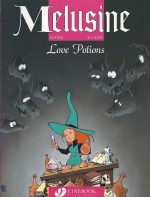
Melusine volume 4: Love Potions


By Clarke (Frédéric Seron) & Gilson, coloured by Cerise and translated by Jerome Saincantin (Cinebook)
ISBN: 978-1-84918-005-4

Like most things in life, this ideal keepsake for Love’s Labours’ Ludicrously Lost comes far too late to be the perfect St. Valentine’s Day recommendation, but let’s face it: if you want to read a comic rather than romance a paramour – imagined, potential or otherwise – there’s little hope for you anyway…

And Dark Gods forbid if you think buying one for him/her/it/they counts as a Romantic Gesture. You deserve everything you get…

Witches – especially cute and sassy teenage ones – have a long and distinguished pedigree in fiction and one of the most seductively engaging first appeared in venerable Belgian magazine Spirou in 1992.

Mélusine is actually a sprightly 119-year-old diligently studying to perfect her craft at Witches’ School. To make ends meet she spends her days – and far too many nights – working as au pair and general dogsbody to a most disgraceful family of haunts and horrors who inhabit/infest a vast, monster-packed, ghost-afflicted chateau some chronologically adrift, anachronistically awry time in the Middle-ish Ages…

The long-lived, much-loved feature is presented in every format from one-page gag strips to full-length comedy tales, all riffing wickedly on supernatural themes and detailing Mélusine’s rather fraught existence is filled with the daily indignities day-job, college studies, the appallingly trivial domestic demands of the master and mistress of the castle and even our magic maid’s large circle of exceedingly peculiar family and friends.

The strip was devised by writer François Gilson (Rebecca, Cactus Club, Garage Isidore) and cartoon humorist Frédéric Seron, AKA Clarke whose numerous features for all-ages Spirou and acerbic adult humour publication Fluide Glacial include Rebecca, Les Cambrioleurs, Durant les Travaux, l’Exposition Continue… and Le Miracle de la Vie.

Under the pseudonym Valda, Seron also created Les Babysitters and as Bluttwurst Les Enquêtes de l’Inspecteur Archibaldo Massicotti, Château Montrachet, Mister President and P.38 et Bas Nylo.

A former fashion illustrator and nephew of comics veteran Pierre Seron, Clarke is one of those insufferable guys who just draws non-stop and is unremittingly funny. He also doubles up as a creator of historical and genre pieces such as Cosa Nostra, Les Histoires de France, Luna Almaden and Nocturnes and apparently is free of the curse of having to sleep…

Collected Mélusine editions began appearing annually or better from 1995 onwards, with the 24th published in 2015 and another due this year. Thus far five of those have shape-shifted into English translations…

Originally released in 1998, Philtres d’amour was Continentally the fifth fantabulous folio of mystic Mélusine mirth and is again most welcoming: primarily comprised of one and two page gags starring the sassy sorceress which delightfully eschew continuity for the sake of new readers’ instant approbation…

As the translated title of this (fourth) Cinebook offering suggests, Love Potions devotes the majority of its content to affairs of the heart – and lower regions – and how to alchemically stack the deck in the game of romance….

When brittle, moody Melusine isn’t being bullied for her inept cleaning skills by the matriarchal ghost-duchess who runs the castle, ducking cat-eating monster Winston, dodging frisky vampire The Count or avoiding the unwelcome and often hostile attentions of horny peasants and over-zealous witch-hunting priests, our saucy sorceress can usually be found practising her spells or consoling and coaching inept, un-improvable and lethally unskilled classmate Cancrelune.

Unlike Mel, this sorry enchantress-in-training is a real basket case: her transformation spells go awfully awry, she can’t remember incantations and her broomstick-riding makes her a menace to herself, any unfortunate observers and even the terrain and buildings around her…

This tantalising tome features the usual melange of slick sight gags and pun-ishing pranks; highlighting how every bug, beast, brute and blundering mortal suffers the pangs of longing and occasionally needs a little Covenly charisma to kick romance into action…

Whether that means changing looks, attitudes or minds already firmly made up, poor harassed student Mel is bombarded with requests to give Eros a hand…

Her admittedly impatiently administered and often rather tetchy aid is pretty hit-or-miss, whether working for peasants, rabbits, tortoises or even other witches, and helping poor Cancrelune is an endless, thankless and frequently risky venture.

Moreover the master and mistress of the castle have obviously never had an ounce of romance in them, even when they were alive…

At least daunting dowager Aunt Adrezelle‘s is always around to supply the novice with advice, a wrinkly shoulder to cry on and, when necessary, a few real remedies…

This turbulent tome also includes a longer jocular jaunt exploring the dull verities of housework, anti-aging elixirs and the selfish ingratitude of property-speculators…

Wrapping up the thaumaturgical hearts-&-flowers is eponymous extended epic ‘Love Potions’ which sees Melusine’s patience pushed to the limits after another attempt by the local priest to “burn the witch” ends up with her helping the locale’s latest scourging saurian marauder find the dragon of his fiery dreams…

Wry, sly, fast-paced and uproariously funny, this compendium of arcane antics is a great taste of the magic of European comics and a beguiling delight for all lovers of the cartoonist’s art. Read before bedtime and share with your loved ones – but only after asking politely first…
Original edition © Dupuis, 1998 by Clarke & Gilson. All rights reserved. English translation 2009 © Cinebook Ltd.