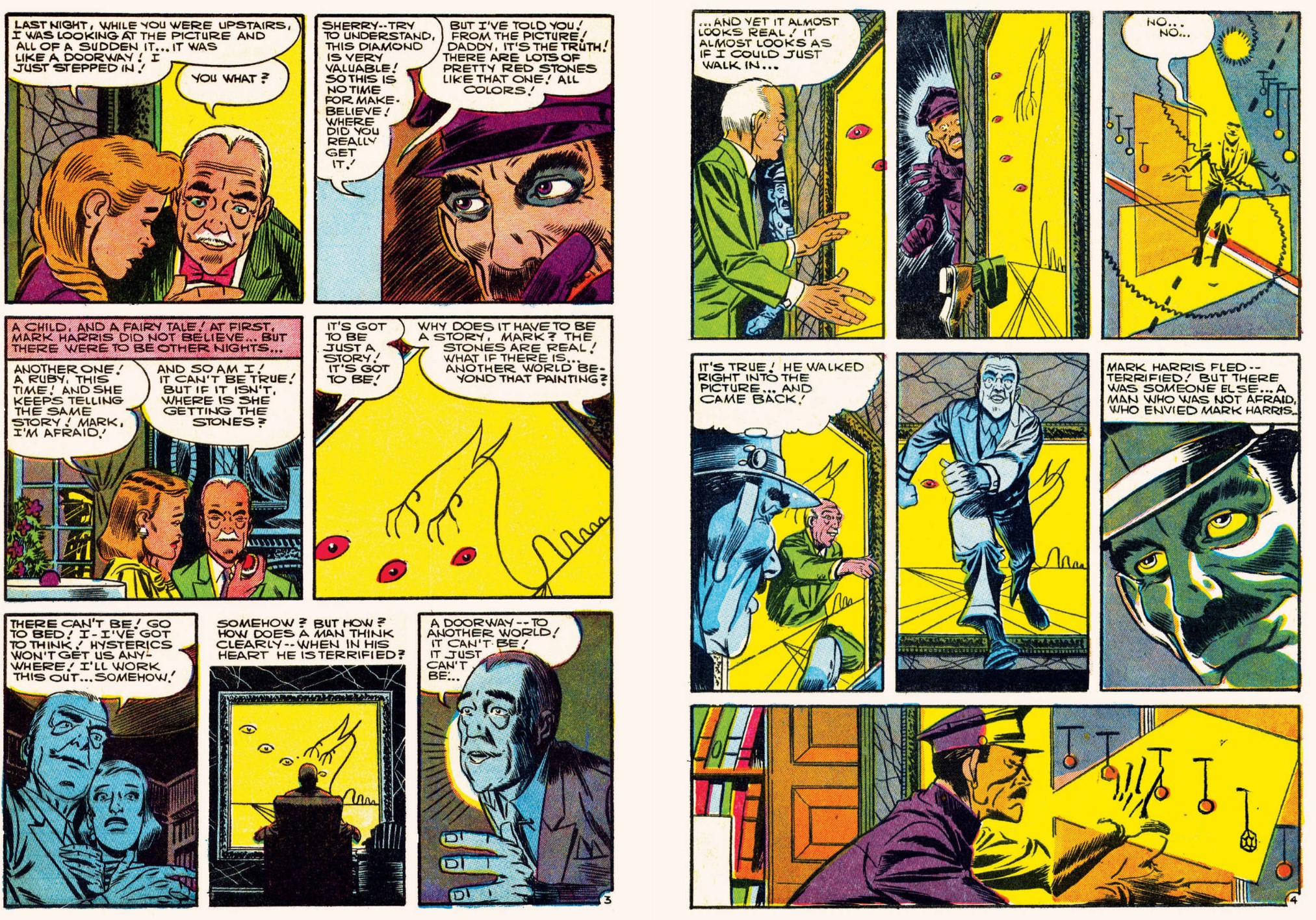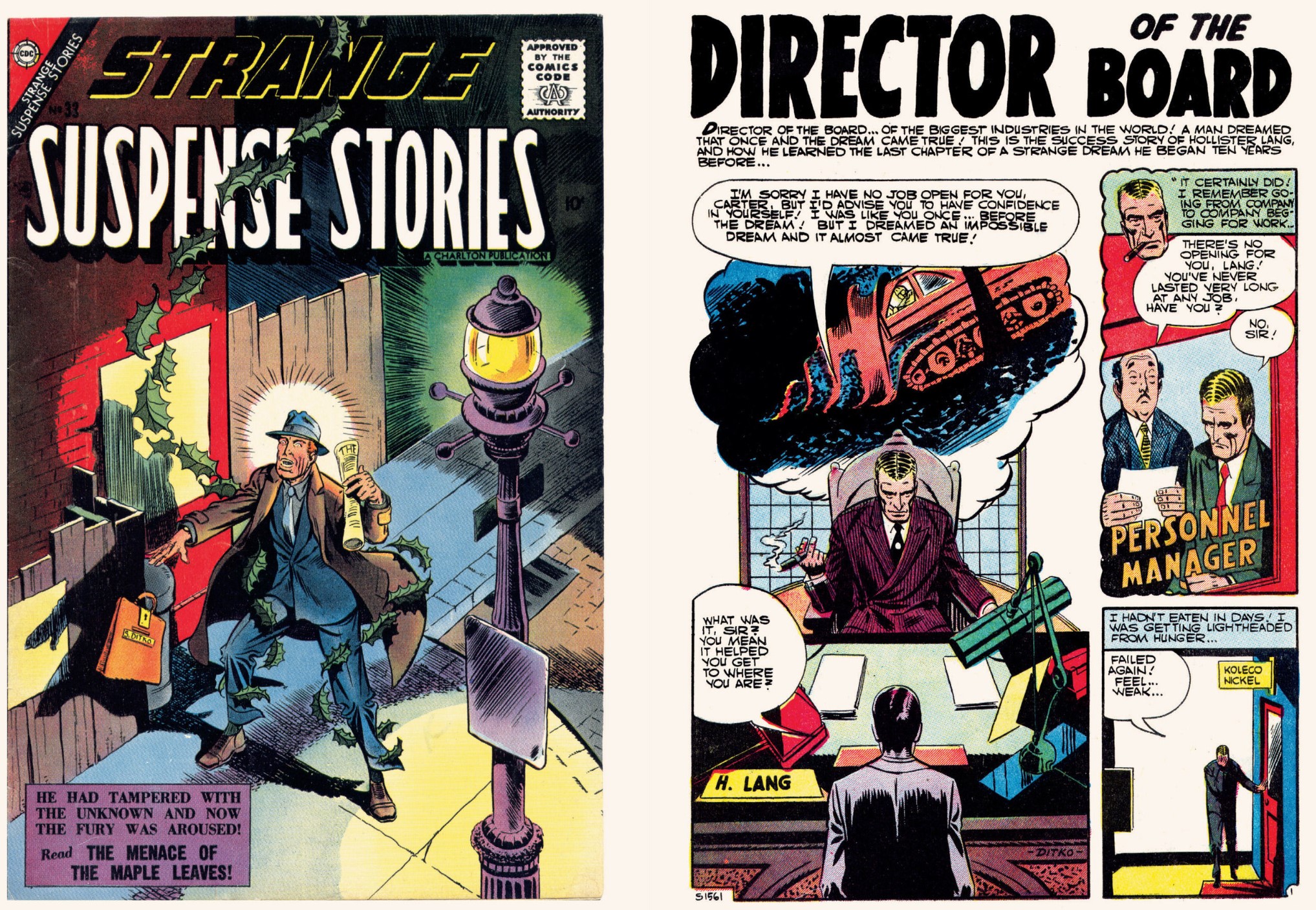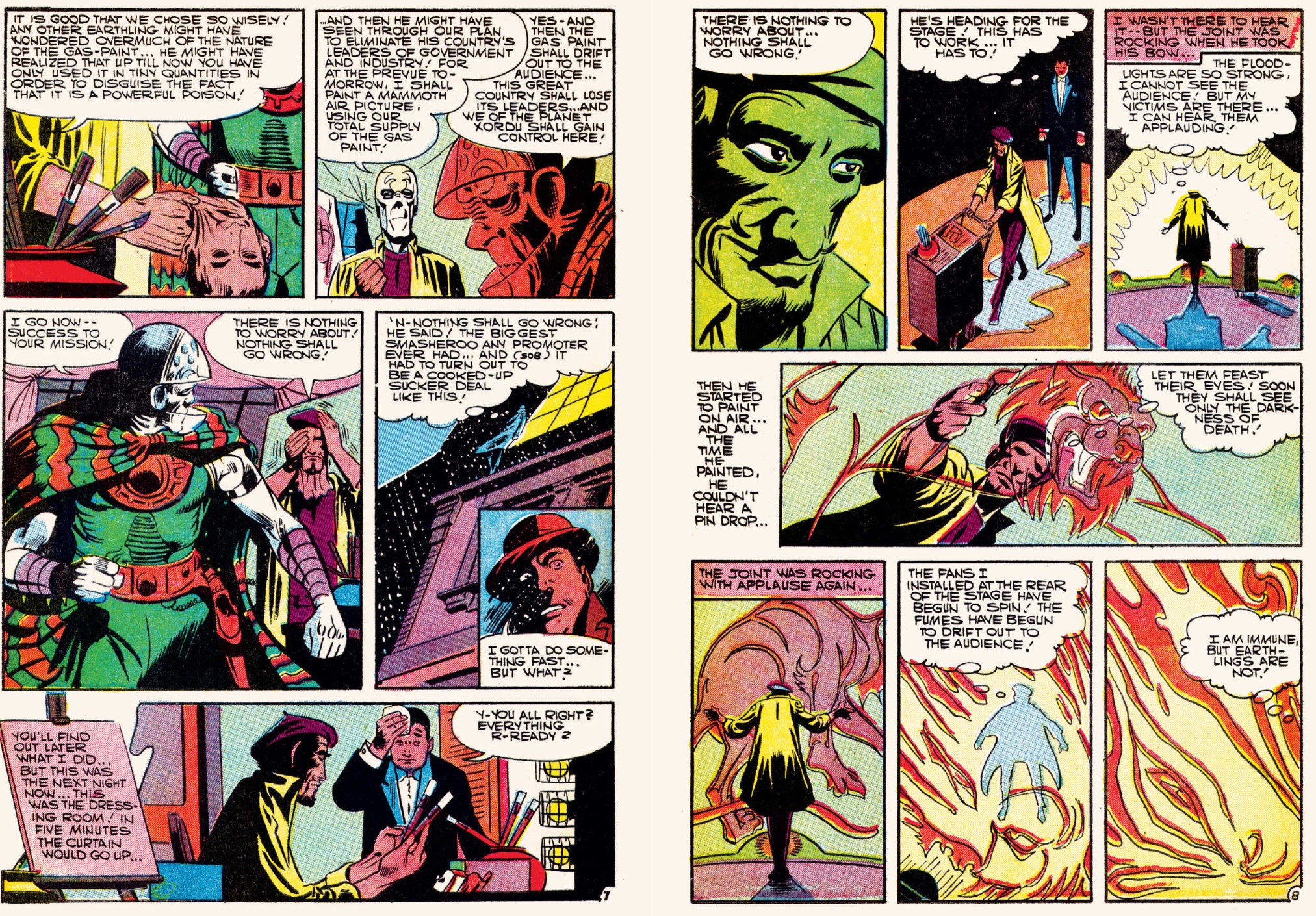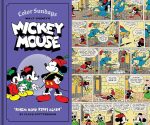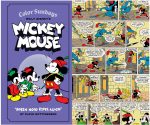
The Phantom: The Complete Sunday Archive volume Four 1950-1953


By Lee Falk, Ray Moore & Wilson McCoy, with Dick Wood, Pat Fortunato, Bill Lignante, José Delbo, Sal Trapani & various (Hermes Press)
ISBN: 978-1-61345-137-3 (HB/Digital edition)

This book includes some Discriminatory Content produced during less enlightened times.

In this month of romantic anticipation and disillusionment, it’s worth remarking that every iconic hero of strips and comics has a dutiful, stalwart inamorata waiting ever so patently in the wings for a moment to spoon and swoon. Here’s another date with one of the earliest and most resolute…

Born Leon Harrison Gross, “Lee Falk” created the Ghost Who Walks at the request of his King Features Syndicate employers who were already making history, public headway and loads of money with his first strip sensation Mandrake the Magician. Although technically not the first ever costumed champion in comics, The Phantom became the prototype paladin to wear a skin-tight body-stocking and the first to have a mask with opaque eye-slits…

The generational champion debuted on February 17th 1936, in an extended sequence pitting him against an ancient global confederation of pirates. Falk wrote and drew the daily strip for the first two weeks before handing over illustration to artist Ray Moore. The spectacular and hugely influential Sunday feature began in May 1939.

For such a long-lived, influential series, in terms of compendia or graphic collections, The Phantom has been quite poorly served in the English language market (except for the Antipodes, where he has always been accorded the status of a pop culture god). Many companies have sought to collect strips from one of the longest continually running adventure serials in publishing history, but in no systematic or chronological order and never with any sustained success. That began to be rectified when archival specialists Hermes Press launched their curated collections…

This fourth fabulous curated conclave of rain forest romances and jungle action is a lovely landscape hardback (or digital) tome, displaying alternately complete full colour Sunday episodes or crisp monochrome instalments shot from press proofs and digitally remastered. Released in March 2016, its 208 pages are stuffed with sumptuous visual goodies like panel and logo close-ups, comics covers and original art, opening with publisher Daniel Herman’s Introduction ‘The Phantom Sundays March On’. This recaps all you need to know about the ongoing feature and discloses how the advent of a woman superhero might have changed the strip’s dynamic forever…

For those who came in late: 400 years ago, a British mariner survived an attack by pirates, and – after washing ashore on the African coast – swore on the skull of his father’s murderer to dedicate his life and that of his descendants to destroying all pirates and criminals. The Phantom fights evil and injustice from his fabulous lair deep in the jungles of Bengali. Throughout Africa and Asia he is known as the “Ghost Who Walks”…

His unchanging appearance and unswerving war against injustice led to his being considered an immortal avenger by the uneducated, credulous and wicked. Down the decades, one heroic son after another has inherited the task, fought and died in an unbroken family line, with the latest wearer of the mask indistinguishable from the first and proudly continuing the never-ending battle.

In his first published exploit, the Phantom met and fell for wealthy American sophisticate Diane Palmer. His passion for her was soon reciprocated and returned and she became a continuing presence in both iterations of the series as ally, partner, sounding board, a means of reader identification and naturally a plot pawn and perennial hostage to fortune. She was also a handy conduit as the hero occasionally shared four centuries of Phantom history, hearing tales of ancestral Ghosts Who Walked in earlier eras. As was the fashion of the feature almost every saga included powerful, capable and remarkably attractive women as both heroes and villains.

However as the new ultra conservative Fifties decade progressed, that femme fatale policy was gradually but increasingly downplayed. In Falk & Wilson McCoy’s opening tale ‘The Mysterious Passenger’ (running from May 14th 1950 to July 16th 1950), Diana is wholly absent as the mysterious “Mr. Walker” and his faithful wolf companion Devil board ship for Bengali, only to be quickly framed for a huge jewel theft…

Marooned in the vast trackless ocean after jumping ship, the pair are soon hot on the trail of the plunderers and soon bring them to justice.

Evil never sleeps, however, and in the Phantom’s absence horse thieves visited his “native” stable boy Toma and stole the hero’s fabulous steed Hero. ‘The Jungle King’ (July 23rd – October 22nd 1950) proves a far harder proposition to keep than to take, though, and when Mr Walker returns and sets out to recover the wonder horse, the trail leads all over the world and ultimately to an emotional showdown with the world’s richest sportsman and racehorse owner…

A key component of the Phantom’s appeal is the weight of history built into the premise, and that’s perfectly exploited in ‘The Phantom’s Ring’ (October 29th 1950 to June 10th 1951), as the signet that has adorned the fingers of every masked champion since the first one goes missing. Recognised by educated and illiterate alike across Africa and the east, the “Death’s head” has been used to mark felons and acted as a symbol of the ghost’s power for centuries. Now a succession of ne’er-do-wells briefly possess and exploit the soft power of the trinket, but the seasoned detective and his “dog” are rapidly gaining on them and dispensing plenty of jungle justice even without the skull printing adornment. Pursuit of the ring even ends a modern pirate brotherhood – much like the one the first Phantom fought – and acts as cupid bringing a prince and a pauper together forever…

Order restored, a tale very much of its time follows as The Phantom must rescue scientist Dr Archer and his pretty daughter June from cannibal terrors ‘The Rope People’ (June 17th to November 4th 1951), by repeating the herculean tasks he (in actuality his grandfather) had performed generations ago, after which ‘Tale of Devil’ (November 11th 1951 to March 23rd 1952) finds the mighty lupine relentlessly stalked by sadistic visiting royalty with vacant spots on his palace wall and a fondness for bear baiting and other acts of organised animal cruelty.

However, Devil is beloved by Prince Hirk’s son and wife, and even before the Phantom can save his faithful hound – and after the potentate refuses to change his ways – the royal family find a way to stop him for good…

An actual feel-good tale of redemption and repentance, the saga is followed by a return to all-out action as ‘The ‘Copter Pirates’ (March 30th to July 13th 1952) finally reintroduces potential Ghost-Who-Walks-wife Diana Palmer, as she sets out to rejoin her masked man in darkest Bengali, only to be kidnapped. An unwilling spoil of war taken by thieves plundering passenger planes with helicopters, she soon overwhelms unstable lothario Drake and is able to keep him at bay until the Phantom organises an army (navy?) of local tribal fisherfolk to search hundreds of islands and spectacularly lower the boom on the aerial upstarts…

A sublime lost opportunity comes next as ‘The Female Phantom’ (July 20th – October 12th 1952) introduces one of the only woman Crimebusters in US comics of this era. Reunited with “Kit Walker”, Diana has him delve into the meticulous family chronicles to reveal how, a few generations previously, the feisty twin sister of a former Ghost Who Walked took her brother’s place to police the jungles of Bengali after he was shot battling river pirates. Girl Phantom Julie briefly substituted for Kip, saving a hostage missionary that she later married, and kept the Phantom’s Peace until the natural order was restored.

The concept obviously intrigued Falk who carried it on in sequel saga ‘Diana and the Bank Robbers’ (October 19th 1952 to February 1st 1953) wherein Diana “borrowed” Julie’s well-preserved fitted costume for a prank and was captured and entombed by ruthless bullion thieves. Discovered and rescued by super-steed Hero, Diana then let the true, many masked manhunter settle their hash and resumed her rightful place as asker of leading questions…

Closing this section of this compilation, she enquires about ‘The Chain’ (February 8th – May 24th 1953) welded to the Phantom’s throne in the Skull Cave, just in time to reinvigorate the exhausted hero whose constant attempts to forestall an impending tribal war have led him to the brink of resignation and retirement…

As the couple listen to elder Woru, they learn how a similar situation plagued the fearsome forest peacekeeper’s own father and how, after solving his crisis of confidence, escaping slavery, saving his own intended (Kit Walker’s mother-to-be) from abduction and destroying a human monster through sheer persistence, the weary victor attached the links in hopes that they would serve as a reminder for all who followed in his footsteps…

And they do…

Closing this tome ‘Focus: The Female Phantom in the Comics’ discusses the female Phantom (who never appeared again in the 1950s) and provides two tales from her resurrection in the 1960s – albeit not in family oriented strips but in those rowdily anarchic comic books.

Between 1966 and 1967 King Features Syndicate dabbled with a comic book line of their biggest stars Flash Gordon, Popeye, Mandrake and The Phantom: developed after the Ghost Who Walks had enjoyed a solo-starring vehicle under the broad and effective aegis of veteran licensed properties publisher Gold Key Comics. The Phantom was no stranger to funnybooks, having been featured since the Golden Age in titles such as Feature Book and Harvey Hits, but only as straight reformatted strip reprints. The Gold Key exploits were tailored to a big page and a young readership, a model King maintained for their own run.

Here, from the era of superhero saturation and The Phantom #20 (cover dated January 1967, scripted by Dick Wood and illustrated by Bill Lignante) ‘The Adventures of the Girl Phantom’ expands upon the strip sequence above as Julia again dons the purple leotard, mask and gun belt to counter a crime wave following Kit’s incapacitation due to fever. Although more than a match for normal bandits, poachers and evil Europeans, she almost succumbs to the sinister plots of gang boss Lamont until her ferocious jungle cat Fury comes to her aid…

Closing the extra treats is vignette ‘The Secret of the Golden Ransom’ from Charlton’s The Phantom #30 ( February 1969, by Pat Fortunato, José Delbo & Sal Trapani) as Julie and faithful (human) friend Maru face a flamboyant pirate who demands a unique payment for returning her captive brother, the “real Phantom”…

If the kind of fare you’d encounter in a 1940s Tarzan movie or noir thriller might offend, you should consider carefully before starting this book, but if you’re open to oldies with historical cultural challenges there’s a lot to be said for these straightforward and pioneering thrillers. Finally rediscovered, these lost treasures are especially rewarding as the material is still fresh, entertaining and addictively compelling. However, even if it were only of historical value (or just printed for Australians – manic devotees of the implacable champion from the get-go) surely the Ghost Who Walks and fiancée/wife-who-waits is worthy of a little of your time?
The Phantom® © 1950-1953 and 2018 King Features Syndicate, Inc. ® Hearst Holdings, Inc. Reprinted with permission. All rights reserved.

Superman: The Golden Age Dailies 1942 to 1944


By Jerry Siegel & Joe Shuster, Whitney Ellsworth, Wayne Boring & the Superman Studio (IDW/ Library of American Comics)
ISBN: 978-1-63140-383-5 (HB)

This book includes Discriminatory Content produced in less enlightened times.

In this month of romantic anticipation and disillusionment, it’s worth reminding ourselves that every iconic hero of strips and comics has a dutiful, stalwart inamorata waiting ever so patently in the wings for their moment to spoon and swoon or be rescued. Here’s another vintage outing for one of the earliest and most resolute…

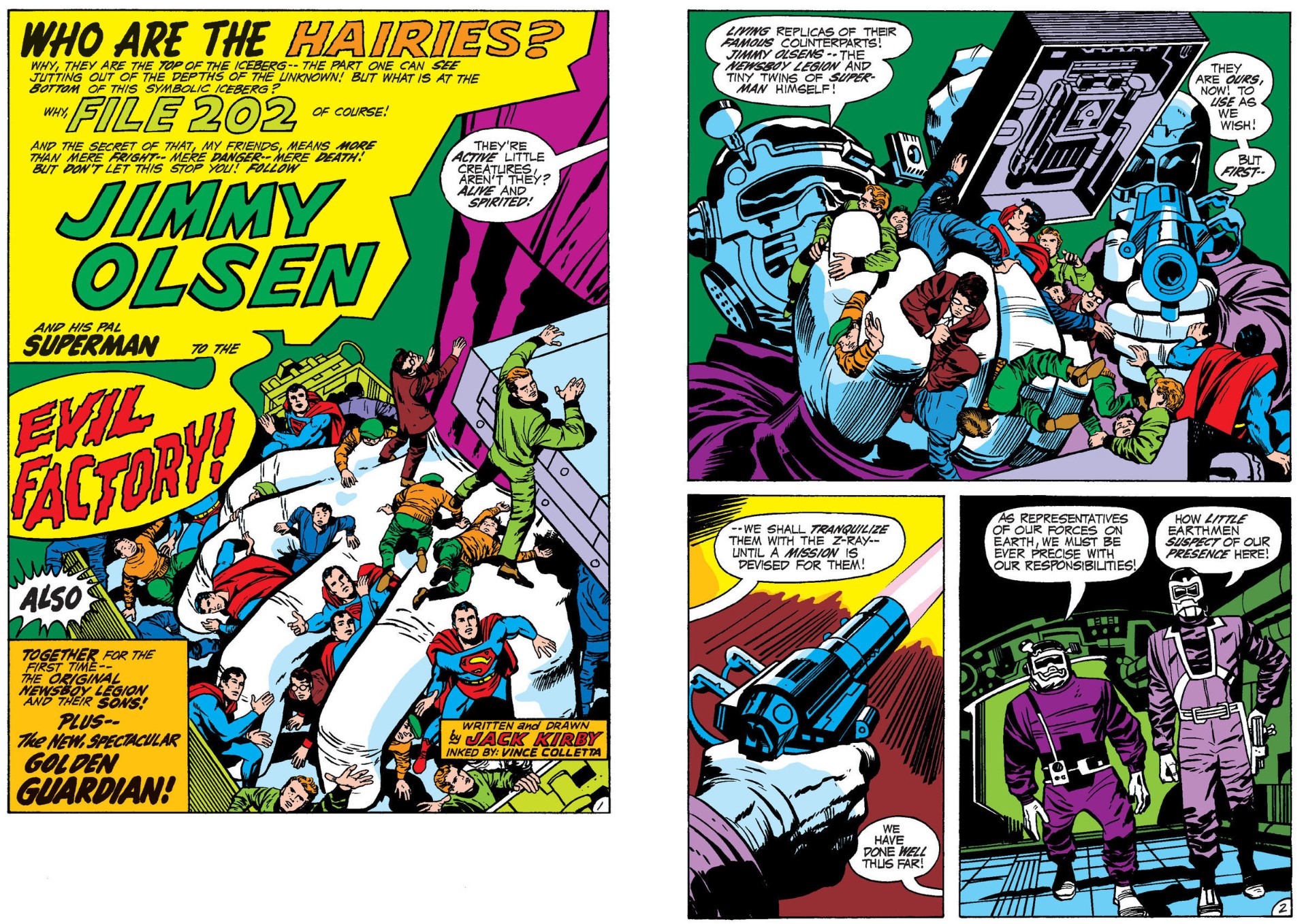
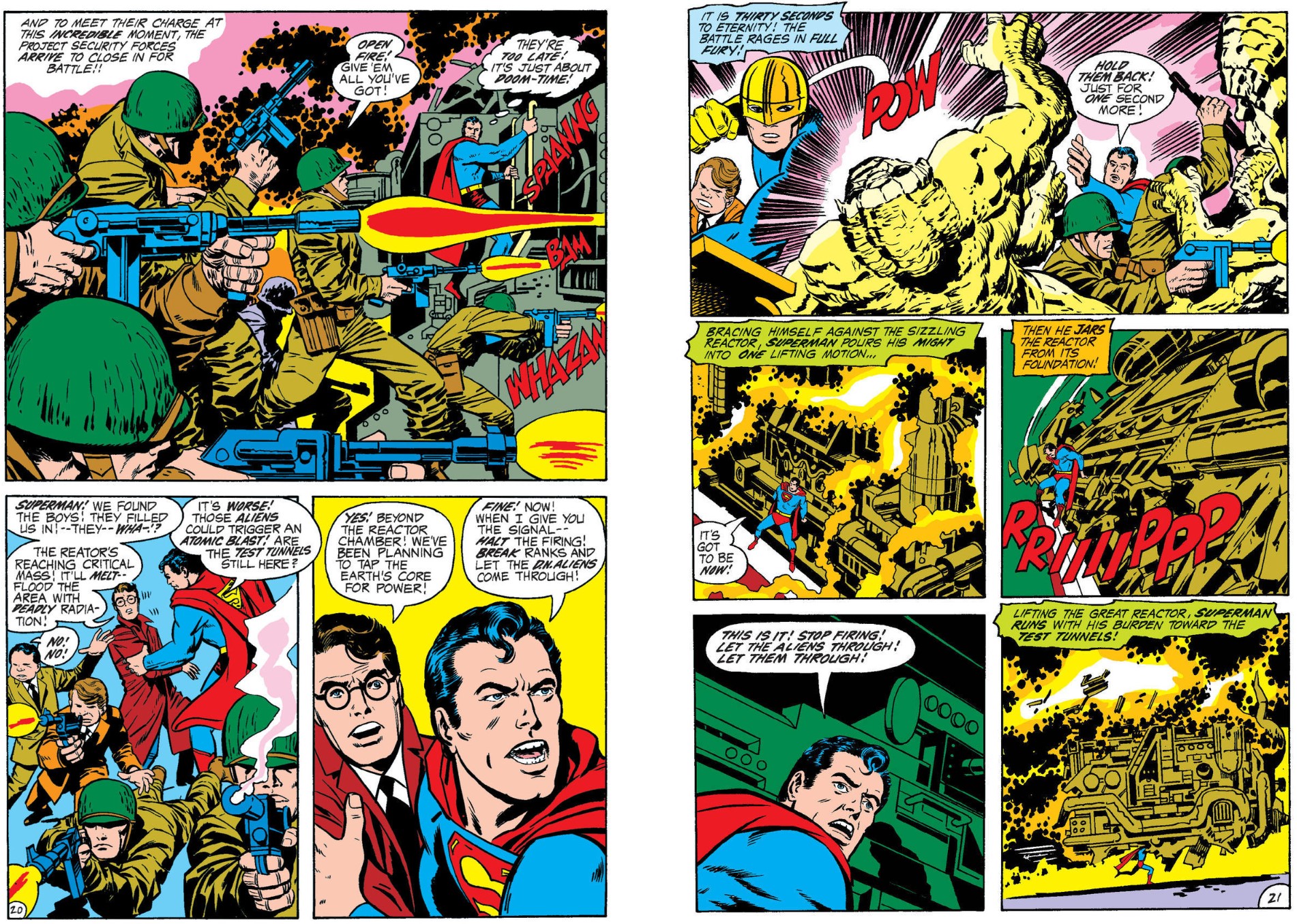
The American comic book industry – if it existed at all – would be utterly unrecognisable without Superman. Jerry Siegel & Joe Shuster’s unprecedented invention was first fervidly adopted by a desperate and joy-starved generation, and gave birth to a genre if not an actual art form. Spawning an army of imitators and variations within three years of his 1938 debut, the intoxicating blend of breakneck, breathtaking action and wish-fulfilment which epitomised the early Man of Steel grew to encompass cops-&-robbers crimebusting, socially reforming dramas, sci fi fantasy, whimsical comedy and, once the war in Europe and the East sucked in America, patriotic relevance for a host of gods, heroes and monsters, all dedicated to profit through exuberant, eye-popping excess and vigorous dashing derring-do.

From the outset, in comic book terms Superman was master of the world. Moreover, whilst transforming the shape of the fledgling funnybook biz, the Man of Tomorrow irresistibly expanded into all areas of the entertainment media. Although we all think of the Cleveland boys’ iconic invention as epitome and acme of comics creation, the truth is that very soon after his springtime debut in Action Comics #1 the Man of Steel was a fictional multimedia monolith in the same league as Popeye, Tarzan, Sherlock Holmes and Mickey Mouse. We parochial and possessive comics fans too often regard our purest and most powerful icons in purely graphic narrative terms, but the likes of Batman, Spider-Man, Avengers and their hyperkinetic kind long ago outgrew four-colour origins to become fully mythologized modern media creatures familiar in mass markets, across all platforms and age ranges…

Far more people have seen and heard the Man of Steel than have ever read his comic books. These globally syndicated newspaper strips alone were enjoyed by countless millions, and by the time his 20th anniversary rolled around, at the very start of what we call the Silver Age of Comics, he had been a thrice-weekly radio serial star, headlined 17 astounding animated cartoons, become a novel attraction (written by George Lowther) and helmed two feature films and his first smash 8-season live-action television show. Superman was a perennial sure-fire success for toy, game, puzzle and apparel manufacturers all over the planet.

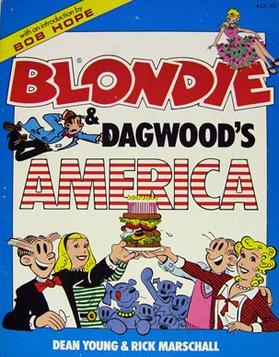
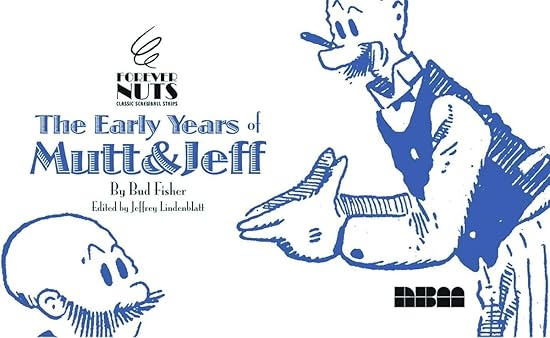
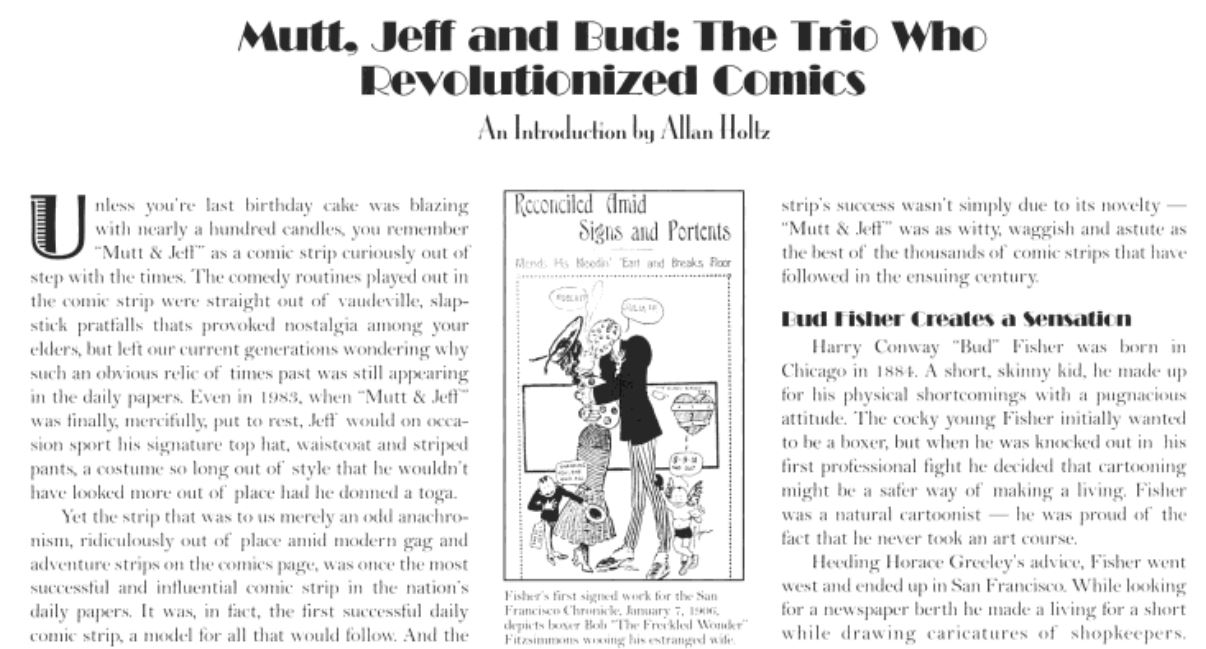
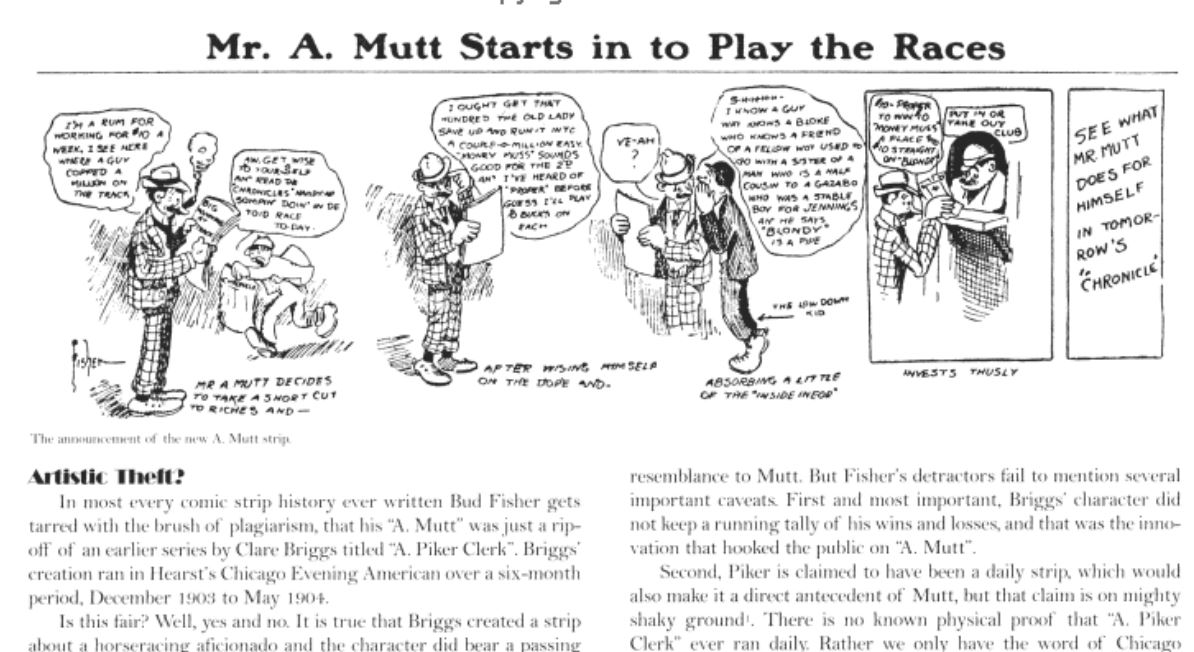
Although pretty much a spent force these days, for the majority of the previous century the newspaper comic strip was the Holy Grail that all American cartoonists and graphic narrative storytellers hungered for. Syndicated across the country – and often the planet – it was seen by millions, if not billions, of readers and generally accepted as a more mature and sophisticated form of literature than comic books. It also paid better, and rightly so. Some of the most enduring and entertaining characters and concepts of all time were created to lure readers from one particular paper to another and many of them grew to be part of a global culture. Mutt and Jeff, Flash Gordon, Dick Tracy, Buck Rogers, Charlie Brown and so many more escaped humble, tawdry newsprint origins to become meta-real: existing in the minds of earthlings from Albuquerque to Zanzibar. Most still do…

The daily Superman newspaper strip launched on 16th January 1939, augmented by a full-colour Sunday page from November 5th of that year. Originally crafted by luminaries like Siegel & Shuster and their studio (Paul Cassidy, Leo Nowak, Dennis Neville, John Sikela, Ed Dobrotka, Paul J. Lauretta & Wayne Boring), the mammoth task required additional talents like strip veteran Jack Burnley and writers including Whitney Ellsworth, Jack Schiff & Alvin Schwartz.

The McClure Syndicate feature ran continuously until May 1966, appearing, at its peak, in over 300 daily and 90 Sunday newspapers; a combined readership of more than 20 million. Eventually, Win Mortimer and Curt Swan joined the unflagging Boring & Stan Kaye whilst Bill Finger and Siegel provided stories, telling serial tales largely divorced from comic book continuity throughout years when superheroes were scarcely seen.

This is the first volume of the Library of American Comics collection, which picks up from the Sterling/Kitchen Sing softcover editions which ceased production in 1999. All of the material is long overdue for re-release and digital editions. Here, however, the never-ending battle resumes with Siegel & Shuster and their helpers addressing the world war had just become part of. This superb collection – still not available digitally, despite its superb quality and sublime content – opens with an Introduction by John Wells discussing the Man of Tomorrow’s role of during those days of combat and fear, comprises episodes #20-30, pages 967 through 1814, and publication dates February 16th 1942 to October 28th 1944. It begins with ‘Lair of the Leer’ (February 16 – May 23 1942, #967-1050) as following Pearl Harbor, Clark Kent tries to enlist but fails the physical. In his eagerness, the hero had accidentally activated his super vision and read an eye chart in another room!

Marooned at home, Superman instead counters a wave of sabotage instigated by a murderous maniac dubbed The Leer and addresses Congress, swearing to defend the homeland while America’s brave boys settle the fascists overseas…via a string of Japanese, Italian and German operatives, seeking to destroy government, shipping transport infrastructure and arms plants. As he tirelessly stops these attempts, savvy Lois Lane investigates and soon is in the thick of the action…

The challenge is swiftly taken up by the master spy who mistakenly targets male reporter Clark, but gets snoopy Lois anyway; a mistake that leads to his undoing and his end…

Dialling down fury and spectacle, strips 1051-1115 reveal the secret of ‘The Steel Mill Poet’ (May 25-August 8) as Lois & Clark visit critical war industry site the Canby steel mill where fanciful dowager Mrs Canby believes her cousin’s odes and ditties will uplift the sweaty toilers. With morale plummeting Superman goes looking for her vanished husband, and finds himself playing cupid to two generations of steel tycoons whilst also scotching a sabotage scheme unlike any other…

The naval war features heavily in ‘The Monocle Menace’ (August 10-November 21, #1116-1205) as a new malicious mastermind targets shipping and support services by creating a evil Superman doppelganger, although his real objective is a secret formula. As usual Lois is first on the case and has a ringside seat to an ever-escalating battle of super-powers against super science; even saving her hero when the Man of Steel succumbs to sinister mesmerism and seemingly switches sides!

With Wayne Boring taking more and more of the drawing duties, Seasonal whimsy informs the 23rd exploit as Hitler, Mussolini and General Tojo combine forces to shatter the moral of the world by having ‘Santa Claus Kidnapped’ (November 23-December 19, strips 1206-1229). This compels Superman to go undercover in Berlin, saving Saint Nick and giving the German resistance a big boost before returning to truly nasty business by countering ‘The Villainy of the Voice’ (December 21 1942 to April 17 1943, and 1230-1331). Here an anonymous plotter uses a whispering campaign of insinuation and innuendo to terrorise key workers until Lois and Clark expose the rat and his insidious gang of spying blackmailers and extortionists…

As the Daily Planet’s top reporters are despatched to “war-torn Europe”, Lois &Clark accidentally encounter super spy ‘The Nefarious Noname’ (April 19-June 26, 1332-1391) and are sucked into a Hitchcockian chase around London in pursuit of stolen Allied invasion plans. “Luckily” Superman is also on hand to help them against the freakish, many-eyed psionic mutant terror commanding the enemy agents and a ferocious battle of powers and war of wills ends with the right side victorious again…

Returning safely to America, LL & CK are just in time to see how ‘The Sneer Strikes’ (June 28 – August 21, #1392-1439) as the brother of the Leer targets Japanese Internment Camps in a remarkably even-handed exploration of what we now consider one of the darkest ethical moments in US history. Hopefully that’s not a statement I’ll have amend over the next four years…

Back then though, the reporters’ investigative visits uncover spy schemes and escape plots, forcing the Man of Steel to use his disguise powers to go undercover, infiltrating the Nipponese gang as they attempt to destroy US/Chinese relations and foil a West Coast invasion. The war was slowly turning in the Allies’ favour and reader burnout was growing, so it’s no surprise story #27 moved into solid mystery territory with ‘Where is Lois Lane?’ (August 23 – November 18, #1440-1518) as Clark and Jimmy Olsen realise the woman working at the Daily Planet with them has vanished. Moreover, every aspect of her non-work life – home, neighbours, friends – has been eradicated…

It’s even more confusing when she suddenly reappears, claiming everyone else is crazy. Maybe its because she’s been replaced by an enemy agent wearing her face and form carrying out a bizarre ploy to make Superman her slave and destroy the US economy…

A different kind of whimsy is in play when Lois’s niece – a habitual liar who could shame Baron Munchausen, if not the 47th President – debuts in ‘Little Susie’s Fibs’ (November 19 1943 – February 19 1944, #1519-1598). The fabricating deceiver is an inveterate troublemaker, and when she sees Clark become Superman the scene is set for an avalanche of chaos, after Susie confronts Kent. Of course, he denies everything but cannot find a way to prove he is NOT the Man of Steel telling a lie, and the fantastic hilarity goes into overdrive when ‘The Mischievous Mr. Mxyztplk’ first manifests (February 21 – July 19, #1599-1727). Forewarned by medium Madame Zodia, Lois & Clark are still utterly unprepared for a spate of poltergeist phenomena at the Planet building, heralding the arrival of a fun-addicted magical imp who doesn’t care who gets hurt whilst he’s getting his giggles…

As if his antics aren’t enough to fully occupy the Action Ace, the “Most Beautiful Woman in the World” chooses that moment to stop covering her face, no longer caring about the fights and accidents her looks generate. With men rioting and suiciding everywhere, the imp sets his heart on her too, but Miss Dreamface seeks to steal Superman’s, even though faithful old flame Ted is still chasing her too. The frenzy mounts and peaks in Metropolis, setting the scene for tragedy and disaster, even if true love eventually finds a way to restore order…

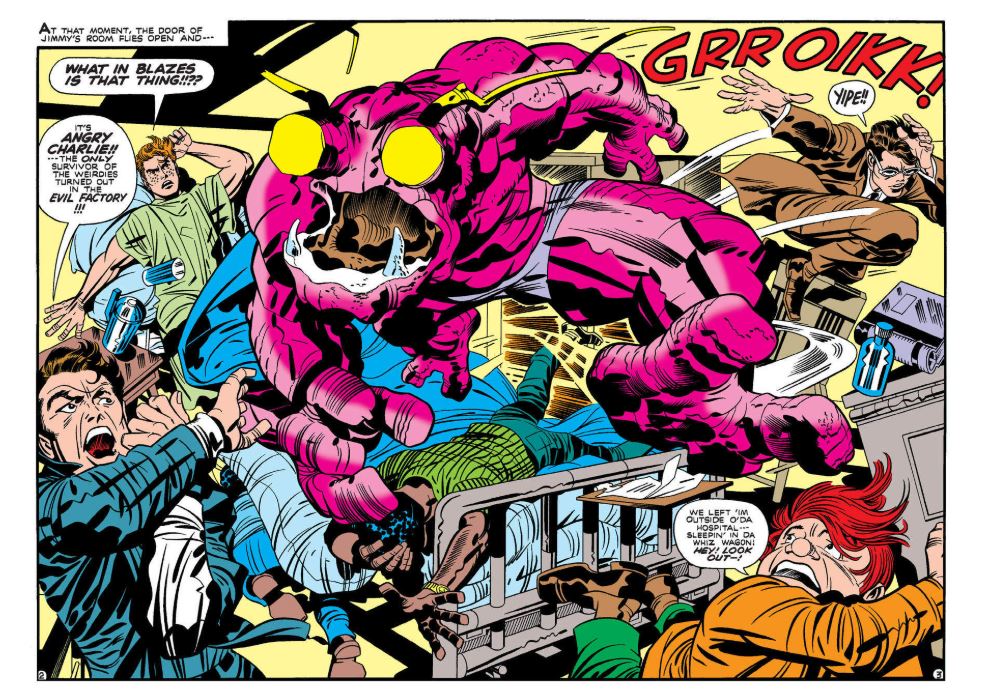
Acclaimed favourite of the Superman radio show, the Daily Planet copy boy got his first taste of pictorial fame in concluding sequence #30 ‘King Jimmy Olsen’ (July 20-October 28 1944, #1728-1814). Here the dauntless is lad abducted by hidden super-scientific kingdom Thymaung. The boy is the exact double of ruler Rahma, and a council of usurpers want to replace their noble boy king with a pliable primitive they can control and who will front their campaign to conquer Earth. Unfortunately for them, Superman tracks down his pal, but insists the kid plays along until the Man of Tomorrow can safely liberate the captive king. A whirlwind ride of action, fantasy and first love, it heralds a new era of decreasingly political satire in favour of gender stereotyping and reinforcement masked as a comedic “battle of the sexes”. There will be more of that next time -and all through the “Atomic age” of the 1950s & 1960s…

For now though, these yarns offer timeless wonders and mesmerising excitement for lovers of action and fantasy. The raw-boned early Superman is beyond compare. If you can handle the warts of the era or just crave simpler stories from less angst-wracked times, they are ideal comics reading, and this a book you simply must see.
© 2016 DC Comics. All rights reserved. Superman and all related names, characters and elements are ™ DC Comics.

Mandrake the Magician: Fred Fredericks Dailies volume 1: The Return of Evil – The Cobra


By Lee Falk & Fred Fredericks (Titan Books)
ISBN: 978-1-78276-691-9 (HB)

This book includes Discriminatory Content produced during less enlightened times.

In this month of romantic anticipation and disillusionment, it’s worth remarking that every iconic hero of strips and comics has a dutiful, stalwart inamorata waiting ever so patiently in the wings for a moment to spoon and swoon. Here’s another beguiling outing starring one of the earliest and most resolute…

Regarded by many as comics’ first superhero, Mandrake the Magician debuted as a daily newspaper strip on 11th June 1934 – although creator Lee Falk had sold the strip almost a decade previously. Initially drawing it too, Falk replaced himself as soon as feasible, allowing the early wonderment to materialise through the effective understatement of sublime draughtsman Phil Davis. An instant hit, Mandrake was soon supplemented by a full-colour Sunday companion page from February 3rd 1935. Happy other Birthday, dapper tuxedo dude…

Whilst a 19-year old college student Falk had sold the strip to King Features Syndicate years earlier, but asked the monolithic company to let him finish his studies before dedicating himself to it full time. Schooling done, the 23-year-old born raconteur settled into his life’s work, entertaining millions with astounding tales. Falk also created the first costumed superhero – moodily magnificent generational manhunter The Phantom – whilst spawning an entire comic book subgenre with his first inspiration. Most Golden Age publishers boasted at least one (but usually many) nattily attired wizards in their gaudily-garbed pantheons: all roaming the world(s) making miracles and crushing injustice with varying degrees of stage legerdemain or actual sorcery. Characters such as Mr. Mystic, Ibis the Invincible, Sargon the Sorcerer, and an assortment of  the Magician” ’s like Zatara, Zanzibar, Kardak proliferated ad infinitum: all borrowing heavily and shamelessly from the uncanny exploits of the elegant, enigmatic man of mystery gracing the world’s newspapers and magazines.

In the Antipodes, Mandrake was a suave stalwart regular of Australian Women’s Weekly and became a cherished icon of adventure in the UK, Australia, Italy, Brazil, Germany, Spain, France, Turkey and across Scandinavia: a major star of page and screen, pervading every aspect of global consciousness.

Over the years he has been a star of radio, movie chapter-serials, a theatrical play, television and animation (as part of the cartoon series Defenders of the Earth). With that has come the usual merchandising bonanza of games, toys (including magic trick kits), books, comics and more…

Falk helmed Mandrake and The Phantom until his death in 1999 (even on his deathbed, he was laying out one last story), but also found some few quiet moments to become a renowned playwright, theatre producer and impresario, as well as an inveterate world-traveller. After drawing those the first few strips Falk united with sublimely polished cartoonist Phil Davis (March 4th 1906 -16th December 1964). His sleekly understated renditions took the daily strip, especially the expansive Sunday page to unparalleled heights of sophistication. Davis’ steadfast, assured realism was the perfect tool to render the Magician’s mounting catalogue of spectacular miracles. He rendered and realised Falk’s words until his death by heart attack…

Harold “Fred” Fredericks, Jr. (August 9th 1929 – March 10th 2015) took over – with strips starting in June 1965 – he was also handpicked by Falk who admired his work as both writer and/or illustrator on teen strip Rebel and family comic books such as Nancy, Boris Karloff, The Twilight Zone, The Munsters, Mister Ed, O.G. Whiz presents Tubby, Mighty Mouse, Barney Google and Snuffy Smith, and Bullwinkle.

In later years tireless taleteller Fredericks became an inking mainstay at Marvel & DC on titles including New Titans, Catwoman, Robin, Punisher War Journal, Nth Man, Daredevil, Quasar, G.I. Joe and Defenders of the Earth.

Preceded by Roger Langridge’s essay ‘Fred Fredericks – An Appreciation’ and John Preddle’s appraisal ‘Mandrake: The Fred Fredericks Era’, the official changing of the artistic guard comes with a cheeky contemporary mystery…

However, firstly…

Mandrake was educated at the fabled College of Magic in Tibet, thereafter becoming a suave globetrotting troubleshooter, accompanied by his faithful African friend Lothar and eventually enchanting companion (and in 1997, bride) Princess Narda of Cockaigne. They co-operatively solve crimes, fight evil and find trouble and mystery apparently everywhere. Although the African Prince was a component from the start, Narda turned up fashionably late (in 1934) as victim/secret weapon in early escapade ‘The Hawk’ (see Mandrake the Magician: Dailies vol. 1 – The Cobra ): a distrait socialite forced to use her every wile to seduce and destroy the magician and Lothar. Thwarting each attack, Mandrake went after the monstrous stalker blackmailing Narda’s brother Prince Sigrid/Segrid and extorting her, decisively lowering the boom and liberating the embattled aristocrats. Bear all that in mind: it’s going to come in handy later…
Falk and Fredericks started as they meant to go on with ‘Odd Fellow’ (running from May 3rd to August 14th 1965) wherein a puckish little chap ruins a day of quiet contemplation for Narda before going on to peddle incredible inventions to greedy industrialists. By the time Mandrake gets involved, a lethal looking pursuer is hard on their heels and the mounting chaos is explained by the deduction that the jolly leprechaun is actually Roger the Rogue: a conman from the future with a deadly secret agenda but no idea who he’s messing with…

Following an interlude that introduces Mandrake’s palatial super citadel Xanadu, it’s back to basics for the next epic as the Princess goes to college to improve her mind and inadvertently uncovers and exposes a criminal gang embedded in world culture for hundreds of years. With echoes on modern conspiracy thriller 100 Bullets, ‘The Sign of 8’ (August 16th 1965 to February 6th 1966) arise from managed obscurity to discredit, hunt and destroy Narda with increasingly baroque and deadly assaults before falling to the counterattack of the Magician…

Growing contemporary fascination in the supernatural is addressed an capitalised upon in ‘The Witches’ (February 7th – May 28th) as criminal hypnotist Count Diablo and his all-women gang terrorise young heiress “Really” Riley , only to learn to their lasting regret what a master mesmerist can do to punish the wicked…

Another headline fuelled thriller, ‘The UFO’ May 30th – September 17th) sets the trio on the trail of aliens robbing banks with heat rays and escaping in flying saucers. Of course, it’s not long before Mandrake makes the connection between these uncanny events and missing military ordnance hot off the drawing board and takes steps to stop the plunderers from the stars…

In an era of super spies and covert cabals it wasn’t long before our heroes were back on ‘The Trail of the 8’ (September 19th 1966 – January 14th 1967) as Mandrake discovers evidence that the ancient order is still active. Teaming with good-guy agency Inter-Intel, the hunt makes Mandrake a target for repeated assassination attempts but ultimately leads to the organisation’s explosive demise. And yet the magician remains unconvinced…

This titanic tome terminates with a long-anticipated revival as ‘The Return of Evil – The Cobra’ (January 16th to June 3rd 1967) reveals how King Segrid of Cockaigne needs the help of his sister and her boyfriend after a sinister presence buys up tracts of the country and populace: using wealth, influence, chicanery, publicity stunts, blackmail and sheer dominating physical presence to rule the nation from behind the oval office throne. Thankfully, Mandrake and Lothar know just how to deal with the villain once he’s exposed as fatally flawed old foe The Cobra, and foil the fiend’s scheme to steal the nation from its legally-appointed ruler…

Supplemented here by a ‘Fred Fredericks – Biography’ before closing with ‘The Fred Fredericks Mandrake the Magician Complete Daily Checklist 1965-2013’, this thrilling tome offers exotic locales, thrilling action, fantastic fantasy, space age shocks, sinister spycraft, crafty criminality and spooky chills in equal measure. As always, the strip abounds with fantastic imagery from whenever “Mandrake gestures hypnotically” and drips with wry dialogue and bold action. Paramount taleteller Falk instinctively knew from the start that the secret of success was strong and – crucially – recurring villains and uncanny situations to test and challenge his heroes, making Mandrake the Magician an unmissable treat for every daily strip addict. These stories have lost none of their impact and only need you reading them to concoct a perfect cure for 21st century blues.
Mandrake the Magician © 2017 King Features Syndicate. All Rights Reserved. All other material © 2017 the respective authors or owners.
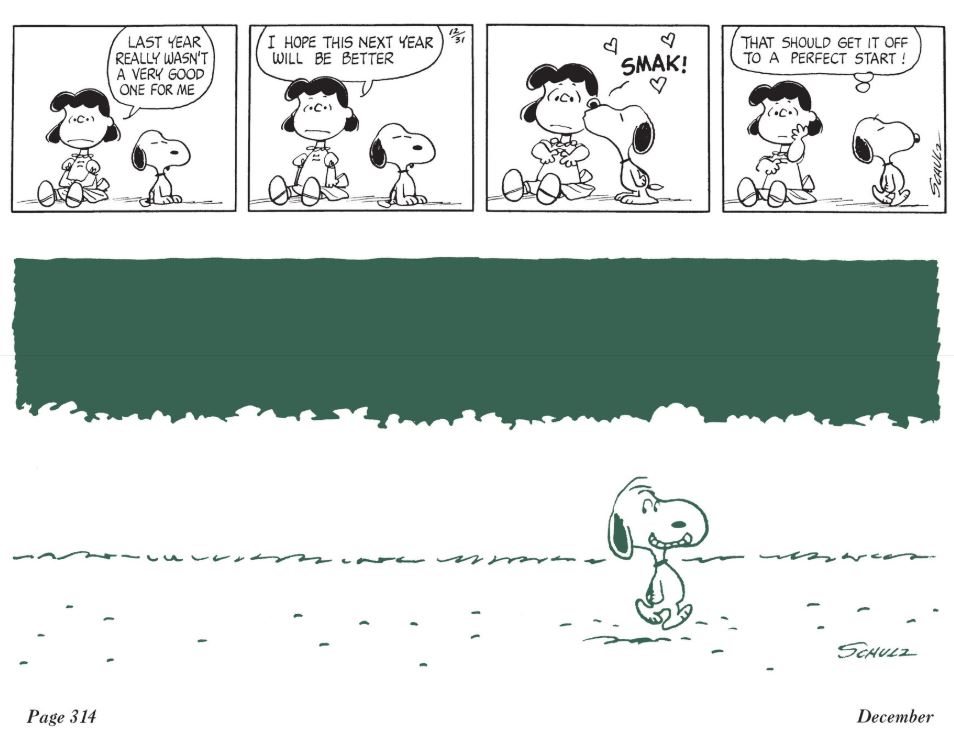
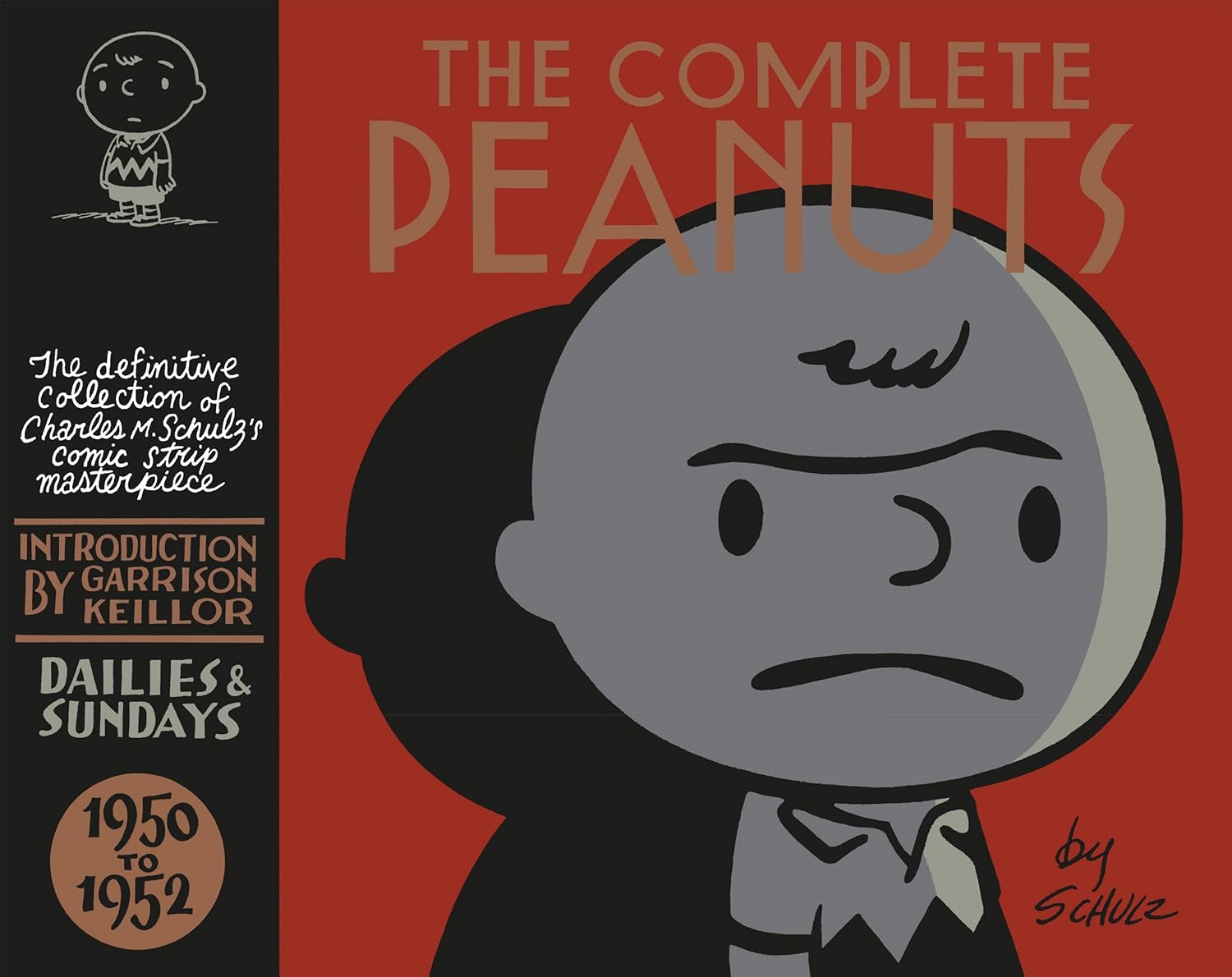
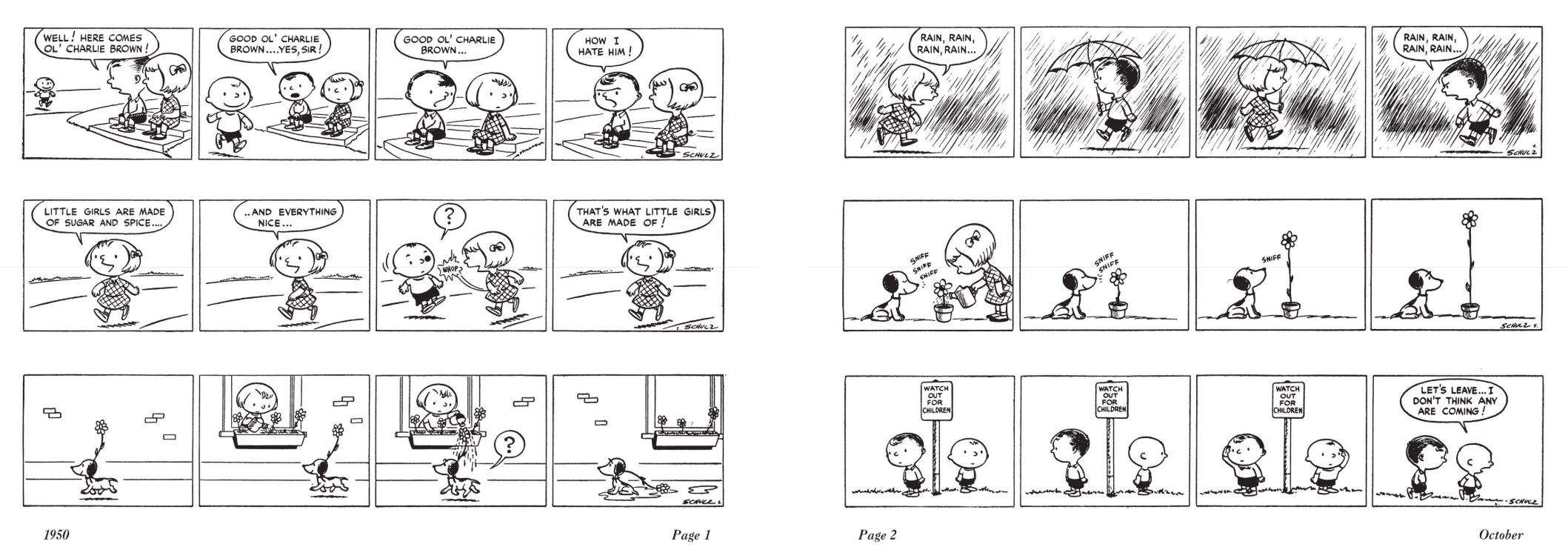
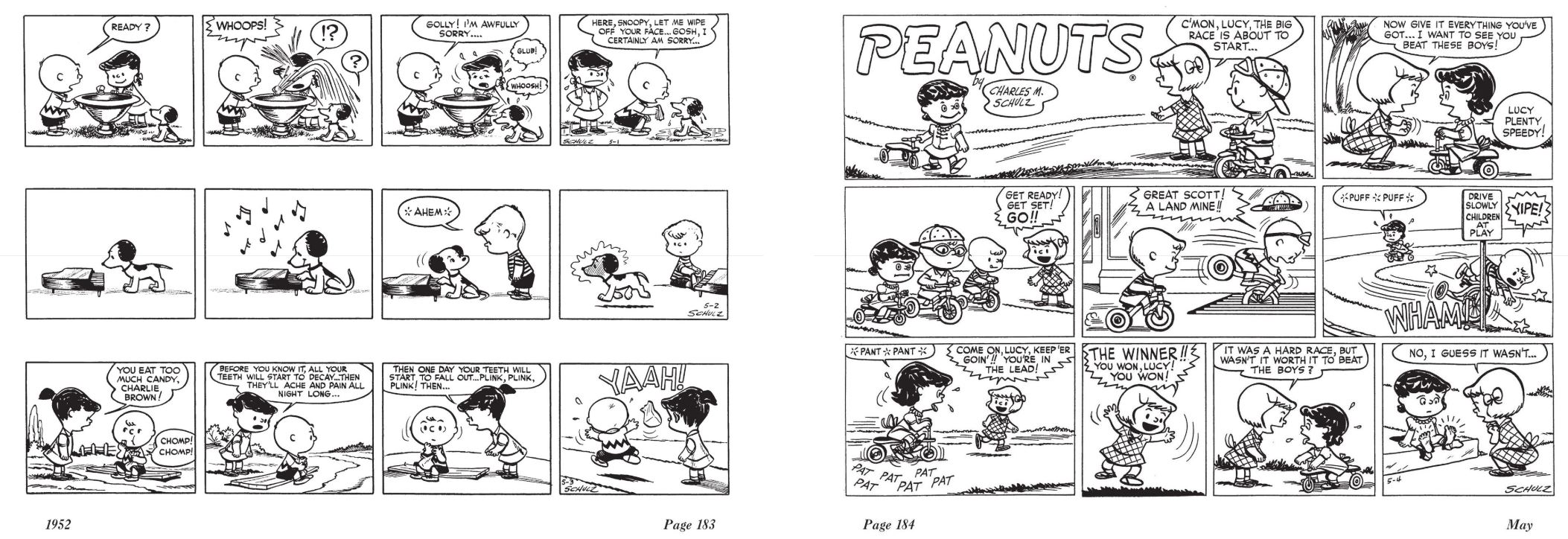
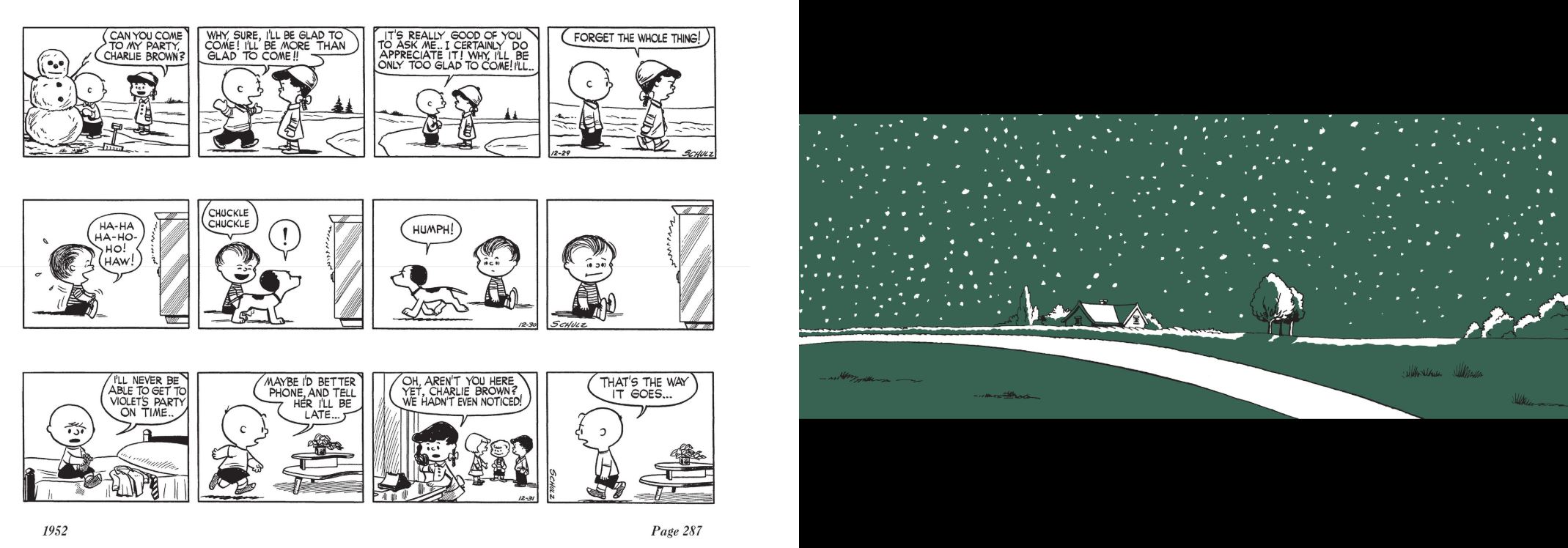
Peanuts Dell Archive


By Charles M. Schulz, Jim Sasseville, Dale Hale, Tony Pocrnick & various (KaBOOM!)
ISBN: 978-1-68415-255-1 (HB) eISBN: 978-1-64144-117-9

This book includes Discriminatory Content produced in less enlightened times.

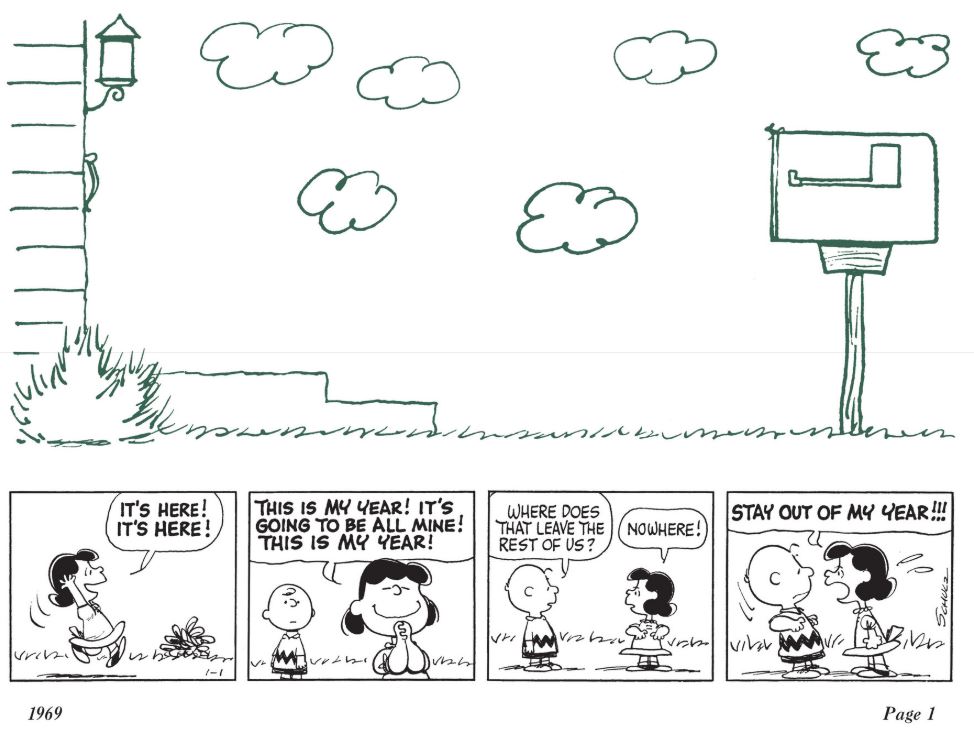
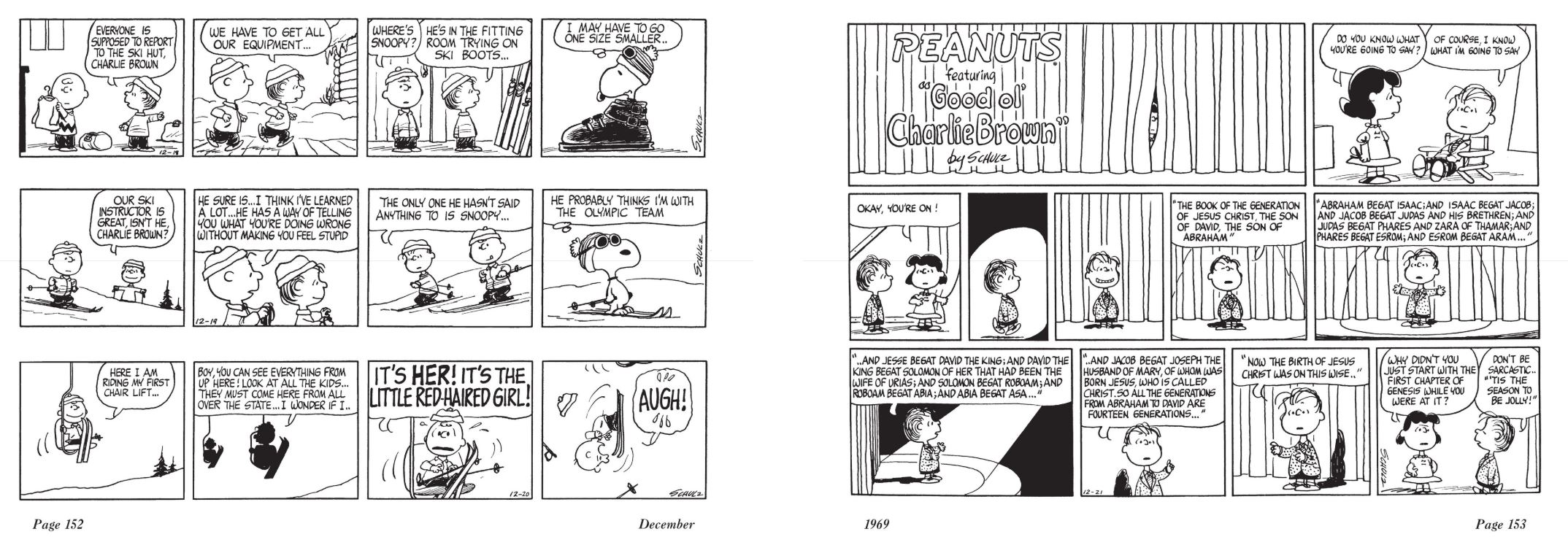
Peanuts is unequivocally the most important comics strip in the history of graphic narrative. It is also the most deeply personal. Cartoonist Charles Monroe “Sparky” (forever dubbed thus by an uncle who saw young Charlie reading Billy DeBeck’s strip Barney Google: that hero’s horse was called “Spark Plug”) Schulz crafted a moodily hilarious, hysterically introspective, shockingly philosophical epic for half a century, producing 17,897 strips from October 2nd 1950 to February 13th 2000. He died, from the complications of cancer, the day before his last strip was published. Twenty five years later, his strip is still seen daily all over the world.

At its height, Peanuts ran in 2,600 newspapers in 75 countries, translated into 21 languages. Many of those venues are still running perpetual reprints, and have ever since his departure. Attendant book collections, a merchandising mountain and television spin-offs made the publicity-shy artist a billionaire.

In case you came in late – and from Mars – our focus (we just can’t call him “star” or “hero”) is everyman loser Charlie Brown who, with increasingly high-maintenance, fanciful mutt Snoopy, is at odds with a bombastic and mercurial supporting cast hanging out doing kid things with disturbingly mature psychological overtones…

The gags and tales centre on play, pranks, sports, playing musical instruments, teasing each other, making baffled observations about the incomprehensible world and occasionally acting a bit too much like grown-ups. The ferocious unpredictability and wilfulness of seasonal weather often impacts on these peewee performers, too. You won’t find many adults in the mix – which includes Mean Girl (let’s call her “forthright”) Violet, prodigy Schroeder, “world’s greatest fussbudget” Lucy, her strange baby brother Linus and dirt-magnet “Pig-Pen” all adding signature twists to the mirth – because this is essentially a kids’ world.

Charlie Brown has settled into existential angst and is resigned to his role as eternal loser: singled out by fate and the relentless diabolical wilfulness of Lucy who sharpens her spiteful verve on everyone around her. Her preferred target is always the round-headed kid though: mocking his attempts to fly a kite, kicking away his football and perpetually reminding him face-to-face how rubbish he is…

A Sunday page debuted on January 6th 1952; a standard half-page slot offering more measured fare than the daily. Both thwarted ambition and explosive frustration became part of the strip’s signature denouements and these weekend wonders gave Sparky room to be at his most visually imaginative, whimsical and weird. By that time, rapid-fire raucous slapstick gags were riding side-by-side with surreal, edgy, psychologically barbed introspection, crushing judgements and deep ruminations in a world where kids – and certain animals – were the only actors. The relationships were increasingly deep, complex and absorbing…

None of that is really the point. Peanuts – a title Schulz loathed, but one the syndicate forced upon him – changed the way comics strips were received and perceived, by showing cartoon comedy could have edges and nuance as well as pratfalls and punchlines. It also became a multimedia merchandising bonanza for Schulz and the United Features Syndicate, generating toys, games, books, TV shows, apparel and even comic books. These days there’s even an educational institution, The Charles M. Schulz Museum and Research Center, from which a goodly portion of the archival contributions in this wonderful compilation originate…

Just how and why the comic book version differs from the strip is explored with incisive and analytical vigour in Derrick Bang’s (of CMS M&RC) Introduction ‘Peanuts in Comic Books’ revealing how, in the early 1950s, reprints in St. John and, later, Dell Comics titles such as Tip Top Comics and United Comics gradually gave way to original back-up material in Fritzi Ritz, Nancy and other anthology titles. Very little of it was by Schulz – although he did contribute many covers – but rather were ghosted by hand-picked associates like Jim Sasseville, who ably aped Sparky Schulz and kept the little cast in character and on message for strips in Fritzi Ritz, Nancy, Tip Top or Nancy and Sluggo. Sasseville wrote and drew all of the Western Publishing’s Peanuts try-out issue (Four Color #878, February 1958). However, Schulz contributed heavily to the second FC Peanuts (#969, February 1959) with Dale Hale and Tony Pocrnick handling subsequent back-up tales plus third Four Color tester #1015 (August/October 1959).

The fourth release became Peanuts #4: a title that ran for 13 issues, before ending in July 1962. By then, Dell staff artists and writers were generating the stories and the overall quality was nothing to brag about – although Schulz still drew covers, at least. In terms of calibre and standards, the 75 comic tales here – beginning with the very first by Schulz from Nancy #146 (September 1957) to the anonymous last – are quite enjoyable and some are truly exceptional: such as Sasseville’s ‘The Mani-Cure’ (Tip Top #211, November 1957/ January 1958) or Dale Hale’s untitled treatise on keeping secrets from Tip Top #217 (May/July 1959).

Admittedly, hard core fans might have trouble with later yarns as the kids face an amok robot or dare the terrors of an old haunted house, but overall this collection remains a splendid peek at a little known cranny of the franchise and there is the joy of all those lost gems from Sparky to carry the day. After all, where else are you going to see the kids in stories you haven’t read yet… you Blockhead!?
Peanuts Dell Archive all contents unless otherwise specified © 2005 Peanuts Worldwide, LLC. All rights reserved.

Roy Crane’s Captain Easy, Soldier of Fortune: The Complete Sunday Newspaper Strips volume 3 1938-1940


By Roy Crane with Leslie Turner (Fantagraphics Books)
ISBN: 978-1-60699-529-7 (HB)

This book includes Discriminatory Content produced in less enlightened times.

The comics industry evolved from newspaper strips and these circulation-boosting pictorial features were, until relatively recently, utterly ubiquitous, hugely popular with the public and regarded as invaluable by publishers who used them as an irresistible sales weapon to guarantee consumer loyalty, increase sales and ensure profits. Many a scribbler became a millionaire thanks to their ability to draw pictures and spin a yarn.

It’s virtually impossible for us to today to understand the overwhelming power of the comic strip in America (and the wider world) from the Great Depression to the end of World War II. With no television, broadcast radio far from universal and movie shows at best a weekly treat for most folk, household entertainment was mostly derived from the comic sections of daily and especially Sunday Newspapers. The Funnies were the most common recreation for millions who were well served by a fantastic variety and incredible quality. From the very start humour was paramount… that’s why we call them “funnies” or “comics”, after all. From these gag and stunt beginnings, blending silent movie slapstick, outrageous antics, fabulous fantasy and vaudeville shows, came a thoroughly unique entertainment hybrid: Royston Campbell Crane’s Wash Tubbs.

Debuting on April 21st 1924 Washington Tubbs II was a comedic gag-a-day strip not entirely dissimilar from confirmed family favourite Harold Teen (by Crane’s friend and contemporary Carl Ed). Tubbs was a diminutive, ambitious young shop clerk when the strip began, but gradually he moved into mock-heroics, then through harm-free action into full-blown, light-hearted rip-roaring adventures with the introduction of pioneering he-man, moody swashbuckling prototype Captain Easy in the landmark episode for 6th May, 1929.

As the tales became increasingly more exotic and thrill-drenched, the globe-trotting little dynamo clearly needed a sidekick who could believably handle the combat side of things, and thus in the middle of a European war Tubbs liberated a mysterious fellow American from a jail cell and history was made. Before long the mismatched pair were inseparable comrades; travelling the world, hunting treasure, fighting thugs and rescuing a bevy of startlingly comely maidens in distress…

The 2-fisted, bluff, completely capable and utterly dependable, down-on-his-luck Southern Gentleman was something not seen before in comics: a raw, square-jawed hunk played straight rather than the buffoon or music hall foil of such classic serials as Hairsbreadth Harry or Desperate Desmond. Crucially, Crane’s seductively simple blend of cartoon exuberance and compelling page-design was a far more accessible and powerful medium for action story-telling than the static illustrative style favoured by artists like Hal Foster (just starting to make waves on the new Tarzan Sunday page).

While we’re thinking of Edgar Rice Burroughs, it’s difficult to re-read the phrase “Southern Gentleman” these days without pausing to consider how much of that term originally denoted chivalric do-gooder, rather than Defender of Slavery, to most readers. Frankly, I’m not sure Crane gave a moment’s thought to political or social implications, although his heroes never made any distinction between races and treated all characters equally, even back then. Their only motivations were getting rich honestly and helping folks in trouble. These stories come from a long time ago, so just read along with a sense of historical perspective, please…

Tubbs and Easy were easily as exotic and thrilling as the Ape Man but rattled along like tempestuous Sailor Man Popeye, full of vim, vigour and vinegar, as attested to by a close look at the early work of the would-be cartoonists who followed the strip with avid intensity: Floyd Gottfredson, Milton Caniff, Jack Kirby, Will Eisner and especially young Joe Shuster…

After a couple of abortive attempts starring his little-guy hero, Crane bowed to the inevitable and created a full colour Sunday page dedicated to his increasingly popular hero-for-hire. Captain Easy debuted on 30th July 1933, in madcap, two-fisted exploits (originally) set before his first fateful meeting with Tubbs.

The third terrific tome of a stupendous 4-volume set covers May 22nd 1938 to December 15th 1940 and opens with a Foreword by Rick Norwood contrasting storylines in Daily and Sunday iterations whilst re-presenting a number of Crane’s illustrated articles on life in Mexico, after which R.C. Harvey’s Introduction provides some historical context and speculates on a potential real-life inspiration for the enigmatic Captain. There’s also a long-overdue appreciation of the artist’s friend, silent partner and eventual successor in ‘Easy Does it… And So does Leslie Turner’. Initially hired to provide Crane time and breathing room from the punishing seven day a week deadlines, from 1937 Turner increasingly took responsibility for the Sunday strip after the Newspaper Enterprise Association syndicate ordered Crane to drop his cherished full-page experimental designs.

When he first began the Sunday page in 1933, Crane’s creativity went into overdrive: an entire page and sharp vibrant colours to play with had clearly stirred his imagination. The results were wild visual concoctions which achieved a timeless immediacy and made each instalment a unified piece of sequential art. The effect of the pages can be seen in so many comic and strips since – even in the works of such near-contemporaries as Hergé and giants-in-waiting like Charles Schulz. The pages were a clearly as much of a joy to create as to read but the commercial argument ran that the company couldn’t sell a feature which client periodicals were unable to cut-up and reformat to suit their own needs. In 1943 the former assistant inherited the black-&-white Daily feature after Crane quit NEA to produce his creator-owned Buz Sawyer strip for William Randolph Hearst’s King Features syndicate.

Once Crane was gone, Turner took Wash & Easy into ever more comedic regions, crafting the strip until his retirement in 1969 after which other writers and artists carried the Captain until the feature was ended in 1988. But that’s largely immaterial as here the superb high-adventuring is seen in its absolute prime…

As seen in Roy Crane’s Captain Easy, Soldier of Fortune: The Complete Sunday Newspaper Strips volume 2, after a spectacular string of solo adventures the solitary soldier of fortune at last met Tubbs whilst jugged in a jail cell in a Ruritanian European kingdom. He had been framed in an espionage plot. Risking life and diminutive limb to save his pal, Wash also rescued sultry spitfire Ruby Dallas who promptly entangled them in her own unfortunate tale of woe. Witness to a murder in America, she had been on the run ever since because the killer was a prominent millionaire with too much to lose. Once the trio escaped murderous cutthroats, slavers and assassins, they soon settled his hash…

The story picks up here with the lads again looking for jobs and passage home. Opportunity knocks in the form of an animal collector in need of a crew, but when his tiger gets loose on the boat everybody jumps overboard. Washing up on the isolated island of Koolyhow where an American entomologist and his female assistant are hunting the legendary doodle-bug, the boys sign on as helpers. They are soon embroiled in burgeoning madness gripping local governor Sergeant Major Gaspe Shalayli, and further complicating matters is a lost temple full of ancient treasures and a cute furry creature called a Swink. The gluttonous little anteater takes a shine to Wash and has a capacity for finding trouble or creating chaos exponentially greater than his new owner’s…

With bugs and Swink – christened “Bennie” – the triumphant Americans reach Singapore only to be targeted by grifters Sadie and Dipper, who believe their latest marks have the temple jewels (actually confiscated by the local government). Tricking their way onto the flying boat carrying Wash and Easy home, the crooks cause a crash leaving Sadie and our heroes stranded on a desolate island inhabited by the extremely civilised descendants of piratical bandits. The place is a utopian paradise with only one rule: nobody ever leaves…

Of course Easy, Wash & Bennie do, in a stolen sail boat which promptly starts sinking, leaving the voyagers in dire straits. They’re almost saved by a passing vessel but the pirates aboard The Typhoon gleefully ignore their plight and sail on…

Frantically bailing, they reach land just as Cap’n Robbins sinks and plunders a trading ship. Once again in hot water, Wash & Easy rescue Mona Milson – stranded survivor of a previous shipwrecking – and return her to her grateful father on yet another Pacific paradise, only to find the furious Robbins waiting for them. He’s just agreed to transport the old gent, his family and, most importantly, his life savings to Honolulu…

Unable to dissuade old man Milson, the boys book passage with him and Mona and, after days of outrageous hijinks as the voracious and disaster-prone Bennie makes life hell for the pirates, expose and capture the villains. With reward money in their pockets Wash & Easy (and the Swink) finally get back to America and begin a search for gainful employment which highlights a return to gag-filled short stories. The ever-ravenous Swink is a popular sensation, prompting his owners to buy a travelling medicine show truck. Whilst touring the country they discover the elixir they’re peddling has genuine restorative powers whilst encountering a succession of conmen, women, thieves, scheming women, bandits and determinedly marriage-minded women – some of whom even steal the fabulous, potentially invaluable Bennie. A martyr to crazy, hungry critters, Wash improbably inherits a hippo named Kittie.

It’s just one disaster after another…

Feeling they’ve outlived their welcome Wash & Easy go adventuring again, accidentally ending up in Peru, where dauntless Mary Lancaster is searching for her lost father. She enlists their help to enter the forbidden Lost Canyon region where they discover not only the missing archaeologist but a lost race of Indians who still practise human sacrifice. The humans only escape by trading their lives for Bennie, but as they make their forlorn way back to civilisation, the indomitable Swink catches up to them, having proved too smart for the Andeans. Packing the Lancasters off home, but too short of funds to accompany them, our heroes are soon clapped in jail for vagrancy, where they meet magician, ventriloquist and escapologist “the Great Plunkett”: an inveterate prankster who joins them as stowaways on a steamer back to the USA. Once there, Plunkett’s gift for opening safes makes him a target for opportunistic mobsters – until his new friends step in…

Big changes were underway at this time and Turner was increasingly yielding the focus on his titular stars to explore an array of new and returning supporting characters – presumably to allow Crane more leeway, if not exclusivity – on Tubbs and Easy. However with January 21st 1940’s episode, the boys were back, as Easy became a freelance spy-hunter/crimebuster in a nation progressively, inevitably marching towards war. The tone was still light and humorous, but the writing was on the wall…

After stopping spies, Easy tracked down escaped convict Killer Beck, exposed the murder of a Chinese servant and captured America’s Most Wanted female-impersonating conman. That led to his being hired to safeguard a new aviation weapon from a veritable army of foreign agents and the diabolical Mata Hari Z-1. Defeating her led to Easy and Wash being marooned in a vast jungle of cactus in the Western American desert where they stumbled onto a gang of ruthless counterfeiters before tackling train-stealing gunrunners in Mexico.

More short yarns bracket a concerted re-lightening of mood as the lads are hired by arrogant, flighty heiress and aspiring film star Honey Darling who uses them to stage dangerous, headline-grabbing stunts, before they’re hired to recover a yacht and rescue the passengers after the Captain loses control of it in a rigged card game. The mission goes slightly awry and leaves the boys, heiress Ginger Nelson, her chaperone aunt and some of the more nefarious crewmen shipwrecked. Amongst the saved luggage is the 12th biggest diamond in the world.

… And then the murders start happening…

Nevertheless Easy & Tubbs again save the day, but on returning stateside, the surly Soldier of Fortune is made the basis of a bet between two wealthy men. One wagers that any man can be made afraid, but the other believes Easy disproves the notion. Of course, neither has asked him to participate, and after the hero is tricked into a haunted house the trouble really begins as the mountaintop dwelling is invaded by bandits wanting their perfect hideout back…

After discovering the only thing that frightens Easy, this compelling cartoon carnival ends with the heartwarming tale of newsboy Buddie Burns who turns his passion for detecting into a successful anti-crime campaign – with a little help from a certain South’un Gen’leman…

Also included here are examples of original artwork and this colossal luxury hardback compilation (pages 380 x 270mm) even offers an extra colour tear-sheet plus a full hand-coloured page by Crane, used by print processors as a guide to produce finished instalments.

This volume also heralds the irrepressible humour which Turner would increasing bring into the feature and the stories – although still action adventures – abound with breezy, light-hearted banter, outrageous situations, hilarious slapstick and outright farce: a sure-fire formula modern cinema directors plunder to this day.

Captain Easy was the grandfather of Indiana Jones, Flynn (the Librarian) Carsen and Jack (Romancing the Stone) Cotton, clearly setting the benchmark for all of them. Happily, Crane’s rip-snorting, pulse-pounding, exotically racy adventure trailblazer fell into hands every bit as talented and the huge pages in this stupendous chronicle, crackling with fun and excitement, provide the perfect stage from which to absorb and enjoy the classic tale-telling of another sublime master raconteur.

This is storytelling of impeccable quality: unforgettable, spectacular and utterly irresistible. These tales rank alongside the best of Hergé, Tezuka, Toth and Kirby and unarguably fed the imaginations of them all as they still should for today’s comics creators. Now that you have the chance to experience the strips that inspired the giants of our art form, how can you possibly resist?
Captain Easy strips © 2012 United Feature Syndicate, Inc. This edition © 2012 Fantagraphics Books, all other material © the respective copyright holders. All rights reserved.

T.H.U.N.D.E.R. Agents Classics volume 5


By Wally Wood, Steve Skeates, Jerry Siegel, Ralph Reese, Dan Adkins, Mike Sekowsky, George Tuska, Frank Giacoia, John Giunta, Ogden Whitney, Chic Stone & various (IDW)
ISBN: ?978-1-63140-182-4 (HB) eISBN: 978-1-62302-754-4

This book includes Discriminatory Content produced in less enlightened times.

The meteoric lifespan and output of Tower Comics is one of the key creative moments in American comic book history. The brief, bombastic saga of The Higher United Nations Defense Enforcement Reserves was a benchmark of quality and sheer fun for fans of both the then-still-reawakening superhero genre and that era’s spy-chic obsession. In the early 1960s, the Bond movie franchise was going from strength to strength, with blazing action and heady glamour totally transforming the formerly low-key and seedy espionage genre. The buzz was infectious: soon a Man like Flint and Matt Helm were carving out their own piece of the action as television shanghaied the entire bandwagon with the irresistible Man from U.N.C.L.E. (premiering in September 1964), bringing the whole shtick into living rooms across the planet.

Veteran Archie Comics editor Harry Shorten was commissioned to create a line of characters for a new distribution-chain funded publishing outfit – Tower Comics. He brought in creative maverick Wally Wood, who called on some of the biggest names in the industry to produce material in the broad range of genres the company demanded; as well as T.H.U.N.D.E.R. Agents and its spin-offs Undersea Agent, Dynamo and NoMan, there was a magnificent anthology war-comic Fight the Enemy and wholesome youth-comedy Tippy Teen.

Samm Schwartz & Dan DeCarlo handled the funny stuff – which outlasted everything else – whilst Wood, Larry Ivie, Len Brown, Bill Pearson, Steve Skeates, Dan Adkins, Russ Jones, Gil Kane, Ditko and Ralph Reese contributed scripts for themselves and the industry’s other top talents to illustrate on the adventure series. With a ravenous appetite for super-spies and costumed heroes growing in comic-book popularity and amongst the general public, the idea of blending the two concepts seemed inescapable…

T.H.U.N.D.E.R. Agents #1 appeared with no fanfare or pre-publicity on newsstands in August 1965 (with a cover off-sale date of November, so many, many, many happy returns team!). Better yet, all Tower titles were in the beloved-but-rarely-seen 80-page Giant format, offering a huge amount of material in every issue. All that being said these tales would not be so revered if they hadn’t been so superbly crafted. As well as Wood, the art accompanying the compelling, subtly more mature stories was by some of the greatest talents in comics: Reed Crandall, Gil Kane, George Tuska, Mike Sekowsky, Dick Ayers, Joe Orlando, Frank Giacoia, John Giunta, Ogden Whitney, Steve Ditko and more, as well as budding stars like Ralph Reese, Steve Skeates and Dan Adkins…

For those who came in late: When philanthropic benevolent supergenius Professor Emil Jennings perished in an assault by forces of the mysterious Warlord, late-arriving UN troops salvaged some of his greatest inventions. These included a belt that increased the density of the wearer’s body until it became as hard as steel; a cloak of invisibility and a brain-amplifier helmet. These uncopiable prototypes were divided between several agents: the basis of a unit of super-operatives to counter the increasingly bold attacks of multiple global terror threats such as the aforementioned Warlord. First chosen was affable, honest, but far from brilliant file clerk Len Brown. To the astonishment of everyone who knew him, he was assigned the belt and codename Dynamo.

T.H.U.N.D.E.R. Agent NoMan was previously decrepit Dr. Anthony Dunn who chose to have his mind transferred into an android body and then gifted with the invisibility cape. If his artificial body was destroyed, Dunn’s consciousness could transfer to another android body. As long as he had a spare ready, he could never die. The helmet went to John Janus: a seemingly perfect UN employee and mental and physical marvel. He easily passed all the tests necessary to wear the Jennings helmet. Sadly, he was also a double agent: the Warlord’s mole poised to betray T.H.U.N.D.E.R. at the earliest opportunity. All plans went awry once he donned the helmet and became Menthor as the device awakened his mind’s full potential, granting him telepathy, telekinesis and mind-reading powers, but also drove all evil from his mind. Such was the redemptive effect that Janus actually gave his life to save his comrades: an event which astounded readers at the time…

Guy Gilbert was leader of crack Mission: Impossible style T.H.U.N.D.E.R. Squad and asked to beta-test an experimental super-speed suit. As Gung-ho Lightning he proudly did so, even if every use of the hyper-acceleration gimmick shortened his life-span. As the concept grew and the niche universe expanded other augmented agent appeared – such as human fighter jet Raven and subsea spin-off U.N.D.E.R.S.E.A. Agent (AKA Davy Jones of the United Nations Department of Experiment and Research Systems Established at Atlantis

This penultimate collection re-presents the compelling contents of T.H.U.N.D.E.R. Agents#12-14 and Dynamo #4 (cover dated April to June 1967) – with the incomparably cool concept and characters going from strength to strength as a spirit of eccentric experimentation and raucous low comedy increasingly manifested in the wake of the defeat of the Warlord (part of a subterranean race intent on world conquest) and rise of independent supervillains, sinister crime cabals S.P.I.D.E.R. and O.G.R.E. or political foes like China’s Red Star

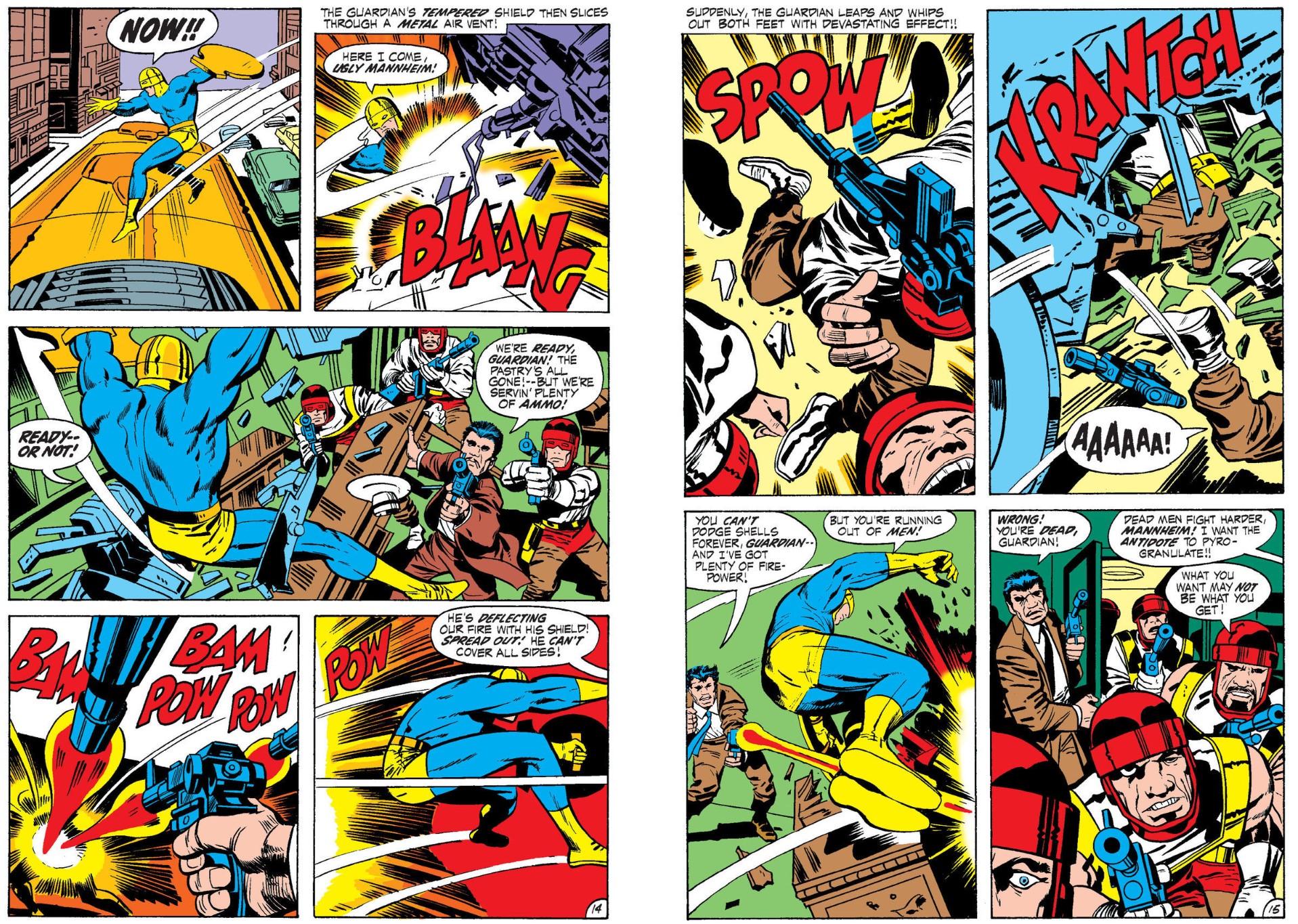
As always the action opens with a Dynamo solo tale as ‘Strength is Not Enough’ by an unknown scripter, Steve Ditko, Dan Adkins & Wally Wood sees S.P.I.D.E.R. unleash a petty thug transformed into human weapon able to outpower the hero. Sadly, Rocky Stone loved to fight but had a conscience, and when he learned from Dynmao that his rebuild left him with only days to live he sought to make amends on his own terms. Fighting fire with fire was a persistent theme then, as Lightning battled a super-fast ‘Speed Demon’ unleashed by S.P.I.D.E.R.’s Nazi-trained mad scientist Herr Doktor in a rapidly unfolding romp by Steve Skeates, Mike Sekowsky & Frank Giacoia while android avenger NoMan faces ‘The Rock’ (John Giunta & Giacoia): a seemingly unkillable madman with the ability to vitrify his victims and petrify buildings…

Lightning quits using the speed augmenter and returns to the T.H.U.N.D.E.R. Agent squad in a tense thriller by Skeates, Mike Sekowsky & Giacoia, but the act is merely a ploy to locate ‘The Road to Spider HQ’ after which flying agent in Craig Lawson suits up in his heavily armed augmented flight-costume to crush another neo-Nazi revival in Manny Stallman’s politically-charged battle bonanza ‘The Raven Battles the Storm Troopers of Xochimilco’

Behind a Wally Wood cover for Dynamo #4, ‘The Maze’ (Wood & Dan Adkins) sees the strongman undergo terrifying psychologically reinforcement prior to being beamed to another world to face aliens that have previously probed Earth after which Ralph Reese, Joe Orlando, Adkins & Wood reveal the teething of a voice-controlled Thunderbelt in ‘The Secret Word is…’, before Reese & Chic Stone depict the awful monkeyshines of ‘Dynamo’s Day Off’ and the seductive power of returned foe The Iron Maiden who uses her wiles and stuff to turn the super-agent into ‘The Weakest Man in the World’

The fun expands and concludes with a tale of T.H.U.N.D.E.R. Agent Weed (a character Wally Wood regarded as his “spirit animal”) as ‘Once Upon a Time’ (Wood & Ditko) sees the seedy spook reinterpret state secrets and the final battle with the Iron Maiden as an expurgated fairy tale for the kids he’s babysitting…

The big spy bubble was bursting by this point and the spin-off titles had all folded by the time T.H.U.N.D.E.R. Agents #13 was released. The anthological line up continued as always however, and opens here with Adkins & Wood’s ‘ “A” Bullet for Dynamo’ as a handheld atom bomb launcher is stolen by a S.P.I.D.E.R. infiltrator and only Len Brown has any chance of averting ultimate armageddon…

Jerry Siegel & Ogden Whitney then had NoMan seemingly ‘Escape From Destiny’ when a bizarre accident implants his consciousness in a human body. Sadly, conscience and sense of duty ruin his dreams of real life before Steve Skeates and Stone unite to pit Lightning against evil duplicates in ‘The Quick and the Changing’ and the entire T.H.U.N.D.E.R. Agents cadre unites against a villain using ‘The Black Helmet’ once used by Menthor in a titanic tussle by Reese, Wood & George Tuska. The issue ends with an unused U.N.D.E.R.S.E.A. Agent short by Skeates & Paul Reinman. Evil android duplicates also infest this fishy tale as Davy Jones and assistant Skooby inadvertently invade ‘The Second Atlantis’ and foils a dastardly plot to replace all their friends and allies…

Sporting a Gil Kane Raven cover, T.H.U.N.D.E.R. Agents #14 opens with Ditko & Wood & Adkin’s ‘Dynamo vs Andor! Return Engagement’: another spectacular bravura battle between the agent and a misunderstood modern Prometheus.

Long ago the Warlords stole a human baby and spent decades turning the waif into a biological superman devoid of sentiment or compassion. Sadly, they lost all control of the living weapon once he met fellow mortals. Since their defeat, the pitiful misfit’s attempts to rejoin mankind are constantly thwarted and derailed. Here, his latest sanctuary – a hippy commune – is taken over by S.P.I.D.E.R. until he single-handedly repels them and in retaliation they orchestrate a clash with their other nemesis Len Brown…

Lightning’s campaign against disguise master Mock-Man intensifies in return match ‘To Fight is to Die’ by Skeates & Stone and ends with the hero the loser, after which S.P.I.D.E.R. also score a win by reprogramming NoMan and making him an operative ‘On the Other Side’ (Skeates & Giunta) before Kane writes and illustrates ‘Darkly Sees the Prophet’ wherein Raven confronts a rabble rousing, clairvoyant demagogue who is far more than he seems before the entire gang reassembles to save New York and the UN building from terrifying weapons platform ‘The Fist of Zeus’ (anonymous & George Tuska).

With stories all shaded in favour of fast pace, knowing wit, sparse dialogue, explosive action and breathtaking visuals, T.H.U.N.D.E.R. Agents was decades ahead of its time and informed everything in Fights ‘n’ Tights comics that came after it. These are truly timeless comic classics which improve with every reading, so do yourself a favour and add these landmark super-sagas to your collection.
T.H.U.N.D.E.R. Agents Classics volume 5 © 2015 Radiant Assets, LLC. All rights reserved.

Scorchy Smith: Partners in Danger


By Noel Sickles (Nostalgia Press)
ISBN10: 0-87897-029-0 (TPB)

This book includes Discriminatory Content produced during less enlightened times.

This is a big year for comics and strip anniversaries. Here’s one of the very best; but good luck and deep pockets to you if you decide to act on my fervent recommendations…

For one of the most influential and well-regarded comics strips of all time, aviation feature Scorchy Smith is also one of the most enigmatic and unreachable. A surprisingly long-lived proposition running in total from March 17th 1930 to December 30th 1961, the strip took off in the heyday of adventure comics and employed a pretty impressive roster of story-makers – officially ten in total including Bert Christman (The Sandman), Frank Robbins (Johnny Hazard) and George Tuska (Buck Rogers). However, it achieved its zenith in the mere three years pioneering cartoon visionary Noel Sickles steered its course.

Noel Douglas Sickles (January 24, 1910-October 3, 1982) had a very short and barely acknowledged career as a newspaper cartoonist. He worked as a jobbing illustrator in the features department of the Associated Press – an organisation that provided top-rated news items but only cheap (if high-quality) filler material such as cartoons, ads, comic strips, recipes, horoscopes, puzzles: All the pages a local newspaper might need but couldn’t afford to produce themselves…

In 1934 Sickles took over the inexplicably popular aviation strip Scorchy Smith from animator & political cartoonist John Terry, after the creator/originator contracted rapid-acting terminal tuberculosis. The publishers required Sickles to emulate Terry’s style, which Sickles diligently did (with his first credited strip on April 2nd 1934) until Terry’s death. At that point he was invited to make the strip his own and – a driven experimenter – he replaced Terry’s scratchy, cross-hatched, intensely feathered methods with a moody impressionism that used volume, solid blacks and a careful manipulation of light sources to tell his tales. He also traded standard proscenium arch layouts for impressionistically styled (if not actually expressionistic), cinematic composition which made backgrounds and scenery an integral part of the story-telling process.

An exceedingly straight action/drama serial about a pilot for hire based on the public persona of Charles Lindbergh, the high-flying exploits of named star Scorchy Smith catalogue the travels of a stout hearted, valiant Knight of the Skies, complete with trusty sidekick, “Heinie”, flying about and Doing Good. That’s it.

Sickles famously never worked to a plan when writing the strip, he just made it up as he went along to avoid boring himself. For an extended exploration of his chimeric art process you should read R C Harvey’s Meanwhile…: a superb biography of Sickles’s friend and studio-mate Milton Caniff, who sat across from the innovator taking notes and making his own inspired style revolutions…

Stories abound that the two frequently collaborated. Certainly, Caniff admitted to helping out with deadlines and story-polishing, but the bold visuals were always the product of a driven and dedicated seeker of artistic truths. The Chiaroscurist style developed by Sickles was adopted by Caniff, although he largely eschewed the lavish use of photomechanical dot-screens Sickles applied to create different flavours of Black in his monochrome masterpieces.

Reprinted in this slim tome are three thrillers from that brief period. ‘Lafarge’s Gold’ (10th October 1935 – January 30th 1936), ‘New York, N. Y.’ (January 31st 1936 – March 18th 1936) and ‘Desert Escape’ (March 19th 1936 – August 14th 1936) all come from the very end of Sickles’ strip career, with a pretty girl swindled out of a goldmine, big-city conmen, and Tuaregs and the Foreign Legion providing admittedly lacklustre narrative maguffins. However, the bravura vivacity and artistic flair employed by Sickles to tell these tales elevate the B-movie plots into breathtaking high art drama by the sheer magnificence of the drawing and design.

Over his tenure, the great experimenter pushed the minor strip’s syndication to over 250 papers, so he asked for a raise. When he was refused, he quit, with his last episode published on October 24th 1936. Noel Sickles left the restricted and drudge-work world of newspaper strips, chasing the greater challenge of higher education. He eventually settled into the more appreciative and challenging magazine illustration field, making new fans in the Saturday Evening Post, Life and Readers Digest. His few months in narrative story-telling changed our entire industry, not so much with what he did, but by the way he did it and who he shared his discoveries with. He is an unsung immortal, and his brief output deserves a commemorative, retrospective collection more than any other creator that I can think of. Until the precious few previous collections are rereleased – and preferably in digitised formats – lost gems like this will have to suffice.
© 1936 The A. P.

Mac Raboy’s Flash Gordon volume 4


By Mac Raboy & Don Moore, Dan Barry & various (Dark Horse Books)
ISBN: 978-156971-979-9 (TPB)

This book includes Discriminatory Content produced in less enlightened times.

By almost every metric, Flash Gordon is the most influential comic strip in the world. When the hero debuted on Sunday January 7th 1934 (Happy Birthday Flash!) with equally superb Jungle Jim running as a supplementary “topper” strip, it was a slick, sophisticated answer to Philip Nolan & Dick Calkins’ revolutionary, ideas-packed, inspirational, but quirkily clunky Buck Rogers (which also launched on January 7th – albeit in 1929) with two fresh elements added to the wonderment: Classical Lyricism and Poetic Dynamism. The newcomer became a weekly invitation to stunningly exotic glamour and astonishing beauty.

Where Buck merged traditional adventure with groundbreaking science concepts, Flash reinterpreted fairy tales, hero epics and mythology, draping them in the spectacular trappings of contemporary futurism, with the varying “rays”, “engines” and “motors” of modern pulp sci fi substituting for trusty swords and lances. There were also plenty of those too – and exotic craft and contraptions stood in for galleons, chariots and magic carpets. Look closely, though, and you’ll see cowboys, gangsters and of course, contemporary flying saucer fetishes adding flourish to the fanciful fables. The narrative trick made the far-fetched satisfactorily familiar – and was continued with contemporary trends and innovations by Austin Briggs and Don Moore before Mac Raboy (with Moore and Robert Rogers) took over the Sunday strips for a groundbreakingly modern yet comfortably familiar tenure lasting from 1948 to 1967.

The sheer artistic talent of Raymond, his compositional skills, fine linework, eye for clean, concise detail and just plain genius for drawing beautiful people and things, swiftly made this the strip that all young artists swiped from literally all over the world. When original material comic books began a few years later, many talented kids used Gordon as their model and ticket to future success in the field of adventure strips. Almost all the others went with Raymond’s stylistic polar opposite: emulating Milton Caniff’s expressionist masterwork Terry and the Pirates (and to see one of his better disciples check out Beyond Mars, limned by the wonderful Lee Elias).

Flash Gordon began on present-day Earth (which was 1934, remember?) with a wandering world about to smash into our planet. As global panic ensued, polo player Flash and fellow passenger Dale Arden narrowly escaped disaster when a meteor fragment downed their airliner. They landed on the estate of tormented genius Dr. Hans Zarkov, who imprisoned them in the rocket-ship he had built. His plan? To fly the ship directly at the astral invader and deflect it from Earth by crashing into it! Thus began a decade of sheer escapist magic in a Ruritanian Neverland: a blend of Camelot, Oz, John Carter of Mars and a hundred other fantasy realms promising paradise yet concealing vipers, ogres and demons, all cloaked in a glimmering sheen of sleek scientific speculation. Worthy adversaries such as utterly evil yet magnetic Ming, emperor of the fantastic wandering planet; myriad exotic races and shattering conflicts offered a fantastic alternative to drab and dangerous reality for millions of avid readers around the world.

With Moore handling the bulk of scripts, Alex Raymond’s ‘On the Planet Mongo’ ran every Sunday until 1944, when the artist joined the Marines. On his return, he forsook wild imaginings for sober reality by introducing gentleman gumshoe Rip Kirby. The public’s unmissable weekly appointment with wonderment perforce continued under the artistic auspices of Austin Briggs – who had drawn the monochrome daily instalments since 1940.

In 1948, eight years after beginning his career drawing for the Harry A. Chesler production “shop”, comic book artist Emmanuel “Mac” Raboy took over illustrating the Sunday page. Moore remained as scripter and began co-writing with the new artist. Raboy’s sleek, fine-line brush style – heavily influenced by his idol Raymond – had made his work on Captain Marvel Jr., Kid Eternity and especially Green Lama a pinnacle of artistic quality in the early days of the proliferating superhero genre. His seemingly inevitable assumption of Flash Gordon’s extraordinary exploits led to a renaissance of the strip and in a rapidly evolving post-war world, it became once more a benchmark of timeless, hyper-realistic quality escapism which only Hal Foster’s Prince Valiant could match.

This fourth and final 276-page paperback volume – printed in stark monochrome, landscape format and still criminally out-of-print/long overdue for a fresh edition – spans December 16th 1962 through December 31st 1967 – by which time successor Dan Barry was already adding his artistic contributions to the final chapter (from December 24th). After one last informative appraisal of Raboy in Bruce Jones’ Introduction ‘Walking with Giants’ it’s time for one last blast-off as the adventure resumes with already-in-progress thriller ‘Sons of Saturn’… Sequence SO91 had begun on October 21st 1962 and cliffhangerly closed the previous volume barely weeks in. It resumes here with the episode for December 16th and carries on until January 20th 1963 revealing how the hitherto unsuspected super-civilisation thriving in the clouds of the Sixth Planet is revealed when an Earth probe provokes its current overlord to determine human nature and resource by sending super-criminal outcast Baldr to plague, punish and test them. That results in the indestructible giant breaking into Flash’s ship and going on a rampage, but ultimately alien force proves no match for human – i.e. Flash Gordon’s – ingenuity and the embattled visitors accidentally initiate a sudden and very permanent regime change…

Running from January 27th to April 14th pure cold war paranoia shapes sequence S092. ‘The Force Dome’ sees well-meaning Professor Howe build a perfectly impenetrable protective energy barrier and convince the authorities to let him run a live test by shielding all of Metropole City. When Howe dies suddenly the experiment goes awry and the generators can’t be switched off. Thankfully, Flash and Zarkov are on site and able to avert the crisis before all the air under the city-sized bubble is used up…

Its back to the beyond next as (S093: 21/4/63 – 14/7/63) finds our hero further testing the bounds of Earth’s recently-developed Faster-Than-Light technologies, with Flash despatched to a far star system to discover what happened to an off-line ‘Star Beacon’ that has stopped providing subspace navigation data. That all sounds quite technical, but it’s just a plot device to enable Flash & Co to wryly clash with cunning alien primitives after which it’s back to Earth and the Himalayas to rescue explorer Bill Penrose from fabled monsters (S094: 21/7/63-17/11/63). However, as Flash digs deeper, he learns these ‘Yeti’ are actually robots employed by extraterrestrial resource bandits to steal uranium, resulting in an epic battle beneath the Earth, before returning to space and a new station orbiting Jupiter. Set on Earth’s newly-constructed interstellar transit station, sequence S095 (24/11/63 to 15/3/1964) sees Dale and Flash accidentally in loco parentis to Miki – an extremely impulsive ‘Boy From Another World’ …and his disruptively radioactive pet Zhlubb

The furore builds as the star waifs suddenly go missing just as interplanetary bandit trio the Breen Brothers invade the station whilst Flash is testing Zarkov’s latest super-ship, triggering a monumental and manic battle beyond the stars. When the shooting stops and with Miki restored to his parents, Flash finally boosts off in the new FTL vessel, destined for a colony world that has called for help by sending back all its women and children. In truth, the castaways’ return is a bid by aliens on a dying world who seek to inveigle tribute and rations for their starving civilisation by holding the male human colonists hostage.

Backed up by colonist Kitty Corum and rash, overconfident Star Patrol Special Service recruit Dino, Flash’s test ride becomes a rescue/diplomatic mission to the ‘Dark Sun of Dragor’ (S096: 22/3/ to 7/19/64): a most unconventional confrontation that culminates in the death of a star system, followed by a brief diversion. Spanning 26th July to November 8th, sequence S097 sees a family of giant, shapeshifting aliens crash on Earth and their colossal child faces typical panic and bigotry until Dale steps in to salve tensions and save ‘The Chameleon’, prior to sheer arrogance almost destroying the world’s hopes of halting chaotic storms caused by solar flares and securing reliable ‘Man-Made Weather’ (S098: 15/11/64 – 2/14/February 65). The problem is a clash of wills between abrasive Dr Franz Graf and Zarkov, but eventually the meteorological fireworks spark a world-saving inspiration…

Another mountaintop yarn finds Flash and junior shuttle pilot Wally Green captive of the ‘Lost Tribe of the Andes’ (S099: February 21st to 13th June), facing the bellicose descendants of Spanish conquistadors shielded from progress for hundreds of years and ultimately duelling dastardly power-hungry despot-in-waiting El Mono, before a return to modern civilisation brings the first Moon’s Fair and a transport nightmare when the best pilot in space gets involved in transporting Michelangelo’s David to the exhibition site. It all results in ‘The Greatest Art Theft’ (SI00: June 20th – October 10th) as petty tyrant/organised crime overlord Baron Borgaz purloins the masterpiece for his private orbital fiefdom and is vain enough to allow Flash entrance to search his sinister, thug-&-monster-stuffed citadel…

Next comes a yarn older British fans might recognise as part of the 1967 digest series World Adventure Library: a line that also included Mandrake the Magician, The Phantom, The Man from U.N.C.L.E. and Batman. Here Flash plays space cop in pursuit of devious disguise artist/thief Merlyn, who swindles his way across the solar system and even escapes Gordon’s justice… but not his fate or just deserts in year spanning comedic change-of-pace ‘Con Man in Space’ (SI01: 17/10/1965 to 30/01/1966). It’s followed by ‘A Visit From Mercury’ (February 6th to June 5th ’66 and another tale reprinted in the UK) as a trip to erupting volcano Vesuvius allows “impervium”-clad Flash, Dale & Zarkov to enter a undiscovered base deep in the magma, where visitors fleeing the first rock from the sun are hiding. Sheltered from geological upheaval and basking in Earth’s warmth, they’re ultimately restored to their point of origin with Earth’s aid, but only after Gordon deals with flaming recidivist usurper Janj

Old-style mystery and monster hunting shapes survival saga ‘Death World’ (SI03: 12/06 – 23/10/66) as Flash and a Space Agency Survival Corps squad led by Sikh commander Singh are despatched to learn what caused the disappearance of an entire human colony and rise of a swathe of killer beasts. What they discover changes lives and the annals of bio-science, before Flash tangles with another low-orbit lowlife when ‘The Duke of Naples’ (SI04: 30th October 1966 – April 2nd 1967) reinstitutes privateering, slave-taking and gladiatorial combat on his private space station in his passionately plutocratic desire to return humanity to feudalism, after which big science engineering finds Flash and Zarkov mediating war between grudge-bearing Madame Mimi Duclos and martinet Godfrey Ledge as each attempts to seize control and complete construction of ‘The Moon Launcher’ (April 9th to July 16th). The ion launch platform is an obvious and permanent boon to human space expansion, but the project takes on desperate urgency after explorers on Pluto encounter trouble and the acceleration launcher offers the only possibility of getting a rescue ship to them in time.

The bitter war between the project chiefs sparks industrial strife, worker mutiny and even criminal changes against Flash’s new best pal Pancho, but sooner rather than later the job is done and Gordon (plus fugitive stowaway Pancho) are rocketing into infernal darkness and Raboy’s last adventure.  Sequence SI06 spans 23/7/1967 to 7/1/1968 (with Dan Barry taking over on December 24th) as the voyagers find the lost explorers but are ‘Captured on Pluto’ by super-advanced aliens playing mindgames and conjuring fantastic worlds and beings in a cosmic scaled romp deeply redolent of 1964 Star Trek pilot episode The Cage

To Be Continued… by other hands

Each week as he toiled on the strip, Raboy produced ever-more expansive artwork filled with distressed damsels, deadly monsters, incredible civilisations, increasingly authentic space hardware and locales, and all sorts of outrageous adventure that continued until the illustrator’s untimely death in 1967. Perhaps it was a kindness. He was the last great Golden Age romanticist illustrator and his lushly lavish, freely-flowing adoration of perfected human form was beginning to stale in popular taste. The Daily feature had already switched to the solid, chunky, He-Manly burly realism of Dan Barry and Frank Frazetta, but here at least the last outpost of ethereally beautiful heroism and pretty perils still prevailed: a dream realm you can visit as easily and often as Flash, Dale & Zarkov popped between planets, just by tracking down this book and the one which preceded it…
© 2003 King Features Syndicate Inc. ™ & © Hearst Holdings, Inc. All rights reserved.

Dandy and Beano Present The Comics at Christmas


By Robert Duncan Low, Dudley D. Watkins, Allan Morley, James Crichton, Davey Law, Eric Roberts, David Sutherland, Ken Reid, Bill Holroyd, Reg Carter, Jim Petrie, Malcolm Judge, Robert Nixon, Barrie Appleby, Gordon Bell, Sam Fair, John Brown, James Clark, Basil Blackaller, Vic Neill, Hugh Morren, Bob McGrath, Tom Paterson, John Sherwood, Hugh McNiel, Jimmy Hughes, Charlie Gordon, George Martin, Jack Prout, Sandy Calder, Charles Grigg, Ron Spencer, the Dinelli Brothers  & many & various (D.D. Thomson & Co, Ltd.)
ISBN: 978-0-85116-636-0 (HB)

Win’s Christmas Gift Recommendation: Evergreen Seasonal Traditions Celebrated and Ideal Last-Minute Gift… 10/10

This book includes Discriminatory Content produced in less enlightened times.

DC Thompson’s publications have always played a big part in Britain’s Christmas festivities, so let’s revel in the Good Old Days of comics and look at what their publications have offered to celebrate the season via a lovingly curated accumulation of Scotland’s greatest cartoon stars and artisans.

Released in 1997 as part of DC Thomson’s Sixtieth Anniversary celebrations of their children’s periodicals division – which has, more than any other, shaped the psyches of generations of kids – this splendidly oversized (297 x 206mm), exceedingly jolly 144-page hardback compilation justifiably glories in the incredible wealth of ebullient creativity that paraded through the flimsy colourful pages of The Beano and The Dandy during the days and weeks of December from 1937 to the end of the century.

Admittedly, the book required some careful editing and paste-up additions – editorially explaining for younger or more socially evolved readers the subtle changes in attitude that occurred over more than half a century – to tone down and/or expurgate a few of the more egregious terms that don’t sit well with 21st century sensibilities, but otherwise this is a superb cartoon commemoration of a time and state of mind that means so much to us all. It’s also an exquisitely evergreen tribute to cartoon storytelling at its best which could stand a bit more curating and re-release…

The shape and structure of British kids’ cartoon reading owes a huge debt to writer/editor Robert Duncan Low (1895-1980) who was probably DC Thomson’s greatest creative find. Low began at the publishing monolith as a journalist, rising to Managing Editor of Children’s Publications where he conceived and launched (between 1921 and 1933) the company’s Big Five story-papers for boys. Those rip-roaring illustrated prose periodicals comprised Adventure, The Rover, The Wizard, The Skipper and The Hotspur. In 1936 his next brilliant idea was The Fun Section: an 8-page pull-out supplement for Scottish national newspaper The Sunday Post consisting of comic strips. The illustrated accessory premiered on March 8th and from the very outset The Broons and Oor Wullie – both limned by the incomparable Dudley Watkins – were its unchallenged star turns. In December 1937, Low launched DC Thomson’s first weekly pictorial comic. The Dandy was followed by The Beano in 1938 and early-reading title The Magic Comic one year after that. War-time paper shortages and rationing sadly curtailed this strip periodical revolution, and it was 1953 before the next wave of cartoon caper picture-papers. To supplement Beano and Dandy, the ball started rolling again with The Topper, closely followed by a host of new titles like Beezer and Sparky augmenting the expanding post-war line.

Every kid who grew up reading comics has their own personal nostalgia-filled nirvana, and DC Thomson have always sagely left that choice to us whilst striving to keep all eras alive with the carefully-tooled collectors’ albums like this one. These offer the appeal and panache of coffee-table art books; gathering material from nearly nine decades of publishing – plus oodles of original art reproductions – but rather than just tantalising and frustrating incomplete extracts, here the reader gets complete stories starring immortal characters from comics and Christmas Annuals past…

Once upon a time The Dandy was the third-longest running comic in the world (behind Italy’s Il Giornalino (launched in 1924) and America’s Detective Comics in March 1937). Premiering on December 4th 1937, it broke the mould of traditional British predecessors by using word balloons and captions rather than narrative blocks of text under the sequential picture frames. A monster success, it was followed eight months later by The Beano (July 30th 1938) and together they utterly revolutionised how children’s publications looked and, most importantly, were read. Over the decades the “terrible twins” spawned a bevy of unforgettable and beloved household names to delight generations of avidly devoted readers. and end of year celebrations were blessed with extraordinary efforts in the weeklies as well as bumper bonanzas of comics’ stars in breathtakingly addictive hardback annuals.

As WWII progressed rationing of paper and ink forced the “children’s papers” into an alternating fortnightly schedule: on September 6th 1941, only The Dandy was published. A week later just The Beano appeared. Happily, they returned to normal weekly editions on 30th July 1949. During the war the Annuals alternated years too.

This superb celebration of Celtic creativity is packed literally cover-to-cover with brilliant strips. The fun starts on the inside front with a riotous party scene featuring all the assorted favourites, illustrated by indisputable key man Dudley D. Watkins, followed by Korky the Cat frontispiece (by James Crichton), and bombastic title page with western wonderman Desperate Dan standing in for Santa. An introductory spread follows, reliving a manic Davey Law Dennis the Menace Xmas episode from the 1960s, as well as a quartet of Beano Christmas cards from the same era, presaging seasonally-themed comic strip offerings beginning with Dandy delinquent Dirty Dick (by Eric Roberts) and guest star stuffed ‘Xmas Shopping with Biffo the Bear’ (David Sutherland) and Jim Petrie’s Minnie the Minx impatiently ransacking the house for her prezzies also from the 1960s.

There is a selection of Christmas week front pages (actually covers but we never wasted an opportunity for a full gag strip here!), beginning with Beano #169, (December 20th 1941) featuring Reg Carter’s obstreperous ostrich Big Eggo getting well-deserved revenge via Xmas lights during a blackout, after which Colonel Crackpot’s Circus (Malcolm Judge) and Sutherland’s Bash Street Kids frolic as prelude to robot schoolboy Brassneck (Bill Holroyd) demonstrating the meaning of the season in a savvy and sterling spin on A Christmas Carol, even as Robert Nixon – or perhaps Ron Spencer – details how “Red Indian” scamp Little Plum gets a tree for the tribe, before Ken Reid’s wild west rogue Bing-Bang Benny scores a free dinner from his worst enemies, as the triumphs of Roger the Dodger are encapsulated in a multifarious montage of strips by Ken Reid, Barrie Appleby, Gordon Bell and others.

Watkins illuminates Desperate Dan’s attempts to enjoy a white Christmas and Law details similar catastrophic capers for Dennis the Menace before Watkins reveals how the upper class live in a party favour from Beano starring veteran class warriors Lord Snooty and his Pals, after which ‘Jimmy and his Grockle’ (a kind of Doberman dragon) reap just rewards for wrecking other folks’ presents. Illustrated by James Clark, the feature stems from Dandy in 1938, recycled and adapted from prose 1932 “Boys Paper” The Rover – where it was Jimmy Johnson’s Grockle.

Holroyd’s The Tricks of Screwy Driver (a junior handyman inventor of variable efficacy – especially in the Holiday Season) segues to a Biffo front cover strip (Beano #649, December 25th 1954) before the Bash Street Kids destroy a school concert and 1940s feudal adventurer Danny Longlegs (Watkins) delays his voyage East to share the Yule festival with an embattled knight. A montage of Beano B-stars including Sammy Shrinko, Have-a-go-Joe, Little Nell and Peter Pell, The Magic Lollipops, Maxi’s Taxis and Rip Van Wink compliment a triptych of ’40’s Dandy strips Freddy the Fearless Fly (Allan Morley), Hair Oil Hal (John Brown) and Sam Fair’s Meddlesome Matty, easing us into a section concentrating on gluttony and the big blowout as seen in Eric Robert’s hospital-ward feast feature Ginger’s Super Jeep, Basil Blackaller’s Hairy Dan and the saga of a stolen plum pudding and The McTickles (Vic Neill) salutary tale of an escaped Haggis. A classic Korky the Cat Christmas yarn segues neatly into a Reid fantasy romp starring Ali Ha-Ha and the 40 Thieves, after which Hugh Morren’s The Smasher fights for his right to party as prelude to a look at a wartime classic. Sam Fair was – as always – in excoriating top form with superbly manic Addie and Hermy – slapstick assaults on Adolf Hitler and Hermann Wilhelm Goering – and the selection here helped counter Home Front austerity by punfully positing how bad the German High Command were having it…

Football mad Ball Boy (Malcolm Judge) and a vintage Desperate Dan strip lead to more Watkins wonderment via a double-length revel in Lord Snooty’s castle (and no, the topper-wearing posh boy was never the pattern for a certain over-privileged Tory lounging lizard!!! It’s just an uncannily creepy coincidence cum laude and example of life imitating art), before Colonel Crackpot’s Circus stages an encore and Billy Whizz (Judge again) finds time to attend multiple nosh-ups in one short day. Odd couple Big Head and Thick Head (Reid) work far too hard for their places at the youth club bash whereas the ever-ravenous Three Bears (Bob McGrath) literally fall into a festive feast but eternal loser Calamity James (Tom Paterson) loses out yet again, unlike Law’s Corporal Clott who manages to become a hero to his comrades by getting rid of Grinch-like Colonel Grumbly

A 1940’s Biffo extravaganza starring the entire Beano cast takes us neatly into a rousing comedy romp starring wonderful Eric Roberts’ immortal rascal-conman Winker Watson, who saves his chums from being stuck at school over the holidays in a full-length fable.

What’s Christmas without loot? A host of comics stars weigh in on presents in a section that begins with the cover of The Dandy #358 (December 20th 1947) as Korky’s greed is aptly rewarded, before John Sherwood’s dreamer Les Pretend (He’s Round the Bend!) wakes up frustrated, Dennis the Menace turns unwanted gifts into offensive weapons and – from December 1950 – Hugh McNeil’s Pansy Potter, the Strongman’s Daughter gives Santa Claus an uncomfortably emphatic helping hand…

From 1987, Appleby’s unlovable infants Cuddles and Dimples wreck another Christmas before Desperate Dawg (from 1973 by George Martin) uses canine ingenuity to pimp that legendary sleigh, whilst Dodgy Roger outsmarts himself but still comes up trumps in the gift department. Lassie-like wonder dog Black Bob was popular enough to support his own book series in the 1950s (illustrated by Jack Prout) and here traditionally rendered ‘Black Bob the Dandy Wonder Christmas dog’ sees the hairy paragon raise the flagging spirits of a ward full of ailing bairns before Charles Grigg’s Prince Whoopee (Your Pal from the Palace) (and a strip that could be revived instantly for today’s more cynical, satire-saturated market) learns the downside of childish pranks, after which a tantalising photo feature on assorted Beano and Dandy figurines leads to a montage of ancient robot romps starring with Tin-Can Tommy, the Clockwork Boy (by the Dinelli Brothers & Sam Fair), featuring the mechanical misfit as well as his brother Babe and tin cat Clanky. An extended Xmas excursion for Minnie the Minx and vintage larks with Keyhole Kate (Allan Morley), Gordon Bell’s Pup’s Parade starring the Bash Street Dogs and George Martin’s Sunny Boy – in Santa’s Grotto – bring us to another brilliant cover spread: this one for The Dandy #204, from December 27th 1941, with Korky losing out after trying to outsmart Santa.

A rare prose yuletide yarn starring sagacious moggy Sooty Solomon shares space with a Christmas comic caper concerning Raggy Muffin the Dandy Dog, before Pleasant Presents offers a gaggle of want’s lists from the comics characters before the animal antics resume with doses of doggerel clipped from annual feature Korky’s Christmas Greeting and a lengthy yarn starring Gnasher and his hairy pal Dennis the Menace. Stocking stuffing and tree trimming occupy Roger the Dodger and Tom, Dick and Sally (Dave Jenner?) but Nixon’s Ivy the Terrible is all about the packages. Focus shifts to excerpts from other times of year next, beginning with Prince Whoopee’s bath day, Billy Whizz on ‘Shoesday’ and an April Fool’s Day cover for Dandy #70, from 1939. Following on, ‘Sports Day’ is celebrated on Beano #465 (June 16th 1951)’s cover whilst Desperate Dan turns April 1st into April dooms day before similarly wrecking Easter, Pancake Day and Bonfire Night in a mini marathon of smashing strips. Equally tough and disastrously well-meaning, Pansy Potter in Wonderland makes herself persona non grata with fairy tale folk prior to Lord Snooty and his Pals’ good deed resulting in a catastrophic ‘Biff-day’ before Dennis discovers the joy of graffiti on ‘“Mark-it” Day’.

The section concludes with a Big Eggo Beano cover (#321; November 1st 1947) on a windy day, allowing pint-sized dreamer Wonder Boy to aspire to Santa’s job as Billy Whizz gets a job in the old boy’s grotto and Bully Beef and Chips (Jimmy Hughes) inevitably clash at a party. Watkins delights in depicting Jimmy and his Magic Patch as the lad with a ticket to anywhere stumbles into a north pole plot to burgle Saint Nick. Desperate Dan’s plans to play Santa are sabotaged by his niece & nephew before Sandy Calder’s acrobatic schoolboy avenger Billy the Cat brings to justice a thief who stole the silver from Burnham Academy – and still gets back in time for the school’s Xmas party. George Martin’s school master Jammy Mr. Sammy uses his phenomenal luck to deal with pranksters and thugs whilst Winker Watson fosters a festive feud between his schoolmasters and a local police training college; Nixon’s Grandpa gets Gnomework at a local grotto and Ron Spencer’s bonny bouncing bandit Babyface Finlayson gets locked up to get stuffed, even as The Jocks and the Geordies go to war over sharing an Xmas party, courtesy of the utterly unique stylings of Jimmy Hughes.

Hurtling towards the Eighth Day of Christmas, the final strips here focus on a Ha-Ha-Happy New Year! with a classic Korky confrontation, a harsh Hogmanay hash-up starring Corporal Clott and a frankly disturbing exploit of animal excess and conspicuous consumption from 1940s Bamboo Town as limned by Charlie Gordon. Disaster-prone Dirty Dick shows Eric Roberts at his inspired best in a cautionary tale about resolutions first seen in 1963, allowing the Bash Street Kids and Grandpa to have the cacophonous last words in a brace of action-packed slapstick strips anticipating many more years of fun to come…

Sadly, none of the writers are named and precious few of the artists in this collection but, as always, I’ve offered a best guess as to whom we must thank, and of course I would be so very grateful if anybody seeing this could confirm or deny my suppositions. A miracle of nostalgia and timeless comics marvels, the true magic of this collection is the brilliant art and stories by a host of talents that have literally made Britons who they are today. Bravo to DC Thomson for letting them out to run amok once again and can we do it again, please?

This sturdy celebration of the company’s children’s periodicals division rightly revels in the incredible wealth of ebullient creativity that paraded through their back catalogue: jam-packed with some of the best written, most engagingly drawn strips ever conceived: superbly timeless examples of cartoon storytelling at its best.
© D.C. Thomson & Co., Ltd. 1997. All rights reserved.

Superman: The Dailies volume III: 1941-1942


By Jerry Siegel & Joe Shuster & the Superman Studio (Kitchen Sink Press/DC)
ISBN: 978-1-56389-462-9 (TPB)

Win’s Christmas Gift Recommendation: Up, Up And Forever Away …10/10

This book includes Discriminatory Content produced in less enlightened times.

The American comic book industry – if it existed at all – would be utterly unrecognisable without Superman. Jerry Siegel & Joe Shuster’s unprecedented invention was fervidly adopted by a desperate and joy-starved generation and quite literally gave birth to a genre if not an actual art form. Spawning an army of imitators and variations within three years of his 1938 debut, the intoxicating blend of breakneck, breathtaking action and wish-fulfilment which epitomised the early Man of Steel grew to encompass cops-&-robbers crimebusting, socially reforming dramas, sci fi fantasy, whimsical comedy and, once the war in Europe and the East sucked in America, patriotic relevance for a host of gods, heroes and monsters, all dedicated to profit through exuberant, eye-popping excess and vigorous dashing derring-do.

From the outset, in comic book terms Superman was master of the world. Moreover, whilst transforming the shape of the fledgling funnybook biz, the Man of Tomorrow irresistibly expanded into all areas of the entertainment media. Although we all think of the Cleveland boys’ iconic invention as epitome and acme of comics creation, the truth is that very soon after his springtime debut in Action Comics #1 the Man of Steel was a fictional multimedia monolith in the same league as Popeye, Tarzan, Sherlock Holmes and Mickey Mouse.

We parochial and possessive comics fans too often regard our purest and most powerful icons in purely graphic narrative terms, but the likes of Batman, Spider-Man, Avengers and their hyperkinetic kind long ago outgrew four-colour origins to become fully mythologized modern media creatures familiar in mass markets, across all platforms and age ranges…

Far more people have seen and heard the Man of Steel than have ever read his comic books. His globally syndicated newspaper strips alone were enjoyed by countless millions, and by the time his 20th anniversary rolled around, at the very start of what we call the Silver Age of Comics, he had been a thrice-weekly radio serial star, headlined a series of astounding animated cartoons, become a novel attraction (written by George Lowther) and helmed two films and his first smash, 8-season live-action television show. Superman was a perennial sure-fire success for toy, game, puzzle and apparel manufacturers all over the planet.

Although pretty much a spent force these days, for the majority of the previous century the newspaper comic strip was the Holy Grail that all American cartoonists and graphic narrative storytellers hungered for. Syndicated across the country – and often the planet – it was seen by millions, if not billions, of readers and generally accepted as a more mature and sophisticated form of literature than comic-books. It also paid better, and rightly so. Some of the most enduring and entertaining characters and concepts of all time were created to lure readers from one particular paper to another and many of them grew to be part of a global culture. Mutt and Jeff, Flash Gordon, Dick Tracy, Buck Rogers, Charlie Brown and so many more escaped their humble tawdry newsprint origins to become meta-real: existing in the minds of earthlings from Albuquerque to Zanzibar. Most still do…

The daily Superman newspaper strip launched on 16th January 1939, augmented by a full-colour Sunday page from November 5th of that year. Originally crafted by luminaries like Siegel & Shuster and their studio (Paul Cassidy, Leo Nowak, Dennis Neville, John Sikela, Ed Dobrotka, Paul J. Lauretta & Wayne Boring), the mammoth task required additional talents like strip veteran Jack Burnley and writers including Whitney Ellsworth, Jack Schiff & Alvin Schwartz. The McClure Syndicate feature ran continuously until May 1966, appearing, at its peak, in over 300 daily and 90 Sunday newspapers; a combined readership of more than 20 million. Eventually, Win Mortimer and Curt Swan joined the unflagging Boring & Stan Kaye whilst Bill Finger and Siegel provided stories, telling serial tales largely divorced from comic book continuity throughout years when superheroes were scarcely seen.

This superb, long overdue for re-release collection comes from 1999, re-presents strips #673-866 (episodes 20-28) and is preceded by Steve Vance’s informative, picture and photo-packed introduction ‘Superman Goes Hollywood’, focussing on the hero’s spectacular early triumphs on the big screen in animated and live action formats. If I live long enough, next year I’ll move on to the IDW American classics volumes…

The never-ending battle resumes with Siegel & Shuster attempting something quite spectacular. Although daily strips were never meant to be packaged as units of entertainment but rather present an ongoing, non-stop reading experience, all funnies features incorporated an internal “beginning-middle-end” structure that allowed new readers (preferably in new client regions) to hop aboard the adventure bus. With these tales, however, the creators built in a serial within a serial motif as one deadly enemy enlisted a horde of foes to face the Man of tomorrow, each in his/their own tale…

The saga began on March 10th 1941, as sequence #20, with the initial chapter playing out until April 19th by launching ‘The League to Destroy Superman’ (episodes #673-708). It begins as Daily Planet reporter Clark Kent investigates shady property tycoon Ralph Roland and uncovers a viper’s nest of thugs and bandits resulting in the news hound’s attempted murder. However, after applying his usual heavy-handed solutions, Superman is accused of the manslaughter of one of Roland’s staff – the honest, “nice guy” partner Horace Danvers

Shocked by the accusation and now doubting himself, the Man of Steel is unaware outraged, affronted, arrogant Roland has convened a forum of crime bosses, enemy spies, mad scientists and professional killers, offering $1,000,000 to anyone who can eradicate the vigilante riff-raff…

First to try is Spanish self-proclaimed “super-scientist” Carlos who – with ferocious flunky Rolf – unleashes a wave of diabolical inventions between April 21st and May 22nd in ‘The Scientists of Sudden Death’ (#709-736), all based around luring the caped champion into lethal traps baited with abducted person of interest Lois Lane

The League had also agreed to a gentlemanly running order of attempts, but fiery murderess the Blond Tigress keeps jumping the gun due to her hidden personal stake in the contest…

After epically failing, Carlos is readily replaced by overconfident technologist Block whose weapon can derail trains and shoot planes from the sky but also falls short in ‘The Death Ray’ (#737-774 May 23rd – July 5th).

While the Action Ace is drawing fire, Lois and the Tigress individually and jointly address the bigger mystery of who killed Danvers, and why organised crime is seemingly acting on some hidden mastermind’s agenda: an investigation that keeps both fully in harm’s way all year long…

Evil engineer Coker comes next, but although confident his electro-dart gun can do the job, its short range requires an extra effort and employment of deadly doppelganger ‘The Pseudo-Superman’ (#775-798, July 7th – August 2nd) to get his high-flying target into range. Cue a confusing comedy of errors, twisty twin tumult, and sudden deaths before next contender Slag – AKA ‘The Deadly Dwarf’ – (#799-840 August 4th – September 20th) tries his shaky old hand by deploying his incredible gift for hypnotism. Despite provoking a wave of suicides, terrorism and destruction, Slag too fails to collect the bounty, prompting chemist Fant to modify his plans to kill the hero via a hyper-capsule ‘Explosion’ (#841- 854 September 22nd – October 7th). However, even recruiting Blond Tigress to vamp and distract the caped wonder has no appreciable effect, and last genius standing Sleez orchestrates a crimewave and employs lethal ultimate weapon ‘The Electric Rod’ (#855-876 October 8th – November 1st) with as little success as all his competitors. With the field clear the deeply conflicted final contestant at last officially strikes, but ‘The Blond Tigress Regrets’ (#877-888, November 3rd – November 15th) that she might be playing on the wrong team. That’s confirmed when Lois solves the murder mystery and exposes the big shot behind Superman’s frame up…

The compendium concludes with a slice of justified infomercial bragging as – in loose conjunction with the Man of Tomorrow’s screen triumphs – ‘Superman’s Hollywood Debut’ (#889-966, November 17th 1941 – February 14th 1942) follows Lois & Clark to Lala Land where an impending movie biopic is being hampered by a dearth of suitable leading men. Even after that problem is fixed when klutzy Kent takes off his glasses, a rash of weird accidents seems to indicate someone doesn’t want this Super-flick released…

Cue lights! Action! Cartoonists….

Offering timeless wonders and mesmerising excitement for lovers of action and fantasy, the early Superman is beyond compare. If you love the era or just crave simpler stories from less angst-wracked times, these are perfect comics reading, and this a book you simply must see.
Superman: The Dailies volume III co-published by DC Comics and Kitchen Sink Press. Covers, introduction and all related names, characters and elements are ™ & © DC Comics 1998, 1999. All Rights Reserved.