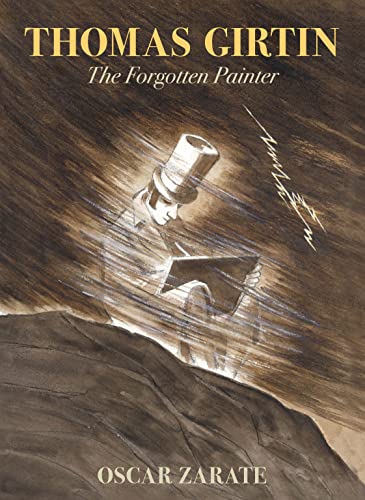

Thomas Girtin: The Forgotten Painter


By Oscar Zárate (SelfMadeHero)
ISBN: 978-1-914224-07-2 (HB/Digital edition)

Oscar Zárate was born in Argentina in 1942. After studying architecture he worked in advertising until 1971, at which time, like so many other countrymen, he migrated to Europe. Restarting his life and career, his design and painting jobs were augmented from 1977 onwards by illustrating histories of scientific and political luminaries (the …For Beginners and Introducing… series). This led to his adapted literary graphic novels Othello (1983) and Dr. Faustus (1986). A year later he collaborated with Alexei Sayle on Geoffrey the Tube Train and the Fat Comedian and in 1991 the award-winning A Small Killing, written by Alan Moore. He also produced socially active comics strips for Fleetway’s Crisis magazine.

A creator of intellect, passion and sensitivity, Zárate has always delivered far more than expected and in his latest magnum opus advances the potential of graphic biography by combining the avowed popular rediscovery of outsider English Master Thomas Girtin: The Forgotten Painter with a compelling (hopefully, largely fictionalised) drama. The players are three modern day artistic apprentices, devout and dedicated yet adrift and floundering in their own highly personalised searches for integrity and eternal truths. Ultimately, they all finally find ways forward by looking back to a rebel genius inexplicably sidelined by history…

Arturo, Sarah and Fred are all mature-student artists who meet up at a weekly life drawing class in London. Each is passionate about their pastime but cannot escape the crippling pressures their regular lives bring. Arturo is from Argentina and still carries self-inflicted scars of betrayal and failure, as well as the shame of having escaped terror at the cost of his family. It makes him seem gruff, distrusting, weary and cynical …

Architect and imminent grandmother-to-be Sarah is crippled by a different kind of guilt: perpetually wracked by how she is not good enough at anything she does. This recently remanifested when her greatest friend from art school reached out after decades of silence and separation. Back then, Sarah had abandoned and ghosted her on the cusp of success and greatness and has ever since writhed in the torment of debilitating guilt only Catholicism can (self) inflict.

Poor Fred is perhaps the most troubled: an honest, fair-minded worker who accidentally uncovered high levels of tax fraud at work. Even after losing his job because of it, he is still being pilloried: on one side pursued by a journalist who wants him to become a whistle-blower and on the other by a gang of heavies his former bosses hired to ensure his silence…

For nearly a year the trio have gradually become friends, discussing art in after-class pub sessions. Now Fred has become an impassioned zealot with a new love. He’s discovered an 18th century genius who changed the shape of English watercolour painting and then simply vanished from public view and memory.

It’s an injustice Fred is determined to set right…

The story of Thomas Girtin is woven throughout their cumulative tale. He is an intriguing mystery and shining exemplar whose gradually reconstructed history inspires each modern-day acolyte to change the course of their own life. Arturo finds strength from the tragically ill-starred artist’s resolve and courage at a time of widespread and earthshaking political unrest: an outright proudly rebel republican in an avidly monarchist nation, despising, decrying and working against the patronage system that supported his work and kept him in luxury.

Sarah finds inspiration in the driven quest for an almost-mystical connection to Nature and a higher truth. Young Girtin was a contemporary, rival and friend of latterday English icon JMW Turner, and at the turn of the 18th century was rapidly growing in renown. Already recognised as a groundbreaking pioneer outselling his old schoolmate in the cutthroat and exploitative art scene of the day, Girtin never rested, but continually strove to capture the fundamental revelations of reality.

That all ended with his early death in 1802, aged 27. Crucially for Sarah, in his search for the truth of time and the cosmos, Girtin martyred himself: dying due to his own obsessive compulsion to capture the elements in all their ferocious fury and restorative glories…

As for Fred, Girtin’s life increasingly becomes his own. Resurrecting and redeeming the lost painter’s reputation and sharing his mastery with the world becomes his reason for living, driving him to make a pilgrimage in Girtin’s footsteps and thereafter reorder the course of his own remaining years…

The twinned stories are subtly and smoothly presented by Zárate using two different styles of illustrative painting; mixing modern-day pastel tones with stark, sepia-tinted historical episodes that reveal – in his and his characters’ eyes at least – who Girtin was and how he lived, thrived and died.

As this monumental tome unfolds and tellingly argues for Girtin’s popular revival and reassessment, the most convincing asset in that campaign are the beautiful original Girtin works. The reproductions of his greatest triumphs – “View near Beddgelert”, “Estuary of the River Taw, Devon”, “Storiths Heights” and his undisputed masterpiece “The White House at Chelsea” – are judiciously folded into the text and include a selection of large gatefold images.

This is a book about Art and a story of artists, operating on the principle that what we see which moves us, we need to share. Once the story’s done here, that can be easily first facilitated by reading erudite and engaging endpiece ‘Thomas Girtin (1775-1802) An Afterword’ by Dr Greg Smith, (Senior Research Fellow, Paul Mellon Centre for Studies in British Art) and the attendant Acknowledgements, Permissions, and copious Bibliography sections.

You can always check him out yourself. There are many places online to see Girtin’s work, and even a few museums, if you’re pushy. Then go tell a like-minded friend.
© Oscar Zárate 2023. All rights reserved.

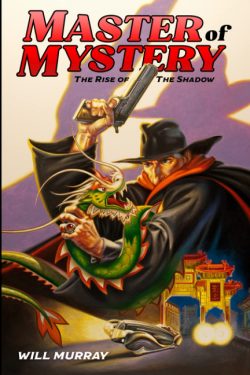
Master of Mystery: The Rise of The Shadow (Will Murray Pulp History Series)


By Will Murray, illustrated by Frank Hamilton, Rick Roe, Colton Worley, Joe DeVito, Edd Cartier & various (Odyssey Publications)
ISBN: 979-8-54I38-708-7 (PB/Digital edition)

In the early 1930s, just as the Great Depression hit hardest, a new kind of literary (and ultimately multimedia) hero was born …or more correctly, evolved. The Shadow afforded thrill-starved Americans measured doses of extraordinary excitement via cheaply produced periodical novels and over eerily charged airwaves via an iconic radio show.

Made exceedingly cheaply and published in their hundreds for every style and genre, “Pulps” bridged stand-alone books and periodical magazines. Results ranged from unforgettably excellent to pitifully dire, and amongst originals and knock-offs of every conceivable stripe, for exotic or esoteric adventure-lovers there were two stars who outshone all others in terms of quality and sheer imagination.

The Superman of his day was Doc Savage, whilst the premier relentless creature of the night darkly dispensing grim justice was the enigmatic vigilante/ultimate detective discussed here.

As seen in Dark Avenger: The Strange Saga of The Shadow (successor to this book) the enthralling enigma grew out of a combination of sources: radio show Detective Story Hour and the Street & Smith publication Detective Story Magazine it promoted; a succession of scary voices variously deployed by Orson Welles, James LaCurto and Frank Readick Jr.) but above all a Depression-era populace in dire need of cathartic entertainment.

From the very start on July 31st 1930, that narratorial “Shadow” was more popular than the stories he highlighted…

How that aural phenomenon was translated into an iconic literary/media sensation and exactly who was responsible forms the basis of this compelling testament as prolific author, scripter and historian Will Murray turns his spotlight on those who contributed to the amalgamated marvel of mystery and imagination.

Following his reminiscence-fuelled Introduction, Murray restates the origin of the character in photo-filled feature ‘The Five O’clock Shadow’ and details how the Street & Smith campaign to make a voice and a feeling real and remunerative spawned a landmark of broadcast entertainment, before ‘Out of the Shadows: Walter Gibson’ offers an engaging and revelatory interview with the magician-turned-crime writer conducted by Murray and Jim Steranko at the 1975 New York Comic Art Convention.

That interview was in a public forum, and the transcript omitted a lengthy digression comprising Gibson’s oral history of the Shadow’s signature fire opal ring. Here – in its entirety – it comprises ‘The Purple Girasol’, after which it’s the turn of ‘Heroic Editor: John L. Nanovic’ to be rediscovered and awarded his share of the acclaim.

Prolific and underrated, successor scripter ‘Theodore Tinsley: Maxwell Grant’s Shadow’ is celebrated all his many works after which we concentrate on illustration as cover artist ‘Graves Gladney Speaks’.

‘Walter B. Gibson Revisited’ revisits an interview with the author from PulpCon 5 (Akron Ohio, July 1976) conducted by Murray and Bob Sampson, discussing his working stance and fellow creatives at Street & Smith, whilst his connection to, expertise and excellence in conjuring and legerdemain are celebrated in ‘Walter Gibson’s Magical Journey’

Back in the realm of visions, an appreciation of a true master of pulp art exploring the mysterious ‘Edd Cartier: Master of Shadows’ is augmented by acknowledgement of the Dark Detective’s most obvious legacy in ‘The Shadowy Roots of Batman’, with ‘Memories of Walter’ synthesizing the emotions stirred up by the author’s passing in December 1985.

Packed with fascinating detail and elucidatory anecdotes, plus plenty of pictures and photos, this beguiling documentary of bygone times and appreciation of the giant shoulders we all stand on, this so readable tome also includes biographies ‘About the Author’ and ultra-fan Tim King, whose crucial role is covered in ‘About our Patron’.

If heroes and history are important to you this Master of Mystery: The Rise of The Shadow is truly unmissable.
© 2021 Will Murray. All rights reserved. Artwork © Condé Nast & used with permission.

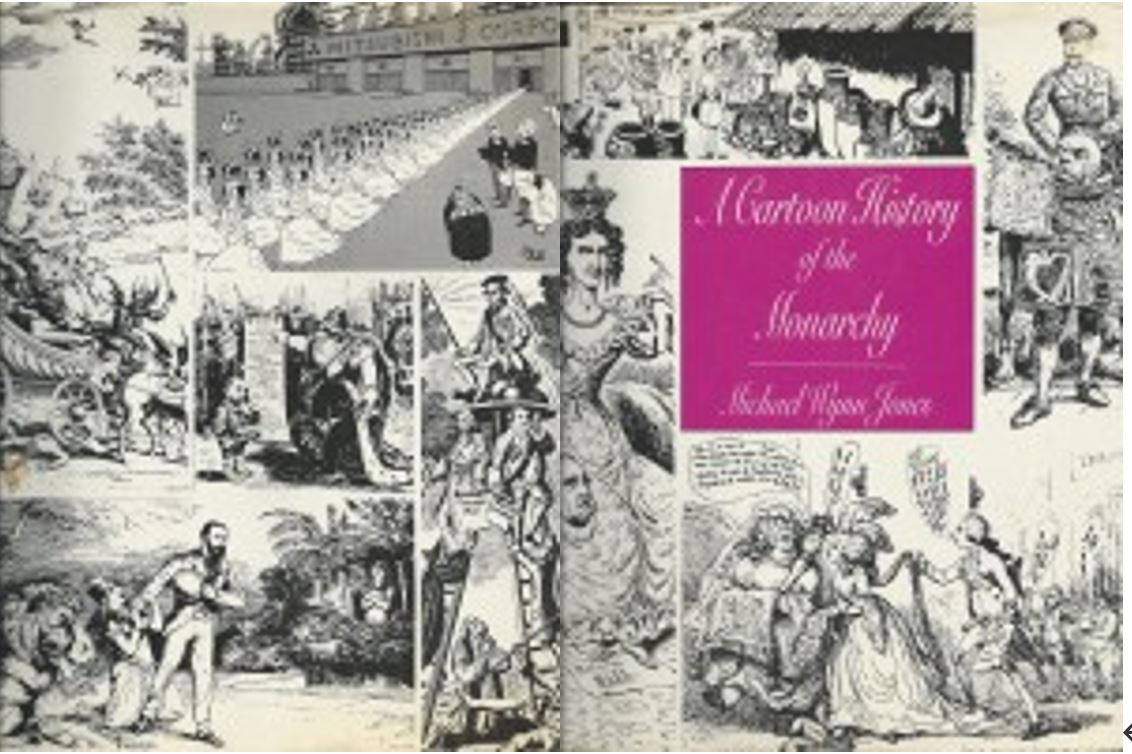
A Cartoon History of the Monarchy


By Michael Wynn Jones and Many & Various (Macmillan)
ASIN: B001H0OAOO (HB), ISBN: 978-0333198056 (PB)

We’re far too reluctant in this country to celebrate the history and quality of our own cartooning tradition; preferring simply to remark on the attention-grabbers or impressive longevity of one or two classic and venerable veterans of the pen-&-ink game for TV soundbites and platform clickbait. The actual truth is that for an incredibly long time the political art movement of the Empire and Commonwealth – and its enemies – was vast, varied and fantastically influential.

The British wing of the form has been magnificently serviced over centuries by masters of form, line, wash and most importantly ideas, repeatedly tickling our funny bones or enraging our sleeping consciences and sensibilities, all whilst poking our communal pomposities and fascinations.

From earliest inception, satiric draughtsmanship has been used to attack and sell: initially ideas, values, opinions and prejudices or but eventually actual products too. In newspapers, magazines and especially comic books, the sheer power of graphic narrative, with its ability to create emotional affinities, has led to the creation of unforgettable images and characters – and the destruction of real people or social systems.

When those creations can affect the daily lives of millions of readers, the force they can apply in the commercial or political arena is well-nigh irresistible…

In Britain, the cartoonist has held a bizarrely precarious position of power for centuries: the deftly designed bombastic broadside or savagely surgical satirical slice instantly capable of ridiculing, exposing, uplifting or deflating the powerfully elevated, unapproachable and apparently untouchable with a simple shaped-charge of scandalous wit and crushingly clear, universally understandable visual metaphor.

For this method of concept transmission, lack of literacy or education is no barrier. As the Catholic Church proved centuries ago with the Stations of the Cross, stained glass windows and a superteam of idealised saints, a picture is worth far more than a thousand words…

For as long as we’ve had printing there have been scurrilous gadfly artists commentating on rulers, society and all iniquities: pictorially haranguing the powerful, pompous, privileged and just plain perfidious through swingeing satire and cunning caricature. Sometimes artists have been just plain mean. Those are usually the best and most memorable…

Britain had no monopoly on talent and indignation, and this canny compendium also frequently features European – and latterly American – takes on our always-scandalous Royals and oddball citizenry…

Released in 1978 and desperately in need of updating and re-issue, A Cartoon History of the Monarchy offers a potted, far from hagiographic history and deliciously skewed view of our Ruling Elite in all their unsavoury glory. Here is an unbroken line of jibes, asides and broadsides culled from diverse sources by jobbing journalist and aficionado of japes, lampoons and sketches Michael Wynn Jones, who casts his discriminating eye from the reign of Elizabeth I up until just before the Silver Jubilee of the second Regina to bear the name…

Following a rota of the Kings and Queens of England, the pomposity-puncturing procession commences with The Age of Intolerance, reproducing cartoons and adding commentary dealing with the doings of the 10 monarchs from the initial Elizabeth I to George II.

Accompanying essays share the zeitgeist of those times; the religious questions as England, Wales, Ireland and eventually Scotland faced numerous crises regarding succession. That issue always revolved around whether the land should be Catholic or Protestant. ‘Popes, Plots and Puritans’ led to a final solution when ‘The Men from Hanover’ arrived to settle the matter and fully cement the nation under the Church of England.

A savage sampling of national and European opinions are represented by 26 visual bombards such as allegorical assault ‘Diana and Callisto’ by Dutch artist Miricenys (1585), the anonymous ‘England’s Miraculous Preservation’ (1648) and ‘The Royal Oake of Brittayn’ (1649) amongst many others.

Cartoon grotesques like ‘Cromwell’s Car’ (1649) or ‘Babel and Bethel’ (1679) appear beside such scandalous foreign attacks as Dutch illustrator Dusart’s ‘Fr. James King’ or anonymous French pictorial polemic ‘Notice of Burial’ (both from 1690). We Brit’s riposted with jeering celebrations of martial triumphs such as ‘The Arrival of William and Mary’ (1689), ‘The Great Eclipse of the Sun’ (simultaneously a topical spin on a 1706 solar event and defeat of “Sun King” Louis XIV by the British armies of Queen Anne), and ‘A Bridle for the French King’ from the same year.

Domestic contretemps are highlighted through such draughtsman’s delights as anonymous 1743 shocker ‘The Hanover Bubble’, Ebersley’s ‘The Agreeable Contrast’ (1746 and attacking King George’s brother “Butcher” Cumberland’s treatment of Jacobites after the Young Pretender’s defeat), and exposure of Popish influence in the Highlands, described in ‘The Chevalier’s Market’ 1745…

Whereas much of this material – British and foreign – was generally national commentary and straight religio-political assault, by the time period covered in The Wickedest Age: George III to George IV (1760-1830), the cartoon had also evolved into a weapon designed to wound with wit and crush through cruel caricature.

After covering major crises and scandals of the generally sensible – if parsimonious – third George in ‘The Royal Malady’, ‘The Dregs of Their Dull Race’ and ‘Twilight Years’, a veritable Golden Age of popular disapproval and pictorial pummelling of the Prince Regent and much-delayed, frustrated monarch (plus his many indiscreet mistresses) is covered in ‘The Prince of Whales’, ‘The Secret Marriage’, ‘…Pray Get Me a Glass of Brandy’ and ‘Delicate Investigations’.

The public disdain of the times generated a fusillade of cartoon prints, represented here by 35 graphic thrusts and savage cartoon sallies by names now as famous as any ruler. However master character assassins Townsend (‘The Scotch hurdy-gurdy’), George Cruikshank (‘Royal Condescension’), Gillray (‘A New Way to Pay the National Debt’, ‘A Voluptuary under the Horrors of Digestion’), Rowlandson (‘The Prospect Before Us’) and Heath (‘A Triumph of innocence over perjury’) are brilliantly bolstered by lesser lights West (‘The Save-all and the Extinguisher!’), Williams (‘Low Life above stairs’), Vowles (‘The shelter for the destitute’) and Marshall (‘The kettle calling the pot ugly names’) and some anonymous pen-pricks who nevertheless hit hard with ‘Tempora Mutantor’, ‘The captive Prince’ and ‘Reading of the Imperial decree’ and more.

Eventually, periodical publication overtook print-shops as the great disseminators of carton imagery, and open savagery and targeted vulgarity of caricaturists gradually gave way to mannered, if barbed, genteel observation. Thus, The Age of Discretion: William IV to Victoria (1830-1901) offers a different style of Royal Commentary: no less challenging, but certainly more overtly respectful even when critical. Sometimes, though, the new family-oriented cartooning – even in magazines like Punch and The Times, simply sunk to fawning veneration as the institution of monarchy became more and more removed from the lives of the citizenry.

William’s times are summed up in text via ‘The Sailor King’ and ‘Reform Billy’ whilst Victoria’s epochal reign and the Parliamentarians who increasingly wielded decisive power is described through ‘The Queen of the Whigs’, ‘Revolutions are bad for the Country’, ‘The Black and the Brown’ and ‘Years of Widowhood’.

The 36 collected images recapture days of Empire, with Heath, Seymour and Doyle predominant in illustrating bluff sea-dog William’s socially contentious days of Reform.

Victoria’s years – from engaging popular ingénue Queen, through happy bride to politically intrusive grand dame of European Court intrigue – highlights the craft of Doyle ‘The Queen in Danger’ (1837), Leech ‘There’s Always Something’ (1852), Tenniel ‘Queen Hermione’ (1865), ‘New Crowns for Old Ones!’ (1876), Morgan (Where is Britannia?’ and ‘A Brown Study’ (both 1867) and Sambourne ‘Kaiser-i-Hind’ (1876) amongst so many others.

Her latter years saw a rise in social conscience cartooning as displayed by the crusading Merry with ‘The Scapegrace of the Family’ (1880), ‘The fall of the rebels’ in 1886 and more. The telling modernist take of Max Beerbohm cuttingly illustrated the rift between the Empress and her playboy heir in ‘The rare, the rather awful visits of Albert Edward to Windsor Castle’

Despite her well-publicised disapproval of the good-time Prince, he became an effective king as did his son, both covered in The Edwardian Age: Edward VII to George V, spanning 1901-1936. Their dutiful achievements are depicted in ‘The Coming King’ and ‘The First Gentleman of Europe’ before war with Germany necessitated a family name change for George: ‘The First Windsor’

With kings increasingly used as good-will ambassadors and cited in scandals frequently ending in court (sound familiar?), the 30 cartoons in this section include many German pieces from not only the war years but also the tense decade that preceded them. At that time of tinderbox politics, Imperial Superpowers jostled for position and used propaganda to appeal to the world’s “unwashed masses” for justification in their aims and ambitions.

Beside veteran caricaturists like Leech, Morgan, May, Partridge, Staniforth and David Low are merciless lampoons from German cartoonists Brandt, Blir, Heine, Gulbransson and Johnson as well as French illustrator Veber and lone American Kirby.

Our pen-&-ink pictorial history lesson concludes with The Age of Respectability: Edward VIII, George VI, Elizabeth II, by generally skipping World War II, concentrating on the openly secret scandal of Edward and Mrs Simpson in ‘Abdication’. Thereafter the advent of ‘New Elizabethans’ brought a modern age of monarchs as sideshow attractions…

Although Fleet Street chose to whitewash and suppress the affair between a King-in-waiting and an American divorcee, the rest of the world made great play of the situation: as seen here with 11 telling cartoon shots from Americans McCutcheon and Orro, whilst French scribbler Effel posited typically insouciant Gallic pragmatism in ‘Une Solution’ and German-based Gulbransson played up the true romance angle…

In the meantime, British cartoonist Low had to be at his most obliquely hilarious, delineating the crisis by not mentioning it, whilst Punch stars such as Partridge steadfastly pursued a line of deferential, tragic sacrifice…

Although there is very little material featuring wartime monarch George VI – a propaganda casualty of the conflict – the last 20 cartoons herein celebrate the changing image of a very public Royal Family, pictured by names hopefully familiar to contemporary cartoon lovers.

The imagery is also contextually far more familiar – and presumably comfortable – to modern tastes as print media generally learned to save their vitriol for politicians and celebrities: reserving only minor chidings and silly teasing for “the Royals”, as seen in ‘Birthday Greetings’ and ‘Under the Splendid Empire Tree’ (Shepard from 1947) or Illingworth’s 1951 panels ‘Family Ties’ and ‘Happy Returns’.

Papers were, however, happy to utilise the monarchy to score points against governments, as seen in an attack on Enoch Powell (Cummings’ ‘Ministry of Repatriation’) and the battle between Rhodesia’s Ian Smith and Harold Wilson, lampooned in ‘Your Move!’ by Jak (both 1968) or the legendary Giles’ ‘New Rent Assistance Bill’ (1971).

Also offering acerbic jollity of a far more blueblood-specific variety are cartoon giants Trog and Waite, joining the abovementioned in exploiting the Royal Family’s gift for headline-stealing gaffes in such daring gags as ‘I Suppose we did send them to the Right Schools?’, ‘I Suppose she’ll think these are of the Queen Mother’, ‘More Pay’ and ‘Andrew’s Exchange Student’: coming full circle with the best of Hanoverian excesses scrutinised by cost-conscious government and public – albeit this time for rather more gentle laughs…

Appended with a scholarly section of Acknowledgements, Illustration sources and Index of artists, this is an extremely effective introduction to the lasting relationship between Royalty, Church and Fourth Estate, offering a fantastic overview of Regal adaptability and cultural life through cunningly contrived images and pictorial iconography that shaped society and the world.

These are timeless examples of the political pictorialist’s uncanny power and, as signs of the times, form a surprising effecting gestalt of the never-happy nation’s feeling and character.

None of that actually matters now, since these cartoons have performed the task they were intended for: moulding attitudes of generations of voters who never voted for monarchy. That they have also stood the test of time and remain beloved relics of a lethal art form is true testament to their power and passion.

Stuffed with astounding images, fascinating lost ephemera and mouth-watering tastes of comic art no aficionado could resist, this colossal collection is a beautiful piece of cartoon history to delight and tantalise all who read it.

We haven’t had many monarchs since this book was first released, but there are plenty of new Royals and scandals to ponder, so it’s long past time for a fresh edition, no?
© Michael Wynn Jones 1978. All rights reserved.

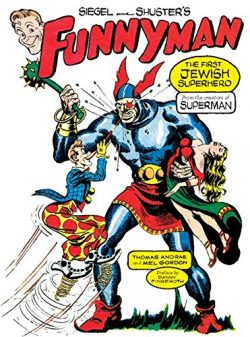
Siegel and Shuster’s Funnyman: The First Jewish Superhero


By Jerome Siegel & Joe Shuster with Thomas Andrae, Mel Gordon & various (Feral House)
ISBN: 978-1-932595-78-9 (TPB/Digital edition)

The comics industry owes an irredeemable debt to two talented and ambitious Jewish kids from Cleveland in the right place at the right time who were able to translate their enthusiasm and heartfelt affection for beloved influences and delight in a new medium into a brand-new genre which took the world by storm.

Writer Jerome Siegel and artist Joe Shuster were a jobbing cartoonist team just breaking into the brand-new yet already-ailing comicbook business with strips such as ‘Henri Duval’, Doctor Occult and Slam Bradley. Thanks to editorial visionary Sheldon Mayer, they hastily rejigged a frequently rejected newspaper strip concept for an upcoming new title and manifested the greatest action sensation of the age – if not all time…

Superman captivated depression-era audiences and within a year had become the vanguard of a genre and an industry. In those early days, the feature was both whimsical and bombastic – as much gag strip as adventure serial – and it was clear the utterly inspired whiz kids were wedded to laughs just as much as any wish-fulfilling empowerment fantasies.

As even the most casual scholar knows, Siegel & Shuster were not well-served by their publishers and by 1946 no longer worked for National Periodicals (today’s DC Comics). In fact, they were in acrimonious litigation which led to the originators losing all rights to their creation and suffering years of ill-treatment until an artist-led campaign at the time of the 1978 Superman movie shamed the company into a belated reversal and financial package (consisting mostly of having their names returned to the character’s logo and company medical benefits).

Long before this however, the dynamic duo produced an abortive “Last Hurrah”: another unique character based on early influences, but one who sadly did not catch the public’s attention in those post war years when the first super-heroic age was ending.

Based broadly on performing sensation Danny Kaye, Funnyman was a stand-up comedian dressed as a clown who used comedy gimmicks to battle criminals, super-villains and aliens: initially in 6 issues of his own comic book and thereafter as a Daily/Sunday newspaper strip.

A complete antithesis to the Man of Steel, Larry Davis was a total insider, no orphan or immigrant, but a wealthy, successful man, revered by society, yet one who chose to become a ridiculous outsider, fighting for not the common good but because it gave him a thrill nothing else could match. The series was light, beautifully audacious, tremendous fun and sank like a concrete-filled whoopee cushion.

Here social historians Thomas Andrae and Mel Gordon carefully re-examine the strip in the much broader context of Jewish Identity and racial character, with particular reference as it applies to Jewish-Americans, and make some fascinating observations and postulates.

Following an intriguing preface by author, writer, editor and comics historian Danny Fingeroth, this book assiduously dissects the history and psychology of the Judaic experience in a compelling series of astoundingly illustrated essays gathered under the umbrellas of Gordon’s ‘The Farblondjet Superhero and his Cultural Origins’ and Andrae’s ‘The Jewish Superhero’.

The former (and Farblondjet translates as “mixed up” or “lost”) probes ‘The Mystery of Jewish Humor’, ‘The Construct of Humor in Everyday Jewish Life’, ‘The Old Theories: Laughter-Through-Tears’; ‘A Laughing People’; ‘Outside Observer’ and ‘The Badkhn Theory’ (Badkhn being performers hired to insult, offend and depress guests and celebrants at social gatherings such as weddings or funerals).

‘Characteristics of Modern Jewish Humor’ are subdivided and explored in ‘Aggression’, ‘The Yiddish Language’, ‘Self-Mockery’, ‘Inversion and Skepticism’, ‘Scatology’, ‘Gallows Humor’ and ‘Solipsism and Materialism’ before Gibson’s compelling, contextual potted-history concludes with ‘American-Jewish Comedy Before 1947’ (the year Funnyman debuted), ‘Weber and Fields’, ‘On the Boards’, ‘The Borscht Belt’, ‘Cartoons and Jokebooks’ and ‘Hollywood Talkies and Syndicated Radio’.

Then, in ‘The Jewish Superhero’ Andrae examines Siegel & Shuster’s possible influences; everything from German expressionist cinema masterpiece The Golem: How He Came into This World to real-life strongman Sigmund Breitbart, a Polish Jew who astounded the world with his feats in the early 1920s. On his American tour Sigmund appeared in Cleveland in October 1923. Siegel, a local resident, would have been 9 years old – which as everyone knows is the actual “golden age of comics”…

‘Funnyman, Jewish Masculinity and the Decline of the Superhero’ explores the psychology and landscape of the medium through the careers and treatment of Siegel & Shuster in ‘The Birth of Funnyman’, ‘The Body Politic’, ‘The Schlemiel and the Tough Jew’, ‘The Decline of the Superhero’ and ‘Comic Book Noir’ before going on to recount the story of the newspaper strips in ‘The Funnyman Comic Strip’ and ‘Reggie Van Twerp’ (a last ditch attempt by the creators to resurrect their comic fortunes) before the inevitable axe falls in ‘End Game…

Thus far this engaging tome is a compulsive and hugely informative academic work, but in ‘Funnyman Comic Book Stories’ the resplendently vintage fan fun truly takes hold with a full colour section reproducing a selection of strips from the 6-issue run.

‘The Kute Knockout!’ (Funnyman #2, March 1948) pits the Hilarious Hero against a streetwalker robot built to seduce and rob Johns after which ‘The Medieval Mirthquake’ (Funnyman #4, May 1948) propels our Comedy Crusader back to the time of Camelot. From the same issue comes ‘Leapin’ Lena’ as Funnyman faces a female bandit who can jump like a kangaroo whilst yarn #5 (July 1948) catches him chasing a worrisome new crime wrinkle in ‘The Peculiar Pacifier’.

Also included are the striking covers of all 6 issues, the origin of Funnyman from #1, lots of splash pages and a selection of Shuster’s Superman art, but the most welcome benefit for fans and collectors is a detailed precis of the entire run’s 20 tales.

The same consideration is offered for the newspaper strips. As well as similar synopses for the Sundays (12 adventures spanning October 31st 1948 to the end of October 1949) and the Dailies (another dozen larks covering October 18th 1948 to September 17th 1949), there are 11 pages of full-colour Sunday sections plus the complete monochrome ‘Adventure in Hollywood’ (December 20th-January 12th 1949) to enjoy and marvel over.

Like Funnyman himself, this book is an odd duck. Whereas I would have loved to see the entire output gathered into one volume, what there is here is completely engrossing: a wonderful assessment and appreciation of genuine world-altering hugely creative comics pioneers enjoying some well-deserved acclaim and compelling cultural contextualization for something other than their mighty Man of Steel. This is a fabulous tome with an appeal extending far beyond its arguably limited funnybook fan audience.
Siegel and Shuster’s Funnyman © 2010 Thomas Andrae and Mel Gordon. All rights reserved.

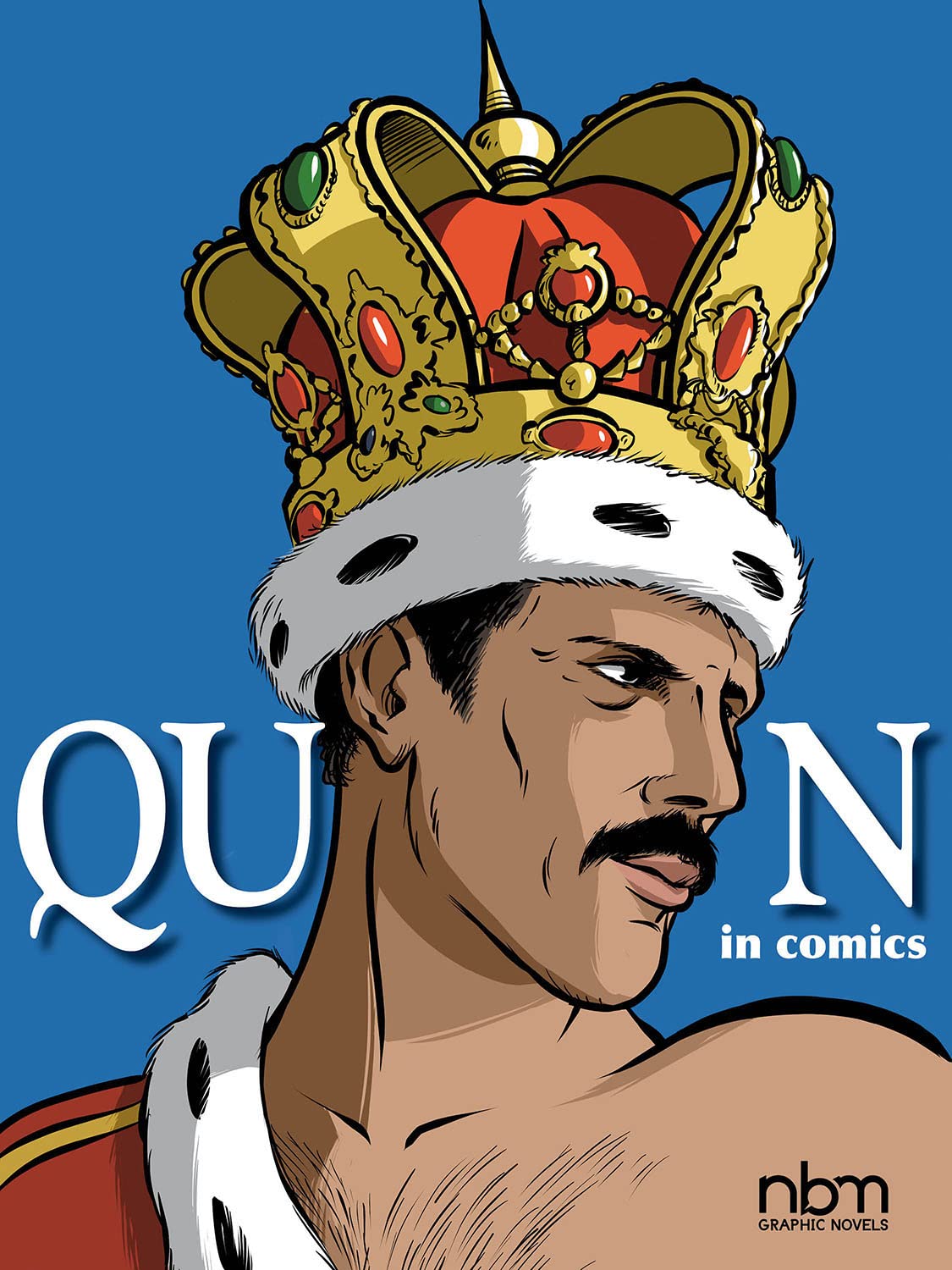
Queen in Comics


By Emmanuel Marie (narrative) & Sophie Blitman (articles); illustrated by Bast, Riccardo Randazzo, Céline Olive, Antonio Campofredano, Samuel Wambre, Julien Huggonard-Bert, Lauriane Rérolle, Jean-Jacques Dzialowski, Alex-Imé, Francesco Colafella, Samuel Figuiére, Antoine Pédron, Arnaud Jouffroy, Toni Cittadini, Carmelo Zagaria, François Foyard, Paulo Loreto, Dario Formisani, Nicolò Laporini, Luigi Ziteli, Enzo Gosselin & various: translated by Christopher Pope (NBM)
ISBN: 978-1-68112-311-0 (HB) eISBN: 978-1-68112-312-7

It’s time for another stunning rock biography: released continentally in 2021 but which will certainly appeal to readers all over the English-speaking world. Another entry in NBM’s superb “…in Comics” sub-strand, it unlocks and unleashes the history of another musical sensation that shook the planet, focussing in particular (how could you not?) on a unique performer who changed popular culture and modern society…

Gathered in this fetching account are context-providing, photo-packed essays bracketing individual comics sections. Here chronological article researched and documented by French journalist/educator Sophie Blitman and sociologist/graphic novelist Emmanuel Marie dramatise those dry facts for a horde of artists to spectacularly realise in comics vignettes…

Our baroque journey begins with the scene stealing front-man as ‘Farrokh’s Childhood’ – limned by Riccardo Randazzo and fleshed out by colourist Luigi Ziteli – views the schooldays of Farrokh Bulsara (September 5th 1946 – November 24th 1991) leaving his childhood home in the British Protectorate of Zanzibar. Son of a well-to-do Parsi family at the tail-end of the British Empire, in 1954 he transferred to St. Peter’s Boys Boarding School in what was then Bombay, India. Dubbed “Freddie” by his classmates, the boy excels at the piano and boxing.

In 1958, he hears Little Richard for the first time and adds Rock ‘n’ Roll to his eclectic love of Bollywood singers and classical opera. With his band – The Hectics – he plays constantly, honing his skills whilst pursuing his studies until 1964, when revolution creates the nation of Tanzania, forcing the entire Bulsara family to relocate to England…

Following Blitman’s context-packed essay on the geo-political and cultural status quo prior to the move to London, Céline Olive takes us to Kensington in 1969 to experience ‘Youth in London’. Here recent graduate in Graphic Arts Freddie Bulsara makes a living selling clothes on a market stall and tries to break into the big time with his band Ibex. His partner in the rags venture is Roger Taylor, who plays with guitarist Brian May in Smile. One night in September, both bands play in Liverpool and a jam session creates a kind of magic…

A text piece covering college days and tentative early moves in the burgeoning music scene segues into Antonio Campofredano’s bold rendition ‘Everything Starts With a Smile’ (colour by Nicolò Laporini) in 1970 as almost-hitmakers Smile take on pianist Freddie (call me “Mercury”) and discover a voice beyond compare…

A feature on the music biz and Smile precedes a leap to cartoon creativity in 1971 as Samuel Wambre reveals how a mix, match, merge and classified ad brings bassist John Deacon into play even as Freddie doodles out the ‘Birth of an Esthetic’ and Smile become Queen…

A prose feature detailing that transition in the era of Glam-Rock is accompanied by a detailed deconstruction of the band’s iconic “Royal Coat of Arms” before Julien Huggonard-Bert & colourist Laporini explore ‘First Album, Little Success’ as the up-&-comers cut their first LP and sign with EMI in 1972. After a discussion of Queen I, Lauriane Rérolle details the first days of an epic stage and performing legend in ‘We Want a Show!’ seeing Freddie consult fashion force Zandra Rhodes to ensure a once-seen, never-forgotten stage presence all round, duly supplemented and photographically augmented in another informative article…

Laporini’s hues boost Jean-Jacques Dzialowski trip to 1975 as ‘Queen Takes Off’ supported by a feature on the early albums and singles, after which Alex-Imé revisits landmark release Bohemian Rhapsody and how the record company tried to stifle it in ‘6 Minutes Too Long!’, which also offers a rather technical assessment of why it’s so gosh-darned great!

Francesco Colafella & Laporini examine the individual bandmates’ many side-projects and coping methods for too much time in each other’s company. ‘Roger Taylor Goes Solo’ is bolstered by a text feature adding detail and tenor, before Samuel Figuiére explores the supergroup era of ‘Legendary Hits’. Focusing on stadium-shaking anthems takes us to Montreux in Switzerland where Antoine Pédron further details a time when outrageously “decadent” Queen could not do a bad thing in ‘Get on Your Bike!’

A feature on Europe’s Jazz mecca and music the band conceived there precedes Arnaud Jouffroy’s graphic question ‘But Who Was Freddie Mercury Really?’: probing the flamboyant star’s scrupulously guarded private life and astoundingly broad friend network, and is again expanded upon in its prose accompaniment. Next comes the tremor-inducing, fan-polarising shift in musical stance of the Eighties, with its repercussions revealed and detailed by Toni Cittadini & Laporini in ‘Disco Never Dies!’ An attendant article exploring the band at the height of its fame and power is an intro to Figuiére’s graphic interlude as a return to Montreux in 1981 leads to a confrontational collaboration with David Bowie in ‘Under Pressure’ with Blitman’s supporting article detailing the bandmembers’ need to express their individualism.

That theme is further explored in Carmelo Zagaria’s ‘Search for Freedom’: an illustrated interview/skit on how the video for I Want to Break Free scandalised macho nations across the Earth, with the text support explaining the situation and how it all started with the band watching Coronation Street

François Foyard limnsThe Works, Rock and Controversy’ as 1984 saw Queen return to its raunchy rocking roots with global tours and 11th album leading to reinvention via the Live Aid benefit event, as a text piece reviews those events and the band’s controversial tour of South Africa (at that time a UN-sanctioned pariah state due to its Apartheid regime)…

Randazzo & Ziteli take an anachronistic peek at ‘History-Making Concerts’ – suitably expanded upon in prose – before Paulo Loreto tackles the beginning of the tragic end in ‘A Final Album Amidst Suffering’ as the vivacious, attention-attracting frontman becomes a recluse due to a mystery disease, and his bandmates organise one last musical hurrah…

The article on HIV and AIDs at that moment in time is a sobering preamble and overture to the star’s final days and recordings – as visualised by Dario Formisani & Laporini – in ‘“Was it all Worth It?” Yes!’ and an abridged overview of everything that has happened since in ‘The Show Must Go On!’ each accompanied by comprehensive prose features.

With beguiling ‘endpapers’ by Enzo Gosselin and an iconic cover from Bast, this graphic appreciation offers a tantalising glimpse at true legends of mass entertainment and an evocative exploration of a one-man cultural and social revolution, who was at once known by all and truly seen by no one.

In so many ways, Queen and Freddie Mercury inspired and united people of disparate views and did so by example and not listening when they heard the words “no” or “but”…

Queen in Comics is an astoundingly readable and beautifully rendered treasure for narrative art and music fans alike: one to resonate with anybody who loves to listen and look. If you love pop history and crave graphic escape, this will truly rock you.

© 2021 Editions Petit à Petit. © 2022 NBM for the English translation.
Queen in Comics is scheduled for UK release May 4th 2023 and available for pre-order now. Most NBM books are also available in digital formats. For more information and other wonderful reads see http://www.nbmpub.com/

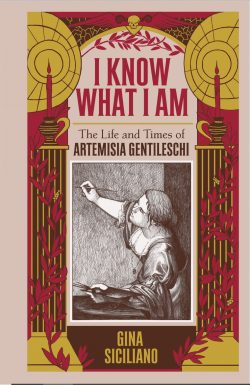
I Know What I Am: The Life and Times of Artemisia Gentileschi


By Gina Siciliano (Fantagraphics Books)
ISBN: ?978-1-68396-211-3 (HB/Digital edition)

A denizen of Seattle, Gina Siciliano studied at Pacific Northwest College of Art and has worked as a musician and bookseller whilst self-publishing highly personal comics such as Summertime. In 2019 she released her first graphic novel, a compelling and comprehensive pictorial biography and sociological reassessment of a figure who has become of late a hard-fought-over darling of art historians and feminists.

In recent years, Artemisia Gentileschi has become the desired property of many factions, all seeking to bend her life and mould her struggles and triumphs to fit their beliefs, opinions, and agendas, almost as much as kings, clerics and merchant princes sought to own her paintings whilst she was alive.

Monumental and scholarly, meticulously researched and refined from what is often too much conflicting information and assumptions, this utterly absorbing account successfully restores some humanity and a portion of muddled, day-by-day dancing to stay alive and ahead of the game desperation that must surely have preoccupied the gifted but generally powerless woman under all those layers of heaped-up symbolism…

I Know What I Am: The Life and Times of Artemisia Gentileschi is an earnest, incredibly engaging narrative built on (whenever possible) first hand quotes and primary sources, whilst also employing some reasonable speculation, extrapolation, and narrative dramatization, all delivered via ball-point pen illustration deriving from Artemisia’s own great works and other contemporary art sources.

Author’s Preface ‘Making New Worlds Out of Old Worlds’ shares Siciliano’s motivations which sparked the project whilst drawing appropriate parallels between creators as subjects of study and how renaissance Europe strangely resonates with modern #MeToo society. Think of it as “A girl artist in 21st century Seattle writes about a girl artist in 17th century Rome…”

The narrative tracks the life of professional artist Orazio Gentileschi and his extended family of jobbing artisans, paying particular – but not exclusive – attention to his daughter Artemisia. Here we see her immediate ancestors and influences: seeing her grow from anonymous assistant to celebrated painter in her own right in a society where women were property, sex objects, servants, bargaining chips or worthless.

As the 17th century opened, art – especially painting – had matchless force as currency and proof of power, with royalty and even Popes commissioning religious, classical and mythological works. There was an especial value to images incorporating beautiful – usually partially clothed – women. That Artemisia used herself as a model and sold many, many biblical scenes will provide a clue to the other recurring motif in her life; how so many men sought to possess her…

A story equal parts sordid, infuriating, shockingly unjust and ultimately just like so many others is shared in Parts I, II and III as the childhood, working life, constant betrayals and eventual passing of one of Europe’s greatest art makers is unpicked in forensic detail and with an empathy that is simply astounding. It’s not dry history here, it’s life in the raw…

Moreover, you’ll soon grasp how multifarious levels of politicking from family dynamics to the whims of kings shapes the lives of ordinary people, no matter how talented they are or of worth to the wealthy…

The compelling melodrama of Artemisia’s struggles are augmented by a ‘Reference section’ comprising a truly massive prose-&-picture section of ‘Notes’, offering context, commentary, specific factual detail plus clarification or speculation. It also expands on general points of detail brought up by the main illustrated narrative and provides candid guidance to Siciliano’s own interpretations of a life now fully co-opted by history-writers seeking to validate their own viewpoints.

Should you seek further fuel for discourse – and yes, I did deliberately avoid mentioning the infamous, attention-diverting rape (because everyone else hasn’t) – there’s a copious and colossal ‘Bibliography’ to work through on your own time.

Passionate, enlightening, emphatically empathetic and unforgettable, this is a book for all seasons and all humans wanting to learn from the past and form a fitter future.
All characters, stories, and artwork © 2019 Gina Siciliano. This edition of I Know What I Am © Fantagraphics Books, Inc. All rights reserved.

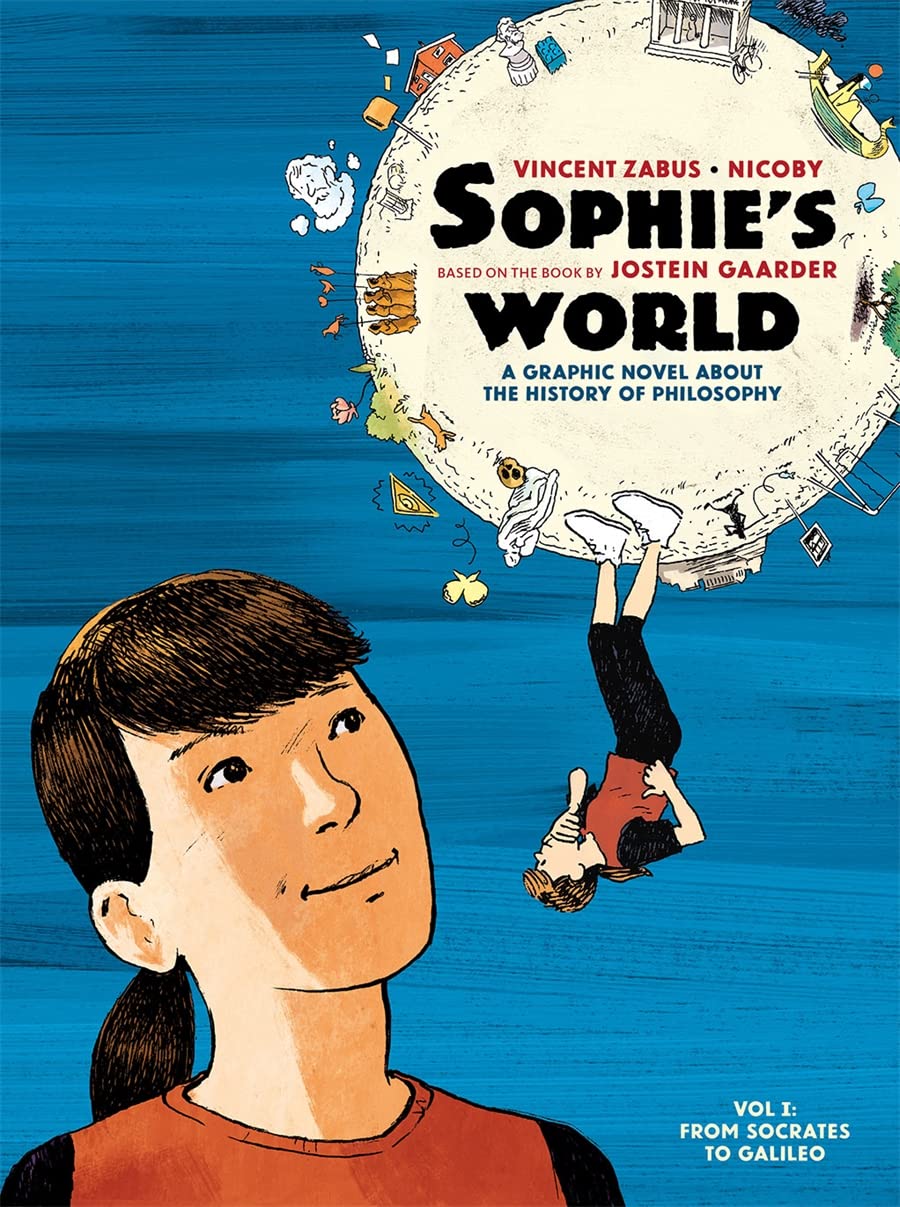
Sophie’s World – A Graphic Novel About the History of Philosophy: Volume 1: From Socrates to Galileo


By Jostein Gaarder, adapted by Vincent Zabus & Nicoby, colours by Philippe Ory with Bruno Tatti; translated by Edward Gauvin (SelfMadeHero)
ISBN: ?978-1-91422-411-9 (TPB/Digital edition)

It has long been a truism of the creative arts that the most effective, efficient and economical method of instruction and informational training is the comic strip. If you simply consider the medium’s value as a historical recording and narrative system, the process encompasses cave paintings, hieroglyphs, pictograms, oriental prints, Stations of the Cross, the Bayeux Tapestry and so much more: and pretty succinctly covers the history of humanity…

For well over a century and a half, advertising mavens exploited the easy impact of words wedded to evocative pictures, whilst public information materials frequently used sequential narrative to get hard messages over quickly and simply. In a surprisingly short time, the internet and social media restored and enhanced the full universal might of image narratives to transcend language. Who doesn’t “speak” emoji?

Since World War II, carefully crafted strips have been used as training materials for every aspect of adult life from school careers advice to various disciplines of military service – utilising the talents of comics giants as varied as Milton Caniff, Will Eisner (who spent decades producing reams of comic manuals for the US army and other government departments), Kurt Schaffenberger and Neil Adams. The educational value and merit of comics is a given.

The magnificent Larry Gonick in particular uses the strip medium to stuff learning and entertainment in equal amounts into weary brains of jaded students with his webcomic Raw Materials and such seasoned tomes as The Cartoon History of the Universe, The Cartoon History of the United States and The Cartoon Guide to… series (Genetics, Sex, The Environment et al). That’s not even including his crusading satirical strip Commoners for Common Ground, and educational features Science Classics, Kokopelli & Company and pioneering cartoon work with the National Science Foundation…

For decades Japan has employed manga textbooks in schools and universities and has even released government reports and business prospectuses as comic books to get around the public’s apathy towards reading large dreary volumes of public information. So do we and everybody else. I’ve even produced the occasional multi-panel teaching-tract myself. The method has also been frequently used to sublimely and elegantly tackle the greatest and most all-consuming preoccupation and creation of the mind of Man…

Like organised religion, the conceptual discipline dubbed Philosophy has had a tough time relating to modern folk and – just like innumerable vicars in pulpits everywhere – its proponents and followers have sought fresh ways to make eternal questions and subjective verities understandable and palatable to us hoi-polloi and average simpletons.

In 1991 Norwegian teacher Jostein Gaarder found one that became a global sensation. Oslo-born in 1952, he taught Philosophy and the History of Ideas in Bergen until he retired to write a modern prose masterpiece of allegory and symbolism in the guise of a fantastic mystery and quest saga.

In an assortment of languages, Sofies verden became an award-winning bestseller in Europe, before being translated into English in 1994 and – as Sophie’s World: A Novel About the History of Philosophy – metamorphosed into the top-selling book on Earth a year later.

Translated into 59 languages with sales far in excess of forty million copies, it enjoys regular anniversary rereleases, and has been adapted to the large and small screen in many countries, as well as PC and board games, and all the usual merchandising instances of a global sensation…

In 2022, playwright/comics scribe Vincent Zabus (Le Journal de Spirou, Les Ombres, Incroyable!) and prolific, wide-ranging Bande Dessinée illustrator Nicolas Bidet AKA “Nicoby” and “Korkydü” (Ouessantines, Le Manuel de la Jungle, Belle-Île en père, Sang de Sein, Tête de gondola, Poète à Djibouti, C’est la guerre – journal d’une famille confine) joined forces to translate the philosophical phenomenon into words and pictures: deftly embracing the magically realist underpinnings of the tale by fully exploring and exploiting the self-imposed fourth wall (and floors and ceilings) of the “ninth art”…

Big, bold and embracing wonderment head-on, Sophie’s World – A Graphic Novel About the History of Philosophy: Volume 1: From Socrates to Galileo seductively adapts the first half of Gaarder’s masterpiece as 14-year-old Sophie Amundsen and her best friend Colleen anticipate their first protest event. They are fired up about the planet’s imminent demise and ready to fight for its life, but Sophie’s scattershot passions are suddenly derailed and her curiosity enflamed after receiving an anonymous package asking the somehow compulsively significant question ‘Who Are You?’

The Who and Why of this enigmatic pen pal transaction completely obsess her after the unseen arrival of follow-up question “Where does the world come from”, and as she ponders, she is lured into the first of some frankly weird if not supernatural proceedings…

As Sophie determinedly seeks answers on a range of conceptual levels, further inquiring despatches literally take her on a journey through all of human development, guided at first remotely, but eventually in the shadow and company of a seemingly benign tutor with an agenda all his own.

…And at every moment and juncture – no matter how wild, impossible or magical – the girl learns and grows…

This initial comics session encompasses cunningly targeted and curated visits, affording up-close-&-personal experiences, via the entirety of the evolution of Western history and culture…

However, as bewildering engagements (or at least gripping, interactive syntheses thereof) unfold in ‘Myths and Natural Philosophers’, ‘Atom and Fate’, ‘Athens and Socrates’, ‘Plato’, ‘Aristotle’, ‘Hellenism’, ‘Two Cultures’, ‘St. Augustine, Averroes, St. Thomas’, ‘The Renaissance’, there’s a turning point in ‘The Baroque’ that unlocks and expands Sophie’s understanding whilst addressing a secret tragedy that unconsciously drives her.

Ultimately, the avid teen discovers other forces in play and unknown actors participating in her lessons, as glimpsed in ‘The Dream of Hilde’ and rebellious phase/phrase ‘A Woman is a Man’s Equal’, and before long the seeker is ready to chart her own course…

Completing the educational brief, this opening discourse includes ‘Author Biographies’ of ‘Nicoby’, ‘Vincent Zabus’ and ‘Jostein Gaarder’ and is absolutely To Be Continued…

Rendered in bright, cheerfully inviting colours in the welcoming manner of a children’s book, this vibrant voyage of discovery is mesmerising in its gently mischievous intensity: an outrageously joyous, entertaining rundown of humanity’s evolution and fundamental principles of thought, cunningly disguised as a superb conundrum to rival any detective yarn. Moreover, the seeds have all been laid for a monumental “Big Reveal” in the next volume…
© 2022 Albin Michel. Based on & © Jostein Gaarder’s novel Sophie’s World. English translation © 2022 SelfMadeHero. All rights reserved.

Dark Avenger: The Strange Saga of The Shadow (Will Murray Pulp History Series)


By Will Murray, illustrated by Frank Hamilton, Rick Roe, Colton Worley, Joe DeVito & various (Odyssey Publications)
ISBN: 979-8-36971-672-4 (PB/Digital edition)

In the early 1930s, just as the Great Depression hit hardest, The Shadow afforded thrill-starved Americans measured doses of extraordinary excitement via shoddily produced periodical novels and over eerily charged airwaves via an iconic radio show.

The “Pulps” were a blend of book and monthly magazine, made exceedingly cheaply and published by their hundreds in every style and genre. The results ranged from truly excellent to pitifully dire, but for exotic or esoteric adventure-lovers there were two stars who outshone all others in terms of quality and sheer imagination. The Superman of his day was Doc Savage, whilst the premier relentless creature of the night darkly dispensing grim justice was the enigmatic vigilante discussed here.

Detective Story Hour licensed and dramatised stand-alone crime yarns from Street & Smith publication Detective Story Magazine, deploying a spooky-toned narrator (variously Orson Welles, James LaCurto or Frank Readick Jr.) to introduce each tale and set the scene and mood. Think of it as just like our Jackanory, but for grown-ups and rather toned down….

The anonymous usher absolutely obsessed listeners and became known as “the Shadow”. From the very start on July 31st 1930, he was more popular than the stories he highlighted…

Dark Avenger: The Strange Saga of The Shadow is a beguiling and utterly compelling history of how the phenomenon occurred: revealing exactly how that voice evolved through sheer popular demand, smart business acumen and the writing find of a generation, to manifest as proactive character/brand The Shadow: solving instead of narrating mysteries, defending the innocent and punishing the guilty, and reshaping how the public viewed its leisure and entertainments.

Thanks to fervent and incessant demand, on April 1st 1931, the sepulchral stranger began mastering newsstands in his own adventures, mostly written by incredibly prolific and astounding gifted Walter Gibson. He was a journalist, author, historian and aficionado of stage magic and legerdemain who broke records and sired legends under the house pseudonym “Maxwell Grant”.

On September 26th 1937, the radio show was officially rebranded as The Shadow and the menacing call-&-response motto “Who knows what evil lurks in the hearts of Men? The Shadow knows!” resonated out unforgettably over the nation’s airwaves and into common cultural currency.

Over the next 18 years, 325 novels were published, usually at the rate of two a month. The uncanny crusader infested comic books, movies, newspaper strip and all the hoopla and merchandising paraphernalia you’d expect of an indisputable superstar.

The pulp series officially ended in 1949, although Gibson and others added to the canon during the 1960s when a pulp/fantasy revival gripped the world. This trend generated reprinted classic yarns and new contemporary stories in paperback novels from Belmont Books, catapulting the sinister sentinel back into print in both books and especially comics.

In graphic terms The Shadow had always been a major player. His national newspaper strip – by Gibson & Vernon Greene – launched on June 17th 1940 and, when comic books really took off, the Man of Mystery had his own four-colour title; running from March 1940 to September 1949. Stablemate Doc Savage was also present in his own solo strip…

Archie Comics published a controversial contemporary reworking in 1964-1965, crafted by Robert Bernstein, Jerry Siegel, John Rosenberger & Paul Reinman under their Radio/Mighty Comics imprint. In 1973, DC acquired the rights, producing a captivating, brief and definitive series of classic sagas unlike any other superhero comic on the stands. Thereafter, DC periodically revived the venerable vigilante and even made him an official influencer of Batman

After the triumph of Crisis on Infinite Earths, The Dark Knight Returns and Watchmen, Howard Chaykin was allowed to utterly overhaul the vintage vigilante for an audience at last acknowledged as mature enough to handle some sophisticated fare. This led to further, adult-oriented iterations and one cracking outing from Marvel, before Dark Horse assumed the license for the latter half of the 1990s and beyond.

There’s been another movie (1994) and the promise of still another, whilst Dynamite Entertainment secured the comic book option in 2011: reissuing much of those other publishers’ earlier efforts, and releasing fresh Shadow comics sagas closely adhering to the tone, timing and continuity of the pulp epoch.

In prose, new novels by the author of this mighty monograph have followed, including a fan’s dream teaming of the Man of Mystery and Man of Bronze…

Just as compelling as the stories themselves is how the Dark Avenger was born and precisely how he changed the world. This dossier details how it all came about in fascinating detail, beginning in a ‘Preface’ revealing how Will Murray’s 1970’s fanzine Duende has been retooled and remastered. Sharing the secrets and setting the scene, ‘The Men Who Cast The Shadow’ recounts precisely how The Shadow came to be: introducing the hidden men who made him and telling the tale of wonder scribe Walter Gibson.

What follows is a critical appreciation and outline of the publishing phenomenon, divided into discreet eras and tracked by cited individual issues. The formative cases are covered in ‘Phase One, 1931-1934: The Living Shadow to The Chinese Disks’, laying out how Gibson/Dent crafted fortnightly thrillers whilst building a supporting cast, core mythology, rogues gallery and new ways to enchant and confound readers.

The literary deconstruction continues with a period of confident experimentation in ‘Phase Two, 1934-1936: The Unseen Killer to Crime, Insured’, the pivotal payoffs of ‘Phase Three, 1933-1940: The Shadow Unmasks to Crime Undercover’ and confidant consolidation of ‘Phase Four, 1941-1943: The Thunder Kings to The Muggers’.

Firmly established and perhaps more risk-averse because of it, ‘Phase Five, 1943-1946: Murder By Moonlight to Malmordo’ deals with a managed decline. Wartime restrictions, substitute and auxiliary writers like Theodore Tinsley, as well as the series sheer age and ponderous back canon, augured a lack of assured spontaneity, even though the vigilante was now a cinema star too.

Another supplemental scripter signalled interim era ‘Phase Six, 1946-1948: The Blackest Mail to Reign of Terror’ as Noir-tinged, post-war attitudes and style infiltrated the established mystery detective oeuvre before the end came with a too-late return to first principles in ‘Phase Seven, 1948-1949: Jade Dragon to The Whispering Eyes’

Although the magazine was gone, certain shadows lingered in the place where he’d begun. The 325th and final issue of The Shadow was cover-dated Summer1949, but his radio crusades against crime continued until December 21st 1954. As the Sixties unfolded he was back on the airwaves again, in comics and in new tales, whilst outside America he never went away. The British Shadow magazine, for example, kept on going until 1957…

Wrapping up the investigations, ‘Epilogue’ explores those later years and discusses that Batman connection and influences, before we learn a bit more of the backroom boys. That includes illustrator Joe DeVito in ‘About the Artist’, “angel” Dave Smith in ‘About our Patron’ and Murray himself in ‘About the Author’.

If you’re addicted to classic pulp fiction but need more than just the stories, you really need to check out Will Murray. New prose stories continue the primal legends of Doc Savage – including sidebar novels starring his phenomenal kinswoman Pat Savage; The Spider; the C’thulu mythos; Sherlock Holmes; King Kong; The Green Lama; The Bat; The Avenger; The Shadow; The Destroyer (Remo Williams); and Tarzan even as his astoundingly accessible scholarly books about the characters, era and especially creators, published as the Will Murray Pulp History Series.

You’ll probably want to see – or may already enjoy – Murray’s comics too: gems like The Unbeatable Squirrel Girl (co-created with Steve Ditko), Spider-Man, Hulk, The Destroyer, Superman, Batman, Wonder Woman, Secret Six, The Spider, The Gray Seal, Ant-Man, Green Hornet, Zorro, The Phantom and many more…

When Sherlock Holmes wrote such informational tracts like this one, they were called monographs. These days we just call them unmissable.
© 2022 Will Murray. All rights reserved.

Invisible Men – The Trailblazing Black Artists of Comic Books


By Ken Quattro, and featuring material by Adolphus Barreaux Gripon, Elmer Cecil Stoner, Robert Savon Pious, Jay Paul Jackson, Owen Charles Middleton, Elton Clay Fox & George Dewey Lipscomb, Clarence Matthew Baker, Alvin Carl Hollingsworth, Ezra Clyde Jackson Alfonso Greene. Eugene Bilbrew, Orrin C. Evans, George J. Evans Jr., John H. Terrell, William H. Smith, Leonard Cooper, Calvin Levi Massey & various (IDW/Craig Yoe Books)
ISBN: 978-1-68405-586-9 (HB) eISBN: 978-1-68406-912-5

I’ve spent a lot of time here talking about “firsts” and “breakthroughs”, “role models” and changes in culture, and frankly, I’m not apologizing for any of it. We are not just the Naming ape and the Making ape, we’re also the Worshipping ape: contriving a never-ending blend of guesses, fiction and unexplained phenomena to bolster our courage, feed our hopes and explain away bewildering mysteries.

No other animal worships anything or uses supposition to build a model of the universe. Well, maybe cats do, but only in front of refrigerators. I’m still pondering that one and I’ll get back to you…

In comics we have always noted what hero and villain does what, mused on how that affects the reader and generally congratulated ourselves on how far we’ve come. What we don’t do so often is focus on how those comics are made, who did the work and how their lives were and are shaped by and impacted upon in what has always been a very hard-hearted if not actually cutthroat commercial industry.

For decades, a notion persisted that American comic books and the newspaper and magazine strips they grew out of were the sole preserve and creation of white men. It’s a blatant lie of omission fuelled by ignorance and apparent lack of interest. In recent years, as the world of word/picture stories became both an acceptable art form and cultural wellspring as valid and profitable – and high-fallutingly pompous – as movies, ballet or even jazz, it’s a belief that has been thoroughly challenged and utterly rubbished.

This superb, Award-winning collection drives a final great big stake through the notion by detailing the lives of black contributors to and workers in comics who were unnecessarily neglected and sidelined from the start. Here is a catalogue of almost universally unsung stars whitewashed out of comics history – just like in so many other areas of human endeavour over the last three centuries…

This scholarly examination details and commemorates the artists (some of whom you may have even heard of), threading and weaving them back into the full tapestry through a concise history of America’s negro culture spanning the end of slavery to the latter quarter of the last century. when the Civil Rights movement reminded white America and the wider western world that black people still dwelt amongst them and would no longer tolerate being Separate and (un)Equal…

Published under the aegis of Craig Yoe’s pioneering, tireless efforts to legitimise the world of funnybooks, Invisible Men is Compiled and written by author, essayist and historian Ken Quattro (Hoo-Hah!, The Al Williamson Reader). It shines a light on dozens of African Americans who contributed to the burgeoning comic book field. Many also had lengthy careers in a parallel but unspoken, black-only publishing industry (to which, just like the movies, made books, comics and magazines white audiences were utterly oblivious). Others were not so fortunate…

These personal histories are supported by copious examples of their work and even the other sort of stories: complete strips to read and enjoy, elevating this collection beyond mere historical tract and cultural correction whilst conveying and sharing the joyous exuberance and “anything goes mentality of Golden Age” comics entertainments…

Setting the scene is an Introduction from archaeologist, cultural anthropologist and comics fan Stanford W. Carpenter, PhD, addressing the vast, varied and deliberately buried social and racial mix that was almost uniformly subverted to a male, white, Anglo-Saxon sensibility and agenda in the natal moments of the comics industry…

Then Quattro’s essay ‘Seeing the Unseen’ scrupulously details the lousy, dangerous working world for non-white mass media artists and how the situation so-slowly altered over decades. He also bravely takes the bull by the horns in addressing the ever-shifting terminologies used to define racial (and religious) differences over decades. If even reading certain words or mercifully archaic and obsolete phrases might cause you difficulties, you’re better off stopping here and staying unenlightened. We’ll just go on without you…

The first candidate for your attention is ‘Adolphus Barreaux Gripon – Visible Man, Invisible Pioneer’ and he is the perfect example to discuss the far from clear-cut social scene of this era. Well-educated and relatively well-off, he was also called Adolphe Leslie Barreaux and was officially classified by the US Census Bureau as “mulatto”. For many that meant he was just white enough to acceptable…

He worked as a magazine illustrator, newspaper strip artist and – when comic books were born – drew those too. Here, that translates to beautiful examples of The Enchanted Stone of Time (Dell’s The Comics), Flossie Flip (a regular of the Police Gazette), Dragon’s Teeth from Champion Comics, and the legendarily salacious Sally the Sleuth (Private Detective Stories, Crime Smashers). His entry concludes with Sally saga ‘Death Bait’, as seen in Private Detective Stories volume 21, #3 from June 1949.

‘Elmer Cecil Stoner – Harlem Renaissance Man’ traced his lineage back to George and Martha Washington (before the first First Lady freed his ancestors), and became a prominent artist in Pennsylvania. His comics efforts included The Golden Age Blue Beetle, The Challenger and Phantasmo whom he created for Dell’s The Funnies. After WWII he moved into producing commercial and promotional comics as well as high profile advertising work. His major contribution here is ‘The Threat from Saturn’ as originally seen in The Blue Beetle #34, September 1944 and biographic strip ‘Rev. Ben, Fighter of Fascism’ (detailing the life of black anti-fascist preacher Ben Richardson from 1945’s The Challenger #1).

Money talks and at this juncture enforced egalitarianism. The new big thing in entertainment was exploding and publishers needed pages filled as cheaply as possible, even if they had to be written, drawn and lettered by black people or even women…

Legendary designer and Civil Rights activist ‘Robert Savon Pious – The Afrocentric Historian’ is represented by many of his most important works. However we’re focussing on his early strips The Dopes, Blue Bolt covers and Kalthar the Giant Man (Zip Comics). Also on show is informational feature ‘Facts on the Negro in World War Two’ with horror classic ‘The Ghost from Algol’ (Adventures into the Unknown #8: December 1949/January 1950). Tragically short-lived ‘Jay Paul Jackson – an Artist Apart’ is celebrated in many racy works (such as Tisha Mingo, Speed Jaxon and Home Folks) from black newspapers; patriotic cartoons and paintings and his only known comic book strip ‘Blond Garth’ (from Colossus Comics #1, March 1940).

Troubled ‘Owen Charles Middleton – Resilient Idealist’ reveals a talented creator who spent much of his as an incarcerated black man, union worker, and American political campaigner. His art entries include paintings, political advertising imagery, newspaper cartoons and comics such as Fawcett’s Spy Smasher. His complete tale is ‘Two Months in the Bush’ from Dell’s War Heroes #5 (July-September 1943).

The contrasting lives of ‘Elton Clay Fox & George Dewey Lipscomb – The Progressive and the Professor’ displays Fax’s landmark posters for the NAACP and his rousing anti-“Jim Crow” newspaper cartoons. Less well known are pioneering teen magazine Young Life, syndicated biographical panel cartoon ‘They’ll Never Die’, cover/interior illustrations from Dr. George Washington Carver, Scientist and extracts from the Classics Illustrated newspaper serial. Also on view are Susabelle and Afro Comics strips, as well as a complete Bull’s-Eye Bill episode from Target Comics (vol. 6, #3 May 1945). Lipscombe’s contribution is the script for African adventure strip ‘Simba Bwana – Lion Master!’, limned by Fax for Jack Armstrong #1 (November 1947).

If the nebulous cohort of black comics artists had a super star, it was absolutely ‘Clarence Matthew Baker – The Natural’ who lived fast, drew lots and died notoriously young. Matt Baker is famed for racy sexy adventure, but he evolved into a sublimely gifted master illustrator of subtle drama and romance. Unlike most of his contemporaries, Baker did most of his work in comic books, as seen here in covers for Phantom Lady, Seven Seas Comics, Cinderella Love and Teen-Age Temptations. Interior Tiger Girl pages complement extracts from Canteen Kate – an early, outrageous “crossdresser” challenging those hidebound male role models…

Examples of his magazine illustration work comes from Pulp Mystery Tales #6 and the Flamingo newspaper strip, but the true gold here is the complete Voodah adventure from Crown Comics #3. Cover-dated Fall 1945, it featured the first clearly, indisputably black hero in American comics: an otherwise standard jungle god type character battling white hunters and marauding natives. By issue #6, the editors had noticed what was happening and Voodah magically and without fuss turned into a far more believable white guy king of the jungle…

Baker is so darned wonderful that his chapter includes a second complete strip with the improbably pneumatic Phantom Lady polishing off ‘The Subway Slayer!’ in a wild romp from the appropriately dubbed All Top Comics #12 (July 1948)…

A pre-eminent illustrator of a later era, ‘Alvin Carl Hollingsworth – The Young Professional’ blends fascinating tales of the educational opportunities enjoyed by young black and ethnic artists (like Joe Kubert or Alex Toth) with later adult success. Many comic books ultimately benefited from New York’s forward-looking scholastic integration policies as seen in images re-presented here.

These include Hollingworth excerpts from Diary of Horror #1, Inspector Roc’s Felony Files (inked by Kubert), ‘Farewell to Love’ (True-To-Life Romances #9, 1949), and even superhero Bronze Man. Horror snippet ‘The Ripper’s Return’ precedes a selection of prospective newspaper features about black schoolteachers. Somehow, neither Dorothy Tutor or Bob Mentor caught on in the 1950s…

Hollingsworth was of Afro-Caribbean rather than African American origins and the dichotomy and tensions between the distinctly different communities makes for fascinating reading here, supplemented by later fine art, design, political, editorial and journalistic paintings and prints.

His comic book section delivers biographical tale ‘Lena Horne’ (Juke Box Comics #2, May 1948) and ‘Where Zombies Walk!’ (Witchcraft #5, December 1952/January 1953)…

Triumph and tragedy tinge the stories of ‘Ezra Clyde Jackson & Alfonso Greene – A Tale of Two Students’ who attended Manhattan’s High School of Industrial Art.

Originally Jackson paired with white veteran Maurice Whitman before going solo, in features such as The Iron Ace (Airboy Comics), ‘The Secret Seven’ (Patches Comics #1, 1945) and Classics Illustrated: Typee. His complete solo outing here is eerie chiller ‘Sentence of Death’ (Suspense Comics #9, August 1945).

As described in a heartbreaking testimony from Alex Toth, Alfonso Greene had a far harder ride and died the way so many black men still do today, but his work at least survives in strips like ‘Swimming Lessons Save a Life’ and true crime yarn ‘Bandit Patrol’ (both from New Heroic Comics #64, January 1951), ‘Boy Hero’ (life-saving black youngster Roy Marshall Jr.in New Heroic Comics #53, March 1949), and ‘Wonder Women of History: Sojourner Truth’ (Wonder Woman #13, Summer 1945).

‘Eugene Bilbrew – A Different Talent’ found his place in comics via popular music and record design, via strips like Astro Girl, The Charlie Mingus Record Club, fetish magazines and the comedic Clifford back-up strip in Will Eisner’s syndicated Spirit Section.

As previously stated, America at this time supported two separate worlds, one black and the other acceptable. Even in liberal states that championed full equality, most black folk kept to their own neighbourhoods, ran their own businesses and ran their own churches and entertainments. Inevitably, that led to comics for coloured folks thanks to ‘Orrin C. Evans, George J. Evans, Jr., John H. Terrell, William H. Smith, Leonard Cooper – At Last, The First’ who acted in concert and launched All-Negro Comics in June 1947. Closely allied to left wing political movements the output was target-specific, limited in distribution and short lived, but it proved there was room for many kinds of readership. This chapter includes formative strips from black papers – such as Adventures of Tiger Ragg by John Terrell – and describes how All-Negro Comics was born and died. On show are house ad, covers, excerpts from assorted series ‘Sugarfoot’, ‘Lion Man’ various gags and cartoons and the complete first exploit of two-fisted street tough private eye ‘Ace Harlem’

This astounding chronicle concludes with the life of breakthrough artist ‘Calvin Levi Massey – Vanguard of the Next Generation’. His later artistic endeavours advanced black culture on a rapidly-shifting world stage, but only after a relatively stellar comics career as a cartoonist. Employers included James Warren, and he was a mainstay of Atlas/Timely and a jobbing illustrator; as seen here in moments from ‘The Milton Berle Story’ (Uncle Milty #2, February 1952), and all of ‘Absent-Minded Professor’ (Horror from the Tomb #1, September 1954)…

Augmented by an affirming ‘Afterword by Ken Quattro’ and a prodigious ‘Index’, this powerful tract balances some historical scales and bestows acclaim on those unjustly excluded, by offering a sublime selection of strips and stories crafted by Invisible Men who – like women – were always there, if we’d only bothered to look…
™ & © 2020 Gussoni-Yoe Studio, Inc. All Rights Reserved.

Paul Robeson for Beginners


By Paul Von Blum, illustrated by Elizabeth Von Notias & Ramsess (For Beginners)
ISBN: 978-1-934389-81-2 (PB/Digital edition)

For Beginners books are heavily-illustrated text primers: accessible graphic non-fiction foundation courses in a vast variety of subjects ranging from art to philosophy, politics to history and much more, all tackled in an accessible yet readily respectful manner. This particular volume was written by Paul Von Blum, author and Senior Lecturer in African American Studies and Communication Studies at UCLA, wedded to a wealth of strips and illustrations by graphic design specialist Elizabeth Von Notias and self-taught multi-media creator Ramsess.

If remembered at all, Paul Leroy Robeson ((9th April 1898-23rd January 1976) is regarded by most people as that African American performer with an incredibly deep voice. Maybe some will recall that he was a left wing political activist who particularly incensed Senator Joe McCarthy during America’s infamous “Red-baiting” witch-hunting period… so, kudos for that, too…

That’s all true enough, but he was also one of the most accomplished and gifted individuals in the nation’s history: a true Renaissance man who was cheated of his ultimate potential simply because his skin was the wrong colour…

An Introduction lists Robeson’s astonishing accomplishments – all the more amazing when you realise the lack of opportunities if not outright repression facing negroes in segregated America at the time of his birth and not truly tackled until the Civil Rights movement began gaining traction in the late 1950s. If even then…

As told in more telling detail – via word and pictures in ‘The Early Days’, ‘Paul Robeson the Athlete’, ‘Paul Robeson the Stage Actor’, ‘Paul Robeson the Screen Actor’ and ‘Paul Robeson the Singer’ – he was the son of a preacher and born in Princeton, New Jersey. He was the last of five children, locked into a time and place rigidly defined by class and race divisions…

A brilliant student, Paul Robeson graduated Somerville High School in 1915 and won a 4-year scholarship to Rutgers University, where – despite initial hostility and actual physical assaults – he became the star of the Football, Baseball, Basketball and Athletics squads. He was twice designated “All-American”.

Graduating from Rutgers, he attended New York University Law School before transferring to Columbia University Law School. Talented and seemingly tireless, Robeson turned an interest in the dramatic arts into a part-time stage career and became a professional Football player in 1920.

He married, acted, sang, played Pro ball and kept on studying: graduating Columbia in 1923 to work as a lawyer at a prestigious firm… until the bigotry he experienced from his own subordinates became too much.

In 1924, during the enthralling localised period of negro liberality and cultural growth dubbed “The Harlem Renaissance” (1923-1927), he switched from stage acting to movies, but still carried on a glittering international career: starring as Othello in London and playing in many hit plays and musicals including Showboat, Emperor Jones, Stevedore and All God’s Chillun’s Got Wings

Incessantly, helplessly politically active, he visited the Soviet Union in 1934, spoke out against Fascism during the Spanish Civil War, co-founded the anti-colonial Council on African Affairs and used his name and fame to agitate for social and legal changes in such contentious areas as Southern lynch law and trade union legislation. These activities made him a prime target in the USA and in 1941 J. Edgar Hoover ordered the FBI to open a file on him…

In 1950, the US government took away his passport because he refused to recant his pro-Soviet, pro-socialist stance, making Robeson an exile in his own country. He was unable to leave America for 8 years, until a Supreme Court ruling decreed the State Department had no right to revoke passports due to an individual’s political beliefs.

Somehow, I’m reminded of how successive British Home Secretaries have smugly wallowed in the shameful, self-granted ability to revoke and deny the nationality and movements of its own citizens: especially the young, brown, non-Christian, groomed and trafficked one…

Robeson’s life was filled with such astounding breakthroughs and landmarks. Once free to travel again, he became an international political celebrity and social commentator, using his concerts and stage appearances in places as disparate as Wales, Australia, Russia, New Zealand, East Germany, Canada, and elsewhere to promote a dream of World “Freedom, Peace and Brotherhood”…

His beliefs, struggles achievements and failures are scrutinised in ‘Paul Robeson the International Activist’, ‘Paul Robeson the Domestic Political Activist’ before a thorough appreciation in ‘The Final Years and His Lasting Legacy’

Augmented by a ‘Bibliography’, ‘Selected Chronology’ and creator biographies, this absorbing documentary proves again the astounding power of visual narrative when wedded to the life story of a truly unique individual, and begs the question: where are his graphic biography and definitive biopic?
© 2013 Paul Von Blum. Illustrations © 2013 Elizabeth Von Notias & Ramsess. All rights reserved. A For Beginners Documentary Comic Book © 2013.