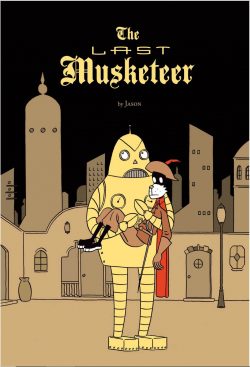
The Last Musketeer


By Jason, coloured by Hubert and translated by Kim Thompson (Fantagraphics Books)
ISBN: 978-1-56097-889-3 (TPB/Digital edition)

Jason is secretly John Arne Saeterrøy: born in Molde, Norway in 1965 and an overnight international cartoon superstar since 1995 when his first graphic novel Lomma full ay regn (Pocket Full of Rain) won that year’s Sproing Award (Norway’s biggest comics prize).

He won another Sproing in 2001 for the series Mjau Mjau and in 2002 turned almost exclusively to producing graphic novels. A global star among the cognoscenti, he has won many major awards.

Jason’s breadth of interest is wide and deep: comics, movies, music, high literature and pulp fiction all feature equally with no sense of hierarchy and his puckish mixing and matching of his inspirational sources always produces a picture-treatise well worth a reader’s time.

As always, this visual/verbal bon mot unfolds in his beguiling, sparse-dialogued, pantomimic progressions with enchantingly formal page layouts rendered in the familiar, minimalist evolution of Hergé’s Claire Ligne style: solid blacks, thick lines, settings of seductive simplicity augmented here by a beguiling palette of stark pastels and muted primary colours. This delicious caper is one of his best yarns ever and even spawned a prequel…

The Last Musketeer is an epic rife with his signature surrealism; populated with his quirkily quotidian cast of darkly comic anthropomorphic regulars, and downplaying his signature themes of relationships and loneliness to produce a wild action-adventure for a charmingly macabre cast of bestial movie archetypes and lost modern chumps to romp through.

With hues from much missed triple-threat Hubert, our brief full-colour thriller opens with a drunk in a Paris bar. He claims to be legendary musketeer Athos, still alive after four centuries. And he actually is.

The contemplative warrior dreams of past glories and inseparable old comrades but things aren’t the same anymore. However, as he muses on a bench, destructive balls of energy rain down on the city and Athos realises he is needed again and might just have one last adventure in him…

Despite failing to get the old gang back together, Athos persists in his quest and, after fighting a couple of green-skinned invaders, induces them to take him to their world. All too soon, he is making friends, battling the flamboyantly evil King of the Red Planet, helping a Princess of Mars foment an Earth-saving revolution and re-encountering an enemy from home he had long forgotten…

And we’re all still here so he must have triumphed in the end…

Outrageously merging the worlds of Alexander Dumas with Edgar Rice Burroughs, whilst gleefully borrowing Flash Gordon’s props and work ethic, The Last Musketeer is a superbly engaging pastiche that is pure nostalgia and pure Jason.

Jason is instantly addictive and a creator every serious fan of the art form should move to the top of the “Must-Have” list.
All characters, stories and artwork © 2007 Jason. All rights reserved.

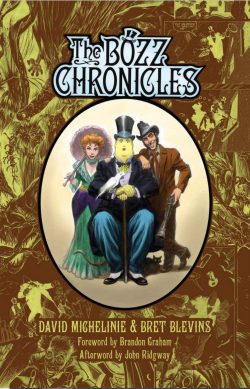
The Bozz Chronicles


By David Michelinie & Bret Blevins, with John Ridgway, Al Williamson & various (Dover Comics & Graphic Novels)
ISBN: 978-0-486-79851-6 (TPB/Digital edition)

During the 1980s the American comics scene experienced an astounding proliferation of new titles and companies in the wake of the creation of the Direct Sales Market. With publishers now able to firm-sale straight to specialised, dedicated-retail outlets rather than overprint and accept returned copies from general magazine vendors, the industry was able to risk and support less generic titles whilst authors, artists and publishers could experiment without losing their shirts.

At the height of the subsequent publishing explosion and in response to a wave of upstart innovators, Marvel developed its own line of creator-owned properties: launching a host of idiosyncratic, impressive series in a variety of formats under the watchful, benevolent and exceptionally canny eye of Editor Archie Goodwin. The delightfully disparate line was dubbed Epic Comics and reshaped the industry.

One of the most significant hits was a winsomely engaging blend of fantasy, criminology and urban myth with a beautifully simple core concept: “Sherlock Holmes from Outer Space”. Even that painfully broad pitch-line does the series it became an unforgivable disservice…

The Bozz Chronicles was – and is – so much more. It became one of Epic’s earliest hits and sensations, and the reasons it never continued beyond its initial 6-issue run (December 1985 to November 1986) had nothing to do with poor sales…

The mesmerising mix of Victoriana, super-science and sorcery might even be considered as an early precursor if not progenitor of the visual form of the literary genre K. W. Jeter dubbed “steampunk” in 1987…

Preceded with a Foreword from Brandon Graham, Dave Michelinie’s self-deprecating Introduction ‘Blame it on Spielberg’, and fond reminiscences from originating illustrator Bret Blevins, an amazing moment in comics history repeats itself as ‘The Bozz Chronicles’ opens on Mandy Flynn. She is a fiercely independent young woman plying her trade – described then and now as the World’s Oldest – in the sooty, sordid environs of London in the last quarter of the 19th century.

Saucy, sassy, sensitive and lovely, she is bringing her latest “brief acquaintance” up to her attic abode when the incipient physical transaction is suddenly curtailed by discovery of a strange-looking foreigner trying to commit suicide in her rooms…

As her toff flees in terror, Mandy tries to talk down the intruder and realises just how strange he truly is: eight feet tall, pale yellow in complexion, with a hairless, pointy head. He is also gentle, exceptionally well-spoken, has a long tail and can fly…

Six months pass. Mandy and the creature she calls Bozz are doing exceptionally well. He still claims to be from another world and certainly acts like no human she has ever met: he cannot tell lies, communicates with animals, constantly wanders around naked and absorbs like a sponge every scrap of knowledge she can provide for him through books and journal and newspapers.

Bozz misses his home: a far-distant world of benevolent intelligences he has no chance of ever returning to: so much so that he was trying to end himself as much through boredom as loneliness. Mandy’s brilliant idea to keep him alive was to engage his prodigious intellect in puzzles. She set them up as consulting detectives based in the less than fashionable Maracot Road, using the proceeds to better her own hand-to-mouth existence in the process. The only problem is that when no challenging cases manifest, Bozz’s thoughts instantly return to ending it all…

Thankfully, just as she is preparing to hide all the sharp objects again, a truly unique mystery knocks on the door and the secretary of Lord Giles Morgan requests their help. According to the Press, Pamela Grieves’ employer – and prospective Prime Minister – recently escaped an assassination attempt. However, the loyal amanuensis was with him when it happened and claims he did not survive. In fact, after having made further discreet inquiries, Miss Grieves found her master had in fact been dead for some three years prior to the attack…

As Bozz excitedly accepts the commission, Mandy is convinced they are dealing with a madwoman, but when their client is destroyed by a bolt of lightning as soon as she leaves their office the retired demimondaine is forced to think again…

Naturally the inquiry agents’ first step is to interview Lord Giles and although the shady politician proves no help at all, Bozz gleans much useful information from the caged bird in Morgan’s study. Soon they are on the trail of an aristocratic secret society utilising vast funds and weird science to resurrect the dead in pursuit of a deadly and regressive political and economic agenda (so hard not to comment satirically here!)…

Sadly, even the alien outcast’s uncanny powers prove insufficient to stop the schemers, but Mandy has gifts of her own and beguiles a rowdy American former prize-fighter she finds in a bar to assist in the climactic final confrontation.

Besotted, punch-drunk Salem Hawkshaw then joins the detectives to handle any future physical exigencies that might occur, but despite everything he sees is never convinced his big, bemused boss is anything other than a crazy circus freak…

The new colleagues are all painfully aware that their sudden success has brought them to the attention of Scotland Yard’s most privileged operative and the notorious trio have barely caught their breath before Inspector Colin Fitzroy comes calling, deviously offering them a case the police have no interest in.

Apparently a drunk has seen demons in Park Lane…

As the shamefully-employed scion of Britain’s richest family continues trying to impress the ravishing Miss Flynn, further arcane incidents occur, ‘Raising Hell’ in the capital’s swankiest district. Before long the consulting detectives find troubled Samantha Townes, whose husband has fallen foul of the vilest black magic and his own gullibility…

Wealthy Inspector Fitzroy has more pressing problems. A rash of exceedingly orderly murders has turned up odd artefacts defying explanation by any expert Scotland Yard can muster: things that cannot possibly have been built by any craftsman on Earth…

In ‘The Tomorrow Man’ (inked by Al Williamson) a trip to the funfair does little to alleviate Bozz’s boredom, but does lead to the genteel gullible giant being gulled: lured away by a wily pack of street children who use his powers and naivety to perpetrate a crime spree.

Later, when the shady show’s owner tries to kidnap Bozz for his freak attractions, the ultimately unsuccessful attack leaves the alien blind. The kids’ ringleader Oliver brings him to underworld surgeon Dr. Paine – who runs a subterranean clinic as a sideline to pay for his researches into time travel. He sees in the stranger a perfect opportunity to advance the causes of science…

Redeemed by Bozz’s unflagging trust, Oliver at last realises the enormity of his betrayal and fetches Mandy and Salem to effect a rescue, but by the time they arrive, chronal chaos is erupting everywhere…

As engaging and enthusiastic as the tales have been until this point, ‘Were-Town!’ is (at least for history-buffs and especially Londoners) a truly stand-out moment in the series, as the ineffably marvellous British veteran John Ridgway stepped in to illustrate a pithy, punchy deep midwinter tale disclosing a hint of Mandy’s past whilst introducing her reprehensible absentee father Egan Thorpe.

We’ve always whined in Britain about how Us and Ours are represented in American productions and, despite the obviously strenuous and diligent researches Michelinie & Blevins undertook, frequently the tone of their Bozz Chronicles often smacks more of Hollywood than Cricklewood. It’s not something non-Brits will even notice, but for us aging “Cockerney Sparrers” the differences are there to be seen… and felt.

Such is not the case (as gratefully acknowledged by the creators themselves in the respective, respectful Introductions) when Ridgway applied his meticulous line and copious pictorial acumen – gleaned from decades drawing a variety of British strips for everything from Commando Picture Library to Warrior to 2000AD or Doctor Who and The Famous Five – to a genuinely spooky, photographically authentic tale of deranged artists, dastardly squires and infernal paintings coming to unholy life in snow-capped rural wilds of Southeast England…

Michelinie & Blevins reunited for ‘The Cobblestone Jungle’ as Inspector Fitzroy again calls upon Bozz & Co: impelled as much by his lusty fascination with Amanda as the demands of an African king who needs the assistance of the British Empire if he is to guarantee a steady flow of diamonds from his equatorial satrapy…

Apparently, a white man had stolen the tribe’s sacred jewel and brought it to his hidden jungle playground in London. Thanks to some canny legwork from little Oliver, the detective trio track the bounder, but nobody anticipated the filched gewgaw emitting destructive death-rays…

After a spectacular battle high above the city, Bozz ends the threat, but his biggest surprise comes when the grateful king asks to thank him personally and reveals a millennia-old connection to Bozz’s extraterrestrial race…

For Mandy, Bozz, Salem and Fitzroy it all culminates in a desperate trek to the Dark Continent in search of ‘King Solomon’s Spaceship’ and the achievement of the marooned alien’s most fervent desires… until a gang of German raiders and Mandy’s own cynical self-interest ruins everything…

Rounded out by sketches and preliminary designs in a superb ‘Bonus Artwork and Cover Gallery’ from Blevins and closing with an effusive ‘Afterword by John Ridgway’, this is a magnificent moment in comics collaboration which will soon hopefully reclaim its place at the forefront of fantasy fables.
The Bozz Chronicles © 1985, 1986, 2015 David Michelinie. Introduction © 2015 David Michelinie. Foreword © 2015 Brandon Graham. Afterword © 2015 John Ridgway. All rights reserved.

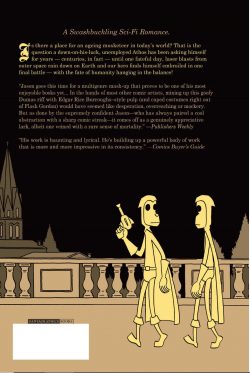
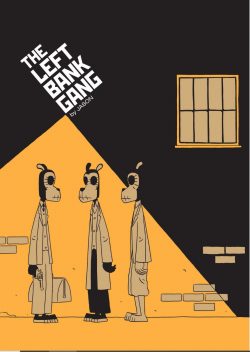
The Left Bank Gang


By Jason, coloured by Hubert, translated by Kim Thompson (Fantagraphics Books)
ISBN: 978-1-56097-742-1 (TPB/Digital edition)

Jason is secretly John Arne Saeterrøy: born in Molde, Norway in 1965 and an overnight international cartoon superstar since 1995 when his first graphic novel Lomma full ay regn (Pocket Full of Rain) won that year’s Sproing Award (Norway’s biggest comics prize).

He won another Sproing in 2001 for the series Mjau Mjau and in 2002 turned almost exclusively to producing graphic novels. Now a global star among the cognoscenti he has won seven major awards from such disparate regions as France, Slovakia and the USA.

Now his latest novella is released, rife with his signature surreality: populated with cinematic, darkly comic anthropomorphs and featuring more bewitching ruminations on his favourite themes of relationships and loneliness, viewed as ever through a charmingly macabre cast of bestial movie archetypes and lost modern chumps.

In this full-colour tract – originally released in France as Hemingway – Jason sets his quirkily-informed imagination into literary overdrive: postulating what might have been at a moment of intense intellectual cross-pollination.

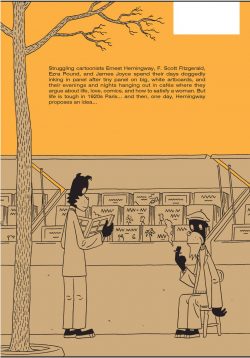
It’s Paris in the 1920s: émigrés F. Scott Fitzgerald, Ezra Pound, James Joyce and Ernest Hemingway are all struggling to make their marks on the world – and most especially on the other artistic Men and Women of Destiny congregated in the enclave of creative excellence that has grown up around the Latin Quarter. Wannabe cartoonists, their own meagre efforts seem paltry and trivial in comparison to the masterful comic books produced by Faulkner or Dostoyevsky, whilst true artists such as Jean-Paul Sartre and Man Ray all seem to have no trouble with their medium or message…

Worst of all, Scott thinks something is bothering Zelda: she might even be cheating on him…

The disaffected Young Turks are uniformly plagued by nightmares of the past and frustrated dreams of mediocre futures with everyday life relentlessly coming at them demanding vile money just to stay alive and keep on fruitlessly toiling.

… And then Hemingway says it: why not just rob a bank?

Blending literary pretention and modern creative mythology with the iconography and ironic bombast of Reservoir Dogs is a stroke of genius no one else could pull off. As always, this visual/verbal bon mot unfolds via Jason’s beguiling, sparse-dialogued, pantomimic progressions with enchantingly formal page layouts rendered in the familiar, minimalist evolution of Hergé’s Claire Ligne style; solid blacks, thick lines and settings of seductive simplicity augmented here by a stunning palette of stark pastels and muted primary colours.

Jason’s work always jumps directly into the reader’s brain and heart, always probing the nature of “human-ness” by using the beastly and unnatural to ask persistent and pertinent questions. Although the clever sight-gags are less prominent here his repertory company of “funny-animal” characters still uncannily depict the subtlest emotions with devastating effect, proving again just how good a cartoonist he is.

This wry mis-history lesson is strongly suggested for adults but makes us all to look at the world through wide-open childish eyes. Jason is instantly addictive and a creator every serious fan of the art form should move to the top of the Must-Have list.
All characters, stories and artwork © 2007 Editions de Tournon-Carabas/Jason. All rights reserved.

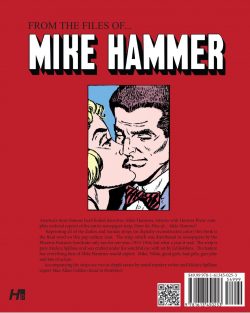
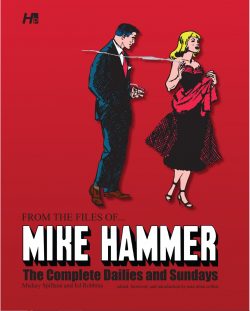
From the Files of… Mike Hammer: The Complete Dailies and Sundays


By Mickey Spillane & Ed Robbins: edited by Max Allan Collins (Hermes Press)
ISBN: 978-1-61345-025-3 (HB/Digital edition)

Frank Morrison Spillane was Brooklyn born on March 9th 1918 and raised in Elizabeth, New Jersey. He started writing in High School and, after trying a wide variety of jobs, joined a production shop in 1940, where he worked on articles for magazines (“slicks”), pulps and – thanks to a connection to Joe Gill (Captain Atom, Blue Beetle, Peacemaker and more horror, war and science fiction tales than you can imagine) – comic books.

Spillane wrote dozens of text fillers (usually the only place you could sign your own name) for Funnies Inc. who supplied Timely Comics, Fawcett, National/DC and more, but also crafted comics tales too, including Blue Bolt, Captain Marvel, Batman, Captain America and Sub-Mariner. A rough, tough guy, and already qualified pilot, he enlisted the day after Pearl Harbor, but his expertise denied him the combat he craved and relegated him to the despised role of Army Air Corps flight instructor, stationed in Mississippi.

Married in 1945, he found employment scarce when peace broke out and turned his 1942 comic creation Mike Lancer P.I. (latterly Mike Danger) into a rough, tough, vulgar and compelling paragon of toxic masculinity. The 1947 novel I, The Jury was written in 9 days and, on the suggestion of Ray Gill (brother of Joe), offered to EP Dutton. They published it in hardback which sold moderately that year. One year later the paperback edition sold six and a half million copies in the US alone, was translated everywhere, kicked off a detective boom in film and books, and created both an iconic character and arguably an entire subgenre. Spillane died in July 2006.

Love him or loathe (and people have always fallen pretty equally on either side) Mike Hammer changed the world of entertainment. Apparently based on Texas Ranger Mike Hamer (who killed Bonnie & Clyde in 1934), Hammer is hard-boiled and smart but also brutally violent, mercurial and misogynistic. His hatred for criminality borders on psychosis and in his later books viciously anti-communist. Despite respecting law and cops he considers both a constant impediment to justice. He carries a Colt 45 M1911A1 and has a distinctly modern relationship with his secretary Velda – who might well be a harder man than him. His best pal is NYPD Homicide Captain Pat Chambers

Spillane wrote 13 Hammer novels between 1947 and 1996: a tiny fraction of a frankly heroic output, with the canon further extended in later years by crime maven and comics marvel Max Allen Collins – a close friend and associate who added 30 more to the tally. Working from Spillane’s notes, he posthumously extended Spillane’s Hammer canon by writing a further 13 Hammer novels and 17 other characters from the author’s notes…

Collins (Dick Tracy, Batman, Ms. Tree, Wild Dog, Mike Danger, Nathan Heller, Mallory, Nolan & Quarry series, The Road to Perdition) also edited and curated this epic collected archival edition, gathering another controversial Hammer spin-off but one of the anti-hero’s few failures…

We open with his Foreword ‘Mickey and Me’ and informative Introduction From the Files of… Mike Hammer’ relating history and building context in heavily illustrated features sharing novel dustjackets, posters and lobby cards from some of the many movies, logos, designs and original art from the strip, all augmented throughout by promotional ads.

The short run was distributed by Phoenix Features Syndicate from 1953-1954: written by Spillane, Joe Gill and illustrator Ed Robbins, narrated like the books, in first person by Hammer. The reason for the minor league management was to keep authorial control out of the hands of timid censorious editors but it proved the strip’s undoing…

Originally compiled by Ken Pierce Books as Mickey Spillane’s Mike Hammer – The Comic Strip volume 1 (The Sudden Trap and Other Stories) & 2 (The Dark City and Other Stories), this edition maintains their layout of up to 4 dailies per page and opens with ‘Half-Blonde’ as the grim gumshoe stumbles over a pretty singer, witness – or culprit – to senseless murder. Inserting himself into the case, Hammer is shot, beaten and lied to but still unearths a long-buried secret to expose high society schemes of embezzlement and casual execution…

Whilst recovering from the latest bullet wounds incurred in the line of duty, Mike discovers dark deeds in the hospital and intercedes on behalf of ‘The Bandaged Woman’ who doesn’t officially exist; bringing down a diabolical doctor happy to butcher and torture patients to mollify his own monstrous child and maximise his personal fortune. Hammer’s cure is suitably efficient and comes in a single treatment…

The strip was full of raw, violence, barely concealed sex and comparatively shocking violence for America’s prime family entertainment medium, which made the subject of ‘The Child’ a charged one as Hammer is gulled by one gangster inro saving a little girl from another mob of kidnappers. When he learns he’s been made a patsy and the actual bereaved parent is President Eisenhower things get really nasty in the name of patriotism…

Hammer was never a conventional hero and the stories always pushed boundaries. Emotional turmoil rages through ‘Another Lonely Night’ after best pal Pat callously makes Mike bait to draw out mob killers and sits back as a procession of assassins seek to rub him out. At least the wounded warrior can always depend on pistol-packing Velda…

Newspapers used seasons as key sales points and everybody worked a ‘Christmas Story’ angle. For Hammer it took a typically bleak turn as – after arguing with Velda – Mike sets out to catch a crook on Christmas Eve: the busiest day of the year for grifters, grafters, pickpockets and buttonmen. Although apparently proving his point, Hammer had to ultimately concede that there is such a thing as the spirit of the season…

The dailies wrapped up with an epic ideological challenge as Hammer is targeted by the greatest criminal in America and forced to hunt an even worse public enemy in ‘Adam and Kane’. Facing three generations of sheer evil, Mike suffers a psychological freeze and is helpless against the truly diabolical son of aged Adam Shaver.

That “Napoleon of Crime” retired when he found true love but the fruit of it was even more evil and Adam now wants the toughest man in New York to bring him down for the sake of all.

Despite being physically outmatched and intellectually dwarfed, Hammer’s biggest handicap is his own fear until gloating Kane attacks other innocents under Mike’s protection. From then on, the gloves are off…

Sundays began on May 17th 1953 and there were only three before reader complaints ended the run and both strips. It began in full colour splendour with ‘Comes Murder!’ as Hammer discovers a young couple who have been gulled and roughed up by pro gambling racketeers. Incensed, Mike goes after slick Art Selton and meets his match and a major setback in the mobster’s busty blonde “assistant”. Overpowered but undaunted, he changes tack and quickly realises he’s not the only one after Selton. All he has to do is stir things up and stand back, but it helps if you know who’s actually calling the shots…

Crime never rests and when Hammer takes a short country break he meets a ghost in ‘The Sudden Trap.’ His astonishment at seeing the wife of gang boss Al Quinn two years after she died in a car crash and hubby dearest collected a million-dollar insurance pay out obsesses the PI, and his bullish investigations soon have everyone gunning for him. Luckily, local reporter Miss Hayes (no first name; just loads of diminishing “terms of affection”!) backstops him as he crashes from one wrong conclusion to the next until the many murderous fiends who want the revenant dead again are caught and the incredible truth is exposed…

The series concluded with ‘Dark City’ as traumatised Korean War vet Buddie and his sister Eve hire Mike to keep her safe from unknown assailants. Whilst doing the job, Hammer learns that he’s been lied to again. However, before he can confront them, the shamus is compelled by sheer decency to rescue her from abductors.

The scene of her being tortured is extremely graphic even by modern standards, leading to artist Robbins being accused of doing what no man could… killing Mike Hammer…

The story was wrapped up rapidly with our hero exposing the siblings’ scam in two-fisted style and the dream was over…

At its best the strip was evocative and extremely competent as well as being true to its times and its tenets. For those who admired Hammer’s oeuvre they comprise a lost treasure…

Closing this collection is behind-the-scenes feature ‘Restoring Mike Hammer by Daniel Herman revealing how the scattered and distressed remnants of the series were saved for publication.

Then come more objects of interest in Mike Hammer and Pop Culture’ delivering poster and book cover art, extracts from comic spoofs ‘My Gun is the Jury! By Melvie Splane’ (Panic! #1 1954) and Mad Magazine’s parody of the 1980’s TV show (illustrated by Sam Viviano), candid photos and more.

Certainly not everybody’s shot of rye, From the Files of… Mike Hammer: The Complete Dailies and Sundays is a glimpse at a global icon at his visual peak: one you can take or leave but never ignore if you love exploring the annals of crime fiction.
© 2013 Mickey Spillane Publishing, LLC.

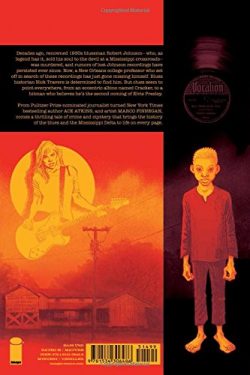
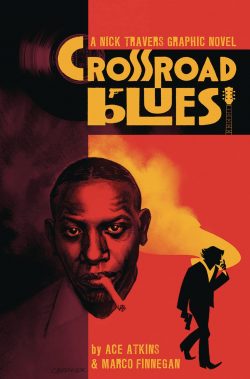
Crossroad Blues – A Nick Travers Graphic Novel


By Ace Atkins & Marco Finnegan (12-Guage Comics/Image)
ISBN: 978-1-5343-0648-0 (TPB/Digital edition)

Following the success of long-delayed originating Nick Travers tale Last Fair Deal Gone Down, Ace Atkins & Marco Finnegan regrouped and applied their brand of Southern discomfort to the first official published exploit. Prose novel Crossroad Blues was released in 1998, with three more following every two years thereafter until 2004.

Here history and myth collide with modern tastes and business practises as Travers reviews the celebrated legend of Robert Leroy Johnson who infamously sold his soul to the Devil for musical success. He “invented” the Delta Blues, was killed in still-mysterious circumstances, is a global presence and still personifies the image of a doomed musician at the mercy of his gifts and cruel commerce. Despite his fame then and influence since, Johnson’s recording career only lasted seven months in total…

Here, a glimpse at his last moments neatly segues into college lecturer/blues documentarian Travers who is momentarily stymied in his plans to make a film about his hero Guitar Slim. Keen to break the deadlock, he checks in with Tulane’s Head of Jazz Archives Professor Randy Sexton. A guy who likes to help and one easily distracted, Nick is soon heading into the Delta for Sexton, looking for absent colleague Professor Michael Baker, who has been missing since some big-time collector hired him to locate the fabled but apparently fictional “lost recordings of Robert Johnson”…

Disbelieving but still beguiled by the notion of the Holy Grail of Blues music, Travers dogs his trail across Mississippi, encountering many dubious characters and finding new girlfriend Virginia before being sent in the direction of negro-albino “Cracker”. This enigmatic “devil-touched” old coot actually met Johnson and now lives at the Old Three Forks Store where Johnson was murdered in 1938. Sadly, he’s not there now, having been abducted and tortured by a wannabe (possibly reincarnated?) new Elvis Presley. The gun for hire has been told the aged hermit knows the location of certain legendary recordings but is all shook up at the dotard’s resistance to pain and mockery of “The King”…

After rescuing Cracker, Travers and local sheriff Willie Brown join forces, but when Nick and multi-talented Virginia search another potential location, the sheriff is murdered and Travers takes the fall until Virginia provides an alibi…

In the interim, the closeted money man behind “Elvis” breaks cover and takes over questioning Cracker. When Nick gets home to New Orleans, trouble follows him back and begins hitting his closest friends – like JoJo and Loretta

He also has a new suspect but nobody wants to tell him who Earl Snooks is or was, and many other people even try to kill just for saying his name…

In the end, it’s Professor Randy who supplies that information and also a possible prime suspect behind all the killings and horror. Just as Travers decides to come down heavy, he gets a message that the villain will trade the recordings no one has actually seen yet for Virginia…

When the dust and blood settles, the mystery of Johnson’s death is solved, but it’s only one of many homicides and the lost records are where they’ve always been as befits the dictates of a real myth…

Complex, compelling and sublimely orchestrated, this is a yarn to delight crime cognoscenti everywhere and one you cannot miss..
© 2018 Ace Atkins. 12-Guage Comics LL authorized user. All Rights Reserved.

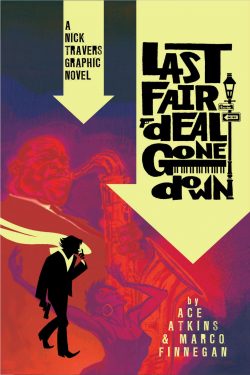
Last Fair Deal Gone Down – A Nick Travers Graphic Novel


By Ace Atkins & Marco Finnegan (12-Guage Comics/Image)
ISBN: 978-0-9836937-1-0 (TPB/Digital edition)

For the majority of private eyes, unshakable ethics, deductive reasoning and an attitude are not enough. The best ones also enjoy a specific time and/or location as well as a quirk or fascination that drives them. For Nero Wolf it was fine food and rare orchids, Marcus Didio Falco was an anti-establishment family man in first century Rome, Miss Marple was elderly and genteel, and both Phryne Fisher and Lord Peter Wimsey were posh, rich, and socialist. Moreover, Harry Dresden abets sleuthing with wizardry, Dirk Gently favours a holistic approach and Detective Chimp is a chimp…

Locale and an overarching outside interest flavours so many great crimebusting ratiocinators, none more so than Nick Travers: a music-loving history-driven investigator plying his twin trades in the moody Big Easy and its shady, murder & melody immersed environs.

The musical mystery prodigy was devised by former footballer award-winning investigative journalist Ace Atkins, a prolific writer who was himself compelled to re-examine cold cases and forgotten crimes.

Born in 1970, Atkins began his fiction-weaving aged 30: penning Crossroad Blues before going on to write three more Travers books between 1998 and 2004, 11 novels of former soldier Quinn Colson and standalone novels White Shadow, Wicked City, Devil’s Garden and Infamous. In 2011, the estate of Robert B. Parker commissioned Atkins to continue that author’s saga of P.I. Spenser, with a further ten books resulting thus far.

All that industrious fictive intrigue stemmed from an unfinished, abortive early exploit of the still unformed Nick Travers. The author’s Introduction for this stunning monochrome graphic grimoire details the strange circumstances leading to that abandoned outline finally being finished in 2016 to become something of a crime-writing sensation. It pays particular heed to the fevered efforts of fan Marco Finnegan to adapt the potent parable into comics…

A masterpiece of mood and style, the story sees Blues historian and occasional Tulane University lecturer Travers enjoying the distinctive Saturday night ambience of JoJo’s Bar (as well as Loretta’s cooking). In that suitably seedy dive, veteran sax player Fats beguiles drink-sodden listeners whilst continuing his own gradual self-extinction via booze and betting. It’s the founding myth of this city…

At the close, Nick spots him a meal and realises the little legend is especially troubled. He talks about being in love Real Love. Two days later, Fats is dead… an accidental fall…

The bluesman had no friends or family so JoJo and Travers are asked to clear his meagre belongings from the flop he rented. Fats had practically nothing left but his vintage sax. It was worth a fortune if he could have ever conceived of selling it, but it’s missing now…

Outraged and overwhelmed, Nick relentlessly employs his other skillset to discover how Fats actually died, who did it and why. As more far-from-innocents are killed, he kicks open a viper’s nest of betrayal, twisted hopes, frustrated desires, criminal exploitation and bitter disappointment – which only confirms all the legends and lies of the men who make the music and the lovers they despondently play it for…

And of course, even when the case closes and the bad guy is dealt with, there’s one last moment of revelation and another betrayal to avenge…

Atmospheric, moodily authentic and drowning in potent edgy drama and tension, Last Fair Deal Gone Down is a perfect example of comics crime and Southern Noir: a wonderful passport to the world of passion, idealism and shop-soiled justice…
© 2016 Ace Atkins. Image Comics. All Rights Reserved.

Sam Hill™: In the Crosshairs


By Tom DeFalco, Greg Scott, Janice Chiang & Art Lyon coloured by Anne-Marie Ducasse, translated by Jerome Saincantin (Dark Circle Comics/Archie)
No ISBN: Digital edition

At the height of America’s Film Noir era of the early 1950s – and following the game changing emergence of Mickey Spillane’s Mike Hammer in 1947 – comics concocted a flurry of lonely, tarnished knights. Like their literary and cinematic equivalents, they solved crimes and unravelled mysteries employing varying degrees of excessive violence, street savvy and frankly a high degree of manly misogyny.

We’ll be seeing the prime offender in action at the end of this week and I’ll be back with Hammer’s greatest disciple – Johnny Dynamite – in the not too distant future. Today, though, it’s the turn of a revived reincarnation of one of the gumshoe’s earliest imitators.

Swiftly moving to exploit the trend, recently rechristened Archie Comics (nee MLJ) launched sidebar imprint Close-Up, Inc. to carry the semi-sordid shenanigans of titular tough guy Sam Hill.

That series (boasting five or more adventures per comic) ran to seven issues in 1951 before shutting down until another century. The writer(s?) remain undisclosed to this day, but the majority of the casebook was illuminated by company A-Lister Harry Lucey (Archie, Betty & Veronica, The Hangman, Madame Satan).

For more broadminded modern times, the character was revived by Archie’s modern mature reading imprint Dark Circle. Enjoying a very contemporary setting and milieu, the enquiry agent is reinvented by scripter Tom DeFalco (Amazing Spider-Man, Thor, Fantastic Four, Spider-Girl, The Phantom), illustrator Greg Scott (X-Files, Area 51, Black Hood, Steve McQueen, Wolverine), colourist Art Lyon & letterer Janice Chiang also suffered from company hesitancy, and the presumably traditional print-designed tales ultimately surfaced as a digital only compilation. Thankfully, the material itself is eminently readable genre fare that fills a gap between mature material like Ed Brubaker & Sean Phillips’ Criminal, Jason Aaron & R.M. Guéra’s Scalped or Azzarello & Risso’s 100 Bullets and all-ages crimebusting fare such as Max Allan Collins’ CSI comic adaptations, Marvel’s Cops: The Job (Larry Hama, Joe Jusko & Mike Harris) or Robert Loren Fleming & Ernie Colón’s Underworld from DC.

So, in the cosy manner of a post-watershed TV show, ‘The Case of the Willful Widow’ sees a now late middle-aged veteran sleuth hired to discreetly retrieve a sex-tape lost by or stolen from recently bereaved cougar Mrs. Clare Wentworth.

Offering no judgement, Sam scrupulously swears not to watch it before checking out family members who might profit from Clare’s public humiliation: accumulating a few suspects in the husband’s murder, and soon finding all leads point to lethal and grudge-bearing old adversary Philip “Big Marco” Marconi

It’s not long before this poking around confirms that there’s a double cross in play, no one is telling the truth and that Hill is marked for murder… again…

After skilfully avoiding that trap, Hill and secretary assistant Molly Barsdale relax until life gets hectic again when notorious District Attorney Nathan Geller blows his brains out. ‘The Case of the Purged Politician’ latterly exposes the playboy politico’s corrupt connections to Big Marco and results in Hill being hired to shadow the DA’s successor amidst rumours that his entire staff were on the take…

Bullets replace flying accusations and more bodies drop, and just who is clean becomes a moot point when Sam’s cop buddy Detective Rufus Stack is forced to act on behalf of the city police chief who hates Hill’s guts. When another motive becomes embarrassingly clear, the true cost of power politics is apparent to all…

Sleazy glamour seizes the Private Eye’s attention in ‘The Car, the Chorus Girl and the Killers’ with Sam paid to find missing showgirl Jenna Ray DeCarlo. Gleefully checking out nightclubs, the suave shamus learns that other, far shadier guys are also seeking her…

Once again he’s stepped on the toes of Marconi and – crucially – his heirs. Oddly, Sam’s client – mob-accountant Mr Mopely – seems more eager to locate her car than his latest squeeze, and when he’s found executed in the traditional manner, Sam realises Jenna wasn’t missing but hiding…

Big changes are happening in the Marconi family, and when what everyone is looking for falls into Hill’s unwilling hands, the P.I. is hunted by the cops and the robbers…

Set square In the Crosshairs’ the investigator goes on the run but doesn’t escape unscathed, (prompting an easter egg guest-shot for Archie’s own medical hero as originally seen in Young Doctor Masters) and a spectacular trap and showdown that offers no conclusion but just a precarious détente…

Stylish, smart, sassy and classy, Sam Hill: In the Crosshairs delivers plenty of action and comfortable crime drama to please any genre fan, with DeFalco’s steadfast tributes to past glories and mob fiction superbly realised by Greg Scott’s slickly atmospheric yet understated art.
© 2015 Archie Comic Publications, Inc. All rights reserved.

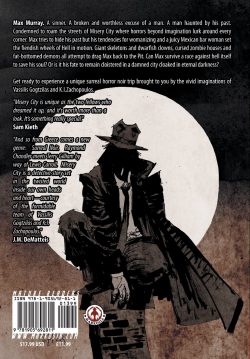
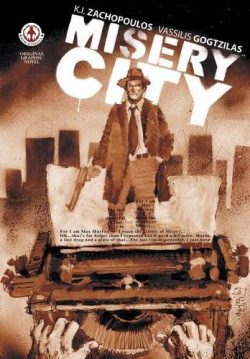
Misery City


By K. I. Zachopoulos & Vassilis Gogtzilas (Markosia)
ISBN: 978-1-905692-81-1 (TPB)

For purists every literary genre is sacrosanct – unless you can come up with a way to mix or blend them with such style, verve and panache that something new is born which feels like it’s always been one of the gang…

Lurking in the shadows since first released in 2013, Misery City is a dark, bleak and ferociously introspective tale that relates the cases of Max Murray. He’s a dowdy, down-at-heel private eye stalking the meanest streets imaginable, in a vast and ever-changing metropolis situated on the outskirts of Hell – and, no, that’s not poetic license or flowery prose, it’s a satnav instruction…

Following an effusive Foreword from arch-stylist Sam Keith and Introduction from writer J. M. DeMatteis, the first 5 issues of the original comics series unfold in this pocket novel package: a stark, unrelenting procession of grimly trenchant case-files starring a shabby, unshockable shamus just trying to get by uncovering other people’s secrets whilst making some sense of the most pitiless town in creation.

Of course, Max has a few secrets of his own…

The black parade begins on the ‘Night of the Corpse’ when the world-weary peeper is attacked by a giant skeleton and must employ his beloved and handy handgun Fat Betty to end the undead animate. Times are both tough and weird, so he doesn’t give it much thought before retiring to his dingy office to await a new client and case…

When the phone rings it’s that sexy waitress Pakita from The Bar. Max has suffered the serious hots for the hot totty simply forever, but his rising hopes take a dive when the mercurial Mexican only hires him to check up on her cheating boyfriend.

With heavy heart and azure cojones, the gumshoe goes looking, utterly unaware that an old enemy has returned seeking vengeance. Professor Ego was penned in unimaginable torment because of Murray, and now he’s out and wasting no time in sending a plague of devils to secure some payback…

As a host of demonic clowns hunt the private detective, Max finds Pakita’s man. However, catching the faithless dog with another woman drives the PI crazy, and Murray goes ballistic, beating the cheating Dick to a pulp. Appalled and repentant, he then heads over to Pakita’s place to apologise but finds her gone, snatched by his long-forgotten foe.

Answering the ‘Call of Ego’, Max heads for the horror’s Tower hideout and a brutal showdown…

Despite his shoddy appearance, this detective is no dumb palooka. His secret vice is reading, and Max’s unceasing internal monologue is peppered with quotes and allusions from poets like Dante and Tennyson. They’re the only thing comforting him as ‘A Wooden Coffin for Max Murray part I’ sees him taking the Hell train to a surveillance job in the worst part of Misery City.

Horny as always, Max is disappointed to discover what the owner of that so-sexy French voice on the phone really looks like, but nevertheless agrees to check out the abandoned timber-framed family house the tearful widow fears property developers crave…

Maybe he should have been more suspicious, but the client’s stunning daughter Josephine had turned his head and all points south…

Upon entering the ramshackle old pile, a colossal zombie fiend attacks and before he can react, the entire house explodes out of the ground and rockets into orbit. Lost in space and out of options, the gumshoe reveals a few of his own incredible survival secrets, destroying the monster (said client’s vengeful and very angry husband) in ‘A Wooden Coffin for Max Murray part II’ before escaping the timber trap to settle scores with the murderous she-devils. It appears Max is on a first name basis with the Big Boss of the Inferno, and the head man is keen on renewing a satanic acquaintance with the understandably reluctant detective…

These malign mystery yarns conclude with a stunning surprise in ‘The Last Drag of a Pocket God’ with Max dogging a phantom with astounding delusions of grandeur. However, after sending Marty “The Voice” Coronado to his final rest, an uncomfortable conversation with Pakita forces the shamus to confront his own long-suppressed thoughts: examining the illusions that keep him going on the pitiless streets of Misery City…

Potently targeted vulgarity and a brusque, verbally confrontational narrative style gives Kostas (Mister Universe, The Fang, The Cloud) Zachopoulos’ manic scripts a supremely savage edge, whilst the freakish, surreal Horror-Noir milieu is perfectly captured by frequent collaborator/illustrator Vassilis (The Biggest Bang) Gogtzilas’ astoundingly frenetic art, delivered in a melange of assorted styles.

This mean, moody and menacing chronicle is topped off with a host of powerful pin-ups and a cover art gallery to further disquiet and beguile the unwary reader.
Misery City ™ & © 2013 Kostas Zachopoulos, Vassilis Gogtzilas and Markosia Enterprises, Ltd. All rights reserved.

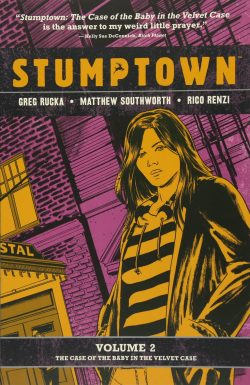
Stumptown volume 2: The Case of the Baby in the Velvet Case


By Greg Rucka, Matthew Southworth, Rico Renzi & various (Oni Press)
ISBN: 978-1-93496-89-7 (HB) 978-1-620104-80-4 (TPB) eISBN: 978-1-62010-032-5

Plenty of superhero, supernatural and sci fi comics make the jump to TV and movies these days, but not so many crime sagas. One that did came from ever-entertaining, prodigiously prolific, multi award-winning Greg Rucka.

A screenwriter (The Old Guard) and novelist (Atticus Kodiak crime sequence, Jad Bell series and a whole bunch of general thrillers), he also crafts astounding graphic thrillers like Whiteout, Queen & Country, Lazarus or The Old Guard whilst excelling on major properties and characters including Star Wars, Batman, Gotham Central (co-scripted by Ed Brubaker), Superman, Wonder Woman, Grendel, Elektra, The Punisher, Wolverine and Lois Lane. He has been a major contributor to epic events such as 52, No Man’s Land, Infinite Crisis and New Krypton.

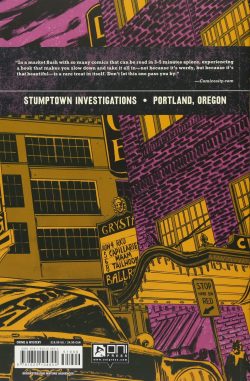
To my mind this most engaging original comicbook concept features a non-traditional private eye barely getting by in the writer’s own backyard: Portland Oregon – AKA “Stumptown”…

The series launched in November 2009 as a 6-issue miniseries, with modern day Portland a vibrant and integral character in the story. A huge hit, the series was indefinitely extended and ran until #19. The TV show launched September 25, 2019 and was equally entertaining and initially successful, before dying after one superb season during the worst days of the pandemic.

Fronted by Kelly Sue DeConnick’s Introduction ‘On Stumptown’ and illustrated by Matthew (Savage Dragon, Ares, Infinity Inc.) Southworth and supplemental colourist Rico Renzi, the daily grind resumes with ‘The Case of the Baby in the Velvet Case’. Here we meet again Dexadrine Callisto Parios, independent private detective and sole owner/primary operative of Stumptown Investigations.

Professionally, things are on the up. “Dex” now has an actual office to work out of, but still struggles with bills, two mortgages, a gambling problem, impulse control and dangerously implacable ethics. She’s also caring for dependent brother Ansel and ignoring other people’s opinions of her bisexuality – or more likely her attitude to them shoving their noses into problems she doesn’t want to confront yet…

After a missing persons case struck far too close to home made her name, briefly secured her future and brought her to the unwelcome attention of billionaire crime-boss/legit businessman Hector Marenco, Dex hoped life would settle down to regular PI gigs: cheating spouses, lost wills and the like.

In fact, there is a lot of that, like the potentially rewarding work-pilferage job she turns down after learning it would be for one of Marenco’s shady enterprises…

Suddenly, things get complicated and crazy again when a living legend walks through the door of her new office. Miriam “Mim” Bracca is a local legend made good globally and her band Tailhook are the epitome of wild success and excess. The megastar has a unique problem though: someone has stolen her baby…

The sweet child in question is a 1977 Gibson Les Paul, perfectly restored and utterly adored. It’s her favourite guitar: more crucial to her life and wellbeing than all her internal organs combined. The sweet precious vanished during or after the last gig and she doesn’t care if it’s just lost or been stolen. Mim will pay anything to get her true and perfect soulmate back…

Parios is astounded and reminds the star that the police work for free. Bracca however, has just ended an affair with Detective Tracy Hoffman (Dex’s inside pal on the Portland Police Bureau) and resoundingly rules that out…

Swallowing a huge amount of sheer fan froth, Dex gets down to business: checking Mim’s mental state and physical dependencies. Once convinced she’s serious, it’s all about the process, and Dex looks into just how much Mim Bracca’s go-to guitar is worth on the open market before interviewing the other band members, roadies and crew. It all seems silly but straightforward: a simple case of following well-rehearsed steps until the axe is recovered or uncovered, but there are levels of betrayal, criminality and deception in play that will make this job lethally risky business…

Dex gets her first inkling visiting Mim’s personal guitar manager Fabrizio Pullano, who she finds being beaten up by manically violent and remarkably dumb skinheads prepared to torture and kill to find the guitar. Being smart and handy, she soon sends them packing, and learns she’s in the middle of a covert DEA operation. Obnoxiously abrasive agent Cathy Chase and her so-mellow associate Mike Vela try to arrest, implicate and then co-opt her…

No stranger to legal officialdom and blinkered procedures, Dex correctly assesses there’s a lot more going on than a missing instrument, and despite hot Tailhook drummer “Click” Mayes being far more open and forthcoming than he needs to be in his interview, she leaps to an obvious conclusion…

A confrontation with her client convinces her that if drugs are being smuggled on Tailhook tours, the band know nothing about it, but Dex’s notion that she’s now got it all sussed bar some legwork evaporates when she gets home and finds Ansel and neighbour Grey playing with “Baby”.

An unidentified stranger left the hot item at Her House (!) in an obvious attempt to deliver a threat and end her involvement, but a quick examination of the case proves her suspicions and Parios knows this isn’t over at all…

In fact, the return of Baby triggers a rapid spiral of manic events as Tracy Hoffman confronts her old lover, the DEA try to arrest everybody, and viciously stupid skinheads Brad and Mick burst in guns blazing and spark one of the most spectacular car chases in comics…

Insanely, when the dust settles, the mystery remains. No one admits to taking Baby in the first place and Dex has to think again…

Happily, she deduces whoactuallydunnit just in time, and is there when the drug smugglers, their skinhead clients and the enigmatic mystery supplier move to recover their product and seek redress for their trouble. With a fluid and potentially deadly standoff resulting, Parios – as always – hangs tough, thinks fast and exploits her gift for making plans on the fly…

A superbly stylish thriller perfectly exploiting the nature of Oregon myth and culture, this yarn perfectly captures a magical place and its self-appointed shop-soiled white knight. Extras include Artifacts of Stumptown – a feature on Southworth’s art process plus promo posters.

Rucka excels in capturing character in meaningful but believable ways that add to understanding whilst always advancing the plot. Ansel (a superbly positive take on a neuro-atypical character: living with Downs Syndrome but realistically rendered, sensitively realised and fully participatory) is used to great effect and, as always, serves to ground Dex’s more dangerous impulses.

…And it’s all clever, witty fast paced and superbly action-packed. If you love crime drama, detective fiction, strong female role models or just bloody great storytelling, you need to pay a visit to Stumptown.
Stumptown volume 2: The Case of the Baby in the Velvet Case ™ & © 2013 Greg Rucka & Matthew Southworth. All rights reserved.

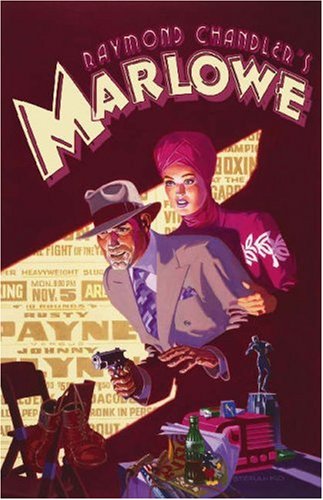
Raymond Chandler’s Marlowe: A Trilogy of Crime


Adapted by Tom DeHaven & Rian Hughes; Jerome Charyn & David Lloyd; James Rose, Lee Moyer & Alfredo Alcala, & various (iBooks)
ISBN: 978-0-7434-7489-4 (HB), 978-1-59687-839-6 (TPB 2016 edition)

If you’re going to adapt classic, evocative crime stories into graphic narrative there really isn’t no better source material than Chandler. This follow-up to the adaptation of Raymond Chandler’s Marlowe: The Little Sister was last reissued in 2016 as Raymond Chandler’s Marlowe: The Graphic Novel: once again the fruit of comics visionary Byron Preiss.

It adroitly adapts three short tales from the master of hard-boiled fiction. Significantly, they are all rendered in a variety of unique and impressive styles by an international array of top-flight creators…

Opening the show is ‘Goldfish’, first published in 1949 and the writer’s ninth short story sale. It preceded his first Marlowe novel by three years and is here adapted by Tom DeHaven (Green Candles, It’s Superman!) & lettered by Willie Schubert. The stylish illustration comes courtesy of British designer/artist Rian Hughes (Dare, I Am a Number) using muted colour tones that have only the merest hint of hue to them. The effect is powerfully evocative and atmospheric.

When former cop Kathy Horne sidles into the tough guy’s seedy office, she brings a tale of lost pearls, an absconded convict and a huge reward just waiting to be claimed. Dragged far out of his comfort zone and sent up and down the Pacific Seaboard, our world-weary shamus is just steps ahead of sadistic, casually murderous Carol Donovan and her gang of thugs in a superb thriller of double-cross and double-jeopardy…

Next up is ‘The Pencil’, scripted by award-winning mystery novelist Jerome Charyn (Isaac Sidel series, The Magician’s Wife, New York Cannibals), brilliantly rendered by British comics legend David Lloyd (V for Vendetta, Hellblazer, Wasteland, Aces Weekly) in moody, dry-brush black and white, and lettered by long-term collaborator Elitta Fell. This was Chandler’s 21st – and final – Marlowe adventure, published posthumously in 1959, shortly after the author’s death. You might know it as Marlowe Takes on the Syndicate, Wrong Pigeon or even Philip Marlowe’s Last Case.

Hollywood 1955: Ikky Rossen is a bad man, a career gangster and mob leg-breaker. When he crosses his bosses he hopes Marlowe can get him safely out of the City of Angels before The Organization’s East Coast “button men” send him to Hell. Marlowe knows these are people to be avoided at all costs and only one thing is always true: everybody lies…

Closing the casebook – and somewhat ill-considered and misplaced to my mind – is ‘Trouble is My Business’ as interpreted by James Rose (Thundercats, Savage sword of Conan), Lee Moyer (Starstruck, Dungeons & Dragons) & Alfredo Alcala (Voltar, Swamp Thing, Man Thing, Batman, Savage Sword of Conan), with Schubert again filling the word balloons.

This is a weak tale of vengeful Harriet Huntress who intends to destroy two generations of wealthy socialites mixed up in the gambling rackets originated in 1939: a rather tame and straightforward yarn in comparison to the other stories here, not to mention the landmark first full novel The Big Sleep, which was also published in that year.

Moyer and Alcala do a solid job of illustrating the plot (although it’s a little pretty for my tastes) but the cynical edge that is the hallmark of Chandler’s iconic creation is muted if not actually extinguished here.

Despite ending on a sour note, this is still a superb sample of Detective comics any fan can revel in, with the incredible Steranko cover alone well worth the effort of tracking down…
Adaptations and illustrations © 2003 Byron Preiss Visual Publications Inc. Original stories “Goldfish” and “Trouble is my Business” © 2003 Philip Marlowe BV (Estate of Raymond Chandler) All Rights Reserved. “The Pencil” © 1971 Helga Greene, Executrix, Estate of Raymond Chandler. All Rights Reserved.