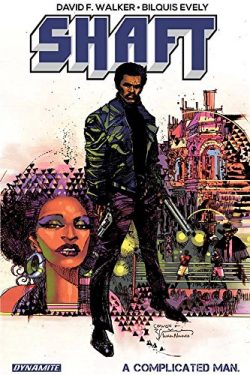
Shaft: A Complicated Man


By David F. Walker, Bilquis Evely & various (Dynamite Entertainment)
ISBN: 978-1-60690-757-3 (TPB/Digital edition)

For decades Black consumers of popular entertainments had far too few fictive role models. For the English-speaking world that began changing in the turbulent 1960s and truly took hold during the decade that followed. A lot of the characters developed at that time came from a cultural phenomenon called “Blaxploitation” (other spellings are available). Despite being criticised for their seedy antecedents, stereotypical situations and violence, these films and books were the first mass-market examples of minority characters in leading roles, rather than as mere fodder or flunkies.

One of the earliest movie icons of the genre was a man called Shaft.

The landmark film was scripted by journalist and screenwriter Ernest Tidyman (The French Connection; High Plains Drifter) from his own 1970 novel. He authored six more between 1972 and 1975, with his timeless urban warrior starring in numerous films and a TV series. Eighth novel Shaft’s Revenge was released in 2016, written by David F. Walker.

Amongst his many gifts Walker numbers writing comics (Occupy Avengers; Cyborg; Red Sonja and many more) and in 2014 he was invited to write a long-overdue comics iteration… Illustrated by Bilquis Evely and coloured by Daniela & Miwa (Walker lettered the series himself), the comic book took its look, settings and tone primarily from the novels rather than the Richard Roundtree films. The first 6-chapter story-arc was collected as Shaft: A Complicated Man and offers some intriguing love overdue backstory. In all the detective’s prior appearances, no mention was made of his past, but here Big John gets a proper Origin…

Following an Introduction by educator and author Shawn Taylor, the saga – which won the 2015 Glyph Comics Award for Story of the Year – begins in December 1968. John Shaft is a former marine and veteran of the Vietnam war who’s come home and is trying to find his place in the world. An indomitable fighter, he’s using boxing as his big chance, but when he refuses to throw a fight, he incurs the wrath of both local black gang boss Junius Tate and the district’s mafioso overlord Sal Venneri.

Proud and resolute, but no fool, Shaft wins his bout, and accepts brutal punishment from Tate’s conflicted leg-breaker Bamma Brooks before vanishing from the cloistered island-within-an-island known as Harlem…

Just drifting, Shaft briefly goes to college before the call of adventure finds him joining private detective agency National Investigation & Security Services. His first job is as a plainclothes guard and “undercover negro shopper” at a fancy department store…

While on duty he meets pretty Arletha Havens and finds a reason to stop drifting and start planning. Before long, he’s seeing a bright future together.

That all goes to hell when thugs bust into their apartment looking for a hooker named Marisol Dupree and her pimp Jimmy Style

With Arletha hostage, Shaft is forced to accompany one of the abductors back to Harlem for the first time in years, hunting the missing woman and a package she’s holding: something someone really important wants back. In fact, Marisol’s mystery treasure has big city money men in a panic and all the criminal factions in Harlem at each other’s throats, but Shaft’s immediate problem is simply staying alive…

After surviving a savage gunfight dropping five bodies in an alley, he returns home to find Arletha’s body and resolves that somebody – maybe everybody – is going to pay…

All on his own again, the coldly furious avenger finds his true calling, tracking down Marisol, methodically putting the pieces together in a chilling city-wide web of graft, favours, murder and money before ensuring the guilty parties pay the ultimate price…

Comprising a devious, byzantine wasps’ nest of civic corruption, crooked cops, warring mobsters and treacherous allies, played out against a tragic backdrop of true love forever lost, Shaft’s first case is a superb crime thriller no fan of the genre should miss and comes with a bevy of bonus features. These include character designs; unused illustrations by Walker & John Jennings; script excerpts; in-production art pages and a covers and variants gallery by Denys Cowan, Bill Sienkiewicz, Ivan Nunes, Francesco Francavilla, Michael Avon Oeming, Ulises Farinas, Matt Haley, Sanford Greene, Nacho Tenorio & Sergio Mora.

It even comes with a toe-tappingly cool playlist to track down and enjoy whilst reading…
Shaft is ™ & © 2015 Ernest Tidyman. All rights reserved.

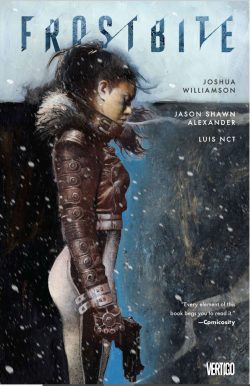
Frostbite


By Joshua Williamson, Jason Shawn Alexander, Luis NCT, Steve Wands & various (DC Comics)
ISBN: 978-1-4012-7134-3 (HB/Digital edition)

As you have probably noticed, Earth as we know it is doomed. It’s a tragedy of staggering proportions and a telling indictment of the suicidal greed and indifference afflicting so many humans. Ironically this fact does fuel an immense and growing genre of armageddon fiction…

Here’s a – brace yourselves! – truly chilling, utterly gripping yarn from writer Joshua Williamson (The Flash, Infinite Frontier, Justice League vs Suicide Squad, Birthright. Deathbed), illustrator Jason Shawn Alexander (Killadephia, Marvel Zombies, Empty Zone, Batman), colour-artist Luis NCT and letterer Steve Wands that superbly captures all the grim foreboding of the Last Days whilst still dangling cruel hopes of possible survival.

If you’re one of that strange breed of modern knight errant who just can’t stomach a woman – and a black one, too! – in the role as Last Action Hero, you won’t like this superb science-gone-bad, doom-watched dystopian drama, so you’ll want to go play somewhere else for validation…

Once upon a time, six scientists sought to save the world from destruction and humanity from itself. As inexorable climate change turned Earth into an uninhabitable tinderbox, they did something wondrous with cold fusion and eradicated the searing heat build-up.

However, as we all know, no good deed ever goes unpunished and their miraculous solution unleashed a new ice age that brought civilisation to its knees and human beings to the edge of extinction.

In the aftermath, as pockets of mankind sought to stay warm and eat on a desolate ice-ball world, it was revealed that the temperature inversion had brought another – even more terrifying – tribulation: a bizarre disease that slowly turned living creatures into ice. Terrified humans began isolating themselves in smaller groups, making pariahs of strangers, abhorring the blue stigma and dreading the inescapable death sentence that was “Frostbite”…

America 57 years after big freeze is an icy wind-wracked wilderness, with meagre population pockets occupying what used to be mega-cities. It’s a world of barter, exploitation and quick violence, with heating devices and drugs as the prime transferable resources. Criminals have scrambled to the top of the heap and dictate the way things are. Everyone is terrified that fraternisation also brings the cold contagion…

In Mexico City, freelance cargo-shippers Keaton and her partner Chuck Barlow accept a commission to transport a father and his daughter to what used to be Alcatraz Island. Both prospective passengers are science doctors and display obvious signs of great wealth, but broke as she is, Keaton can’t shake her suspicions of something bad in play…

Henry Bonham and his brilliant child Victoria clearly have the resources to travel in style and comfort, but instead want the secrecy of a lumbering tractor like Barlow’s pride-&-joy Icebreaker. Keaton would be even more upset if she knew who they were and who was chasing them…

When those pursuers attack, the Bonhams are separated and Keaton, on learning Henry’s secret, kills him herself. Only afterwards does she discover that it wasn’t him the pursuers wanted, but Victoria. The junior scientist has developed a cure for frostbite and is now the most valuable thing on earth…

Furious, guilt-ridden, repentant, hopeful and slowly dying, Keaton resolves to get the daughter to the Alcatraz lab before she expires, no matter who or what stands in their way. As she grows ever closer to her trek buddy, the hardest part is not confessing what she’s done and what’s she’s becoming. Although built on mutual lies, there’s a painfully doomed relationship growing that might be even more important to Keaton than saving the world or her own life…

Their voyage across the frozen south overflows with violent clashes as relentless pursuit constantly results in explosive violence, with Keaton’s prowess and ingenuity significantly reducing the numbers of humans in existence every time they are caught or intercepted.

Soon however, their only foe is Keaton’s secret and when that’s exposed, everything changes forever…

Fast-paced, smart, action-packed and tension-taut, Frostbite is a picture perfect action adventure with a flawed but indomitable hero in the same unstoppable yet fragile mould as Ripley or Sarah Connor.

Graced by a magnificent cover gallery by Alexander & NCT, this is the kind of chill affirmative action we should all enjoy.
© 2016, 2017 Joshua Williamson and Jason Shawn Alexander. All Rights Reserved.

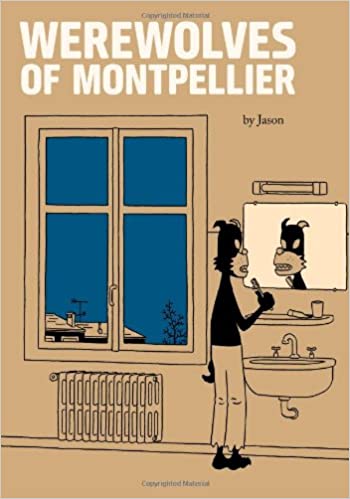
Werewolves of Montpellier


By Jason, translated by Kim Thompson (Fantagraphics Books)
ISBN: 978-1-60699-359-0 (HB/Digital edition)

Jason is secretly John Arne Saeterrøy: born in Molde, Norway in 1965 and an overnight international cartoon superstar since 1995 when his first graphic novel Lomma full ay regn (Pocket Full of Rain) won Norway’s biggest comics prize A Sproing Award.

He won another in 2001 for the series Mjau Mjau and by 2002 was almost exclusively producing graphic novels. Now a global star, he has won many more major awards from such disparate regions as France, Slovakia and the USA.

Rife with his signature surreality, this novella was first released in 2010; populated with cinematic, darkly comic anthropomorphs and featuring more bewitching ruminations on his signature themes of relationships and loneliness, viewed as ever through a charmingly macabre cast of bestial movie archetypes and lost modern chumps.

Here he focuses on the hollow life of expatriate Swede Sven, a purposeless artist who has gravitated into a stagnant, romance-lite existence in a provincial French town. Sven fritters away his days just like his close friend Audrey – another listless intellectual looking for the right lady to love.

The only thing quickening his pulse these days is the occasional nocturnal foray over the rooftops: burglarizing houses dressed as a werewolf. Unfortunately, Montpellier already has a genuine lycanthrope community and they don’t look kindly upon gauche parvenus intruding into their world with criminal cosplay…

This post-modern short-&-spooky fable unfolds in Jason’s beguiling, sparse-dialogued, pantomimic progressions delivering resonances of Hitchcock’s bubbly comedy-thrillers, quirkily blended with Bergman’s humanist sensibilities. The enchantingly formal page layouts are rendered in his minimalist evolution of Hergé’s Claire Ligne style: solid blacks, thick lines and settings of seductive simplicity augmented here by a stunning palette of stark pastels and muted primary colours.

Jason’s work always jumps directly into the reader’s brain and heart, deftly probing the nature of “human-ness” by using the beastly and unnatural to ask persistent and pertinent questions. Although the clever sight-gags are less prominent here, his repertory company of “funny-animal” characters still uncannily displays the subtlest emotions with devastating effect, proving again just how good a cartoonist he is.

This comic tale is best suited for adults but makes us all to look at the world through wide-open childish eyes. Jason is instantly addictive and a creator every serious fan of the medium should move to the top of the “Must-Have” list. Buy, borrow or even steal it if you must, but be aware that actions have consequences… even for faux monsters…
© 2010 Jason. All rights reserved.

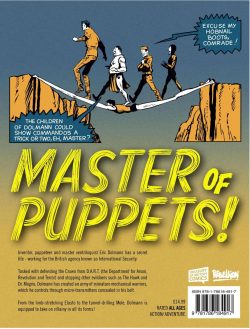
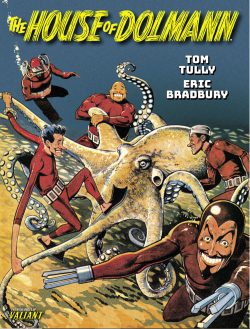
House of Dolmann


By Tom Tully & Eric Bradbury, with Carlos Cruz & various (Rebellion)
ISBN: 978-1-78618-491-7 (TPB/Digital edition)

Win’s Christmas Gift Recommendation: Weird, Wonderful, So Why Not?… 9/10

Wrapping up a week of Unamerican Superheroes is a classic British confection which might well be the closest we ever got to a Silver Age super-team – even if the members are technically all the same bloke…

Valiant debuted as a “Boys’ Paper” in 1962, as our indigenous periodicals industry struggled to cope with spiralling costs and a sudden mass importation of brash, flashy, full-colour comics from America. A weekly anthology dedicated to adventure features and providing a constantly-changing arena of action, the comic became the company’s most successful title for over a decade: absorbing many less successful titles whilst preserving their top features between its launch on October 6th and eventual amalgamation into new-styled, immensely popular Battle Picture Weekly in 1976. It also generated dozens of extra-sized Summer Specials and 21 Annuals between 1964 and 1985: combining original strips with prose stories; sports, science and general interest features, short humour strips and – increasingly from the 1970s onwards – reformatted reprints from IPC/Fleetway’s copious back catalogue.

In February of 1963 it merged with the company’s previous star vehicle Knockout and, mere months later, became the brand title for a series of fortnightly – later monthly – digest-sized comics volumes. The Valiant Picture Library offered longer stories at the cost of 1 shilling. It ran to 144 issues ending in 1969…

In May 1965, the weekly Valiant increased its price from sixpence to 7d (that was in old money, of course) but also increased the page count from 28 to 40 action and fun-packed pages, and ramped up the innovative anthological entertainment…

British weekly comics in the 1960s and early 1970s were a phantasmagorical playground of bizarre wonders. Truly recognisable heroes appeared in war, western and its gradually declining straight crime serials, whilst the most memorable momentum devolved to a hybrid, bastardized mixture of fantasy, horror and science fiction themes to spawn an evil-crushing pantheon unlike any other…

The Spider, Steel Claw, Thunderbolt, Phantom Viking, Captain Hurricane, Robot Archie, Kelly’s Eye, Cursitor Doom and others utterly tainted the gleaming pristine gene pool of noble superheroism with its bleak and often manic sensibilities. You can thank this stuff for the 1980s “British Invasion” of American comic books and the dystopian weltschmerz that dominated the industry for a decade thereafter, peppering the genre with our sort of misfit, maverick and malcontent misanthrope…

Even early on when we briefly adopted full-blown US style superheroes like Marvelman, Captain Universe, Danger Man and Thunderbolt Jaxon, or late entries Tri-Man, The Leopard from Lime Street, Gadget Man & Gimmick Kid and the wondrous Johnny Future at the height of “Batmania”, Brits could never really take it straight. There was always something daft, anarchic, quirky or just scarily warped in the final result…

Here’s a sublimely perfect example of all that: a seedy solitary inventor with a hidden past who spends his days playing with puppets: an obsessive who can’t help literally putting words into their mouths…

Another stunning salvo of baby boomer nostalgia courtesy of Rebellion’s Treasury of British Comics strand, this first collection of The House of Dolmann gathers the early material from Valiant, spanning October 8th 1966 (issue #208) to May 6th 1967, plus a late entry from Valiant Super Special 1980. The strip itself ran until May 1970, and has resurfaced a few times since then, both in reprint form and new tales…

It also offers an incisive Introduction from modern day comics scribe Simon Furman and begins with a handy character guide in ‘Meet Dolmann’s Dolls (part 1)’ providing a pictorial and text run-down of Astro, Elasto, Giggler, Micro, Mole, Raider and Togo: purpose-built robots designed with amazing specialised abilities. I’m sure I don’t need to remind you that this was the mid-Sixties, so racial depictions like the half-sized sumo wrestler-bot last cited were perpetrated “in fun”, and not fairness or good taste…

House of Dolmann was a curious, inexplicably compelling blend of super-spy and crime-buster strip scripted by the magnificently prolific Glasgow-born Tom Tully. His astoundingly broad output included classic delights like Roy of the Rovers, Heros the Spartan, Dan Dare, Master of the Marsh, Janus Stark, Mytek the Mighty, The Wild Wonders, Nipper, Adam Eterno, The Mind of Wolfie Smith, Johnny Red, Harlem Heroes, Mean Arena, Inferno, The Robo Machines, Football Family Robinson, Buster’s Ghost as well as many of the strips cited above.

His collaborative co-creator here also worked on many of those sagas. The incredibly gripping moody comic art of Eric Bradbury had begun gracing newsagents shelves in 1949 in Knockout. Frequently working with studio mate Mike Western, Bradbury drew strips like Our Ernie, Blossom, Lucky Logan, Buffalo Bill, No Hiding Place, The Black Crow and Biggles. He was an “in-demand” illustrator who worked into the 1990s on landmark strips like The Avenger, Phantom Force 5, Maxwell Hawke, Death Squad, Doomlord, Darkie’s Mob, Hook Jaw, The Sarge, Invasion, Invasion 1984, Rogue Trooper, Future Shocks, Tharg the Mighty and so much more…

From the start, Tully & Bradbury delivered intense, claustrophobic tension-drenched, action-packed episodic adventures, opening with a spectacular kidnapping at the London Opera House.

When Professor Hanson – head of Britain’s atomic missile program – is abducted by jetpack-wearing masked thugs, the police and security services are stumped and the authorities have no recourse but to call in independent contractors International Security. Enigmatic chief Mr. Marshal and his top aide promptly pop over to the East End and The House of Dolmann: a pokey shop owned by a grimy, creepy puppet seller who apparently makes ends meet as a mannequin repairman who also dabbles in second-hand dolls, puppets, animatronics and shop or museum dummies.

However, in the grotty emporium – looking like a blend of junk shop and the parlour set of Steptoe & Son – a brilliant inventor has been clandestinely building an army of automated assistants – if not actual friends – to do his bidding. The IS operatives are greeted by a 3-foot tall articulated sumo automaton who invites them inside. They are as yet unaware that the voice – and appallingly racist accent – in fact belongs to proprietor Eric Dolmann who uncontrollably puts words in the mouths of all his creations… and perhaps divides a series of multiple personalities amongst them all at the same time. Shabby Dolmann’s life is pure subterfuge. (I digress here, but an awful lot of “our” heroes were tattily unkempt: we had “Grunge” down pat decades before the Americans made a profit out of it!)

The bizarre figure is in fact a troubled engineering genius who designs and constructs an army of specialised robots disguised as puppets to act as his shock-troops in his a dark and crazy war against the forces of evil. They are all directly radio-controlled by the inventor, but seem to act with increasing autonomy as the months go by …

Top of his hit list is subversive organisation D.A.R.T. – the Department for Arson, Revolution and Terror – and he eagerly accepts the job of foiling their plans by single-handedly raiding their London secret HQ with small army of super-bots…

The assault is a complete success but in the resultant rout and rescue, D.A.R.T. boss Rafe Garrott gets away from Dolman and his “children”…

Pattern set, what follows is a potent and spectacular parade of peril-packed romps: complete 4-page thrillers alternating with extended sagas wherein the troubled and frankly disturbing puppeteer and an ever-expanding team tackle high-tech kidnappers, rascally protection racketeers, road haulage hijackers, weapons dealers, bullion bandits, museum marauders, blackmailers and a silver-obsessed madman…

In his unceasing war on wickedness, the daring Dolls hunt and confront modern-day river pirates, escaped killer convicts, train robbers and mail van raiders, fur-thieves, mad scientists Dr. Magno and Doctor Volt, a costumed cat-burglar, super-sophisticated safecrackers, deranged arsonist Firebug, cunning counterfeiters in their tricked-out funfair of doom, a brutal biker gang and – repeatedly – the massed minions of arch super-criminal ‘The Hawk’. The half-pint heroes even infiltrate a prison in search of justice…

As the series progressed, additions were made to the synthetic squad – like tactical calculator Egghead – and supplemental gadgets such as a flying Dolmobile and all-terrain Dol-Bike (with sidecar for the fractious, ever-squabbling toy boys), tacitly acknowledging the tropes and trends gripping the world beyond the comic.

A slow backstory develops, hinting at the inventor’s murky past. Eventually his real name – Jonas Luthor – is revealed after his obscuring clown mask falls off in a tussle with a career criminal. The accident belatedly leads to his squalid shop being threatened by a police raid as diabolical plunderer The Gold Miser drives London into a glistering plutocratic panic and it takes all Dolmann’s ingenuity and dexterity to deflect, divert, disinform and save the day…

Ultimately, wild sci fi spy paraphernalia like levitation ray thieves and the tank-driving Commando Raiders inform and dominate the stories, with D.A.R.T.’s resurrection adding layers of fearsome fantasy frenzy. Crucially, the always-unsettling sight of dolls perpetually arguing amongst themselves grows more frenetic, generating moments of apparently genuine animosity within the automatic adventurers …

The weekly stories were always a mix of action, surreal humour and topical bombast, which close here with a rowdy, rousing romp involving saving the Tower of London and the Crown Jewels from fake guards tunnelling under the walls…

One final treat opens the ‘Extras’ section, with the 1980 Valiant Summer Special providing an extended maritime exploit from Tully and Spanish artist Carlos Cruz (AKA Carlos Cruz González, who limned many UK yarns including Sergeant Kirk, The Shrinker’s Revenge, Mighty McGinty, Sergeant Rock – Paratrooper, Dr. Mesmer’s Revenge, Bloodfang, Union Jack Jackson, M.A.S.K., Dan Dare: Pilot of the Future, The Phantom and so forth) detailing how a jaunt to Cornwall leads to the plastic pack scuppering a gang of transatlantic pirates raiding shipping in a submarine…

That’s supplemented by prose thriller ‘Slaves of the Spider’: a tantalising promo and extract by Barrington J. Bayley & Bradbury taken from the forthcoming Mind of Jason Hyde collection and a batch of Creator Biographies

Brilliantly bizarre, creepily compelling and stuffed to overflowing with zany thrills and chills, The House of Dolmann is inconceivably engrossing and incontrovertibly British to the core: fast-paced, freakily funny and once seen, never forgotten. Buy it for the kids and read it too; this is a glorious book, and you should brace yourself for better yet to come…
© 1966, 1967 & 2022 Rebellion Publishing IP Ltd. All Rights Reserved.

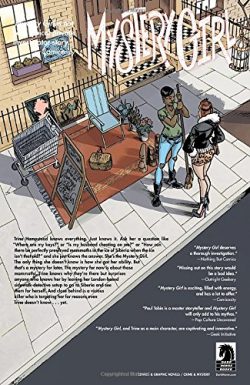
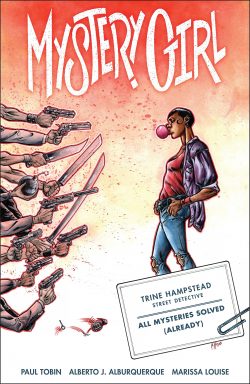
Mystery Girl


By Paul Tobin, Alberto J. Albuquerque, Marissa Louise & Marshall Dillon (Dark Horse Books)
ISBN: 978-1-61655-959-5 (TPB/Digital edition)

There are many fabulous smartly entertaining stand-alone comics collections on the market these days, offering readers a single done-in-one hit of graphic entertainment without the grief of buying into massive back-history or infinite cross-continuity.

One of the best I’ve ever seen compiles a fierce, frenetic and funny 4-issue miniseries from 2015, starring the most infallible detective of all time. No sequel yet, but I live in hope, which is a rather apposite thing to say here…

As crafted by American author Paul Tobin (Marvel Adventures Spider-Man, Plants vs. Zombies, Bandette, Colder) and Spanish artist Alberto Jimenez Albuquerque (Les Fugitifs de l’Ombre, Letter 44, Generation X, Wakanda Forever) – with colours by Marissa Louise and letters from Marshall Dillon – this slim, sleek, slick yarn simply screams for more enigmas to be excitingly unravelled by this sleuthing star in waiting.

Like any ancient city, London has its fair share of unique characters and unsolved mysteries, but that’s never the case whenever Trine Dorothy Hampstead sets up her “office” on the pavements and begins chatting…

The effusive, ebullient young woman has an incredible gift. She knows the answer to any question she’s asked. Instantly and infallibly. “Where are my keys?” “Did Dad leave a will?” “Where is my missing son’s body…?”

All inquiries get an instant response and every answer is correct!

Trine is a local celebrity in her community, not only for the fact that she’s never judgemental or exploits her gift, but also because everyone knows there’s only one mystery the poor lass can’t solve: how she got her uncanny power…

Trine has an immense taste for life at full throttle and abiding desire to help those in need: regularly consulting with local private eye Alfie and aiding her perpetually sceptical boyfriend Ken Bloke – a Metropolitan police constable – in his work, even though he refuses to believe in her gift…

Her already extraordinary life takes a big step into the unknown when ancient DNA specialist Jovie Ghislain comes to Trine with a fascinating query. The biologist had been researching a 1930’s expedition to the wild Sakha region of Siberia. In the notes of the fabled Weimar-Steinberg trek, the explorers detailed how they uncovered a frozen mammoth carcass so perfectly preserved that the meat was still fresh and edible. Their records are tragically incomplete and Ghislain – desperate to secure viable DNA from the deceased giant – wants to know where the rest of the body is now…

The answer is not immediately forthcoming. In fact, Trine refuses to say anything unless she can join Jovie’s new expedition to personally show the scientists where it is.

Trine thrives on new experiences and this time her gift pays a huge dividend. As preparations are made, she shrugs off all questions from friends and acquaintances, but does confide in her pet budgie Candide. The reason that mammoth meat was so fresh is obvious. It hadn’t been dead long. Now she’s off to see its kin in the only place on earth where the mighty beasts still live…

Sadly, the original expedition – and its journals – are also the subject of a search by wealthy and far less friendly folk. However, when a mystery billionaire commissions a psychopathic hitman to find and secure all the original journals and stop the new expedition, even deadly Linford is taken with Trine. Foregoing his usual callous efficiency, the murdering mercenary takes his time, insinuating himself into the life of all her friends. It’s all working out just fine until the Mystery Girl is asked about her pal’s latest boyfriend and suddenly “knows” all about the new beau – including his actual profession.

Miss Hampstead’s plan to deal with him is shockingly effective, but doesn’t go nearly far enough…

Believing the coast clear, Trine and Jovie head for the Arctic Circle, blissfully unaware that their trail is being dogged by Linford’s sinister paymaster or that the killer himself is down, but not out. Instead, he has devised a cunning method to turn his opponent’s gift against her…

Even so, the obsessive hitman has underestimated Trine’s power, ingenuity and ruthless resolve. However when finesse fails, he can always fall back on overwhelming firepower and direct action…

With the steadfast explorers nearing their frozen El Dorado, the bad guys make their move, revealing what’s actually behind all the death and destruction. Now it no longer matters if Trine is asked the right question or not…

As the ghastly truth of the Weimar-Steinberg expedition is exposed, their heirs and inheritors prove willing to commit mass murder to keep the bloody secret covered up. Happily, Trine asks herself a different question and a life-saving solution pops into her head…

Fast-paced, spectacularly action-packed, witty and superbly balanced as hero and villain play cat-&-mouse around the world, Mystery Girl is funny, imaginative and savagely uncompromising: a superb introduction to a potent and engaging new female character who seems destined for greatness.

Also included are satisfyingly informative bonus features including a copious and heavily annotated Sketchbook section with commentary from Tobin & Albuquerque; concept to finished art examples; cover roughs: designs and unused cover art, all revealing the masses of effort that went into making this such a treat.

Don’t ask why you weren’t in at the beginning of her climb to stardom: get Mystery Girl and become someone with (some of) the answers…
Mystery Girl ™ & © 2015, 2016 Paul Tobin and Alberto J. Albuquerque. Mystery Girl and all prominently featured characters are trademarks of Paul Tobin and Alberto J. Albuquerque.

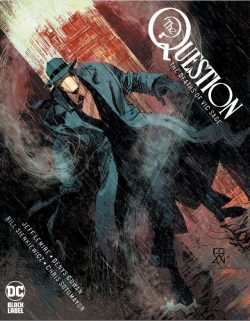
The Question: The Deaths of Vic Sage


By Jeff Lemire, Denys Cowan, Bill Sienkiewicz, Chris Sotomayor, Willie Schubert & various (DC Comics)
ISBN: 978-1-7795-0558-3 (HB/Digital edition)

One of DC’s best 1980s comics series was – for the longest time – out of print and unavailable digitally. It more or less still is, except for a prohibitively expensive Omnibus edition, and if you have strong arms and a big budget you should really track those stories down, whilst the rest of us wait for more reasonable trade paperbacks and eBook editions…

As devised and delivered by Steve Ditko in the 1960s – as he sank ever more deeply into the Objectivist philosophy of Ayn Rand – The Question was Vic Sage: a driven, implacable, justice-obsessed journalist seeking out crime and corruption uncaring of the consequences.

The Charlton “Action-Line Hero” was acquired by DC when the Connecticut outfit folded and was the template for compulsive vigilante Rorschach when Alan Moore & Dave Gibbons first drafted the miniseries that would become the groundbreaking Watchmen.

The contemporary rumour-mill had it that since the creators couldn’t be persuaded to produce a spin-off Rorschach comic, DC went with a reworking of the Ditko original…

As revised by writer Denny O’Neil and illustrators Denys Cowan & Rick Magyar, Vic Sage was an ordinary man pushed to the edge by his obsessions, using his fists and a mask that made him look utterly faceless to get answers (and justice) whenever standard journalistic methods failed. After a few minor appearances around the DC universe, Sage got a job in the town where he grew up and resumed his campaign for answers…

Always more cult hero than classic crusader, The Question revival carved a unique niche for itself as “comics grew up” post Crisis on Infinite Earths and Watchmen. The character was periodically radically rebooted and reimagined, but here scripter Jeff Lemire (Sweet Tooth, The Underwater Welder, Trillium, Black Hammer, Descender, Ascender, Gideon Falls, Essex County) returns to O’Neil’s canon to tell a revelatory tale of reincarnation, zen mystery and undying evil. The project was part of DC’s latest high end mature reader imprint Black Label: released as four single issues before becoming a spiffy hardback with a digital equivalent…

Hub City is a hell-hole, the most corrupt and morally bankrupt municipality in America. Mayor Wesley Fermin is a slick, degenerate crook, but real power resides in his Special Counsel Holden Malick, political cronies, a hand-picked gang of “heavies” and the largely corrupt and racist police force…

Originally, Sage was supported by college lecturer Aristotle “Tot” Rodor: the philosopher-scientist who created his faceless mask and other gimmicks as well as being a sounding board for theories and plans and ethical bellwether. He remains so here but is also increasingly challenging his former pupil’s motives and methods…

After being killed by Fermin’s forces The Question was revived and retrained by O’Neil’s other legendary martial arts creation, Richard Dragon, Kung Fu Fighter . A year passed and a reenergised, faceless avenger began cleaning up Hub City…

The saga opens with the city rushing into chaos and the Question busting a brothel trafficking children to city officials. Later, when reporting the raid on his TV show, Sage ambushes former lover Myra Fermin (the mayor’s sister and oblivious City Alderman) with the fact that the Councilman he left for the cops has mysteriously been erased from all official reports. Shocked and outraged, Fermin continues deluding herself about her brother and the administration, but the damage has been done and she starts looking where she shouldn’t…

When Malick arrives to clean up the mess, Sage notices a ring the politico wears: something old and somehow deeply disturbing…

Tot is no help, but the ring sticks in Sage’s mind and eventually he uncovers a historical organisation called the Hub City Elder Society that all wore such symbols and draws some telling conclusions to today’s political elite…

Hot on the trail he moves, unaware that events are converging into a dark miracle. At the exact moment The Question uncovers an ancient den of occult ceremony, an innocent black man is gunned down by a racist cop and Myra Fermin bursts in on her beloved brother committing savage atrocities on a bound captive. The concatenation of blood climaxes as The Question finds an old faceless mask with a bullet hole through the forehead in a cavern under the city. It’s not one of his, but he is assaulted by a wave of memories and images of supernal evil when he holds it…

Barely conscious, he retreats from the underground lair into streets awash with blood as a protest march becomes a race riot. Urged by Tot to go on TV to calm the tide, all Sage can think of is finding Dragon and getting some metaphysical first aid…

What he gets is doped, as the hermit applies zen hoodoo and drugged tea, despatching the unwilling rationalist sceptic on a vision quest into the past…

Sage awakens in the wilderness that will one day be his home town, bare-footed and wearing a faceless mask…

In Hub City 1886, Viktor Szasz is a blacksmith desperately seeking to escape the vile acts he committed as a soldier fighting the Comanche, in a frontier outpost well on its way to becoming truly civilised. Silent and solitary Viktor intervenes when negro settler Irving Booker and his family are repeatedly harassed and ultimately murdered by the local priest and his devout flock. Szasz reverts to his gun-toting ways to save or avenge them but is outmatched until rescued by a red-headed Indian woman. She shares some secrets about true evil, most notably that a mystical “Man with a Thousand Faces” can only be killed by someone named “Charlie”.

Delirious and experiencing hallucinations of himself in different times, agnostic Szasz still refuses to believe in devils, which is probably why the thing in pit under the town gets the drop on him…

In 1941, Hub City private eye Charlie Sage groggily looks at his notebook, where someone has written “Man with no face” and “man with a thousand faces???”. Blaming too much booze, he cleans himself up whilst glimpsing flashes of unknown dead people and adds “red-haired woman” to the page for no reason he can think of…

When red-haired walk-in client Maggie Fuller hires him to investigate her brother Jacob’s disappearance, he has no idea it will be his last case. They are both union organisers and prime targets for the bosses and the city officials they own, and before long the shamus has annoyed all the wrong people, ending up attacked by thugs wearing fancy rings…

Even his one pal on the Police Force – veteran patrolman “Tot” – can’t help him. But does reluctantly pass him a file full of juicy potential prospects for Fuller’s absence. Still enduring staggering western visions and brutal flashforwards, Charlie becomes lost in civil violence in three eras, and succumbs to another ring-wearer ambush.

The PI awakes in a subterranean chapel in the middle of some kind of crazy black mass, meets a devil and is never seen again…

Awaking from his vision-quest, present-day Sage leaves Dragon, set on sorting his city’s real world distress: braving riot and savage, premeditated retaliation by the administration and cops hungry to put the rabble back in their place. Unable to stop the carnage with his fists, The Question instead uses mass media to deliver a stunning counterstroke, turning the tables and critically destabilising Firmin and Malick.

He also has Tot build a permanent solution to the thing in the pit under Hub City, but has gravely underestimated the horror and indeed his own childhood connection to it…

Even after overcoming the odds, the illusion of victory is tenuous and insubstantial, leaving The Question still looking for answers in all the wrong places…

This book also offers covers and a gallery of variants by Cowan, Sienkiewicz & Sotomayor, Lemire & Marcelo Maiolo; Eduardo Risso; Howard Chaykin & Gustavo Yen, Andrea Sorrentino plus Cowan & Sienkiewicz’s sketchbook section ‘Questionable Practises’ with roughs, finished pencils pages and covers, portraits, finished pre-colour inks, unused cover art and creator bios.

Combating Western dystopia with Eastern Thought and martial arts action is not a new concept, but here the problems of a society so utterly debased that the apocalypse seems like an improvement are also lensed though a core of absolutism. Is man good? Is there such a thing as True Evil? What can one man do?

Who’s asking..?

Although the creators keep the tale focused on dysfunction – social, societal, civil, political, emotional, familial and even methodological – the core motivation for today’s readers has shifted, with the horror show that is and always has been Hub City now arguably attributed to an eternal supernatural presence. Regulation masked avenger tactics don’t work in such a world, and some solutions require better Questions…
© 2019, 2020 DC Comics. All Rights Reserved.

Almost Silent


By Jason, translated by Kim Thompson (Fantagraphics Books)
ISBN: 978-1-606-99315-6 (HB/Digital edition)

John Arne Saeterrøy, who works under the pen-name Jason, was born in Molde, Norway in 1965, and appeared on the international cartoonists’ scene at age 30 with his first graphic novel Lomma full ay regn (Pocket Full of Rain) which won that year’s Sproing Award (Norway’s biggest comics prize).

He followed with the series Mjau Mjau (winning another Sproing in 2001) and in 2002 turned almost exclusively to producing graphic novels. Now an international star, he has won seven major awards from such disparate regions as France, Slovakia and the USA.

Here the fine folks at Fantagraphics collected four of his earliest graphic novels in a superb hardback companion to the 2009 classic [Low Moon] which provides more of Jason’s surreal and cinematic, darkly hilarious anthropomorphic ruminations on his favourite themes of relationships and loneliness, viewed as ever through a charmingly macabre cast of silent movie archetypes, cinematic monsters and sad sack chumps.

Told in pantomimic progressions rather than full stories – and often as classical chase scenes reminiscent of Britain’s The Benny Hill Show – the wonderment begins with breakthrough album ‘Meow, Baby’ wherein a mummy goes walkabout from his museum sarcophagus encountering bums and gamins, vampires, aliens, angels, devils, skeletons and cops – always so many cops – in hot pursuit…

This primarily monochrome collection is called Almost Silent because it mostly is. Moreover, what dialogue appears is never informative or instructive, merely window dressing. The artwork is displayed in formalised page layouts rendered in a minimalist evolution of Hergé’s Claire Ligne style: solid blacks, thick lines and settings of seductive simplicity unwinding like an unending, infinite zoetrope show. These early works are collections of gags and situations more experienced than read.

A second untitled tale follows the perceived social inadequacies of males hungry for love: a werewolf, caveman – complete with courting cudgel, a Martian, Frankenstein’s monster and even Elvis. All try and die in the modern dating whirl…

The next sequence introduces cannibal ghouls and a movie-buff Travis Bickle/Arnold Schwarzenegger wannabe also starving for acceptance, and continues with the bleakly comedic ‘Return of the Mummy’ and a delightfully tongue in cheek pastiche of Tintin and Blake and Mortimer entitled ‘The Mummy’s Secret’, featuring the entire ghastly cast, before ending with a fascinating selection of 3-panel gag strips.

The next featured volume is ‘Tell Me Something’: a more ambitiously visual outing that acknowledges its antecedents and influences by using silent movie dialogue cards instead of word balloons. It follows a plucky heroine as she searches for affection in all the wrong places with her Harold Lloyd-like would-be beau. Also in attendance are the usual cast of filmic phenomenons…

‘You Can’t Get There from Here’ concentrates mainly on the 1930s movie Frankenstein cast: the monsters, their equally artificial wives, their lovelorn and covetous creators and even the Igors: misshapen, wizened assistants also all seeking that one special person – or thing. Here the art is supplanted by the startling and highly effective addition of bronze inks for a compelling duo-tone effect that sits oddly well with the beast’s bittersweet search for his stolen, bespoke bride.

We conclude with a rather riotous adventure romp. ‘The Living and the Dead’ details a perfect first date interrupted by the rising of the unquiet dead and end of civilisation in the rotting teeth of carnivorous zombies on their final march – possibly the funniest and most romantic yarn in the whole book.

Jason’s work always jumps directly into the reader’s brain and heart, using the beastly and unnatural to ask gentle questions about basic human needs in a wicked quest for answers. That you don’t ever notice the deep stuff because of the clever gags and safe, familiar “funny-animal” characters should indicate just how good a cartoonist he is.

His comic tales are strictly for adults but allow us all to look at the world through wide-open childish eyes. He is a taste instantly acquired and a creator any fan should move to the top of the “Must-Have” list, so consider this superb hardback your guaranteed entry into his fabulous fun world…
© 2009 Jason. All rights reserved.

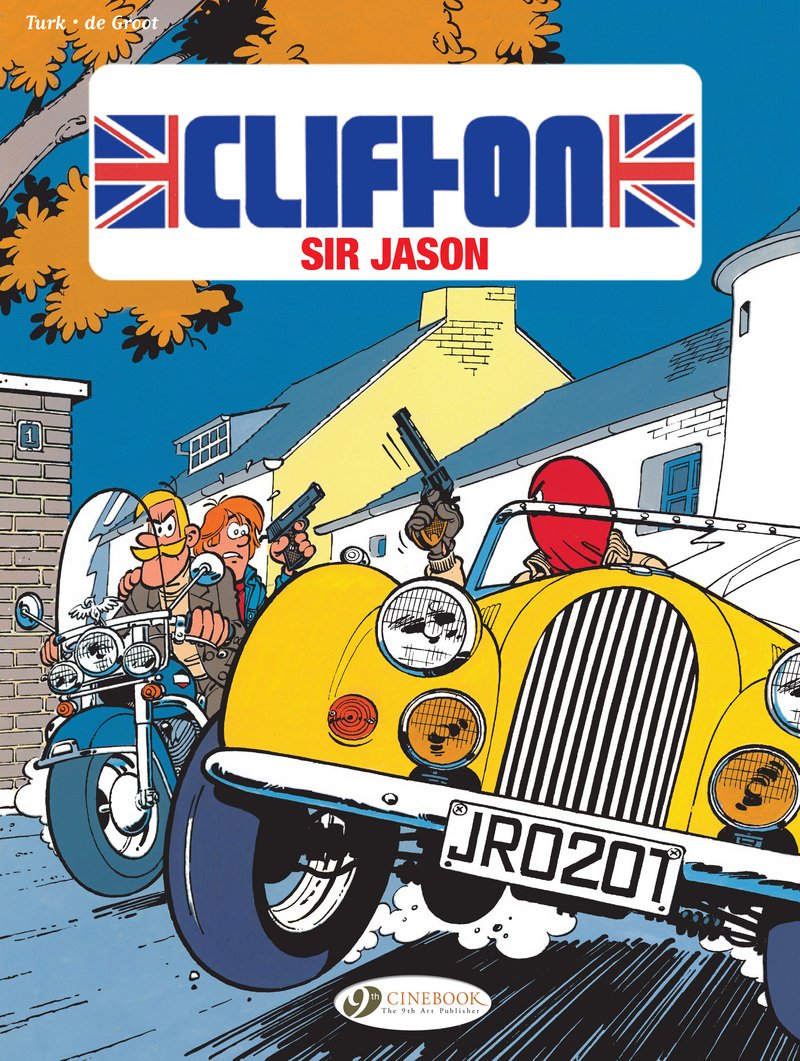
Clifton volume 8: Sir Jason


By De Groot & Turk, translated by Mark Bence (Cinebook)
ISBN: 978-1-84918-407-6 (Album PB/digital edition)

For some inexplicable reason and despite our recent obnoxiously ungrateful behaviour, most of Europe’s comics cognoscenti – most especially French and Belgians – seem fascinated with us Brits. Maybe it’s our shared heritage of Empires lost and cultures in transition? An earlier age might well have claimed it’s simply a case of “Know your Enemy”…

Whether we look at urban guttersnipes Basil and Victoria, indomitable adventurers Blake and Mortimer, the Machiavellian machinations of Green Manor or even the further travails of Long John Silver, so many serried stalwarts of our Scepter’d Isles cut a dashing swathe through the pages of the Continent’s assorted magazines and albums, it’s like Europe is our second home.

…And then there’s Clifton

As originally devised for iconic comic Le Journal de Tintin by strip genius Raymond Macherot (Chaminou, Les croquillards, Chlorophylle, Sibylline), this doughty True Brit troubleshooter first appeared in December 1959. After three albums worth of material – compiled and released in 1959 and 1960 – Macherot quit Tintin for arch-rival Le Journal de Spirou, leaving the eccentric crime-fighter to flounder until LJdT revived him at the height of the Swinging London scene. This was courtesy of Jo-El Azaza & Greg (Michel Régnier), and those strips were subsequently collected as Les lutins diaboliques in French and De duivelse dwergen for Dutch-speakers in 1969.

It was back to retirement for a few years until the early 1970s saw writer Bob De Groot & artist Philippe “Turk” Liégeois revive Clifton for the long haul: producing 10 tales of which this – Sir Jason (from 1976) – was their seventh collaboration.

Son of a cabinet maker, Turk was born in Durbuy, Belgium on July 8th 1947. His wonderful mother ran a boarding house and didn’t seem to mind that her dreamy, lazy lad spent his days taking things apart or redrawing (“improving”) his favourite comics – usually ones by Peyo and Franquin.

In fact, in 1963, when Phillipe was just 16, she sent a bunch of those upgrades to Le Journal de Spirou where editor Yvan Delporte promptly arranged for the kid to become an office apprentice, learning the profession under celebrated cartoonist Maurice Rosy (Jerry Spring; Spirou et Fantasio; Tif et Tondu; Max the Explorer; Boule et Bill/Billy & Buddy).

Young Liégeois worked for two years at Dupuis’ Brussels studio, and his first professional sale – to LJdS – came in 1967. It was the year he first met Bob De Groot as they collaborated as artists on a strip scripted by “Fred” (AKA Frédéric Othon Théodore Aristidès) to appear in Pilote. The casual alliance became a life-long association in such series as Archimède; Robin Dubois; Léonard and more. The price of success is increased workload and they were convinced to add Macherot’s moribund spy saga to their schedules…

Those comic escapades all ran in parallel with Turk’s other projects such as Les Club des “Peur-de-rien”; La Plus Grande Image du Monde; Docteur Bonheur and more.

Bob de Groot was born in Brussels in 1941, to French and Dutch parents. He was art assistant to Maurice Tillieux on Félix before creating his own short works for Pilote. A rising star in the 1960s, he was drawing 4 × 8 = 32 L’Agent Caméléon when he met Philippe Liégeois. They hit it off and as established a team with De Groot beginning a slow transition from artist to writer on Clifton and 1989’s Digitaline – devised with Jacques Landrain and a strong contender for the first comic created entirely on a computer. He kept busy, working with legendary creator Morris on both Lucky Luke and its canine comedy spin-off Rantanplan whilst co-creating Des villes et des femmes with Philippe Francq; Doggyguard with Michel Rodrigue, Pére Noël & Fils (Bercovici art) and Le Bar des acariens (with Godi) and so much more.

The association with Clifton is perennial however and even after their first tour of duty ended they stayed in touch. From 1984 on, artist Bernard Dumont – AKA Bédu – limned De Groot’s scripts: eventually assuming the writing role as well, persevering until the series ended in 1995. In keeping with its rather haphazard nature and typically undying nature, the Clifton experience resumed once again in 2003, crafted by De Groot & Rodrigue for four further adventures: a grand total of twenty album length tales and as many shorter exploits.

In 2016 the old comrades even co-operated on more Clifton cases with Zidrou scripting…. and one day we’ll see English editions of Clifton et les gauchers contraries (Clifton and the Upset Left-Handers???) and 2017’s Just Married

So what’s the Sit Rep?

The scenario is deliciously simple: pompous and irascible Colonel Sir Harold Wilberforce Clifton, ex-RAF, former Metropolitan Police Constabulary and recently retired from MI5, has a great deal of difficulty dealing with being put out to pasture in rurally bucolic Puddington. He thus takes every opportunity to get back in the saddle, occasionally assisting the Government or needy individuals as an amateur sleuth.

Sadly for Clifton – as with that other underappreciated national treasure Captain George Mainwaring in TV landmark Dad’s Army – he is convinced that he is the only truly competent man in a world full of blithering idiots. Of course, he’s generally proved correct in that assumption…

In this translated album from 2018, the Gentleman Detective is again enduring the mixed blessing of a holiday in England when he is outrageously dragged out of his permanent dudgeon and unwanted retirement by his old spymaster handlers who need him to attend to a tricky problem only someone of his vast experience and discretion could handle…

It begins in the sleepy hamlet of Dormhouse, where the vacationing surly sod livens up his day by furiously debating the correct surface temperature of toast, annoying village “bobby” Constable Walrus and failing to fish in idyllic streams. That changes in an absurdly fraught instant when old associate Captain Twincam ambushes him…

The government operative is in a bit of a pickle and needs the old Clifton finesse…

Twincam’s partner is Sir Jason: a strapping Adonis of a young man with generations of pedigree and privilege behind him. His family – the highly-entitled clan Macassock -have always produced sons who became spies or clergymen, and despite this lad’s heartfelt desire to be a jazz musician, he will do his duty and follow family tradition…

The minor noble has finished training and is – on paper at least – a superbly-schooled, hyper-fit, lethally capable super-agent in waiting. There’s only one small snag: this aristocratic boy wonder freezes at the merest hint of actual action…

With the future of the whole hidebound spycraft system under threat, the Secret Service need someone to teach the lad how to use what he knows for the good of the nation. No expense spared, carte blanche in methods used and the promise of some much-missed excitement finally induce old warhorse Clifton to agree, and no sooner does he accept the mission than fate smiles on them as mentor and apprentice stumble into an armed robbery and indulge in a spectacular high speed chase through the verdant countryside…

It’s an utter disaster and the Colonel realises he has his work cut out for him if he’s to unleash the tiger buried deep, deep, deep inside the spy scion…

After a short stopover in his own house in bucolic Puddington  and a fractious reunion with Housekeeper Miss Partridge, it’s off to London for Clifton and his protégé. Unbeknownst to Sir Jason (as most things seem to be), the wily old spy has hired some of his seedier acquaintances to jump the lad as a kind of live fire test. Confidant that in the crunch, superb training, heroic heritage and elevated lineage will kick in, the old soldier lets himself get beaten up and witnesses some truly shameful acts of cowardice before giving up…

They are down by the Embankment cleaning up when Clifton sees two frogmen riding a minisub emerge from the waters. He knows true evil in play when he sees it but is barely able to stop these really capable villains killing them both to keep whatever they’re up to secret…

Now mentor and terrified apprentice are on the run with relentless, ruthless hunters chasing them all over the landscape. Jason gains plenty of on-the-job experience but no appreciable increase in confidence, gumption or backbone. Cut off from all possible assistance, the veteran warrior has no choice but to go after the killers’ boss himself, using his partner’s failings to his advantage and hoping they all make it out alive and relatively unscathed…

Visually spoofing 1970’s London and eternally staid and stuffy English Manners with wicked effect, these comfy thrillers are big on laughs but also pack loads of consequence-free action into their eclectic mix. Delightfully surreal, instantly accessible and doused with daft slapstick in the manner of Jacques Tati and humoresque intrigue like Margaret Rutherford as Miss Marple, this wild ride rattles along in the grand comedic manner of Will Hay, Terry-Thomas and Alistair Sim (maybe Wallace and Gromit or Johnny English if you’re of a later generation) by channelling classic crime series like The Sweeney or The Professionals – offering splendid fun and timeless laughs for all.
Original edition © Les Editions du Lombard (Dargaud-Lombard S. A.) 2001 by Turk & De Groot. English translation © 2018 Cinebook Ltd.

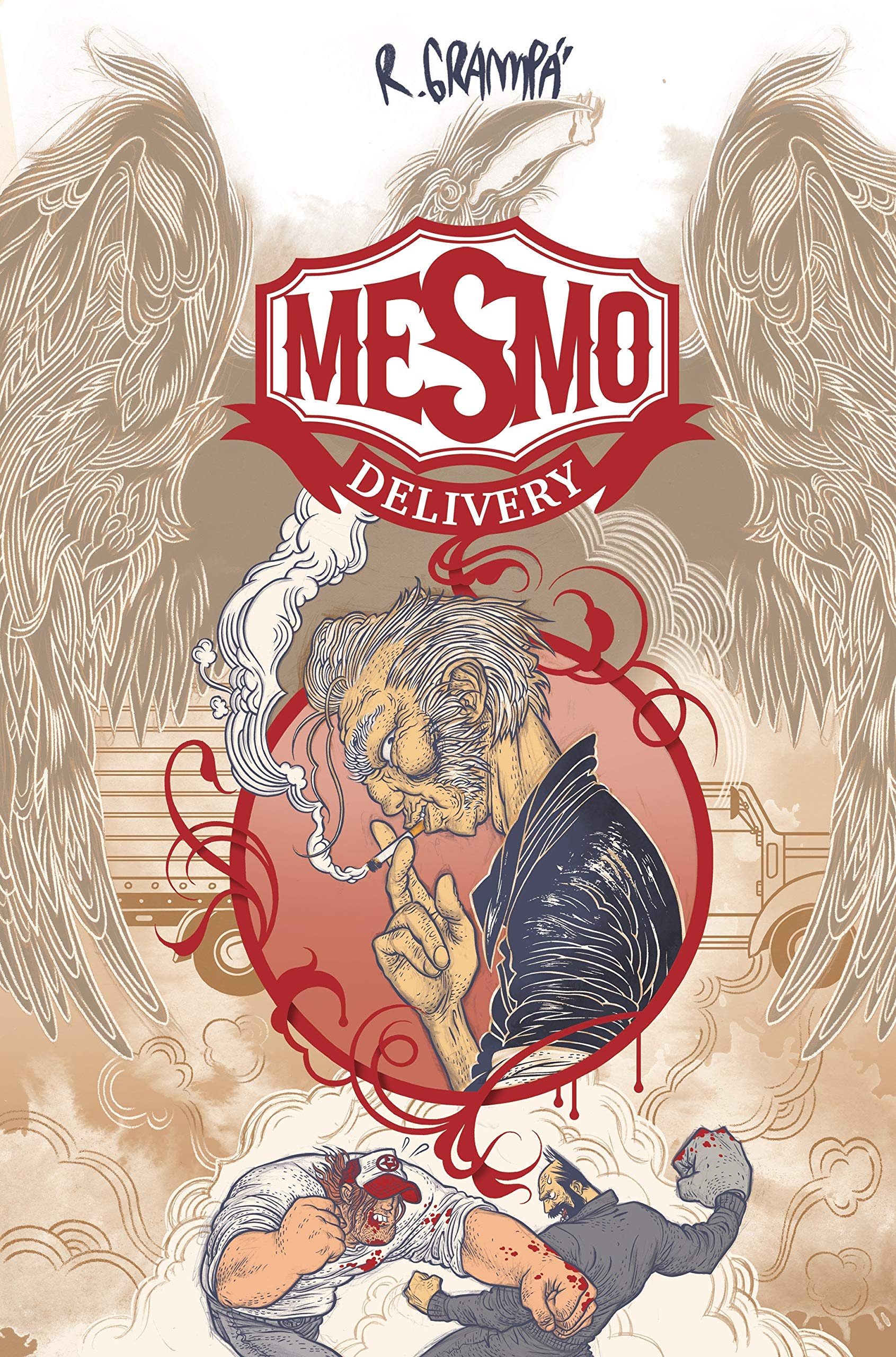
Mesmo Delivery


By Rafael Grampá, with Marcus Penna, translated by Júlio Mairena (Dark Horse Books)
ISBN: 978-1-61655-457-6 (HB) 978-1-59582-465-3 (TPB)

In an industry and art form that has become so very dependent on vast interlocking storylines, an encyclopaedic knowledge of a million other yarns and the tacit consent to sign up for another million episodes before reaching any kind of narrative payoff, the occasional short, sharp, intensely stand-alone tale is as welcome and vital as a cold beer in the noon-day desert.

Just such a salutary singleton was Mesmo Delivery, first solo English-language release of singularly gifted writer/artist Rafael Grampá, who originally devised the macabre and gritty thriller in his native Brazil back in 2008.

Picked up and translated by Dark Horse two years later, this stark and spookily effective grindhouse/trucker movie amalgam delivers dark chills, gritty black humour and eerie, compulsive mystery in equal, intoxicating amounts… and it all starts, unfolds and ends right here. No muss, no fuss, no busload of tie-ins.

Aging, raddled Elvis impersonator Sangrecco is an extremely odd deliveryman, working for a rather unique haulage business. For a start, he can’t actually drive, which is why hulking, gentle, cash-starved ex-boxer Rufo has been temporarily hired by the boss to operate the truck on a run through some very bleak bad country.

Rufo doesn’t ask questions. He just pilots that huge container rig with its mysterious and unspecified cargo – that he’s not allowed to see – to God knows where, listening to the obnoxious, pompous Sangrecco mouth off about his many, unappreciated talents.

Things take a bad turn when they break at the isolated Standart Truck Stop. The Elvis freak is too lazy to even fetch his own beer, and when Rufo takes care of business and grudgingly tries to pay, a sleazy pack of locals trick him into an impromptu street fight on a cash-bet.

The ploy is a set-up and when Rufo proves unexpectedly tough, the prize-fight gets too serious and results in a fatality – and possibly more…

Street-fighting boss tough Forceps then convinces his “townie” cronies and the other onlookers that they need to get rid of all the witnesses. And that’s when old Sangrecco reveals what his speciality is…

Stark, brutal, rollercoaster-paced and rendered with savage, exhilarating bravura, this thundering, down-and-dirty fable grips like a vice and hits like a juggernaut, providing the kind of excitement every jaded thriller fan dreams of.

Also included in this brief, slim, scary and mesmerising tome is an effusive Introduction from Brian Azzarello, pin-ups by Mike Allred, Eduardo Risso, Craig Thompson and Fábio Moon plus stunning 16-page sketch, design and commentary section ‘Making of Mesmo Delivery’.

Since Mesmo Delivery, Grampá has gone on to shine with his deliciously eccentric Furry Water as well as on such established titles like Hellblazer, American Vampire, Strange Tales and Uncanny X-Force amongst others, but this superbly visceral, raw storm of sheer visual dexterity and narrative guile is an ideal example of pared back, stripped down, pure comics creativity that no mature lover of the medium can afford to miss.
Mesmo Delivery ™ & © 2008, 2010, 2014 Rafael Grampá. All rights reserved.

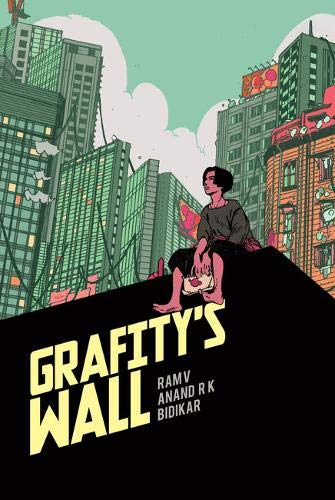
Grafity’s Wall


By Ram V, Anand Radhakrishnan, Aditya Bidikar & various (Unbound)
ISBN: 978-1-78352-684-0 (HB) eISBN: 978-1-78352-686-4

Ram V (AKA Ram Venkatesan) began professionally writing comics while still resident in Mumbai. His acclaimed 2012 series Aghori preceded a move to Britain for a Creative Writing MA at the City of London University. Since then he’s become a prolific creator with series like Black Mumba; The Many Deaths of Laila Starr; Ruin of Thieves; Paradiso; Blue in Green; Radio Apocalypse and Brigands, backed up with US superhero mainstream forays such as Marvel’s Venom and DC’s Justice League Dark; Catwoman, a new Swamp Thing and Batman: Gotham Nocturne.

In 2018 he returned to his roots for a richly compelling coming-of-age story with a dash of whimsy and a splash of heart, brimming with dangerous optimism and soaked in the dark passions of life lived on the line between subsistence and glory. It’s a timeless and familiar tale of winning and losing encompassing self-expression, rebellion, ambition and acceptance.

It probably has a Bhangra or desi hip hop soundtrack, but if you play early rock ‘n’ roll hits while reading it, you could believe you’re watching a Bollywood remake of American Graffiti

Huge, thriving, bustling cities like Mumbai have a life all their own: a miasma of need, urgency and desperation underpinning every moment and aspect of existence. Everyone is trying to get by and get on. And amidst those masses there will always be some who stand out and stand apart…

Mumbai is special: a modern metropolis with no respect for its past, cramming together rich and poor alike whilst continually mixing the best and worst of everywhere else into an ever-evolving social soup A cultural vampire, the place finds room for every foreign fad and fashion, but always merges and remakes it with what has gone before…

The story opens in ‘What Goes Up’ as, in the heart of that constant churn, street artist Grafity paints walls with spray cans. Little Suresh Naik just can’t help himself, despite countless costly and painful confrontations with policemen: blank walls just call to him and demand he makes magic on them.

He’s lucky he has Jayesh looking out for him. Even fiercely pragmatic “Jay” has dreams – he wants to be a major American style rapper – but he also understands exactly how the world works and who needs paying at every level. That’s why he’s trapped acting as fixer and drug mule for minor gangster Mario

The dreamers – and vanishingly quiet, ever-observing student Chasma – are closer than the family who cannot understand them and, when it’s not trying to crush them, the city belongs to them. For all its allure, though, they can’t imagine anything better than leaving it behind forever…

Their lives all change when the ramshackle Kundan Nagar slums are razed for a new development. In the aftermath, Grafity finds a lone pristine, wall defiantly standing proud and knows it must carry his mark…

In ‘What Goes Up’, he’s laying the groundwork for a masterpiece, with Jay and Chasma idly watching, Grafity realises Mario has found them. The hood and his new arm candy Saira are figures of terror, especially since Jay used the gangster’s money to buy the tagger’s freedom from the cops. In calculated retaliation, Mario throws his weight around and gives Jay a delivery designed to prevent him from playing at his first major gig…

The wall becomes Grafity’s testament, changing daily to record the events that inevitably engulf those around him. The worst is seeing Jay slowly sucked down into the morass of petty crime and expedient compromises, becoming colder and harder inside…

Chasma is fat, slow-seeming and looks a bit Chinese. It’s how he got his job waiting tables at the Dragon Wok restaurant, where the closet intellectual talks to interesting people while taking their orders.

Exploring the concept of ‘American Chop Suey’ – as carefully explained by the diner’s well-seasoned chef – Chasma applies it to his creative efforts:  making time to work on his writing and model own grand dreams. Many of them centre around Mario’s “girlfriend” Saira, and he assuages his frustrations by writing letters to anonymous passers-by. He’s become used to being ridiculed, bullied and beaten up by strangers, which is why it’s so hard when Jay starts doing it…

Graphity’s masterpiece grows more magnificent and revelatory by the moment in ‘Bambai Talkies’, and watching him work utterly captivates his friends. When Saira joins the vigil and strikes up a conversation with Chasma, the writer is carried away in her vivacious wake. She wants to be an actress and soon the boys join her in regular afternoon movie matinees.

When she says she’s quitting the rat race and leaving Mumbai, Chasma agrees to go with her, even after discovering she’s funding the getaway with a case full of the gangster’s money…

When Mario finds them, Chasma makes a supreme sacrifice worthy of a storybook hero, provoking Jay and Grafity to do the same in their own manner…

Illustrated with warmth, edgy versatility and a profound appreciation of street art and hip hop style by Anand Radhakrishnan and benefitting from imaginative colouring by Jason Wordie, Irma Kniivila and letters from Aditya Bidikar, this paean to the Places We Came From, the danger of aspiration and the power of hopes and dreams is an exotic and memorable delight: the kind of Eastern promise you can depend on.
© 2018 Ram Venkatesan, Anand Radhakrishnan. All rights reserved.