
Blake and Mortimer: Professor Satō’s Three Formulae Parts One (Mortimer in Tokyo) & Two (Mortimer versus Mortimer)


By Edgar P. Jacobs and Bob De Moor: with colours by Paul-Serge Marssignac, translated by Jerome Saincantin(Cinebook)
ISBN: 978-1-84918-292-8 (Album PB Pt 1) 978-1-84918-303-1(Album PB Pt 2)

Pre-eminent fantasy raconteur Edgar P. Jacobs devised one of the greatest heroic double acts in pulp fiction: pitting his distinguished scientific adventurers Professor Philip Mortimer and Captain Francis Blake against a daunting variety of perils and menaces in a sequence of stellar action-thrillers which blended science fiction scope, detective mystery suspense and supernatural thrills. The magic was made perfect through his stunning illustrations, rendered in the timeless Ligne Claire style which had made intrepid boy-reporter Tintin a global sensation.

The Doughty Duo debuted in September 1946; gracing the pages of the very first issue of Le Journal de Tintin: an ambitious international anthology comic with editions in Belgium, France and Holland. It was edited by Hergé, with his eponymous, world-famous star ably supplemented by a host of new heroes and features for the rapidly-changing post-war world. Bon anniversaire, Chaps!…

Les 3 formules du professeur Satō was a tragically extended affair and Jacob’s last hurrah. What became the 11th album was originally serialised between September 1971 and May 1972 in LJdT, after which the author abandoned his story due to failing health and personal issues.

Edgard Félix Pierre Jacobs died on February 20th 1987 and soon after, Bob de Moor was commissioned by the family and estate to complete the final tale from Jacob’s pencil roughs and script notes. The concluding album was finally released in March 1990. This led to a republishing of all the earlier exploits and eventually fresh adventures from a variety of creative teams…

Mortimer in Tokyo opens at Haneda Airport, where Air Traffic Controllers experience a unique problem when a UFO disrupts their carefully plotted flight courses. With disaster imminent, jets are scrambled to pursue the meteoric anomaly. Just before they perish, the pilots radio back that they are being attacked by a dragon…

As the news filters around the world, renowned cyberneticist Professor Akira Satō argues with assistant Dr. Kim, deeply remorseful that his latest breakthrough has been the cause of such tragedy. Kim only barely dissuades his Sensei from turning himself in to the authorities but is utterly unable to convince or prevent Satō from involving visiting colleague Philip Mortimer in his crisis of conscience…

The British scholar is in Kyoto attending a succession of scientific conferences, and when an ominous outsider overhears Satō’s intentions through hidden surveillance methods, the reaction is both explosive and potentially murderous…

The first Mortimer knows of the problem is when a gang of gunmen attempt to kidnap him off the streets, but after fighting them off and escaping, the old warrior returns to his hotel and finds a telegram waiting for him…

An urgent request to join old friend Satō immediately seems impossible due to stringencies of train timetabling, but an accommodating journalist overhears and offers a speedy compromise. Mortimer is suspicious of the happy accident… but not suspicious enough…

Surviving another assassination attempt by sheer force of will, the professor is then lost in the wilds of Japan before eventually battling his way to Satō’s lab outside Tokyo where he witnesses a series of astonishing sights.

His host has worked miracles in the fields of robotics – including the dragon which so recently and horrifically malfunctioned – but is at a loss to explain how his incredible creations have gone wrong at such a late stage. Worldly-wise Mortimer soon deduces the causes: espionage and sabotage…

As the British boffin sends for doughty comrade-in-arms Captain Blake, Satō is comforted by the fact that the key formulae for producing his mechanical marvels have been divided and deposited at three different banks in Tokyo. The Sensei breathes even easier after arranging that only Mortimer can retrieve them, but this only prompts their hidden enemy to accelerate his plans and reveal himself as one of Mortimer’s greatest foes…

Unable to induce or force Mortimer to retrieve the scientific goldmine, the mastermind has an android double constructed to fool the banks, but the rush-job breaks down before the task is completed. Now the vile villain has only more card to play before the formidable Blake arrives…

This edition – available as always in paperback album and digital formats – concludes with excerpts from other B & M albums, plus a short biographical feature and publication chart of Jacobs’ and his successors’ efforts to whet the appetite for further treats in store…

Cunning and convoluted, this devilishly devious tale unfolds with potent authenticity and ever-escalating tension, building to an explosive conclusion which eventually took eighteen years to conclude. At least we don’t have to wait that near-lifetime for the epic denouement…

Part 2: Mortimer versus Mortimer
Edgard Félix Pierre Jacobs (March 30th 1904-February 20th 1987) is deservedly considered a founding father of the Continental comics industry. Although his output was relatively modest compared to many of his contemporaries, Jacobs’ landmark serialised epic formed the backbone of the modern action-adventure comic in Europe.

His splendidly adroit, roguish, thoroughly British stars were conceived for the premier issue of Le Journal de Tintin, and quickly became a crucial staple of life for post-war European kids – in exactly the same way Dan Dare was for 1950s Britain.

Jacobs was Brussels-born: a precocious child perpetually drawing, but even more obsessed with music and performing arts – especially opera. He attended a commercial school but loathed the idea of office work, avidly pursuing arts and drama jobs after graduation in 1919.

A succession of such at opera-houses (scene-painting, set decoration and even performing as both an acting and singing extra) supplemented his private performance studies, and in 1929 Jacobs won an award from the Government for classical singing. His dreamed-of operatic career was thwarted by the Great Depression. When arts funding suffered massive cutbacks following the global stock market crash, he was compelled to pick up whatever dramatic work was going, although this did include more singing and performing.

In 1940, Jacobs switched to commercial illustration, winning regular work in the magazine Bravo, as well as illustrating short stories and novels. He famously took over the syndicated Flash Gordon strip after the occupying German authorities banned Alex Raymond’s quintessentially All-American Hero and the publishers desperately sought someone to satisfactorily complete the saga.

Jacobs’ ‘Stormer Gordon’ lasted less than a month before being similarly embargoed by the Occupation fun-police, after which the man of many talents simply created his own epic science-fantasy feature in the legendary Le Rayon U: a milestone in both Belgian comics and science fiction adventure.

During this period Jacobs and Tintin creator Hergé got together, and whilst creating the weekly U Ray strip, the younger man began assisting on Tintin, colouring the original black and white strips of The Shooting Star (originally published in newspaper Le Soir) for an upcoming album collection.

By 1944 Jacobs was performing similar duties on Tintin in the Congo, Tintin in America, King Ottokar’s Sceptre and The Blue Lotus. He was also contributing to the drawing too, working on extended epic we know as The Seven Crystal Balls and Prisoners of the Sun.

After the war and Europe was liberated, publisher Raymond Leblanc convinced Hergé, Jacobs and a few other comic strip stars to work for his proposed new venture. Founding publishing house Le Lombard, Leblanc also commissioned Le Journal de Tintin, an anthology comic with simultaneous editions in Belgium, France and Holland to be edited by Hergé and starring the intrepid boy reporter and a host of new heroes.

Beside Hergé, Jacobs and writer Jacques van Melkebeke, Le Journal de Tintin featured Paul Cuvelier’s Corentin and Jacques Laudy’s Legend of the Four Aymon Brothers.

As revealed in an enticing, photo-packed essay closing this Cinebook volume, Blake and Mortimer were a lucky compromise. Jacobs had wanted to create a period historical drama entitled Roland the Bold but changed genres due to an overabundance of such strips…

Laudy had been a friend of Jacobs since their time together on Bravo, and the first instalment of the epic thriller serial Le secret de l’Espadon starred a bluff, gruff British scientist and an English Military Intelligence officer closely modelled on Laudy himself…

The initial storyline ran from issue #1 (26th September 1946 to September 8th 1949): cementing Jacobs’ status as a star in his own right.

In 1950, with the first 18 pages slightly redrawn, The Secret of the Swordfish became Le Lombard’s first album release, with the concluding volume published three years later. The albums were reprinted nine more times between 1955 and 1982, in addition to a single omnibus edition released in 1964.

Hergé and Jacobs purportedly suffered a split in 1947 when the former refused to grant the latter a by-line on new Tintin material they had collaborated on, but since the two remained friends for life and Jacobs continued to produce Blake et Mortimer for the weekly, I think it’s fair to assume that if such was the case it was a pretty minor spat. I rather suspect that the Eccentric Englishmen were simply taking up more and more of the diligent artist’s time and attention…

Cinebook have made the Gentleman Heroes a bankable proposition, releasing the 29-and-counting albums, but suffice to say that the concluding instalment of Professor Satō’s Three Formulae was a long time coming …

Les 3 formules du professeur SatōMortimer contre Mortimer was a tragically extended affair and only credited Jacobs as writer and layout artist. The 11th album had been serialised between September 1971 and May 1972, after which the author simply dropped the story.

He died on February 20th 1987 and as cited veteran cartoonist Bob de Moor (Bart de Scheepsjongen, Monsieur Tric, Cori le Moussaillon, Balthazar, Barelli and so many others) was commissioned to complete his final tale from pencils and notes.

The concluding album was released in March 1990, sparking a republishing renaissance and new adventures from a variety of creative teams…

As previously described, boisterous boffin Mortimer is in Japan when contacted by robotics pioneer and cyberneticist supreme Professor Akira Satō. The savant has performed miracles in mass-production of highly specialised mechanoids and androids, but his discoveries – parsed down into three crucial processes and deposited in three separate banks – are targeted by a ruthless gang led by Blake and Mortimer’s greatest enemy.

The villains infiltrated Satō‘s home and laboratory, tried to murder Mortimer numerous times and unleashed a robot duplicate of the scientist, but have been unable to stop a summons for help going out to his Secret Service ally. Now, with Blake imminently expected, the gang radically accelerate their timetable…

Blake is watched from the moment he disembarks at Haneda Airport and hidden enemies are already in place at his hotel. The MI5 chief has a suite next to Mortimer’s, and although his comrade is missing, finds plenty of clues as to what has happened to him. The diligent search also uncovers the video surveillance gear infesting both rooms and sets his watchers running for the exits in panic…

A hasty pursuit only leads to his own capture but, with fortune ever favouring the brave, Blake turns the tables on his foes in a deadly clash at the hotel garages, before sending them all fleeing for their lives.

By the time he has connected with Police Superintendent Hasumi and briefed Colonel Mitsu of the Japanese Public Security Intelligence Agency, the assailants have vanished, but Blake is building a picture of what is going on. To end the Englishman’s threat forever, a diabolical and desperate scheme is devised and a second Mortimer robot is built to assassinate Blake…

Turncoat assistant Kim is nervous. Although happy to use Satō‘s incredible inventions to detain Mortimer and his former employer, the traitor is not conversant enough with production procedures to guarantee success. Nevertheless, a deadly doppelganger of the Professor is soon despatched to kill Blake…

The real Mortimer has not been idle. With Satōs aid he has escaped the lab prison, rushing to intercept the android assassin, but unaware that behind him, unqualified hands have meddled with the duplication processes and a legion of horrific misfit mechanoids are tumbling off the conveyor belts…

What follows is a succession of spectacular chases, frantic battles and a final shattering showdown between Blake, Mortimer and the man who has bedevilled them since the Swordfish case – a fitting end to their exploits and, thanks to the graphic efforts of De Moor, a perfect, revitalising stepping stone for other creators to continue the feature…

Rocket-paced, suspenseful and cathartically action-packed, this is an enthralling changing-of-the-guard, building to an explosive conclusion and satisfying final flourish: another superbly stylish blockbuster to delight every adventure addict and Jacobs purist.

As well as the aforementioned historical overview – ‘Jacobs: 1946, the Swordfish, starting point of a masterful work’ – this Cinebook edition also includes excerpts from two other albums, a short biographical feature and publication chart of Jacobs’ and his successors’ efforts.
Vol 1: Original edition © Editions Blake & Mortimer/Studio Jacobs (Dargaud-Lombard S. A.) 1977 by E.P. Jacobs. All rights reserved. English translation © 2016 Cinebook Ltd.
Vol. 2: Original edition © Editions Blake & Mortimer/Studio Jacobs (Dargaud-Lombard s. a.) 1990 by E.P. Jacobs & Bob De Moor. All rights reserved. English translation © 2016 Cinebook Ltd.

The Phantom: The Complete Newspaper Dailies volume 1 1936-1937


By Lee Falk & Ray Moore: introduction by Ron Goulart (Hermes Press)
ISBN: 978-1-932563-41-5 (HB)

There are plenty of comics-significant anniversaries this year, and this guy is probably right at the top of the birthday cake.

For such a long-lived, influential series, in terms of compendia or graphic novel collections, The Phantom has been very poorly served by the English language market (except in Australia where he has always been accorded the status of a pop culture god).

Numerous companies have sought to collect the strips – one of the longest continually running adventure serials in publishing history – but in no systematic or chronological order and never with any sustained success. At least the former issue began to be rectified with this initial curated collection from Archival specialists Hermes Press…

This particular edition is a lovely large hardback (albeit also available in digital formats), printed in landscape format, displaying two days strip per page in black and white with ancillary features and articles in dazzling colour where required.

Born Leon Harrison Gross, Lee Falk created the Jungle Avenger at the request of his King Features Syndicate employers who were already making history, public headway and loads of money with his first strip sensation Mandrake the Magician. Although technically not the first ever costumed champion in comics, The Phantom became the prototype paladin to wear a skin-tight body-stocking and the first to have a mask with opaque eye-slits…

The Ghost Who Walks debuted on February 17th 1936 in an extended sequence pitting him against an ancient global confederation of pirates. Falk wrote and drew the daily strip for the first two weeks before handing over illustration to artist Ray Moore. A spectacular and hugely influential Sunday feature began in May 1939.

In a text feature stuffed with sumptuous visual goodies like movie posters; covers for comics, Feature and Little Big Books plus merchandise, Ron Goulart’s eruditely enticing ‘Introduction: Enter the Ghost Who Walks’ tells all you need to know about the character’s creation before the vintage magic begins with ‘Chapter 1: The Singh Brotherhood’.

American adventurer Diane Palmer returns to the USA by sea, carrying a most valuable secret making her the target of mobsters, society ne’er-do-wells and exotic cultists. Thankfully, she seems to have an enigmatic guardian angel who calls himself  “the Phantom”…

As successive attacks and assaults endanger the dashing debutante, she learns that an ancient brotherhood of ruthless piratical thieves wants her secret, but that they have been opposed for centuries by one man…

Kidnapped and held hostage at the bottom of the sea, she is saved by the mystery man who falls in love and eventually shares his incredible history with her…

In the 17th century a British sailor survived an attack by pirates, and – washing ashore on the African coast – swore on the skull of his murdered father to dedicate his life and that of his descendants to destroying all pirates and criminals. The Phantom fights crime and injustice from a base deep in the jungles of Bengali, and throughout Africa is known as the “Ghost Who Walks”.

His unchanging appearance and unswerving war against injustice have led to him being considered an immortal avenger by the credulous and the wicked. Down the decades, one hero after another has fought and died in an unbroken family line, and the latest wearer of the mask, indistinguishable from the first, continues the never-ending battle. And he’s looking to propagate the line…

In the meantime, however, there’s the slight problem of Emperor of Evil Kabai Singh and his superstitious armies to deal with…

‘Chapter 2: The Sky Band’ (originally published from 9th November 1936 to April 10th 1937) finds the mystery avenger caught in love’s old game as a potential rival for Diana’s affections materialises in the rather stuffy form of career soldier Captain Meville Horton – an honourable man who sadly knows when he’s outmatched, unwanted and in the way. Mistakenly determined to do the right thing too, The Phantom concentrates on destroying a squadron of thieving aviators targeting the burgeoning sky clipper trade: airborne bandits raiding passenger planes and airships throughout the orient.

His initial efforts lead to the Phantom’s arrest: implicated in the sky pirates’ crimes, before escaping from police custody with the aid of his devoted pygmy witch doctor Guran and faithful Bandar tribe allies, he’s soon hot on the trail of the real mastermind…

On infiltrating their base, he discovers the airborne brigands are all women, and that his manly charms have driven a lethal wedge between the deadly commander and her ambitious second in command Sala…

A patient plaything of the manic Baroness, The Phantom eventually turns the tide not by force but by exerting his masculine wiles upon the hot-blooded – if psychopathic – harridan, unaware until too late that his own beloved, true-blue Diana is watching. When she sets a trap for the Sky Band, it triggers civil war in the gang, a brutal clash with the British military and the seemingly end of our hero, triggering Diana’s despondent decision to return alone to America…

‘Chapter 3: The Diamond Hunters’ opened on April 12th 1936 and revealed how the best laid plans can go awry…

In Llongo territory, white prospectors Smiley and Hill unearth rich diamond fields but cannot convince or induce local tribes to grant them mineral rights to the gems they consider worthless. Like most native Africans, they are content to live comfortably under the “Phantom’s Peace” and it takes all the miners’ guile – including kidnapping a neighbouring chief’s daughter and framing the Llongo; gunrunning and claiming the Ghost Who Walks has died – to set the natives at each other’s throats. Recovering from wounds, the Phantom is slow to act, but when he does his actions are decisive and unforgettable…

With the plot foiled and peace restored, Smiley flees, only to encounter a returned Diana who has acted on news that her man still lives. Seeing a chance for revenge and profit, Smiley kidnaps “the Phantom’s girl”; provoking his being shunned by all who live in the region, a deadly pursuit and a spectacular last-minute rescue. Smiley’s biggest and last mistake is reaching the coast and joining up with a band of seagoing pirates…

At least he is the catalyst for Diana and The Ghost finally addressing their romantic issues….

To Be Continued…

‘Afterword: For Those Who Came in Late…’ then sees editor Ed Rhoades offer his own thoughts on the strip’s achievements and accomplishments.

Stuffed with chases, assorted fights, torture, blood & thunder antics, daredevil stunts and many a misapprehension – police and government authorities clearly having a hard time believing a pistol-packing masked man with a pet wolf might not be a bad egg – this a pure gripping excitement that still packs a punch and quite a few sly laughs. …

© 2010 King Features Syndicate, Inc.: ® Hearst Holdings, Inc.; reprinted with permission. All rights reserved.


Yoko Tsuno volume 10: Message for Eternity


By Roger Leloup translated by Jerome Saincantin (Cinebook)
ISBN: 978-1-84918-251-5 (Album PB)

The uncannily edgy yet excessively accessible exploits of Japanese scientific adventurer Yoko Tsuno first graced the pages of Le Journal de Spirou in September 1970 and are still going strong, with 29th album Anges et Faucons (Angels and Falcons) released in 2019.

The eye-popping, expansively globe-girdling multi-award-winning series is the brainchild of Roger Leloup, another hugely talented Belgian who worked as a studio assistant on Herge’s Adventures of Tintin before striking out on his own. Compellingly told, astoundingly imaginative yet always grounded in hyper-realistic settings whilst sporting utterly authentic and unshakably believable technology, these illustrated epics were at the vanguard of a wave of comics featuring competent, clever and brave female protagonists that revolutionised Continental comics from the last third of the 20th century onwards and are as potently empowering now as they ever were.

The initial Spirou stories ‘Hold-up en hi-fi’, ‘La belle et la bête’ and ‘Cap 351’ were short introductory vignettes prior to the superbly capable Miss Tsuno and her always awestruck and overwhelmed male comrades Pol and Vic truly hitting their stride with premier extended saga Le trio de l’étrange (which began serialisation with the May 13th 1971 issue).

That epic of extraterrestrial intrigue was the first of many European albums, with the one here first serialised in LJdS #1882-1905 (from 9th May-17 October 17th 1974) and released a year later as Message pour l’éternité. A skilfully crafted suspenseful mystery thriller, the chronologically fifth album over there reaches us as Cinebook’s 10th translated chronicle.

It all begins as Yoko perfects her skills in a new hobby. Gliding high above Brittany. she fortuitously sets down in a field near a vast telecommunications complex. Offered a tour of the space-probing facility, she learns from one of the scientists of a fantastic “ghost message” recently picked up by their satellites: a Morse code signal from a British plane lost in 1933. Moreover, the signal is still being regularly broadcast…

As Yoko tries to arrange for her glider to be collected, a mysterious Englishman offers her a lift in his private helicopter but he has an ulterior motive. He works for the company which insured the lost flight and is looking for someone with certain exacting qualifications to trace the downed flight and recover a fortune in jewels from it. Her fee will be £20,000…

His firm has known where the plane went down for quite some time, but geographical and logistical difficulties have prevented them from undertaking a recovery mission until now. Moreover, although they have now started the process, the petite engineer is physically superior to the candidates the company are currently working with…

Cautiously accepting the commission, Yoko starts planning but even before Pol and Vic can join her the following day, strange accidents and incidents impact and imperil her life…

The boys are understandably reluctant but that attitude turns to sheer frustration and terror after someone tries to shoot Yoko down as she practises in her glider. This only makes her more determined to complete the job at all costs…

Two weeks later the trio are heading to the daunting Swiss fortress the company uses as a base, when another spectacular murder attempt almost ends their lives. Yoko remains undaunted but not so Vic and Pol, especially after overhearing that two of her fellow trainees recently died in similar “accidents” in the mountains…

Carrying on regardless, she assesses the technologically sophisticated glider-&-launch system which will take her to the previously unattainable crash site and perfects her landing technique in a fantastic training simulator. Eventually more details are provided and the real story unfolds.

In November 1933, the Handley-Page transport they are hunting was conveying diplomatic mail from Karachi to London before vanishing in a storm over Afghanistan. Decades later, a satellite somehow picked up a broken radio message stating it had landed…

Somewhere…

The businessman the trio call “Milord” identifies himself as Major Dundee – a spymaster from Britain’s Ministry of Defence – who explains how a shady American former U2 pilot approached the British government, claiming to have spotted the downed ship during a clandestine overflight of Soviet territories.

He provided purloined photos showing the plane in the centre of a vast circular crater on the Russo-Chinese border, but subsequent reconnaissance flights revealed nothing in the hole so the decision was taken to make a physical assessment, even though the already inaccessible site was deep in hostile enemy territory. Since then, it has become clear that some unidentified agent or group is acting against the recovery project, presumably intent on retrieving the ship’s mysterious but valuable cargo for a foreign power.

Events spiral out of control when a traitor in the training team attempts to kill Yoko and “Operation Albatross” is rushed to commencement before the unknown enemy can try again…

Within a day she is transported in a speedy manner around the world before her space-age glider prototype is secretly deployed over the enigmatic crater…

Narrowly avoiding patrolling Soviet jets, Yoko deftly manoeuvres into the mist-covered chasm and plunges into one of the most uncanny experiences of her life.

The old plane is certainly gone. The floor of the crater is strangely  cracked and at the centre stands a burned and blackened monolith; there are uncharacteristic animal bones everywhere and at one end of the vast cavity is a primitive but large graveyard…

When the astounded girl goes exploring, she is ambushed by her treacherous fellow trainee who has raced after her by conventional means before parachuting into the bizarre basin. However, his original plans have changed drastically since arrival, and despite the machine gun he wields, he needs Yoko’s help. He’s already located the Handley-Page – somehow manually dragged under an unsuspected overhang in the crater – but is mortally afraid of what he describes as the “tiny people” infesting the terrifying impact bowl…

As the unlikely allies head towards the eerily preserved plane, the truth about the terrifying homunculi is shockingly revealed and they encounter the last human survivor of the downed Diplomatic Flight, discovering to their cost the uncanny and ultimately deadly atmospheric anomaly which has kept the plane a secret for decades and turned the crater into a vast geological radio set…

When the dust settles, Yoko realises she is trapped in the subterranean anomaly. With all her escape plans rendered useless she must align herself with the bizarre sole survivor and his bestial, rebellious servants, but she also refuses to give up on the recovery mission. Of course, that doesn’t mean that she has to trust anything the old relic in the hole or Major Dundee has said. With that in mind she lays her own plans to settle matters…

As ever, the most potent asset of these breathtaking dramas is the astonishingly authentic and staggeringly detailed draughtsmanship and storytelling, which benefits from Leloup’s diligent research and meticulous attention to detail, honed through years of working on Tintin.

With this sleekly beguiling tale Yoko proved that she was a truly multi-faceted adventurer, equally at home in all manner of dramatic milieux and able to hold her own against the likes of James Bond, Modesty Blaise, Tintin or any other genre-busting super-star: as triumphantly capable thwarting spies and crooks as alien invaders, weird science effects or unchecked forces of nature…

This is a splendidly frenetic, tense thriller which will appeal to any fan of blockbuster action fantasy or devious espionage exploit.
Original edition © Dupuis, 1973, 1979 by Roger Leloup. All rights reserved. English translation 2015 © Cinebook Ltd.

Batman Year 100 and Other Tales Deluxe Edition


By Paul Pope, with José Villarrubia, Ted McKeever, James Jean & others (DC Comics)
ISBN: 978-1-4012-5807-8 (HB)

Paul Pope is one of the most individualistic comics creators in the business, both in his writing and the superbly moody drawing which usually resembles a blend of manga and European modern realism.

He was born in 1970 and straddles a lot of seemingly disparate arenas. The multi award-winning raconteur began making waves in 1995 with self-published Sci-Fi caper THB, simultaneously working for Japan’s Kodansha on the serial feature Supertrouble.

Pope is dedicated to innovation and inquiry: taking fresh looks at accepted genres with works such as One-Trick Ripoff, 100%, Escapo, Heavy Liquid, Sin Titulo or his Young Adult OGN franchise Battling Boy. He’s worked on a few DC projects over the years but none quite as high-profile or well-received as his 2006 prestige mini-series Batman: Year 100.

This collection – available in hardback and digital formats – gathers the entire saga whilst also representing a few other pertinent titbits for your delectation and delight…

In Gotham City 2039AD there’s a conspiracy brewing. It’s a dystopian, authoritarian world where the Federal Government is oppressive, ruthless and corrupt, but from out of the shadows a long-vanished threat to that iron-fisted control has resurfaced. In spite of all odds and technologies of the ultimate surveillance society, a masked vigilante is once again taking the law into his own hands…

Eschewing our contemporary obsession with spoon-fed explanations and origin stories, Pope leaps head-first into the action for this dark political thriller. We don’t need a backstory. There’s a ‘Bat-Man of Gotham’ dispensing justice with grim effectiveness. There’s a good but world-wearied cop named Gordon, helpless but undaunted in the face of a bloated and happily red-handed bureaucracy. There’s a plot to frame this mysterious vigilante for the murder of a federal agent. Ready, steady, Go!

Fast paced, gripping, eerie and passionate, this stripped-down version of the iconic Batman concept taps into the primal energy of the character seldom seen since those early days of Bob Kane, Bill Finger & Jerry Robinson. Once more, a special man who – at the end – is only human fights for good against all obstacles, and uncaring of any objections… especially the police.

For me, Guys with Suits and a Plan have always been scarier than nutters in spandex and it’s clear I’m not alone in that anxiety, as Pope’s smug, officious civil servant antagonists callously and continually cut a swathe of destruction through the city and populace they’re apparently protecting. Like so many previous Administrations in US history, the objectives seem to have obscured the intentions in Gotham 2039. With such sound-bite gems as “To save the village, we had to destroy the village” echoing in your head, follow the projected Caped Crusader and his dedicated band of associates as they clean house in the dirtiest city in a dirty world.

Following that clarion call to liberty are a small selection of graphic gems beginning with Pope’s first ever Bat tale from 1997. Accompanied by a commentary, ‘Berlin Batman’ (originally published in The Batman Chronicles #11) sees Pope and colourist Ted McKeever relate the career of a German Jewish costumed avenger plaguing the ascendant Third Reich in the dark days of 1939.

Winning the 2006 Eisner Award for Best Short Story, ‘Teenage Sidekick’, from Solo #3, sees first Robin Dick Graysonescape a chilling fate and learn a chilling lesson at the hands of both his masked mentor and the Joker, before Batman: Gotham Knights #3 (May 2000) provides a black & white memory as a neophyte Dark Knight ponders the repercussions of his first ever ‘Broken Nose’ and takes a rather petty revenge on the perpetrator…

Also included here are ancillary text pages to supplement the main story, delivered as ‘Batman: Year 100 News Archives’and as plus notes, design sketches and unused artwork

All science fiction is commentary on the present, not prognostication of tomorrows. The Heroic Ideal is about wish-fulfilment as much as aspiration and escapism. Batman: Year 100 is a moody yet gloriously madcap story honouring the history and conventions of the primal Batman by speaking to modern audiences in the same terms as the 1939 prototype did. This is a book for the generations.
© 1998, 2000, 2005, 2006, 2015 DC Comics. All Rights Reserved.

Dick Tracy: The Collins Casefiles volume 1


By Max Allan Collins & Rick Fletcher (Checker Books)
ISBN: 978-0-97416-642-1 (TPB)

Time for another anniversary celebration. Here’s a superb collection crying out for revival in either physical or digital forms. Time to agitate against the publishing powers-that-be, I think…

All in all, comics have a pretty good track record for creating household names. We could play the game of picking the most well-known fictional characters on Earth – usually topped by Sherlock Holmes, Mickey Mouse, Superman, Batman and Tarzan – and supplement the list with Popeye, Blondie, Charlie Brown, Tintin, Spider-Man, Garfield, and – not so much now, but once definitely – Dick Tracy…

At the height of the Great Depression cartoonist Chester Gould sought fresh strip ideas. The story goes that as a decent guy incensed by the exploits of gangsters like Al Capone – who monopolised the front pages of contemporary newspapers – the scribbler settled upon the only way a normal man could fight thugs: Passion and Public Opinion…

Raised in Oklahoma, Gould was a Chicago resident and hated seeing his home town in the grip of such wicked men, with far too many honest citizens beguiled by the gangsters’ charisma. He decided to pictorially get it off his chest with a procedural crime thriller that championed the ordinary cops who protected civilisation.

He took his proposal – “Plainclothes Tracy” – to legendary newspaperman and strips Svengali Captain Joseph Patterson, whose golden touch had already blessed strips like The Gumps, Gasoline Alley, Little Orphan Annie, Winnie Winkle,Smilin’ Jack, Moon Mullins and Terry and the Pirates among others. Casting his gifted eye on the work, Patterson renamed the hero Dick Tracy, also revising his love interest into steady, steadfast girlfriend Tess Truehart.

The series launched on October 4th 1931 through Patterson’s Chicago Tribune Syndicate and quickly grew into a monumental hit, with all the attendant media and merchandising hoopla that follows. Amidst toys, games, movies, serials, animated features, TV shows et al, the strip soldiered on, influencing generations of creators and entertaining millions of fans. Gould unfailingly wrote and drew the strip for decades until retirement in 1977.

The legendary lawman was a landmark creation who influenced not simply comics but the entirety of American popular fiction. Its signature use of baroque villains, outrageous crimes and fiendish death-traps pollinated the work of numerous strips (most notably Batman), shows and movies since then, whilst the indomitable Tracy’s studied, measured use – and startlingly accurate predictions – of crimefighting technology and techniques gave the world a taste of cop thrillers, police procedurals and forensic mysteries such as CSI decades before the current fascination took hold.

As with many creators in it for the long haul, the revolutionary 1960s were a harsh time for established cartoonists. Along with Milton Caniff’s Steve Canyon, Gould’s grizzled gangbuster especially foundered in a social climate of radical change where popular slogans included “Never trust anybody over 21” and “Smash the Establishment”.

The strip’s momentum faltered, perhaps as much from the move towards science fiction (Tracy moved into space and the character Moon Maid was introduced) and even more improbable, Bond-movie style villains as any perceived “old-fashioned” attitudes. Even the introduction of more minority and women characters and hippie cop Groovy Groovecouldn’t stop the rot. However, the feature soldiered on regardless…

Max Allen Collins is a hugely prolific and best-selling author of both graphic novels (Road to Perdition, CSI, Mike Mist, Ms. Tree) and prose thriller series featuring crime-creations Nathan Heller, Quarry, Nolan, Mallory, Krista Larson and a veritable pantheon of others. When Gould retired from the Tracy strip, the young author (nearly 30!) won the prestigious role as scripter, promptly taking the series back to its roots for a breathtaking 11-year run, ably assisted by Gould as consultant even as his chief artistic assistant Rick Fletcher was promoted to full illustrator.

This criminally scarce but splendidly enthralling monochrome paperback compilation opens with publisher Mark Thompson’s informative Introduction ‘Flatfoot’, and offers a frankly startling ‘Dick Tracy Timeline’ listing the series achievements and innovations from 1931 to 1988 even before the captivating Cops-&-Robbers clashes recommence with Collin’s inaugural adventure.

Angeltop’s Last Stand’ (3rd January-March 12th 1978) rapidly sidelined all the fantastical science fiction trappings (Tracy’s adopted son Junior had previously married lunar princess Moon Maid) whilst reviving grittily ultra-violent suspense as old friend Vitamin Flintheart is targeted for assassination.

With the senior detective’s assistants Sam Catchem and Lizz Worthington on the case, it’s soon clear the assault is part of a plan to make Tracy suffer. Solid investigation turns up two suspects, relatives of old – and expired – enemies Flattop Jonesand The Brow confirming familial revenge is the motive…

Sadly, the Police Department’s resources are inadequate to prevent aggrieved daughter Angeltop Jones and the new Browfrom abducting Tracy. Tragically for the vengeful felons, the grizzled crimebuster might be old but he’s still inventive and indomitable, and a cataclysmic confrontation leads to a fatal conflagration at the place of Flattop’s demise…

The next tale features an original Gould villain making a surprise comeback in the ‘Return of Haf-and-Haf’ (March 13th-June 11th) as maniac murderer Tulza Tuzon – whose left profile had been hideously scarred with acid – is released from the asylum, rehabilitated by modern psychology and groundbreaking plastic surgery…

Of course, only his face was fixed and the fiend quickly tries to murder ex-fiancée Zelda – who had betrayed him to the cops a decade previously. Tracy is on hand to save her life but unable to prevent her from enacting grisly retribution on her attacker, leaving Tuzon woefully in need of fresh cosmetic repair.

The unscrupulous surgeon who fixed him on the State’s dime wants a huge amount of clandestine cash to repeat the procedure and the stage is soon set for doom and tragedy on a Shakespearean scale…

This first Collins collection concludes with an epic minor classic that harked back to Tracy’s first published case. ‘Big Boy’s Revenge’ – AKA ‘Big Boy’s Open Contract’ – ran from 12th June 1978 to January 2nd 1979) detailing the unexpected return of the thinly-disguised Al Capone analogue Tracy had sent to prison at the very start of his career.

Decades later Big Boy, still a member of the crime syndicate known as The Apparatus, has been diagnosed with terminal cancer and wants to take with him the cop first who brought him down…

Ignoring and indeed eventually warring with the other Apparatus chiefs, the dying Don puts a $1,000,000 contract on Tracy’s head and lies back to watch the fireworks as a horde of hitmen and women zero in on the blithely unaware Senior Detective…

The resulting collateral damage costs the hero one of his nearest and dearest, removes most of the strip’s accumulated sci fi trappings and firmly resets the scenario in the grim and gritty world of contemporary crime. The Good Guys triumph in the end but the cost is shockingly high for a family strip…

Dick Tracy has always been a fantastically readable feature and this potent return to first principles is a terrific way to ease yourself into his stark, no-nonsense, Tough-Love, Hard Justice world.

Comics just don’t get better than this…
© Checker Book Publishing Group 2003, an authorized collection of works © Tribune Media Services, 1978, 1979. All characters and distinctive likenesses thereof are trademarks of Tribune Media Services. All rights reserved.

Steed and Mrs Peel volume One: A Very Civil Armageddon


By Mark Waid, Caleb Monroe, Steve Bryant, Will Sliney, Yasmin Liang & Chris Rosa & various (Boom! Studios/Titan Books)
ISBN: 987-1-60886-306-8 (TPB)

Generally, when I write about the Avengers, we’re all thinking about an assembled multitude of Marvel superheroes, but – until the blockbuster movie franchise stormed the 21st century world – for most non-comics civilians that name usually conjured up images of dashing heroics, old world charm, incredible, implausible adventure and true British style – not to say bizarrely fetishistic attire. It’s easy to see how that might lead to some consumer confusion…

In this anniversary year for the TV show, I thought we’d revisit some of the many comics outings of the English iteration, so we’re starting here. Be prepared for a sparkling variety of follow-up treats in the months ahead…

The (other) Avengers was a stylish, globally popular crime/spy TV show made in Britain: glamorously and seductively blending espionage thrills with arch, knowing comedy. After a grim-‘n’-gritty start in 1961, it gradually combined deadly danger with elements of technological fantasy, capturing the mood of two distinct eras, A phenomenal cult hit, the show and its1980s sequel The New Avengers are best remembered now for Cool Britannia-styled action, kinky quirkiness, mad gadgetry, surreal suspense and the wholly appropriate descriptive phrase “Spy Fi”.

The legacy of the series is apparent in many later shows like The Invisible Man (both TV spy iterations); Chuck, the Mission: Impossible movie franchise and Marvel’s Agents of S.H.I.E.L.D.

Enormously popular across the globe – even Warsaw Pact Poland was crazy for Rewolwer i melonik (“A Revolver and a Bowler Hat”) – the show evolved from bleak vengeance thriller Police Surgeon (September-December 1961) into the epitome of wittily sophisticated adventure lampoonery with suave, urbane British Agent John Steed partnering with a succession of dazzlingly talented women displaying the true meaning of the term “agency”.

Most revered was amateur sleuth Mrs. Emma Peel who battled spies, supervillains, robots, criminals, secret societies, monsters and even “aliens” with tongue very much in cheek and always under the strictest determination to remain cool, dashingly composed and exceedingly eccentric…

The format was a winner. Peel, as played by (Dame) Diana Rigg, had been a replacement for landmark and breakthrough character Cathy Gale – the first hands-on fighting female in British television history. She left the show in 1964 to become Bond Girl Pussy Galore (in Goldfinger), but her replacement with Rigg took the show to even greater heights of success. The role of recently bereaved Emma Peel hit a chord with viewers and cemented the archetype of a powerful, clever, competent woman into the nation’s psyche: forever countering – if not quite abolishing – the screaming, eye-candy girly-victim to the dustbin of popular fiction.

Rigg left in 1967 (to marry James Bond in On Her Majesty’s Secret Service) and another feisty female was found in the person of Tara King (Linda Thorson) to carry the series to its demise in 1969. Its continued popularity in more than 90 countries eventually resulted in a revival during the late 1970s. The New Avengers saw glamorous “Sloane Ranger” Purdey (Joanna Lumley) and brutishly manly Gambit (Gareth Hunt) acting as partners and foils to the agelessly debonair and deadly Steed…

The show has remained a hugely enticing cult icon. There was a rather ill-conceived major motion picture in 1998, but the television version regularly features in Top 20 rankings for assorted polls assessing Cult TV Shows. During its run and beyond, the internationally adored series has spawned toys; games; collector models; a pop single and stage show; radio series; posters and books plus all the myriad merchandising strands that inevitably accompany an evergreen media sensation.

Naturally, as a popular British Television program these Avengers were no stranger to our comics pages either.

Following an introductory cartoon strip starring Steed & Gale in listings magazines Look Westward, The Viewer and Manchester Evening News (September 1963 to the end of 1964), legendary children’s staple TV Comic launched its own Avengers strip in #720 (October 2nd 1965) with Emma Peel firmly ensconced and crushing crime.

This serial ran until #771 (September 24th 1966), with the dashing duo also starring in TV Comic Holiday Special, whilst a series of young Emma Peel adventures featured in June & Schoolfriend. This feature transferred to DC Thomson’s Diana, running until 1968 whereupon it returned to TV Comic (from #877): now depicting Steed and Tara King until 1972 (#1077).

In 1966 there was a one-off, large-sized UK comicbook from Mick Anglo Studios whilst in America, Gold Key’s Four-Color series published a try-out book in 1968 using recycled UK material under the rather obvious title John Steed/Emma Peel – since Marvel had already secured an American trademark for comics with the name “Avengers”.

There were also a number of wonderful, sturdily steadfast hardback annuals for the British Festive Season trade, beginning with 1962’s TV Crimebusters Annual and thereafter pertinent TV Comic Annuals after which a run of solo editions graced Christmas stockings from 1967-1969, augmented by plus a brace of New Avengers volumes for 1977 and 1978.

Between 1990 and 1992, Eclipse Comics and the UK’s ACME Press produced a trans-Atlantic prestige miniseries, Steed & Mrs. Peel: crafted by Grant Morrison, Anne Caulfield & Ian Gibson. Stay tuned for a review of that one too…

Repackaged and reprinted in 2012 by media-savvy publishers Boom! Studios, that event acted as a pilot for a fresh iteration, the first compilation of which is under review here. Wisely set in the series’ Swinging Sixties Britain heyday, this volume of Steed and Mrs. Peel collects issues #0-3 (August-December 2012): a worthy reintroduction for the faithful and happily accessible introduction for notional newcomers as the dedicated followers of felons return for another clash with memorable TV antagonists The Hellfire Club.

These baroque bounders appeared in episode ‘A Touch of Brimstone’ and so warped the maturing personalities of young Chris Claremont & John Byrne that they later created their own version for a comic book they were working on – the Uncanny X-Men…

The drama here opens in ‘A Very Civil Armageddon: Prologue’ (written by Boom! chief creative guru Mark Waid and illustrated by Steve Bryant) as, way back then, our heroes are called upon to investigate ‘The Dead Future’, as an active – albeit murdered – agent seemingly ages decades overnight.

The situation reminds Mrs. Peel of the mind-bending, lethally effective fun-&-games perpetrated by the insidious Hellfire Club and its now-defunct leader the Honourable John Clever-Cartney…

Further inquiries take them to the latest incarnation of the ancient Gentleman’s Club where avowed futurist Ian Lansdowne Dunderdale Cartney disavows any knowledge of the matter… or his dad’s old antisocial habits. In fact, the current scion is far more absorbed with the World of Tomorrow than the embarrassing peccadilloes of the past. However, it’s all a trap and whilst Mrs Peel is attacked by a killer robot maid, Steed is ambushed – only to awaken as a doddering old man 35 years later in the year 2000AD!

Forever undaunted, the temporarily separated Derring-Duo refuse to accept the improbable, impeccably and individually striking back to uncover the incredible answer to an impossible situation…

The main event – by Waid & Caleb Monroe with art from Will Sliney – depicts ‘London Falling’ as long-anticipated and dreaded nuclear Armageddon finally happens, leaving Steed, Peel and a swarm of politicians, Lords and civil servants as the only survivors, hunkered down in a battered atomic bunker beneath the utterly devastated Houses of Parliament.

The shattered, shaken remnants of Empire and Civilisation soon discover that the only other survivors are ghastly atomic mutants and a coterie of exceptionally well-stocked and fully prepared members of the Hellfire Club…

‘Life in Hell’ finds the former foes joining forces and combining resources, but Steed and Peel are convinced something is “not kosher”. For one thing, former members of once-important political committees and knowledgeable generals keep disappearing, but – most importantly – Ian Cartney and his deplorable sister Dirigent are now known to be masters of their father’s dark arts of illusion, trickery and brainwashing…

Almost too late, Steed rumbles the nature of an audaciously cunning Psy-Ops espionage scheme as Emma is once more transformed into a ferocious, whip-wielding bondage nightmare for concluding instalment ‘Long Live the Queen’. Of course, a good spy, like a boy scout, is always prepared, and the dapper detective adroitly turns the tables on his foes just in time for a rollicking, explosively old-fashioned comeuppance…

Wry, arch and wickedly satisfying, this opening salvo in the reborn franchise remains a delight for staunch fans and curious newcomers alike. This volume includes a vast (28) gallery of covers and variants by Joseph Michael Linsner, Phil Noto, Joshua Covey & Blond, Mike Perkins & Vladimir Popov and Drew Johnson to astound the eyes as much as the story assaults the senses…

…And the best is yet to come…
© 2013 StudioCanal S.A. All rights reserved.

Blake and Mortimer: S.O.S. Meteors


By Edgar P. Jacobs, translated by Jerome Saincantin (Cinebook)
ISBN: 978-1-905460-97-7 (Album PB)

Not all of 2021’s comics milestones are Anglo-American affairs. These guys are celebrating 75 glorious years of uncanny exploits and still going strong. Bon Anniversaire, mes amis …

Master storyteller Edgar P. Jacobs pitted his distinguished duo of Scientific Adventurers Professor Philip Mortimer and Captain Francis Blake against a wide variety of perils and menaces in stunning yarns combining science fiction scope, detective mystery suspense and supernatural thriller action, rendered in the same ageless and inviting Ligne Claire style which first made intrepid boy reporter Tintin into a global sensation.

The strip debuted in the premier issue of Le Journal de Tintin (dated 26th September 1946): an international anthology comic with multi-language editions in Belgium, France and Holland. The magazine was edited by Hergé himself, with his eponymous star ably supplemented by a host of new heroes and features designed to inspire young readers of the post-war world…

S.O.S. Météores began serialisation in the January 8th 1958 issue: running until April 22nd 1959 before being subsequently collected six months after the conclusion as the 8th album of the drama-drenched epic escapade. It was just in time for the Christmas rush.

In 2009 the tale was translated into English as Cinebook’s 6th Blake and Mortimer release, and – subtitled ‘Mortimer in Paris’ – opens here with the incomparable boffin in the City of Lights, answering a Gallic colleague’s pleas for assistance.

Like all his unhappy ilk, meteorologist Professor Labrousse is shouldering the brunt of public ire over freak weather events which are systematically bringing France to its knees. When Mortimer arrives, he experiences for himself the chaos tumultuous storms are inflicting upon the traffic-heavy metropolis. Thankfully, the embattled weatherman has despatched a taxi to collect the weary Englishman and bring him to the relative calm of suburban enclave Jouy.

Both driver and passenger are unaware of a flashy American car covertly dogging them. As conditions steadily worsen, the ride becomes truly hazardous, leading to an inevitable crash. Separated from the driver and blindly wandering in the storm, Mortimer plunges into a lake and barely manages to scrabble to safety.

Finding his way back to the road, the exhausted scientist thumbs a lift to Labrousse’s house and is warmly welcomed. Of the taxi driver, however, there is no trace…

The old chums discuss the catastrophic conditions and uncanny events long into the night, but the next morning further deliberations are curtailed when the police arrive, eager to interview the Englishman about a certain cab driver’s disappearance…

Deeply troubled, the learned men attempt to retrace Mortimer’s steps and discover the terrain is completely different from Englishman’s memories. They also encounter a thug and his immense dog going over the same sodden ground. The strangers are clearly following the orders of a boss who keeps well hidden, and a violent altercation is barely avoided with a simple whistle from the unseen voyeur…

Eventually the lifetime experience of the local postman enables the baffled British boffin to solve his geographical conundrum, and a recovered trail leads to a nearby estate with huge walls patrolled by the same terrifying hound he met earlier. Well-versed in surveillance procedure, Mortimer prepares to probe further but is distracted when a sudden snowstorm begins. Determinedly he returns later, well-prepared and using the blizzard as cover to investigate the estate. It proves to be a tremendous mistake…

Next morning in Paris, Divisional Commissioner Pradier of French Intelligence welcomes a counterpart from Great Britain, looking into an espionage ring at work in France. Captain Francis Blake’s keen insight quickly scores a hit: opening up new leads that seemly connect to the weather conditions tormenting the nation. However, on meeting hastily-summoned Labrousse, Blake learns old comrade Mortimer has vanished after announcing that the aberrant meteorology is man-made…

Travelling to Jouy with the horrified weatherman, Blake makes a shocking impression on Labrousse’s usually-affable neighbour as the strange atmospheric conditions are abruptly compounded with odd little accidents and frustrations that can only be seen in total as concerted enemy action…

The saga kicks into high gear when Blake recognises old – and presumed dead – enemies and is chased through unrelenting arctic conditions back to Paris in a deadly, hair-raising game of cat-&-mouse which culminates in another confrontation with his most implacable foe…

Assisted by Pradier’s forces, Blake soon has the villains on the run, spectacularly fleeing over Parisian rooftops, but the big fish again escapes, and our heroes face the fact that they may never know what has become of Mortimer…

In Jouy, however, the irascible researcher has made good use of his time. Incarcerated with diabolical Professor Milosh Georgevich – who has used the vast resources of an aggressor nation to weaponise weather in advance of an audacious scheme to invade France for the third time in a century – Mortimer acts alone and escapes his jailers. Picking up an unexpected ally as he tries to sabotage the colossal climate engines, the Prof is utterly unaware that his greatest friend has picked up new clues and is closing in on the plotters…

Moody and comparatively low-key until the final act – when tensions build to explosive heights and a Bond-Movie finish – S.O.S. Meteors is a splendid romp packed with astounding action, scads of sinister deviltry and a blockbuster climax to delight spy-buffs and all devotees of the Distinguished Duo.

Addictive and absorbing in the truest tradition of pulp sci-fi and Boy’s Own Adventures, Blake and Mortimer are the epitome of dogged heroic determination and the natural successors to such heroic icons as Professor Challenger, Bulldog Drummond and Richard Hannay, delivering grand Blood-&-Thunder thrills, chills and spills in timeless fashion and with a mesmerising visual punch.

Any kid able to suspend modern mores and cultural disbelief (call it alternate earth history or bakelite-punk if you want) will enjoy the experience of their lives…

This Cinebook edition – available in paperback and digital editions – also includes excerpts from two other B&M albums plus a short biographical feature and publication chart of Jacobs’ and his successors’ efforts.
Original edition © Editions Blake & Mortimer/Studio Jacobs (Dargaud-Lombard S. A.) 1989 by E.P. Jacobs. All rights reserved. English translation © 2009 Cinebook Ltd.

Trent volume 2: The Kid


By Rodolphe & Léo with colour by Marie-Paul Alluard, translated by Jerome Saincantin (Cinebook)
ISBN: 978-1-84918-374-1 (Album PB)

European comics audiences have long been fascinated with the mythologised American experience, whether it be the big-skied Wild West or later eras of crime-riddled, gangster-fuelled dramas. They also have a vested historical interest in the northernmost parts of the New World which has resulted in some pretty cool graphic extravaganzas.

Léo is actually Brazilian artist and storymaker Luiz Eduardo de Oliveira Filho: born in Rio de Janeiro on December 13th, 1944. Attaining a degree in mechanical engineering from Puerto Alegre in 1968, he was a government employee for three years, until forced to flee the country because of his political views. While a military dictatorship ran Brazil, he lived in Chile and Argentina before illegally returning to his homeland in 1974. To survive, he worked as a designer/graphic artist in Sao Paulo and created his first comics art for O Bicho magazine.

In 1981 he migrated to Paris, seeking to pursue a career in Bande Dessinée, and found some work with Pilote and L’Echo des Savanes as well as more advertising and graphics fare. The big break came when Jean-Claude Forest invited him to draw stories for Okapi which led to regular illustration work for Bayard Presse. In 1988 Léo began his long association with scripter and scenarist Rodolphe D. Jacquette – AKA Rodolphe.

His prolific, celebrated writing partner has been a giant of comics since the 1970s: a Literature graduate who transitioned from teaching and running libraries to creating poetry and writing criticism, novels, biographies, children’s stories and music journalism. In 1975, after meeting Jacques Lob, he expanded his portfolio to write for a vast number of artists and strip illustrators in magazines ranging from Pilote and Circus to À Suivre and Métal Hurlant. Amongst his most successful endeavours are Raffini (with Ferrandez) and L’Autre Monde (Florence Magnin) but his collaborations in all genres and age ranges are too numerous to list here.

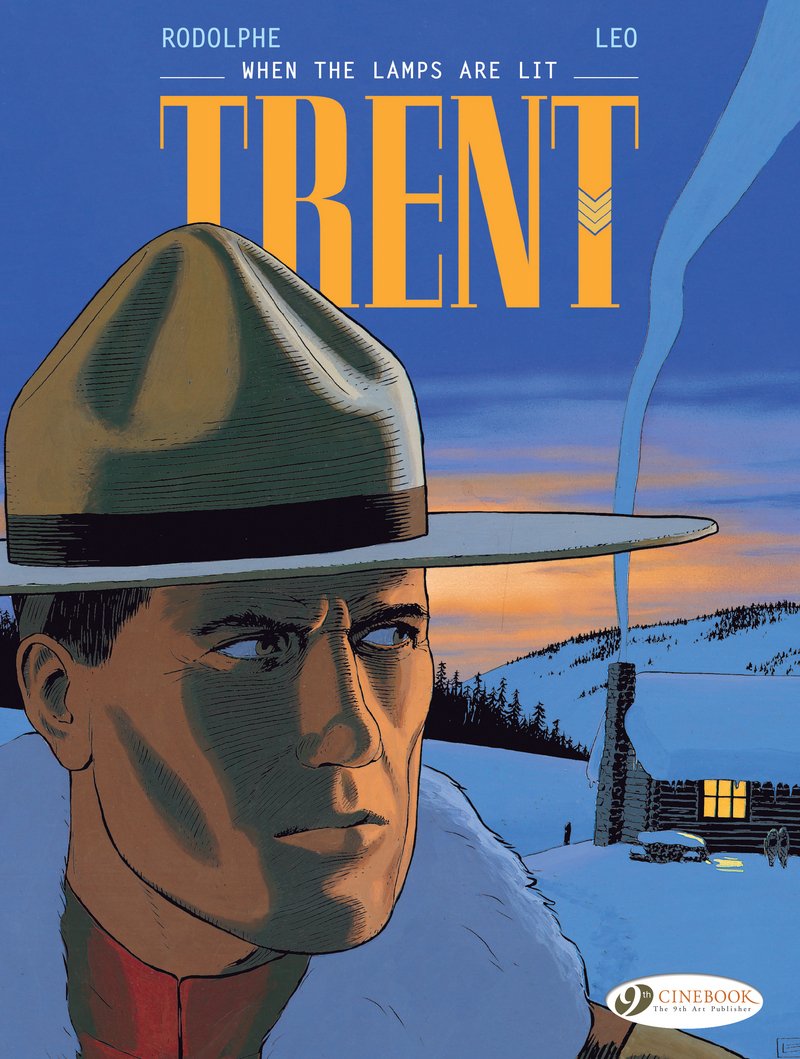
In 1991 he began working with Léo on a period adventure series of the far north. Taciturn, introspective and fiercely driven Royal Canadian Mounted Police sergeant Philip Trent premiered in L’Homme Mort, forging a lonely path through the 19th century Dominion over eight tempestuous, hard-bitten albums between then and 2000. He also prompted the collaborators’ later fantasy classics Kenya (and its spin-offs), Centaurus and Porte de Brazenac.

Cast very much in the classic adventure mould as crafted by the likes of Jack London and John Buchan, Trent is a man of few words, deep thoughts and unyielding principles who gets the job done whilst stifling emotional turmoil boiling deep within him…

As ‘Le Kid’, this conflicted, moving second exploit originated in 1992, opening with a robbery in Blacktown, North Dakota that goes appallingly awry. The bandits are idealistic teenagers and when Laura is killed in a shootout, her poetry-obsessed partner Emile Tourneur goes completely off the rails…

With nine confirmed kills and nothing to live for, Emile heads north and becomes an RCMP problem. One of many officers assigned to catch him, Trent is despatched to Lake Manitoba with explicit orders to find but not confront the ruthless killer, aided only by faithful canine companion “Dog”.

Following sporadic poetic graffiti, the officer quickly picks up the trail and the impression that something isn’t right. For one thing, the kid is not hiding his tracks, and making plenty of friends and admirers along the way as his adds to the notches on his gun. Some think he’s only killing people who have it coming…

Eventually, Trent locates his quarry in the Frozen wastes and far-too-easily overcomes him. Their long trek back only adds to the mystery of the Rimbaud-quoting golden boy, who has a distressing knack of asking uncomfortable questions…

Brooding tensions and paradoxical revelations explosively come to a head when the now amiable fellow-travellers are ambushed by escaped convicts. Sudden, ruthless gunplay leaves the Mountie inexplicably alive, alone and still fully armed. He can only assume his recent captive is provoking him for some reason, as he traces a trail back to the scene of the kid’s last atrocity and a town full of vengeful survivors…

A beguiling voyage of internal discovery where environment and locales are as much a major character as hero and foe, The Kid offers suspense, action, humour and poignant evocation in a compelling confection that will appeal to any fan of widescreen cinematic crime fiction or epic western drama.
Original edition © Dargaud Editeur Paris 1992 by Rodolphe & Léo. All rights reserved. English translation © 2016 Cinebook Ltd.

The System


By Peter Kuper (DC-Vertigo/PM Press)
ISBN: 978-1-60486-811-1 (PMP HB) 978-1-56389-322-3 (Vertigo TPB)

Artist, storyteller and activist Peter Kuper was born in Summit, New Jersey in 1958, before the family moved to Cleveland when he was six. There the youngster met fellow comics fan Seth Tobocman and they progressed through the school system together, catching the bug for self-publishing early.

They then attended Kent State University together. On graduation in 1979, they moved to New York and – whilst both studying at Brooklyn’s Pratt Institute – created groundbreaking political art/comics magazine World War 3 Illustrated.

Both separately and in conjunction, in comics, illustration and through art events, Kuper & Tobocman have championed social causes, highlighted judicial and cultural inequities and spearheaded the use of narrative art as an effective means of political activism.

Many of Kuper’s most impressive works have stemmed from his far-flung travels but at heart he is truly a son of New York, with a huge amount of his work using the city as bit player or star attraction.

In 1993, he created Eye of the BeholderThe New York Times‘ first continuing strip – and adapted such modern literary classics as Franz Kafka’s Give It Up! (1995) and The Metamorphosis (2003) to strip form, whilst always creating his own canon of intriguing graphic novels and visual memoirs.

Amongst the many strings to his bow – and certainly the most high-profile – has been his brilliant stewardship of Mad Magazine‘s beloved Spy Vs. Spy strip which he inherited from creator Antonio Prohias in 1997.

In 1995 he undertook a bold creative challenge for Vertigo (DC’s Mature Reader imprint) by crafting a mute yet fantastically expressive 3-part thriller and swingeing social commentary released under the Vertigo Verité imprint. The System was repackaged and released as a softcover graphic album in 1997 and evolved into a magnificent and lavish hardback edition from PM Press. It now also accessible as an eBook.

Following a moving Preface from the author describing the genesis of the project, Senior News Editor at Publisher’s Weekly, Carl Reid offers an effusive appreciation in ‘Bright Lights, Scary City’ before the truly urban drama begins…

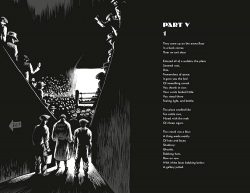
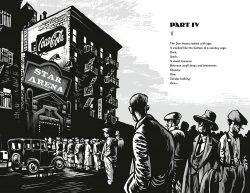
As if relating a beguiling, interlinked portmanteau tale of many lives interweaving and intersecting – and often nastily ending – in the Big City without benefit of word-balloons, captions or sound effects was not challenge enough, Kuper pushed his own storytelling abilities to the limit by constructing his pages and panels from cut stencils, creating the narrative in a form akin to street art.

It is astoundingly immediate, evocative and effective…

A stripper is murdered by a maniac. An old, weary detective ruminates on his failures. A boy and girl from different neighbourhoods find love. A derelict and his dog eke out a precarious daily existence and a beat cop does his rounds, collecting payoffs from the crooked dealers and helpless shopkeepers he’s supposed to protect. Religious zealots harass gay men and an Asian cabbie gets grief from white fares who despise him whilst depending on his services.

The streets rattle with subway trains below and elevated trains above.

Strippers keep dying, children go missing, love keeps going and the airport brings a cruel-faced man with radioactive death in his carry-on luggage…

There are so many million stories in The City and they are all connected through the unceasing urban pulse and incessant, unending forward motion of The System…

Clever, compulsive and breathtakingly engrossing, this delicious exercise in dramatic interconnectivity and carefully constructed symbolism is a brilliant example of how smart and powerful comics can be.
© 2014 Peter Kuper. All rights reserved.

Dash: The Case of the Mysterious Zita Makara


By Dave Ebersole, Delia Gable, Vinnie Rico, Sean Von Gorman, Tana Ford, Josh Lester & various (Northwest Press)
ISBN: 978-1-94-389055-2 (TPB) eISBN 978-1-94-389056-9

The 1930s were a golden age of fantasy fiction, particularly in the genres of pulp adventure, crime stories and supernatural horror. As such it’s a time period accessible to some degree by most modern consumers of escapist entertainment. It was also a time of great hypocrisy, social conservatism – except in the arts and politics – and enforced conformity.

All that gets a great big “So What?” in this deliriously rambunctious melange of mixed media forms wherein writer Dave Ebersole and illustrator Delia Gable finally complete their long-delayed epic tale of boozy, proudly unrepentant queer private eye Dashell Malone, who cautiously negotiates the hostile environment of pre-WWII Los Angeles and outraged former colleagues from the LAPD in search of the mystic horror that destroyed the man he loved…

It all begins in 1940 when exotic and sultry Zita Makara hires him to act as go-between in a shady deal. She is exceptionally unforthcoming with useful details and not a little annoyed at his easy resistance to her charms and attentions… much to the amusement of Dash’s sassy but efficient secretary Cindy Crenshaw…

The PI’s attention is further derailed by the return of his lover, shady ne’er-do-well Johnny Plinketts, so when his diligent investigations of Zita take him to a travelling Egyptian antiquities exhibition, Dash is totally unprepared for the appalling consequences. Dash still has friends on the force – such as patrolman Sal McGillicutty – who is there to break the shocking news that “Plink” has been found dead in incredible circumstances. Moreover, he’s not the first. LA has become the hunting grounds for a ghastly beast…

A convenient suspect for bigoted detective Bruno Perez, Dash is eventually released and falls into a depression until Cindy and Sal get him moving on finding the real killer, but before long the trail leads to an ancient Egyptian heretic cursed by the gods and an undying predator active for ages. This terror has been methodically preparing to turn back time and remake the world and Plink was not only his latest meal but also deeply involved in the plot from the start…

As events spiral and supernatural Hell inescapably comes to Earth, Dash is thrust into the role of mystic avenger and saviour of humanity, but it’s a job the grieving shamus neither wants nor feels qualified to handle…

Augmented by an effusive Introduction and appreciation from Steve Orlando, the book also includes a background-packed ‘Interlude’ from Ebersole and artist Vinnie Rico, as well as a trio of brief ‘Further Cases’.

‘The Case of the Man in the Mask’ (art by Sean Von Gorman) sees Dash dismantle a devious blackmail scheme, whilst Rico’s ‘The Case of the Best Friend on the Police Force’ traces the story of LAPD officers Malone and McGillicutty before Cindy’s origins are explored in ‘The Case of the Wisecracking Secretary’ (Rico again). Rounding up the fun is early promotional art, Afterwords and thank-yous, plus a recipe section inviting you to “make the cocktails you just read about” in ‘You Don’t Have to Drink, But If You Do… Drink Well!’

A superbly engaging romp in the manner of The (1999) Mummy whilst tipping its battered, dusty fedora to classics of film noir and latter-day pulp homages like Raiders of the Lost Ark and Hooten and the Lady, this is a splendid excursion categorically proving that not all rugged he-men get the girl in the end…
© 2020 Dave Ebersole. Dash co-created by Dave Ebersole and Delia Gable. All rights reserved.