Yoko Tsuno volume 5: The Dragon of Hong Kong


By Roger Leloup translated by Jerome Saincantin (Cinebook)
ISBN: 978-1-84918-041-2

Indomitable intellectual adventurer Yoko Tsuno debuted in Spirou in September 1970 and is still delighting regular readers and making new fans to this day. These astounding, all-action, excessively accessible exploits of the slim, slight Japanese technologist-investigator are amongst the most intoxicating, absorbing and broad-ranging comics thrillers ever created.

The globe-girdling, space-&-time-spanning episodic epic was devised by monumentally multi-talented Belgian maestro Roger Leloup who began his solo career after working as a studio assistant on Herge’s Adventures of Tintin.

Compellingly told, superbly imaginative and – no matter how implausible the premise of any individual yarn – always solidly grounded in hyper-realistic settings and underpinned by authentic, unshakably believable technology and scientific principles, Leloup’s illustrated escapades were at the forefront of a wave of strips changing the face of European comics in the mid-1970s.

That long-overdue revolution featured the rise of competent, clever and brave female protagonists, all taking their places as heroic ideals beside the boys and uniformly elevating Continental comics in the process. Happily, most of their exploits are as timelessly engaging and potently empowering now as they ever were, and none more so than the trials and tribulations of Yoko Tsuno.

Her very first outings (the still unavailable Hold-up en hi-fi, La belle et la bête and Cap 351) were mere introductory vignettes before the superbly capable engineer and her valiant but less able male comrades Pol Paris and Vic Van Steen properly hit their stride with premier full-length saga Le trio de l’étrange in 1971 with Spirou‘s May 13th issue…

Yoko’s exploits generally alternate between explosive escapades in exotic corners of our world, time-travelling jaunts and sinister deep-space sagas with the secretive, disaster-prone alien colonists from planet Vinea. However, for the majority of English translations thus far, the close encounters have been more-or-less sidelined in favour of intriguing Earthly exploits such as this gloriously gargantuan ground-shaker with hidden depths.

There have been 27 European albums to date. This tale was first serialised in 1981 (Spirou #2244-2264) and collected the following year as 16th album Le Dragon de Hong Kong. Due to the quirks of publishing it reached us Brits as Yoko’s fifth Cinebook outing: a delicious homage to monster movies displaying the technomantic trouble-shooter’s softer sentimental side…

In the years before China regained control of Hong Kong, Yoko is visiting a distant Chinese branch of the family when the boat she is travelling on is attacked by a colossal reptile. The beast is driven off but Yoko finds a claw fragment imbedded in a gunwhale and takes it to a local lab for analysis. The results are startling…

The boffin in charge declares the talon is from a creature which has been biologically manipulated. He’s seen other such samples recently, all provided by a seller in the harbour fishmarket…

On questioning the vendor, Yoko learns the oversized produce on offer comes from an abandoned typhoon-wrecked aquaculture farm on Lantau Island, but by the time she reaches the desolate area the sun is setting.

It’s a lucky break. With the growing darkness, a little girl with a lantern appears amongst the broken pens and enclosures and starts playing a flute. As Yoko watches, the scene becomes even more incredible as the sounds summon the monstrous lizard, which the child joyously addresses as Dai Loon…

Astonished, Yoko watches the girl feed the beast and make it perform tricks, but the uncanny sight becomes deadly serious when a masked man in a motorboat roars in and tries to kidnap the little miss…

Yoko’s prompt and dynamic action drives off the thug and soon the sodden wanderer is sitting in front of fire whilst little Morning Dew‘s grandfather relates the bizarre history of the scaly wonder.

It all began when a researcher from the Chinese mainland rented the enclosures from Dew’s father to use as test-beds for his experiments…

They varied in success, but when the storm came all the subjects escaped. The elderly guardian cannot explain the strange connection between the dragon and the child but worries for her safety and future as his own days are surely numbered…

Three days later, Yoko and Morning Dew are shopping in Kowloon before meeting the recently arrived Pol and Vic at the airport. The canny inventor has a few ideas about tracking the dragon and wants their technical assistance with the details…

The scheme garners almost instant rewards and the three friends are actually gently guiding the vast creature into their custody when both boat and beast are simultaneously attacked by another – even larger – sea dragon… and this one shoots fire…

And thus kicks off a spectacular and cunningly devised mystery monster-fest as our heroes uncover a cruel and deadly get-rich-quick scheme which endangers the entire region. There will be terror, destruction and tragedy before the villain is brought to book, and before the case is closed Yoko will assume one of the greatest and most rewarding responsibilities of her young life…

Complex, devious and subtly suspenseful, this fresh look at a classic plot crackles with electric excitement and delivers a powerfully moving denouement conclusion, again affirming Yoko Tsuno as a top flight troubleshooter, at home in all manner of scenarios and easily able to hold her own against any fantasy superstar you can name: as triumphantly able to apprehend swindlers and wrangle marauding monsters, aliens, mad scientists or unchecked forces of nature…

As always the most effective asset in these breathtaking tales is the astonishingly authentic and staggeringly detailed draughtsmanship and storytelling, which superbly benefits from Leloup’s diligent research and meticulous attention to detail.

The Dragon of Hong Kong is a stunning mystery mash-up which will appeal to any devotee of Holmes, Professor Challenger or Tintin.
Original edition © Dupuis, 1986 by Roger Leloup. All rights reserved. English translation 2010 © Cinebook Ltd.

Criminal volume 5: The Sinners


By Ed Brubaker & Sean Phillips (Image Comics)
ISBN: 978-1-63215-298-5

Way back in 2007, Tracey Lawless debuted in the second Criminal story-arc: a tough but comparatively honest guy drawn back from military service and into the underworld to repay his family’s debts.

At that time collaborators Ed Brubaker & Sean Phillips were forging a creative partnership incapable of setting a foot wrong: each stand-alone tale building on the previous exploit, getting tougher, stronger, meaner and better…

Everything is set in and around Center City, a prototypical American everytown which serves as a shared backdrop for various seemingly unconnected ventures. Slowly, however, connections were made and a wider mosaic began to become clearer…

The entire series of compulsive crime capers was repackaged and re-released as a uniform set of trade paperbacks in 2015 with this as the fifth turbulent tome (reprinting the five issue comicbook series Criminal: The Sinners, September 2009-March 2010) as Lawless rears his battered grizzled head once again…

For a year the Lawless has been working off his dad’s and brother Ricky‘s debts to undisputed Boss of Bosses Sebastian Hyde, killing whoever the ruthless bastard tells him to.

At least that was the plan, but Lawless doesn’t like wholesale slaughter and has been quietly choosing who lives or dies. Sure, he’ll cap anybody who really deserves it – and there are plenty of them – but he’s been increasingly finding ways to punish the little people who arouse Hyde’s ire without needing the services of an undertaker afterwards.

Despite himself, Sebastian has a grudging respect for Tracey and has been letting it slide, since Lawless has been his most effective enforcer since he joined the team. He’d probably feel less sanguine if he knew what his star goon was doing with Mrs. Hyde…

Today, however, Hyde has an even bigger problem, one that needs brains not butchery.

All over town well-connected associates considered utterly beyond the reach of the law and even underworld rivals have been hit: not just Sebastian’s crew, but also feared and respected colleagues-in-crime nobody should be able to get near. It’s affecting everyone’s business and has to be stopped. Hyde owns plenty of cops, but this is something he needs sorted by someone he can at least control if not trust…

Tracy is no sleuth, but with no other choice, begins making enquiries into the shootings. Father Grant was a loan-shark and possible serial sexual predator, shielded by both the Church and the Mob; Scotty Adsit ran drugs and collected thumbs from those who baulked him and Big Tom McGinnis was the elder Statesman of the Irish Mafia, capped in his own restaurant rest room with twenty bodyguards just outside. There’s no connection other than that they were all very bad people and in every execution it’s like the killer was invisible…

Further complicating the issue is the arrival of military cop Special Agent Yoakum. Tracey has been AWOL for year now and despite his current untenable situation has no desire to trade it for active service or a stockade…

As he flounders through the darkest regions of the underworld, the death toll mounts. Joe Hill was Sebastian’s top man inside the police force and best hope for a lead, but he was left dead in the gutter before Lawless could meet him. However he provides a first inkling of what’s really going on and an idle comment from a sympathetic Internal Affairs cop forces Lawless to re-examine his assumptions…

In the course of his investigations Tracey met war vet and replacement priest Father Mike, but had no idea that while he was starting to put things together, Sebastian has made a few misapprehensions of his own and is now gunning for his unwilling gunsel…

As the bodycount of untouchables keeps rising, Tracey tracks another potential answer to Chinatown and ends up framed for the death of a Triad Boss, just as Yoakum closes in. All the time the trail keeps coming back to the church and Father Mike, but Tracey is blithely unaware that he has already met the killer – who has also passed sentence on him too – or that Sebastian has decided to cut his losses…

As all the strands converge, the slaughter mounts and when the shooting stops the criminal hierarchy of Centre City has changed forever…

Filled with twists, turns and devious double-cross, this viciously effective sex-&-violence saga offers a stark look at the other side of society: providing an irresistible view of raw humanity. These stories are amongst the very best crime comics ever crafted: ignore them at your peril…
© 2015 Basement Gang Inc. All rights reserved. Criminal™ and all prominent characters, likenesses and logos are trademarks of Ed Brubaker and Sean Phillips.

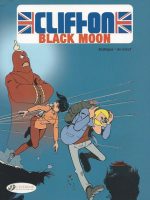
Clifton volume 4: Black Moon


By Rodrigue & de Groot, coloured by Liliane Denayer, translated by Luke Spear (Cinebook)
ISBN: 978-1-905460-30-4

An infallible agent of Her Majesty’s assorted security forces, Clifton was originally devised by Raymond Macherot (Chaminou, Les croquillards, Chlorophylle, Sibylline) for the weekly magazine Tintin. The doughty exemplar of Albion debuted in December 1959, just as a filmic 007 was preparing to set the world ablaze and get everyone au fait with espionage…

After three albums worth of strip material – compiled and released between 1959 and 1960 – Macherot left Tintin for arch-rival Spirou and his comedic crime-buster forlornly floundered.

Tintin revived him at the height of the Swinging London scene and aforementioned spy-boom, courtesy of Jo-El Azaza & Greg (Michel Régnier). These strips were subsequently collected as Les lutins diaboliques in French and De duivelse dwergen for Dutch-speakers in 1969.

Then it was back into retirement until 1971 when first Greg – with artist Joseph Loeckx – took his shot. He toiled on the True Brit until 1973 when Bob De Groot and illustrator Philippe “Turk” Liegeois fully regenerated the be-whiskered wonder. They produced ten tales after which, from 1984 on, artist Bernard Dumont (AKA Bédu) limned from De Groot’s scripts before eventually assuming the writing chores as well. The series concluded in 1995.

…But Not For Long…

In keeping with its rather haphazard Modus Operandi and indomitably undying nature, the Clifton experience resumed yet again in 2003, crafted now by De Groot & Michel Rodrigue for four further adventures. Although the humorous visual vein was still heavily mined in these tales, the emphasis was subtly shifted and the action/adventure components strongly emphasised…This one, Black Moon, was originally released in 2004 as Lune noire – Clifton: the 22nd of 25 to date and Rodrigue & De Groot’s second collaboration…

Bob de Groot was born in Brussels in 1941, to French and Dutch parents. As a young man he became art assistant to Maurice Tillieux on Félix, before creating his own short works for Pilote. A rising star in the 1960s, he drew 4 × 8 = 32 L’Agent Caméléon where he met Philippe “Turk” Liegeois and consequently began making a slow transition from artist to writer. Together they created Archimède, Robin Dubois and Léonard and eventually inherited Raymond Macherot’s moribund Clifton.

In 1989 de Groot – with Jacques Landrain – devised Digitaline, a strong contender for the first comic created entirely on a computer, and co-created Doggyguard with Michel Rodrigue, even whilst prolifically working with the legendary Morris on both Lucky Luke and its canine comedy spin-off Rantanplan.

He’s still going strong with strips such as Leonard in Eppo, Père Noël & Fils and Le Bar des acariens (both published by Glénat) and much more.

Michel Rodrigue really, really likes Rugby. He was born in Lyon in 1961 and eventually pursued higher education at the National School of Fine Arts, where he also studied medieval archaeology.

From 1983-85 he was on the French Rugby team and in 1987 designed France’s mascot for the World Cup. He made his comics debut in 1984 with sports (guess which one) strip Mézydugnac in Midi Olympique. After illustrating an adaptation Edmond Rostand’s Cyrano de Bergerac in 1986 he and collaborator Jean-Claude Vruble produced a volume of La Révolution Française, scripted by Patrick Cothias.

Rodrigue then joined Roger Brunel on Rugby en B.D., Du Monde dans la Coupe!, Concept, Le Rugby en Coupe and La Foot par la Bande.

For Tintin he drew Bom’s Les Conspirateurs and produced Rugbyman, the official monthly of the French Rugby Federation, amongst a welter of other strips. Along the way he began scripting too, and, after working with de Groot on Doggyguard joined him on the revived Clifton.

He also remains astonishingly creatively occupied, working on Ly-Noock with André Chéret, Brèves de Rugby, La Grande Trambouille des Fées for René Hausmann, Futurama comics, Cubitus with Pierre Aucaigne, and many more…

So who’s our hero?

Pompous, irascible Colonel Sir Harold Wilberforce Clifton is ex-RAF, a former officer with the Metropolitan Police Constabulary and recently retired from MI5. Typically, he has a great deal of difficulty dealing with being put out to pasture in rural Puddington and takes every opportunity to get back in the saddle, assisting the Government or needy individuals as an amateur sleuth whenever the opportunity arises.

Sadly, he is also all too keenly aware that he is generally the only truly competent man in a world chockfull of blithering idiots…

In this relatively recent offering the accent is heavily on blistering adventure and sinister intrigue – albeit with a liberal dosing of political satire tipped in – and begins at the end with the murder of Clifton in a seedy hotel in North Korea.

Photos of his bloody corpse are leaked to the press and soon cause a terrific commotion in the secret Headquarters of MI-5. Veteran warhorse and ultra-capable spymaster Colonel Donald Spruce cannot believe the evidence of his eyes and neither can any of his appalled staff…

Agent Brian begins translating the text and recounts how British subject “Marmaduke Brent” was chased by persons unknown through the town of Ptang-Kong before being machine gunned to death. With no other information available all the devastated agents can do is arrange for the body of their fallen former comrade to be shipped home…

To Spruce falls the unenviable task of informing Clifton’s fiery, frequently befuddled housekeeper Mrs. Partridge of the tragedy…

A few days later, with great ceremony a British transport picks up the coffin and the exotic widow escorting it to its final destination. With the plane safely in the air, she quickly opens the box and lets Clifton out before his oxygen supply is exhausted…

Battered and groggy, the old war horse begins reviewing the convoluted path which led to this fine turn of events…

Was it only a month ago that he and the ravishing Miss Jade were approached by Spruce to clandestinely follow the Prime Minister’s idiot nephew Hank to North Korea and infiltrate the bizarre and avaricious Black Moon Cult which had somehow changed an annoying chinless wonder and embarrassing idiot into a blithering nincompoop and danger to the prestige of the nation?

Of course the valiant old soldier accepted the mission, but neither he nor Jade could have known how devious was their masked leader The Great Tralala, how well-established, ambitious and deadly his cult was, nor that they were already a clandestine nuclear power with the entire world in their sights…

Still, with nothing to lose and a world to save, Clifton naturally had to do his utmost…

Fast-paced, action packed and sporting set pieces and a body count that would put James Bond and SPECTRE to shame, Black Moon is a cleverly contrived light romp that will astound and delight blockbuster addicts and comes with a smart line in sardonic social commentary to please every fun-loving sucker for satire.
Original edition © Les Editions du Lombard (Dargaud-Lombard) 2004 by Rodrigue & De Groot. English translation © 2007 Cinebook Ltd.

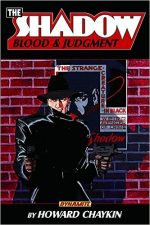
The Shadow: Blood and Judgement


By Howard Chaykin with Ken Bruzenak & Alex Wald (Dynamite Entertainment)
ISBN: 978-1-60690-327-8

I’ve been a fan of The Shadow ever since I picked up a couple of paperbacks as a kid in my local Woolworth’s in the 1960s. Over many decades I’ve followed the various comic and movie interpretations with mixed feelings and general acceptance. However, when Howard Chaykin had a crack at the venerable crime-crusher at the height of the turbulent game-changing 1980’s, I nearly blew a gasket. I was appalled.

And that was the point.

Chaykin has for his entire career lovingly cultivated a reputation as an iconoclast and bombast over many years and the four issue miniseries collected here certainly ruffled a few feathers – those of severe traditionalist me included.

As originally disseminated in the days before comic-books, The Shadow gave thrill-hungry readers their measured doses of extraordinary excitement via cheaply produced periodical novels dubbed “pulps” (because of the low-grade paper they were printed on) and over the mood-drenched airwaves through his own radio show.

Pulps were published in their hundreds every month, ranging from the truly excellent to the pitifully dire, in every style and genre, but for exotic adventure lovers there were two star characters that outshone all others. The Superman of his day was Doc Savage, Man of Bronze, whilst the premiere dark, relentless creature of the night dispensing terrifying grim justice was our mysterious slouch-hatted hero.

Originally the radio series Detective Story Hour – based on stand-alone yarns from the Street & Smith publication Detective Story Magazine – used a spooky voiced narrator (most famously Orson Welles, although he was preceded by James LaCurto and Frank Readick Jr.) to introduce each tale. He was dubbed “the Shadow”, and from the start on July 31st 1930, he was more popular than the stories he introduced.

The Shadow evolved into a proactive hero solving mysteries and, on April 1st 1931, debuted in his own pulp series written by the incredibly prolific Walter Gibson under the house pseudonym Maxwell Grant. On September 26th 1937 the radio show officially became The Shadow with the eerie tag-line “Who knows what evil lurks in the hearts of Men? The Shadow knows!”

From June 17th 1940 he starred in a newspaper strip by Vernon Greene and when comic books took off he had his own four-colour title which ran for 101 issues (March 1940 – September 1949). Years later Archie Comics published a controversial contemporary version in 1964-5 under their Radio/Mighty Comics imprint, written by Robert Bernstein and Jerry Siegel, illustrated by John Rosenberger and latterly Paul Reinman.

In 1973 DC acquired the comic rights and produced a captivating if brief series of classic tales unlike any other superhero title then on the stands.

Grant wrote 282 of 325 novels over the next two decades, which were published twice a month. The series spawned comic books, seven movies, a newspaper strip and all the merchandising paraphernalia you’d expect of a superstar brand. The pulp series also ended in 1949, although many novels have been written (both by Gibson and others) since 1963 when a pulp and fantasy revival gripped America generating reprinted classic stories and a run of new adventures as paperback novels.

Then he was gone again but the mesmerising master of menace always seemed to be lurking in the background…

DC periodically revived their comicbook iterations of the venerable vigilante and in the wake of Crisis on Infinite Earths, The Dark Knight Returns and Watchman tasked one of the comics industry’s most controversial creators with reviving the pre-eminent mystery men of all time…

Fresh from an awe-inspiring, inspirational and transformative run on his creation American Flagg, Howard Chaykin returned to DC to shake up everything with an interpretation which offended fans, purists (still including me) and franchise-owners Conde Nast but which ultimately proved to be just the medicine the property needed to become relevant again.

That crucial year 1949 is the embarkation point for this flashy, savage, witty and completely captivating updating. This is not a reboot. Chaykin was extremely careful to accept and utilise the decades of established canon; deftly accommodating old material whilst infilling information gaps by scrutinising world history and tacitly accepting that a do-gooder who exploited and expended his own agents whilst kidnapping, brainwashing and slaughtering the bad guys wasn’t what most people would consider a hero…

Devised and delivered as a glittering, frenetic avalanche of graphic and text material – spectacularly made comprehensible by the calligraphic skill of lettering wizard Ken Bruzenak and the understated colour-palette of Alex Wald – the story opens with a series of increasingly brutal murders. It doesn’t take long to connect the victims: old people from all walks of life rumoured to have worked with an old urban legend known as The Shadow…

That mystery manhunter vanished in 1949, abandoning his grim crusade to destroy criminals and now (for which read 1986) some hidden mastermind is eliminating every surviving member of his organization. Before long a figure comes out of the closeted east: easily slipping past China’s Bamboo Curtain and returning to blighted, benighted America…

Suddenly amidst a broiling sea of perversion, sex and violent death, The Shadow is back and dealing bloody justice to petty thugs. In a desperate race against time, the impossibly young and still vital Lamont Cranston reunites with his elderly surviving agents to track down his oldest enemy and thwart a deadly plan to bring about nuclear annihilation.

However, as arrogant and officious as ever, the master manipulator is probably in more danger from the colleagues he abandoned than the gun-toting punks and maniacs dogging his smartly-shod heels…

Chaykin even had the chutzpah to provide the eternal Man of Mystery with a Real Origin, something he never really had before…

Bonus features include a cover gallery, Marc Guggenheim’s Foreword ‘Looking Back on the Shadow’ plus ‘The Light Behind The Shadow’: an interview with Chaykin and Joe Orlando which first appeared in the 1987 trade paperback collection.

I don’t know why I used to dislike this book so much: Although I still feel the proper milieu for the character is the iconic era of mobsters, militarists and madmen (by which I mean the 1930s and 1940s) I can see what Chaykin’s getting at. Those threats and motivations were common enough in the Eighties and even more so nowadays.

Perhaps the author’s trademark trick of confronting misogyny, racism and suppressed sexuality by seemingly advocating them just wore a bit thin when applied to such a treasured old friend. There’s certainly a disquieting amount of adult themes, kinky sex and graphic violence on offer…

With sufficient distance however I now find this tale a terrific thrill-ride; stylish and compelling – if a little “in your face” and “on the nose”. Somebody must have liked it back then: Blood and Judgment spawned a fascinating follow-up series (by Andy Helfer, Bill Sienkiewicz, Kyle Baker and others) before DC reverted to The Shadow Strikes: a series safely restored to its natural pre-war time period.

Out of print since 1991 until Dynamite picked up the option in 2011, this is a vital and vigorous read which inspired some of today’s very best creators, and acts as a perfect introduction to the character. You could even complement the experience by tracking down DC’s first experiment with the character – partially collected as The Private Files of the Shadow – and Dynamite’s new edition of The Shadow: Hitler’s Astrologer, before moving on to the new tales currently being published.

After all, a crime fighter this durable has to have something to him…
The Shadow ® & © 2012 Advance Magazine Publishers Inc. d/b/a Conde Nast. All Rights Reserved.

XIII volume 3: All the Tears of Hell


By William Vance & Jean Van Hamme, coloured by Petra (Cinebook)
ISBN: 978-1-84918-051-1

One of the most consistently entertaining and popular adventure serials on the European scene, XIII was created by author Jean Van Hamme (Wayne Shelton, Blake and Mortimer, Lady S.) and illustrator William Vance (Bruce J. Hawker, Marshal Blueberry, Ramiro).

Van Hamme was born in Brussels in 1939 and is one of the most prolific writers in comics. After pursuing business studies he moved into journalism and marketing before selling his first graphic tale in 1968. Immediately clicking with the public, by 1976 he had also branched out into prose novels and screenwriting. His big break was monumentally successful mixed-genre fantasy series Thorgal for Tintin magazine but he truly cemented his reputation with mass-market bestsellers Largo Winch and XIII as well as more cerebral fare such as Chninkel and Les maîtres de l’orge. In 2010 Van Hamme was listed as the second-best selling comics author in France, ranked between the seemingly unassailable Hergé and Uderzo.

William Vance is the bande dessinée nom de plume of William van Cutsem. He was born in 1935 in Anderlecht and, after military service in 1955-1956, studied art at the Académie Royale des Beaux-Arts. He became an illustrator of biographic features for Tintin in 1962. His persuasive illustrative style is a classical blend of meticulous realism, scrupulous detail and spectacular yet understated action.

In 1964 he began maritime adventure serial Howard Flynn (written by Yves Duval) before graduating to more popular genre work with western Ray Ringo and espionage thriller Bruno Brazil (scripted by “Greg”). Further success followed when he replaced Gérald Forton on science fiction classic Bob Morane in Femmes d’Aujourd’hui and latterly Pilote and Tintin.

Although working broadly and constantly on serials and stand-alone stories, Vance’s signature achievement is his lengthy collaboration with fellow Belgian Van Hamme on this contemporary thriller loosely based on Robert Ludlum’s novel The Bourne Identity…

XIII premiered in 1984, originally running in Spirou to great acclaim. A triad of albums were rushed out – simultaneously printed in French and Dutch editions – before the first year of serialisation ended.

The series was a monumental hit in Europe but has fared less well in its many attempts to make the translation jump to English, with Catalan Communications, Alias Comics and even Marvel all failing to find an audience for the epic mystery thriller.

The grand conspiracy saga of unrelenting mood, mystery and mayhem opened in The Day of the Black Sun when an old beachcomber found a body. The human flotsam had been shot in the head and was near death when old Abe‘s wife examined the near-corpse. She discovered a key sewn into his clothes and the Roman numerals for thirteen tattooed on the victim’s neck. Their remote hideaway offered little in the way of emergency services, but their alcoholic, struck-off surgeon friend was able to save the stranger…

As he recuperated a complication became apparent. The patient – a splendid physical specimen clearly no stranger to action or violence – had suffered massive irreversible brain trauma and although increasingly sound in body had completely lost his mind.

Language skills, muscle memories, even social and reflexive conditioning all remained, but every detail of his life-history was gone…

Abe and Sally named him “Alan” after their own dead son – but hints of the intruder’s lost past explosively intruded when hitmen invaded the beach house with guns blazing. Alan lethally retaliated with terrifying skill, but too late…

In the aftermath he found a photo of himself and a young woman on the killers and traced it to nearby Eastown. Desperate for answers and certain more killers were coming, the human question mark headed off to confront unimaginable danger and hopefully find the answers he craved.

The picture led to a local newspaper and a crooked cop who recognised the amnesiac but said nothing…

The woman in the photo was Kim Rowland, a local widow recently gone missing. Alan’s key opened the door of her house. The place had been ransacked but a thorough search utilising his mysterious talents turned up another key and a note warning someone named Jake that “The Mongoose” had found her…

He was then ambushed by the cop and newspaper editor Wayne. Calling him “Shelton” they demanded the return of a large amount of missing money…

Alan/Jake/Shelton reasoned the new key fitted a safe-deposit box and bluffed the thugs into taking him to the biggest bank in town. The staff there also knew him as Shelton, but when his captors examined the briefcase in Shelton’s box a booby trap went off. Instantly acting, the mystery man expertly escaped and eluded capture, holing up in a shabby hotel room, pondering again what kind of man he used to be…

As he prepared to leave he stumbled into a mob of armed killers. In a blur of lethal action he escaped and ran into another gang led by a Colonel Amos. This chilling executive referred to his captive as “Thirteen”, claiming to have dealt with his predecessors XI and XII in regard to the “Black Sun” case…

Amos very much wanted to know who Alan was, and offered some shocking titbits in return. The most sensational was film of the recent assassination of the American President, clearly showing the lone gunman was XIII…

Despite the amnesiac’s heartfelt conviction that he was no assassin, Amos accused him of working for a criminal mastermind, and wanted that big boss but failed to take Alan’s instinctive abilities into account and was astounded when his prisoner leapt out of a fourth floor window…

The fugitive headed back to the beach where he was found but more murderers awaited; led by a mild-seeming man Alan inexplicably knew was The Mongoose. The mastermind expressed surprise and admiration: he thought he’d killed Thirteen months ago…

Following an explosion of hyper-fast violence which left the henchmen dead and Mongoose vanished but vengeful, the mystery man regretfully hopped a freight train west towards the next stage in his quest for truth…

His journey of discovery took him to the army base where Kim Rowland’s husband was stationed. His enquiries provoked an unexpected and violent response resulting in his interrogation by General Ben Carrington and his sexily capable aide Lieutenant Jones.

They’re from the Joint Chiefs of Staff, know an awful lot about black ops units and have proof that their memory-challenged prisoner is in fact their agent: believed-deceased Captain Steve Rowland…

After testing the amnesiac’s abilities Carrington then drops him off in Rowland’s home town of Southberg to pursue his search for his missing wife, but the prodigal’s return to his rat’s nest of a family rekindles long-simmering passions and jealousies. The entire town seems to want Rowland’s blood and before long he’s been made the target of an assassination attempt and victim of a diabolical murder-plot…

Despite Carrington and Jones’ last-minute intervention Alan/Steve is framed for murdering his father and grabbed by a furious posse…

This third gripping instalment (originally seen in Europe as Toutes Les larmes de l’enfer in 1986) opens with Steve Rowland undergoing the worst kind of psychiatric care at the Plain Rock Penitentiary for the Criminally Insane. Despite drugs and shock treatments, his progress at the Maximum Security Facility is negligible. Young Dr. Ralph Berger seems amenable enough but all elderly martinet Dr. Johansson‘s claims to be seeking a cure for his patient’s amnesia are clearly no more than a proselytising, judgemental sadist’s justifications for inflicting pain…

Meanwhile in Washington DC, Carrington and Jones have met with Colonel Amos who has a strange request and troubling new information. His investigations have revealed that the amnesiac in the desert hell of Plain Rock has undergone plastic surgery and his army records have been altered. Steve Rowland is definitely not Steve Rowland…

Moreover, Amos has information proving that the plotters who had the President killed are still active and their amnesiac assassin is the only link and hope of finding them. Acting on her own initiative, Jones decides it’s time she took a hands-on approach to the problem…

Meanwhile, anxious and isolated Not-Rowland has a visitor who galvanises him out of his electro-chemically induced fugue-state as the Mongoose gloatingly pops in to inform the prisoner that his days are numbered…

Deep within the corridors of power, Colonel Amos informs Carrington that his further investigations have resulted in a name. He has solved the mystery of XIII and the man they are actually dealing with is former soldier and intelligence operative Ross Tanner.

Probably…

Knowing his time is limited, Rowland/Tanner opts for escape and decides to take along the kid who shares his cell. It’s as if he’s forgotten they’re in a maximum security facility for criminal maniacs, but he’s painfully reminded of the fact when sweet little Billy starts killing again as soon as they’re clear of the detention wing…

Recaptured and restricted to the medical section, XIII is helpless when the Mongoose’s inside man makes his move. Luckily Jones has also inserted herself in a position where she can do the most good…

Spectacularly busting out of the prison, “Rowland” and the mystery-woman then race into the desert, somehow avoiding a massive manhunt before vanishing without trace. Some time later Amos and Carrington confer over the disappearance, but one of them knows exactly where the fugitive is.

Now, with another new name, the warrior without a past and his new powerful allies lay plans to take the fight to their secret enemy…

To Be Continued…

XIII is one most compelling and convoluted mystery adventures ever conceived, with subsequent instalments constantly taking the questing human enigma two steps forward, one step back, stumbling through a world of pain and peril whilst cutting through an interminable web of past lives he seemingly led…

Fast-paced, clever and immensely inventive, XIII is a series no devotee of mystery and murder will want to miss.
Original edition © Dargaud Benelux (Dargaud-Lombard SA), 1986 by Van Hamme, Vance & Petra. All rights reserved. This edition published 2010 by Cinebook Ltd.

Arctic Comics


By Nicholas Burns, Jose Kusugak, Michael Kusugak, Germaine Arnaktauyok, George Freeman, Susan Shirley & various (Renegade Arts Entertainment)
ISBN: 978-1-98782-503-9

According to the Introduction by project instigator Nicholas Burns, this edition of Arctic Comics has been a long time coming. Springing out of his 1986 prototype comics anthology – created for the World Exposition of that year – the work here was originally intended for its 1992 sequel. Thanks to life and an astounding number of other worthy and worthwhile endeavours, that book now materialises as this superb oversized full-colour hardback album.

It certainly hasn’t suffered for the wait…

Offering a clutch of tales by creators from the far north – most of them of Inuit heritage – this Arctic Comics is a magnificent melange of mirth, murder, mythology, merriment and adventure that feels authentically hale, hearty and welcoming: gathering yarns and entertainments from a land and culture which values the power of stories…

Setting the ball rolling is a smart silent-gag strip starring Sheldon the Sled Dog who endures his own frustrating ‘Hunger Games’ courtesy of Burns before revered author, advocate, scholar and cultural proponent Jose Kusugak unites with noted Inuit printmaker Germaine Arnaktauyok to share their retelling of an Inuit creation myth when ‘Kiviuq meets Big Bee’.

Long ago in the time when men and animals were one, both could change shape and one could never be sure what you were dealing with. Kiviuq was the first man and one day he became circumstantially embroiled in the death of an able man and good provider. The dead man’s grandmother Angakkuq held Kiviuq and all the other village men equally responsible and used her magic to punish them all, luring them out to sea on a seal hunt and smashing them with a storm…

Kiviuq knew many things and survived the assault but it took many years to find his home again. Moreover, every landfall was fraught with peril such as this encounter with the eyelid-stealing woman known as Iguptarjuaq or Big Bee…

That mythological Arctic odyssey is followed by ‘On Waiting’: a poetic paean to childhood at the top of the world from author Michael Kusugak (Baseball Bats for Christmas, The Shaman) and celebrated landscape artist Susan Thurston Shirley. A moving celebration of a childhood packed with everyday delights – hunting, warm clothes, playing soccer under the illumination of the Northern Lights – is coloured with simple acceptance and edged with the pain of early loss…

Sled Dog Sheldon hilariously pops back on a snowy night – aren’t they all? – looking for ‘Any Port in a Storm’, after which Burns displays his pictorial versatility to detail romantic entanglements and sporting pride at war in ‘The Great Softball Massacre’.

Originally entitled ‘The Great Slo-Pitch Massacre’ this mini soap-opera is splendidly reminiscent of cult comedy movie classic Men with Brooms: a tale of young love gone wrong during a municipal slo-pitch tournament between deadly rivals.

In case you’re wondering, slo-pitch is like Softball or Rounders – except in the ways it differs – and is championed by beer leagues and other manful aggregations of inebriates across North America too far gone to indulge in the rigours and dangers of a real sport. It’s not Life and Death: it’s far more serious that that….

Slipping back into his Ligne Clair-informed Hergé style, Burns then introduces RCMP sleuth Constable Puqittuq and her Loyal Sled Dog Vincent in ‘Film Nord’ where the canny Inuk investigator uncovers skulduggery on a tundra movie location. Clearly shot through with weirdoes and probable perps, the long list of suspects dwindles and before long the sagacious peacekeeper discovers the victim’s death is the result of a most uncanny act…

Wrapping up the excitement is a dark and sinister eco-thriller by Burns and Winnipeg-based comicbook veteran George Freeman (Captain Canuck, Batman, Jack of Hearts, Elric: Weird of the White Wolf). ‘Blizzard House: a Future Arctic Adventure’ finds a couple of horny teenagers trapped in a prototype passive-energy wonder-house of tomorrow, even as a murderous energy baron attempts to sabotage and destroy the looming threat to his corporate cash cow…

Enthralling, astounding and beguilingly exotic, this collection of comics treasures offers tantalisingly different visions and voices that will appeal to every funnybook fan who thinks they’ve already seen everything under the sun…
Arctic Comics, the stories, characters, world and designs are copyright their respective writers and artists. This edition © Renegade Arts Canmore Ltd. 2016.

This book is available in English, Inuktitut and French editions.

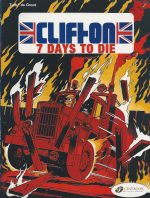
Clifton volume 3: 7 Days to Die


By Turk & De Groot, translated by Luke Spear (Cinebook)
ISBN: 978-1-905460-08-3

Seeing ourselves through other’s eyes is always a salutary experience and our Continental cousins in the comics biz are especially helpful in that respect as regards the core characteristics of being British

For some inexplicable reason most of Europe’s comics cognoscenti – most especially the French and Belgians – seem fascinated with us. Maybe it’s a shared heritage of Empires in Decline and old cultures and traditions in transition? An earlier age would have claimed it’s simply a case of “Know your Enemy”…

Whether we look at Anglo air ace Biggles, indomitable scientific adventurers Blake and Mortimer, the Machiavellian machinations of Green Manor or the further travails of Long John Silver, the serried stalwarts of our Scepter’d Isles cut a dashing swathe through the pages of Europe’s assorted strip-magazines and albums.

Clifton was originally devised by child-friendly strip genius Raymond Macherot (Chaminou, Les croquillards, Chlorophylle, Sibylline) for iconic Tintin Magazine; a doughty True Brit troubleshooter who debuted in December 1959, just as a filmic 007 was preparing to set the world ablaze…

After three albums worth of material – compiled and released between 1959 and 1960 – Macherot left Tintin for arch-rival Spirou and his eccentric comedy crime-fighter forlornly floundered until Tintin brought him back at the height of the Swinging London scene and aforementioned spy-boom, courtesy of Jo-El Azaza & Greg (Michel Régnier).

These strips were subsequently collected as Les lutins diaboliques in French and De duivelse dwergen for Dutch-speakers in 1969.

Then it was back into retirement until 1971 when first Greg (in collaboration with artist Joseph Loeckx) took his shot; working until 1973 when writer Bob De Groot and illustrator Philippe “Turk” Liegeois fully revived the be-whiskered Brit for the long haul. They produced ten tales of which this – 7 jours pour mourir from 1979 – was the fourth.

From 1984 on, artist Bernard Dumont – AKA Bédu – limned De Groot’s scripts before eventually assuming the writing chores as well, until the series at last concluded in 1995.

…But Not For Long…

In keeping with its rather haphazard Modus Operandi and indomitably undying nature, the Clifton experience resumed yet again in 2003, crafted by De Groot & Michel Rodrigue for four further adventures; a grand total of 25 to date.

The setup is deliciously simple: pompous, irascible Colonel Sir Harold Wilberforce Clifton, ex-RAF, former Metropolitan police Constabulary and recently retired from MI5, has a great deal of difficulty dealing with being put out to pasture in rural Puddington. He thus takes every opportunity to get back in the saddle, occasionally assisting the Government or needy individuals as an amateur sleuth.

Sadly for Clifton – as with that other much-underappreciated national treasure Captain Mainwaring in Dad’s Army – he is too keenly aware that he is usually the only truly competent man in a world full of blithering idiots…

This particular tale however strays somewhat from well-trodden humour paths and indulges in some frantic action and sinister suspense bombastic whilst still resolutely going for comedy gold.

In this third translated Cinebook album – first seen in 2005 – the Gentleman Detective is notably absent as the tale opens in London at the secret Headquarters of MI-5. Veteran warhorse and ultra-capable spymaster Colonel Donald Spruce is having a little bit of a crisis…

A battled-scarred survivor of simpler times, Spruce longs for one last field mission, but is instead swamped with petty admin nonsense. That all changes in an instant as the computer boffins in charge of Betty – latest in the line of “Thinkover” super-calculators – discover a little problem.

In the age of automation, Betty controls every aspect of physical eliminations for the agency. It is an infallible electronic assassination expediter. Information on a target is fed in and Betty commences a contract, contacting outside agents to do the dirty work and providing all the details they will need to complete the commission. No hostile has ever lasted more than a week when Betty is concerned: she provides efficiency, expediency, economy and utter deniability…

Except now the harassed technos are enduring a severe tongue-lashing from Spruce who has noticed that the latest print-out is retired agency star and his old chum Harold Wilberforce Clifton. As Spruce fumes and fulminates the abashed boffins try to explain that the process is irreversible. They can’t contact the contractors to cancel the hit. Clifton is as good as dead…

With no other choice the Colonel frantically phones the retired agent and gives him the bad news. Our hero, unwilling to bow out gracefully, immediately goes on the run, using all his cunning and years of tradecraft to stay one step ahead of his faceless hunters. His stalkers however are seasoned professionals too and luck more than guile is the only thing saving him from an increasingly spectacular succession of devastating “accidents”…

Thematically far darker than previous tales, 7 Days to Die is nevertheless stuffed with hilarious moments of slapstick and satire to balance some pretty spectacular action set-pieces as frantic flight, devious disguise and even coldly calculated counterattack all fail to deter the implacable assassins. However as the climax approaches Clifton and Spruce individually come to the same stunning conclusion: this selection by Betty might not have been an accident after all…

Visually spoofing the 1970s’ original era of Cool Britannia and staidly stuffy English Mannerism with wicked effect, these gentle thrillers are big on laughs but also pack a lot of trauma-free violence into the eclectic mix. Delightfully surreal, instantly accessible and doused with serous slapstick à la Jacques Tati and deft, daft intrigue like Carry On Spying or Morecambe & Wise’s The Intelligence Men, this romp rattles right along offering readers a splendid treat and loads of to think about.
Original edition © 1979 Le Lombard (Dargaud-Lombard S. A.) by De Groot & Turk. English translation © 2005 Cinebook Ltd.

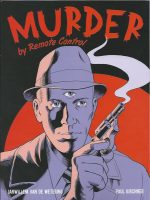
Murder by Remote Control


By Janwillem van de Wetering & Paul Kirchner (Dover Comics & Graphic Novels)
ISBN: 978-0-486-80560-3

“Graphic novels” are utterly ubiquitous these days, even though a huge part of the population can’t or won’t differentiate between the big books we insiders mean and the flimsy, pamphlet periodicals comprising the bulk of items on sale.

Can I at least muddy the waters a little more?

Yes I Can.

Something that gathers a selection of previously-published material – strips, comicbook issues, selected stories on a theme – used to be an Album, Collection, or even, God help us, an Omnibus or Trade Paperback. These included any re-presentation of superhero sagas like Archives or Essentials, themed conglomerations like Greatest Batman Stories Ever Told or Marvel Visionaries or even the groundbreaking Cerebus “phone-book” editions.

Anything serialised in periodicals, but intended from conception to be eventually gathered into one unified form, was a graphic novel (Maus, Watchmen, Persepolis or Cerebus – confusing ain’t it?)

Any long-form tale utilising sequential narrative (A Contract with God, Sabre, Pride of Baghdad) released in one big bite is a true Graphic Novel. That’s what Will Eisner, Jim Steranko and Neal Adams were getting at when they started using the term in the late 1970s and it’s what we should mean when lobbing these terms about willy-nilly.

For every person who agrees with those categorisations, there are a dozen who violently disagree and can cite at least one package which correctly refutes and defies the definition. And because I’m a wilfully contrary pixie, I’ll just remind you that Charles Dickens published his greatest books as periodical magazine part-works before some bright spark stitched them all together in single complete editions called novels…

I don’t care: just remember all modern comics publishers crave the cachet of the term graphic novel attached to their product but it is one that has been adopted and most ardently championed by retailers and distributors who – from the moment big books of drawn stories started appearing – needed some way to pigeon-hole and differentiate them from cookbooks, coffee-table tomes, kids story-books and other releases packed with pictures.

Murder by Remote Control is a true Graphic Novel – arguably one of the very first planned and premeditated examples of the form – and after decades in obscurity you have the chance to see it in all its intended glory…

In the 1980s American comics got a huge creative boost with the advent of high quality magazines such as Heavy Metal and Epic Illustrated which showcased adult-oriented material with high quality graphics and formats such as had taken Europe by storm a decade earlier.

Previous US experience of such work had been limited to the Underground Comix scene – in terms of content if not production values, at least – and the occasional independent, out-market experiment of such maverick luminaries as Wally Wood, Steve Ditko and Steranko.

When Heavy Metal premiered in April 1977 – looking very much like its French conceptual “parent” Métal Hurlant – there was precious little original American material to supplement the sumptuous continental work therein. One of the first US creators to join the magazine was Paul Kirchner (The Bus, Realms, Dope Rider), who had worked as an assistant to Wood in the early 1970s, contributing to such projects as Big Apple Comics.

Born in 1952, Kirchner was in his third year at Cooper Union School of Art in New York when Neal Adams and Larry Hama introduced him to the horror editors at DC, whose anthology titles always needed fresh blood. He thereafter assisted Tex Blaisdell on Little Orphan Annie and in 1973 joined Ralph Reese at Wood’s studio.

A young man in tune with many of the spiritual and conceptual tropes prevalent during those culturally cosmopolitan times, there was a thoughtful, underplayed intensity in his meticulously-crafted work, but Kirchner was hampered by his slow working-speed, at a time when quick turnaround always trumped artistic merit and quality. He eventually drifted out of comics to find far better-paying work in the advertising, animation and design trades.

Part of the reason for the transition is explained in his Introduction, which describes his meeting with Dutch expatriate author Janwillem Lincoln van de Wetering (The Empty Mirror, Grijpstra and de Gier crime novels, Hugh Pine (the Porcupine), Judge Dee Plays His Lute); a global-traveller and Zen Buddhist scholar who eventually settled in Maine. Under circumstances best enjoyed first hand by reading the actual Intro, the exuberant writer and jaded cartoonist met in 1981 and decided to work together on a dream project: a crime mystery in comics form…

The project took Kirchner a few years to complete but when ready for publication the real hard work began. Most publishers prefer to work in 20-20 hindsight: happy to jump on a successful bandwagon but preferring to chew off their own arms rather that risk money on being first with something new that can’t be easily categorised…

The completed work was schlepped around for two years until in 1986 Ballantine bought it. This was the period in which Maus, The Dark Knight Returns and Watchman all simultaneously slapped the world in the face and the public went ga-ga for graphic narratives.

Ballantine – who had decades earlier introduced America to comicstrip paperbacks with its digest-sized collections of Mad reprints – was willing to take a chance on a mass-market edition, albeit in a diminished size and format, even though as Moord Op Afstand the tale had been a success in Holland and elsewhere as a lavish, full-sized hardback album. Despite favourable coverage from Gahan Wilson in The New York Times Book Review, the bowdlerised Murder by Remote Control sank without trace and the creators reluctantly moved on to other things.

Now, after far too long, I can retire my battered old copy since Dover have added the sublime metaphorical masterpiece in monochrome to their crucial list of rescued comics treasures, restored to its intended page size (278 x 218 mm) and with the original cover replacing the sliced-&-sampled multiple-panel mock-up of the 1986 edition…

The story itself would have been groundbreaking if it had been released in 1983 and remains decidedly off-key and devilishly off-beat. Resonances of Agent Dale Cooper, Blue Velvet and later cult entertainment icons eerily abound here…

After obnoxious property speculator Mr. Jones starts buying up sections of idyllic Maine coastline, he suddenly turns up dead in his little fishing dingy. The death occurs in full view of four residents who each might have a strong motive to remove the interloper, but the County Sheriff is extremely keen on ruling the case an accidental death.

However, his report results in the unwelcome arrival of agonisingly restrained and refined – almost emotionless – Detective Jim Brady from the Augusta Office. Cool and preternaturally calm, the self-effacing little man has a way of seeing deep into the hearts and minds of everybody, and he quickly rules it a homicide by most arcane means.

Now he’s going to stick around, probing the characters and backgrounds of the uniquely baroque quartet of suspects and undoubtedly sticking his nose where it doesn’t belong…

Informed by Zen principles, the story unfolds as Brady flamboyantly deconstructs each potential suspect, consequently uncovering far more secrets than any little rural enclave could possibly contain before reaching his conclusions.

However, even with the case closed his actions remain at odds with your run-of-the-mill Copper, and there’s one last twist still in store…

Cool, surreal and challengingly psychedelic, the plot is realised with sleek and understated panache; mixing the welcoming warmth and idiosyncratic style of Ditko’s figure-work and facial expressions with the glossy sleek glamour and factual solidity of Wally Wood. This book is a delicious treat for the eyes and a therapeutic exercise for the mind…

Supplemented by Stephen R. Bissette’s incisive and expansive Afterword ‘A Man, A Boat, A Bay, A Bite, A Beer Can…’ offering historical context and artistic commentary, this is a magnificent lost gem, rightly restored to its place in the history of our art form, but it’s also a beautifully-crafted, intellectually challenging Bloody Good Read.

Go get it.
© 1986, 2016 by The Wetering Family Trust and Paul Kirchner. Afterword © 2016 by Stephen R. Bissette. All rights reserved.

Murder by Remote Control will be published on 24th June 2016 and is available for pre-order now. Or if you still wander actual streets it might already be on the shelves of your local comic shop…

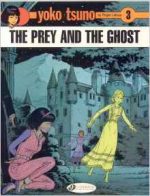
Yoko Tsuno: the Prey and the Ghost


By Roger Leloup translated by Jerome Saincantin (Cinebook)
ISBN: 978-1-905460-56-4

Sublime scientific investigator Yoko Tsuno debuted in Spirou in September 1970 and is still going strong. As detailed by Roger Leloup, the astounding, all-action, excessively accessible exploits of the slim, slight Japanese techno-adventurer are amongst the most intoxicating, absorbing and broad-ranging comics thrillers ever created.

The phenomenal magnum opus is an expansively globe-girdling, space-&-time-spanning series devised by another monumentally talented Belgian maestro. Roger Leloup began his solo career after working as a studio assistant on Herge’s Adventures of Tintin. Compellingly told, superbly imaginative and – no matter how fantastic the premise of any individual yarn – always solidly grounded in hyper-realistic settings underpinned by authentic, unshakably believable technology and scientific principles, his illustrated epics were the forefront of a wave of strips changing the face of European comics in the mid-1970s.

This gentle revolution featured the rise of competent, clever and brave female protagonists, all taking their places as heroic ideals beside the boys and elevating Continental comics in the process. Happily, most of their exploits are as timelessly engaging and potently empowering now as they ever were, and none more so than the trials and tribulations of Yoko Tsuno.

Her very first outings – Hold-up en hi-fi, La belle et la bête and Cap 351 – were brief introductory vignettes before the superbly capable engineer and her valiant but less able male comrades Pol Paris and Vic Van Steen properly hit their stride with premier full-length saga Le trio de l’étrange which began in 1971 with Spirou‘s May 13th issue…

In the original European serialisations, Yoko’s exploits alternated between explosive escapades in exotic corners of our world and sinister deep-space sagas with the secretive, disaster-prone alien colonists from Vinea but, for the majority of the English translations thus far, extraterrestrial encounters have been generally sidelined in favour of epically intriguing Earthly exploits such as this sinister, spectrally-inspired crime caper…

There have been 27 European albums to date. This tale was first serialised in 1981 (in Spirou #2244-2264) and collected the following year as 12th volume La Proie et l’ombre. Due to the quirks of publishing it reached us Brits as Yoko’s third Cinebook outing: a suspenseful modern gothic thriller challenging the barnstorming boffin’s courage, resourcefulness and fundamental beliefs…

Yoko and Pol are driving through Scotland on a Highlands road as the afternoon lengthens into evening when they are forced into a ditch by a young woman throwing herself at their car. The dishevelled creature is being pursued by a pack of hounds and gang of men, but Yoko’s horror is momentarily quelled when the leader of the pursuers explains that poor Cecilia is mad…

The deranged waif begs the strangers to save her, but when her guardian Sir William – the local Laird – arrives, further answers emerge. The poor lass believes she is visited by her dead mother…

Yoko and Pol accept an invitation to stay at the castle, but stay behind to repair their vehicle before joining the party. As they change the tyre a stranger approaches, offering another side to the strange family history. An author, scientific ghosthunter and debunker, the anonymous newcomer relates how 15 years previously Cecilia’s mother Mary chose Sir Brian over another ardent suitor. The rejected swain was a self-proclaimed sorcerer named Mac Nab who prophesied the newlyweds would both die violently and that their daughter would perish before reaching her majority…

When Brian died in a strange accident, his brother William took the seat and married the grieving widow. Mary went mad when Cecilia was five and was killed in a riding accident.

In the intervening years William has tried everything to ensure the last part of the curse would never come to pass, but now at twenty, the daughter seems to have gone the way of her tragic mother. Moreover, reports abound that the sorcerer is still alive, hiding on the estate to ensure his prediction’s completion. When Yoko and Tsuno finally reach the castle they are bristling with theories and suspicions, but steadfastly refuse to give any credence to supernatural forces…

As the household convenes for supper, the visitors are astounded to find Cecilia completely recovered: almost a completely different woman, whose only problems are a short temper and tendency to forget things…

The meal is strained and fractious and ends early. Strangely tired and oddly clumsy, Yoko retires to bed but her sleep is disturbed after a veiled woman in black lures her out into the castle halls before disappearing. All that is left of her is an empty gown.

Baffled Yoko heads back upstairs and lets herself into Cecilia’s locked room. The strange girl is now eager to see her; quitting her painting to examine the dress which she claims belonged to her mother. As they talk, the women glance out of a window and Yoko sees a ghostly figure on a far parapet. It looks exactly like the portrait of deceased, tragic Mary…

Giving chase – and carefully noting that every door seems to open for her – Yoko races across the castle grounds in rapid pursuit with Cecilia trying to keep up. The chase ends in the ruins of an abbey where the technologist passes right through the apparition and realises her suspicions have been confirmed.

Even though she is unaware that sinister eyes are watching her, Yoko is pretty convinced that she knows what’s going on now…

The next day she deftly continues her investigations and makes her preparations to expose a criminal conspiracy years in the making, but has she made the foolish mistake of underestimating her opponents and incorrectly deducing who’s actually behind the murderous scheme?

Complex, devious and subtly suspenseful, this fresh take on an old plot bristles with clever clues for the attentive reader to pick-up on and delivers a splendidly crafty conclusion, once more affirming Yoko Tsuno as top flight troubleshooter, at home in all manner of scenarios and easily able to hold her own against the likes of James Bond, Modesty Blaise, Tintin or other genre-busting super-stars: as triumphantly capable facing swindlers and murderers as aliens, mad scientists or unchecked forces of nature…

As always the most effective asset in these breathtaking tales is the astonishingly authentic and staggeringly detailed draughtsmanship and storytelling, which superbly benefits from Leloup’s diligent research and meticulous attention to detail.

The Prey and the Ghost is a brilliant mystery; which will appeal to any devotee of Holmes, Marple, Castle or Scooby-Doo.
Original edition © Dupuis, 1982 by Roger Leloup. All rights reserved. English translation 2008 © Cinebook Ltd.

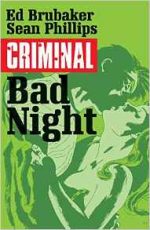
Criminal volume 4: Bad Night


By Ed Brubaker & Sean Phillips (Image Comics)
ISBN: 978-1-63215-260-2

Do you recall the early 1950s? I wasn’t actually there, but for comics fans it was a time of astounding promise. Every conceivable genre of funnybook could be found on US newsstands (except porn, I guess): children’s fantasies, teen comedies, licensed books, war, super-heroes, horror, science fiction and especially crime stories.

Bad guys living (and dying) bad lives were everywhere, and don’t even get me started on movies. Technicolorâ„¢ was still expensive so the concerns and sensibilities of the public were most commonly realised through gritty, grainy, moody Film Noir vehicles.

This populist pulp-paperback and B-Movie movement towards cynical post-war realism grew into an art form all its own while nobody was looking…

What has this to do with the book in question? Nothing really except that when this series first came out the comics industry was enjoying a mini-revival and resurgence of straight crime thrillers. Moreover, collaborators Ed Brubaker and Sean Phillips were then forging a creative partnership that seemed incapable of setting a foot wrong: each stand-alone story arc building on the previous caper, getting tougher, stronger, meaner and better…

The entire series was repackaged and re-released as a uniform set of trade paperbacks in 2015 with this fourth captivating collection featuring Criminal volume 2 #4-7 (July-November 2008) – possibly the most experimental tale in the entire canon.

Jacob Kurtz has got a lot of rage to deal with. The mild-mannered sap was never an angel. In fact he used to be a pretty good counterfeiter. However, when his wife disappeared he was the cops’ prime suspect in her murder until the body finally turned up, clearly the result of an automobile accident.

In the meantime of course Jake had been targeted by remorseless, hard-line Police Detective Max Starr, who had gone totally old school on him to secure a confession the widower could not make. Those injuries healed pretty quickly but were nothing compared to what his wife’s mobster uncle Sebastian Hyde did to him…

Crippled, ostracised and a total recluse, these days Jacob spends his time and makes his living crafting the savagely ironic comic strip Frank Kafka, Private Eye, gaining petty points by making the cops – especially the funnybook version of Starr – look like utter idiots.

Still, things are tough. Kurtz is in constant pain and afflicted with crippling insomnia, and even when he does drop off for a couple of hours the idiot vigilante haunting his neighbourhood pulls some crazy stunt like torching a drug-house and another night gets shot to hell…

When all else fails, Jacob heads for the all-night Blue Fly Diner to pass the time reading and shooting the breeze with Bob and Pat…

This one Bad Night, however, even that surcease is denied him as a young punk starts beating on the girl he’s with and Jacob is drawn in. Nobody thanks him for it; not the girl and certainly not cartoon super-Dick Frank Kafka who is always beside him, annoyingly telling the pen-pusher what a real man would have done…

Driving home in the pouring rain, Jacob picks up a drenched hitchhiker and is horrified to discover it’s the girl from the diner…

And so starts a devious and convoluted saga of sexual obsession, subterfuge, big scores, torture and vengeance as she seduces Jacob into theft and murder and far, far worse. Iris is a crazy lady with lots of problems and a body to die for, but she’s working to someone else’s hidden agenda and, after all the double-dealing and bloodletting peaks, the slick conspirators learn a dreadful truth: it’s Noir; everybody’s got a secret they haven’t shared yet…

What they should have wondered from the start is where would a counterfeiter-turned-cartoonist could learn so much about violent crime… and especially how to get rid of bodies?

Filled with twists, turns and even the occasional stunning plot-somersault, this viciously effective and deceptively scary yarn is dark, brutal and fearfully compelling: a tale of the other side of society which affords an irresistible view of raw humanity. These are stories that can’t be ignored… so don’t.
© 2008, 2015 Ed Brubaker & Sean Phillips. All rights reserved.