New, Revised review
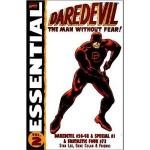
By Stan Lee, Gene Colan & various (Marvel)
ISBN 0-7851-905239-1462-9
Marvel Comics built its fan-base through strong and contemporarily relevant stories and art, but most importantly, by creating a shared continuity that closely followed the characters through not just their own titles but also through the many guest appearances in other comics. Such an interweaving meant that even today completists and fans seek out extraneous stories to get a fuller picture of their favourites’ adventures. In such an environment, series such as ‘Essential’ and DC’s ‘Showcase’ are an economical and valuable product that approaches the status of a public service for collectors.
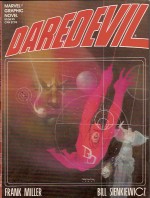
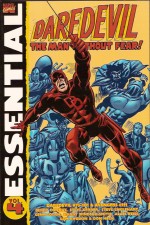
This particular edition, reprinting the exploits of a very different Daredevil to the one radicalised into a grim urban vigilante by Frank Miller and his successors from the 1980’s onwards, covers the period from March 1967 (#26) to January 1969 (#48), and includes the first Annual plus Fantastic Four #73 where a long-running storyline concluded (see what I mean about cross-collecting?).
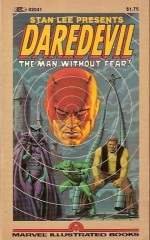
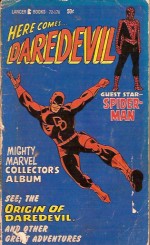
The adventures are fairly typical 1960’s action-fodder. Matt Murdock is a blind lawyer whose other senses hyper-compensate, making him a formidable acrobat and fighter, and a human lie-detector. Very much a second-string hero for most of his early years, he was nonetheless a popular one, due in large part to the incredibly humanistic art of Gene Colan. He fought gangsters and a variety of super-villains, and even the occasional alien invasion. He also joked and wise-cracked his way through life, unlike the grim and moody quasi-religious metaphor he’s been seen as in latter years.
The action commences with marked improvement in overall story quality as Stan Lee began to use longer soap operatic plot-threads to string together the unique fight scenes of increasingly bold Gene Colan, who was finally shaking off the last remnants of his predecessor’s art style. In a very short time John Romita had made the character his own before moving on to Spider-Man, so when Colan took over he kept the clipped solid, almost chunky lines whilst drawing the Man without Fear, but increasingly drew everything else in his loose, fluid, near-tonal manner.
This clash of visuals was slow to pass but by the time of ‘Stilt-Man Strikes Again’ (DD #26, March 1967) a leaner, moodier hero was emerging. The major push of the next few issues was to turn the hopeless romantic triangle of Matt Murdock, best friend/Law partner Foggy Nelson and their secretary Karen Page into a whacky quadrangle by introducing fictitious twin brother Mike, who would be “revealed†as Daredevil to divert suspicion from the blind attorney who actually battled all those weird villains…
Confused yet…?
Also skulking in the background was arch-villain Masked Marauder who was closing in on DD’s alter ego. He got a lot closer in ‘Mike Murdock Must Die!’ (inked by Frank Giacoia) as Stilt-Man teamed with the Marauder and Spider-Man clashed with old Horn-Head before the villains met their apparent ends.
DD had his first clash with extraterrestrials in #28’s moody one-trick-pony ‘Thou Shalt Not Covet Thy Neighbor’s Planet!’ a Dick Ayers inked thriller wherein the invaders’ blindness rays proved inexplicably ineffective against the Crimson Crime-buster.
John Tartaglione inked the next tale, a solid, action-packed gangster thriller entitled ‘Unmasked!’ whilst issue #30 began a protracted and impressive epic clash with old Thor foes the Cobra and Mister Hyde, complete with Asgardian cameo in ‘…If There Should Be a Thunder God!’
Attempting to catch the criminals DD masqueraded as Thor only to encounter the real McCoy, and was ambushed by the villains once the Thunderer departed. As a result DD lost his compensating hyper-senses and had to undertake a ‘Blind Man’s Bluff!’ which almost fooled Cobra and Hyde… Sadly it all went wrong before it all came right and against all odds Murdock regained his abilities just in time ‘…To Fight the Impossible Fight!’
Daredevil #33 saw the entire cast head to Canada for Expo ’67 (the World’s Fair) encountering another borrowed villain in ‘Behold… the Beetle!’ and its frenetic sequel ‘To Squash the Beetle!’ The first Annual follows; a visually impressive but lacklustre rogues’ gallery riot as five old foes ganged up on Daredevil in ‘Electro and the Emissaries of Evil!’ with the Man without Fear putting a pretty definitive smack-down on the electric felon, the Matador, Gladiator, Stilt-Man and Leapfrog.
Of more interest are the ‘Inside Daredevil’ pages, explaining his powers, how his Billy Club works and the Matt/Mike Murdock situation, with stunning pin-ups of Karen, Foggy, Ka-Zar, DD and a host of old foes. Rounding out the experience is a short comedy tale ‘At the Stroke of Midnight!: an Actual Unrehearsed Story Conference with (and by) Stan and Gene!’
‘Daredevil Dies First!’ pitted the sightless wonder against old Fantastic Four foe Trapster, but Horn-Head was only a stepping-stone in his complex plan to destroy the World’s premier super-team. However DD managed to turn the tables in #36’s ‘The Name of the Game is Mayhem!’ (inked by Giacoia) a clash that left the blind hero weakened and easy prey for another FF arch-foe. Tartaglione returned to ink the startling ‘Don’t Look Now, But It’s… Doctor Doom!’
Helpless before the Iron Dictator DD was trapped in ‘The Living Prison!’ (Giacoia inks) as Doom swapped bodies with the sightless crusader to facilitate an ambush on the FF which culminated in a stupendous Battle Royale in Fantastic Four #73’s crossover conclusion as the Torch, Thing and Mr. Fantastic fought DD, Thor and Spider-Man in ‘The Flames of Battle…’ (by Lee, Jack Kirby & Joe Sinnott). When involved in mind-swap cases it’s always prudent to advise your friends when you regain your original body…
DD finally got to battle some of his own bad-guys in #39 as old foes the Ani-Men returned with a new name and a new boss. ‘The Exterminator and the Super-Powered Unholy Three’ (inked by George Tuska) reintroduced Bird-Man, Ape-Man and Cat-Man in the pay of a criminal genius working with time-based weapons, but the real meat of the tale was Foggy Nelson’s campaign to become New York City’s District Attorney and his revived relationship with ex-con Deborah Harris: now Matt Murdock’s only rival for Karen’s affections was his imaginary twin brother Mike…
That story proceeded in #40, resulting in a spectacular clash ‘The Fallen Hero!’ (inked by Tartaglione) and concluded the only way it could in ‘The Death of Mike Murdock!’ as Matt took advantage of his final battle with the Exterminator to end the charade. He didn’t come clean though, as Daredevil revealed that Mike was only one of a number of Men without Fear in the first part of a prolonged battle with a new nemesis as ‘Nobody Laughs at The Jester!’ (inked by Dan Adkins).
The Malevolent Mountebank only wanted to be more successful as a criminal than he had been as an actor until mayoral candidate Richard Raleigh hired him to spoil incorruptible Foggy Nelson’s campaign for the D.A. post; precipitating a protracted saga which kicked off with a temporarily befuddled DD ‘In Combat with Captain America!’ (inked by Vince Colletta) before being framed for killing the Jester’s alter ego Jonathan Powers in #44’s ‘I, Murderer!’
Defeated by the Jester in ‘The Dismal Dregs of Defeat!’, Horn-Head became a wanted fugitive and after a frenetic manhunt was finally arrested before snatching victory in the thoroughly enthralling conclusion ‘The Final Jest!’ as inker extraordinary George Klein began a long and impressive association with the series.
With the Vietnam War raging a story involving the conflict was inevitable, but #47’s ‘Brother, Take My Hand!’ was so much more than a quick cash-in or even well-meaning examination of contemporary controversy, as Marvel found a new African-American character (one of far too few in those blinkered times).
Newly-blinded veteran Willie Lincoln turned to Matt Murdock and Daredevil for help on his return home. A disgraced cop framed by gang-boss Biggie Benson before joining the army, Lincoln was now back in America to clear his name… at all costs. This gripping, life-affirming crime thriller not only triumphs in Daredevil’s natural milieu of moody urban menace but also sets up a long-running plot that would ultimately change the Man without Fear forever.
The book ends with the return of Stilt-Man in ‘Farewell to Foggy’ as Matt’s oldest friend wins the election for D.A. but acrimoniously turns his back on Murdock, seemingly forever.
This is a good place to end as Stan Lee would hand over the scripting to Roy Thomas soon after this and the social turbulence that marked the end of the 1960s would begin to transform the dashing, wise-cracking Daredevil into something closer to his current dark archetype. But that’s for another volume…
© 1967, 1968, 1969, 2004 Marvel Characters, Inc. All rights reserved.