
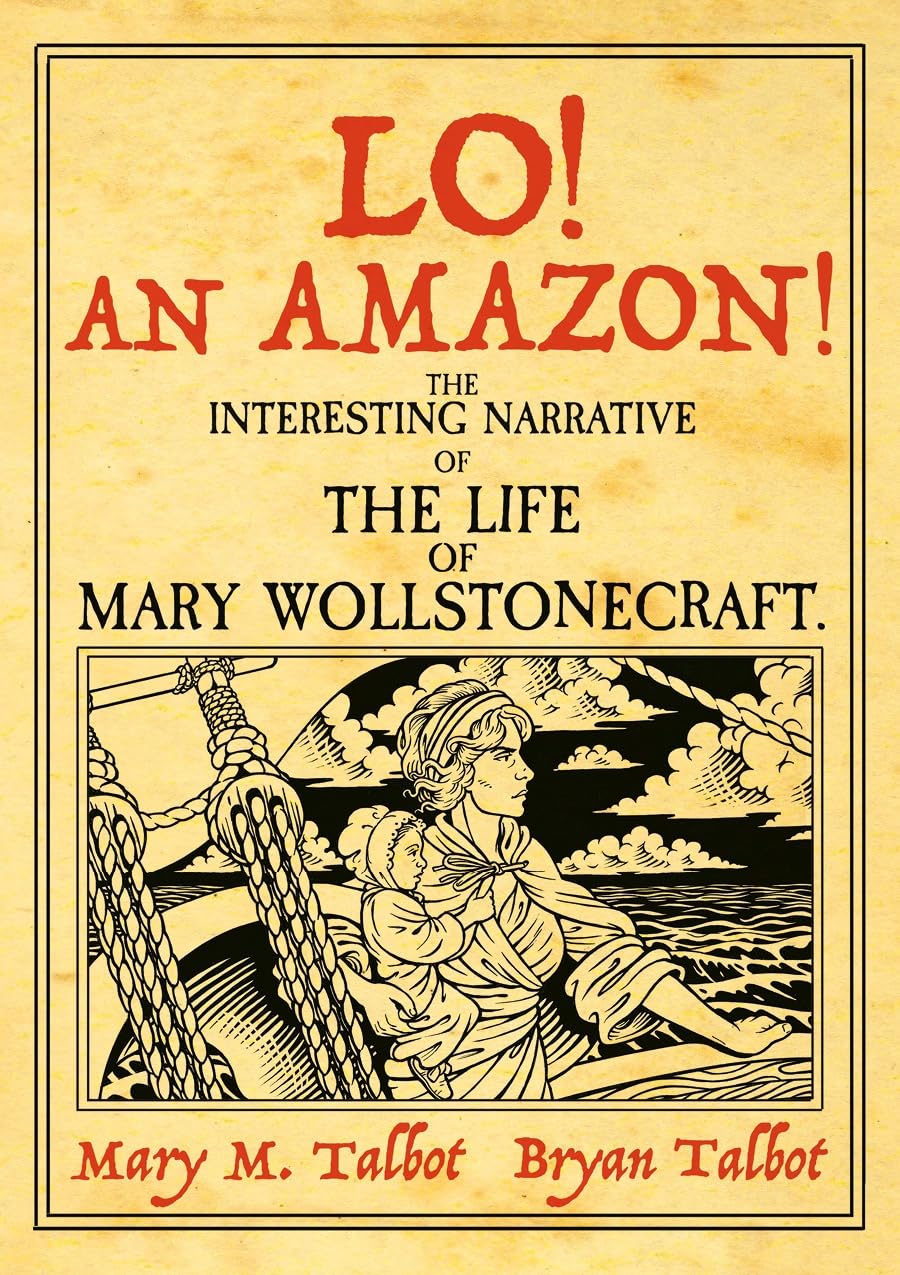
by Mary M. Talbot & Bryan Talbot (SelfMadeHero)
ISBN: 978-1-91422-449-2 (HB)
Although now rightly considered one of the most influential and radical thinkers in history Mary Wollstonecraft (April 27th 1759 – September 10th 1797) achieved a smidgeon on intellectual renown but no security in her own lifetime and a degree of notoriety and exclusion in the years that followed her death. She only began winning back her deserved position after the rise of the Suffragettes and Feminist Philosophy, which saw many aggrieved and disenfranchised people (infamously “half of those on Earth”) rediscover her forgotten books and letters.
Amidst the gender-inequality of the 18th century Wollstonecraft led a controversial life: always close to the edge of acceptability. In death she was misrepresented, dis-remembered, shoved into quiet corners (if not suppressed), slandered, libelled and actually written out of history. Posthumously pilloried and even slut-shamed by generations of “decent” middle class folk and autocratic literary men (and women) for her ways and choices. Her iconoclastic thoughts and groundbreaking writings were simply ignored until they all but went away…
Thus, there’s a strong chance that you’ve never heard of her and even an greater one that you’ve conflated her with her own daughter Mary Wollstonecraft Shelley, who invented science fiction and wrote Frankenstein.
Hagiography and justice-seeking aside, Mary Wollstonecraft’s efforts revolutionised modern social norms and gender thinking and she has been reclaimed by those she too-late inspired, but what was she like and how did she find the strength to keep going?
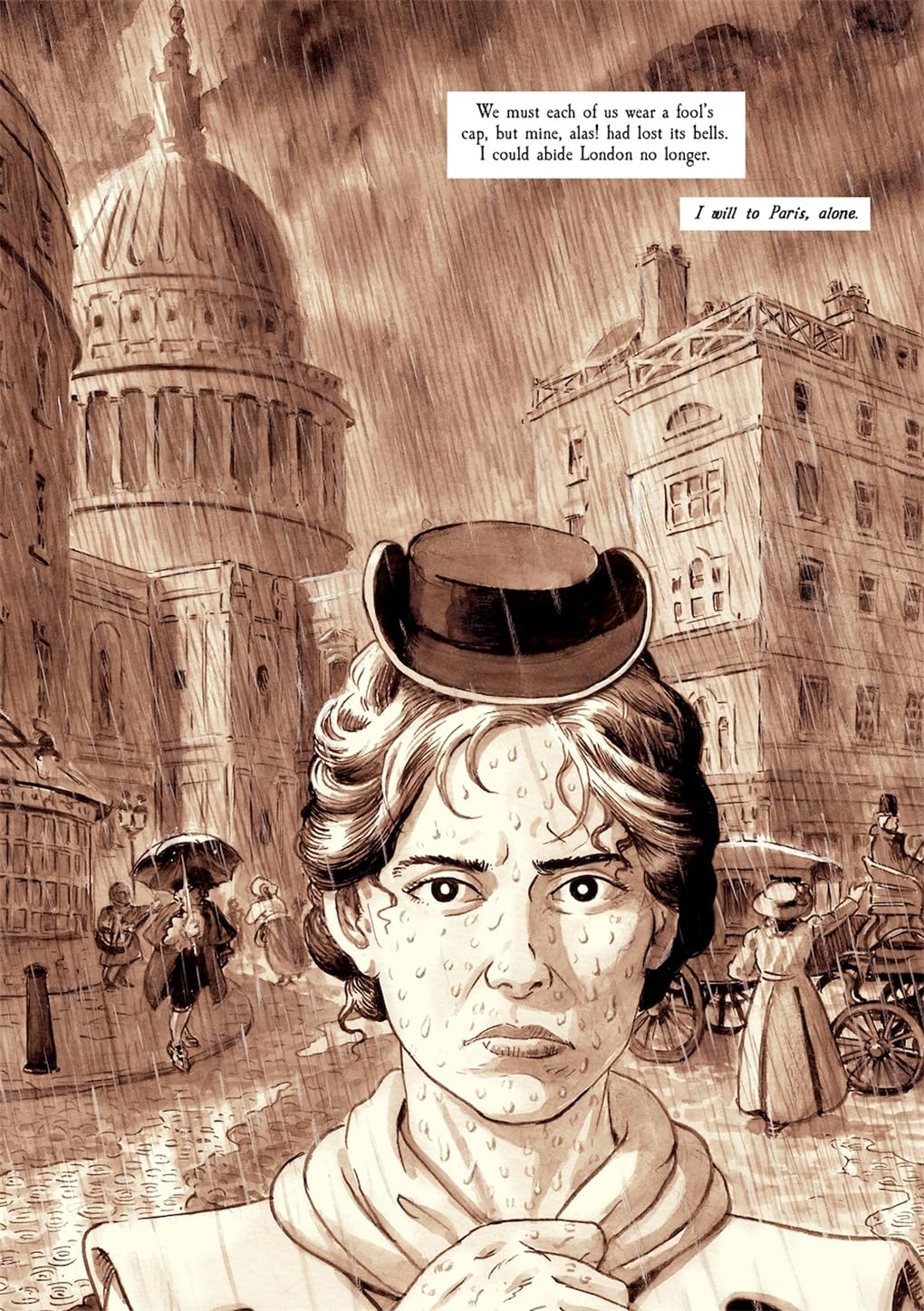
Potential insight and answers lie enthrallingly packaged here in another biographical picture-box depiction from Mary M. Talbot and spouse Bryan Talbot – focussing on her struggles to be independent and prosperous in the years when humanity’s first leaps in humanist revelation correspond with some of our darkest hours…
Dr. Mary is an academic, educator, linguist, social theoretician, author and specialist in Critical discourse analysis. In 2012 she added graphic novelist to her portfolio of triumphs, collaborating with her husband on Dotter of Her Father’s Eyes. That award-winning memoir/biography of Lucia Joyce was followed by Sally Heathcote: Suffragette (drawn by Kate Charlesworth), The Red Virgin and the Vision of Utopia, Rain and Armed With Madness: The Surreal Leonora Harrington (all with Bryan). These merely supplement a glittering educational career and such academic publications as Language and Gender: an Introduction and Fictions at Work: language and social practise in fiction. She is particularly drawn to true stories of gender bias and social injustice.
Bryan has been a fixture of British comics since the late 1960s, moving from Tolkien-fandom to college strips, self-published classics like Brainstorm Comix (starring Chester P. Hackenbush – the Psychedelic Alchemist!), early Luther Arkwright and Frank Fazakerly, Space Ace of the Future to paid pro status with Nemesis The Warlock, Judge Dredd, Sláine, Ro-Busters and more in 2000 AD. Inevitably headhunted by America, he worked on key mature-reading titles for DC Comics (Hellblazer, Shade the Changing Man, The Nazz, Batman: Legends of the Dark Knight, Fables, The Dead Boy Detectives and The Sandman) and was a key creative cog in short-lived shared-world project Tekno Comix, before settling into global acclaim via steady relationships with Dark Horse Comics and Jonathan Cape. These unions generated breakthrough masterpieces like The Tale of One Bad Rat and a remastered epic revival of The Adventures of Luther Arkwright.
Since then he’s been an independent Force To Be Reckoned With, doing just what he wants, promoting the art form in general and crafting various fascinating and compelling works, from Alice in Sunderland, Cherubs! (with Mark Stafford), to Metronome (as Véronique Tanaka) and his fabulously wry, beguiling and gallic-ly anthropomorphic Grandville sequence, as well as his mostly biographical/historical collaborations with Mary.
In the interest of propriety, I must fully disclose that I’ve known him since the early 1980s, but other than that shameful lack of taste and judgement on his part, have no vested interest in confidently stating that he’s probably Britain’s greatest living graphic novelist.
For this convincingly pastiched tome all that experience and dedication is combined to unpick an astoundingly unjust life with no happy ending even today. However, the war for equality grinds inexorably on and as Wollstonecraft implicitly understood, knowledge is power and a weapon…
Rendered in subtle palettes and muted tones, the tale begins and ends in modern times with a mother and child acknowledging their debt to a fallen pathfinder before a creators’ ‘Prefatory Note’ explains certain conceits and contrivances made to clarify meaning.
Then we meet Mary in pensive mood at the heart of the French Revolution in opening chapter ‘How filent is now Versailles!’ before exploring her formative years as a mere daughter of her abusive, profligate parvenu father. Tasked with looking after her six siblings and deprived of her personal inheritance, she briefly found friends, shelter and an unquenchable thirst for knowledge with the Arden clan in ‘Sweet Beverley’. Ultimately however – and saddled with her younger sisters – she had to find means to support herself and them in ‘How my heart pants to be free’…
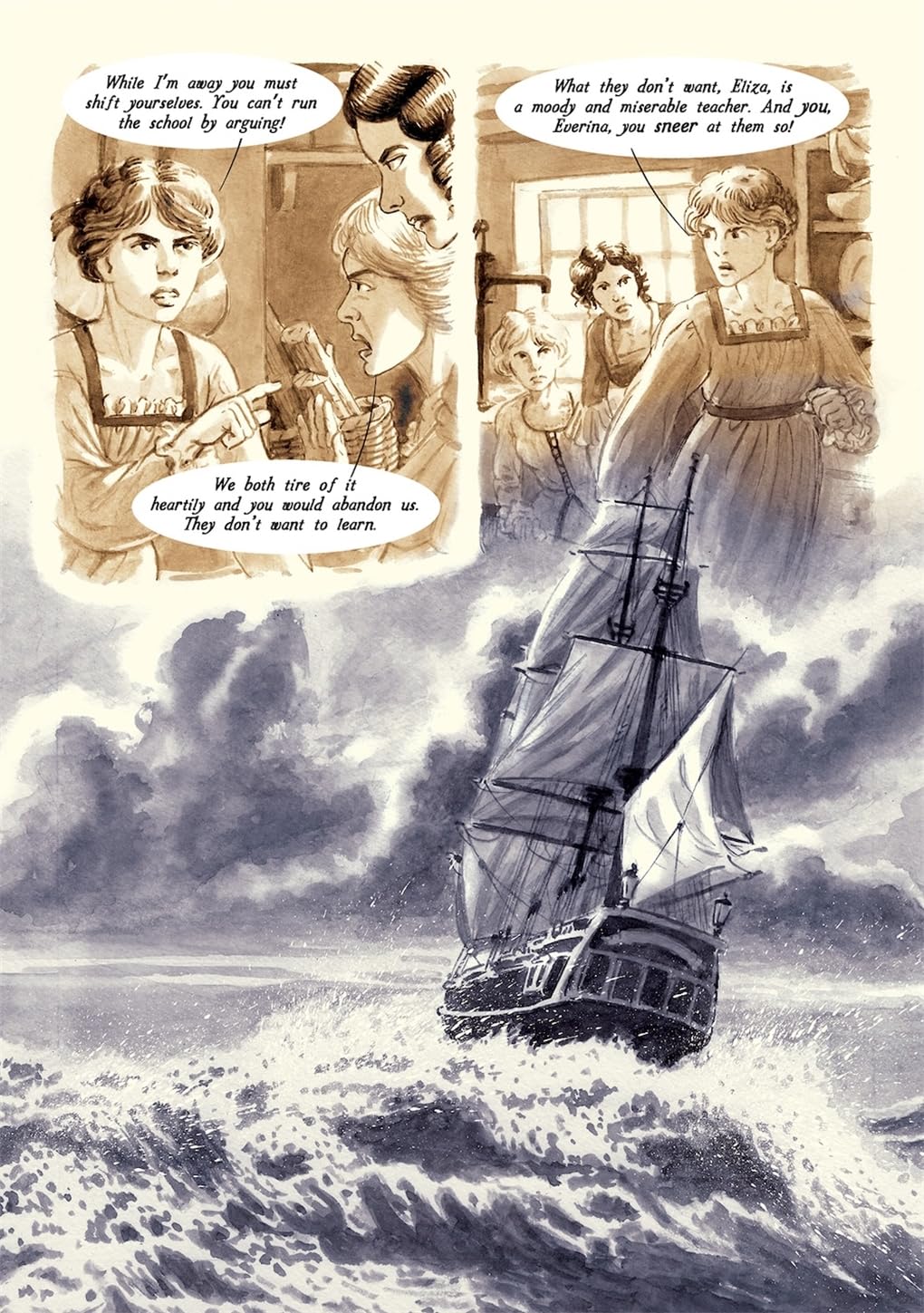
These included traditional roles as Ladies’ companion and governess before finding funds sufficient to open a school for girls in Newington Green (1784), but being unable to keep it after her siblings suffered disastrous marriages a year later as seen in ‘I am a poor forlorn wretch without her’…
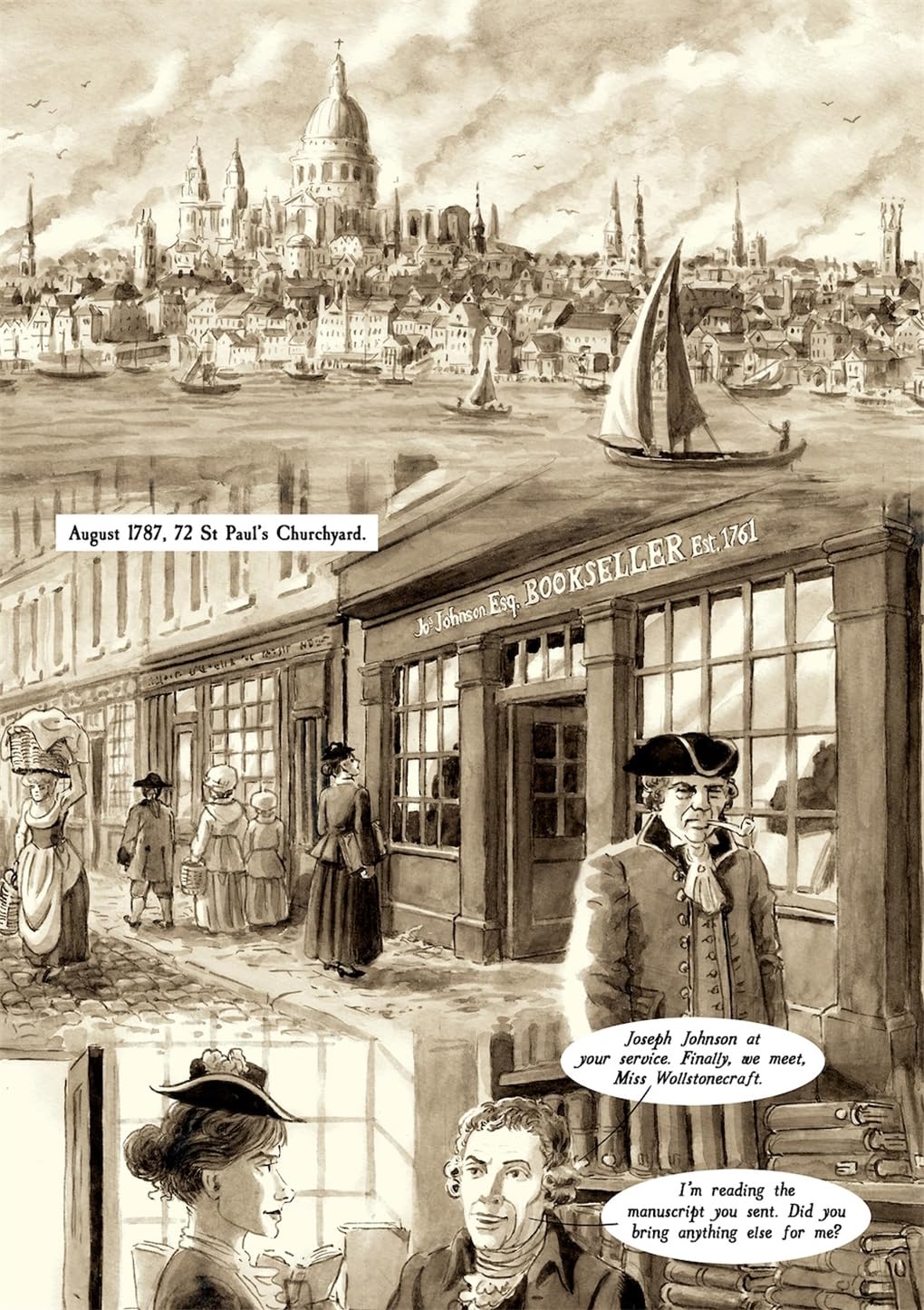
Thanks to new friends like anti-Monarchists, Republicans, religious Dissenters and grand liberal thinkers Reverend Dr Price and publisher Joseph Johnson, a solution comes in Chapter V’s ‘If I exert my talents in writing I may fupport myfelf in a comfortable way.’ Soon the starving impulsive rebel is being feted by the greatest and most dangerous minds of the age; penning articles, essays, political rebukes, travelogues, educational and social primers and even novels and children’s books. However, her beliefs – always stridently expressed – on the slavery of marriage results in socially and even physically perilous relationships outside acceptable norms, as seen in ‘My wayward heart creates its own mifery.’
Fired up by the age of intellectual revolution and crumbling aristocratic old orders, rejecting toxic notions of unfettered capitalism and divinely dictated layering of races, classes and genders, she makes her way to Paris in 1792, and unwittingly brings herself into the sights of Britain’s ruling elites an the swiftly-changing factions briefly and successively leading the unchecked political storm of the Terror. Her observations there lead to more books describing ‘Death and mifery, in every fhape of terrour.’ but also deliver another man she thought she could trust, but who would inevitably betray. Dragged back to the London in 1795 – as revealed in ‘I reft my cheek on thine, forgetting all the world.’ – that mistake, overwhelming melancholia and a failed suicide attempt lead to another path taken as Wollstonecraft and her infant daughter Fanny are packed off to Norway, where she finds fresh stability and restores her fortune by writing a hugely popular travel book…
Her final years in England and comfortable but faux, face saving “marriage” to philosopher William Godwin are covered in ‘My foul has been fhook.’ As she played housewife, raised Fanny and investigated the horrors of women committed to mental hospitals at the whim of their male guardians, her extraordinary life constantly caught up with her. Although Godwin loved her as much as he could, his entrenched attitudes meant that she died unsupported after traumatically delivering second child Mary. In final chapter ‘I had never loved till now.’ Godwin’s inept attempts to atone and memorialise her with his tell-all 1798 Memoirs of the Author of A Vindication of the Rights of Woman, instead gave her detractors plenty of scandalous muck-raking fuel to trash and functionally erase Mary Wollstonecraft for decades to come…
To balance the tragedy and offer some shred of hope the story ends with an ‘Epilogue’ offering the prototypical free-thinker the chance to reflect upon and assess her own life and achievements, and is backed up by a copious, contextual appendix of ‘Annotations’ as well as ‘Bibliographical References’ should you care to read more and further…
Compellingly scripted with a fine eye for elucidatory minutiae, visually Mary Talbot’s carefully catalogued, chronologically deduced events range from strict reportage to speculative political and emotional broadsides.
This is another powerfully enraging, engagingly uplifting rescue mission of one more calculatedly forgotten woman of achievement and a sheer delight that will absolutely compel all readers to look for more.
© 2026 Bryan Talbot and Mary M Talbot. All rights reserved.