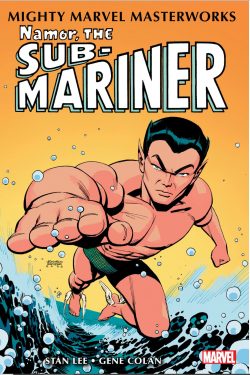
Mighty Marvel Masterworks: Namor, the Sub-Mariner volume 1: The Quest Begins


By Stan Lee, Gene Colan, Wallace Wood & various (MARVEL)
ISBN: 978-1-3029-4885-6 (TPB/Digital edition)

If you’re currently sitting on or near a beach that isn’t actually storm-wracked or on fire, you might be feeling in the mood for a little salty sea-borne fun about now. The stories re-presented here are timeless and have been gathered many times before but today we’re enjoying another example of The Mighty Marvel Masterworks line: designed with economy in mind and newcomers as target audience. These books are far cheaper, on lower quality paper and smaller – like a paperback novel. Your eyesight might be failing and your hands too big and shaky, but at 152 x 227mm, they’re perfect for kids. If you opt for digital editions, that’s no issue at all.

Prince Namor, the Sub-Mariner is the offspring of a water-breathing Atlantean princess and an American polar explorer: a hybrid being of immense strength; highly resistant to physical harm; able to fly and exist above and below the waves. Created by young, talented Bill Everett, Namor technically predates Marvel/Atlas/Timely Comics.

He first caught the public’s attention as part of the fire vs. water headlining team in Marvel Comics #1 (October 1939 and soon to become Marvel Mystery Comics). He shared honours and top billing with The Human Torch, but had originally been seen (albeit in a truncated monochrome version) in Motion Picture Funnies: a promotional giveaway handed out to moviegoers earlier in the year.

Quickly becoming one of the company’s biggest draws, Namor gained his own title at the end of 1940 (cover-dated Spring 1941) and was one of their last super-characters to go at the end of the first heroic age.

In 1954, when Atlas (as the company then was) briefly revived its costumed character “Big Three” (the Torch and Captain America being the other two), Everett returned for a run of superb fantasy tales, but even so the time wasn’t right and the title sunk again.

When Stan Lee & Jack Kirby started reinventing comic-books in 1961 with the Fantastic Four, they revived the all-but-forgotten awesome amphibian as a troubled, semi-amnesiac, and decidedly more regal, if not grandiose, antihero. The returnee despised humanity; embittered at the loss of his sub-sea kingdom (seemingly destroyed by American atomic testing) whilst simultaneously besotted with the FF’s Sue Storm.

Namor knocked around the budding Marvel universe for a few years, squabbling with other assorted heroes such as the Hulk, Avengers and X-Men, before securing his own series as one half of Tales to Astonish. Marvel’s “split-books” had been devised as a way to promote their burgeoning stable of stars whilst labouring under a highly restrictive distribution deal limiting the number of titles they could release per month. In 1968 the company ended this commitment and expanded exponentially.

This first celebratory volume collects one of those 1960’s guest shots – Daredevil #7 – and the first Subby’s solo stories from Tales to Astonish #70-80, spanning April 1965 to June 1966, and opening without preamble with a fateful encounter with his least powerful antagonist. Previously, Fantastic Four #4 had reintroduced the all-powerful amphibian Prince of Atlantis as an amnesiac relic who recovered his memory thanks to some rather brusque treatment by teen delinquent and AWOL Human Torch Johnny Storm. Rapidly returning to his sub-sea homeland he found it lain waste by atomic testing. A monarch without subjects, he swore vengeance on humanity and attacked New York City with a gigantic monster. In short order thereafter he met and battled Doctor Doom, The Hulk, Puppet Master, The Avengers, Magneto, the X-Men, and Doctor Strange, Master of the Mystic Arts

As previously stated, prior to Tales to Astonish, Namor appeared in numerous titles as guest villain du jour. One last guest shot with Namor acting as a misunderstood bad-guy was Daredevil #7 (April 1965): a tale qualifying as a perfect comic book and a true landmark – to my mind one of the Top Ten Marvel Tales of all time.

Here, Lee and creative legend Wally Wood concocted a timeless masterpiece with ‘In Mortal Combat with… Sub-Mariner!’ as Namor of Atlantis – recently reunited with the survivors of his decimated race – returns to the surface world to sue mankind for their crimes against his people. To expedite his claim, the Prince engages the services of Matt Murdock‘s law firm; little suspecting the blind lawyer is also the acrobatic Man without Fear.

Whilst impatiently awaiting a hearing at the UN, Namor is informed by his lover Lady Dorma that his warlord Krang has usurped the throne in his absence. The tempestuous monarch cannot languish in a cell when the kingdom is threatened, so he fights his way to freedom through the streets of New York, smashing National Guard battalions and the dauntless Daredevil with supreme ease.

The hopelessly one-sided battle with one of the strongest beings on the planet shows the dauntless courage of DD and the innate nobility of a “villain” far more complex than most of the industry’s usual fare at the time.

Augmented by a rejected Wood cover repurposed as ‘A Marvel Masterwork pin-up: Namor and D.D.’, this yarn is merely a cunning prelude…

A few months later Tales to Astonish #70 heralded ‘The Start of the Quest!’ as Lee, Gene Colan (in the pseudonymous guise of Adam Austin) & Vince Colletta set the Sub-Mariner to storming an Atlantis under martial law. The effort is for naught and the returning hero is rejected by his own people. Callously imprisoned, the troubled Prince is freed by the oft-neglected and ignored Lady Dorma…

As the pompous hero begins a mystical quest to find the lost Trident of King Neptune – which only the rightful ruler of Atlantis can hold – he is unaware that treacherous Krang allowed him to escape, the better to destroy him with no witnesses. The serialised search carries Namor through a procession of fantastic adventures and pits him against spectacular sub-sea horrors: a giant octopus in ‘Escape… to Nowhere’: a colossal seaweed man in ‘A Prince There Was’ and a demented wizard and energy-sapping diamonds in ‘By Force of Arms!’

As the end approaches in ‘When Fails the Quest!’, revolution grips Atlantis, and Namor seemingly sacrifices his kingdom to save Dorma from troglodytic demons the Faceless Ones.

Issue #75’s ‘The End of the Quest’ finds the Prince battling his way back into Atlantis with a gravely-injured Dorma, before the saga calamitously concludes in ‘Uneasy Hangs the Head…!’ as the status quo is restored and Namor finally regains his stolen throne.

Back in charge, the Prince once more turns his thoughts to peace with the surface world and resolves ‘To Walk Amongst Men!’, but his mission is derailed on encountering a deep-sea drilling platform and finds himself fighting the US military and retired Avengers Henry Pym and Janet Van Dyne. The fracas is abruptly curtailed in #78’s ‘The Prince and the Puppet’ as an old adversary once again seizes control of the amphibian’s fragile mind…

Inked by the brilliant Bill Everett, ‘When Rises the Behemoth’ sees Namor struggling against Puppet Master’s psychic control and confronting the US Army in the streets of New York, before returning to clash with a cataclysmic doomsday monster in Atlantis. Dick Ayers stepped in to ink tense conclusion ‘To the Death!’, wherein Warlord Krang returns, blackmailing Dorma into betraying her beloved Prince and fleeing away with him…

To Be Continued…

Supplemented with House ads, a full cover gallery and pages of Colan original art this assemblage of tales featuring Marvel’s first antihero are timeless treasures to delight comics lovers of every age and vintage.
© 2022 MARVEL.

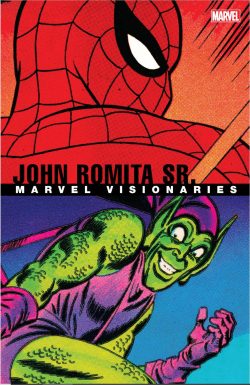
Marvel Visionaries: John Romita, Sr.


By John Romita Sr., with Stan Lee, Roger Stern & various (MARVEL)
ISBN: 978-1-3029-1806-4 (TPB/Digital edition)

We lost one of last giants of the industry this week when John Romita died on Monday. He was 93 and his work is inextricably woven into the Marvel canon: permeating and supporting the entire company’s output from top to tail and from the Sixties to right now… and even before the beginning of the House of Ideas actually began. 

One of the industry’s most polished stylists and a true cornerstone of the Marvel Comics phenomenon, the elder John Romita began his comics career in the late 1940s (ghosting for other artists) before striking out under his own colours. eventually illustrating horror and other anthology tales for Stan Lee at Timely/Atlas.

John Victor Romita was born and bred in Brooklyn, entering the world on January 24th 1930. From Brooklyn Junior High School he moved to the famed Manhattan School of Industrial Art, graduating in 1947. After spending six months creating a medical exhibit for Manhattan General Hospital he moved into comics, in 1949, with work for Famous Funnies. A “day job” working with Forbes Lithograph was abandoned when a friend found him inking and ghosting assignments, until he was drafted in 1951. Showing his portfolio to a US army art director, after boot camp at Fort Dix New Jersey, Romita was promoted to corporal, stationed on Governors Island in New York Bay doing recruitment posters and allowed to live off-base… in Brooklyn. During that period he started doing the rounds and struck up a freelancing acquaintance with Stan Lee at Atlas Comics…

He illustrated horror, science fiction, war stories, westerns, Waku, Prince of the Bantu (in Jungle Tales), a fine run of cowboy adventures starring The Western Kid and 1954’s abortive revival of Captain America, and more, before an industry implosion derailed his – and many other – budding careers. Romita eventually found himself trapped in DC’s romance comics division – a job he hated – before making the reluctant jump again to the resurgent House of Ideas in 1965. As well as steering the career of the wallcrawler and so many other Marvel stars, his greatest influence was felt when he became Art Director in 197. He had a definitive hand in creating or shaping many key characters, such as Mary Jane Watson, Peggy Carter, The Kingpin, The Punisher, Luke Cage, Wolverine, Satana ad infinitum.

This celebratory volume from 2019 re-presents Amazing Spider-Man #39, 40, 42, 50, 108, 109, 365; Captain America & The Falcon #138; Daredevil #16-17; Fantastic Four #105-106; Untold Tales Of Spider-Man #-1; Vampire Tales #2; and material from Strange Tales #4; Menace #6, #11; Young Men #24, 26; Western Kid 12; Tales To Astonish #77; Tales Of Suspense #77 spanning cover-dates December 1951 to July 1997. It opens with a loving Introduction from John Romita Jr., sharing the golden days and anecdotal insights on the “family business”. Not only the second son but also his mother Virginia Romita were key Marvel employees: she was the highly efficient and utterly adored company Traffic Manager for decades.

A chronological cavalcade of wonders begins with official first Marvel masterwork ‘It!’. Possibly scripted by Lee and taken from Strange Tales #4 (December 1951), we share a moment of sheer terror as an alien presence tales over the newest member of a typical suburban family…

Next is verifiable Lee & Romita shocker ‘Flying Saucer!’ (Menace #6, August 1953) and a sneaky invasion attack preceding the first Romita superhero saga as seen in Young Men #24, December 1953.

In the mid-1950s Atlas tried to revive their Timely-era “Big Three” (and super-hero comics in general) on the back of a putative Sub-Mariner television series intended to cash in on the success of The Adventures of Superman show. This led to some impressively creative comics, but no appreciable results or rival in costumed dramas.

Eschewing here the Human Torch and Sub-Mariner segments – and with additional art from Mort Lawrence – ‘Captain America: Back From the Dead’ features a communist Red Skull attacking the UN, with school teacher Steve Rogers and top student Bucky coming out of retirement to tackle the crisis. The Star-Spangled Avenger gets another bite of the cherry in ‘Captain America Turns Traitor(Young Men Comics #26, March 1954) with guest shots for Subby and the Torch as the Sentinel of Liberty apparently goes from True Blue to a deadly shade of Red…

Latterly reimagined as one of the modern Agents of Atlas, ‘I, the Robot!’ began as a deadly threat to humanity in Menace #11, and is followed here by a yarn from Romita’s first residency as the wandering hero Tex Dawson and his dauntless dog Lightning and super steed Whirlwind survive sudden stampedes and tackle vile horse butchering killers in a tale from his own eponymous title (Western Kid #12, October 1956)…

Atlas collapsed soon after, due to market conditions when a disastrous distribution decision resulted in their output being reduced to 16 titles per month, distributed by arch rival National Comics/DC. Under those harsh conditions the Marvel revolution started small but soon snowballed, drawing Romita back from ad work and drawing romances for DC.

Romita’s return began with inking and a few short pencilling jobs for the little powerhouse publisher’s split books. Tales To Astonish #77 revealed ‘Bruce Banner is the Hulk!’ (March 1966, written by Lee, laid out by Jack Kirby and finished by the returning prodigal) with the gamma goliath trapped in the future and battling the Asgardian Executioner, whilst in his home era, Rick Jones is pressured into revealing his awful secret…

The Captain America story for May 1966’s Tales of Suspense # 77 added inker Frank Giacoia/Frank Ray to the creative mix for ‘If a Hostage Should Die!’: recounting a moment from the hero’s wartime exploits with a woman he loved and lost. These days we know her as Captain Peggy Carter

After a brief stint in his preferred role as inker, Romita took over illustrating Daredevil with #12, following a stunning run by Wally Wood & Bob Powell. Initially Kirby provided page layouts to help Romita assimilate the style and pacing of Marvel tales, but soon “Jazzy Johnny” was in full control of his pages. He drew DD until #19, by which time he had been handed the assignment of a lifetime… The Amazing Spider-Man!

A backdoor pilot for that jump came in Daredevil #16-17 (May and June 1996) with ‘Enter… Spider-Man’ wherein criminal mastermind Masked Marauder manipulates the amazing arachnid into attacking the Man Without Fear. The schemer had big plans, the first of which was having DD and the wallcrawler kill each other, but after Spidey almost exposes Matt Murdock’s secret in ‘None are so Blind!’ they mend fences and go after the real foe…

By 1966 Stan Lee and Steve Ditko could no longer work together on their greatest creation. After increasingly fraught months Ditko resigned, leaving Marvel’s second best-selling title without an illustrator. Nervous new guy Romita was handed the ball and told to run. ‘How Green Was My Goblin!’ and ‘Spidey Saves the Day!’ – “Featuring the End of the Green Goblin!” – as it so dubiously proclaimed) was the climactic battle fans had been clamouring for since the viridian villain’s debut. It didn’t disappoint – and still doesn’t today.

Reprinted from issues #39 and 40 (August & September 1966 and inked by old DC colleague Mike Esposito as “Mickey Demeo”), this remains one of the best Spider-Man yarns ever, and heralded a run of classic sagas from the Lee/Romita team that actually saw sales rise, even after the departure of the seemingly irreplaceable Ditko. If you need further convincing, it sees the villain learn Peter Parker’s identity, capture and torture our hero and share his own origins before falling in the first of many final clashes…

Amazing Spider-Man #42 heralded ‘The Birth of a Super-Hero!, with John Jameson (Jonah’s astronaut son) mutated by space-spores and going on a Manhattan rampage. It’s a solid, entertaining yarn that is only really remembered for the last panel of the final page.

Mary Jane Watson had been a running gag in the series for years: a prospective blind-date arranged by Aunt May who Peter had avoided – and Ditko skilfully never depicted – for the duration of time that our hero had been involved with Betty Brant, Liz Allen, and latterly Gwen Stacy.

Now, in that last frame the gobsmacked young man finally realises that for years he’s been ducking the “hottest chick in New York”! I’m sure we all know how MJ has built her place in the Marvel Universe…

Issue #50 (July 1967) featured the debut of one of Marvel’s greatest villains in the first chapter of a 3-part yarn that saw the first stirrings of romance between Parker and Gwen, the death of a cast regular, and re-established the webslinger’s war on cheap thugs and common criminals. Here it all begins with a crisis of conscience that compels him to quit in ‘Spider-Man No More!

Romita was clearly considered a safe pair of hands and “go-to-guy” by Stan Lee. When Jack Kirby left to create his incredible Fourth World for DC, Romita was handed the company’s other flagship title – in the middle of an on-going storyline. Here we focus on Fantastic Four #105-106 (December 1970 and January 1971 and both inked with angular, brittle brilliance by John Verpoorten). and ‘The Monster’s Secret’.

Scripted by Lee, they comprise a low-key yet extremely effective suspense thriller played against a resuming subplot of Johnny Storm’s failing romance. When his Inhuman girlfriend Crystal is taken ill – preparatory to writing her out of the series – Reed Richards’ diligent examination reveals a potential method of curing the misshapen Thing of his rocky curse.

Tragically, as Ben Grimm is prepped for the radical process in ‘The Monster in the Streets!’ a mysterious energy-beast begins tearing up Manhattan. By the time ‘The Monster’s Secret!is exposed, the team strongman is almost dead and Crystal is gone… seemingly forever.

Romita briefly and regularly returned to the Star-Spangled Avenger in the 1970s and June 1971’s Captain America & The Falcon #138 reveals how ‘It Happens in Harlem!’ sporting a full art job by Romita, Lee’s tale sees new hero The Falcon foolishly try to prove himself by capturing the outlaw Spider-Man, only to be himself kidnapped by gang lord Stoneface. Cue a spectacular three-way team up and just desserts all round…

The Amazing Spider-Man was never far from Romita’s drawing board and in #108 the secret of high school bully Flash Thompson – freshly returned from the ongoing war in Indochina – finally unfolds ‘Vengeance from Vietnam!’ With Romita inking his own pencils, it details how our troubled war hero was connected to an American war atrocity that left a peaceful village devastated and a benign wise man comatose and near-dead. The events consequently set a vengeful cult upon the saddened soldier’s guilt-ridden heels, which all the Arachnid’s best efforts could not deflect or deter.

The campaign of terror is only concluded in #109 as ‘Enter: Dr. Strange!sees the Master of the Mystic Arts divine the truth and set things right… but only after an extraordinary amount of unnecessary violence…

Marvel was expanding and experimenting as always and a horror boom saw them move into mature reader monochrome magazines. In Vampire Tales #2 (October 1973), Roy Thomas scripted a short vignette of a woman apparently imperilled who turned out to be anything but. Delivered in moody line and wash, Devil’s Daughter Satana began her predations via Romita before joining the Macabre Marvel Universe. Her debut is supplanted by a house ad…

Commemorating the hero’s 30th anniversary, Amazing Spider-Man 365 (August 1992) carried a bunch of extras including sentimental reverie ‘I Remember Gwen’ (Tom DeFalco, Lee & Romita) before we close with a wild ride from Roger Stern, inked by Al Milgrom.

‘There’s a Man Who Leads a Life of Danger’ comes from July 1997’s Untold Tales Of Spider-Man #minus 1: an adventure of Peter Parker’s parents and part of the Flashback publishing event. It pits the married secret agents against deadly Baroness Adelicia von Krupp and guest-stars a pre-Weapon-X Logan/Wolverine in a delightful spy-romp.

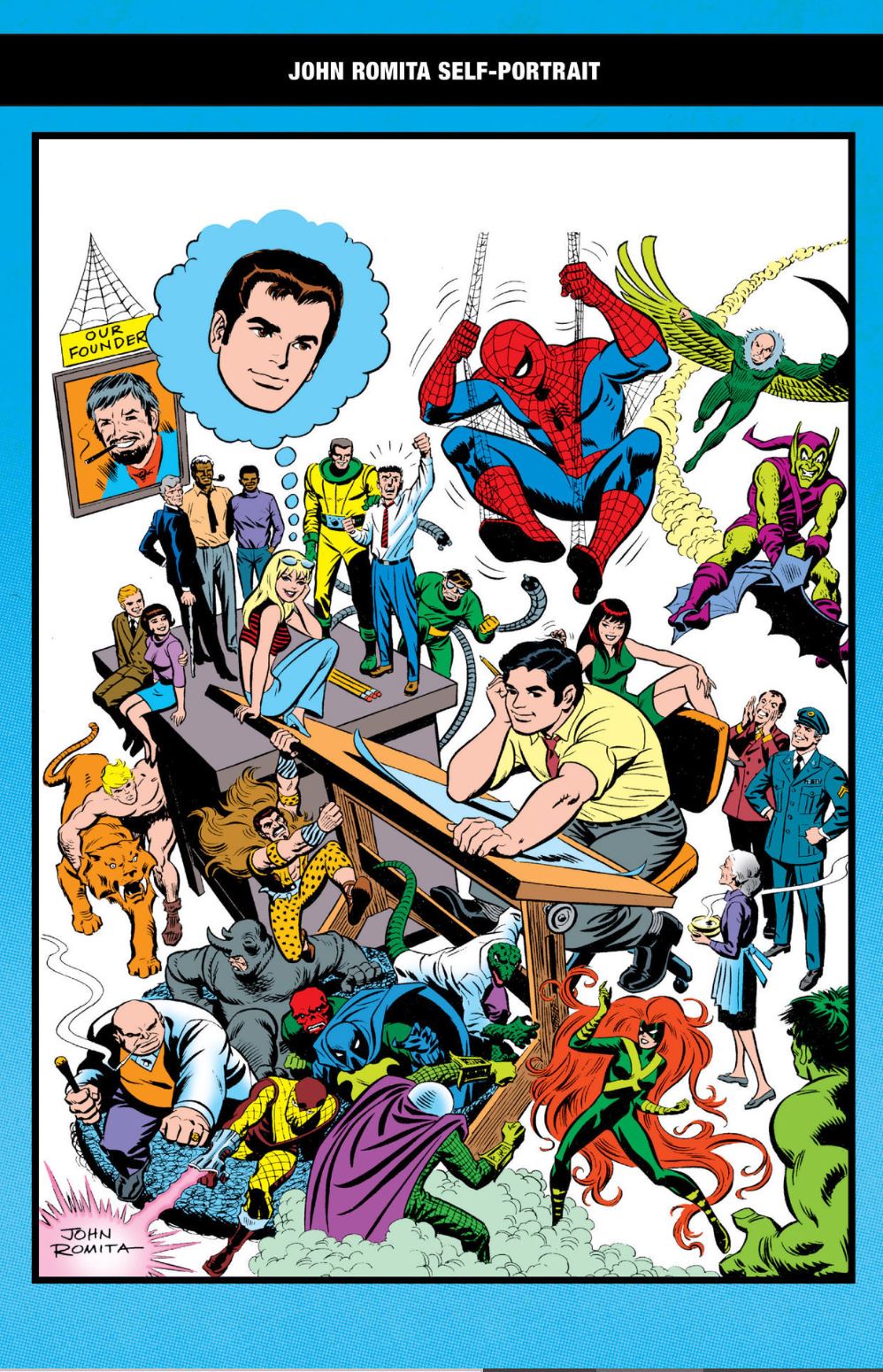
Added extras here include Romita’s unused splash page from Young Men Comics #24, character designs for Robbie Robertson, Mary Jane, Captain Stacy and his daughter Gwen, John Jameson, The Prowler, Wolverine and The Punisher; Fan sketches and doodles; an Amazing Spider-Man poster (painted); the covers of Spectacular Spider-Man Magazine #1 & 2 (ditto) plus original proposal art for the Amazing Spider-Man newspaper strip. There are also covers for F.O.O.M. #18, Amazing Spider-Man Annual #21 (1987), New Avengers #8 and Mighty Marvel Heroes & Villains (with Alex Ross) and a vintage self-portrait.

This is absolutely one of the most cohesive and satisfactory career compilations available and one no fan should miss.
© 2019 MARVEL.

For a slightly different selection, I’d advise also tracking down Marvel Masters: The art of John Romita Sr (ISBN: 978-1-84653-403-4), although that’s not available in digital formats.

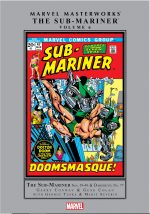
Sub-Mariner Marvel Masterworks volume 6


By Gerry Conway, Roy Thomas, Gene Colan, George Tuska, Marie Severin, Ross Andru & various (Marvel)
ISBN: 978-0-7851-9184-1 (HB/Digital edition)

In his most primal incarnation (other origins are available but may differ due to timeslips, circumstance and screen dimensions) Prince Namor, the Sub-Mariner is the proud, noble and generally bellicose offspring of the union of a water-breathing Atlantean princess and an American polar explorer.

That doomed romance resulted in a hybrid being of immense strength and extreme resistance to physical harm, able to fly and thrive above and below the waves. Over the years, a wealth of creators have played with the fishy tale and today’s Namor is frequently hailed as Marvel’s First Mutant. What remains unchallenged is that he was created by young, talented Bill Everett, for non-starter cinema premium Motion Picture Weekly Funnies: #1 (October 1939) so – technically – Namor predates Marvel, Atlas and Timely Comics.

The Marine Miracleman first caught the public’s avid attention as part of an elementally appealing fire vs. water headlining team-up in the October 1939 Marvel Comics #1 (which renamed itself Marvel Mystery Comics from #2 onwards. The amphibian antihero shared honours and top billing with The Human Torch, having debuted (albeit in a truncated, monochrome version) in the aforementioned promotional booklet which had been designed to be handed out to moviegoers earlier in the year.

The late-starter antihero rapidly emerged as one of the industry’s biggest draws, and won his own title at the end of 1940 (cover-dated Spring 1941). His appeal was baffling but solid and he was one of the last super-characters to vanish at the end of the first heroic age.

In 1954, when Atlas (as the company then was) briefly revived its “Big Three” line-up – the Torch and Captain America being the other two – Everett returned for an extended run of superbly dark, mordantly moody and creepily contemporary fantasy fables. Even so, his input wasn’t sufficient to keep the title afloat and eventually Sub-Mariner sank again.

In 1961, as Stan Lee & Jack Kirby were reinventing superheroes with the Fantastic Four, they revived the awesome, all-but-forgotten aquanaut as a troubled, semi-amnesiac antihero. Decidedly more bombastic, regal and grandiose, this returnee despised humanity: embittered and broken by the loss of his sub-sea kingdom which had been (seemingly) destroyed by American atomic testing. His rightful revenge became infinitely complicated after he became utterly besotted with the FF’s Susan Storm.

Namor knocked around the budding Marvel universe for some years, squabbling with other star turns such as The Hulk, Avengers, X-Men and Daredevil before securing his own series as one half of Tales to Astonish. From there he graduated in 1968 to his own solo title.

This sixth subsea selection trawls The Sub-Mariner #39-49, and includes a crossover confrontation from Daredevil #77. The subsea sagas cumulatively span cover-dates July 1971 to May 1972 and are preceded by heartfelt appreciation and more creative secret-sharing from incoming scripter Gerry Conway in his Introduction ‘See the Sea’ before the (now) dry land dramas recommence…

Previously, Namor had endured months of escalating horror as old enemies like Prince Byrrah, Warlord Krang, Attuma and Dr. Dorcas continuously assaulted his sunken kingdom. They were soundly defeated, and, in the throes of triumph, the Prince announced his marriage to lifelong companion Lady Dorma. He was then betrayed by his most trusted ally whilst sinister shapeshifter Llyra murdered his bride and sought to replace her…

Heartsick, angry and despondent, Namor abdicated the throne: choosing to henceforth pursue the human half of his hybrid heritage as a surface dweller…

The tragedy instantly intensifies in Sub-Mariner #39 as seasoned scripter Roy Thomas bows out with ‘…And Here I’ll Stand!’ Illustrated by Ross Andru & Jim Mooney, it sees the former royal arrive in New York City and move onto abandoned, desolate Prison Island.

However, the intrusion is taken for invasion by the curmudgeonly human authorities who mobilise the military to drive him out. A tense stand-off soon escalates and a typically bombastic response all round reduces Sub-Mariner’s sanctuary to shards and rubble.

In the aftermath, human friends Diane Arliss and Walt Newell (who operates parttime as undersea Avenger Stingray) bring the twice-exiled Prince staggering news…

Meanwhile in Manhattan – and depicted in Daredevil #77 – Conway, Gene Colan & Tom Palmer embroil Namor in a 3-way clash after a strange vehicle materialises in Central Park. Irresistibly summoned by telepathic force, Namor arrives just in time for the Sightless Swashbuckler to jump to a wrong conclusion and attack… Then a late-arriving third hero butts in…

Guest stars abound in ‘…And So Enters the Amazing Spider-Man!’ and when the uncanny alien artefact explodes, a mysterious woman ominously invites DD, the webspinner and Namor to participate in a fantastic battle in a far-flung, dimensionally-adrift lost world. Exhausted by the traditional misunderstanding and subsequent fight, Daredevil begs off and goes home, leaving the wallcrawler to join now-nomadic Namor on a fantastic voyage and bizarre adventure that concludes in the Atlantean’s own comic…

Sub-Mariner #40 sees Conway, Colan & Sam Grainger detail how Spider-Man and Namor are compelled ‘…Under the Name of Ritual…’ to save The People of the Black Sea from murderous usurper Turalla. The telepathic subspecies has undisclosed links to Atlantis and a claim on Namor’s honour: demanding he fight on their behalf since their true king has been missing for decades…

In distant Boston, angry and reclusive elder Stephan Tuval is somehow aware of what’s transpiring and – just when arachnid and amphibian are about to fall in the brutal duel – strikes with all the terrifying power of his mind…

Returned to Manhattan, the weary heroes part, and Sub-Mariner #41 finds Namor following up the revelations shared by Diane and Walt. Illustrated by George Tuska & Grainger, ‘Whom the Sky Would Destroy!’ sees the sea lord struck down over rural New York by mutants artificially created by deranged scientist Aunt Serr.

Her son Rock is terrifying, but the real threat is meek, gentle, deceptive Lucile and before long Namor has fallen to the demonic clan. Seen as raw material, the former prince barely escapes destruction in #42’s ‘…And a House Whose Name…is Death!’ as Conway, Tuska & Mooney briskly build to larger epic featuring Tuval…

If you’re a completist, this issue also offers a brief Mr. Kline interlude, as Conway continued an early experiment in close-linked crossover continuity. Issue #42 contributes to a convoluted storyline involving the mystery mastermind from the future, twisting human lives and events. For the full story you should also track down contemporaneous Daredevil and Iron Man issues: you won’t be any the wiser, but at least you’ll have a complete set…

For one month, Marvel experimented with double-sized comic books (whereas DC’s switch to 52-page issues lasted almost a year: August 1971 to June 1972 cover-dates). November’s Sub-Mariner #43 held an immense, 3-chapter blockbuster beginning with ‘Mindquake!’ as Namor reaches Boston. He has come in search of his father Leonard McKenzie, whom he believed had been killed by Atlanteans in the 1920s. Instead he finds Tuval, driven mad by his re-emerging psychic abilities and now a danger to all.

Crafted throughout by Conway, Colan & Mike Esposito, the tale of the aged tele-potent reveals how he has built a cult around himself ‘…And the Power of the Mind!’, before his increasingly belligerent acts trigger ‘The Changeling War!’ and cause his own downfall…

Cruelly unaware how close he is to his father, Sub-Mariner is then distracted by the return of Llyra and new consort Tiger Shark in #44’s ‘Namor Betrayed!’ With art by the magnificent Marie Severin & Mooney, the story reviews the antihero’s love-hate relationship with Human Torch Johnny Storm, just in time for the shapeshifter to orchestrate a heated clash with the teen hero.

The blistering battle concludes in #45 with McKenzie’s abduction, and ‘…And Fire Stalks the Skies!’ sees Namor surrender himself to save his sire…

Conway, Colan & Esposito then pile on the trauma in #46 as ‘And Always Men Will Cry: Even the Noble Die!’ sees the son’s quest end in death and disaster, despite the best – if badly mismanaged – interventions of the Torch and Stingray.

Doubly orphaned and traumatised, Namor loses his memory again, and is easily gulled by ultimate manipulator Victor Von Doom in #47’s ‘Doomsmasque!’: duly deployed as cannon fodder in the Demon Doctor’s duel with M.O.D.O.K. and AIM to control a reality-warping Cosmic Cube.

The war is dirty and many-sided, with a frontal assault in #48’s ‘Twilight of the Hunted!’ leaving Namor to a pyrrhic triumph in concluding chapter ‘The Dream Stone!’ (inked by Frank Giacoia) before retrenching in confusion to ponder his obscured future…

To Be Continued…

Sunken treasures salvaged here include Everett’s cover to all-reprint Sub-Mariner Annual #2 (January 1972, reprising the underwater portions of Tales to Astonish #74-76); a covers gallery by Sal Buscema, Everett ,Tuska, Gil Kane & Giacoia; original art from Andru & Mooney, Sal B, Severin, Kane, Giacoia & Esposito plus a copious Biographies section.

Many early Marvel Comics are more exuberant than qualitative, but this volume, especially from an art-lover’s point of view, is a wonderful exception: historical treasures with narrative bite that fans will delight in forever. Moreover, as the Prince of Atlantis is now a bona fide big screen sensation, now might be the time to get wise and impress your friends with a sunken treasure…
© 2018 Marvel Characters, Inc. All rights reserved.

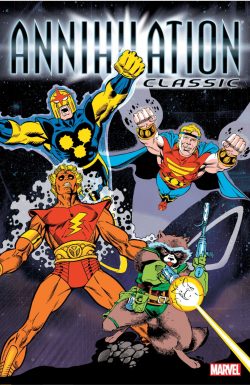
Annihilation Classic


By Todd Dezago, Stan Lee, Larry Lieber, Marv Wolfman, Mark Gruenwald, Bill Mantlo, Doug Moench, Scott Edelman, Roy Thomas, Pat Broderick, Fred Hembeck, Derec Aucoin, Jack Kirby, John Buscema, Paul Ryan, Mike Mignola, Tom Sutton, Mike Zeck, Gil Kane & various (MARVEL)
ISBN: 978-0-7851-3410-7 (TPB/Digital edition)

With the third Guardians of the Galaxy movie set to open on May 5th, here’s a brief reminder of what comics did to inspire the phenomenon: still a grand example of cosmic hero wonderment…

Annihilation was another of those company-wide publishing events that “Changed the Marvel Universe Forever” (and don’t they all?). which ran for most of 2006, involving most of the House of Ideas’ outer space outposts and cosmic characters. Among the stalwarts in play were Silver Surfer, Galactus, Firelord, Moondragon, Quasar, Star-Lord, Thanos, Super-Skrull, Gamora, Ronan the Accuser, Nova, Drax the Destroyer, The Watchers and a host of alien civilisations such as the Kree, Skrulls, Xandarians, Shi’ar, et al, all falling before an invasion of rapacious Negative Zone bugs and beasties unleashed by the insectoid horror Annihilus.

If you’re new to the Marvel universe and that bewildering list of daunting data didn’t leave you screaming in frustration, then please read on…

As is usual in these public herd-thinnings, a number of good guys and bad died and had their trademark assumed by newer, glitzier models whilst some moribund careers got a successful and overdue shot in the arm…

The event spawned a number of specials, miniseries and new titles (subsequently collected as three volumes plus this Annihilation Classic compilation reprinting key and origin appearances of some major players) and led to follow-up event Annihilation: Conquest. Of particular interest to fun-loving screen-watchers might be early appearances of Galaxy Guardians Rocket Raccoon, Groot, Starlord and Adam Warlock

This sharp selection comprises of and contains pertinent material from Bug #1, (March 1997), Tales to Astonish #13, (December 1960), Nova #1, (September 1976), Quasar #1 (October 1989), Rocket Raccoon #1-4 (May-August 1995) ,Marvel Spotlight #6 (May 1980), Logan’s Run #6 (June 1977) and Marvel Premiere #1 (April 1972) and opens with the frenetic and light-hearted solo outing for Galactic Warrior Bug (originally a cheeky stalwart from the 1970’s toy-license phenomenon Micronauts)…

In ‘Apples and Oranges’ by Tod Dezago, Derec Aucoin, Rich Farber & Ralph Cabrera, the insectivorid from the Microverse accidentally clashes with all-consuming cosmic menace Annihilus and gets stuck in a time/space warp.

Bounced around the history of the Marvel Universe, the warring weirdoes reveal their unheralded contributions to the origin stories of a number of the company’s greatest stars before Bug finally triumphs…

With accompanying pinup by Pat Broderick and hilarious game pages by Fred Hembeck including ‘Bug’s Brain-Tik-lers’, ‘The Help Bug Right the Time/Space Continuum Board Game’, ‘What’s Wrong with This Picture?’ and ‘Bug’s Catch-All Activity Page’, this is a splendidly engaging and irreverent treat, followed by an absolute classic of the gloriously whacky “Kirby Kritter” genre as a humble biologist saved earth from a rapacious walking tree in ‘I Challenged Groot! The Monster from Planet X!’ (Tales to Astonish #13 by Stan Lee/Larry Lieber, Jack Kirby & Dick Ayers).

Next to grab the spotlight is The Man Called Nova who was in fact a boy named Richard Rider. A working-class nebbish in the tradition of Peter Parker – except he was good at sports and bad at learning – Rich attended Harry S. Truman High School, where his strict dad was the principal. His mom worked as a police dispatcher and he had a younger brother, Robert, who was a bit of a genius. Other superficial differences to the Spider-Man canon included girlfriend Ginger and best friends Bernie and Caps, but Rich did have his own school bully, Mike Burley…

An earlier version, “Black Nova” had apparently appeared in the author Marv Wolfman’s fan-mag Super Adventures in 1966 (produced with fellow writer Len Wein), but following a few revisions and artistic make-over by the legendary John Romita (Senior) the Human Rocket launched into the Marvel Universe in his own title, beginning in September 1976, ably supported by the illustration A-Team of John Buscema & Joe Sinnott.

‘Nova’ – borrowing heavily from DC’s Silver Age Green Lantern franchise as well as Spider-Man’s origin – is structured like a classic 4-chapter Lee/Kirby early Fantastic Four fable, and rapidly introduced its large cast before quickly zipping to the life-changing moment in Rider’s life when a star-ship with a dying alien aboard transferred to the lad all the mighty powers of an extraterrestrial peacekeeper and warrior.

Rhomann Dey tracked a deadly marauder to Earth. Zorr had already destroyed the idyllic world of Xandar, but the severely wounded vengeance-seeking Nova Prime was too near death and could not avenge the genocide. Trusting to fate, Dey beams his powers and abilities towards the planet below where Rider is struck by the energy bolt and plunged into a coma. On awakening the teen realises he has gained awesome powers …and the responsibilities of the last Nova Centurion…

Wendell Vaughn debuted in 1977 as S.H.I.E.L.D. super-agent Marvel Boy (Captain America #217), graduating and rebranding as Quasar during a stint as security chief of Project Pegasus during the early 1980s. He finally got an origin with his own title Quasar #1 (cover-dated October 1989).

He learned ‘The Price of Power!’ courtesy of Mark Gruenwald, Paul Ryan & Danny Bulanadi in a rousing romp wherein he washes out of agent training for lack of a killer instinct. Whilst acting in a security detail, Wendell dons alien quantum wrist-bands to stop them being stolen by AIM, even though they had vaporised every S.H.I.E.L.D. operative who had test-piloted them.

As well as not dying, he gained incredible quantum light powers and began a brief but glorious career as an Avenger and Protector of the Universe…

Rocket Raccoon was a minor character who appeared in brief backup sci fi serial ‘The Sword in the Star’ (specifically in Marvel Preview #7 in 1976). He won a larger role in Incredible Hulk #271 (May 1982), and like Wolverine years before, refused to go away quietly.

Reprinted here in its entirety is the 4-issue Rocket Raccoon miniseries (May to August 1985, as crafted by Bill Mantlo, Mike Mignola, Al Gordon & Al Milgrom): a bizarre, baroque sci-fi fantasy blending the edgy charm of Pogo with the biting social satire of One Flew Over the Cuckoo’s Nest, all whilst ostensibly describing a battle between Good and Evil in a sector of space completely crazy even by comicbook standards.

Rocket was one of many talking animals populating the impenetrable, inescapable Keystone Quadrant; a Ranger in charge of keeping the peace as robots and anamorphic beasties went about their holy, ordained task of caring for the distinctly odd and carefree humans known as The Loonies on their idyllic, sybaritic planet Halfworld.

However when a brutal shooting war between voracious apex toymakers Judson Jakes and Lord Dyvyne led to Rocket’s girlfriend Lylla Otter being kidnapped, the planet went wild, or more accurately… Animal Crackers’

In rescuing her, Rocket and his faithful deputy Wal Rus had to contend with a murderous army of mechanised Killer Clowns, face an horrific, all-consuming bio-weapon at ‘The Masque of the Red Breath’ and even team up with arch-foe and disreputable mercenary bunny Blackjack O’Hare before uncovering the horrendous truth behind the mad society he so tirelessly defended in ‘The Book of Revelations!’

The final chapter then shook everything up as ‘The Age of Enlightenment’ saw the end of The Loonies, allowing Rocket and his surviving companions to escape the confines of the eternally segregated Keystone Quadrant into the greater universe beyond…

Starlord (without the hyphen) premiered in 1976, headlining monochrome mature-reader magazine Marvel Preview # 4. He appeared thrice more – in #11, 14 and 15 – during the height of a Star Wars inspired Science Fiction boom.

Years previously, the warrior prince of an interstellar empire was shot down over Colorado and had a fling with solitary Earther Meredith Quill. Despite a desire to remain in idyllic isolation, duty called her starman back to battle and he left, leaving behind an unborn son and a unique weapon. A decade later, the troubled boy saw his mother assassinated by alien lizard men.

Peter Jason Quill vengefully slew the creatures with Meredith’s shotgun, before his home was explosively destroyed by a flying saucer.

The newly-minted orphan awoke in hospital, his only possession a “toy” ray-gun his mother had hidden from him his entire life. Years later his destiny found him, as the half-breed scion was elevated by the divinity dubbed the “Master of the Sun”, becoming StarLord. Rejecting both Earth and his missing father, Peter chose freedom, the pursuit of justice and the expanse of the cosmos…

Here, from Marvel Spotlight volume 2 #6, Doug Moench & Tom Sutton revisit and clarify that origin as the pacifistic Quill and his sentient starship return to Sol and discover the truth about his nativity and ascension as well as the true nature of The Master of the Sun…

Logan’s Run was a short-lived licensed property tie-in, and #6 incongruously featured a 5-page short starring mad Titan Thanos in battle against his precision-crafted nemesis Drax the Destroyer: a typically inconclusive, explosively violent out-world clash over ‘The Final Flower’ crafted by Scott Edelman & Mike Zeck.

This star-studded compilation then concludes with an allegorical masterpiece by Roy Thomas, Gil Kane & Dan Adkins from Marvel Premiere #1. During a time of tremendous social upheaval Thomas transubstantiated an old Lee/Kirby Fantastic Four throwaway foe into a potent political and religious metaphor. Debuting as a dreaded mystery menace, the character dubbed Him was re-imagined as a contemporary interpretation of the Christ myth and placed on a world far more like our own than the Earth of Marvel’s superhero-stuffed universe.

‘And Men Shall Call Him… Warlock!’ adroitly recapitulates the artificial man’s origins as a lab experiment concocted by rogue geneticists eager to create a superman they could control for conquest. After facing the FF, Him subsequently escaped to the stars and later initiated a naive clash with Thor over the rights to a mate before returning to his all-encompassing cocoon to evolve a little bit more.

Now that stellar shell is picked up by the moon-sized ship of self-created god The High Evolutionary who is obsessed with a bold new experiment. Our hand-made hero observes as the savant creates a duplicate Earth on the far side of the sun, fast-forwarding through billions of years of evolution in mere hours. The man-god’s intent is to create a civilisation without aggression or rancour, but the Evolutionary collapses from exhaustion just as proto-hominid becomes Homo Sapien and his greatest mistake takes instant advantage of his exhaustion to meddle with fate…

Years previously Man-Beast had been hyper-evolved from a wolf and instantly became his creator’s nemesis. Now he and his equally-debased minions invade the ship and interfere with the experiment: reintroducing evil to the perfect creatures below and, in fact, making them just like us. At incredible speed Earth’s history re-ran with the creature in the cocoon afforded a ring-side seat to humanity’s fall from grace…

When the High Evolutionary awakes to fight Man-Beast’s army, Him explodes from his shell to help rout the demons, who flee to despoiled Counter-Earth. With calm restored, the science-god prepares to sterilise his ruined experiment: a world now indistinguishable from our own. No superheroes; disease and poverty rampant; injustice in ascendance and moments away from nuclear Armageddon… but the cosmic newborn begs him not to.

He claims the evil tide can be turned and pleads for the Evolutionary to stay his hand. The grieving, despondent creator agreed… but only until the rechristened Adam Warlock should admit that humanity is beyond redemption…

This ends a magnificent compendium of genuine magical Marvel moments: an eclectic but hugely entertaining procession of thrills, spectacle and laughs no comic fan or interested neophyte could possibly resist. And when you’ve read all this, you’ll be properly primed for some wide screen wonders too…
© 2020 MARVEL.

Night Nurse


By Jean Thomas, Linda Fite & Win Mortimer; Brian Michael Bendis & Alex Maleev, & various (MARVEL)
No ISBN: Digital-only edition

During the costumed hero boom of the 1960s, Marvel experimented with a solo title shot for Inhuman anti-hero/political refugee Madame Medusa (Marvel Super-Heroes #15, July 1968) and a solo series for established supporting character The Black Widow (Amazing Adventures # 1-8, August 1970 – September 1971). Both were sexy, reformed supervillains, not wholesome girl-next-door heroines like long-domesticated costumed chicks The Invisible Girl, Marvel Girl and The Wasp… and neither lasted solo for long.

The other two actual action women – rather than simple romantic-complication fodder – of that early Marvel era were The Scarlet Witch (mutant/ex-villain/occasional Avenger) and superspy Sharon Carter/Agent 13 of S.H.I.E.L.D.

Just for the sake of completeness: post-World War II, Timely/Atlas Comics embraced and published fiercely independent, capable female operators like Miss America, Namora, Golden Girl, Sun Girl, Blonde Phantom, Venus and more. None survived the insidious social domestication movement that drove American women out of the workplace and back into kitchens and bedrooms: a period that (coincidentally?) generated a growing fascination with captivating jungle women living wild and free in primal freedom – in space as well as on Earth – and a huge explosion in straight romance comics where decent white girls competed for the best husband…

When the costumed crazies craze began to subside in the 1970s, newly-promoted Publisher Stan Lee and his editor-in-chief Roy Thomas looked into creating a girl-friendly boutique of proper “heroines” for the changing tastes of the nation. Written by women, they sought to address and satisfy a wider market than simple boy-fuelled superheroics ever could.

The early 1970s was an era of turbulent social change, with established notions, traditions and laws being constantly challenged. Banner headlines and TV news everywhere confirmed that women’s rights were now being fought for – and thus consequently fiercely resisted – just as vigorously as the Civil Rights movement that had polarised and incensed Americans a handful of years previously…

Marvel’s opening shots in this mini-liberation war were in established genres and both cover-dated November 1972. Claws of the Cat – by Linda Fite, Marie Severin & Wally Wood – added a female superhero to the pantheon, whilst Night Nurse combined contemporary daytime television medical dramas with Marvel’s long-established romance/“career girl” tradition. New post-Feminism jungle goddess Shanna the She-Devil – by Carole Seuling & George Tuska – debuted in December 1972.

Despite impressive creative teams, none of these fascinating and trailblazing experiments lasted beyond a fifth issue, but the characters have all since then become fully established in the greater continuity…

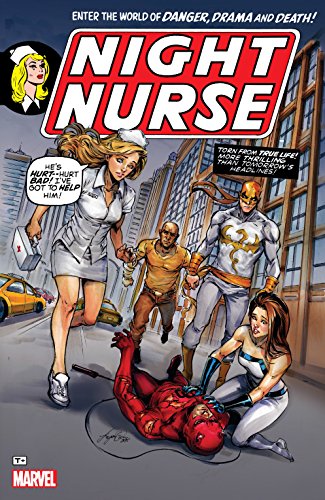
That certainly applies to today’s pioneer. Collecting Night Nurse #1-4 and a stunning reinvention from Marvel Knights Daredevil (volume 2) #80 – also numbered #460 as a result of renumbering nonsense you really don’t need to care about. This digital-only compilation gathers the entire melodrama-drenched saga of a tough and determined young woman looking to make a difference. The print equivalent is the 2015 Night Nurse one-shot: cover-dated July and published to capitalise on the traction her appearance in the mainstream MU generated.

With covers by Winslow Mortimer, John Romita Sr., Frank Giacoia & Joe Sinnott, and adapting the character and concepts first seen in Linda Carter: Student Nurse (#1-9, spanning cover-dates September 1961-January 1963), Night Nurse saw writer Jean Thomas and illustrator Mortimer reintroduce our star as her-long-deferred graduation day approached: peeking behind the curtain of professionalism to reveal ‘The Making of a Nurse!’

Carter and her roomies – ghetto child Georgia Jenkins and disgraced, disinherited rich kid Christine Palmer – have all been learning-by-working at vast and prestigious Metro General: enduring a relentless regimen of complex hands-on training adapting them to the constant high pressure demands of their proposed careers. Particularly difficult was the suffering they were daily exposed to, and how each student coped with it…

Things start to get truly complicated when Linda falls for wealthy good-looking patient Marshall Michaels. His whirlwind courtship leads to a marriage proposal and wedding plans… until he reveals that no wife of his will ever prioritise a job over running his home…

Georgia, meanwhile, finds her ghetto roots still dragging her down when – in the midst of a city-wide power-outage – her brother Ben and his activist friend Rocky try to blow up Metro’s back-up generator. When she and Linda discover them the result is tragedy…

In the second issue, a ‘Night of Tears… Night of Truth!’ sees Carter save a VIP life during a hit-and-run incident, only to endure an acclaimed and ultra-rich surgeon parachuted in to conspicuously fix the patient and reap temporary glory.

Arrogant Dr. Sutton subsequently offers well-bred rebel Palmer a job as his permanent assistant: a position that comes with amorous assumptions and intent. However, the snobbish surgeon underestimates her resolve and loathing of the unspoken code dictating that the wealthy should stick together and he can’t understand why Christine calls the cops when she finds out his side hustle business, how he uses his prescription privileges and one other secret he’s been keeping from all his powerful friends and associates…

Linda, meanwhile, is getting far too friendly with hunky doctor Jack Tryon

Events escalate in ‘Murder Stalks Ward 8!’ when Carter is the only witness to a gangland killing that leads back to major mobster Victor Sloan: a crime kingpin connected to Georgia’s wayward brother Ben. When Sloan is admitted to Metro, nurse Jenkins finds her dedication and resolve severely tested, especially after rival crooks invade the hospital looking for payback and Jack and Linda have to play detective and bodyguard…

There’s an abrupt change of pace in final issue #4 and a touch of gothic romance in the air as Thomas and co-writer Linda Fite focus on Christine. Rocked by scandal, Dr. Sutton’s betrayal and repeated rejection by her elitist father, nurse Palmer seeks a different career path and answers an ad for a live-in nurse/physiotherapist in Boston.

Illustrated by Mortimer, ‘The Secret of Sea-Cliff Manor!’ revels in all the trappings of gothic mystique typifying that period, as Christine meets and manages moody, magnificently angry paraplegic Derek Porter, his sweet Aunt Edna, and spooky old manservant Harold: dispensing care and comfort whilst being dragged deep into a manic murder plot…

The series terminated there, although the nurses popped up occasionally in various titles over the years. Then in Marvel Knights Daredevil volume 2 #58 (May 2004) Linda Carter returned without warning and in an extremely specific role: running a sort-of secret underground clinic in NYC as the enigmatic “Night Nurse”. The facility catered exclusively to metahumans – mostly the heroic or vigilante ones – who needed fixing and couldn’t trust the regular hospital system…

Inexplicably, that yarn is not included here. Instead we have Marvel Knights Daredevil volume 2, #80 (February 2006): fifth chapter 5 of ‘The Murdock Papers’ wherein Brian Michael Bendis, Alex Maleev and colourist Dave Stewart detail how Matt Murdock is almost fatally shot after his secret identity is made public.

On the run, his occasional ally and paramour Elektra drags his failing form to the clinic where it transpires Murdock is a frequent flyer. As the mysterious medic seeks to stabilise him, heroes like Jessica Jones, Luke Cage, Iron Fist and Black Widow rush to his side. It’s a smart move since Kingpin Wilson Fisk, an army of irate Feds and ninja cult The Hand have all zeroed in on the dying man, all determined to complete their unfinished business with Daredevil

From this revival and revision, Night Nurse evolved into a crucial component of both the print and cinematic Marvel Universes, playing a role in the Civil War and Secret Invasion storylines; working with The Young Avengers, Captain America, Doctor Strange, Iron Man and all the above-mentioned street level champions…

A tribute to Marvel’s ceaseless commitment to reinvention, reappraisal and rebirth, Night Nurse is an intriguing example of how the role of women has evolved in comic books and will delight both incurably addicted fans and those casual dabblers looking for different flavours of Marvel medicine.
© 2013 Marvel Characters, Inc. All rights reserved.

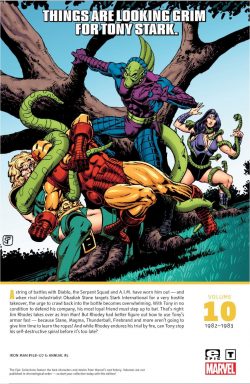
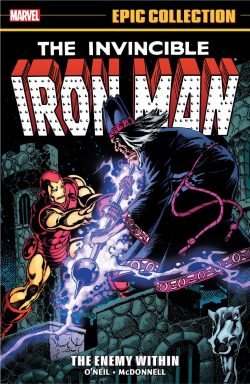
Invincible Iron Man Epic Collection volume 10: The Enemy Within 1982-1983


By Denny O’Neil, Roger McKenzie, Peter B. Gillis, Ralph Macchio, Carmine Infantino, Steve Ditko, Paul Smith, Luke McDonnell, Jerry Bingham, Mike Vosburg, Marie Severin & various (Marvel)
ISBN: 978-0-7851-8787-5 (TPB/Digital edition)

Tony Stark is a super-rich supergenius inventor who moonlights as a superhero: wearing a formidable, ever-evolving suit of armour stuffed with his own ingenious creations. The supreme technologist hates to lose and constantly upgrades his gear, making Iron Man one of the most powerful characters in the Marvel Universe.

However, in Iron Man #120-128 (March to November 1979), the unrelenting pressure of running a multinational corporation and saving the world on a daily basis resulted in the weary warrior succumbing to the constant temptations of his (originally sham) sybaritic lifestyle. Thus, he helplessly slipped into a glittering world drenched with excessive partying and drinking.

That dereliction was compounded by his armour being usurped by rival Justin Hammer: used to murder an innocent. The ensuing psychological crisis forced Stark to confront the hard fact that he was an alcoholic …and probably an adrenaline junkie too.

That crux landmark story ‘Demon in a Bottle’ saw the traumatised hero plumb the depths of grief and guilt, bury himself in pity, and alienate all his friends and allies before an unlikely intervention forced him to take a long, hard look at his life and actions…

A more cautious, level-headed and wiser man, Stark resumed his high-pressure lives, but he could not let up and the craving never went away. Then in 1982 author/editor Denny O’Neil made him do it again, with the result that Marvel gained another black superhero at long last…

It was the start of a period of legacy heroes inheriting the mantles, established roles and combat identities from white and mostly male champions, and was certainly a move in the right direction…

This grand and gleaming chronological compendium navigates that transitional period, re-presenting Iron Man #158-177 and Iron Man Annual #5: episodically spanning cover-dates May 1982 through December 1983, as the title experienced an uncomfortable number of creative personnel shuffles before settling on a steady team to tackle the biggest of changes…

It starts with Iron Man #158 as O’Neil, Carmine Infantino, Dan Green & Al Milgrom breeze through the motions as a deranged junior genius attacks modern technology from his literal man-cave by tapping the latent psychic power of his ‘Moms’

Roger McKenzie, rising art star Paul Smith & inking collective “Diverse Hands” stepped in to relate what occurs ‘When Strikes Diablo’, as the Fantastic Four’s alchemical nemesis infiltrates Stark International to steal the techno-wizard’s resources and obsolete suits, only to unleash a mystic menace beyond all control…

With pressure mounting and threats everywhere, the craving for booze painfully manifests in ‘A Cry of Beasts’ – by O’Neil, Steve Ditko, Marie Severin & Green – as Stark’s party-persona collides with hot, willing babes …until an attack on his factory by the sinister Serpent Squad reminds him of his priorities.

Preceding Iron Man Annual #5, and by O’Neil, Luke McDonnell, Mike Esposito & Steve Mitchell, a brief encounter with newcomer hero Moon Knight sees Stark at odds with rival rich man Steven Grant (one of four people comprising the edgy new crusader) in ‘If the Moonman Should Fail!’

Frenemies at first sight, the Golden Avenger and Fist of Khonshu swallow their differences to save mutual friends held hostage by Advanced Idea Mechanics, after which the extra-length Annual extravaganza sees Iron Man in Wakanda where The Black Panther must defeat mysteriously resurrected nemesis and determined usurper Eric Killmonger

Crafted by Peter B. Gillis, Ralph Macchio, Jerry & Bingham & Green, the action-packed ‘War and Remembrance!’ reveals an old foe methodically manoeuvring Stark and Iron Man into an inescapable trap, which closes tighter in Iron Man #162 as O’Neil, Mike Vosburg & Mitchell expose ‘The Menace Within!’ as a trusted employee sabotages S.I.…

There seems to be more than one campaign to crush Stark, and – as O’Neil, McDonnell & Mitchell become the regular creative team – ‘Knight’s Errand!’ opens an extended gambit with another hidden plotter turning ruthless capitalism, corporate raiding, advanced weaponry and an obsession with chess into a war for control of the company.

Up first is fast-flying tech terror The Knight who makes short work of Tony’s bodyguard, pilot, friend and confidante James Rhodey, but the real threat comes from a new acquaintance and future companion, covertly hollowing out Stark at close hand. Rising in the rankings after defeating the hovering horseman, Iron Man barely survives the ‘Deadly Blessing’ of The Bishop after his security team digs up leads to the plot in Scotland…

In IM #165, the trail leads to Jamie, Laird of Glen Travail and another deadly duel of devices, but the true purpose is to destabilise Stark by abducting Rhodey in an effort to coerce his capitulation. The resultant ‘Endgame’ seemingly goes Stark’s way, but the battle is fought on many levels by a distanced player secretly commanding the Laird: one with a cruel emotional counterpunch long-prepared to destroy the hero from within…

After a brief interlude offering original art pages from issues #161, 163 & 165, the stories resume and tensions mount on ‘One of Those Days…’ as old foe The Melter attacks Stark’s New York facility. Rhodey is recuperating in Scotland and Stark yet again faces enforced inactivity in the land of sublime alcoholic beverages, so he abruptly abandons his friend and jets home to stop the supervillain. He also learns his brilliant head of security Vic Martinelli has uncovered the identity of one of the hidden players attacking the company: chess grandmaster turned armaments entrepreneur Obadiah Stane

With Rhodey missing again in Scotland, the newcomer wants all Stark’s creations and in the most hostile of takeovers, has used every trick in the book – from honey traps to guided missiles and abduction to intoxication – to seize the advantage…

‘The Empty Shell’ sees that nefarious planning bear evil fruit as Stark finally cracks under interminable pressure and one last betrayal, leading to a crushing fall “off the wagon” and into the gutter in ‘The Iron Scream’.

Permanently drunk and deprived of all judgement, Stark dons his armour to clash with Machine Man, even as far away, Rhodey makes his own life-threatening break for freedom and home…

As chaos ensues at the Stark plant, a major player debuts in the form of junior employee and minor boffin Morley Erwin, who’s on hand for Stark’s reunion with Rhodey and an aghast witness to one of the smartest men alive willingly crawling into a bottle and trying to drown away his pain…

That process begins in #169 as ‘Blackout!’ sees Stark simply give up when confronted by volcanic B-list villain Magma, and sleep through the moment Jim Rhodes steps up – and into – the role and armour of Iron Man

The new era properly begins in #170’s ‘And Who Shall Clothe Himself in Iron?’ (cover-dated May 1983) as the former military airman promotes Erwin to the role of tech support adviser to help him pilot the most complex weapon he’s ever used to defeat Magma and save a far from grateful Tony Stark…

In the aftermath, the inventor just walks away: letting a new hero flounder even as, in the shadows, Stane gradually completes his takeover. Alone, isolated and under resourced, Rhodey and Erwin stumble into a heist in ‘Ball and Chain’, after seeking to arbitrate a domestic hostage situation triggered by Asgardian-powered supervillain Thunderball not knowing when no means no…

They are then duty-bound to intervene when Stark – completely off the rails – is arrested. However, his drunken debacle is only the start of their woes, as one the souse’s most murderous enemies tries to exact ‘Firebrand’s Revenge!’ and an entire hotel goes up in flames.

Thankfully Captain America is on hand to give the new guy in the suit a helping hand, but the distraction is just what Stane needs to seal his deal…

Homeless, broke and close to death on the streets, Stark is then accidentally saved by his conqueror, who lays the seeds of his own eventual downfall by dragging the lush to a grand takeover ceremony. Also attending is the new Iron Man who gets a lead to the woman who tempted and crushed Stark: an operative of freelance espionage ring The Sisters of Ishtar. This time both Stane and Rhodey learn that ‘Judas is a Woman’

During this period every effort to turn Stark around fails: shot down by his self-sabotage. Now however, his friends must pause their personal interventions as the national and international repercussions of Stane’s triumph grows. Refusing to let a ruthless war profiteer benefit from Iron Man tech, Rhodey and Morley take drastic steps: stealing all the old kit and prototypes from Stane International. They are blithely unaware Nick Fury and S.H.I.E.L.D. share those opinions and are making their own clandestine arrangements in ‘Armor Chase’ (inked by Sam de LaRosa)…

A three-way clash escalates in O’Neil, McDonnell, & Mitchell’s Iron Man #175 as all ‘This Treasure of Red and Gold…’ ends up dumped deep in the ocean: purportedly beyond human reach. Nobody seemed to think that maybe water breathers like bellicose Atlantean renegade Warlord Krang might be in the market for a weapons upgrade dropped right in his lap…

Still operating under what can only be described as trial-by-fire period, Rhodey dives right in, triumphs again and even makes a new friend…

Stark’s own deep descent is marginally arrested after befriending an elderly “un-homed” guy on the streets in ‘Turf’, even as far away Iron Man meets the Sisters of Ishtar again and has his first encounter with something not of this Earth…

This tome pauses for now with a transitional tale loaded with portents of bad times to come. After meeting Erwin’s even smarter sister Clytemnestra, Rhodey looks – after a chat with Heroes for Hire Luke Cage & Iron Fist – into forming a rather unique start-up company in ‘Have Armor Will Travel’. The idea only truly gels after he’s hired to bodyguard an officious unflappable official in South America and encounters – and survives – deadly armoured mercenary Flying Tiger. However, in all the furore, our hero barely notices that he’s having headaches almost constantly these days…

To Be Continued…

With covers by Bob Layton, Smith, Jim Starlin, Ed Hannigan & Al Milgrom, Bingham & Brett Breeding, McDonnell, Brent Anderson & Mitchell, the bonus section includes ‘Original art and covers’, the cover for The Many Armors of Iron Man collection by McDonnell, Mitchell, & Frank D’Armata and contemporary House ad from Marvel Age #12.

As comics companies sought to course correct old attitudes and adapt their wares to a far wider and more diverse readership than they had previously acknowledged, some rash rushed decisions were made that did not suit all the fans. Thankfully, that never stopped the editors and publishers from trying and the wonderful results are here and everywhere in comics because of it. Go read and enjoy and see how it all began to change.
© 2017 Marvel Characters, Inc. All rights reserved.

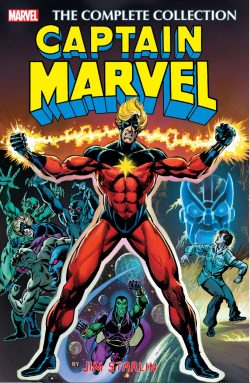
Captain Marvel by Jim Starlin: The Complete Collection


By Jim Starlin, Mike Friedrich, Steve Gerber, Steve Englehart & various (Marvel)
ISBN: 978-1-30290-017-5

50 YEARS!! It’s been five decades since this tale was first told! If you don’t know why, you have a real treat in store…

As much as I’d love to claim that Marvel’s fortunes are solely built on the works of Jack Kirby and Steve Ditko, I’m just not able to. Whereas I can safely avow that without them the modern monolith would not exist, it is also necessary to acknowledge the vital role played by a second generation of creators of the early 1970s. Marvel’s eager welcome to fresh, new, often untried talent paid huge dividends in creativity and – most importantly at a time of industry contraction – resulted in new sales and the retention of a readership that was growing away from traditional comics fare. Best of all, these newcomers spoke with a narrative voice far closer to that of its rebellious audience…

One of the most successful of these newcomers was Jim Starlin. As well as the topical and groundbreaking Master of Kung Fu – co-created with his equally gifted confederates Steve Englehart & Al Milgrom – Starlin’s earliest success was the epic of cosmic odyssey compiled here.

Captain Marvel was an alien on Earth, a defector from the militaristic Kree. He fought for Earth and was atomically bonded to professional sidekick Rick Jones by a pair of wristbands allowing them to share the same space in our universe. When one was here, the other was trapped in the antimatter dimension designated the Negative Zone.

After meandering around the Marvel Universe for a while, continually one step ahead of cancellation (the series had folded many times, but always quickly returned – primarily to secure the all-important Trademark name), Mar-Vell was handed to Starlin – and the young artist was left alone to get on with it.

With many of his fellow neophytes, he began laying seeds (particularly in Iron Man, Sub-Mariner and Daredevil) for a saga that would in many ways become as well-regarded as the Jack Kirby Fourth World Trilogy that inspired it. However, the Thanos War, despite many superficial similarities, would soon develop into a uniquely modern experience. And what it lacked in grandeur, it made up for with sheer energy and enthusiasm…

This epic compendium gathers and collates Iron Man #55, Captain Marvel #25-34, Marvel Feature #12 and pertinent extracts from Daredevil #105. It collectively spanning February 1973 to September 1974, and concludes with the landmark Marvel Graphic Novel #1 from 1982: thus re-presenting Starlin’s entire input into the legend of the Kree Protector of the Universe and one of the company’s most popular and oft-reprinted sagas.

The artistic iconoclasm began in Iron Man #55 (February 1973) where Mike Friedrich scripted Starlin’s opening gambit in a cosmic epic that would change the nature of Marvel itself.

Inked by Mike Esposito, Beware… Beware… Beware the… Blood Brothers!’ introduces formidable and obsessive Drax the Destroyer: an immensely powerful apparent alien trapped under the Nevada desert and in dire need of rescue thanks to the wiles of even more potent extraterrestrial invader Thanos

That comes when the Armoured Avenger blazes in, answering a mysterious SOS, but only after brutally dealing with the secret invader’s deadly underlings…

All this is merely a prelude to the main story which begins unfolding a month later in Captain Marvel #25, courtesy of Friedrich, Starlin, & Chic Stone wherein Thanos unleashes ‘A Taste of Madness!’ and exiles Mar-Vell’s fortunes change forever…

When ambushed by a pack of extraterrestrials, Mar-Vell is forced to admit that his powers have been in decline for some time. Unaware that an unseen foe is counting on that, he allows Rick to manifest (from the Negative Zone) and they check in with sagacious scientific maverick Dr. Savannah. Suddenly, Rick is accused by the savant’s daughter (and Rick’s beloved) Lou-Ann of her father’s murder…

Hauled off to jail, Rick brings in Mar-Vell who is suddenly confronted by a veritable legion of old foes before deducing who in fact his true enemies are…

Issue #26 then sees Rick freed from police custody to confront Lou-Ann over her seeming ‘Betrayal!’ (Starlin, Friedrich & Dave Cockrum). Soon, however, he and Mar-Vell realise they are the targets of psychological warfare: the girl is being mind-controlled whilst Super Skrull and his hidden “Masterlord” are manipulating them and others in search of a lost secret…

When a subsequent scheme to have Mar-Vell kill The Thing spectacularly fails, Thanos takes personal charge. The Titan is hungry for conquest and needs Rick because his subconscious conceals the location of an irresistible ultimate weapon.

Jones awakens to find himself ‘Trapped on Titan!’ (Pablo Marcos inks) but does not realise the villain has already extracted the location of a reality-altering Cosmic Cube from him. Rescued by Thanos’ hyper-powered father Mentor and noble brother Eros, the horrified lad sees first-hand the extent of the genocide the death-loving monster has inflicted upon his own birthworld. Utterly outraged, he summons Captain Marvel to wreak vengeance…

Meanwhile on Earth, still-enslaved Lou-Ann has gone to warn the Mighty Avengers and summarily collapsed. By the time Mar-Vell arrives in #28 she lies near death. ‘When Titans Collide!’ (inks by Dan Green) reveals another plank of Thanos’ plan. As the heroes are picked off by psychic parasite The Controller, the Kree Captain is assaulted by bizarre visions of an incredible ancient being. Fatally distracted, he becomes the malevolent mind-leech’s latest victim…

Al Milgrom inks ‘Metamorphosis!’ as Mar-Vell’s connection to Rick is severed before the Kree is transported to an otherworldly locale where a grotesque eight billion-year-old being named Eon reveals the origins of universal life whilst overseeing the lifelong soldier’s forced evolution into an ultimate warrior: a universal champion gifted with the subtly irresistible power of “Cosmic Awareness”…

Iron Man, meanwhile, has recovered from a previous Controller assault and headed for Marvel Feature #12 to join Ben Grimm in ending a desert incursion by Thanos’ forces before enduring ‘The Bite of the Blood Brothers!’ courtesy of Friedrich, Starlin, & Joe Sinnott, after which the story develops through an extract first seen in Daredevil #105.

Here enigmatic and emotionless super scientist Madame MacEvil tells her origins and foreshadows her future role in the cosmic catastrophe to come. When Thanos killed her family, the infant Heather Douglas was adopted by Mentor, taken to Titan and reared by psionic martial artists of the Shao-Lom Monastery. Years later when Thanos attacked Titan and destroyed the monks, she swore revenge and took a new name – Moondragon

Subsequently returned to Earth and reconnected to his frantic atomic counterpart, the newly-appointed “Protector of the Universe” confronts The Controller, thrashing the monumentally powerful brain-parasite in a devastating display of skill countering exo-skeletal super-strength in #30’s ‘…To Be Free from Control!’ after which #31 celebrates ‘The Beginning of the End!’ (inked by Green & Milgrom) as the Avengers – in a gathering of last resort – are joined by psionic priestess Moondragon and Drax. The latter is revealed as one more of Thanos’ victims, but one recalled from death by supernal forces to destroy the deranged Titan…

The cosmic killer is then revealed as a lover of the personification of Death: determined to give her Earth as a betrothal present. To that end he uses the Cosmic Cube to turn himself into ‘Thanos the Insane God!’ (Green inks) who, with a thought, imprisons all opposition to his reign. However, his insane arrogance leaves cosmically aware Mar-Vell with a slim chance to undo every change, and the last hero brilliantly outmanoeuvres, defeats and apparently destroys The God Himself!’ in the cosmically climactic Captain Marvel #33 (inked by Klaus Janson)…

With the universe saved and a modicum of sanity and security restored, Starlin’s run ended on a relatively weak and inconclusive note in #34 as ‘Blown Away!’ – inked by Jack Abel and dialogued by Englehart – explored the day after doomsday…

As Rick strives to revive his on-again, off-again musical career, a new secret organisation called the Lunatic Legion sends Nitro, the Exploding Man to acquire a canister of deadly gas from an Air Force base where old pal Carol Danvers (long before her transformations into Ms. Marvel, Binary, Warbird and ultimately Captain Marvel) is head of Security…

Although the Protector of the Universe defeats his earth-shattering enemy, Mar-Vell succumbs to the deadly nerve agent released in the battle. The exposure actually kills him but he will not realise that for years to come…

In 1982, The Death of Captain Marvel was the first Marvel Graphic Novel and the one that truly demonstrated how mainstream superhero material could breach the wider world of general publishing.

Written and illustrated by Starlin with lettering by James Novak and colours from Steve Oliff, this tale concluded the career of the mighty Kree Champion in a neatly symmetrical and textually conclusive manner – although the tale’s success led to some pretty crass commercialisations in its wake…

As previously stated, Mar-Vell was an honoured soldier of the alien Kree empire dispatched to Earth as a spy, who went native: becoming first a hero and then the cosmically “aware” Protector of the Universe, destined since universal life began to be its stalwart cosmic champion in the darkest hours.

In concert with the Avengers and other heroes, he defeated death-worshipping Thanos, just as that villain became God, after which the good Captain went on to become a universal force for good.

That insipid last bit pretty much sums up Mar-Vell’s later career: without Thanos, the adventures again became uninspired and eventually just fizzled out. He lost his own comic book, had a brief shot at revival in try-out title Marvel Spotlight and then just faded away…

Re-enter Starlin, who had long been linked to narrative themes of death. He offered a rather novel idea – kill Mar-Vell off and actually leave him dead. What no fan realised at the time was that Starlin was also processing emotional issues thrown up by the passing of his own father and the story he crafted echoed his own emotional turmoil.

In 1982, killing such a high-profile hero was a bold idea, especially considering how long and hard the company had fought to obtain the rights to the name (and sure enough there’s always been somebody with that name in print ever since) but Starlin wasn’t just proposing a gratuitous stunt. The story developed into a different kind of drama: one uniquely at odds with contemporary fare and thinking.

Following the Thanos Saga, Mar-Vell defeated second-rater Nitro but was exposed to experimental nerve gas during the fight. Now years later he discovers that, just as he has found love and contentment, the effects of that gas have inexorably caused cancer in his system. Moreover, it has metastasized into something utterly incurable…

Going through the Kree version of the classic Kubler-Ross Cycle: grief, denial, anger, bargaining, depression and acceptance, the Space-Born hero can only watch as all his friends and comrades try and fail to find a cure, before death comes for him…

This is a thoughtful, intriguing examination of the process of dying observed by a being who never expected to die in bed, and argues forcefully that even in a universe where miracles occur by the hour sometimes death might not be unwelcome…

Today, in a world where the right to life and its intrinsic worth and value are increasingly being challenged and contested by special interest groups, this story is still a strident, forceful reminder that sometimes the personal right to dignity and freedom from distress is as important as any and all other Human Rights.

No big Deus ex Machina, not many fights and no happy ending: but still one of the most compelling stories the House of Ideas ever published.

Augmenting the sidereal saga, a number of now-mandatory bonus bits include Starlin’s exploded-view map-&-blueprint of Thanos’ homeworld Titan; original cover art from Captain Marvel #29 plus original art and the 3-page framing sequence for the reprint issue #36.

Other extras follow: the all-cosmic hero cover to fan-magazine F.O.O.M. #19; the all-new covers, back covers and bridging pages for prestige reprint miniseries The Life of Captain Marvel (as well as the humorous introductory Editori-Al’ strips cartooned by Al Milgrom) and much, much more.

A timeless classic of the company and the genre, this is a tale no full-blooded Fights ‘n’ Tights fan can be without.
© 1972, 1973, 1974, 1982, 2016 Marvel Characters, Inc. All rights reserved.

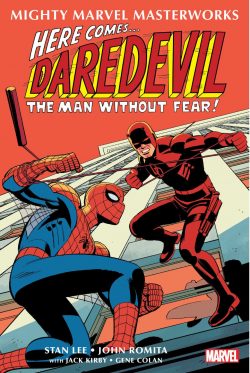
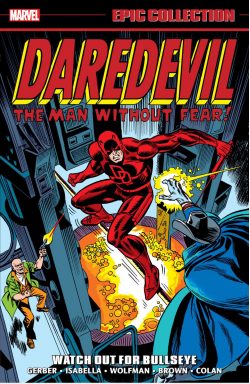
Mighty Marvel Masterworks Daredevil volume 1


By Stan Lee, Bill Everett, Joe Orlando, Wally Wood, Bob Powell & various (MARVEL)
ISBN: 978-1-3029-3440-8 (PB/Digital edition)

As the remnants of Atlas Comics grew in popularity in the early 1960s it slowly replaced its broad variety of genre titles with more and more super-heroes. The recovering powerhouse that was to become Marvel was still hampered by a crippling distribution deal that limited the company to 16 titles (curtailing their output until 1968), so each new untried book would have to fill the revenue-generating slot (however small) of an existing title.

Moreover, as costumed characters were selling, each new similarly-themed title would limit the breadth of the monster, western, war, humour or girls’ comics that had been the outfit’s recent bread and butter. It was putting a lot of eggs in one basket, and superheroes had failed twice before for Stan Lee.

So in retrospect the visual variety of the first few issues of Daredevil, the Man Without Fear seemed a risky venture indeed. Yes, the artists were all talented, seasoned veterans, but not to the young kids who were the audience. Most importantly, they just weren’t Jack Kirby or Steve Ditko, and new features need consistency and continuity…

Still, Lee and his rotating line-up of artists plugged on, concocting some extremely engaging tales until the latest Marvel Sensation found his feet, and the fascinating transition of moody masked avenger to wisecracking Scarlet Swashbuckler can be enjoyed in this collection gathering the first 11 issues (spanning April 1964 to December 1965): an effervescent package of thrills and spills which begins with ‘The Origin of Daredevil’

This much-retold tale recounts how young Matthew Murdock grew up in the slums of New York City, raised alone by his father: washed-up second-rate prize-fighter Battling Jack Murdock.

Determined that his boy will be something, the father extracts a solemn promise from Matt that he will never fight. Mocked by other kids who sarcastically dub him “Daredevil”, the kid abides by his vow, but secretly trains his body to physical perfection.

One day, he saves a blind man from being hit by a speeding truck, only to be struck in the face by its radioactive cargo. His sight is burned away forever, but his other senses are super-humanly enhanced and he gains a sixth, “radar-sense”.

He tells no-one, not even his dad.

The senior Murdock is in dire straits. As his career declined, he signed with The Fixer, knowing full well what the corrupt promoter expected from his fighters. Somehow, the pug’s star started to shine again and his downward spiral reversed itself. Unaware that he was being set up, Battlin’ Jack got a shot at the Big Time, but when ordered to take a dive, he refused. Winning was the proudest moment of his life. When his bullet-riddled corpse was found, the cops had suspicions but no proof…

Heartbroken, Matt graduated college with a law degree and set up in business with his room-mate FranklinFogg” Nelson. They hired a quiet young secretary named Karen Page and, with his life on track, young Matt now had time to solve his father’s murder…

His promise stopped him from fighting, but what if Matt became “someone else”?

Scripted by Lee and moodily illustrated by the legendary Bill Everett (with the assistance of Ditko), this is a rather formulaic and nonsensical yarn but is astonishingly engaging visually. The oft-told tale looked a little dated even at the time, but hinted at magic yet to come…

Plot-wise, the second issue fares little better as Joe Orlando & Vince Colletta assume the art chores for ‘The Evil Menace of Electro!’: a saga wisely exploiting the celebrity of guest-stars The Fantastic Four and featuring a second-hand Spider-Man villain.

The FF consult lawyer Matt Murdock just as the electrical outlaw tries to break into their building and before long Daredevil is spectacularly and relentlessly dealing with the voltaic villain. DD #3 finally offers the sightless swashbuckler a super-foe of his own when he meets and trounces crooked corporate raider ‘The Owl, Ominous Overlord of Crime!’

Daredevil #4 was a turning point, and possibly just in time. ‘Killgrave, the Unbelievable Purple Man!’ finally gave some distinctive character to the big stiff as he strove to overcome a villain who could exert total control over anyone who saw him. Although Orlando & Colletta’s uncomfortable, sedate and over-fussy illustration remained for one last episode, Lee finally got a handle on the hero; just in time for a magician-in-waiting to elevate the series to spectacular heights.

With #5, Wally Wood assumed the art chores and his lush, lavish work brought power, grace and beauty to the series. At last the costumed combat acrobat seemed to spring and dance across the rooftops and pages. Wood’s contribution to the plotting didn’t hurt either. He actually got a cover plug on his first issue.

In ‘The Mysterious Masked Matador!’ a cool, no-nonsense hero who looked commanding and could handle anything started fighting hard and fast. The series began advancing the moribund romantic sub-plot – Foggy adores Karen, who only has eyes for Matt, who loves her, but won’t let her “waste” her life on a blind man – and actually started making sense and progress.

Most importantly, the action scenes were intoxicating…

Although a bullfighter who used his skills for crime is frankly daft, the sublime drawing and sleek inking makes it all utterly convincing, and breathtakingly battle sequence is augmented by a Wood ‘Marvel Masterwork Pin-up of “DD”’ signalling a grand change in fortune…

The wonderment intensified in the following issue as the bold bravo was  ‘Trapped by the Fellowship of Fear!’: a minor classic as the Man Without Fear must defeat not only the super-powered Ox and Eel (two more recycled villains) but also his own threat-specific foe Mr. Fear – who could instil terror and panic in victims, courtesy of his ghastly gas gun.

The improvements led to a major change in Daredevil #7: a true landmark and to my mind one of the Top Ten Marvel Tales of all time.

Here Lee & Wood concocted an indisputable masterpiece as ‘In Mortal Combat with… Sub-Mariner!’ sees Prince Namor of Atlantis travel to the surface world to have his day in court. Resolved to sue all Mankind, he hires Nelson & Murdock and submits to being arrested, but discovers too late that his warlord Krang has usurped the throne in his absence. The tempestuous monarch will not languish in a cell when the kingdom is threatened, so he fights his way to freedom and the sea.

This saga shows Murdock the lawyer to be a brilliant orator, whilst his hopelessly one-sided battle against one of the strongest beings on the planet shows the dauntless courage of DD and true nobility of the Sub-Mariner.

Most notably, and with no fanfare at all, Wood replaced the original yellow-&-black “wrestler’s costume” with the iconic and beautiful all-red outfit we know today. As one pithy commentator stated, “the original costume looked as if it had been designed by a blind man”…

Augmented by another pin-up – in actuality a rejected cover for the tale – this issue proved beyond doubt the potential of Daredevil and promised even better to come…

Another all-new villain debuted in #8; a gripping industrial espionage thriller, ‘The Stiltman Cometh!’ pits the ace acrobat against a thieving, murderous masked miscreant towering above the skyscrapers, after which Golden Age Great Bob Powell came aboard as penciller to Wood’s layouts and inks with #9’s That He May See!’

Relentlessly badgered by Karen, Matt finally agrees to see an eye-specialist who might cure his blindness, but his visit to the European principality of Lictenbad quickly embroils the adventurer in a plot to conquer the world by a Ruritanian maniac with twin knights-in-armour and killer robot fixations…

Wood was clearly chafing after a year on the book and looking to stretch himself. Thus he also scripted the series’ first continued story ‘While the City Sleeps!’: a sophisticated political thriller and complex crime caper which first saw Foggy run for District Attorney of New York, even as a mysterious mastermind known as The Organizer created an animal-powered gang comprising Bird-Man, Frog-Man, Cat-Man and Ape-Man to terrorise the city.

With Powell now on layouts and pencils with Wood as finisher, Lee was left to dialogue the concluding chapter (which also proudly proclaimed the title’s advancement to a monthly schedule) ‘A Time to Unmask!’ as Daredevil pulled out all the stops to confound a devious power-grab scheme which saw the villains defeated, but only at great personal cost to Nelson & Murdock…

Offering covers from Everett, Jack Kirby, Colletta, Wood and Powell and closing with a rousing house ad by Wood, this sleek, economical, kid-friendly Mighty Marvel Masterworks compendium offers a few bumpy false starts before blossoming into a truly magnificent example of Marvel’s miraculously compelling formula for success: smart stories, human characters and magnificent illustration.

If you’ve not read these tales before I strongly urge you to rectify that error as soon as superhumanly possible…
© 2022 MARVEL.

Mighty Marvel Masterworks Spider-Man volume 2: The Sinister Six


By Stan Lee & Steve Ditko, with Sam Rosen & Art Simek (MARVEL)
ISBN: 978-1-3029-3195-7 (TPB/Digital edition)

As any fule kno, The Amazing Spider-Man celebrated his 60th anniversary in 2022. However, I’m one of those radicals who feel that 1963 was when he was really born, so let’s start the New Year with acknowledgement of that opinion and warning of many more of the same over the next 12 months…

These stories are timeless and have been gathered many times before but this time we’re looking at The Mighty Marvel Masterworks line: designed with economy in mind and newcomers as target audience. These new books are far cheaper, on lower quality paper and smaller, about the dimensions of a paperback book. Your eyesight might be failing and your hands too big and shaky, but at 152 x 227mm, they’re perfect for kids. If you opt for the digital editions, that’s no issue at all.

Marvel is often termed “the House that Jack Built” and King Kirby’s contributions are undeniable and inescapable in the creation of a new kind of comic book storytelling. However, there was another unique visionary toiling at Atlas-Comics-as-was, one whose creativity and philosophy seemed diametrically opposed to the bludgeoning power, vast imaginative scope and clean, gleaming futurism that resulted from Kirby’s ever-expanding search for the external and infinite.

Steve Ditko was quiet and unassuming, diffident to the point of invisibility, but his work was both subtle and striking: innovative and meticulously polished. Always questing for affirming detail, he ever explored the man within. He saw heroism and humour and ultimate evil all contained within the frail but noble confines of humanity. His drawing could be oddly disquieting… and, when he wanted, decidedly creepy.

Crafting extremely well-received monster and mystery tales for and with Stan Lee, Ditko had been rewarded with his own title. Amazing Adventures/Amazing Adult Fantasy featured a subtler brand of yarn than Rampaging Aliens and Furry Underpants Monsters: an ilk which, though individually entertaining, had been slowly losing traction in the world of comics ever since National/DC had successfully reintroduced costumed heroes.

Lee & Kirby had responded with The Fantastic Four and so-ahead-of-its-time Incredible Hulk, but there was no indication of the renaissance ahead when officially just-cancelled Amazing Fantasy featured a brand new and rather eerie adventure character…

This compelling compilation re-presents the rise of the wallcrawler as first seen in Amazing Spider-Man #11-19 and Amazing Spider-Man Annual #1 (spanning cover-dates April – December 1964) and is lettered throughout by unsung superstars Sam Rosen & Art Simek, allowing newcomers and veteran readers to comprehensively relive some of the greatest moments in sequential narrative.

The parable of Peter Parker began when a smart but alienated high schooler was bitten by a radioactive spider on a science trip. Discovering he’d developed arachnid abilities – which he augmented with his own ingenuity and engineering genius – Peter did what any lonely, geeky nerd would when given such a gift… he tried to cash in for girls, fame and money.

Creating a costume to hide his identity in case he made a fool of himself, Parker became a minor celebrity – and a vain, self-important one. To his eternal regret, when a thief fled past him, he didn’t lift a finger to stop the thug, and days later returns discovered that his Uncle Ben has been murdered by the same criminal…

Crazy for vengeance, Parker stalked and captured the assailant who made his beloved Aunt May a widow and killed the only father he had ever known. Since his social irresponsibility led to the death of the man who raised him, the boy swore to always use his powers to help others…

It wasn’t a new story, but the setting was familiar to every kid reading it and the artwork was downright spooky. no gleaming high-tech world of moon-rockets, mammoth monsters and flying cars here… this stuff could happen to anyone…

Amazing Fantasy #15 came out the same month as Tales to Astonish #35 – the first to feature the Astonishing Ant-Man in costume, but it was the last issue of Ditko’s Amazing playground. However, the tragic last-ditch tale struck a chord with the public and by year’s end a new comic book superstar launched in his own title, with Ditko eager to show what he could do with his first returning character since the demise of Charlton’s Captain Atom

Holding on to the “Amazing” prefix to jog reader’ memories, the Amazing Spider-Man #1 hit newsstands in December sporting a March 1963 cover-date and two complete stories.

Sans frills and extras, the ongoing saga resumes here with Amazing Spider-Man #11. Ditko’s preference for tales of gangersterism drove the stories and his plot for ‘Turning Point’ involves the reappearance of a major supervillain and a growing dependence on soap opera drama, but his solitary, driven hero was always a loner, never far from the streets and small-scale-crime…

In the aftermath of the webspinner crushing a prison riot single handed and defeating the Big Man and The Enforcers, longer plot-strands were introduced as Peter’s potential girlfriend Betty Brant mysteriously vanishes.

Resolved to find her, Parker discovers she’s somehow involved with the multi-armed menace and the Philadelphia mob and goes after her, clashing again with the lethally deranged scientist whilst seeking to expose a long-hidden secret which had haunted Brant for years. It all ended in a spectacularly climactic fight scene on a ship that has still never been beaten for action-choreography…

The wonderment actually intensifies with ‘Unmasked by Dr. Octopus!’, detailing a dark, tragedy-filled tale of extortion and excoriating tension that stretches from Philadelphia to the Bronx Zoo: cannily tempering trenchant melodrama with spectacular clashes in unusual and exotic locations, before culminating in a truly staggering super-powered duel as only the masterful Ditko could orchestrate it.

A new super-foe premiered in Amazing Spider-Man #13 with ‘The Menace of Mysterio!’ as a seemingly eldritch bounty-hunter hired by Daily Bugle publisher J. Jonah Jameson to capture Spider-Man eventually lets slip his own dark criminal agenda, whilst ASM #14 delivers an absolute milestone in Marvel History when a hidden criminal mastermind manipulates a Hollywood studio into making a movie about the wall-crawler.

Even with guest-star opponents The Enforcers and The Incredible Hulk (his last true guest shot before moving into his new residency in Tales to Astonish), ‘The Grotesque Adventure of the Green Goblin’ is most notable for introducing Spider-Man’s most perfidious and flamboyant enemy.

Jungle superman and thrill-junkie ‘Kraven the Hunter!’ makes Spider-Man his intended prey at the behest of embittered Spidey-foe The Chameleon in #15, and – after ignominiously failing to trap his target in the wilds of Central Park – promptly reappears in the first Amazing Spider-Man Annual

A timeless landmark and still magnificently thrilling Fights ‘n’ Tights tussle, the ‘Sinister Six!’ begins after a team of villains comprising Electro, Kraven, Mysterio, The Sandman, Vulture and Doctor Octopus abduct Aunt May and Betty. Briefly deprived of his powers – lost to a guilt-fuelled panic attack – Peter is forced to confront them without nothing but courage & determination.

A staggeringly enthralling combat clash, with Spider-Man systematically taking down each enemy in a death-defying duels, this influential tale featured cameos (or, more honestly, product placement segments) by every other extant hero of the budding Marvel universe: everyone from The Avengers to The X-Men

Also included from that colossal comic book are special feature pages on ‘The Secrets of Spider-Man!’; comedic short ‘How Stan Lee and Steve Ditko Create Spider-Man’ and a gallery of pin-up pages starring ‘Spider-Man’s Most Famous Foes!’ (namely the Burglar, Chameleon, Vulture, Terrible Tinkerer, Dr. Octopus, Sandman, Doctor Doom, The Lizard, Living Brain, Electro, The Enforcers, Mysterio, Green Goblin and Kraven the Hunter).

There are also pin-ups of Betty and Jonah, Peer Parker’s House and classmates plus a heroic guest stars page…

Amazing Spider-Man #16 extended that circle of friends and foes as the webslinger battles the Ringmaster and his Circus of Crime: consequently meeting – and inevitably battling – a fellow loner hero in a dazzling and delightful ‘Duel with Daredevil’.

We conclude this outing with an ambitious 3-part saga that began in Amazing Spider-Man #17, wherein the rapidly-maturing hero touches emotional bottom before rising to triumphal victory over all manner of enemies. It begins with ‘The Return of the Green Goblin!’ as the wallcrawler endures renewed print assaults from the Daily Bugle and its obsessed publisher J. Jonah Jameson, just as the enigmatic Green Goblin commences a war of nerves and attrition, using the Enforcers, Sandman and an army of bargain basement thugs to publicly humiliate the Amazing Arachnid and make him look like a fool in front of rival frenemy Johnny StormThe Human Torch.

To exacerbate matters, Peter’s beloved Aunt May’s health takes a drastic downward turn…

In ‘The End of Spider-Man!’ pressure continues to mount and the troubled champion quits, concentrating exclusively on finding money to pay for his aunt’s treatment and leaving the Torch to handle the Goblin’s crime rampage…

It all explosively concludes in ‘Spidey Strikes Back!’ featuring a turbulent team-up with the Torch – as a powerful pep talk from May galvanises the disgruntled teen terror and sets him back on his fated path: to the everlasting regret of the Goblin, his gangsters, the Enforcers and Sandman… and Jameson…

This extended tale proved fans were ready for every kind of narrative experiment (single issue or even two stories per issue were still the norm in 1964) and Stan & Steve were more than happy to try anything…

I claimed no extras here, but I lied. Closing the book are some lovely art treats: an unedited view of Ditko’s original cover for ASM #11, the original splash page art for #12 plus page 12and the closing page of #18; every one reason enough to buy this book…

These immortal epics are something no serous fan can be without, and will make an ideal gift for any curious newcomer or nostalgic aficionado.

Happy Unbirthday Spidey and many, many more please…
© 2021 MARVEL.

Mighty Marvel Masterworks Black Panther volume 1: The Claws of the Panther


By Stan Lee & Jack Kirby, Roy Thomas, John Buscema, Frank Giacoia, Barry Windsor-Smith & various (MARVEL)
ISBN: 978-1-3029-4709-5 (TPB/Digital edition)

Win’s Christmas Gift Recommendation: Golden Oldies for Kids of All Ages… 9/10

The Mighty Marvel Masterworks line was designed with economy in mind. Classic tales of Marvel’s key characters by the founding creators, re-presented in chronological order have been a staple since the 1990s, but always in lavish, expensive collectors editions. These books are far cheaper, but with some deletions like the occasional pin-up. They are printed on lower quality paper and – crucially – are physically smaller, about the dimensions of a paperback book. Your eyesight might be failing and your hands too big and shaky, but they’re perfect for kids and if you opt for the digital editions, that’s no issue at all…

This tome gathers in whole or in part early Black Panther adventures from Fantastic Four #52-54, 56; Tales of Suspense #97-99; Captain America #100; The Avengers #52, 62, 73-74 and Daredevil #52 spanning July 1966-March 1970: including his debut and career as a peripatetic guest star before finally securing a series of his own…

Acclaimed as the first black superhero in American comics and one of the first to carry his own series, the Black Panther’s popularity and fortunes have waxed and waned since he first appeared in the summer of 1966.

As created by Jack Kirby & Stan Lee and inker Joe Sinnott, T’Challa, son of T’Chaka, is an African monarch whose secretive kingdom is the only source of vibration-absorbing wonder mineral Vibranium. The miraculous alien metal – derived from a fallen meteor which struck the continent in lost antiquity – is the basis of Wakanda’s immense wealth, making it one of the wealthiest and most secretive nations on Earth. These riches allowed the young king to radically remake his country, creating a technological wonderland even after he left Africa to fight as one of America’s mighty Avengers.

For much of its history Wakanda was an isolated, utopian technological wonderland with tribal resources and people safeguarded and led since time immemorial by a human warrior-king deriving cat-like physical advantages from secret ceremonies and a mysterious heart-shaped herb. This has ensured the generational dominance of the nation’s Panther Cult and Royal Family…

The highly guarded “Vibranium mound” had guaranteed the nation’s status as a clandestine superpower for centuries, but modern times increasingly found Wakanda a target for subversion, incursion and even invasion as the world grew ever smaller.

It all began with Fantastic Four #52-53 (cover-dated July and August 1966) as the innovative and unforgettable character launched in ‘The Black Panther!’: an enigmatic African monarch whose secretive kingdom was the only source of a vibration-absorbing alien metal. These mineral riches had enabled him to turn his country into a futuristic marvel who introduced himself by luring the FF into his savage super-scientific kingdom. Although the team was oblivious to the danger, it was all part of T’Challa’s extended plan to gain vengeance on the murderer of his father.

After battling the team to a standstill, the King revealed his tragic origin in ‘The Way it Began..!’, revealing how his father was murdered by marauding sonic science researcher Ulysses Klaw. However, even as the monarch details how he took vengeance and liberated his people, word comes of incredible solidified-sound monsters attacking the region. Klaw has returned at last…

The cataclysmic clash that follows set the scene for the African Warrior-Chieftain to guest star with a number of Marvel superstars before breaking out into the wider world, but it would years before he finally won his own solo series…

In the aftermath, Human Torch Johnny Storm and his tag-along college roommate Wyatt Wingfoot embark on a quest to rescue the Torch’s Inhuman lover Crystal (imprisoned with her people behind an impenetrable energy barrier in the Himalayas). Their journey is greatly assisted by the Panther’s incredible technology but here that means FF #54’s ‘Whosoever Finds the Evil Eye…!’ ends on page 8, and you’ll need to find a different collection to finish that tale…

The monarch and his personal nemesis returned in #56 when ‘Klaw, the Murderous Master of Sound!’ – reborn as a being of sentient sound energy – ambushes the team in their own home. Happily, the Panther is able to assist them in the nick of time…

Marvel’s inexorable rise to dominance in the American comic book industry really took hold in 1968, when a number of their characters finally got their own titles. Prior to that and due to a highly restrictive distribution deal, the company was tied to a limit of 16 publications per month. To circumvent this, Marvel developed titles with two series per publication, such as Tales of Suspense where original star Iron Man shared honours with late addition Captain America. When the division came, Shellhead started afresh with a First Issue, and Cap retained the numbering of the original title; thereby premiering with #100.

The last few issues of the run – ToS #97-99 and the freshly re-titled Captain America #100 opens with the Sentinel of Liberty having just retired from superhero service and revealed his secret identity to the world, However, he hurtles straight back into the saddle for S.H.I.E.L.D. in ‘And So It Begins…!’: a 4-part saga featuring the Black Panther.

It tells of the apparent return of long-dead Nazi war criminal and Master of Evil Baron Zemo who is attacking the world with an orbital death ray controlled from somewhere in Africa. The epic was scripted by Lee and bombastically plotted and drawn by King Kirby with Sinnott & Syd Shores inking, and sees chaos escalate in ‘The Claws of the Panther!’ and ‘The Man Who Lived Twice!’ before climactically closing in explosive action and a very Big Reveal in ‘This Monster Unmasked!’

As a result of his aid in ending the crisis, T’Challa was recommended by Cap and won his first regular slot in super team, beginning with The Avengers #52 (cover-dated May 1968). At that time, the active team had been reduced to Hawkeye, the Wasp and a recently re-powered Goliath. This changed when they belatedly welcomed new recruit Black Panther. That delay was because ‘Death Calls for the Arch-Heroes!’ was a fast-paced murder mystery by Roy Thomas, John Buscema & Vince Colletta which also introduced obsessive super-psycho The Grim Reaper, who had seemingly murdered the trio and let bewildered newcomer T’Challa take the rap…

After clearing his name and resurrecting the teammates, the Panther settled in as a high-profile international superhero but remained very much a mystery until Avengers #62 (March 1969, by Thomas. Buscema & George Klein), where in the aftermath of a mystic crisis in Africa, Hawkeye, The Vision and occasional ally Black Knight were invited to visit Wakanda…

‘The Monarch and the Man-Ape!’ was a revelatory if brief interlude in the hidden nation and a brutal exploration of the African Avenger’s history and rivals which resulted in a deadly coup attempt when a super-strong trusted regent turned usurper, declaring himself leader of a banned cult and living icon M’Baku the Man-Ape

Returned to America, the African Avenger stepped in as another acrobatic superhero loner struggled with identity issues.

Daredevil #52 (May 1969, by Thomas, Barry Windsor-Smith & Johnny Craig) saw the Scarlet Swashbuckler at his lowest ebb: battling robotics genius, Mad-Scientist-for-Hire and certified lunatic Starr Saxon. The war of wills was wickedly engaging: frantically escalating into a psychedelic thriller wherein Saxon uncovers the hero’s greatest secret after the Man Without Fear succumbs to toxins in his bloodstream and goes berserk.

That saga climaxes here in stunning style on ‘The Night of the Panther!’ as the African Avenger joins the hunt for the out-of-control Daredevil before subsequently helping thwart, if not defeat, the dastardly Saxon. The radically unsettling ending blew away all conventions of traditional Fights ‘n’ Tights melodrama and still shocks today…

These initial forays finish with another 2-part tale, beginning with Avengers #73 and ‘The Sting of the Serpent’. Another Thomas triumph – illustrated by Frank Giacoia & Sam Grainger – it pits the Panther (at the height of the Civil Rights campaign) against his natural prey in the form of seditious racist hate-mongers determined to set New York ablaze, leading to a spectacular and shocking clash between whole team and The Sons of the Serpent in ‘Pursue the Panther!’ when the sinister supremacists capture the hero and set a doppelganger loose to destroy his reputation…

With covers by Kirby, Sinnott, Gene Colan, Giacoia, Buscema, Klein, Marie Severin & Palmer, this tidy tome is a wonderful, star-studded precursor to the Black Panther’s solo exploits and a perfect accessory for film-fans looking for more context.
© 2022 MARVEL