
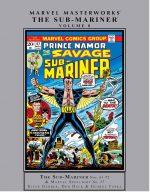
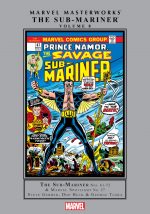
By Steve Gerber, Bill Everett, Howard Chaykin, Marv Wolfman, Steve Skeates, Bill Mantlo, Don Heck, George Tuska, Win Mortimer, Sam Kweskin, Jim Mooney, Dan Adkins, Frank Giacoia, John Sinnott, Syd Shores, Don Perlin, Frank Chiaramonte, Frank Bolle, Vince Colletta, John Romita Sr., Gil Kane & various (MARVEL)
ISBN: 978-1-3029-0962-8 (HB/Digital edition)
This book includes Discriminatory Content produced in less enlightened times.
In his most primal incarnation (other origins are available but may differ due to timeslips, circumstance and screen dimensions) Prince Namor, the Sub-Mariner is the proud, noble and generally upset offspring of the union of a water-breathing Atlantean princess and an American polar explorer. That doomed romance resulted in a hybrid being of immense strength and extreme resistance to physical harm, able to fly and thrive above and below the waves. Over decades, a wealth of creators have added to the fishy tale and today’s Namor is hailed as Marvel’s First Mutant as well as the original “bad boy Good Guy”.
He was created by young, talented Bill Everett, for non-starter cinema premium Motion Picture Weekly Funnies: #1 (October 1939) so – technically – Namor predates Marvel, Atlas and Timely Comics. The Marine Miracleman first caught the public’s avid attention as part of an elementally appealing fire vs. water headlining team-up in the October 1939 Marvel Comics #1 (which renamed itself Marvel Mystery Comics from #2 onwards). The amphibian antihero shared honours and top billing with The Human Torch, having debuted (albeit in a truncated, monochrome version) in the aforementioned promotional booklet designed to be handed out to moviegoers earlier in the year.
Our late-starter antihero rapidly emerged as one of the industry’s biggest draws, winning his own title at the end of 1940 (cover-dated Spring 1941). His appeal was baffling but solid and he was one of the last super-characters to vanish at the end of the first heroic age. In 1954, when Atlas (as the company then was) briefly revived its “Big Three” line-up – the Torch and Captain America being the other two – Everett returned for an extended run of superbly dark, mordantly moody, creepily contemporary fantasy fables. Even so, his input wasn’t sufficient to keep the title afloat and eventually Sub-Mariner sank again.
In 1961, as Stan Lee & Jack Kirby were reinventing superheroes with their Fantastic Four, they revived and reimagined the awesome, all-but-forgotten aquanaut as a troubled, angry semi-amnesiac. Decidedly more bombastic, regal and grandiose, this returnee despised humanity: embittered and broken by the loss of his subsea kingdom… which had been (seemingly) destroyed by American atomic testing. His urge for rightful revenge was infinitely complicated after he became utterly besotted with the FF’s Susan Storm…
Namor knocked around the budding Marvel universe for years, squabbling with star turns such as The Hulk, Avengers, X-Men and Daredevil before securing his own series as one half of Tales to Astonish. From there he graduated in 1968 to his own solo title again.
Cumulatively spanning cover-dates June 1972 – April 1973, this eighth and final deluxe subsea compilation of the Swinging Sixties Subby trawls Sub-Mariner #61-72, signalling the end of another era and rising dominance of genre fare in the superhero-saturated market of that period. Also trawled up and tipped in is a tentative attempt to revive his solo star status as seen in Marvel Spotlight #27 (April 1976) just as horror-hero dominance was giving way to superhero resurgences and all of us were unwittingly biding their time for the advent of Star Wars and a wave of Science Fiction space opera titles.
It opens with one last revelatory reminiscence from Roy Thomas’ in his Introduction before
the dry land dramas and thrill soaked yarns recommence…
Previously: Namor had endured escalating horror as old enemies like Prince Byrrah, Warlord Krang, Attuma, Dr. Dorcas and others attacked. They were soundly defeated, but constant battles cost Namor his lifelong companion in bride-to-be Lady Dorma as well as his long-absent human father Leonard McKenzie, murdered by Tiger Shark and sinister shapeshifter Llyra as they constantly assaulted his sunken kingdom. The prince had been betrayed by his most trusted ally and, heartsick, angry and despondent, had abdicated the throne, choosing to pursue the human half of his hybrid heritage as a surface dweller. These wanderings were also wracked with conflict, as, amnesiac again, he faced The Human Torch, A.I.M,. M.OD.O.K., Doctor Doom, Japanese war criminals and more, prior to meeting and adopting his unsuspected cousin Namorita (daughter of WWII ally Namora). Namor battled the Badoon, and reluctantly inevitably returned to Atlantis. Back, but not officially in charge, he became increasingly burdened again. He befriended Hellenic goddess Venus and fought war god Ares; took responsibility for an Atlantean massacre of alien ambassadors; granted asylum to alien survivor Tamara of the Sisterhood; narrowly avoided a global conflagration with the UN and clashed with Thor before at last taking up the mantle of ruler again…
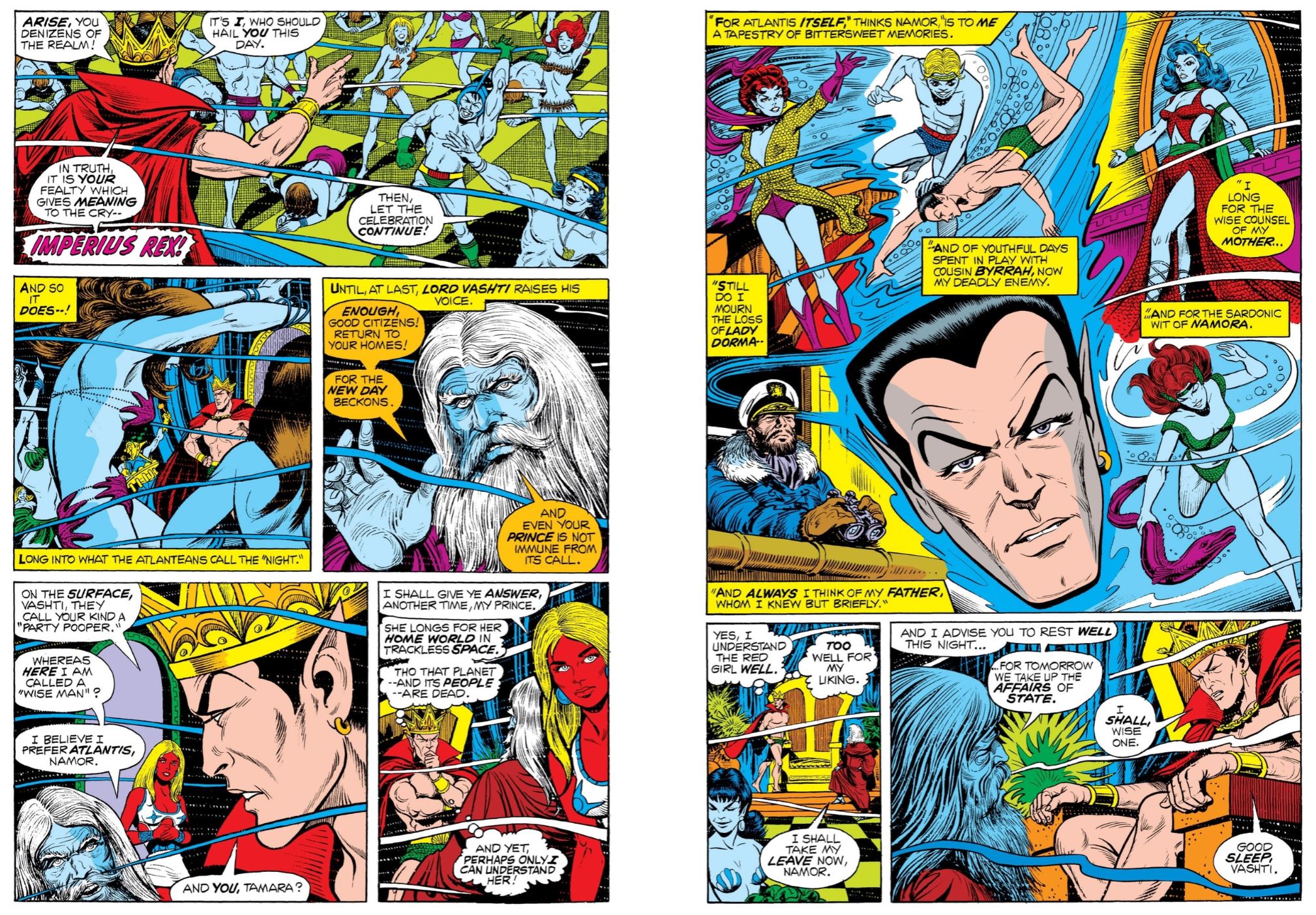
It was an open secret that Bill Everett was dying at this time but his Marvel friends and employers allowed him to work on until he couldn’t. Thus Sub-Mariner #61’s ‘The Prince and the Pirate!’ – credited to Steve Gerber, Everett, Win Mortimer & Jim Mooney – opens with the old master pictorially revealing revelry in the subsea kingdom as Namor’s coronation ends before a new storyline starts with page 4 as Namorita and her human guardian Betty Prentiss are abducted along with an entire passenger plane. The voyagers are victims of deranged geneticist Dr. Hydro who mutates them all – bar already amphibian Nita – into human/merman hybrids to populate his armies of environmental conquest. All too soon Namor tracks the ongoing abductions and invades mobile island Hydrobase to save his cousin, but is soundly defeated by the maniac’s super science. Moreover, the attack inspires Hydro to invade Atlantis and make it his stronghold from which to convert the rest of humanity…
The drama plays out in #62 as Gerber, Sam Kweskin & Frank Giacoia explore ‘A Realm Besieged!’ before Tamara in Atlantis and Nita on Hydrobase thwarts Hydro’s schemes leaving the Sub-Mariner to ponder what to do with the hundreds of innocent, unwilling scaly amphibian freaks that neither Atlanteans or surface-dwellers want anything to do with…
Steve Gerber was a uniquely gifted writer who combined a deep love of Marvel’s continuity minutiae with dark irrepressible wit, incisive introspection, barbed socio-cultural criticism, a barely reigned-in imagination and boundless bizarrely wilful surrealism. His stories were always at the extreme edge of the company’s intellectual canon and never failed to deliver surprise and satisfaction, especially when he couched his sardonic sorties in thinly veiled attacks on burgeoning cultural homogenisation and commercial barbarity.
With critical success Man-Thing he was holding up a mirror to many cordoned-off and taboo subjects and weaving history from scattered snippets of Marvel’s continuity. With his final stint on Sub-Mariner, Gerber expanded that universe exponentially, building by exploring the pre-cataclysm days of Atlantis, aided by Howard Chaykin in anew back-up series dubbed ‘Tales of Atlantis!’ here the first chapter – inked by Joe Sinnott – sees antediluvian, human-built Atlantis losing its war with rival superpower Lemuria and Emperor Kamuu and his bride Zartra prepare for the bloody end…
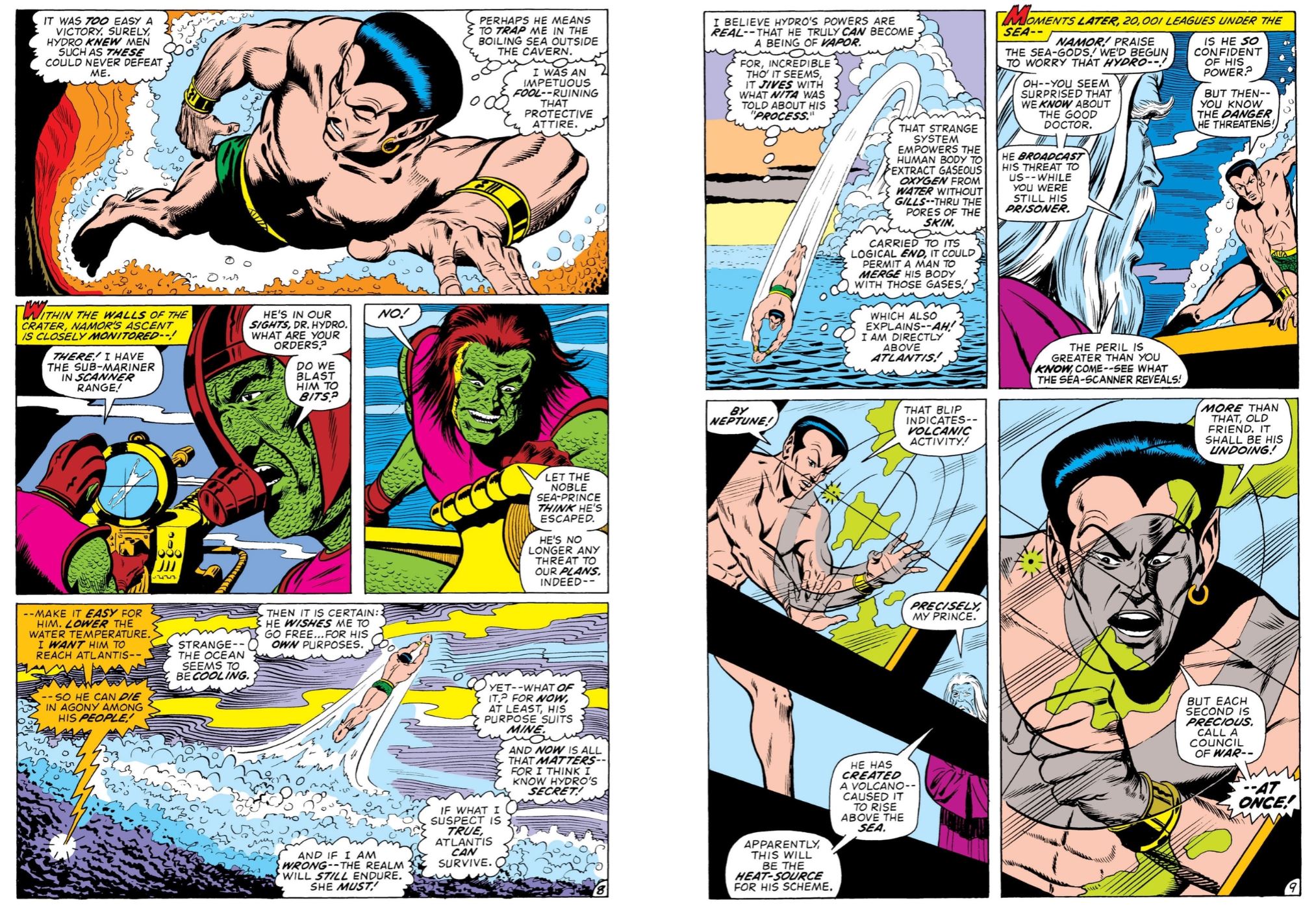
Over Everett’s posthumous plot, Gerber, Kweskin & Syd Shores produce #63 as ‘…And the Seas Shall Explode!’ sees seemingly dead Dr Hydro return to destroy the Atlanteans by triggering a volcano under their city and compelling Namor to take no chances and offer no mercy to save his subjects once and for all…
Tales of Atlantis resumes as Gerber, Chaykin & Sinnott reveal how the fate of the first Atlantis is sealed by ‘Cataclysm!’ As hand-to-hand combat peaks, the city sinks beneath the seas, but its heritage is saved, carried away by missionary sorceress Zered-Na and her devout disciples (for which you need to scope out Gerber’s other contemporaneous assignments: Son of Satan in Marvel Spotlight and the aforementioned Man-Thing in Adventures into Fear. we’ve covered them I previous post so feel free to scroll away in the search engines…
Here, however, and taking off on a strange tangent Gerber, Don Heck & Don Perlin play with satire and pop culture during #64’s ‘Voyage into Chaos!’ When intolerant Atlanteans intern the aimless, despondent amphibian victims of Dr. Hydro, furious, ashamed Namor responds with a fit of fury, just as cool heads are needed to assess another astounding incursion.
Soon, a quartet of strange visitors from magical dimension Zephyrland – Ariel the Musician, Ibbar the Scolar, Kabal the Wizard & Zargus the Warrior – are petitioning the Sub-Mariner to hop in their Golden Submarine and help them liberate their enslaved homeland from bestial, tone-deaf horror Virago the She-Beast. Willing and even eager to go for many reasons Namor joins them but is ambushed and defeated as soon as arrives in the land of golden meanies…
Third instalment of Tales of Atlantis ‘In the Wake of the Warriors!’ reveals how, five millennia later, nomadic clans of water-breathing Homo Mermanus settle in the ruins of the sunken city-continent and clash constantly, thanks to the enmity of sworn enemies Widow-Queen Elanna and King Stegor. They cannot see waves of destiny pushing their battle-hardened children towards an incredible coalition. Successive chapters ‘The Lurker in the Ruins!’ (Gerber, Mooney & Frank Chiaramonte in #65 and concluding episode ‘The Sword in the Throne!’ inked by Sinnott in #66) ended the series abruptly as those children – destiny- touched Kamuu and Elanna’s daughter Zartra – after meeting ghosts and battling demons, unite the tribes to create the dynasty of sunken Atlantis that will lead to the coming millennia later of Namor…
Back in the now however, the series was struggling and a rapid radical rebrand as Prince Namor, the Savage Sub-Mariner with #65 leads with ‘The Cry of the She-Beast!’ as Gerber, Heck & Perlin detail how Virago crushes resistance at home, physically humiliates Namor and launches an attack across dimensions upon Atlantis. Her departure sparks a successful but so-costly revolution in Zephyrland and (with valiant Namor clinging to her Golden Submarine) provokes a shocking resurrection after splashing down on Earth in #66. ‘Rise, Thou Killer Whale’ by Gerber, Heck & Perlin sees Virago driven away from Atlantis at great cost, only to stumble upon the tomb of defeated – but apparently only dormant – Orka the (humanoid) Killer Whale – who unites with a clearly kindred spirit to devastate the sunken city with an armada of crazed cetaceans…
The catastrophic clash leads to the Sub-Mariner again falling, but this time it is amidst toxic nerve gas dumped by surface dwellers. The chemical poisons fatally alter his body chemistry, making it impossible to breathe air or maintain body moisture. Moreover, as the cloud of death expands currents wash it overs Atlantis, plunging all within the perimeter – Virago and Orka included – into a stasis-like coma in landmark tale ‘Seawinds of Change!’ by Gerber, Heck & Frank Bolle.
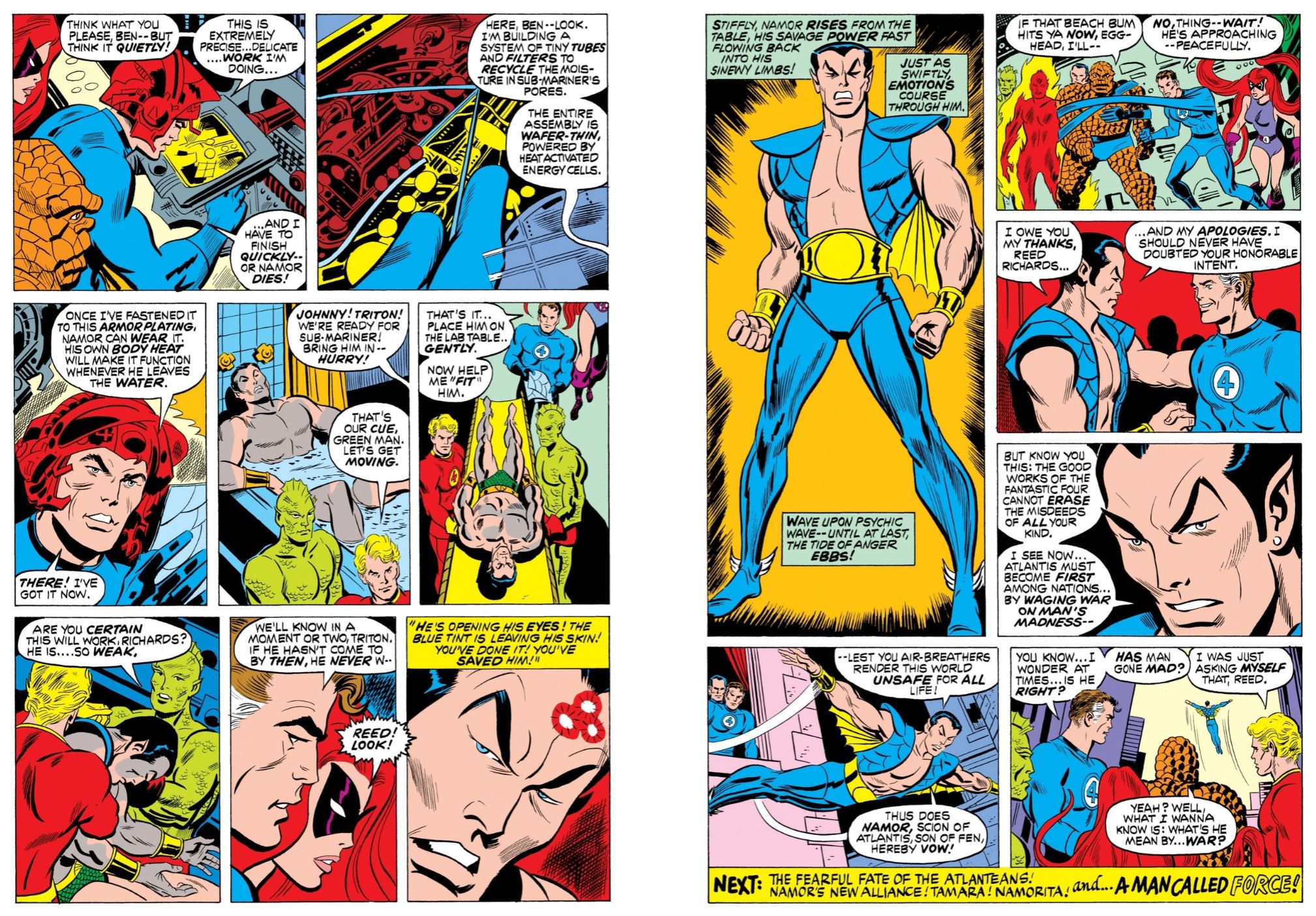
Thankfully, although dying Namor heads for the surface where he is found by old ally Triton of The Inhumans, who in turns brings Namor to old enemies the FF. Smartest Man Alive Reed Richards swiftly diagnoses and rapidly constructs a bodysuit to provide constant artificial respiration – over Namor’s churlish and violent protests – and he heads home to finish his fight. Sadly, what he finds in #68 (January 1974, Mooney inks), leaves him ‘On the Brink of Madness!’
Only Tamara, Nita and Hydro’s amphibians have escaped the nerve agent’s effects and now must calm down the bereft and crushed monarch. Convinced to stabilise the crisis, they relocate to the vacant Hydrobase and direct Namor to a human scientist whose research into forcefields might provide a means to protect the dormant Atlanteans from predators and further harm. After seeking spiritual guidance from patron god Father Neptune, Namor sets off, but when the king without a kingdom seeks out Dr Damon Walthers, he discovers the genius’ works stolen by his assistant. Shot from the sky by a neophyte supervillain calling himself Force, their initial clash is inconclusive but does draw the attention of passing student Peter Parker…
Meanwhile in Zephyrland, the war goes badly and the survivors consider calling in Sorcerer Supreme Stephen Strange…
George Tuska & Vince Colletta illustrate Prince Namor, the Savage Sub-Mariner #69 as Gerber rapidly wraps up his hanging plot threads in anticipation of a sudden cancellation. ‘Two Worlds …and Dark Destiny!’ sees Dr Strange offer aid, a pointless battle between spider hero and fishman and a second and final encounter with Force that leaves Namor victorious, in control of Walthers forcefield tech and Atlantis safely stored “under glass” until a cure can be found… an inauspicious but satisfactory stopping point. Confoundingly the series still had three issues to run with Marv Wolfman, Tuska & Colletta using #70 to depict ‘Namor Unchained!’ whilst adding further safeguards to sleeping Atlantis, until targeted by the now-independent mutated fishmen of Dr. Dorcas under the guidance of an ambitious aquatic atrocity…
The brutal duel culminated in more deaths and butchery as #71 clamours ‘Comes the Pirahna!’ and the series finally sank with #72 (dated September 1974 and on sale from 18th June) as Steve Skeates, Dan Adkins & Colletta catered an alien encounter as Namor faced obnoxious humans and a lost interstellar shapeshifter in ‘From the Void It Came…’
The antihero resurfaced in Giant-Sized Super-Villain Team-Up #1 (cover-dated March 1975), revived as one half of a tag-team with fellow misunderstood autocrat Doctor Doom whilst seeking a cure for his people and his own condition. That sustained momentum led to the last tale here, a solo exploit taken from Marvel Spotlight #27 (April 1976) as Bill Mantlo & Mooney revealed ‘Death is the Symbionic Man!’ Incorporating Prime Earth’s military industrial villain Captain Simon Stryker (of alternate Earth series Deathlok the Demolisher) the pacy yarn saw Sub-Mariner hunted for possible spare parts and powers by the maniac and battling his most deadly killer-cyborg to date…
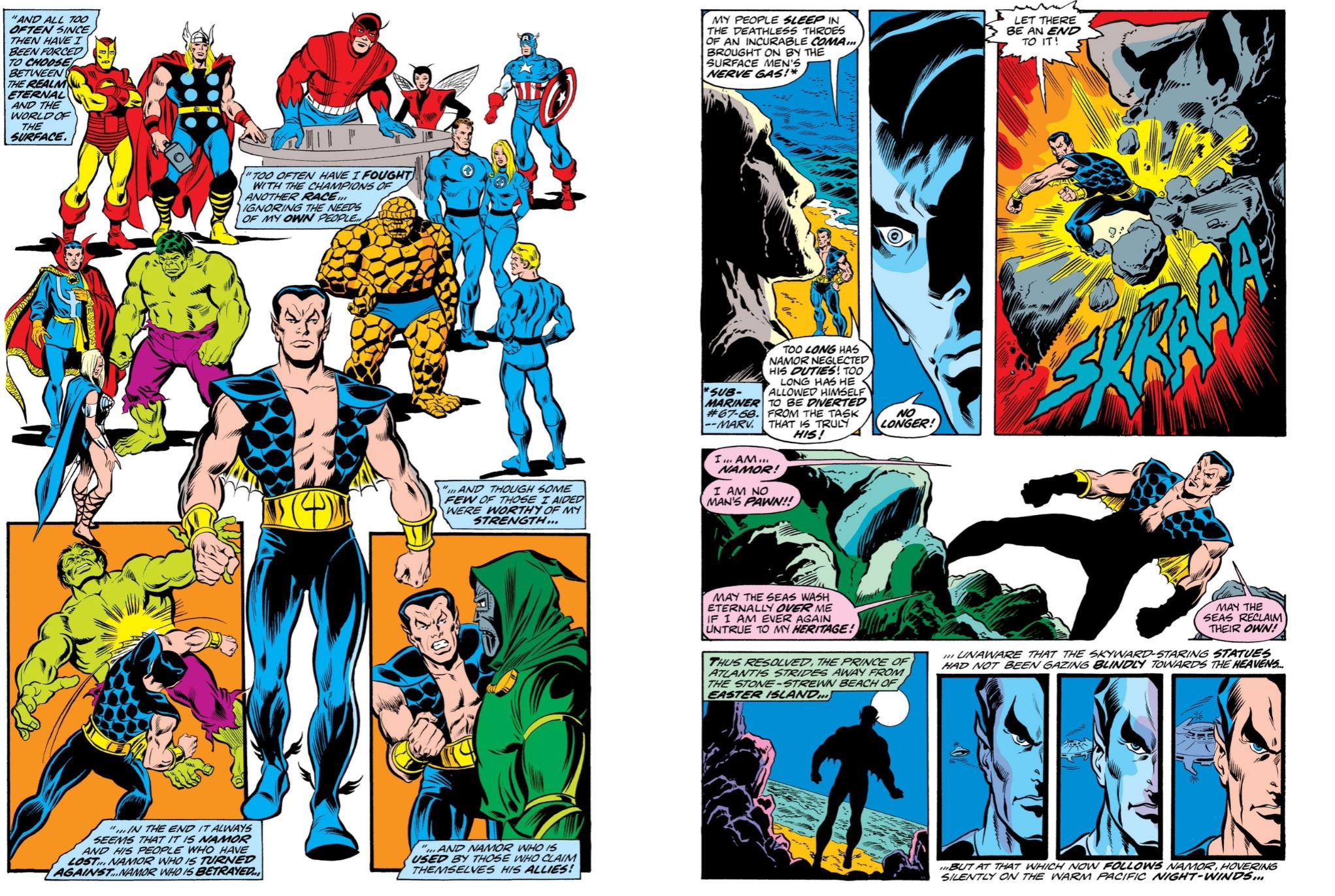
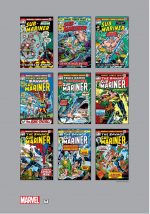
The bonus section in this final collection includes the covers by Everett, John Romita, Rich Buckler, Larry Lieber, Sinnott, Gil Kane, Giacoia, Mike Esposito & Al Milgrom; House ads; the editorial page from #67 wherein Gerber explained the costume change; Romita’s original designs for the new outfit and a selection of original art by Heck, Perlin & Mooney.
In comics, the best thing about “the Mighty falling” is that so often another time throws up fresh ideas and creators who will regenerate faded concepts. It a cycle as timeless and relentless as the tides. The venerable Sub-Mariner always comes back stronger and more appetising, and you owe it to yourself to be ready for the next wave by getting to know these classics. Many early Marvel Comics are more exuberant than qualitative, but this volume, especially from an story-lover’s point of view, is a wonderful exception: historical treasures with narrative bite and indescribable style and panache that fans will delight in forever.
© 2018 Marvel Characters, Inc. All rights reserved. (or possibly © 2026 MARVEL.)
Today in 1924 cartoonist Frank Bolle (The Heart of Juliet Jones, Winnie Winkle, Black Phantom, Tim Holt, Doctor Solar, Man of the Atom) was born, sharing the date with writer Joss Whedon (Astonishing X-Men, Buffy, Fray) in 1964; artist ChrisCross AKA Christopher Williams (Xero, Blood Syndicate, Justice League) in 1968, and author Becky Cloonan (Demo, American Virgin, Gotham Academy, Conan) in 1980.
Today in 2005, artist Sam Kweskin (Atlas anthologies such as Battlefront & Journey Into Mystery; Kid Colt, Outlaw, Sub-Mariner) died.