Green Lantern Corps: Ring Quest


By Peter J.Tomasi, Patrick Gleason & various (DC Comics)
ISBN: 978-1-84856-116-8

Following on from the bombastic Sinestro Corps War, this volume (collecting Green Lantern Corps issues #19, 20 and 23 through 26) of the space opera/cop procedural drama finds the battered but triumphant interstellar peacekeepers on a deadly clean-up duty.

Dispatched by the Guardians of the Universe to collect or confiscate the deadly yellow power rings of their dead foes, an elite team of GLs is ambushed by the monstrous son of Mongul, a ruthless alien despot who controls one of the most insidious and horrifying weapons in creation. And now he’s started collecting yellow rings and rebuilding the Sinestro Corps…

Glossy and gritty, it’s tension and confrontation all the way in this highly readable thriller, but there’s still room for a few “buddy-movie” moments as Earth Lanterns Guy Gardner and Kyle Rayner spend their downtime trying to open a cop-bar on the Guardian’s precinct-planet Oa…

Although this is highly continuity-dependent, determined newcomers will still be able to extract a vast amount of histrionic enjoyment out of this explosive action-blockbuster – and you could always buy the other volumes to get caught up…

© 2008 DC Comics. All Rights Reserved.

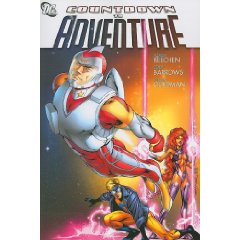
Countdown to Adventure


By Adam Beechen, Eddy Barrows & Allan Goldman (DC Comics)
ISBN: 978-1-84576-866-9

Spinning out of the weekly miniseries 52, (see Volumes 1-4: – ISBN: 1-84576-552-4, ISBN: 978-1-84576-553-8, ISBN: 978-1-84576-604-7 and ISBN: 978-1-84576-624-5) wherein Adam Strange, Starfire and Animal Man were lost in space for a year, this tale of two worlds originally ran as the lead feature in the comicbook miniseries Countdown to Adventure #1-8 (the back-up spot revealing the history and fate of the Forerunner – a living weapon created by the Monitors of the Mulitiverse as a kind of intelligent attack dog): a sidebar saga to the then-ongoing Countdown to Final Crisis.

All caught up? Splendid.

Earthman Adam Strange is reunited with his family on the distant world of Rann when he is forcibly retired as Planetary Champion and replaced by the obnoxious film and Ultimate Fighting celebrity Steven “Champ” Hazard. Whereas Strange solved threats with his wits and good heart, The Champ is psychotically brutal and aggressive, preferring to shoot first and keep on shooting till he’s the only person still breathing.

In San Diego Buddy Baker has returned to his job as a stuntman, since his Animal Man powers are malfunctioning, but at least that’s better than Princess Koriand’r of Tamaran, who has lost her energy-casting abilities completely. For weeks she’s been unconscious in Buddy’s spare room, resting, recharging and not contacting her old super-hero friends in the Teen Titans.

But when Buddy’s son and other people start exhibiting signs of a “Rage-Plague” extraterrestrial contagion experts isolate the city and prepare to sterilise everything in it if they can’t find patient zero, who must have brought the rapidly spreading infection to Earth…

On Rann the same symptoms are ripping through the citizenry, fomenting violence, intolerance and even physical transformations. And then on both worlds the infected begin to chant a phrase Strange, Koriand’r and Buddy last heard from the religious zealots of Lady Styx, a death-worshipping monstrosity they killed a year ago and a zillion light years away…

This interplanetary bio-plague thriller has lots of pace and action, and keeps the tension high, but falls just short of being exceptional or compelling since even newest recruit can plainly see that everything’s going to be all right in the end. Fine for a lazy afternoon but hardly a keeper and adds nothing to the lustre of its stellar, fan favourite cast.

© 2007, 2008 DC Comics.  All Rights Reserved.

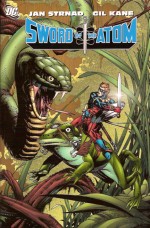
Sword of the Atom

sword-of-the-ato
By Jan Strnad & Gil Kane, with various (DC Comics)
ISBN13: 978-1-4012-1553-8

Wonderfully reminiscent of his superlative Blackmark paperback venture (collected in Blackmark: the 30th Anniversary Edition ISBN: 1-56097-456-7), artist Gil Kane was inspired in this retooling of Silver-Age B-List hero The Atom, removed from his comfort zone of scientific crime-busting to become the sword-wielding champion of a barbaric fantasy kingdom.

Starting off with a four issue miniseries and followed by three giant-sized Specials, the sword and lost science saga revitalized a once great character who had fallen on very lean times and set him up for his eventual return to the big leagues (I apologise for the puns – lowest form of wit, I know!).

Following the break-up of his marriage to ambitious lawyer Jean Loring, size-changing physicist Ray Palmer departs on a research trip to Brazil to think things through. Unfortunately he falls foul of drug-runners who down his plane. To the world he appears dead, but in reality he has stumbled upon an alien civilisation, populated by golden humanoids no more than six inches tall.

Lost for uncounted decades in the verdant vastness of the Amazon on a planet of giants, the aliens have built a city around the ruins of their crashed ship, a vessel powered by White Dwarf star matter. Regrettably, since the incredible star-stuff powers and constitutes the Atom’s size changing outfit, the mighty mite finds himself trapped at the same diminutive height and must rely on his physical prowess and a sharp sword to survive…

In the epic manner of Edgar Rice Burroughs’ John Carter of Mars, Palmer rescues and woos the exotic Princess Laethwen and saves the hidden city of Morlaidh from a usurping dictator in a classic romp of action-packed derring-do. It’s a fabulous dose of ultimate escapism perfectly executed by Kane and writer Jan Strnad, and subsequent sequels continued the magic.

Without wishing to give too much away, the first of these sees a disgruntled and displaced Palmer back in our world, longing for the simplicity of Morlaidh and the love of Laethwen; the second finds Jean doing her own size-shifting (this is probably when she learned the skills she used in Identity Crisis, ISBN: 1-34576-126-X, fans!) as the Tiny Titan is forced to choose between his old life and his current one. The book concludes with Kane replaced by Pat Broderick and Dennis Janke for a rather wordy tale of despots, plague and monstrous afflictions devastating the diminutive jungle kingdom which only the Atom can combat.

Despite the rather tame final tale Sword of the Atom is a flashing, vital burst of graphic excitement that clearly shows what can be done with moribund characters if creators are bold enough and given sufficient editorial support. It’s also a hugely enjoyable read that will make your heart race and your pulse pound – just like comics are supposed to.

© 1983, 1984, 1985, 1988, 2007 DC Comics. All Rights Reserved.

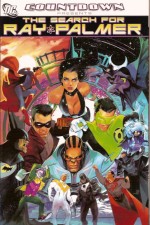
Countdown Presents: The Search for Ray Palmer


By various (DC Comics)
ISBN13: 978-1-84576-868-3

This review feels more like a shopping list than an inducement to share my experiences but if you persevere – with both my burblings and especially this slim tome published as a sidebar to the mega-crossover Countdown to Final Crisis – there’s fun to be had for the dedicated fan.

One of the major plot threads of the main event is that missing physicist/shrinking superhero Ray Palmer holds the answer to an unspecified Great Disaster looming in the future of the DC Universe. A select group of heroes led by a renegade Monitor (a kind of super-watchman assigned to invigilate one of the 52 universe of the multiverse) must search all the realities in hope of finding him before its too late…

A number of Countdown Presents: the Search for Ray Palmer one-shots were released during the weekly, year-long run of the parent series, set on the various 52 Earths (many in fact previously seen alternates or Elseworlds concepts, handily assimilated into the DCU for the occasion).

The first collected here is ‘Running Wild!’ by Ron Marz, Angel Unzueta and inkers Oliver Nome, Richard Friend, Saleem Crawford and Trevor Scott from CPtSFRP: WildStorm #1 wherein Donna Troy, Kyle (Green Lantern) Rayner, Jason (I used to be Robin, and dead) Todd and Bob the Monitor encounter various heroes and villains of the WildStorm Universe in an annoying series of disconnected vignettes that only make sense when read in conjunction with the relevant instalments of the weekly series.

Much more palatable is ‘The Jokester’s Last Laugh’ by Sean McKeever, Jamal Igle and Rob Hunter (from CPtSFRP: Crime Society #1) as the searchers – calling themselves the Challengers of the Unknown – arrive on the world where good is evil and the superheroes are villains. This chapter at least boasts a complete story that can be followed as does the next sinister stopover on an Earth where Batman became a vampire (as seen in Batman: Vampire – Tales of the Multiverse ISBN13: 978-1-84576-645-0).

‘Red Rain: Blood Lust’ by Peter Johnson, Matt Cherniss and Kelley Jones is a brief interlude that originally appeared in DC Infinite Halloween Special #1 and leads directly into CPtSFRP: Red Rain #1 which presented ‘Red Robin’ by Johnson, Jones, Eric Battle, Angel Unzueta, Derek Fridolfs, Vicente Cifuentes and Jonathan Glapion; a gory undead horror from which our protagonists barely escape.

Their next stop is the far more dignified but no less deadly world of Gotham by Gaslight (from the CPtSFRP one-shot of the same name). ‘Night of the Bat’ by Brian Augustyn, Greg Tocchini, Jesse Delperdang, Derek Fridolfs and Paul Neary, a good old-fashioned romp followed by the equally impressive ‘Red Son’ set on a world where that rocket from Krypton landed in the Soviet Union not Kansas. Alan Burnett, Travis Foreman and Lorenzo Ruggiero produced this high-octane cold war incident for CPtSFRP: Red Son #1.

The book, if not the story, ends with ‘Superwoman/Batwoman’ from the eponymous one-shot, a charming and rather peculiar tale from an Earth where the genders of everybody we’re familiar with are reversed. The strangeness comes courtesy of Justin Gray, Jimmy Palmiotti, Kalman Andrasofszky, Jeremy Haun, David Hahn, David Baldeón, Norm Rapmund, Álvaro López, Rick Ketcham and Steve Bird.

On the last page you’ll find that the challengers don’t succeed and that you’ll need Countdown to Final Crisis volume 3 to find out what happens next. As with all the tales here you’ll be reminded that the real story is going on elsewhere and that the confusions you’ve been experiencing were largely unnecessary. The transition from periodical publishing events to book collections is still a young science and every so often the formats simply don’t work together.

This time it would have been best to stick these exceedingly good one-shots into the appropriate places in regular compilations rather than have them stand as the bewildering mess they are here.

© 2007, 2008 DC Comics. All Rights Reserved.

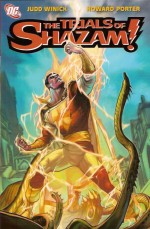
The Trials Of Shazam! Volume 2


By Judd Winick, Howard Porter & Mauro Cascioli (DC Comics)
ISBN: 978-4012-1829-4

Completing the saga begun in volume 1 (ISBN: 978-4012-1331-2) this book reprints issues #7-12 of the DC miniseries and finds Freddy Freeman, once and future super-hero, now successfully blessed with the wisdom of Solomon and the invincibility of Achilles, but only half the strength of Hercules.

Tasked by the 21st century Gods of Magic to prove himself to each of them before winning their powers and patronage, his rite of passage and super-powers have been hijacked by the deadly teenaged psychopath Sabina De La Croix, who intends to steal the magic of the departed wizard Shazam for her coven of evil sorcerers.

Not only has she intercepted some of the might intended for the boy-hero, but she’s even killed one of the gods that should empower him. Freddy must now find a replacement patron simply to complete the trials…

And if that’s not trouble enough some of those remaining gods don’t want their new lives disrupted. They might kill him before Sabina does…

Great thrills and spills beautifully illustrated by Howard Porter (with Mauro Cascioli providing the art for the last three chapters) make this a terrific read for fans of the genre, but I’m still unhappy at the unnecessary division into two short volumes when one complete book would have been easier, cheaper and a more satisfying package.

© 2007, 2008 DC Comics. All Rights Reserved.

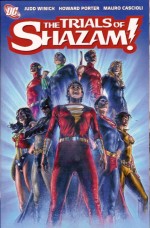
The Trials Of Shazam! Volume 1


By Judd Winick & Howard Porter (DC Comics)
ISBN: 978-4012-1331-2

Inexplicably this is the first of two very slim volumes that collect the pivotal miniseries which redefined magic in the DC Universe after the events of Infinite Crisis. The collection itself (gathering issues #1-6 of the 12 part miniseries, plus the relevant prologue section of the one shot Brave New World) isn’t a conundrum. The story rattles along at a fine clip, full of tension, action and spectacle, and there’s even a little humour.

It’s very well illustrated in an epic, lush manner by Howard Porter. All in all, the tale is a solid Costumes Drama. But what I can’t fathom is why the thing is chopped into two halves when it could so easily – and economically – fit into one volume.

In the aftermath of the aforementioned Infinite Crisis (ISBN: 978-1-4012-0959-9), wild, raw magic escaped into all aspects Earth when the millennial wizard Shazam died and the meta-dimensional Rock of Eternity was destroyed (for further details you should also check out Day of Vengeance, ISBN13: 978-1-84576-230 8). The aged mage was the guardian of magic in our universe and his position was hastily, albeit temporarily, filled by Captain Marvel.

When the senior super-hero unexpectedly ascended to the position Captain Marvel Junior and Mary Marvel – who shared the power – were instantly cut off whilst battling supernatural horrors rampaging across Earth.

Months later with the immediate danger forestalled Freddy Freeman (the human form of Captain Marvel Junior) is offered the opportunity to regain his god-like powers and be a hero once more. But in this new era he must earn them one at a time by completing tasks set by the modern incarnations of the patron gods who supplied Shazam with the power…

Unfortunately its not that simple as a coven of demons and magicians have unleashed their own candidate for the Gods’ abilities and she’s a relentless, ruthless psychopath ready to cheat, steal and especially kill to win the ultimate weapon in the new world older of the supernatural…

© 2006, 2007 DC Comics. All Rights Reserved.
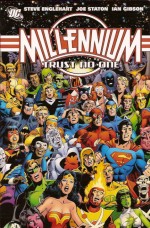
Millennium


By Steve Englehart, Joe Staton & Ian Gibson, (DC Comics)
ISBN: 978-1-84856-094-9

DC Comics third braided mega-series was a bold effort intended to touch all corners of their universe, introduce new characters, tie-in many titles and moreover to do so on a weekly, not monthly schedule.

Hot on the heels of Crisis on Infinite Earths (ISBN: 978-1-56389-750-4) and Legends (ISBN: 978-1-56389-095-6) came Millennium, which saw writer Steve Englehart expand on an iconic tale from Justice League of America #140-141as well as his run on the Green Lantern Corps.

Billions of years ago the robotic peacekeepers called Manhunters had rebelled against their creators. The Guardians of the Universe were immortal and desired a rational, emotionless cosmos – a view not shared by their own women. The Zamarons had abandoned the Guardians at the inception of their grand scheme but after uncounted centuries the two factions had reconciled and left our reality together.

Now they had returned with a plan to midwife a new race of immortals on Earth, but the Manhunters who had infiltrated all aspects of society throughout the universe were determined to thwart the plan, whether by seduction, connivance or just plain brute force. The heroes of Earth gathered to protect the project and confront the Manhunters in their own private lives… and their own comics.

Unfortunately this volume, which only collects the eight-issue miniseries without even a synopsis of those individual tie-ins, is an incomprehensible morass of confusion. In its original form each weekly instalment of Millennium acted as a catalyst for events which played out in the rest of the DC Universe’s comics. Here, without those concluding chapters, the plot and characters bounce about from crisis to revelation to denouement and nothing makes any sense at all.

In addition to the miniseries itself, Millennium spread across 21 titles for two months – another 37 issues for a grand total of 44 comic-books. I know that there might be some small confusion about existing plot-threads in individual titles but nothing like the sheer bewilderment caused by just collecting the core miniseries as a stand-alone book. The target audience is clearly primed – both financially and in terms of story scope – for extended trade paperback series now in the wake of Seven Soldiers, 52 and Countdown to Final Crisis, so why foist this sad, truncated, bowdlerized abridgement on us?

Steve Englehart, Joe Staton and England’s own Ian Gibson may not be stellar names at the moment but this tale was ambitious, bold and highly entertaining, whilst many of the follow-up chapters were incredibly impressive, with individual contributions from such luminaries as George Perez, John Byrne, Kevin Maguire, Kieth Giffen, Jerry Ordway and a host of others. Even if it’s only in the cheap and cheerful Showcase Presents format, don’t the creators and especially the readers deserve the whole story?

© 1988, 2008 DC Comics. All Rights Reserved.

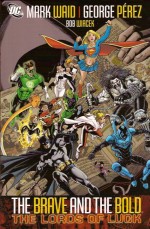
THE BRAVE AND THE BOLD: THE LORDS OF LUCK


By Mark Waid & George Pérez (DC Comics)
ISBN13: 978-1-84576-649-8 (trade paperback)

It’s probably just my age but I often think that I might have a few deep-seated problems with most modern comics. I’ve seen the same old plots regurgitated over and over too many times. Maybe the old stuff is only better because I’ve bronzed it uncritically with my personal nostalgias. Nonetheless a large proportion of contemporary product feels shallow, glossy and calculatedly contrived to me.

But then something like this turns up. The trade paperback edition of The Brave and the Bold: The Lords of Luck collects the first six issues of another revival of this venerable DC title and returns it not only to the fitting team-up format we all enjoyed but does it with such style, enthusiasm and outright joy that I’m almost a gawping, drooling nine-year-old again. Mark Waid, George Pérez and inkers Bob Wiacek and Scott Koblish have crafted an intergalactic romp through time and space that rips across the DC Universe in a funny, thrilling and immensely satisfying murder-mystery-come-universal-conquest saga.

When Batman and Green Lantern discover absolutely identical corpses hundreds of miles apart it sets them on the trail of probability-warping aliens and the missing Book of Destiny – a mystical chronicle of everything that ever was, is, and will be!

Each issue/chapter highlights a different team-up and eventually the hunt by Adam Strange, Blue Beetle, Destiny (of the Endless, no less), the Legion of Super Heroes, Lobo, Supergirl and a mystery favourite from long-ago (you’ll thank me for not blowing the secret, honestly!) plus an incredible assortment of cameo stars coalesces into a fabulous free-for-all that affirms and reinforces all the reasons I love this medium.

With the value-added bonus of a an annotated exploration of Waid and Pérez’s creative process to entrance the aspiring creator-of-tomorrow, this is a great story, with great art and is perfect for all ages to read and re-read over and over again.

© 2006, 2007 DC Comics. All Rights Reserved.
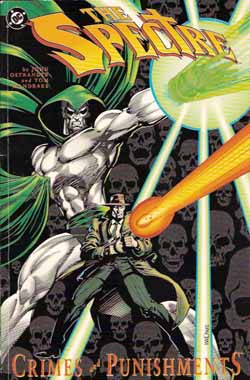
The Spectre: Crimes and Punishment

The Spectre: Crimes and Punishment

By John Ostrander & Tom Mandrake (DC Comics)
ISBN: 1-56389-127-1

The Spectre is one of the oldest characters in DC’s vast stable of characters, created by Jerry Siegel and Bernard Baily in 1940 for More Fun Comics #52 and 53. And just like Siegel’s other iconic creation, he suffers from a basic design flaw: he’s just too darn powerful. But, unlike Superman, he’s already dead, so he can’t really be dramatically imperilled. Starting as a virtually omnipotent ghost, he evolved, over various returns and refits into a tormented soul bonded to the incarnation of the biblical Wrath of God.

With his superb version from the early 1990s, John Ostrander shifted the narrative onto the Tabula Rasa that was Jim Corrigan, a depression era cop whose brutal murder released The Spectre into the world of costumed heroes. This take on the character ran for nearly five years and lent a tragic, barbaric humanity to a hero who was simply too big and too strong for periodical comics.

Collected here is the first four-part story-arc wherein the troubled and Earth-bound Corrigan meets the vulnerable Amy Beitermann, a social worker who is the target of a serial killer – and somehow a living link to the detective’s own murder fifty years ago.

Powerful and often shocking, the developing relationship forces The Spectre’s mortal aspect to confront the traumas of his long suppressed childhood as he relives his own death and the ghastly repercussions of his return. With intense, brooding art by long-time collaborator Tom Mandrake, this incarnation of the character was by far the most accessible – and successful. If it had launched a year or so later and it might well have been a star of the budding Vertigo imprint.

The masterful interpretation seems largely forgotten these days but hopefully with DC trawling its back catalogue for worthy book-fodder this tale – and the issues that followed it – might make a speedy reappearance on book store shelves. Let’s hope so…

© 1992, 1993 DC Comics. All Rights Reserved.
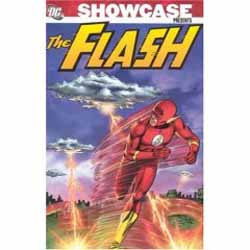
Showcase Presents The Flash vol 1

Flash Showcase 1

By various (DC Comics)
ISBN13: 978-1-4012-1327-5

No matter which way you look at it, the Silver Age of the American comic book began with The Flash. It’s an unjust but true fact that being first is not enough; it also helps to be best and people have to notice. The Shield beat Captain America to the news-stands by over a year yet the former is all but forgotten today.

The industry had never really stopped trying to revive the superhero genre when Showcase #4 was released in late summer of 1956, with such precursors as The Avenger (February-September 1955), Captain Flash (November 1954-July 1955), Marvel’s Human Torch, Sub-Mariner and the aforementioned Sentinel of Liberty (December 1953 – October 1955) and even DC’s own Captain Comet (December 1953 – October 1955) and Manhunter from Mars (November 1955 until the end of the 1960’s and almost the end of superheroes again!) still turning up in second-hand-stores and “Five-and-Dime” half-price bins. What made the new Fastest Man Alive stand out and stick was … well, everything!

Once the DC powers-that-be decided to try superheroes once more, they moved pretty fast themselves. Editor Julie Schwartz asked office partner and Golden-Age Flash scripter Robert Kanigher to recreate a speedster for the Space Age, aided and abetted by Carmine Infantino and Joe Kubert, who had also worked on the previous incarnation. The new Flash was Barry Allen, a forensic scientist simultaneously struck by lightning and bathed in the exploding chemicals of his lab. Supercharged by the accident, Barry took his superhero identity from a comic book featuring his predecessor (a scientist named Jay Garrick who was exposed to the mutagenic fumes of “Hard Water”). Designing a sleek, streamlined bodysuit (courtesy of Infantino – a major talent who was approaching his artistic and creative pinnacle) Barry Allen became the point man for the spectacular revival of a genre and an entire industry.

This gloriously economical, vast black and white tome superbly compliments Infantino’s talents, collecting not only all four Showcase tryout issues and the first full fifteen issues of his own title, but also kicks off with the very last Golden Age adventure from Flash Comics #104 (February 1949). In ‘The Rival Flash’ Kanigher, Infantino and inker Frank Giacoia re-examine the first Flash’s origin when an evil scientist recreates the secret of his speed. Exuberant, avuncular and hugely entertaining in its own right, it’s nonetheless a dated, clunky tale in comparison to what follows.

In sharp counter-point ‘Mystery of the Human Thunderbolt’ (scripted by Kanigher) and ‘The Man Who Broke the Time Barrier’ (written by the superb John Broome) are polished, coolly sophisticated short stories that introduce the comfortingly suburban new superhero and firmly establish the broad parameters of his universe. Whether defeating bizarre criminal masterminds such as The Turtle or returning the criminal exile Mazdan to his own century the new Flash was a protagonist of keen insight and sharp wits as well as overwhelming power.

Showcase #8 (June 1957) led with another Kanigher tale. ‘The Secret of the Empty Box’, a perplexing but pedestrian mystery, saw Frank Giacoia return as inker, but the real landmark is the Broome thriller ‘The Coldest Man on Earth’. With this yarn the author confirmed and consolidated the new phenomenon by introducing the first of a Rogues Gallery of outlandish super-villains. Unlike the Golden Age the new super-heroes would face predominantly costumed foes rather than thugs and spies. Bad guys would henceforth be as memorable as the champions of justice. Captain Cold would return time and again. Broome would go on to create every single member of Flash’s pantheon of super-foes.

Joe Giella inked the two adventures in Showcase #13 (April 1958) ‘Around the World in 80 Minutes’, written by Kanigher and Broome’s ‘Master of the Elements’ which introduced the outlandish Mr. Element, who returned in Showcase#14 (June 1958) with a new M.O. and identity – Doctor Alchemy. ‘The Man who Changed the Earth!’ is a great crime-caper, but Kanigher’s eerie ‘Giants of the Time-World!’ is a masterful fantasy thriller and a worthy effort to bow out on. When the Scarlet Speedster graduated to his own title John Broome was the lead writer, supplemented eventually by Gardner Fox. Kanigher would return briefly in the mid-1960s and would later write a number of tales during DC’s ‘Relevancy’ period.

The Flash #105 launched with a February-March 1959 cover-date (so it was out for Christmas 1958) and featured Broome, Infantino and Giella’s sci-fi chiller ‘Conqueror From 8 Million B.C.!’ and introduced yet another super-villain in ‘The Master of Mirrors!’. ‘The Pied Piper of Peril!’ in #106 introduced another criminal menace, whilst the second story introduced one of the most charismatic and memorable baddies in comics history. Gorilla Grodd and his hidden race of super-simians debuted in ‘Menace of the Super-Gorilla!’, promptly returning for the next two issues,

Presumably this early confidence was fuelled by DC’s inexplicable but commercially sound pro-Gorilla editorial stance (for some reason any comic with a big monkey in it markedly outsold those that didn’t in those far-ago days) but these tales are also packed with tension, action and engagingly challenging fantasy concepts.

Issue #107 lead with the ‘Return of the Super-Gorilla!’ by the regular team of Broome Infantino and Giella, a multi-layered fantasy thriller that took our hero from the African (invisible) city of the Super-Gorillas to the subterranean citadel of antediluvian Ornitho-Men, and ‘The Amazing Race Against Time’ featured an amnesiac who could outrun the Fastest Man Alive in a desperate race against time to save creation. With every issue the stakes got higher and the quality and narrative ingenuity got better!

Frank Giacoia inked #108’s high-tech death-trap thriller ‘The Speed of Doom!’ featuring trans-dimensional raiders but Giella was back for ‘The Super-Gorilla’s Secret Identity!’ wherein Grodd devises a scheme to outwit evolution itself. The next issue brought ‘The Return of the Mirror-Master’ with the first in a series of bizarre physical transformations that would increasingly become a signature device for Flash stories, whilst the Space Race provided a evocative maguffin for a fantastic undersea adventure in the ‘Secret of the Sunken Satellite’.

The Flash #110 was a huge landmark, not so much for the debut of another worthy candidate to the burgeoning Rogues Gallery in ‘The Challenge of the Weather Wizard’ (inked by Schwartz’s artistic top-gun Murphy Anderson) but rather for the introduction of Wally West, who in a bizarre and suspicious replay of the lightning strike that created the Scarlet Speedster became a junior version of the Fastest Man Alive. Inked by Giella, ‘Meet Kid Flash!’ introduced the first sidekick of the Silver Age (cover dated December 1959-January 1960 and just pipping Aqualad who premiered in Adventure Comics #269 which had a February off-sale date).

Not only would Kid Flash begin his own series of back-up tales from the very next issue (a sure sign of the confidence the creators had in the character) but he would eventually inherit the mantle of the Flash himself – one of the few occasions in comics where the torch-passing actually stuck.

Anderson also inked ‘The Invasion of the Cloud Creatures’ in # 111, which successfully overcomes its frankly daft premise to produce a tense sci-fi thriller and nicely counterpoints the first solo outing for Kid Flash in ‘The Challenge of the Crimson Crows!’ This folksy parable has small-town kid Wally West use his new powers to rescue a bunch of kids on the slippery slope to juvenile delinquency. Perhaps a tad paternalistic and heavy-handed by today’s standards, in the opening months of 1960 this was a strip about a little boy heroically dealing with a kid’s real dilemmas, and the strip would remain concerned with human scaled problems, leaving super-menaces and world saving for team-ups with his mentor.

In #112 ‘The Mystery of the Elongated Man’ introduced that super stretchable character to the DC universe in an intriguing puzzler whilst Kid Flash tackled juvenile Go-Carters and corrupt school-contractors in the surprisingly gripping ‘Danger on Wheels!’ The Trickster launched his crime career in #113’s lead tale ‘Danger in the Air!’ and the Kid took a break so that his senior partner could defeat ‘The Man Who Claimed the Earth!’ a full-on cosmic epic wherein the alien Po-Siden attempts to bring the lost colony of our world back into the Empire of Zus.

Captain Cold and Murphy Anderson returned for ‘The Big Freeze’, where the smitten villain turns Central City into a glacier just to impress Flash’s girlfriend Iris West. Meanwhile her nephew Wally saved a boy unjustly accused of cheating from a life of crime when he falls under the influence of the ‘King of the Beatniks!’ The Flash #115 featured another bizarre transformation, courtesy of Gorilla Grodd in ‘The Day Flash Weighed 1000 Pounds!’, and when aliens attempted to conquer the Earth he needed ‘The Elongated Man’s Secret Weapon’ as well as the guest-star himself to save the day. Once again Murphy Anderson’s inking gave the over-taxed Joe Giella a breather whilst taking art-lovers’ breath away in this beautiful, pacy thriller.

‘The Man Who Stole Central City’ had a seemingly fool-proof way of killing the Flash in #116, which took some outwitting, and Kid Flash returned in ‘The Race to Thunder Hill’, a father-son tale of rally driving, but with car-stealing bandits and a young love interest for Wally to complicate the proceedings. ‘Here Comes Captain Boomerang’ by Broome, Infantino and Anderson introduced the Australian super-criminal in what is still one of the most original origin tales ever concocted, whilst ‘The Madcap Inventors of Central City’ saw Gardner Fox (creator of the Golden Age Flash) join the writing team with an ill-considered attempt to reintroduce the comedy relief trio of Winky, Blinky and Noddy to the modern Flash Fans. The fact that you’ve never heard of them should indicate how well that went, although the yarn, illustrated by Infantino and Giella is a fast, witty and enjoyably silly change of pace.

Issue #118 highlighted the period’s (and DC’s) fascination with Hollywood in ‘The Doomed Scarecrow!’ (inked by Anderson), a sharp thriller featuring a villain with a unique reason to get rid of our hero whilst Wally and a friend had to spend the night in a “haunted house” in the Kid Flash chiller ‘The Midnight Peril!’

This wonderful first volume ends with The Flash #119, in which Broome, Infantino and Anderson relate the adventure of ‘The Mirror-Master’s Magic Bullet’, which our hero narrowly evades only to join an old friend in ‘The Elongated Man’s Undersea Trap’ which introduced the vivacious Sue Dibny (as a newly wed “Mrs Elongated Man”) in a mysterious and stirring tale of sub-sea slavers.

These earliest tales were historically vital to the development of our industry, but, quite frankly, so what? The first exploits The Flash should be judged solely on their merit, and on those terms they are punchy, awe-inspiring, beautifully illustrated and captivating thrillers that amuse, amaze and enthral both new readers and old devotees. This lovely collection is a must-read item for anybody in love with our art-form

© 1949, 1956-1961, 2007 DC Comics. All Rights Reserved.