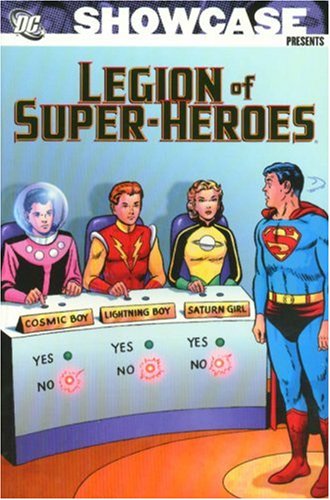
Showcase Presents Legion of Super-Heroes volume 1


By Otto Binder, Jerry Siegel, Robert Bernstein, Edmond Hamilton, Al Plastino, Curt Swan, John Forte, Jim Mooney, & various (DC Comics)
ISBN: 978-1- 4012-1382-4 (TPB)

Once upon a time in the far future, super-powered kids from many alien civilisations took inspiration from the greatest legend of all time and banded together as a club of heroes. One day those Children of Tomorrow came back in time and invited that legend to join them…

Thus, began the vast and epic saga of the Legion of Super-Heroes, as first envisioned by writer Otto Binder & artist Al Plastino when the many-handed mob of juvenile universe-savers debuted in Adventure Comics #247 (April 1958), just as the revived superhero genre was gathering an inexorable head of steam in America. Happy 65th Anniversary, team!

Since that time the fortunes and popularity of the Legion have perpetually waxed and waned, with their future history tweaked and rebooted, retconned and overwritten again and again to comply with editorial diktat and popular whim.

This glorious, far-and-wide ranging collection assembles the preliminary appearances of the valiant Tomorrow People, tracking their progress towards and attainment of their own feature. It re-presents in stunning monochrome all pertinent tales from Adventure Comics #247, 267, 282, 290, 293, 300-321, Action Comics #267, 276, 287, 289, Superboy #86, 89, 98, Superman #147, Superman Annual #4 and Superman’s Pal Jimmy Olsen #72 and 76.

As already stated, the many-handed mob of youthful worlds-savers debuted in Adventure #247, dreamed up for a Superboy tale wherein three mysterious kids invite the Boy of Steel to the 30th century. He is being vetted to join a team of metahuman champions unanimously inspired by his historic career. Binder & Plastino’s throwaway concept inflamed public imagination and after a slew of further appearances throughout Superman Family titles, the LSH eventually took over Superboy’s lead spot in Adventure: thereafter enjoying their own far-flung, quirky escapades, with the Kid Kryptonian reduced to “one of the in-crowd”…

However here the excitement was still gradually building as the kids returned for an encore 18 months later, Adventure #267 (December 1959) saw Jerry Siegel & George Papp make the Boy of Steel ‘Prisoner of the Super-Heroes!’ when the teen wonders attacked and incarcerated Superboy of Steel because of a misunderstood ancient historical record…

The following summer Supergirl met the Legion in Action Comics #267 (Siegel & Jim Mooney, August 1960) as Lightning Lad, Saturn Girl and Cosmic Boy secretly travelled to “modern day” America to invite the Maid of Might onto the team, in a repetition of their offer to Superboy 15 years previously (in nit-picking fact they claimed to be the children of the original team – a fact glossed over and forgotten these days. Don’t time-travel stories make your head hurt?).

Due to a dubious technicality, young and eager Kara Zor-El failed her initiation at the hands of ‘The Three Super-Heroes’ and was asked to reapply later – but at least we got to meet a few more Legionnaires, including Chameleon Boy, Invisible Kid and Colossal Boy.

With the editors still cautiously testing the waters, it was Superboy #86 (January 1961) before the ‘The Army of Living Kryptonite Men!’ by Siegel & Papp turned the LSH into a last-minute Deus ex Machina to save the Smallville Sentinel from juvenile delinquent Lex Luthor’s most insidious assault. Two months later, in Adventure #282, Binder & Papp introduced Star Boy as a romantic rival for the Krypton Kid in ‘Lana Lang and the Legion of Super-Heroes!’

Action Comics #276 (May 1961) debuted Supergirl’s Three Super Girl-Friends’ (Siegel & Mooney) which finally saw her crack the plasti-glass ceiling and join the team, sponsored by Saturn Girl, Phantom Girl and Triplicate Girl. We also met for the first time Bouncing Boy, Shrinking Violet, Sun Boy and potential bad-boy love-interest Brainiac 5 (well at least his distant ancestor Brainiac was a very bad boy…)

Next comes pivotal 2-part tale ‘Superboy’s Big Brother’ (by Robert Bernstein & Papp from Superboy #89 and June 1961) in which an amnesiac, super-powered space traveller crashes in Smallville, speaking Kryptonese and carrying star-maps written by the Boy of Steel’s long-dead father…

Jubilant, baffled and suspicious in equal amounts, Superboy eventually, tragically discovers The Secret of Mon-El’ by accidentally exposing the stranger to a lingering, inexorable death, before providing critical life-support by depositing the dying alien in the Phantom Zone until a cure can be found…

Sporting an August 1961 cover-date, Superman #147 unleashed ‘The Legion of Super-Villains’ (Siegel, Curt Swan & Sheldon Moldoff): a stand-out thriller featuring Luthor and an evil adult Legion coming far too close to destroying the Action Ace until the temporal cavalry arrives…

In Adventure #290 (November), Bernstein & Papp seemingly gave Sun Boy a starring role in ‘The Secret of the Seventh Super-Hero!’ – a clever tale of redemption and second chances, which is followed in #293 (February 1962) by a gripping thriller from Siegel, Swan & George Klein. The Legion of Super-Traitors’ sees the future heroes turn evil, prompting Saturn Girl to recruit a Legion of Super-Pets – comprising Krypto, Streaky the Super Cat, Beppo, the monkey from Krypton and magical Super-horse Comet to save the world…

‘Supergirl’s Greatest Challenge!’ (Siegel & Mooney, Action #287 April) sees her visit the Legion (quibblers be warned: for some reason it was mis-determined as the 21st century in here) to save future Earth from invasion). She also meets a telepathic descendent of her cat Streaky. His name is Whizzy (I could have omitted that fact but chose not to – once more for smug, comedic effect and in sympathy with all humans-with-cats everywhere)…

Action #289 featured ‘Superman’s Super-Courtship!’ wherein the Girl of Steel scours the universe to locate an ideal mate for her cousin. One highly possible candidate is adult Saturn Woman, but her husband Lightning Man objects…

Perhaps charming at the time, although modern sensibilities might quail at the conclusion that his perfect match is a doppelganger of Kara herself… albeit – and thankfully – a bit older…

By the release of Superboy #98 (July 1962), the decision had been made. The buying public wanted more Legion stories and after ‘The Boy With Ultra-Powers’ by Siegel, Swan & Klein introduces an enigmatic lad with greater powers than the Boy of Steel, focus shifted to Adventure Comics #300 (cover dated September 1962) where the super-squad finally landed their own gig; even occasionally taking an alternating cover-spot from still top-featured Superboy.

Tales of the Legion of Super-Heroes opened its stellar run with Siegel, John Forte & Plastino’s ‘The Face Behind the Lead Mask!’; a fast-paced premier pitting Superboy and the 30th century champions against an unbeatable foe until Mon-El, long-trapped in the Phantom Zone, temporarily escapes a millennium of confinement to save the day…

In those halcyon days humour was as important as action, imagination and drama, so many early exploits were light-hearted – if a little  moralistic. Issue #301 offered hope and role model to fat kids everywhere with ‘The Secret Origin of Bouncing Boy!’ by regular creative team Siegel & Forte. This yarn formalised a process of open auditions – providing devoted fans with loads of truly bizarre and memorable applicants over the years – whilst allowing the rebounding human rotunda to give a salutary pep talk and inspirational recount of heroism persevering over adversity.

Adventure #302 featured ‘Sun Boy’s Lost Power!’, as the golden boy is forced to resign until fortune and boldness restore his abilities, whilst ‘The Fantastic Spy!’ in #303 provides a tense tale of espionage and possible betrayal by new member Matter-Eater Lad.

The readership was stunned by the events of #304 when Saturn Girl engineers ‘The Stolen Super-Powers!’ to make herself a one-woman Legion. Of course, it was for the best possible reasons, but still doesn’t prevent the shocking murder of Lightning Lad…

With cosy complacency utterly destroyed, #305 further shook everything up with ‘The Secret of the Mystery Legionnaire!’ who turns out to be the long-suffering Mon-El finally cured and freed from his Phantom Zone prison.

Normally I’d try to be more obscure about story details – after all my intention is to get new people reading old comics, but these “spoiler” revelations are key to further understanding here and you all know these characters are still around, don’t you?

Pulp science fiction writer Edmond Hamilton took over the major scripting role with #306, and introducing ‘The Legion of Substitute Heroes!’ (quirkily, perfectly illustrated by John Forte). This is a group of rejected applicants who selflessly band together to clandestinely assist the champions who spurned them, after which transmuting orphan Element Lad joins the major team. He seeks vengeance on space pirates who had wiped out his entire species in ‘The Secret Power of the Mystery Super-Hero!’ before #308 seemingly sees ‘The Return of Lightning Lad!’

Actual Spoiler Warning: skip to the next paragraph NOW!!! if you don’t want to know it’s actually his similarly empowered sister who – once unmasked and unmanned – takes her brother’s place as Lightning Lass

‘The Legion of Super-Monsters!’ is a straightforward clash with embittered applicant Jungle King who takes rejection far too personally and gathers a deadly clutch of space beasts to wreak havoc and vengeance, whilst #310’s ‘The Doom of the Super-Heroes!’: a frantic battle for survival against an impossible foe.

Adventure #311 opens ‘The War Between the Substitute Heroes and the Legionnaires!’ with a cease-and-desist order from the A-Team that turns into secret salvation as the plucky, stubborn outcasts carry on regardless under the very noses of the blithely oblivious LSH…

The next issue (September 1963) features the ‘The Super-Sacrifice of the Legionnaires!’ and inevitable resurrection of Lightning Lad – but only after the harrowing sacrifice of one devoted team-member, after which Superman’s Pal Jimmy Olsen #72 (October, by Siegel, Swan & Klein) visits ‘The World of Doomed Olsens!’ Depicting an intriguing enigma as the cub-reporter is confronted by materialisations of his most memorable metamorphoses, it’s all just a prank by those naughty Legion scamps – but one with a serious purpose behind the jolly japery…

Adventure #313’s ‘The Condemned Legionnaires!’ (Hamilton, Swan, Klein & Forte) affords Supergirl a starring role after the sinister Satan Girl infects the team with a deadly plague, forcing them all into perpetual quarantine, before ‘The Super-Villains of All Ages!’ (art by Forte) reveals how a manic mastermind steals a Legion Time-Bubble to recruit the greatest monsters and malcontents of history – Nero, Hitler and John Dillinger – as his irresistible army of crime.

Why he’s surprised when they double-cross him and possess Superboy, Mon-El and Ultra Boy is beyond me , but happily, the lesser legionnaires still prove more a match for the brain-switched rogues. Then ‘The Legionnaires Super-Contest!’ in #315 finally sees the Substitute Heroes go public, for which the primary team offer to allow one of them to join the big boys. Which one? That’s the contest part…

Issue #316’s ‘The Renegade Super-Hero!’ outs one trusted teammate as a career criminal who then goes on the run, but there’s more to the tale than at first appears, after which the heroes confront The Menace of Dream Girl!’: a ravishing clairvoyant who beguiles her way into the Legion for her own obscure, arcane reasons. In her knowing way she presages the coming of deadly foe The Time Trapper and even finds time to convert electrically redundant sister of recently-resurrected Lightning Lad into gravity-warping Light Lass.

Adventure #318 sees The Mutiny of the Legionnaires!’ as Sun Boy succumbs to battle fatigue and became a draconian Captain Bligh during an extended rescue mission, whilst in Superman’s Pal Jimmy Olsen #76 (April 1964) Siegel & Forte describe Elastic Lad Jimmy and his Legion Romances!’ wherein the plucky journo is inveigled into the future and finds himself inexplicably irresistible to the costumed champions of Tomorrow. It isn’t his primitive charm, though…

Hamilton & Forte began a strong run of grittier tales from #319 on, beginning with ‘The Legion’s Suicide Squad!’ as the Science Police ask the team to destroy, at all costs, a monolithic space fortress, whilst #320 debuts daring new character in Dev-Em, a forgotten survivor of Superman’s dead homeworld who was little more than a petty thug when Superboy first defeated him. Now in ‘The Revenge of the Knave From Krypton!’ ( Siegel, Forte, Papp, Moldoff & Plastino), the rapscallion returns as either a reformed undercover cop or the greatest traitor in history…

The story portion of this titanic tome concludes with Adventure Comics #321 and Hamilton, Forte & Plastino’s ‘The Code of the Legion!’, revealing the team’s underlying Articles of Procedure during a dire espionage flap, simultaneously testing one Legionnaire to the limits of his honour and ingenuity and actually ending another’s service forever.

Perhaps. Sort of…

An appropriate extra from Superman Annual #4, follows: featuring a 2-page informational guide and pictorial check-list illustrated by Swan & Klein which was amended and supplemented in Adventure #316 with additional pages of stunning micro-pin-ups, all faithfully included here. This fabulously innocent and imaginative chronicle also includes every cover the team starred on: mostly the work of honorary Legionnaire Curt Swan and inkers George Klein, Stan Kaye & Sheldon Moldoff.

The Legion is undoubtedly one of the most beloved and bewildering creations in American comic book history and largely responsible for the growth of the groundswell movement that became Comics Fandom. Moreover, these sparkling, simplistic and devastatingly addictive stories as much as the legendary Julie Schwartz Justice League fired up the interest and imaginations of a generation of young readers and built the industry we all know today.

These naive, silly, joyous, stirring and utterly compelling yarns are precious and fun beyond any ability to explain – even if we old lags gently mock them to ourselves and one another. If you love comics and haven’t read this stuff, you are the poorer for it and need to enrich your future life as soon as possible.
© 1958-1964, 2007 DC Comics. All Rights Reserved.
DC Pride 2021


By Vita Ayala, Sina Grace, Sam Johns, Danny Lore, Nicole Maines, Steve Orlando, Andrea Shea, Mariko Tamika, James Tynion IV, Andrew Wheeler, Stephen Byrne, Elena Casagrande, Klaus Janson, Nic Klein, Trung Le Nguyen, Amancay Nahuelpan, Slylar Patridge, Amy Reeder, Ro Stein & Ted Brandt, Lisa Sterle, Rachael Stott, Luciano Vecchio & various (DC Comics)
ISBN: 978-1-88456-804-6 (HB/Digital edition)

Since the 1960s and the birth of the Civil Rights Movement, comics have always been at the forefront of the battle for equality. Maybe more so in terms of racial issues at the start and not so much on gender disparity or sexual complexity, but now most print and screen superheroes work towards greater diversity and inclusion. The most noticeable strides and breakthroughs have come from industry leaders DC and Marvel, but maybe it’s just that more is expected of them…

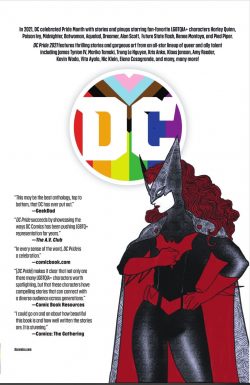
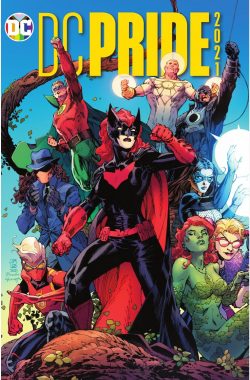
In 2021, the former celebrated accumulated personal freedoms by collecting one-shot DC Pride #1 and select material from similarly-themed specials New Years Evil #1, Mysteries of Love in Space #1 and Young Monsters in Love #1 (cumulatively spanning 2018-2021), celebrating the infinite variety of interpersonal relationships focusing on LGBTQIA+ characters in the DC catalogue as interpreted by creators equally all-embracing.

The compilation – variously lettered by Aditya Bidikar, Josh Reed, Arian Maher, Becca Carey, Steve Wands, Tom Napolitano and Dave Sharpe – opens with a fulsome Foreword from Out & Proud bestselling author and comics scribe Mark Andreyko before we plunge into assorted antics…

James Tynion IV & Trung Le Nguyen begin the festivities with ‘The Wrong Side of the Looking Glass’ as Batwoman Kate Kane confronts memories of her twin sister/deranged arch nemesis Alice and how her enforced solitude after Beth Kane seemingly died may have affected her own life path, after which John Constantine meets magician Extraño in a pub and starts chatting. Gregorio de la Vega was officially DC’s first openly gay super-character, debuting in weekly megaseries Millennium #2 (January 1988) and latterly as a member of The New Guardians. For ‘Time in a Bottle’ creators Steve Orlando & Stephen Byrne pit him in a tall tale contest co-starring Midnighter and featuring queer Nazi vampire cultist Count Berlin

Vita Ayala, Skylar Patridge and colourist José Villarrubia then set lesbian cop Renee Montoya and her alter ego The Question on the trail of a missing politician in ‘Try the Girl’ whilst Mariko Tamaki, Amy Reeder & Marissa Louise have Harley Quinn & Poison Ivy spectacularly and near-lethally address their unique relationship problems in ‘Another Word for a Truck to Move Your Furniture’.

After being in the closet since the 1930s, original Green Lantern Alan Scott shares the story of his first love with openly out son Todd AKA Obsidian. As related by Sam Johns, Klaus Janson & colourist Dave McCaig, ‘He’s the Light of My Life!’ is a sweet romantic interlude balanced by ‘Clothes Makeup Gift’ – by Danny Lore, Lisa Sterle & Enrica Angiolini – a female wherein future Flash multitasks prepping for a date with a new girlfriend and taking down a Mirror Master knockoff Reflek

The Flash connection continues with reformed Rogue Pied Piper foiling and then mentoring social activist outlaw Drummer Boy in wry caper ‘Be Gay, Do Crime’ by Sina Grace, Ro Stein & Ted Brandt before DCTV superhero Dreamer makes their comic book debut in ‘Date Night’, courtesy of Nicole Maines, Rachael Stott and Angiolini.

Arch villains Monsieur Mallah and The Brain prove to gay cop Maggie Sawyer that love truly comes in all forms in Orlando & Nic Klein’s moving confrontation ‘Visibility’ after which Lobo’s troubled, long-abandoned daughter Crush learns some hard truths from the wrong role model in ‘Crushed’ by Andrea Shea and Amancay Nahuelpan Trish Mulvihill…

Harley Quinn offers her particular seasonal felicitations to Renee Montoya and Gotham City in Ayala, Elena Casagrande & Jordie Bellaire’s rendition of ‘Little Christmas Tree’ prior to a host of gay heroes attending a Pride March and forming a team of their own to battle Eclipso in ‘Love Life’ by Andrew Wheeler, Luciano Vecchio & Rez Lokus.

The combination of Aqualad Jackson Hyde, Aerie, Wink, Apollo & Midnighter, Bunker, Tasmanian Devil, The Ray, Shining Knight, Steel/Natasha Irons, Sylvan Ortega, Tremor, Traci 13, Extraño, Batwoman and Crush proved unbeatable and led to them proudly declaring themselves Justice League Queer

This award-winning collection also comes with a cover gallery including 17 variant covers for DC titles during Pride Month and featuring many other out stars, crafted by David Talaski, Brittney Williams, Kevin Wada, Kris Anka, Nick Robles, Sophie Campbell, Travis Moore & Alejandro Sánchez, Jen Bartel, Paulina Ganucheau, Stephen Byrne and Yoshi Yoshitani and closes with a screen-loaded fact feature.

‘DCTV: The Pride Profiles’ offers brief interviews, and Q-&-As of LGBTQ characters in The CW shows – including Batwoman/Ryan Wilder (played by Javicia Leslie), Dreamer (Nicole Maines), White Canary/Sara Lance (Caity Lotz), John Constantine (Matt Ryan), Thunder (Nafessa Williams) and Negative Man (Matt Bomer).

Forthright, fun, thrilling and fabulous, feel free to find and feast on these comics and stories.
© 2018, 2019, 2021, 2022 DC Comics. All Rights Reserved.

Superman: The Dailies 1939-1940


By Jerry Siegel & Joe Shuster with Paul Cassidy (DC/Kitchen Sink Press)
ISBN: 978-1-56389-460-2 (TPB)

It’s indisputable that the American comic book industry – if it existed at all – would have been an utterly unrecognisable thing without Superman. Jerry Siegel & Joe Shuster’s unprecedented invention was rapturously adopted by a desperate and joy-starved generation, quite literally giving birth to a genre if not an actual art form.

Within three years of his 1938 debut, the intoxicating blend of breakneck, breathtaking action and wish-fulfilment that epitomised the early Man of Tomorrow spawned an impossible army of imitators. The original’s antics and variations grew to encompass cops-and-robbers crime-busting, socially reforming dramas, science fiction fantasies, and whimsical comedy. Once the war in Europe and the East ensnared America, patriotic relevance for a host of gods, heroes and monsters exploded: all dedicated to exuberant, eye-popping excess and vigorous dashing derring-do.

In comic book terms Superman was master of the world. Moreover, whilst transforming the shape of the fledgling funnybook industry, the Metropolis Marvel relentlessly expanded into all areas of the entertainment media. Although we all think of the Cleveland boys’ iconic invention as the epitome and acme of comicbook creation, the truth is that very soon after his debut in Action Comics #1, the Man of Steel became a fictional multimedia monolith in the same league as Popeye, Tarzan, Sherlock Holmes and Mickey Mouse.

We parochial and possessive comics fans too often regard our purest, most powerful icons in purely graphic narrative terms, but the likes of Batman, Spider-Man, The Avengers and their hyperkinetic kind long ago outgrew four-colour origins and are now fully mythologized media creatures instantly recognisable globally across all platforms and age ranges…

Far more people have seen or heard an actor as Superman than have ever read his comic books. The globally syndicated newspaper strips alone reached untold millions, and by the time his 20th anniversary rolled around, Superman was a thrice-weekly radio serial regular and starred in an astounding animated cartoon series, two films, on TV and a prose novel by George Lowther.

He was a perennial sure-fire success for toy, game, puzzle and apparel manufacturers and had just ended that first smash live-action television presence. In his future were three more shows (Superboy, Lois & Clark and Smallville), a stage musical, a string of blockbuster movie franchises and an almost seamless succession of games, bubble gum cards and TV cartoons beginning with The New Adventures of Superman in 1966 and continuing ever since. Even his super-dog Krypto got in on the small-screen act…

Although pretty much a spent force these days, for the majority of the last century the newspaper comic strip was the Holy Grail that all American cartoonists and graphic narrative storytellers hungered for. Syndicated across the country – and often the planet – it was seen by millions, if not billions, of readers and generally accepted as a more mature and sophisticated form of literature than comic books. It also paid better.

And rightly so: some of the most enduring and entertaining characters and concepts of all time were created to lure readers from one particular paper to another and many of them grew to be part of a global culture.

Mutt and Jeff, Flash Gordon, Dick Tracy, Buck Rogers, Charlie Brown and so many more escaped their humble tawdry newsprint origins to become meta-real: existing in the minds of earthlings from Albuquerque to Zanzibar. Most of them still do…

However it was considered something of a risky double-edged sword when a comicbook character became so popular that it swam against the tide (after all, weren’t the funny-books invented just to reprint the strips in cheap accessible form?) to become a genuinely mass-entertainment syndicated serial strip.

Superman was the first comic book star to make that leap – six months after exploding out of Action Comics – with only a few ever successfully following. Wonder Woman, Batman (eventually) and teen icon Archie Andrews made the jump in the 1940s with only a handful like Spider-Man, Howard the Duck and Conan the Barbarian doing so since.

The Superman daily newspaper strip launched on 16th January 1939, and was eventually supplemented by a full-colour Sunday page from November 5th of that so momentous year. Originally crafted by Siegel & Shuster – whose primary focus switched immediately from comic books to the more prestigious and lucrative tabloid iteration – and their hand-picked studio (including Paul Cassidy, Leo Nowak, Dennis Neville, John Sikela, Ed Dobrotka, Paul J. Lauretta & Wayne Boring), the mammoth grind soon required the additional talents of Jack Burnley and even co-writers like Whitney Ellsworth, Jack Schiff & Alvin Schwartz.

This superb collection from 1999 – long overdue for re-release, especially in this anniversary year! – opens with an Introduction by James Vance, declaring ‘A Job for Superman’ before effusively recapping the overnight sensation conception, reviewing his antecedents and regaling us with the acts of his creators (and assistants like Cassidy).

Then we see the first 10 tales (nine and a half actually) of the primal powerhouse in all-action monochrome. Wisely and boldly, the first serial – ‘Superman Comes to Earth’ (16th – 28th January 1939) only depicts the Man of Tomorrow on the last of the 12 daily episodes. Instead, Siegel & Shuster took readers to doomed planet Krypton for the first time and revealed how desperate scientist Jor-L and wife Lora were thwarted in their attempts to save the population from their own indifference and ignorance and compelled in desperation to save their newborn son by sending him away in a prototype test rocket aimed at planet Earth. Almost as an afterthought, the last strip reveals how the infant was found, adopted, raised and now operates in secret as vigilante do-gooder Superman…

Whether in pamphlet or local periodical, these tales of the modern Hercules exploded into the consciousness of the world. No one had ever seen a fictionalised hero throw all the rules of physics away and burst into unstoppable, improbable action on every page and panel. In fact, editors and publishers’ greatest concern was that the implausible antics would turn off audiences. Clearly, they could not have been more wrong…

That’s only one reason why the indomitable champion confronted problems and issues every reader was familiar with. Second adventure ‘War on Crime’ (30th January – 18th February) combined social activism and civic corruption as the mighty Man of Tomorrow begins his crusading career by rescuing ten men trapped in a vault. In fact he only saves eight and realises that he needs to be in a place where information can reach him instantly. Thus Clark Kent applies for a job at The Daily Star and stumbles into a deadly case of graft, gangsterism and high-level corruption ferreted out by dynamic reporter Lois Lane. After Superman cleans up the racketeers, the shy unassuming new guy confirms his position by scooping Lois to the first interview with the mysterious costumed vigilante…

A boxing drama follows as the Man of Steel saves a derelict from suicide and uncovers a tragic case of match-fixing and shattered dreams. ‘The Comeback of Larry Trent’ (20th February – 18th March) begins with Superman masquerading as the supposedly finished former heavyweight champion in a whirlwind tour of spectacular bouts, whilst training and rehabilitating the stumblebum to reclaim his title personally in the big championship match. Of course, the Action Ace is on hand when Trent’s crooked manager tries to dope him a second time…

Lois begins her own rise to stardom when she’s relegated to the lonely hearts and lovelorn section, turning up a sinister case of a blackmailed husband entrapped by ‘Jewel Smugglers’ (20th March – April 1st) victimising refugees fleeing war in Europe. Naturally, Superman is lurking in the shadows, ready to handle any necessary roughness required…

A string of fatalities on a construction site takes the hero into the sordid depths of capitalism in ‘Skyscraper of Death’ (3rd – 29th April) as he tackles a saboteur and exposes a ruthless businessman happy to kill innocent workers to destroy a rival, after which ‘The Most Deadly Weapon’ (1st May – 10th June) reflects the tone of the times in a chilling tale of espionage and realpolitik. When Kent interviews Professor Runyan about his deadly new poison gas, the chemist is kidnapped and murdered by spies from a foreign nation. In hot pursuit, Kent discovers the plot was instigated by an arms dealer profiteering from an ongoing civil war and calls in his other – true – self to recover (and ultimately destroy) the formula, punish the perpetrators and even spectacularly force both sides to make peace…

Early episodes never stinted on action and increasingly ingenious ways of displaying Superman’s miraculous abilities. The plan was to simply establish the set-up of an Alien Wonder among us, masquerading as an extremely puny human at a “great metropolitan newspaper” when not crushing evil as his flamboyant alter-ego. These stories are all about constant action and escalating spectacle, displaying the incredible power of a bombastic, heroic man of the people…

Heralding longer stories and more evocative plots, Siegel returned to social crusading for ‘Superman and the Runaway’ (12th June – 22nd July), as the Man of Steel recues orphan Frankie Dennis from imminent destruction and discovers a tale of shocking corruption and abuse at the State Orphanage the boy would rather die than return to. Realising this is no job for Superman, Kent enlists Lois and Frankie to expose monstrous, murderous Superintendent Lyman, but severely underestimates the grafter’s ruthlessness…

Romance taints the air next as ‘Royal Deathplot’ (24th July – 11th November) finds Superman foiling a plan to literally torpedo the diplomatic mission of visiting dignitaries King Boru and Princess Tania of Rangoria. His epic and breathtaking sea battle against a submarine is only the tip of an iceberg of trouble as Superman – and even briefly Kent – find favour in the eyes of the princess, even as elements in the royals’ own embassage continually seek their destruction. Far from impressed, but hot on a scoop, Lois sticks close and plays fifth wheel and rival to super-smitten Tania until the Man of Steel can foil the plot, crush the sinister mad scientist behind it and stabilise the political situation at home and abroad…

Historians might be interested to know that during this yarn, the use of art assistant Cassidy became markedly more noticeable. Other than handling character faces himself, Shuster was happy for the other artists to express themselves in how Siegel’s scripts were interpreted…

Major events were in store both for the hero and the whole of humanity and ‘Underworld Politics’ (13th November – 16th December) signalled the closing of a chapter. Simple cathartic super-deeds would soon take a back seat to grander designs, but only after the tale of how Superman – and especially Lois – destroyed the seemingly impregnable party machine of crooked political boss Mike Hennessey. That well-connected unworthy thought he could terrorise and even murder a crusading new District Attorney, but he was so very wrong…

After his fall Lois thought she had the front page sewed up, but didn’t figure on World War being declared in Europe…

This initial volume of pioneering paper perils begins a saga of sabotage and ‘Unnatural Disasters’ (18th December 1939 – January 6th 1940) as a mysterious gang blow up a dam and then poison the reservoir. Moments too late in each instance, all Superman can do is save what lives he can and determine to avenge the dead…

To Be Continued…

Offering timeless wonders and mesmerising excitement for lovers of action and fantasy, the early Superman is beyond compare. If you love the era or just crave simpler stories from less angst-wracked times, these yarns are perfect comics reading, and this a book you simply must see.
Superman: The Dailies volume 1 copublished by DC Comics and Kitchen Sink Press. Covers, introduction and all related names, characters and elements are ™ & © DC Comics 1998, 1999. All Rights Reserved.

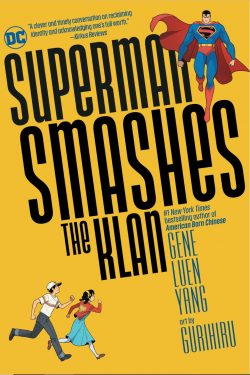
Superman Smashes the Klan


By Gene Luen Yang & Gurihiru (DC Comics)
ISBN: 978-1-7795-0421-0 (TPB/Digital edition)

It’s indisputable that the American comic book industry – if it existed at all – would have been an utterly unrecognisable thing without Superman. Siegel & Shuster’s unprecedented invention was rapturously adopted by a desperate and joy-starved generation, quite literally giving birth to a genre if not an actual art form.

Spawning an astounding army of imitators within 3 years of his 1938 debut, the intoxicating blend of breakneck breathtaking action and cathartic wish-fulfilment epitomising the primal Man of Tomorrow expanded to encompass cops-&-robbers crime-busting, science fiction, fantasy, whimsical comedy, socially reforming dramas – and, once the war in Europe and the East engulfed America – patriotic relevance for a host of gods, champions and monsters, all dedicated to profit through exuberant, eye-popping excess and vigorous dashing derring-do.

In comic book terms Superman was master of the world and, whilst transforming the fledgling funnybook industry, the Metropolis Marvel was also inexorably expanding into all areas of entertainment media. Although we all think of Jerry & Joe’s iconic invention as the epitome and acme of kid stuff creation, the truth is that very soon after his debut in Action Comics #1, the Man of Steel became an all-ages fictional multimedia monolith in the same league as Popeye, Tarzan, Sherlock Holmes and Mickey Mouse.

We parochial, possessive comics fans too often regard our purest and most powerful icons in purely graphic narrative terms, but the likes of Batman, Spider-Man, The Avengers and all their hyperkinetic kin long ago outgrew their 4-colour origins. These days, comics characters don’t really succeed until they’ve been fully mythologized creatures instantly recognisable across all platforms and age ranges… especially by TV, video games and movies…

Far more people have seen or heard an actor as Superman than have ever read his comic tales. The globally syndicated newspaper strips alone reached untold millions, and by the time his 20th anniversary rolled around at the very start of what we know as the Silver Age of Comics, Superman had become an immensely popular, thrice-weekly radio serial milestone with its own spin-off: a landmark novel by radio-show scripter George Lowther.

The audible exploits were translated into 17 astounding animated cartoons by the Fleischer Studios and latterly into live action via two movie serials (Superman 1948 and Atom Man vs Superman 1950) plus a proper movie in 1951 (Superman and the Mole Men).

These paved the way for groundbreaking television series Adventures of Superman which owned the 1950s: running 104 original episodes across six seasons, from September 1952 to April 1958 and for decades after in reruns.

The Man of Steel was a perennial sure-fire success for toy, game, puzzle and apparel manufacturers and had just ended that first smash live-action television presence. In his future were more shows (Superboy, Lois & Clark, Smallville, Superman & Lois), a stage musical, two blockbuster movie franchises and an almost seamless succession of games, bubble gum cards and TV cartoons beginning with The New Adventures of Superman in 1966 and continuing ever since. Even superdog Krypto got in on the small-screen act, and that’s not including spin-offs for Supergirl and even planet Krypton

There have always been “other” versions of Superman, but arguably the most important – even more than his epic newspaper strip career – was the radio serial. The daily newspaper strip launched on 16th January 1939, supplemented by a full-colour Sunday page from November 5th and on February 12th 1940, the Mutual Network transmitted the Man of Tomorrow into homes across America. Initially sponsored by Kellog’s Pep and broadcast as 15-minute episodes three times a week (and in some regions 5 days a week), the show grew into half-hour instalments by August 1942 and continued until February 4th 1949. Thereafter it shifted to ABC in an evening slot and thrice weekly afternoons until March 1st 1951: a total of 2,088 episodes and 128 different storylines. There was even an Australian version with Anzac actors: a total of 1040 episodes from 1949 -1954…

The US serial’s scripters and directors (including B. P. Freeman & Jack Johnstone, Robert & Jessica Maxwell, George F. Lowther, Allen Ducovny & Mitchell Grayson) introduced many innovations that became canonical in comics continuity – such as team-ups with Batman & Robin, inventing Jimmy Olsen and Kryptonite and the immortal opening mantra that began “Up in the Sky! It’s a Bird! It’s a Plane!”…

The show fuelled the imaginations of millions through wonder and action, but also embraced the refugee hero’s socially crusading roots. In 1946, inspired by a resurgence of activity by the Ku Klux Klan, the writers used the 118th saga to fight back against intolerance and bigotry with ‘The Clan of the Fiery Cross’. It began on June 10th and ran16 episodes into July, detailing how a Chinese -American family moves to Metropolis and is targeted by hooded racists until the Action Ace steps in and steps up…

How that ancient tale was revived and adapted into a 3-issue miniseries for DC’s Young Adult imprint by award-winning Gene Luen Yang (American Born Chinese, Boxers and Saints, Avatar: The Last Airbender, New Super-Man) and Japanese women’s illustration collective Gurihiru AKA Chifuyu Sasaki & Naoko Kawano (Avatar: The Last Airbender, Sonic, Unbelievable Gwenpool Power Pack, Tails of the Pet Avengers and more) is recounted at the end of this enthralling adaptation.

‘Superman and Me by Gene Luen Yang’ traces the turbulent and often ludicrous history of the Ku Klux Klan; slavery in the US, Jim Crow laws; The Chinese Exclusion Act; the advent and impact of Superman; abuses of the well-intentioned 1944 G.I. Bill and the radio show that uniquely united non-racist Americans whilst effectively setting the Klan back 20 years…

The story itself is charming, inspirational and decidedly hard-hitting in a manner easily accessible to youngsters; beginning with the Metropolis Marvel still learning about his powers. Strong, fast and able to leap tall buildings, Superman knows very little about his origins but still drives himself tirelessly to save the helpless and punish the guilty.

That starts to change after a titanic battle against leftover Nazi terrorist Atom Man. In the course of a brutal clash, our hero is exposed to a strange green crystal empowering his foe: one that which makes him sick for the first time in his life and triggers bizarre hallucinations – weird smells, odd conversations and images of being a monstrous alien…

As Superman’s friend – “negro” Police Inspector William Henderson – carts off the defeated Nazi, across town Lan-Shin Li is also feeling billious. Her family are driving into Metropolis and their new house, but she already misses Chinatown. She also can’t get used to being called “Roberta Lee” now…

Father’s new job as Chief Bacteriologist for Doctors Segret Wilson and William Jennings at the Metropolis Health Department is a huge triumph and advancement, and her easy-going brother Tommy is ecstatic to move into a white neighbourhood, but mother speaks very little English and is always frightened. Roberta just hates change and misses old friends…

Her anxiety remains high even after new neighbour Jimmy Olsen welcomes them and invites the kids to join the local baseball team. It only really fades after seeing Superman running past at superspeed. Something about him nudges Roberta’s brilliant scientific mind…

Sporting paragon Tommy is a big hit at the Unity House community center, but Roberta just feels out of place, especially after starting pitcher Chuck Riggs uses racist slurs and is fired from the team.

The incident escalates when Chuck sounds off to his Uncle Matt, and that unrepentant racist has his friends leave a burning cross on the Lee’s lawn. As Grand Scorpion of the Klan of the Fiery Kross, he strives to keep America free from impurity, and decides it’s time Chuck also started defending the besieged white race…

Scared and already regretful and repentant, Chuck goes along with the adults, but when he tries to firebomb the house, Roberta recognises him despite his hooded robes…

By-passer Bill Henderson and his buddies help extinguish the flames, but the Inspector cannot convince the Lees to file a complaint. The incident does, however, make Roberta determined to stay and fight back…

Clark Kent and Lois Lane soon arrive and start asking questions. Something about little Roberta reminds the clandestine Kryptonian of growing up in Smallville, particularly those times when his hidden abilities made him feel like an outsider… or even a monster.

… And elsewhere, the secrets of Atom Man and the alien green rock are being decoded by mysterious scientists with a nasty agenda: potential tyrants intent on making mischief at the heart of a brave new society. Soon after, events escalate when the Klan kidnap Tommy and Roberta furiously confronts Chuck…

Thus begins a powerful and rewarding adventure detailing not simply the antagonisms of outsiders and ultra-conservatives, and incomers against entrenched privilege, but also how diversity and inclusion benefits everyone on so many levels. It’s also a smart saga of good versus evil, growth, accommodation and acceptance and a parable of how a wise child taught the Man of Steel where he was going wrong and how to use his powers correctly…

An immigrant’s tale about knowing oneself and adapting to change, Superman Smashes the Klan is wise and welcoming and wants you to see the best in everyone everywhere.
© 2020, DC Comics. All Rights Reserved. Essay by Gene Luen Yang © 2019 Humble Comics LLC.

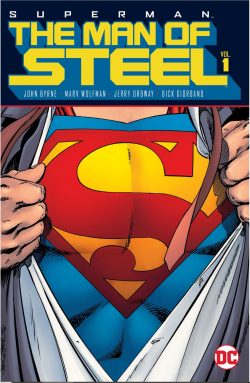
Superman: The Man of Steel volume 1


By John Byrne, Marv Wolfman, Jerry Ordway, Dick Giordano, Terry Austin, Mike Machlan, Karl Kesel & various (DC Comics)
ISBN: 978-1-7795-0491-3 (HB/Digital edition)

In 1985 when DC Comics decided to rationalise, reconstruct and reinvigorate their continuity with Crisis on Infinite Earths they used the event to simultaneously regenerate their key properties at the same time. The biggest gun they had was Superman and it’s hard to argue that the change was not before time.

The big guy was in a bit of a slump, but he’d weathered those before. So how could a root and branch retooling be anything but a pathetic marketing ploy that would alienate the real fans for a few fly-by-night Johnny-come-latelies who would jump ship as soon as the next fad surfaced? This new Superman was going to suck…

They couldn’t have been more wrong.

The public furore began with all DC’s Superman titles being “cancelled” (actually suspended) for three months, and yes, that did make the real-world media sit-up and take notice of the character everybody thought they knew for the first time in decades. However, there was method in this seeming corporate madness.

The missing mainstays were replaced by a 6-part miniseries running from October to December 1986. Entitled Man of Steel, it was written and drawn by Marvel’s mainstream superstar John Byrne and inked by venerated veteran Dick Giordano.

The bold manoeuvre was a huge and instant success. So much so that when it was first collected as a stand-alone compilation album in 1991, it became one of comics’ premiere “break-out” hits in a new format that would eventually become the industry standard for reaching mass readerships. Nowadays few people buy the periodical pamphlets but almost everybody has read a graphic novel…

From that overwhelming start the Action Ace seamlessly returned to his suspended comic book homes, enjoying the addition of a third monthly title which premiered that same month.

Superman, Adventures of Superman, and Action Comics (which acted as a fan-pleasing team-up book guest-starring other favourites of the DC Universe, in the manner of the cancelled DC Comics Presents) were instant best-sellers.

So successful was the relaunch that by the early 1990’s Superman would be carrying four monthly titles as well as Specials, Annuals, guest shots and regular appearances in titles such as Justice League.

Quite a turnaround from the earlier heydays of the Man of Steel when editors were frantic about never overexposing their meal-ticket.

In Superman’s 85th year of more-or-less consecutive and continuous publication, this collection begins with the six self-contained stories from key points in Superman’s career, newly readjusted for contemporary consumption in the wake of that aforementioned worlds-shattering Crisis.

Spanning to cover-dates October 1986 to June 1987 and re-presenting The Man of Steel #1-6, Superman #1-4, Action #584-587 and Adventures of Superman #424-428 plus relevant pages from Who’s Who: Update ‘87 #1, 3, 4 this initial herculean compilation opens with the a reprinting of Byrne’s introduction from the 1991 collection ‘Superman: A Personal View’ before the revelations unfold…

Newsstands and comic stores on July 10th 1986 welcomed a startlingly new and bleakly dystopian Krypton in #1 as ‘Prologue: From Out of the Green Dawn…’ followed the child’s voyage in a self-propelled birthing matrix to a primitive world.

Discovered by childless couple Jonathan and Martha Kent, the alien foundling spends his years growing secretly in Smallville, indistinguishable from other earthlings until strange abilities begin to gradually manifest and hint at ‘The Secret’

Eighteen years after his arrival, the boy learns of his extraterrestrial origins and leaves home to wander the world. Clark Kent eventually settles in Metropolis and we get a rapid re-education of what is and isn’t canonical as he performs his first public super-exploit, meets with Lois Lane, joins the Daily Planet and gets an identity-obscuring costume in ‘The Exposure’ and ‘Epilogue: The Super-Hero’

Lois takes centre-stage for the second issue, scheming and manipulating to secure the first in-depth interview with the new hero before losing out to neophyte colleague Kent whose first big scoop becomes ‘The Story of the Century!’

The third chapter recounts the Metropolis Marvel’s first meeting with Batman as ‘One Night in Gotham City…’ reveals a fractious and reluctant team-up to capture murdering thief Magpie. The unsatisfactory encounter sees the heroes part warily, not knowing if they will become friends or foes…

‘Enemy Mine…’ in MoS #4 expands and redefines the new Lex Luthor: a genius, multi-billionaire industrialist who was the most powerful man in Metropolis until the Caped Crime-buster appeared. When the tycoon overreaches himself in trying to suborn the hero with cash, he is publicly humiliated and swears vengeance and eternal enmity…

By the time of ‘The Mirror, Crack’d…’ in #5, Luthor is Superman’s greatest foe – albeit one who scrupulously maintains a veneer of respectability and plausible deniability. Here, Luthor’s clandestine attempt to clone his own Man of Tomorrow results in a monstrous flawed duplicate dubbed Bizarro and introduces Lois’ sister Lucy to play hapless victim in a moving tale of triumph and tragedy.

The reimagination concludes with ‘The Haunting’ as a troubled Clark/Superman returns to Smallville. Reuniting with childhood sweetheart Lana Lang – who shares his secrets and knows as much as he of his alien origins – the strange visitor finally learns of his Kryptonian origins and heritage when the long-hidden birthing matrix projects a recorded message from his long-dead parents and details their hopes and plans for him…

The shock and reaction of his foster family only affirms his dedication and connection to humanity…

John Byrne was a controversial choice at the time, but he magnificently recaptured the exuberant excitement and visually compelling, socially aware innovation which informed and galvanised Jerry Seigel & Joe Shuster’s inspired creation. Man of Steel granted a new generation the same kind of intoxicating four-colour fantasy that was the original Superman, and made it possible to be a fan again, no matter your age or prejudice. Superman had always been great, but Byrne had once again made him thrilling. Rivetingly so.

The never-ending battle recommenced on a monthly schedule with Superman volume 2 #1, where Byrne & Terry Austin reveal a ‘Heart of Stone’: presenting a new Metallo as thug John Corben is remade as a Terminator-style cyborg with a human brain and a Kryptonite heart by a deranged xenophobic scientist. The transition culminates in a deadly battle and baffling mystery portending big troubles to come. The focus then shifts to Action #584 and ‘Squatter!’ (by Byrne & Giordano) as a body-snatching mental force suborns the Metropolis Marvel and necessitates a team-up with the Teen Titans. The accent is predominantly on breakneck pace and all-out costumed conflict here…

Superman #2 (by Byrne & Austin) then describes ‘The Secret Revealed!’ as modern-day robber baron Luthor makes the biggest mistake of his life after kidnapping and torturing Kent’s first girlfriend Lana Lang

This is followed by Marv Wolfman & Jerry Ordway’s ‘Man O’War!’ and ‘Going the Gauntlet’ (Adventures of Superman #424 & 425, and inked by Mike Machlan). The drama introduces tragic Dr. Emil Hamilton and rival reporter Cat Grant to the mythology as the Action Ace battles high-tech terrorists sponsored by rogue state Qurac and proves to be no respecter of international boundaries like his pre-Crisis counterpart…

These politically and socially aware dramas would become a truer and more lasting template for the modern Man of Tomorrow after Byrne’s eventual retirement from the character…

The Phantom Stranger guests in a battle against a deadly manifestation of unquiet spirits in ‘And the Graves Give Up Their Dead…’ (Byrne & Giordano, Action #585) before the next three chapters address the Superman segment of multi-part crossover event Legends.

Byrne & Austin’s Superman #3 began with ‘Legends of the Darkside!’, as Clark Kent is abducted to Apokolips by its evil master. He escapes to become a rebel leader of the lowly “Hunger Dogs” in Adventures… #426, wherein Wolfman, Ordway & Machlan give us an amnesiac Superman on Apokolips rising ‘From the Dregs’ before the rousing yarn concludes with ‘The Champion!’ as Action Comics #586 (Byrne & Giordano) reintroduces Jack Kirby’s New Gods post-Crisis icons Orion and Lightray, just in time for a blistering battle royale beyond the stars between the Man of Steel and deadly Darkseid

Once the cosmic dust settled, it was back to the regular Never-Ending Battle, with Superman #4 introducing deranged lone gunman ‘Bloodsport!’ courtesy of Byrne & inker Karl Kesel. The merciless shooter is more than just crazy, however: some hidden genius has given him the ability to manifest wonder weapons from thin air and he never runs out of ammo…

Wolfman & Ordway generally concentrated on longer, more suspensefully dramatic character-based tales. Adventures of Superman #427-428 (cover-dated April & May 1987) took the Man of Tomorrow on a punishing visit to rogue state Qurac and an encounter with hidden alien telepaths The Circle: a visceral and beautiful tale of un-realpolitik. ‘Mind Games’ and ‘Personal Best’ combine a much more relevant, realistic slant with lots of character sub-plots featuring assorted staff and family of the Daily Planet.

The story portion of this first volume concludes with Byrne & Giordano back in Action (#587), crafting spectacle, thrills and instant gratification with ‘Cityscape!’ by teaming Superman with Jack Kirby’s Etrigan the Demon. The magic happens when sorceress Morgaine Le Fay seeks to become immortal by warping time itself…

Augmenting the Costumed Dramas are more recovered text commentaries and appreciations from earlier collections: specifically Ray Bradbury’s ‘Why Superman? Why Today?’ (1991), Wolfman’s ‘Reinventing the Wheel’ (2003) and Ordway’s ‘The Adventures of Superman’ from 2004. These are followed by the covers of earlier Superman: The Man of Steel compendia – all by Ordway – and pages taken from supplemental comics reading tool Who’s Who: Update ‘87.

Plucked from issues #1, 3, 4 are Byrne’s Amazing Grace, Bizarro, Bloodsport, Host, Lex Luthor, Krypton and Kryptonite, Lois Lane, Magpie and Metallo before a big bold pin-up of the Man of Steel ends the fun for now.

The back-to-basics approach successfully lured many readers to – and back to – the Superman franchise, but the sheer quality of the stories and art are what convinced them to stay. Such cracking, clear-cut superhero exploits are a high point in the Action Ace’s decades-long career, and these collections are the best way to enjoy one of the most impressive reinventions of the ultimate comic-book icon.
© 1986, 1987, 2020 DC Comics. All Rights Reserved.

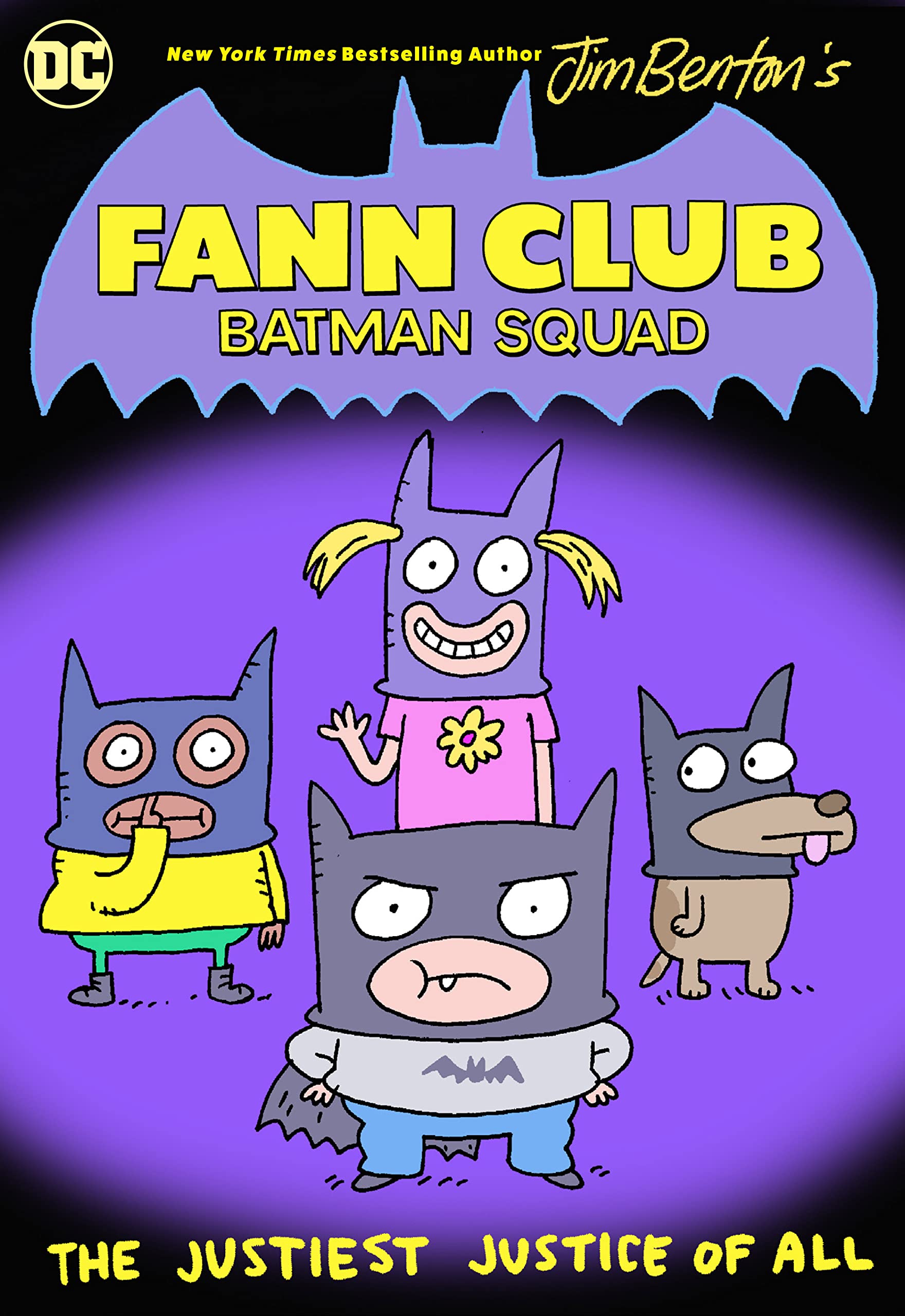
Fann Club: Batman Squad – the Justiest Justice of All


By Jim Benton (DC Comics)
ISBN: 978-1-7795-0889-8 (PB/Digital edition)

In recent years DC has opened up its vast and comprehensive shared superhero universe: generating Original Graphic Novels featuring its many stars in stand-alone adventures specifically tailored for kids and also that tricky demographic so sadly misnamed Young Adult. To date, results have been rather hit or miss, but when they’re good, they are very good indeed…

Another sublime example of the process at its best is this cheery elegy to the joys of crimefighting as channelled through the pristine but so-blinkered purview and perceptions of a youngster who believes in the process with all he’s got…

Ernest Fann is a little kid with a big imagination and a colossal passion. This drive has made him an absolute expert on Superheroes, Vengeance, Justice and The Batman, and that status comes with a necessary burden.

There is anxiety, impatience and even a motivating tragic loss – when something chewed his precious collectors’ item socks. His life is troubled by flashbacks and his sleep by the oddest dreams. It’s a mystery even his dog Westy can’t explain, whilst the neighbours’ kid and babysitter Harriet are completely oblivious to his inner life and secret…

Aware at he is probably the World’s Second Greatest Detective, he swears to share his gifts and the way of the Batman by founding… a fan club.

When willing recruits drawn by his cunning outreach arrive, he clothes them in the costumes he made and code names the (completely anonymous) strangers Night Terrier, Nightstand and Eyeshadow. He, of course, is the mighty Gerbilwing and Evil has never been more scared…

With his Batman Squad equipped it’s ‘Time to Begin: Fanning the Flames’ as their training montage shares secrets – like learning how to scowl and stand mysteriously – before going ‘On Patrol’ to note all the wickedness and mystery besetting the neighbourhood. All those little clues add up to trouble and before long Gerbilwing & Co. are unleashed when they intercept a bank robbery and uncover the true source of all the strange events…

Jim Benton began his illustration work making up crazy characters in a T-Shirt shop and designing greetings cards. Born in 1960, he’d grown up in Birmingham, Michigan before studying Fine Arts at Western Michigan University.

Tirelessly earning a living exercising his creativity, he started self-promoting those weird funny things he’d dreamed up and soon was raking in the dosh from properties such as Dear Dumb Diary, Dog of Glee, Franny K. Stein, Just Jimmy, Just Plain Mean, Sweetypuss, The Misters, Meany Doodles, Vampy Doodles, Kissy Doodles, jOkObo and It’s Happy Bunny via a variety of magazines and other venue…

His gags, jests and japes are delivered in a huge variety of styles and manners: each perfectly in accord with whatever sick, sweet, clever, sentimental, whimsical or just plain strange content each idea demanded, and his SpyDogs effortlessly made the jump to kids’ animated TV success.

He seamlessly segued into best-selling cartoon books (those are the best kind) such as Man, I Hate Cursive, Clyde, Catwad, Jop and Blip Wanna Know, Dog Butts and Love. And Stuff Like That. (And Cats) and Attack of the Stuff. It’ been 10 minutes since I started typing this, so there might be a few more published since then…

Perfectly capturing the wonder of childhood and sheer force of a kid’s unbridled imagination, Fann Club: Batman Squad is hilarious with a huge amount of heart and empathy and literally cloaked in the moody charisma of Frank Miller’s Dark Knight. The combination is utterly irresistible.

Also include is a teaser preview of ‘Young Alfred: Pain in the Butler’, but that’s not the point and can wait for its own review. Here you just need to swear your oath, kit up in your own justice gear and join The Bat Squad ASAP.

Tell them Gerbilwing said it was okay and Eyeshadow would be there to keep things safe…
© 20223 DC Comics. All Rights Reserved.

Fann Club: Batman Squad will be published on June 6th 2023 and is available for pre-order now.

Action Heroes Archive volume 1: Captain Atom & volume 2: Captain Atom, Blue Beetle & The Question


By Steve Ditko, Joe Gill, Gary Friedrich, Dave Kaler, Steve Skeates, Rocke Mastroserio, Frank McLaughlin, Al Milgrom, Roger Stern, John Byrne, Michael Uslan, Alex Toth, and various (DC Comics)
ISBN: 978-1-4012-0302-3 (HB vol. 1) 978-1-4012-1346-6 (HB vol. 2)

Clearly I’m cashing in on the pre-release hype around a new DC Cinema blockbuster here, but I take honest refuge and some comfort in the fact that these books and the stories they contain are actually germane as well as being some of the best Silver Age comics ever crafted… 

Despite being dead – and so very much missed – Steve Ditko remains comics’ most unique stylist. Love him or hate him, you can’t mistake his work for anyone else’s. His career began in the early 1950s and, depending on whether you’re a superhero fan or prefer deeper, more challenging experimental work, peaked in either the mid-1960s or 1970s.

Leaving the Avenging World, Mr. A and his other philosophically-derived creations for another time, the superhero crowd should heartily celebrate and clamour for new editions of these deluxe collections of the first costumed do-gooder that Ditko worked on. Although I’m a huge fan of his linework – which is always best served by monochrome printing – the crisp, sharp colour of these Archive editions is still much better than the appalling reproduction on bog-paper that first displayed Charlton Comics’ Atomic Ace and latterly the Bug Bombshell to the kids of Commie-obsessed America.

As discussed in the Foreword by historian and Ditko-expert Blake Bell, Action Heroes Archive volume 1: Captain Atom reveals – in all the full-on, simplistic furore of a 1950s B-Movie – how a Cold War-obsessed America copes with a modern-day miracle just as the concept of costumed superheroes was being reimagined…

With covers by Ditko and/or Mastroserio, this tome amasses pertinent tales from Space Adventures #33-40 & 42 (spanning cover-dates March 1960 to October 1961), augmented by the contents of the revived, solo-starring Captain Atom #78-82, as published for December 1965 through September 1966.

In those simpler times the short, terse adventures of Captain Atom seemed somehow more telling than the innovative yet rather anodyne DC fare, whilst Marvel was still pushing romances, westerns and monsters in underpants, explorers in pith helmets and citizen scientists with labs in their garden sheds. Their particular heroic revolution was still months away even though Steve Ditko was producing top-flight work for both companies.

Nevertheless, Ditko’s hero was different and we few who read him all knew it….

As scripted by Jo Gill and predating Fantastic Four #1 by more than 18 months, Space Adventures #33 even cover-featured the new sensation-in-waiting as ‘Introducing Captain Atom’ in a brief but vivid vignette, giving us a true American hero and man of his time before instantly killing him.

Captain Adam was an astronaut accidentally but literally atomised in a rocketry accident. Eerily – and the way it’s drawn spooked the short pants off me when I first read it all those years ago – he gradually reassembles himself on the launch pad…

Now blessed with astounding powers, he reports to the President (Eisenhower) and is swiftly kitted up in a protective outfit, allowing contact with normal, non-irradiated humans and reassigned as a masked superhero who will be the USA’s secret weapon…

Mostly written by or co-written with Joe Gill, the first wonderful, addictive run of 18 stories from Space Adventures #33-42 (and three of those were in fact drawn by uninspired, out-of-his-comfort zone Rocke Mastroserio) are a magnificent example of Ditko’s emerging mastery of mood, pacing, atmosphere and human dynamics.

In 1961, with Ditko increasingly doing more work for blossoming – and better paying – Marvel, Charlton killed the Captain Atom feature. However, when Dick Giordano jumped on the superhero bandwagon and created a costumed character line for Charlton in late 1965, the Captain was revived. Space Adventures was retitled, with Atom’s first full length issue numbered #78.

Since he was still drawing Amazing Spider-Man and Doctor Strange, Ditko could only manage pencils, so Mastroserio was recruited to ink the series, resulting in an oddly jarring finish. With #79, Ditko became lead writer too, and the stories took on an eccentric, compelling edge and tone, lifting them above much of the competition’s fare. Eventually the inker adapted to Ditko’s style and much of the ungainliness disappeared from the figurework, although so had the fine detail that had elevated the early art. This volume ends with issue #82, leaving six more published issues and a complete unpublished seventh for another time…

However, those early, Cold War-fired tales are a truly unique blend of action, tension and sheer whimsy which continued in Space Adventures #34 as ‘The 2nd Man in Space’ cheekily sees the magnanimous hero covertly undercut another Soviet space triumph by saving the USSR’s first cosmonaut from his defective capsule, whilst #35#s ‘The Little Wanderer’ finds him traversing the stars to rescue the spirit of an little boy inadvertently abducted by a well-meaning cosmic traveller…

A thermonuclear double bill graced #36, beginning with ‘The Wreck of X-44’, with a new craft detonating in space and leading Captain Atom to a deadly saboteur, after which ‘Captain Atom on Planet X’ finds him defending a US satellite from all-out attack by the dastardly ruthless Russians…

Geopolitics gives way to fantasy as #37 (December 1960) initially details a fusion-foiled invasion by ‘The Space Prowlers’ before a US probe to the second planet is scuttled by svelte space sirens who score ‘A Victory for Venus’ over the stounded atomic Earthman…

Two months later and the count climbed to three stories, beginning with ‘One Second of War’, wherein the Captain wrecks the doomsday missile attack of Dr. Claudius Jaynes, a suicidal maniac with his own atomic arsenal, before repeating the feat in ‘Backfire’ when a tin-pot dictator seeks to nuke the USA. The issue ends with ‘The Force Beyond’ as an alien entity tries to destroy the world with meteors before encountering our nuclear nemesis…

Space Adventures #39 begins with a ‘Test-Pilot’s Nightmare’ as arrogance threatens the life of a helpless jet jockey and Atom invisibly comes to the rescue after which Mastroserio limns ‘Peace Envoy’ with the energetic enigma turning back another alien invasion. Ditko is back for the final fling as Captain Adam goes undercover in Berlin (just before The Wall went up) to crush an espionage plot in ‘An Ageless Weapon’

The atomic experiment was coming to a close. After #40’s ‘The Crisis’ – wherein the hero helps a diplomat call a tyrant’s bluff and ‘The Boy and the Stars’ features another Earth tot transported into the wondrous cosmos – the costumed heroics were absent the next issue.

Just as the FF was about to go big, Space Adventures #42 (October 1961) arrived and depleted all the inventory tales at once beginning with a brace of Mastroserio drawn yarns and one last tantalising Ditko masterpiece. ‘The Saucer Scare’ is yet another mediocre space war clash whilst ‘The Man in Saturn’s Moon’ sees the atomic ace hunting a Soviet dissent squirreled away by wicked commies. Those lesser efforts are utterly eclipsed by ‘The Silver Lady from Venus’ as another sexy extraterrestrial beguiles the humans of Earth before making a fool of the fiery champion…

And that was that the end until of 1965 when a global resurgence of costumed capers led to a new line at Charlton. Leading that charge came Captain Atom #78 (cover-dated December) when Gill & Ditko – with Mastroserio inking – revived the Atomic Adventurer in ‘The Gremlins from Planet Blue’. The genre had moved on in four years and the stripped-back, pared-down B-Movie feel of those early tales had evolved into a more uniquely fulsome and flamboyant affair for this particular extraterrestrial infiltration. Here were subplots and supporting cast to spare, as the hero foiled alien sabotage and mind control at Cape Kennedy, romancing Leah Jupe whilst her scientist father fell under the control of insidious infiltrators. There was even a new gadfly for Captain Adam in the grumpy form of martinet military man General Brill before ultimately saving Earth again…

In the next issue (February/March 1966), a true but tragic supervillain arrives in the series as ‘Captain Atom Faces Doctor Spectro, Master of Moods’ when a spy hunt brings the hero into the orbit of an embittered recluse seeking to master light and colour to revolutionise medicine. Sadly, sudden success tips him over the edge and his newfound abilities drive him even more crazy…

Apparently destroyed, the miscreant is soon forgotten when a wandering planetoid nears Earth and sounds the ‘Death Knell of the World’ (#80, Ditko, Gill & Mastroserio). Happily, the High Energy Hero is up to foiling a cosmic tyrant and liberating his captive satellite people before confronting ‘The Five Faces of Doctor Spectro’ as the misunderstood miscreant reappears in five prismatic pieces with a plethora of different plans but one overriding goal: pulling himself together and finally splitting this atom…

The hero hosts a quick fact feature drawn by Frank McLaughlin in ‘Captain Atom’s Secret’ before this initial outing ends with a magnificent step up in tension and quality. Issue #82 – cover-dated September 1966 and by Ditko with Dave Kaler & Mastroserio – debuts not just the series’ ultimate archfoe and a major story arc but also the company’s first female superhero.

With an enigmatic teleporting thief casually robbing the nation and the military of its wealth and top secrets, Captain Adam is sent undercover with mystery operative Nightshade in ‘Captain Atom vs. The Ghost’

Their mission introduces sleek scoundrel Alec Rois, channels the spy craze of the era and hints at a vast conspiracy underpinning a threat to Earth and even finds time to see the heroes battle an army of thugs and save Fort Knox from bold bullion banditry…

Over half a decade pioneers Steve Ditko and Captain Atom and paved the way and lit a path to a revolution in comics storytelling and these early exploits were only the start…


Action Heroes volume 2: Captain Atom, Blue Beetle & The Question

A second – far longer – volume completes Ditko’s controversial Charlton Comics costumed hero contributions with the remainder of Captain Atom’s exploits, the introduction of a new Blue Beetle and debut of his uniquely iconic vigilante The Question.

Following an effusive and extremely informative Introduction by original Action Line inventor and editor Dick Giordano, Captain Atom #83 (November 1966) starts the ball rolling again with a huge blast of reconstructive character surgery.

Although ‘Finally Falls the Mighty!’ was inked by Mastroserio and scripted by relative newcomer Kaler, thematically it’s pure Ditko. Plotted and drawn by him, it sees an ungrateful public swiftly turn on the Atomic Ace, due to the manipulations of a former colleague turned cunning criminal.

Intended to tone down the character’s sheer omnipotence, the added approachable empathy-inducing humanity of malfunctioning powers made his struggles against treacherous Professor Koste all the more poignant.

Moreover, the sheer visual spectacle of his battle against a runaway reactor is some of Ditko’s most imaginative design and layout work. The tale ends on a cliffhanger – a real big deal when the comic came out every two months – and with the last 7 pages dedicated to debuting a new superhero with one of the oldest names in the business.

The Blue Beetle first appeared in Mystery Men Comics #1, released by Fox Comics and cover-dated August 1939. Created by Charles Nicholas (nee Wojtkowski) the character was inexplicably popular: surviving the collapse of numerous publishers before ending up as an acquired Charlton property in the mid-1950s. After releasing a few issues sporadically, Charlton shelved him until the superhero revival of the 1960s when Gill and latterly young Roy Thomas revised and revived the character for a combined 10-issue run (June 1964 – February 1966).

Here however, Ditko accepts but sets aside all that history to utterly recreate him. Ted Kord is an earnest young scientist with a secret tragedy in his past, which Ditko and scripter Gary Friedrich sagely forbear revealing in deference to intrigue and action, in a taut, captivating crime-thriller where the new hero displays his modus operandi by stopping a vicious crime-spree by the Killer Koke Gang.

This untitled short has all the classic elements of a Ditko masterpiece: outlandish intense, fight scenes, compact, claustrophobic yet dynamic layouts, innovative gimmickry and a clear-cut battle between Right and Wrong. It’s one of the very best introductory stories of a new hero anywhere in comics – and it’s 7 pages long…

The remodelling of the Atomic Ace concludes in the next issue with ‘After the Fall a New Beginning’. Once again Ditko rattled his authorial sabre about the fickleness of the public as the villainous Koste exposes the hero’s face on live TV. Escaping, Atom gets a new costume to match his curtailed powers …and consequently, a lot more drama drapes the series.

Now there is a definite feeling of no safety or status quo. The untitled Blue Beetle back-up (scripted by Friedrich with full art from Ditko) pits the new kid against a Masked Marauder, but the real kicker is the bombshell revelation that Homicide detective Fisher – investigating the disappearance of Dan Garrett – suspects a possible connection to Kord…

Whilst extending a running plot-line about the mysterious Ghost and his connection to a lost civilization of warrior women, ‘Strings of Punch and Jewelee’ introduces a couple of shady carnival hucksters who find a chest of esoteric alien weapons and use them for robbery. Although Cap and partner Nightshade are somewhat outclassed here, the vigour and vitality of the Blue Beetle is again undeniable as a mid-air hijack is foiled and a spy sub and giant killer octopus are given short shrift by the indomitable rookie crusader.

Captain Atom #86 finally brings the long-simmering plot-thread of tech thief The Ghost to a boil as the malevolent science-wizard goes on a rampage, totally trouncing Nightshade and our hero before being kidnapped by the aforementioned mystery maidens. ‘The Fury of the Faceless Foe! is by Ditko, Kaler & Mastroserio whilst in the (still) untitled Blue Beetle strip by Friedrich & Ditko, the cobalt crusader confronts a ruthless scientist/industrial spy he’s convinced he battled before…

This leads directly into the first issue of his own comic book. Blue Beetle #1 (cover-dated June 1967) is an all-Ditko masterpiece (even scripting it as “D.C. Glanzman”) with the hero in all-out action against a deadly gang of bandits. ‘Blue Beetle… Bugs the Squids’ is crammed with the eccentric vitality that made Amazing Spider-Man such a monster hit, with justice-dispensing joie de vivre balanced by the moody, claustrophobic introduction of Ditko’s most challenging mainstream superhero creation.

‘The Question’ is Vic Sage, a TV journalist with an uncompromising attitude to crime and corruption, employing an alter-ego of faceless, relentless retribution. In his premiere outing he exposes the link between his own employers’ self-righteous sponsors and gambling racketeer Lou Dicer. This theme of unflinching virtue in the teeth of both violent crime and pernicious peer and public pressure marked Ditko’s departure from straight entertainment towards philosophical – some would say polemical – examination of greater societal issues and the true nature of both Good and Evil that would culminate in his controversial Mr. A, Avenging World and other independent ventures.

In Captain Atom #87 (August 1967), ‘The Menace of the Fiery-Icer’ presaged the beginning of the end for the Atomic Ace as Kaler, Ditko & Mastroserio dialled back on plot threads to deliver a visually excellent but run-of-the-mill yarn about a spy ring with a hot line in cold-blooded leaders.

Blue Beetle #2 however – another all-Ditko affair from the same month – showed the master at his peak. Lead story ‘The End is a Beginning!’ at last reveals the origin of the character as well as the fate of Dan Garrett, and even advances Kord’s relationship with his assistant Tracey. The enigmatic Question, meanwhile, tackles flying burglar The Banshee in a vertiginous, moody thriller reminiscent of early Doctor Strange strips.

Frank McLaughlin joins as inker for a satisfying no-nonsense escapist romp ‘Ravage of Ronthor’ (Captain Atom #88, October 1967), as the hero answers a distress call from space to preserve a paradise planet from marauding giant bugs. Blue Beetle #3 was another superbly satisfying read, as the eponymous hero routes malevolent, picturesque thugs ‘The Madmen’ in a sharp parable about paranoia and misperception. Equally captivating is the intense and bizarre Question vignette wherein a murderous ghostly deep-sea diver stalks some shady captains of industry…

Cover-dated December 1967, issue #89 was the last Captain Atom published by Charlton: an early casualty of the burn-out afflicting the superhero genre and leading to a resurrected horror and mystery craze. This resurrected genre would form a new backbone for the company’s 1970’s output; one where Ditko would shine again in his role as master of short story horror.

Scripter Kaler satisfactorily ties up most of the hanging plot threads with the warrior women of Sunuria in sci-fi-meets-witchcraft thriller ‘Thirteen’, although the Ditko/McLaughlin art team was nowhere near top form.

The next episode promised a final ‘Showdown in Sunuria’, but never materialized…

Blue Beetle #4 (released the same month) is visually the best of the bunch as Kord follows a somehow-returned Dan Garrett to an Asian backwater in pursuit of lost treasure and a death cult. ‘The Men of the Mask’ is pure strip poetry and bombastic action, cunningly counterbalanced by a seedy underworld thriller as the Question seeks to discover who gave the order to ‘Kill Vic Sage!’ Scripted by Steve Skeates (as Warren Savin) it was the last action any Charlton hero saw for the better part of a year…

Then, cover-dated October 1968, The Question returned as the star of Mysterious Suspense #1, with Ditko producing a captivating cover and three-chapter thriller (with Mastroserio providing a rather jarring full-page frontispiece). ‘What Makes a Hero?’ (probably rescued from partially completed inventory material) sees crusading Vic Sage pilloried by the public, abandoned by friends and abandoned by his employers yet resolutely sticking to his higher principles in pursuit of hypocritical villains masquerading as pillars of the community. Ditko’s interest in Ayn Rand’s philosophical Objectivism had become increasingly important to him and this story is arguably the dividing line between his “old” and “new” work. It’s also the most powerful and compelling piece in this entire book.

A month later one final issue of Blue Beetle (#5) was published. ‘The Destroyer of Heroes’ is a decidedly quirky tale featuring a nominal team-up of the azure avenger and the Question as a frustrated artist defaces heroic and uplifting paintings and statues. Ditko’s committed if reactionary views of youth culture, which so worried Stan Lee, are fully on view in this charged, absorbing tale.

Other material had been created and languished incomplete in editorial limbo. In the early 1970s a burgeoning and committed fan-base created fanzine Charlton Portfolio. With the willing assistance of the company, a host of kids who would soon become household names in their own right found a way to bring the lost work to the public gaze. Their efforts are also included here, in monochrome as they originally appeared.

For Charlton Portfolio #9 and 10 (1974), the unreleased Blue Beetle #6 was serialized. ‘A Specter is Haunting Hub City!’ is another all-Ditko extravaganza, pitting the hero against an (almost) invisible thief. Follow-up magazine Charlton Bullseye (1975) finally published ‘Showdown in Sunuria’ in its first two issues.

Behind an Al Milgrom Captain Atom cover, Kaler’s plot was scripted by Roger Stern (working as Jon G. Michels) and Ditko’s pencils were inked by rising star John Byrne – a cataclysmic climax almost worth the 8-year wait. But even there, the magic doesn’t end in this magnificent Archive volume.

Charlton Bullseye #5 (1975) offers one last pre-DC tale of The Question: 8 gripping, intense and beautiful pages plotted by Stern, scripted by Michael Uslan and illustrated by the legendary Alex Toth. This alone is worth the price of admission.

These weighty snapshots from another era are packed with classic material by brilliant craftsmen. They are books no Ditko addict, serious fan of the genre or lover of graphic adventure can afford to be without. It’s impossible to describe the grace, finesse, and unique eclectic shape of Steve Ditko’s art. It must be experienced, and this is as good a place to start as any. It’s just a shame DC have let these tales languish so long, but hopefully the power of Hollywood will induce a revival…
© 1966, 1967, 1968, 1974, 1975, 1976, 2007 DC Comics. All Rights Reserved.
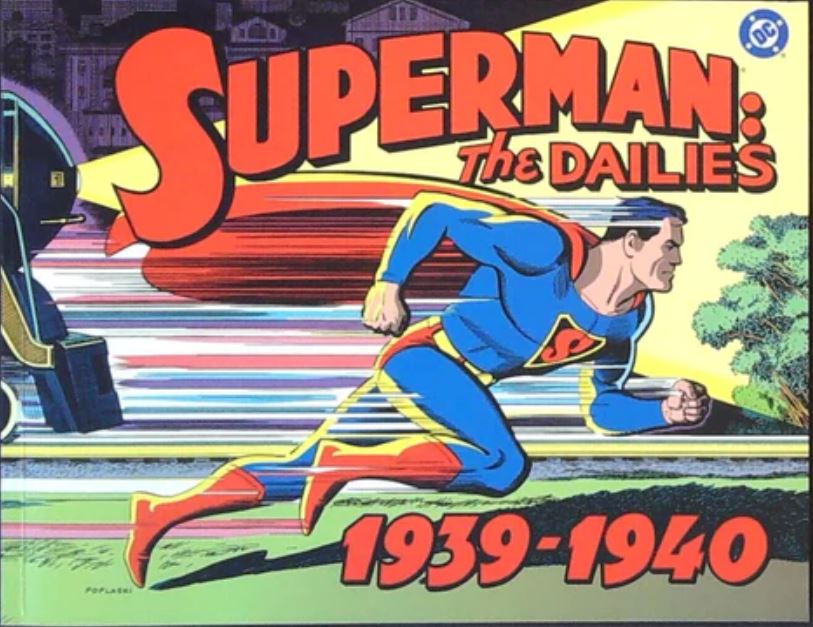
Shazam! The Golden Age of the World’s Mightiest Mortal


By Bill Parker & C.C. Beck, Roscoe Fawcett, Marcus Swayze, Pete Costanza, Otto Binder, Jack Binder, Mac Raboy, Joe Simon & Jack Kirby, Chad Grothkopf, Kurt Schaffenberger, and many & various: compiled & written by Chip Kidd and photographed by Geoff Spear (Abrams ComicArts/Harry N. Abrams, Inc.)
ISBN: 978-0-8109-9596-3 (2010 HB) 978-1-4197-3747-3 (2019 PB)

One of the most venerated and beloved characters in American comics was devised by Bill Parker & Charles Clarence Beck as part of a wave of opportunistic creativity following Superman’s debut in 1938. Although there were many similarities in the early years, the Fawcett Comics character moved swiftly and solidly into the realm of light entertainment -and even broad comedy – whilst, as the 1940s progressed the Man of Steel increasingly put whimsy aside in favour of action and drama.

Homeless orphan and thoroughly good kid Billy Batson was selected by an ancient wizard to battle injustice: granted the powers of six gods and mythical heroes. By speaking aloud the mage’s name – an acronym for the patrons Solomon, Hercules, Atlas, Zeus, Achilles and Mercury – Billy transformed from scrawny boy to brawny adult Captain Marvel.

At the height of his popularity, “the Big Red Cheese” significantly outsold The Man of Steel – published twice monthly and topping 14 million copies per month. Before eventually evolving his own affable personality the full-grown hero was a serious, bluff and rather characterless powerhouse, whilst alter ego Billy was the true star: a Horatio Alger archetype of impoverished, resourceful, boldly self-reliant youth overcoming impossible odds through gumption, grit and sheer determination…

However, as the decade moved on, tastes changed and sales slowed. A court case begun in 1941 by National Comics contesting copyright infringement was settled. Like many other superheroes, Cap disappeared, reduced to a fond memory for older fans. A big syndication success, he was missed all over the world…

In Britain, a reprint line had run for many years, so creator/publisher Mick Anglo had an avid audience and no product. His solution was to reimagine the franchise with atomic age hero Marvelman and Co. continuing to thrill readers well into the 1960s.

As America experienced another superhero boom-&-bust, the 1970s dawned with a shrinking industry and wide variety of comics genres servicing a base increasingly dependent on collectors and fans rather than casual or impulse buyers. DC needed sales and were prepared to look for them in unlikely places. Following a 1953 court settlement with Fawcett, DC ultimately secured the rights to Captain Marvel, his spun-off extended Family and attendant strips and characters.

Despite the actual name having been taken by Marvel Comics (via a circuitous route and quirky robotic hero published by Carl Burgos and M.F. Publications in 1967), the home of Superman opted for tapping into that discriminating, if aging, fanbase. In 1971, they licensed the dormant rights to the character stable (only fully buying them out in 1991) and two years later, riding a wave of national nostalgia on TV and in movies, DC resurrected and relaunched the entire beloved cast in their own kinder, weirder, completely segregated and separate universe.

To circumvent intellectual property clashes, they named the new/old title Shazam! (‘With One Magic Word…’): the unforgettable trigger phrase used by the majority of Marvels to transform to and from mortal form and a word that had entered the American language thanks to the success of the franchise (especially an excellent movie serial) the first time around.

Issue #1 carried a February 1973 cover-date and generated mixed reviews and unconvincing sales, but was pushed hard by DC. It even briefly scored the big prize in the publisher’s eyes. Adapted as live action Saturday morning TV series Shazam!, it ran three season (28 episodes) from 7th September 1974 to October 1976…

The comics are universally welcoming and wonderful and you should read them all, but we’re looking at a different aspect of the phenomenon here. Like any multi-media property, the Marvel Family franchise spawned tons of merchandise and this compendium sublimely showcases those tantalising collectables and examples of ephemera from the first 14 years – 1940-1953.

Most gems reproduced here come from the truly enviable personal collection of Harry Matesky as photographed by Geoff Spear (Batman Collected, The Peanuts Poster Collection, Mythology: The DC Art of Alex Ross). The multi-media melange is compiled, arranged and curated by frequent collaborator and acme and everyman of design fascinations and armchair indolences Chip Kidd (Cheese Monkeys, Batman: Death by Design, Only What’s Necessary: Charles M. Schulz and the Art of Peanuts, Go: A Kidd’s Guide to Graphic Design, Batmanga!: The Secret History of Batman in Japan, Jack Cole and Plastic Man: Forms Stretched to Their Limits).

This celebration of comics’ true magic was first released in 2010 as an epic oversized (235 x 310mm) hardback jam-packed with 3D cutaways, gatefolds and other print technology “bells & whistles”, and re-released in paperback (260 x 190mm) to tie-in with the first modern Shazam movie in 2019.

It’s a virtual wonderland for anyone who’s still a kid inside (AKA all men), overflowing with letters from the Captain Marvel Club, dynamic blow-ups of key characters such as Dr Thaddeus Bodog Sivana, classic covers, early toys, models, games, action figures and even candid shots of happy kids in their Captain and Mary Marvel costumes.

In its heyday, the Captain Marvel Club boasted a membership topping 400,000, serviced by a steady stream of priceless – and exclusive – tat to acquire: buttons, watches, key chains, paper rockets, tin toys, figurines, clothing, patches, transfers and more. Its inclusive and commercially canny model was repeated by later stars like Mary Marvel and others.

These feature amidst a wealth of mouth-watering displays of old comics, covers, original art, movie posters, apparel, toys, games and far rarer items – like Fawcett’s outreach material for potential manufacturers and merchandising partners and in-house writing guidelines.

Publishing house Fawcett first gained prominence through an immensely well-received light entertainment magazine for WWI veterans. From Captain Billy’s Whiz-Bang they branched out into books and general interest magazines. Most successful publication – at least until Batson hit his stride – was ubiquitous boy’s building/activity bible Mechanix Illustrated. As the 1940s unfolded, scientific and engineering discipline and can-do demeanour underpinning MI suffused and informed both art and plots of Marvel Family titles.

On show here are long-lost treats like the Captain Marvel Magic Whistle (complete with packaging), secret codes and decoders, the Captain Marvel Magic Membership Card, gewgaws and gimcracks, house ads, prize competitions and editorials, interspersed with a terse but informative history of the company, the creators, characters and entire beguiling phenomenon,

The star and his spin-offs sparked a huge campaign of coordinated ancillary merchandising, especially once the Big Red Cheese made a spectacular leap to the silver screen in 12-part chapter play The Adventures of Captain Marvel. That luminous landmark provides some rousing stills featuring star Tom Tyler as the Good Captain…

As detailed in ‘Hey Kids! See Capt. Marvel in the Movies’, in 1940 Republic Pictures reached out to Detective Comics Incorporated with the notion of turning Superman into a movie serial. No deal was struck and a year later Republic catapulted Fawcett’s big gun onto screens and into history. This essay is augmented by biographies, lobby cards, posters from many countries, contemporary ads and write-ups from magazines and comics of the period.

The only complete comics yarn included here is a corker. In the formative years as the feature rocketed to the first rank of superhero superstars, there was a scramble to fill pages. Following his Whiz Comics residency and epic one-shot Special Edition Comics, the indomitable innocent was promoted to his own solo title, but with Beck and his studio overstretched, Captain Marvel Adventures #1 (cover-dated March 1941, and on sale from January 17th) was farmed out to up-and-coming whiz-kids Joe Simon & Jack Kirby. With inker Dick Briefer they produced the entire issue in a hurry from Beck and Parker’s guides. Apparently they did it in two weeks whilst finalising the launch of Captain America

‘Captain Marvel versus Z’ remains a visually impressive action-drama with the irrepressible Sivana creating a hulking android brute designed to be the Captain’s equal. Despite numerous clashes and subsequent upgrades, after one last brutal knock-down, drag-out, Kirby-co-ordinated dust-up, it is apparent that Z isn’t…

The hero soon spawned sidekicks and assistants aplenty. The two most successful were Captain Marvel Junior and Mary Marvel who each have their own sections, replete with merch and memorabilia – both American made and from syndicating publishers who reprinted them around the world. There are also short sections devoted to other Fawcett stars Spy Smasher (who also had a Republic movie serial and club – the “Victory Battalion”) and Hoppy the Marvel Bunny.

Toys, stationary, puzzles and games include Captain Marvel Lightning Racing Cars (glorious tin toys!), Captain and Mary Marvel Wristwatches (plus ads and packaging), keychains, a Captain Marvel Fun Kit, Helicopter and Power Siren (“world’s mightiest whistle!”). There are images of Captain Marvel’s Radar Racer, Rocket Raider and Magic Eyes (all with some assembly required); a compass-ring, Shazam board game, 3-D Magic Picture, a jigsaw, paper “punch-out book, and ceramic figurines ready to illuminate in the Captain Marvel Adventures in Paint set.

Throwable toy Hoppy the FLYING Marvel Bunny also needs assembling before launch, as does his Musical Evening Miracle Toy of Today, and there are examples of ultra-rare velveteen stuffed dolls of both the rabbit and his human inspiration…

As well as painting and colouring books, pencils, plastic statuettes, buzz bomb paper planes and Christmas tree decorations, are projects and covers from all across the globe, like lead figures and assorted Pre-Mick Anglo comics from Britain, plus a (gloriously painted) trading card set from Spain. There’s even a bootleg trading card album set from Havana, Cuba, based on the 1941 Republic serial.

Ready to wear items include novelty shirts, braces, neckties and a cape; bean bags, tie-clips, beanie-hats, vinyl saddlebag, bike/wall pennants, “overseas style” hats and caps, skin tattoo and iron-on tee-shirt transfers, illustrated soap (!?), numerous Premium postcards, patches and badges with even Billy and Hoppy the Marvel Bunny proudly included amongst the regular costumed heroes…

Leasing his fame, the Captain appears in strip ads for Coola Cola and other salient sales points (illustrated by Costanza) and proudly confirms his patriotic zeal via many inspirational war-time covers and with the Comics Canteen! packs (comics distributed gratis by Fawcett to US servicemen in 1942).

The titanic tome terminates with an examination of the end as ‘Twilight of the Golden Age’ reveals details of the court settlement, and reviews extracts from trial transcripts.

All items cited here are merely the tip of an iceberg of fabulous stuff no fan could resist, and an evocation to the simple pleasure of youth, making this book an unparalleled package of pure weaponised nostalgia impossible to resist. So don’t…
© 2010, 2019 DC Comics. All rights reserved.

The Newsboy Legion by Joe Simon & Jack Kirby volume Two


By Joe Simon & Jack Kirby with Don Cameron, Joe Samachson, Ed Herron, Arturo Cazeneuve, Curt Swan, Gil Kane, Joe Kubert & others (DC Comics)
ISBN: 978-1-4012-7236-4 (HB/Digital edition)

Just as the Golden Age of comics was beginning, two young men with big dreams met up and began a decades-long association that was always intensely creative, immensely productive and spectacularly in tune with popular tastes. As kids they had both sold newspapers on street-corners to help their families survive the Great Depression…

Joe Simon was a sharp-minded, talented guy with 5 years’ experience in “real” publishing; working from the bottom up to become art director on a succession of small papers – such as the Rochester Journal American, Syracuse Herald and Syracuse Journal American – before moving to New York City to freelance as an art/photo retoucher and illustrator. Recommended by his boss, Simon joined Lloyd Jacquet’s pioneering Funnies Inc. This was a production “shop”: a conveyor belt of eager talent generating strips and characters for numerous publishing houses eager to cash in on the success of Action Comics and its stellar attraction Superman.

Within days, Simon created The Fiery Mask for Martin Goodman of Timely Comics (now Marvel) and met Jacob Kurtzberg, a cartoonist and animator just hitting his stride with the Blue Beetle for the Fox Feature Syndicate.

Together, Simon and Kurtzberg (who went through many pen-names before settling on Jack Kirby) enjoyed a stunning creative empathy and synergy: galvanizing an already electric neo-industry with a vast catalogue of features and even sub-genres.

They produced influential monthly Blue Bolt, rushed out Captain Marvel Adventures #1 for Fawcett and – after Martin Goodman appointed Simon editor at Timely – created a host of iconic characters such as Red Raven, the first Marvel Boy, Hurricane, The Vision, Young Allies and million-selling mega-hit Captain America.

Famed for his larger-than-life characters and colossal cosmic imaginings, “King” Kirby was an astute, spiritual hard-working family man who lived through poverty, gangsterism and the Depression. He loved his work, hated chicanery of every sort and saw a big future for the comics industry…

When Goodman failed to make good on his financial obligations, Simon & Kirby jumped ship to industry leader National/DC, who welcomed them with open arms and open chequebook. The pair were initially an uneasy fit, bursting with ideas the staid company were not comfortable with and thus given two strips that were in the doldrums until they found their creative feet…

Turning both around Sandman and Manhunter virtually overnight and – once established and left to their own devices – went on to devise the “Kid Gang” genre (technically, it was “recreating” as the notion was one of the duo’s last innovations for Timely as seen in 1941’s Young Allies). The result was unique and trendsetting juvenile Foreign Legion The Boy Commandos.

The little warriors began by sharing the spotlight with Batman in flagship publication Detective Comics, but before long they won their own accompanying solo title – which promptly became one of the company’s top three sellers. Frequently cited as the biggest-selling US comic book in the world at that time – Boy Commandos was such a success that the editors, painfully aware that the Draft was lurking, green-lit the completion of extra material to lay away for when their star creators were called up.

S&K assembled a creative team that generated so many stories in a phenomenally short time that publisher Jack Liebowitz then suggested they retool some of it into adventures of a second kid gang…

Thus was born The Newsboy Legion and super-heroic mentor The Guardian

Probably based on the Our Gang/Little Rascals film shorts (1922-1944) and pitched halfway between a surly comedy grotesques and charmingly naive ragamuffins, the Newsboy Legion comprised four ferociously independent orphans living together on the streets of “Suicide Slum” peddling papers to survive. Earnest, good-looking Tommy Tompkins, garrulous genius Big Words, diminutive, hyper-active chatterbox Gabby and feisty, pugnacious Scrapper – whose Brooklyn-based patois and gutsy belligerence usually stole the show – were all headed for a bad end until somebody extraordinary entered their lives…

Their exploits offered a bombastic blend of crime thriller and comedy caper, leavened with dynamic superhero action and usually seen from a kid’s point of view. The series debuted in Star-Spangled Comics #7, forcing Star-Spangled Kid and Stripesy off the covers and to the back of the book. The Legion remained lead feature until the end of 1946 when, without fanfare or warning, issue #65 was published without them.

The lads had been ousted and replaced by solo tales of Robin, the Boy Wonder. His own youth-oriented solo series subsequently ran all the way to SSC #130 in 1952, by which time superhero romps had largely been supplanted throughout the industry by general genre tales.

This second superb collection concludes their Golden Age exploits, with tales from Star-Spangled Comics #33-64 (cover-dated June 1944 – January 1947), including every stunning cover by Kirby, Simon, Fred Ray and teenager Gil Kane all inked by Arturo Cazeneuve, John Daly, Steve Brodie, George Roussos & Stan Kaye. There’s also an informative Introduction from The Jack Kirby Collector/Two Morrows’ publishing guru John Morrow setting the scene for the fun that follows…

In the very first tale, rookie cop Jim Harper adopted a superhero alter ego to administer hands-on justice when The Law was not enough. His vigilantism resulted in the capture of an infamous kidnap ring. Newspapers dubbed the mysterious hero the Guardian of Society and sold like hotcakes on all street corners, making money for even the poorest junior entrepreneurs.

Harper initially had no intention of repeating his foray into vigilantism but when he caught Tommy, Big Words, Gabby and Scrapper shoplifting, his life changed forever. The tough little monkeys were headed for reform school, but he made an earnest plea for clemency on their behalf and the judge appointed him their responsible adult: their “guardian”.

“The Newsboy Legion” were set on a righteous path, but their suspicions were aroused. Frustratingly, no matter how hard they tried, the boys could never prove that their two Guardians were the same guy…

With tales of the war declining in popularity, Star Spangled Comics #33 opens this concluding compilation with ‘The Case of the Bashful Bride!’ Regular illustrator Arturo Cazeneuve limns a fast-paced but uncredited yarn as gangster Sloppy Sam seemingly hangs up his gat after marrying into money. The nosy kids simply can’t accept the transformation and their poking around soon uncovers a cunning plot, cruel criminality and just a hint of hilarious hoity-toity crossdressing behind the scheme…

Naturally, by the time they’re in over their heads, Harper has again swapped his badge and gun for golden helmet and shield to wrap up the case…

The boys’ lives were peppered by dozens of get-rich-quick notions that inevitably uncovered crimes and unleashed chaos. In ‘From Rags to Ruin!’ (#34, by Cazeneuve, July 1944), Gabby discovers the power of positive thinking and talks himself into a high-paying executive position at an insurance company. His dream sours after discovering he’s the figurehead – and fall guy – for a protection racket. Time to call in some old pals…

Still calling himself Eli Katz, future superstar Gil Kane illustrated #35’s ‘The Proud Poppas!’ as the Newsboys adopt a homeless orphan fleeing a cruel and repressive institution. Peter wants to be an artist and gleefully moves into the Boys’ orbit – and shack – but his rightful carers desperately want him back and ruthless kidnappers now know who he is and where he’s hiding…

Cazeneuve returned for ‘The Cowboy of Suicide Slum!’ as grizzled former western sheriff Hawkeye Hawkins of Howlin’ Gulch comes Back East to see the sights. The Legion are all beguiled by his tall tales and before long hip-deep in trouble after they convince the ornery coot to display his talents by going after local gang boss Little Dodo

After saving a swell from bullies in the slum, Scrapper is offered an apprenticeship by the city’s top gem cutter in ‘Diamonds in the Rough!’ However, as a business prone to criminality, the benefactor expects the fisty firebrand to protect his hands and quit fighting…

When workmen fixing waterpipes trigger a crude oil gusher in Suicide Slum, everybody wants to cash in whilst the toffs in swanky Doughbilt Apartments don’t want their views ruined by derricks. Into that bubbling cauldron of trouble come opportunists; crooks too, so it’s not long until The Guardian and the Legion discover what’s actually going on in ‘Roll Out the Barrels’

Steve Brodie begins inking Cazeneuve in #39’s ‘Two Guardians Are a Crowd!’ (December 1944) as a crooked doppelganger plays hob with the hero’s reputation and the boys’ conviction of Harper’s double life – until the inevitable face-off – after which notorious thief Danny the Dip bids ‘Farewell to Crime!’ by writing a tell-all memoir. When the kids get involved, it’s exposed as less a confession and more perjury and blame-shifting, leading to the Guardian getting truth – and justice – his way…

When a criminal set fires and create street accidents to tie up first responders in ‘Time Out for the Guardian!’, cop Harper is among the injured. Mistakenly diagnosed with a broken leg, he uses the mistake to convince his wards that the superhero is another guy when they go after the culprits. However, they are just young, not idiots…

In #42, the Legion discovers ‘The Power of the Press!’ when they produce a grassroots periodical going after crooks at ground level. It’s good enough to get them framed by malign mastermind The Undertaker until good old Jim steps in, before the boys test their musical chops in a (naturally fixed and wildly comedic) barbershop quartet singing competition designed to expose the ‘Trials of a Tenor!’

Misguided philanthropy and unthinking privilege steer Ethelreda Winkle and her nephew Cuthbert when the daft dowager sets up an institute to elevate the poor by teaching them proper manners in ‘Etiquette Comes to Suicide Slum!’ With thieves flocking in to improve their chances of better scores, Harper asks the Newsboys to get with the program and learns all is not as seems, after which ‘Crime Gets Clipped!’ finds the lads setting up a …news-gathering “clipping service” and catching a vain bigshot plundering the city’s banks…

‘Clothes Make the Criminal!’ finds the kids on the trail of crooks using a selection of stolen uniforms and costumes to commit outrages before Jim and the boys again prove they have the right stuff…

With George Roussos inking Cazeneuve, ‘The Triumph of Tommy!’ sees the bold Newsboy gunned down by a robber. To recuperate, he’s carted off to Camp Woko-ni-to (“for underprivileged children of the slums”) by his doctor, and when his comrades visit, it sparks another fight when Tommy spots the thug who shot him laying low. Meanwhile, The Guardian has been following another trail and pops up just when he’s most needed…

‘Booty and the Blizzard!’ is one of the few stories we know the writer of. Don Cameron scripts for Cazeneuve & Roussos as an icy cold snap cuts off Suicide Slum and the industrious boys shovel out a network of tunnels for fellow residents trapped behind ten feet of hard-packed snow. Too bad it’s also an ideal escape route for wily bank bandits, until the Guardian learns to ski…

The same creative team measure out ‘One Ounce to Victory!’ as a scrap paper drive gets hyper-competitive when the Newsboys compete with rival news peddlers the Hawker Street Hawks. As if bitter enmity isn’t enough, the effort is made more dangerous after recently released convict Tightlips Leo hides the map to his stashed loot in one of those collected paper piles and resorts to murderous means to retrieve it…

Cover-dated November 1945, Star Spangled #50 features Joe Samachson, Joe Kubert & Roussos adding a flash of film fantasy in ‘The Leopard Man Changes his Spots!’ Here the boys help a meek movie star specialising in monsters channel his inner hero and escape the clutches of a racketeering mobster.

Another industrious enterprise transforms into a means of corralling crooks when the boys start a second-hand apparel business. Naturally, any way to help poor folk advance draws cunning connivers with a perfidious plan, but ‘The Style Show of Suicide Slum’ (Cameron & Kubert) also triggers a wicked comedy of errors when the ugliest jacket on Earth (concealing a fortune in stolen cash) is inadvertently passed from one ungrateful recipient to the next…

Cameron, Cazeneuve & Brodie reunite for #52’s ‘Rehearsal for a Crime!’ as Gabby breaks into an abandoned theatre and mistakes a practise run for robbery for a new play pre-debut. When he comes back with his pals they are all captured and it’s up to Harper to seek them out, shut them down and save the day…

Kirby returned in the next issue where Gabby won a jingle contest – and $500 – and pursued a career in rhyme as ‘The Poet of Suicide Slum!’ (script by Cameron and inked by Brodie). His delusions and propensity for naming gangsters and their plans in his odes soon made him a target for early immortality… until The Guardian applied his own brand of two-fisted criticism…

Another acknowledgement of the rise in western themes informs ‘Dead-Shot Dade’s Revenge!’ (by an uncredited writer, Kirby & Brodie) as a spiky relic of pioneer days drives his “prairie schooner” into Suicide Slum. He’s come 2000 miles in pursuit of Gaspipe Gosser, who stole Dade’s life savings, and it’s all The Guardian can do to stop the old coot shooting him dead like a dawg just to see him drop…

Happily, Gosser’s guilt triggers a pre-emptive strike that gives the hero all he needs to put the thug away, after which Curt Swan & Jack Farr depict how ‘Gabby Strikes a Gusher!’ He had been tending his vegetable garden when he discovered oil, but just as he looks into setting up a company, the thugs who originally stole the stuff came calling…

Cooking for the Newsboys was done on a strict rota basis, with dealer’s choice the prime consideration. When Gabby accidentally came into possession of oysters dropped by fleet-footed Willy Wetsell, he thought it solved his problem of what the gang would eat that night.

Instead, each mollusc contained a superb, huge fully processed Arabian pearl and Jim Harper realised that this ‘Treasure of Araby’ (art by Kirby & Ray Burnley) was far more than chance and not in the least lucky…

Kirby & John Daly limned Star Spangled Comics #57’s cunning shocker as mobster Snake Huggins resolved to fix the interfering brats for good. His plan was to hit him at his weakest point and resulted in ‘A Recruit for the Legion!’ but wealthy Timothy Tuck was not what he seemed and proved a far bigger threat that he looked…

Kirby handled exotic diversion ‘Matadors of Suicide Slum!’ as the boys befriend elderly janitor Perez and hear rousing tales of his glory days in the bullrings of Mexico. Coincidentally, Yankee businessmen are trying to bring the bloody sport to Suicide Slum, leading to a decades-delayed concluding duel between the man and his nemesis El Diabolo. Only, it’s not quite as they recalled or any onlooker quite expected…

From sentimental slapstick, we turn to criminal mystery in Kirby’s Daly inked ‘Answers, Inc.!’ (#59, August 1946) wherein Tommy cashes in on an unsuspected gift for solving riddles, puzzles and general knowledge quizzes. Although he’s smart, he’s still a kid though and when a cunning cove poses a pithy conundrum, Tommy hands over a method for a foolproof heist. Happily, jaded, cynical Jim Harper is on hand to ask his own difficult questions whilst The Guardian is ready to answer them…

Ed Herron, Swan and Stan Kaye then detail a whimsical winner as Scrapper seeks to become ‘Steve Brodie Da Second!’ to one-up friendly rivals the Boy Commandos. The Brodie in question is not the inker, but the turn of the century sportsman who claimed to have survived jumping off the East River Bridge. Here, however, Scrapper’s idiotic emulation ends when he jumps right into a gangster’s secret submarine, and silly season stunt escalates to front page crime caper…

Swan & Kaye then continued the new trend for stunts as Guardian’s pursuit of a crook leads to a syndicate dictating the demise of him and the Newsboy Legion under the pretence of sponsoring them in ‘The Great Balloon Race!’ across America, after which ‘Prevue of Tomorrow’ sees a mysterious stranger spark chaos by handing out papers offering news from 24 hours into the future. Of course for our heroes forewarned is simply forearmed…

Brodie inked Swan on penultimate outing ‘Code of the Newsstand!’ as the boys visit Chinatown just as Harper enters the enclave to find escaped convict Stiletto Mike. Of course, they are first to find the felon but it’s The Guardian who has the last word… and punch.

Cover-dated January 1947, Star Spangled Comics #64 closed the Newsboy Legion’s eclectic run with ‘Criminal Cruise!’ wherein Swan & Brodie had the kids literally sailing off into the sunset after winning an all-inclusive holiday to the South Seas. Naturally, trouble followed with lost tickets, stowaways and a gang of jewel thieves spicing up the voyage…

And that was that for almost 25 years, until Kirby brought them back in Superman’s Pal Jimmy Olsen #133 (October 1970), spearheading his mega revitalisation of DC’s continuity – but let’s talk of that another day…

There is a glorious abundance of Jack Kirby material available these days: true testament to his influence and legacy, with this magnificent and compelling collection in collaborations with fellow pioneer Joe Simon being another gigantic box of delights perfectly illustrating the depth, scope and sheer thundering joy of the early days of comics. Funny, thrilling and ideally accessing simpler days, this is a treat every fan should enjoy and share.
© 1944, 1945, 1946, 2017 DC Comics. All rights reserved.

Superman and the Legion of Super-Heroes


By Geoff Johns, Gary Frank, Jon Sibal & various (DC Comics)
ISBN: 978-1-4012-1819-5 (HC/Digital edition) 978-1-4012-1904-8 (TPB/Digital edition)

Superman started the whole modern era of fantasy heroes: outlandish, flamboyant, indomitable, infallible, unconquerable.

He also saved a foundering industry and invented an entirely new genre of storytelling – Super heroes. Since May 1938 he has unstoppably evolved into a mighty presence in all aspects of art, culture and commerce, even as his natal comicbook universe has organically and exponentially expanded.

Long ago and far away a scientifically advanced civilisation perished, but not before its greatest genius sent his baby son to safety in a star-spanning ship. It landed in simple, rural Kansas where the interplanetary orphan was reared by decent folk as one of us…

Once upon a time, in the far future, a band of super-powered kids from dozens of alien civilisations took inspiration from the greatest legend of all time and formed a club of heroes. One day these Children of Tomorrow came back in time and invited that legend to join them…

And thus began the vast and epic saga of Superman and – tangentially – the Legion of Super-Heroes as envisioned by writer Otto Binder & artist Al Plastino in Adventure Comics #247 (cover-dated April 1958 and approximately 20 years after Kal-El’s debut).

Since that time, the fortunes and popularity of the Legion have perpetually waxed and waned, with their future history tweaked and rebooted, retconned and unwritten over and again to comply with editorial diktat and popular trends.

One always popular publishing stratagem is to re-embrace those innocent, silly, joyous, stirring and utterly compelling pre-Crisis on Infinite Earths tales, but shading them with contemporary sensibilities. With this in mind Geoff Johns gradually reinstituted the Lore of the Legion in a number of his assignments during the early part of this century.

Beginning most notably with Justice League of America: The Lightning Saga and culminating in the epic New Krypton and War against Brainiac sagas, the Legion were restored: once again carving out a splendid and unique niche in the DC Universe.

Along the way came this superb, nostalgia-laced cracker which re-established direct contact between the futuristic paladins and the current Man of Tomorrow…

Compiling Action Comics #858-863 (December 2007 through May 2008), this collected chronicle – sporting an Introduction from veteran LSH creator Keith Giffen – finds the Legion back in the 21st century, seeking Superman to save Tomorrow’s World once more.

Long ago the Legion had regularly visited: spiriting the young Kryptonian to a place and time where he didn’t have to hide his true nature. However, once he began his official and adult public career, the visits ceased and his memories were suppressed to safeguard the integrity of history and the inviolability of the timeline.

Now a desperate squad of Legionnaires must reawaken those memories since the Man of Steel is the last hope for a world on the edge of destruction. In the millennium since his debut, the myth of Superman has become a beacon of justice and tolerance throughout the Utopian Universe, but recently a radical, xenophobic anti-alien movement has swept Earth, marginalising, interning and even executing all non-Terrans.

Moreover, a super-powered team of Legion rejects has formed a Justice League of Earth to spearhead a crusade against all extraterrestrial immigrants, and outrageously claim Superman was actually a true-born Earthling. They have even declared him the figurehead and spiritual leader of their pogrom…

Of course, Kal-El of Krypton must travel to the future and not only save the day but scour the racist stain from his name: a task made infinitely harder because Earth-Man, psychotic supremacist leader of the Earth-First faction, has turned yellow sun Sol a power-sapping red…

Bold, thrilling and utterly enthralling, the last-ditch struggle of a few brave aliens against a racist, fascistic and unrepentantly ruthless totalitarian tomorrow is the stuff of pure comic-book dreams. Superman strives to unravel a poisonous future where all his hopes and aspirations have been twisted and soiled, with only his truest childhood friends to aid him. It’s all made chillingly authentic thanks to the incredibly intense and hyper-realistic art of Gary Frank & Jon Sibal, making it all seem not only plausible and inevitable, but also inescapably horrible…

Sweetening the deal is a stunning covers and variants gallery by Frank, Adam Kubert, Steve Lightle, Mike Grell & Al Milgrom, plus pages of notes, roughs and designs from Frank’s preparatory work before embarking on the epic adventure.

Unforgettable, total Fights ‘n’ Tights future shock in the best way possible, and a major high point for fans of all ages…
© 2007, 2008 DC Comics. All Rights Reserved.