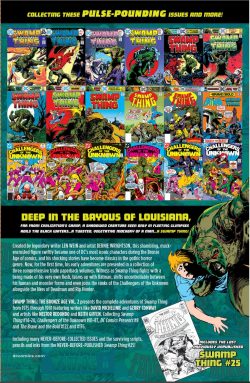
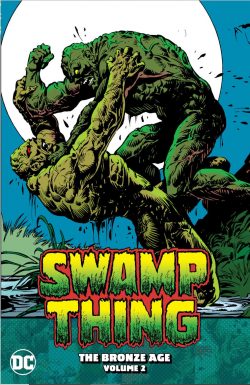
Swamp Thing: The Bronze Age volume 2


By David Michelinie, Gerry Conway, Carla Conway, David Anthony Kraft, Steve Englehart, Bob Haney, Martin Pasko, Nestor Redondo, Fred Carrillo, Keith Giffen, Michael Netzer, Murphy Anderson, Ernie Chan & various (DC Comics)
ISBN: 978-1-4012-9422-9 (TPB/Digital edition)

Win’s Christmas Gift Recommendation: Utter Moodily, Moss-Bedecked Entertainment Perfection… 9/10

The first fan-sensation of the modern era – now officially enshrined as the Bronze Age – of American comic books – Swamp Thing has powerful popular fiction antecedents and in 1972 was seemingly a concept whose time had come again. Prime evidence was the fact that Marvel were also working on a man-into-mucky, muddy mess character at the very same time.

Both Swampy and the Macabre Man-Thing were thematic revisions of Theodore Sturgeon’s classic novella It, and bore strong resemblances to a hugely popular Hillman Comics star dubbed The Heap. He/it sloshed through the back of Airboy Comics (née Air Fighters Comics) from1943 onwards and my fan-boy radar suspects Roy Thomas’ marsh-monster the Glob (from Incredible Hulk #121, November 1969 and #129, June 1970) either inspired both DC and Marvel’s creative teams, or was part of that same zeitgeist.

It should also be remembered that in the autumn of 1971 Skywald – a very minor player with big aspirations – released a monochrome magazine in their Warren Comics knock-off line entitled The Heap.

For whatever reason, by the end of the 1960s superhero comics were in another steep sales decline, again succumbing to a genre boom led by a horror/mystery resurgence. A swift rewriting of the Comics Code Authority augmented the changeover and at National/DC, veteran EC comics star Joe Orlando became editor of House of Mystery and sister title House of Secrets.

These returned to short story anthology formats and gothic mystery scenarios, taking a lead from TV triumphs such as Twilight Zone and Rod Serling’s Night Gallery.

Referencing the sardonic narrator/storyteller format of those EC horror titles, Orlando created Cain and Abel to shepherd readers through brief, sting-in-the-tail yarns produced by the best new and established creators the company could hire. Artists Neal Adams, Mike Kaluta, and especially Bernie Wrightson produced some of their best work for these titles, and the vast range of spin-offs the horror boom generated at DC.

The 12th anthology issue of the resurrected House of Secrets (#92, June/July 1971) cemented the genre into place as the industry leader. There writer Len Wein & Wrightson produced a throwaway gothic thriller set at the turn of the 19th century, wherein gentleman scientist Alex Olsen was murdered by his best friend with his corpse dumped in a swamp.

Years later, Olsen’s beloved bride – now the unsuspecting wife of the murderer – was stalked by a shambling, disgusting beast that seemed to be composed of mud and muck…

The tale struck an immediate chord with the public. That issue was the best-selling DC comic of that month, and reader response was fervent and persistent. By all accounts, the only reason there wasn’t an immediate sequel or spin-off was that the creative team didn’t want to produce one. Eventually however, bowing to interminable pressure, and with the sensible idea of transplanting the concept to contemporary America, Swamp Thing #1 appeared on newsstands in the Spring of 1972. It was an unqualified hit and instant classic…

Wein & Wrightson produced 10 issues together: an extended, multi-chaptered saga of justice and vengeance encompassing a quest for answers that was at once philosophically typical of the time and a prototype for the story-arc and mini-series formats that dominate today’s comics. They also used each issue/chapter to pay tribute to a specific sub-genre of timeless horror story whilst advancing the major plot…

When Alec and Linda Holland retreated deep into the Louisiana Bayou to work on a bio-restorative formula to revolutionise global farming, they had no idea criminal organisation “The Conclave” was after their research. Despite the best efforts of Secret Service agent Matt Cable, the lab was bombed and Linda died instantly. Alec – showered with his own formula and blazing like a torch – hurtled to a watery grave in the swamp. He did not die…

Transformed by the formula (and remember, please, this was prior to Alan Moore’s landmark re-imagining of the character) Holland transformed into a huge man-shaped thing: immensely strong, barely able to speak, and seemingly composed of living plant matter. Holland’s brain still functioned, however, and he vacillated between finding his wife’s killers and curing his own monstrous condition. Cable, misinterpreting the evidence, became obsessed with killing the beat, believing it caused the deaths of his two friends and charges…

Swamp Thing travelled the world, encountering the darkest outbreaks of classic supernature and the insatiable greed of human beasts before eventually convincing Cable of his innocence and true identity. Joined by Abigail Arcane – niece of archenemy and necromantic sorcerer Anton Arcane – they roamed a nation and world increasingly beset by uncanny terrors and macabre plots, with new allies like mystery man Bolt at their side.

Wein’s last issue was #13, having ushered in a new direction for Nestor Redondo – who replaced Wrightson with #11 – to display his own gifts and quickly become the artistic driving force.

Born in 1928 at Candon, Ilocas Sur in the American Territory of the Philippines, Redondo was influenced by US strips like Tarzan, Superman, Buck Rogers and Flash Gordon which were immensely popular in the entertainment-starved Pacific Archipelago.

Drawing from an early age, Nestor emulated his brother Virgilio – who worked as a comics artist in the young country. The Philippines became a commonwealth in 1935, and achieved full-independence from the USA in 1946, but maintained close cultural links to America.

Nestor’s parents pushed him into architecture but within a year he returned to comics. A superb artist, he far outshone Virgilio – and everybody else – in the cottage industry. His brother switched to writing and they teamed up: producing some of the best strips the Islands had ever seen, the most notable and best regarded being Mars Ravelo’s Darna.

Capable of astounding quality and incredible speed, by the early 1950s Nestor was drawing for many titles. Publications like Pilipino Komiks, Hiwaga Komiks and Espesial Komiks were fortnightly and he usually worked on multiple series simultaneously, pencils and inks. He also produced a wealth of covers.

In 1953, he adapted MGM film Quo Vadis for Ace Publications’ Tagalong Klasiks #91-92. Written by Clodualdo Del Mundo, it was serialized to promote the movie in country, and impressed MGM so much that they offered 24-year old Nestor a US job and full residency. He declined, thinking himself too young to leave home yet.

Ace was the country’s biggest comics publisher, but by the early 1960s they were in dire financial straits. In 1963 Nestor, Tony Caravana, Alfredo Alcala, Jim Fernandez, Amado Castrillo and brother Virgilio set up their own company CRAF Publications, Inc., but times were against them and publishers everywhere. Around this time, America called again, in the form of DC and Marvel Comics.

By 1972, US based Tony DeZuñiga had introduced Filipino artists to US editors. Nestor drew horror tales for House of Mystery, House of Secrets, The Unexpected, Phantom Stranger, Secrets of Sinister House, Witching Hour, Weird War Tales; Marvel’s Man-Thing; and an astonishingly lovely run on Rima the Jungle Girl (loosely adapting W. H. Hudson’s seminal 1904 novel Green Mansions), before joining Swamp Thing.

He also worked on Lois Lane and the Tarzan franchise, and in 1973 produced literary adaptations including Dracula and Dr. Jekyll and Mr. Hyde for Vincent Fago’s Pendulum Press Illustrated Classics (later reformatted as Marvel Classics Comics). In later years, he moved to Marvel to ink and eventually fully illustrate The Savage Sword of Conan.

During his DC period he was tapped to draw an adaptation of King Arthur which DC killed before it was completed (once again some pages survive and the internet is your friend if you want to see them) but did limn tabloid-sized Limited Collectors’ Edition: The Bible.

This epic bayou bonanza gathers the last of the original Swamp Thing run (#14-25), plus guest appearances from Challengers of the Unknown #81-87; The Brave and the Bold #122 & 176 and DC Comics Presents #8 (spanning cover-dates January/February 1975 to July 1981) .

Roving America during a period of political instability tainted by cultural hedonism and paranoia, Cable, Abby, Bolt and miserable misshapen Alec Holland (whom they had recently broken out of federal custody) continually stumbled into weird and deadly situations. With writer David Michelinie joining Redondo, proceedings open here with ‘The Tomorrow Children’ (ST #14, January/February 1975).

Separated again, Holland’s human helpers search for him as the depressed nomad discovers an isolated Bayou community of simple folk persecuting a family of freakish kids. Swamp Thing drives off one murderous mob, but stories of the outcast kids’ uncanny powers and the plain facts of strange accidents and mysterious disappearances won’t go away. By the time the townsfolk return to destroy the “demon children”, Holland has discovered radioactive waste is causing all the problems, but far too late to prevent tragedy or promote understanding…

Swamp Thing then falls under ‘The Soul-Spell of Father Bliss’: a seemingly serene and benign cleric with demonically disturbing notions on how to restore faith to his disinterested flock. When Cable and Abby finally find Swamp Thing, it’s not Alec Holland inside the vegetable colossus and only an ultimate sacrifice can save them and humanity from the priest’s folly…

In the awful aftermath, Bolt is captured by agents unknown and the restored Holland-Thing leads a rescue party against an old adversary. Typically, the venture is derailed by cruel fate and the monster ends up alone on tiny Kalo Pago island in the middle of a revolution. On one side is a viciously repressive military government while the rebels are led by High Priestess Laganna – who has a direct line to zombie gods.

Caught in the middle, Holland cannot stem the tide of terror on the climactic ‘Night of the Warring Dead’

ST #17 finds Bolt a prisoner of resurrected former Conclave chief Nathan Ellery, but when Abby, Cable and Swamp Thing finally stumble into his HQ, the maniac’s mercenaries, mechanical myrmidons and global mind-control contraption ‘The Destiny Machine’ at first appear to be an unbeatable opposition. But only at first…

Fleeing the destruction they have partially wrought, the victorious heroes crash land in an idyllic hamlet filled with violently murderous old folk. Its apologetic administrator claims Serenity is an experimental “ultimate retirement facility”, but before long is revealed as a demonic  ‘Village of the Doomed’ requiring all Holland’s power to escape and exorcise…

Cover-dated October 1975, The Brave and the Bold #122 then counts down ‘The Hour of the Beast!’ Bob Haney & Jim Aparo detail the awesome spectacle of Swamp Thing’s return to Gotham City and efforts to save it from a monstrous vegetable infestation. When Holland then becomes a target for a profit crazed showman, it needs all Batman’s ingenuity to save his ally and his city…

That same month in Swamp Thing #19, Gerry Conway joined Redondo to reveal ‘A Second Time to Die’ as a very familiar muck monster prowls Florida’s Everglades and – barely sentient – is befriended elderly Seminole hermit Ho’tah Makanaw. Nearby, Abby Cable and Bolt drive into Gatorberg, seeking their lost companion and following rumours of a big green monster…

The town is far from friendly but one boy is happy to take them to the old Indian who might know something of what they’re seeking…

Events take a drastic turn when the plant giant attacks a government drilling installation even as Ho’tah reveals a magical secret and sets the stage for an incredible clash in the next issue when Swamp Thing Holland battles incredible duplicate ‘The Mirror Monster’ for all the wrong reasons and for people who don’t deserve his aid…

Although the quality of the storytelling was getting better, the times were turning against the horror medium and as Michelinie returned in #21, it was for a science fictional romp as Holland was abducted by alien collector/slaver Solus. The bitterly contested escape left the monster stranded in an American desert and captured by rogue scientists battling madness-inducing contagion in their top secret atomic weapons base. Of course, definitions of “victim” or “cure” for ‘The Solomon Plague’ depended on who was doing the diagnosing, and when the “patients” started resisting treatment Holland could only watch helplessly as nature took its course…

Another attempt at a new direction began in Swamp Thing #23 as Conway & Redondo unleashed ‘Rebirth and Nightmare’, with a mystery mastermind targeting the moss monster and despatching costumed nemeses Sabre and Thrudvang, the Earth Master, even as the lonely wander made contact with his long-lost – and never-mentioned – smarter brother Edward Holland

Their combined efforts to concoct a cure are initially successful despite Sabre’s surprise attack, but as we all know “no good deed goes unpunished”…

Cover-dated August/September 1976, an era ended with #24 as Conway, David Anthony Kraft, Ernie Chan & Fred Carrillo all collaborated on ‘The Earth Below’ as human but still traumatised Alec Holland faces Sabre, even more costumed crazies and ultimately tectonic terror Thrudvang, all craving the bio-regenerative formula still afflicting the former plant monster…

That catastrophic cliffhanger clash was never completed as the title was cancelled without warning or fanfare, just as it was about to formally join the superhero section of the DCU. It was probably for the best. As the Vertigo imprint would prove in a later age, some champions need sophisticated darkness to properly thrive…

As for the Bronze Age, Swamp Thing became a part of the army that hung around waiting to be picked for guest shots or even a revival. With the superhero genre recovering, one old concept granted a new shot ultimately led to fresh shoots for Holland.

The Challengers of the Unknown was a bridging concept. As superheroes were being revived in 1956 here was a super-team – the first of the Silver Age – but with no powers, basic utilitarian uniforms instead of costumes and the most dubious of motives – Suicide by Mystery. They debuted in Showcase #6 (cover-dated February 1957 and on sale in early November of 1956) and followed up in #7, 11 & 12 before gaining their own title (#1-77, May 1958-January 1971, plus a reprint revival in #78-80 in 1973).

They were a huge hit and major players in their time, striking a chord that lasted for more than a decade before they finally died… only to rise again and yet again. The idea of them was stirring enough, but their situation made their success all but inevitable. Conceived by inspirational human hit-factory Jack Kirby – before his move across town to co-create the Marvel Universe – the solid adventure concept and imperfect action heroes he left behind were idealised everyman characters for the tumultuous 1960s – an era before superheroes overtook anthological genre heroes to secure a virtual chokehold on comic book pages.

Kirby had developed a brilliantly feasible concept and heroically archetypical characters in cool pilot Ace Morgan, indomitable strongman Rocky Davis, intellectual aquanaut Prof.” Haley and daredevil acrobat Red Ryan. The Challengers of the Unknown were four (extra)ordinary mortals; heroic troubleshooter and explorers who walked away unscathed from a terrible plane crash. Already obviously what we now call “adrenaline junkies”, they communally decided that since they were all living on borrowed time, they should dedicate what remained of their lives to testing themselves and fate. The quartet would risk their lives for KNOWLEDGE and, naturally, JUSTICE.

They were joined by an occasional fifth member, beautiful (of course) scientist June Robbins in their second appearance (Ultivac is Loose!’ in Showcase #7, March/April 1957), and she became a hardy perennial, frequently popping up to solve puzzles, catch criminals and generally deal with aliens, monsters, mad boffins and assorted supernatural threats. Over the decade other Challengers audited this core group, but none as bizarre as those that popped in during their late 1970s resurgence…

The return began in 1976 as a try-out serial in Super-Team Family #8-10 (January-May 1977) and led to the launch of Challengers of the Unknown #81 (June/July 1977). Crafted by Conway, Michael Netzer (nee Nasser) & Bob Wiacek, it’s included here and sees the boys and June Robbins defeat an old super-foe in ‘Multi-Man’s Master Plan’. In the course of the battle, Prof is diagnosed with an appalling, life-threatening fungal infection that dictates the team heading to Perdition, Pennsylvania, with persistent wannabe hanger-on Gaylord Clayburne desperately seeking to insert himself into the rescue mission…

Older fans will know that’s where Holland first defeated a Lovecraftian horror (Swamp Thing #8): a tale fully reprised in CotU #82, as Conway, Netzer & Joe Rubinstein reveal ‘The Lurker Below’, examine the ‘Legacy of the Damned’, expose ‘The Soul Predator’ and ruthlessly respond as ‘The Lurker Rises’

As a deranged priest seeks to manifest cancer-god M’Nagala, Keith Giffen & John Celardo take over art duties with #83 as the embattled Challs seek to close ‘Seven Doorways to Destiny’. As Prof succumbs to fungal assimilation, aid comes as Clayburne recruits human Dr. Alec Holland as a potential ‘Savior from the Swamp?’ even as ‘The Gods Crawl Closer’. Unknown to the vainly striving Challengers, the subsequent battle reverts Holland to his vegetable form, but ‘Monsters, Good and Evil’ cannot stop the ghastly devil until Holland’s ultimate sacrifice. His triumph over M’Nagala goes completely unnoticed…

Issue #84 finds the human heroes attempting ‘To Save a Monster’ called Prof Haley, but falter until the spirit of Boston Brand occupies and cures him ‘When Deadmen Walk’. In the meantime the Challs learn Holland is the Swamp Thing and seek to make amends. With unperceived aid from Brand, they track the bog beast down only to find he/it has been taken over by Multi-Man…

The threat is covertly countered by Deadman, who sticks around when the Challs offer the plant monster a place on the team, just as Challengers of the Unknown #85 introduces ‘The Creature from the End of Time!’ as ‘The Box from Beyond’ materialises in Toronto, spawning murderous ‘Monsters and Men’ and necessitating a ‘Flight into the Future’

The team had hoped to consult legendary specialist Rip Hunter, Time Master, but learn he and his team have been missing for a decade…

Disappointed but undeterred, the Challs (minus angry quitter Red Ryan but with unsuspected stowaway Deadman) take off for 12 million AD, leaving recuperating Prof behind to face an unsuspected menace…

Penultimate issue #86 solves the mystery of Rip Hunter as the heroes encounter ‘The War at Time’s End’, whilst recap ‘The Way it Began’ restates the convoluted path and events that brought the situation about.

The dismantling of humanity’s final dystopia begins as ‘If This is Tomorrow, You Must Be Rip Hunter!’, leads to the Challenger team investigating ‘Time Times Terror’ and discovering ‘A Pit by Any Other Name’ before the saga concludes in complete chaos with #87 (June/July 1978) as the  ‘Twelve Million Years to Twilight’ pits the human heroes against mutated terrors of the dominant Sunset Lords.

In the end, the future of humanity depends on monsters ghost and primitives enacting an ‘Assault on Sunset’ to secure ‘Twilight’s Last Glimmer’, courtesy of Carla & Gerry Conway, Giffen & Celardo.

Once again, an abrupt cancellation was the reward for valorous service and all players returned home to be shelved again. This compendium closes with a brace of superhero team-ups and a lost treat for true devotees, beginning with DC Comics Presents #8 (April 1979), as ‘The Sixty Deaths of Solomon Grundy!’ by Steve Englehart & Murphy Anderson pairs bog beast with the Man of Steel. Still believing he was a transformed human and not an enhanced plant, Swamp Thing here searches the sewers of Metropolis for a cure to his condition, only to stumble onto a battle between Superman and the mystic zombie who was “born on a Monday…

Crafted by Martin Pasko & Aparo, an encore in The Brave and the Bold #176 (July 1981) reunites Batman and Swamp Thing in a convoluted tale of Bayou-based murder and frame-ups in ‘The Delta Connection’ before the previously unpublished contents of Swamp Thing #25.

With the series cancelled, in-production story ‘The Sky Above’ by Kraft, Chan & Carillo is presented here as plot, script, uncoloured cover 16 pages of layouts, the pencils and inks in a clash with Hawkman that really should have officially taken place…

Also offering covers by Redondo, Aparo, Chan, Netzer, Neal Adams, Rubinstein, Rich Buckler, Jack Abel, Frank Giacoia, Alex Saviuk, Dick Giordano, José Luis García-López and Mike Kaluta; editorial material from Challengers of the Unknown #86 and an unused cover by Rick Veitch & Michelle Madsen, this collection comprises a genuine landmark of the art form, with stories that are superb examples of old-fashioned comics wonderment, from a less cynical and sophisticated age, but with a passion and intensity that cannot be matched. And, ooh, that artwork…

If you love comics you must have his buried treasure.
© 1975, 1976, 1977, 1978, 1979, 1981, 2019 DC Comics. All Rights Reserved.
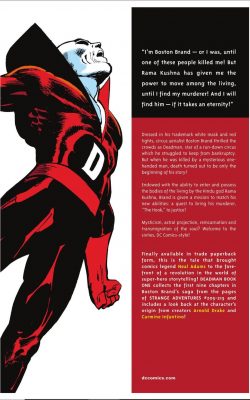
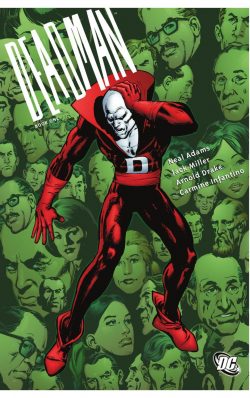
Deadman: Book One


By Arnold Drake, Jack Miller, Carmine Infantino, Neal Adams, George Roussos & various (DC Comics)
ISBN: 978-1-4012-3116-3 (TPB/Digital edition)

As the 1960s ended, a massive superhero boom became a slow but certain bust, with formerly major successes no longer able to find enough readers to keep them alive. The taste for superheroes was diminishing in favour of more traditional genres, and one rational editorial response was to reshape costumed characters to fit evolving contemporary tastes.

Publishers swiftly changed gears and even staid, cautious DC reacted rapidly: making masked adventurers designed to fit the new landscape. Newly revised and revived costumed features included roving mystic troubleshooter The Phantom Stranger and golden age colossus The Spectre, whilst resurgent traditional genres spawned atrocity-faced WWII spy Unknown Soldier and cowboy bounty hunter Jonah Hex, spectral western avenger El Diablo and game-changing monster hero Swamp Thing, spearheading a torrent of new formats, anthologies and concepts.

Moreover, supernatural themes and horror-tinged plots were shoehorned into those superhero titles that weathered the trend-storm. Arguably, the moment of surrender and change had arrived with the creation of Boston Brand in the autumn of 1967, when venerable science fiction anthology Strange Adventures was abruptly retooled as the haunted home of an angry ghost…

Without fanfare or warning, Deadman debuted in #205 with this first collection (of five) re-presenting that origin event and thereafter, pertinent contents from #206-213: cumulatively spanning cover-dates October/November 1967 to July/August 1968. The drama is preceded by Introduction ‘How Deadman Came to Life’ by originator Arnold Drake and the Foreword – ‘A Most Unusual Character’ by Carmine Infantino – each reminiscing, recapitulating and confirming just how daring and unprecedented the new kind of hero was…

Then it’s straight into eerie action with ‘Who Has Been Lying in My Grave?’ – by Arnold Drake, Carmine Infantino & George Roussos – as we attend the funeral of high wire acrobat Boston Brand: a rough, tough, jaded performer who had seen everything and masked a decent human heart behind an obnoxious exterior and cynical demeanour.

As “Deadman”, Brand was the star attraction of Hills Circus and lover of its reluctant owner Lorna Carling, as well as a secret guardian for the misfits it employed and sheltered. That makeshift “family” includes simple-minded strongman Tiny and Asian mystic Vashnu, but also had a few bad eggs too… people like alcoholic animal trainer Heldrich and chiselling carnival Barker Leary.

The aerialist kept them in line… with his fists, whenever necessary…

One fateful night, Brand almost missed his cue because of Leary and Heldrich’ antics and also because he had to stop local cop Ramsey harassing Vashnu. It would have better if he had been late, because as soon as he started his act – 40 feet up and without a net – someone put a rifle slug into his heart…

Despite being dead before he hit the ground, Brand was scared and furious. Nobody could see or hear him screaming, and Vashnu kept babbling on that he was the chosen of Rama Kushna – “the spirit of the universe”. The hokum all came horribly true as the entity astonishingly made contact, telling Brand that he would walk among men until he found his killer…

The sentence came with some advantages: he was invisible, untouchable, immune to the laws of physics and able to take possession of the living and drive them like a car. His only clue was that witnesses in the audience claimed that a man with a hook had shot him…

Outraged, still disbelieving and seemingly stuck forever in the ghastly make-up and outfit of his performing persona, Deadman’s first posthumous act is to possess Tiny and check out the key suspects. Soon the dormant Hercules finds that the cop and Heydrich are involved in a criminal conspiracy, but they definitely are not Brand’s murderers…

Eventually, the ghost learns a shocking fact: his desperation is not worth the life of anyone else and he must not let his anger put his “vessels” in harm’s way…

Second episode ‘An Eye for An Eye!’ was scripted by Drake, and was Adams’ illustrative debut. Originally inked by Roussos, here it is rather unfairly reinked by Adams and further enhanced by modern colouring techniques. I understand how the artist should have autonomy and agency in his own work, but for the sake of chronology and authenticity, I take quite a bit of umbrage on behalf of old “Inky”, whose efforts seem unfairly judged and slighted by these revisions…

That being said, the tale is a strong one and indicates a sea change in narrative style as Deadman expedites his hunt for justice. The stories henceforth focus on those who are temporarily occupied by Brand: a string of episodic encounters that mirrored the protagonist of contemporary hit TV series The Fugitive (and by extension, Victor Hugo’s Les Misérables), with an unfairly accused victim searching for personal justice all across America, to the benefit of many people in crisis.

Here, that’s young Jeff  Carling, who’s fallen in with a dangerous biker gang and is set up to pay for their crimes. He’s also Lorna’s brother, which is how Deadman gets involved in the mess, after learning the cash-strapped kid had taken out a life insurance policy on the circus star just before the Hook struck…

Having saved the kid from a perfect frame, Brand resumes his search and, as Jack Miller took over scripting in #207, is forced to ask ‘What Makes a Corpse Cry? The hunt leads him to revisit the night he saved bar girl Liz Martin from a drunken assault by her boss Rocky Manzel, but when the spook checks in, he finds Liz and boyfriend Paul being terrorised by Rocky, who coldly implies he caused the death of her last protector…

Even after using his ghost gifts to disqualify Manzel, Deadman is compelled to help the young lovers, and exposes the club owner’s criminal secret, but once again almost causes the death of his human ride…

Miller & Adams were providing a very different reading experience with innovative, staggeringly powerful art, but struggled with deadlines, and ‘How Many Ways Can a Guy Die?’ was delivered in 4 parts across Strange Adventures #208 and 209. The revelatory tale introduces Brand’s trapeze artist rival Eagle, who had tried to kill him years before, and now seeks to replace him in the circus and Lorna’s bed – whether she wants him or not…

When Deadman again borrows Tiny to dissuade the brute, Eagle threatens the gentle strongman with the same thing Brand got and the ghost is convinced his quest is almost over. However, the truth is far crueller, and when Deadman uncovers his rival’s actual scheme, the cost to Tiny and alternate vessel Pete is far too high…

The hunt stalled again, Brand finally thinks to check the official police investigation in #210’s ‘Hide and Seek’ (cover-dated March 1968). To his disgust, he finds the case is cold, with assigned detective Michael Riley dishonourably discharged from the force due to the testimony of a man with a hook…

Sensing a breakthrough, Deadman possesses Riley and, visiting the other “witness” to the former cop’s reported use of excessive force, uncovers a devious plot. Sadly, despite clearing Riley’s name, Brand misses The Hook who coldly disposes of the only man who could describe him before fleeing to Mexico…

Hot on the trail, Deadman arrives in El Campo in #211, and endures a shocking surprise in ‘How Close to Me My Killer?’ as Miller’s last story introduces wayward twin brother Cleveland Brand. Flashbacks show the sibling had plenty of motive to murder his showbiz brother, but as the tale unfolds, Boston learns he has an unsuspected niece and his people-trafficking but repentant brother needs some haunted help to save smuggled “wetback” labourers from a Texan businessman looking to whitewash his criminal endeavours…

Adams took over scripting with #212 and ‘The Fatal Call of Vengeance’ sees another change of direction, adding more conventional fantasy elements to the mix as Cleveland and his daughter Lita head north to Hills Circus.

Wearing his brother’s costume, Cleve revives the Deadman act and, in Mexico, a man with a hook sees a headline and rushes back to the USA.

Faster than any jet, Boston is already there and watches helplessly as his brother makes himself a target of the unknown killer. The phantom is also completely spooked by new lion tamer Kleigman who is rude and unfriendly and is missing his right hand…

With everyone at odds, both Boston’s returned killer and the circus family set traps with disastrous results, but in the end the Hook escapes again and it’s Tiny who’s left bleeding out from a gunshot…

This first collection concludes with a dip into the madly metaphysical as ‘The Call from Beyond!’ tests Deadman’s abilities to the limit as he enters Tiny’s consciousness to promote his recovery and break a assumed-fatal coma. Following that miracle, the restless revenant repays his debt by saving the reputation and life of Tiny’s surgeon Dr. Shasti after the medical savant is duped by murderous con artist/medium Madam Pegeen

With groundbreaking covers by Infantino, Sekowsky, Roussos & Adams and ‘Biographies’ of the creators involved, this spectral delight perfectly captures the tone of an era in transition through a delirious run of comics masterpieces no ardent art lover or fanatical fear aficionado can do without.
© 1967, 1968, 2011 DC Comics. All Rights Reserved.

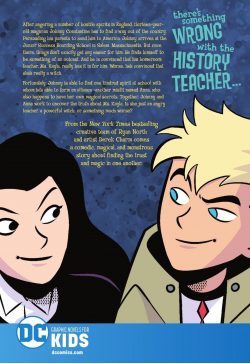
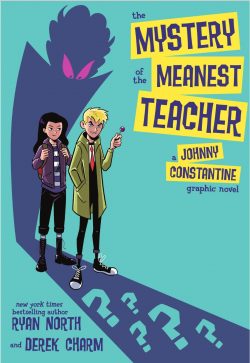
The Mystery of the Meanest Teacher – a Johnny Constantine Graphic Novel


By Ryan North, Derek Charm & various (DC Comics)
ISBN: 978-1-7795-0123-3 (TPB/Digital edition)

Win’s Christmas Gift Recommendation: Moody, Mirthful and Magical… 8/10

In recent years DC has opened up its shared superhero universe: generating Original Graphic Novels featuring its stars in stand-alone adventures for the demographic inappropriately dubbed Young Adult. To date, results have been rather hit or miss, but when they’re good, they are very good indeed. An ideal example is this cheery chiller reinterpreting the formative years of DC’s magical bad boy: particularly concentrating on his early relationship with things that go bump in the night…

You’ve either heard of John Constantine by now or you haven’t, so I’ll be brief. Created in 1985 by Alan Moore, Steve Bissette, Rick Veitch & John Totleben during a groundbreaking run on Swamp Thing, the unlikeliest of heroes is a mercurial modern mage, a dissolute chancer and self-appointed mystic fixer who plays like an addict with magic – on his own terms for his own ends.

He is not a good guy. He is not a nice person, but all too often, he’s all there is between us and the void…

Winning his own series by clamorous popular demand, Constantine’s own series Hellblazer premiered in 1988, during the dying days of Reaganite Atrocity in the US but at the height of Thatcherite Barbarism in England. We’re pretty much singing the same songs now as back then but – with 5th rate Britain’s Got Talent cover-artist wannabes as our revolving-door leaders – that’s something little Johnny will surely get around to sorting if he gets another outing…

In 1988, creative arts and Liberal attitudes were dirty words in many quarters and the readership of Vertigo was pretty easy to profile. The long-running series started with relatively safe horror plots, introducing us to Constantine’s unpleasant nature, chequered history and odd acquaintances. Even then, discriminating fans were aware of a joyously anti-establishment political line, rebellious nature and wildly metaphorical underpinnings. Racism, Darwinian politics, gender fluidity, plague, famine, gruesome supernature and more were everywhere in the dark dystopian purview of John Constantine – a world of bleeding-edge mysticism, Cyber-shamanism and political soul-stealing.

Relax. That is not the Constantine you’re looking at here…

Courtesy of writer Ryan North (Dinosaur Comics, Adventure Time, Slaughterhouse-Five, Power Pack, Machine of Death, Unbeatable Squirrel Girl, How to Invent Everything, Star Trek – Lower Decks) and illustrator Derek Charm (Jughead, Unbeatable Squirrel Girl, Uncle Scrooge, Jughead’s Time Police, Star Wars Adventures) – assisted by letterer Wes Abbott – we’re meeting a wily wizard in waiting: someone apparently without conscience or impulse control who bears more than a passing resemblance to juvenile parental burden Dennis the Menace – but more the malign mischief maker from The Beano than Hank Ketchum’s wayward waif…

It begins in London where a cocky kid pops into a sweetshop. Unfortunately, Archibald Junior’s Discount Confections is no ordinary purveyor of tasty treats, but then again, Johnny Constantine is no ordinary kid…

Behind a cheesy façade of fragrant gleaming bottles, jars and bags, this exotic emporium has a back room where ghosts, demons and world-devouring cosmic entities can also snatch a little snacky something. It just another eldritch secret that Johnny – who calls himself “Kid Constantine” – somehow knows. The boy has an astounding affinity for magic and has even befriended a few lesser devils, but he also has a weakness for Archibald’s magic chocolates.

Sadly, this latest shoplifting lark endangers all of Earth and, haunted by angry ghosts, the Kid has to take refuge with a pack of low-grade demons.

He’s been casually manipulating his parents for a while now, and fooling himself that he’s a wicked cool Jack the Lad, but he learns a few hard truths as he even wears out his welcome with the unholy monsters, and immediately opts to try boarding school to evade further repercussions. Best of all, the place is in America…

It’s pretty far away, but Johnny doesn’t mind. He’s always been better off alone. Just look what happened to the last friend he foolishly shared his magical gifts with…

With terrifying ease, the unaccompanied boy rocks up at The Junior Success Boarding School in Massachusetts, but his charm and roguish manner can’t help him adjust, settle in or make any friends on campus. In fact, he’s actually starting to feel a bit lonely… until a bit of lazy, labour-saving magic is spotted by fellow sixth grade outsider Anna.

The Kid is just starting to think he might have made a mistake coming to America when she comes clean and confesses that she too can make little miracles…

Our gobsmacked loner thinks long and hard before letting his guard down, but soon they are friends and co-conspirators, playing pranks and testing their limits. It seems the best of all worlds until their homeroom teacher Ms. Kayla starts behaving strangely…

Formerly the nicest adult in school, she abruptly changes, spitefully singling out Johnny and Anna for special attention and cruel psychological bullying. Before long, the supernatural students are using their gifts to learn what caused the transformation, but discover it’s far worse than they could ever have imagined…

Facing a deadly existential supernatural threat, Kid Constantine does what he always does and runs away, deserting Anna and the school, but everything changes when he hits the forests surrounding the institution and meets a potentially life-changing ally in the huge form of a witch-hunting demon called Etrigan

Chastened and emboldened, the Kid makes a decision that will change his life: returning to school, joining Anna and the Demon in ending a monstrous menace more terrible than anyone could have imagined…

Rowdy, rousing and riotous – and sublimely stuffed with twists, shocks and enticing snippets of DC lore – the battle against unforgiving evil culminates in a clever piece of misdirection and some stellar sleight of hand as valiant Anna and duty-driven Etrigan see their bad boy come good and save everything…

This tale is done in one but the book also offers a lengthy excerpt from Jeffrey Brown’s Batman and Robin and Howard that is also worth some of your time and attention…

Bold, beguiling, brilliantly entertaining and deliciously uplifting, The Mystery of the Meanest Teacher is a magical rite of passage and smartly funny adventure with a twist to charm and thrill full-on fans and nervous neophytes alike: one introducing a new wondrous world with a rousing reminder that there is magic everywhere.
© 2020 DC Comics. All Rights Reserved.

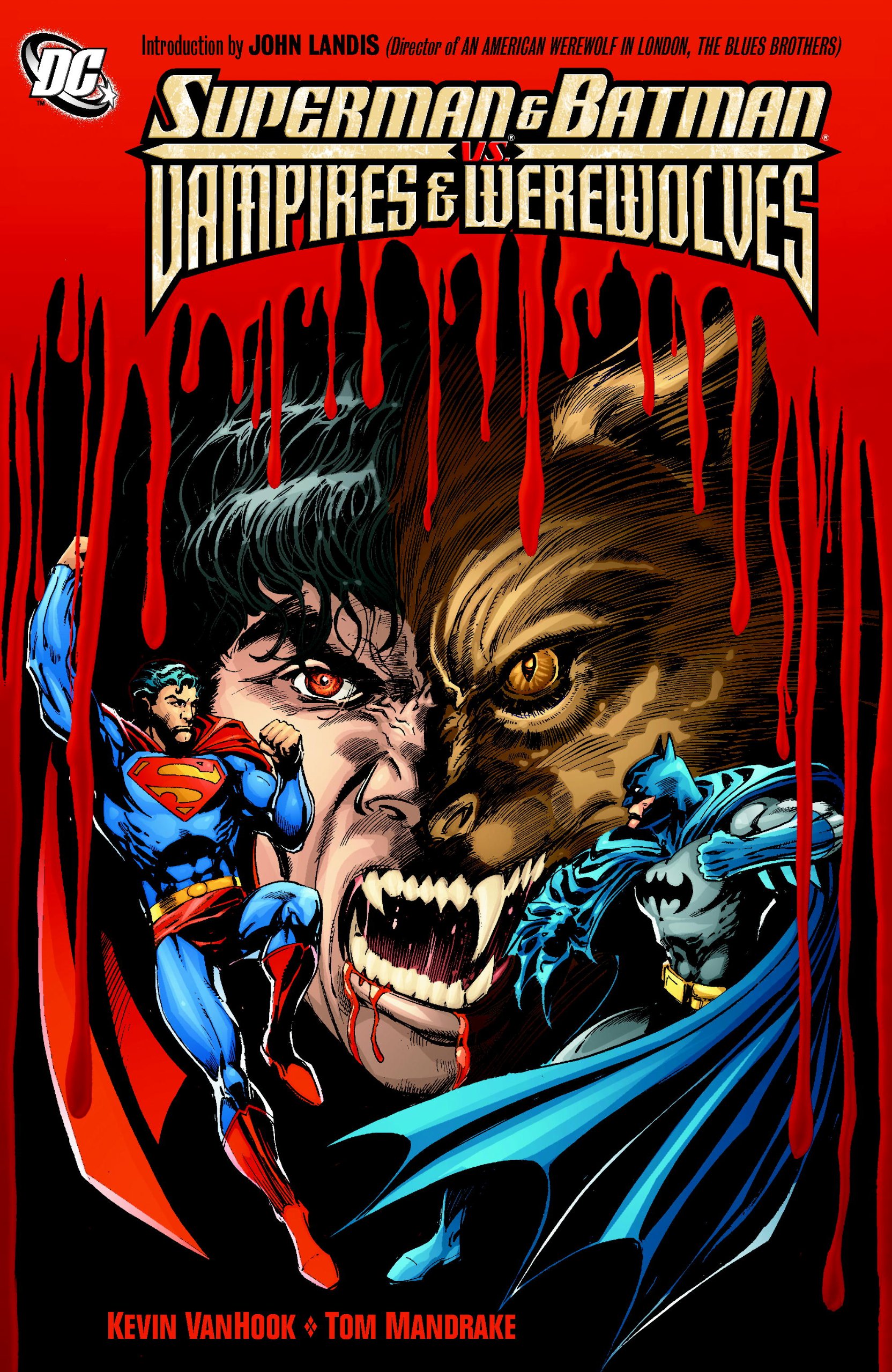
Superman & Batman vs Vampires & Werewolves


By Kevin VanHook & Tom Mandrake (DC Comics)
ISBN: 978-1-4012-2292-5 (TPB/Digital edition)

The Man of Tomorrow and the Dark Knight are two characters who have, for the most part, escaped their lowly comics origins to join a meta-fictional literary landscape populated by the likes of Mickey Mouse, Tarzan and Sherlock Holmes. As such their recognition factor outside our industry means that they get to work in places and with other properties that might not appeal to funny-book purists.

Take for example this out-of-print tale that piles on heaped helpings of monster-bashing, and which, despite a host of guest-stars, felt on release more like a test launch than a assured hit and has since become as vanishingly vaporous as its arcane antagonists…

Superman & Batman vs. Vampires & Werewolves is an intriguing, if flawed, oddment (with one of the clunkiest titles ever imagined) that should have appealed to the casual reader, especially if they’re not too adamantly wedded to the comic book roots and continuity of the DC Universe.

Prowling the streets of Gotham City, Batman comes across a partially devoured corpse and is promptly boots-deep in an invasion of mindless berserker vampires and werewolves who turn the city into a charnel house. Helpless to combat or contain the undead rampage, the Caped Crimebuster accepts the aid of enigmatic (but rational) vampire Marius Dimeter and his lycanthropic counterpart Janko who grudgingly ally themselves with the hero to track down Herbert Combs – a truly deranged scientist resolved to traffic with the Realms Beyond.

To facilitate his goals, Combs turned Janko and Dimeter into the accursed creatures they are and unleashed his plague of horrors on America to further his research. The bonkers boffin is infecting more helpless humans and has become an actual portal for Lovecraftian beasts to invade our reality…

Superman joins the fray just as one of these Elder God nightmares is unleashed, but even after its defeat he’s no real help: hampered more by his ethical nature than utter vulnerability to magic. Far greater aid is provided by super-naturalist Jason Blood and his Demonic alter-ego, whilst Kirk Langstrom – who can transform into the monstrous Man-Bat at will – provides both scientific and brutally efficient clean-up assistance.

Fellow harder-edged heroes such as Wonder Woman, Nightwing and Green Arrow turn up and join the battle to great effect, but after their admittedly impressive cameos and participatory contributions inexplicably wander off before the overarching threat is ended…

Nuh-uuh! Once a team-up begins, comics guys (who aren’t paid big bucks like big-name guest actors) don’t leave until the day is saved!!

So it’s up to the headliners – with Dimeter and Janko – to finally restore order and normality, even though the cost is high both in blood and convictions…

At the last, the superheroes are – relatively – victorious, but the ending is rather ambiguous and leaves the impression that the whole affair has been a pilot for a Dimeter spin-off…

This was clearly a break-out publishing project, aimed at drawing in new readerships like those occasional movie tie-ins that drive professional fans crazy, and on that level the daft and inconsistent plot can be permitted, if not fully forgiven.

VanHook (Flash Gordon, Bloodshot, G.I. Joe, Red Tornado) makes more films than comics these days and the tale is certainly most effective on the kind of action and emotional set-pieces one sees in blockbuster flicks: so even if there are far too many plot holes big enough to drive a hearse through, the sensorial ride should carry most readers through. Most importantly, the moody art of Tom Mandrake (Grimjack, The Spectre, Batman, Firestorm, Martian Manhunter) is – as ever – astoundingly powerful: dark, brooding and fully charged for triumph and tragedy…

So if not perhaps for every reader, there’s a great deal of sinful pleasure to be found here. And let’s face it: who doesn’t like monster stories or finding out “who would win if”…
© 2008, 2009 DC Comics. All Rights Reserved.
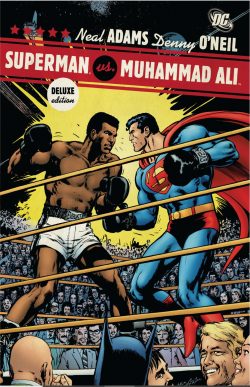
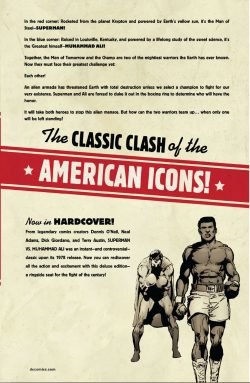
Superman vs Muhammad Ali Deluxe Edition


By Neal Adams, Denny O’Neil, Dick Giordano, Terry Austin, Gaspar Saladino & various (DC Comics)
ISBN: 978-1-4012-2841-5 (HB/Digital edition)

It’s a fact (if such mythological concepts still exist): the American comic book industry would be utterly unrecognisable without the invention of Superman. His unprecedented adoption by a desperate and joy-starved generation quite literally created a genre if not art form.

Within three years of his June 1938 debut, the intoxicating blend of eye-popping action and social wish-fulfilment which hallmarked the early Man of Steel had grown to encompass cops-and-robbers crime-busting, socially reforming dramas, science fiction, fantasy, whimsical comedy and – once the war in Europe and the East embroiled America – patriotic relevance.

If only in comic book terms, Superman is master of the world, having utterly changed the shape of a fledgling industry and entertainment in general. There have been newspaper strips, radio and TV shows, cartoons, games, toys, apparel, merchandise and blockbusting movies. Everyone on Earth gets a picture in their head when they hear the name.

Another icon – a magnificently human one – was a sporting legend who became a paragon of black liberation and human equality, as well as global symbol of power, endurance and dignity. He was an American prizefighter who started life as Cassius Marcellus Clay Jr., before finding his true name and purpose…

Born in Louisville, Kentucky on January 17th 1942 – so, technically, also a son of the Golden Age – Clay began boxing at age 12. He won titles and acclaim – and later notoriety – not simply for his incredible sporting achievements but for his quick wits, cultural savvy and moral standing. Gold medal Olympian, World heavyweight champion, critic, pundit and street poet, in 1966 Clay took on the American government and paid a high personal price for refusing to fight a white man’s war in Vietnam.

A forceful lifetime advocate of equal rights, in 1964, the Conscientious Objector had converted to Islam and formally renounced his “slave name”, adopting new appellation Muhammad Ali. A living symbol of black pride during the Civil Rights era, Ali retired from boxing in 1981, concentrating on commercial, social, political and philanthropic works. He was declared Sportsman and Sports Personality of the (20th) Century by Sports Illustrated and the BBC respectively, and died in June 2016 from complications associated with Parkinson’s disease.

As part of his campaign to draw attention to his causes, in 1977 “The Greatest” agreed to a headline-grabbing exhibition bout with the “World’s Greatest Superhero” which was released in January 1978 in the flashy, oversized tabloid iteration that was the decade’s equivalent of today’s prestige print formats. Originally published as All-New Collectors’ Edition volume 7, #C-56, the project was very much the baby of another phenomenon of the era…

Neal Adams was born on Governors Island, New York City, on June 15th 1941. His family were career military and he grew up on bases across the world. In the late 1950s, Adams studied at the High School of Industrial art in Manhattan, graduating in 1959.

As the turbulent, revolutionary 1960s opened, the illustrator had worked in advertising and ghosted some newspaper strips whilst trying to break into comics. In pursuing a commercial art career – advertising and “real art” – he did some comics pages for Joe Simon at Archie Comics (The Fly and that red-headed kid too) before becoming one of the youngest artists to co-create and illustrate a major licensed newspaper strip: Ben Casey, based on a popular TV medical drama series. His first attempts to find work at DC were not successful…

That comic book fascination never faded, however, and as the sixties progressed Adams drifted back to National/DC, working on covers as inker or penciller. After “breaking in” via anthological war comics, he eventually found himself at the vanguard of a revolution in pictorial storytelling, much of it with similarly socially-inclined writer Denny- O’Neil (with whom he had spearheaded an age of “relevancy” in Green Lantern/Green Arrow)

As well as a comics iconoclast, Adams was a tireless social activist and campaigner. His mission as champion of creators rights even finally secured some long-ignored liberties and rewards for the formerly invisible stars of comic books like Jerry Seigel & Joe Shuster…

For the high-profile Superman vs Muhammad Ali project – immortalised here in a splendidly oversized (187 x 283 mm) commemorative Deluxe collection – Adams even latterly assumed much of the writing thanks to his affinity for the stars and the subject. He also gets in the first word in his ‘Introduction’ before the saga begins…

As well as worthy and well-intentioned, the bombastic saga is also intoxicatingly exciting and well-executed: a classic invasion tale that finds the Man of Steel helpless before an encircling alien armada pointing appalling weapons at the world. Unable to counter the overwhelming force determined to eradicate or enslave troublesome humanity before they become a threat to all the civilised species of the universe, Superman must play a more devious game…

The Scrubb are a warrior race demanding Earth provide a representative champion to fight a single-combat duel as the means of determining the fate of their species. Forced to play the game by the rules of Scrubb leader Rat’Lar, Superman assumes he will fight for Earth, but is challenged by new friend Muhammad Ali who quite reasonably points out that the hero is only an adopted earthman, even as he shares a few fight tips in ‘Training’

The fight to be the challenger is also manipulated by Rat’Lar, who broadcasts the event across the galaxies to cow and intimidate rival civilisations. The emperor makes great capital of the ‘Preliminary’ bout with the de-powered Kryptonian batting valiantly but in vain against the kid from Kentucky.

The result was never in doubt. Without powers, Superman could never handle Ali, and soon the grievously beaten superhero is stretchered out of the ring, leaving the boxer to face Scrubb champion Hun’Ya in the ‘Main Event’

Exactly as Superman and Ali had planned…

Culminating in a battle of wits and blockbusting demonstration of human and superhuman brawn, this cathartic revel was never about showing whose hero is best, but how underdogs working together can defeat any opposition, even nasty aliens who have no intention of acting in good faith or fighting with honour…

Spectacular hokum, magnificently rendered, this is a treat for the eyes and endlessly re-readable, and this Deluxe tome enhances the visceral fun with loads of extras such as the original wraparound cover, and a ‘Seating Chart’ for the dozens of ringside celebrities Adams added to it plus some candid behind-the-scenes revelations in an ‘Afterword’ from then-DC publisher Jenette Khan. Moreover, art fans and history-buffs can delight in a selection of pencil page layouts and roughs in a copious ‘Sketches’ section, which includes script pages and creator ‘Bios’.

Fast, furious, enthralling and extremely rousing, Superman vs Muhammad Ali celebrates a classic moment of comics history: one that is endlessly appealing and rewarding, and one no fan should be without.
© 1978, 2010 DC Comics. All Rights Reserved. Muhammad Ali and all associated marks are trademarks of Muhammad Ali Enterprises LLC © MAE LLC. All Rights Reserved.
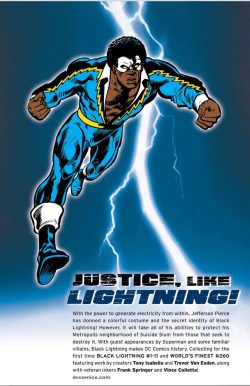
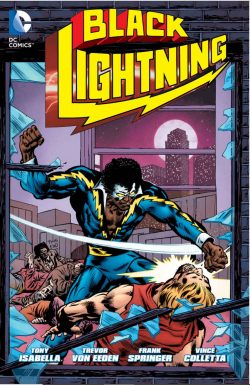
Black Lightning volume 1


By Tony Isabella, Denny O’Neil, Trevor Von Eeden, Mike Netzer, Frank Springer, Vince Colletta & various (DC Comics)
ISBN: 978-1-4012-6071-2 (TPB/Digital edition)

Black Lightning was far from the first superhero of colour, but his mutability, iconic image and sheer tenacity have made him one of the most enduring and widely travelled. He’s been everything from outraged lone street vigilante to teacher; Presidential Secretary to perfect team player (on a succession of super-groups); sporting legend, family man and world-saving wise mentor. He’s even made the turbulent transition to star of his own television series…

Very little of that was apparent when these groundbreaking adventures were first released. Back then, the simple fact that an African-American masked hero was considered sales-worthy was the biggest leap imaginable…

Excluding a few returning characters in jungle-themed comic of the 1940s and 1950s, War comics first opened the door to black characters in the early 1960s, when Robert Kanigher & Joe Kubert created negro boxer Jackie Johnson as a stalwart of Sgt. Rock’s Easy Company in Our Army at War #113 (cover-dated December 1961).

Marvel followed suit with a black soldier in Sgt. Fury’s Howling Commandos (Gabe Jones, debuting in #1, May 1963), and pulled far ahead in the diversity stakes after introducing America’s first negro superheroes. The Black Panther premiered in Fantastic Four #52, (July 1966) and The Falcon first flew in Captain America #117 (September 1969). Luke Cage became the Hero for Hire in the spring of 1972, carrying a June cover-date…

The honour of being the nation’s first black hero to carry in his own title had already come and gone via a little-remembered (or regarded) title from Dell Comics. Created by artist Tony Tallarico & scripter D.J. Arneson, gunslinger Lobo was a vigilante of the wild west who sought out injustice just like any cowboy hero would. He first appeared in December 1965, with his second and final issue cover-dated October 1966…

Gradually, more ethnic lead characters appeared, with DC finally getting a black-skinned hero in John Stewart (Green Lantern #87, December 1971/January 1972), although his designation as a “replacement” GL might be construed as more conciliatory and insulting than revolutionary. By then, Jack Kirby had introduced teen New God Vykin the Black in Forever People #1 (March 1971) and later created enterprising “ghetto kid” Shilo Norman as a hero’s apprentice and eventual successor in Mister Miracle ##15 (August, 1973). DC’s first superhero to have his own solo title didn’t debut until 1977…

This astoundingly accessible, no-nonsense collection – comprising Black Lightning #1-11, material from Cancelled Comics Cavalcade #1 and World’s Finest Comics #260, spans April 1977 to January 1980) and bolts into action following a forthright and informative Introduction by originator Tony Isabella.

It begins as ‘Black Lightning’ (illustrated by neophyte penciller Trevor Von Eeden & veteran inker Frank Springer) sees former Olympic decathlete Jefferson Pierce return to the streets of Suicide Slum, Metropolis to teach at beleaguered inner city Garfield High School. Pierce is determined to make a difference to the troubled kids he used to be numbered amongst, but when the educator interrupts a drug buy on school grounds and sends the dealer packing, the door is opened to vengeance and tragedy…

When the mob – a crime syndicate dubbed The 100 – seek retaliation, one of Pierce’s students pays the ultimate price and the teacher realises he needs the shield of anonymity if he is to win justice and safety for his beleaguered home and charges…

Happily, tailor Peter Gambi – who sheltered Jefferson and his grieving mother after the elder Pierce was murdered – has some useful ideas and inexplicable access to pretty far-out technology…

Equipped with a strength-&-speed enhancing forcefield belt, gaudy costume, a and mask/wig unit completely changing his appearance, a fierce vigilante stalks the streets of Metropolis…

The local chapter of The 100 is run by monstrous, cunning freak Tobias Whale and once the assaults on his soldiers starts biting into profits and offer the downtrodden populace a glimmer of hope, he starts ruthless retaliation.

The sinister strategist lays many traps, culminating in hiring a lethal super-assassin who previously faced Green Arrow and the Justice League of America.

When the killer pounces, Pierce is forced into uneasy alliance with mystery woman Talia Al Ghul, but it ends as soon as bodies start piling up all over the school gym in ‘Merlyn Means Murder’

Vince Colletta assumes the inker’s role as Black Lightning’s continued war against The 100 forces “the Whale” to fight smart, and Metro Police – led by doughty Inspector William Henderson – pursue the vigilante as vigorously as any gangster or felon. Taking seedy stoolie Two Bits Tanner into his confidence, Pierce savagely works his way up the criminal chain of command.

He eventually confronts Tobias in his inner sanctum only to find ‘Every Hand Against Him.’ As the police pounce, paranoia grips Pierce and he begins mistrusting his small team. Has someone he trusts betrayed him?

A more palatable answer seems apparent in #4 as suspicion falls on Tanner’s source – Daily Planet journalist Jimmy Olsen. When the outraged street fighter tries to force a confession from the baffled cub reporter, they are attacked by the 100’s latest super heavy in ‘Beware the Cyclotronic Man’

Jimmy is wounded when they unite to fight off the atomic villain, and Black Lightning is suddenly confronted by the kid’s enraged and late-arriving best pal, who immediately jumps to the wrong conclusion and quickly shows why ‘Nobody Beats a Superman!’

In fact, had Cyclotron not switched attention to the true target Tobias wanted him to kill, everyone might have died, but the heroes’ misunderstandings are all forgotten when Black Lightning saves the Man of Tomorrow from nuclear meltdown, beats the bad guys and uncovers a mole in the police force…

Patience exhausted and under pressure from his own bosses, the Whale declares open season, placing an astounding bounty on Black Lightning. When deeply conflicted manhunter Syonide (and his hilarious, Marvel-baiting in-joke kung fu assistants) stalk the Saviour of Suicide Slum, their first move is to shadow and learn everything about their quarry.

When Gambi is abducted, Jefferson’s secret is finally exposed in ‘One Man’s Poison’, Syonide afflicted with a bizarre sense of honour – hands over a helpless Black Lightning to the Whale in #7. However he cannot escape The Conscience of the Killer’ and is compelled to shelter the captive tailor from the 100’s vengeance before voluntarily paying the ultimate price when ordered to kill the apparently-helpless masked hero…

Tragically, even as Black Lightning undergoes a miraculous transformation and takes out the gathered crooks and villains, he loses another innocent to the violent life he has embraced…

With the power of the 100 seemingly broken and Tobias Whale in custody, Pierce’s war should be over, but the gigantic gangster quickly breaks free and takes hostages from Police HQ.

Determined to end the vendetta, Black Lightning tracks him down for one last duel and in the ‘Deadly Aftermath’ finds the renewed purpose to carry on his alternate lifestyle…

Now considering himself more hero than avenger, Pierce experiences ‘Fear and Loathing at Garfield High’ when his school is invaded by a maniac terrorist operating an army of robotic killers, after which a circus trip exposes ‘The Other Black Lightning’. Sadly, although this well-meaning admirer is a mostly-harmless copycat, jewel thieves and former Flash foe The Trickster provide plenty of genuine danger and menace before the big top sawdust settles…

Comics were experiencing another general sales downturn at this time, and just as Denny O’Neil took over scripting Black Lightning, it was cancelled with #11 (October 1978).

‘All They Will Call You Will Be… Deportee!’ offered hints of a new direction with the urban avenger exposing a people-trafficking ring luring South American refugees into slave jobs at a fast food chain, but for most readers that was the last sight of the hero for some time.

So abrupt was the cancellation, that for legal reasons and to secure copyrights, DC had to put out black-&-white ashcan anthology Cancelled Comics Cavalcade, printing completed but unpublished stories of Claw the Unconquered, The Deserter, The Green Team, Madame Xanadu, Firestorm and others. Also included was Black Lightning #12…

The wider world got to see that last adventure – ‘Lure of the Magnetic Menace’ by O’Neil, Mike Nasser (nee Netzer) & Colletta – a year later when the January 1980 cover-dated World’s Finest Comics #260 ran the story as a prelude to a new series of BL adventures.

This edgy yarn details how the shocking hero is attacked by costumed crazy Doctor Polaris after Jefferson Pierce investigates a possible case of child neglect and abuse involving one of his more troubled students…

Wrapping up this initial outing is a copious selection of working drawings from the ‘Black Lightning Sketchbook’ by Von Eeden, and Mike Netzer’s unfinished cover for never-seen issue #13.

Although closely interlinked to then-current DC continuity, these fast-paced Fights ‘n’ Tights thrillers are so skilfully constructed that even the freshest neophyte can settle in for the ride without any confusion and enjoy a self-contained rollicking rollercoaster of terrifically traditional superhero shenanigans.

So, go do that then…
© 1977, 1978, 1979, 2016 DC Comics. All Rights Reserved.
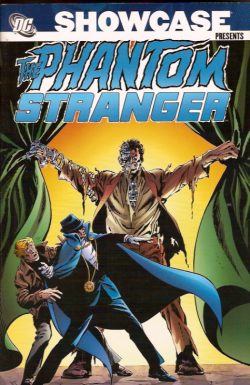
Showcase Presents The Phantom Stranger volume 2


By Bob Haney, Len Wein, Marv Wolfman, Arnold Drake, Michael J Pellowski, Steve Skeates, David Michelinie, Paul Levitz, Gerry Conway, Marty Pasko, Jim Aparo, Gerry Talaoc, Michael Kaluta, Mike Grell, Fred Carrillo, Bernard Baily, Ross Andru/Mike Esposito, Dick Dillin, Tony DeZuñiga, Bill Draut, Romeo Tanghal, Dick Giordano, Bob Layton & various (DC Comics)
ISBN: 978-1-4012-1722-8 (TPB)

The Phantom Stranger was also one of the earliest transitional heroes of the Golden Age of comics, created at the very end of the first superhero boom as readers moved from costumed crimefighters to other genres such as mystery, crime, war and western tales. A trench-coated, mysterious know-it-all, with shadowed eyes and hat pulled down low, he would appear, debunk a legend or foil a supernatural-seeming plot, and then vanish again.

He was coolly ambiguous, never conclusively revealed as man, mystic or personally paranormal. Created by John Broome & Carmine Infantino, who produced the first story in Phantom Stranger #1 (August/September 1952 – Happy Anniversary, Mystery Man!) and most of the others, the 6-issue run also boasted contributions from Jack Miller, Manny Stallman and John Giunta. The last issue was cover-dated June/July, 1953, after which he vanished.

Flash-forward to the end of 1968. The second superhero boom is rapidly becoming a bust, and traditional costumed heroes are dropping like flies. Suspense and mystery titles are the Coming Thing and somebody – probably unsung genius E. Nelson Bridwell – has the bright idea of reviving Phantom Stranger.

He was the last hero revival of DC’s Silver Age and the last to win his own title: another graduate of a star-studded later run in Showcase. After only one appearance in #80 (cover-dated January/February 1969) he returned in his own comic three months later. This time, he found an appreciative audience, running for 41 issues over seven years.

Rather than completely renovate the character, or simply run simple reprints as DC had when trying to revive espionage ace King Faraday (in Showcase #50-51), editor Joe Orlando had writer Mike Friedrich & artist Jerry Grandenetti craft a modern framing sequence around a partial reprint, and – in a masterstroke of print economy – reintroduced another lost 1950s mystery hero to pad out the comic, and provide a rationalist’s contemporary counterpoint.

Dr. Terrence Thirteen was a parapsychologist known as the Ghost Breaker. He predated the Stranger, with his own feature in Star-Spangled Comics (#122-130; November 1951-July 1952). With fiancée (later wife) Marie, the parapsychologist roamed America and the world, debunking supernatural hoaxes and catching mystic-themed fraudsters, a vocal and resolute cynic imported whole into the modern series as a foil for the Stranger.

(Follow Me… For I Am…) The Phantom Stranger launched with a May/June 1969 cover-date. By the end of 1972, the horror/mystery boom had stabilized, and was a key component of both DC and Marvel’s mainstream output, with fantasy and sword & sorcery adventurers also scoring well with fans. However, the glory days of huge comic book print-runs were gone forever. And yet, although a depleted force, superhero comics did not disappear as many older heads suspected they might, and an initially unwieldy amalgam, the horror-hero, soon became a useful crossover sales tool.

Never as common as Marvel’s burgeoning pantheon of spooky crusaders, the most successful and enduring of DC’s supernatural stalwarts were Swamp Thing and Phantom Stranger. This sequel mammoth monochrome tome concludes that impressive second incarnation, incorporating not only his crossover trips into the greater DCU, but also rare appearances that closed his career …until he was resurrected post Crisis on Infinite Earths.

Spanning April/May 1970 to Winter 1978, this collects The Brave and the Bold #89 & 98; Justice League of America #103; Phantom Stranger #22-41; DC Super-Stars #18 and House of Secrets #150, blending a popular taste for blood and horror with traditional mystery man derring-do…

The magic begins with an impressive chiller from Bob Haney, Ross Andru & Mike Esposito originally seen in Batman team-up vehicle The Brave and the Bold (#89, April/May 1970). ‘Arise Ye Ghosts of Gotham’ sees a religious sect return to the city that had driven them out two centuries previously, only to awaken the vengeful spirits of their banished ancestors until pacified by our initially squabbling heroes.

The Stranger’s rerise in Brave and the Bold (#98, October/November 1971) was a more recognisably spooky tale, superbly crafted by Haney & Jim Aparo. ‘Mansion of the Misbegotten!’ is a twist-ridden riot of demon-cults, scheming plots and contemporary-cinema styled possession carefully exploiting the global obsession with Satanism that began with Rosemary’s Baby and peaked with The Exorcist. Here the Gotham Guardian finds himself outwitted, outmatched and in dire need of assistance to foil a truly diabolical force threatening the life of his godson.

Following on is ‘A Stranger Walks Among Us!’ by Len Wein, Dick Dillin & Dick Giordano, as the haunted hero saves Halloween and the World’s Greatest Superheroes from a magical murder plot. He was consequently offered membership in the Justice League of America (in issue #103 of their comic, December 1972) but seldom made any meetings or took a turn on monitor duty…

In the same month, his solo adventures featured ‘Circle of Evil’ (Phantom Stranger #22, by Wein & Aparo), wherein a coalition of evil calling itself the Dark Circle initiates a master plan: attacking the hero through blind psychic – and notional love-interest – Cassandra Craft. At the back of the book, Ghost-Breaker Dr. Thirteen exposes another hoary hoax in Steve Skeates & Tony DeZuñiga’s ‘Creatures of the Night’. These counterpoints to eldritch adventure – although usually excellent – were rapidly reaching their sell-by date, and very soon Thirteen would be battling real monsters he couldn’t rationalize away…

‘Panic in the Night!’ in #23 saw the Stranger and Cassandra in Paris, battling analogues of the Phantom of the Opera and Hunchback of Notre Dame whilst gathering an unlikely ally for the imminent final clash with the Dark Circle. However, great as this yarn is, the real gem is the back-up feature which transformed Terry Thirteen.

‘The Spawn of Frankenstein!’ saw the discovery of an ice-entombed man-monster lead to dark personal tragedy. When Thirteen’s colleague Victor Adams attempted to revive the legendary literary beast, it resulted in his death and Thirteen’s wife Marie being beaten into a coma. Vengeance-crazed, the Ghost-Breaker resolved to hunt down and destroy the monster, utterly unaware – and perhaps uncaring – that the beast was both rational and wholly innocent of any misdeed.

Written by Marv Wolfman and illustrated by the unique talent of Michael Kaluta, this debut promised much, but the feature was plagued by inconsistency. Phantom Stranger #24 (March/April 1973) offered the epic conclusion of the Dark Circle war as the Stranger and Cassandra defrayed the ‘Apocalypse!’ in the shadow of Mount Corcovado (that’s the one with the Jesus statue “Christo Redentor” overlooking Rio de Janeiro) with old foes Tannarak and Tala, Queen of Darkness along for the spectacular and long-overdue ride…

Wolfman & Kaluta’s The Spawn of Frankenstein continued as the revived revenant opted to revenge itself upon Victor Adams for dragging him back to cruel, unwanted life by returning the favour and resurrecting the dead scientist.

A fresh tone and resumption of episodic, supernatural triage marked issue #25 as the Man in the Hat confronted a voodoo cult in ‘Dance of the Serpent’ (Wein – from an idea by Michael J Pellowski – & Aparo), whilst Kaluta ended his run on Frankenstein with another untitled tale wherein Rachel Adams (wife of the departed Victor) was kidnapped by Satanists before being rescued by the monster; leading into #26’s crossover ‘From Dust Thou Art…’

Here Wein, Wolfman & Aparo teamed the Monster and the Stranger against demons seeking earthly bodies.

The radical change was completed with the next issue as innovative horror-anthology artist Gerry Talaoc replaced the sleekly realistic Aparo (moved to The Brave and the Bold for a long career illustrating Batman), whilst journeyman mainstay Arnold Drake assumed the writer’s seat on the stranger. He introduced another long-term nemesis in deeply disturbed psychiatrist/parapsychologist ‘Dr. Zorn: Soul-Master!’

This driven meddler callously warped his patients and performed illicit experiments for the US Military-Industrialist Complex: a far more insidious and freshly contemporary threat in tune with modern mores. Thwarted but seldom defeated, he constantly returned to bedevil the Stranger.

Skeates and legendary veteran Bernard Baily (Golden Age co-creator of Hourman and The Spectre) now helmed Frankenstein, with ‘The Terror and the Compassion’ seeing the misunderstood beast stumble into a commune that is actually a demonic coven intent on blood sacrifice and raising the devil…

‘The Counterfeit Madman!’ by Drake & Talaoc saw the Stranger explore the mind of mad-dog killer Johnny Ganz. Was the young offender a true psychopath or a cunning crook pretending to be a multiple-personality sufferer? Was there another innocent victim trapped inside the killer’s skull with him? An element of moral ambiguity had been added by Drake, layering later adventures with enticing, challenging dilemmas absent from most comic fiction and only matched by Steve Gerber’s challenging work on Man-Thing.

Back-up ‘Night of the Snake God’ was a more traditional tale which continued Frankenstein’s battle against the hippie cult in a solid, if undemanding manner.

Zorn resumed his unscrupulous scientific explorations of the supernatural in PS #29’s ‘The Devil Dolls of Dr. Z!’, whilst matters barely progressed at all in ‘The Snake-God Revealed!’, which saw the Spawn of Frankenstein lose momentum – and story-space – as his strip was reduced to 6 pages. The next issue contained more contemporary chills in ‘The Children’s Crusade!’ as a modern Pied Piper lures a town’s youngsters into his charismatic cult whilst ‘Turn-about!’ concludes – and not before time – the Spawn of Frankenstein’s run.

Issue #31 (June-July 1974) offers an exotic yarn dealing with the aftermath of the Vietnam war as a disgraced US “general” smuggling drugs for a local warlord awakens a slumbering demon in ‘Sacred is the Monster Kang!’ The Stranger’s tales were usually 12-pages long at this period, but the back-up feature that originally filled up the comics – The Black Orchid – is not included in this volume.

Bill Draut, one of the Stranger’s earliest illustrators returned in #32’s ‘It Takes a Witch…!’: an old-fashioned scary whodunit, whilst superstar-in-waiting Mike Grell illustrated a Dr. Zorn vehicle guest-starring Boston Brand. In ‘Deadman’s Bluff!’, the ghost’s protracted hunt for his own murderer ended as usual in frustration, but an antagonistic partnership was established for the future…

Talaoc was back in #34 for ‘A Death in the Family!’ wherein a “clean” brother is compelled to assume control of the family business – running an organised crime mob. His guilt is further compounded when his dead sibling returns from the grave to give him some pointers. Increasingly, the Stranger was becoming a mere witness to supernatural events in his own series, so perhaps it’s no coincidence that this issue featured a return for the more hands-on Dr. Thirteen (wife Marie cured and both of them ignoring that brief stint of Frankensteinian tragedy).

‘…And the Dog Howls Through the Night!’ is another straightforward yet gripping adventure from Skeates & DeZuñiga, which had probably been sitting in a drawer for years before publication.

‘The Demon Gate’ was writer David Michelinie’s debut tale, with the Stranger targeted by derivative Dr. Nathan Seine – who wanted to siphon off the hero’s mystic energy and soul to cure his dying wife. Like ‘Crimson Gold’, a deadly African treasure hunt for Nazi treasure in #36, it briefly betokened a more active role for the immortal wanderer.

Drake & Paul Levitz scripted ‘Images of the Dead’ in Phantom Stranger #37: another highly charged moral quandary with a young artist forced to commit reprehensible crimes to earn money for his wife’s hospital bills…

Talaoc made way for fellow Filipino artist Fred Carrillo with issue #38, as Dr Seine sought to extract bitter vengeance in Levitz’s ‘The Curse of the Stalking Skull’. The new creative team brought back Boston Brand for ‘Death Calls Twice for a Deadman’: a last-ditch effort to revive dwindling sales. Also including Batman villain The Sensei, it signalled a belated return to the company’s over-arching continuity, but was too little, too late.

Deadman also co-starred in #40’s ‘In the Kingdom of the Blind’ and #41’s concluding chapter (February-March 1976) ‘A Time for Endings’ as Seine sought to bring Elder Gods to Earth using long-absent Cassandra Craft as a medium. With that tale’s finish the series ended and the Stranger all-but vanished until the winter of 1978 and a giant-sized tale from DC Super-Stars #18.

‘Phantom Stranger and Deadman’ (by Gerry Conway, Marty Pasko, Romeo Tanghal, Dick Giordano & Bob Layton) was an extended Halloween extravaganza with the supernatural champions – and Dr. Thirteen and Tala in attendance – attempting to eradicate an infestation of demons infiltrating the comic book Mecca of the season: Rutland, Vermont (long associated in both Marvel and DC titles as the only place to be on the Eve of All Hallows).

One final tale appeared a few months later in the 150th issue of House of Secrets (February-March 1978) wherein Conway & Talaoc related a generational tale of restless evil in ‘A God by any Other Name.’

Here, the Stranger and Dr. Thirteen united to complete the work of Rabbi Samuel Shulman and Father John Christian who, in the dire environs of London, 1892, had joined spiritual forces to destroy the World’s first malignant machine intellect Molloch. Sadly, those Satanic Mills had a habit of being rebuilt by greedy men…

More than most, The Phantom Stranger is a strong character and concept at the mercy of pitiless fashion. Revived as the 1960s closed on a wave of interest in the supernatural, and seemingly immune to harm, he struggled to find an audience in the general marketplace before direct sales techniques made publishing a less hit-or-miss proposition. However, blessed with a cohort of talented creators, the stories themselves have proved to be of lasting quality, and would so easily transfer to today’s television screens that I wonder why they haven’t yet (and no, that doesn’t mean animated appearances or cameos on the Swamp Thing series). Mystery, exotic locales, forbidden monsters spectacular effects, a medallion and a cool hat: C’mon, you know you’d watch it…

But until then you’ll have to thrill and scare yourselves with these fantastic tales.
© 1970, 1971, 1972, 1973, 1974, 1975, 1976, 1978, 2006 DC Comics. All Rights Reserved.
Green Lantern John Stewart: A Celebration of 50 Years


By Neal Adams, Dennis O’Neil, Len Wein, Steve Englehart, Christopher Priest, Jim Starlin, Ron Marz, Judd Winick, Geoff Johns, Tony Bedard, Peter J. Tomasi, Van Jensen, Robert Venditti, Stuart Moore, Derek Fridolfs & Dustin Nguyen, Dave Gibbons, Joe Staton, Gil Kane, Mike Mignola, Darryl Banks, Dale Eaglesham, Ed Benes & Maros Marz, Tyler Kirkham, Fernando Pasarin, Igor Lima, Rodney Buchemi & Geraldo Borges, Pat Broderick, Doug Mahnke, John Delaney, Eric Nguyen & various (DC Comics)
ISBN: 978-1-7795-1125-6 (HB/Digital edition)

Win’s Christmas Gift Recommendation: Making Wishes Come True… 8/10

Now a cornerstone underpinning the entire DC Universe, the many heroes called Green Lantern have waxed and waned over eight decades and are now much more Concept than Character. This stunning compilation – part of a dedicated series introducing and exploiting the comics pedigree of veteran DC icons – offers a brief but astoundingly enticing sequence of snapshots detailing how one particular Emerald Gladiator broke many boundaries whilst battling evil and injustice for the entertainment of millions across many generations.

This book features material from Action Comics #601, Batman Beyond Unlimited #4-5, Cosmic Odyssey #2, Green Lantern (volume 2) #87, 182, 185, Green Lantern (volume 3) #74, 156, Green Lantern (volume 4) #49, Green Lantern Corps #211, Green Lantern Corps (volume 2) #60, Green Lantern Corps (volume 3) #9, Green Lantern: Futures End, #1, Justice League #1 (volume 4) #6, 40, Justice League Adventures #22, Justice League of America #110 and Secret Origins (volume 4) #9. These tales span cover-dates January 1971 to April 2020), with the groundbreaking appearances are preceded by brief critical analysis of the significant stages in his development, beginning with Part I: 1971-1985 – A Sign of the Times and a revelatory essay by legendary activist and comics iconoclast Neal Adams who shares the secret origin of the first Green Lantern of colour before we enjoy that seminal classic…

Originally created by Martin Nodell & Bill Finger, the first Emerald Avenger – Alan Scott – debuted in All-American Comics #16 (July 1940), just as superheroes started to take hold, and supplanting newspaper strip reprints and stock genre characters in still primarily-anthologised comic books. He was a white guy with a magic ring and an icon of his era.

After superheroes vanished and returned in the early 1950s, another GL was created: once again a symbol of his era. After the hugely successful revival and reworking of The Flash, DC/National Periodicals were keen to build on the resurgent superhero trend. Showcase #22 hit the stands at the same time as the fourth issue of the new Flash comic book (#108) and once again the guiding lights were editor Julie Schwartz and writer John Broome. Assigned as illustrator was action ace Gil Kane, inked by Joe Giella.

A vivid Space Age origin revealed how young test pilot Hal Jordan was plucked from his Californian aircraft factory by an alien policeman who had crashed his spaceship on Earth. Mortally wounded, Abin Sur commanded his power ring – a device to materialise thoughts – to seek out a replacement officer who was honest and without fear. Scanning the planet, it selected Jordan and brought him to the crash-site. The dying alien bequeathed his ring, lantern-shaped Battery of Power and his professional vocation to the astonished Earthman.

In six pages ‘S.O.S Green Lantern’ established characters, scenario and narrative thrust of a series that became the spine of DC continuity, leaving room for another two adventures in that premiere issue. Unlike the debut of The Flash, the editors were now confident of their ground. Two more Showcase issues carried even greater exploits, and six months later Green Lantern #1 was released.

For the new iteration, emerald ring-wielders were a members of a universal police force and Jordan’s “beat” – which included planet Earth – was Space Sector 2814. Having introduced the cosmic peacekeepers, Broome, Gardner Fox and others expanded the concept throughout the 1960s, adding alien and even female GLs, and alternate human Lanterns like Charlie Vicker and Guy Gardner. They even brought back the original as Alan Scott (now designated Green Lantern of alternate world Earth-Two) became a semi regular cast member…

Over many traumatic years, Jordan grew into one of the greatest members of a serried band of law-enforcers. For billions of years, the Green Lantern Corps protected and served the cosmos, policing countless numbers of sentient beings under the severe but benevolent auspices of immortal super-beings who deemed themselves Guardians of the Universe.

These undying patrons of Order were one of the first races to evolve and dwelt in sublime, emotionless security and tranquillity at the very centre of creation on the small world of Oa.

Primarily chosen for their capacity to overcome fear, Green Lanterns are equipped with a ring that creates solid constructs from emerald light. The miracle weapon is fuelled by the strength of the user’s willpower, making it one of the mightiest tools imaginable.

For eons, a single individual from each of the 3600 sectors of known space was selected to patrol his, her, their or its own beat. Being cautious and meticulous masters, the Guardians laid contingency plans and frequently appointed designated reserve officers to inherit the office of their peacekeeping representatives.

Jordan’s usual substitute was quiet, steadfast PE teacher Gardner, but when the other white Guy was critically injured and required long-term recuperation, the Guardians’ fallback option was somewhat worrying to staid, by-the-book Hal. In #87 (cover-dated December 1971/January 1972 and crafted by Adams, his scripter of choice Denny O’Neil & inker Dick Giordano), ‘Beware My Power!’ introduced a bold new character to the DCU, conceived at a time when non-Caucasian heroes could be counted on the fingers of one hand…

The time was more than ripe for change. With superhero titles in decline, O’Neil & Adams had been asked to try something different to save the title and responded by assaulting all the traditional monoliths of contemporary costumed dramas in tightly targeted, protest-driven stories. The book was re-titled Green Lantern/Green Arrow with the Archer constantly mouthing off as a hot-headed, liberal sounding-board and platform for a generation-in-crisis, whilst staid, conservative, quasi-reactionary Hal Jordan played the part of the oblivious but well-meaning old guard.

America was a bubbling cauldron of social turmoil and experimentation. Everything was challenged and with issue #76 (April 1970 and the first issue of the new decade), O’Neil and comics iconoclast Adams utterly redefined superhero strips with their relevancy-driven stories; transforming complacent establishment boy-scouts into uncertain, questioning champions and strident explorers of the revolution.

Race had been the crux of the creators first outing. ‘No Evil Shall Escape My Sight!’ (not included here) broke the mould of the medium, utterly re-positioning the very concept of the costumed crusader as newly-minted ardent liberal Oliver Queen challenged Jordan’s cosy worldview after the lofty space-cop painfully discovered real villains wear business suits, operate expense accounts, hurt people just because of skin colour and would happily poison their own nests for short-term gain…

In GL/GA #87, that tone and strident attitude gelled into John Stewart: an unemployed architect and full-time “radical” activist. This angry black man was spoiling for a fight and prepared to take guff from no-one, making Jordan certain his bosses had grievously erred when selecting rash, impetuous Stewart as Sector 2814’s official GL stand-in. However, after seeing how his proposed pinch-hitter handled a white supremacist US presidential candidate trying to foment a race war, he was delighted to change his tune…

Once established, Stewart was almost immediately forgotten. His next appearance came in Justice League of America #110 (March 1974) where Len Wein, Dick Dillin & Giordano delivered a delightful and potent seasonal present as Superman, Batman, Green Arrow, Black Canary and Red Tornado had to adapt to the abrasive substitute mid-mission, when the team gathered to hunt down ‘The Man Who Murdered Santa Claus!’ Murderous psychopath The Key had set up the heroes for ambush with the callous assassination of an actor hired to cheer orphaned kids, but his horrific deeper scheme was only foiled thanks to the supernatural intervention of almost forgotten Leaguer The Phantom Stranger, after which rebellious Stewart “finessed” his bosses’ cosmic rules and protocols to give the destitute and impoverished ghetto dwellers a Christmas present that changed their lives forever…

Time passed and Stewart popped up occasionally as the Guardians’ motives and ineffability increasingly came into question by many of their once-devoted operatives and peacekeepers. Frequently, the grunts began seeing their formerly infallible little blue gods exposed as venal, ruthless, doctrinaire and even capricious…

As his repute grew, headstrong Hal Jordan enjoyed an extremely tempestuous and fractious relationship with the Guardians, which eventually led to them accusing him of neglecting his space sector to concentrate on Earth’s problems and criminals. When he couldn’t reconcile his love for Carol Ferris with his offworld duty to the Corps, Jordan quit…

In Green Lantern #182 (November 1984), Wein, Dave Gibbons & Mark Farmer confirmed a landmark reshaping of the legend as ‘It’s a Dirty Job, But…!’ saw the now merely mortal Jordan second-guessing his decision as he revisits Abin Sur’s remote resting place. Meanwhile, across the universe, the Guardians have moved swiftly, promoting Stewart to the full-time position in Space Sector 2814. At this time, the architect was working on rebuilding the shattered Ferris Aircraft complex and had no idea that Jordan was the alter ego of his abruptly “retired” predecessor, nor that his predecessor’s old enemy Major Disaster was back and looking for a fight…

In Green Lantern #185, Wein & Gibbons took another brave step as ‘In Blackest Day…!’ found the latest ringslinger for 2814 fully acclimated to his responsibilities. An overnight celebrity and media sensation, Stewart is courted by TV reporter Tawny Young but only earns her enmity after refusing to divulge the circumstances of his origin and promotion. Meanwhile in the wings evil energy entity Eclipso lays his own plans…

At the time, many fans and critics felt that the substitution of Jordan with Stewart was little more than a PC stunt, but time and the quality of the stories proved the decision to be brilliant one. It certainly offered a cruelly under-served portion of the readership another solid role model but as time progressed and the different personalities and approaches coalesced, the move led to an expansion and re-evaluation the nature of being a DC hero…

Part II: 1987-1996 – More Than Just the Back-up Guy opens with John (12 Years a Slave; The Other History of the DC Universe; Future State: The Next Batman) Ridley’s discussion of Stewart’s evolution from experiment in “measured progressiveness” to uniquely individualist major character prior to another tantalising tranche revolutionary tales.

In the mid-1980s, DC’s editorial hierarchy felt their vast 50-year continuity was deterring new readers. The solution was a colossal braided-mega series to streamline, redefine and even add new characters to the mix. The worlds-shattering, reality-altering Crisis on Infinite Earths resulted in such spectacular commercial success, those movers-&shakers must have felt more than justified in revamping a number of their hoariest icons for their next fifty years of publishing. As well as Superman, Flash, Wonder Woman, and Justice League of America, the Green Lantern franchise was earmarked for a radical revision, with the Guardians removed from existence and most of their surviving agents setting up a far smaller shop on Earth. Stuart, Jordan and Gardner were joined by a number of alien GLs, and John found unlikely romance with his former training officer Katma Tui of Korugar in Steve Englehart, Joe Staton & Farmer’s ‘Pink Elephants’ (Green Lantern Corps #211, April 1987). However, doom lurked in the wings in the form of Hector Hammond and Star Sapphire/Carol Ferris…

Signature DC title Action Comics became a weekly anthology in May 1988, with the GL’s a key feature. Pulling no punches, first chapter ‘…And the Pain Shall Leave My Heart’ (#601, by Christopher Priest – as James Owsley – & Gil Kane) opened years of heartache for Stewart as Star Sapphire murdered his beloved…

Thanks to Jim Starlin, Mike Mignola & Carlos Garzon, the Emerald Gladiator’s troubles peaked as the year ended. Cosmic Odyssey was a stellar melodrama teaming Superman, Batman, Doctor Fate, a cadre of alien superheroes and many of Jack Kirby’s greatest DC creations in an interplanetary slugfest to save the Milky Way galaxy from malevolent sentient concept The Anti-Life Equation. Here Book Two of the 4-part miniseries reveals how the Green Lantern’s arrogant overconfidence causes the obliteration of inhabited world Xanshi…

Years later, after the GL Corps was utterly destroyed by Hal Jordan as Parallax, only one hero remained. Youthful Kyle Rayner wielded the last power ring to keep the green flame burning until the peacekeeper force could rebuild. During that interim, Stewart joined rival paramilitary organisation The Darkstars, and in Ron Marz, Darryl Banks & Romeo Tanghal’s ‘Stand’ (Green Lantern volume 3, #74, June 1996) unites with Rayner, Donna Troy/Troia and space veteran Adam Strange to save planet Rann from annihilation by Grayven, son of Darkseid

Screenwriter and comics author Geoff Johns (JSA, Superman, Green Lantern, Stargirl) then discusses Stewart’s modern major league status in Part III: 2003-2020 – The Identifiable Hero, which begins here in the aftermath of many changes to the history of DC’s first black superhero.

Courtesy of Judd Winick, Dale Eaglesham & Rodney Ramos, Green Lantern volume 3 #156 (January 2003), Stewart is again ‘Walking Tall’: a restored, reactivated ring-wielder freshly healed from wheelchair-bound paraplegia thanks to arch enemy and understandably aggrieved Xanshi survivor Fatality. Sadder, wiser and resolute, he’s ready to resume the duties he was born for….

Ongoing continuity revisions had remade him as a former elite soldier, and ‘Semper Fi’ (Green Lantern #49, February 2003 by Johns, Ed Benes, Marcos Marz & Luciana del Negro) samples epic event Blackest Night as combat flashbacks and fallen Lantern buddies seek to wear him down, after which an increasing breakdown of trust between the Guardians and their agents leads to all-out rebellion as seven different shades of the emotional power spectrum clash.

With Rayner empowered by blue hues of Hope and Stewart employing the indigo shades of Compassion against reborn rogue Oan Krona, the odd couple embark on a suicide mission to assassinate a beloved green comrade suborned to ultimate evil in ‘War of the Green Lanterns, Part Eight’ (Green Lantern Corps #60 July 2011, by Tony Bedard, Tyler Kirkham & Matt Banning).

Months later DC rebooted its entire line for a second time in high profile stunt “The New 52”. The mostly cosmetic changes barely affected the assorted GL boutique titles, which had been merrily dismantling and rebuilding the Master & Servant relationship between ring-wielders and their obsessively controlling bosses. With civil war rending the organisation, ‘Alpha War: Tried and True’ by Peter J. Tomasi, Fernando Pasarin & Scott Hanna (Green Lantern Corps #9 July 2012) saw rapidly ascendant figurehead John Stewart railroaded and held for judgement by the Guardians’ new secret police, and gain ultimate victory by embracing his sins and accepting his guilt…

In 2014, as the New 52 staggered to its conclusion, a company-wide event offered a speculative glimpse at the eventual demise of all its heroes. Green Lantern Corps: Futures End #1 by Van Jensen, Igor Lima, Rodney Buchemi, Geraldo Borges & Ruy José detailed how five years from “now” Stewart had gone rogue: ruthlessly enforcing a Green Peace as ‘The Death Dealer’. He had no inkling of how one last sanction would change him…

Secret Origins #9, March 2015, by Jensen & Pat Broderick related his latest modified backstory in ‘The Architect’, after which Robert Venditti, Doug Mahnke & Richard Friend bring us relatively up to date with Justice League #40 (April 2020) and the ‘Invasion of the Supermen Part One: Impact!’ with Stewart taking point for his earthly teammates when the eradicator leads an army of modified Daxamites (each mightier than Superman) in a war of eradication and conquest…

This celebration concludes with a personal memoir from celebrated actor Phil LaMarr who played Stewart in TV shows Justice League and Justice League Unlimited: discussing the hero’s out-world impact in Part IV: The Animated Years – Voicing an Icon.

It’s supported by tales from assorted DC comic books based on animated shows adapted from the original DC comics – Whoa! Infinity moment! – beginning with ‘Second Contact’ from Justice League Adventures #22 (October 2003). Here Stuart Moore, John Delaney & Robin Riggs reveal how John leads a JL squad against the Shayol, perpetrators of a Green Lantern massacre five years previously and which only he survived. They claim to have changed, but can he trust himself to trust them?

The compulsive comics classics close with a yarn from 2012, culled from the thrilling and expansive sub-universe based on the animated Batman Beyond show. Set in the days when Gotham’s Dark Knight is troubled teen Terry McGinnis, it includes an elderly Superman and a new Justice League populated with the children and legatees of the originals. Taken from Batman Beyond Unlimited #4-5, back-up strip ‘Beyond Origin: Warhawk’ by Derek Fridolfs, Dustin Nguyen & Eric Nguyen details the doomed love story of Stewart and Thanagarian teammate Hawkgirl, his rebound romance with African superhero Vixen and the tragedy and terrors that led to the birth of his son and heir…

Closing with a ‘Poster Pinup’ from Green Lantern: Mosaic by Cully Hamner & Dan Panosian and immeasurably enhanced throughout by a superb collection of covers by Adams, Giordano, Gibbons, Banks & Tanghal, Ariel Olivetti, Benes, Kirkham & Banning, Fernando Pasarin & Scott Hanna, Francis Portela and Bryan Hitch, this is not a sop to minorities or appeasement to diversity, but a solid reminder that heroes and superstars come in all colours.

Green Lantern has a long, proud history of shaking things up and providing provocative, dynamic drama wedded to outstanding artwork. This compelling assortment of snapshots is staggeringly entertaining, titanically tantalising and a monolithic testament to the inestimable value of a strong core concept matured over decades of innovation.
© 1971, 1974, 1984, 1985, 1987, 1988,1996, 2003, 2010, 2011, 2012, 2014, 2015, 2018, 2020, 2021 DC Comics. All Rights Reserved.
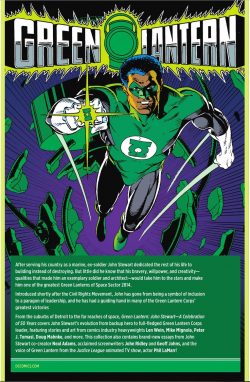
Crisis on Multiple Earths Book 2: Crisis Crossed


By Mike Friedrich, Len Wein, Martin Pasko, E. Nelson Bridwell, Cary Bates, Elliot S! Maggin, Paul Levitz, Gerry Conway, Dick Dillin, Frank McLaughlin, Joe Giella, Dick Giordano & various (DC Comics)
ISBN: 978-1-77951-342-7 (TPB/Digital)

Win’s Christmas Gift Recommendation: utterly Unmissable Entertainment… 9/10

As I’ve incessantly mentioned, I was one of the “Baby Boomer” crowd growing up with Julie Schwartz, Gardner Fox and John Broome’s tantalisingly slow reintroduction of Golden Age superheroes during the halcyon, eternal summery days of the early 1960s. To me, those fascinating counterpart crusaders from Earth-Two weren’t vague and distant memories rubber-stamped by parents or older brothers – they were cool, fascinating and enigmatically new. And for some reason the “proper” heroes of Earth-One held them in high regard and treated them with obvious deference…

The transcendent wonderment began, naturally enough, in The Flash; pioneering trendsetter of the Silver Age Revolution. After successfully ushering in the triumphant return of the superhero concept, the Scarlet Speedster – with Fox & Broome writing – set an unbelievably high standard for costumed adventure in sharp, witty tales of science and imagination, always illustrated with captivating style and clean simplicity by Carmine Infantino.

The epochal epic that literally changed the scope of American comics forever was Fox’s ‘Flash of Two Worlds’ (Flash #123 September 1961, reprinted in many places, but not here): introducing to an emerging continuity the concept of alternate Earths and, by extension, the multiversal structure of the future DCU as well as all the succeeding cosmos-shaking yearly “Crisis” sagas that grew from it.

…And, where DC led, others followed…

Received with tumultuous acclaim, the concept was revisited months later in Flash #129 which also teasingly reintroduced evergreen stalwarts – Wonder Woman, The Atom, Hawkman, Green Lantern, Doctor Mid-Nite and Black Canary: venerable members of the fabled Justice Society of America. Clearly Editor Schwartz had something in mind…

That tale directly led into the veteran team’s first meeting with the Justice League of America and the start of an annual tradition. When ‘Flash of Two Worlds’ brought us the notion of Infinite Earths and multiple iterations of costumed crusaders, fan pressure had begun almost instantly to agitate for the return of the Greats of the “Golden Age”. Editorial powers-that-be were hesitant, fearing too many heroes would be silly and unmanageable, or worse yet, put readers off. If they could see us now…

These innovative adventures generated an avalanche of popular and critical approval (big sales figures, too) so inevitably the trans-dimensional tests led to the ultimate team-up in the summer of 1963. This second gloriously enthralling volume celebrating Infinite Diversity in Infinite Costumes gathers more summer double-headers starring the JLA & JSA and includes a number of revivals and outreach tam-ups designed to set young hearts racing and pulses pounding. The alliances encompass Justice League of America # 91-2, 100-102, 107-108, 113, 123-124, 135-137, 147-148 and 159-160: stunning superhero wonderments which never fail to astound and delight. Also on offer are Len Wein’s context-conveying Foreword ‘Too Much of a Good Thing?’ revealing how the landmark anniversary team-up he scripted came about, and colourist Carl Gafford’s Introduction discussing the incredible achievements of the series’ illustrators such as the criminally underappreciated Dick Dillin who pencilled every story here… usually with his long-term inker Frank McLaughlin, although there are few other old friends here.

In terms of narrative, the writing – by a formidable cohort of writers nurtured and mentored by “Julie” – consists of nothing more and nothing less than bunches of beguiling mystery men getting together to deal with extra-extraordinary problems…

From the early 1970s, DC started methodically reintroducing lost and forgotten characters from other companies and pantheons DC had bought out over the years, at last convinced that costumed heroes were not a fad but here to stay. With hindsight, it was all also about sales and the attempted revival of so many super-characters during a period of intense sales rivalry between DC Comics and Marvel was just sound business sense…

The dramas resume with Mike Friedrich, Dillin & inker Joe Giella’s Justice League of America #91 (cover-dated August 1971), the hero-heavy opening chapter of the annual get-together. In ‘Earth… the Monster-Maker!’, the Supermen, Flashes, Green Lanterns, Hawkmen, Atoms and Robins of two separate Realities simultaneously but ineffectually battle an alien boy and his symbiotically-linked “dog” on twin planets a universe apart.

The result is pointless carnage and imminent death until ‘Solomon Grundy… the One and Only!’ gives all concerned a life-saving lesson on togetherness and lateral thinking…

Justice League of America #100 (August 1972) heralded a move away from relevancy and social hot-button topics that had dominated the industry for a number of years and a return to full-on Costumed melodramas, beginning with a colossal 3-team collaboration that also featured almost every hero in then-DC’s pantheon.

‘The Unknown Soldier of Victory!’ saw debuting scripter Len Wein assemble champions of two Earths to facilitate a monumental hunt through time and retrieve forgotten heroes the Seven Soldiers of Victory: not simply out of common decency, but also because the vanished vigilantes held the answer to defeating a criminal mastermind literally holding the world of Earth-Two to ransom.

Inked by Giella & Dick Giordano, the quest continued in ‘The Hand that Shook the World!’ before ending in one adventurer’s gallant final sacrifice in ‘And One of Us Must Die!’

A year gone by, Justice League of America #107 by Wein, Dillin & Giordano proclaimed ‘Crisis on Earth-X!’ as the opening chapter of another landmark crossover. Following the successful revival of a lost team in their previous get-together, this time the annual shenanigans reintroduced another band of Golden Age warriors – from corporate acquisition Quality Comics and newly rechristened The Freedom Fighters

It begins when a recreational trip across the dimensional barrier is accidentally sabotaged by android stowaway Red Tornado, depositing Batman, Green Arrow and Elongated Man from Earth-One and Superman, Sandman and Doctor Fate from Earth-Two into another alternate universe – one where the Nazis had won World War II.

Trapped and outnumbered, the seven displaced heroes were rescued by the last liberty-loving champions of a world dominated by fascist super-science and a secret dictator. Joining forces with embattled champions Uncle Sam, The Ray, Doll Man, Phantom Lady, Black Condor and The Human Bomb, the newcomers ended the fascist threat forever in sinister sequel ‘Thirteen Against the Earth!’

With everybody returned to their home planes, #113 (September/October 1974) proved how desperate times were the for the spandex set as the epic annual collaboration was restricted to a single issue. Nevertheless, ‘The Creature in the Velvet Cage!’ proved to be one of the very best tales as a JLA visiting party to Earth-Two (Batman, Superman, Green Lantern and Elongated Man) share the shame and horror of The Sandman, when his greatest secret is catastrophically revealed.

Years previously, the Master of Dreams had accidentally transformed his sidekick Sandy, the Golden Boy into a ravening silicoid monster during an attempt to modify their crimebusting technology. Dreading a holocaust, Wesley Dodds been compelled to sedate and imprison his best friend for years…

Now after three decades the beast was awake and free, seemingly intent on destroying the world. At least, that’s what Hourman and the Golden Age Flash and Wonder Woman believe] when they join their old comrade on his tragic manhunt…

For the next annual yarn, Cary Bates, Elliot S! Maggin, Dillin & Frank McLaughlin stepped far off the reservation with ‘Where on Earth Am I?’ and ‘Avenging Ghosts of the Justice Society!’ (#123 and 124)….

In Flash #179 (‘The Flash – Fact of Fiction?’: May 1968) Bates & Gardner Fox first took the multiple Earths concept to its illogical conclusion by trapping the Monarch of Motion in “our” Reality of Earth-Prime, where the Sultan of Speed was merely a fictional comic book character.

For this sequel, Bates and co-scripter Maggin revisited the notion, as a story conference in Editor Julie Schwartz’s office leads to the oafish goons playing with the Flash’s hastily-constructed Cosmic Treadmill. Inevitably their meddling sends one of them hurtling between dimensions…

Transformed and empowered by the journey, Bates becomes the most dangerous villain alive, leading Earth-Two criminals The Wizard, Shade, Sportsmaster, Huntress, Icicle and The Gambler in a lethal assault on JSA heroes Robin, Hourman, Wildcat, Wonder Woman, Johnny Thunder and Dr. Mid-Nite.

Maggin, meanwhile, has followed his friend but ended up on Earth-One. Undaunted, he recruits Batman, Black Canary, Aquaman, Hawkman, Green Arrow and Flash to save three imperilled universes, but it takes the Divine Might of the supernal Spectre to truly set everything back to its assigned place and time…

Plotted by E. Nelson Bridwell and scripted by Marty Pasko, 12 months later the get-together attained epic proportions with the inclusion of venerable champions of the recreated Shazam! Universe – imaginatively dubbed Earth-S. It opens with a ‘Crisis in Eternity!’

One of the most venerated and loved characters in American comics, the original Captain Marvel was created by Bill Parker & C. C. Beck: the best of a wave of costumed titans devised in the wake of Superman’s blockbuster 1938 debut.

Although there were many similarities in the early years, the Fawcett character moved early into fanciful light entertainment and even comedy, whilst as the 1940s progressed the Man of Steel increasingly left whimsy behind in favour of action and drama.

Homeless orphan Billy Batson was chosen to battle injustice by an ancient wizard who bestowed upon him the powers of six gods and heroes. Billy transforms from scrawny boy to brawny (adult) hero by speaking aloud the wizard’s name – an acronym for the legendary patrons Solomon, Hercules, Atlas, Zeus, Achilles and Mercury. At the height of his popularity Captain Marvel was published twice a month and outsold Superman.

However, as tastes and the decade changed, sales slowed and a court case begun by National Comics citing copyright infringement was settled. The Big Red Cheese disappeared – as did many superheroes – becoming merely a fond memory for older fans.

As America lived through another superhero boom-&-bust, the 1970s dawned with a shrinking industry and wide variety of comics genres servicing a base that was increasingly founded on collector/aficionados, not casual or impulse buys. DC needed sales and were prepared to look for them in unusual places: opting to tap into a proven, discriminating fanbase…

After the settlement with Fawcett in 1953, DC secured the rights to Captain Marvel and Family, even though the name itself had been taken up by Marvel Comics (via a circuitous and quirky robotic character published by Carl Burgos and M.F. Publications in 1967). In 1973, riding a wave of nostalgia, DC brought back the entire beloved Fawcett cast and crew in their own kinder, weirder universe. To circumvent an intellectual property clash, they entitled the new comic book Shazam! (With One Magic Word!) the trigger phrase used by most of the many Marvels to transform to and from mortal form, and a word that had entered the American language due to the success of the franchise the first time around…

In Justice League of America #135, the usually stand-alone Shazam heroes meet other costumed champions when antediluvian dictator King Kull (a bestial despot from a pre-human civilisation who held mankind responsible for the extinction of his race) invaded the Wizard’s home on the Rock of Eternity.

From this central point in the Multiverse, Kull intends wiping out humanity on three different Earths and commences by capturing the gods and goddesses who empower Billy and his magical allies Captain Marvel Jr. and Mary Marvel.

Thankfully, fleet Mercury is able to escape, warning Earths-One and Two, even as lesser heroes Bulletman & Bulletgirl, Ibis the Invincible, Spysmasher and Mister Scarlet & Pinky take up the fight without the missing Marvels…

Recruiting an army of super-villains from three worlds, Kull unleashes a plague of unnatural disasters in ‘Crisis on Earth-S!’, unaware that Mercury, Shazam and dim-witted magic-wielder Johnny Thunder are undertaking a devious counterattack to bring the vanished Marvel Family back into action, just in time to avert a cataclysmic ‘Crisis in Tomorrow!’

The cross-collaboration protocol resurfaces one year later in brace of double-length sagas guest-starring Silver Age DC’s second-most popular superteam…

Once upon a time, a thousand years from now, a band of super-powered kids from many worlds took inspiration from the greatest heroic legend of all time, founding a club of champions. One day those Children of Tomorrow came back in time and invited their inspiration to join them…

Thus began the vast, epic saga of the Legion of Super-Heroes, as first envisioned by writer Otto Binder & artist Al Plastino when the many-handed mob of juvenile universe-savers debuted in Adventure Comics #247 (April 1958), just as the revived superhero genre was gathering an inexorable head of steam in America.

The coalition grew and prospered, becoming a phenomenon generally attributed with birthing organised comics fandom. After years of slavishly remaining a closely-guarded offshoot of Superman’s corner of continuity, the Legion finally crossed over into the broader DCU with this saga wherein Paul Levitz & Martin Pasko united to detail ‘Crisis in the 30th Century!’

It begins when ultimate sorcerer Mordru drags a handful of JLA and JSA-ers (Superman, Batman, Green Lantern, Green Arrow and Black Canary from Earth-One plus the other Green Lantern, Doctor Fate, Power Girl, Flash and Hawkman from E-Two) into the future to replace a band of ensorcelled Legionnaires he has somehow lost contact with…

Mordru’s previous slaves had been tasked with retrieving three arcane artefacts that were in the JLA’s keeping a millennium past, but with the pawns lost, the wizard now expects his new pets to finish the task. Naturally, the ancient heroes have other ideas…

Even after linking up with the lost Legionnaires, the 20th Centurians cannot prevent the return of demonic triumvirate Abnegazar, Rath and Ghast, but happily, their eons in stasis have affected the eldritch horrors’ psychological make-up and their consequent disunity gives the puny humans one shot at saving the universe from a ‘Crisis in Triplicate!’

This monumental melange of metahuman mayhem concludes with another time tempest and more forgotten stars as five legendary warriors are plucked from history by a most malevolent malefactor for the noblest of reasons. They are then pitted against the greatest superheroes of two worlds in ‘Crisis from Yesterday!’ by scripter Gerry Conway and artistic dynamic duo Dillin & McLaughlin.

In his zeal to conquer and plunder, the nefarious Lord of Time has accidentally created an omnipotent super-computer which is counting down to permanently ending the passage of time. Unable to halt or avoid an impending cosmic catastrophe, the temporal terrorist extracts Jon, the Viking Prince, English freebooter Black Pirate, Revolutionary War heroine Miss Liberty, western gunman Jonah Hex and WWI German enemy ace Hans von Hammer: supercharging them with eerie energies and programming them to attack the united Justice League and Society.

The Time Lord’s logic is simple: after suffering a shattering defeat, the teams – fired with determination and righteous fury – will promptly track him down, invade his Palace of Eternity and destroy for him his unstoppable computer. Or at least, the survivors will…

Surprisingly, that convoluted plan seems to work out in ‘Crisis from Tomorrow!’, but only after the chronally kidnapped quintet overcome their perfidious programming and revert to their valiant true selves. Even as the beleaguered superhero teams sacrifice everything to thwart the Lord of Time, the time-lost warriors prove their mettle against the errant computer…

This staggering panoply of multi-manned calamities and alternate Armageddons is rounded off with an instructive contextual lecture in John Wells’ Afterword ‘Those Were the Days’, augmented by all the rousing front covers by Neal Adams, Giordano, Nick Cardy, Ernie Chan, Frank Giacoia, McLaughlin, Rich F. Buckler, Jack Abel & Dillin: supported by full creator biographies and a ‘Cover Gallery’ from Alex Ross, featuring his painted delights from earlier collected editions.

These tales won’t suit everybody, and I’m as aware as any that in terms of the “super-powered” genre, the work here can be boiled down to bunches of heroes formulaically getting together to deal with extra-extraordinary problems.

Thankfully, I don’t have to be mature in my off-hours and for those who love costume heroes, crave cunningly constructed modern mythologies and actually care about fun, this is simply a grand parade of straightforward action, great causes and momentous victories.

…And since I wouldn’t have it any other way, why should you?
© 1971, 1972, 1973, 1974, 1975, 1976, 1977, 1978, 2021 DC Comics. All Rights Reserved.
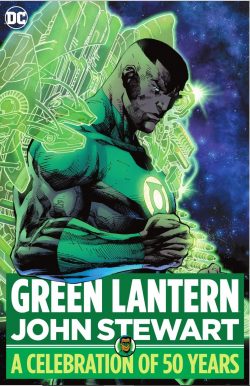
Suicide Squad: The Silver Age


By Robert Kanigher, Howard Liss, Ross Andru & Mike Esposito, Gene Colan, Joe Kubert & various (DC Comics)
ISBN: 978-1-4012-6343-0 (HB) 978-1 4012 7516 7 (TPB)

The War that Time Forgot was a strange series which saw paratroopers and tanks of the “Question Mark Patrol” dropped on Mystery Island from whence no American soldiers ever returned. Assorted crack GIs discovered why when the operation was suddenly overrun by pterosaurs, tyrannosaurs and worse…

However, the combat-&-carnosaur creation was actually a spin-off of an earlier concept which hadn’t quite caught on with the comics-buying public. That wasn’t a problem for Writer/Editor Kanigher: a man well-versed in judicious recycling and reinvention…

Back in 1955 he had devised and written anthology adventure comic The Brave and the Bold which featured short complete tales starring a variety of period heroes: a format mirroring that era’s filmic fascination with historical dramas.

Issue #1 led with Roman swords-&-sandals epic Golden Gladiator, medieval mystery-man The Silent Knight and Joe Kubert’ Viking Prince. Soon the Gladiator was side-lined by the company’s iteration of Robin Hood, but the high adventure theme carried the title until the end of the decade when the burgeoning superhero revival saw B&B transform into a try-out vehicle in the manner of the astounding successful Showcase. Used to launch enterprising concepts and characters such as Cave Carson, Strange Sports Stories, Hawkman and the epochal Justice League of America, the title began test runs s with #25 (August/September 1959) with the fate-tempting Suicide Squad – code-named Task Force X by the US government to investigate uncanny mysteries and tackle unnatural threats.

The scary tales were all illustrated by Kanigher’s go-to team for fantastic fantasy (Ross Andru & Mike Esposito) and they clearly revelled at the chance to cut loose and show what they could do outside the staid whimsy of Wonder Woman or gritty realism of the war titles they usually handled…

The Brave and the Bold #25 introduced a quartet of merely human specialists – air ace war hero Colonel Rick Flag, combat medic Karin Grace and big-brained boffins Hugh Evans and Jess Price – all officially convened into a unit whose purpose was to tackle threats beyond conventional comprehension such as the interstellar phenomenon dubbed ‘The Three Waves of Doom!’

The quartet were built on a very shaky premise. All three men loved Karin. She only loved Rick (who wouldn’t?), but agreed to conceal her inclinations and sublimate her passions so Hugh and Jess would stay on the team of scientific death-cheaters…

In their first published exploit, a cloud from outer space impacted Earth and created a super-heated tsunami which threated to broil America. With dashing derring-do, the troubleshooters quenched the ambulatory heat wave only to have it spawn a colossal alien dragon emanating super-cold rays that might trigger a new ice age…

The only solution was to banish the beast back into space on a handy rocket headed for the sun, but tragically, the ship had to be piloted…

Having heroically ended the invader, the team were back two months later as B&B #26 opened with an immediate continuation. ‘The Sun Curse’ saw our stranded astronauts struggling – in scenes eerily prescient and reminiscent of the Apollo 13 crisis a decade later – to return their ship to Earth. Uncannily, the trip bathes them in radiation which causes them to shrink to insect size…

Back on terra firma but now imperilled by everything around them, the team nonetheless manages to scuttle a proposed attack by a hostile totalitarian nation before regaining their regular stature…

A second, shorter tale finds the quartet enjoying some downtime in Paris before the Metro is wrecked by an awakened dinosaur. Of course, our tough tourists are ready and able to stop the ‘Serpent in the Subway!’

In an entertainment era dominated by monsters and aliens, with superheroes still only tentatively resurfacing, Task Force X were at the forefront of beastie-battles. Their third and final try-out issue found them facing evolutionary nightmare as a scientist vanished and the region around his lab was suddenly besieged by gigantic insects and a colossal reptilian humanoid the team dubbed ‘The Creature of Ghost Lake!’ (December 1959/January 1960). They readily destroyed the monster but never found the professor…

A rare failure for those excitingly experimental days, the Suicide Squad vanished after that triple try-out run, only to resurface months later for a second bite of the cherry. The Brave and the Bold #37 (August/September 1961) opened with Karin displaying heretofore unsuspected psychic gifts and predicting an alien ‘Raid of the Dinosaurs!’ which pitted the group against hyper-intelligent saurians whilst ‘Threat of the Giant Eye!’ focussed on the retrieval of a downed military plane and lost super-weapon. That mission brought the Squad to an island of mythological mien where a living monocular monolith hunted people…

In #38 (October/November 1961) the team tackled the ‘Master of the Dinosaurs’ – an alien using Pteranodons to hunt like an Earthling employs falcons – after which the fabulous four fell afoul of extra-dimensional would-be conquerors but still had enough presence of mind and determination to defeat the ‘Menace of the Mirage People!’

B&B #39 (December 1961/January 1962) called “time!” on Task Force X after ‘Prisoners of the Dinosaur Zoo!’ saw the team uncover an ancient extraterrestrial ark caching antediluvian flora and fauna, and a ‘Rain of Fire!’ found them crushing a macabre criminal entombing crime-busters in liquid metal. That was it for the Squad until 1986 when a new iteration of the concept was launched in the wake of Crisis on Infinite Earths.

Or was it? Superhero fans are notoriously clannish and insular so they might not have noticed how one creative powerhouse refused to take “no thanks” for an answer…

Robert Kanigher (1915-2002) was one of the most distinctive authorial voices in American comics, blending rugged realism with fantastic fantasy in his signature war comics, westerns, horror stories, superhero titles such as Wonder Woman, Lois Lane, Teen Titans, Hawkman, Metal Men, Batman and other genres too numerous to cover here. He also scripted ‘Mystery of the Human Thunderbolt’ – the very first story of the Silver Age. This introduced Barry Allen AKA the Flash to hero-hungry kids in 1956.

Kanigher sold his first stories and poetry in 1932 and wrote for the theatre, film and radio before joining the Fox Features shop where he created The Bouncer, Steel Sterling and The Web whilst also providing scripts for Blue Beetle and the original Captain Marvel.

In 1945, he settled at All-American Comics as both writer and editor, staying on when the company amalgamated with National Comics to become the forerunner of today’s DC. He wrote the original Flash and Hawkman, created Black Canary and Lady Cop, plus many memorable villainous femme fatales like Harlequin and Rose and Thorn. This last he reconstructed during the relevancy era of the early 1970s into a schizophrenic crime-busting female superhero.

When mystery-men faded out at the end of the 1940s, Kanigher easily switched to espionage, adventure, westerns and war stories, becoming in 1952 writer/editor of the company’s combat titles: All-American War Stories, Star Spangled War Stories and Our Amy at War.

He created Our Fighting Forces in 1954 and added G.I. Combat to his burgeoning portfolio when Quality Comics sold their line of titles to DC in 1956, all the while helming Wonder Woman, Johnny Thunder, Rex the Wonder Dog, Silent Knight, Sea Devils, The Viking Prince and a host of others.

Among his numerous game-changing war series were Sgt. Rock, Enemy Ace, the Haunted Tank and The Losers as well as the visually addictive, irresistibly astonishing “Dogfaces and Dinosaurs” dramas sampled and filling out the back of this stunning collection…

Kanigher was a restlessly creative writer and even used the uncanny but formulaic adventure arena of The War that Time Forgot as a personal laboratory for his series concepts. The Flying Boots, G.I. Robot and many other teams and characters first appeared in the manic Pacific hellhole with wall-to-wall danger. Indisputably the big beasts were the stars, but occasionally (extra)ordinary G.I .Joes made enough of an impression to secure return engagements, too…

The War that Time Forgot debuted in Star Spangled War Stories #90 (April-May 1960), running until #137 (May 1968). It skipped only three issues: #91, 93 and #126 (the last of which starred the United States Marine Corps simian Sergeant Gorilla – look it up: I’m neither kidding nor being metaphorical…).

Simply too good a concept to ignore, this seamless, shameless blend of Sir Arthur Conan Doyle’s Lost World and Edgar Rice Burroughs’ Caprona stories – known alternatively as the Caspak Trilogy or The Land That Time Forgot – provided everything baby-boomer boys could dream of: giant lizards, humongous insects, fantastic adventures and two-fisted heroes with lots of guns. The only thing mostly missing was cave-girls in fur bikinis…

In the summer of 1963, a fresh Suicide Squad debuted in Star Spangled War Stories #110 to investigate a ‘Tunnel of Terror’ into the lost land of giant monsters: this time though, a giant albino gorilla decided that us mammals should stick together…

The huge hairy beast was also the star of ‘Return of the Dinosaur Killer!’ in #111 as the unnamed Squad leader and a wily boffin (visually based on Kanigher’s office associate Julie Schwartz) struggled to survive on a reptile-ridden tropical atoll…

SSWS #116 (August/September 1964) depicted a duo of dedicated soldiers facing ice-bound beasts in ‘The Suicide Squad!’ – the big difference being that Morgan and Mace were more determined to kill each other than accomplish their mission…

‘Medal for a Dinosaur!’ in #117 bowed to the inevitable: introducing a (relatively) friendly and extremely cute baby pterodactyl to balance out Mace & Morgan’s barely suppressed animosity, after which ‘The Plane-Eater!’ in #118 saw the army odd couple adrift in the Pacific and in deep danger until the leather-winged little guy turned up once more…

The Suicide Squad were getting equal billing by the time of #119’s ‘Gun Duel on Dinosaur Hill!’ (February/March 1965), as yet another band of men-without-hope battled saurian horrors – and each other – to the death, after which seemingly unkillable Morgan & Mace returned with Dino, the flying ptero-tot, who found a new companion in handy hominid Caveboy before the whole unlikely ensemble struggled to survive against increasingly outlandish creatures in ‘The Tank Eater!’…

Issue #121 presented a diving drama when a UDT (Underwater Demolitions Team) frogman won his Suicide Squad rep as a formidable fighter and ‘The Killer of Dinosaur Alley!’ Increasingly now, G.I. hardware and ordnance trumped bulk, fang and claw…

Undisputed master of gritty fantasy art Joe Kubert added his pencil-and-brush magic to a tense, manic thriller featuring the return of the G.I. Robot in stunning battle bonanza ‘Titbit for a Tyrannosaurus!’ in #125 (February/March 1965), after which Andru & Esposito covered another Suicide Squad sea-saga in #127: ‘The Monster Who Sank a Navy!’

This eclectic collection tumultuously terminates in scripter Howard Liss and visual veteran Gene Colan’s masterfully crafted, moving human drama from #128 which was astoundingly improved by the inclusion of ravening reptiles in ‘The Million Dollar Medal!’

Throughout this calamitous compilation of dark dilemmas, light-hearted romps and battle blockbusters, the emphasis is always on foibles and fallibility; with human heroes unable to put aside grudges, swallow pride or forgive trespasses even amidst the strangest and most terrifying moments of their lives. This edgy humanity informs and elevates even the daftest of these wonderfully imaginative adventure yarns.

Classy, intense, insanely addictive and Just Plain Fun, the original Suicide Squad offers a kind of easy, no-commitment entertainment seldom seen these days and is a deliciously guilty pleasure for one and all. Surely, this is a movie we would all watch…
© 1959, 1960, 1961, 1962, 1963, 1964, 1965, 1966, 2016 DC Comics. All Rights Reserved.