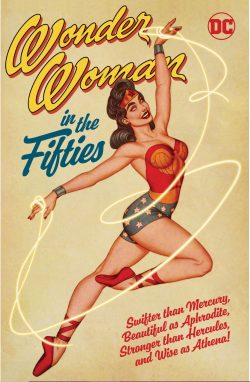
Wonder Woman in the Fifties


By Robert Kanigher, John Broome, Harry G. Peter, Ross Andru & Mike Esposito, Frank Giacoia, Arthur Peddy & Bernard Sachs & various (DC Comics)
ISBN: 978-1-779507-624-6 (TPB/Digital edition)

In the early years of this century, DC launched a series of graphic archives intended to define DC’s top heroes through the decades: delivering magnificent past comic book magic from the Forties to the Seventies via a tantalisingly nostalgic taste of other – arguably better, but certainly different – times. The collections carried the cream of the creative crop, divided into subsections, partitioned by cover galleries, and supplemented by short commentaries; a thoroughly enjoyable introductory reading experience. I prayed for more but was frustrated… until now…

Part of a trade paperback trilogy – the others being Superman and Batman (thus far, but hopefully Aquaman, Green Arrow and Martian Manhunter are in contention too, as they have become such big shot screen stars these days) – the experiment was recently re-run, with even more inviting samples from the company’s vintage, family-friendly canon.

Gathered here is a menu of deliciously dated delights starring Earth’s most recognisable Female Heroic Ideal, heralded by a time-&-tone-setting Introduction from historian, author and columnist Andy Mangels augmenting each context-stuffed chapter text piece.

With Robert Kanigher as primary writer of record throughout the book, the contents here originated in Sensation Comics #97, 100; Wonder Woman #45, 50, 60, 66, 72, 76, 80, 90, 94-95, 98-105, 107, 108, 750; and All-Star Comics #56, 57 spanning the entire decade whilst attempting to reconcile an indomitable symbol of female emancipation and independence with a post-war world determined to turn them back into docile brood mares and passive uber-consumers…

Wonder Woman was created by polygraph pioneer William Moulton Marston – apparently at the behest of his remarkable wife Elizabeth and their life partner Olive Byrne. The vast majority of the outlandish early adventures were limned by illustrator Harry G. Peter.

The Astounding Amazon debuted in All Star Comics #8 (cover-dated December 1941, and top-selling home of the Justice Society of America) just before launching in her own solo series and cover-spot of new anthology Sensation Comics the following month. She was an instant hit, and gained her own eponymous title in late Spring of that year (Summer 1942).

Using the nom de plume Charles Moulton, Marston & Co scripted all her many and fabulous exploits until his death in 1947, whereupon Kanigher officially took over the writer and editor’s role. The venerable Peter continued until his own death in 1958. Wonder Woman #97 – in April of that year – was his last hurrah and the end of an era.

Supported by a factual briefing, the comics classics commence with The (Many) Origins of Wonder Woman, and the first adjustments to the classic origin tale…

For purposes of comparison, the 1940s saga stated that on a hidden island of immortal super-women, American aviator Steve Trevor of US Army Intelligence crashed to Earth. Near death, he was nursed back to health by young, impressionable Princess Diana.

Fearing her growing obsession with the creature from a long-forgotten, madly violent world, her mother Queen Hippolyte shared the hidden history of the Amazons: how they were seduced and betrayed by men, but rescued by goddess Aphrodite on condition they isolated themselves from the world, devoting their eternal lives to becoming ideal, perfect creatures.

However, when Athena and Aphrodite subsequently instructed Hippolyte to despatch an Amazon with the American to fight for global freedom and liberty and against oppression and barbarism, Diana overcame all other candidates in a brutal open competition to became their emissary – Wonder Woman.

On arriving in America, she purchased the identity and credentials of lovelorn Army nurse Diana Prince, elegantly allowing the Amazon to be close to Steve and the heartsick medic to wed her own fiancé in South America. Diana also joined Army Intelligence as secretary to General Darnell, ensuring she would always be able to watch over her beloved. She little suspected that, although painfully shallow Steve only had eyes for the dazzling Amazon superwoman, the General had fallen for mousy yet superbly competent Lieutenant Prince…

As the decade turned it was deemed time for a refurbished origin and – illustrated by Harry G. Peter – WW #45 (cover-dated January/February 1951) delivered ‘The Wonder Woman Story!’

This found childhood rivals vying for the journalistic kudos of publishing the Amazon’s backstory. However, after a hard-won trip to Paradise Island led to Mary Ellen learning the details of it all – Hercules’s ancient ‘Act of Treachery!’ and how the Princess defied authority for love – all manner of trouble emerged…

Cunning competitor John Lane had bugged Mary’s jewellery and craftily followed her to the Amazon homeland, causing a major upset…

Back then Wonder Woman’s artists were astonishingly faithful and true, staying with her for pretty long hauls. Peter and his uncredited team of female assistants served nearly 20 years before he was let go mere weeks before dying. His replacements Ross Andru & Mike Esposito drew her adventures from 1958 to the middle of 1967 (#98 – 171), and limned this breakthrough tale from WW #105 (April 1959)

The issue debuted Wonder Girl in the ‘‘The Secret Origin of Wonder Woman’, revealing how centuries ago Olympian divinities bestowed unique powers on the daughter of Queen Hippolyta and how – as a mere teenager – the indomitable Diana brought the Amazons to Paradise Island. Continuity – let alone consistency or rationality – were never as important to Kanigher as strong story or breathtaking visuals, and this eclectic odyssey is a great yarn that simply annoyed the heck out of a lot of fans – but not as much as the junior Amazon would in years to come after these teen tales spawned an actual junior Amazon as sidekick to Diana…

That ball started rolling in #107 (July 1959) and proved that the high fantasy exploits of the minor had clearly caught somebody’s editorial fancy. Follow-ups came thick and fast after ‘Wonder Woman Amazon Teen-Ager!’ saw the youngster ensnare an unwanted romantic interest in merboy Ronno, whilst dutifully undergoing a quest to win herself a superhero costume…

Fronted by an article on her legendary kit and illustrated throughout by H.G. Peter, Fashion as Armor: The Equipment List shares some of Kanigher’s frequent and often contradictory exposés on the source and powers of Wonder Woman’s combat gear. It begins with ‘The Secret Story of Wonder Woman’s Lasso!’ (WW #50, November/December 1951), depicting how the princess undertakes three divine tasks to ensure the rope gains magical traits of unbreakability, infinite elasticity and truthful compulsion. Along the way she uses it against crooks, spies, other Amazons, submarines, dinosaurs and a Roc…

That mythological bird, another dinosaur and aliens play a major role in ‘The Talking Tiara!’ (#66, May 1954) as Steve learns how Diana belatedly won possession of her headpiece, a “Linguagraph Tiara” capable of translating any language past present or future, whilst ‘The Secret of Wonder Woman’s Sandals’ (#72, February 1955) reveals some odd characteristics of the footwear as she performs incredible feats (sorry!) to confirm her worthiness…

Cover-dated February 1956 ‘The Origin of the Amazon Plane!’ featured in Wonder Woman #80, recalling a trio of tasks undertaken to collect separated sections of her faithful, invisible robot conveyance before #95 (January 1958) offered ‘The Secret of Wonder Woman’s Tiara!’: this time in the form of a tale told to toddlers, revealing how the hat was a gift from aliens given in thanks for saving them from marauding Phenegs…

Moving on to highlight the Amazon’s noteworthy collaborations, One of the Team offers a trio of tales. The section is a somewhat “Marmite” moment that fans will either love or hate…

The majority of the chapter is devoted to a brace of tales starring the Justice Society of America and, whilst I’m never going to complain about seeing such classics where new readers can discover them, it’s a lot of pages to hand over to a group who had Wonder Woman serving coffee and taking notes as “Club Secretary” for years. At least here, in the last of the original run, she’s graduated to being an leading participant in their adventures…

After the actual invention of the superhero via the 1938 Action Comics debut of Superman, the most significant event in our industry’s history was the combination of individual stars into a like-minded group. Thus, what seems blindingly obvious to us with the benefit of four-colour hindsight was proven: consumers can’t get enough of garishly-hued mystery men, and combining a multitude of characters inevitably increases readership. Plus, of course, a mob of superheroes is just so much cooler than one…or one-and-a-half if there’s a sidekick involved…

The creation of the Justice Society of America in 1941 utterly changed the shape of the budding industry. Following the runaway success of Superman and Batman, both National Comics and its separate-but-equal publishing partner All-American Comics went looking for the next big thing whilst frantically concentrating on getting anthology packages into the hands of a hungry readership. Thus All Star Comics: conceived as a joint venture affording characters already in their respective stables an extra push towards winning elusive but lucrative solo titles.

Technically, All Star Comics #3 (cover-dated Winter 1940-1941 and released in December 1940) was the kick-off, but the mystery men merely had dinner and recounted recent cases and didn’t actually go on a mission together until #4, which had an April 1941 cover-date.

The merits of the marketing project would never be proved: rather than a runaway favourite graduating to their own starring vehicle as a result of the poll, something radically different evolved. For the third issue, prolific scribe Gardner Fox apparently had the bright idea of linking all the solo stories through a framing sequence with the heroes gathering to chat about their latest exploits. With that simple notion that mighty mystery men hung out together, history was made and it wasn’t long before they started working together…

However, after WWII ended, superheroes gradually declined, and most companies had shelved them by 1950. Their plummet in popularity led to a revival in genre-themed titles and characters, and it was a stripped-down team (Flash, Green Lantern, Hawkman, The Atom, Black Canary, Dr. Mid-Nite and Wonder Woman) in contemporarily tailored crime and science fiction sagas before the title abruptly changed into All Star Western with #58.

Both JSA stories were written by John Broome and illustrated via alternating chapters by Frank Giacoia and Arthur Peddy & Bernard Sachs. Leading off is All-Star Comics #56 (December 1950/January 1951) and ‘The Day the World Ended!’ wherein a future scientist goes to extraordinary lengths to recruit the 20th century stalwarts to save Tomorrow’s World from shapeshifting invaders. Issue #57 was the JSA’s last hurrah with ‘The Mystery of the Vanishing Detectives!’ pitting them against criminal mastermind The Key after he abducts Earth’s greatest criminologists in advance of a spectacular robbery spree. Both are great yarns that deserve their own archival volume, but the Amazon’s contributions are barely visible in both…

Of more interest is the Kanigher & Peter tale from Wonder Woman #72 (November 1957). ‘The Channel of Time’ begins as an unashamed plug for The Adventures of Superman TV show, with the Amazon eagerly enjoying the latest episode when interference turns the screen into an SOS through time, displaying old ally Robin Hood in existential peril…

An initial iteration of the legendary archer had debuted in New Adventure Comics #23 (January 1938), and National/DC also acquired Quality Comics’ Robin Hood Tales title. That version had begun in February 1956, with DC continuing the run from #7 (cover-dated February 1957) as well as featuring the hero in Kanigher’s The Brave and the Bold from #5 (May 1956). That was (coincidentally?) the same month The Amazing Amazon first met the Sentinel of Sherwood Forest, who here requires assistance against a dragon, wicked foemen and a shark-infested moat safeguarding evil Prince John…

Seeing Double then highlights the hero’s tendency to encounter copies of herself – everything from evil doppelgangers from parallel universes to weirdly exact robot facsimiles…

When Showcase #4 rekindled the readership’s imagination and zest for masked mystery-men with a second, brand-new iteration of The Flash in 1956, the fanciful floodgates opened wide once more. As well as re-inventing Golden Age stars like Green Lantern and Hawkman, the company consequently updated many hoary survivors like Green Arrow and Aquaman. Also included in the revitalising agenda were the High Trinity: Man of Steel, Caped Crusader and the ever-resilient Princess of Power…

Andru & Esposito had debuted as cover artists 3 issues earlier, but with Wonder Woman #98 they took over the entire comic book as Kanigher reinvented much of the old mythology and tinkered with her origins in The Million Dollar Penny!’ After Athena visits an island of super-scientific immortal women, informing Queen Hippolyta that she must send an emissary and champion of justice to crime-ridden “Man’s World”, the sovereign declares an open competition for the job.

She isn’t surprised when her daughter wins and is given the task of turning a penny into a million dollars in one day – all profits going to children’s charities, of course…

Just as the new Wonder Woman begins her coin chore, American airman Steve Trevor bails out of his malfunctioning jet high above the magically hidden isle, unaware that should any male set foot on Amazon soil the immortals would lose all their powers. Promptly thwarting impending disaster, Diana and Steve then team up to accomplish her task, encountering along the way The Undersea Menace’ before building The Impossible Bridge!’

Following that epic comes the lead from landmark issue #100 (August 1958): a spectacular battle saga commencing with The Challenge of Dimension X!’ as an alternate Earth Wonder Woman competes with the Amazing Amazon for sole rights to the title: all culminating with a deciding bout in The Forest of Giants!’

No celebration of the fifties could be complete without an exploration of the outdated concept of gainful female employment. With art by Peter, Working 9 to 5: The Careers of Wonder Woman offers a quick peek of typical opportunities beginning with Sensation Comics #97 (May 1950). ‘Wonder Woman, Romance Editor’ sees the Amazon agree to a task no male journalist can handle, solving the woes of lovelorn women seeking husbands, whilst her own duties prevent her giving in to Steve’s increasingly urgent demands to settle down… Cover-dated November 1950, Sensation Comics #100 showcases ‘Wonder Woman, Hollywood Star!’ as the Amazon and Steve endure peerless perils making a movie one crazed glamour queen is determined only she should star in, after which two millionaires make a bet that propels the Amazon into a string of crazy roles culminating in her shepherding an infant T-Rex as ‘Wonder Woman, Amazon Baby Sitter!’ (WW #90, May 1957)…

As you’ve probably ascertained, much of Kanigher’s oeuvre depended on the Princess of Paradise undergoing tasks and tests for a variety of reasons and this voyage of rediscovery concludes with some of the most noteworthy, gathered as The Trials of Wonder Woman

Leading off is Peter-rendered classic ‘The Secret Olympics!’ (WW #60, July 1953) as Diana justifies her legendary brief as “beautiful as Aphrodite, wise as Athena, swifter than Mercury (sic) and stronger than Hercules”…

 Issue #76 (August 1955) introduces ‘The Bird Who Revealed Wonder Woman’s Identity!’ before Diana devises a way to undermine a gabby Mynah’s proclamations before Andru & Esposito assume the art duties for the remainder of the book, beginning with Top Secret!’ from Wonder Woman #99 (July 1958).

Introducing the Hellenic Hero’s new covert identity as Air Force Intelligence officer Lt. Diana Prince the tale opens a decade of tales with Steve perpetually attempting to uncover her identity and make the most powerful woman on Earth his blushing bride, whilst his bespectacled, glorified secretary stands unnoticed, exasperated and ignored right beside – or slightly behind – him…

Here that means attempting to trick her into marriage with a rigged bet – a tactic the creep tried a lot back then – after which ‘Wonder Woman’s 100th Anniversary!’ (WW #100 again) deals with the impossibility of capturing the far-too-fast and furious Amazon’s exploits on film for Paradise Island’s archives…

In #101 (October 1958), ‘Undersea Trap!’ sees Steve tricking his “Angel” into agreeing to marry him if she has to rescue him three times in 24 hours (just chalk it up to simpler times, or you’ll pop a blood vessel, OK?) after which January 1959 and WW #103 spotlight ‘The Wonder Woman Album!’ returning to the previously explored “impossible-to-photograph” theme, before we close on Wanted… Wonder Woman’ (#108, August 1959), as Flying Saucer aliens frame her for heinous crimes as a precursor to a planetary invasion but are not smart enough to realise when they are being played…

Also including a selection of breathtaking covers by Irwin Hasen & Sachs, Irv Novick, Peddy and Andru & Esposito plus a Bonus Cover Gallery by the latter pair, this is a fascinating but potentially charged tome. By modern standards these exuberant, effulgent fantasies are all-out crazy, but as examples of the days when less attention was paid to continuity and concepts of shared universes and adventure in the moment were paramount, these outrageous romps simply sparkle with fun, thrills and sheer spectacle -a s long as you keep in mind the outrageous undercurrent of blatant sexism underpinning it all. This was a period when – officially – only men could tell the tales of the Amazing Amazon…

Wonder Woman is rightly revered as a focal point of female strength, independence and empowerment, but the welcoming nostalgia and easy familiarity of these costumed fairy tales remain a delight for all open-minded readers with the true value of these exploits being the incredible quality of entertainment they provide.
© 1950, 1951, 1953, 1954, 1955, 1956, 1957, 1958, 1959, 2020, DC Comics. All Rights Reserved.
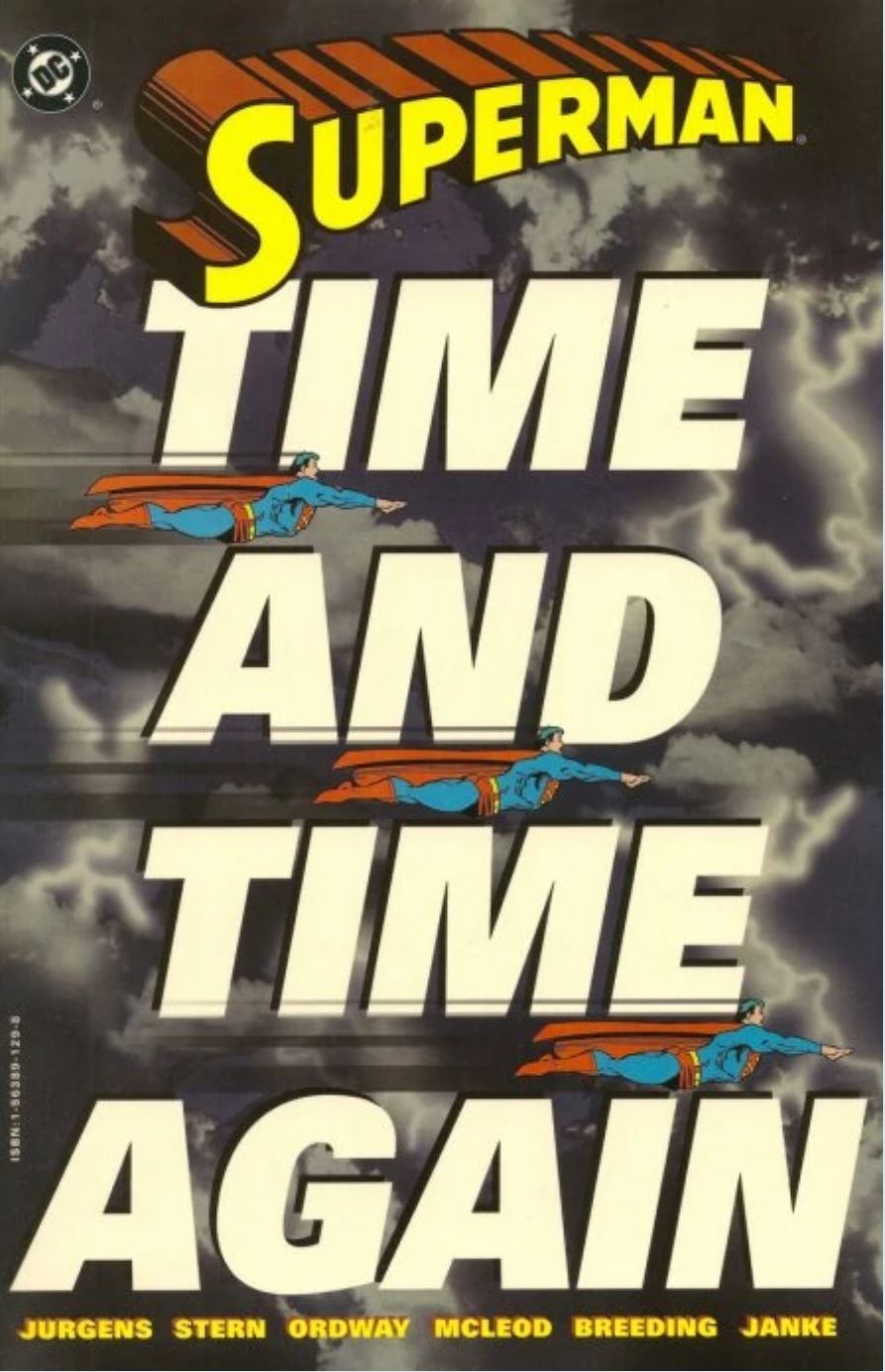
Superman: Time and Time Again


By Dan Jurgens, Jerry Ordway, Roger Stern, Bob McLeod, Brett Breeding, Dennis Janke, Tom Grummett, Jose Marzan & various (DC Comics)
ISBN: 978-1852865702 (TPB)

When Superman was re-imagined after Crisis on Infinite Earths, many of his more omnipotent abilities were discarded. Like his earliest days, he was a far from omnipotent hero, more in touch with humanity because he wasn’t so far above it. One thing that was abandoned was his casual ability to travel through time.

Indeed, rather than being able to navigate the chronal corridors with ease, in this splendid epic from 1991 (originally published serially in Action Comics #663-665, Adventures of Superman #476-478, and Superman (volume 2) #54-55 -with epilogues from #61 & 73 – the Man of Tomorrow is trapped in a cataclysmic and volatile temporal warp, bounced around from era to era with his abilities constantly diminishing and utterly unable to regain his home and loved ones.

That specifically means co-worker and girlfriend Lois Lane, to whom he has just divulged his greatest secret… his real identity…

It all begins in Adventures of Superman #476 as Dan Jurgens & Brett Breeding’s ‘The Linear Man’ sees a rogue (self-appointed) guardian of the Time Stream attempt to forcibly return chronal refugee-turned superhero Booster Gold to the 25th century he originated from. When Superman intervenes, the battle sparks a tremendous explosion, causing the Caped Kryptonian to careen through time. Each “landing” leaves him in a significant period of Earth’s history such as Roger Stern & Bob McLeod’s ‘Lost in the ‘40s Tonight’ (Action Comics #663) precipitating a meeting with that era’s first mystery men before almighty wraith the Spectre transports him not home but to ‘The Warsaw Ghetto!’ to act as temporary savour in an iconic battle saga by Jerry Ordway & Dennis Janke from Superman #54.

Apparently only gigantic explosions can launch him back into the time stream, such as occurs in in ‘Death Rekindled’ (Adventures of Superman #477 Jurgens & Brett Breeding) when a trip to the future introduces him to an iteration of the Legion of Super-Heroes needing help to destroy a monstrous Sun Eater… ‘

That climactic detonation deposits him ‘Many Long Years Ago’ (Action Comics #664, Stern & McLeod) to end up a Jurassic castaway until a clash with marooned time thief Chronos propels him into the Pleistocene and a chronologically adrift encounter with primordial alien race the H’v’ler’ni (AKA the Host)…

That tussle tosses him forward to ‘Camelot’ just as the Dark Ages begin, battling valiantly but in vain beside eventual All-Star Squadron champion and Seventh Soldier of Victory Sir Justin the Shining Knight in Superman #55 (Ordway) before landing again with another LSH for blockbusting finale ‘Moon Rocked’ (Adventures of Superman #478 Jurgens & Breeding) and resolution and reunion with Lois via a 5-page excerpt from Action Comics #665’s ‘Wake the Dead’

Also included are the contents of Superman #61’s ‘Time and Time Again Again!’ and #73’s ‘Time Ryders’ – both by Jurgens & Breeding – as the Man of Tomorrow has further dealings with the Linear Men Matthew Ryder, Waverider, Liri Lee and Hunter

As Superman is gradually depowered whilst seeking to get home without wrecking reality, he enjoys incredible memorable moments – such as walking with dinosaurs, cathartically crushing Nazis, tussling with a mammoth and fighting Etrigan the Demon during the fall of civilisation. He also meets many milestone characters from DC history including the WWII Justice Society of America, and encounters the Legion of Super-Heroes at three critical points of their long and varied career: making this tale a significant marker for establishing the key points of post-Crisis on Infinite Earths continuity…

This hugely enjoyable epic is highly readable and cheerfully accessible for both returning and first time fans so it’s a true shame it’s currently out of print and still unavailable as a digital edition. Hopefully with Superman’s 85th anniversary impending there are moves afoot to rectify that…
© 1991, 1992, 1994 DC Comics. All Rights Reserved.
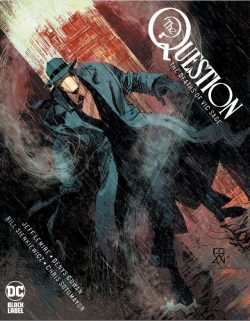
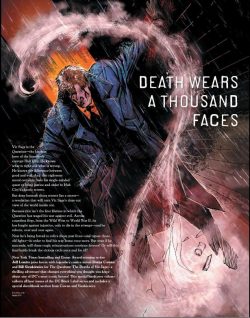
The Question: The Deaths of Vic Sage


By Jeff Lemire, Denys Cowan, Bill Sienkiewicz, Chris Sotomayor, Willie Schubert & various (DC Comics)
ISBN: 978-1-7795-0558-3 (HB/Digital edition)

One of DC’s best 1980s comics series was – for the longest time – out of print and unavailable digitally. It more or less still is, except for a prohibitively expensive Omnibus edition, and if you have strong arms and a big budget you should really track those stories down, whilst the rest of us wait for more reasonable trade paperbacks and eBook editions…

As devised and delivered by Steve Ditko in the 1960s – as he sank ever more deeply into the Objectivist philosophy of Ayn Rand – The Question was Vic Sage: a driven, implacable, justice-obsessed journalist seeking out crime and corruption uncaring of the consequences.

The Charlton “Action-Line Hero” was acquired by DC when the Connecticut outfit folded and was the template for compulsive vigilante Rorschach when Alan Moore & Dave Gibbons first drafted the miniseries that would become the groundbreaking Watchmen.

The contemporary rumour-mill had it that since the creators couldn’t be persuaded to produce a spin-off Rorschach comic, DC went with a reworking of the Ditko original…

As revised by writer Denny O’Neil and illustrators Denys Cowan & Rick Magyar, Vic Sage was an ordinary man pushed to the edge by his obsessions, using his fists and a mask that made him look utterly faceless to get answers (and justice) whenever standard journalistic methods failed. After a few minor appearances around the DC universe, Sage got a job in the town where he grew up and resumed his campaign for answers…

Always more cult hero than classic crusader, The Question revival carved a unique niche for itself as “comics grew up” post Crisis on Infinite Earths and Watchmen. The character was periodically radically rebooted and reimagined, but here scripter Jeff Lemire (Sweet Tooth, The Underwater Welder, Trillium, Black Hammer, Descender, Ascender, Gideon Falls, Essex County) returns to O’Neil’s canon to tell a revelatory tale of reincarnation, zen mystery and undying evil. The project was part of DC’s latest high end mature reader imprint Black Label: released as four single issues before becoming a spiffy hardback with a digital equivalent…

Hub City is a hell-hole, the most corrupt and morally bankrupt municipality in America. Mayor Wesley Fermin is a slick, degenerate crook, but real power resides in his Special Counsel Holden Malick, political cronies, a hand-picked gang of “heavies” and the largely corrupt and racist police force…

Originally, Sage was supported by college lecturer Aristotle “Tot” Rodor: the philosopher-scientist who created his faceless mask and other gimmicks as well as being a sounding board for theories and plans and ethical bellwether. He remains so here but is also increasingly challenging his former pupil’s motives and methods…

After being killed by Fermin’s forces The Question was revived and retrained by O’Neil’s other legendary martial arts creation, Richard Dragon, Kung Fu Fighter . A year passed and a reenergised, faceless avenger began cleaning up Hub City…

The saga opens with the city rushing into chaos and the Question busting a brothel trafficking children to city officials. Later, when reporting the raid on his TV show, Sage ambushes former lover Myra Fermin (the mayor’s sister and oblivious City Alderman) with the fact that the Councilman he left for the cops has mysteriously been erased from all official reports. Shocked and outraged, Fermin continues deluding herself about her brother and the administration, but the damage has been done and she starts looking where she shouldn’t…

When Malick arrives to clean up the mess, Sage notices a ring the politico wears: something old and somehow deeply disturbing…

Tot is no help, but the ring sticks in Sage’s mind and eventually he uncovers a historical organisation called the Hub City Elder Society that all wore such symbols and draws some telling conclusions to today’s political elite…

Hot on the trail he moves, unaware that events are converging into a dark miracle. At the exact moment The Question uncovers an ancient den of occult ceremony, an innocent black man is gunned down by a racist cop and Myra Fermin bursts in on her beloved brother committing savage atrocities on a bound captive. The concatenation of blood climaxes as The Question finds an old faceless mask with a bullet hole through the forehead in a cavern under the city. It’s not one of his, but he is assaulted by a wave of memories and images of supernal evil when he holds it…

Barely conscious, he retreats from the underground lair into streets awash with blood as a protest march becomes a race riot. Urged by Tot to go on TV to calm the tide, all Sage can think of is finding Dragon and getting some metaphysical first aid…

What he gets is doped, as the hermit applies zen hoodoo and drugged tea, despatching the unwilling rationalist sceptic on a vision quest into the past…

Sage awakens in the wilderness that will one day be his home town, bare-footed and wearing a faceless mask…

In Hub City 1886, Viktor Szasz is a blacksmith desperately seeking to escape the vile acts he committed as a soldier fighting the Comanche, in a frontier outpost well on its way to becoming truly civilised. Silent and solitary Viktor intervenes when negro settler Irving Booker and his family are repeatedly harassed and ultimately murdered by the local priest and his devout flock. Szasz reverts to his gun-toting ways to save or avenge them but is outmatched until rescued by a red-headed Indian woman. She shares some secrets about true evil, most notably that a mystical “Man with a Thousand Faces” can only be killed by someone named “Charlie”.

Delirious and experiencing hallucinations of himself in different times, agnostic Szasz still refuses to believe in devils, which is probably why the thing in pit under the town gets the drop on him…

In 1941, Hub City private eye Charlie Sage groggily looks at his notebook, where someone has written “Man with no face” and “man with a thousand faces???”. Blaming too much booze, he cleans himself up whilst glimpsing flashes of unknown dead people and adds “red-haired woman” to the page for no reason he can think of…

When red-haired walk-in client Maggie Fuller hires him to investigate her brother Jacob’s disappearance, he has no idea it will be his last case. They are both union organisers and prime targets for the bosses and the city officials they own, and before long the shamus has annoyed all the wrong people, ending up attacked by thugs wearing fancy rings…

Even his one pal on the Police Force – veteran patrolman “Tot” – can’t help him. But does reluctantly pass him a file full of juicy potential prospects for Fuller’s absence. Still enduring staggering western visions and brutal flashforwards, Charlie becomes lost in civil violence in three eras, and succumbs to another ring-wearer ambush.

The PI awakes in a subterranean chapel in the middle of some kind of crazy black mass, meets a devil and is never seen again…

Awaking from his vision-quest, present-day Sage leaves Dragon, set on sorting his city’s real world distress: braving riot and savage, premeditated retaliation by the administration and cops hungry to put the rabble back in their place. Unable to stop the carnage with his fists, The Question instead uses mass media to deliver a stunning counterstroke, turning the tables and critically destabilising Firmin and Malick.

He also has Tot build a permanent solution to the thing in the pit under Hub City, but has gravely underestimated the horror and indeed his own childhood connection to it…

Even after overcoming the odds, the illusion of victory is tenuous and insubstantial, leaving The Question still looking for answers in all the wrong places…

This book also offers covers and a gallery of variants by Cowan, Sienkiewicz & Sotomayor, Lemire & Marcelo Maiolo; Eduardo Risso; Howard Chaykin & Gustavo Yen, Andrea Sorrentino plus Cowan & Sienkiewicz’s sketchbook section ‘Questionable Practises’ with roughs, finished pencils pages and covers, portraits, finished pre-colour inks, unused cover art and creator bios.

Combating Western dystopia with Eastern Thought and martial arts action is not a new concept, but here the problems of a society so utterly debased that the apocalypse seems like an improvement are also lensed though a core of absolutism. Is man good? Is there such a thing as True Evil? What can one man do?

Who’s asking..?

Although the creators keep the tale focused on dysfunction – social, societal, civil, political, emotional, familial and even methodological – the core motivation for today’s readers has shifted, with the horror show that is and always has been Hub City now arguably attributed to an eternal supernatural presence. Regulation masked avenger tactics don’t work in such a world, and some solutions require better Questions…
© 2019, 2020 DC Comics. All Rights Reserved.

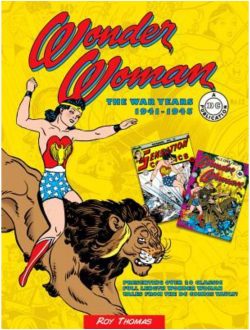
Wonder Woman: The War Years 1941-1945


By William Moulton Marston & Harry G. Peter, with Gardner F. Fox, Jack Burnley, Frank Godwin, Joe Gallagher & various: curated & edited by Roy Thomas (Chartwell Books)
ISBN: 978-0-7858-3284-3 (HB)

Without doubt Wonder Woman is the very acme of female role models. Since her premier she has permeated every aspect of global consciousness, becoming not only a paradigm of comics’ very fabric but also an affirming symbol to women everywhere. In whatever era you observe, the Amazing Amazon epitomises the perfect balance between Brains and Brawn and, over decades, has become one of a rarefied pantheon of literary creations to achieve meta-reality.

In 2019, fans celebrated the 80th anniversary of Batman’s debut in Detective Comics #27. A year after that dynamic debut his astounding popularity resulted in the launch of Batman #1 (cover-dated “Spring” and released April 25th 1940). Back then, only precursor/stablemate Superman was more successful, but it wasn’t long before one half of the company that became todays DC Comics delivered another timeless game-changing icon…

Wonder Woman was born on the cusp of a year and a new age, and fans have argued about her debut date ever since. Her first appearance was in late 1941, buried and shoe-horned in without fanfare into top-selling All-Star Comics (#8): home of the mighty Justice Society of America. However, as revealed here by Roy Thomas, she was intended to launch later, in Sensation Comics #1, but events overtook her and her creators…

Once the war in Europe and the East snared America’s consciousness, crime and domestic deviltry increasingly gave way to combat and espionage themes. Patriotic imagery dominated most comic book covers – if not interiors – and the USA’s mass-publishing outfits geared up for joining the seemingly inevitable conflict.

I feel – like many of my era and inclinations – that superhero comics were never more apt or effective than when wholeheartedly combating global fascism with explosive, improbable excitement courtesy of a myriad of mysterious, masked marvels. I have similar thoughts about the early 1970s “relevancy period”, when my heroes turned to tackling slum landlords, super-rich scum, social injustice, crushing poverty and environmental issues: at least we won that one and don’t have to face real atrocities like that anymore, right?

Somehow, the genre’s most evocatively visceral moments seemingly come when gaudy gladiators soundly thrashed – I hope you’ll please forgive the appropriated and now truly offensive contemporary colloquialisms – “Japs and Krauts”. Wonder Woman was actually designed to do so an,d again, Thomas’ editorial comments provide historical revelations throughout…

A companion to volumes featuring Superman and Batman, Wonder Woman: The War Years 1941-1945 is superb hardcover archive curated by Thomas, exclusively honing in on the Amazing Amazon’s’ euphoric output from those war years, even though in those long-ago dark days, comics creators were wise enough to offset and counterbalance their tales of espionage and imminent invasion with a barrage of home-grown threats as well as gentler or even more whimsical four-colour fare…

Marshalled here is material from All-Star Comics #8,11, 15, 20, 24, 27; Sensation Comics #1, 2, 4, 5, 9, 10, 12, 13, 15, 16, 20, 21, 24, ; Wonder Woman #1-3, 5, 7, 11, 12; Comic Cavalcade #1-2 and excerpts from the short-lived Wonder Woman newspaper strip, cumulatively covering Winter 1941 to Winter 1945. The comics stories, snippets, ads, features and patriotic covers are augmented throughout by essays or brief critical analyses. Champion and grandmaster of WWII-era material, Thomas opens with a scene-setting Introduction and prefaces each chapter with essays establishing tone and context before the four-colour glories commence with Part 1: The War Comes to Paradise Island

For decades, the official story was that the Princess of Paradise Island was conceived by psychologist/polygraph pioneer/showman William Moulton Marston: a calculated attempt to offer girls a positive and forceful role model and – for forward-thinking Editor M.C. Gaines – a sound move to sell more funnybooks to girls. From a teaser shot in All Star Comics the Amazon immediately catapulted one month later into her own series and the cover-spot of new anthology Sensation Comics.

An instant hit, Wonder Woman won her own title six scant months later (cover-dated Summer 1942). That start (or was it a savvy contract? …see inside for more details!) enabled the Star-Spangled Sensation to weather the vicissitudes of the turbulent comics marketplace. Ultimately – beside Superman, Batman and a few lucky hangers-on who inhabited the backs of their titles – she survived far beyond the Golden Age of costumed heroes…

We now know Wonder Woman was a team – if not truly communal – effort, with Moulton Marston acting in conjunction with his remarkable wife Elizabeth and their life partner Olive Byrne. Moreover, barring a couple of early fill-ins by Frank Godwin, the vast majority of outlandish, eccentric, thematically barbed adventures they collectively penned were limned by classical illustrator Harry G. Peter; a man personally hired ay the writers, not the editors.

This stunning compilation is part of a series introducing and exploring the historical and cultural pedigree of venerable DC icons. Sadly, it’s only available in hardback, but it offers a sequence of sublime snapshots detailing how Diana of the Amazons evolved and thrived in a war setting that challenged traditional roles of women: back when the entire gender was generally regarded as second class, second rate, painfully functional or strictly ornamental.

‘Introducing Wonder Woman’ was a hidden extra in All Star Comics #8 (December 1941/ January 1942): It led directly to ‘Wonder Woman Comes to America’: her formal debut in Sensation Comics #1 (January 1942).

In combination they reveal how, once upon a time on a hidden island of immortal super-women, US Army Intelligence aviator Steve Trevor crashes to Earth. Near death, he is nursed back to health by young, impressionable Princess Diana

Fearful of her besotted child’s growing obsession with the creature from a long-forgotten and madly violent world, Diana’s mother Queen Hippolyte reveals the Amazons’ hidden history: how they were seduced and betrayed by brutal men and saved by goddess Aphrodite, on condition that they forever isolate themselves from the mortal world and devote their eternal lives to becoming ideal rational beings.

However, once Trevor explains the perfidious spy plot which accidentally brought him to the Island enclave and how the world is in crisis, Athena and Aphrodite instruct the Queen to send an Amazon back with the American to fight for global freedom and liberty. Hippolyte declares an open contest to find the best candidate and – despite being forbidden to compete – closeted, cosseted masked Diana clandestinely overcomes all to become their emissary.

Accepting the will of fate, her worried mother outfits Diana in the guise of Wonder Woman; sending her to Man’s World carrying an arsenal of super-scientific and magical weapons…

Here, that origin is also retold in extracted ‘Wonder Woman Daily Comic Strips’ from June 12-17, 1944. The strip was a relative late entry, running from May 8th 1944 to December 1st 1945. It never found a solid audience or secured a Sunday Colour section…

Fronted by a stunning H.G. Peter, cover and leading from the front in her own series, Diana truly debuted in anthological Sensation Comics #1. The origin resumes in ‘Wonder Woman Comes to America’’ as the eager, culture-shocked immigrant returns recuperating Trevor to Man’s World, before incidentally trouncing a gang of bank robbers and briefly falling in with a show business swindler.

An intriguing innovation was the newcomer buying her secret identity from lovelorn Army nurse Diana Prince: elegantly enabling the Amazon to remain close to Steve whilst the heartsick trained medic joined her fiancé in South America. Even with all that going on, there was still room for Wonder Woman and Captain Trevor to stop a spy ring using poison gas on a Draft Induction centre. Typically, Steve breaks his leg and ends up in hospital again, where “Nurse Prince” looks after him…

Sensation #2 (February 1942) introduced deadly, toxic enemy agent ‘Dr. Poison’ in a cannily crafted tale with plenty of twists and surprises, which also debuted the most radical comedy sidekicks of the era…

The plucky, fun-loving gals of the Holliday College for Women and their rotund, chocolate-gorging Beeta Lamda sorority-chief Etta Candy would get into trouble and save the day in equal measure for years to come: constantly demonstrating Diana’s – and Marston’s – philosophical contention that girls, with the correct encouragement, could accomplish anything that men could…

With the War raging espionage and sabotage were inescapable plot devices. Diana arranged a transfer to the office of General Darnell as his secretary, so that she could keep a closer eye on the finally fit Steve. Her new position with Army Intelligence created a big problem, but she little suspected that, although painfully shallow Steve only had eyes for the dazzling superwoman, the General had fallen for mousy but supremely competent Lieutenant Prince…

Unlike most comics of the period, Wonder Woman followed a tight continuity. School for Spies’ in Sensation #4 sees American girls, who had become enemy agents, murdered by way of introducing inventive genius and Nazi master manipulator Baroness Paula von Gunther. She employs psychological tricks to enslave girls to her will and set otherwise decent Americans against their homeland. Even Diana initially succumbs to her deadly machinations until Steve and the Holliday Girls crash in…

‘Wonder Woman versus the Saboteurs’ (Sensation Comics #5 May) closes the first section as America’s newest submarine is saved from destruction and a cunning gang of terrorists is brought to justice, after which an essay detailing how and why Wonder Woman joined the JSA and her role in their wartime exploits opens Part 2: The War Comes to America.

That’s followed by selected pages from All-Star Comics #11 (June/July 1942) as ‘The Justice Society Joins the War on Japan’. All-Star featured individual chapters for each team member, and here a page from the Hawkman section by Gardner Fox & Jack Burnley sees the Winged Wonder and future Hawkwoman Shiera Sanders meet Diana Prince on a medical troopship headed for the besieged Philippines. It’s followed by the full Fox & Peter crafted chapter starring the Amazon as she routs Japanese troops trying to establish a beachhead, and concludes with 2 more Burnley pages  as she is officially inducted int the team as they rename themselves the Justice Battalion of America for the duration…

The next major landmark was the launch of the Amazon’s solo title. “Moulton” & Peter handled the launch of quarterly Wonder Woman #1 (Summer 1942), represented here by short espionage mystery yarn ‘Wonder Woman Goes to the Circus’ wherein Diana solves bizarre serial murders of the show’s elephants…

The covers to Sensation Comics #9 & 10 (September & October) segues into the lead story from the latter. ‘The Railroad Plot’ celebrates Steve and Wonder Woman’s first anniversary – which they celebrate by exposing a sinister plan devised by Japanese and German agents to blow up New York using the labyrinth of subway tunnels under the city…

Peter’s iconic cover for Sensation Comics #12 (December 1942) precedes Part 3: Against the Axis: and an essay detailing with the worst moments of the real war and the morale boosting efforts of America’s home front entertainers.

Then Wonder Woman #2 (Fall 1942) follows in full: Peter’s cover backed up by photo feature ‘The Men Behind Wonder Woman’ and an illustrated prose feature about ‘The God of War’ before 4-part epic ‘The Spirit of War’ introduces the Astounding Amazon’s greatest nemesis: ‘Mars, God of War’. The deadly divinity had instigated the World War from his HQ on the distant red planet, but chafes at the lack of progress since Wonder Woman entered the fray on the side of the peace-loving allies.

He opts for direct action rather than trust his earthly pawns Hitler, Mussolini and Hirohito

When Steve goes missing, Diana orchestrates her own capture and is ferried to Mars. Here she disrupts the efficient working of the war-god’s regime: fomenting unrest amongst the slave population, before rescuing Steve and heading home to Earth. ‘The Earl of Greed’, one of Mars’ trio of trusted subordinates, takes centre stage in the second chapter with orders to recapture Steve and Diana at all costs.

As the bold duo infiltrate Berlin, Greed uses his influence on Hitler to surreptitiously redirect the German war effort, using Gestapo forces to steal all the USA’s gold reserves…

When Steve is gravely injured, the Amazon returns to America and – as he recuperates – foils the Ethereal Earl’s machinations to prevent much-needed operating funds reaching Holliday College where young girls learn to be independent free-thinkers…

With Greed thwarted, Mars next dispatches ‘The Duke of Deception’ to Earth, where the spindly phantom impersonates Wonder Woman and frames her for murder. Easily escaping prison, the Princess of Power not only clears her name but also finds time to foil a Deception-inspired invasion of Hawaii, leaving only ‘The Count of Conquest’ free to enact Mars’ orders.

This scheme is simple: through his personal puppet Mussolini, the Count tries to physically overpower the Hellenic Heroine with a brutal giant boxing champion, even as Italian Lothario Count Crafti attempts to woo and seduce her. The latter’s wiles actually work, but capturing and keeping the Amazon are two entirely different affairs. Breaking free on the Red Planet, Diana delivers a devastating blow to the war-machine of Mars…

This issue ends with a sparkling double page patriotic plea as ‘Wonder Woman Campaigns for War Bonds and Stamps’

Fans could not get enough Wonder Woman and she next became a big draw in new project: a huge and spectacular 96-page card-cover anthology package based on DC’s World’s Finest Comics and highlighting AA’s other big guns Flash and Green Lantern, plus a string of lesser luminaries. At this time National/DC enjoyed an editorially-independent business relationship with Max Gaines that involved shared and cross promotion and distribution for comic books released by his own All-American Publications outfit. Although technically competitors if not rivals, the deal included shared logos and advertising and even combining both companies’ top characters in All Star Comics as the Justice Society of America.

However, by 1942 relations between the companies were increasingly strained; and would culminate in 1946 with DC buying out Gaines, who used the money to start EC Comics.

Thus, A-A created its own analogue to World’s Finest, featuring only AA characters. The outsized, outstanding result was Comics Cavalcade

Cover-dated December 1942/January 1943 Wonder Woman’s fourth regular residency began with the company superstar solving the ‘Mystery of the House of the Seven Gables’ – as ever, the fruits of Marston & Peter’s fevered imaginations – wherein Diana Prince stumbles upon a band of Nazi spies. As was so often the case, the Amazing Amazon needs the help of some plucky patriotic youngsters to quash the submarine-sabotaging barbarians…

The January 1943 cover for Sensation Comics #13 and a roll call of members from All-Star Comics #15 February/March 1943 leads to Part 4: Don’t You Know There’s a War On? via a text treatise on comic book covers and Home Front occupations.

Comics sagas resume with America’s Guardian Angel’ from Sensation #12 which finds the Warrior Princess accepting an offer to play herself in a patriotic Hollywood movie, only to learn the production had been infiltrated by the insidious Paula von Gunther and her gang of slave-girls…

‘Wanted by Hitler Dead or Alive’ comes from Comic Cavalcade #2 (Spring 1943), pitting Wonder Woman against devious gestapo agent Fausta Grables and her own purloined magic lasso. It’s one of very few stories not limned by H.G. Peter but the work of illustrator and strip cartoonist Frank Godwin, stepping in as the crushing workload of an extra 64-page comicbook every couple of months piled the pressure on WW’s artistic director.

It’s followed by the cover and story from Sensation #15 (March) with HGP on top form as ‘Victory at Sea’ pits Diana Prince and Steve against murderous saboteurs set on halting military production…

The patriotic H.G. Peter cover for Sensation Comics #16 is followed by a key excerpt from Wonder Woman #5 (June/July 1943). As previously mentioned, the Amazing Amazon was a huge and ever-growing hit, and her solo title frequently innovated with full-length stories, and rather radical themes. This extract – the opening chapter of interlinked epic the ‘Battle for Womanhood’ – had repercussions for the cast for decades to come.

War-god Mars returned to plague humanity directly, this time enlisting the aid of a brilliant but physically deformed and intellectually demented woman-hating psychologist with psychic powers. The very model of a true sexual predator, tormented Dr. Psycho uses his gifts to marry and dominate a medium named Marva, employing her unique abilities to form ectoplasmic bodies to attempt the enslavement of every woman on Earth. Allegorical or what, huh?

Dated August & September 1943, the covers of Sensation Comics #20 & 21 lead into the latter’s gripping tale – once again drawn by Godwin. As the war turned in favour of the Allies overseas, Steve and Wonder Woman  tracked down an insidious traitor dubbed the American Adolph as he conducted a murderous ‘War Against Society’

The final section explores an end of hostilities and new challenges and enemies explained by Thomas in Part 5: Victory in Sight with Sensation Comics #24 (December 1943) leading the charge to triumph with Marston & Peters’ ‘Adventure of the Pilotless Plane’. Steve is abducted by Japanese agents whilst investigating a new gas weapon preventing US aircraft from flying. The vile villains have nothing that can stop Wonder Woman from smashing them and freeing him, however…

Wonder Woman #7 offered an optimistic view of the future in a fantastic fantasy tale of America in the year 3000AD: a utopian paradise ruled by a very familiar female President. It’s represented here by its vibrant cover  and supplemented by a Joe Gallagher drawn public service ad from All-Star Comics #20 Spring 1944 to combat polio: ‘Justice Society of America – the March of Dimes’, before the cover for Wonder Woman #11 (Winter 1944) brings us to stories’ end and ‘The Invasion of Paradise Island’ (Sensation Comics #37 January 1945) wherein maltreated county orphans stow away to the Amazon’s home, just in time to help repel a U-boat full of Nazis unwilling to accept their war is over…

A triptych of visual treats wraps up the history lesson: firstly the cover of Wonder Woman #12 followed by PSA page ‘Wonder Woman Explains Waste Paper Salvage’ from All-Star Comics #24 (both from Spring 1945), and finally the cover of All-Star Comics #27 (Winter 1945) honouring disabled war veterans.

Because I’m me, I can’t stop without a minor quibble, so please be warned, the Contents Pages here have mis-listed a couple of things. What’s there is just as good, and individual page credits DO attribute everything that’s here accurately – just don’t expect to see a Junior Justice Society of America Ad’ or ‘The Secret of Baroness Von Gunther’ from Wonder Woman #3. You can, however, find them in other collections, so you now have a reason to look at more books…

The story of the American comic book industry – in almost every major aspect – stems from the raw, vital and still powerfully compelling tales of DC’s Trinity icons: Superman, Batman and Wonder Woman. These wartime tales cemented their popularity, bringing inspiration and hope to millions during a time of tremendous hardship and crisis. Even if these days aren’t nearly as perilous or desperate – although many aren’t so sure anymore! – the power of such work to rouse and charm is still potent and just as necessary. You owe it to yourself and your family and even your Kanga to Buy This Book…
™ & © 2015 DC Comics. All Rights Reserved.
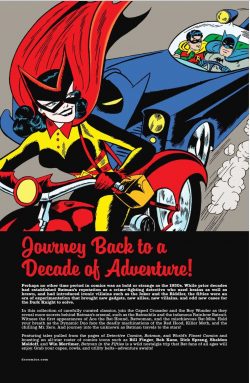
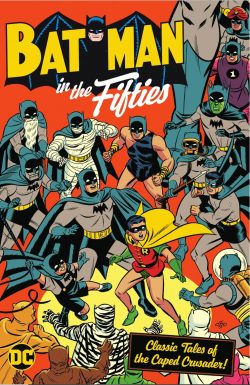
Batman in the Fifties


By Bill Finger, Don Cameron, Edmond Hamilton, France Herron, David Vern Reed, Dave Wood, Joe Samachson, Sheldon Moldoff, Dick Sprang, Lew Sayre Schwartz, Bob Kane, Win Mortimer, Charles Paris, Stan Kaye, George Roussos, Ray Burnley & various (DDC Comics)
ISBN: 978-1-7795-0950-5 (TPB/Digital edition)

In the early years of this century, DC launched a series of graphic archives intended to define DC’s top heroes through the decades: delivering magnificent past comic book magic from the Forties to the Seventies via a tantalisingly nostalgic taste of other – arguably better, but certainly different – times. The collections carried the cream of the creative crop, divided into subsections, partitioned by cover galleries, and supplemented by short commentaries; a thoroughly enjoyable introductory reading experience. I prayed for more but was frustrated… until now…

Part of a trade paperback trilogy – the others being Superman and Wonder Woman (thus far, but hopefully Aquaman, Green Arrow and Martian Manhunter are in contention too, as they have become such big shot screen stars these days) – the experiment is being re-run, with even more inviting wonders from the company’s amazing family-friendly canon.

Gathered here is an expanded menu of delights adding to that of the 2002 edition, rerunning Michael Uslan’s original context-stuffed Introduction and chapter text pieces. The stories originated in Detective Comics #156, 165, 168, 180, 185, 187, 215, 216, 233, 235, 236, 241, 244, 252, 267; 269, 1000; Batman #59, 62, 63, 81,92,105, 113, 114, 121, 122, 128; and World’s Finest Comics #68, 81, 89 which span the entire decade while laying the rather bonkers groundwork for the landmark television series of the next decade.

Supported by the first of a series of factual briefings, the comics open with Classic Tales, and ‘The Batmobile of 1950!’ Written by Joe Samachson and illustrated by visionary artist Dick Sprang and ideal inker Stan Kaye, the clever saga of reinvention originated in Detective Comics #156 (cover-dated February 1950 and on sale from December 19th 1949):  heralding new vistas as their reliable conveyance is destroyed by cunning crooks.

Badly injured, Batman uses the opportunity to rebuild his ride as moving fortress and crime lab and scores his first techno advance. There would soon be many more: a Batplane II, new boats and subs and even a flying Batcave…

David Vern Reed, Sprang & Charles Paris then set the Crime Crushers to recovering a vital lost tool assemblage before some villain could decipher ‘The Secret of Batman’s Utility Belt!’ (Detective #185 July 1952) and end their careers, after which ‘The True History of Superman and Batman’ (World’s Finest Comics #81, March/April 1956 by Edmond Hamilton, Sprang & Kaye) finds a future historian blackmailing the heroes into restaging their greatest exploits so that his erroneous treatise on them will be accurate…

Foreshadowing modern tastes and tropes, an unknown author & Sheldon Moldoff reveal ‘The New-Model Batman’ in Detective #236 (October 1956) as recently-released criminal genius Wallace Waley deploys counters to all the heroes’ techniques and tech, necessitating a change of M.O and new toys… like a Bat-tank…

In a classic case of misdirection, the Dark Knight briefly becomes ‘The Rainbow Batman! in Detective #241 (March 1957). As delivered by Hamilton, Moldoff & Kaye, a series of outlandish costumes keep the public – and reporters’ – gaze on the mighty masked peacock and well away from the biggest story of the decade…

Bill Finger, Moldoff & Paris detail a review of the hero’s most versatile weapon in ‘The 100 Batarangs of Batman!’ (Detective #244 June 1957) as criminals begin using old variants of the throwing tool against him and the Gotham gangbuster has to unleash an almost dangerous and untested prototype to defeat them…

In a most frustrating piece of poor editing, next up is the seminal sequel story to a most important and repercussion-packed yarn. Crafted by Hamilton, Sprang & Kaye, ‘The Club of Heroes’ first appeared in World’s Finest Comics #89 (July/August 1957) reprising an earlier meeting of Batmen from many nations. It became a key plank of Grant Morrison’s latterday epic Batman: the Black Glove as those valiant foreign copycats reconvened to add the Man of Steel to their roster only to find him suffering recurring amnesia and outshone by brand-new costumed champion Lightning Man

‘The Thousand Deaths of Batman!’ (Detective #269 July 1959) comes from another uncredited scripter, with Moldoff & Paris limning a bizarre tale of a criminal entertainment network offering staged deaths of their greatest enemies until the Caped Crusaders infiltrate and exterminate…

Just as the adventures always got bigger and bolder, so too did the character roster and internal history. The Bat-Family section homes in on the heroes’ constantly expanding supporting cast, and leads with something I just finished whining about.

Detective Comics #215 (January 1955) featured ‘The Batmen of All Nations!’ by Edmond Hamilton, Moldoff & Paris) and saw the World’s Greatest Crimefighters acknowledged as such by well-meaning champions from Italy, England, France, South America and Australia, who took the sincerest form of flattery a step too far by becoming nationally-themed imitations. That was fine until they all attend a convention in Gotham City doomed to disaster after a villain replaces one of them…

Why on Earth did this tale have to follow its own sequel?

Anyway, back to our usual nonsense and a question: Do you believe in coincidence? Superman was incredibly popular throughout the 1950s and many things that happened to him were tried in Batman stories. For a while the caped crusader even had a girl reporter – Vicki Vale – trying to ferret out hi secret identity. So when Adventure Comics #210 (March 1955) introduced a dog from Krypton, how surprising was it that Batman would soon join that rather exclusive kennel club?

For no reason I could possibly speculate upon, ‘Ace the Bat-Hound!’ debuted in Batman #92 (June 1955), created by Bill Finger, Sheldon Moldoff & Charles Paris. Ace was a distinctive German shepherd temporally adopted by Bruce Wayne when his actual owner John Wilker is abducted by crooks. A skilled tracker with distinctive facial markings, the pooch inserts himself into the case repeatedly, forcing the Dynamic Duo to mask him up as they hunt his master and foil a criminal plot. Like Krypto, Ace reappeared intermittently until Wayne stopped borrowing him and just adopted the amazing mutt.

Almost as necessary a Fifties adjunct, ‘The Batwoman!’ debuted in Detective #233 (July 1956) as Hamilton, Moldoff & Kaye added a female copy to the cannon…

Today fans are pretty used to a vast battalion of bat-themed champions haunting Gotham City and its troubled environs, but for the longest time it was just Bruce, Dick Grayson and an occasionally borrowed dog keeping crime on the run. However, three months before the debut of the Flash officially ushered in the Silver Age, editorial powers-that-be introduced valiant heiress Kathy Kane, who incessantly suited-up in chiropteran red and yellow over the next eight years. She was a former circus acrobat who burst into Batman’s life, challenging him to discover her secret identity at the risk of exposing his own…

Far more critical to the growing legend was Finger, Moldoff & Kaye’s ‘The First Batman!’

as originally seen in Detective Comics #235 (September 1956): a key story of this period which introduced a strong psychological component to Batman’s origins, disclosing how when Bruce was still a toddler, his father had clashed with gangsters whilst clad in a fancy dress bat costume…

In Batman #105, (February 1957) France Herron, Moldoff & Paris introduced ‘The Second Boy Wonder!’ as a stranger apparently infiltrates the Batcave by impersonating the kid crimebuster, but there’s more going on than would first appear, unlike Batman #114 (March 1958) wherein unknown writer, Moldoff & Paris reveal how circus gorilla Mogo joins the team to clear his framed keeper’s name in ‘The Bat-Ape!’

The grim gritty tone of the Dark Knight remains utterly absent in ‘The Marriage of Batman and Batwoman!’ (Batman #122, March 1959) as Finger, Moldoff & Ray Burnley manifest Robin’s bleakest nightmares should such a nuptial event ever occur, before Detective #267 (May 1959) details how ‘Batman Meets Bat-Mite!’ and Finger, Moldoff & Paris launch the Gotham Guardian’s most controversial “partner” – a pestiferous, extra-dimensional prank-playing elf who “helps” his hero by aiding his enemies to extend the duration of the fun… (World’s Finest Comics #68, January/February 1954).

In the 1950s costumed villains faded from view and preference for almost a decade – until the Batman TV show made them stars in their own right. Thus there’s not as big a pool to draw on here as you might expect, and what there is mostly the old favourites..

The Villains highlights our hero’s greatest recurring enemies, leading with The Secret Life of the Catwoman!’ from Batman #62 (December 1950/January 1951) by Finger, with Lew Sayre Schwartz ghosting for Bob Kane – who only pencilled a few faces and figures. It’s all inked by Paris.

Here the Felonious Feline reforms and retires after a head trauma cures all her larcenous tendencies… until Batman begs law-abiding Selina Kyle to suit up once more and go undercover to catch crime boss Mister X.

Kane had all but left his role to others by this time and his contributions remained minor in The Origin of Killer Moth!’ (Batman #62, February/March 1951) as Finger, Sayre Schwartz & Paris record how a recently-released convict steals Batman’s ideas and sets up as a paid costumed crusader for crooks…

Around that time Detective #168 (February 1951) began the long road to an origin for the Joker as Finger, Sayre Schwartz, Kane George Roussos and Win Mortimer exposed ‘The Man Behind the Red Hood!’ This reveals a partial origin as part of a brilliantly engrossing mystery which begins when the Caped Crusader regales eager college criminology students with the story of “the one who got away” – just before the fiend suddenly comes back…

Batman’s most tragic Golden Age foe resurfaced cured and fully functional in Detective #187 (September 1952), but Harvey Dent was soon on a spree committing ‘The Double Crimes of Two-Face!’ (by Don Cameron, Sprang & Paris). Although the Dynamic Duo knew from the start their foe was a fake, the situation was far different two years later when Reed, Sprang & Paris detailed how ‘Two-Face Strikes Again!’ in Batman #81 (February 1954). This time a freak accident restored Dent’s scarred bipolar state and the heroes were outmatched all the way to the stunning turnabout conclusion…

The bit about bad guys bows out with ‘The Ice Crimes of Mr. Zero’ (Batman #121, February 1959) as Dave Wood, Moldoff & Paris depict a scientist’s turn to crime after an experiment afflicts him with a condition that will kill him if his temperature rises above freezing point. Although cured in this yarn, that villain would return, taking the name Mr. Freeze

Final comics section Tales from Beyond highlights the increasingly strange adventures of the Dynamic Duo which – due to Comics Code embargoes on horror and the supernatural – meant a wealth of weird alien and startling science fiction themes. The wonders beginswith a rarely reprinted yarn from Finger, Sayre Schwartz, Kane & Paris originally seen in Batman #59 (June/July 1950). It begins as the heroes seek to use time travel to cure The Joker, before a mistake by chronal scientist Professor Carter Nichols dumps them in 2050 AD. ‘Batman in the Future!’ finds them aiding the Harlequin of Hate’s crimefighting descendant against space pirates before returning to their own era…

A solid gold classic follows as ‘The Batman of Tomorrow!’ (Detective #216, February 1955) visits the 20th century – from his home in 3054 – to save an injured Bruce Wayne from Vicki Vale’s latest exposé and catch a cunning crook in a fast paced and fantastical romp by Hamilton, Sprang & Paris.

Many of these bright-&-breezy high fantasy tales deeply affected modern writers and the overarching continuity, perhaps none more so than Herron, Sprang & Paris’ ‘Batman – The Superman of Planet X!’ from Batman #113 (February 1958): which formed a key thematic plank of Grant Morrison’s epic 2008 storyline Batman R.I.P. The story details how the Gotham Guardian is shanghaied to distant world Zur-En-Arrh by its version of Batman to fight an alien invasion: a task rendered relatively simple since the planet’s atmosphere and gravity gives Earthmen incredible superpowers…

In Detective #252 (February 1958) Wood, Moldoff & Paris channelled contemporary film fashion as a monster makes trouble on a movie location shoot, compelling the costumed champions to tackle ‘The Creature from the Green Lagoon!’ before the last tale in this section – and volume – reveals how our heroes mistakenly aid an alien pirate and are arrested and imprisoned offworld by interstellar lawmen. ‘The Interplanetary Batman!’ (Batman #128. December 1959) is a riotous rollercoaster rocket ride by Finger & Moldoff with Batman and Robin overcoming all odds to clear their names and get home and is a perfect place to pause this circus of ancient delights.

Also including a selection of breathtaking covers and a ‘Bonus Cover Gallery’ by Sprang, Mortimer, Moldoff, Curt Swan, Sayre Schwartz, Kaye & Paris, this is a splendidly refreshing, comfortingly compelling and utterly charming slice of comics history that any aged fan or newcomer will delight in: a primer into the ultimate icon of Justice and fair play.
© 1950, 1951, 1952, 1954, 1955, 1956, 1957, 1958, 1959, 2002, 2019, 2021 DC Comics. All Rights Reserved.
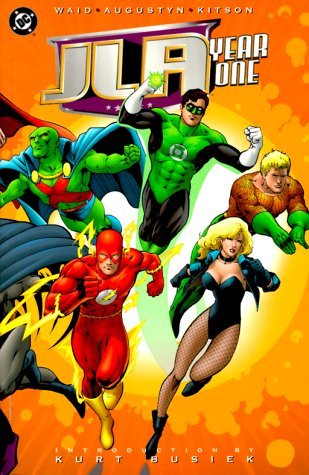
JLA: Year One


By Mark Waid, Brian Augustyn & Barry Kitson with Michael Bair, John Stokes, Mark Propst, & various (DC Comics)
ISBN: 978-1-56389-512-8 (TPB)

If the chop-and-change continuity gymnastics DC have undergone in recent years gives you a headache, but you still love reading excellent superhero team stories, you could just take my word that this is one of the best of that breed and move on to the next review. If you’re okay with the confusion or still need convincing, though, please read on.

With then-partner All-American Publishing, in 1940 DC published the Justice Society of America in All-Star Comics from #3. Cover-dated “Winter Issue”, it spanned the year end and was on sale from November 22nd until January. The JSA were the first superhero team in comics.

In 1960 after a decade largely devoid of superheroes, the now fully-amalgamated publisher sagely revived the team concept as the Justice League of America, and gradually reintroduced the JSA ancestors as heroes of an alternative Earth to a fresh new caped and cowled world. By 1985, the continuity had become saturated and overcrowded with so many heroic multiples and close duplicates that DC’s editorial Powers-That-Be deemed it all too confusing and a deterrent to new readers, and decreed total change. It resulted in maxi-series Crisis on Infinite Earths and the events of the groundbreaking, earth-shattering saga led to a winnowing and restructuring of the DC universe…

With all the best bits from past stories (for which one could read “least charming or daft”) having now occurred on one Earth, and with many major heroes remade and re-launched (Superman, Wonder Woman, Flash et al.), one of the newest curses to readers – and writers – was keeping definitive track of what was now DC “History” and what had now never actually happened.

Thus 12-issue maxi-series JLA: Year One presented the absolute, definitive, real story of the formation and early days of the Justice League, the World’s Greatest – but no longer first – Superheroes…

Of course, since Zero Hour, Infinite Crisis and all the other subsequent publishing course-correcting extravaganzas (such as 52, Countdown, Dark Nights: Death Metal and so on) it’s not strictly true anymore. Still. Again…

None of which impacts upon the superb quality of the tale told here. Way back then – January to December 1998 and in the wake of Grant Morrison & Howard Porter’s spectacular re-reboot of the team – Mark Waid, Brian Augustyn & illustrator Barry Kitson (plus assorted assisting inkers) produced a superb version of that iteration’s earliest days. It’s still one of the best and most readable variations on the theme, even if DC have inexplicably let it slide out of print…

It begins “ten years ago” in ‘Justice League of America: Year One’ as a hidden observer gathers files on an emergent generation of new costumed heroes. When an alien invasion from Appellax brings inexperienced neophyte heroes Flash, Green Lantern, Black Canary, Aquaman and Martian Manhunter together to save Earth from colonisation, the media scents a news sensation, but the real story is the hidden forces hovering in the background of the event…

The Canary was reimagined as the rebellious daughter of the JSA original who had been active during WWII, and the others, like the Sea King and J’onn J’onzz, had undergone recent origin revisions too…

The main action begins after that initial victory, as the heroes – novices all, remember – opt to stick together as a team, only to be targeted by secret super-science society Locus, who begin snatching up alien invader corpses for genetic experimentation…

The second issue sees the new kids as media sensations overwhelmed and out of their depth, with everyone wanting a piece of them. Older outfits like the Blackhawks, Challengers of the Unknown and even officially-retired JSA veterans are watching with apprehension whilst Bruce Wayne wants them far away from Gotham City as they establish their ‘Group Dynamic’. Even trick archer Green Arrow is constantly hanging around, clearly angling for an invitation to join, but that’s never gonna happen…

Immortal villain Vandal Savage targets the inexperienced heroes with a squad of veteran supervillains – the Thorn, Solomon Grundy, Clayface and Eclipso – as everywhere, more new superheroes are emerging. Savage is resolved to stop this second Heroic Age before it begins…

In #3, Locus’ bio advancements lead to alliance with Savage, but their schemes are sidelined as the team struggle to work together. Every man there seems distracted by Black Canary, but their “chivalrous impulses” in combat are not only insulting but will get someone killed – if not by enemies, then by her…

The team is fully occupied playing ‘Guess Who?’ after accepting funding and resources from a mystery billionaire. The influx of cash results in a purpose-built secret mountain HQ, a covert personal communications network, live-in custodian/valet/tech support Snapper Carr and a security system designed by maverick teen genius Ted Kord.

At least the heroes are starting to bond, sharing jokes, origins and trade secrets, but tensions are still high and trust in each other is fragile…

Inker Michael Bair joins with #4 as ‘While You Were Out…’ sees Locus at last launch their campaign of conquest: picking off lone hero Dan Garrett, whose mystic Blue Beetle scarab proves no match for alien-enhanced bio-weaponry, even as the heroes are all singled out for close observation by mystery operatives…

The merciless Brotherhood of Evil unleash Locus-designed horrors on Manchester, Alabama in #5, leading to a tenuous team-up of Justice League and Doom Patrol that ends in disaster and defeat. Maimed and deprived of their abilities, they are ‘A League Divided’ until the DP’s resident genius Niles Caulder provides stopgap powers and weapons in ‘Sum of Their Parts’ (inked by Bair & John Stokes), enabling the heroes to rally and restore themselves…

In ‘The American Way’ the JLA suffer a shock after their greatest inspiration – Superman – declines an offer to join, even as Locus’ endgame begins.

The dispirited heroes barely notice, as ‘Loose Ends’ exposes treachery in the ranks, further distracting the heroes who discover a trusted ally has been spying on them in their private lives. They have no idea what’s really going on…

With unity shattered, the JLA turns on itself, missing Locus’ attempt to terraform Earth and literally ‘Change the World’

‘Heaven and Earth’ (inked by Bair & Mark Propst) finds all humanity’s helpless and all its many heroes subdued in a superpowered blitzkrieg that catches the planet napping. Crushed, defeated and interned in ‘Stalag Earth’ all hope is lost until the reunited Justice League lead a counter-offensive, turning tragedy into triumph and ensuring ‘Justice for All’

A brilliantly addictive plot, superbly sharp dialogue and wonderfully underplayed art suck the reader into an enthralling climax that makes you proud to be human… or at least terrestrially-based. This saga of our champions’ bonding and feuding under extended threat of rogue geneticists, planetary upheaval, and the mystery of who actually bankrolls the team, all added to continual, usual, everyday threats in a superhero’s life, is both enchanting and gripping.

When it’s done right there’s nothing wrong with being made – and allowed – to be feel ten years old again. In-the-know fans will delight at the clever incorporation of classic comics moments, in-jokes and guest-shots from beloved contemporaneous heroes and villains such as the Sea Devils, Metal Men, Atom and such, but the creators of this revised history never forget their new audience and nothing here is unclear for first-timers. The finale is a fan’s all-action dream with every hero on Earth united to combat all-out alien invasion! …And of course, the rookie JLA save the day again in glorious style.
© 1998 DC Comics. All Rights Reserved.
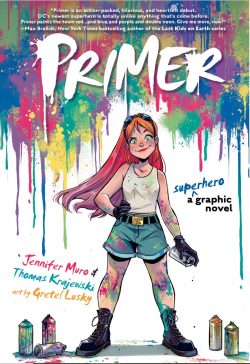
Primer

By Jennifer Muro & Thomas Krajewski, illustrated by Gretel Lusky (DC Comics)

ISBN: 978-1-4012-9657-5 (TPB/Digital edition)

In recent years DC opened up its interlinked superhero multiverse to generate Original Graphic Novels featuring its stars and new characters in stand-alone(ish) adventures for the demographic clumsily dubbed Young Adult.

They’ve been especially scrupulous producing material catering to girls and other previously neglected comics minorities, and to date results have been rather hit or miss. However, when they’re good, they are very good indeed. One such triumph is Primer, which taps into the communal history and mystique of the DCU to introduce a sparkling new character who encapsulates every aspect of youthful rebellion channelled into doing good in the traditional cape and cowl manner…

Written by animation scripters Jennifer Muro (Critical Role: The Legend of Vox Machina; Spider-Man; Star Wars: Forces of Destiny; Justice League Action; Lego DC Super Hero Girls) & Thomas Krajewski (Buddy Thunderstruck; Fairly OddParents; Scooby-Doo and Guess Who?; Penguins of Madagascar; Looney Tunes; Iron Man; Teenage Mutant Ninja Turtles) this origin adventure crackles with pace and thrills whilst basking in superbly effective dialogue and sharp one-liners.

Making the pictures sparkle and shine is 2-D visual developer, animation/games character designer and jobbing illustrator Gretel Lusky. Primer is her first comics project and augurs a long and fruitful career ahead as the artist seems able to effortlessly mix drama, pathos, spectacular action and sheer glee for maximum impact.

Lettered throughout by Wes Abbott, the wonderment first unfolds in ‘Primary Colors’ as a crashing airliner is plucked from the sky over Washington DC. Suddenly, everyone is saved by what appears to be a paint-spattered, super-powered thirteen year old girl…

Flashing back three weeks, we meet troubled Ashley Rayburn, who – after another bout of nightmares about her dad – escapes from the State group home to go tagging walls with her personal brand of street art. The cops who arrest and return her are pretty sympathetic – for cops. They realise it must be tough having a major crook for a father… even if he is currently in jail.

Ashley is basically a good kid acting out, and home supervisor Mrs. Boyd is trying her best to be understanding, but after regular graffiti incidents with cops involved, and being swiftly returned by five sets of prospective foster parents, the child is becoming a real problem with diminishing chances of a normal life…

If Ash doesn’t gel with latest prospects Mr & Mrs Nolan, she might be stuck in the system for her entire teen years. Thankfully, these adults are pretty cool. Kitch is a laid back art teacher with a wicked sense of fun/mischief, whilst his partner Yuka is a brilliant scientist: a geneticist who’s as obsessed with football as Ashley is.

Within a week, they’re all happily settling in together …so that’s when things start going wrong after the kid inadvertently overhears her new mom fretting about having made a mistake that will ruin their lives…

When there’s an accident in the kitchen, Ash overreacts and relapses into old behaviours: running away to paint walls again. This time, Kitch follows and they bond over her unleashed creativity. Soon he’s giving her art lessons and inviting her to share his studio. The first class is how to use brushes and canvas like she uses spray cans and other people’s walls…

Everything seems cool at home too now, but they don’t know what Yuka has done and can’t imagine how their lives are going to change…

Answers come as Ashley starts Middle School in ‘No Paint, No Gain’, but her resolution to make no new enemies only lasts until she stops bullies picking on a little kid. At least Luke – who’s being harassed for being small and a future star hairstylist – is now her ally against the rest of the jocks and jerks…

What Yuka’s actually fretting over is revealed as her employers Zecromax Labs are occupied by a client – the US Army in the forms of Major General Temple and his extremely menacing assistant Cal Strack. The science facility had been undertaking Project Warpaint for them, before Dr. Nolan secretly destroyed all the files and removed the only samples of their experiments.

These are gel solutions enhanced with the DNA of superheroes and villains. They look like body paints and can temporarily endow specific powers – 33 different ones – in whoever absorbs them through skin contact.

By the time the warmongers come to claim them, Yuka has acted for the good of humanity and – she thought – completely covered her tracks…

Sadly, she’s new to parenting and doesn’t realise that acting suspicious and conspicuously hiding a flashy briefcase is the best way to get a teenager about to celebrate a birthday to poke around where she shouldn’t. Before long, Ash and Luke have uncovered the paint tubes and are playing with borrowed superpowers…

From there on, things get exponentially complicated pretty quickly, as the military mavericks hunt their missing miracle weapon, even as Ashley’s real dad reaches out from the maximum security penitentiary he’s locked in to play his old mind games and remind her that deep down she’s just like he is. The pressured girl reacts by creating her own new alter ego and fighting super-criminals (albeit not particularly effective ones) on the streets of DC in ‘Red, White, and Bruised’.

Restricting the personal crusade of “Primer” because she’s afraid of being caught by Yuka, Ashley has no idea Temple and Strack are hunting the mystery thieves of Project Warpaint, and already on the Nolan’s trail, though the Major General has no idea that his deputy – and personal guinea pig – has his own ambitions involving the superpower supply…

The flashback reaches real time as Ashley finally rejects her dad’s mind games to save the falling plane and go public. Unfortunately, her televised debut enables a lot of people to recognise her and leads to the Nolans’ abduction by Strack and a gaudy gladiatorial clash as the power-crazed maniac attempts to capture all the paints and discovers, to his shock, Primer’s ‘True Colors’

Even with the drama satisfactorily concluded, there’s an added inducement: an introductory section from Grace Ellis & Brittney Williams’ DC OGN Lois Lane and the Friendship Challenge offering a light and airy sneak peek at the formative years of the ace reporter and another splendidly welcome tale aimed at inspiring younger female readers.

A fabulously gripping tale about origins, exploring the process of finding yourself and being your best, smartly cloaked in the bombastic trappings of costumed heroics, and the search for belonging and taking control of your life, Primer is a compelling romp to warm the heart, stir the pulse and light up your life. Sequel ASAP and series soon, Please!

© 2020 DC Comics. All Rights Reserved.
The All-New Atom volume 2: Future/Past


By Gail Simone, Mike Norton, Eddy Barrows & various (DC Comics)
ISBN: 978-1-4012-1568-2 (TPB)

Gail Simone (Wonder Woman; Batgirl; Secret Six; Red Sonja) is one of the best scripters of superhero stories in the business. She handles High Concept attention grabbers, gripping fight scenes and compelling pathos with elegant ease, but where she is truly unsurpassed is in the rounded depth of her characterisations. Combined with solid plotting, bravura whimsy and the sharpest, funniest dialogue money can buy, everything she touches becomes a thoroughly delightful “must-read” item.

That was never more ably demonstrated than in her run on the All-New Atom (most volumes of which remain stubbornly out of print and inexplicably unavailable in digital collections). In second volume Future/Past she continued deftly  detailing the trials and tribulations of a new incarnation of one of the Silver Age’s most enduring heroic brands, in the further adventures of neophyte college professor and scientific adventurer Ryan Choi.

After the tragic, horrific events of crossover epic Identity Crisis size-shifting physics professor Ray Palmer disappeared, leaving this world behind him. However, life – and academia – goes on, and his teaching chair at Ivy University was offered to a young prodigy who just happened to be Palmer’s pen-friend and close confidante: privy to his predecessor’s secrets ever since he was a child in Hong Kong.

Ivy Town has seen better days, however, and continues to go downhill. This collection – reprinting from March-July 2007 issues #7-11 of the much-missed comic book – returns to Ivy Town: a place that has seen better days. Everything continues to go downhill, and the college paradise is no longer the sedate place Palmer always made it sound. Neophyte hero Choi continues to expose a city plagued by temporal anomalies, warring tribes and supernatural freaks and to make matters even worse, the new Dean is an unctuous toad (and possibly a criminal), whilst Choi’s fellow science professors are a bizarre and unconventional band of truly brilliant loons…

The teeny-weenie thrills and chills resume here with a 2-parter illustrated by Mike Norton and Andy Owens. ‘The Man who Swallowed Eternity – The Energy of the Universe is Constant’ and concluding chapter ‘The Entropy of the Universe Tends to a Maximum’ reveal how the recurring time-hiccups that pepper Ivy Town go into overdrive, necessitating an unwelcome intervention from the Temporal police known as Linear Men. Choi’s reluctant attempts to solve the problem soon uncover a tragic secret that draws him uncomfortably closer to his missing mentor.

What’s follows is a gratifying change of pace and tone as the young professor returns to Hong Kong to rescue his sometime true love in ‘Jia.’ Limned by Eddy Barrows & Trevor Scott, the saga kicks off with ‘Her Name Meant Beauty’ as we learn some unpleasant truths about Ryan’s childhood…

‘Unwanted Advances’ show Choi that being a superhero can’t compensate for the girl he loves marrying the bully who made his life hell, and it’s even worse when said brute becomes a vengeful ghost trying to kill them both. Mercifully in ‘The Border Between’, ancient wisdom and unwelcome truths assist the hero in overcoming the supernatural odds…

The utterly enchanting (pre-The New 52) career of Ryan Choi was simultaneously funny, charming, stirring and incredibly addictive: moreover, his gently beguiling, so-skilfully orchestrated hero’s journey to the West was riddled with cunningly planted clues and hints which only made sense once the final volume ended – and Simone had the nerve and confidence to treat the entire venture as a fair-play mystery. The fun just never let up…

Even at this late stage, it is worth whatever effort it takes to follow the All-New Atom, matching wits with the writer and having huge amounts of fun along the way. What are you waiting for?
© 2007 DC Comics. All Rights Reserved.
Batman: The Scottish Connection


By Alan Grant & Frank Quitely (DC Comics)
ISBN: 978-1-5638-9372-8 (TPB)

Once again we’ve lost another comics great, another uniquely brilliant and imaginative voice. Alan Grant died yesterday, July 21st 2022.

Born on February 9th 1949, in Bristol, Alan Grant grew up as a true Scot in the heart of Midlothian. He was a bit wayward and anarchic and – after trying regular life a couple of times –  began his comics career in 1967 as an editor for DC Thomson. Soon he was writing scripts – many with life-long collaborator John Wagner – and inventing characters, first for British companies but eventually all over the world.

His triumphs include Tarzan, Judge Dredd, Strontium Dog, Batman, Lobo, L.E.G.I.O.N., Judge Anderson, The Bogie Man, Channel Evil, Kidnapped, The Demon, Anarky, Robo-Hunter, The Loxleys and the War of 1812 and countless more.

Alan contributed to amateur fanzines, constantly encouraging and supporting new talent; adapted classic literature to comics form for major art festivals; worked in animation; organized his own comic conventions in home village of Moniaive; self-published and ran his own publishing house Berserker Comics. He was tirelessly inquisitive, deeply philosophical and instinctively socially philanthropic. In 2020, he led a community outreach project to inform about CoVID-19 via a comic book.

Alan Grant was funny, and friendly and amazing. Here’s one of his best books remembered. A fuller tribute will follow shortly: probably one of his more controversial (for which read scandalous and hilarious) efforts, because that would have pleased him greatly…

Way, way back in 1953, Detective Comics #198 cover featured ‘Lord of Bat-Manor’, written by Leigh Brackett & Edmond Hamilton and drawn by the legendary Dick Sprang. In it, Batman inherited a Scottish Castle and it was later established that Bruce Wayne’s ancestors came from Scotland.

Don’t ask me why that bit of ephemera remains when so very much else has been rewritten over the years but it has, and decades later, canny, proud and professional Scots Alan Grant & Frank Quitely parlayed that trivia titbit into this slim yet gripping Caledonian conundrum.

On a visit to the Auld Country, Bruce Wayne stumbles onto a quasi-Masonic plot to locate the lost treasure of the Knights Templar, but that’s simply the tip of the iceberg in a revenge scheme centuries in the making: one involving beautiful tragic women, deadly plagues, ancient super-weapons, crazed claymore-waving maniacs and good old-fashioned Heid-cases and Barm-pots all a-bother…

Beautifully illustrated, seditiously scripted and brilliantly dancing on the line between classic comedy and chilling thriller, this is pure adventurous escapism from two consummate professionals. Go and get it, bonny lads and lassies and all you others…
© 1998 DC Comics. All Rights Reserved.

DC’s Greatest Detective Stories Ever Told


By Jerry Siegel & Joe Shuster, Gardner F. Fox, Mindy Newell, Mike W. Barr, Denny O’Neil, Andy Helfer, Rusty Wells, Creig Flessell, Carmine Infantino, Alan Davis, Paul Neary, Terry Beatty & Dick Giordano, Al Vey, E.R. Cruz, Denys Cowan & Rick Magyar, Mark Badger, Jim Aparo & Mike DeCarlo & various (DC Comics)
ISBN: 978-1-7795-0594-1 (TPB/Digital edition)

Fundamental and definitive aspects of “detective stories” have been attributed to the Bible, ancient Greek dramas, One Thousand and One Nights and similarly compelling classical texts from China, India and other places, but the true genre of crime and mystery fiction really began with cheap printing and the rise of mass entertainment culture.

Detective stories are a subgenre wherein an investigation – by amateur or professional (active or retired) – into a legal felony or moral/social injustice. Like exploration/adventuring, fantasy, horror and science fiction, Detective Stories blossomed in white western societies in the mid-19th century: spreading from prose books and magazines to other entertainment media like plays and films, with early stars including C. Auguste Dupin, Sherlock Holmes, Jules Maigret, Father Brown, Lord Peter Wimsey, Sexton Blake and Hercule Poirot. Tales aimed at youngsters generated their own sleuthing stars: Nancy Drew, The Hardy Boys and more

As comic strips developed, they also spawned detective champions like Hawkshaw, Dick Tracy, Charlie Chan, Kerry Drake ad infinitum: all contributing to a tidal wave of pulp fiction crimebusters that inspired true literary legends – Philip Marlow, Sam Spade, Simon Templar, Mike Hammer and so on…

Detective Comics #1 had a March 1937 cover-date and was the third and final anthology title devised by luckless pioneer Major Malcolm Wheeler-Nicholson. In 1935, the entrepreneur had seen the potential in Max Gaines’ new invention – the comic book – and reacted quickly, conceiving and releasing packages of all-new strips in New Fun: The Big Comic Magazine and its follow-up New Fun/New Adventure (which ultimately became Adventure Comics) under the banner of National Allied Publications.

These publications differed from similar prototype comics magazines which simply reprinted edited collations of established newspaper strips. However, these vanguard titles were as varied and undirected in content as any newspaper funnies page.

Detective Comics was different. Specialising solely in tales of crime and crimebusters, the initial roster included (amongst others) adventurer Speed Saunders, Cosmo, the Phantom of Disguise, Gumshoe Gus and two series by a couple of kids from Cleveland named Siegel & Shuster: espionage agent Bart Regan and two-fisted shamus Slam Bradley

Within two years the commercially unseasoned Wheeler-Nicholson had been forced out by his more adept business partners, and eventually his company grew into monolithic DC (for Detective Comics) Comics. Surviving a myriad of changes and temporary shifts of identity and aims, it’s still with us – albeit primarily as a vehicle for the breakthrough character who debuted in #27 (May 1939)…

Celebrating that quintessential connection and affiliation to the form, this slim tome gathers an unconventional array of sleuths and problem solvers, many not native to the parent title, but all offering a heady taste of what made the title great. Re-presenting material from Adventure Comics #51; Batman #441; Detective Comics #2, 329 & 572; Lois Lane #1-2; Secret Origins #40 and The Question #8 it spans August 1937 to November 1989: an epic package chronologically sampling the company’s connection and debt to the genre that truly started their ball rolling…’’

Sans preamble, we dive straight into action with early star Slam Bradley in his second ever case. ‘Skyscrapers of Death’ originated in the April 1937 cover-dated Detective Comics #2, (by Jerry – back when he still called himself “Jerome” – Siegel & Joe Shuster). It reveals how the abrasive, two-fisted gumshoe is framed for murder by a crooked Union boss. Slam and his assistant Shorty were a big draw in those early days: revelling in all the raw action and spectacle that would fire up his younger cousin Superman. The Bradley strip ran until October 1949, finally closing shop in Detective Comics #152.

Next up is quintessential pulp sleuth The Sandman who premiered in either Adventure Comics #40 July 1939 (two months after Batman debuted in Detective Comics #27) or two weeks earlier than that in New York World’s Fair Comics 1939, depending on which distribution records you choose to believe.

He was created and originally illustrated and scripted by multi-talented all-rounder Bert Christman, with assistance from Gardner F. Fox. Head utterly obscured by a gas-mask and slouch hat; caped, business-suited millionaire adventurer Wesley Dodds is a rugged playboy scientist cut from the radio drama/prose periodical mystery-men mould of The Shadow, Phantom Detective, Green Hornet, Lone Ranger, Spider, Avenger and so many more: all household names of early mass-entertainment.

Wielding a sleeping-gas gun and haunting the night hunting killers, thieves and spies, he was soon joined by plucky paramour Dian Belmont, before gradually losing readers’ interest and slipping from cover-spot to last feature in Adventure, just as the shadowy, morally ambiguous avengers he emulated also slipped from popularity in favour of gaudily clad glory-boys…

Alternately titled ‘The Pawn Broker’ in previous reprints, ‘The Van Leew Emeralds’ comes from Adventure Comics #51 (June 1940 by Fox & Creig Flessel): a fascinating mystery romp for the romantically-inclined crimebusters to solve in fine style and double-quick time…

In 1963 Julius Schwartz took editorial control of Batman and Detective Comics and finally found a home for a character who had been lying mostly fallow ever since his debut as a walk-on in The Flash #112 (April/May 1960). The Elongated Man was Ralph Dibny: a circus-performer who discovered an additive in soft drink Gingold which granted certain people increased muscular flexibility. Intrigued, he refined the chemical until he had a serum bestowing ability to stretch, bend and compress his body to an incredible degree. Then Ralph had to decide how to use his new powers…

Designed as a modern take on Jack Cole’s immensely popular Golden Age star Plastic Man, Dibny became a regular guest star/colleague for the Scarlet Speedster. He married vivacious debutante Sue Dibny and joined Flash’s battles against aliens and supervillains, but when the back-up spot opened in Detective Comics (previously held by Martian Manhunter since 1955 and only vacated because J’onn J’onzz was promoted to lead position in House of Mystery) Schwartz had Dibny slightly reconfigured as a flamboyant, fame-hungry, attention-seeking, brilliantly canny globe-trotting private eye solving mysteries for the sheer fun of it.

Aided by his equally smart but thoroughly grounded wife, the short tales were patterned on classic Thin Man filmic adventures of Nick and Norah Charles: blending clever, apparently impossible crimes and events with slick sleuthing, all garnished with the outré permutations and frantic physical antics first perfected by Cole…

Drenched in fanciful charm and sly dry wit, the complex yet uncomplicated sorties began in Detective #327 (May 1964) running until #371 (cover-dated January 1968). Crafted by Fox & Infantino – who inked himself in early episodes – this third outing has them heading for cowboy country to unravel the ‘Puzzle of the Purple Pony!’ (Detective Comics #329) by inadvertently playing cupid for a young couple hunting a gold mine before capturing a gang of murderous bandits with money and murder in mind.

Next up is a rare, completely serious outing for the oldest female lead in superhero comics. Although her role varied from patsy to comedy stooge, from jester to romantic ideal to eye-candy as the situation warranted, Lois Lane was always an investigative whirlwind.

Here in the dying moments of the pre-Crisis on Infinite Earths continuity, scripter Mindy Newell & artist Gray Morrow found their 4-issue miniseries scrunched into two double-length issues (August-September 1986,with that notorious “Superman’s Girl Friend…” strap line thankfully dropped) as Lois Lane #1-2, scrupulously, meticulously, obsessively, and ultimately unsuccessfully tried to bring a national crisis in missing children to the public’s attention in ‘When it Rains, God is Crying’.

Devoid of superhero involvement, the regular Superman cast are drawn into a polemical story exposing the extent of child abduction, the repercussions of recovering victims – dead or otherwise – and official responses in ‘Ignorance Was Bliss’, ‘Dark Realities’, ‘Quicksand’ and ‘Bless the Child’ after Lois becomes increasingly driven to solve the mystery of an unidentified child found dead in Metropolis. Refusing to accept the horrific toll of disappearances she uncovers, the traumatised reporter puts her life and career on the line to find answers nobody seems willing to hear…

From painful reality we fold back into fantastic fantasy as anniversary issue Detective Comics #572 (March 1987) unites Batman, second Robin Jason Todd, Elongated Man, Slam Bradley and Sherlock Holmes in a hunt for ‘The Doomsday Book’, courtesy of scripter by Mike W, Barr, Alan Davis & Paul Neary, Terry Beatty & Dick Giordano, Infantino & Al Vey & ER Cruz.

The story begins with the descendent of infamous Professor Moriarty enacting a century old scheme, countered by each hero in a solo turn before all leads connect them to a certain British castle and a manic climactic confrontation…

In the gritty post-Crisis reality, Denny O’Neil, Denys Cowan & Rick Magyar retooled Steve Ditko’s ultimate lone agent of justice into a philosophical force of nature, relentless in his pursuit of answers.

An ordinary man pushed to the edge by his obsessions, Vic Sage used his fists and a mask that makes him look faceless to secure truth and justice whenever normal journalistic methods failed. Here the remorseless Question prowls Hub City hunting the ‘Mikado’ (The Question #8, September 1987): a good man driven by the daily horrors of the city to take action, against villains and hypocrites, making his punishments fit the crime…

In the years when superheroes were in retreat and considered too foolish for readers. DC launched Rex the Wonder Dog, who solved crimes, fought dinosaurs and saved the world. In issue 4 (July/August 1952), a back-up feature launched. Written by John Broome, Bobo was Detective Chimp: a Florida-based stalwart who was assistant and deputy to the local sheriff. He cracked many cases and was extremely popular among certain types of fan. He remains so and in Secret Origins #40 (May 1989) finally enjoyed ‘The Origin of Detective Chimp’ thanks to Mark Badger Andy Helfer & Rusty Wells. Madcap and hilarious, it’s a wild ride but has been superseded in later years by other, more quasi rational tales. Nevertheless, an ape solving crimes is a sure-fire winner as many other hirsute DC gumshoes could attest…

This eclectic selection closes with the middle chapter of a landmark crossover tale. Crafted by Marv Wolfman, Jim Aparo & Mike DeCarlo, ‘Parallel Line’ comes from Batman #441 (November 1989) the third chapter of the Batman: A Lonely Place of Dying arc introducing third Robin Tim Drake.

After original Robin Dick Grayson’s departure, the Dark Knight worked solo until he caught a streetwise urchin stealing the Batmobile’s tires. This lost boy was Jason Todd, whose short but stellar career as the Boy Wonder was fatally tainted by his impetuosity, tragic links to one of the hero’s most unpredictable foes and shocking death. The trauma of losing his comrade forced Batman to re-examine his own origins and methods, becoming darker still..

After a period of increasingly undisciplined encounters Batman was on the edge of losing not just his focus but also his ethics and life: seemingly suicidal on frequent forays into the night. Interventions from his few friends and associates had proved ineffectual. Something drastic had to happen if the Dark Knight was to be salvaged.

Luckily there was an opening for a sidekick…

The crossover tale originally appeared in Batman #440-442 and New Teen Titans #60-61 (all plotted by Wolfman & George Pérez) and a new character entered the lives of the extended Batman Family; a remarkable child who would reshape the DC Universe.

‘Parallel Lines’ unravels the enigma of Tim Drake, who as a toddler was in the audience the night the Flying Graysons were murdered. Tim was an infant prodigy, and when, some months later he saw new hero Robin perform the same acrobatic stunts as Dick Grayson, he instantly deduced who the Boy Wonder was – and by extrapolation, the identity of Batman.

A passionate fan, Drake followed the Dynamic Duo’s exploits for a decade: noting every case and detail. He knew when Jason became Robin and was moved to act when his death triggered Batman’s increasing instability. Taking it upon himself to fix his broken heroes, Tim tried to convince the “retired” Grayson to became Robin once more – but fate had other plans…

Eccentrically engaging, these tales are the merest hint of the wonders locked in DC’s vaults of fun and wonder. Hopefully, it’s also simply the start of a long and vibrant caseload of recovered mysteries
© 1937, 1940, 1964, 1986, 1987, 1989, 2020 DC Comics. All Rights Reserved.