Black Lightning


By Dennis O’Neil, Gerry Conway, J.M. DeMatteis, Martin Pasko, Paul Kupperberg, Dick Dillin, George Tuska, Rich Buckler, Marshall Rogers, Mike Netzer/Nasser, Romeo Tanghal, Joe Staton, Pat Broderick, Dick Giordano, Gerald Forton & various (DC Comics)
ISBN: 978-1-4012-7546-4 (TPB/Digital edition)

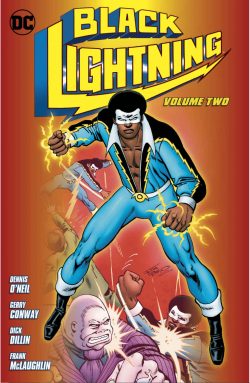
Black Lightning was the first African American superhero to have his own solo DC title. It launched in 1977 and ran for 11 issues.

When former Olympic decathlete Jefferson Pierce returned to the streets of Metropolis’ Suicide Slum to teach at inner city Garfield High School, he was determined to make a real difference to the disadvantaged and often troubled kids he used to be numbered amongst. However, when he interrupted a drug buy on school grounds and sent the dealer packing, he opened everyone around him to mob vengeance and personal tragedy…

When the ruling racketeers – an organised syndicate dubbed The 100 – came seeking retaliation, one of Pierce’s students paid the ultimate price. The traumatised teacher realised he needed the shield of anonymity if he was to win justice and safety for his beleaguered home and charges…

Happily, tailor Peter Gambi – who had raised Jefferson and taken care of his mother after the elder Pierce was murdered – had some useful ideas and inexplicable access to some pretty far-out technology. Soon, equipped with a strength-&-speed-enhancing forcefield belt and costume, plus a mask and wig that completely changed his appearance, a fierce new vigilante stalked the streets of Metropolis…

This second outing gathers a flurry of back-up and guest appearances from May 1979 to October 1980, garnered from various titles the urban avenger prowled in after his solo title folded. They cumulatively comprise World’s Finest Comics #256-259 and #261, DC Comics Presents #16, Justice League of America #173-174, Detective Comics #490-491, 495-495 and The Brave and the Bold #163 plus pertinent material from Who’s Who: The Definitive Directory of the DC Universe #3 (1985) and Who’s Who in the DC Universe #16 (1992).

Following an informative Introduction by character originator Tony Isabella reprising Black Lightning: The In-Between Years, the (relatively) down-to-earth superhero antics recommence in ‘Encounter with a Dark Avenger!’ (courtesy of Denny O’Neil, Dick Dillin & Frank Chiaramonte, as seen in World’s Finest Comics #256).

Here the electric warrior is manipulated into a potentially fatal confrontation with equally fervent urban vigilante Green Arrow. As the heroes clash, neither is aware the 100’s ousted boss Tobias Whale is behind their mutual woes…

That short yarn saw Black Lightning as GA’s guest star and served as a prelude to ‘Death Ransom!’ (WFC #257), beginning Pierce’s second (strictly backup) series. Crafted by O’Neil, George Tuska & Bob Smith, it sees a fateful, brutal clash with The Whale, resulting in a wary ceasefire for the archenemies as they unite to destroy a swiftly rebuilding 100 cartel…

Of course, a scorpion’s gotta sting and the alliance only lasts one issue before Whale betrays Lightning’s trust and another innocent dies in ‘The Blood of the Lamb!’ (O’Neil, Rich Buckler & Romeo Tanghal, from World’s Finest #258)…

Issue #259 offers a labyrinthine conundrum as the hero and a horde of gunmen act on a deathbed tip-off, converging on a seedy welfare hotel that might be ‘The Last Hideout’ (O’Neil, Marshall Rogers, Michael Nasser/Netzer & Vince Colletta) of a legendary criminal and his ill-gotten gains. Sadly, only the masked vigilante cares about collateral casualties…

‘Return of the River Rat!’ (O’Neil, Tanghal & Colletta, WFC #261) ends this back-up run on a mediocre note as school chaperone Jefferson Pierce is fortuitously on hand for a river cruise party, just as an exiled mobster attempts to sneak back into the USA by submarine…

A co-starring role in DC Comics Presents #16 (December 1979) finds the street-smart urban avenger and Superman facing a heartsick, violently despondent alien trapped on Earth for millennia in ‘The De-volver!’ (O’Neil, Joe Staton & Frank Chiaramonte) after which the loner gets a nod of approval from Superhero Big Guns…

Justice League of America #173-174 (December 1979 and January 1980) sees a smart 2-parter with a twist ending as the League seek to induct the mysterious, unvetted vigilante.

After much fervent, self-righteous and smugly privileged debate, they decide to set their still-unsuspecting candidate a little problem to prove his worth.

However, as a vermin-controlling maniac unleashes terror upon Metropolis, the ‘Testing of a Hero’ and ‘A Plague of Monsters’ (Gerry Conway, Dillin & Frank McLaughlin) takes the old recruitment drive in a very fresh direction and delivers disappointment all around…

Still Not Quite Popular Enough, the hero was found tenure in the more moody but grounded Detective Comics, beginning with #490 (May 1980).

Here Martin Pasko, Pat Broderick & McLaughlin reveal how ‘Lightning Strikes Twice Out!’ as a protracted clash with a ruthless Haitian gang led by Mama Mambu leads to Pierce’s kidnap and loss of his powers and gimmicks in concluding chapter ‘Short-Circuit’ (Detective #491).

A corrupt Senator stealing oil shipments to finance a private army and planned takeover of America is foiled in separate-but-convergent investigations conducted by Black Lightning and Batman in ‘Oil, Oil… Nowhere’ (Paul Kupperberg & Dick Giordano from The Brave and The Bold #163, June 1980) after which J.M. DeMatteis & Gerald Forton assume creative control of the Lightning’s path in Detective Comics #494…

‘Explosion of the Soul’ (cover-dated September 1980) sees the streets haunted by a murderous junkie-killing vigilante, with all Pierce’s investigations leading inexorably back to one of his students…

Ending on a dark note of tragedy, ‘Animals’ (DeMatteis & Forton, Detective #494) then sees the Suicide Slum School Olympics turned into a charnel house when a juvenile street gang seizes the girls’ hockey team and demands safe passage and new lives in Switzerland. When Black Lightning intercedes, events escalate and not everyone gets out alive…

Supplemented with a cover gallery by Ross Andru, Giordano, Jim Aparo, Neal Adams & Dillin, with fact-packed background and data pages about ‘Black Lightning’ from Who’s Who: The Definitive Directory of the DC Universe #3 (1985) and an updated entry from Who’s Who in the DC Universe #16 (1992), this is a potent package of fast-paced Fights ‘n’ Tights thrillers no thriller fan could resist.
© 1979, 1980, 2018 DC Comics. All Rights Reserved.

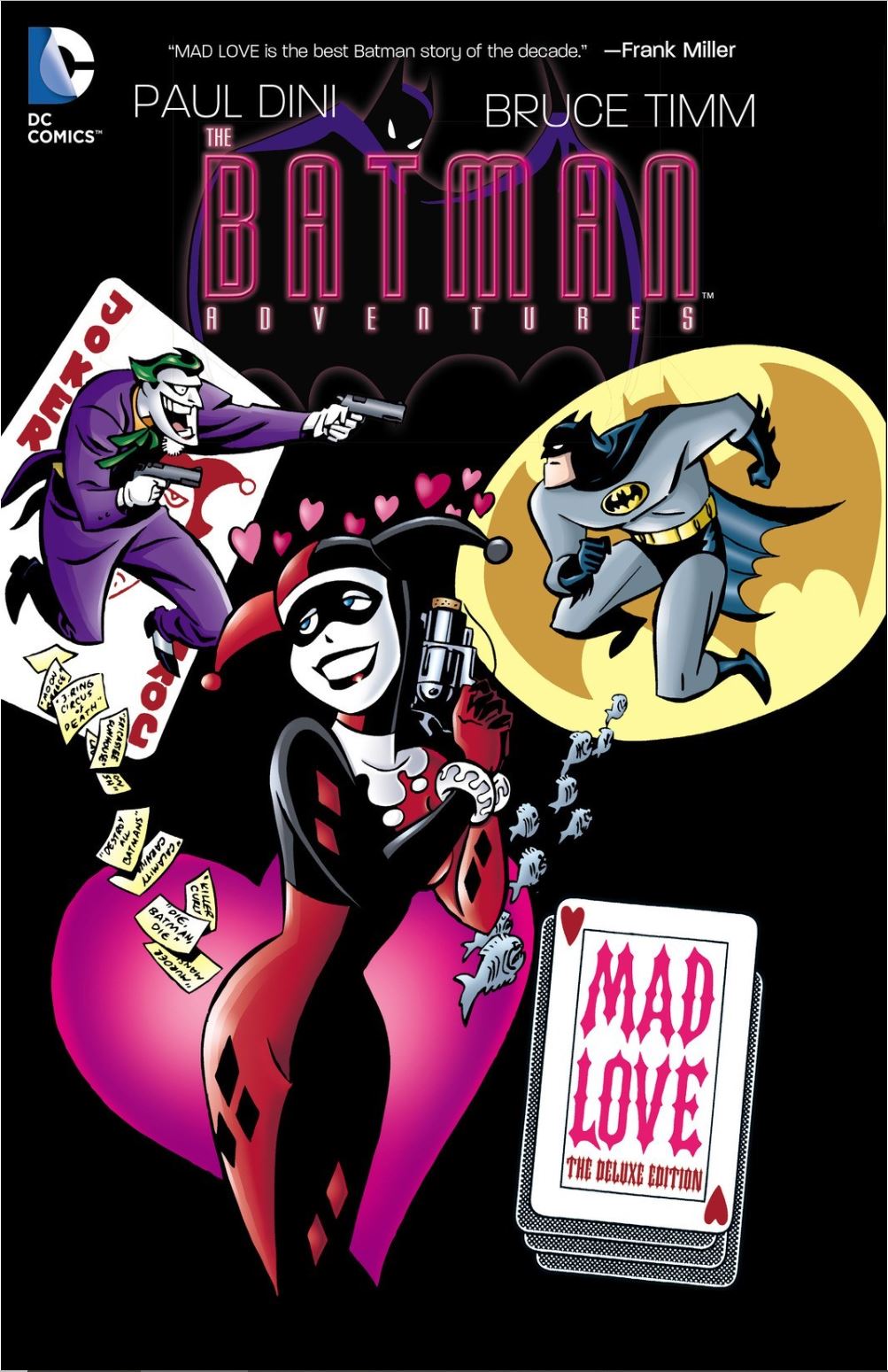
The Batman Adventures: Mad Love Deluxe Edition


By Paul Dini & Bruce Timm, with Rick Taylor, Tim Harkins & various (DC Comics)
ISBN: 978-1-4012-5512-1 (HB/Digital edition)

Harley Quinn wasn’t supposed to be a star… or even an actual comic book character. As soon became apparent, however, the manic minx always has her own astoundingly askew and off-kilter ideas on the matter… and any other topic you could name: ethics, friendship, ordnance, true love…

Created by Paul Dini & Bruce Timm, Batman: The Animated Series aired in the US from September 5th 1992 to September 15th 1995. Ostensibly for kids, the breakthrough television cartoon revolutionised everybody’s image of the Dark Knight and immediately began feeding back into the print iteration, leading to some of the absolute best comic book yarns in the hero’s many decades of existence.

Employing a timeless, all-embracing visual style dubbed “Dark Deco”, the show mixed elements from all iterations of the character and, without diluting the power, tone or mood of the premise, reshaped the grim avenger and the extended team around him into a wholly accessible, thematically memorable form that the youngest of readers could enjoy, whilst adding shades of exuberance and panache only most devout and obsessive Batmaniac could possibly object to…

Harley was first seen as the Clown Prince of Crime’s slavishly adoring, extreme abuse-enduring assistant in Joker’s Favor, which aired on September 11th 1992. She instantly captured the hearts and minds of millions of viewers.

From then on she began popping up in the incredibly successful licensed comic book and – always stealing the show – soon graduated into mainstream DC continuity.

After a period bopping around the DCU, she was re-imagined as part of the company’s vast post-Flashpoint major makeover: regularly appearing as part of a new, gritty-but-still-crazy iteration of the Suicide Squad. However, at heart she’s always been a cartoon glamour-puss, with big, bold, primal emotions and only the merest acknowledgement of how reality works…

Re-presenting the 1994 one-shot Batman Adventures: Mad Love, this slight and breezy hardcover is made up of mostly recycled material – including writer Paul Dini’s comfortably inviting Foreword and co-plotter/illustrator Bruce Timm’s effusive and candidly informative ‘Mad Love Afterword’.

However, a truly unmissable bonus treat for art-lovers and all those seeking technical insight (perhaps with a view to making comics or animation their day job) is the illustrator’s full monochrome ‘Original Layouts for The Batman Adventures: Mad Love’: displaying how the story materialised page by page. There’s even previous and variant covers to earlier editions and unused painted back cover art plus highly detailed, fully-annotated colour guides for the complete story, offering a perfect “How To”  lesson for aspiring creators…

All that being said though, what we want most is a great story, and that magnificently madcap mayhem commences after Police Commissioner James Gordon heads to the dentist. When Batman easily foils the Joker’s latest manic murder attempt, the mountebank of Mirth pettishly realises he’s lost his inspirational spark.

He’s therefore in no mood for lasciviously whining lapdog Harley’s words of comfort or flirtatious pep talks…

As the Dark Knight reviews his files on the Joker’s girlfriend and ponders on how Harleen Frances Quinzel breezed through college and came away with a psychology degree that bought her a staff position at Arkham Asylum, in the now, the larcenous lady in question has gone too far in the Joker’s lair. The trigger is comforting sympathy and telling her “precious pudden” how his baroque murder schemes could be improved…

Kicked out and almost killed (again), Harleen harks back to her first meeting with the devilishly desirable crazy clown and how they instantly clicked. She fondly recalls how her original plan to psychoanalyse the Joker and write a profitable tell-all book was forgotten the moment she fell under his malign spell. In that moment she became his adoring, willing and despised slave…

She also realises that Batman too-quickly scotched their budding eternal love by capturing the grinning psycho-killer she secretly aided and abetted, both before and after she created her own costumed alter ego…

In fact, Batman always spoils her dreams and brutalises her adored “Mistah J”. It’s long past time she took care of him once and for all…

Driven by desperation and fuelled by passion, Harley Quinn appropriates one of the Joker’s abortive schemes and tweaks it.

Before long, the Gotham Gangbuster is duped, doped, bound and destined for certain doom. Sadly, the triumphant Little Woman hasn’t reckoned on how her barmy beloved will react to learning she has done in mere hours what he’s failed to accomplish over many bitter years…

Coloured by Rick Taylor and lettered by Tim Harkins, the classy, classically staged main feature plays very much like a 1940s noir blend of morbid melodrama and cunning crime caper – albeit with outrageous over-the-top gags, sharply biting lines of dialogue and a blend of black humour and bombastic action. This story easily qualifies as one of the top five bat-tales of all time.

A frantic, laugh-packed, action-driven hoot that manages to be daring, deranged and demure by turns, Mad Love is an absolute delight, well worth the price of admission and an irresistible treasure to be enjoyed over and over again.
© 1994, 2015 DC Comics. All Rights Reserved.

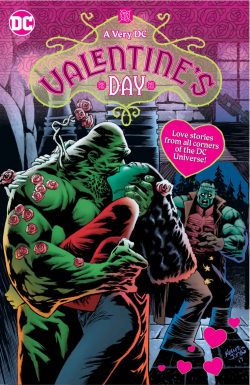
A Very DC Valentine’s Day


By Cecil Castellucci, Amanda Conner, Andy Diggle, Paul Dini, Ray Fawkes, Phil Hester, Kyle Higgins, Collin Kelly, Alisa Quitney, Jackson Lanzing, Peter Milligan, Ann Nocenti, Steve Orlando, Jimmy Palmiotti, James Robinson, Mark Russell, Mairghread Scott, Tim Seeley, Simon Bisley, Ben Caldwell, Aaron Campbell, Giuseppe Camuncoli, Mirko Colak, Andrew Currie, Javier Fernandez, Julio Ferreira, Julius Gopez, Sanford Greene, Stephanie Hans, Bryan Hitch, Frazer Irving, Kelley Jones, Nic Klein, Emanuela Lupacchino, Guillem March, John McCrea, Jaime Mendoza, Inaki Miranda, Robson Rocha, Thony Silas, Cam Smith, John Timms & various (DC Comics)
ISBN: 978-1401287665 (TPB/Digital edition)

After generations of incorporating seasonal occasions, milestones and themes into their regular chronology, in recent years comics publishers have started releasing special issues and compilations to single out those sale-enhancing moments. For DC, that process really began during their New 52 reboot…

Regrettably eschewing their own vast back catalogue of magnificently-limned genre romance material (still… maybe one day, hey?) the home of Batman, Superman and Wonder Woman released all-new anthologies exploring the many roads to and ways of loving.

In 2018, three one-shots – Young Monsters in Love #1, Young Romance: The New 52 Valentine’s Day Special #1 and Harley Quinn Valentine’s Day Special #1 – were tangled together as a celebratory tome which might entice less traditional fans…

We begin with Young Monsters in Love #1, which hit stores on February 7th 2018 carrying an April cover-date. It opens with a tale of Man-Bat wherein Kyle Higgins, Kelley Jones & colourist Michelle Madsen expose the bestial inner monologue of Kirk Langstrom’s ‘“Nocturnal Animal”’ as the self-mutated science renegade seeks to rekindle his romantic relationship with ex-wife Francine…

Tim Seeley, Giuseppe Camuncoli & Cam Smith also explore that theme of stability lost as Frankenstein, Agent of S.H.A.D.E. reviews his centuries-long relationship with “The Bride” in ‘Pieces of Me’ whilst Clark Kent and his son Jon learn a few hard truths about love and loss in ‘Buried on Sunday’. It’s a potentially shattering lesson for the Man of Steel and Superboy who seek to ensure that Solomon Grundy does not wallow in the eternal despair of bereavement as sensitively detailed by Mairghread Scott, Bryan Hitch & Andrew Currie…

Disgruntled Teen Titan/peripatetic ghost buster Raven discovers ‘The Dead Can Dance’ on a long-deferred Prom Night(mare) by Collin Kelly, Jackson Lanzing & Javier Fernandez, after which Paul Dini & Guillem March expose the cruel traumas of elementary school bullying when Deadman saves a lonely boy crushed and nearly killed by the annual purgatory of card-giving in ‘Be My Valentine’…

Swamp Thing loves and loses another frail and fragile human contact in the beautifully eerie ‘Heart-Shaped Box’ by Mark Russell & Frazer Irving, before Steve Orlando & Nic Klein push the parameters of amour and self-sacrifice when queer cop Maggie Sawyer seeks to stop a potential bloodbath as Monsieur Mallah & The Brain (of the Brotherhood of Evil) seek a way to further their impossibly complex relationship by looking backwards in ‘Visibility’…

Andrew Bennet (I, Vampire, by Alisa Quitney & Stephanie Hans) then experiences painful revelation when forced to accept a new role for his ever-maturing disciple in ‘The Turning of Deborah Dancer’, whereas Etrigan – The Demon – brutally challenges the entire infernal host to reach Jason Blood’s lost love in ‘To Hell and Gone’ by Phil Hester &Mirko Colak.

Amidst the madness of WWII, the warped wooing closes with a distressing brush-off letter to the Creature Commandos’ man-made vampire in ‘Dear Velcoro’, by James Robinson & John McCrea.

Heralding a shift from dark dilemmas to costumed courting – courtesy of the contents of Young Romance: The New 52 Valentine’s Day Special #1 (originally cover-dated April 2013) – our soap-opera sagas start with Catwoman reminiscing over her first meeting and troubled history with Batman in Ann Nocenti, Emanuela Lupacchino & Jaime Mendoza’s ‘Think it Through’…

Aquaman & Mera uncover unrequited love and reunite unquiet separated spirits in ‘The Lighthouse’ (by Cecil Castellucci & Inaki Miranda) before Batgirl Babs Gordon lets her guard down with a certified bad boy in Ray Fawkes & Julius Gopez’s ‘Dreamer’.

Superhero teammates Apollo & Midnighter revisit their first “ mad moment” mid-mission in ‘Seoul Brothers’ by Peter Milligan & Simon Bisley, whilst paragon legacy hero Nightwing makes all his old mistakes again with new foe/ally/love interest Ursa in ‘Another Saturday Night’ by Kyle Higgins & Sanford Greene…

One of the biggest and most touted draws of the New 52 was the sidelining of Lois Lane and shocking romantic entanglement of Superman and Wonder Woman. Here, Andy Diggle, Robson Rocha & Julio Ferreira depict the ultimate power couple in the early, exploratory stages of that relationship and learning via a shocking game of ‘Truth or Dare’ …until spiteful sirens and a possessed god of love violently object…

The final third of this torrid tome sees lunatic love bandit Harleen Quinzel hog the limelight and steal the show with an extended epic from the Harley Quinn Valentine’s Day Special #1: released on February 11th 2015 and once again cover-dated for the month of All Fools…

Written by Amanda Conner & Jimmy Palmiotti, and collaboratively illustrated by John Timms, Ben Caldwell, Aaron Campbell, Thony Silas and colourists Paul Mounts & Hi-Fi, ‘Just Batty Over You’ offers an hallucinogenic rollercoaster ride of passions and perplexing playfulness as The Joker’s former main squeeze espies and is enthralled by super-sexy Bruce Wayne who is a prize in a charity dating auction…

She determines to make him hers and the abduction part goes off pretty much as required. However, complicating the scheme is Harley’s own meandering grip on reality, Bruce’s many jobs and secrets, so very much over-applied and shared narcotic inducement, hench-folk who can only see the billionaire’s vast dollar-value and the perpetual interference of briny costumes activists The Carp and Sea Robin, who really want everybody to heed their message of marine environmental crisis…

Daft, delightful and delivered with perfect timing and elan, this lustful lark caps a supremely frothy and inconsequential diversion to charm casual and fully committed thrill seekers in equal amounts.
© 2013, 2015, 2018 DC Comics. All Rights Reserved.

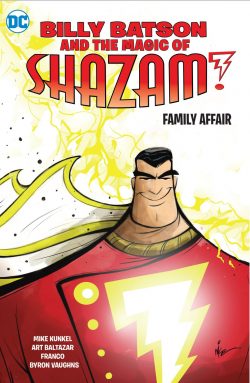
Billy Batson and the Magic of Shazam!: Family Affair


By Mike Kunkel, Art Baltazar, Franco, Byron Vaughns, Ken Branch & Stephen DeStefano & various (DC Comics)
ISBN: 978-1-49650-290-2 (HB/Digital edition)

After the runaway success of Jeff Smith’s magnificent reinvention of the original Captain Marvel (Shazam! The Monster Society of Evil ) it was simply a matter of time before that iteration won its own title in the monthly marketplace. What was a stroke of sheer genius was to place the new Billy Batson and the Magic of Shazam! under the bright and shiny aegis of the company’s young reader imprint – in what used to be the Cartoon Network spin-off section.

This collection re-presents the first dozen issues, spanning cover-dates September 2008 through March 2010 and opens on a most familiar world, slightly askew of the mainstream DC Universe. These frantically ebullient and utterly contagious tales of the orphan Batson and his obnoxious, hyperactive little sister Mary – both gifted by an ancient mage with the powers of the gods – could play out in wild and woolly semi-isolation hampered by nothing except page count…

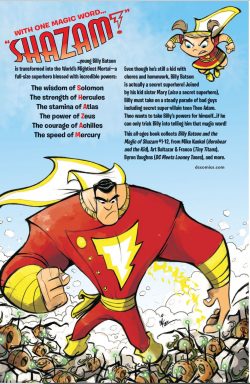
Billy Batson is a homeless kid with a murky past and a glorious destiny. One night he followed a mysterious figure into an abandoned subway station and met the wizard Shazam. The ancient guardian of good granted him the ability to turn into an adult superhero called Captain Marvel.

Gifted with the wisdom of Solomon, strength of Hercules, stamina of Atlas, power of Zeus, courage of Achilles and speed of Mercury, the lad was despatched into the world to do good: a noble if perhaps immature boy in a super man’s body.

Accompanied by talking tiger-spirit Mr. Tawky Tawny, Billy tracked down his missing little sister, but whilst battling evil genius Dr. Sivana (US Attorney General and would-be ruler of the universe) he impetuously caused a ripple in the world’s magical fabric through which monsters and ancient perils now occasionally slip through. Currently, the reunited orphans are trying to live relatively normal lives, but finding the going a little tough…

Firstly, without adults around, Billy often has to masquerade as his own dad and when he’s not at school he’s the breadwinner, earning a living as a boy-reporter at radio/TV station WHIZ. Moreover, little Mary also has access to (most of) the Power of Shazam, and she’s a lot smarter than he is in using it… as well as a real pain in Billy’s neck.

Animator and storyteller Mike Kunkel, inspired creator of the simply lovely Herobear and the Kid, leads off this collection: writing, drawing and colouring a breakneck, riotous romp over the first four issues reintroducing the new Marvel Family to any new readers and, by virtue of that pesky rift in the cosmic curtain, recreating the Captain’s greatest foe: Black Adam. In case you’re wondering, Steve Wands did the lettering…

The villain was once the mightiest man alive but was banished for abusing Shazam’s gift. However, after the damage to reality Billy caused, he’s back but nowhere near the Man he was…

This time the evil predecessor of the World’s Mightiest Mortal is a powerless but truly vile brat: a schoolboy bully who returns to Earth after millennia in limbo, ready to cause great mischief – but he cannot remember the magic word that activates his evil adult self…

This hilarious tale has just the right amount of dark underpinning, as the atrocious little thug stalks Billy and Mary, trying to wheedle and eventually torture the secret syllables from them. When – inevitably – Black Adam regains his mystic might and subsequently liberates the petrified Seven Deadly Evils of Mankind from their imprisonment on the wizard’s Rock of Eternity, the stage is set for a classic confrontation.

Along the way to that climactic clash there’s oodles of sheer hilarity as Billy’s troubles are magnified by increasing demands on his time by overzealous teachers and Principal Strikta wanting to conference with his “dad”, whilst his journalistic partner and mentor Ms. Fidelity seems romantically attracted to his older body – which is still piloted by Billy’s pre-teen mind…

It’s no comfort at all that Mary is still thinking up better and cleverer ways to use the powers they share and that she might be the Wizard’s favourite, but the real problem is Theo Adam…

The returned terror might be stuck in his child form, but when he joins Billy in class, it soon becomes clear that the bully is sticking painfully close just in case one of the emergencies he’s orchestrated allows him to overhear Billy shouting out that word…

Inevitably all Billy’s worries come true and Black Adam regains his powers, leading the resurrected Seven Deadly Evils against humanity. Happily, although outpowered, out-fought and at his lowest moment, Billy comes up with a plan…

Pitched perfectly at the young reader, with equal parts danger, comedy, sibling rivalry and the regular outwitting of adults, this first storyline screams along with a brilliantly clever feel-good finish, perfectly setting up the next all-action comedic challenge…

From issue #5 (September 2009) writing team Art Baltazar & Franco (Franco Aureliani) – collectively responsible for the incomparably compulsive madness of Tiny Titans and Superman Family – took over the legend-spinning, and artists Byron Vaughns & Ken Branch limn the first bombastic tale as convict Doctor Sivana unleashes a stolen atomic automaton against the two kids he hates most in the world in ‘Mr Who? Mr. Atom!’.

The destructive giant robot rampage was simply a ploy to cover his escape from prison. Although the mighty marvels overcome the onslaught thanks to input from its creator, Billy has a bigger problem to solve. He has a tremendous crush on Ms. Fidelity but she barely notices him whenever his heroic alter ego is around and even when he’s not…

‘To Be King’ then pits the champions of Fawcett City against primordial super-caveman King Kull: a physical and mental giant trying to reconquer the planet he ruled in millennia past. Older fans of gentle fantasy will be enthralled and delighted here by the singular art of Stephen DeStefano, who won hearts and minds with his illustration of Bob Rozakis’ seminal series Hero Hotline and ’Mazing Man – both painfully, criminally overdue for graphic novel collections of their own…

The King’s defeat is singular and shocking, but the young warriors are unaware that Sivana has again benefitted from their actions and is now weaponizing Kull’s remains…

Encroaching disaster is everywhere. At the Rock of Eternity, Shazam is helpless to prevent the Seven Evils from slowly awakening again and senses another hidden enemy in play. Calling on long-sidelined shapeshifting tiger totem Mr. Tawky Tawny, he inadvertently tips off evil genius Sivana and leads him to the Batson’s home. The wicked misfit even captures the tiger-man and uses him to power a newer, deadlier Mr. Atom in the Byron Vaughns illustrated ‘Deception Reception’…

With (the original) Captain Marvel on the ropes, ‘Come Together!’ sees Sivana press his attack, deploying enslaved Kull to back up his killer bot, before being again outsmarted by Mary Marvel whose grasp of physics saves the day and the tiger…

Another classic villain is revived as Shazam’s observations of Earth hone in on a deadly arsonist just as Billy begins acting strangely …like a jerk or perhaps pubescent schoolboy…

As Mary talks things over with recuperating houseguest Tawky-Tawny, they realise they haven’t seen Billy for some time, only his increasingly obnoxious adult alter ego. The crisis comes to head in ‘Fire Fire Everywhere!’ as the hero appallingly overreacts to the firebug, employing excessive force and accidentally creating an Arson Fiend…

‘The Legacy of Mr. Banjo!’ also channels a Golden Age bad guy as Billy and Mary stumble into a bank robbery perpetrated by Axe, the teenage son of the Axis agent and using his mystic music to mesmerise mortals into parting with their money. Although Billy is wilful enough to shrug off the spell it takes a pep talk from Ms. Fidelity to give him the edge needed to free Mary and stop Axe…

One good thing about the clash is that Billy is clearheaded now and realises he must not say his magic word ever again…

With Mary and Tawky-Tawny in tow, Billy heads for Shazam’s citadel and  proper diagnosis. The result is the freeing of an evil duplicate in ‘Mirror Mirror’, but the stupendous battle between hero and reflection is just a prelude to the final clash as the fight exposes the long-hidden secret villain in ‘Mr. Mind Over Matter!’ and Billy and his sister must stop both the wicked worm and its Monster Society of Evil with brains not brawn…

Billy Batson and the Magic of Shazam!: Family Affair is ideal for bringing kids into comics: funny, thrilling, stylishly illustrated and perfectly in tune with what young minds want to see. Moreover, with another major motion picture adaptation set to premiere in March, it’s a timely moment to get reacquainted with the Big Red Cheese …and the Little Babybel…

Incorporating a full cover gallery and a Kunkel variant, plus a key code for those pages written in the ‘Monster Society of Evil Code’ this is an addictive treat for all readers who can still revel in the power of pure wonderment and still glory in an unbridled capacity for joy.
© 2008, 2009, 2020 DC Comics. All Rights Reserved.

Tales of the Batman: Carmine Infantino


By Carmine Infantino, Gardner Fox, John Broome, Cary Bates, Gerry Conway, Don Kraar, Mike Barr, Geoff Johns & various (DC Comics)
ISBN: 978-1-4012-4755-3 (HB/Digital edition)

Born on May 24th 1925, Carmine Michael Infantino was one of the greatest comic artists America ever produced: a multi-award-winning innovator who was there when comic books were born, reshaped the industry in the Silver Age and was still making fans when he died in 2013.

As an illustrator he co-created and initially visualised Black Canary, Detective Chimp, Pow-Wow Smith, the Silver Age Flash, Elongated Man, Deadman, Batgirl, Dial H for Hero and Human Target and revitalised characters such as Adam Strange and Batman. He worked for numerous companies, and at Marvel ushered in a new age by illustrating the licensed Star Wars comic book whilst working on titles and characters such as The Avengers, Daredevil, Ms. Marvel, Nova, Star-Lord and Spider-Woman…

His work on two separate iterations of the Batman newspaper strip is fondly remembered and whilst acting as Art Director and Publisher of National DC, he oversaw the most critically acclaimed period in the company’s history, ushering in the “relevancy” era and poaching Jack Kirby from Marvel to create the Fourth World, Kamandi, The Demon and others…

Very much – and repeatedly – the right man at the right time and place, Infantino shaped American comic book history like few others, and this bumper compendium comprehensively covers his contributions to the lore of Batman: collecting the stunning covers from Detective Comics #327-347, 349, 351-371, 500 and Batman #166-175, 181, 183-185, 188-192, 194-199 plus the Bat-Saga stories he drew for Detective #327, 329, 331, 333, 335, 337, 339, 341, 343, 345, 347, 349, 351, 353, 357, 359, 361, 363, 366-367, 369, and 500.

Also included are the contents of The Brave and the Bold #172, 183, 190, 194 and DC Comics Presents: Batman #1: an artistic association cumulatively spanning May 1964 to September 2004.

I’m assuming everybody here loves comics and that we’ve all had the same unpleasant experience of trying to justify that passion to somebody. Excluding your partner (who is actually right – the living room floor is not the place to leave your $£#!D*&$£! funnybooks) even today, many people have an entrenched and erroneous view of strip art, resulting in a frustrating and futile time as you tried to dissuade them from that opinion.

If so, this collection might be the book you want next time that confrontation occurs. It offers breathtaking examples of the prolific association of one the industry’s greatest illustrators with possibly the artform’s greatest creation.

Many of these “Light Knight” sagas stem from a period which saw the Dynamic Duo deftly reshaped for global Stardom – and subsequent fearful castigation from fans – as the template for the Batman TV show of the 1960s. It should be noted, however, that the producers and researchers took their creative impetus from stories of the era preceding the “New Look Batman” – as well as the original l940s movie serial…

So, what happened?

By the end of 1963, editor Julius Schwartz had spectacularly revived much of National/DC’s line – and the entire industry – with his modernisation of the superhero, and was then asked to work his magic with the creatively stalled and nigh-moribund Caped Crusaders.

Bringing his usual team of top-notch creators with him, Schwartz stripped down and back to the core-concept, downplaying aliens, outlandish villains and daft transformation tales to bring a cool modern take on combatting criminals. He even oversaw a streamlining and rationalisation of the art style itself.

The most apparent innovation was a yellow circle around the Bat-symbol, but far more importantly, the stories also changed. A subtle aura of genuine menace re-entered the comfortable and absurdly abstract world of Gotham City.

Infantino was key to the changeover that reshaped a legend – but this was while still pencilling Silver Age superstar The Flash – so, despite generating the majority of covers, Infantino’s interior art was limited to alternate issues of Detective Comics with the lion’s share of narrative handled by Bob Kane’s then-uncredited deputies Sheldon Moldoff, Joe Giella, Chic Stone & others, plus occasional guest artists such as Gil Kane…

Punctuated throughout by his chronologically sequenced covers, Infantino’s part in the storytelling revolution began then and kicks off here with Detective #327 – written by John Broome and inked by Joe Giella at the very peak of their own creative powers.

‘The Mystery of the Menacing Mask!’ is a cunning “Howdunnit?”, long on action and moody peril, as discovery of a criminal “underground railroad” leads Gotham Gangbusters Batman and Robin to a common thug seemingly able to control them with his thoughts…

‘Castle with Wall-To-Wall Danger!’ (Detective #329 with Broome and Giella in their respective roles) follows: a captivating international thriller with the heroes braving a deadly death-trap in Swinging England in pursuit of a dastardly thief.

A rare full-length story in #331 co-starred Elongated Man Ralph Dibny. He was Detective Comics’ new back-up feature: a costumed sleuth blending the charm of Nick (The Thin Man) Charles with the outré heroic antics of Plastic Man.

The ‘Museum of Mixed-Up Men’ (Broome & Infantino) united the eclectic enigma-solvers against a super-scientific felon, whilst in #333 Batman & Robin fought a faux goddess and genuine telepaths in the ‘Hunters of the Elephants’ Graveyard!’, written by Gardner Fox and inked by Giella.

The same team revealed the ‘Trail of the Talking Mask!’ in #335, giving the Dynamic Duo an opportunity to reinforce their sci-fi credentials in a classy high-tech thriller guest-starring private detective Hugh Rankin (of “Mystery Analysts of Gotham City” fame) before ‘The Deep-Freeze Menace!’ (Detective #337 delivered a fearsome fantasy chiller pitting Batman against a super-powered caveman encased in ice for 50,000 years…

DC’s inexplicable (but deeply cool) long-running love-affair with gorillas resulted in a cracking doom-fable as ‘Batman Battles the Living Beast-Bomb!’ (#339) highlighted the hero’s physical prowess in a duel of wits and muscles against a sinister, super-intelligent simian.

Up until this time the New Look Batman was forging his more realistic path, as the TV series was still in pre-production. The Batman TV show (premiering on January 12th 1966 and running for three seasons of 120 episodes in total) aired twice weekly for its first two seasons, resulting in vast amount of Bat-awareness, no end of spin-offs and merchandise – including a movie – and the overkill phenomenon of “Batmania”.

No matter how much we might squeal and foam about it, a huge portion of this planet’s population Batman will always regard that “Zap! Biff! Pow!”  buffoonish costumed boy scout as The Real Deal…

Regrettably this means that the comic stories published during that period have been similarly excoriated and maligned by most Bat-fans ever since. It is true that some tales were crafted with overtones of the “camp” comedy fad – presumably to accommodate newer readers seduced by the arch silliness and coy irony of the show – but no editor of Schwartz’s calibre would ever deviate far from the characterisation that had sustained Batman for nearly 30 years, or the then-recent re-launch which had revitalised the character sufficiently for television to take an interest at all.

Nor would such brilliant writers as John Broome, Bill Finger, Gardner Fox and Robert Kanigher ever produce work which didn’t resonate on all the Batman’s intricate levels just for a quick laugh or cheap thrill. The artists tasked with sustaining the visual intensity included Infantino, Moldoff, Stone, Giella, Murphy Anderson and Sid Greene, with covers from Gil Kane and Joe Kubert supplementing Infantino’s stunning, trend-setting, fine-line masterpieces.

Most of the tales here reflect those gentler times and editorial policy of focusing on Batman’s reputation as “The World’s Greatest Detective”, so colourful, psychotic costumed super-villains are in a minority, but there are first appearances for a number of exotic foes who would become regular menaces for the Dynamic Duo in years to come.

Broome & Infantino detailed the screen-inspired, comedically-catastrophic campaign of ‘The Joker’s Comedy Capers!’ in #341, with the mayhem and mystery continuing in Detective Comics #343 (September 1965) with ‘The Secret War of the Phantom General!’: a tense thriller pitting our hard-pressed heroes against a hidden army of gangsters and Nazi war criminals.

Detective #345 brought forth a terrifying and tragic new villain in ‘The Blockbuster Invasion of Gotham City!’ (scripted by Fox), as a monstrous giant with the mind of a child and the raw, physical power of a tank is driven to destructive madness at sight of Batman and only placated by the sight of Bruce Wayne…

‘The Strange Death of Batman!’ (Fox, in Detective #347) fired the opening shot of habitual B-list villain the Bouncer in a bizarre experimental yarn which has to be seen to be believed, whereas it’s business as usual when monstrous, microcephalic man-brute returns in ‘The Blockbuster Breaks Loose!’: a blistering, action-fuelled thriller from Fox, Infantino & Giella first seen in Detective #349. This tale sports a cover by Infantino’s colleague Joe Kubert whilst also hinting at the return of a long-forgotten foe…

Detective #351 premiered game-show host turned felonious impresario Arthur Brown in a twisty, puzzle-packed battle of wits detailing ‘The Cluemaster’s Topsy-Turvy Crimes!’ (Fox, Infantino & Sid Greene) after which the action accelerates as ‘The Weather Wizard’s Triple-Treasure Thefts!’ (Fox/Giella in #353) bring a torrent of trouble to Gotham and the Dynamic Duo battle in spectacular opposition to the Flash’s meteorological arch-enemy. This was one of the earliest times a Silver Age DC villain moved out of his usual haunts…

Detective #357 then delivers a clever secret identity saving puzzler when – apparently – ‘Bruce Wayne Unmasks Batman!’ (Broome, Infantino & Giella) as a prelude to big changes in the Batman mythos…

After three seasons (perhaps two and a half would be more accurate) the Batman show ended in March, 1968. It had clocked up 120 episodes since the US premiere. The era ended but the series had instilled an undeniable effect on the world, the comics industry and – crucially – on the characters and history of its four-colour inspiration. Most notable was a whole new caped crusader who would become an integral part of the DC universe.

The comic book premiere of that aforementioned character came in ‘The Million Dollar Debut of Batgirl’ (Detective Comics#359, cover-dated January 1967). Fox provided art team supreme Infantino & Greene a ripping yarn to introduce Barbara Gordon (mousy librarian and daughter of the Police Commissioner) into the superhero limelight. Thus, by the time the third season began on September 14th, 1967, she was well-established among comics fans at least…

A different Batgirl – Betty Kane (teenaged niece of the 1950s Batwoman) – was already a nearly-forgotten comics fixture, but for reasons far too complex and irrelevant to mention, she was conveniently ignored to make room for a new, empowered woman in the fresh and fashionable tradition of Emma Peel, Honey West and the Girl From U.N.C.L.E.

“Babs” was considered pretty hot too, which is always a plus for television…

Whereas she fought The Penguin on the small screen, her print origin features the no less ludicrous but at least visually forbidding Killer Moth in a clever yarn that still stands up today.

Editor Schwartz always preferred to play-up mysteries and crime conundrums in Detective Comics and #361’s ‘The Dynamic Duo’s Double-Deathtrap!’ was one of Fox’s best, especially as drawn by the now increasingly over-stretched Infantino & Greene. The plot involves Cold War spies and a maker of theatrical and stage paraphernalia; I shall reveal no more to keep you guessing when you read it…

Detective #363 was a full co-starring vehicle as the Dynamic Duo challenged the new Batgirl to deduce Batman’s secret identity whilst tracking down enigmatic Mr. Brains in ‘The True-False Face of Batman!’, leading to a taut suspense thriller stretching across Detective #366 & 367 – an almost unheard-of event in those cautiously reader-friendly days…

As devised by Fox, Infantino & Greene, ‘The Round Robin Death Threats’ involves a diabolical murder-plot threatening to destroy Gotham’s worthiest citizens, with the tension peaking and drama concluding in high style with ‘Where There’s a Will… There’s a Slay!’: a dark and deadly denouement barely marred by that dreadful title…

It was just a symptom of the times – as is Detective #369 (November 1967) – which somewhat reinforces boyhood prejudices about icky girls in otherwise classy thriller ‘Batgirl Breaks Up the Dynamic Duo!’…

Here, Robin seemingly abandons Batman for a vivaciously curvaceous new partner, and the best of clandestine reasons, ignominiously signalling – other than for the occasional cover – the end of Infantino’s tenure as a bat-illustrator.

His next Bat-contribution came in anniversary landmark Detective Comics #500 (March 1981): part of a huge creative jam-session specifically examining the legend of the immortal hero in ‘What Happens When a Batman Dies?’

Scripted by Cary Bates and inked by Bob Smith, this extracted chapter from a greater saga co-stars restless revenant Deadman as the Gotham Guardian hovers in a coma between this world and the next, yet still manages to find a way to save himself…

The cover is another collaborative effort with Dick Giordano, José Luis García-López, Joe Kubert & Tom Yeates all joining forces.

What follows is a quartet of tales from The Brave and the Bold, with Jim Aparo providing covers whilst Infantino handled interior art. Issue #172 (March 1981, inked by Steve Mitchell) paired the Caped Crimebuster with Firestorm in Gerry Conway scripted ‘Darkness and Dark Fire’, with the World’s Greatest Detective seeking to solve the mystery of the Nuclear Man’s periodic mental blackouts, after which #183 (February 1982, written by Don Krarr and inked by Mike DeCarlo) sees the crimebuster allied with The Riddler to prevent ‘The Death of Batman!’

Scripter Mike Barr & inker Sal Trapani worked with Infantino on B&B #190 (September 1982) and #194, January 1993), respectively challenging the Dark Knight to visit planet Rann and find ‘Who Killed Adam Strange?’ before subsequently working with the Flash against Doctor Double-X and the Rainbow Raider when they ‘Trade Heroes – And Win!’…

One final Infantino fling comes from DC Comics Presents: Batman #1 (September 2004), courtesy of writer Geoff Johns, with inks by Giella and a retro cover from Ryan Hughes, as ‘Batman of Two Worlds’ gets real metaphysical with narrative boundaries as the modern Batman and Robin investigate murder on the set of the 1960s Batman TV show in a bizarrely engaging romp with a mystery villain to expose…

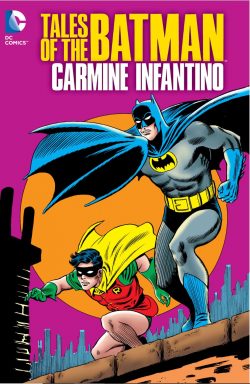
The visual cavalcade then ends on a nostalgic high with ‘Batman and Robin Retail poster’ – AKA the front cover of this titanic tome – possibly the most iconic bat-image of the entire era.

Whether you tend towards the anodyne light-heartedness of Then, the socially acceptable psychopathy of assorted movie franchises or actually just like the comic book character, if you can make a potential convert sit down, shut up and actually read these wonderful adventures for all (reasonable) ages, you might find that the old adage “Quality will out” still holds true. And if you’re actually a fan who hasn’t read this classic stuff and revelled in the astounding timeless art, you have an absolute treat in store…
© 1964, 1965, 1966, 1967, 1981, 1982, 1983, 2004, 2014 DC Comics. All Rights Reserved.

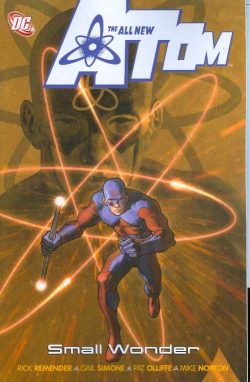
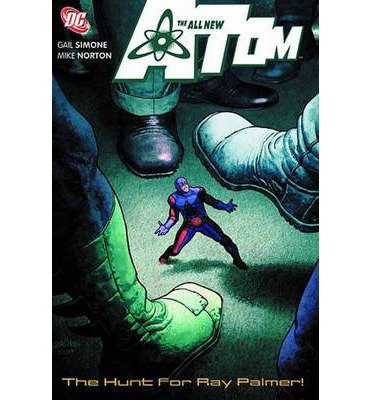
The All-New Atom volumes 3 & 4: The Hunt for Ray Palmer & Small Wonder


By Gail Simone, Rick Remender, Mike Norton, Pat Oliffe, Dan Green & Trevor Scott & various (DC Comics)
ISBN: 978-1-4012-1782-2 (TPB Hunt) 978-1-4012-1996-3 (TPB Wonder)

After the events of Identity Crisis and 52, superhero physicist Professor Ray Palmer disappeared, leaving his world behind him. But life goes on, and his teaching chair at Ivy University was offered to a young prodigy from Hong Kong. The neophyte just happened to be Palmer’s pen-friend and confidante: privy to his predecessor’s secrets ever since he was a child.

Dr. Ryan Choi unwillingly inherited his predecessor’s super-hero career as well – under some rather suspicious circumstances – battling super-villains, monsters and seemingly random chronal catastrophes that are making Ivy Town a viper’s nest of bizarre occurrences.

With this third volume (collecting issues #12-16 of All-New Atom) the so-likable legacy hero joins an eccentric team of heroes to track down his missing mentor in a story-arc that coincided with events of unfolding mega-crossover Countdown to Final Crisis…

Written by the brilliant Gail Simone and illustrated by Mike Norton, Dan Green & Trevor Scott, the The Hunt for Ray Palmer starts with ‘Never Too Small to Hit the Big Time’ as size-shifting homicidal maniac Dwarfstar returns, swiftly followed by a procession of Palmer’s oddly unique Rogues’ Gallery.

Temporal anomalies are devastating the city and Choi’s only chance to sort it all is the creepily coincidental alliance offered by infamous “time-thief” Chronos…

‘Second Genesis’ finds Choi and the wily villain lost in the South American jungles, encountering the tiny alien barbarians Palmer once lived with (see Sword of the Atom link please) before the new Tiny Titan links up with Donna Troy, Jason Todd and the Monitor – all major protagonists in the aforementioned Countdown to Final Crisis.

Choi joins forces in their search of the entire multiverse, with a first stop in ‘Heavens to Bitsy’ taking them from the super-scientific civilisation located on the bottom of Choi’s pet dog (not his underside, but the bit by the tail…) and from there to the post-existence paradise where all dead superheroes go. The manic manoeuvring features classy and clever cameos from a host of departed DC stars…

However, nothing is as it seems and by the time the new “challengers of the unknown” reach neutral ground and a rendezvous with Green Lantern Kyle Rayner, it’s clear that something or someone is sabotaging them. ‘Loss Leader’ sees Choi abruptly yanked from the quest and returned to Earth to save Ivy Town from the effects of the swifty escalating and accelerating time-storm one: of the funniest and grossest hero exploits ever recorded – or as Choi puts it, ‘Ewwww’…

The book concludes on a hilariously action-packed high note with ‘Forward! Into the Past!’ as further hints on the identity of the mastermind behind the All-New Atom’s troubles are revealed when Ivy Town takes a reality-warping, mind-bending trip back into the Summer of Love.

Ghosts, aliens, monsters, naff villains and Hippies abound, and there’s a guest-shot for those clearly inadequate guardians of the Time Stream, the Linear Men…

This fun-filled frantic frolic is a joyous return to clever, light-hearted adventure of the Good Old days (whenever they were) and these collected tales are everything a jaded superhero fan needs to clear the palate and revive flagging interests.


The All-New Atom volume 4: Small Wonder sees the adventures of the legacy Tiny Titan come to an abrupt halt with this final collection of mind-bending, time-busting yarns, collecting issues #17, 18 and 20-25 but sadly and inexplicably omitting #19 – a rather tasty subterranean thriller fill-in from Keith Champagne & Jerry Ordway.

Whether the switch from gleefully, wistfully whimsical scripter Gail Simone to darker, more hard-edged Rick Remender indicated the series was failing or perhaps actually caused its eventual demise is a matter of speculation – but it was probably neither and just another example of rapidly changing popular taste shredding sales below a viable cut off point…

Following the events of publishing events Identity Crisis and 52, size-changing part-time superhero Professor Ray Palmer vanished, leaving his world behind him. But life went on regardless, and his position at Ivy University was offered to a young prodigy from Hong Kong: Palmer’s confidante and someone privy to his predecessor’s secrets since childhood. Ryan Choi inherited his Palmer’s super-hero identity too – under rather suspicious circumstances.

The kid battled super-villains, monsters and seemingly random chronal catastrophes that were making Ivy Town a viper’s nest of bizarre occurrences and nexus of improbability.

Gail Simone started proceedings with 2-parter ‘The Atom and the Amazon’ – illustrated by Mike Norton, Andy Smith, Trevor Scott & Keith Champagne: a bravura blend of action, adventure and surreal comedy wherein expanding villainess Giganta sexually harasses the junior professor into a date whilst the mysterious forces and agencies infesting Ivy Town jockey for position before an impending emergent crisis…

Things come to a head when Federal Department of Metahuman Affairs agent Diana Prince steps in and asks Choi to wear a wire on his assignation…

When a creep with a detachable brain provokes a confrontation, Wonder Woman steps in and events spiral out of control until Ryan uses a brilliant seldom-seen ploy to calm things down. Sadly, the pacification is only temporary, as the brain-thing incites the entire city to attack the heroes, before The Atom saves the day …and is rewarded by the most outrageous offer he has ever heard…

Simone ended her run with ‘A Few Small Affairs’ wherein the sinister mastermind behind so many of Choi’s problems traps the diminishing hero in a perfect prison: a paradisiacal hallucination…

Meanwhile in consensus reality, demons, monsters and aliens rampage through Ivy Town…

To see how he stops that mess you’ll need to get this book, but that’s not the end of the affair. That comes in epic encounter ‘Inside Out’ by Rick Remender, Pat Olliffe & John Stanisci, pitting the out-of-his-depth Tiny Titan against truly horrendous odds and seemingly insurmountable hazards.

In ‘The Positive Aspects of Negative Thinking’, Choi learns that his explorations of the micro-cosmos have infected him with a virus and unleashed a monstrous carnivore on the city that only he can deal with. ‘How to Disappear Completely’ then leaves him shocked and reeling when the beast devours his best friend Panda.

Consumed with a need to make amends, Choi is utterly unaware that arch-enemies Chronos and Dwarfstar are preparing to attack, and is horrified and derailed to discover that the micro-monster has since disintegrated dozens of citizens. Meanwhile, his bodily infection is causing him to uncontrollably shrink in violently painful spasms…

Donning a high-tech containment suit, Choi struggles on in ‘Strange New World’: becoming lost in the Microverse before joyfully discovering that the townsfolk “consumed” by the monster were in fact simply reduced to sub-atomic proportions and entrapped in an extremely hostile new universe.

That elation is tempered however when he realises that time passes much faster there, and if the horrors inhabiting the place don’t eat them first, they will all die of old age before he can save them…

Guest-starring time-displaced hero Booster Gold, ‘Forecast Fascist Future’ focuses on Chronos and his partner in time-crime, a mysterious lady from Choi’s past, before the myriad plot-threads of the series converge and Ray Palmer returns to save the day: revealing some shocking truths to – and about – his successor in ‘Time’, a gripping conclusion to a bold epic and conclusive proof that the Tiny Titans should have been awarded more time to continue their adventures…

Alas they didn’t and the series passed away, but at least lovers of fun, fantastic fantasy Fights ‘n’ Tights fiction have these volumes to enjoy, if they can find them. Let’s all hope that DC get around to rereleasing all of them digitally ASAP…
© 2007, 2008 DC Comics. All Rights Reserved.
Showcase Presents Superman Family volume 2


By Otto Binder, Jerry Coleman, Alvin Schwartz, Leo Dorfman, Robert Bernstein, Bill Finger, Curt Swan, Wayne Boring, Kurt Schaffenberger, Dick Sprang, Al Plastino & various (DC Comics)
ISBN: 978-1-84576-812-4 (TPB)

In America during the 1950s and early 1960s being different was a bad thing. Conformity was sacrosanct, even in comic books, and everybody and thing was meant to keep to its assigned and intended role.

For the Superman family and extended cast that meant a highly strictured code of conduct and parameters: Daily Planet Editor Perry White was a stern, shouty elder statesman with a heart of gold, Cub Reporter Jimmy Olsen was a brave and impulsive, unseasoned fool with a heart of gold – and plucky News-hen Lois Lane was nosy, impetuous and unscrupulous in her obsession to marry Superman, although she too was – deep down – another possessor of an Auric aorta. They were – of course – uniformly white and the Anglo-est of Saxons…

Yet somehow even with these mandates in place, talented writers and artists assigned to detail their wholesomely uncanny exploits managed to craft tales both beguiling and breathtakingly memorable – and usually as funny as they were exciting as seen in this second cunningly combined chronologically complete compendium. Here, collected in marvellous monochrome, are the affably all-ages tales from Superman’s Pal Jimmy Olsen #23-34 (September 1957-January 1959), Lois’s second try-out issue originally seen in Showcase #10 (September/October 1957) and #1-7 of her subsequent solo series Superman’s Girl Friend Lois Lane (March/April 1958-February 1959).

We commence with the Man of Steel’s Go-To Guy in three tales comprising issue #23 of his solo title: illustrated as almost always by the wonderful Curt Swan & Ray Burnley. ‘Jimmy Olsen’s Two Super-Pals’ was the first of three scripts by irrepressible Otto Binder, describing how our lad gains an other-dimensional Genie as another faithful Super-Friend. Of course with sinister radium bandits plaguing Metropolis there’s more to the cosmic companion than meets the eye…

Next comes ‘Jimmy Olsen, the Bearded Boy’ wherein boastful hubris and a magic potion inflict runaway whiskers on many Daily Planet staffers – even Clark Kent – prompting a flurry of face-saving secret feats from the identity conscious Man of Tomorrow.

As Jimmy’s series progressed, one of the most popular plot-themes (and most fondly remembered and referenced today by surviving Baby-Boomer fans) was the unlucky lad’s appalling talent for being warped, mutated and physically manipulated by fate, aliens, magic, mad science and even his friends …a fate which frequently befell Lois too, although Jimmy got far fewer marriage proposals (but not NONE!) from aliens, murderers of monsters…

The boy’s bits briefly conclude with ‘The Adventures of Private Olsen’, wherein the Cub Reporter is assigned to write articles on Army life and – with Superman’s assistance – teaches a nasty and unscrupulous drill sergeant a much-needed lesson…

When Lois Lane – arguably the oldest supporting character/star in the Superman mythology if not entire DC universe – finally received her own shot at a solo title, it was very much on the terms of the times. I must shamefacedly admit to a deep, nostalgic affection for her bright and breezy, fantastically fun adventures, but as a free-thinking, (nominally) adult liberal of the 21st century I’m often simultaneously shocked these days at the jollified, patronising, patriarchally misogynistic attitudes underpinning so many of the stories.

Yes, I’m fully aware that the series was intended for young readers at a time when “dizzy dames” like Lucille Ball or Doris Day played up to the popular American gestalt stereotype of Woman as jealous minx, silly goose, diffident wife and brood-hungry nester, but to ask kids to seriously accept that intelligent, courageous, ambitious, ethical and highly capable women would drop everything they’d worked hard for to lie, cheat, inveigle, manipulate and entrap a man just so that they could cook pot-roast and change super-diapers is plain crazy and tantamount to child abuse. They’re great, great comics but still… whooo… gah… splutter… I’m just saying…

Cover-dated September/October 1957 and illustrated by Wayne Boring & Stan Kaye, Showcase #10 was the second and final test appearance for what became  Superman’s Girl Friend Lois Lane, opening with scripter Binder’s ‘The Jilting of Superman’, wherein the Action Ace almost falls for a most ancient ploy as Lois pretends to marry another man to make the Kryptonian clod realise what she means to him…

Written by Jerry Coleman, ‘The Sightless Lois Lane’ tells how a nuclear accident temporarily blinds the journalist, and how her sudden, unexpected recovery almost exposes Clark Kent’s secret when he callously changes to Superman in front of his “sightless” friend, after which Binder delightfully details the contents of ‘The Forbidden Box from Krypton’. Exhumed by a Smallville archaeologist, this hoard houses devices originally packed by Superman’s birth father Jor-El and intended to aid the infant Superbaby on Earth. Of course, when Lois opens the chest all she sees is a way to become as powerful as the Man of Steel. Before long, she’s addicted to being a super-champion in her own right…

Scant months later, the mercurial journo had her own title, clearly offering exactly what the reading public wanted…

Jimmy Olsen #24 featured another trio of top tales from Binder, Swan & Burnley beginning with ‘The Superman Hall of Trophies’ which finds a Kryptonite-paralysed Metropolis Marvel trapped in a museum and rescued by the brave boy reporter. ‘The Gorilla Reporter!’ sees the poor kid briefly brain-swapped with a mighty (confused) Great Ape before – as so often before – Superman must audaciously divert attention from his exposure-threatened alter ego by convincing the world at large that Jimmy is ‘The Luckiest Boy in the World’…

Issue #25 – by Binder, Swan & Burnley – features ‘The Secret of the Superman Dummies’ wherein a trip to a magic show results in Jimmy being inescapably handcuffed to the last man in the world Superman dares to approach, after which ‘The Second Superboy’ reveals how poor Jimmy is accidentally rocketed to an alien world where he gains incredible abilities courtesy of resident absent-minded genius Professor Potter. ‘The Day There Was No Jimmy Olsen’ then offers a tantalising hoax and mystery which ends with an unexpected promotion for the pluckily ingenious boy…

Jimmy began #26 subject to inexplicable bouts of deadly mass fluctuations and improbably became ‘The World’s “Heavyweight” Champ’ before – as newly appointed ‘Jimmy Olsen, Foreign Correspondent’ – uncovering a sinister scheme to defraud the Ruritanian Kingdom of Hoxana. Back home again though, he has to again undergo a well-intentioned con from his best pal after seeing Clark flying and subsequently – inadvertently – himself becoming ‘The Birdboy of Metropolis’…

Superman’s Girlfriend Lois Lane #1 (March/April #1958) at last arrived, sporting three stunning yarns illustrated by sleek, slick comedically-inclined illustrator Kurt Schaffenberger, whose distinctive art-style would become synonymous with the woman reporter. Everything kicked off with ‘The Bombshell of the Boulevards’ (scripted by Leo Dorfman) wherein she dons a blonde wig to deceitfully secure a Hollywood interview and provokes a death-duel between rival enflamed suitors. Of course, it’s only another scheme by Superman and Jimmy to teach her a lesson in journalistic ethics. It’s a good thing reporters are so much less unscrupulous these days…

During this Silver Age period, with Superman a solid gold sensation of the newly ascendant television medium, many stories were draped in the wholesome trappings of Tinseltown – even more so than most of celebrity-obsessed America. It didn’t hurt that chief editor Whitney Ellsworth was a part-time screenwriter, script editor and producer, as well as National DC’s Hollywood point man.

Otto Binder then reunited with old Captain Marvel collaborator Schaffenberger for ‘Lois Lane, Super-Chef’ as she disastrously tries to master home cooking in another scheme to get the Man of Steel to propose, whilst in ‘The Witch of Metropolis’ a science assignment goes horrifically awry, transforming her into a wizened old hag every time the sun sets…

All courtesy of Binder, Swan & Burnley, SPJO #27 opens with ‘The Boy from Mars’ wherein the cub reporter gets his own lesson in integrity after trying to create a circulation-boosting hoax, and a refresher course on the perils of pride and over-confidence after messing up ‘A Date with Miss Metropolis’ before the issue ends in a riotous battle with his own evil duplicate after Professor Potter accidentally creates ‘The Outlaw Jimmy Olsen’…

Ever so slowly a more mature tone was developing in the kid’s adventures. In #28’s ‘The Spendthrift and the Miser’ an alien gift from Superman triggers wildly manic mood swings whilst an accidental time-trip incredibly reveals that Jimmy is destined to become ‘The Boy who Killed Superman’ after which in ‘The Human Skyscraper’, another botched Potter product enlarges the kid to monumental, city-endangering size.

Over in the second Lois Lane comic book she is apparently appalled to uncover ‘Superman’s Secret Sweetheart’ (uncredited here but possibly Bill Finger?), but is in fact on her very best mettle and helping a bullied college girl fight back against her mean sorority sisters.

The Binder recounts how Tinseltown improbably calls and the reporter becomes – eventually – an extremely high maintenance actress in ‘Lois Lane in Hollywood’…

‘Superman’s Forbidden Room’ closes proceedings with a cruel hoax played on her well-publicised infatuation, but this time it isn’t the Man of Steel doing the fooling and the stakes have never been higher than in this moody thriller illustrated by Boring & Kaye and probably written by Jerry Coleman.

In Jimmy Olsen #29 the usually adept reporter suffers a monumental writer’s block whilst working on a novel, but ‘The Superman Book that Couldn’t be Finished’ eventually is …with a little hands-on Kryptonian help. ‘Jimmy Olsen’s Super-Pet’ then sees the cub reporter adopted by super-hound Krypto in his twilight years: an act that is instrumental in rejuvenating the Dog of Steel for a new generation.

The issue ends with ‘The Amazing Spectacles of Doctor X’: a clever thriller seeing Jimmy appropriate goggles which can see the future and glimpsing something he wishes he hadn’t!

Crafted by Binder & Schaffenberger, The Rainbow Superman’ opens Lois Lane #3 portraying the “News-hen” at her very worst as a cosmic accident makes the Man of Tomorrow an ambulatory spectrum and she sets about seeking to see if Clark also glows, whilst ‘The Man who was Clark Kent’s Double’ (scripted by Coleman, as is the final tale here) breaks her heart after she again proves too nosy for her own good.

‘Lois Lane and the Babe of Steel’ then delivers a terrifying glimpse of her dreams come true when Superman trades temporal places with his toddler self, causing all manner of problems for the capable bachelorette…

In JO #30, ‘The Son of Superman’ – by Binder, Swan & Burnley – jerks our tears as an attempt by the Kryptonian to adopt the boy reporter goes tragically wrong, after which the creators prove equally adept at concocting mystery and tension when criminals scheme to destroy Jimmy by making him ‘The Cub who Cried Wolf’.

‘Superman’s Greatest Enemy’ – with Dick Sprang standing in for Swan – then discloses how the naive lad falls for a crook’s scam but has enough smarts to turn the tables at the end…

Binder & Schaffenberger open SGFLL #4 with a well-meaning Jimmy using hypnotism to get Clark to propose to Lois, utterly unaware who he is actually using these gimmicks on, and catastrophically leading to ‘The Super-Courtship of Lois Lane’…

Times have changed, but when Coleman scripted ‘Lois Lane, Working Girl’ he was simply referring to her being challenged to undertake a job in manual labour, so shame on you. Alvin Schwartz then crafts a canny conundrum in ‘Annie Oakley Gets her (Super)man’ for Boring & Kaye to illustrate, when a riding accident out West causes Lois to believe she is the legendary sharpshooter whilst hunting some very nasty gangsters with very real guns…

Jimmy Olsen #31 highlights the now mythic tale of ‘The E-L-A-S-T-I-C Lad’ (Binder, Swan & Burnley) wherein Superman is ultimately responsible for the reporter gaining stretching powers. He should have known better than to leave a chest of alien artefacts with the nosy, accident-prone kid…

‘The Mad Hatter of Metropolis’ sees the simple power of suggestion convince the kid that he can imitate the feats of famous folks simply by donning their characteristic chapeaus,  before ‘The Boy who Hoaxed Superman’ has him attempt to secure a pay raise by pretending to leave for the future. Sadly, it doesn’t work, and everybody seems to prefer the replacement Perry hired who is, of course, Jimmy in disguise…

For #32 Professor Potter’s latest chemical concoction makes Jimmy look like Pinocchio but does compensate by giving him ‘The Super Nose for News’, whilst an uncanny concatenation of crazy circumstances turns the sensibly staid Man of Tomorrow into ‘The Rock ‘n’ Roll Superman’ every time the kid reporter – masquerading as a pop star – twangs his old guitar. Then, Alvin Schwartz scripts ‘The Jimmy Olsen from Jupiter’, revealing how aliens mutate the cub reporter into one of their scaly selves: complete with extremely useful mind-reading abilities, much to Superman’s dismay…

Robert Bernstein & Schaffenberger’s ‘Superman’s Greatest Sacrifice’ leads in Lois Lane #5, as the journalist meets her millionaire double and seemingly loses her beloved sort-of lover to the rich witch, whilst in ‘The Girl of 100 Costumes’ the canny lass employs a myriad of new looks to catch his attention, in an uncredited story drawn by Al Plastino.

It was back to silly, disquieting (and fat-shaming) usual for Binder & Schaffenberger’s ‘The Fattest Girl in Metropolis’ as a plant growth ray “accidentally” super-sizes the valiant but vain reporter. Imagine her reaction when Lois learns Superman has deliberately expanded her dimensions… for good and solid reasons, of course…

Binder, Swan & Burnley were in sparkling form in JO #33, starting with ‘Legends that Came to Life’, wherein a nuclear accident animates the strangest foes from fairy tales and only Jimmy, but not his mighty mentor, can save the day, after which ‘The Lady-Killer from Metropolis’ offers a classic case of boyish arrogance and girlish gossip which leads to the boy reporter briefly becoming the sexiest thing in Hollywood. The horror and hilarity is capped by ‘The Human Flame-Thrower!’ as Potter’s latest experiment leaves Jimmy with the worst case of high-octane halitosis in history…

Coleman, Boring & Kaye opened LL #6 with ‘The Amazing Superman Junior’ as yet another attempt to teach Lois a lesson backfires on the pompous Man of Steel and she brings in a mysterious kid to show the Kryptonian what it feels like…

This is followed by a brace of tales by Bill Finger & Schaffenberger, starting with ‘Lois Lane… Convict!’ which seemingly sees the reporter take a bribe from gangster Baldy Pate and pay a terrible price, whilst in ‘Lieutenant Lois Lane, U.S. Army’ she and Clark join the military for a story only to have Lois’ (temporary) rank turn her into a man-hating bully. Surely some mistake, no…?

‘Superman’s Pal of Steel’  by Binder, Swan & Burnley, begins the last Jimmy Olsen issue in this marvellous monochrome collection, as another secret identity-preserving scheme takes a bizarre turn after the boy reporter genuinely gains an incredible power. Alvin Schwartz then fills ‘The Underworld Journal’ which see our kid inherit his own newspaper …and swiftly go off the journalistic rails.

Finally for the boy, Potter’s newest invention turns Jimmy’s clunky old kit into ‘The Most Amazing Camera in the World’ (Binder, Swan & Burnley) – and a deadly danger to Superman’s greatest secret…

Superman’s Girlfriend Lois Lane #7 ends this volume with three more mixed-message masterpieces. beginning with ‘Lois Lane’s Kiss of Death’ (by Bernstein & Schaffenberger), wherein a canny conman tries to fool the reporter into botching her biggest crime exposés. Schwartz then has Lois use hypnotism to wash her heroic obsession out of her mind in ‘When Lois Lane Forgot Superman’.

Illustrated by Boring & Kaye, the tale takes an unlikely turn when she turns her passionate, unfulfilled attentions on poor Clark, after which Lana Lang fully enters the Man of Steel’s modern mythology. When Lois took in the destitute, down-at-heel lass who once held the Boy of Steel’s heart, she seemingly allowed her to also become ‘The Girl who Stole Superman’ in a tense and clever tale from Coleman & Schaffenberger…

These spun-off, support series were highly popular, top-selling titles for more than two decades: blending action, adventure, broad, wacky comedy, fantasy and science fiction in the gently addictive whimsical manner that Binder and Schaffenberger had perfected at Fawcett Comics on the magnificent Marvel Family.

As well as containing some of the most delightful episodes of the jovial, pre angst-anointed, cosmically catastrophic DC, these fun, thrilling and yes, occasionally deeply moving, all-ages stories also perfectly depict the changing mores and tastes which reshaped comics from the safe 1950s to the seditious, rebellious 1970s, all the while keeping to the prime directive of the industry – keep them entertained and keep them wanting more…

I certainly do…
© 1957, 1958, 1959, 2008 DC Comics. All Rights Reserved.
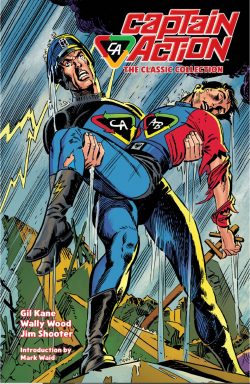
Captain Action: Classic Collection


By Gil Kane, Wally Wood, Jim Shooter & various (IDW)
ISBN: 978-1- (TPB) eISBN: 978-1-64936-046-5

These days comics are about kids of varying ages looking back. So too are toys, and baby boomers like me are particularly prone to the fabled golden age and certain “must-have” items – whether we ever actually owned them or not. An added bonus comes if those toys made it to comics and vice versa…

Back then, the ultimate acme for so many of us in the UK was – no, not the Johnny Seven multi-gun, or Man from U.N.C.L.E. briefcase – but the Captain Action nine-heroes-in-1 doll (sorry, Action Figure)… 

Once upon a time comics were considered the nigh-exlusive domain of children, with many scrupulously-policed genres and subdivisions catering to particular and stratified arenas such as fact, fantasy, adventure and humour. They were even further codified by age and gender.

A particular and popular recurring theme was tapping into the guaranteed and hopefully mutual sales boost offered by licensing and cross-marketing. West Coast outfit Dell/Gold Key had early on specialised in out-industry licensing deals and adaptations…

Many titles depended on a media celebrity like Howdy Doody, Charlie Chaplin or Mickey Mouse and in America that eventually spread to the marketing of products also aimed at kids… such as sweets, cartoons and toys…

By the end of that era, comics for kids were almost exclusively released as a minor strand of a major maketing strategy. That comics like Thundercats, Micronauts, Transformers, Rom and G.I. Joe were actually good and entertaining on strictly strip terms was a happy coincidence and thanks solely to the diligent pride and efforts of the creators involved. Sadly, it also led to publishers intensifying efforts to add a toy component to their own properties. Hands up anyone out there who owns a Spider-mobile, Batboat or Supermobile…

For DC, that trend really began in 1968. Although the company – known as National Periodical Publications back then – had long benefitted from creating comics adventures of movie stars like Bob Hope, Jerry Lewis or Dale Evans and shows such as Gang Busters, A Date with Judy and Mr. District Attorney, they had stayed away from the toy biz – unless you count two issues of Showcase (#53 & 54 Novenber/December 1964 and January/February 1965) that unofficially tied-in to Hasbro’s release of the first G.I. Joe line.

Then, just as costumed superheroes boomed, peaked and began an inexorable die-back, an old connection resurfaced…

In 1964 inventor and promotions wizard Stan Weston devised a way to sell dolls to boys: a dilemma that had stumped toymakers for centuries. He devised an articulated mannequin that would represent all branches of the military and could be aurmented by add-on uniforms and equipment. He called it an “action-figure” and sold the notion to Hasbro, who marketed it with great and lasting success as G.I. Joe (in Britain it was rebranded Action Man).

With his remuneration, Weston – whose promotions company Leisure Concepts had secured representation rights to DC, Marvel and King Features characters – devised a similar boys toy figure designed to ride the then-current global superhero wave triggered by the Batman TV show. “Captain Magic” was not only a superhero in his own right but could also transform into other superheroes via costumes and masks purchased seperately…

Released in waves, these alter egos included Superman, Batman, Aquaman, Spider-Man, Captain America, Sgt. Fury, The Phantom, 2 different Lone Rangers, Tonto, Steve Canyon, Flash Gordon, Buck Rogers and the Green Hornet.

Weston sold this concept to Hasbro’s rival Ideal Toy Company who went all-out in producing and marketing the range. It launched in 1966, redesignated Captain Action…

A huge success, an expansion line in 1967 introduced a kid sidekick, pet panther, villains, an Action-Cave, secret lairs, a super car and lots of other paraphenalia. Latterly, distaff partner Lady Action was joined by doll versions (“Super Queens”) of Wonder Woman, Mera, Supergirl and Batgirl…

The line was an early casualty of the downturn in superheroes and discontinued in 1968. It has, however, cemented itself in popular memory, with the core character returning on many occasions. He now enjoys a new marketing company seeking to rebuild the brand, Since 2005, Catain Action Enterprises have been testing the waters and some of their efforts can bee seen as ads and addenda throughout the book…

However, back at the height if the craze that DC link led to Editor in Chief Mort Weisinger commissioning a comic book tie-in. It turned out to be one of the most lovely, powerful, experimental and maturely sophisticated titles of the era and – finally – all the legal loopholes have been circumvented so you can see it at last …or if you’re truly blessed, once again…

Weisinger tapped his youngest writer – teenager Jim Shooter – and teamed him with veterans on the potentially colossal project. Miracle-working editor Julie Schwartz was in charge, and Wally Wood started the ball rolling artistically, but the real revelation came after replacement penciller Gil Kane took over the writing…

Born Eli Katz and a pre-WWII infant immigrant from Latvia, Kane was one of the pivotal players in the development of the American comics industry, and indeed of the art form itself. Working as an artist, and an increasingly more effective and influential one, he drew for many companies from the 1940s onwards, tackling superheroes, crime, action, war, mystery, romance, animal heroes (Streak and Rex the Wonder Dog!), movie adaptations and, most importantly perhaps, Westerns and Science Fiction tales.

In the late 1950s he became one of Schwartz’s key artists in regenerating and rebooting the superhero concept. Yet by 1968, at the top of his profession, this relentlessly revolutionary and creative man felt so confined by the juvenile strictures of the industry that he struck out on bold new ventures that jettisoned the editorial and format bondage of comic books for new visions and media.

His Name Is Savage was an adult-oriented black & white magazine about a cold and ruthless super-spy in the James Bond/Matt Helm/Man Called Flint mould; co-written by friend and collaborator Archie Goodwin. It was very much a precursor in tone, treatment and subject matter of many of today’s adventure titles.

His other venture, Blackmark (1971, and also with Goodwin), not only ushered in the comic book age of Sword and Sorcery, but also became one of medium’s first Graphic Novels. Technically, as the series was commissioned by fantasy publisher Ballantine as eight volumes, it was also envisioned as America’s first comic Limited Series.

Before them, though, there was Captain Action…

Edited by Schwartz with covers by Irv Novick, Wood, Kane & Dick Giordano, the entire DC run is collected here, preceded by a fulsome and informative Introduction from Mark Waid.

Unable to play with the toy’s major attraction – multiple super-personalities – Shooter & Wood instead went with classical drama for issue #1’s ‘Origin of Captain Action!’: revealing how archaeologist Clive Arno and his assistant Krellik uncover a chest of coins left in antiquity by incredible superbeings remembered by humanity as gods.

These coins allow the holder to access the incredible powers of countless deities, but the temptation proves too much for the scheming assistant.

However, when he tries to steal them, an ancient failsafe painfully prevents him…

Driven away, the scoundrel is then found by the coin vindictively created by primal God of Evil Chernobog: one which imparts astounding magical abilities and feeds his hatred. As Arno designs a costumed identity to help the world via the coins, Krellik spies on and steals his thunder, resolved to taint the project before it even begins…

Returning to America, Arno learns ‘Where the Action is’ from his son Carl, as Krellik plunders museums dressed in Arno’s proposed uniform. A swift chase then results in a cataclysmic clash and brief cameo by Superman…

Trailing his enemy, the true Captain cannot stop Krellik obtaining more deadly artefacts of the lost gods. As the first issue ends he is savagely beaten and apparently defeated before he’s even started …

With Kane pencilling Shooter’s script and Wood inking, the saga concludes in #2 as ‘The Battle Begins!’ with the victorious villain repeatedly failing to appropriate the power coins: stymied by the remarkably astute and valiant Action Boy. When Krellik’s frustration boils over and he starts wrecking the city, our recently returned hero goes all out and at last overcomes in ‘Captain Action’s Reactions!’ Kane was eager to stretch his creative muscles in a period of great change and challenge and Schwartz was happy to oblige…

Although already distressingly high in drama and calamity, the series went into overdrive with #3 as the toy company’s preferred archfoe debuted. A blue skinned humanoid with an exposed brain. Dr Evil was fleshed out as Kane wrote and pencilled ‘…And Evil This Way Comes!’, revealing how a catastrophic earthquake in San Francisco caused hundreds of deaths and triggered an evolutionary aberration in the laboratory of Dr. Stefan Tracy…

The Nobel Laureate was also Arno’s father-in-law and both were united in grief over the death of his daughter (and Arno’s wife) Kathryn. They also shared an abiding love for Carl Arno.

All that seemed over when Tracy was elevated to the status of a futureman resolved to similarly improve mankind, no matter how many perished in the process…

The most telling consequence of the quake is the loss of all but a handful of power coins. Action Boy is given the superspeed inducing Mercury artefact, whilst his dad keeps the tokens of Zeus, Hercules and Heimdall (rationalising why the Captain needs cool tools like his supercar the Silver Streak), and they deploy to save lives in the aftershocks.

They are hindered and countered by Tracy/Dr. Evil: using his devices to amplify the natural disaster. His deed almost kills his grandson, until a fast-fading final shred of humanity hampers his deeds and hold back his damning hand…

The act is his last as a human being and allows the Captain a desperate chance to drive him away…

From this issue on a letters page – Action Line – was included, and they are reprinted from here on.

Kane went even more deeply into mature themes with #4 as ‘Evil at Dead World’s End!’, sees the hyper-evolved savant drawn across the universe to a dying planet peopled with beings just like him. Well, not quite: these beings are at the end of existence on a dying planet, worn out by eons and resolutely awaiting death. Dr. Evil refuses to let them go, inspiring their brief rejection of well-earned rest with the promise of a fresh young world: Earth. To offset his son-in-law’s interference, the mind master distracts the hero with a trio of rampaging monsters and cruel resurrection of dead Kathryn. The alluring spectre then implores her husband to forsake life and join her in the beyond…

The high impact dramas were far from what any kid might expect, and the series closed on an even more shocking premise as ‘A Mind Divided’ revealed a nation torn apart by a racist demagogue inciting insurrection and racial purity: a campaign polarising America’s youth and encapsulated in a single father’s descent into madness. Captain Action might be able to rescue victims, stop bombers, break up riots and beat uniformed thugs but saving a twisted soul from self-inflicted tragedy was beyond even the reach of gods…

Now, rush out and buy the Captain Action Parachute Mortar, kids…

The comics material closes with text and letters page Action Line and a reader competition – ‘The Two Faces of Dr. Evil’ – before even more avarice-inspiring found-features fill out the Captain Action Gallery.

The comics stories preceding this section were packed with ads for old and new Cap merch in the gaps originally filled by DC comics releases (some contemporarily crafted by Michael Polis) for dolls/action figures, toys, accessories, costumes, “Captain Action Action Facts!”, card & board games, choco bars, breakfast cereal, freezer pops and vintage comic book house ads and TV promos for the franchise.

Here however are full-page delights such as paintings of Captain Action; toy ads from the comics for Action Boy, Dr. Evil. Lady Action and pages from the Captain Action Yellow Book by Murphy Anderson, Kurt Schaffenberger, & Chic Stone, plus astondingly lovely original art pages and pencil art by Kane & Wood.

Although Captain Action couldn’t sustain a readership or toy-buying clientele, DC would dabble again and again with related topics (like Alex Toth & Neal Adams’s sublime Hot Wheels comic in 1970, MASK, Masters of the Universe, and DC in-house properties Mego Superheroes and Kenner’s Super Powers action figures) and publishing properities now make a large paart of every successful comics company…

The 1960s was the era when all the assorted facets of “cool-for-kids” finally started to coalesce into a comprehensive assault on our minds and our parents’ pockets. TV, movies, comics, bubble-gum cards and toys all began concertedly feeding off each other, building a unified and combined fantasy-land no kid could resist. That nostalgic force has never been more wonderfully expressed than in the stories in this book and you would be mad to miss it.
Captain Action: Classic Collection © & ™ 2022 Captain Action Enterprises, LLC. All rights reserved.

Doom Patrol: Silver Age volume 1


By Arnold Drake, Bob Haney, Bruno Premiani, Bob Brown & various (DC Comics)
ISBN: 978-1-4012-8111-3 (TPB/Digital edition)

1963 was the year when traditionally cautious comic book publishers finally realised that superheroes were back in a big way and began reviving and/or creating a host of costumed characters to battle outrageous menaces and dastardly villains.

Thus it was that the powers-that-be at National Comics decided that venerable adventure-mystery anthology title My Greatest Adventure would dip its toe in the waters with a radical take on the fad. Still, infamous for cautious publishing, they introduced a startling squad of champions with its thematic roots still firmly planted in the B-movie monster films of the era that had not-so-subtly informed the parent comic.

No traditional team of masked adventurers, this cast comprised a robot, a mummy and an occasional 50-foot woman, who joined forces with and were guided by a vivid, brusque, domineering, crippled mad scientist to fight injustice in a whole new way…

Covering June 1963 to May 1965, this stunning compilation collects the earliest exploits of the “Fabulous Freaks”, gathered from My Greatest Adventure #80-85 and thereafter issues #86-95 of the rapidly renamed title, once overwhelming reader response compelled editor Murray Boltinoff to change it to the Doom Patrol.

These dramas were especially enhanced and elevated by the drawing skills of Italian cartoonist and classicist artist Giordano Bruno Premiani, whose highly detailed, subtly humanistic illustration made even the strangest situation dauntingly authentic and grittily believable.

Eponymous premier tale ‘The Doom Patrol’ was co-scripted by Arnold Drake and Bob Haney, depicting how a mysterious wheelchair-bound scientist summons three outcasts to his home through the promise of changing their miserable lives forever…

Competitive car racer and professional daredevil Cliff Steele had died in a horrific pile up, but his undamaged brain had been transplanted into a fantastic mechanical body. Test pilot Larry Trainor had been trapped in an experimental stratospheric plane and become permanently irradiated by stratospheric radiation, with the dubious benefit of gaining a semi-sentient energy avatar which would escape his body to perform incredible feats for up to a minute at a time. To pass safely amongst men Trainor had to constantly wrap himself in unique radiation-proof bandages…

Former movie star Rita Farr was exposed to mysterious gases which gave her the terrifying, unpredictable and, at first, uncontrolled ability to shrink or grow to incredible sizes.

The outcasts were brought together by brilliant but enigmatic Renaissance Man The Chief, who sought to mould the solitary misfits into a force for good. He quickly proved his point when a mad bomber attempted to blow up the city docks. The surly savant directed the trio of strangers in defusing it and no sooner had the misfits realised their true worth than they were on their first mission…

Second chapter ‘The Challenge of the Timeless Commander’, sees an implausibly ancient despot seeking to seize a fallen alien vessel: intent on turning its extraterrestrial secrets into weapons of world conquest, culminating in ‘The Deadly Duel with General Immortus’ which saw the Doom Patrol defeat the old devil and thereafter dedicate their lives to saving humanity from all threats.

My Greatest Adventure #81 featured ‘The Nightmare Maker’, combining everyday disaster response – saving a damaged submarine – with a nationwide plague of monsters. Stuck at base, The Chief monitors missions by means of a TV camera attached to Robotman/Steele’s chest, and quickly deduces the uncanny secret of the beasts and their war criminal creator Josef Kreutz…

Solely scripted by Drake, a devious espionage ploy outs the Chief – or at least his image, if not name – in #82’s ‘Three Against the Earth!’, leading the team to believe Rita is a traitor. When the cabal of millionaires actually behind the scheme are exposed as an alien advance guard who assumed the wheelchair-bound leader to be a rival invader, the inevitable showdown nearly costs Cliff what remains of his life…

In #83, ‘The Night Negative Man Went Berserk!’ spotlights the living mummy as a radio astronomy experiment interrupts the Negative Man’s return to Trainor’s body: pitching the pilot into a coma and sending the ebony energy being on a global spree of destruction. Calamity piles upon calamity when crooks steal the military equipment constructed to destroy the radio-energy creature and only desperate improvisation by Cliff and Rita allows avatar and host to reunite…

Issue #84 heralded ‘The Return of General Immortus’ as ancient Babylonian artefacts lead the squad to the eternal malefactor, only to have the wily warrior turn the tables and take control of Robotman. Even though his comrades soon save him, Immortus escapes with the greatest treasures of all time…

My Greatest Adventure #85 was the last issue, featuring ‘The Furies from 4,000 Miles Below’: monstrous subterranean horrors fuelled by nuclear forces. Despite having tricked Elasti-Girl into resuming her Hollywood career, the paternalistic heroes are pretty grateful when she turns up to save them all from radioactive incineration…

An unqualified success, the comic book transformed seamlessly into The Doom Patrol with #86 and celebrated by introducing ‘The Brotherhood of Evil’: an assemblage of international terrorist super-criminals led by French genius-in-a-jar The Brain. He was backed up by his greatest creation, a super-intelligent talking gorilla dubbed Monsieur Mallah.

The diametrically opposed teams first cross swords after brotherhood applicant Mr. Morden steals Rog, a giant robot the Chief constructed for the US military…

DP #87 revealed ‘The Terrible Secret of Negative Man’ after Brotherhood femme fatale Madame Rouge attempts to seduce Larry. When the Brain’s unstoppable mechanical army invades the city, Trainor is forced to remove his bandages and allow his lethal radiations to disrupt their transmissions…

An occasional series of short solo adventures kicked off in this issue with ‘Robotman Fights Alone’. Here Cliff is dispatched to a Pacific island in search of an escaped killer, only to walk into a devastating series of WWII Japanese booby-traps…

All mysteries surrounding the team’s leader are finally revealed in issue #88 with ‘The Incredible Origin of the Chief’: a blistering drama telling how brilliant but impoverished student Niles Caulder suddenly received unlimited funding from an anonymous patron interested in his researches on extending life.

Curiosity drove Caulder to track down his benefactor and he was horrified to discover the money came from the head of a criminal syndicate who claimed to be eons old…

Immortus had long ago consumed a potion which extended his life and wanted the student to recreate it since the years were finally catching up. To insure Caulder’s full cooperation, the General had a bomb inserted in the researcher’s chest and powered by his heartbeat…

After building a robot surgeon, Caulder tricked Immortus into shooting him, determined to thwart the monster at all costs. Once clinically dead, his Ra-2 doctor-bot removed the now-inert explosive and revived the bold scientist. Tragically, the trusty mechanoid had been too slow and Caulder lost the use of his legs forever…

Undaunted, ‘The Man Who Lived Twice’ destroyed all his research and went into hiding for years, with Immortus utterly unaware that Caulder had actually succeeded in the task which had stymied history’s greatest doctors and biologists…

Now, under the alias of super-thief The Baron, Immortus captures the Doom Patrol and demands a final confrontation with the Chief. Luckily, the wheelchair-locked inventor is not only a biologist and robotics genius but also adept at constructing concealed weapons…

In DP #89 the team tackle a duplicitous scientist who devises a means to transform himself into ‘The Animal-Vegetable-Mineral Menace’ before ‘The Private War of Elasti-Girl’ finds the Maid of Many Sizes using unsuspected detective skills to track down a missing soldier and reunite him with his adopted son.

‘The Enemy within the Doom Patrol’ sees shape-shifting Madame Rouge infiltrate the team and turn them against each other whilst issue #91 introduces multi-millionaire Steve Dayton.

Used to getting whatever he wants, he creates a superhero persona solely to woo and wed Rita Farr. With such ambiguous motivations ‘Mento – the Man who Split the Doom Patrol’ was a radical character for the times, but at least his psycho-kinetic helmet proved a big help in defeating the plastic robots of grotesque alien invader Garguax…

DP #92 tasks the team with a temporal terrorist in ‘The Sinister Secret of Dr. Tyme’ and features abrasive Mento again saving the day, after which ‘Showdown on Nightmare Road’ in #93 features The Brain’s latest monstrous scheme. This results in the evil genius being transplanted inside Robotman’s skull whilst poor Cliff is dumped into a horrific beast, until the Chief out-plays the French Fiend at his own game…

Creature-feature veteran Bob Brown stepped in to illustrate #94’s lead tale ‘The Nightmare Fighters’ as an eastern mystic’s uncanny abilities are swiftly debunked by solid American science. Premiani returned to render back-up solo-feature ‘The Chief …Stands Alone’ wherein Caulder eschews his deputies’ aid to bring down bird-themed villain The Claw with a mixture of wit, nerve and weaponised wheelchair.

This initial outing concludes with The Chief’s disastrous effort to cure Rita and Larry (DP #95), resulting in switched powers and the ‘Menace of the Turnabout Heroes’, so naturally that would be the very moment the Animal-Vegetable-Mineral Man picks for a return bout…

Although as kids we all happily suspended disbelief and bought into the fanciful antics of the myriad masked heroes available, somehow the exploits of the Doom Patrol – and their surprisingly synchronistic Marvel counterparts The X-Men (freaks, outcasts, wheelchair geniuses, both debuting in the summer of 1963 – so happy shared 60th folks!) – always seemed just a bit more “real” and plausible than the usual caped and costumed crowd.

With the edge of time and experience on my side it’s obvious just how incredibly mature and hardcore Drake, Haney & Premian’s take on superheroes actually was. These superbly engaging, frantically fun and breathtakingly beautiful tales should rightfully rank amongst the finest Fights ‘n’ Tights tales ever told. Moreover, you should definitely own them, so go do that now.
© 1963, 1964, 1965, 2018 DC Comics, Inc. All Rights Reserved.

Superadventure Annual 1960-1961


By Jack Miller, Jack Schiff, Joe Millard, Otto Binder, Edmund Hamilton, Robert Bernstein, Gardner Fox, John Forte, Bob Brown, Ramona Fradon, Jim Mooney, Edwin J. Smalle Jr, Howard Sherman, Ruben Moreira, Henry Boltinoff & others (Atlas Publishing & distributing Co./K.G. Murray)
No ISBN:

Before 1959, when DC and other American publishers started exporting directly into the UK, our exposure to their unique brand of fantasy fun came mostly from licensed reprints. British publishers/printers like Len Miller, Alan Class and bought material from the USA – and occasionally, Canada – to fill 68-page monochrome anthologies – many of which recycled the same stories for decades. In Britain we began seeing hardcover Superman Annuals in 1950, Superboy Annuals in 1953, Superadventure Annuals in 1959 and Batman books in 1960. Since then many publishers have carried on the tradition…

Less common were the oddly coloured pamphlets produced by Australian outfit K.G. Murray and exported here in a somewhat sporadic manner. The company also produced sturdily substantial Christmas Annuals which had a huge impact on my earliest years (I strongly suspect my adoration of black-&-white artwork stems from seeing supreme stylists like Curt Swan, Carmine Infantino, Al Plastino, Wayne Boring, Gil Kane or Murphy Anderson utterly uncluttered by flat, limited colour palettes).

This particular tome comes from 1960 whilst a superhero craze was barely bubbling under, allowing us access a wide range of the transitional genre material that fell between the Golden and Silver Ages. Everything in comics was changing and this book offers a delightfully eclectic mix of material far more in keeping with the traditionally perceived interests of British boys than the caped-&-cowled masked madness soon to obsess us all…

This collection is all monochrome, soundly stiff-backed, and sublimely suspense and joyous, and begins with Space Ranger: a relatively new property seen in Showcase #16.

In America, Showcase was a try-out comic designed by DC to launch new series and concepts with minimal commitment of publishing resources. If a new character sold well initially, a regular series would follow. The process had been proved with Frogmen, The Flash, Challengers of the Unknown and Lois Lane, so Editorial Director Irwin Donenfeld urged his editors to create science fiction heroes to capitalise on the twin zeitgeists of the Space Race and the popular fascination with movie monsters and aliens.

Jack Schiff came up with a “masked” crimefighter of the future who premiered in issues #15 & 16 (1958). The hero was Rick Starr: interplanetary businessman who – thanks to incredible gadgets and the assistance of shape-shifting alien pal Cryll and capable Girl Friday Myra Mason – spent his free time battling evil and injustice from his base in a hollow asteroid.

A few months later, the State-side Space Ranger was transported to DC’s science fiction anthology Tales of the Unexpected, beginning with issue #40 (August 1959): holding the lead and cover spot for a 6-year run and enduring frequent revivals and reboots ever since…

Canonically, we start with his third published exploit as ‘The Secret of the Space Monster’ (plot by John Forte, scripted by pulp veteran Edmond Hamilton and illustrated by Bob Brown) sees Rick, Myra and Cryll investigating an impossible void creature and uncovering a band of alien revolutionaries testing novel super-weapons.

Continuity was practically unheard in these DC overseas editions – and I’m pretty sure the editorial staff never gave a monkey’s about reading cohesion. UK spellings and currency were scrupulously re-lettered, but stories were arbitrarily trimmed to fit the page count and layout, making endings unclear or uncertain. However, we loved the sheer eclectic exoticism (we didn’t call it that, though); we were just wide-eyed impressionable grateful kids, okay?

One of the few superheroes to survive the collapse at the end of the Golden Age was a rather nondescript and generally bland looking chap who solved maritime crimes, rescuing fish and people from sub-sea disaster.

Created by Mort Weisinger & Paul Norris in the wake of Timely Comics’ Sub-Mariner, Aquaman first set sail in More Fun Comics #73 (November 1941). Strictly a second stringer for most of his career, the Sea King nevertheless continued on far beyond many stronger features. He was primarily illustrated by Norris, Louis Cazeneuve and Charles Paris, until young Ramona Fradon took over the art chores in 1954, by which time the Sea King had settled into a regular back-up slot in Adventure Comics. All of the salty sagas here are illustrated by her, and limned every single adventure until 1960: indelibly stamping the hero with her unique blend of charm and sleek competence.

At the time this book was released, America’s Aquaman had been refitted. Showcase #4 (1956) rekindled the public’s taste for costumed crime-fighters. As well as re-imagining Golden Age stalwarts, DC updated its hoary survivors. The initial revamp ‘How Aquaman Got His Powers!’ (Adventure #260, May 1959) was the work of Robert Bernstein. That tale set a new origin – offspring of a lighthouse keeper/refugee from undersea Atlantis – and eventually all trappings of the modern superhero followed: themed hideout, sidekick, even super-villains! Moreover, continuity and the concept of a shared universe became paramount.

In this seasonal collection however, he’s still a charming, dedicated seagoing nomad with a tendency to find trouble as in ‘The Ocean of 1,000,000 B.C.’ (Adventure Comics #253, October 1958 by Bernstein & Fradon) where he swims through a time warp and helps a seashore-dwelling caveman against a marauding dragon.

Cartoonist Henry Boltinoff was a prolific and nigh-permanent fixture of DC titles in this period, providing a variety of 2, 1, and 1½ page gag strips to cleanse visual palates and satisfy byzantine US legal directives allowing publishers to sustain cheaper postal shipping rates. He’s here in strength: his gentle humour jibing perfectly with contemporary British tastes, in the first vignette starring space boffin Professor Eureka…

Based on Alex Raymond’s newspaper star Jungle Jim, the next feature was very much of its time. Congo Bill debuted in More Fun Comics #56 (June 1940) and adventured there for a year (#67, May 1941) before upgrading to flagship title Action Comics with #37 (June 1941). A solid and reliable B-feature, his global safaris were popular enough to make him a star of his own movie serial and win his own 7-issue series (running from August/September 1954 to August/September 1955). His exploits followed trend slavishly: he faced uprisings, criminals, contemptuous rich wastrels, wars, plagues, evil witch-doctors, mad scientists, monsters, aliens – and every permutation thereof – in his monthly vignettes; gained a sidekick in Action Comics #191 (April 1954) and even evolved into a sort of superhero in Action #224 (January 1957) when he gained the power to body swap with golden gorilla Congorilla. He/they prowled in Action until #261 (February 1960), whereupon the feature moved into Adventure Comics, running from #270-283 (March 1960-April 1961). As comics folk are painfully, incurably nostalgic, the characters have been revived many times since…

Here Congo Bill – with Janu the Jungle Boy open their innings with ‘The Mystery of the Jungle Monuments!’ (Action Comics #206, July 1955) authorially uncredited but illustrated by Edwin J. Smalle, Jr., as they uncover a cunning smuggling plot before equally long-lived space patrolman/interplanetary Coast Guard operative Tommy Tomorrow pops in from the future to solve ‘The Puzzle of the Perilous Planetoid’ – from Action Comics #206 July 1955 and crafted – as were most of his missions – by Otto Binder & Jim Mooney.

The strip was a hugely long-running back-up strip which began in Real Fact Comics #6 (January 1947). Devised by Jack Schiff, George Kashdan, Bernie Breslauer, Virgil Finlay and Howard Sherman, it was a speculative science feature that returned in #8, 13 & 16 before shifting to Action Comics (#127-251, December 1948 to April 1959). Along the way Tommy became a Colonel in the peacekeeping Planeteers organisation…

With superheroes ascending again, he then moved into World’s Finest Comics (#102- 124, June 1959 to March 1962) and endured one final reboot in Showcase #41-42, 44 & 46-47 (1962-1963) before fading from sight and memory until rediscovered and reimagined by later generations…

Here the interstellar star of 2058 (so not long now) and his patrol partner Captain Brent Wood solve a titanic taxonomical conundrum before we switch from fantasy to contemporary showbiz…

When superheroes declined in the early 1950s, Detective Comics shed its costumed cohort for more rationalistic reasoners and grounded champions. One of the most offbeat was Roy Raymond, a TV personality who hosted hit series “Impossible… But True”. Illustrated by Ruben Moreira, it launched in #153 (November 1949): its formulaic yet versatile pattern being that his researchers or members of the public would present weird or “supernatural” items or mysteries for the arch-debunker to inevitably expose as misunderstanding, mistake or, as in this case, criminal fraud…

Produced throughout this book by Jack Miller & Moreira, Roy Raymond, TV Detective introduces ‘The Man with the Magic Camera’ (Detective Comics #246 August 1957) as a tinkerer with an X-ray camera is exposed as a cunning crook after which another Boltinoff Professor Eureka treat segues into Aquaman thriller, ‘The Guinea Pig of the Sea’ (by Joe Millard & Fradon from Adventure Comics #250, July 1958) with the Sea King abducted by a well-intentioned but obsessive researcher fed up with waiting for a moment in the hero’s hectic schedule to open up…

My earlier carping about continuity is confirmed here as Congo Bill and Janu face ‘The Five from the Future’. Crafted by Miller & Sherman, it comes from Action Comics #243 (August 1958) and sees the heroes facing an alien invasion of beasts. It reads well enough as is, but is actually the second part of a continued tale, with the first chapter appearing towards the end of this tome. I pity the little kid trying to make sense of that. Actually, no I don’t: we didn’t care that much – it’s just adults that worry about that instead of great art and fantastic thrills…

If you can find this book, just read part 1 at the back then flip back here, ok?

Tommy Tomorrow then makes a rare mistake by accidentally destroying ‘The Interplanetary Scarecrow’ (Action Comics #245, October 1958) before ending the seasonal menace it was intended to frighten off and – following another Professor Eureka moment – Roy Raymond heads to Africa and encounters ‘The Man who Charmed Wild Beasts’ (Detective Comics #256 June 1958).

Space Ranger is next in his very first tale (from Showcase #15 and seen in the US with a September/October 1958 cover-date). It commenced – without fanfare or origin – the ongoing adventures of the futuristic mystery man – beginning in ‘The Great Plutonium Plot’. Plotted by Gardner Fox, scripted by Hamilton and illustrated by Brown, it begins when Jarko the Jovian space pirate targets ships carrying a trans-uranic element. Rick Starr suspects hidden motives and, as Space Ranger, lays a cunning trap, exposing a hidden mastermind and a lethal ancient device endangering the entire solar system…

Keeping up a theme of times and space ‘At Sea in the Stone Age’ is an anonymously scripted Aquaman yarn limned by Fradon (Adventure Comics #184, January 1953) which sees another watery warp propel the Sea King into the distant past. Once again primordial men need help against ravening sea monsters and the hero is happy to oblige…

Bill and Janu then confront ‘The Riddle of the Roc!’ (illustrated by Sherman from Action Comics #244 September 1958) as crooked diamond prospector Ed Vance finds a giant egg and trains the hatchling into the perfect plundering weapon …until our great white hunter employs his trapping skills…

With his job and reputation on the line, Tommy Tomorrow solves ‘The Mystery of the Three Space Rookies’ (Action #244, September 1958) who are just too good to be true, before tantalising ads and public service announcement ‘The Atom – the Servant of Man’ – by Schiff, Morris Waldinger & Tony Nicolosi? – precede Miller & Fradon’s salty tale of Aquaman’s plight as ‘The Robinson Crusoe of the Sea’ (Adventure Comics #252, September 1958). It begins when a chemical spill makes the Sea King allergic to seawater and offers a charming sequence of clever crisis management by our hero’s octopus pal Topo…

Miller & Smalle, Jr. pit Bill and Jungle Boy against ‘The Amazing Army of Apes!’ (Action #219, August 1956) as a soldier seemingly deranged by jungle fever goes on a rampage, after which Colonel Tommy Tomorrow is pressganged into a space tyrant’s retinue to stalk freedom fighters as one of ‘The Hunters of the Future!’ (Binder & Mooney from Action Comics #190 March 1954) and Boltinoff’s Moolah the Mystic has a close encounter on his flying carpet…

Roy Raymond exposes fraud and attempted murder in the case of accident-prone ‘Mr. Disaster’ (Detective #258, August 1958) before one final Space Ranger romp solves ‘The Riddle of the Lost Race’ (Fox, Hamilton & Brown from Showcase #16). The case takes Rick’s team on a whistle-stop tour of the Solar system in pursuit of a vicious criminal and hidden treasures of a long-vanished civilisation…

Aquaman scuppers ‘The Outlaw Navy’ of a modern pirate in a rip-raring romp by Millard & Fradon (Adventure Comics #194, November 1953) and the first part of Congo Bill’s alien adventure finds him and Janu the Jungle Boy facing Venusian marauder Xov on a ‘Safari from Space!’ (Miller & Sherman, Action Comics #242, July 1958). To confirm an old prospector’s bonanza claim Tommy Tomorrow assembles ‘The Strangest Crew in the Universe’ (Action Comics #241 June 1958) before the Superadventuring wraps up with Roy Raymond investigating apparently accursed timber from ‘The Fantastic Forest’ as seen in Detective Comics #260 October 1958). The festivities finish with a quick cartoon lesson in science feature Solar System Sizes!, revealing the wonders of comets and meteors.

Quirky and fun, this is a true delight for oldsters and casual consumers of comics and offers true fans their only real opportunity to see material DC doesn’t seem to care about any more…
© National Periodical Publications, Inc. Published by arrangement with the K.G. Murray Publishing Company, Pty. Ltd., Sydney.