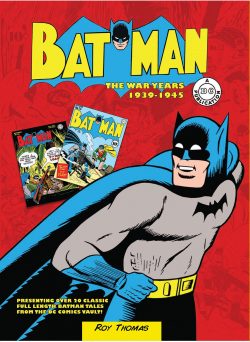
Batman: The War Years 1939-1945


By Bob Kane & Bill Finger with Gardner Fox, Joe Greene, Don Cameron, Alvin Schwartz, Sheldon Moldoff, Jerry Robinson, George Roussos, Fred Ray, Jack & Ray Burnley, Dick Sprang, Stan Kaye, Stan Kaye, Jack Kirby, Ed Kressey & various: curated and edited by Roy Thomas, (Chartwell Books)
ISBN: 978-0-7858-3283-6 (HB)

Win’s Christmas Gift Recommendation: Evergreen Action Adventure… 10/10

March 2019 saw the 80th anniversary of Batman‘s debut in Detective Comics #27. About one year after that dynamic debut his resounding growth in popularity resulted in the launch of Batman #1 (cover-dated “Spring” and released on April 25th, 1940). At that time, only his precursor and stablemate Superman was more successful…

Created a year after and in response to the furore generated by the Man of Steel, “The Bat-Man” (and latterly Robin, the Boy Wonder) confirmed DC/National Comics as the market frontrunner and conceptual leader of the burgeoning comicbook industry.

Having established the parameters of the metahuman with their Man of Tomorrow, the physical mortal perfection and dashing derring-do of the strictly-human Dynamic Duo rapidly became the swashbuckling benchmark by which all other four-colour crimebusters were judged.

However, once the war in Europe and the East snared America’s consciousness, crime and domestic deviltry increasingly gave way to combat and espionage themes. Patriotic imagery dominated most comicbook covers – if not interiors – and the USA’s mass-publishing outfits geared up for a seemingly inevitable conflict.

I feel – like many others of my era and inclinations – that superhero comics were never more apt or effective than when whole-heartedly combating global fascism with explosive, improbable excitement courtesy of a myriad of mysterious, masked marvel men. I have similar thoughts about the early 1970s “relevancy period”, when my masked miracle men turned to tackling slum landlords, super-rich scum, social injustice, crushing poverty and environmental issues: at least we won that one and don’t have to face real atrocities like that anymore…

All the most evocatively visceral moments of the genre seem to come when gaudy gladiators soundly thrashed – and I hope you’ll please forgive the appropriated (but now truly offensive) contemporary colloquialism – “Nips and Krauts”.

A companion to volumes starring Superman and Wonder Woman, Batman: The War Years 1939-1945 is superb hardcover archive curated by comicbook legend Roy Thomas, exclusively honing in on the Gotham Gangbusters’ euphoric output from those war years, even though in those long-ago dark days, comics creators were wise enough to offset and counterbalance their tales of espionage and imminent invasion with a barrage of home-grown threats as well as gentler or even more whimsical four-colour fare…

Past master of WWII-era material Thomas opens this tome with scene-setting Introduction Batman: The War Years and prefaces each chapter division with an essay offering tone and context before the four-colour glories commence with Part 1: From Perfidy to Pearl Harbor…

Following the cover to Detective Comics #27, the first the Dark Knight story offers is the ‘Case of the Chemical Syndicate!’ by Bob Kane and his close collaborator Bill Finger. The spartan, understated yarn introduces dilettante criminologist and playboy wastrel Bruce Wayne, drawn into a straightforward crime wherein a cabal of industrialists are successively murdered. The killings stop only when an eerie figure dubbed “The Bat-Man” intrudes on Police Commissioner Gordon‘s stalled investigation and ruthlessly deals with the hidden killer.

Most of the early tales were untitled, but for everyone’s convenience have in later years been given descriptive appellations by the editors, and were teeming with intriguing extras.

Cover-dated November 1939, Detective Comics #33 featured Gardner Fox & Kane’s (with lifetime ghost-artist Sheldon Moldoff quietly toiling on in unsung anonymity with the named creator) ‘The Batman Wars Against the Dirigible of Doom’: a blockbusting disaster thriller which just casually slips in the secret origin of the Gotham Guardian, as mere prelude to intoxicating air-pirate adventure…

With backgrounds inked by new kid Jerry Robinson, the Grim Detective hunted all-pervasive enemy agents in Finger & Kane’s ‘The Spies’. They ultimately prove no match for the vengeful Masked Manhunter in #37.

The covers for Detective Comics #38 (April 1940 and introducing Robin) and Batman #1 (Spring 1940) then precede Finger, Kane, Robinson & George Roussos’ ‘The Strange Case of the Diabolical Puppet Master’: an eerie episode of uncanny mesmerism and infamous espionage first seen in Batman #3 (Fall 1940).

The all-out action continues with a magnificent horrific Joker jape from Detective Comics #45 (November 1940) as ‘The Case of the Laughing Death’ displays the Harlequin of Hate undertaking a campaign of macabre murder against everyone who has ever defied or offended him. Apart from its release date, the wartime connection comes through the catastrophic climax aboard a ship under full steam…

Detective #55 (September 1941, by Finger, Kane, Robinson & Roussos) favours a back-to-basics approach with spectacular mad scientist thriller ‘The Brain Burglar’ as diabolical Dr. Deker plunders the thoughts and inventions of patriotic armaments inventors.

From Batman #8 (newly-promoted to bi-monthly just as the nation began paper-rationing), cover-dated December 1941-January 1942, comes a then-rare foray into science fiction as a scientist abused by money-grubbing financial backers turns himself into a deadly radioactive marauder in ‘The Strange Case of Professor Radium.’ This tale was later radically revised and recycled by Finger & Kane as a sequence of the Batman daily newspaper strip…

This initial section then closes with the cover to Batman #10 before neatly segueing into Part 2: The Home Front War: a section heavy on the unforgettable patriotic covers crafted by Fred Ray, Jack Burnley, Jerry Robinson and others: preceded here by a context-establishing briefing from Thomas.

As the heroes’ influence expanded, new talent joined the stable of creators. Jerry Robinson had already worked with writer Bill Finger and penciller Bob Kane, and during this period more scripters gradually joined the ever-expanding team to detail morale-boosting adventures during the darkest days of World War II.

I’m certain it’s no coincidence that many of these Golden Age treasures are also some of the best and most reprinted tales in the Batman canon. With Finger at a peak of creativity and production, everybody on the Home Front was keen to do their bit – even if that was simply making kids of all ages forget their troubles for a while…

Beginning with a gallery consisting of World’s Finest Comics #5. 6 and 7 (Ray), Detective #64 and 65 (Robinson, with Joe Simon & Jack Kirby pitching in on the latter) and Batman #12 (Robinson & Roussos), the story portion then offers the astounding case of ‘The Harlequin’s Hoax!’ (Detective #69 November 1942) with Joseph Greene, Kane, Robinson & Roussos detailing the Joker’s latest escapade, which ends explosively in an aircraft factory…

The chapter ends – following the stunning Robinson cover for Batman#12 – with Don Cameron’s ‘Swastika Over the White House!’ (limned by Jack & Ray Burnley from Batman #14, October/November 1942): a typically rousing slice of spy-busting action readers were gratuitously lapping up at the time.

Part 3: Guarding the Home Front opens with another historically-informative essay – and Jack Burnley’s cover to Batman #15 – before Cameron and those Burnley boys introduce plucky homeless boy Bobby Deen as ‘The Boy Who Wanted to be Robin!’ so badly he became an easy mark for a sinister Svengali…

The same art team illustrated Finger’s powerful propaganda tale ‘The Two Futures’, which examined an America under Nazi subjugation after which Cameron, Kane & Robinson go back to spooky basics in Detective Comics #73 (March 1943) as ‘The Scarecrow Returns’, intent on profiting from wrecking American morale through a campaign of terror…

Following Burnley’s cover to World’s Finest #9 (Spring 1943) is Finger, Robinson & Roussos’ saga of a criminal mastermind who invents a sure-fire ‘Crime of the Month!’ scheme from that same anthological issue.

Augmented by the all-Robinson eye-catcher from the front of Batman #17 (June/July 1943), WFC #10 (Summer) provides Finger, Robinson & Roussos’ ‘The Man with the Camera Eyes’: a gripping battle of wits between the tireless Gotham Guardians and a crafty crook possessing an eidetic memory, leading to the chapter’s end and a stunning Burnley masterpiece from the front of World’s Finest #11 (Fall 1943)…

Part 4: Closing the Ring supplements that vital history feature with the cover to Batman #18 – by Ed Kressey, Dick Sprang & Stan Kaye – before Finger, Kane & Roussos introduce a fascinating new wrinkle to villainy with the conflicted doctor who operates ‘The Crime Clinic’ in Detective #77. Crime Surgeon Matthew Thorne would return many times over the coming decades…

The next issue (#78, August 1943) then pushes the patriotic agenda with ‘The Bond Wagon’ (by Greene, Burnley & Roussos) wherein Robin’s efforts to raise war funds through a parade of historical look-alikes is targeted by Nazi spies and sympathisers.

Batman #19 (October/November) then delivers the magnificent artwork of rising star Dick Sprang who pencilled breathtaking fantasy masterpiece ‘Atlantis Goes to War!’ with the Dynamic Duo rescuing that fabled submerged city from overwhelming U-Boat assault.

The same creative team returned for Batman #21 (February/March 1944) as detailing the sly antics of murderous big city mobster Chopper Gant who cons a military historian into planning his capers, briefly bamboozling Batman and Robin with his warlike ‘Blitzkrieg Bandits!’…

‘The Curse of Isis’ comes from WFC #13 (Spring 1944) courtesy of Finger & Jack Burnley with inks by brother Ray & George Roussos: a maritime mystery of superstition, smugglers and sabotage with devious transatlantic crooks targeting hapless American Merchant Marine sailors, after which a legendary classic still proves its worth and punch…

Crafted at the end of 1944, Greene & Sprang’s ‘The Year 3000!’ was a timely allegory of recent terrors and earnest warning to tomorrow as the usual scenario boldly switches to an idyllic future despoiled when the Saturnian hordes of Fura invade Earth and nearly crush humanity.

Happily, one brave man and his young friend find records of ancient heroes named Batman and Robin and, patterning themselves on the long-gone champions, lead a rebellion which overturns and eradicates those future fascists…

The war’s end and aftermath are covered in the feature opening Part 5: Victory after which this titanic tome concludes on a redemptive high note as ‘Batman Goes to Washington!’ (Alvin Schwartz & Robinson, from Batman #28, April/May 1945) finds the Dark Knight supporting a group of former criminals heading to the nation’s capital to argue the case for jobs for ex-offenders.

Typically, some gang bosses react to the threat to their potential labour pool with murderous overkill and the whole affair is neatly completed by a brace of contemporary Sprang covers, from Detective Comics #101 (July) and Batman #30 (August/September 1944).

This stuff set the standard for comic superheroes. Whatever you like now, you owe it to these tales. Superman gave us the idea, and writers like Finger and Cameron refined and defined the meta-structure of the costumed crime-fighter. Where the Man of Steel was as much social force and wish fulfilment as hero, Batman and Robin did what we ordinary mortals wanted and needed to do. They taught bad people the lesson they deserved.

The history of the American comic book industry – in almost every major aspect – stems from the raw, vital and still powerfully compelling tales of DC’s twin icons: Superman and Batman. These wartime tales cemented the popularity of Batman and Robin, bringing welcome surcease to millions during a time of tremendous hardship and crisis. Even if these days aren’t nearly as perilous or desperate – and there ain’t many who thinks otherwise! – the power of such work to rouse and charm is still potent and just as necessary. You owe it to yourself and your family and even your hamster to Buy This Book…
™ & © 2015 DC Comics. All Rights Reserved.
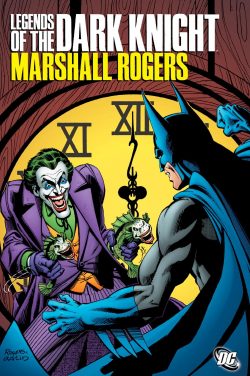
Legends of the Dark Knight: Marshall Rogers


By Marshall Rogers, Bob Rozakis, Steve Englehart, Dennis J. O’Neil, Roy Thomas, Archie Goodwin, James Robinson, Terry Austin & various (DC Comics)
ISBN: 978-1-4012-3227-6 (HB)

Win’s Christmas Gift Recommendation: Timeless Bat-Magic… 10/10

William Marshall Rogers (January 22nd 1950 – March 24th 2007) was a true but quiet giant of comic books. He was born in Flushing, Queens region of New York City and attended Kent State University in Ohio (yeah, that Kent State) where he trained as an architect.

He afterwards worked lots of menial jobs – both inside the arts industries and the real world – before his first work was published, and that only after years of trying, getting close and resolutely trying harder and always getting better at his craft. He was first published in Marvel’s Deadly Hands of Kung Fu magazine after which he got his big break at DC under editor Julie Schwartz, doing superhero back-up strips in prestigious title Detective Comics.

That led to work on Batman and a fortuitous pairing with high-level Marvel defector Steve Englehart in 1977.

A period of pure magic resulted and the creators would reunite regularly thereafter: on Mister Miracle, Madame Xanadu (DC first direct sale title), Eclipse’s I am Coyote, Scorpio Rose and Marvel’s Doctor Strange and Silver Surfer, as well as Batman sequel series Dark Detective.

In 1989, he was the first artist for the revived Batman newspaper strip (from November 6th until January 21st 1990.

Always in demand, Rogers worked on countless features for many companies over the years but was at his boldly experimental best drawing Howard the Duck and G.I. Joe, adapting Harlan Ellison’s Demon With a Glass Hand (1986) and illustrating Don McGregor’s noir thriller Detectives Inc.: A Remembrance of Threatening Green. Perhaps his most personal contribution was his own charming fantasy Cap’n Quick and a Foozle…

Although his contributions to Batman’s canon were relatively few, they are all of exceptional quality and this commemorative hardback and digital tome reprints Roger’s contributions from Detective Comics #468, 471-476, 478, 479, 481; DC Special Series #15, Secret Origins #6; Legends of the Dark Knight #132-136 and Dark Detective #1-6, cumulatively spanning April 1977 to September 2005.

This fabulous celebration opens sans preamble in ‘Battle of the Thinking Machines’, scripted by Bob Rozakis and inked by Terry Austin. The big fight yarn was the culmination of a series of solo stories starring rotating back up stars Green Arrow, Black Canary, Elongated Man, Hawkman and the Atom wherein each singly battled computerised schemer The Calculator. Here, the villain returns to face lead hero Batman at the front of the book, with all the aforementioned costumed champions in attendance as the Printed Circuit Predator sought a way to inoculate himself from all future superheroic interference…

In the mid-1970s Marvel were kicking the stuffing out of DC Comics in terms of sales if not quality product. The most sensible solution – as always – seemed to be to poaching away top talent. That strategy had limited long-term success but one major defection was Steve Englehart, who had recently scripted groundbreaking, award winning work on the Avengers, Defenders and Dr. Strange titles.

He was given the Justice League of America for a year but also requested – and was given – the Batman slot in flagship title Detective Comics. Expected to be daring, innovative and forward looking, he instead chose to invoke a classic and long-departed style which became a new signature interpretation, and one credited with inspiring the 1989 movie mega-blockbuster. It also gibed perfectly with the notions of Rogers and his inseparable inker Austin. Initially Englehart was paired with artists Walt Simonson & Al Milgrom for the series, introducing in ‘…By Death’s Eerie Light!’ and ‘The Origin of Dr Phosphorus’; not only a skeletal, radioactive villain but also the corrupt City Council of Rupert “Boss” Thorne.

In those issues – not included here – the Caped Crusader first isolated and then outlawed in his own city. The team also provided the sequel ‘The Master Plan of Dr. Phosphorus!’ which introduced another landmark character: captivating Modern Woman Silver St. Cloud.

With issue #471 (August 1977) relative newcomers Rogers & Austin took over the art chores and true magic began to be made. As the scripts brought back golden-age and revered A-list villains, the art captured and reinforced the power and moodiness of the strip’s formative years whilst adding to the unique and distinctive iconography of the Batman.

Last seen in Detective Comics #46 (1940), quintessential Mad Scientist Hugo Strange came closer than any other villain to destroying both Bruce Wayne and the Batman in ‘The Dead Yet Live’ and ‘I Am The Batman!’ (Detective #471 and #472 respectively), briefly stealing his identity and setting in motion a diabolical scheme that would run through the entire sequence…

Teen Wonder Robin returned in Detective Comics #473’s ‘The Malay Penguin!’ as podgy Napoleon of Crime the Penguin challenged a temporarily reunited Dynamic Duo to an entrancing, intoxicating duel of wits, after which ‘The Deadshot Ricochet’ updates an old loser in the second ever appearance of a murderous high society dilettante sniper (after an initial outing in Batman #59, 1950). The tale so reinvigorated the third-rate trick-shooter that he’s seldom been missing from the DC Universe since; starring in a number of series such as Suicide Squad and Secret Six, and even in a couple of eponymous miniseries and on both silver and small screens.

The best was saved for last, with all the sub-plots concerning Silver St. Cloud, Boss Thorne, Gotham City Council, and even a recurring ghost culminating in THE classic confrontation with The Joker.

The absolute zenith in this short, stellar sequence resurrecting old foes could only star the Dark Knight’s nemesis at his most chaotic. Cover-dated February and April 1978, Detective #475-476 introduces ‘The Laughing Fish’ before culminating in ‘The Sign of the Joker!’: one of the most reprinted Bat-tales ever concocted. It was later adapted as an episode of award-winning Batman: The Animated Adventures TV show in the 1990s.

In fact, you’ve probably already read it. But if you haven’t… what a treat you have awaiting you! Manic and murderous, the Harlequin of Hate goes on a murder spree after mutating fish.

As sea food with the Joker’s horrific smile turn up in catches all over the Eastern Seaboard, the Clown Prince attempts to trademark them. When patent officials foolishly tell him it can’t be done, they start dying… publicly, impossibly and incredibly painfully…

The story culminates in a spectacularly apocalyptic clash among the city’s rooftops which shaped and informed the Batman mythos for the next two decades…

Having said all he wanted to say, Steve Englehart left Batman and soon after quit comics for a few years. After a reprinted story in #477, Rogers drew one last extended adventure for #478-479…

Len Wein scripted ‘The Coming of… Clayface III’ and ‘If a Man be Made of Clay…’ with Dick Giordano replacing Austin as inker on a tale of obsession and tragedy. Another Golden Age villain got a contemporary make-over. Here a deranged scientist seeks to cure his deformed body and instead becomes a walking, predatory disease until the overmatched manhunter steps in…

‘Death Strikes at Midnight and Three’ is taken from all-Batman DC Special Series#15 (Summer 1978): an ambitious if not totally successful text-thriller in pulp style marrying a wealth of superb illustrations by Rogers to Denny O’Neil’s uncharacteristically lacklustre prose as the Gotham Gangbuster hunts a murderous self-proclaimed genius of crime through the city night.

O’Neil & Rogers were far more effective in crafting enigmatic, experimentally retro comics tale ‘Ticket to Tragedy’ (Detective Comics #481 December 1978/January 1979), with Batman stalking a killer from London to America to prove to a disillusioned scientist that justice could still be found for the innocent…

After a long time away, Rogers – and Austin – returned to the Dark Knight in ‘Secret Origin of The Golden Age Batman’ (Secret Origins #6 September 1986), wherein Roy Thomas précised and codified the history of the 1940s (or Earth-2) hero just in time for ongoing sensation Crisis on Infinite Earths to wipe it all away in a new unified, rationalised DCU.

Post-Crisis, Legends of the Dark Knight was a Batman title employing star guest creators to reimagine the hero’s history and past cases for modern audiences.

Devised by Archie Goodwin, James Robinson, Rogers, Bob Wiacek & John C. Cebollero, issues #132-136 (August-December 2000) explore Wayne family history in story arc ‘Siege’ as an elderly mercenary and his deadly team return to Gotham in ‘Assembly’. Colonel Brass has a multi-layered plan for profit and personal gratification that harks back to the old days when he was a trusted aide and virtual son to Bruce’s grandfather Jack Wayne.

Regrettably, as seen in ‘Assault’, ‘Breach’, ‘Battle’ and ‘Defense’, that involves not only duping business woman Silver St. Cloud and plundering the city but also taking over Wayne Mansion, and digging down to some old hidden caves (now fully-inhabited and packed with Bat paraphernalia). Of course, if that entails wiping out any surviving Waynes who might keep Brass from his long-awaited revenge and reward, that’s just a well-deserved bonus…

Under Englehart, Rogers & Austin, Detective Comics managed to be nostalgically avant-garde and iconoclastically traditional at the same time, setting both the tone and the character structure of Batman for decades to come, and leading, indirectly, to both an award-winning animated TV series and the blockbuster movie of 1989. That made thoughts of a reunion run both constant and inevitable – like a school reunion where you forget yourself for a moment, then catch yourself pogoing to “God Save the Queen” in the bar mirror. Of course, the truth is you can’t ever go back and you just look like an idiot doing it now.

Although not quite as bad as that, Batman: Dark Detective #1-6 (July-September 2005) suffers from an excess of trying too hard as Englehart, Rogers & Austin reunited to recount what happened after the major players reassembled on ‘Some Enchanted Evening’ as Silver St. Cloud returns to Gotham to help her new fiancé Senator Evan Gregory secure his nomination as a Gubernatorial candidate. That means looking for donations from old lover Bruce Wayne, but events are further complicated when the Joker announces his own run for the role. His tactics can be best described by his own slogan “Vote for Me …Or I’ll Kill You”.

The plot thickens in ‘You May See a Stranger’ as – amidst a growing bodycount – other lethal loons make their own sinister sorties. Now, as well as The Joker’s terrifyingly unconventional political aspirations, Batman also has to deal with The Scarecrow‘s unwitting release of Wayne’s repressed memories of a murder attempt upon himself the night after his parents were killed, and a frankly ludicrous clone-plot as Two Face tries to fix himself through Mad Science.

Before long, the shamefully inescapable occurs as Bruce and Silver succumb to long-thwarted unresolved passions in ‘Two Faces Have I’…

Plagued by guilt – both long entrenched and of more recent vintage – the Dark Knight writhes in manufactured nightmares even as fresh horrors are actually happening in grim reality. ‘Thriller’ sees the Maniac of Mirth abduct Silver and her recently un-engaged would-be Governor joins Batman in a rescue bid in ‘Everybody Dance Now’ that leads only to tragedy and doom in catastrophic concluding chapter ‘House’…

Rounding out the magnificent mystery and mayhem is a lengthy Cover Gallery by Rogers and his many inkers and colourists.

These tales are just as fresh and welcoming today, their themes and scenes just as compelling now as then and Marshall Roger’s vision of Batman is a unique and iconic one. This is a Bat-book literally everybody can enjoy and this lavish compilation is a treat any Batfan or comics aficionado will always treasure.
© 1977,1978, 1979, 1986, 2000, 2011 DC Comics. All Rights Reserved.

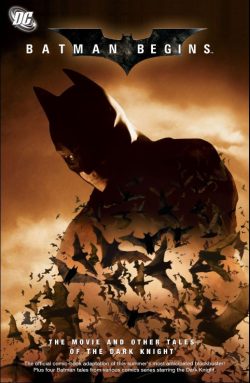
Batman Begins – the Movie and Other Tales of the Dark Knight


By Scott Beatty, Denny O’Neil, Greg Rucka, Ed Brubaker, Bill Willingham, Kilian Plunkett, Dick Giordano, Rick Burchett, Scott McDaniel, Tom Fowler & various (DC Comics)
ISBN: 978-1-4012-0440-2 (TPB)

Win’s Christmas Gift Recommendation: Blockbuster Bat Fun… 8/10

It looks like I’m just destined to be wrong. Do you remember flared jeans, or even bell-bottoms? From which time? As the 1970s gasped to a close I said that we’d never see those again. Horribly, tragically, I was wrong.

I was seven when the Batman TV show first aired, and I loved it. By the time I was nine I had learned the word ‘travesty’ and loathed the show with a passion. When it was all over and the “Camp” fallout had faded from my beloved comics, giving way to the likes of Frank Robbins, Denny O’Neil and the iconoclastic Neal Adams, I was in seventh heaven and praised pantheons of deities that I should never see ‘Batmania’ again. I was, of course, doubly wrong.

The Caped Crusader reconquered the world in 1989 and only the increasing imbecility of its movie sequels stopped that particular multimedia juggernaut. Now there’s a been a whole new sequence of films (some not half-bad – though that’s beside the point) spin-offs and a new iteration beyond that beckons. Each of these cinematic milestones generated its own host of print (and latterly, digital) tie in Bat Products.

Originally released in 2005, this crafty marriage of an inevitable “Official Movie Adaptation” of Batman Begins with a well-considered selection of thematically similar stories is one of the best I can recall and a nice prospect if you’re looking for a great read or ideal gift option…

The lead feature – creditably handled by Scott Beatty on script with Kilian Plunkett & Serge LaPointe illustrating – is an intensely readable reworking of the myth, so much so that I was able, for once, to stifle the small, shrill and incessant comic-fan voice that always screams “why do they keep mucking about with this?”, and “why isn’t the comic version good enough for those movie morons?”

I do, however, still question the modern hang-up with having to start from origin stories at all. Was Star Wars: A New Hope a relative flop because we didn’t know how Darth Vader got Laryngitis? Which Bond movie tells us how he got to be so mean and sardonic? Why can’t film-makers assume that an audience can deduce motivation without a brand-spanking-new road-map every time? Although to be painfully honest, most modern comics seem to be afflicted with this bug too…

Could it be that it’s simply a cheap way of adding weight to the villain du jour, who can then become a Motivating Force in the Birth of the Hero? Said baddies this time out are the Scarecrow and Ra’s Al Ghul, but I’m not going to speak any more about the cinema or plot of a movie that’s already being superseded by this generation’s Gotham Guardian. Batman fans will have already passed judgement…

Accompanying the filmic iteration, and following a pin-up by Ruben Procopio, is ‘The Man Who Falls’ by the aforementioned O’Neil and veteran Bat-artist Dick Giordano and taken from Secret Origins of the World’s Greatest Heroes. This is a skilful, engaging comics retooling of the so-pliable natal legend, created to address the media mania around the 1989 movie.

Hard on its heels and prefaced by a pin-up courtesy of Bill Sienkiewicz comes one of the better stories of recent vintage. ‘Air Time’ is by Greg Rucka, Rick Burchett & Rodney Ramos from Detective Comics #757 in 2001. It’s a taut countdown thriller that in many ways presages the style adopted for the wonderful procedural series Gotham Central.

KReasons’ (Batman #604, 2002), by Ed Brubaker & Scott McDaniel, revisits Batman’s origins in a tale seeking to redefine his relationship to inimical amour Catwoman, before the volume concludes with the brilliant ‘Urban Legend’ from Batman: Legends of the Dark Knight #168.

In a grim and unsettling tale of frailties, Tom Fowler illustrates a wickedly sharp Bill Willingham script stuffed with the dark humour and skewed sensibilities that made his Fables stories such a joy for grown-ups who love comics.

This is a smart package for any casual reader the films might send our way, with a strong thematic underpinning. In an era of streaming and ultra-rapid home release, I’m increasingly unsure of the merit of comic adaptations, but if you are into such things it’s probably best they’re done well, like here…
© 1989, 2001, 2002, 2003, 2005, 2012 DC Comics. All Rights Reserved.

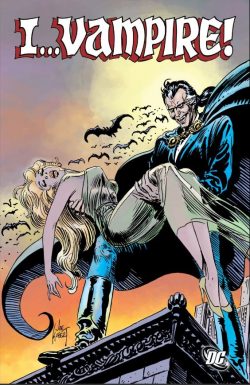
I… Vampire


By J.M. DeMatteis, Bruce Jones, Dan Mishkin, Gary Cohn, Mike W. Barr, Tom Sutton, Ernie Colon, Adrian Gonzales, Paris Cullins, Dan Day, Jim Aparo & various (DC Comics)
ISBN: 978-1-4012-3371-6 (TPB)

When superheroes entered their second decline at the end of the 1960s, four of the six surviving newsstand comicbook companies (Archie, Charlton, DC, Gold Key, Harvey and Marvel) increasingly turned to horror and suspense anthologies to bolster their flagging sales. Even wholesome Archie briefly produced Red Circle Sorcery/Chillers comics, diverting a portion of their teen-comedy core gently into tales of witchcraft, mystery and imagination.

DC’s first generation of mystery titles blossomed at the end of the first Heroic Age when most comicbook publishers of the era began releasing Crime, Romance, Western and Horror genre anthologies to recapture an aging readership which was drifting away to other mass-market entertainments like television and movies.

After a few tenuous attempts with supernatural-themed heroic leads in established titles (Johnny Peril in Comic Cavalcade, All-Star Comics and Sensation Comics; Dr. Terry Thirteen, The Ghostbreaker in Star-Spangled Comics) in 1951 National Comics bowed to the inevitable and launched a comparatively straight-laced anthology sans recurring stars – which nevertheless became one of their longest-running and most influential titles – with the December 1951/January 1952 launch of The House of Mystery.

When a hysterical censorship scandal led to witch-hunting hearings attacking comicbooks and newspaper strips (feel free to type Senate Subcommittee on Juvenile Delinquency, April-June 1954 into your search engine at any time) the industry panicked and hurriedly adopted a castrating straitjacket of stringent self-regulatory rules and admonitions.

Even though mystery/suspense titles produced under the aegis of the Comics Code Authority were sanitised, anodyne affairs in terms of Shock and Gore, the appetite for mystery and suspense was still high, and in 1956 National introduced sister titles Tales of the Unexpected and House of Secrets.

Supernatural thrillers and spooky monster stories were dialled back into marvellously illustrated, genteel, rationalistic fantasy-adventure vehicles which nonetheless dominated the market until the end of the 1950s when the super-hero returned in force – having begun a renaissance after Julius Schwartz reintroduced the Flash in Showcase #4, 1956.

Revivals of Green Lantern, Hawkman, The Atom and a host of new costumed cavorters generated a gaudy global bubble of masked myrmidons which even forced these dedicated anthology suspense titles to transform into super-character split-books with J’onn J’onzz, Manhunter from Mars and Dial H for Hero in House of Mystery and paranormal investigator Mark Merlin (latterly Prince Ra-Man) sharing space with anti-hero Eclipso in House of Secrets.

When the caped crusader craziness peaked and popped, Secrets was one of the first casualties, folding with the September-October 1966 issue. House of Mystery carried on with its eccentric costumed cohort until #173, and Tales of the Unexpected carried on until #104.

However, nothing combats censorship better than falling profits, and at the end of the 1960s the superhero boom busted again. With many once-popular titles gone and some of the industry’s most prestigious series circling the drain too, this real-world Crisis led to the surviving publishers of the field agreeing to loosen their self-imposed restraints against crime and horror comics. Nobody much cared about gangster titles at the time, but as this liberalisation coincided with another bump in global public interest in all aspects of the Great Unknown, the resurrection of scary story comics was a foregone conclusion and obvious “no-brainer.”

Thus, with absolutely no fanfare at all House of Mystery and Unexpected switched back to tales of magic, mystery and imagination stories and House of Secrets rose again with issue #81, (cover-dated August-September 1969): retasked and retooled to cater to a seemingly insatiable appetite for terror and suspense yarns…

Before long, an expansive battalion of supernatural thriller titles dominated DC – and other companies’ – publishing schedules again. This time, however, although the initial impetus died out by 1978, horror comic books had secured a dedicated audience, and soldiered on despite a decline in sales into the turbulent 1980s.

During that period, the venerable periodical experimented with varying formats and became a springboard for many creative careers, but never returned to established, recurring heroes until the reign of publishing whiz kid Karen Berger who officially assumed control with #292. A few issues earlier, a new longform miniseries had debuted, detailing the exploits of a reluctant monster seeking to atone for past sins…

The full groundbreaking tragic, idiosyncratic saga has been gathered into a sinister trade paperback – or digitally formatted – chronicle collecting the adventures of the bloodsucker and his human allies as first seen in House of Mystery #290-291, 293, 295, 297, 299, 302, 304-319 as well as a fast-paced guest-shot in The Brave and the Bold #195, cumulatively spanning March 1980 to August 1983 and opens without fanfare or preamble with ‘I… Vampire’ by co-creators J.M. DeMatteis & Tom Sutton.

In ten tightly-packed but smoothly inviting pages we are introduced to English noble Sir Andrew Bennett, who died at the hands of a nosferatu during the reign of Queen Elizabeth I. Beloved by his fiancée, Mary Seward, Bennett succumbs to her desperate pleas to be similarly infected, her so their love could last forever. Only afterwards does he realise that the transformation creates soulless monsters, but, somehow, he has retained his conscience and personality…

Over four centuries, “Bloody Mary” becomes a leader of vampires in an insidious, influential covert global cult dubbed the Blood Red Moon, spreading chaos and destruction whilst working towards their ultimate goal of vampires ruling a world of human cattle. Heartbroken and guilt ridden, Bennett opposes her schemes for all that time, aided by human allies such as his most recent daywalkers: aged Russian warrior Dimitri Mishkin and go-getting “Eighties Woman” Deborah Dancer…

Empowered by all the traditional gifts of the undead (shapeshifting, supernatural vigour, hypnosis, etc) and similarly afflicted by their weaknesses (sunlight, crucifixes, Holy Water, stakes et al) Bennett staves off his insatiable hunger for blood by sheer willpower and the determination that he will not die until he has ended Mary’s depredations…

The introductory episode covers all that even as Mary’s minions lose another running battle with Bennett’s team but escape to instigate their latest plan…

The adventure concludes in ‘Night of the Living Undead’ as team Bennett expose and end a proposed alliance between the cult and New York’s biggest drug dealer after which ‘The Burning’ sees the hunters scotch a scheme to infiltrate the White House after Mary affiliates with a race-hate spouting demagogue with links to the KKK and the President…

The closure of that case tears open old wounds, as Mishkin subsequently clashes with one of Mary’s lieutenants only to discover a dreaded family connection in ‘Mother Love/Mother Hate’, leading to a look into how Bennett recruited him as a boy at the turn of the 20th century…

DeMatteis’ moves on after the dark heroes foil Mary’s attempt to destroy an ashram and its spiritual guru in ‘Zen Flesh! Zen Bones!’ after which Bruce Jones moves in, offering a more fanciful approach in ‘The Sun Also Burns’. Here Bennett and his human friends are ambushed and left to die in a mine. As time passes, the valiant vampire – deprived of bottled blood – must battle his irresistible thirst, before abandoning them. Resolved never to endanger them again, he sets out on a solo quest for vengeance…

‘Blood Ties’ in HoM #302 sees that lonely walkabout take him to Eudora, Kansas where strange events culminate in Bennett causing the accidental death of an entire family of innocents before stumbling across a predatory circus abducting innocents for profit, and sponsored by Bloody Mary. His war against the ‘Carnival of Souls’ lasts until #304 where – with Ernie Colon substituting for Sutton – Bennett learns that ‘The Night Has Eyes’ and proves that he has no pity for child stealers…

Jones kicks off a lengthy saga in ‘Blood and Sand’ as the still-solo Bennett tracks Mary’s agents to Egypt in the wake of a global anti-cancer vaccine rollout that has the unexpected side-effect of making human blood toxic to the undead…

Meanwhile, and for all this time, Mishkin and Dancer have been hunting for their leader, and are closing in…

Made unwilling allies by fate, Andrew and Mary invade a lost tomb, where the cult queen steals the time-travelling Rings of Anubis from a mystic mummy and sets off to the past to undo the creation of the vaccine. In hot pursuit, thanks to a second ring, Bennett arrives in Whitechapel, London at the height of history’s most infamous serial killer spree.

Crafted by Jones and the returned Sutton, ‘A Rip in Time’ sees all Mary’s efforts thwarted, and the ancestor of mysterious vaccine creator Dr. Barr escape unharmed, even as the vampires are hurled back into the time stream…

Bennett washes ashore in Maine in November 1964, just in time to save a little girl from drowning. ‘Lovers Living, Lovers Dead’ reveals that in the present Deborah Dancer has developed a psychic link and can “see” the vampire past actions as they happen. She is suitably horrified to observe Mary then attack the child and aghast to realise that the child is herself…

After a heroic intervention from Bennett saves the girl, the time chase pauses as the undead knight battles a crew of revenant Nazi submariners in ‘Mirrors That Look Back’ before his pursuit resumes, depositing him and his quarry in Elizabethan England mere days before their first deaths…

A bewildering succession of time-tossed doubles and mistaken identity switches culminates in a deadly ‘Witch Hunt’ with religiously enflamed peasants running riot before all the chronal paradoxes dump them both back in the 20th century where new writers Dan Mishkin (no relation) & Gary Cohn concoct a ‘Manhattan Interlude’ (HoM #310, November 1982) foe penciller Adrian Gonzales and ever-faithful Tom Sutton to render. Here Bennett encounters another vampire who has retained both soul and innocence and regretfully helps her meet her final end on her own terms…

Paris Cullins joins Mishkin & Cohn, Gonzales & Sutton for a dark peek at Deborah Dancer’s teen years in ‘By the Time We Got to Woodstock…’, revealing how she “first” stumbled into the Blood Red Moon’s schemes of conquest after losing all her friends to hippy vampires at the legendary festival and only survived thanks to an old Russian and eerie, red-eyed Englishman…

Issue #312 reunites the trio in time to tackle ‘The Thing in the Tunnel’ (Mishkin, Cohn, Gonzales & Sutton): a predatory beast escaped from the familiar-sounding Barr Research Laboratories leading to a deadly clash with the enigmatic and extraordinarily long-lived (hint, hint) biologist in ‘Side Effects’, before ‘I.. Edward Trane, I… Vampire’ in #314 (illustrated solely by Sutton) sees a tragic reunion for Bennett with one of his Victorian acolytes who fell in battle but never fully died…

Mishkin, Cohn, Cullins & Sutton then detail an untitled exploit wherein the vampire hunters are targeted by sanctimonious religious zealots hunting he unholy. Sadly, their leader’s top aide is not only undead herself, but also Dimitri’s mother and the Presidency is once more the glittering prize being sought…

Although the plot is foiled, the cost is high, compelling Bennett to turn eastwards, and ‘Back in the U.S.S.R.’ he uncovers a KGB program to weaponize vampirism and extend the joys of eternity to the aging Politburo. The result is open warfare between Mary’s cult and a Soviet secret army, ultimately proving in ‘Blood is Thicker…’ that that not all military spending is pointless and not every hero gets to ride off into the sunset…

Despite a long run, changing times and tastes were indicating that the title and, indeed, entire genre were not a viable contemporary option. With the series building to climax, #318 offered another untitled yarn (with Dan Day pencilling) wherein a freshly bereaved Andrew Bennett employs stolen Soviet technology to force a final confrontation with Mary and the Blood Red Moon resulting in his final demise and the birth of a new kind of hero in climactic last episode ‘Dreams of Death’ by Mishkin & Cohn, & Sutton in House of Mystery #319 (August 1983).

Rather annoyingly, the big finish isn’t the end here, as there follows a solid but painfully out-of-continuity tale taken from The Brave and the Bold #195 (February 1983). In ‘Night of Blood’ – by Mike W. Barr & Jim Aparo – Bennett’s perpetual hunt for Mary brings him to Gotham City after a gangster’s daughter becomes the latest victim of a killer vampire. Batman is firmly convinced the attacks are fake – and he’s right – until an actual magic-accursed blood drinker shows up. At least this time the standard misunderstanding doesn’t result in pointless battle before reason prevails and the mismatched heroes unite to catch the real culprits…

A genuine slice of engaging, unorthodox and vastly entertaining horror action that predates – and probably influenced – later hits like Buffy the Vampire Slayer and Angel, this is a hugely enjoyable edgy romp: well-scripted, imaginative and gorgeously illustrated. Even the covers are special; crafted by industry icons Joe Kubert and Michael Wm. Kaluta.

I… Vampire is a tome for all lovers of dark delight and one no arcane aficionada can afford to be without.
© 1981, 1982, 1983, 2012 DC Comics. All Rights Reserved.

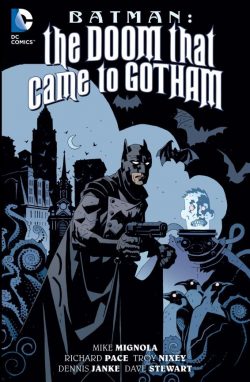
Batman: The Doom That Came to Gotham


By Mike Mignola, Richard Pace, Troy Nixey, Dennis Janke & Dave Stewart (DC Comics)
ISBN: 978-1-4012-5806-1 (TPB)

The origins of the Dark Knight are so well-known now that it’s simple to twist and tweak them to suit almost any tale. It doesn’t hurt that the character has a universal recognition factor that holds up in almost any imaginary scenario…

Released in 2015, available in trade paperback and digital formats and collecting the 3-issue Elseworlds miniseries (from November 2000 – January 2001), The Doom That Came to Gotham was written by horror moodmeister Mike Mignola (Hellboy; duh!) and Richard Pace (Negative Burn; Ashes; Imaginary fiends) with art from Troy Nixey (Harley Quinn; Trout; Only the End of the World Again), inker Dennis Janke & colourist & Dave Stewart.

In case you came in late: During the 1990s, DC regrouped and rebranded its frequent dalliances with alternate reality scenarios under the copious and broad umbrella of a separate imprint. The Elseworlds banner and credo declared that heroes would be taken out of their usual settings and put into strange places and times – some that have existed, or might have existed, and others that can’t, couldn’t or shouldn’t exist…

No doubts here, however, as the tale deftly takes us back to Roaring Twenties America, dishing out a daring dose of pulp fiction plumb centre in the ghastly spine-chilling mythos of H.P. Lovecraft, Clark Ashton Smith and their darkly-demented contemporaries…

It’s 1928 and orphaned Bruce Wayne is returning to Gotham City two decades after his parents were murdered by a maniac. He’s been roving the world, and recently uncovered the fate of long-lost Professor Cobblepot‘s Antarctic expedition. That resulted in a clash with a naked madman who talked to penguins and a large slab of ice with a creature inside it: a thing that never evolved on this world…

By the time he and his close associates Alfred, Dick, Jason and the rest have docked in his bleak and daunting home town, they have all had more than enough of the vile dreams the thing in the hold has generated…

There are more surprises when he reaches his long-closed mansion: a dead man who somehow speaks and a mysterious stranger named Jason Blood who has been sent to deliver a dire warning. Turning into an actual demon the visitor warns that to save Gotham, Bruce must cut out its heart…

Although shocked, Bruce is ready to act, and dons the strange uniform that makes him look like a human bat…

And thus begins a skilful, macabre pastiche as the desperate driven mystery man haunts the alleys and byways of the city, testing corrupt cops, self-serving officials and outright villains – all with names most comics fans will recognise – uncovering a long-suppressed, centuries-old secret even as literal Things From Beyond human comprehension and the borders of time and space congregate.

Can even a heroic Bat Man triumph against such odds and if so, at what cost…?

Complementing the eldritch epic is a full cover gallery by Mignola and a hefty sketches and design section, featuring pencilled pages by Pace (originally slated to illustrate the tale) and layouts by Nixey.

Bold, compelling, potently stylish and chilling in all the right places, The Doom That Came to Gotham is a supernatural romp to delight and impress: once read and never forgotten…
2000, 2001, 2015 DC Comics. All Rights Reserved.
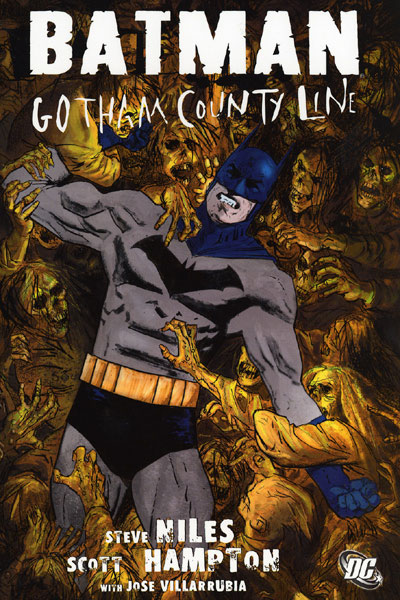
Batman: Gotham County Line


By Steve Niles & Scott Hampton, with Jose Villarrubia (DC Comics)
ISBN: 978-1-4012-0905-6 (TPB)

Many superheroes have a universal genre plasticity and can fit seamlessly into almost any kind of story. Even so, it’s almost no stretch at all to see DC’s Dark Knight tackling marauding monsters and dire demonic disaster, such as in this lost gem, long overdue for a new edition.

Released in 2006 and collecting a 3-issue miniseries (October-December 2005) by written by Steve Niles (30 Days of Night; Simon Dark; Criminal Macabre) with art by Scott Hampton (Silverheels; Batman: Night Cries; Simon Dark) and colourist Jose Villarrubia, the sinister suspense opens in ‘The Obvious Kill’ as yet another Batman-Joker clash throws up an aggravating mind-worm for the Dark Knight: is there a continuance of spirit and personality after death?

Suddenly obsessed with the notion, the manhunter’s subsequent researches are interrupted by a strange series of robbery/murders in the notionally peaceful, sleepy suburbs of the big, bad city. Reluctantly investigating, Batman overturns the police findings and discovers a serial killer at work. In the process of stopping the slaughter, Detective Radmuller of the Gotham County Sheriff’s Department is killed. He won’t be the last…

After closing the case, Batman returns to the city, unaware that the officer has subsequently risen from the dead. With unalloyed horror Batman realises that this case only really kicked into high gear after the death of the perpetrator. …

With zombies prowling the city and county – and even faithful manservant Alfred exhibiting symptoms – a nightmare-wracked but still ardently rationalistic Batman is forced to face the incredible facts of supernatural incursion by the ghost of Boston Brand – murdered aerialist and questing spirit Deadman – who accompanies him on ‘Death’s Highway’ in search of a solution to the plague of walking dead…

With life itself in retreat, Deadman, mystic guardian Phantom Stranger and recently deceased sidekick Jason (Robin) Todd hold back the hordes of unlife, allowing Batman to divine the root cause of the necromantic disaster and set the balance right again on the ‘Night of the Living Death’.

Batman is one of the few heroic icons who has always been equally at home with super-science and the supernatural and the Dark Knight’s arena is here extended to beyond the veil of tears and deep into nightmare territory.

Rife with zombies, ritual killers, early life revelations and doom-drenched guest-stars, this still manages to be a crime thriller and a detective mystery Bat-fans will enjoy and cross-over readers – especially horror aficionados – can revel in.
© 2006 DC Comics. All Rights Reserved.
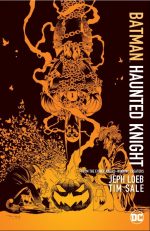
Batman: Haunted Knight


By Jeph Loeb, Tim Sale & various (DC Comics)
ISBN: 978-1 401-28486-2 (TPB)

Win’s Christmas Gift Recommendation: Timeless Seasonal Wonderment… 9/10

The creative team of Jeph Loeb & Tim Sale have tackled many iconic characters in a number of landmark tales, but their reworkings of early Batman mythology – such as The Long Halloween – must certainly rank amongst their most memorable.

Set during the Batman: Year One scenario created by Frank Miller, and originally released as a 13-part miniseries (running from Halloween to Halloween), it detailed the early alliance of Police Captain Jim Gordon, District Attorney Harvey Dent and the mysterious vigilante Batman, to destroy the unassailable mob boss who ran Gotham City: Carmine Falcone – “The Roman”.

However, even before that epic undertaking, the creators worked together on another All Hallows adventure; one that grew like Topsy to eventually become a triptych of Prestige One-Shot Specials under the aegis of Archie Goodwin’s most significant editorial project…

After the continuity-wide reset of Crisis on Infinite Earths, and with DC still in the throes of re-jigging its entire narrative history, a new Batman title launched, presenting multi-part epics refining and infilling the history of the post-Crisis hero and his entourage.

The added fillip was a fluid cast of prominent and impressively up-and-coming creators…

Batman: Legends of the Dark Knight was a fascinating experiment, even if ultimately the overall quality became a little haphazard and hit-or-miss.

Most of the early story-arcs were quickly collected as trade paperback editions – helping to jump-start the graphic novel sector of the comics industry – and the moody re-imaginings of the Gotham Guardian’s early career gave fans a wholly modern insight into the ancient yet highly malleable concept.

As explained in ‘Trick or Treat’ – Editors Goodwin’s reproduced introduction from the 1996 compilation – the first Batman: Legends of the Dark Knight Halloween Special began life as a story-arc for the monthly series before being cannily promoted to a single, stand-alone publication released for October 1993. Its success spawned the two sequels also included in this volume and the aforementioned Long Halloween epic…

Collected in one spooky stripped-down paperback and/or eBook compilation, those three scary stories comprise a raw and visceral examination of an obsessive hero still learning his trade and capable of deadly misjudgements as seen in initial yarn ‘Fears’.

Here, after spectacularly capturing terror-obsessed psychopath Jonathan Crane, the neophyte Caped Crusader leaves him to mere policemen ill-equipped to cope with the particular brand of malicious insanity cultivated by The Scarecrow…

It’s fair to say that the man behind the bat mask is distracted; still attempting to reconcile his nocturnal and diurnal activities, young Bruce Wayne is currently floundering before the seductive and sophisticated blandishments of predatory social butterfly and matrimonial black widow Jillian Maxwell. Faithful major-domo Alfred Pennyworth is not so easily swayed, however…

Left too much to his own devices, Scarecrow has run wild through Gotham, but when he abducts Gordon, he at last makes a mistake the Dark Knight can capitalise upon…

One year later another Halloween brings ‘Madness’ as rebellious teen Barbara Gordon choses exactly the wrong moment to run away from home: a night when her dad’s mysterious caped pal is frantically hunting Jervis Tetch – a certified nutcase abducting runaways to attend decidedly deadly Tea Parties orchestrated by a truly Mad Hatter…

Steeped in personal nostalgia as a maniac rampages through his city, inadvertently trampling upon some of Bruce Wayne’s only happy memories (of his mother’s favourite book), the heroic pursuer almost dies at the hands of the Looking Glass Loon, only to be saved by unlikely angel Leslie Thompkins – another woman who will loom large in the future life of the Batman…

The final fable here pastiches a Christmas classic by Charles Dickens as ‘Ghosts’ sees a delirious Bruce Wayne uncharacteristically taking to his bed early on the night before Halloween.

After socialising with young financier Lucius Fox, eating bad shrimp and crushing baroque bird bandit The Penguin, our sick and weary playboy lapses into troubled sleep, only to be visited by three spectres…

Looking like Poison Ivy, The Joker and the corpse of Batman himself, whilst representing Past, Present and inescapable Future, these phantoms prove that only doom awaits unless the overachieving hero strikes a balance – or perhaps truce – between his two divergent identities…

Trenchant with narrative foreboding – long-time fans already know the tragedies in store for all the participants, although total neophytes won’t be left wondering – these eerily enthralling Noir thrillers by Loeb perfectly capture the spirit of the modern Batman, supremely graced with startlingly powerful images of Mood, Mystery and rampant Mayhem from the magic pencil and brush of Tim Sale, vividly augmented by the colours of Gregory Wright and lettering of Todd Klein.

Adding lustre to these moody proceedings are a gallery of prior covers culled from earlier collections as well as a Sale Batman sketch, making this one of the very best Batman books you could read.
So, do…
© 1993, 1994, 1995, 2014, 2018 DC Comics. All Rights Reserved.
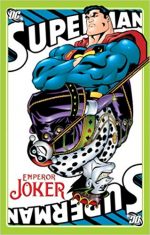
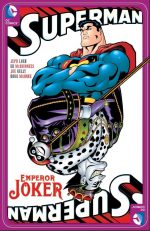
Superman: Emperor Joker

By Jeph Loeb, J.M. DeMatteis, Mark Schultz, Joe Kelly, Ed McGuinness, Mike Miller, Doug Mahnke, Kano, Duncan Rouleau, Todd Nauck, Carlo Barberi, Scott McDaniel & various (DC Comics)
ISBN: 978-1-4012-1193-6 (TPB)

In the arena of superhero stories, the terms of narrative are often determined more by the antagonists than the gaudily costumed champions doggedly duelling with them. That’s never been more apparent than in tales featuring the Clown Prince of Crime such as this one…

Originally available as a trade paperback and now in a selection of digital formats, this outlandish yarn collectively spans September and October 2000, as originally published in Superman #160-161, Adventures of Superman #582-583, Superman: The Man of Steel #104-105, Action Comics #769-770 and Emperor Joker #1.

First 4-part story arc Superman: Arkham begins in Superman #160 with ‘It’s a Mad, Mad, Mad World!’ by Jeph Loeb, Ed McGuinness & Cam Smith. The night is broken with hideous screams. Every night.

A black-clad maniac dubbed Superman smashes out of grim asylum Arkham, only to be subdued again and re-incarcerated by warped clone Bizarro before day breaks.

Every night a diminutive and greatly distracted pixie of a man dashes to an appointment only to be hit by a train, or a giant weight or something else gigantic, weighty and somehow non-fatal…

In a sky that rains custard pies hangs a moon with the Joker‘s face. What is going on and when will it all end?

The madness spreads to Adventures of Superman #582 and ‘Crazy About You’ (by J.M. DeMatteis, Mike Millar & José Marzan Jr.) where unlikely nun Supergirl is tormented by visions whilst evil billionaire genius Lois Lane sets her incomparable intellect to solving the mystery of the constant Arkham escapee.

A ghastly warped convocation of the JLA resumes their terrorising activities as Superman: The Man of Steel #104 ‘No Axioms’ (Mark Schultz, Doug Mahnke, Tom Nguyen & John McCrea) sees the perennial escapee meet up with inspirational inventor armourer John Henry Irons; a man afflicted with astounding ideas and concepts torturously leaking out of his brain. As he strives to create a suit of Steel to aid the prisoner, Bizarro and the powered-up posse attack…

And elsewhere the little man remembers who he is. Now there’s a ghost of a chance to save and correct Reality…

Forced to toil as ineffectual fast-food peon Super Burger Boy, rebel teen Conner Kent witnesses a war between wonder beings and his clouded thoughts stir in ‘SupermanamrepuS’ (Joe Kelly, Kano & Marlo Alquiza from Action Comics #769). As Irons and the prisoner invade the JLA’s moon citadel, the kid’s powers revive too…

When 5th Dimensional trickster Mr. Mxyzptlk finally arrives to beg the Men of Steel’s assistance, they initially assume he’s the cause of the universe’s woes… until he makes them look at the Earth they’ve just come from…

Answers if not solutions are forthcoming in Emperor Joker #1. ‘It’s a Joker World, Baby, We Just Live in it!’ by Kelly, Loeb, Duncan Rouleau, Todd Nauck, Carlo Barberi, Scott McDaniel, Alquiza, Jaime Mendoza & Richard Bonk reveals how the beyond-deranged Harlequin of Hate appropriated the immeasurable power of Mxyzptlk, what he did with it and how his whimsical changes are threating all existence.

As the crisis encompasses a host of transformed and tormented guest stars, the disparate remnants of the former Superman Family launch a desperate last-ditch scheme to save everything, leading to closing story arc ‘The Reign of Emperor Joker’ and beginning with Superman #161.

Loeb, McGuinness & Smith’s ‘You Say You Want a Revolution?’ finds Superboy, Supergirl and the Action Ace picking off the Joker’s minions and invading his awesome Hahacienda, only to discover what the Joker has done to his greatest obsession The Batman…

The infernal realms are assaulted and overturned in Adventures of Superman #583’s ‘Life is but a (Very Bad) Dream’ (DeMatteis, Millar & Armando Durruthy), resulting in a shocking resurrection and counterstrike before even more unlikely revivals converge on the mad clown in ‘All the World His Stage’ (by Schultz, Mahnke & Nguyen from Superman: The Man of Steel #105).

After an inconceivable final battle that rocks all reality, the universe is set aright in Action Comics #769-770’s ‘He Who Laughs Last’ by Kelly, Kano & Marlo Alquiza, but don’t think for a moment that all’s right with the world…

Although not a new plot, this tale of a time and place where compulsively interventionist god the Joker employs Fifth dimensional magic to literally remake creation in his own image just so he can torture the heroes who have so often thwarted him, actually works. Maintaining breakneck pace and peppering the action with in-jokes and sly asides, the narrative of Superman under terminal pressure to save the universe is truly gripping and the eventual denouement actually succeeds in both contextual terms and delivery of a powerful payoff. This is a marvellous piece of comic eye-candy.

Although taken from a particularly grim and humourless period in Superman history, this thinly disguised tribute to the zany genius of Chuck Jones, Tex Avery and those wacky Warner Brothers cartoons reads like a breath of fresh air when gathered together in one collection and comes with closing contrary codicil ‘The Codex Comicon’ from Joe Kelly under his nom de plume Professor B. Zarro.
Thrilling, fun and full of perfect comics moments, this is a book every Fights ‘n’ Tights fan should have.
© 2000, 2007, 2016 DC Comics. All Rights Reserved.
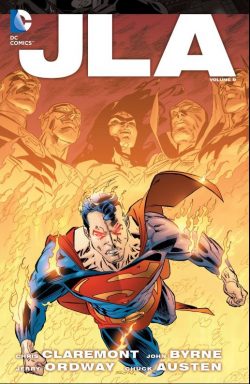
JLA Deluxe volume 8

By Chris Claremont, Chuck Austen, Joe Kelly, John Byrne, Ron Garney, Doug , Jerry Ordway, Tom Nguyen & various (DC Comics)
ISBN: 978-1-4012-6342-3 (TPB)

When the Justice League of America – driving force and cornerstone of the Silver Age of Comics – were relaunched in 1997, the sheer bravura quality of the stories propelled the series back to the forefront of industry attention, making as many new fans as it recaptured old ones. However, fans are fickle and the intoxicating sheen of “fresh and new” never lasts. By the time of these tales – spanning May to November 2004 from JLA #94-106 plus material from JLA Secret Files 2004 #1 – there had been numerous changes of creative personnel… usually a bad omen… and a certain straying from the clear missions of the earliest adventures…

As you’ve come to expect by now, this volume is available in all digital formats as well as traditional trade paperback…

After battling all manner of contemporary and futuristic foes, in ‘Suffer the Little Children’ the World’s Greatest Superheroes now find themselves pitted against an ancient malevolence from out of Earth’s oldest nightmares. Contrived by a trio of the industry’s biggest talents – Chris Claremont, John Byrne & Jerry Ordway – the expansive saga originally ran in issues #94-99 of the monthly title.

When team mystic Manitou Raven divines that a great evil has come hunting, he is suddenly silenced before he can warn his comrades. As Batman and Flash follow a rash of global child disappearances, Superman is astonishingly defeated by a pair of strange juvenile runaways.

Comparing notes with other JLA members the heroes discover a pattern of metagenic abductions: someone or something is taking super-powered children…

Meanwhile an enthralled Man of Steel has become the slave – and ambulatory lunchbox – of diabolical vampire lord Crucifer, whose race of undying leeches has been secretly working to conquer the world since their initial defeat and extra-dimensional banishment by the Amazon warriors of Themyscira thousands of years previously.

‘The Enemy Within’ sees team boffin The Atom lost in a microverse within a magic artefact and meeting a lost race with a hidden connection to the crisis, even as a mysterious third force of freaks maneuverers for advantage in the background. When Wonder Woman consults ancient scroll records she is betrayed and attacked by her closest ally and the crucial data is erased…

As the beleaguered and outclassed heroes strive to cope, ‘The Heart of the Matter’ sees Martian Manhunter use his unique gifts to trace the Atom, but even as master tactician Batman works to counter the infallible plans of their hidden enemy, his ace in the hole Faith falls to Crucifer’s power…

And in the background, that shady band of outcasts undertakes their own plan to save the day…

‘Interludes on the Last Day of the World!’ sees the vampire resurgence edge ever closer. With Crucifer’s abducted metahuman victims acting as shock troops and physical hosts for the bloodsucking arcane exiles, the embattled remnants of the JLA reconsolidate and ally themselves with the skulking outsiders watching them, just as the vampire lord opens a hole into hell and bids his kin to freely enter…

The fightback begins in ‘Convergence’ with the rescue of the Atom whose fresh data provides the answer to the mystery of Crucifer’s seeming invulnerability, leading to a mass assault and ultimate victory by the competing teams of heroes in ‘Heartbreaker!’

The former X-Men creative team supreme reunited for this supernatural romp, but their old magic was sorely lacking: Byrne co-writing with Claremont and pencilling for the criminally underappreciated Jerry Ordway to ink and embellish is a far better “look” than “read”.

Comic fans love these sorts of nostalgia stunts, but sadly, the results here don’t really live up to expectations, resulting in a competent but predictable heroes-versus-vampires yarn that suffers greatly because it’s painfully obvious that the whole thing is a high-profile, extended gimmick designed to kick-start Byrne’s then-forthcoming reinvention of the Doom Patrol, and not really a JLA story at all…

Most comic books – indeed all popular fiction – are a product of or reaction to the times in which they are created. In the grim, authoritarian, morally ambiguous climate of post 9-11 America writer Joe Kelly wrote an issue of Action Comics (#775) addressing the traditional ethics and practices of ultimate boy scout Superman in a world where old values were seen as a liability and using “The Enemy’s” own tactics against them was viewed with increasing favour by the public.

‘What’s So Funny about Truth, Justice and the American Way’ (not included here) introduced super-Esper Manchester Black and his team of Elite metahumans who responded proactively and with extreme overkill to global threats and menaces in such a drastic and final manner that Superman was forced to take a long, hard look at his core beliefs before triumphing over a team who saw absolutely no difference between villains, monsters or people who disagreed with them…

In a distressing sign of those times, The Elite proved so overwhelmingly popular that they returned in JLA #100. ‘Elitism’ – by Kelly, Doug Mahnke & Tom Nguyen – depicts how the team, led now by Black’s cyborg sister Vera, at first oppose and eventually cooperate with the traditionally-minded JLA to save Earth from a catastrophic ecological and metaphysical meltdown – but all is not as it seems…

Vera Black correctly assesses the fundamental flaws in her methodology but also similar weaknesses in the JLA’s. She proposes becoming the League’s “Black Ops” division, gathering intel, working undercover and decisively dealing with potential threats before they become global crises. Her team will get their hands dirty in a way the JLA simply cannot afford to…

Over Superman’s protests, but with stringent oversight in place and using a combination of Elite and League volunteers, the plan is adopted and Justice League Elite subsequently won their own 12-issue series with Major Disaster, Green Arrow, Manitou Raven, and Flash joining Vera, energy manipulator Coldcast, human bio-weapon arsenal Menagerie and Naif al-Sheikh (a human spymaster who acts as): Director, Adjudicator and Conscience for a unit designed to neutralise organizations and nations that threaten World Security before things ever reach a boiling point.

JLA Secret Files 2004 develops the controversial theme in ‘Same Coin’, by Kelly, Byrne, Mahnke & Nguyen, wherein the two teams work separately – and mostly at odds – to stop a Hitlerian Ragnarok from occurring thanks to illicit use of mystic doomsday weapon the Spear of Destiny…

Getting over a post-celebration hump is always tricky for a long-running comic series. An anniversary or centenary is usually celebrated by some large-scale cosmos-shaking exploit which it’s impossible to top, leading to an anti-climactic “day in the life” venture. In the case of story arc Pain of the Gods – reprinting JLA #101-106 – Chuck Austen & Ron Garney take that hoary tradition, and indeed the equally tired plot of heroes’ soul-searching angst after a failure to succeed, and run with it to produce a stirring, potent exploration of humanity too often absent in modern adventure fiction.

Each chapter deals with an emotional crisis affecting an individual Leaguer who fails to save a life, beginning with Superman in ‘Man of Steel’ as the perfect hero misjudges the abilities of a new costumed champion and witnesses the wannabe hero perish in explosive conflagration…

‘Scarlet Speedster’ treads similar ground as Flash misses two children whilst evacuating a burning building and Green Lantern misjudges the homicidal determination of a domestic abuser in ‘Emerald Gladiator’. Throughout each of these tragedies a single family reappears; fuelling the emotional turmoil pushing each hero into obsession and psychosis.

In ‘Manhunter from Mars’ team telepath and philosophical lynchpin J’onn J’onzz is forced to confront the life-long emotional barriers distancing him from his companions and resulting from surviving the death of his entire species, whilst Wonder Woman faces her own mortality whilst battling a super-killer in ‘Amazonian Warrior’ before Batman ultimately must acknowledge that he can’t know and do everything alone in ‘The Dark Knight’

The entire story can be viewed as a treatise on fallibility and post-traumatic distress with superheroes acting as metaphors for Police and Firemen, and the cleverly-inserted sub-plot of a seemingly mundane family seeking redress plays well against the tragic grandeur of the stars. It’s grand to see a superhero tale that thinks with a heart rather than acts with gaudily gloved fists for a change…

The JLA – in all its incarnations – has endured a long history of starting strong but losing focus, and particularly of coasting by on past glories for extended periods. Luckily the team still had a few more tricks left during this period and a little life in it before the inevitable demise and reboot for the next generation after Final Crisis: offering plenty of fun and thrills for casual readers and full-on fans alike.
© 2004, 2016 DC Comics. All Rights Reserved.
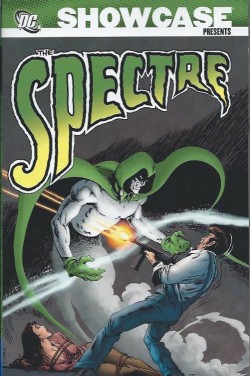
Showcase Presents the Spectre volume 1


By Gardner F. Fox, Bob Haney, Mike Friedrich, Steve Skeates, Dennis J. O’Neil, Mark Hanerfeld, Michael L. Fleisher, Len Wein, Paul Kupperberg, Mike W. Barr, Murphy Anderson, Carmine Infantino, Ross Andru & Mike Esposito, Neal Adams, Jerry Grandenetti, Jack Sparling, Bernie Wrightson, Jim Aparo, Frank Thorne, Ernie Chan, Jim Starlin, Michael R. Adams & various (DC Comics)
ISBN: 978-1-4012-3417-1 (TPB)

Created by Jerry Siegel & Bernard Baily in 1940 and debuting via a 2-part origin epic in More Fun Comics #52 and 53, The Spectre is one of the oldest characters in DC’s vast character stable. Crucially, just like Siegel’s other iconic creation, he soon began to suffer from a basic design flaw: he was just too darn powerful.

Unlike Superman however, this relentless champion of justice was already dead, so he can’t really be logically or dramatically imperilled. Of course, in those far off early days that wasn’t nearly as important as sheer spectacle: forcibly grabbing the reader’s utter attention and keeping it stoked to a fantastic fever pitch.

Starting as a virtually omnipotent phantom, the Grim Ghost evolved, over various revivals, refits and reboots into a tormented mortal soul bonded inescapably to the actual embodiment of the biblical Wrath of God.

The story is a genuinely gruesome one: police detective Jim Corrigan is callously executed by gangsters before being called back to the land of the living. Commanded to fight crime and evil by a glowing light and disembodied voice, he was indisputably the most formidable hero of the Golden Age.

He has been revamped many times, and in the 1990s was revealed to be God’s own Spirit of Vengeance wedded to a human conscience. When Corrigan was finally laid to rest, Hal (Green Lantern) Jordan and murdered Gotham City cop Crispus Allen replaced him as the mitigating conscience of the unstoppable, easily irked force of Divine Retribution…

However, the true start of that radically revitalised career began in the superhero-saturated mid-1960s when, hot on the heels of feverish fan-interest in the alternate world of the Justice Society of America and Earth-2 (where all the WWII heroes retroactively resided), DC began trying out solo revivals of 1940’s characters, as a counterpoint to such wildly successful Silver Age reconfigurations as Flash, Green Lantern, Atom and Hawkman…

This sublime and colossal Showcase selection collects and documents the almighty Man of Darkness’ return in the Swinging Sixties, his landmark reinterpretation in the horror-soaked, brutalised 1970s and even finds room for some later appearances before the character was fully de-powered and retrofitted for the post-Crisis on Infinite Earths DC Universe.

As such, this mammoth monochrome tome (624 peril-packed pages!) contains Showcase #60, 61 and 64; The Spectre #1-10; team-up tales from The Brave and the Bold #72, 75, 116, 180 & 199 and DC Comics Presents #29; the lead strips from Adventure Comics #431-440 and one last hurrah from horror-anthology Ghosts #97-99, cumulatively encompassing the end of 1965 to the middle of 1983.

DC had tried a number of Earth-2 team-iterations (Starman/Black Canary – with Wildcat – in The Brave and the Bold #61-62, whilst Showcase #55 & 56 spotlighted Doctor Fate & Hourman with a cameo from the original Green Lantern), but inspirational editor Julie Schwartz and scripter Gardner F. Fox only finally achieved their ambition to launch a Golden Age hero into his own title with the revival of the Ghostly Guardian in Showcase. It was hard going and perhaps ultimately benefited from a growing general public interest in supernatural stories…

After three full length appearances and many guest-shots, The Spectre won his own solo series at the end of 1967, just as the super-hero craze went into a steep decline, but arguably Showcase #60 (January/February 1966) anticipated the rise of supernatural comics by re-introducing Corrigan and his phantom passenger in ‘War That Shook the Universe’ by Earth-2 team supreme Fox & illustrator Murphy Anderson.

This spectacular saga reveals why the Heroic Haunt had vanished two decades previously, leaving the fundamentally human Corrigan to pursue his war against evil on merely mortal terms – until a chance encounter with a psychic investigator frees the spirit buried deep within him.

A diligent search reveals that, 20 years previously, a supernal astral invader broke into the Earth plane and possessed a mortal, but was so inimical to our laws of reality that both it and the Grim Ghost were locked into their meat shells – until now…

Thus began a truly spectre-acular (feel free to groan, but that’s what they called it back then) clash with the devilish Azmodus that spans all creation and blew the minds of us gobsmacked kids…

Issue #61 (March/April) upped the ante when the even-more satanic Shathan the Eternal subsequently insinuates himself into our realm from ‘Beyond the Sinister Barrier’, stealing mortal men’s shadows until he is powerful enough to conquer the physical universe. This time The Spectre treats us to an exploration of the universe’s creation before narrowly defeating the source of all evil…

The Sentinel Spirit re-manifested in Showcase #64 (September/October 1966) for a marginally more mundane but no less thrilling adventure when ‘The Ghost of Ace Chance’ takes up residence in Jim’s body. By this time, it was established that ghosts need a mortal anchor to recharge their ectoplasmic “batteries”, and this unscrupulous crooked gambler is determined to inhabit the best frame available…

The try-out run concluded, the editors sat back and waited for sales figures to dictate the next move. When they proved inconclusive Schwartz orchestrated a concerted publicity campaign to further promote Earth-2’s Ethereal Adventurer.

The Brave and the Bold #72 (June/July 1967) saw the Spectre clash with Earth-1’s Scarlet Speedster in ‘Phantom Flash, Cosmic Traitor’ (by Bob Haney, Carmine Infantino & Charles “Chuck” Cuidera). This sinister saga sees the mortal meteor arcanely transformed into a sinister spirit-force and power-focus for unquiet American aviator Luther Jarvis who returns from his death in 1918 to wreak vengeance on the survivors of his squadron – until the Spectre intervenes…

Due to the vagaries of comicbook scheduling, Brave and the Bold #75 (December 1967/January 1968) appeared at around the same time as The Spectre #1, although the latter had a cover-date of November/December 1967. In the Batman team-up tale – scripted by Haney and drawn by Ross Andru & Mike Esposito – Ghostly Guardian joins Dark Knight to free Gotham City’s Chinatown from ‘The Grasp of Shahn-Zi!’: an ancient oriental sorcerer determined to prolong his reign of terror at the expense of an entire community and through the sacrifice of an innocent child, after which the Astral Avenger finally, simultaneously, debuted in his own title…

The Spectre #1 featured ‘The Sinister Lives of Captain Skull’ by Fox & Anderson, divulging how the botched assassination of American Ambassador Joseph Clanton and an experimental surgical procedure allows one of the diplomat’s earlier incarnations to seize control of his body and, armed with mysterious eldritch energies, run amok on Earth.

These “megacyclic energy” abilities enable the revenant to harm and potentially destroy the Ghostly Guardian and compel the Spectre to pursue the piratical Skull through a line of previous lives until he can find their source and purge the peril from all time and space…

With issue #2 (January/February 1968) artistic iconoclast Neal Adams came aboard for the Fox-scripted mystery ‘Die Spectre – Again’ wherein crooked magician Dirk Rawley accidentally manifests his etheric self and severely tests both Corrigan and his phantom lodger as they seek to end the double-menace’s string of crimes, mundane and magical. At this time, the first inklings of a distinct separation and individual identities began. The two halves of the formerly sole soul of Corrigan were beginning to disagree and even squabble…

Neophyte scripter Mike Friedrich joined Adams for #3’s ‘Menace of the Mystic Mastermind’ wherein pugilistic paragon Wildcat faces the inevitable prospect of age and infirmity even as an inconceivable force from another universe possesses petty thug Sad Jack Dold, turning him into a nigh-unstoppable force of cosmic chaos…

‘Stop that Kid… Before He Wrecks the World’ was written & illustrated by Adams with a similar trans-universal malignity deliberately empowering a young boy as a prelude to its ultimate conquest, whilst #5’s ‘The Spectre Means Death?’ (all Adams again) appears to show the Ghostly Guardian transformed into a pariah and deadly menace to society, until Jim’s investigations uncover the emotion-controlling Psycho Pirate at the root of the Heroic Haunt’s problems…

Despite all the incredible talent and effort lavished upon it, The Spectre simply wasn’t finding a big enough audience. Adams left for straight superhero glory elsewhere and a hint of changing tastes came as veteran illustrator of horror comics Jerry Grandenetti came aboard.

Issue #6 (September/October 1968) saw his eccentric, manic cartooning adding raw wildness to the returning Fox’s moody thriller ‘Pilgrims of Peril!’ Murphy Anderson also re-enlisted, applying a solid ink grounding to the story of a sinister quartet of phantom Puritans who invade the slums of Gateway City, driving out the poor and hopeless as they hunt long-lost arcane treasures. These would allow demon lord Nawor of Giempo access to Earth unless The Spectre can win his unlife or death duel with the trans-dimensional horror…

As the back of issue #7 was dedicated to a solo strip starring Hourman (not included in this collection), The Spectre saga here – by Fox, Grandenetti & Anderson – was a half-length tale which followed the drastic steps necessary to convince the soul of bank-robber Frankie Barron to move on. Since he was killed during a heist, the astral form of aversion therapy used to cure ‘The Ghost That Haunted Money!’ proves not only ectoplasmically effective but outrageously entertaining…

Issue #8 (January/February 1969) was scripted by Steve Skeates and began a last-ditch and obviously desperate attempt to turn The Spectre into something the new wave of anthology horror readers would buy.

As a twisted, time-lost apprentice wizard struggles to return to Earth after murdering his master and stealing cosmic might from the void, on our mundane plane an exhausted Ghostly Guardian neglects his duties and is taken to task by his celestial creator.

As a reminder of his error, the Penitent Phantasm is burdened by a fluctuating weakness – which would change without warning – to keep him honest and earnest. What a moment for the desperate disciple Narkran to return then; determined to secure his elevated god-like existence by securing ‘The Parchment of Power Perilous!’…

The Spectre #9 completed the transition, opening with an untitled short from Friedrich (illustrated by Grandenetti & Bill Draut) which sees the Man of Darkness again overstep his bounds by executing a criminal. This prompts Corrigan to refuse the weary wraith the shelter of his reinvigorating form and when the Grim Ghost then assaults his own host form, the Heavenly Voice punishes the spirit by chaining him to the dreadful Journal of Judgment: demanding he atone by investigating the lives inscribed therein in a trial designed to teach him again the value of mercy…

The now anthologised issue continued with ‘Abraca-Doom’ (Dennis J. O’Neil & Bernie Wrightson) as The Spectre attempts to stop a greedy carnival conjurer signing a contract with the Devil, whilst ‘Shadow Show’ – by Mark Hanerfeld & Jack Sparling – details the fate of a cheap mugger who thinks he can outrun the consequences of a capital crime…

The next issue gave up the ghost. The Spectre folded with #10 (May/June 1969), but not before a quartet of tantalising tales by – writer or writers unknown – shows what might have been…

‘Footsteps of Disaster’ with art from Grandenetti & George Roussos, follows a man from cradle to early grave, revealing the true wages of sin, whilst ‘Hit and Run’ (probably drawn by Ralph Reese) proves again that the Spirit of Judgment is not infallible and even human scum might be redeemed…

‘How Much Can a Guy Take?’ (Sparling) offers salvation to a shoeshine boy pushed almost too far by an arrogant mobster before the series closed with a cunning murder mystery involving what appeared to be a killer ventriloquist’s doll in the Grandenetti & Roussos limned ‘Will the Real Killer Please Rise?’

With that the Astral Avenger returned to comicbook limbo for nearly half a decade until changing tastes and another liberalising of the Comics Code saw him arise as lead feature in Adventure Comics #431 (January/February 1974) for a shocking run of macabre, ultra-violent tales from Michael L. Fleisher & Jim Aparo.

‘The Wrath of… The Spectre’ offered a far more stark, unforgiving take on the Sentinel Spirit; reflecting the increasingly violent tone of the times. Here, a gang of murderous thieves slaughter the crew of a security truck and are tracked down by a harsh, uncompromising police lieutenant named Corrigan. When the bandits are exposed, the cop unleashes a horrific green and white apparition from his body which inflicts ghastly punishments that horrendously fit their crimes…

With art continuity (and no, I’m not sure what that means either) from Russell Carley, the draconian fables continue in #432 as in ‘The Anguish of… The Spectre’ assassins murder millionaire Adrian Sterling and Corrigan meets the victim’s daughter Gwen. Although the now-infallible Wrathful Wraith soon exposes and excised the culprits, the dead detective has to reveal his true nature to the grieving daughter. Moreover, Corrigan begins to feel the stirring of impossible, unattainable yearnings…

Adventure #433 exposed ‘The Swami and… The Spectre’ as Gwen seeks spiritual guidance from a ruthless charlatan who promptly pays an appalling price when he finally encounters an actual ghost, whilst in #434 ‘The Nightmare Dummies and… The Spectre’ (with additional pencils by the great Frank Thorne), a plague of department store mannequins run wild in a killing spree at the behest of a crazed artisan who believes in magic – but can’t imagine the cost of his dabbling…

Issue #435 introduces journalist Earl Crawford who tracks the ghastly fallout of the vengeful spirit’s anti-crime campaign as ‘The Man Who Stalked The Spectre!’ Of course, once he sees the ghost in grisly action, Crawford realises the impossibility of publishing this scoop…

Adventure #436 finds Crawford still trying to sell his story as ‘The Gasmen and… The Spectre’ sets the Spectral Slaughterman on the trail of a gang who kill everyone at a car show as a simple demonstration of intent before blackmailing the city. Their gorily inescapable fate only puts Crawford closer to exposing Corrigan, after which, in #437’s ‘The Human Bombs and… The Spectre’ (with pencils from Ernie Chan & Aparo inks) a kidnapper abducts prominent persons – including Gwen – to further a merciless mad scheme of amassing untold wealth… until the Astral Avenger ended the depredations forever…

In #438, ‘The Spectre Haunts the Museum of Fear’ (Chan & Aparo again) sees a crazed taxidermist turning people into unique dioramas until the Grim Ghost intervenes, but the end was in sight again for the Savage Shade. Issue #439’s ‘The Voice that Doomed… The Spectre’ (all Aparo) turns the wheel of death full circle, as the Heavenly Presence who created him allows Corrigan to fully live again so that he can marry Gwen. Sadly, it is only to have the joyous hero succumb to ‘The Second Death of The… Spectre’ (#440, July/August 1975) and tragically resume his never-ending mission…

This milestone serial set a stunning new tone and style for the Ghostly Guardian which has informed each iteration ever since…

From midway through that run, Brave and the Bold #116 provides another continuity-coshing supernatural team-up with Batman – a far less graphically violent struggle against the ‘Grasp of the Killer Cult’ (Haney & Aparo). When Kali-worshipping Thugs from India seemingly target survivors of a WWII American Army Engineer unit, Detective Corrigan and the Dark Knight clash on both the method and motives of the mysterious murderers…

DC Comics Presents #29 (January 1981, by Len Wein, Jim Starlin & Romeo Tanghal) revealed what happened after Supergirl is knocked unconscious during a cataclysmic battle and sent hurtling through dimensions measureless to man. When her cousin tries to follow, the Ghostly Guardian is dispatched to stop the Metropolis Marvel from transgressing ‘Where No Superman Has Gone Before’…

By the early 1980s, the horror boom had again exhausted itself and DC’s anthology comics were disappearing. As part of the effort to keep them alive, Ghosts featured a 3-part serial starring “Ghost-Breaker” and inveterate sceptic Dr. Terry 13 who at last encounters ‘The Spectre’ in issue #97 (February 1981, by Paul Kupperberg, Michael R. Adams & Tex Blaisdell), wherein terrorists invade a high society séance and are summarily dispatched by the inhuman poetic justice of the freshly-manifested Astral Avenger…

Now determined to destroy the monstrous revenant vigilante, Dr. 13 returns in #98 as ‘The Haunted House and The Spectre’ finds the Ghost-Breaker interviewing Earl Crawford and subsequently discovering the long-sought killer of his own father. Before 13 can act however, the Spectre appears and steals his justifiable retribution from the aggrieved psychic investigator…

The drama closed in Ghosts #99 as ‘Death… and The Spectre’ (inked by Tony DeZuñiga) sees scientist and spirit locked in one final furious confrontation.

This staggering compendium of supernatural thrillers concludes with two more team-up classics from Brave and the Bold, beginning with ‘The Scepter of the Dragon God’ by Fleisher & Aparo (from #180, November 1980). Although Chinese wizard Wa’an-Zen steals enough mystic artefacts to conquer Earth and destroy The Spectre, he gravely underestimates the skill and bravery of merely mortal Batman, whilst in #199 (June 1983) ‘The Body-napping of Jim Corrigan’ (Mike W. Barr, Andru & Rick Hoberg), finds the ethereal avenger baffled by the abduction and disappearance of his mortal host. Even though he cannot trace his own body, the Spectre knows where the World’s Greatest Detective hangs out…

Ranging from fabulously fantastical to darkly, violently enthralling, these comic masterpieces perfectly encapsulate the way superheroes changed over a brief 20-year span, but remain throughout some of the most beguiling and exciting tales of DC’s near-80 years of existence. If you love comicbooks you’d be crazy to ignore this one…
© 1966, 1967, 1968, 1969, 1974, 1975, 1981, 1983, 2012 DC Comics. All Rights Reserved.