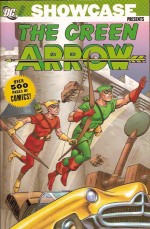
Showcase Presents Green Arrow volume 1


By France Herron, Dave Wood, Jack Kirby, George Papp, Lee Elias & various (DC Comics)
ISBN: 978-1-4012-0785-4

Green Arrow is one of DC’s Golden All-Stars: a fixture of the company’s landscape, in many instances for no discernable reason, more or less continually since his debut in 1941. He was originally created by Mort Weisinger and George Papp for More Fun Comics # 73 as an attempt to expand the company’s superhero portfolio, and in the early years proved quite successful. The bowman and boy partner Speedy were two of the few costumed heroes to survive the end of the Golden Age.

His blatant recombination of Batman and Robin Hood seemed to have very little going for itself but the Emerald Archer has somehow always managed to keep himself in vogue. He carried on adventuring in the back of other heroes’ comicbooks, joined the Justice League of America at the peak of their fame and became the spokes-hero of the anti-establishment generation during the 1960’s “Relevancy Comics” trend, courtesy of Denny O’Neil and Neal Adams.

Under Mike Grell’s stewardship and thanks to the epic miniseries Green Arrow: the Longbow Hunters (DC’s second ‘Prestige Format Mini-Series’ after the groundbreaking success of Miller’s Batman: The Dark Knight Returns) he at last became a headliner: an urban predator dealing with corporate thugs and serial killers rather than costumed goof-balls.

After his long career and a few venue changes, by the time Julie Schwartz’s revivification of the Superhero genre the Emerald Archer was solid second feature in both Adventure and World’s Finest Comics where, as part of the wave of retcons, reworkings and spruce-ups the company administered to all their remaining costumed old soldiers, a fresh start began in the summer of 1958…

This splendidly eclectic collection of the peripatetic Bowman’s perennial second string exploits gathers the pertinent material from Adventure Comics #250-269, World’s Finest Comics #95-140, Justice League of America #4 and his guest-shots in Brave and the Bold #50, 71 and 85, covering the period July 1958 to September 1969.

Part of that revival happily coincided with the return to National Comics of Jack Kirby after the collapse of Mainline: the comics company he and partner Joe Simon had created as part of the Crestwood/Prize publishing combine.

Not long after that groundbreaking move the industry was hit by the Comics Code censorship controversy and a sales downturn that hit many creators very, very hard…

This stunning monochrome compendium opens with ‘The Green Arrows of the World’ (by scripter Dave Wood and Jack with wife Roz inking) wherein heroic masked archers from many nations attended a conference in Star City unaware that a fugitive criminal was lurking within their midst, whilst that same month George Papp illustrated the anonymously scripted ‘Green Arrow vs Red Dart’ in World’s Finest Comics #95, a dashing tale of the Ace Archer’s potential criminal counterpart and his inevitable downfall.

Adventure #251 took a welcome turn to fantastic science fiction as Ed Herron & the Kirbys resolved ‘The Case of the Super-Arrows’ wherein the heroes took possession of high-tech trick shafts from 3000AD, whilst WFC #96 (writer unknown) revealed ‘Five Clues to Danger’ – a classic kidnap mystery made even more impressive by Kirby’s lean, raw illustration.

A rare continued case spanned Adventure‘s #252 and 253 as Wood, Jack & Roz revealed ‘The Mystery of the Giant Arrows’ before Green Arrow and Speedy temporarily became ‘Prisoners of Dimension Zero’ – a spectacular riot of giant aliens and incredible exotic otherworlds, followed in WF #97 with a grand old-school crime-caper in Herron’s ‘The Mystery of the Mechanical Octopus’.

Kirby was going from strength to strength and Adventure #254’s ‘The Green Arrow’s Last Stand’, written by Wood, is a particularly fine example as the Bold Bowmen crashed into a hidden valley where Sioux braves had thrived unchanged since the time of Custer whilst the next issue saw them battle a battalion of Japanese soldiers who refused to surrender their island bunker in ‘The War That Never Ended’ (also by Wood).

World’s Finest #98 almost ended the heroes’ careers in Herron’s ‘The Unmasked Archers’ wherein a practical joke caused the pair to expose themselves to public scrutiny and deadly danger…

During those heady days origins weren’t as important as imaginative situations, storytelling and just plain getting on with it, so co-creators Weisinger & Papp never bothered to provide one, leaving later workmen Herron, Jack & Roz (in Kirby’s penultimate tale before devoting all his energies to the fabulous newspaper strip Sky Masters) to fill in the blanks with ‘The Green Arrow’s First Case’ as the Silver Age superhero revival hit its stride in Adventure Comics #256 (January 1959).

Here we learned how wealthy wastrel Oliver Queen was cast away on a deserted island and learned to use a hand-made bow simply to survive. When a band of scurvy mutineers fetched up on his desolate shores Queen used his newfound skills to defeat them and returned to civilisation with a new career and secret purpose…

Adventure #257’s ‘The Arrows That Failed’ saw a criminal mastermind tamper with the archer’s equipment in a low-key but intriguing yarn by an unknown scripter, most memorable for being the first artistic outing for golden-age great Lee Elias who would become the strip’s sole artist until its demise after Kirby’s spectacular swan-song in WF #99. ‘Crimes Under Glass’ was written by Robert Bernstein and found the GA and Speedy battling cunning criminals with a canny clutch of optical armaments.

Adventure Comics #258 (March 1959) featured a rare cover appearance for the Emerald Archer as he guest-starred in the lead feature ‘Superboy Meets the Young Green Arrow’ by Jerry Coleman & Papp, after which inspiring boyhood on-the-job training the mature bowman then schooled a lost patrol of soldiers in Toxophily (that’s posh talk for archery, folks), desert survival and crime-busting in ‘The Arrow Platoon’: another anonymously scripted yarn limned by Elias.

The same month in WF #100 the Emerald Avenger faced light-hearted lampoonery and sinister larcenists in ‘The Case of the Green Error Clown’ by Herron and the now-firmly entrenched Elias, whilst Adventure #259 showed that ‘The Green Arrow’s Mystery Pupil’ had ulterior and sinister motives for his studies whilst #260 revealed ‘Green Arrow’s New Partner’ to be only a passing worry for Speedy in a clever drama by Bernstein.

World’s Finest #101 introduced a crook who bought or stole outlandish ideas for malevolent purposes in ‘The Battle of the Useless Inventions’ by lead writer Herron, whereas Adventure #261 and the uncredited fable ‘The Curse of the Wizard’s Arrow!’ used bad luck and spurious sorcery to test the Archers’ ingenuity.

WF #102 featured Herron’s snazzy crime-caper ‘The Case of the Camouflage King!’ whilst in Adventure #262 ‘The World’s Worst Archer!’, by Bernstein, finally gave Boy Bowman Speedy an origin of his own and explained how just how narrowly the part-Native American boy Roy Harper came to not being adopted by Oliver Queen, after which #263 ‘Have Arrow – Will Travel’ (Bernstein) saw the independent lad sell his skills to buy a boat… a solid lesson in thrift and good parenting if not reference-checking….

World’s Finest #103 offered a Bob Haney mystery-thriller ‘Challenge of the Phantom Bandit’ after which an anonymous scripter finally bowed to the obvious and dispatched the Emerald Archer to feudal Sherwood Forest in ‘The Green Arrow Robin Hood’ (Adventure #264, September 1959) and WF #104 found GA undercover on a modern Native American Reservation ‘Alias Chief Magic Bow’ (by Herron).

‘The Amateur Arrows!’ (by Bernstein in Adventure #265) had the Battling Bowmen act as Summer Camp tutors on a perilously perfidious Dude Ranch for kids, #266 again saw their trick-shot kit malfunction in a clever conundrum with a surprise mystery guest-star in Bernstein’s ‘The Case of the Vanished Arrows!’ and WF #105 introduced deceptively deadly toy-making terror ‘The Mighty Mr. Miniature’ (Herron).

In Adventure Comics #267 the editors tried another novel experiment in closer continuity. At this time the title starred Superboy with two back-up features following. The first of these starred equally perennial B-list survivor Aquaman who in that tale ‘The Manhunt on Land’ (but not this volume: you’ll need to scoop up Showcase Presents Aquaman volume 1 for the full saga) saw villainous Shark Norton trade territories with Green Arrow’s foe The Wizard. In a rare crossover, both parts of which were written by Bernstein, the two heroes worked the same case with Aquaman fighting on dry land whilst the Emerald Archer pursued his enemy beneath the waves in his impressively innovative strip ‘The Underwater Archers’.

‘The Crimes of the Pneumatic Man’ by Herron, (WF #106) debuted a rather daft balloon-based bandit, whilst Adventure #268 saw another time-trip result in ‘The Green Arrow in King Arthur’s Court!’ by Bernstein who also scripted the February 1960 issue #269 wherein ‘The Comic Book Archer!’ saw the pair aid a cartoonist in need of inspiration and salvation.

That was the hero’s last appearance in Adventure. From then on the Amazing Archers’ only home was World’s Finest Comics, beginning a lengthy and enthralling run from Herron & Elias in #107-112, systematically defeating ‘The Menace of the Mole Men’ – who weren’t what they seemed – and ‘The Creature from the Crater’ – which also wasn’t – before becoming ‘Prisoners of the Giant Bubble’, a clever crime caper loaded with action.

WF 110 introduced photonic pillager ‘The Sinister Spectrum Man’ with a far more memorable menace challenging the heroes in ‘The Crimes of the Clock King’ before a lucky felon discovered their hidden lair and became ‘The Spy in the Arrow-Cave’ a tale that starts weakly but ends on a powerfully poignant high note.

The painfully parochial and patronising tone of the times seeped into the saga of ‘The Amazing Miss Arrowette’ (scripted by Wood) in WF #113 as a hopeful, ambitious Ladies’ Archery competitor tried her very best to become Green Arrow’s main helpmeet. Moreover, in a series famed for absurd gimmick shafts, nothing ever came close to surpassing the Hair-Pin, Needle-and-Thread, Powder-Puff or Lotion Arrows in Bonnie King’s fetching and stylish little quiver…

The times were changing in other aspects, however, and fantasy elements were again popular at the end of 1960, as evidenced by Herron’s teaser in WF #114. ‘Green Arrow’s Alien Ally’ neatly segued into ‘The Mighty Arrow Army’ as the Ace Archers battled a South American dictator and then encountered a sharp-shooting circus chimp in #116’s ‘The Ape Archer’.

A jump to the big time occurred in Justice League of America #4 (April 1961) when Green Arrow was invited to join the world’s Greatest Super-Heroes just in time to save them all – and the Earth for good measure in Gardner Fox, Mike Sekowsky & Bernard Sachs’ epic sci fi extravaganza ‘Doom of the Star Diamond’ before returning to quirkiness and mere crime-crushing in WF #117 and ‘The Cartoon Archer’ by Wood & Elias, wherein a kidnapped cartoonist used caricature as a deadly weapon and desperate life-line…

World’s Finest #118 featured ‘The Return of Miss Arrowette’ (more Wood); a far less cringeworthy effort which nonetheless still managed to make the Bow Babe both competent and imbecilic at the same time, before Herron penned ‘The Man with the Magic Bow’ in #119, with an actual sorcerous antique falling into the greedy hands of a career criminal whilst Oliver Queen and Roy Harper became victims of ‘The Deadly Trophy Hunt’ in #120 and needed a little Arrow action to save the day and their secret identities.

Master scribe John Broome provided a taut and impressive tale of despair and redemption in #121 with ‘The Cop Who Lost his Nerve’ and WF #122 saw ‘The Booby-Trap Bandits’ (Haney) almost destroy our heroes in a tense suspense thriller and Wood wrote one of his very best GA yarns in #123 ‘The Man Who Foretold Disaster’. Herron rose to the challenge in WF 124-125: a brace of bold and grittily terse mini-epics beginning with a breathtaking gang-busting yarn ‘The Case of the Crime Specialists’ and the taut human drama of ‘The Man Who Defied Death’ to pay his son’s medical bills…

‘Dupe of the Decoy Bandits’ by Wood in #126 was another sharp game of cops and robbers whilst George Kashdan revealed the heart-warming identity of ‘Green Arrow’s Secret Partner’ in #127 after which Wood successfully tried his hand at human-scaled melodrama as a retiring cop proved himself ‘The Too-Old Hero’ in #128.

Oddly – perhaps typically – just as the quality of Green Arrow’s adventures steadily improved, his days as a solo star were finally ending. Herron scripted all but one of remaining year’s World’s Finest exploits, beginning with #129’s robotic renegade ‘The Iron Archer’, after which an author unknown contributed ‘The Human Sharks’ as the Bold Bowmen returned to battle crime beneath the seas.

A despondent boy was boosted out of a dire depression by joining his heroes in #131 and ‘A Cure for Billy Jones’ whilst ‘The Green Arrow Dummy’ was an identity-saver and unexpected crook catcher in its own right.

Subterranean thugs accidentally invaded and became ‘The Thing in the Arrowcave’ in #133, whilst ‘The Mystery of the Missing Inventors’ saw a final appearance and proper treatment of Arrowette, but the writing was on the wall. Green Arrow became an alternating feature and didn’t work again until WF #136 and the exotic mystery of ‘The Magician Boss of the Incas’ (September 1963).

A month later Brave and the Bold #50 saw the Ace Archer team-up in a book length adventure with the Martian Manhunter. ‘Wanted – the Capsule Master!’ pitted the newly minted Green Team in a furious fight with marauding extraterrestrial menace Vulkor; a fast-paced thriller by Bob Haney & George Roussos followed by WF #138’s ‘The Secret Face of Funny-Arrow!’ wherein a formerly positive and good natured spoof-performer took a sudden turn into darker and nastier “jokes” and World’s Finest #140 (March 1964) aptly presented ‘The Land of No Return’ by Bill Finger, with the Battling Bowmen falling into a time-locked limbo where heroes from history perpetually strove against deadly beasts and monsters…

The heroes’ decades-long careers ended there and they became nothing more than bit-players in JLA and Teen Titans exploits until Brave and the Bold #71 (April-May 1967) written by Haney and drawn by his Golden Age co-creator George Papp, wherein Green Arrow helped Batman survive ‘The Wrath of the Thunderbird!’ and crush a criminal entrepreneur determined to take over the wealth and resources of the Kijowa Indian Nation.

This volume ends with the first cathartic and thoroughly modern re-imagining of the character which paved the way for the rebellious, riotous, passionately socially-aware avenger of modern times.

Brave and the Bold #85 is arguably the best of an incredible run of team-ups in that title’s prestigious history and certainly the best yarn in this collection. ‘The Senator’s Been Shot!’ reunited Batman and Green Arrow in a superb multi-layered thriller of politics, corruption and cast-iron integrity, wherein Bruce Wayne became a stand-in for a law-maker and the Emerald Archer got a radical make-over that turned him into the fiery liberal gadfly champion of the relevancy generation – and every one since.

Ranging from calamitously repetitive and formulaic – but in a very good and entertaining way – to moments of sublime wonder and excitement, this is genuine mixed bag of Fights ‘n’ Tights swashbuckling with something for everyone and certainly bound to annoy as much as delight. All ages superhero action that’s unmissable. Even if you won’t love it all you’ll hate yourself for missing this spot-on selection.

© 1958-1964, 1967, 1969, 2006 DC Comics. All Rights Reserved.
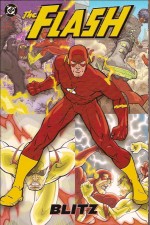
The Flash: Blitz

New revised review

By Geoff Johns, Scott Kolins, Phil Winslade & various (DC)
ISBN: 978-1-84023-986-7

Blitz brings to an end a stunning storyline which has already filled previous editions Blood Will Run, Rogues and Crossfire – so you’d better have read those first – and sees third incarnation of the Flash Fastest Man Alive Wally West end his protracted war against a veritable army of super-villains in triumph and tragedy as potentially his greatest foe, the “Reverse Flash” called Zoom, strikes his cruellest blow.

This climactic collection gathers the tumultuous epic conclusion from Flash volume 2, #192-200 and opens with ‘Run Riot, part 1: Awakened’ scripted, as ever, by Geoff Johns and illustrated by Scott Kolins & Doug Hazlewood wherein an army of apes invades Extreme-Security metahuman penitentiary Iron Heights to free diabolical super-gorilla Grodd, consequently liberating most of the Rogues Flash had spent so much time and energy capturing.

Instantly on the scene, Wally is hard-pressed to contain the chaos before ‘On the Run’ ramps up the tension as the monstrous anthropoid casually, callously cripples Wally’s friend Rogue-profiler Hunter Zolomon and leaves the Scarlet Speedster a physically and emotionally broken man before escaping.

‘Dead or Alive’ finishes the Run Riot triptych as an almost-restored and vengeful Vizier of Velocity visits the hidden Gorilla City which spawned Grodd in search of allies and answers just as that hirsute horror attempts to conquer the apes who first spurned him…

After that catastrophic combat Wally returns to America in ‘Off Balance’ where his wife Linda is experiencing some odd symptoms as her pregnancy progresses. And in the Twin Cities of Keystone and Central, deceased villain The Top has returned in a borrowed body… Meanwhile, wheelchair-bound Zolomon finds it impossible to accept his new condition…

Phil Winslade applies his gritty realist art-style to ‘Helpless’ as explosive teleporter Peek-a-boo returns and Zolomon presses Wally to use his time-travelling technology to undo the attack which incapacitated him.

Unable to comply, Flash abandons the angry profiler but is totally unprepared when Linda becomes a casualty of Peek-a-boo’s detonating departures and utterly unaware that the furious ex-cop – obsessed with changing his recent history at all costs – has stolen the time-bending Cosmic Treadmill…

Kolins & Hazlewood return for the eponymous story-arc Blitz and ‘Rogue Profile: Zoom’ wherein Hunter Zolomon’s tragic history is fully revealed and the horrific consequences of his desperate, doomed act become apparent before ‘Rush’ finds him as the newly-minted Zoom hunting everybody Wally holds dear…

‘Into the Fast Lane’ reveals the hideous effects the Treadmill have wrought on Zolomon as his campaign of terror extends to Wally’s hometown: his malign warped intent to inflict maximum suffering on his erstwhile friend, before the spectacular, brutally shocking conclusion ‘The Final Race’ wherein all the Flash’s greatest allies gather to protect Wally and Linda, but simply aren’t enough to forestall a ghastly tragedy…

The culmination of years of high-octane tension and action, this tale cleared the decks for a startling new direction and is prime Fights ‘n’ Tights fiction of the highest quality.
© 2003, 2004 DC Comics. All Rights Reserved.
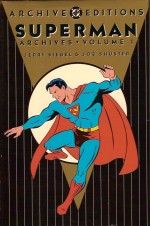
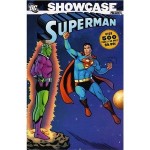
Showcase Presents Superman volume 1


By Otto Binder, Jerry Coleman, Bill Finger, Jerry Siegel, Wayne Boring, Al Plastino, Curt Swan & various (DC Comics)
ISBN: 978-1-4012-0758-8

Although we all think of Jerry Siegel and Joe Shuster’s iconic creation as the epitome of comicbook creation the truth is that very soon after his launch in Action Comics #1 he became a multimedia star and far more people have seen or heard the Man of Steel than have ever read him – and yes, that does include the globally syndicated newspaper strip. By the time his 20th anniversary rolled around he had been a regular on radio, starred in a series of astounding animated cartoons and two movies and just ended his first smash live-action television serial. In his future were three more (Superboy, Lois & Clark and Smallville), a stage musical, a franchise of stellar movies and an almost seamless succession of TV cartoons beginning with The New Adventures of Superman in 1966 and continuing ever since. Even Krypto got in on the small-screen act…

It’s no wonder then that the tales from this Silver Age period should be so draped in the wholesome trappings of Tinseltown – even more so than most of celebrity-obsessed America. It didn’t hurt that editor Whitney Ellsworth was a part-time screenwriter, script editor and producer as well as National DC’s Hollywood point man.

However, that’s not all there is to these gloriously engaging super-sagas culled from Action Comics #241-257 and Superman #122-133, reliving the period June 1958 to November 1959 in crisp, clean black and white in this first economical Showcase Presents collection.

By the mid-1950s Superman had settled into an ordered existence. Nothing could really hurt him, nothing would ever change, and thrills seemed in short supply. With the TV show cementing the action, writers increasingly concentrated on supplying wonder, intrigue, imagination and, whenever possible, a few laughs as well.

The adventure begins with Action Comics #241 and ‘The Key to Fort Superman’ a fascinating and clever puzzle-play guest-featuring Batman, written by Jerry Coleman and illustrated by Wayne Boring & Stan Kaye, wherein an impossible intruder vexes the Man of Steel in his most sacrosanct sanctuary, after which Superman #122 (July, 1958) presented three yarns by veteran scripter Otto Binder beginning with ‘The Secret of the Space Souvenirs’ (illustrated by Al Plastino) as a temporary madness seemed to grip the Man of Tomorrow as he gathered artefacts for a proposed time-capsule, ‘Superman in the White House’ a fanciful dream by Jimmy Olsen also drawn by Plastino and the Boring/Kaye bamboozler which finds the hero investigating an outbreak of super-powers at a US military base in ‘The Super-Sergeant’…

That same month Binder & Plastino introduced both the greatest new villain and most expansive new character concept to the series had seen in years in The Super-Duel in Space’ (Action Comics #242) which saw an evil alien scientist named Brainiac attempt to add Metropolis to his collection of miniaturised cities in bottles.

As well as a titanic tussle in its own right, this tale completely changed the mythology of the Man of Steel, by introducing Kandor, a city full of Kryptonians who had escaped the planet’s destruction when Brainiac captured them. Although Superman rescued his fellow survivors, the villain escaped to strike again, and it would be years before the hero could restore the Kandorians to their true size.

Superman #123 (August 1958) featured ‘The Girl of Steel’ by Binder, Dick Sprang & Kaye which tested the potential of a distaff Supergirl as part of a three-chapter yarn involving a magic wishing totem, which tragically segued into ‘The Lost Super-Powers’ before granting the hero’s greatest dream and facilitating ‘Superman’s Return to Krypton’. Action #243 by Binder & Boring saw Superman mysteriously transformed into a beast in ‘The Lady and the Lion’ after which Superman #124 provided the intriguing menace of ‘The Super-Sword’ by Coleman & Plastino, Binder & Kurt Schaffenberger’s delightful desert island drama wherein Lois Lane became ‘Mrs. Superman’ and Clark Kent’s investigation of construction industry corruptions which compelled him to become ‘The Steeplejack of Steel’ (Binder, Boring & Kaye).

Curt Swan pencilled Binder’s ‘Super-Merman of the Sea’ (inked by Kaye) in Action #244: a canny mystery wherein the Man of Steel abandoned the surface world for an alien aquatic princess, after which Boring & Kaye delineated Binder’s compelling thriller ‘The Shrinking Superman!’ featuring an insidious menace from the Bottle City of Kandor…

‘Lois Lane’s Super-Dream’ (Coleman & Schaffenberger) opened Superman #125 (October-November 1958) with another potentially offensive and certainly sexist parable wherein the plucky news-hen learnt a salutary lesson about powers and responsibility whilst ‘Clark Kent’s College Days’ (illustrated by Plastino) began an occasional series of Untold Tales of Superman by revealing just how, when and why Superboy became the Man of Tomorrow, before Boring & Kaye concluded Coleman’s hat-trick with ‘Superman’s New Power’ as the hero gained new and incomprehensible abilities with catastrophic consequences

Action #246 featured ‘Krypton on Earth!’ (Binder, Boring & Kaye) as a trip to tourist attraction “Krypton Island” revealed a crafty criminal scam whilst #247 presented ‘Superman’s Lost Parents!’ (Binder & Plastino) wherein a criminal scheme to reveal the hero’s secret identity prompted an extreme face-saving solution, after which Superman #126 had Binder, Boring & Kaye reveal ‘Superman’s Hunt for Clark Kent’ a thrilling tale of amnesia and deduction whilst ‘The Spell of the Shandu Clock’ by Coleman, Boring & Kaye, provided spooky chills and clever ploys to outwit a malevolent mastermind and ‘The Two Faces of Superman’ (Coleman & Schaffenberger) again saw conniving Lois learn a much-needed lesson in humility.

Action #248 (January 1959) was a rare contribution from Bill Finger, illustrated by Boring & Kaye as the Caped Kryptonian became ‘The Man No Prison Could Hold!’ to topple a war criminal tyrant whilst Superman #127 opened with another Untold Tale of Superman, ‘When There Was No Clark Kent!’ (Coleman, Swan & Kaye) as an accident temporarily deprived the hero of his treasured alter ego, after which Coleman, Boring & Kaye exposed ‘The Make-Believe Superman’ as a depressed dad tried to impress his son with a most preposterous fib before another hugely popular character debuted in ‘Titano the Super-Ape!’. The chimpanzee who became a giant ape with Kryptonite vision was one of the most memorable “foes” of the period, courtesy of Binder, Boring & Kaye’s sublime treatment combining action, pathos and drama to superb effect.

‘The Kryptonite Man!’ by Binder & Plastino in Action #249, saw Lex Luthor deliberately irradiate himself with Green K to avoid capture, but his evil genius was no match for the hero’s sharp wits, used with equal aplomb in ‘The Eye of Metropolis!’ (Finger & Boring) as a prominent TV journalist sought to expose Superman’s secret identity in #250.

Bill Finger scripted the entirety of #128 as ‘Superman versus the Futuremen’ (Boring & Kaye) and ‘The Secret of the Futermen’ saw the Metropolis Marvel framed for heinous crimes and hijacked to the impossible year of 2000AD before outwitting his abductors and retuning in time to encounter ‘The Sleeping Beauty from Krypton!’ – actually Lois in another hare-brained scheme to trap her beloved into marriage, illustrated by the unmistakable and deliciously whimsical Kurt Schaffenberger.

‘The Oldest Man in Metropolis!’ by Robert Bernstein & Plastino, saw an unfortunate lab accident age Superman decades overnight in Action #251 whilst Superman #129 (May 1959) revealed ‘The Ghost of Lois Lane’ (Coleman, Boring & Kaye) to be anything but and Binder & Plastino’s ‘Clark Kent, Fireman of Steel!’ depicted the reporter’s aggravating and hilarious “luck” as a temporary fire-fighter before introducing the bewitching mermaid Lori Lemaris in ‘The Girl In Superman’s Past’ – another moving Untold Tale of Superman (from Finger & Boring) which again refined the Man of Steel’s intriguing early life.

Action Comics #252 (May 1959) would have been significant enough merely for introducing the threat of John Corben, a criminal whose crushed body was replaced by a robot body and Kryptonite heart to become ‘The Menace of Metallo!’ (by Bernstein & Plastino) but a new back-up feature also began in that issue which utterly revolutionised the Man of Tomorrow’s ongoing mythology.

‘The Supergirl from Krypton!’ introduced Kal-El’s cousin Kara Zor-El in another captivating, groundbreaking yarn by Binder & Plastino. The Maid of Might would occupy the back of Action and alternate covers for a decade and more to come, carving her own unique legend (see Showcase Presents Supergirl volumes 1 and 2)…

Issue #253 featured ‘The War Between Superman and Jimmy Olsen!’ by Alvin Schwartz, Swan & Kaye as an alien presence gave the boy reporter super-powers and a mania to conquer the world whilst Superman #130 presented ‘The Curse of Kryptonite!’ by Binder & Plastino, wherein the Man of Tomorrow relived his past experiences with the lethal mineral; ‘The Super-Servant of Crime!’ by Bernstein, Swan & John Sikela which finds the hero turning the tables on a petty crook who thinks he’s fooled the Action Ace, and ‘The Town That Hated Superman!’ (Binder, Boring & Kaye): a happy hamlet which had outlawed the hero and he simply had to know why…

‘The Battle with Bizarro!’ (Action Comics #254, by Binder & Plastino) re-introduced an imperfect duplicate super-being who had initially appeared in a well-received Superboy story (#68, from the previous year), courtesy of Luthor’s malfunctioning duplicator ray. Even way back then high sales trumped death and so popular was the fatally-flawed character that the tale was continued over two issues, concluding with ‘The Bride of Bizarro!’ in #255, an almost unheard of luxury back then, but here that bombastic, traumatic conclusion is separated by the contents of Superman #131, which firstly reintroduced a long-vanished pestiferous annoyance with ‘The Menace of Mr. Mxyzptlk!’ by Coleman & Plastino, before Lois Lane was granted a tantalising glimpse of ‘Superman’s Future Wife’ (Bernstein & Schaffenberger) and ‘The Unknown Super-Deeds’ revealed hitherto hidden connections with the Daily Planet staff long before Superboy left Smallville in another Untold Tale of Superman from Binder & Plastino.

Action #256 seemingly unleashed ‘The Superman of the Future’ (Binder, Swan & Kaye) whilst in Superman #132 (October 1959) Batman and the projections of a super-computer showed what might have happened if Superman had grown up on an unexploded Krypton in the three chapter epic ‘Superman’s Other Life’, ‘Futuro, Super-Hero of Krypton!’, ‘The Superman of Two Worlds!’ by Binder, Boring & Kaye.

Action #257 revealed Clark Kent as ‘The Reporter of Steel!’ after he was hit by a ray from mad scientist Luthor in a cunning yarn by Binder, Boring & Kaye before the contents of Superman #133 brings to a close this premier compendium with ‘The Super-Luck of Badge 77’ (Binder & Plastino) as the reporter tried his hand as a beat cop, before the first new tales by co-creator Jerry Siegel in nearly a decade: ‘How Perry White Hired Clark Kent’ (art by Plastino) and the wryly light-hearted ‘Superman Joins the Army!’ illustrated by Boring & Kaye.

Superman has proven to be all things to all fans over his decades of existence and with the character undergoing another radical overhaul at this time these timeless tales of charm and joy and wholesome wit are more necessary than ever: not just as a reminder of great tales of the past but as an all-ages primer of the wonders still to come…
© 1959-1963, 2005 DC Comics. All Rights Reserved.
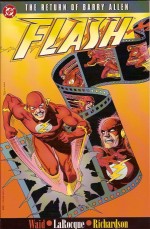
The Flash: the Return of Barry Allen

New revised review

By Mark Waid, Greg LaRocque, Sal Velluto & Roy Richardson (DC Comics)
ISBN: 978-1-56389-268-4

When the Silver Age Flash died during the Crisis on Infinite Earths in 1985, he was promptly succeeded by his grieving shell-shocked sidekick and nephew Wally West, who initially struggled to fill the boots of his groundbreaking predecessor, both in sheer physical ability and, more tellingly, in confidence. Wally felt like a fraud, but like a true hero he soldiered on and eventually rose to esteemed heights.

Just as he was becoming comfortable in the role though, the unthinkable happened… Actually in comics not so unthinkable and that idea is used to telling effect within the text.

Years later just as Wally was coming to terms with his historic heritage and still painful sense of bereavement Barry Allen reappeared, stunned, amnesiac, but unquestionably alive…

This slender chronicle collects issues #74-78 of the Wally West Flash (which originally ran from March to August 1993) and, after ‘Flashback’ – an informative introduction from Mark Waid & Brian Augustyn – opens with a couple of teasing, foreshadowing pages from earlier issues which lead to the late Scarlet Speedster turning up on Wally’s doorstep on Christmas Eve after which the high-speed action opens with ‘Trust’ by Waid, Greg LaRocque – assisted by Sal Velluto – & Roy Richardson.

Heroes have come back before and villains have always pulled imposturing fast ones too, so as Barry’s memories slowly return Wally is suspicious, although his mentor’s oldest friends Jay Garrick and Hal (Green Lantern) Jordan are quickly convinced. But still, something doesn’t seem quite right with the returned, but no longer so easygoing, heroic ideal…

In ‘Running Behind’ Barry and Wally are happily patrolling together and the younger Flash is becoming convinced that nothing more than insecurity and jealousy are colouring his misgivings. Even Garrick, the WWII Flash, is apparently content and cooperating in their unstoppable crime-blitz. Wally is even considering surrendering the name and creating a new heroic persona for himself when, during a skirmish with high-tech bandits Barry inexplicably flies into a psychotic rage…

Helpless, fearing Barry’s derangement is caused by his death and resurrection, Wally watches his mentor progressively lose it in ‘Identity Crisis’, whilst the utterly pragmatic Garrick recruits fellow veteran speedsters Johnny Quick and Max Mercury just in case the worst comes to pass. When the tech-bandits are revealed to be a deadly alien gang Wally and uncle Barry track them down and the younger Flash is apparently killed…

Wally has survived but is hiding: only he knows that his beloved uncle Barry has gone mad, attempting to murder his own nephew, after which in ‘Suicide Run’ the returned Scarlet Speedster tries to kill everybody else who might rival his standing as the Fastest Man Alive…

An incredible accident finally reveals the truth to the despondent Wally as “Barry Allen” goes on a murderous global rampage in ‘Blitzkrieg’ before the youngest Flash returns to lead a dramatic and desperate final charge against the most dangerous man of all time in the staggering, blockbuster, revelatory conclusion ‘The Once and Future Flash’.

That is one of the very best Fights ‘n’ Tights tales of the 1990s, a rollercoaster ride of bluff, misdirection and all-out action that was instrumental in shutting up old coots like me who kept whining about how the new stuff just wasn’t as good as the old…

Despite some less than stellar artwork this is a great tale, captivatingly told and which powerfully pushes the buttons of any superhero fan, whether a Flash follower or not. Catch and enjoy, time after time after time….

© 1993 DC Comics. All Rights Reserved.
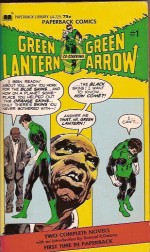
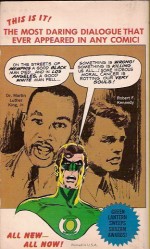
Green Lantern and Green Arrow #1


By Denny O’Neil, Neal Adams, John Broome, Gil Kane & various (Paperback Library)
ISBN: 0-446-64729-2 075

Until relatively recent times, comic strips – like rock ‘n’ roll or spray-can street art – were considered an outcast, bastard non-Art form continually required to explain and justify themselves.

And during those less open-minded times, just like the other examples cited, every so often the funnybook industry produced something which forced the wider world to sit up and take notice. In this slim paperback – in itself proof positive of the material’s merit because the stories were contained in a proper book and not a flimsy, gaudy, disposable pamphlet – some of the most groundbreaking tales in American comicbook history were re-presented to an audience finally becoming cognizant that a mere Children’s medium” might have something to contribute to the whole culture and society…

This striking paperback book collection opens with an introduction from Samuel R. Delaney and is rather sensibly followed by the very first Green Lantern tale from Showcase # 22 (September-October 1959), providing much needed background – as well as few solid old-fashioned thrills for readers new to the character and concept.

After the successful revival and reworking of The Flash in 1956, DC (or National Comics as they then were) was keen to build on a seemingly resurgent superhero trend. Showcase #22 hit the stands at the same time as the fourth issue of the new Flash comicbook (#108) with architects of the Silver Age editor Julie Schwartz, writer John Broome and artists Gil Kane & Joe Giella providing a Space Age reworking of a Golden-Age superhero with the magic ring.

Super-science replaced mysticism as Hal Jordan, a young test pilot in California, was transported to the side of a dying alien policeman who had crashed on Earth. Mortally wounded, Abin Sur commanded his power-ring, a device which could materialise thoughts, to seek out a replacement ring-bearer; honest and without fear.

Scanning the planet, it had selected Jordan and brought him to an appointment with destiny. The dying alien bequeathed the ring, a lantern-shaped Battery of Power and his noble profession to the astonished Earthman.

In six pages ‘S.O.S Green Lantern’ established the characters, scenario and narrative thrust of a series that would become the spine of DC continuity, opening a universe of wonder to wide eyed readers of all ages.

However, after a decade of earthly crime-busting, interstellar intrigue and spectacular science fiction shenanigans the Silver Age Green Lantern was about to become one of the earliest big-name casualties of the downturn in superhero sales in 1969 prompting Editor Schwartz to try something extraordinary to rescue the series.

The result was a bold experiment which created a fad for socially relevant, ecologically aware, mature stories which spread throughout DC’s costumed hero comics and beyond; totally revolutionising the industry and nigh-radicalising readers.

Tapping superstars-in-waiting Denny O’Neil and Neal Adams to produce the revolutionary fare, Schwartz watched in fascinated disbelief as the resultant thirteen groundbreaking, landmark tales captured the tone of the times, garnered critical praise, awards and desperately valuable publicity from the outside world, whilst simultaneously registering such poor sales that the series was finally cancelled anyway, with the heroes unceremoniously packed off to the back of marginally less endangered comicbook The Flash.

The main event of this pocket-sized collection re-presents the first two landmark stories, perfectly encapsulating everything Americans were already experiencing in the bubbling cauldron of social turmoil and experimentation on their own doorsteps. Everything was challenged on principle and with issue #76 of Green Lantern (April 1970 and the first issue of the new decade) O’Neil and Adams redefined the nature of superhero adventure with their “Issues”-driven stories; transforming complacent and all-powerful establishment masked boy-scouts into uncertain, questioning champions and strident explorers of the enigma of America.

When these stories first appeared National/DC was a company in transition – just like America itself – with new ideas sought for and acted upon: a wave of fresh, raw talent was hired, akin to the very start of the industry, when excitable scarce-young creators ran wild with imagination. Their cause wasn’t hurt by the industry’s swingeing commercial decline: costs were up and the kids just weren’t buying funnybooks in the quantities they used to so perhaps it was time to see what the next generation had to offer…

O’ Neil, working in tight collaboration with hyper-realistic artist Adams, assaulted all the traditional monoliths of contemporary costumed dramas with tightly targeted, protest- driven stories. The comicbook had been re-designated Green Lantern/Green Arrow with Emerald Archer Oliver Queen constantly mouthing off as a hot-headed, liberal sounding-board and platform for a generation-in-crisis whilst staid, quasi-reactionary GL Hal Jordan played the part of the oblivious but well-meaning old guard. At least the Ring-Slinger was able to perceive his faults and more or less willing to listen to new ideas…

‘No Evil Shall Escape My Sight!’ (inked by Frank Giacoia) is a true landmark of the medium, utterly reinventing the concept of the costumed crusader as newly-minted, freshly bankrupted millionaire Oliver (Green Arrow) Queen challenged his Justice League comrade’s cosy worldview when the lofty space-cop painfully discovered real villains wore business suits, had expense accounts, hurt people just because of skin colour and would happily poison their own nests for short-term gain…

The specific villain du jour was a wealthy landlord whose treatment of his poverty-stricken tenants wasn’t actually illegal but certainly was wickedly immoral… Of course, the fact that this yarn is also a brilliantly devious crime-thriller with science-fiction overtones didn’t exactly hurt either…

The continuation ‘Journey to Desolation’ from #77 was every bit as groundbreaking.

At the conclusion of the #76 an immortal Guardian of the Universe – known as “the Old Timer” – was assigned to accompany the Emerald Duo on a voyage to “discover America”: a soul-searching social exploration into the dichotomies which divided the nation – and a tremendously trendy and popular pastime for the nation’s disaffected citizens back then.

Their first stop brought the trio to a poverty-stricken Appalachian mining town run as a private kingdom by a ruthless entrepreneur happy to use agent-provocateurs and Nazi war criminals to keep his wage slaves in line. When a young protest singer looked likely to become the next Bob Dylan and draw unwelcome publicity, he had to be eliminated – as did the three strangers who drove into town at just the wrong moment…

Although the heroes provided temporary solutions and put away viciously human criminals, these tales were always carefully heavy-handed in exposing bigger ills and issues which couldn’t be fixed with a wave of a Green Ring; invoking an aura of helplessness that was metaphorically emphasised during this story when Hal was summarily stripped of much of his might for no longer being the willing, unquestioning stooge of his officious, high-and-mighty alien masters…

It’s impossible to assess the effect this early bookstore edition had on the evolution of comics’ status – it certainly didn’t help keep the comicbook series afloat – but  this edition certainly gave credibility to the stories themselves: a fact proved by the number of times and variety of formats these iconic adventures have been reprinted.
© 1959, 1970, 1972 National Periodical Publications, Inc.

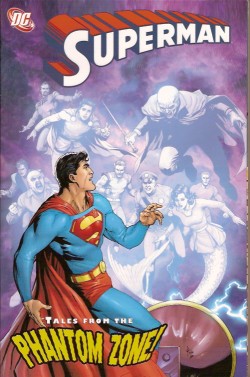
Superman: Tales From the Phantom Zone


By Jerry Siegel, Edmond Hamilton, Otto Binder, Curt Swan & various (DC Comics)
ISBN: 978-1-4012-2258-1

Superman is comics’ champion crusader: the hero who effectively started a whole genre and in the decades since his spectacular launch in June1938 one who has survived every kind of menace imaginable. With this in mind it’s tempting and very rewarding to gather up whole tranches of his prodigious back-catalogue and re-present them in specifically-themed collections, such as this sinister set of sorties into the stark and silent realm of nullity designated the Phantom Zone: a time-proof timeless prison for the worst villains of lost planet Krypton.

This captivating collection (gathering material from Adventure Comics #283, 300, Action Comics #336, Superman’s Girl Friend, Lois Lane #33, Superman’s Pal, Jimmy Olsen #62, Superman #157, 205, Superboy #89, 104 and Who’s Who volume 18) represents appearances both landmark and rare, crafted by the many brilliant writers and artists who have contributed to the Kryptonian canon over the years.

Naturally this terrific tome begins with the first appearance of the dolorous dimension in ‘The Phantom Superboy’ by Robert Bernstein & George Papp (from Adventure Comics #283 April, 1961) wherein a mysterious alien vault smashes to Earth and the Smallville Sensation finds sealed within three incredible super-weapons built by his long-dead dad Jor-El. There’s a disintegrator gun, a monster-making de-evolutioniser and a strange projector that opens a window into an eerie, timeless dimension of stultifying intangibility.

However as Superboy reads the history of the projector – used to incarcerate Krypton’s criminals – a terrible accident traps him inside the Phantom Zone and only by the greatest exercise of his mighty intellect does he narrowly escape…

Next is the pivotal two-part tale ‘Superboy’s Big Brother’ (by Robert Bernstein & Papp from Superboy #89, June 1961) in which an amnesiac, super-powered space traveller crashes in Smallville, speaking Kryptonese and carrying star-maps written by the long-dead Jor-El…

Jubilant, baffled and suspicious in equal amounts the Boy of Steel eventually, tragically discovers ‘The Secret of Mon-El’ by accidentally exposing the stranger to a fatal, inexorable death and desperately provides critical life-support by depositing the dying alien in the Phantom Zone until a cure can be found…

Superman’s Girl Friend, Lois Lane #33 (May 1962) by a sadly unknown writer, but illustrated by the always exceptional art team of Curt Swan and George Klein, further explored the dramatic potential of the Zone in ‘The Phantom Lois Lane!’ when a temporarily deranged Lana Lang dispatched all her romantic rivals for the Man of Tomorrow’s affections to the extra-dimensional dungeon, whilst one month later in ‘Superman’s Phantom Pal!’ (Leo Dorfman, Swan & Klein from Superman’s Pal, Jimmy Olsen #62) Jimmy Olsen in his Elastic Lad role was drawn through a miniscule rip in the fabric of reality and joined Mon-El in the Zone where the plucky cub reporter faced down the worst of Krypton’s villains and resisted their ultimate temptation…

Adventure Comics #300 (September 1962) saw the debut of the Legion of Super-Heroes in their own series by Jerry Siegel, John Forte & Al Plastino. That premier yarn ‘The Face Behind the Lead Mask!’ pitted Superboy and the 30th century champions against an unbeatable foe until Mon-El intervened, briefly freed from a millennium of confinement…

‘The Super-Revenge of the Phantom Zone Prisoner!’ by Edmond Hamilton, Swan & Klein (from Superman #157 November 1962) saw the introduction of power-stealing Gold Kryptonite and Superman’s Zone-o-phone – which allowed him to communicate with the incarcerated inhabitants – in a stirring tale of injustice and redemption. Convicted felon Quex-Ul uses the device to petition Superman for release since his sentence has been served, and despite reservations the fair-minded hero can only agree.

However further investigation reveals Quex-Ul had been framed and was wholly innocent of any crime, but before Superman can explain or apologise he has to avoid the deadly trap the embittered and partially mind-controlled parolee has laid for the son of the Zone’s discoverer…

Superboy #104 (April 1963) contained an epic two-part saga ‘The Untold Story of the Phantom Zone’ with ‘The Crimes of Krypton’s Master Villains’, by Hamilton & Papp describing Jor-El’s discovery of the Zone, his defeat of ambitious political criminal Gra-Mo and the reasons the vault of super-weapons was dispatched into space whilst ‘The Kid who Knocked Out Superboy!’ (illustrated by Swan & Klein) saw Gra-Mo return to take vengeance on the son of his nemesis.

‘The Man From the Phantom Zone!’ (Action Comics #336, April 1966, by Hamilton, Swan & Klein) had Superman release another convict whose time was served, leading to a captivating crime mystery in the Bottle City of Kandor as 50 year old juvenile delinquent Ak-Var found life in a solid and very judgemental world a very mixed blessing…

By April 1968, times and tone were changing as seen in ‘The Man Who Destroyed Krypton!’ (Superman #205, Otto Binder & Plastino) as alien terrorist Black Zero comes to Earth determined to blow it up just as he had the planet Krypton decades ago! Overmatched and stunned by the truth of his world’s doom, the Man of Steel is convinced that releasing Jax-Ur, the Zone’s wickedest inhabitant, is the only way to save his adopted homeworld… an absorbing, enthralling, surprisingly gritty tale of vengeance and a perfect way to end this eclectic collection.

With a comprehensive informational extract from the 1986 Who’s Who in the DC Universe entry from the Zone and its most notorious inmates, illustrated by Rick Veitch, this compelling collection is an intriguing introduction to the aliens hidden amongst us and a superb treat for fans of every vintage.

© 1961, 1962, 1963, 1964, 1966, 1968, 1986, 2009 DC Comics. All Rights Reserved.

Superman: Eradication! (The Origin of the Eradicator)


By Dan Jurgens, Jerry Ordway, Roger Stern, George Pérez & various (DC Comics)
ISBN: 978-1-56389-193-9

Once the 1987 John Byrne re-imagining of the Man of Steel had stripped away much of mythology and iconography which had grown up around the Strange Visitor from Another World over fifty glorious years, succeeding creative teams spent a great deal of time and ingenuity putting much of it back, albeit in terms more accessible to a cynical and well-informed young audience far more sophisticated than their grandparents ever were.

This slim but exceedingly effective tome, collecting material from Action Comics #651-652, Adventures of Superman #460, 464-465 and Superman #41-42, provides fascinating insights and fresh revelations into the long-gone world of Krypton as well as introducing new character-concepts which would inform and affect the entire mythology of the World’s Ultimate Superhero.

After a lengthy period of self-impose banishment in deep space (for which see Superman: Exile) the Man of Tomorrow returned to Earth carrying an incredibly powerful artefact which had survived the destruction of Krypton. The Eradicator could reshape matter and was programmed to preserve, or indeed, resurrect and restore the heritage and influence of the lost civilisation at all costs.

After a number of close calls Superman realised the device was too dangerous to leave loose so he buried it in an Antarctic crevasse and assumed that ended the affair…

‘Be it ever So Deadly’ by Dan Jurgens & Andy Kubert, found the Metropolis Marvel hurtling to the South Pole to rescue a survey team transformed into slaves of an automated fortress built by the Eradicator to emulate Krypton on Earth. Investigating the alien citadel, Superman discovered the Eradicator had been built by his own ancestor and was attuned his own genetic structure. A spectacular battle ensued…

‘The Nature of the Beast’ by Jerry Ordway & Dennis Janke saw a far calmer hero adopt the Fortress as his secret base, whilst light years away the infallible bounty hunter Lobo got really drunk and was conned into travelling to Earth to destroy Superman. The Czarnian had no idea it was a betting scam by gamblers who didn’t want to see War World Gladiator Draaga bankrupt them by killing the Man of Steel…

Clark Kent had been made editor of glossy magazine News-time, but the pressure was clearly affecting the once affable and easygoing guy. Lately he’d become a cold, calculating, nitpicking martinet…

Even Superman seemed distant and aloof, especially with loved ones such as Ma and Pa Kent…

Still pickled, Lobo reached Earth before Draaga and promptly started throwing blockbusting punches…

‘Blood Brawl’ (Jurgens & Art Thibert) pulled all the clues together as Lobo and his entourage invaded the Antarctic citadel. When the Action Ace responded his uniform momentarily converted to Kryptonian apparel… As Superman and Lobo cataclysmically clashed, the Eradicator openly continued reprogramming the Man of Steel’s mind converting him into a ruthless, passionless Kryptonian science-warrior, who deemed it more expedient to avoid combat rather than strive against one of the most dangerous killers in the universe…

The tension increased in ‘Not of this Earth’ by Roger Stern, George Pérez, Kerry Gammill & Brett Breeding, as alien warrior queen Maxima returned, determined to make Superman her mate. When he again rejected her, their blistering battle allowed the Eradicator to take full control of the embattled Kryptonian.

Ordway & Janke then described how Kal-El the ‘Krypton Man’ began reshaping the chaotic, emotion-afflicted Earth into a world of cold logic just as Draaga arrived, hungry for a decisive return match…

A catastrophic combat almost decimated Metropolis before scientist Emil Hamilton forcibly moved the fight to the Moon, resulting in a turning point for ‘The Last Son of Krypton’ (Jurgens & Thibert) as Clark Kent’s foster parents, realising the horror their boy has become, risked everything to help him shake off the influence of the alien artefact, culminating in a magnificent victory of love over logic in Stern, Pérez, Gammill & Breeding’s stirring finale ‘Wayward Son’.

When they were first published these tales of the post-Crisis Superman continually confounded old fans (like me) and industry pundits (me again, I suppose) simply by being, against all expectations, the very best in good, old fashioned four-colour fun, crafted by creators who went above and beyond to deliver cracking good reads week after week. These little gems are an absolute must for any lover of Fights ‘n’ Tights wonderment.
© 1989, 1990, 1996 DC Comics. All Rights Reserved.

Showcase Presents Wonder Woman volume 2


By Robert Kanigher, Ross Andru & Mike Esposito (DC Comics)
ISBN: 978-1-4012-1373-2

The Amazing Amazon Adventuress was created by polygraph pioneer William Moulton Marston – apparently at the behest of his remarkable wife Elizabeth – and illustrated by Harry G. Peter just as the spectre of another world-girdling global Armageddon loomed.

She debuted as an extra feature in All Star Comics #8 (December 1941) before catapulting into her own cover-starring series in Sensation Comics a month later. An instant smash-hit she also quickly won her own title in the Spring of that year (cover-dated Summer 1942).

Using the nom de plume Charles Moulton, Marston scripted all her many and fabulous adventures until his death in 1947, whereupon Robert Kanigher took over the writer’s role. The venerable co-creator H. G. Peter continued on as illustrator until his death in 1958. Wonder Woman #97, in April of that year, was his last hurrah and the discrete end of an era.

This second economical monochrome Showcase collection covers issues #118-137 from November 1960-April 1963, a period of increased fantasy frolics and wildly imaginative excess which still divides fans into violently opposing camps…

With the notable exception of Superman, Batman, Wonder Woman and a few anodyne back-up features, costumed heroes died out at the beginning of the 1950s, replaced by a plethora of merely mortal champions and a welter of anthologised genre titles.

Showcase #4 rekindled the public’s interest in costumed crime-busters with a new iteration of The Flash in 1956 (see Showcase Presents the Flash volume 1 or the first Flash: Archive Edition) the fanciful floodgates opened wide once more…

Whilst re-inventing a section of Golden Age Greats like Green Lantern, Atom and Hawkman, National/DC also updated all those hoary survivors who had weathered the backlash especially the Man of Steel, Caped Crusader and the ever-resilient Amazing Amazon…

Artists Ross Andru & Mike Esposito, who illustrated all Kanigher’s scripts in this all-ages compendium, had actually debuted as cover artists from #95, but with Wonder Woman #98 (May 1958) they took over the interiors as the writer/editor reinvented much of the old mythology and tinkered with her origins before letting her loose on an unsuspecting world.

The fanciful blend of girlish whimsy, rampant sexism, untrue romance, alien invasion, monster-mashing and all-out surreal (some would say-stream-of-consciousness) storytelling continues unabated here with ‘Wonder Woman’s Impossible Decision!’ (#118) and found the comely crusader constantly distracted from her mission to wipe out injustice by the antics of her savagely-sparring suitors Colonel Steve Trevor and Manno the mer-man.

Amazon science (and the unfettered imagination of Kanigher, for whom slavish continuity, consistency or rationality were never as important as a strong plot or breathtaking visual) had long enabled readers to share the adventures of Wonder Girl and latterly Wonder Tot – the Princess of Power as teen and toddler – both in their appropriate time-zones and, on occasion, teamed together on “Impossible Days”.

WW #119 opened with an adventure of the Titanic Teenager in ‘Mer-Boy’s Secret Prize!’ wherein the besotted undersea booby repeatedly risked his life to win his inamorata a flashy treasure, whilst in ‘Three Wishes of Doom!’ a capable but arrogant young girl won a competition and claimed Wonder Woman’s Bracelets, Lasso and Tiara, with the disastrous idea of using them to out-do the Amazing Amazon…

‘The Secret of Volcano Mountain!’ in #120 pitted teen and adult Amazon – a decade apart – against the same terrifying threat when an alien elemental twice attempted to conquer the world, after which an Impossible Day event had Wonder Girl, her older self and their mother Queen Hippolyta unite to defeat the monster-packed peril of ‘The Island Eater!’

‘The Skyscraper Wonder Woman’ introduced her pre-schooler incarnation when the Sinister Seer of Saturn sought to invade Earth with a colossal robot facsimile whilst de-aging the Amazon to her younger – but thankfully, no less competent – adolescent and pre-adolescent incarnations…

Wonder Woman #123 opened with a glimpse at the ‘Amazon Magic-Eye Album!’ as Hippolyta reviewed some of the crazy exploits of her daughter as Tot, Teen and adult adventuress, whilst the issue after managed to team them all together against the unfortunately named shape-shifting nuclear threat of the Multiple Man on ‘The Impossible Day!’

Steve and Manno resumed their war for the heroine’s hand in marriage in #125’s ‘Wonder Woman… Battle Prize!’ with the improbable trio ending up marooned on a beast and alien amoeba-men infested Blue Lagoon…

‘Wonder Tot and Mister Genie!’ was the first of two tales in WW #126, depicting what might happen when an imaginative super-kid is left on her own, whilst exasperated US Air Force lieutenant Diana Prince got steamed at being her own romantic rival for Steve Trevor in ‘The Unmasking of Wonder Woman!’ The next issue opened with the defeat of another extraterrestrial assault in ‘Invaders of the Topsy-Turvy Planet’ before ‘Wonder Woman’s Surprise Honeymoon!’ gave the usually incorrigible Colonel Trevor a terrifying foretaste of what married life with his Amazon Angel would be like…

WW#128 revealed the astounding and rather charming ‘Origin of the Amazing Robot Plane!’ before things turned a bit more serious when our heroine endured the deadly ‘Vengeance of the Angle Man!’

In #129 another spectacular Impossible Day adventure featured the entire Wonder Woman Family (that would be just her at three different ages with her mum alongside to save the day) in ‘The Vengeance of Multiple Man!’ whilst #130 opened with Wonder Tot discovering the ‘Secret of Mister Genie’s Magic Turban!’ and ended with an outrageous and embarrassing attack by Angle Man on her mature self in ‘The Mirage Mirrors!’

‘The Proving of Wonder Woman!’ in #131 detailed the history of her unique epithets such as “Thunderbolts of Jove”, “Neptune’s Trident” and “Great Hera” whilst the back-up tale ‘Wonder Woman’s Surprise Birthday Gift!’ saw the indefatigable Manno risk all manner of maritime monsters to find her a dazzling bauble whilst the Amazon herself was trying to find her mother a present.

‘Wonder Tot and the Flying Saucer!’ depicted how the adult Amazon turned herself into a toddler to converse with a baby and discover the secret of a devastating alien atomic attack and the second story revealed some ancient romantic encounters which occurred when ‘Wonder Queen Fights Hercules!’

Wonder Woman #133 cover-featured the Impossible Tale of ‘The Amazing Amazon Race!’ wherein Tot, Teen, Woman and Queen competed in a fraught athletic contest with deadly consequences, whilst in Man’s World Diana Prince took centre-stage to become ‘Wonder Woman’s Invincible Rival… Herself!’ when a movie-project went dangerously awry.

‘Menace of the Mirror Wonder Women!’ pitted her and Steve against the Image-Maker; a deadly other-dimensional mastermind who could animate and enslave reflections, and #134 closed with another disastrous sub-sea date for Wonder Girl when she had to prevent ‘The Capture of Mer-boy!’

It was one more time for Multiple Man as he/it returned again to battle the Wonder Woman Family in #135’s Impossible Day drama ‘Attack of the Human Iceberg!’ whilst the next issue had the Female Fury transformed into a ravenous and colossal threat to humanity after alien machine men infected with a growth-agent and she became ‘Wonder Woman… World’s Greatest Menace!’

This fabulous follow-up compendium concludes with #137’s classic duel on an ersatz Earth with mechanical replicas of the world’s populace and metal facsimiles of all the Amazons. Our foremost female defender had to overcome ‘The Robot Wonder Woman!’ if she had any hope of returning with Steve to their own sweet home…

By modern narrative standards these exuberant, effulgent fantasies are usually illogical and occasionally just plain bonkers, but in those days less attention was paid to continuity and shared universes: adventure in the moment was paramount and these utterly infectious romps simply sparkled then and now with fun, thrills and sheer spectacle.

Wonder Woman is rightly revered as a focus of female strength, independence and empowerment, but the welcoming nostalgia and easy familiarity of such innocuous costumed fairytales must be a delight for open-minded readers, whilst the true, incomparable value of these stories is the incredible quality of entertainment they still offer.

© 1960-1963, 2008 DC Comics, Inc. All Rights Reserved.

The Flash: Rogues


By Geoff Johns, Scott Kolins, Doug Hazlewood & various (DC)
ISBN: 978-1-56389-950-8

When Barry Allen, the Silver Age Flash whose creation ushered in a new and seemingly unstoppable era of costumed crusaders, was killed during the Crisis on Infinite Earths in 1985, he was succeeded by his young sidekick Wally West, a young man who initially struggled to fill the boots of his predecessor, but like a true hero persevered and eventually overcame…

After years in the role West adapted and made a convincing argument for being an even greater hero as he triumphed over both his mentor’s uncanny foes and a whole new Rogue’s Gallery of his own.

This volume, Rogues which follows directly on from Blood Will Runis part of a massive continued storyline by scripter Geoff Johns and will be best enjoyed if you can also lay your hands on Crossfire and Blitz – at the very least – and collects issues #177-182 of the long-gone monthly comicbook.

The twin cities of Keystone and Central City are in economic turmoil. In an atmosphere of job-cuts and financial woe, ostensibly-reformed super-villain Keith Kenyon AKA Goldface is causing (mostly legal) trouble promoting his militant blue-collar union, whilst on the crime front a new conglomeration of Rogues is being formed by a sinister mastermind…

The action in this particular tome, all pencilled and mostly inked by Doug Hazlewood, begins with ‘Event Horizon’ when Flash’s oldest ally and human Black Hole Chester Runk, gifted with incredible teleportation and gravity-warping powers, is shot by an assassin. Although Chunk survives the bullet, the wound causes his powers to spiral out of control and subsequently endangers the entire planet until Wally can find a typically fast-paced fix.

Meanwhile in Keystone City, a new, non-union manufacturer of detention units falls foul of Kenyon’s pickets, allowing the lethally destructive super-gorilla Grodd to escape in ‘Caged’…

Immensely strong, carnivorous and possessing staggering psionic abilities, the savage simian goes on an earth-shattering rampage through the city until the hard-pressed hyper-fast hero finally stops him. Across town at that moment, another Flash-friend is arrested for murder…

‘Smile for the Camera’ incorporates a DC braided crossover event which spanned the entire DC pantheon (for more details and murderous high jinks see Batman: The Joker’s Last Laugh) which can be summed up by saying the Joker thought he was dying and infected hundreds of villains with his looks and madness before setting them loose to hilariously wreck civilisation and kill millions.

By the time the Pied Piper is remanded to super-penitentiary Iron Heights, the Jokerising plague is in full effect and chaos ensues. Even with Flash on hand the situation only gets more difficult as the Piper also succumbs to the contagious insanity…

A new villain is introduced in ‘Peek-a-boo’ when a desperate medical student uses her teleporting powers to steal harvested organs for her dying dad. Unfortunately, whenever young Lashawn Baez triggers her power, the air explodes with the force of a detonating missile. Happily for Wally, his old Teen Titans pal Cyborg has moved to town and is able to lend a detachable hand…

‘Fallout’ was a radioactive minor player illegally exploited to power Iron Heights until the Flash liberated him; but the walking atomic reactor was finding life on the outside increasingly hazardous. However, whilst the Scarlet Speedster struggled to find an ethical solution to his dilemma his oldest friends and mentors were falling victim to terrible personal tragedy…

The Rogues and their new boss Blacksmith are happily celebrating their carefully laid plans as Flash’s police contact Detective Jared Morillo becomes their latest victim, but the villains have no idea what trouble is waiting them as this tense tome concludes with ‘Absolute Zero’ (inked by Dan Panosian) when Captain Cold goes renegade to avenge the murder of his sister and affords us all a look at the early life which made him such a cold-hearted killer…

Fast, furious and fantastic, The Flash has always epitomised the very best of Fight ‘n’ Tights fiction. This impressive slice of top-speed, high-octane action can happily be read as is, but as part of the intended, extended epic these tales become vital parts of an overwhelming whole.

The Geoff Johns years are slick and absolutely addictive: engrossing, suspenseful and often genuinely scary comics you simply have to read. If you haven’t seen them yet, run – don’t walk – to your nearest purveyor of graphic magnificence and snag all the breathless excitement you could ever withstand.

© 2000, 2001, 2003 DC Comics. All Rights Reserved.

Showcase Presents World’s Finest volume 1


By Edmond Hamilton, Bill Finger, Curt Swan, Dick Sprang & various (DC Comics)
ISBN: 978-1-4012-1697-9

Some things were just meant to be: Bacon & Eggs, Rhubarb & Custard, Chalk & Cheese…

For many years Superman and Batman worked together as the “World’s Finest” team. They were friends as well as colleagues and the pairing made sound financial sense since DC’s top heroes (in effect the company’s only costumed stars) could cross-pollinate and, more importantly, cross-sell their combined readerships.

This most inevitable of Paladin Pairings first occurred on the Superman radio show in the early 1940s, whilst in comics the pair had only briefly met whilst on a Justice Society of America adventure in All-Star Comics #36 (August-September 1947) – and perhaps even there they missed each other in the gaudy hubbub…

Of course they had shared the covers on World’s Finest Comics from the outset, but never crossed paths inside; sticking firmly to their specified solo adventures within. So for us pictorial continuity buffs, the climactic first time was in the pages of Superman’s own bi-monthly comic (issue #76, May/June 1952).

Science fiction author Edmond Hamilton was tasked with revealing how Man of Steel and Caped Crusader first met – and accidentally discovered each other’s identities – whilst sharing a cabin on an over-booked cruise liner. Although an average crime-stopper yarn, it was the start of a phenomenon. The art for The Mightiest Team in the World’ was by the superb Curt Swan and inkers John Fischetti & Stan Kaye with that keynote caper the opening inclusion in this first magnificent monochrome compendium (which thereafter re-presents their first 41 collaborations from World’s Finest Comics #71-111).

With dwindling page counts, rising costs but a proven readership and years of co-starring but never mingling, World’s Finest Comics #71 (July-August 1954) presented the Man of Tomorrow and the Gotham Gangbuster in the first of their official shared cases as the Caped Crusader became ‘Batman – Double For Superman!’ (by scripter Alvin Schwartz with Swan & Kaye providing the pictures) as the merely mortal hero traded identities to preserve his comrade’s alter ego and latterly, his life…

‘Fort Crime!’ (Schwartz, Swan & Kaye) saw them unite to crush a highly organised mob with a seemingly impregnable hideout, after which Hamilton returned to script ‘Superman and Batman, Swamis Inc’, a clever sting-operation that almost went tragically awry before an alien invader prompted an insane rivalry which resulted in ‘The Contest of Heroes’ by Bill Finger, Swan & Kaye, from World’s Finest #74.

The same creative team produced ‘Superman and Robin!’ wherein a disabled Batman could only fret and fume as his erstwhile assistant seemingly dumped him for a better man, whereas ‘When Gotham City Challenged Metropolis’ (Hamilton, Swan & Charles Paris) saw the champions at odds as their hometowns over-aggressively vied for a multi-million dollar electronics convention before a landmark tale by Hamilton, Swan & Kaye invented a new sub-genre when a mad scientist’s accident temporarily removed the Caped Kryptonian’s powers and created ‘The Super-Batman!’ in WF #77.

Arguably Batman’s greatest artist joined the creative crew ‘When Superman’s Identity is Exposed!’ (by Hamilton, Dick Sprang & Kaye) as a mysterious source kept revealing the Man of Steel’s greatest secret, only to be revealed as a well-intentioned disinformation stunt, whereas the accent was on high adventure when the trio became ‘The Three Musicians of Bagdad’ – a stunning time-travel romp from Hamilton, Sprang & Kaye.

When the Gotham Gazette faced closure days before a spectacular crime-expose, Clark Kent and Lois Lane joined dilettante Bruce Wayne as pinch-hitting reporters on ‘The Super-Newspaper of Gotham City’ (Hamilton, Sprang & Charles Paris) after which ‘The True History of Superman and Batman’ (Hamilton, Sprang & Kaye, #81) saw a future historian blackmail the heroes into restaging their greatest exploits so his erroneous treatise on them would be accurate…

Hamilton also produced a magnificent and classy costumed drama when ‘The Three Super-Musketeers!’ visited 17th century France to solve the mystery of the Man in the Iron Mask whilst Bill Finger wrote a brilliant and delightful caper-without-a-crime in ‘The Case of the Mother Goose Mystery! before Hamilton provided insight on a much earlier meeting of the World’s Finest Team with ‘The Super-Mystery of Metropolis!’ in #84, all for Sprang & Kaye to enticingly illustrate.

Hamilton, Swan, Sprang & Kaye demonstrated how a comely Ruritanian Princess inadvertently turned the level-headed heroes into ‘The Super-Rivals’ (or did she?), before a monolithic charity-event ‘The Super-Show of Gotham City’ (Hamilton, Sprang & Kaye) was almost turned into a mammoth pay-day for unscrupulous con-men whilst ‘The Reversed Heroes’ (Finger, Sprang & Ray Burnley) once again saw the costumed champions swap roles when Batman and Robin gained powers thanks to Kryptonian pep-pills found by criminal Elton Craig, just as Superman’s powers faded…

World’s Finest #87 presented ‘Superman and Batman’s Greatest Foes!’ (Hamilton, Sprang, Kaye) and found “reformed” villains Lex Luthor and the Joker ostensibly setting up in the commercial robot business – which nobody really believed – after which seminal sequel ‘The Club of Heroes’ by Hamilton, Sprang & Kaye, reprised a meeting of Batmen from many nations (Detective Comics #215, January 1955 or Batman: the Black Casebook and a key plank of Grant Morrison’s epic Batman: the Black Glove serial) but added the intriguing sub-plot of an amnesiac Superman and a brand-new costumed champion…

That evergreen power-swap plot was revisited in #90’s ‘The Super-Batwoman’ (Hamilton, Sprang & Kaye) when the headstrong heroine defied Batman by restarting her costumed career and was quickly compelled to swallow Elton Craig’s last Krypton pill to prevent criminals getting it, after which the stirring time-busting saga of ‘The Three Super-Sleepers’ (Hamilton, Sprang & Kaye) saw our heroes fall into a trap which caused them to slumber for 1000 years and awaken in a fantastic world they could never escape…

But of course they could and once back where they belonged ‘The Boy From Outer Space!’ by Hamilton, Sprang & Kaye detailed how a super-powered amnesiac lad crashed to Earth and briefly became Superman’s sidekick Skyboy, whilst ‘The Boss of Superman and Batman’ (author unknown, Sprang & Kaye) revealed how a brain-amplifying machine turned Robin into a super-genius more than qualified to lead the trio in their battle against insidious rogue scientist Victor Danning.

When the Man of Tomorrow replaced the Caped Crusader with a new partner it led to a review of ‘The Origin of the Superman-Batman Team’ by Hamilton, Sprang & Kaye after which Dave Wood, Sprang & Ray Burnley pitted the now equally multi-powered and alien-entranced champions against each other in ‘The Battle of the Super-Heroes’ from WF #95.

A magical succession of magnificent and whacky classics began in #96 with Hamilton’s ‘The Super-Foes From Planet X’ as indolent and effete aliens dispatched fantastic monsters to battle the titanic trio for the best possible reasons, before Bill Finger took over scripting and turned the Man of Steel on his greatest friends in ‘The Day Superman Betrayed Batman’ after which ‘The Menace of the Moonman!’ pitted the heroes against a deranged hyper-powered astronaut, ‘Batman’s Super-Spending Spree!’ baffled all his close friends and Luthor then trapped Superman in the newly recovered Bottle City of Kandor and became ‘The Dictator of Krypton City’ – all astounding epics beautifully limned by Sprang & Kaye.

Sprang inked himself in the rocket-paced super-crime thriller ‘The Menace of the Atom-Master’ whilst it took Swan, Burnley, Sprang & Paris to properly unveil the titanic tragedy of ‘The Caveman from Krypton’ in #102.

‘The Secret of the Sorcerer’s Treasure’ (art by Sprang & Paris) found two treasure hunters driven mad by the tempting power unearthed magical artefacts and Luthor quickly regretted used a hostage Batwoman to facilitate ‘The Plot to Destroy Superman’ whereas the metamorphosis which turned Clark Kent into ‘The Alien Superman’ proved not at all what it seemed.

‘The Duplicate Man’ in WF #106 had developed an almost unbeatable crime tool – whereas ‘The Secret of the Time-Creature’ spanned centuries and produced one of Finger’s very best detective thrillers to baffle but never stump the Terrific Team.

Jerry Coleman took over scripting with ‘The Star Creatures’, (art by Sprang & Paris), the tale of an extraterrestrial moviemaker whose deadly props were stolen by Earth crooks, whilst ‘The Bewitched Batman’ drawn by Swan & Kaye, was a tense race to save the Gotham Guardian from an ancient curse and ‘The Alien who Doomed Robin’ (Sprang & Sheldon Moldoff) saw a symbiotic link between monster marauder and Boy Wonder leave the senior heroes apparently helpless… at least for a little while…

This inaugural black and white chronicle concludes with ‘Superman’s Secret Kingdom’ by Finger, Sprang & Moldoff from World’s Finest #111 (August 1960): a compelling lost world yarn wherein a cataclysmic holocaust deprives the Man of Steel of his memory and Batman and Robin have to find and cure him at all costs…

These are gloriously clever yet uncomplicated tales whose dazzling style has returned to inform if not dictate the form for much of DC’s modern television animation – especially the fabulous Batman: the Brave and the Bold series – and the contents of this tome are a veritable feast of witty, charming thrillers packing as much punch and wonder now as they always have.
© 1952, 1954, 1955, 1956, 1957, 1958, 1959, 1960, 2007 DC Comics. All Rights Reserved.