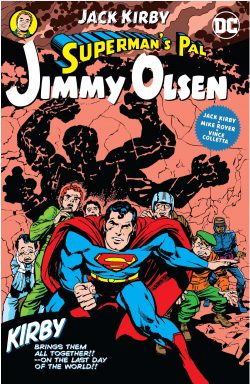
Superman’s Pal Jimmy Olsen by Jack Kirby


By Jack Kirby, Vince Colletta & Mike Royer, with Murphy Anderson, Neal Adams, Al Plastino & various (DC Comics)
ISBN: 978-1-84576-746-4 (TPB/Digital edition)

This book includes Discriminatory Content produced in less enlightened times.

For nearly nine decades, Superman has provided excitement, imagination and fun in more or less equal amounts. Although unnamed, since Action Comics #6 (November 1938), a red-headed, be-freckled plucky kid worked alongside Clark Kent & Lois Lane and enjoyed a unique and special relationship with the Metropolis Marvel.

We saw him called by his first name in Superman #13 (November/ December 1941). Jimmy Olsen became a major player on The Adventures of Superman radio show from its debut on April 15th 1940: someone for the hero to explain stuff to for the listener’s benefit and the closest thing to a sidekick the Man of Tomorrow ever needed. That partnership transferred to the comics. Following a string of hit movie chapter plays, when the similarly titled television show launched in the autumn of 1952, it was a monolithic hit and co-star Jimmy was in constant attendance. Thus, National Periodicals began cautiously expanding their precious franchise with new characters and titles. First up was the gloriously charming, light-hearted escapades of an impetuous, naïve but capable Daily Planet cub reporter/photographer forever onward saddled with the cognomen Superman’s Pal. Jimmy Olsen, which launched in 1954 carrying a September/October cover date. For 20 years the comic blended action, adventure, wacky comedy, fantasy and science fiction in the gentle, wry, exceedingly popular manner scripter Otto Binder had perfected in the 1940s at Fawcett Comics on the magnificent Captain Marvel.

Over those years, one of its most popular plot-themes (and most fondly revered and referenced today by Baby-Boomer fans) was the unlucky lad’s appalling talent for being warped, mutated and physically manipulated by fate, aliens and even his supposed friends. Latterly, however, Leo Dorfman had begun the process of remaking Jimmy as a more competent action hero and serious investigative journalist in tune with the rebellious era when the worlds of DC forever altered on the pages of what was then considered one of their least appreciated and poorest-selling titles.

According to fan myth & legend, none of it apparently mattered when Jack Kirby – hot from making Marvel the top company in the business – took over. By all popular accounts, he had asked for DC’s worst performing title to prove what he could do, and used it to spearhead a wave of changes whilst adapting grand schemes his old employers were too timid to countenance on their pages…

Jack’s first issue was #133, cover-dated October and on sale from August 25, 1970.

Jack Kirby (28th August 1917 – 6th February 1994) was – and, more than three decades after his death, remains – the most important single influence in the history of American comics. There are innumerable accounts of and testaments to what the man has done and meant, and you should read all of those if you are at all interested in the bones and breath of our medium. Kirby was a man of vast imagination who translated big concepts into astoundingly potent, instantly accessible symbols, thereby creating an iconography for generations of fantasy fans. If you were exposed to Kirby as an impressionable child, you were his for life. To be honest, that probably applies at whatever age you jump aboard the “Kirby Express”…

Synonymous with larger-than-life characters and vast cosmic imaginings, he was an astute, spiritual man who lived through poverty, prejudice, gangsterism, The Great Depression and World War II. He experienced Pre-War privation, Post-War optimism, Cold War paranoia, political cynicism and the birth and death of peace-seeking counter-cultures, but always looked to the future while understanding human nature intimately. Beginning his career in the late 1930s, it took a remarkably short time for Jack and creative collaborator Joe Simon to become the wonder-kid dream-team of the newborn comic book industry. Together they produced a year’s worth of influential monthly magazine Blue Bolt, dashed off Captain Marvel Adventures #1 for overstretched Fawcett, and – after Martin Goodman appointed Simon editor at Timely Comics – launched a host of pivotal characters including Red Raven, Marvel Boy, Mercury/Hurricane, The Vision, Young Allies and million-selling mega-hit Captain America. When Goodman failed to honour his financial obligations, Simon & Kirby were snapped up by National/DC, who welcomed them with open arms and a fat chequebook.

Bursting with ideas these staid industry leaders were never really comfortable with, the pair were initially an uneasy fit. Awarded two moribund strips to play with until they found their creative feet, they turned around both Sandman and Manhunter virtually overnight and, once safely established and left to their own devices, switched to the “Kid Gang” genre they had pioneered at Timely. Joe & Jack created wartime sales sensation Boy Commandos and Homefront iteration The Newsboy Legion before being called up to serve in the war they had been fighting on comic pages since 1940. Once demobbed, they returned to a very different funnybook business, and soon after left National to create their own empire…

S&K ushered in the first age of mature American comics – not just by inventing the Romance genre, but with all manner of challenging modern material about real people in extraordinary situations, only to see it all disappear again in less than eight years. Simon & Kirby had established their own publishing house, creating comics for far more sophisticated readerships, but found themselves in a sales downturn and awash in public hysteria generated by an anti-comic book pogrom. Their small stable of magazines – generated for an association of companies known as Prize, Crestwood, Pines, Essenkay and Mainline Comics – blossomed and as quickly wilted when the industry contracted throughout the 1950s, but had left future generations fascinating ventures such as Boys’ Ranch, Bullseye, Crime Does Not Pay, Black Magic, Boy Explorers, Fighting American and the entire genre of Romance Comics…

Hysterical censorship fever spearheaded by US Senator Estes Kefauver and opportunistic pop psychologist Dr. Frederic Wertham led to witch-hunt Senate hearings. Most publishers caved, adopting a castrating self-regulatory straitjacket of draconian rules and guidelines. Crime & Horror titles produced under the aegis and emblem of the Comics Code Authority were sanitised, anodyne affairs in terms of mature themes, political commentary, shock and gore even though the market’s appetite for suspense and the uncanny was still high. Crime comics vanished as adult sensibilities challenging an increasingly stratified and oppressive society were suppressed. Salaciousness, suspense and horror were dialled back to the level of technological fairy tales and whimsical parables…

Simon left the business for advertising, but Jack soldiered on, taking his skills and ideas to safer, more conventional, less experimental companies. As the panic abated, he returned to DC Comics, working on bread-&-butter anthological mystery tales and revamping Green Arrow (at that time a back-up feature in Adventure Comics and World’s Finest Comics) whilst concentrating on a passion project: newspaper strip Sky Masters of the Space Force.

During this period Kirby also re-packaged a superteam concept that had kicked around in his head since he and Joe closed their innovative, ill-timed ventures. At the end of 1956, Showcase #6 premiered Challengers of the Unknown and following three further test issues they won their own title with Kirby crafting the first eight. Then a dispute with Editor Jack Schiff exploded and the King was gone…

He found fresh fields and an equally hungry new partner in Stan Lee at the ailing Atlas Comics outfit (AKA once mighty Timely Comics), launching and spearheading a revolution in comics storytelling. However, after just over a decade of a continual innovation and wonderment, Kirby felt increasingly stifled. His efforts had transformed a dying publisher into industry-leader Marvel, but success had left him trapped in a profitable rut. Thus, he moved back to DC to generate another tidal wave of sheer imagination and pure invention. The result was experimental adult magazines Spirit World & In the Days of the Mob followed by a stunning reworking of Superman’s Pal Jimmy Olsen – and by the time he had finished, all DC continuity. The latter was a prelude to his landmark Fourth World Saga comprising interlinked and contemporaneous titles Forever People, New Gods & Mister Miracle: the very definition of something game-changing and too far ahead of its time…

Incidentally, on many levels Jimmy was an ideal match for the King and not an incongruous display of breast-beating or do-or-die audition. Olsen was an idealistic, heroic young man in the thick of the incredible at all times, and Kirby had a long history with such boy heroes. He and Joe Simon had invented the comic book “kid gang” subgenre and for the next two years Kirby revived it with a new take on The Newsboy Legion… albeit interlaced with a future-embracing backstory, and aspirational wonder, rather than the poverty, privation and ongoing war of survival embodied by the Forties iteration…

In last non-Jack issue, Jimmy had been abducted by gangsters convinced he knew Superman’s secret identity, before battling a soviet champion for sovereignty of a floating island (as you do…) but everything abruptly changed with Superman’s Pal Jimmy Olsen #133. Suddenly readers were thrown into a bravely strange new world where, out of nowhere, extremely shady incoming Daily Planet owner Morgan Edge gifts Jimmy with a fantastic supercar – the “Whiz Wagon” – and demands that he and his previously unseen pals ‘The Newsboy Legion!’ (actually the “New Newsboy Legion” comprising the sons of Tommy, Big-Words, Gabby & Scrapper, with the addition of African-American, scuba diving addict Flipper Dipper) deliver an exclusive scoop on a strange counterculture movement living in the wilds outside Metropolis. The mysterious subjects are all weird hippie-types and don’t trust anyone over age 25, so he needs youth and experience…

However, the one who can’t be trusted is Edge himself. He has undisclosed connections to crime combine Intergang and a chilling stone-faced alien called Darkseid

After very publicly surviving an assassination attempt, Clark Kent goes into hiding allowing Superman to take off after Jimmy and the boys as they probe a fantastic unsuspected region dubbed the Wild Area. Here Olsen survives trial by combat to become leader of futuristic biker gang The Outsiders, and is sucked into their quest for meaning by hunting a moving mountain inhabited by techno-pacifists “The Hairies”

Linking up with the Man of Steel as tremors rock the organically grown refuge city of Habitat, Jimmy and the Newsboys chase the ultimate test of existence alongside all the other motor nomads, unaware that pal Superman already knows the secret they’re all seeking. What Jimmy isn’t aware of is that Edge has boobytrapped the Whiz Wagon to satisfy his master’s desire to destroy what might the next step in human evolution and a threat to his own schemes…

Although Kirby and Inker Vince Colletta put their hearts and souls into the job, and despite Publisher Carmine Infantino’s promise of strict non-intervention, meddling with the concept began early with regular Superman art staff redrawing Superman and Jimmy’s faces. We’ll never know what they tried to do to the overall story arc…

Without pause for breath, exposition or recap Superman’s Pal Jimmy Olsen #134 saw Jimmy and his biker wild bunch catch up to monstrous mechanised white whale ‘The Mountain of Judgement!’ after astoundingly taking out Superman with weapons casually discarded by inveterate tinkerers the Hairies. Thankfully, Edge’s bomb is easily defused by the techno-hippies who all share an incredible secret – one Superman is fully aware of. In short order Jim and the lads are briefed on “The Project”: the US government’s cracking of the human genome and extensive duplication and experimentation of life forms. This has already resulted in cloning the deceased, mass-producing soldiers and staff and, most incredibly, meddling with/reconfiguring chromosomal structure to create new life forms: “D.N.A.liens” like the pacifist techno-wizards called Hairies…
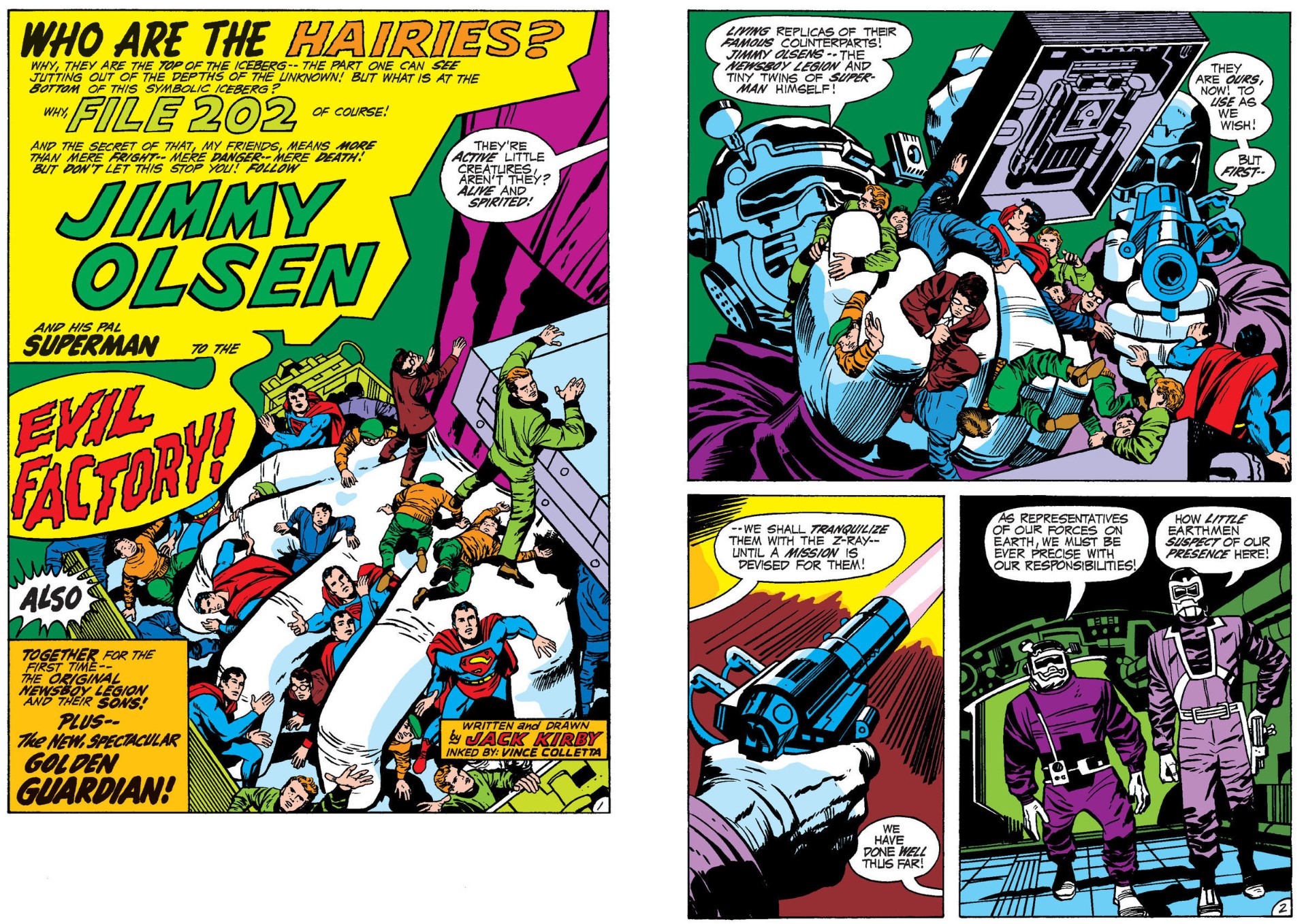
Moreover, the Project is run by none other than slum-kids made good the original Newsboy Legion!

Although commonplace now, the notion of cloning was practically unknown in 1970 and Kirby took the idea and ran with it: blending eternal questions about Life itself with Spy Fi tropes, gansterism and Bond movie settings, all packed with freaks and monsters and underpinned by a constant threat posed by a mysterious mastermind and his own experimental devils. The inspired auteur was also pulling out all the stops visually and his experimental concepts were backed up by equally innovative art and photo collages.

In SPJO #135 we meet Simyan & Mokkari, whose raid on the Project’s genetic storehouse provides raw material to constantly reproduce wilder and wilder versions of our heroes in their own hidden ‘Evil Factory!’ Being utterly without restraint or ethical scruple, their goal of destroying the Project for Darkseid is well-advanced, and – as previously stated – Jimmy’s genes are a particularly promising medium for random transformations…

Their control of what they make is less impressive however, and a superstrong, giant Jimmy infused with Kryptonite is teleported without a plan into the Project simply to save Simyan & Mokkari being killed by their own experiment. Although it almost kills Superman and his pal, the day is saved by the Senior Newsboys’ passion project – a new iteration of their murdered WWII superhero patron Jim Harperthe (Golden) Guardian – in concluding, action-packed background-filling expository chapter ‘The Saga of the D.N.A.liens!’ (cover-dated March 1971 and leading into the launch of Kirby’s opening Fourth World titles Forever People and New Gods #1. We’ll be covering those and final plank Mister Miracle later in the year).

With the scene set, Jimmy’s further exploits are generally Fourth World adjacent: a forge and funnel for concepts linking Superman to the ongoing narrative of Gods and Armageddons whilst exploring Mankind’s dangerous tendencies and corruptible natures. In Superman’s Pal Jimmy Olsen #137, as the Newsboys and Jimmy learn more about their own (utterly non-consensual) contributions to the Project (without their knowledge Scrapper has been mass-produced as soldiers and guards in different sizes from six feet to six inches, and innumerable Gabbys man switchboards and communications consoles!) the Evil Factory strike again.

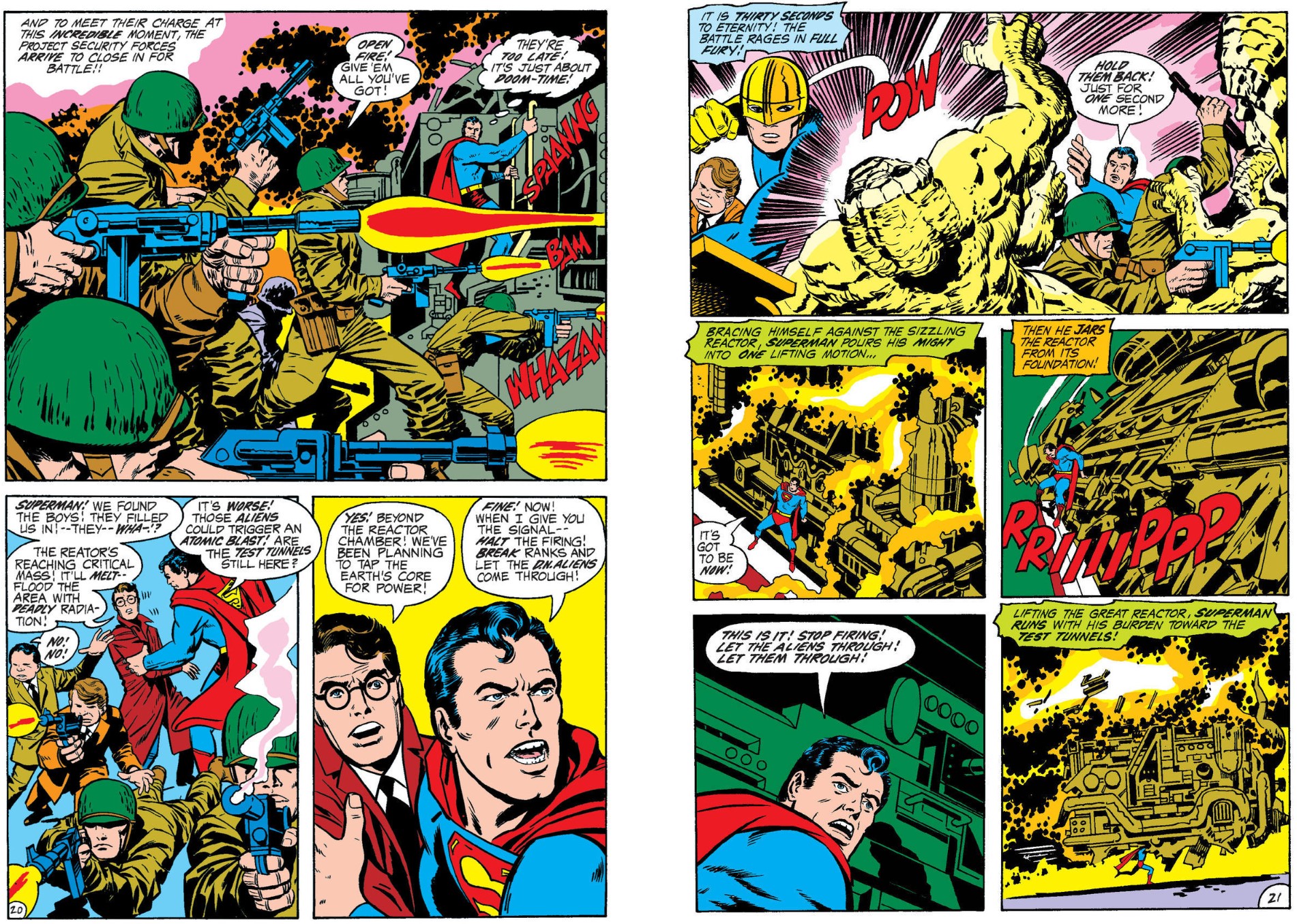
As Jimmy meets The Project’s emergent telepath/resident D.N.A.lien Dubbilex, elsewhere Darkseid demands results and Simyan & Mokkari unleash another Olsen variant on the hidden science citadel. Gifted with astounding strength and uncanny energy powers ‘The Four-Armed Terror!’ has been bred to feed on nuclear radiation and carves a wave of destruction that extends into the Wild Area on its path to the Project’s atomic power plant. Superman and the boys are easily disposed of and discarded, with the crisis escalating even further after Simyan & Mokkari lose control of all the other quadra-killers and beam the entire rampaging herd into the subterranean Project’s tunnels, forcing Superman to pull out all the stops to get free and save everything in cataclysmic closing chapter ‘The Big Boom!’
Despite those promises of non-interference, DC editors and promotional staff perpetually sought to “goose up” the Kirby flagship title. Always a team player, the King acquiesced to a guest-appearance by currently-hot comedian Don Rickles and oddly – in the manner of Marmite – it either worked uproariously or appalled readers. I thought it was a genuine hilarious hoot. Further undercutting the narrative, the saga was bifurcated by a reprint 80-Page Giant of pre-Kirby Olsen escapades in SPJO #140 and not included here.

Nevertheless #139 and 141 ( July’s ‘The Guardian Fights Again!!!’ and September’s ‘Will the Real Don Rickles Panic?’) is a compelling tale of Edge’s unfolding evil, Intergang’s growing influence and the creeping menace of Darkseid, who allows his tech to be used to send Clark Kent into hyperspace destined for Apokolips whilst Jimmy and the Golden Guardian are poisoned by slow-acting incendiary poison Pyro-Granulate: a slow death that will turn them into human torches unless they find an antidote. Slowing them down is equally doomed Galaxy Broadcasting staffer Goody Rickles whom Edge wants gone because he looks like the star Edge wants to sign up… and is really, really annoying…
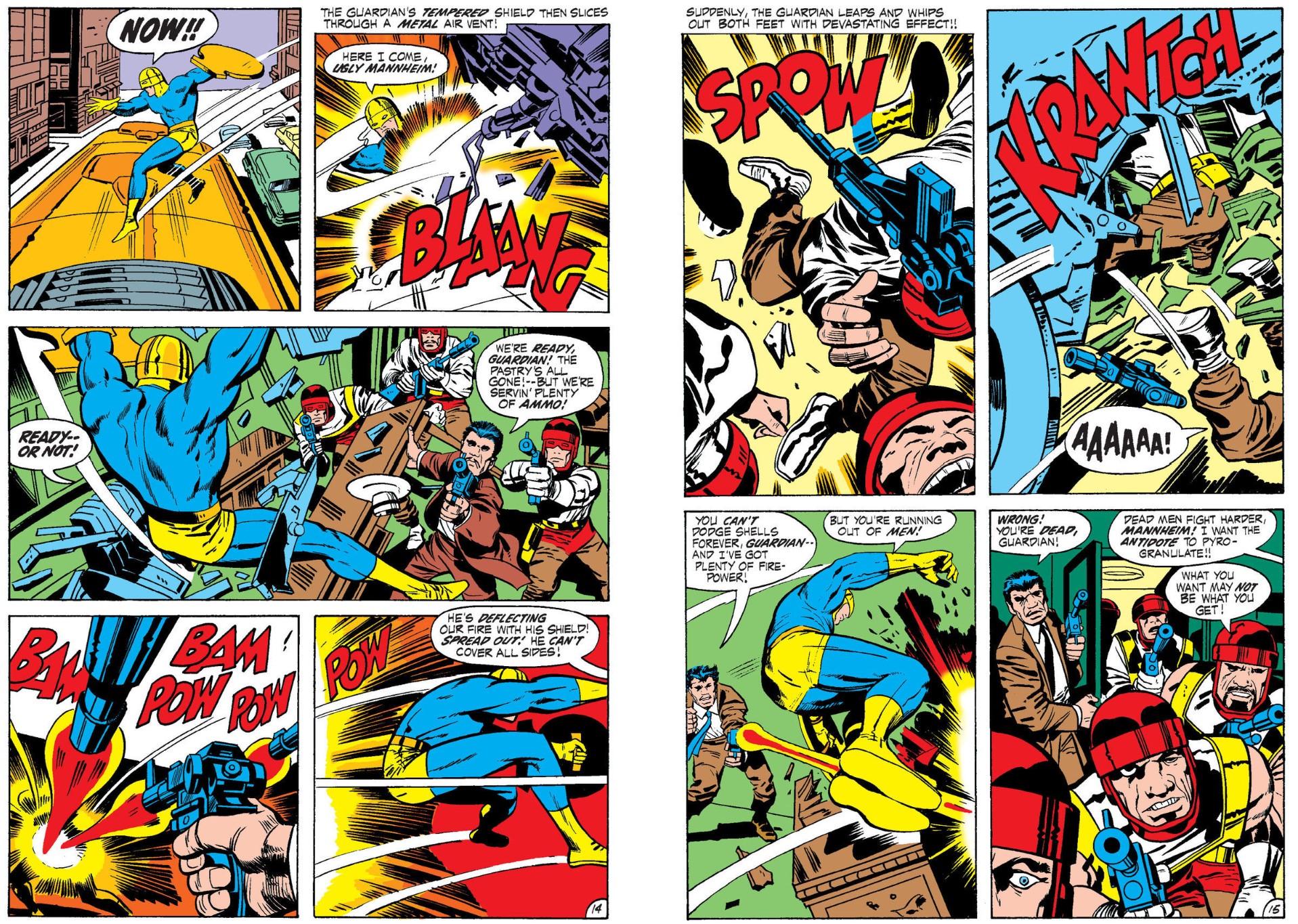
With Kent saved from a modern hell by New God Lightray, Kirby next addressed the rise in horror and supernatural tales via another two-parter that began in #142 with ‘The Man from Transilvane!’ Here, apparent vampire Count Dragorin and his wolfman assistant Lupek target and “turn” Edge’s PA Laura Conway in their desperate hunt for long-missing mad scientist Dabney Donovan: a planetologist who apparently built worlds in his laboratory and shaped civilisations by screening movies in their skies. Like all sensible scientists, Donovan planned to end his research project on a certain day and set up programmed measures involving his ‘Genocide Spray!’ with no consideration of the beings he had made and discarded… but Jimmy and Superman certainly did…

Elsewhere, the Newsboy Legion had their own case, one that again led to Intergang but also the thug who murdered the original Jim Harper/Guardian…

In SPJO #142, Kirby began adding short background-enhancing vignettes and here 2-pager ‘Strange Stories of the D.N.A. Project!! “Hairie” Secrets Revealed!!!’ offered a glimpse of the techno-hippies and their Mountain of Judgment, whilst the next issue added drama to fact-finding as ‘Strange Stories of the D.N.A. Project!! The Alien Thing!!!’ details the terrifying results of creating the first non-human clone…

More much-needed laughs underpin a return to and imminent ending of Olsen’s involvement with the Evil Factory and Apokolips after Edge sends the lads to Britain on a snipe hunt to find and film ‘A Big Thing in a Deep Scottish Lake!’ in Superman’s Pal Jimmy Olsen #144 (cover-dated December 1971). Sadly, it’s just another baroque attempt to kill the pesky, interfering kids, but Edge’s delightfully outré assassins are not up to the task and actually facilitate the Whiz Wagon wonders finally finding the long-sought Evil Factory…

Back in Metropolis, as Superman, the Guardian and Dubbilex visit a discotheque and accidentally uncover a connection to the Project and the New Gods, the back of the book discloses ‘Strange Stories of the D.N.A. Project! – The Torn Photograph!’, hinting that not all the mysteries of the top secret base were created by modern scientists…

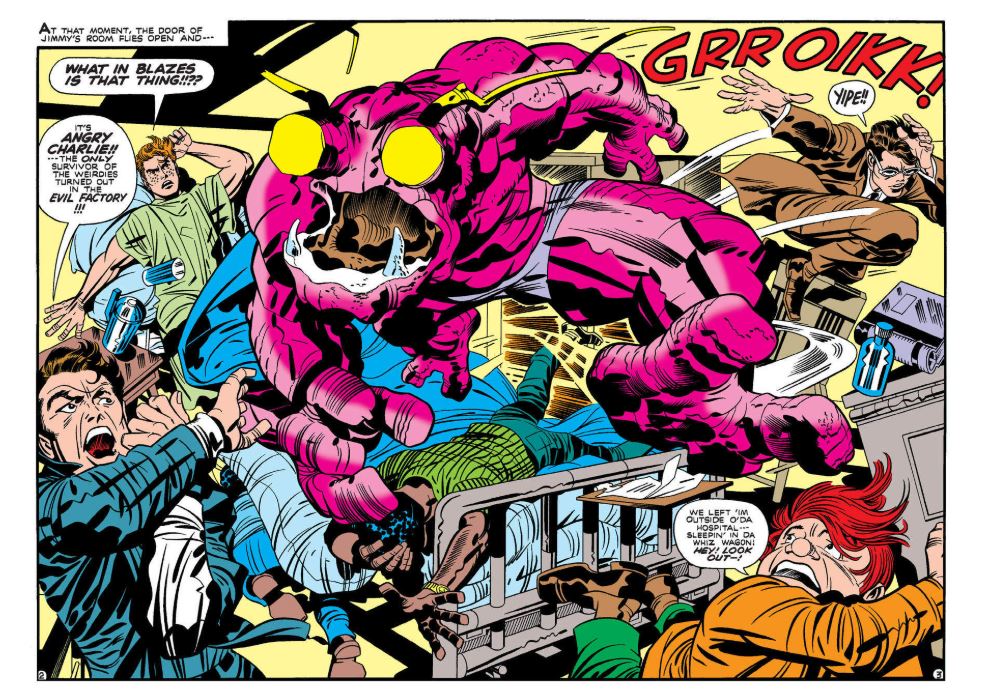
Jimmy at last gets transformed himself as the Newsboys encounter a menagerie of uncanny creatures in ‘Brigadoom!’ (#145, January 1972) before falling victim to Simyan & Mokkari’s tender ministrations. Unfortunately for them, reverting Olsen to primal revenant ‘Homo Disastrous!’ opens the door to chaos and their own destruction, even if it does add a (semi-) friendly monster to the team in affable escapee “Angry Charlie”

Issue #146 also added a little lore to Superman’s personal canon after ‘Tales of the DNA Project! Arin the Armored Man!!!’ reveals how the geneticists found a way to safeguard the man of Steel’s precious and potential deadly cell cultures and decoded genetic structure from potential abuse…

An issue later, heavily-edited down from his original idea, and inked by Mike Royer rather than Colletta, SPJO #147 saw ‘A Superman in Supertown!’, completing a plot thread begun in Forever People #1, wherein the one-&-only Man of Tomorrow accidentally ends up amongst his “own kind” on paradise planet New Genesis, only to realise he cannot rest until his work is done. An example of that carries over into Kirby’s final issue as Jim, the Newsboys and Angry Charlie head across the Atlantic for a confrontation with Morgan Edge and are abducted in mid-air by purely earthborn menace Professor Victor Volcanum.

Incongruously backed up by one last revelatory episode of ‘Tales of the DNA Project – Genetic Criminal’ with cloned killer Floyd “Bullets” Barstow apparently answering the question of whether evil is an inherited trait, the tale of a Victorian-era supergenius who made himself immortal by distilling the essence of volcanoes wrapped up Jimmy’s Kirby-Era. Volcanum had ended a lengthy period of solitude and isolation by attacking the modern world with robots, death-rays and an advanced flying gondola in his efforts to become ‘Monarch of All He Subdues!’ (SPJO #148, April 1972). His first mistake was capturing the Whiz Wagon riders, but when Highfather of New Genesis graciously dropped Superman into his ongoing campaign, the writing was on the wall.

Of course it had been for Jack for some while. Happy to be deprived of the poison chalice of the committee-mindset governing every aspect of all Superman titles, the King soldiered on with his original intention of creating a timeless saga of celestial drama, passion and mind-bending scope – but there too he would be ultimately thwarted and frustrated. Basically and as was always the case, management wanted New and Different, but didn’t like or understand it when they got it…

Almost overnight and in one broad flourish, Kirby had created one of the most powerful concepts in comic book history. His Fourth World inserted a whole new mythology into the existing DC Universe and blew the developing minds of a generation of readers and especially those who would become the next generation of creators. Who know what could have happened if the publishers had had a little more courage, patience and vision?

Kirby instinctively grasped the fundamentals of pleasing his audience and always diligently struggled against the appalling prejudice regarding the comics medium – especially from industry insiders and professionals who despised the “kiddies world” they felt trapped in. After his grandiose, controversial editorially unappreciated Fourth World was cancelled immediately prior to his long-planned grand finale, Kirby explored other projects that would stimulate his own vast creativity yet still appeal to a market growing ever more fickle. These included supernatural stalwart The Demon, traditional war stories starring established DC team The Losers, OMAC: One Man Army Corps and even a new metaphysically mighty Sandman – co-created with old pal Joe Simon and his biggest hit since science fictional survival saga Kamandi. However, although ideas kept coming (Atlas, Kobra, a new Manhunter and Dingbats of Danger Street), once again editorial disputes took up too much of his time. Reluctantly, he left again, choosing to believe in promises of more creative freedom elsewhere…

As early as 1974, worn down by a lack of editorial support and with his newest creations inexplicably tanking, Kirby considered returning to Marvel, but – ever the consummate professional – scrupulously rode out his contract and carried out every detail of an increasingly onerous, emotionally unrewarding DC contract. The Demon was cancelled after 16 issues and he needed another title to maintain his Herculean commitments (legally obliged to deliver 15 completed pages of art and story per week!): Kamandi – The Last Boy on Earth had found a solid and faithful audience. It also provided further scope to explore big concepts as seen in thematic companion OMAC. Both series granted Kirby’s darkest assumptions and prognostications free rein, and his “World That’s Coming” has proved far too close to the World we’re frantically trying to fix or escape from today…
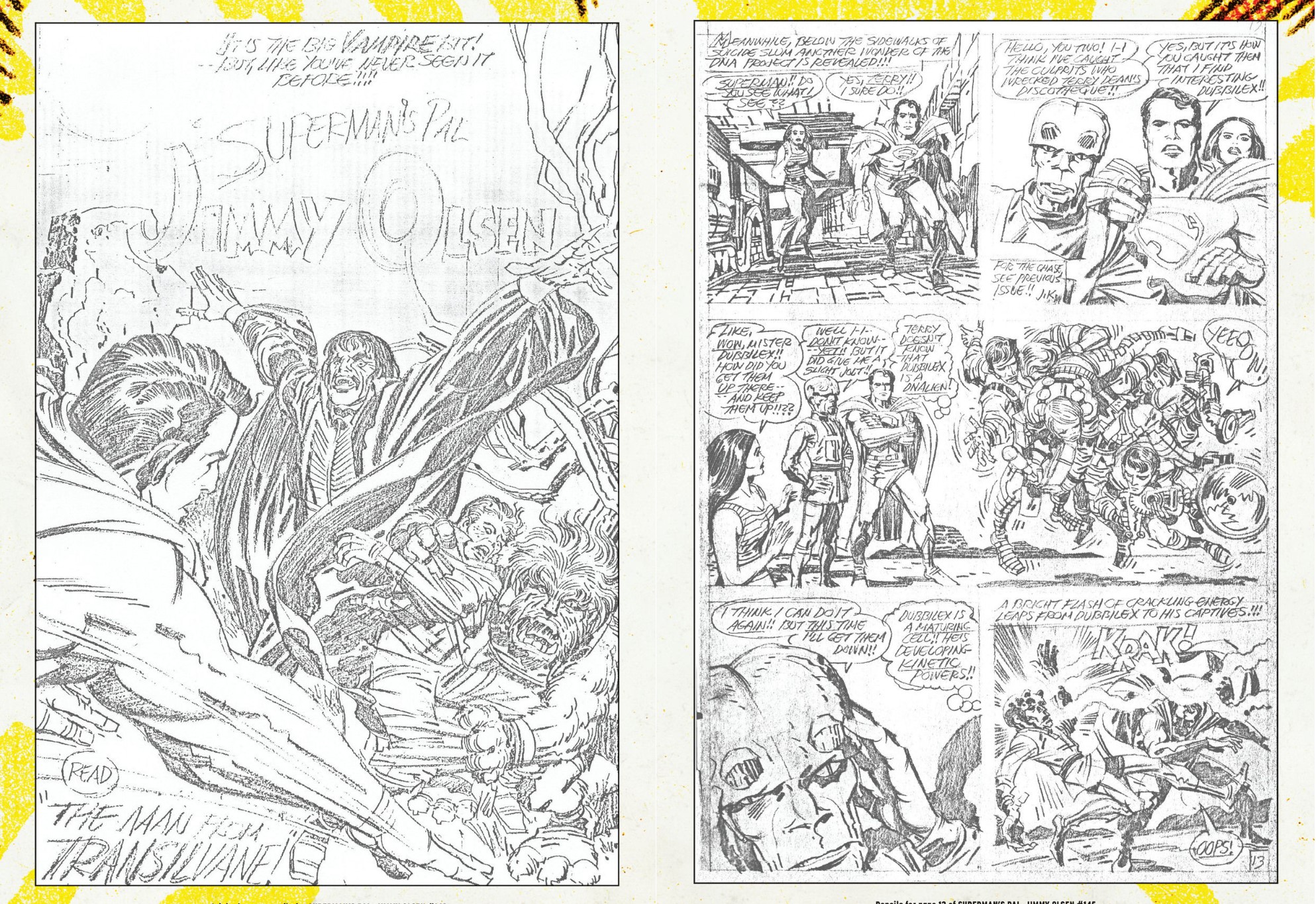
It’s hard to see these stories – supplemented in this edition by ‘Mother Box Files’ culled from 1986’s Who’s Who: The Definitive Directory of the DC Universe #16 and glorious pages of pencils featuring ‘The Art of Jack Kirby’ – isolated from the original Fourth World titles, and to be honest Jimmy plays a back seat role in most of the tales here. When not driving, being chased by or turned into assorted monsters, he’s Superman’s sounding board and supervising adult for the new Newsboy Legion, but at least he’s treated as a clever and competent active player rather than charming directionless idiot…

Once Kirby left the book things changed slowly. The Newsboys and Angry Charlie stuck around for a while and characters like The Guardian, Morgan Edge and the Project became fundamentals of the Superman universe and continuity. The ongoing continuity repercussions of Kirby’s passing were mostly addressed in, of all places, Superman’s Girlfriend Lois Lane, so much as I’d like otherwise, there’s little chance of seeing collected curated editions of those…

Here though is Kirby at his finest and most iconoclastic, doing what he always did: telling stories of wonder, verve and unparalleled imagination. What more could you possibly want?
© 1970, 1971, 1972, 1986, 2019 DC Comics. All Rights Reserved.

Carl Barks died today in 2000. If you want to learn about him, our most recent review of his magic can be found here.


DC Finest: Hawkman volume 1 – Wings Across Time


By Gardner F. Fox, Bob Haney, Joe Kubert, Gil Kane, Murphy Anderson, Howard Purcell, Carmine Infantino & various (DC Comics)
ISBN: 978-1-79950-250-0 (TPB)

This book includes Discriminatory Content produced in less enlightened times.

Here’s another stunning compilation from the DC Finest line: full colour chronolgically curated collections delivering “affordably priced, large-size (generally around 600 pages) paperback collections” of past glories. Whilst concentrating on the superhero pantheon, there are and will also be assorted genre selections like horror and war books, and themed compendia.  

Sadly, none of these comics classics are available digitally, as were the last decade’s Bronze, Silver and Golden Age collections, but we live in hope and keep on whining…

Not all passions are romantic: mine is to finally have all old comics forever available in curated editions. These astoundingly engaging Silver Age tales are another joyous moment of past glories revisited highlighting one of the most effective and enduring romantic crime-busting, world-saving partnerships in comics…

With a superhero revival in full swing by 1961, Editorial mastermind Julius Schwartz turned to resurrecting one of DC’s most visually arresting and iconic Golden Age characters. Once again eschewing mysticism for science fiction (the original Hawkman was a reincarnated Egyptian prince murdered by a villainous priest who just kept coming back…), Schwartz picked scripter Gardner F. Fox who had created the Golden Age great and matched him with artist Joe Kubert to construct a new and contemporary hero for the Jet/Space Age.

This titanic tome at last gathers in full colour the works and deeds of the Winged Wonders as first seen in The Brave and the Bold #34-36 & 42-44 & 51; The Atom #7; Mystery in Space #87-90 and Hawkman #1-11: cumulatively spanning February/March 1961 to December 1965/January 1966.

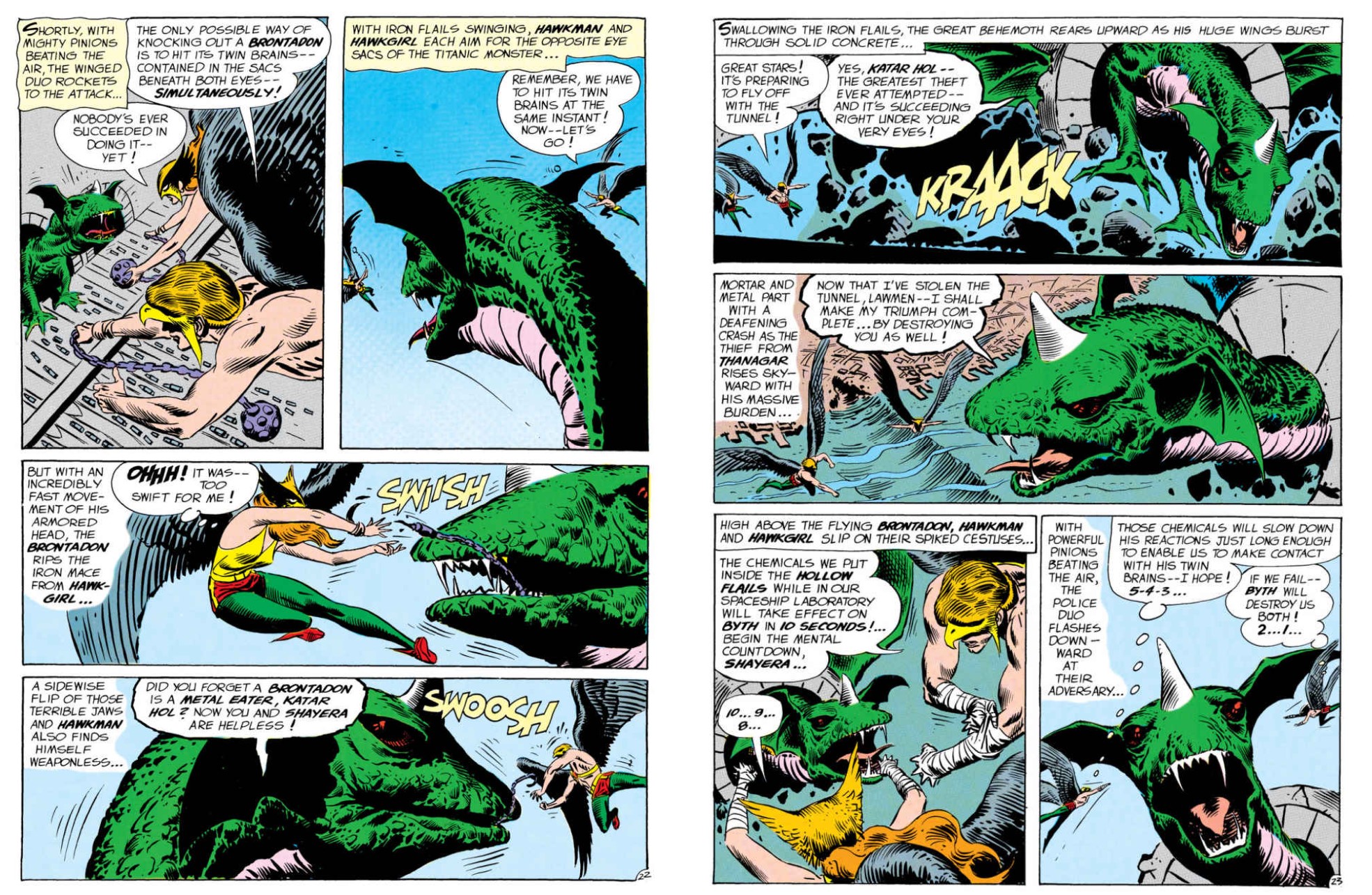
Katar Hol and Shayera Thal are police officers on their own planet of Thanagar. The married couple have travelled to Earth from the star system Polaris in pursuit of a spree-thief named Byth who assaulted a scientist and stole a drug bestowing the ability to change into anything. Thus the scene was set in ‘Creature of a Thousand Shapes!’ which graced The Brave and the Bold #34 (cover-dated February/March 1961) back when the title was a try-out vehicle like Showcase. Disappointments aside, the origin yarn is a spectacular work of graphic magic, with the otherworldly nature of the premise rendered captivatingly human by the passionately emphatic, moody expressiveness of Kubert’s art. It is a minor masterpiece of comic storytelling, and still a darned good read.

The high-flying heroes returned in the next issue, now “temporarily” stationed on Earth to study Terran police methods. In ‘Menace of the Matter Master’ they defeat a plundering scientist who has discovered a means to control elements and indulge in super-larceny, before ‘Valley of Vanishing Men’ takes our fully-integrated visitors from another world to the Himalayas to unlock the astounding and ironic secret of the Abominable Snowmen. Last shot in the try-out session, B&B #36 sees them defeat modern day wizard Konrad Kazlak in ‘Strange Spells of the Sorcerer!’ and, soon after, save Earth from another Ice Age whilst outwitting ‘The Shadow Thief of Midway City!’

With the 3-issue audition over, the publishers sat back and waited for the fan letters and sales figures… and something odd happened: fans were vocal and enthusiastic, but the huge sales figures that previously accompanied such reactions just weren’t there. It was inexplicable. The quality of the work was plain to see on every page, but somehow not enough people had plunked down their dimes to justify an ongoing Hawkman series.

A year later DC tried again. The Brave and the Bold #42 (June/July 1962) featured ‘The Menace of the Dragonfly Raiders’ which found Katar & Shayera returning to Thanagar just in time to encounter a bizarre band of alien thieves and the sinister hand of their oldest foe. Here was superhero action in a fabulous alien locale and the next issue maintained the exoticism – at least initially – before Hawkman and Hawkgirl returned to Midway City to defeat a threat to both worlds – ‘The Masked Marauders of Earth!’.

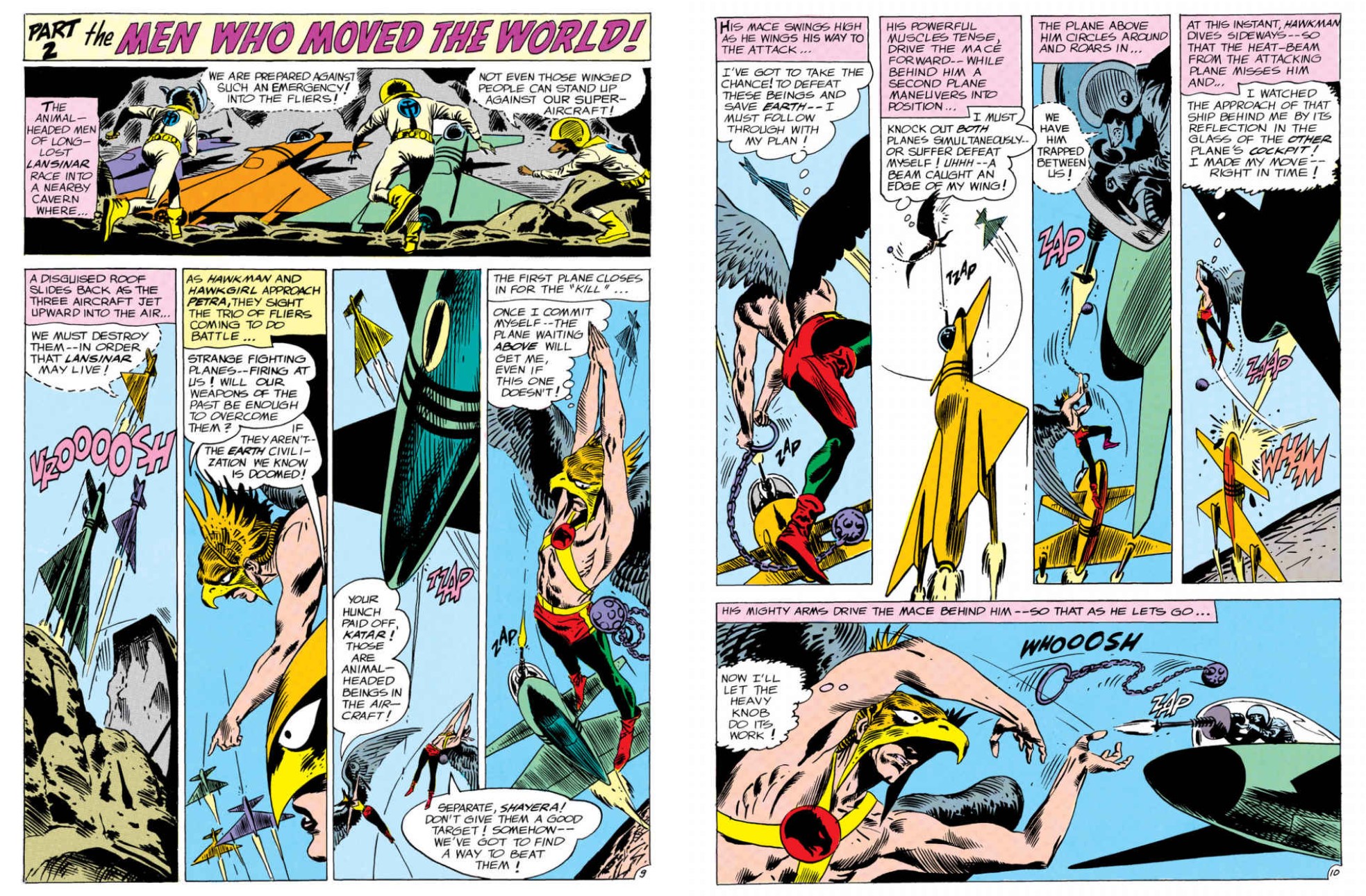
One last B&B issue followed (#44, October/November 1962) with two splendid and delightful short tales. ‘Earth’s Impossible Day!’ focused on Shayera’s desire to celebrate a holiday tradition of Thanagar before eerie doomsday thriller ‘The Men who Moved the World’ unearthed a lost civilisation and the return of Earth’s original occupiers seeking to move back again…

And then the Hawks vanished again. It certainly looked like this time the Schwartz magic had stumbled if not faltered. It was not, however, the end of the saga. Convinced he was right, Schwartz retrenched. Enjoying some success with his latest revival and mindful of the response when he had teamed Flash with Green Lantern in the summer of 1962, the editor had writer Fox include the Winged Wonder in The Atom #7 (cover-dated June/July 1963). An interplanetary thriller illustrated by Gil Kane & Murphy Anderson, ‘The Case of the Cosmic Camera!’ is a rocket-paced invasion rollercoaster ranging from the depths of space to Earth’s most distant past, where this new, clean-limbed version of the Avian Avenger clearly found fan-favour. In 1963 Hawkman returned! Again!

Mere months later, and dated November, Mystery in Space #87 had the Pinioned Paladin in action on the cover. The anthologogical sci fi standard had been the home of interstellar adventurer Adam Strange since #53, so now Schwartz moved his Winged Wonders into a plausible back-up slot and even bestowed occasional cover-privileges. Still beguilingly written by Fox, Kubert’s dark gritty art was superseded by the clean, graceful illustration of Anderson. Crime caper ‘The Amazing Thefts of the I.Q. Gang!’ dealt with a unexpected repercussion of an Adam Strange thriller and was followed a month later by ‘Topsy-Turvy Day in Midway City!’… a whimsical flourish as the cosmic couple’s devotion and Thangarian wedding customs lead to the capture of Terran bank bandits…

With the management now on board, guest appearances to maximise profile were easier to find. Hawkman returned to The Brave and the Bold with #51 (December 1963/January 1964) to team with Aquaman and face the ‘Fury of the Exiled Creature’ in a quirky tale of monsters, magic and mayhem in sunken Atlantis written by Bob Haney and illustrated by the criminally neglected Howard Purcell. Back in Mystery in Space #89 the ‘Super-Motorized Menace!’ proved the highest tech motor cycle is still no match for ancient weapons and alien  advantages…

These brief, engaging action pieces paled before the majesty and ambition of MiS #90 which delivered a full length epic uniting teaming the Hawks and Adam Strange in a legendary End-of the-World(s) epic. Illustrated by Carmine Infantino & Anderson, ‘Planets in Peril!’ was the last Hawkman back-up. From the next month, and after three years of trying, Hawkman soared into his own title.

Cover-dated April/May 1964, Hawkman #1 is a gem by Fox & Anderson. Two of the most visually arresting chracters in comics, the Hawks also boasted one of the most subtle and sophisticated relationships in the business. Like Sue & Ralph Dibney (Elongated Man and wife) Katar & Shayera are equal partners, and both couples were influenced by the Nick & Nora Charles characters of the Thin Man movies. Like those progenitors, the interplay of the Hols at home or at work is always rich in humour and warmth. In ‘Rivalry of the Winged Wonders’ – and whilst accommodatingly recapping their origins for newcomers, the couple decide to turn their latest case into a contest – Hawkgirl (eventually more appropriately called Hawkwoman) will use Thanagarian super-science to track and catch a band of thieves, whilst Hawkman limits himself to Earth techniques and tools to solving the crime.

This charmingly witty yarn is balanced by action thriller ‘Master of the Sky Weapons’ as recentlt resurrected ancient Mayan warrior Chac threatens Earth with disinterred alien super weapons. The the second issue stuck with star-stuff as the ‘Secret of the Sizzling Sparklers!’ offered an action-packed thriller of transdimensional invasion before closing with ‘Wings across Time!’: a mystery revolving around the discovery of the flying harness of legendary figure Icarus.

With “Carter & Shiera Hall” established as archeologists at Midway City Museum and Earth’s crypto-history & -zoology offering constant story-inspiration, another criminal brain-teaser opened the third issue. However, scientific bandits proved less of a menace than ‘The Fear that Haunted Hawkman’ with inexplicable panic attacks, before ordinary thugs and an extraordinary alien owl converged to make our heroes ‘Birds in a Gilded Cage’. Hawkman #4 then opened with a tale destined to revolutionise DC comics. ‘The Girl who Split in Two!’ introduced legacy hero Zatanna, daughter of a magician who fought crime in the 1940s only to “mysteriously disappear”…

From the very first issue, and for over a decade, Zatarra was a hero in the Mandrake mould who fought evil in the pages of Action Comics. During the Silver Age, Gardner Fox had Zatarra’s young, equally gifted daughter search for the missing mage, systematcally teaming up with superheroes he was currently scripting (if you’re counting, those tales appeared in Hawkman #4, The Atom #19, Green Lantern #42, and the Elongated Man strip from Detective Comics #355). A very slick piece of backwriting latterly included the high-profile Caped Crusader via Detective #336 – ‘Batman’s Bewitched Nightmare!’. The saga concluded in Justice League of America #51’s ‘Z… As in Zatanna… and Zero Hour!’). The collected saga Zatanna’s Search is currently out of print but you can go here for our take on it…

This wide, long-running experiment in continuity proved there was a dedicated fanbase with a voracious appetite for experimentation and relatively deep pockets. Most importantly, it finally signalled an end of the period where DC heroes largely lived and battled in self-imposed worlds of their own.

Hawkman #4 back-up ‘The Machine that Magnetized Men!’ is another enthalling howdunnit  tale as the Pinioned Paladins use reason and deduction to defeat thieves who are impossible to touch. For the next issue ‘Steal, Shadow… Steal!’ was the first full-length thriller, wherein ruthless Shadow Thief Carl Sands returns seeking revenge, believing causing Earth’s next Ice Age to be an acceptable consequence of his schemes, whilst in #6, publishing fashion caught up with the Hawks…

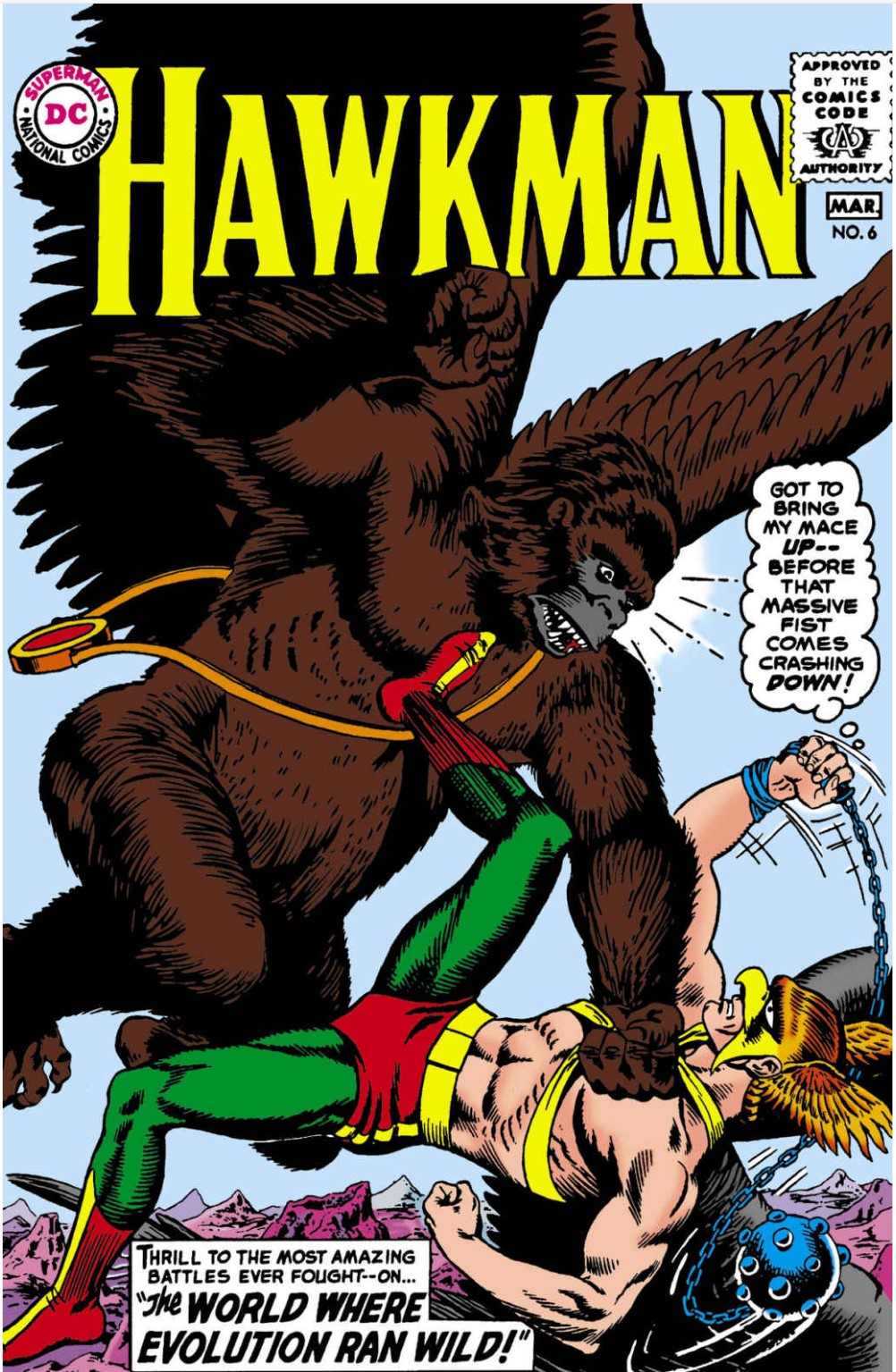
Another epic, and one that turned DC’s peculiar obsession with gorillas into a classic adventure, ‘World Where Evolution Ran Wild!’ lures our heroes to fabled Illoral, where a scientist’s explorations and interventions have stretched Natural Selection to un-natural limits. Bold, brash and daft in equal amounts, this is a fabulous romp and seeing again the cover where Hawkman struggles for his life against a winged gorilla makes the adult me realise those DC chaps might have known what they were doing with all those anthropoid covers!

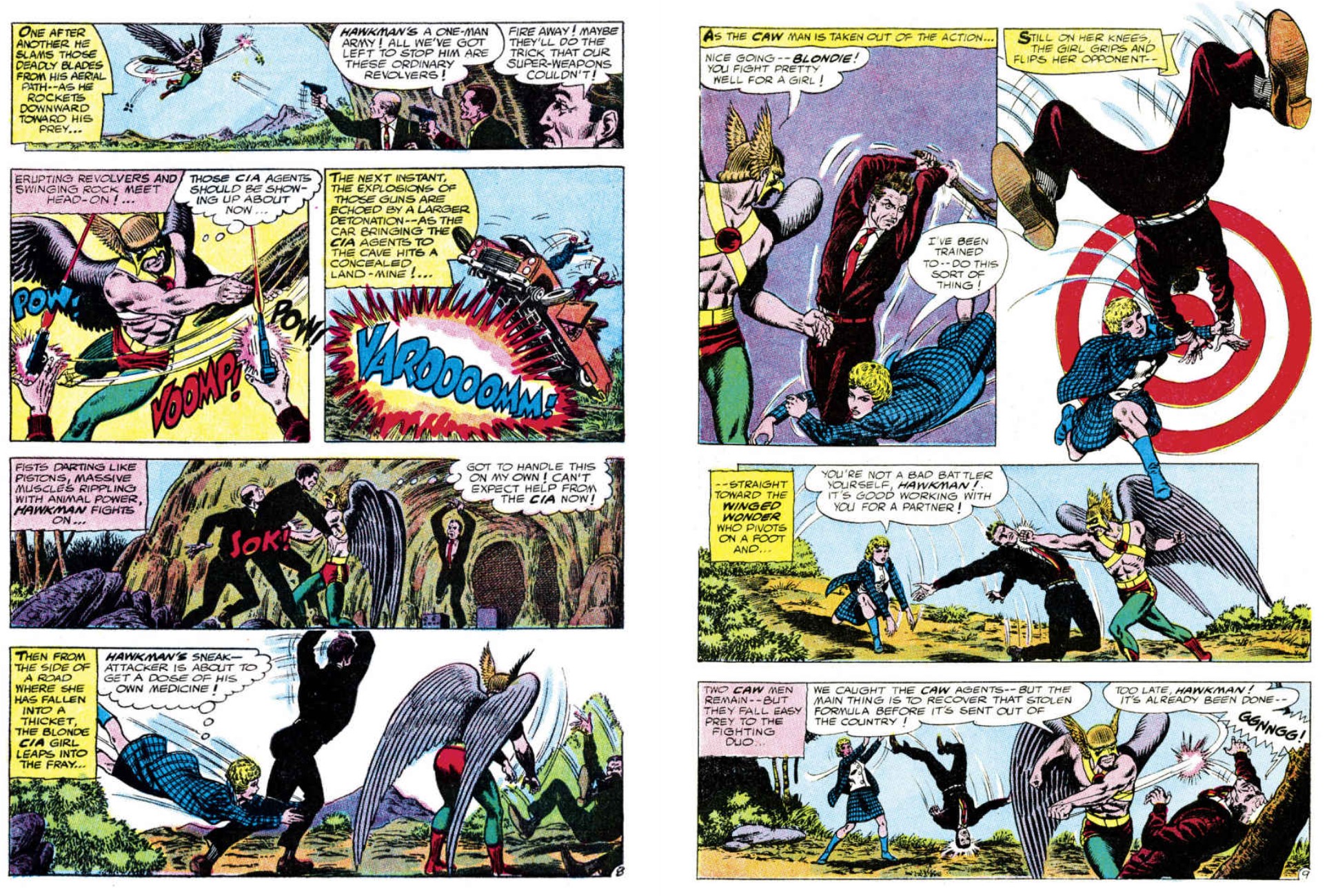
By issue #7 (April/May 1965) the world was gripped in secret agent fever as the likes of James Bond, The Man from U.N.C.L.E., and a host of others snuck and sashayed across our screens. Comics were not immune,  even though spies had been a staple threat there for decades. Before Hawkman joined the gang, however, he had to deal with the rather mediocre threat posed by solar ray inspired criminal genius Ira Quimby and ‘The Amazing Return of the I.Q. Gang!’ As they were quickly returned to prison the Hawks faced the ‘Attack of the Crocodile-Men!’: a high-octane super-science thriller introducing C.A.W. – the Criminal Alliance of the World…

Another supremely captivating cover adorned #8, as the Hawks fought an ancient Roman Artificial Intelligence, built by not-so-mythical metalsmith Vulcan in ‘Giant in the Golden Mask!’, before defeating an alien Harpy who’d been buried for half a million years and promptly triggered a ‘Battle of the Bird-Man Bandits!’ as soon as she woke up…

Hawkman #9 saw The Atom as guest star when an old villain returned with a seemingly perfect revenge plan. Full-length super-thriller ‘Master Trap of the Matter Master!’ offered sheer superhero hi-jinks, after which #10 saw a playful Fox at his best in both ‘Hawkman Clips the Claws of C.A.W!’ This was another espionage drama with a delicious subplot as the Winged Wonder aids a sexy CIA agent with a big secret of her own – before solving ‘The Magic Mirror Mystery!’: a fair-play brainteaser with lots of high-flying action to balance the smart stuff.

This glorious volume closes with another superb full-length epic. Clearly designed as a so-fashionable “player on the other side”, ‘The Shrike Strikes at Midnight!’ leaving our heroes trailing a super-powered, winged bandit all over the world and on to the star system Mizar, in a gripping tale of crime, super-villainy, aliens, revolutions and even dinosaurs…

Although never the major player of his 1940s ancestor, Hawkman grew to be one of the most iconic characters of the second superhero boom, not just for the superb art but also because of a brilliantly sly, whimsically subtle writer with a huge imagination. These tales are comfortably familiar but also grippingly timeless. Thankfully, comics are a funny business; circumstances, tastes and fashions often mean that wonderful works are missed and unappreciated, but it aso means revivals are never too late. Don’t make the same mistake readers did in the 1960s. Whatever your age, read these astounding adventures and become a fan. It’s never too late.
© 1961, 1962, 1963, 1964, 1965, 1966, 2025 DC Comics. All Rights Reserved.

Beano and The Dandy: A Celebration of Dudley D. Watkins


By Dudley D. Watkins, R.D. Low & various (DC Thomson)
ISBN: 978-1-84535-818-1 (HB)

This book includes Discriminatory Content produced in less enlightened times.

As the physical books I bought to commemorate this occasion still haven’t arrived yet, and none of them are available digitally, I’m celebrating the achievements of one of Britain’s greatest cartoonists with something you might have read before. So if I didn’t convince you then, here’s a another shot at what you see and what should be a compulsory text in Art, Sociology and History classes. Don’t make me repeat myself again…

Unlike any other artform, Comics is uniquely set up to create small gods. Initially low cost, mass-market and appearing with rapidity – occasionally over the course of decades – the works of some creators are instantly recognisable and generally prolific, and come to define the medium for generations of enthralled recipients. All generally defy exact duplication, despite being always heavily imitated by adoring adherents, since they possess an indefinable element that slavish imitation cannot capture: Osamu Tezuka, Hergé, Jack Kirby, Alex Raymond, Moebius, Steve Ditko and Charles Schulz are all instantly known. There are certainly a few others you’d like to add to that list.

Feel free.

My own candidate for ascension is Dudley Dexter Watkins…

A tireless and prolific illustrator equally adept at comedy and drama storytelling, his style more than any other’s shaped the postwar look and form of Scottish publishing giant DC Thompson’s comics output. Watkins (1907-1969) started life in Manchester and Nottingham as an artistic prodigy prior to entering Glasgow College of Art in 1924. Before too long he was advised to get a job at expanding, Dundee-based DCT, where a 6-month trial illustrating prose boys’ stories led to comic strip specials and some original cartoon creations. Percy Vere and His Trying Tricks and Wandering Willie, The Wily Explorer made him the only contender for both lead strips in a bold new project conceived by Robert Duncan Low (1895-1980).

Low began as a journalist for DC Thomson, rising via story scripting to Managing Editor of Children’s Publication and between 1921 and 1933 launched the company’s “Big Five” story papers for boys: Adventure, The Rover, The Wizard, The Skipper and The Hotspur. In 1936, he created the landmark “Fun Section”: an 8-page pull-out comic strip supplement for national newspaper The Sunday Post. This illustrated accessory – prototype and blueprint for every comic the company subsequently released – launched on 8th March. From the outset The Broons and Oor Wullie were the uncontested headliners.

Low’s shrewdest notion was to devise both strips as comedies played out in the charismatic Scottish idiom and broad unforgettable vernacular, supported by features such as Chic Gordon’s Auchentogle, Allan Morley’s Nero and Zero, Nosey Parker and other strips. These pioneering comics then laid the groundwork for the company’s next great leap. After some devious devising, in December 1937 Low launched DC Thomson’s first weekly all-picture strip comic. The Dandy was followed by The Beano Comic in 1938, and early-reading title The Magic Comic in 1939.

Low’s irresistible secret weapon in all of these ventures was Watkins. The indefatigable cartoon stalwart drew the Fun Section signature strips The Broons and Oor Wullie from the outset and – without missing a beat – added Desperate Dan (in The Dandy) to his weekly workload in 1937. Seven months later, placidly outrageous, subtly subversive social satire Lord Snooty became a big draw for freshly launched companion paper The Beano.

This stunning and luxurious hardback commemorative celebration was released to mark 50 years since Watkins’ death and – despite dealing with a rather solemn topic – is exuberantly joyous in tracing the man’s astounding career and output. No one could read this stuff and not smile, if not actually collapse in mirth.

Packed with brief commentary and visual extracts, the artist is revealed in excerpts and complete episodes chronologically curated to maximise his artistic development. Beginning with The 1930s, a selection of strips starring Oor Wullie and The Broons from The Fun Section is followed by a vintage full-colour Beano Book cover, before a feature on Desperate Dan leads inevitably to a tranche of wild cowboy antics in the best Dundee tradition. The system then repeats for Lord Snootyand his Pals – and then forgotten almost-stars Wandering Willie the Wily Explorer and aforementioned Percy Vere and his Trying Tricks who share their brand of whimsy. Up until now, the majority of strips are monochrome, but the sequence starring Smarty Grandpa comes in the nostalgic two-colour style we all remember so fondly…

An introductory essay about The 1940s is followed by more of the same, but different; beginning with lost family favourite adventure series. Jimmy and His Magic Patch (latterly Jimmy’s Magic Patch) share the exploits of a wee nipper whose torn trousers were repaired with a piece of mystical cloth that could thereafter grant wishes and transport the wearer to other times and fantastic realms. Here Watkins got to impress with authentic imagery of pirates and dinosaurs, while a two-tone tale from an annual took Jimmy to Sherwood Forest and a meeting with Robin Hood

Apparently Watkins could handle anything, as seen by a selection of book covers that follow – The Story of Kidnapped, The Story of Treasure Island and The Story of Robinson Crusoe – and illustrated general knowledge pages Cast Away!, Wolves of the Spanish Main and Soldiers’ Uniforms & Arms 1742-1755 which precede complete Jacobite adventure strip Red Fergie’s “Army”.

Once upon a time, comics offered illustrated prose yarns too, and a literary legend was a fan favourite when Watkins did the pictures. ‘Gulliver – the Paraffin Oil Plot’ has splendidly stood the test of time and neatly segues into a hefty section of strips starring the evergreen Lord Snooty and his Pals and Desperate Dan, before Biffo the Bear debuts in full colour, beginning with his premier on January 24th 1948 and including three more captivating outings. The decade closes with another prose Gulliver treat in ‘Baron Bawler’s Blackout’

A true golden age, The 1950s section opens with Oor Wullie derivative Ginger (from The Beezer), another full-colour cover-star copiously represented and followed by fellow mischief-maker Mickey the Monkey out of The Topper, after which Lord Snooty and his Pals get the text & picture treatment for an extended (possibly Annual or summer special?) lark, and Desperate Dan & Biffo the Bear star in multi-hued shorts trips, after which ‘The Tricks of Tom Thumb’ – another classical adventure yarn – sets the scene for a veritable flurry of strips starring Biffo & Dan to see the decade out.

Venerable Lord Snooty and his Pals open The 1960s, with Desperate Dan quickly following, before more full-colourful Mickey & Ginger strips lead into what was probably the artist’s preferred material. Watkins was a committed man of faith, creating illustrated Bible tracts in his spare time, and always eager to (decorously) promote his beliefs. Here – in full colour – are a brace of theological adventure strips beginning with ‘David’ and his notorious battle, supplemented by ‘The Road to Calvary’ which lead into a rousing clan romp in the prose-&-picture yarn of English-trouncing Scots rebel Wild Young Dirky

Ending the festival of fun, with a lump in the throat, is the Biffo strip that formed the cover of Beano #1423 (25th October 1969). Watkins had soldiered on in unassailable triumph for decades, drawing some of the most lavishly lifelike and winningly hilarious strips in comics history, and died at his drawing board on August 20th 1969. The page he was working on was completed by David Sutherland, who adds his own gracious homily to the piece.

For all those astonishingly productive years, Dudley D. Watkins had also unflaggingly crafted a full captivating page each of Oor Wullie and The Broons, as well as his church tracts and periodical commitments. His loss was a colossal blow to the company. DC Thomson reprinted old episodes of both strips in the newspaper and the Annuals for seven years before a replacement was agreed upon, whilst The Dandy reran Watkins’ Desperate Dan stories for twice that length of time.

DCT’s publications have always played a big part in Britain’s Christmas festivities and are still a cornerstone of our cultural bulwarks, so let’s revel in the Good Old Days of comics via this lovingly curated tribute to Scotland’s greatest cartoon artisan.
© DCT Consumer Products (UK) Ltd. 2020.

Hugo Pratt also died today in 1995. If you want to learn about him, our most recent review of his magic can be found here.
Prince Valiant volumes 1-3 Gift Box Set


By Hal Foster (Fantagraphics Books)
ISBN: 978-1 68396-072-0 (boxed set)

Individual volume ISBNs: 978-1-60699-141-1 (HB vol. 1), 978-1-60699-348-4 (HB vol. 2), 978-1-60699-407-8 (HB vol. 3)

This book includes Discriminatory Content produced in less enlightened times.

Today, way back in 1892, a god of comics was born. His work will never die.

Rightly reckoned one of the greatest comic strips of all time, the majestic, nigh-mythical saga of a king-in-exile who became one of the greatest warriors in an age of unparalleled heroes is at once fantastically realistic and beautifully, perfectly abstracted – an indisputable paradigm of adventure fiction where anything is possible and justice always prevails. It is the epic we all want to live in. However, on one thing let us be perfectly clear: Hal Foster’s Prince Valiant is not historical. It is far better and more real than that.

Possibly the most successful and evergreen fantasy creation ever conceived, Prince Valiant in the Days of King Arthur launched on Sunday 13th February 1937, a glorious weekly, full-colour window not onto the past but rather onto a world that should have been. It followed the tempestuous life of a refugee boy driven by invaders from his ancestral homeland of faraway Thule who persevered and, through tenacity, imagination and sheer grit, rose to become one of the mightiest heroes of the age of Camelot.

As depicted by the incomprehensibly gifted Foster, this noble scion would, over decades, grow to mighty manhood in a heady sea of wonderment: roaming the globe and siring a dynasty of equally puissant heroes whilst captivating and influencing generations of readers and thousands of creative types in all the arts. There have been films, cartoon series and all manner of toys, games and collections based on the feature – one of the few newspaper strips to have lasted from the thunderous 1930s to the present day (well over 4600 episodes and STILL counting) and, even in these declining days of newspaper cartooning, it still claims over 300 American papers as its home.

Foster produced the strip, one spectacular page a week until 1971 when, after auditioning such notables as Wally Wood and Gray Morrow, Big Ben Bolt artist John Cullen Murphy was selected to draw the feature. Foster carried on as writer and designer until 1980, after which he fully retired and Murphy’s son took over scripting duties. In 2004 Cullen Murphy also retired (he died a month later on July 2nd) but the strip soldiered on under the extremely talented auspices of artist Gary Gianni and writer Mark Schultz prior to Thomas Yeates settling in and conquering one more exotic land by making it onto the worldwide web.

The first three exquisite oversized hardback volumes (362 x 268mm) are happily still available as a monumental gift set nobody could resist. They reprint, in glorious colour spectacularly restored from Foster’s original printer’s proofs, the princely pristine Sunday pages cumulatively spanning February 1937 to 20th December 1942: six years of formative forays comprising an impressive saga which promised much and delivered so much more than anybody could have suspected during those dim, distant and dangerous days…

Volume 1 opens with editor Brian M. Kane’s informative picture/photo-packed potted history of ‘Harold Rudolf Foster: 1892-1982’, after which Fred Schreiber conducts ‘An Interview with Hal Foster’ as first seen in Nemo: The Classic Comics Magazine (1984). Additionally, after the Arthurian epic exploits of our quintessential swashbuckling hero, this initial tome is rounded off by Kim Thompson’s discourse on the many iterations of reprints over the years and around the world in ‘A History of Valiants’

The actual action-packed drama commences in distant Scandinavia as the King of Thule, his family and a few faithful retainers dash for a flimsy fishing boat, intent only on escaping the murderous intentions of a usurper’s army. Their voyage carries them to the barbarous coast of Britain and into battle against bands of wild men before they secure a safe point in the gloomy fens of East Anglia. After many hard fights they reach an uneasy détente with the locals and settle into a harsh life as regal exiles. Prince Valiant is but 5 years old when they arrive, and his growing years in a hostile environment toughen the heir, sharpen his wits and give him an insatiable taste for mischief and adventure. He befriends a local shepherd boy and together their escapades include challenging the marauding ancient dinosaurs which infest the swamp, battling a hulking man-brute and bedevilling a local witch. In retaliation the hag Horrit predicts that Val’s life will be long and packed with incredible feats… but always tainted by great sorrow. All that, plus a constant regimen of knightly training and scholarly tuition befitting an exile learning how to reclaim his stolen kingdom, make the lad a veritable hellion…

Everything changes when his mother passes away. After a further year of intense schooling in the arts of battle, Valiant leaves the Fens, and makes his way in the dangerous lands beyond. Whilst sparring with his boyhood companion, he unsuspectingly insults Sir Launcelot who is fortuitously passing by. Although that noble warrior is sanguine about the cheeky lad’s big mouth, his affronted squire attempts to administer a stern punishment… and is rewarded with a thorough drubbing. Indeed, Launcelot has to stop the Scion of Thule from slitting the battered and defeated man’s throat. Moreover, although he has no arms, armour, steed or money, Valiant swears that he too will be a Knight…

Luck is with the Pauper Prince. After spectacularly catching and taming a wild stallion, his journey is interrupted by gregarious paladin Sir Gawain who shares a meal and regales the wide-eyed lad with tales of chivalry and heroism. When their alfresco repast is spoiled by robber knight Sir Negarth – who unfairly strikes the champion of Camelot – Val charges in. Gawain regains consciousness to find the threat ended, with Negarth hogtied and his accomplice skewered…

Taking Val under his wing, wounded Gawain escorts the lad and his prisoner to Camelot, although their journey is delayed by a gigantic dragon. Val kills it too – with the assistance of Negarth – and spends the rest of the trip arguing that the rogue should be freed for his display of gallantry. Val is still stoutly defending the scoundrel at the miscreant’s trial before King Arthur, and is rewarded by being appointed Gawain’s squire. Unfortunately, he responds badly to being teased by the other knights-in-training and soon finds himself locked in a dungeon whilst his tormentors heal and the remaining Knights of the Round Table ride out to deal with an invasion of Northmen…

Whilst the flowers of chivalry are away, a plot is hatched by scheming Sir Osmond and Baron Baldon. To recoup gambling debts, they capture and ransom Gawain, but have not reckoned on the dauntless devotion and ruthless ingenuity of his semi-feral squire. Easily infiltrating the bleak fortress imprisoning the hero, Valiant liberates his mentor through astounding feats of daring and brings the grievously wounded knight to Winchester Heath and Arthur…

As Gawain recuperates, he is approached by a young maiden. Ilene is in need of a champion and – over his squire’s protests – the still gravely unfit knight dutifully complies. Val’s protests might have been better expressed had he not been so tongue-tied by the most beautiful girl he has ever seen. The quest to rescue Ilene’s parents is delayed when an unscrupulous warrior in scarlet challenges them, intent on himself possessing the lovely maiden. Correctly assessing Gawain to be no threat, the Red Knight does not live long enough to revise his opinion of the wild-eyed boy who then attacks him…

Leaving Ilene and re-injured Gawain with a hermit, Valiant continues on alone to Branwyn Castle, recently captured by an “Ogre” who terrorises the countryside. Through guile, force of arms and diabolical tactics the boy ends that threat forever. This is an astonishing tour de force of graphic bravura no fan could ever forget. Aspiring cartoonist Jack Kirby certainly didn’t: he recycled Val’s outlandish outfit used to terrorise the Ogre’s soldiers into the visual basis for his 1972 horror-hero Etrigan the Demon

Having successfully routed the invaders and freed Ilene’s family, Val begins earnestly courting the grateful girl, but his prophecy of lifelong misery seems assured, however, when her father regretfully informs him that she is promised to Arn, son and heir of the King of Ord. Even before that shock can sink in, Valiant is called away again. Ailing Gawain has been abducted by sorceress Morgan le Fey, who is enamoured of the knight’s manly charms…

When Val confronts her, le Fey drugs him with a potion and the Prince endures uncounted ages in her dungeon before escaping. Weak and desperate, he makes his way to Camelot and enlists Merlin in a last-ditch ploy to defeat the witch and save his adored mentor. In the meantime, events have progressed, and Val’s bold plans to win Ilene are derailed when invitations to her wedding arrive at Camelot. Initially crushed, the resilient youth determines to travel to Ord and challenge Prince Arn for her hand. Their meeting is nothing like Val imagined but, after much annoying interference, he and the rather admirable Arn finally engage in their oft-delayed death-duel, only to be again distracted when news comes that Ilene has been stolen by Viking raiders…

What follows is another unparalleled moment of comics magnificence as Valiant sacrifices everything for honour, gloriously falls to superior forces, wins possession of Flamberge (the legendary Singing Sword which is brother to Excalibur), is captured and then reunited with Ilene… only to lose her again to the cruellest of fates…

After escaping from the Vikings and covering himself with glory at the Lists in Camelot – although he doesn’t even realise it – the heartsick, weary Prince returns to his father in the melancholy Anglian fens, again encountering ghastly Horrit and nearly succumbing to fever. When he recovers months later, he has a new purpose: he and his faithful countrymen will travel to Thule and rescue the nation from the cruel grip of usurper Sligon. Unfortunately, during the preparations, Valiant discovers his region of Britain has been invaded by Saxons and is compelled by his honour to race to Camelot and warn Arthur first…

To Be Continued…


Volume 2 reprints perfectly-restored Sunday pages from January 1st 1939 to 29th December 1940, following Sir Gawain’s extremely capable squire as he rushes to warn Camelot of invasion by rapacious Saxons via vast Anglian Fens. Here Thule’s Royal Family have hidden since being ousted from their Nordic Island Kingdom by the villainous usurper Sligon. After a breathtaking battle which sees Saxons repulsed and the battle-loving boy-warrior knighted upon the field of victory, Valiant begins a period of globe-trotting. This carries him through the fabled lands of Europe just as the last remnants of the Roman Empire are dying in deceit and intrigue.

Firstly, Val revisits Thule and restores his father to the throne, narrowly escaping the alluring wiles of a conniving beauty with an eye to marrying the Heir Apparent. Quickly bored with palaces, peace and plenty, the roving royal wildcat then encounters a time-twisting pair of mystical perils who show him the eventual fate of all mortals. Sobered but not daunted, he makes his way towards Rome, where he will become unwittingly embroiled in the manic machinations of the Last Emperor, Valentinian. Before that, however, Val is distracted by an epic feat that would have struck stunning resonances for the readership at the time. With episode #118 (14th May 1939) Val joins the doomed knights of mountain fortress Andelkrag, who, alone and unaided, hold back the assembled might of the terrifying hordes of Attila the Hun: a terror who is currently decimating the civilisations of Europe and now marshals his forces to wipe out its last vestige.

With Hitler & Mussolini hogging headlines and Modern European war seemingly inevitable, Val shares the Battle of Decency and Right against untrammelled Barbarism. His epic struggle and sole survival comprise one of the greatest episodes of glorious, doom-fated chivalry in literature…

After the fall of the towers of Andelkrag, Valiant makes his way onward to diminished Rome, picking up a wily sidekick in the form of cutpurse vagabond Slith and is once more distracted and delayed by dastardly Huns. The indomitable lad resolves to pay them back in kind, gathering dispossessed victims of Hunnish depredations and forging them into a resistance army of guerrilla-fighters: the Hun-Hunters. Thereafter he liberates vassal city Pandaris, driving back the invaders and their collaborator allies in one spectacular coup after another.

Valiant eventually reunites with equally action-starved Round Table companions Sir Tristram and Sir Gawain to make further fools of the Hun, who have lost heart after the death of their charismatic leader Attila (nothing to do with Val, just a historical fact). When Slith falls for a warrior princess, the Knights leave him to a life of joyous domesticity and move ever on…

An unexpected encounter with a giant and his unconventional army of freaks leads to the heroes inadvertently helping a band of marshland refugees from Hunnish atrocity, before establishing the nation-state of Venice. Then, at long last – and after a side-trip to the fabulous city of Ravenna – the Courtly trio cross the fabled Rubicon and plunge into a hotbed of political tumult. Unjustly implicated in a web of murder and double-dealing, the knights barely escape with their lives and split up to avoid pursuit. Tristan heads back to England and a star-crossed rendezvous with comely Isolde, Gawain takes ship for some fun in Massilia and Valiant, after an excursion to the rim of fiery Vesuvius, boards a pirate scow for Sicily and further adventure.

To Be Continued…


Volume 3 of the most successful and evergreen fantasy creation ever conceived offers the Sunday pages from January 5th 1941 to 20th December 1942, but only after erudite foreword ‘Modestly, Foster’ by Dan Nadel. The illustrated action opens in the shadow of flaming Vesuvius as Val’s vessel is attacked by self-proclaimed Sea-King Angor Wrack. Even the ferocious warrior-prince’s martial might is insufficient against insurmountable odds and the young Lord is captured and enslaved, his fabled Singing Sword confiscated by the victorious pirate.

Thus begins an astonishingly impressive chapter in the hero’s history. Val becomes a galley slave, escapes and washes up, starving and semi-comatose on the lost shores of the Misty Isles. Delirious, he glimpses his future wife Queen Aleta when she re-provisions his boat before casting him back to the sea’s mercies. The Misty Isles are secure only because of their secret location and the noble girl has broken a great taboo by sparing the shipwrecked lad. Replenished but lost, Val drifts helplessly away but resolves that one day he will discover again the Misty Isles and the enigmatic Aleta…

Eventually he is picked up by more pirates, but overwhelms the captain and takes charge. Finding himself in the island paradise of Tambelaine courting the daughters of the aged King Lamorack, Val encounters Angor Wrack again, but fails to recover the Singing Sword, precipitating an extended saga of maritime warfare and spectacular voyaging across the Holy Land from Jaffa to Jerusalem. The vendetta results in both Angor and Val being taken by Arab slavers, but the Prince nobly allows Wrack to escape whilst he battles Bedouin hordes…

Enslaved in Syria, even Val’s indomitable will and terrifying prowess are insufficient to his need so he seduces his owner’s daughter to effect an escape, only to stumble into a marital spat between the region’s greatest necromancer and his tempestuous bride.

Reaching Jerusalem, Val finally regains his beloved sword and settles his scores with Angor Wrack before determining to return to the hidden Misty Isles, but once again falls afoul of the pirates infesting the region. After incredible hardships, he is reunited with Aleta before fate drags them apart once more. Despondent, he departs alone – but not for long though, as on reaching Athens Val meets far-larger-than-life Viking raider Boltar: a Falstaff-like rogue and “honest pirate”. Together they rove across the oceans to the heart of the African jungles. On securing a huge fortune, their Dragonship reaches Gaul and Val is finally reunited with Gawain, and, after settling a succession of generational feuds between knights and defeating a seductive maniac, the paladins at last return to Britain courtesy of Boltar. This is just in time to be dispatched by Arthur to the far North. The King needs to scout Hadrian’s Wall and see if it can still keep belligerent Picts out. Unfortunately, libidinous Gawain abandons Val and the lad is captured by Caledonian wild-men and their new allies – a far nastier breed of Vikings intent on conquering England…

Tortured nigh unto death, the Prince is saved by the ministrations of Julian – a Roman warrior who has seemingly safeguarded the wall for centuries. And when he is recovered, Prince Valiant begins to inflict a terrible and studied revenge upon his tormentors…

To Be Continued…

Rendered in an astoundingly lovely panorama of glowing images, Prince Valiant is a lyrical juggernaut of stirring action, exotic adventure and grand romance; blending realistic fantasy with sardonic wit, and broad humour with unbelievably dark violence. Here closing text feature ‘Too Violent for American Dog Lovers’ reveals censored panels and changes editors around the world inflicted upon the saga during this period.

Beautiful, captivating and utterly awe-inspiring, Foster’s magnum opus is a World Classic of storytelling, something no adventuresome fan can afford to be without.

Volume 1: All comics material © 2009 King Features Syndicate except Tarzan page, © 2009 ERB Inc. All other content and properties © 2009 their respective creators or holders.
Volume 2: © 2009 King Features Syndicate. All other content and properties © 2009 their respective creators or holders.
Volume 3: © 2011 King Features Syndicate. All other content and properties © 2011 their respective creators or holders. All rights reserved throughout.
Gift Set © 2017 King Features Syndicate. Published by Fantagraphics Books.

Ka-Zar Marvel Masterworks volume 2


By Mike Friedrich, Steve Gerber, Carol Seuling, Ross Andru, Don Heck, Dan Adkins, Jim Starlin, Marie Severin, Werner Roth, George Tuska, Paul Reinman, Mike Royer, Bob Brown, Sal Buscema, Gene Colan & various (Marvel)
ISBN: 978-1-3029-0966-6 (HB/Digital edition)

This book includes Discriminatory Content produced in less enlightened times.

There are quite a few comics anniversaries this year. Some of the most significant will be rightly celebrated, but a few are going to be unjustly ignored. As a feverish fanboy wedged firmly in the past, I’m again abusing my privileges and advising an encounter with something old, nigh forgotten but definitely worth a soupçon of your time and energies…

IT’S A JUNGLE OUT THERE! …and apparently everywhere else, too…

Retconned from a pulp hero and latterly comics B-Lister from the early days of Timely comics, primal white jungle god Ka-Zar most accurately stems from 1965 where he stole the show in a dinosaurs & mutants yarn in X-Men #10.

Beginning as a cheeky Tarzan tribute act relocated to a lost world in a realm of swamp-men and dinosaurs, Ka-Zar eventually evolved into one of Marvel’s more complex – if variable – characters. Fabulously wealthy heir to one of Britain’s oldest noble families, his bestest friend is “sabretooth tiger” Zabu and his wife is feisty environmental-crusader Shanna the She-Devil. His dad was apparently a mad scientist, his brother a homicidal super-scientific modern day pirate. Kevin Reginald, Lord Plunder is perpetually torn between the clean life-or-death simplicity of the wilds and bewildering constant compromises of modern civilisation.

The primordial paragon is arguably Marvel’s oldest star, having begun life as a prose star, boasting three issues of his own pulp magazine between October 1936 and June 1937. They were authored by Bob Byrd – a pseudonym for publisher Martin Goodman or one of his retinue of staff writers. Goodman latterly shoehorned him into his speculative venture: new-fangled comic book Marvel Comics #1 (October 1939), where he lurked alongside fellow pulp line graduate The Angel, Masked Raider, Human Torch and Sub-Mariner

In the sixties, when Ka-Zar reappeared he was all rowdy, reimagined and renovated by Jack Kirby for X-Men #10 (cover-dated March but actually on sale from January 5th), and it was clear the uncrowned Sovereign of the Savage Land was destined for bigger and better things. However, for years all we got was guest shots as a misunderstood foe du jour for Daredevil, Sub-Mariner, Spider-Man, and The Hulk.

In 1969 he got his shot as a lone wolf starring in Marvel Super-Heroes. Later that year – after Roy Thomas & Neal Adams used him so effectively in their X-Men run (issues #62-63) – Ka-Zar was awarded his own giant-sized title, reprinting most of his previous appearances. However, the reruns oddly bracketed all-new stories of Hercules and The Angel (the new one from X-Men not the costumed detective of the 1940s). That same month, his first solo series began in a split book entitled Astonishing Tales

Gathering material from Astonishing Tales #17-20, Shanna the She-Devil #1-5, Ka-Zar (volume 2) #1-5 and Daredevil #110-112, spanning cover-dates December 1972 through August 1974, this sequel compilation volume begins with reminiscences from Mike Friedrich and Carole Petersen-Sueling in two separate (but equal) Introductions.

Previously, Ka-Zar & Zabu’s idyllically brutal lives hunting dinosaurs and battling aliens, gods, wizards and lost civilisations in the Savage Land had been turned on its head with the arrival of apparently irresistible S.H.I.E.L.D. agent Barbra “Bobbi” Morse (who becomes costumed spy/Avenger Mockingbird many years from now) and aging biologist Dr. Wilma Calvin. Their quest for a Super-soldier formula dragged the wild man across continents to Florida and into conflict with Advanced Idea Mechanics (A.I.M.), the Man-Thing, super-mercenary Gemini and, on reaching New York City, drug lord dope peddler The Pusher…

Increasingly enamoured of Morse, Ka-Zar opts to give the modern world another go, but increasingly comes to despise the greed, the dirt, the greed, the callous brutality and the sheer greed of civilisation, especially after encountering the drug crisis first hand…

Culture clash conflict resumes with ‘Target: Ka-Zar!’ as crafted by Friedrich, Dan Adkins & Frank Chiaramonte for April 1973’s Astonishing Tales #17. Here, the Jungle Lord’s impatience and discontent are magnified when AIM again tries to snatch Calvin’s prototype serum, employing gunmen on the ground and ultimately super-mercenary Gemini to humiliatingly grab the formula from S.H.I.E.L.D.’s helicarrier and making Ka-Zar and Zabu look like idiots in the process…

Pride stung and mad as hell, the wild man follows Gemini to earth and falls into an ambush laid by his brother Parnival and backed up by his pet alien monster. Hired by AIM to secure the serum the Plunderer has the upper hand when ‘Gog Cometh!’ since the childlike colossus is lethally loyal and can teleport on command. He/it is also growing larger every minute…

The saga spirals out of control as Ka-Zar wins a rematch with Gemini but loses the serum sample to The Plunderer who heads for Manhattan whilst in Land’s End, England, another strand of the search for super-soldiers culminates with AIM scientist Professor Victor Conrad surviving a gun battle with S.H.I.E.L.D. agents by taking his own medicine…

Back in the USA, late-arriving Bobbi Morse and Zabu give the blonde barbarian a lift to Manhattan in time to channel the end of King Kong, as the ever-enlarging Gog runs amok with the local landmarks before confronting its destiny on top of the city’s tallest building, even as, far below, the strictly human clashes result in triumph for the forces of right and wonders of chemistry…

With the serum recovered and his honour upheld, the Noble Savage realises that – other than Bobbi – there is nothing about civilisation that please him, but as he ponders that and pines for the Savage Land, one last loose thread needs tying off as a new threat seizes control of AIM and seeks redress for past sins. Inked by Jack Abel, and with Jim Starlin stepping in to complete the episode begun by Adkins, AT #19 reveals ‘…And Men Shall Name Him… Victorius!’ as Conrad abducts agent Morse to obtain S.H.I.E.L.D.’s version of the formula that made him an unstoppable warrior. When Ka-Zar & Zabu track him down he rejects taking the serum himself and attacks the scientist, Gemini and brother Parnival in all his purely human might and main…

Marie Severin, Werner Roth & Frank Giacoia wrap up the run as Astonishing Tales # 20 (October 1973) depicts ‘The Final Battle!’ before Ka-Zar returns to his (un)natural environment and a new solo title, pausing only to crush his assembled foes turn down a job with Nick Fury and briefly regret losing Bobbi to the Big City….

Before that new beginning though, there’s a slight chronological sidestep to introduce a soon-to-be-crucial character who came and went with little fanfare a few months previously. As the costumed cohort craze subsided with the close of the Sixties, Stan Lee & Roy Thomas looked into creating a girl-friendly boutique of female stars written by women.

Opening shots in this act of liberation were Claws of the Cat by Linda Fite, Marie Severin & Wally Wood (who at least knew how to draw them) and Night Nurse by Jean Thomas & Win Mortimer. Both #1’s were cover-dated November 1972 and despite impressive creative teams none of these fascinating experiments lasted beyond a fifth issue, although a third shot was kept from limbo by some judicious teamwork. The caregiver vanished for decades and the feline fury mutated into Tigra, the Were-Woman in Giant-Size Creatures #1 (July 1974), and even though their experimental comrade stuck around, the general editorial position was upheld… “books starring chicks don’t sell…”

Contemporary jungle queen – possibly the last hurrah of an extremely popular genre subset in Fifties comic books – Shanna the She-Devil #1 was created by Carole Seuling, Steve Gerber & George Tuska, and on sale from 29th August with a December 1972 cover date.

Inked by Vince Colletta, Shanna the She-Devil #1 debuted in a touching and troubled tale, detailing how the gun-hating daughter of Africa-based American game warden Gerald O’Hara became a vet in Manhattan. Wrapped in a contemporary framing sequence, ‘Shanna the She-Devil!’ recalls her origin whilst stalking ruthless poachers ravaging a game preserve in modern-day Africa.

The clash and her capture prompt memories of how, decades previously, she had fled that verdant world of casual slaughter to save lives… and how a moment of casual atrocity by “fun-loving” American gun nuts in the zoo where she worked led to the death of all its big cats bar two panther cubs she saved and fled to Africa with…

Recreating herself as guardian of nature, rearing the kittens Ina & Biri and training her body to the peak of physical readiness and unarmed combat prowess, Shanna O’Hara became a legend to the local peoples, a trusted and valuable ally to game warden Patrick McShane and a nemesis to all interlopers endangering the balance of nature or disrupting its uncompromising harmony…

Two months later Sueling, Ross Andru & Colletta exposed ‘The Sahara Connection!’ as Shanna acquiesces to the desperate requests of S.H.I.E.L.D. agent Jakuna Singh and uses her gifts and cats to crush drug-peddling human traffickers El Montano and Abdullah after which ‘The Moon of the Fear-Bulls!’ finds her fighting the murderous thralls of a lost Minoan colony sacrificing entire African villages to their lost gods and current chief Phobotauros: a maniac with an unsavoury secret…

Gerber scripted Seuling’s plot for #4 as ‘Cry… Mandrill!’ introduced one of Marvel’s wildest mutants. Searching for her vanished father, Shanna inadvertently unravels a conquest plot to subjugate three emerging African nations by the ape-visaged maniac with the power to control women – except apparently Shanna… usurped and captured, Mandrill scores one minor victory by admitting Gerald O’Hara is his hostage…

The series abruptly folded with #5 cover-dated August 1973, but as we’ll see here later, the She-Devil carried on via judicious team-ups and eventually scored a continuance of solo sagas in matured-themed monochrome magazine Savage Tales.

Here and now, Gerber, Andru & Colletta reveal ‘Where Nekra Walks – Death Must Follow!’ as Jakuna Singh, S.H.I.E.L.D. and FBI agent Amos Duncan request Shanna’s participation in dismantling the still-active organisation of Mandrill’s enthralled women: a task necessitating a quick consult with mutant advisor Professor Charles Xavier

The trail then leads to barbarous ceremonies held by the villain’s top subordinate, a brutal superstrong mutant who stokes hatred to feed on the emotion and augment her powers. Directing all her loathing at Shanna makes Nekra physically unbeatable, but being angry all the time is no help if your opponent can stay calm and clear-headed…

Cover dated January 1974, Ka-Zar #1, (volume 2, and on sale from September 25th 1973) boasted the adventurer’s ‘Return to the Savage Land!’, courtesy of Friedrich, Paul Reinman & Mike Royer, and teasingly saw Shanna in a cameo as the victim du jour.

Being parachuted in by S.H.I.E.L.D. was the last modern convenience Kevin Plunder would stomach. Within minutes he was back battling behemoths in his furry underwear and announcing his return to all the primitive tribes, but Ka-Zar was blithely unaware that a new menace lurked. Evil necromancer Malgato, the Red Wizard sought power and control and used the Jungle Lord’s most despised enemy Maa-Gor the Man-Ape to carry out his schemes. These almost come together after a brief history of Ka-Zar’s kingdom, when a pteranosaur ambush leads to our stalwart hero being held for sacrifice beside a strikingly beautiful red-headed woman in a leopard-skin bikini…

Don Heck & Jack Abel limned the catastrophic conclusion and ‘The Fall of the Red Wizard!’ as faithful Zabu comes to the rescue, unleashing utter chaos, routing the wizard and latterly proving the mage and his mission were never what they seemed…

Issue #3 played out on the ‘Night of the Man-God!’ as Maa-Gor, humiliated again by the puny human, undertakes a trek to the mutagenic Region of Mists and gets boosted far up the evolutionary ladder. Transformed into a telepathic wonder, he still clings to his hatred of Ka-Zar and psychically connects to old X-Men villain El Tigre, drawing him to the Savage Land to trap his foe. The ambush succeeds, but only until Bobbi Morse shows up intent on settling unresolved issues. Battling the villains and stopping Man-God’s plans to despoil the wild sanctuary is a welcome break for both unhappy lovers but the battle carries over into #4, albeit broken here by a fabulous maps section entitled ‘Ka-Zar Presents The Savage Land’

Plotted by “Bullpen West”, written by Friedrich and illustrated by Heck & Royer, ‘Into the Shadows of Chaos!’ sees Ka-Zar and all his allies crushed as the Man-God broadcasts global threats of extinction, before distracting himself by resurrecting his dead Man-Ape kin to destroy his most despised foe. The issue concludes with a Royer pin-up of ‘Ka-Zar’s Lair!’ before Mike Esposito inks the epic downfall of the monster in #5’s ‘A Man-God Unleashed!’ wherein a desperate Jungle monarch – and Bobbi – trash the anthropoidal zombies and Maa-Gor falls victim to his own doubts…

Ka-Zar would soon experience a complete change of outlook and genre, but the saga of Shanna and Mandrill carried on in series scripted by Gerber. Here, an excerpt from Daredevil #109 and longer extract from Marvel Two-in-One #3, bring DD, Black Widow, The Thing and, briefly, Captain America into the ongoing war with a sinister terrorist group…

In DD #109 (by Gerber, Bob Brown & Heck), Foggy Nelson’s radical student sister Candace tells Matt Murdock of a plot by criminal gang Black Spectre to steal government printing plates. En route to stop the raid the Scarlet Swashbuckler is intercepted by The Beetle and this brutal interference allows the sinister plotters to abscond with the prize. Even as the exoskeleton-clad thugs break away in Manhattan, in San Francisco Natasha Romanova is attacked by Nekra, Priestess of Darkness, who tries to forcibly recruit her into Black Spectre.

After defeating the Beetle, DD meets Africa-based champion Shanna O’Hara, unaware the fiery American ex-pat is seeking bloody vengeance against enemies who have attacked Foggy, Natasha and the US economy… and murdered her father…

Marvel Two-in-One #3 (Gerber, Sal Buscema & Joe Sinnott) peeped ‘Inside Black Spectre!’ as destabilising attacks on prosperity and culture foment riot in the streets of the beleaguered nation. Following separate clue trails, Ben Grimm joins the Man Without Fear to invade the cabal’s aerial HQ, before they are improbably overcome soon after discovering the Black Widow has defected to the rebels…

Reprinted in full, DD #110 (Gerber, Gene Colan & Frank Chiaramonte) sees perfidious plot ‘Birthright!’ expose Black Spectre as an exclusively female-staffed group, personally led by pheromone-emitting male mutant Jerome Beechman AKA Mandrill. One of the earliest “Children of the Atom”, he endured years of appalling abuse and rejection until he met equally ostracised Nekra. Once they realised their combined power, they swore to make America pay…

Brown & Jim Mooney drew ‘Sword of the Samurai!’ in #111, with DD & Shanna attacked by a formidable Japanese warrior, even as the She-Devil discloses her tragic reasons for hunting Nekra and Mandrill. When she too is taken by Black Spectre – who want to dissect her to discover how she can resist Mandrill’s influence – DD is attacked again by an outrageously powerful sword-wielding Silver Samurai

Triumphing over impossible odds, the Man Without Fear infiltrates the cabal’s flying fortress in #112 to spectacularly conclude the insurrection in ‘Death of a Nation?’ (Colan & Frank Giacoia), which finds the mutant duo seemingly achieving their ultimate goal by desecrating the White House and temporarily taking (symbolic) control of America… But only until Shanna, freshly-liberated Natasha and the fighting mad Man Without Fear marshal their utmost resources…

With covers throughout by Adkins, John Romita, John Buscema, Gil Kane, Frank Brunner, Frank Giacoia, Jim Steranko, Joe Sinnott, Ron Wilson and Colan, this remarkably collegiate collection concludes with tantalising treats including house ads, cover sketches by Romita, original art by Brunner, Heck, Abel and Royer plus a truly copious creator biographies section…

Boldly bombastic if sometimes madly muddled, brilliantly escapist and crafted by some of the biggest and best in comics, these wild rides and riotous romps are timeless fun from the borderlands of Marvel’s endless universe: a fabulous excursion to forgotten worlds you’ll want to treasure forever…
© 2018 Marvel Characters, Inc. All rights reserved.

Superman: The Secrets of the Fortress of Solitude


By Jerry Siegel, Jerry Coleman, Roy Thomas, Jerry Ordway, Roger Stern, Mark Schultz, Geoff Johns & Richard Donner, John Sikela, Wayne Boring & Stan Kaye, Ross Andru & Romeo Tanghal, John Statema, George Peréz, Mike Mignola, Curt Swan, Brett Breeding, Doug Mahnke & Tom Nguyen, Phil Jimenez & Andy Lanning & various (DC Comics)
ISBN: 978-1-4012-3423-2 (TPB)

This book includes Discriminatory Content produced in less enlightened times.

Superman is comics’ champion crusader: the hero who heralded and defined a genre. In the decades since his spectacular launch in April 1938 (cover-dated June), one who has survived every kind of menace imaginable. With this in mind it’s tempting and very rewarding to gather up whole swathes of his prodigious back-catalogue and re-present them in specifically-themed collections, such as this fun but far from comprehensive chronicling of someone who’s become his latter-day Kryptonian antithesis: a monstrous militaristic madman with the same abilities but far more sinister values and motivations.

For fans and creators alike, continuity can be a harsh mistress. These days, when maintaining a faux-historical cloak of rational integrity for the made-up worlds we inhabit is paramount, the greatest casualty of the semi-regular sweeping changes, rationalisations and reboots is those terrific tales which suddenly “never happened”.

The most painful example of this – for me at least – was a wholesale loss of the entire charm-drenched mythology which had evolved around Superman’s birthworld in the wonder years between 1948 and 1986. Happily, DC post Future State/Infinite Frontier/other recent publishing events are far more inclusive, all-encompassing and history-embracing…

Silver Age readers buying Superman, Action Comics, Superman’s Girlfriend Lois Lane, World’s Finest Comics and Superman’s Pal Jimmy Olsen (not forgetting Superboy and Adventure Comics) would delight every time some fascinating snippet of information was revealed. We spent our rainy days filling in the incredible blanks about the lost world through the delightful and thrilling tales from those halcyon publications.

Thankfully DC was never as slavishly wedded to continuity as its readership and understood that a good story is worth cherishing. This captivating compilation gathers material from

Superman #17: Action Comics #241 & 261; Action Comics Annual #2; Superman Man of Steel #100 and Superman and His Incredible Fortress of Solitude All New Collector’s Edition/DC Special Series #26 spanning 1942 to 2000, and focusing on landmark, rare, and notionally non-canonical tales of his astounding home-away-from-home/Super Mancave: all crafted by some of the countless gifted writers and artists to have contributed to the mythology of the Man of Tomorrow over the years.

Without preamble we open with Jerry Siegel & John Sikela’s ‘Muscles for Sale!’ (from Superman #17, cover-dated July/August 1942) which offered the very first revelation that the ultra-busy champion of the weak had built himself a little retreat. Here, located in a remote US mountain, the Action Ace enjoyed some Me-time in his new “Secret Citadel”, exercising, letting off super-steam and wandering about his Trophy Room before battling a mad mesmerist turning ordinary citizens into dangerously overconfident louts, bullies and thieves…

Then, an era later and after the Metropolis Marvel had become a small screen star, the Silver Age officially began with Action Comics #241 cover-dated June 1958. Scripted by Jerry Coleman and limned by Wayne Boring & Stan Kaye ‘The Super-Key to Fort Superman’ is a fascinating, clever puzzle-play guest-featuring Batman as an impossible intruder vexes, taunts and baffles the Man of Steel in his most sacrosanct sanctuary: a place packed with fascinating wonders for Space Age kids…

February 1960 offered a classic return to the icy palace in ‘Superman’s Fortress of Solitude!’ (Action Comics #261 by Siegel, Boring & Kaye) as linked but previously untold anecdotes detail the secret history of the citadel of wonders to foil a cunning criminal plot against the indomitable hero…

Next, from 1981 and in its 64-pages + covers entirety, is an epic time travel excursion catered and curated by Roy Thomas, Ross Andru & Romeo Tanghal, and only previously seen in film-inspired oversized tabloid treat Superman and His Incredible Fortress of Solitude All New Collectors Edition (DC Special Series #26). A cunning excuse to revisit past stories and glories and enjoy a room-by-room meander, ‘Fortress of Fear!’ finds the Man of Steel scouring his vast domicile for a clue to prevent the imminent explosive demise – 59 minutes and counting! – of his second homeworld! He’s also planning on thoroughly chastising mystery villain Dominus for risking all of humanity for simple vengeance…

Co-crafted by Jerry Ordway, John Statema, George Peréz, Mike Mignola, Roger Stern, Curt Swan & Brett Breeding, ‘Memories of Krypton’s Past’ (Action Comics Annual #2 1989) was a way-station moment in an absolutely epic endeavour wherein the post-Crisis on Infinite Earths Superman finally learned why he was the last and only Kryptonian.

Previously. when trapped in a pocket dimension he had been forced to execute three super-criminals who had killed every living thing on their Earth and were determined to do the same to ours. Although given no choice, Superman’s actions plagued him, and on his return his subconscious caused him to stalk the streets in a fugue-state dealing out brutal justice to criminals in the guise of Gangbuster. When finally made aware of his schizophrenic state, Kal-El banished himself before he could do any lasting harm to Earth.

For months the exile roamed space, losing his abilities (deprived of Sol’s rays his powers quickly fade), before being enslaved by tyrant Mongul and forced into gladiatorial games on giant battle-planet Warworld…

Not seen here is the aftermath of those revelations wherein Superman overthrows the despot, liberates the hordes of the Warworld and returns to Earth with the most powerful device in Kryptonian history…

Closing the vacation trips comes the last chapter of another extended epic as first seen in Superman: Man of Steel #100 (May 2000). In Mark Schultz, Doug Mahnke & Tom Nguyen’s ‘Creation Story’, semi-retired inventor hero John Henry Irons AKA Steel and his brilliant niece Natasha continue their battle against electronic packrat cult the Cybermoths: foiling the theft of future tech. Their efforts and resultant struggle happily lead to a brand new extra-dimensional opportunity for the astounded and late-arriving Caped Kryptonian as a freshly discovered pocket dimension discovered by Steel is filled and repurposed with the last Kryptonian remnants of the original Fortress of Solitude. Sadly, the astounding architectural feat draws rapacious Cybermoths and their anarchic queen Luna into action again, with neither Superman nor his engineering associates aware that a horrifying old enemy is behind her repeated attempts to seize this new citadel in a “Phantom Zone”…

No trip is complete without a little keepsake, and here we finish with double page cutaway diagram spread ‘Secrets of the Fortress of Solitude’ by Geoff Johns, Richard Donner, Phil Jimenez & Andy Lanning, taken from Action Comics Annual #10 in 2007. Be assured, should you ever get lost in the astounding arctic sanctuary, this should keep you out of the Interplanetary Zoo and well away from the Phantom Zone portal.

You’re welcome…
Copyright 1942, 1958, 1960, 1981, 1989, 2000, 2007, 2012 DC Comics. All Rights Reserved.

Batman: The Dark Knight Archives volume 8


By Bob Kane, Don Cameron, Bill Finger, Joe Samachson, Alvin Schwartz, Dick Sprang, Jerry Robinson, Ray Burnley & various (DC Comics)
ISBN: 978-1-4012-3744-8 (HB)

This book includes Discriminatory Content produced in less enlightened times.

It’s an absolute crime that the comics stories of Richard W. Sprang have never been gathered in a properly curated edition. On the 110th anniversary of his birth in Fremont, Ohio, I’m flogging another dead comics horse by re-reviewing one of my favourite collections, but even that is a venue he shared with others. Surely his astounding, compelling contributions particularly to DC key icons Batman & Superman have earned him a dedicated Sprang Legends or Tales of omnibus or compendium?

Dick Sprang (July 28th 1915 – May 10th 2000) began earning money from art and narrative early on, working as a designer and illustrator in Ohio whilst still in high school: editing and contributing art to magazines and pulps from the early 1930s onwards. On graduation in 1934 he joined the bullpen of Toledo, Ohio publishing chain Scripps-Howard delivering deadline-busting ads, editorial cartoons and illustrations. Working with the company engravers Sprang mastered every aspect of print technology before moving to New York City in 1936 to illustrate pulps – everything from westerns to detective to general adventure yarns.

Regular clints included Popular Detective, Popular Western, Phantom Detective, G-Men, Detective Novels Magazine, Crack Detective & Black Hood Detective/Hooded Detective, for which he also wrote stories. In 1937, Sprang began ghosting/assisting on newspaper strips including Secret Agent X-9 and The Lone Ranger, which led to his scripting episodes of the latter’s radio show.

As pulps declined and comic books proliferated, he capitalised on the trend, forming a studio shop with Ed Kressy (Fact Finders, The Lone Ranger, Power Nelson) & Norman Fallon (Speed Comics, Shock Gibson, World’s Finest Comics). In 1941 they were hired by DC supremo Whitney Ellsworth who anticipated with dread Bob Kane being drafted. The trio began crafting inventory material to offset that inevitable day, which gradually slipped out over the course of the conflict. His first newsstand appearance was on part of the cover for Batman #18 (August/September 1943) whilst his first full outing was the next issue. For Batman #19, he pencilled all four stories and the cover, but only inked the first three (!) leaving Fallon to embellish the fourth yarn. By 1946, and although utterly uncredited, Sprang was the leading artist on Batman comic book material, which marrying and moving to Sedona, Arizona barely impacted. In fact, he taught commercial photographer/new bride Lora Ann Neusiis to letter and colour his pages and, as “Pat Gordon”, she took off some of the load until their divorce in 1951. Gordon carried on working for DC until around 1961…

In 1955, despite still being unknown to fans, Sprang took on the Superman/Batman team-up feature in World Finest Comics and soldiered on with it, newspaper strips, countless covers and more. His astounding artistry enhanced DC titles for 20 years, including Real Fact Comics #1–3, 18, Strange Adventures #1, Superman, Superman’s Girl Friend, Lois Lane & Superman’s Pal, Jimmy Olsen, and he fully recreated Batman’s look for the forward-facing 1950s, with a new Batplane, Batmobile and other paraphernalia. Sprang’s Joker was definitive and he also co-created the Riddler and the character who became Supergirl.

That all ended on his retirement in 1963. When he wasn’t beguiling sedentary adventure fans, Sprang had become a noted explorer and historian of Arizona, Utah and Colorado, and happily commenced a career that brought him the fame comics hadn’t. His many celebrated discoveries and contributions are on show at Northern Arizona Universities Cline Library Special Collections in Flagstaff and the Utah Historical Society in Salt Lake City.

Under recommendation here in my What the £*^&$!? section is a tome chockfull of Sprang in full bloom, but which still only has him as just one of the guys. Nevertheless what is there is totally unmissable and on the 110th anniversary of his birth there’s something to look for as the material is rarely reprinted and utterly eternally beguiling…

Batman: The Dark Knight Archives volume 8

Launching a year after Superman, “The Bat-Man” (and latterly Robin, the Boy Wonder) cemented DC/National Comics as the market frontrunner and conceptual leader of the burgeoning comic book industry. Having established the fantastic parameters of metahumans with their Man of Tomorrow, the strictly mortal physical perfection and dashing derring-do of DC’s Dynamic Duo then became the swashbuckling benchmark by which all other four-colour crimebusters were measured.

This luxuriously lavish hardback Archive Edition covers another bevy of Batman adventures (#32-37 from his solo title, spanning December 1945/January 1946 to October/November 1946), with the Gotham Gangbusters resolutely returned to battle post-war perils and peacetime perfidies of danger, doom and criminality…

These Golden Age greats comprise many of the greatest tales in Batman’s decades-long canon, as lead writers Bill Finger & Don Cameron, supplemented by Joe Samachson, Alvin Schwartz and other – sadly unrecorded – scripters, pushed the boundaries of the medium. On the visual side, graphic genius Dick Sprang superseded and surpassed freshly-returned originator Bob Kane – who had been drawing Batman’s daily newspaper exploits until its cancellation – making the feature utterly his own in all but name whilst keeping the Dauntless Double-act at the forefront of a legion of superhero stars, just as veteran contributor Jerry Robinson was reaching the peak of his illustrative powers and preparing to move on to other artistic endeavours. The sheer creativity exhibited here proved the creators responsible for producing the bi-monthly adventures of the Dark Knight were hitting their own artistic peak: one few other superhero titles might match. Within scant years they would be one of the only games in town for Fights ‘n’ Tights fans…

Following a fascinatingly fact-filled and incisive Foreword from the inestimable Roy Thomas, the all-out action begins with Batman #32 and another malevolently marvellous exploit of The Joker whose ‘Racket-Rax Racket!’ (by Cameron & Sprang) finds its felonious inspiration in college-student hazing and initiation stunts, after which Finger scripted ‘Dick Grayson, Boy Wonder!’ for your man Sprang, reprising the jaunty junior partner’s origins to reveal how the lad earned the right to risk his life every night beside the mighty Batman in a blisteringly tense first case…

Light-hearted supplemental feature ‘The Adventures of Alfred’ provides thrills and laughs in equal measure as the dutiful retainer reluctantly baby-sits a posh pooch and ends up ‘In the Soup’ after stumbling upon a gang of high society food smugglers (Samachson & Robinson), before Cameron & Sprang spectacularly combine a smidgen of sci fi flair and a dash of historical conceit to the regular adventure mix when Professor Carter Nichols uses his hypnosis-powered time-travel trick to send Bruce & Dick to the court of Louis XIII to work with D’Artagnan and the Three Musketeers in ‘All for One, One for All!’

Issue #33 was 1945’s Christmas issue – complete with seasonal cover by Sprang – but is otherwise an all-Win Mortimer art-fest; beginning with Finger’s ‘Crime on the Wing’, wherein the Penguin pops up with a renewed campaign of crime employing trick umbrellas, just to prove to modern mobsters that he’s still a force to be reckoned with, after which anonymously-scripted thriller ‘The Looters!’ has the Dynamic Duo hunting a heartless pack of human hyenas led by the Jackal: raiding cities struck by disasters natural and not…

As if that wasn’t vile enough, the shameless exploiter also tries to steal or sabotage the invention of a dedicated seismologist who thought he’d found a way to predict earthquakes. Thankfully, the Batman & Robin are on site to rock the Jackal’s world…

The issue ended with a similarly uncredited Holiday treat as ‘The Search for Santa Claus’ sees three broken old men redeemed by the season of goodwill. After selflessly standing in for Saint Nick, an innocent man who’d spent 25 years in jail, an over-the-hill actor and a millionaire framed and certified insane by unscrupulous heirs all find peace, contentment and justice after encountering our industriously bombastic caped & masked elves…

Three quarters of issue #34 was crafted by Finger & Sprang, beginning with ‘The Marathon of Menace!’ as an old man who dedicated his life to speed records organises a cross-country race across the US with enough prize cash to interest crooks – and the ever-vigilant Gotham Gangbusters, after which an insufferable chatterbox deafeningly returns in ‘Ally Babble and the Four Tea Leaves!’; in which the chaos-causing manic maunderer consults a fortune teller and accidentally confounds a string of dastardly desperadoes…

Robinson limned an anonymous yet timely tale as ‘The Adventures of Alfred: Tired Tracks’ finds the veteran valet stumbling upon opportunistic thieves before the issue ends with Finger & Sprang detailing ‘The Master Vs. the Pupil!’ Here Batman tests his partner’s progress by becoming the quarry in a devious manhunt, but Robin’s early confidence and success take a nasty nosedive after an embarrassing gaffe which proves the danger of too much success…

Finger, Bob Kane & Ray Burnley crafted the lion’s share of Batman #35, beginning with the landmark ‘Nine Lives has the Catwoman!’ wherein the slinky thief finally emerged as the Dark Knight’s premier female foil. Escaping prison and going on a wild crime spree, the feline felon convinces the world – and possibly the Caped Crusaders – that she cannot die, after which the equally auspicious and influential ‘Dinosaur Island!’ catches the heroes performing a sociology experiment in a robotic theme park, only to find the cavemen and giant beasts co-opted by a murderous enemy looking to become king of the criminal underworld by orchestrating their deaths…

An unknown creator scripted the whimsical exploits of ‘Dick Grayson, Author!’ (Kane & Burnley art) as the young daredevil deems comic book stories too unrealistic and is offered the opportunity to write some funnybook dramas which would benefit from actual crime-fighting experience. Of course, all that typing and plotting are harder than they look…

Kane & Burnley also illustrated all the Batman tales in #36, beginning with Alvin Schwartz’s ‘The Penguin’s Nest!’ wherein the podgy Bird of Ill-Omen starts imperilling his new, successful – and legitimate – restaurant venture by committing minor misdemeanours just to get arrested. Unsure of what he’s up to, the Masked Manhunters spend an inordinate amount of time and energy keeping him out of jug… until they finally glean his devious, million-dollar scheme…

When Hollywood’s top stuntman suffers a head injury on set and begins acting out assorted past roles in the real world, the panicked studios call in Batman as ‘Stand-In for Danger!’ (Cameron, Kane & Burnley), whilst Robinson’s ‘The Adventures of Alfred: Elusive London Eddie!’ sees the mild-mannered manservant ferreting out a British scallywag gone to ground in Gotham, after which the issue ends on a spectacular high with another terrific time-travel trip. Courtesy of Finger, Kane & Burnley ‘Sir Batman at King Arthur’s Court!’  sees our compulsive chrononauts crisscrossing fabled Camelot and battling rogue wizards to verify the existence of enigmatic Round Table legend Sir Hardi Le Noir

This stunning and sturdy compilation concludes with the all-Robinson, all anonymously scripted #37, beginning with ‘Calling Dr. Batman!’ wherein the wounded crimebuster is admitted to hospital and uncovers dark doings and radium robbery. As if that wasn’t enough, a very sharp nurse seems to have suspicions regarding the similarity of the masked celebrity’s wounds to those of a certain millionaire playboy she recently tended to…

Batman & Robin are back in Tinseltown to solve a dire dilemma as ‘Hollywood Hoax!’ sees them hunt thieves and blackmailers who have swiped the master print of the latest certified celluloid smash before the dauntless derring-do ends with a magnificent clash of eternal adversaries when ‘The Joker Follows Suit!’ Fed up with failing in all his felonious forays, the Clown Prince of Crime decides imitation is the sincerest form of theft and begins swiping the Dark Knight’s gimmicks, methods and gadgets; using them to profitably come to the aid of bandits in distress…

Accompanied as always by a full creator ‘Biographies’ section, this superb collection of comic book classics is a magnificent rollercoaster ride back to an era of high drama and breathtaking excitement: a timeless, evergreen delight no addict of graphic action can ignore.

And it’s got lots of Dick Sprang in it!
© 1945, 1946, 2012 DC Comics. All Rights Reserved.

DC Finest: Superman – Kryptonite Nevermore


By Dennis O’Neil, Leo Dorfman, Cary Bates, Len Wein, Curt Swan & Murphy Anderson, Ross Andru & Mike Esposito, Dick Giordano, Carmine Infantino, Neal Adams & various (DC Comics)
ISBN: 978-1-79950-165-7 (TPB/Digital edition)

This book includes Discriminatory Content produced in less enlightened times

This stunning compilation is part of the DC Finest editions line: full colour chronologically curated paperback compilations delivering “affordably priced” comic books generally around 600 pages and highlighting past glories.Whilst primarily and understandably concentrating on the superhero character pantheon, there will also be genre selections like horror and war books, and themed compendia. Sadly, they’re not yet available digitally, as were the last decade’s Bronze, Silver and Golden Age collections, but we live in hope…

Superman is the comic book champion who started the whole genre and, in the decades since his 1938 debut, has probably undertaken every kind of adventure imaginable. With that in mind it’s tempting and very rewarding to gather up whole swathes of his inventory and periodically re-present them in specific themed collections, such as this one commemorating one his greatest extended adventures. The episodes contained herein were originally released just as comics fandom was becoming a powerful – if headless – lobbying force reshaping the industry to its own specialised desires and remains a true landmark of the superhero genre. Moreover the brand overhaul seen here was a major concerted effort to re-energise the Man of Steel at a time when comics superheroes were experincing a major die-back…

When Julie Schwartz took over editorial responsibility for the Superman title in 1970, he was expected to shake things up with nothing less than spectacular results. To that end, he incorporated many key characters and events simultaneously developing as part of fellow iconoclast Jack Kirby’s freshly unfolding “Fourth World”. That bold experiment was a breathtaking tour de force of cosmic wonderment which brought a staggering new universe to fans: instantly and permanently changing the way comics were perceived and how the entire medium could be received. Don’t think for a moment that the 1985 reboot triggered by Crisis on Infinite Earths was new or innovative… just necessary…

As the Sixties closed, Schwartz was again breathing fresh life into a powerful but moribund icon – a job he had been excelling at since more-or-less singlehandedly kickstarting the Silver Age of Comics. Superman had been a mega-media star since his launch, with internationally syndicated comics, books, newspaper strips, movie and cinema serials plus hugely successful radio and TV shows (live action and animated) making the franchise globally recognizable. Whenever that happens, inevitably overkill and overexposure inescapably set in and the core property needs to be carefully overhauled or vanish forever. I’ll bet you can think of plenty of really famous and ubiquitous things from your childhood that one day you simply stopped noticing. Happily, sometimes they can be reborn…

Schwartz knew his market and was open to new ideas, and his creative changes were just appearing in 1971. The new direction was also vanguard and trigger for a wealth of controversial, socially-challenging “realistic” story content unseen since the feature’s earliest days: a wave of tales ultimately described as “Relevant”…

With iconic covers by Curt Swan, Carmine Infantino, Neal Adams, Dick Giordano, Murphy Anderson & Jack Adler, this titanic tome collects in whole or in part the Man of Steel’s first comics renaissance through exploits from Action Comics #393-406 and Superman #233-238 and #240-242, spanning cover dates October 1970 to December 1971.

On sale from 27th August 1970, Action Comics #393 hinted at rather than heralded a new era as ‘Syperman Meets Super-Houdini!’ In a tale by prolific lead super-scribe Leo Dorfman and artists Curt Swan & Murphy Anderson (AKA “Swanderson”) the ultimate hero faces a moral dilemma when reformed crimnal turned escape artist “Hair-breadth” Holahan is blackmailed to resume his criminal ways – or lose his abducted son. Of course, Superman can help…

Following a Superman Scrapbook Pinup, with Swanderson reworking a classic Golden Age Superman contents page, second strip ‘The Day Superboy Became Superman!’ (by Dorfman as Geoff Brown with Ross Andru & Mike Esposito illustrating) depicts a pivotal moment for college boy Clark Kent as radical student Marla Harvey showed the so-conservative law-&-order adherent what those concepts meant to people trapped in poverty and privation…

The updating of an icon continued in AC #394 with Swanderson illustrating both ‘Midas of Metropolis’ and low key “Geoff Brown” character vignette ‘Requiem for a Hot Rod’. The lead yarn pits Superman against world’s richest man Cyrus Brand, who seemingly infects the Action Ace with his own all-encompsing lust for money, only to find the hero is incorruptible and knows actual crime when he sees it, whilst a humourous follow-up sees Clark and Lois Lane at a vintage car event, cleverly exposing a bully rigging games of chicken for cash…

Action #395 revealed ‘The Secrets of Superman’s Fortress’ with a dynamic cutaway spread fuelling an “untold tale” of an early romantic encounter with a sexy alien Superman could have loved. Sadly, super-powered Althera was of an incompatible species… and also a slaver…

Dorfman was the go-to guy for supernatural tales and weird phenomena articles, and at the forefront of a shift in tone as DC characters and titles embraced the global resurgence in spooky horror and mystery fare. Next here a back-up guest starring Supergirl explores the uncanny powers and shocking truth of accident inducing accessory ‘The Credit Card of Catastrophe’, but comes down down heavily on the side of rationality and confidence trickery in the end…

As the sixties closed and with his various screen appearances a thing of the past, Superman was soon in dire need of an editorial overhaul. That officially began with Superman #233 in a groundbreaking epic serial edited by incoming reboot wunderkind Julius Schwartz that was heavily promoted in advance. Crafted by scripter Dennis J. “Denny” O’Neil, and ubiquitous illustrators Swan & Anderson – although stand-in Dick Giordano inked #240 – a deliberate and very public abandonment of tired old super-villains, fanciful Kryptonian scenarios and otherworldly paraphernalia instantly poked the readership and revitalised the Man of Tomorrow, attracting new readers and beginning a period of engagingly human-scaled stories making Superman a “must-buy” character all over again.

The innovations began with ‘Superman Breaks Loose’ as a government experiment to harness Kryptonite as an energy source goes explosively wrong. Closely monitoring the test, the Metropolis Marvel is blasted across the desert surrounding the isolated lab, but somehow survives a supposedly fatal radiation-bath. Then, reports begin filtering in from all over Earth: every piece of the deadly mineral has been transformed to harmless, common iron! As he goes about his protective, preventative patrols, the liberated hero experiences an emotional high at the prospect of all the good he can now accomplish. He isn’t even phased when the Daily Planet’s new owner Morgan Edge – a key character created by Jack Kirby for his soon to unfold Fourth World Saga – shakes up Clark Kent’s cosy civilian life: summarily ejecting him from the print game and remaking him as a roving TV journalist…

Meanwhile, the desert site of his recent crashlanding offers a moment of deep foreboding as Superman’s irradiated imprint in the sand shockingly grows solid and shambles away in ghastly parody of life…

Over in Action Comics #396, editors Murray Boltinoff & E. Nelson Bridwell continued in their editorial positions (right up until #419 December 1972) but heralded the beginning of a radical new age with a 2-chapter Imaginary Story (hey, didn’t Alan Moore do that too?) ‘The Super-Panhandler of Metropolis!’ was set years from “now”, where a highly advanced Earth wonders why and how Superman disappeared. Media mogul Jimmy Olsen discovers the shocking truth of the hero’s degrading decline in #397 as ‘Secret of the Wheel-Chair Superman!’ sentimentally focuses on a pitiable but still valiant do-gooder giving everything for those in need, and thereby saving himself too.

For this colossal collection, each issue’s stand-alone back-up has been moved to allow an uninterrupted lead story and for reader convenience of comprehension. Thus, next comes #396’s Brown/Swanderson teaser ‘The Invaders from Nowhere!’: an intellectual mystery with Superman perplexed and imperiiled by super-technological aliens somehow living inside his own infallible arctic citadel. It is bolstered by the legendary ad that announced the big change in Metropolis…

Rendered by Swan & Vince Colletta, ‘A New Year Brings a New Beginning for Superman 1971’ announced Clark’s job change and enhanced cast, trumpeted that Jimmy Olsen and Lois Lane would be joined by The Newsboy Legion and Rose and the Thorn and that Supergirl would get a new look, as well as suspending the venerable World’s Finest team of Superman, Batman & Robin, with the title becoming a Superman team-up book…

‘The Super-Captive of the Sea!’ was AC #397’s closer, wherein the Man of Tomorrow is indefinitely trapped beneath the oceans thanks to aquatic aliens flooding Earth’s skies with red sun refracting crystal clouds. They wanted Superman for their own world, but foolishly understimated his ingenuity and determination…

O’Niel & Swanderson’s intensely sophisticated suspenseful overhaul properly resumes in Superman #234’s ‘How to Tame a Wild Volcano!’ as an out-of-control, politically untouchable plantation owner/human trafficker refuses to let his indentured workforce flee an imminent eruption on the island of Boki. Handicapped by international laws, the Man of Steel can only fume helplessly as the UN blunders towards a diplomatic solution, and his anxiety intensifies when a sinister sand-thing inadvertently and agonisingly drains him of his powers. Crashed to Earth in a turbulent squall, the de-powered champion is attacked by work boss Boysie Harker’s thugs and instantly responds to the foolish provocation, relying for a change on determination rather than overwhelming might to save the day…

In #235, the ‘Sinister Scream of the Devil’s Harp’ tacitly acknowledged fasionable arcane influences – remember, the comics industry and wider world was enjoying a periodic revival of interest in supernatural themes and stories – as mystery musician and apparent polymath Ferlin Nyxly reveals the secret of his ever-growing aptitudes and gifts is an archaic artefact which steals from living beings knowledge, talents and even Superman’s alien abilities. The Man of Steel is initially unaware of the drain as he’s trying to communicate with his eerily silent dusty doppelganger, but once Nyxly graduates to a full-on raving super-menace self-proclaimed “Pan”, the taciturn homunculus unexpectedly joins its living template to trounce the power plunderer…

“The Youth” and their music take centre stage in Action #398 as Kent’s news round-up of the college campus scene unmasks sinister sonic skulduggery that – accidentally combined with Kryptonian recording tech – makes Superman an out-of-control rioter thanks to ‘The Pied Piper of Steel’, after which Dorfman/Brown reveal a horrifiying transformation for Supergirl into a ‘Spawn of the Unknown’

Superman #236 offered a Batman cameo and science fictional morality play when cherubic E.T.’s seek Superman’s assistance to defeat a band of devils and rescue Kent’s friends from Hell. However, the ‘Planet of the Angels’ proves to be nothing of the kind, and the Man of Steel must pull out all the stops to save his adopted homeworld from a very real Armageddon, whilst in Action #399 ‘Superman, You’re Dead… Dead… Dead!’, finds the hero trapped with other great men of the past abducted by future historians and accidentally discovering a ghastly end that awaits him, before realising that something’s not quite right, whilst B-feature ‘Superbaby’s Lost World’ sees the Tot of Tomorrow lost in a theme park and exploited as cover by charismatic bandits Connie & Hyde. Of course this innocent waif is far more than anyone can handle…

Superman #237 sees him save an astronaut only to see him succumb to a madness-inducing mutative disease. After another savage confrontation with the Sand-thing further debilitates him, the harried hero is present as more mortals fall to the contagion. Convinced he is both carrier and cause, the ‘Enemy of Earth’ considers quarantining in space. Meanwhile, Lois tumbles into another lethal predicament and Kal-el’s instinctive intervention seemingly confirms his earlier diagnosis, before another clash with the sandy simulacrum on the edge of space presents an incredible truth.

Painfully debilitated, Superman nevertheless saves Lois and again meets the ever-more human creature. Now able to speak, it offers a chilling warning and the Man of Steel realises exactly what it is taking from him and what it might become…

In Action #400 ‘My Son… Is He Man or Beast?’ sees Superman made reluctant guardian to troubled teen Gregor Nagy: an angry boy with astounding shapeshifting powers that will inevitably kill him, whilst back-up ‘Duel of Doom!’ offers an untold Tale of Kandor as students, rivals and lovers Yllura and Arvor vie for academic awards, almost die together and ultimately learn the value of teamwork and togetherness…

The Man of Tomorrow is a mere shadow of his former self in Superman #238, unable to prevent terrorists taking over a magma-tapping drilling rig and endangering all Earth in ‘Menace at 1000 Degrees!’ With Lois among their hostages and the madmen threatening to detonate a nuke in the pipeline, the Action Ace desperately begs his doppelganger to assist him, but its cold rejection forces the depleted hero to take the biggest gamble of his life…

Superman #239 was an all-reprint giant featuring the hero in his incalculably all-powerful days – so not included here – before Action Comics #401 & 402 address the growing contemporary political crisis of First Nations’ rights in ‘Invaders Go Home’ and ‘This Hostage Must Die!’ The continued tale sees Superman taken hostage by Indian protesters seeking to stop the US government taking a piece of sacred ground for a rocket base. Despite being apparently helpless before the magic of Angry Young Medicineman Dan Red Hawk the Action Ace is playing a covert game and hunting a criminal profit motive behind all the passionate rhetoric and popular dissent…

Cary Bates scripted #401’s back-up yarn as ‘The Boy Whe Begged to Die!’ sees our hero forced to use his superwits when he’s accidentally activates a mega-timebomb and fails to evacuate every civilian in time whilst Brown delivers #402’s ‘The Feud of the Titans!’ as Superman and Supergirl inexplicably go to war for possesion of the Fortress of Solitude…

The physically diminished Caped Kryptonian returned in Superman #240 (O’Neil, Swan and Dick Giordano inks) to confront his own lessened state and seek a solution. In ‘To Save a Superman’, his inability to extinguish a tenement fire and the wider world’s realisation that their unconquerable champion is now vulnerable and fallible makes his dilemma dangerously common knowledge. Especially interested are the Anti-Superman Gang who immediately allocate all resources to destroying their nemesis. After one particularly close call, Clark is visited by an ancient Asian sage who somehow knows his other identity and offers an unconventional solution…

From 1968 superhero comics began to decline – just as they had at the end of the 1940s – so publishers sought fresh ways to maintain their readerships as tastes changed. Back then, the industry depended on newsstand sales, and if you weren’t popular, you died. Editor Jack Miller, innovating illustrator Mike Sekowsky and relatively new scripter Denny O’Neil came up with a radical proposal and made history by depowering the only female superhero then in the marketplace. They had the mystical Amazons leave our dimension, taking with them all their magic – including Wonder Woman‘s powers and all her weapons…

Reduced to humble humanity she chose to stay on Earth, assuming and legitimising her own secret identity of Diana Prince and resolved to fighting injustice as a mortal. Tutored by blind Buddhist monk I Ching, she trained as a martial artist, and quickly became a formidable enemy of contemporary evil. Now, I Ching claims he can repair Superman’s difficulties and restore his dwindling might, but evil eyes are watching. Arriving clandestinely, Superman allows the adept to remove his remaining Kryptonian powers as a precursor to fully regaining them, allowing the ASG opportunity to strike. In the resultant brutal melee, the all-too-human hero triumphs in the hardest fight of his life…

The saga continues with Swanderson back on art in #241, withSuperman overcoming momentary but nigh-overwhelming temptation to put down his oppressive burden of duty and lead a normal life. Admonished and resolved, he submits to Ching’s resumed remedy ritual and finds his spirit soaring to where the sand-being lurks, before explosively reclaiming the stolen powers. Leaving the gritty golem a shattered husk, the astral Kal-El brings the awesome energies back to their true owner and a triumphant hero returns to saving the world…

Over the next few days, however, it becomes clear that something has gone wrong. The Man of Tomorrow has become arrogant, erratic and unpredictable, acting rashly, overreacting and even making stupid mistakes. In her boutique, Diana Prince discusses the problem with Ching and the sagacious teacher deduces that whilst merely mortal and fighting ASG thugs, Superman received punishing blows to the head which have caused a brain injury that did not heal when his powers returned…

When the out-of-control hero refuses to listen, Diana & Ching track down the dying sand-thing and beg its aid. The elderly savant recognises it as a formless creature from other-dimensional Quarrm and listens to the amazing story of its entrance into our world. He also suggests a way for it to regain some of what it recently lost…

Superman, meanwhile, has blithely gone about his deranged business until savagely attacked by a statue of a Chinese war-demon. Also able to steal his power, it has been possessed by a second fugitive from Quarrm. It has no conscience and wears ‘The Shape of Fear!’…

The shocking saga concludes in ‘The Ultimate Battle’ as the second Quarrmer falls under the sway of two petty thugs who use it to put freshly de-powered Superman into hospital…

Rushed into emergency surgery, the Kryptonian fights for his life as sand-thing confronts war-demon in the streets. Events take an even more bizarre turn once the latter drives off its foe and turns towards the hospital to finish off the flesh-&-blood Superman…

Regaining consciousness – and a portion of his power – the Metropolis Marvel battles the beast to a standstill but needs the aid of his silicon stand-in to drive the thing back beyond the pale. With the immediate threat ended, Man of Steel and Man of Sand face off one last time, each determined to ensure his own existence no matter the cost…

The stunning conclusion was a brilliant stroke on the part of the creators, one which left Superman approximately half the Man of Tomorrow he used to be. Of course, he eventually returned to his unassailable, god-like power levels but never quite regained the tension-free smug assurance of his pre-1970s self…

For now though, with the epic ended day-to-day dilemmas resume with Action #403 and Bates & Swanderson’s ‘Attack of the Micro-Murderer’, wherein the Krptonian is attacked and fatally infected by sentient time-travelling micobe Zohtt before millions of earthlings donate blood to flush his system clean, after which Brown channels Daniel Keyes’ Flowers for Algernon for ‘The Man With the X-Ray Mind’ as an intellectually-challenged janitor develops and tragically loses astounding mental abilities…

Dorfman scripted #404’s ‘Kneel to Your Conqueror, Superman!’ wherein governemntal secret weapon/supergenius Rufus Caesar goes rogue and devises tech to steal The Action Ace’s powers, before inevitably overreaching and reaping every tyrant’s fate. As Geoff Brown, the multi-faceted writer offers another glimpse at our hero’s college years with ‘The Day They Killed Clark Kent’ relating a memorable teaching moment after a hazing incident is covertly commandeered and redirected by the Adolescent of Steel. Then Bates introduces ‘The Starry-Eyed Siren of Space!’ in Superman #243, as cosmic catastrophe catapults the Caped Kryptonian into an encounter with disembodied ultra-mentalities Kond & Rija. Sadly, the latter recalls the long forgotten joys of physicality and constructs an organic form to woo Superman, leaving Rija no choice but to do similar and win back his mate…

‘Superman, Bodyguard or Assassin?!’ leads in Action #405, as Bates posits an Imaginary Story near future where a Psy-ops expert turns the Man of Steel into an assassin pointed at the US President. He follows up with regulation continuity thriller ‘The Most Dangerous Bug in the World?’ as Clark Kent is swept up in a product demo that threatens to expose his secret identity. Over in Superman #244, O’Neil anticipates early AI anxiety and human responses via the rampages of ‘The Electronic Ghost of Metropolis!’, before AC #406 sees Dorfman deal with the rise of counter cultures and semi-religious cults as telejournalist Clark Kent investigates a charismatic ‘Master of Miracles’. What he discovers is a devious plot orchestrated by someone very close to his home and his heart…

For the same issue, the writer dons his “Brown” mantle to expose a restless and beleagured supernatural alchemist inhabiting the Tower of London for centuries as ‘The Ghost That Haunted Clark Kent’ before the wraparound superhero-bedecked cover for all reprint giant Superman #245 and Curt Swan’s pencilled model sheet ‘The Man of Many Faces’ penultimately usher in final wonder ‘Danger… Monster at Work!’ from #246, with Len Wein debuting as super-scribe and introducing an extended cast of Clark Kent’s neighbours in a wry and witty warning tale of pollution gone mad and monsters in Metropolis’ sewers, perfectly limned by Swan & Anderson…

A fresh approach, snappy dialogue and more human-scaled concerns to balance outrageous implausible fantasy elements all wedded to gripping plots and sublime art make Kryptonite Nevermore one of the very best Superman sagas ever created, and its wonderful to see the other stories of the time included for balance and to prove that this was very much the Man of Steel getting his long-needed second wind for the next comics age.

A must-have graphic collection to sit on the same shelf as Watchmen, Batman: Year One, Segar’s Popeye, Gottfredson’s Mickey Mouse, The Fourth World Saga, Kirby & Lee’s Galactus Trilogy and Chaykin’s American Flagg!, this is a shining exemplar of action- adventure comics captured at their most perfect moment. Why don’t you have this yet?
© 1970, 1971, 2025 DC Comics. All Rights Reserved.

Maroc the Mighty


By an unknown author & Don Lawrence with Alfredo Marculeta (Rebellion Studios/ Treasury of UK Comics)
ISBN: 978-1-83786-517-8 (TPB/Digital edition) 978-1-83786-518-5 (Webshop Edition)

This book includes Discriminatory Content produced in less enlightened times.

For British, commonwealth and European readers of a certain age and prone to debilitating nostalgia, the comic works of Don Lawrence (17th November 1928 – 29th December 2003) are a treat that never pales and always satisfies. His lavish painted-narrative illustration was only ever about two things: boyish wish-fulfilment and staggeringly beautiful images.

Beginning in the 1950s, Lawrence (Marvelman, Wells Fargo, Billy the Kid, Fireball XL5, Olac the Gladiator, The Adventures of Tarzan, The Rise and Fall of the Trigan Empire, adult comedy strip Carrie and multi-volume Dutch magnum opus Storm), inspired a host of artists like Brian Bolland and Dave Gibbons. However, as Lawrence worked into the 1990s, his eyesight was increasingly impaired by cataracts, and he took on and diligently trained apprentices like modern stars Chris Weston and Liam Sharp who collaborated with the venerable mentor on his last Storm stories.

Although magnificent painted fantasies are Don’s everlasting legacy, he was also a supremely gifted master of monochrome illumination and gritty realism. Astoundingly, in Britain most of those pre-colour comics remained unreprinted until relatively recently. Now a regular and recognised wellspring for Rebellion Studios’ Treasury of UK Comics, two volumes of his Karl the Viking have been augmented by a true lost classic: a historical but engagingly daft fantasy that Lawrence was plucked from in midstream to begin the Trigan Empire opus…

The extraordinary adventures of a valiant and benevolent wandering Devonshire yeoman making his way back to England after the Third Crusade never actually carried the hero’s name in the weeklies where it was serialised, but ever since the feature – long mis-attributed to writer Michael Moorcock, but now officially devoid of a credited author – has been called by fans Maroc the Mighty

This brief but bombastic movie-influenced (particularly Ray Harryhausen) skein of sword & Sorcery sagas was first seen in Lion: a triptych of tales spanning 3rd October 1964 to 6th February 1965 (The Hand of Zar); 13th February – May 1st (The Red Knights of Morda) and then May 8th to 3rd July 1965 (The Gigantos), augmented by a short escapade from Lion Annual 1967 as originally released in the autumn of 1966.

Following an enthusiastic and informative Introduction from historian Steve Holland ‘The Hand of Zar’ introduces John Maroc: a doughty English fighter serving the Lords and Nobles of militant Christendom, who now the defeated Christian warriors flee the Holy Land. Sadly, the term “noble” never really applied to aristocratic leader Sir Guy who uses the retreat to pillage and plunder, and when his depredations threaten a helpless Arab boy, outraged Maroc leaps to his defence and must battle his way out with young Ahmid. Fleeing to the mountains they meet an old man who gives the Englishman a golden wrist bracer. The Hand of Zar originally belonged to an ancient “Sun warrior” who fought for justice, and will make Maroc “a giant among men”. It gets the chance almost immediately as Sir Guy’s men ambush them and overwhelm them… until John discovers he has strength enough to snap chains and topple stone pillars…

Over ensuing weeks Maroc and Ahmid thwart Sir Guy’s schemes despite quickly discovering that although the relict imparts incomprehensible strength – and a little enhanced stamina and durability – it only does so as long as it remains in direct sunlight. If clouds appear or night arrives, Maroc is reduced to his ordinary self…

The clashes eventually attract the attention of Richard the Lionheart, who values and admires the efforts of the peasant warrior, but must follow the codes of chivalry and shun him for fighting against his betters, no matter how scurrilous they might be. To make matters worse, Sir Guy accuses the lowly hero of treason and settles a death sentence upon his head…

Their flight across the middle east brings them into extended conflict with all-conquering Warlord Kalin and his war elephants, wicked mountain wizards and dinosaurs, marine slavers, shark packs and reivers, and embroils Maroc and Ahmid in a deadly quest for a mystic artifact – the Stone of Aolath – fighting antediluvian primitives inhabiting The City of the Clouds. Ultimately the legacy of Zar proves unconquerable and the wandering heroes part ways…

One week later, the Englishman abroad reached Spain as The Red Knights of Morda plunged into more of the episodic same. In mountainous, arid Morda Maroc encounters a band of rogue paladins steadily eroding established rule and bleeding the coffers of true local sovereign Don Miguel Y Cipriano. When Maroc befriends the Baron’s son Carlos and charming scoundrel “Ramon the Gypsy”, it begins a brutal, bloody fightback to restore order and justice. The real enemy is a secret society led by evil genius mastermind Satana, and encompasses defeating his colossal enforcer Khala the Strong and legions of fanatical killers, bad knights, huge swamp lizards and more war elephants…

The final Lawrence exploit began in colour on the cover of Lion’s May 8th 1965 issue, with the wanderer still trudging through Spain and abruptly ambushed by archers. Falling victim to the assault he sees with amazement that none of his attackers are over four feet tall…

Explanations by the Minimas lead to the Englishman enlisting to aid the “dwarf folk” against a determined foe sworn to enslave them for their mines – ‘The Gigantos’. Nominative determinism was a major factor at this time in comics and their oppressors are a tribe of oversized tyrants misusing their strength and exploiting equally prodigious wildlife – like giant eagles and bears – to tyrannise the Minimas, but all their might, diabolical traps and the wiles of their leader Pesado – and the active volcano they live in – are insufficient to deter Maroc when he finds injustice festering…

… And that was it for Lawrence’s most superheroic star since Marvelman. From September 18th 1965 fans were periodically gobsmacked and enthralled by The Rise and Fall of the Trigan Empire – and never really looked back. Editors, however, are callous pragmatic folk and established name brand Maroc returned via Lion Annual 1967 in another anonymously scripted, done-in-one tale illustrated by UK comics mainstay Alfredo Marculeta. He was a regular of the era’s weeklies probably most recognisable today for The Rubber Man, a superhero knock-off of Jack Cole’s Plastic Man written by Ken Mennell and running in Smash from #15.

I can’t find out much about him, but his work and overall style look remarkably similar to that of Spanish political exile, cartoonist, caricaturist and comics illustrator Edmundo Marculeta (6th April 1923 – 3rd May 1989 and AKA “Marcouleta”, “Marcouletta”, “Marcou”, “Tony Cranach” & “Boris Tunder”) who worked in Europe and the UK in the 1960s & 1970s on everything from all-ages westerns and historical adventures to adult comics.

Here, those gifts are employed depicting how mighty Maroc is tramping through Germany’s Black Forest and attacked. Losing and winning back the armlet of Zar, he joins ousted prince Johann of Grunde, helping him regain his birthright from usurping murderer Baron Grimm, a tyrant obsessed with gladiatorial contests and animal cruelty…

Based in equal part on cinematic Sword & Sandal and Knight & Ladies epics and a long-cherished movie genre of manly blockbusters to construct a vast sprawling serial of heroic vigilantism, two-fisted warriors, wild beasts, deadly monsters and even occasionally the odd female (very, very occasionally in this instance!) Maroc the Mighty is the quintessential 5-minute read, but with visuals every boy I knew spent hours staring at. Some – who shall remain nameless – might even have traced or copied many of the panels and tableaux for art and history projects, Hem Hem…

Incorporating a tantalising teaser for the next volume and creator biographies, this truly spectacular visual triumph is a monument to British Comics creativity, simultaneously pushing memory buttons for old folk whilst offering a light but beautiful straightforward epic readily accessible to the curious and genre inquisitive alike or anyone who actually saw the latest William Tell movie…

Is that you or someone you know?
Maroc the Mighty is ™ Rebellion Publishing IP Ltd. © 1964, 1965, 1966 & 2025 Rebellion Publishing IP Ltd. All Rights Reserved.

Word came yesterday that we’ve lost yet another comics giant. James Charles Shooter (27th September 27th 1951 – 30th June 2025) wrote countless comics stories, from the minor to the most major of major stars, and changed or steered the courses of US comic book stars with landmark tales like Marvel Super Hero Secret Wars, Secret Wars 2, Avengers: The Korvac Saga, The Superman vs. Flash race tradition, and Original Graphic Novels for Dazzler, Thor, the Avengers & X-Men (The Aladdin Effect) and more.

Wikipedia has a very fair assessment of him which you can read here .

Jim Shooter began his creative career at DC, a teenager helping his poorly-paid parents with bills. His submissions impressed editor Murray Boltinoff who bought his early stories, leading to residencies on the Legion of Super-Heroes and most of the Superman family of titles.

Combining his continued education with the stresses of being a jobbing writer, when he moved to Marvel his tales included continuity-changing runs on Daredevil, The Avengers, Super-Villain Team-Up, Ghost Rider, Spider-Man and others. As editor and publisher he created child-friendly imprint Star Comics for younger readers, sanctioned creator-owned venue Epic Comics and created Marvel’s New Universe sub-strand (writing core title Star Brand – some would say as autobiographical wish fulfilment). He pushed moving beyond the company’s established complex-continuity roots, writing “real world” material such as Team America and others. He also forged indelible links with toy and licensing brands that swiftly made Marvel the most profitable comics publisher in the US.

Outspoken, controversial and often ferociously dogmatic, Jim was Business to the bone without ever forgetting his blue-collar, poverty-driven roots. Bluntly, he alienated many key creators, but whatever others thought, did what he considered best. However, his work – he also pencilled many stories – was never dull and never, never, never boring. He was a master of science fiction themes, and understood childlike wonder, loss and comedy moments.

Always championing creator rights, Jim instituted return of artwork to artists and, when ousted from Marvel and setting up his later companies Valiant, Defiant and Broadway Comics, operated a collective writing policy that saw every participant in the incredibly collaborative process of making comics fully credited and remunerated for their contributions. He also always mentored new talent and encouraged everyone to push their own limits.

Jim Shooter was One of Us: a comics fan and story lover who made the jump from consumer to creator, so I’m asking those who care to remember him for his less well known – but often best written – efforts by hunting down and enjoying the items – or any Shooter effort – reviewed here.
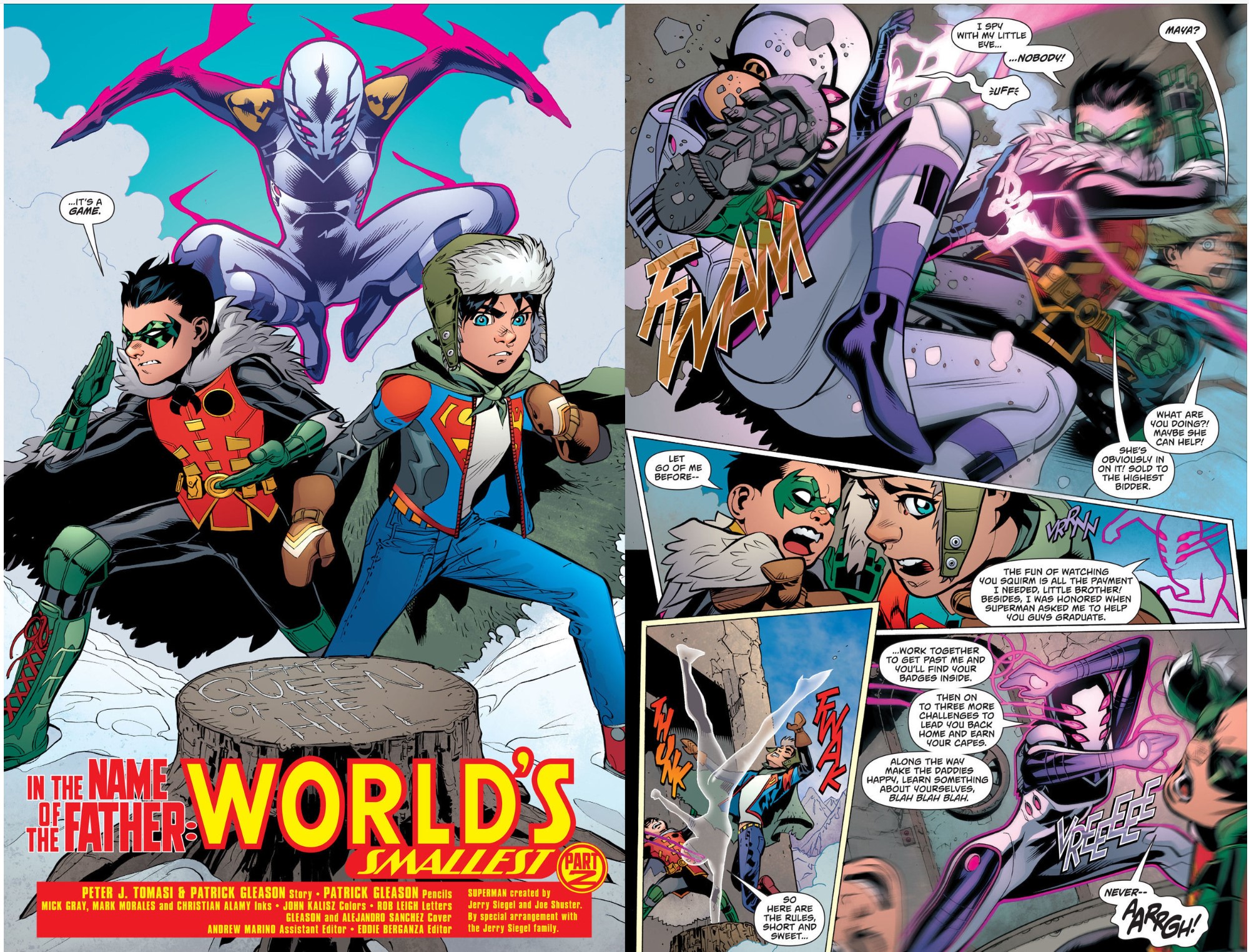
The Valiant Era Collection and Warriors of Plasm
By Jim Shooter, Bob Hall, Faye Perozich, Kevin Vanhook, Don Perlin, Steve Ditko, Gonzalo Mayo, Stan Drake, Yvel Guichet, Ted Halsted, John Dixon, Paul Autio & various (Valiant)
No ISBN/ ASIN: B000H2UTEI

During the market-led, gimmick-crazed frenzy of the 1990s, amongst the interminable spin-offs, fads and shiny multiple-cover events a new comics company revived some old characters and proved once more that good story-telling never goes out of fashion. At DC, 14-year-old Shooter wrote epic runs on The Legion of Super-Heroes, Supergirl and Superman, and scripted the company’s first toy tie-in Captain Action, before moving to Marvel in 1976. When he became the Editor-in-Chief, Shooter made Marvel the most profitable and high-profile they had ever been. and, after his departure, used that writing skill and business acumen to transform an almost forgotten Silver-Age character pantheon into contemporary gold.

Western Publishing had been a major player since comics’ earliest days, blending a wealth of licensed titles such as TV and Disney titles, Tarzan, and the Lone Ranger with homegrown hits like Turok, Son of Stone and Space Family Robinson. During the 1960s superhero boom, these adventure titles expanded to include, Brain Boy, M.A.R.S. Patrol – Total War, Magnus, Robot Fighter and in deference to the atomic age of heroes, Nukla and the utterly brilliant Dr. Solar, Man of the Atom. Despite supremely high quality and passionate fan-bases, they never captured the media spotlight of DC or Marvel’s costumed cut-ups. Western shut up their comics division in 1984.

With an agreement to revive some, any or all of these four-colour veterans, Shooter and co-conspirator Bob Layton came to a bold decision and made those earlier adventures part-&-parcel of their refit: acutely aware that older fans don’t like having their childhood favourites bastardized and that revivals need all the support they can get. Thus the old days were canonical: they “happened”…

The company launched with a classy reinterpretation of science fiction icon Magnus, but the key title to the new universe they were building was the broadly super-heroic Solar, Man of the Atom Alpha & Omega and Second Death which launched with an eye to all the gimmicks of the era, but also cleverly realised and realistically drawn.

Hit after hit followed and the roster of heroes expanded until dire market conditions and corporate chicanery ended the company’s stellar expansion. Gradually it fractionated and despite many revivals since, has all but disappeared now…

Here’s another innovation of that idea-packed era – a sampler of hits and one of their earliest graphic novels – from the early days of the format we’re all so familiar with. The Valiant Era Collection, re-presenting Magnus #12, Solar #10-11, Eternal Warrior #4-5 and Shadowman #8 was released in 1994 as an introduction to the new old brand and canny compendium of first appearances from the company’s burgeoning continuity. It gathered a disparate selection of tales which had one thing in common: the debuts of characters that had quickly become “hot”.

In the collector-led era of the early 1990s – before one zillion internet sites and social networking media – many new concepts caught the public’s attention only after publication. The seemingly-savvy snapped up multiple copies of comics they subsequently couldn’t sell and many genuinely popular innovations slipped by unnoticed until too late. This trade paperback from a company that valued storytelling above all else addressed that thorny issue by simply bundling their own hot and hard to find hits in one book…
‘Stone and Steel’ was written by Faye Perozich & Shooter and illustrated by Gonzalo Mayo, and found Robot-Fighting superman Magnus transported to a timeless dimension where dinosaurs and cavemen existed side by side. Once there he became embroiled in a battle for survival against his old enemy Laslo Noel: a rabid anti-technologist not averse to using modern super-weapons to force his point of view.
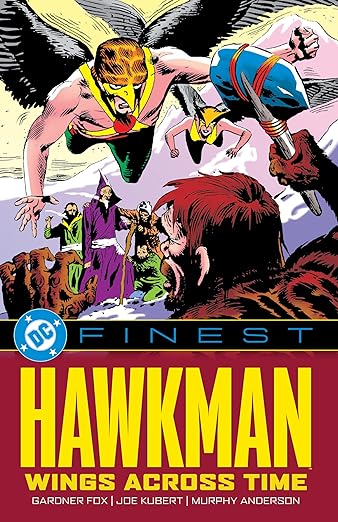
The Lost Land had other defenders, most notably two Native American warriors named Turok and his young companion Andar. The pair had been a popular Western Publishing mainstay for over a quarter of a century (see Turok, Son of Stone) and their initial (re)appearance here led to their revival in a succession of titles which survived the company’s demise, as well as a series of major computer and video games.

That spectacular, entrancing epic is followed by a 2-part Solar saga introducing an immortal warrior prince and paving the way for the disclosure of the secret history which underpinned the entire Valiant Universe.

Solar was brilliant nuclear physicist Phil Seleski, who designed a new type of fusion reactor and was transformed into an atomic god when he sacrificed his life to prevent it destroying the world. His energized matter, troubled soul, coldly rational demeanour and aversion to violence made him a truly unique hero – but his discovery of hidden meta-humans and a genuine supervillain in the ambitious, mega-maniacal form of ultra psionic Toyo Harada led Solar into a constantly escalating Secret War. Solar #10 – ‘The Man who Killed the World’ by Shooter, Don Perlin, Stan Drake, John Dixon & Paul Autio – introduced a raft of new concepts and characters, beginning with troubled teen Geoffry McHenry – the latest in a long line of Geomancers blessed/cursed with the power to communicate with every atom that comprises our planet. When the world screams that a sun-demon is about to consume it, Geoff tracks down Seleski only to determine that Solar is not unique and the threat is still at large.

Meanwhile, Harada’s Harbinger Foundation has sent all its unnatural resources to destroy the Man of the Atom, supplemented by a mysterious individual named Gilad Anni-Padda: an Eternal Warrior who had been battling evil around the globe for millennia and has worked with a number of Geoff’s predecessors…

Concluding chapter ‘Justifiable Homicides’ (Shooter, Steve Ditko, Ted Halsted & Mayo) finds Geomancer, Gilad and Solar battling for their lives against an army of Harbinger super-warriors. As always with this series, the ending is not one you’ll see coming…

Gilad soon helmed his own series and Eternal Warrior #4-5 introduced his immortal but unnamed undying nemesis in ‘Evil Reincarnate’ (Kevin Vanhook, Yvel Guichet & Dixon), a tale of ancient China which segues neatly into a contemporary clash with a drug-baron who is his latest reborn iteration. Then nanite-enhanced techno-organic wonder warrior Bloodshot explodes onto the scene in ‘The Blood is the Life’ (Vanhook & Dixon): a blockbusting action epic setting up the enhanced assassin’s own bullet-bestrewn series and tangentially, the 40th century Magnus spin-off Rai

The final debut in this volume was not for another hero but rather the introduction of the Valiant Universe’s most diabolical villain. Shadowman #8 held ‘Death and Resurrection’ (Bob Hall, Guichet & Dixon) and changed the rules of the game throughout the company’s growing line of books.

Jack Boniface was a struggling session saxophonist trying to strike it rich in the Big Easy when he was seduced by Lydia, a mysterious woman he picked up in a club. Her sinister, trysting assault left him unconscious, amnesiac and forever altered by a bite to his neck. Lydia was a Spider Alien: part of a race preying on humanity for uncounted centuries and responsible for creating many of the paranormal humans who secretly inhabit the world.

Her bite forever changes Jack and when darkness falls he becomes agitated, restless and extremely aggressive: forced to roam the Voodoo-haunted streets of New Orleans as the compulsive, impulsive daredevil dubbed Shadowman – violent, driven, manic and hungry for conflict… but only when the sun goes down. This tale examines the deadly criminal drug sub-culture of the city as a new narcotic begins to take its toll. a poison forcing its victims to careen through the streets bleeding from every orifice until they die. Witnesses call them “Blood Runners”…

As Shadowman investigates he is unaware that he is a target of the drug’s creator – ancient sorcerer Master Darque – and that soon the world will no longer be the rational, scientific place he believed. Before long, Jack will have terrifying proof that magic is both real and painfully close and that the Man of Shadow is not a creature of exotic physics and chemistry but something far more arcane and unnerving…

Despite being a little disjointed, these stories are immensely readable and it’s a tragedy that they’re not all readily available, as Valiant’s hostile takeover led to the breaking up of and selling on of various stars…

Still, there are always back issue comics and digital collections and the hope that the new revival might spawn a few trade paperback editions. Until then you can still hunt down this and the precious few other collections via your usual internet and comic retailers, and trust me, you really should…
© 1994 Voyager Communications Inc. and Western Publishing Company, Inc. All rights reserved.

Warriors of Plasm: The Collected Edition
By Jim Shooter, David Lapham, Mike Witherby, Bob Smith & various (Defiant)
ISBN: 978-1374700000, ASIN: B000R4LMUQ

If the 1980s was the decade where anybody with a pencil and a printer’s phone number could enter the business, the 1990s saw the rapid rise – and very often equally swift fall – of the small corporation publisher. Many businesses opened or acquired a comics division to augment or supplement their core business: like the Nintendo Comics that were packaged by and published in conjunction with Valiant Comics…

Jim Shooter founded Valiant with Bob Layton, and later went on to launch the short-lived but highly impressive Defiant Comics of which this book is – to my knowledge – the only collected edition. That’s a great pity as the range of talent that briefly worked there, as well as the titles themselves, showed immense promise. The legal war of attrition with Marvel that caused their early closure is well documented elsewhere, so I’ll swiftly move on to the product itself.

Flagship title Warriors of Plasm was a powerful alien intervention tale set mostly in an alternate universe where a single race had taken genetic science to such extremes that their homeworld had become a voracious planetary organism continually feeding on the biomass of other worlds.

Society on The Org was hierarchical, imperialistic and ritually sadistic, where the credos of “survival of the fittest” and “evolve or die” had the force of fanatical religion. Ruled by a weak Emperor, the court lived a life of brutal hedonistic luxury, revelling in decadence whilst relentlessly jockeying for advantage.

Lorca is a Seeker, high in the court and charged with finding new worlds for the Org to consume, but something within him defies official doctrine that personality is an aberration and that all bio-matter belongs to the greater whole. Bodies are mulched and recycled whilst individuality is an anti-social aberration, yet all organisms clearly would do absolutely anything not to die.

Spurred on by his corrupt rival Ulnareah, Lorca forms an illegal relationship with Laygen, a girl created without state-approval, and when caught, he is forced to recycle her to preserve his own existence.

Bitter and discontented, he eventually returns to work, but when he discovers Earth beyond the transdimensional veil he sees an opportunity to overthrow the Org and take supreme control. Humans are strong, individualistic, fierce warriors, and – with his tricks of genetic augmentation – could defeat any force the Org might muster. Thus, he teleports 10,000 test subjects to his private vats… but something goes wrong.

Only five humans survive, mutated into superhuman beings, but the Seeker is unaware of this since he’s been arrested by the authorities who never stopped watching him…

How the transformed humans escape and the uneasy alliance they form with unlikely liberator Lorca makes for a refreshingly novel spin on the old plot of revolution and redemption, and Shooter’s dialogue and characterisations of what could so easily have been stock characters add layers of sophistication to a fantasy drama many “adult” comics would kill for even today.

Simultaneously understated and outrageous as inked by Mike Witherby, David Lapham’s incredible art & design captivates and bewilders, adding a moody disorientation to a superb, action-packed thriller, especially in the incredible, climactic 4-page fold-out battle scene.

Originally produced as Warriors of Plasm #1-4, ‘The Sedition Agenda’ was preceded by an issue #0 daringly released only as a set of trading cards and supplemented by a prequel tale outlining the social relevance of gory global sporting phenomenon known as ‘Splatterball’, (written & drawn by Lapham with inks by Bob Smith), and these too are gathered here for your delectation.

Still seen on internet vendors’ sites, I have no idea where else you can find a copy of this terrific little book but I hope you do, just as I wish that some smart publisher would pick up the rights for all the Defiant material and the Broadway Comics Shooter produces after Defiant died: but maybe one day somebody will get the remaining band back together and finish all these lost stories…
© 1994 EEP, L.P. All Rights Reserved.

R.I.P. Jim…