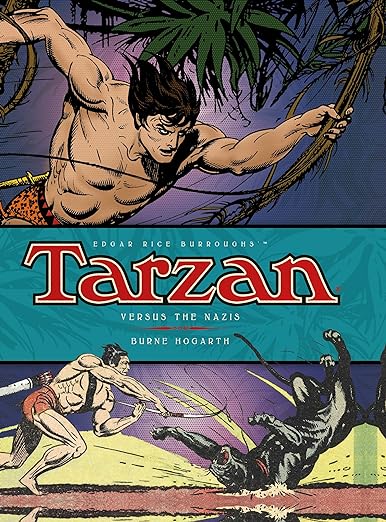
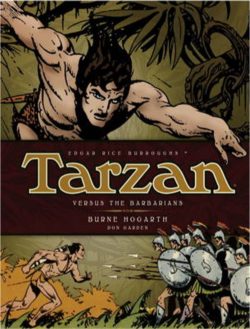
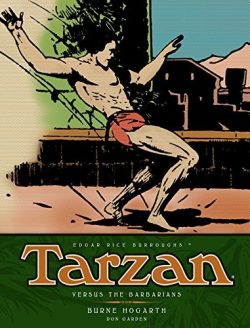
Tarzan versus The Barbarians (Complete Burne Hogarth Comic Strip Library volume 2)


By Burne Hogarth & Don Garden (Titan Books)
ISBN: 978-1-78116-318-4 (Album HB)

Modern comics and graphic novels evolved from newspaper comic strips. These pictorial features were – until quite recently – overwhelmingly popular with the public and highly valued by publishers who used them as a powerful tool to guarantee and increase circulation and profits. From the earliest days humour was paramount; hence the terms “Funnies” and, of course, “Comics”…

The full blown dramatic adventure serial began with Buck Rogers on January 7th 1929 – and Tarzan which debuted the same day. Both were adaptations of pre-existing prose properties and their influence changed the shape of the medium forever. The 1930s saw an explosion of such fare, launched with astounding rapidity and success. Not just strips but actual genres were created in that decade which still impact on today’s comic-books and, in truth, all our popular fiction forms. In terms of sheer artistic quality, adaptations of Edgar Rice Burroughs’ novels starring jungle-bred John Clayton, Lord Greystoke by Canadian commercial artist Harold “Hal” Foster were unsurpassed, and the strip soon became a firm favourite of the masses, supplementing movies, books, a radio show and ubiquitous advertising appearances. As fully detailed in the previous volume of this superb oversized (330 x 254mm), full-colour hardback series, Foster initially quit the strip at the end of the 10-week adaptation of the first novel Tarzan of the Apes. He was replaced by Rex Maxon, but returned (at the insistent urging of Edgar Rice Burroughs) when the black-&-white daily was expanded to include a lush, full colour Sunday page featuring original adventures.

Leaving Maxon to capably handle the Monday through Saturday series of novel adaptations, Foster produced the Sunday page until 1936 (233 consecutive weeks) after which he moved to King Features Syndicate to create his own momentous weekend masterpiece Prince Valiant in the Days of King Arthur which debuted on February 13th 1937.

Once the four month backlog of material he had built up was gone, Foster was succeeded by a precociously brilliant 25-year-old artist named Burne Hogarth: a young graphic visionary whose superb anatomical skill, cinematic design flair and compelling page composition revolutionised the entire field of action/adventure narrative illustration. The galvanic modern dynamism of the idealised human figure in today’s comicbooks can be directly attributed to Hogarth’s pioneering drawing and, in later years, educational efforts…

This second sublime collection begins with fascinating original art examples peppering the ‘Introduction’ by former Tarzan and Prince Valiant illustrator Thomas Yeates, who shares memories of and commentary upon Hogarth the man, the exemplar and the educator. The visual virtuosity then resumes with ‘Tarzan and the Peoples of the Sea and the Fire’ (episodes #478-527-8, spanning 5th May 1940 to April 20th 1941) wherein the ape-man, incessantly journeying across fantastic, unexplored Africa, discovers an inland sea and stumbles into an ages-old war between two lost races.

On one side are water-worshipping mariners called the Sea People whose vile Prince Jagurt captures Tarzan whilst beautiful maiden Leecia is falling for him. Sadly, the real problem is arch-priest Molocar, who takes an instant dislike to the newcomer and tries to feed him to the Demon-fish…

Escaping antediluvian ichthyosaurs, the jungle lord stumbles upon secret subterranean caverns where the priesthood perfect their seemingly supernatural tricks to cow the populace. These superstition-peddlers try to make him a slave. Within the compound Tarzan meets a warrior of the city’s ancestral enemies, the volcano-worshipping Fire People, befriending a crippled boy named Prince Tanny. The child is heir to the lava-lovers’ throne and Molocar intends to brainwash and torture him into switching faiths…

The ape-man cannot abide cruelty and in a fit of righteous rage frees the boy and breaks out of the den of iniquity. Eluding the prowling demon-fish, Tarzan swims the lagoon with his frail prize, moving into the city, where – after sustained pursuit – he elicits Leecia’s aid. After many savage battles they flee together into the dense jungle.

The plan had been to take Tanny home, but since the boy’s capture his father has been murdered and Towrit the Cruel now rules the Fire People. When the fugitive trio are intercepted by the usurper’s soldiers, only Tarzan and Tanny escape, but after hiding in a cave the jungle lord is ambushed by a ferocious giant who turns out to be the boy’s faithful guardian Jaxie

Resolved to free Leecia and restore Tanny to the throne, Tarzan’s herculean efforts are thwarted as all-out war begins. The implacable religious hatred of each faction for him and each other results in unceasing battle, but as Jagurt, Molocar and Tawrit all strive for supremacy, nature itself rebels and the entire region is devastated when the volcano erupts, imperilling all dwellers around the inland sea…

Lost World romance gave way to modern militaristic mayhem in ‘Tarzan Against Dagga Ramba’ (#529-581, running from 27th April 1941 to 26th April 1942). Having sailed a river to a great desert, the regal wanderer encounters a camel caravan in time to save an Arabian princess from a stalking leopard, although it leaves him grievously injured. Haughty Ta’ama much prefers the wild man saviour to her own (arranged) affianced man, something rapacious Sheik Numali is not going to allow. The caravan continues with comatose Tarzan guarded by the Princess, but Numali knows that sooner or later her attention will lapse and accidents can be made to happen…

Happily, the white god recovers before any untoward occurrences but frustratingly agrees to remain with them until the Great Desert is crossed. Into that simmering bath of tension and suspicion a greater menace soon intrudes as ambitious army sergeant Dagga Ramba abandons the war currently engulfing North Africa. Declaring himself General, he convinces a band of Askari deserters they can carve out their own kingdom in the sands…

When the caravan is captured by Ramba’s band, Tarzan escapes and stumbles upon old ally Kamur and his mountain-living Ibek Nomads. The doughty warrior is tracking the Askaris -who have stolen his wife Nikotris – but that noble woman is in far greater danger from her fellow captive Ta’ama than the self-appointed warlord. The mountain dwelling elder has idly expressed her (platonic) admiration for Tarzan in the cell they share and the ruthless Arabian princess has wrongly deduced she has a rival for the ape-man’s affections…

Thankfully, a daring raid of the warlord’s fortress by Tarzan liberates Kamur’s bride before Ta’ama can act, but in the melee he is trapped and – despite soundly thrashing Dagga Ramba – is sentenced to hang. Spectacularly escaping the gallows, the hero rapidly returns to the mountains unaware the warlord has subtly suborned noxious Numali…

Soon a guerrilla war is underway at great cost to the Ibeks, whose bows and raw courage are no match for machine guns and armoured cars. Tarzan volunteers to re-cross the desert and try to recruit the normally impartial Soufara into a grand alliance against Ramba. His brief time with nomadic Bedouins garners no support but their initial refusal only allows the upstart warmonger to mount a surprise attack on the desert dwellers.

Racing out into a sandstorm on a stolen camel, Tarzan heads for the Soufara with Numali in hot pursuit. When his mount expires the indomitable ape-man continues his epic trek on foot, eventually reaching their forbidden city, only to find gloating Numali waiting for him.

The sheik’s attempts to assassinate jungle-man are forestalled by the Emir (Ta’ama’s father), but the potentate is disdainful of the warning Tarzan brings. Only Numali is aware Ramba’s army is approaching and will soon attack the complacently overconfident walled metropolis…

With his daughter hostage, the Emir is helpless to resist a mechanised assault and names Tarzan his War Sheik. The noble savage’s ideas on what we now call asymmetrical warfare rapidly stem the tide and when he abandons the battle to call the Ibeks into the fray, it spells the beginning of the end for Dagga Ramba’s dreams…

Job done, Tarzan slips away, crossing the mountains until washed by a tumult into a lush, isolated valley where two unlikely westerners are exploring. ‘Tarzan and the Fatal Mountain’ (#582-595, 3rd May – 2ndAugust 1942) returns to high fantasy as murderous dwarf Kalban Martius takes an instant dislike to the tall, clean-limbed Adonis, whilst his reluctant companion and unwitting target object d’amour Olga finds her heart all a-flutter…

These unwelcome Europeans were exploring the valley with Olga’s scientist father who had discovered the place was rife with oversized lifeforms. Even the generally peaceful white natives dubbed Kolosans average eight feet tall. In fact, almost everything there was bigger yet more passive…

After Martius fires a few shots at Tarzan and is easily eluded and subdued, the ape-man is befriended by Olga who explains they are looking for the secret of the Kolosans’ immensity. Later, the giants take him into their confidence whilst explaining that he can never escape the steep encircling escarpments back to his own world. The big men also reveal an ancient temple where a lizard-shaped “forbidden fountain” spews forth a vile liquid. This tribal secret is unfortunately exposed by Martius who covertly joined the party. When he stole some of the evil water it instantly transformed him into a brutal gargantuan twice the size of Kolosans…

Crazed with dreams of power, the beast-man flees taking a canteen full of the liquid. Soon the gentle valley is filled with his aggressive army of super-giants and Tarzan must lead the Kolosans in a final cataclysmic battle for survival. Eventually the carnage subsides and Olga reveals how they will leave the hidden valley. She, her father and Kalban had arrived by airplane and Tarzan can return with them. Sadly, one final catastrophe looms as their take-off is interrupted by a super-ape altered by Martius’ stolen growth toxin…

Following a stupendous duel on the ship’s wing Tarzan returns to the relative safety of the cockpit, but as they fly on the voyagers encounter an RAF plane in a death-spiral over a murky island as ‘Tarzan and the Barbarians’ (#596-659, 9th August 1942 to 24th October 1943) opens with the ape-man parachuting out of Olga’s plane (and life) to assist the downed pilot.

Wing Commander Jonathan is badly injured, but before Tarzan can administer aid he is interrupted by a bizarre stranger. Nahro the Hermit wants them gone and has decided to hunt the pair for sport. The swampy terrain proves the madman’s downfall, after which Tarzan carries his ailing charge across lethal trees through mire and past deadly beasts until they are captured by brutal warriors who look like Vikings…

The barbarians are dismissive of their captives as they carry them up a huge mesa to their stony citadel. Although threatened with death Tarzan eschews easy escape by refusing to marry one of the warrior’s women and earns the undying enmity of the shamed Hilsa.

Penned with other captives, he meets the slave Leeta and learns the mesa-marauders have preyed on the region’s inhabitants for centuries. When Tarzan tries to carry her away to safety, Hilsa is waiting and ambushes them…

Forced to flee alone, Tarzan heads for Leeta’s village seeking men to mount a rescue mission for her and the aviator but the chieftain’s wizard ignores his entreaties and instead prepares to undertake a venerable custom. The Berian people have always sacrificed the strongest heroes in their midst so the warrior could travel to the departed ancestors and beseech supernatural aid. Tarzan ferociously suggests they stop killing the best fighters and use them to actually fight the barbarians. To aid their assault he even introduces them to the concept of aerial warfare, engineering a giant balloon from sewn animal hides…

The skyborne blitzkrieg fails and Tarzan plunges into a vast cave in the centre of the mesa, which fortuitously exposes the citadel’s great weakness… a secret tunnel leading to the plains below, big enough for a small force of men to use in a sneak attack…

After much travail and bloodshed the plan succeeds but even in victory Tarzan finds no peace. Ferrying Jonathan back to civilisation leads to another primitive city, another lusty lass and one more jealous suitor. Soon the ape-man is embroiled in a brutal conflict where the balance of power rests with the side that can muster the most mastodons! The most worrying aspect of the war is that it is being fought for ownership of a huge jewel which can cause instant death…

Although the battle eventually goes to the just, it exposes Jonathan’s true colours as he tries to seize the lethal death-ray device for his country and especially himself. Exasperated and fed up with humans, Tarzan heads back to the wild woods only, to encounter old “friends” when arboreal amazon Tibeela ambushes the man who once eluded her amorous advances. This time she takes no chances, knocking him unconscious before making her move…

Her scheme might have worked had not a band of roving buccaneers chosen that moment to come to the forest hunting women for slaves, leading to another uncanny escapade against a decadent king in a debased kingdom as well as three uncanny reunions… with an ape, a lion and a Boer beside whom Tarzan had battled before…

These tales are full of astounding, unremitting, unceasing action with Hogarth and scripter Don Garden spinning page after page of blockbuster Technicolor epics over months of non-stop wonder and exotic adventure. Plot was never as important as generating a wild rush of rapt and rousing visceral response and every Sunday the strip delivered that in spades.

Edgar Rice Burroughs was a master of populist writing and always his prose crackled with energy and imagination. Hogarth was an inspired intellectual and, as well as gradually instilling his pages with ferocious, unceasing action, layered panels with subtle symbolism. Heroes looked noble, villains suitably vile and animals powerful and beautiful. Even rocks, vegetation and clouds looked spiky, edgy and liable to attack at a moment’s notice…

These vivid visual masterworks are all coiled-spring tension or vital, violent explosive motion, stretching, running, fighting: a surging rush of power and glory. It’s a dream come true that these majestic exploits exist – especially in such lavish and luxurious editions for generations of dedicated fantasists to enjoy.

Magnificent, majestic and awe-inspiring.
Tarzan ® & © 2014 Edgar Rice Burroughs, Inc. All Rights Reserved. All images copyright of Edgar Rice Burroughs, Inc 2014. All text copyright of Edgar Rice Burroughs, Inc 2014.

What Am I Going To Do Without You?


By Patt Kelley (Top Shelf Digital)
No ISBN. A Digital Exclusive (2012)

We live not just in the End Days but also truly Fortean Times. That’s artfully demonstrated and perfectly embodied in this forgotten gem from Patt Kelley (Fedor, Scout, And Then There Was Nothing, What’s for Breakfast?) who here pokes gently with a soft stick the sore subjects of love, loss, loneliness, mortality and embracing enforced change…

A dozen years ago in his debut graphic novel Kelley captivatingly mixed small town small mindedness with a look at enduring relationships and dawning independence played against a backdrop of the world turned upside down…

When little kids discover a dead dinosaur (an apatosaurus, if you’re asking) in the woods it soon escalates into a full-on media circus with gawkers, reporters and chancers invading a little piece of hamlet heaven we’re all programmed to crave. The news sensation doesn’t really affect Jeanie, who’s more concerned with stopping her moronic provincial classmates – especially Kaylee and her God-fearing Mean Girls – picking on her because she’s the only goth in high school. Typically though, her miracle-hungry mom goes crazy and drags the rebel sophisticate into the building gossip frenzy.

Across town, Flo and her husband Murray get some bad news when the doctor reveals what’s causing his persistent cough. Flo is facing the rest of her life alone and asks herself a question she doesn’t want answered…

When Kaylee starts spiteful Satanic rumours about Jeanie it’s not long before the faculty jump on board to ostracise the nonconformist weird kid, but the authorities’ disposal of the dead dino is what’s really gripping the parochial townsfolk. Even rapidly-declining Murray is blown away by the big lizard story. Hubby seems pretty accepting of his own imminent extinction, and just won’t shut up about what Flo should do once he’s out of the picture…

Everywhere strangers start talking to each other, moved by the incredible once-in-a-lifetime event, but Kaylee is gleefully punishing proudly unrepentant voluntary outsider Jeanie… until another unique one-in-a-billion happenstance settles that confrontation. It’s only the start of more strange encounters and freak accidents that Flo is oblivious to. For now Murray is all the world to her…

As chaos increasingly unfolds peaks and finally fades, the inevitable comes and many players confront their fears and reconcile regrets where they can. In the aftermath, widow Flo tries to adjust and on a whim heads for those woods where the dinosaur died and happens on one last once-in-a-lifetime meeting…

Slowly building and beguilingly understated, the interplay of little lives Kelly unpicks and puts under the microscope here form a mosaic of overwhelming emotion, wedding pedestrian and universally shared aspects of human existence with the reminder that there is wonder everywhere if you just look. So why don’t you?
What Am I Going To Do Without You? © & ™ Patt Kelley. All Rights Reserved.

Fantastic Four Epic Collection volume 9: The Crusader Syndrome – 1974-1976


By Gerry Conway, Roy Thomas, Len Wein, Tony Isabella, Steve Englehart, Marv Wolfman, Chris Claremont, Rich Buckler, John Buscema, George Pérez, Sal Buscema, Bob Brown, Joe Sinnott, Jim Mooney, Joe Staton, Frank Giacoia, Mike Esposito, Chic Stone, Vince Colletta with Stan Lee, Dick Ayers, Paul Reinman & various (MARVEL)
ISBN 978-1-3029-4875-7 (TPB/Digital edition)

Monolithic modern Marvel truly began with the adventures of a small super-team who were as much squabbling family as coolly capable costumed champions. Everything the company is now stems from the quirky quartet and the groundbreaking, inspired efforts of Stan Lee & Jack Kirby…

Cautiously bi-monthly and cover-dated November 1961, Fantastic Four #1 – by Stan, Jack, George Klein & Christopher Rule – was raw and crude even by the ailing company’s standards: but it seethed with rough, passionate and uncontrolled excitement. Thrill-hungry kids pounced on its dynamic storytelling and caught a wave of change starting to build in America. It and succeeding issues changed comics forever. As seen in the premier issue, maverick scientist Reed Richards, his fiancée Sue Storm, their close friend Ben Grimm and Sue’s bratty teenaged brother Johnny survived an ill-starred private space-shot after Cosmic Rays penetrated their ship’s inadequate shielding.

All four permanently mutated: Richards’ body became elastic, Sue became (even more) invisible, Johnny Storm burst into living flame and tragic Ben shockingly devolved into a shambling, rocky freak. After the initial revulsion and trauma passed, they solemnly agreed to use their abilities to benefit mankind. Thus was born The Fantastic Four.

Throughout the 1960s it was indisputably the key title and most consistently groundbreaking series of Marvel’s ever-unfolding web of cosmic creation: a forge for new concepts and characters. Kirby was approaching his creative peak: continually unleashing his vast imagination on plot after spectacular plot, whilst Lee scripted some of the most passionate superhero sagas ever seen. Both were on an unstoppable roll, at the height of their powers and full of the confidence only success brings, with The King particularly eager to see how far the genre and the medium could be pushed… which is rather ironic since it was the company’s reticence to give the artist creative freedom which led to Kirby’s moving to National/DC in the 1970s.

Without Kirby’s soaring imagination the rollercoaster of mind-bending High Concepts gave way to more traditional tales of characters in conflict, with soap-opera leanings and super-villain-dominated Fights ‘n’ Tights dramas. This stripped-down, compelling compilation gathers Fantastic Four #147-167, Giant-Size Fantastic Four #2-4 and Avengers #127: collectively covering June 1974 to February 1976 and heralding a change of pace and partial return of The King – even if only on covers…

Fantastic Four #147 offers action-tinged melodrama with Gerry Conway, Rich Buckler & Joe Sinnott in how ‘The Sub-Mariner Strikes!’ as long-sidelined and neglected Susan Richards starts divorce proceedings against Reed whilst seemingly taking comfort in the arms of long-time admirer/stalker Prince Namor of Atlantis. When Reed, Johnny, Ben and Inhuman substitute teammate Medusa try to “rescue” her, the Atlantean ruler thrashes them before Sue sends them packing…

To add insult to injury, the dejected men return home to find the Baxter Building once more invaded by the Frightful Four and are forced to fight a ‘War on the Thirty-Sixth Floor!’ Sadly The Sandman, Wizard and Trapster have no idea their newest ally Thundra is secretly smitten with the Thing. FF #149 resolves the scandalous Sub-Mariner storyline as the undersea emperor invades New York in ‘To Love, Honour, and Destroy!’ Happily, his awesome attack is merely a cunning plan to trick Sue into reconciling with her husband. It almost works…

Courtesy of Conway, John Buscema & Chic Stone, Giant-Size Fantastic Four #2 reveals a time-twisting ‘Cataclysm!’, wherein cosmic voyeur The Watcher warns of a hapless innocent who has inadvertently altered history, thanks to Dr. Doom’s confiscated time platform. Once again the supposedly non-interventionist extraterrestrial expects the FF to fix a universal dilemma…

With more than one temporal hot-spot, Reed and Johnny head for Colonial America to rescue the Father of the Nation in ‘George Washington Almost Slept Here!’, whilst Ben and Medusa crash into the “Roaring Twenties” and save the time-lost wanderer from being rubbed out by racketeers in ‘The Great Grimmsby’. Thinking their mission accomplished, the heroes are astounded to then find themselves trapped in timeless Limbo, battling monstrous giant Tempus before escaping to their restored origin point in ‘Time Enough for Death!’

For months lovelorn Johnny had fretted and fumed that his first true love Crystal was to marry super-swift mutant Quicksilver. That plot-thread finally closed in a 2-part crossover tale opening in Avengers #127 (September 1974). Crafted by Steve Englehart, Sal Buscema & Joe Staton, ‘Bride and Doom!’ sees the Assemblers travel to Attilan (hidden homeland of the Inhumans) for the wedding of aforementioned speedster Pietro to elemental enchantress/Royal Princess, only to meet an uprising of the genetic slave-race designated Alpha Primitives. Once again, sinister robotic colossus Omega has incited revolt, but this time it isn’t insane usurper Maximus behind the seditious skulduggery but an old Avengers enemy who reveals himself in the concluding chapter from in Fantastic Four #150.

‘Ultron-7: He’ll Rule the World!’ (Conway, Buckler & Sinnott) finds both teams joining Black Bolt’s Inhumans against the malign A.I., but only saved by a veritable Deus ex Machina after which, at long last, ‘The Wedding of Crystal and Quicksilver’ finally closes events on a happy note – for everybody but the Torch, that is…

The dramatic tensions resume with Giant-Size Fantastic Four #3 as plotter Gerry Conway, scripter Marv Wolfman and illustrators Rich Buckler & Joe Sinnott deliver an epic tale of global import. The extra-special quarterly Giant-Size range was devoted to offering blockbuster thrills, and herein reveal ‘Where Lurks Death… Ride the Four Horsemen!’ as cosmic aliens arrive, intent on scourging the Earth.

Forewarned after the team stumble across the first horror in ‘…There Shall Come Pestilence’, our harried heroes split up with Inhuman stand-in Medusa and Johnny striving against international madness in ‘…And War Shall Take the Land!’ whilst Reed and Ben fight to foil the personification of Famine in ‘…And the Children Shall Hunger!’, before all reunite to wrap up the final foe in ‘…All in the Valley of Death!’

In FF #151 Conway, Buckler & Sinnott begin revealing the truth about the mysterious “Femizon” stalking the Thing. ‘Thundra and Lightning!’ introduces male-dominated alternate Future Earth Machus and its brutal despot Mahkizmo, the Nuclear Man, who explosively invades the Baxter Building in search of a mate to dominate and another world to conquer…

Inked by Jim Mooney, #152 exposes ‘A World of Madness Made!’ with the team captive in the testosterone-saturated side-dimension whilst Medusa seemingly flees, whilst actually seeking reinforcements from the diametrically-opposed Femizon future/alternity, resulting in two universes crashing together in the concluding ‘Worlds in Collision!’ by Tony Isabella, Buckler & Sinnott.

Rapidly reworked by Len Wein, Fantastic Four #154 featured ‘The Man in the Mystery Mask!’: a partial reprint from Strange Tales #127 in which Stan Lee, Dick Ayers & Paul Reinman pitted Ben and Johnny against ‘The Mystery Villain!’. Here, however, Bob Brown, Frank Giacoia & Mike Esposito’s revisions depict how Reed’s early lesson in leadership has been hijacked by another old friend with explosive and annoying results…

Meanwhile over in Giant-Size Fantastic Four #4, Wein, Chris Claremont, John Buscema, Chic Stone & Sinnott unite to introduce ‘Madrox the Multiple Man’: a young mutant who grew up on an isolated farm unaware of the incredible power he possessed. When his parents pass away, the kid is inexplicably drawn to New York City, where the hi-tech suit he wears to contain his condition malfunctions. Soon the boy devolves into a mobile fission device that can endlessly, lethally replicate himself. Thankfully the FF are aided by mutant Moses Charles Xavier who dutifully takes young Jamie under his wing…

A minor classic from Wein, Buckler & Sinnott follows s seen in Fantastic Four #155-157 when the long dormant Silver Surfer resurfaces in ‘Battle Royal!’ – apparently a murderous thrall of Doctor Doom. The Iron Dictator commands the Stellar Skyrider because he holds the alien’s lover Shalla Bal –-even cruelly threatening to take her in marriage. However, as seen in ‘Middle Game!’ (with Roy Thomas joining as co-writer and Editor) the Surfer cannot kill and merely delivers the defeated FF as prisoners to the Devil Doctor’s citadel. Naturally, there are schemes within schemes unfolding and Doom is playing a waiting game whilst covertly siphoning the Surfer’s “Power Cosmic” to fuel a deadly Doomsman mechanoid…

With Thomas in full authorial control ‘And Now… the Endgame Cometh!’ sees the heroes fight back to conquer the Lethal Latverian, blithely unaware the entire charade has been a crafty confection of malignly manipulative demon-lord Mephisto

The furore is followed by another nostalgia-tinged 2-part epic beginning with FF #158’s ‘Invasion from the 5th (Count it, 5th!) Dimension’ by Thomas, Buckler & Sinnott. When one of the Torch’s earliest solo scourges returns to occupy the homeland of the Inhumans, extra-dimensional dictator Xemu opens his campaign of vengeance by dispatching Quicksilver to lure his sister-in-law Medusa back to Attilan. The intention is to force defiant King Black Bolt to utilise his doomsday sonic power on the invaders’ behalf, for which the conqueror needs the silent king’s true love as a bargaining chip. However, when the FF accompany her into the blatant trap, they bring a hidden ally who turns the tables on Xemu, unleashing ‘Havoc in the Hidden Land!’, coincidentally and at last reuniting the First Family of comic book fiction…

More pan-dimensional panic ensues when a multiversal conflict is cunningly concocted by a hidden mastermind orchestrating Armageddon for a trio of dimensionally-adjacent planets for ‘In One World… and Out the Other!’ Devised by Thomas, John Buscema & Stone, the initial chapter sees shapeshifting Reed Richards sell his patents to a vast corporation, even as in the streets his counterpart from another universe is kidnapped by barbarian warlord Arkon the Magnificent. That abduction is investigated by a very Grimm Thing who has uncomfortable suspicions about what’s occurring…

With Buckler & Sinnott doing the depicting ‘All the World Wars at Once!’ expands the saga as Johnny Storm visits the recently liberated 5th Dimensional Earth to discover it under assault by androids from yet another slightly different one. As the Thing teams up with his other-earth counterpart to quell a dinosaur invasion, “our” world is assaulted by an army from the 5th dimension led by the Torch. With each realm believing itself provoked by trans-terrestrial aggressors, the divided team only knows one thing: each invading force is using weaponry invented by Richards…

The crises peaks in ‘The Shape of Things to Come!’ as the mastermind is exposed and the scheme to annihilate three worlds come close to fruition, necessitating a voyage to a cosmic nexus point and a devastating battle with yet another twisted alternate-reality hero to save existence in a spectacular and poignant ‘Finale  #163.

A new direction began with #164 (part 1 of a reconditioned yarn originally intended for Giant-Size Fantastic Four), courtesy of Thomas and then-neophyte illustrator George Pérez, backed up by Sinnott. ‘The Crusader Syndrome!’ sees the team battling a veteran superhero gone bad since his last outing as Atlas-Era champion Marvel Boy. Now as The Crusader he wages savage war on financial institutions whose self-serving inaction doomed his adopted Uranian race in the 1950s. However, his madness and savagery are no match for the FF and #165’s ‘The Light of Other Worlds!’ details his apparent demise. It also sparks many successful additions to Marvel Continuity, such as new hero Quasar, the 1950s Avengers and Agents of Atlas whilst introducing Galactus’ herald-in-waiting Frankie Raye as Johnny’s new girlfriend…

This formidable high-tension Fights ‘n’ Tights tome terminates in a titanic tussle as Vince Colletta inks #166 as ‘If It’s Tuesday, This Must be the Hulk!’ as the team hunts the Gamma Goliath with a potential cure for Bruce Banner. Sadly, aggressive and insulting military treatment of their target enrages fellow-monster Ben Grimm who unites with The Hulk to menace St. Louis, Missouri as ‘Titans Two!’ (with Sinnott back on inks). Following a mighty struggle with his old friends and constantly bathed in Hulk’s Gamma radiation, Ben is permanently reduced to human form and contemplates a whole new life…

To Be Continued…

With covers by Buckler, Gil Kane, John Romita, Ron Wilson, Kirby, Sinnott and more this power-packed package also includes the covers to all-reprint Giant-Sized Fantastic Four #5 & 6 and the original unused cover for GSFF #5 (which contents became FF #158-159); house ads and the new material from The Fabulous Fantastic Four Marvel Treasury Edition #2 (December 1975). This bombastic oversized tabloid edition featured a bevy of classic yarns and is represented here by front-&-back cover art from John Romita, a Marie Severin frontispiece and Stan Lee Introduction, contents page and double-page pin-up of the team and supporting cast by John Buscema & Giacoia.

Also on view are extracts from F.O.O.M. #8-10 (comedic exploits of Doctor Foom by Charley Parker), pertinent pages by Buckler & Sinnott from The Mighty Marvel Calendar 1975, cover plus splash page by Dave Cockrum & Sinnott from November 1977’s Marvel Super Action #4 which reprinted Marvel Boy stories from the early 1950s and a gallery of original art pages and a colour guide.

Although Kirby had taken the unmatched imagination and questing sense of wonder with him on his departure, the sheer range of beloved characters and concepts he had created with Lee carried the series for years afterwards. So once writers who shared their sensibilities were crafting the stories a mini-renaissance began. Although the “World’s Greatest Comics Magazine” didn’t quite return to the stratospheric heights of yore, this period offers fans a tantalising taste of the glory days. These honest and extremely capable efforts will still thrill and enthral the generous and forgiving casual browser looking for an undemanding slice of graphic narrative excitement.
© 2023 MARVEL.

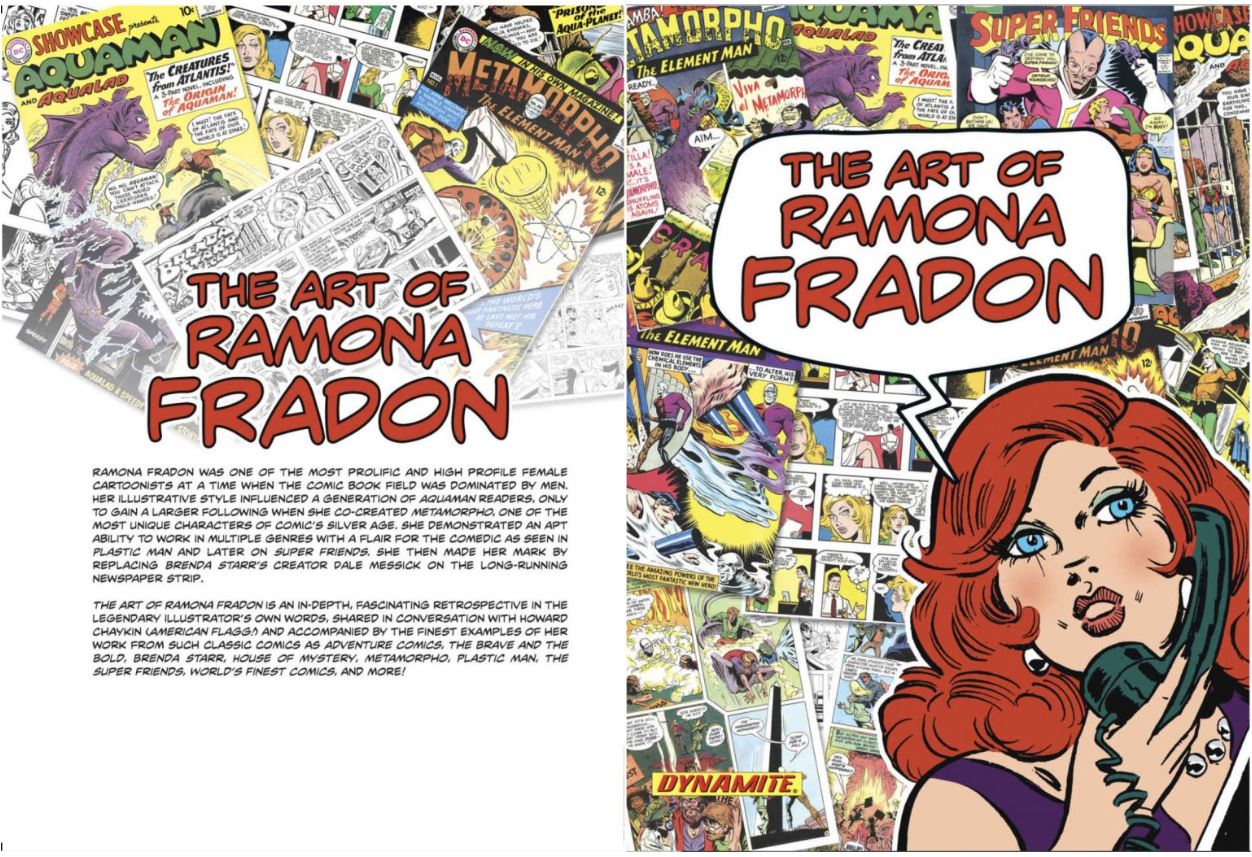
Showcase Presents Metamorpho, The Element Man


By Bob Haney, Gardner Fox, Ramona Fradon, Joe Orlando, Sal Trapani, Jack Sparling, Charles Paris, Mike Sekowsky, Mike Esposito, Bernard Sachs & various (DC Comics)
ISBN: 978-1-4012-0762-5 (TPB)

By the time Metamorpho, The Element Man was introduced to a superhero-obsessed world the first vestiges of a certifiable boom were just becoming apparent. As such, the light-hearted, nigh-absurdist take struck a Right-Time, Right-Place chord, blending far out adventure with tongue-in-cheek comedy.

Celebrating 60 years of weird happenings, the bold, brash “Man of a Thousand Elements” debuted in The Brave and the Bold #57, cover-dated January 1965 and on sale from October 29th 1964 – just in time for Halloween. After a second try-out tale in the next issue, he and his crackers cast catapulted right into a solo title for an eclectic and oddly engaging 17-issue run. Sadly, this canny monochrome compendium – collecting those eccentric debut adventures from B&B #57 & 58, Metamorpho, The Element Man #1-17 and team-up tales from The Brave and the Bold #66 and 68 and Justice League of America #42 – is at present STILL the only archival collection available. Until someone rectifies that situation, at least here you can revel in some truly enchanting monochrome illustration and madcap myth-making. Unlike most Showcase editions, the team-up stories here are not chronologically re-presented in original publication order but are closeted together at the back, so if stringent continuity is important to you, the always informative old-school credit-pages will enable you to navigate the wonderment in the correct sequence.

Sans dreary preamble, the action commences immediately with ‘The Origin of Metamorpho’, written by Bob Haney (who created the concept and character and wrote everything here except the Justice League story). The captivating art is by Ramona Fradon & Charles Paris and introduces glamorous he-man Soldier of Fortune Rex Mason: currently working as a globetrotting artefact-procurer and agent for ruthlessly acquisitive scientific genius and business tycoon Simon Stagg. Mason is obnoxious and insolent but his biggest fault as far as the boss is concerned is that the mercenary dares to love – and be loved – by the plutocrat’s only daughter Sapphire

Determined to rid himself of the impudent “fortune-hunter”, Stagg sends his potential son-in-law to Egypt tasked with retrieving a fantastic artefact dubbed the Orb of Ra from the lost pyramid of Ahk-Ton. The tomb raider is accompanied only by Java, a previously fossilised Neanderthal corpse Rex had extracted from a swamp and which (whom?) Stagg had subsequently restored to life. Mason plans to take his final fabulous fee and whisk Sapphire away from her controlling father forever, but fate and his companion have other plans…

Utterly faithful to the scientific wizard who was his saviour, Java sabotages the mission and leaves Mason to die in the tomb, victim of an ancient, glowing meteor. The man-brute rushes back to his master, carrying the Orb and fully expecting Stagg to honour his promise and give him Sapphire in marriage. Meanwhile, trapped and painfully aware his time has come, Mason swallows a suicide pill as the scorching rays of the star-stone burn through him…

Instead of death relieving his torment, Rex mutates into a ghastly chemical freak capable of shapeshifting and transforming into any of the elements or compounds that comprise his human body: carbon, hydrogen, oxygen, calcium, iron, cobalt and so many others…

Hungry for vengeance, Mason returns and confronts his betrayers only to be overcome by the alien energies of the Orb of Ra. An uneasy détente is declared as Mason accepts Stagg’s desperate offer to cure him – if possible…

The senior Stagg is further horrified when Rex reveals his condition to Sapphire and finds she still loves him. Totally unaware of his employer’s depths of duplicity, Mason starts working for the tycoon as metahuman problem-solver Metamorpho, the Element Man.

Brave and the Bold #58 (February-March 1965) reveals more of Stagg’s closeted skeletons when old partner Maxwell Tremayne kidnaps the Element Man and later abducts Sapphire to ‘The Junkyard of Doom!’ Apparently, the deranged armaments manufacturer was once intimately acquainted with the girl’s mother and never quite got over it…

The test comics were an unqualified success and Metamorpho promptly started in his own title, cover-dated July-August 1965, just as the wildly tongue-in-cheek “High Camp” craze was catching on in all areas of popular culture: mixing ironic vaudevillian kitsch with ancient movie premises as theatrical mad scientists and scurrilous spies began appearing everywhere.

‘Attack of the Atomic Avenger’ sees nuclear nut-job Kurt Vornak seeking to crush Stagg Industries, only to be turned into a deadly, planet-busting radioactive super-atom, after which ‘Terror from the Telstar’ pits our charismatic characters against Nicholas Balkan, a ruthless criminal boss set on sabotaging America’s Space Program. Manic multi-millionaire T.T. Trumbull uses his own daughter Zelda to get to Simon Stagg through his heart, accidentally proving to all who know him that the old goat actually has one. This was part of TT’s attempt to seize control of America in ‘Who Stole the U.S.A.?’, with the ambitious would-be despot backing up the scheme with an incredible robot specifically designed to murder Metamorpho.

Happily, Rex Mason’s guts and ingenuity prove more effective than the Element Man’s astonishing powers…

America saved, the dysfunctional family head South of the Border, becoming embroiled in ‘The Awesome Escapades of the Abominable Playboy’ as Stagg schemes to marry Sapphire off to Latino Lothario Cha Cha Chavez. The spoiled wilful girl is simply trying to make Mason jealous and had no idea of her dad’s true plans; Stagg senior has no conception of Chavez’s real intentions or connections to the local tin-pot dictator…

With this issue the gloriously stylish innovator Ramona Fradon left the series, to be replaced by two artists who strove to emulate her unique, gently madcap manner of drawing with varying degrees of success. Luckily, veteran inker Charles Paris stayed on to smooth out the rough edges. First was E.C. veteran Joe Orlando whose 2-issue tenure began with outrageous doppelganger drama ‘Will the Real Metamorpho Please Stand Up?’ wherein eccentric architect Edifice K. Bulwark tries to convince Mason to lend his abilities to his chemical skyscraper project. When Metamorpho declines, Bulwark and Stagg attempt to create their own Element Man with predictably disastrous consequences. ‘Never Bet Against an Element Man!’ (#6 May-June 1966) took the team to the French Riviera as gambling grandee Achille Le Heele snookers Stagg and wins “ownership” of Metamorpho. The Gallic toad’s ultimate goal was stealing the world’s seven greatest wonders (including the Taj Mahal and Eiffel Tower) and, somehow, only the Element Man can make that happen…

Sal Trapani began drawing with #7’s ‘Terror from Fahrenheit 5,000!’ as the acronymic superspy fad hit hard. Here Metamorpho is enlisted by the C.I.A. to stop suicidal maniac Otto Von Stuttgart destroying the entire planet by dropping a nuke into the Earth’s core, before costumed villain Doc Dread is countered by an undercover Metamorpho becoming ‘Element Man, Public Enemy!’ in a diabolical caper of doom and double-cross. Metamorpho #9 shifted into classic fantasy when suave and sinister despot El Mantanzas maroons the cast in ‘The Valley That Time Forgot!’: battling cavemen and antediluvian alien automatons, after which a new catalysing element is added in ‘The Sinister Snares of Stingaree!’ This yarn introduces Urania Blackwell – a secret agent somehow transformed into an Element Girl and sharing all Metamorpho’s incredible abilities. Not only is she dedicated to eradicating evil such as criminal cabal Cyclops, but Urania is also the perfect paramour for Rex Mason, who even cancels his wedding to Sapphire to go gang-busting with her…

With a new frisson of sexual chemistry sizzling barely beneath the surface, ‘They Came from Beyond?’ finds a conflicted Element Man confronting an apparent alien invasion whilst ‘The Trap of the Test-Tube Terrors!’ sees another attempt to cure Rex of his unwanted powers. This allows mad scientist Franz Zorb access to Stagg Industry labs long enough to build an army of chemical horrors. The plot thickens with Zorb’s theft of a Nucleonic Moleculizer, prompting a continuation in #14 wherein Urania is abducted only to triumphantly experience ‘The Return from Limbo’

Events and stories grew increasingly outlandish and outrageous as TV’s superhero craze intensified and ‘Enter the Thunderer!’ (#14, September/October 1967) depicted Rex pulled between Sapphire and Urania whilst marauding extraterrestrial Neutrog terrorises Earth in preparation for the arrival of his mighty mutant master. The next instalment augured an ‘Hour of Armageddon!’ as the uniquely menacing Thunderer takes control of Earth until boy genius Billy Barton aids the Elemental defenders in defeating the alien horrors.

Trapani inked himself for Metamorpho #16: an homage to H. Rider Haggard’s She novels (and 1965 movie blockbuster) wherein ‘Jezeba, Queen of Fury!’ changes the Element Man’s life forever. When Sapphire marries playboy Wally Bannister, the heartbroken Element Man undertakes a mission to find the lost city of Ma-Phoor and encounters an undying beauty who wants to conquer the world… and just happens to be Sapphire’s exact double. Moreover, the immortal empress of a lost civilisation once loved an Element Man of her own: a Roman soldier named Algon who became a chemical warrior two thousand years previously.

Believing herself reunited with her lost love, Jezeba finally launches her long-delayed attack on the outside world with disastrous, tragic consequences…

The oddly appetising series came to a shuddering unsatisfactory halt with the next issue as the superhero bubble burst and costumed comic characters suffered their second recession in 15 years. Metamorpho was one of the first casualties, cancelled just as (or perhaps because) the series was emerging from its quirky comedic shell with the March/April 1968 issue.

Illustrated by Jack Sparling, ‘Last Mile for an Element Man!’ sees Mason tried – and executed! – for the murder of Bannister, resurrected by Urania Blackwell and set on the trail of true killer Algon. Consequently, Mason and Element Girl uncover a vast conspiracy and rededicate themselves to defending humanity at all costs. The tale ends on a never-resolved cliffhanger: when Metamorpho was revived a few years later no mention was ever made of these last game-changing issues…

Our elemental entertainment doesn’t end here though, as this tome somewhat expiates the frustrating denouement with three terrific team-up tales, beginning with The Brave and the Bold #66 (June/July 1966) and ‘Wreck the Renegade Robots’ wherein a mad scientist usurps control of the Metal Men just as their creator Will Magnus is preoccupied with a cure turning Metamorpho back into an ordinary mortal…

Two issues later (B& B #68 October/November 1966), the still chemically active crimebuster battles popular TV Bat-Baddies The Penguin, Joker and Riddler as well as a fearsomely mutated Caped Crusader in thoroughly bizarre tale ‘Alias the Bat-Hulk!’ with both yarns courtesy of Haney, Mike Sekowsky & Mike Esposito. Sekowsky also drew the final exploit in this volume as Justice League of America #42 (February 1966) sees the hero joyfully join the World’s Greatest Superheroes to defeat cosmic menace The Unimaginable. The grateful champions instantly offer him membership but are astounded when – and why – ‘Metamorpho Says… No!’: a classic romp written by Gardner Fox and inked by Bernard Sachs.

The wonderment concludes with a sterling pin-up of Element Man and core cast by Fradon & Paris. Individually enticing, always exciting but oddly frustrating in total, this book will delight readers who aren’t too wedded to cloying continuity but simply seek a few moments of casual, fantastic escapism.
© 1965-1967, 2005 DC Comics. All Rights Reserved.

Flash Gordon Annual 1969


By anonymous staff of the Mick Anglo Studio, Dick Wood, Al Williamson, Don Heck & various (World Distributor’s [Manchester] Ltd.)
No ISBN – B06WGZR1KX

By most lights, Flash Gordon is the most influential comic strip in the world. When the hero debuted on Sunday January 7th 1934 (with the superb if now-dated Jungle Jim running as a supplementary “topper”) in response to revolutionary, inspirational, but clunky Buck Rogers (by Philip Nolan & Dick Calkins and which had also began on January 7th but back in 1929), a new element was added to the realm of fantasy wonderment: Classical Lyricism.

Where Rogers had traditional adventures and high science concepts, this new feature reinterpreted Fairy Tales, Heroic Epics and Mythology. It did so by spectacularly draping them in the trappings of the contemporary future, with varying esoteric “Rays”, “Engine” and “Motors” substituting for trusty swords and lances – although there were also plenty of those – and exotic flying craft and contraptions standing in for Galleons, Chariots and Magic Carpets.

Most important of all, the sheer artistic talent of Raymond, his compositional skills, fine line-work, eye for concise, elegant detail and just plain genius for drawing beautiful people and things, swiftly made this the strip all young artists swiped from.

When all-original comic books began a few years later, literally dozens of talented kids used the clean lined Romanticism of Gordon as their model and ticket to future success in the field of adventure strips. Most of the others went with Milton Caniff’s expressionistic masterpiece Terry and the Pirates (which also began in 1934 – and he’ll get his go another day).

At the time of this annual a bunch of Gold Key and King Features Syndicate licenses were held by Mick Anglo, who provide strip and prose material for UK weekly TV Tornado. It combined British-generated material with US comic book reprints in an era when the television influence of shows like Tarzan and Batman, and veteran features like Flash Gordon – who had a small screen presence thanks to frequent re-runs of his cinema chapter plays. The project was extremely popular, even though not always of the highest quality…

In 1966, newspaper monolith King Features Syndicate briefly got into comic book publishing again: releasing a wave of titles based on their biggest stars. These were an ideal source of material for British publishers, whose regular audiences were profoundly addicted to TV and movie properties. Moreover, thematically they fitted with World Distributors’ other licensed properties, which repackaged Western’s comics material like Star Trek, Beverly Hillbillies and Voyage to the Bottom of the Sea with domestically generated material – generally by Mick Anglo’s packaging company Gower Studios.

This Anglo-American (tee-hee!) partnership fulfilled our Christmas needs for decades, generating a wealth of UK Annuals, comics and the occasional Special, mixing full-colour US reprints with prose stories, puzzles, games and fact-features on related themes.

Flash Gordon Annuals appeared sporadically over the next few decades with this release from 1968 (and forward-dated for 1969) being the second. Like the previous book it leaned heavily on generic space opera adventure in prose-based illustrated vignettes leavened with some truly stunning comics tales recasting Flash, Dale Arden and Dr. Hans Zarkov as generalised space explorers undertaking non-stop voyages to the unknown by saving lesser civilizations from mischance, misfortune and monsters sentient and not.

The action opens with a prose return to last year’s main comic feature. Sporting full-colour illustrations peppered with mini general knowledge/science factoids, ‘The Terror of Krenkelium’ sees Flash and Zarkov head back underground to a subterranean kingdom where first-timer Dale meets her rival for Flash’s attention. Happily, Princess Darla regains her equilibrium and common sense when usurper Mogulari tries to kill the court and take over only to meet stern and fatal resistance from the upworlders…

‘Plague of the Underground Forest’ then finds our heroes revisiting a formerly idyllic aboriginal paradise planet whose deeply spiritual people are now racked with famine thanks to an invasion of super-rats. The problem is not destroying the immediate menace but convincing the despondent survivors to leave their ancestral lands for somewhere that can actually support them in the solution’s aftermath…

Astronautics quiz ‘Space Probe’ and a page of ‘Fun Time’ cartoons presage a switch to 2-colour illustration as prose thriller ‘The Idol of Zatamandoo’ sees the star travellers uncover the dark underbelly of another apparent paradise planet where a godlike being trades peace and perfection for the occasional human sacrifice. After a traditional quiz – ‘Know Your Sport’ – Flash, Dale and Zarkov return to Mongo to save Earth from being drowned by ‘The Floating Desert’ before prose pauses and this year’s strip quotient begins. Originating in US comic book Flash Gordon #6 (cover-dated July 1967) as ‘Cragmen of the Lost Continent’, here Bill Pearson & Reed Crandall’s sublime romp becomes Flash Gordon meets the Cragmen of the Lost Continent’ as a trek through unknown regions of Mongo sees Dale in charge and kicking alien butt when Flash is swallowed by a monster and the old doctor breaks his leg.

Striving against uncredible beasts and hostile conditions she eventually rescues her captive hero from sinister mountain dwellers and is bringing him to safety when…

An abrupt return to words follows a full-colour board game delivering ‘Danger in Space’ (as long as you can find dice and counters) after which diversion our dynamic trio scotch ‘The Micro-Men Plot’: an invasion scheme by a despot able to shrink his all-conquering forces.

An activity page of conjuring tricks shares the how-to of ‘Magic by Illusion’ before strip thrills blast back with a short spy story also taken from Flash Gordon #6. Written by Gary Poole and limned by either Mike Roy and/or Frank Springer, it tells of Secret Agent X-9 in Japan to obtain at all costs ‘The Third Key of Power’.

It’s back to 2-tone visions and peerless prose as our heroes endure the strangest case of their lives after encountering an advanced culture of ants. ‘The Swarming Peril’ proves so fearsome Flash has his brain inserted into an insect’s skull to complete his mission…

‘Time For a Laugh’ affords more cartoon buffoonery before The Mazzlins try to eradicate humankind in a ‘Deluge!’, after which thrills pause for general knowledge and testing in ‘Flash Puzzles’ and ‘Strange But True’.

Prose poser ‘Return to Krenkelium’ finds the human heroes again going underground, with Princess Darla’s embattled people invaded by The Snakemen of Syndromeda – beings from even deeper in the planet’s core…

Crossword ‘Out of This World’ segues into comics and the conclusion of the Cragmen crisis as Flash faces ‘The Totem Master!’ before this slice of Christmas past fades away with another board game situated in a ‘City Under the Sea.’

Once upon a time this type of uncomplicated done-in-one media-tasty package was the basic unit of Yule fuel, entertaining millions of British kids, and still holds much rewarding fun for those looking for a simple and straightforward nostalgic escape.
MCMLXVII, MCMLXVIII by King Features Syndicate, Inc. All rights reserved throughout the world. The Amalgamated Press.

The X-Men Omnibus volume 1


By Stan Lee & Jack Kirby, Roy Thomas, Werner Roth, Alex Toth, Jack Sparling, Paul Reinman, Dick Ayers, John Tartaglione, & various (MARVEL)
ISBN: 978-1-3029-3289-3 (HB/Digital edition)

Win’s Christmas Gift Recommendation: Incomparable Strangers Bearing Gifts … 9/10

In 1963 things really took off for the budding Marvel Comics as Stan Lee & Jack Kirby expanded their diminutive line of action titles, putting a bunch of relatively new super-heroes (including hot-off-the-presses Iron Man) together as the Avengers, launching a decidedly different war comic in Sgt. Fury and his Howling Commandos and creating a group of alienated heroic teenagers who gathered together to fight a rather specific, previously unperceived threat to humanity.

Those halcyon days are revisited in this splendid but weighty compilation: gathering from September 1963 to April 1967, the contents of X-Men #1-31, pertinent letters pages, sundry historically pertinent extras and a trio of Introductions by Lee and Roy Thomas culled from previous Marvel Masterworks collections.

Issue #1 introduced Cyclops, Iceman, Angel and the Beast: very special students of wheelchair-bound telepath Professor Charles Xavier who has dedicated his life to brokering peace and integration between the masses of humanity and the emergent off-shoot race of mutants dubbed Homo Superior. The story opens as the students welcome newest classmate Jean Grey, a young woman with the ability to move objects with her mind. No sooner has the Professor explained their mission than an actual Evil Mutant, Magneto, single-handedly takes over American missile base Cape Citadel. Seemingly unbeatable, the master of magnetism is nonetheless driven off – in under 15 minutes – by the young heroes on their first mission…

It doesn’t sound like much, but the gritty dynamic power of Kirby’s art, solidly inked by veteran Paul Reinman, imparted a raw energy to the tale which carried the bi-monthly book irresistibly forward. With issue #2, a Federal connection was established in the form of FBI Special Agent Fred Duncan, who requests the teen team’s assistance in capturing a mutant who threatens to steal US military secrets in ‘No One Can Stop the Vanisher!’.

These days, young heroes are ten-a-penny, but it should be noted that these were Marvel’s first juvenile super-doers since the end of the Golden Age, so it’s perhaps unsurprising that in this tale of a terrifying teleporter the outmatched youngsters need a little adult supervision…

Issue #3’s ‘Beware of the Blob!’ displays a rare lapse of judgement as proselytising Professor X invites a sideshow freak into the team only to be rebuffed by the fully felonious mutant. Impervious to mortal harm, The Blob incites his carnival cronies to attack the hidden heroes before they can come after him, and once again it’s up to teacher to save the day…

With X-Men #4 (March 1964) a thematic sea-change occurs as Magneto returns, leading ‘The Brotherhood of Evil Mutants!’ Intent on conquering a South American country and establishing a political powerbase, he ruthlessly dominates Mastermind, Toad, Quicksilver and The Scarlet Witch, who are very much unwilling thralls in the bombastic struggle that follows. From then, the champions-in-training are the prey of many malevolent mutants.

As well as beginning letters page ‘Let’s Visit the X-Man’, #5 reveals ‘Trapped: One X-Man!’ as an early setback in that secret war sees Angel abducted to Magneto’s orbiting satellite base Asteroid M, where only a desperate battle at the edge of space eventually saves him, after which ‘Sub-Mariner Joins the Evil Mutants!’

The self-explanatory tale of gripping intensity is elevated to magical levels of artistic quality as the superb Chic Stone replaced Reinman as inker for the rest of Kirby’s tenure. The issue also incorporates a stunning ‘Special Pin-up page’ starring “Cyclops” before genuine narrative progress is made in ‘The Return of the Blob!’ as their mentor leaves on a secret mission, after appointing Cyclops team leader. Comedy relief is provided as Lee & Kirby introduce Beast and Iceman to a Beatnik-inspired “youth scene” whilst a high action quotient is maintained courtesy of a fractious teaming of Blob and Magneto’s malign brood…

Another and very different invulnerable mutant debuted in ‘Unus the Untouchable!’: a wrestler with an invisible force field who attempts to join the Brotherhood by offering to bring them an X-Man. Also notable is the first real incident of “anti-mutant hysteria” after a mob attacks Beast – a theme that would become the cornerstone of X-Men mythology – and added delight ‘Special Pin-up page – ‘The Beast’.

X-Men #9 (January 1965) is the first true masterpiece of this celebrated title. ‘Enter, The Avengers!’ reunites the youngsters with Professor X in the wilds of Balkan Europe, as deadly schemer Lucifer seeks to destroy Earth with a super-bomb, subsequently manipulating the teens into an all-out battle with the awesome Avengers. This month’s extra treat is a Marvel Masterwork Pin-up of ‘Marvel Girl’.

This is still a perfect Marvel comic story today, as is its follow-up ‘The Coming of Ka-Zar!’: a wild excursion to Antarctica, featuring the discovery of the Antediluvian Savage Land and a modern incarnation of one of Marvel/Timely’s oldest heroes (Kazar the Great was a pulp Tarzan knock-off who migrated to comics pages in November 1939’s Marvel Comics #1).

Dinosaurs, lost cities, spectacular locations, mystery and action: it never got better than this…

After spectacular starts on most of Marvel’s Superhero titles (as well as western and war revamps), Kirby’s increasing workload compelled him to cut back to just laying out most of these lesser lights whilst Thor and Fantastic Four evolved into perfect playgrounds and full-time monthly preoccupations for his burgeoning imagination. The last series Jack surrendered was still-bimonthly X-Men wherein an outcast tribe of mutants worked clandestinely to foster peace and integration

His departure in #11 was marked by a major turning point. ‘The Triumph of Magneto!’ sees our heroes and the Brotherhood both seeking a fantastically powered being dubbed The Stranger. None knew his true identity, nature or purpose, but when the Master of Magnetism finds him first, it signalled the end of his war with the X-Men…

With Magneto gone and the Brotherhood broken, Kirby relinquished pencilling to others, providing loose layouts and character design only. Alex Toth & Vince Colletta proved an uncomfortable mix for #12’s tense drama ‘The Origin of Professor X!’: opening a 2-part saga introducing Xavier’s half-brother Cain Marko and revealing that simplistic thug’s mystic transformation into an unstoppable human engine of destruction.

The story concludes with ‘Where Walks the Juggernaut’: a compelling, tension-drenched tale guest-starring The Human Torch, most notable for the introduction of penciller Werner Roth (as “Jay Gavin”). He would be associated with the mutants for the next half decade. His inker for this first outing was the infallible Joe Sinnott.

Roth was an unsung industry veteran, working for the company in the 1950s on star features like Apache Kid and the inexplicably durable Kid Colt, Outlaw, as well as Mandrake the Magician for King Features Comics and Man from U.N.C.L.E. for Gold Key. As with many pseudonymous creators of the period, it was DC commitments (mostly romance stories) that forced him to disguise his moonlighting until Marvel was big enough to offer full-time work.

From issue #14 and inked by Colletta, ‘Among us Stalk the Sentinels!’ celebrated the team’s inevitable elevation to monthly publication with the first episode of a 3-part epic introducing anthropologist Bolivar Trask, whose solution to the threat of Mutant Domination was super-robots that would protect humanity at all costs. Sadly, their definition of “protect” varied wildly from their builder’s, but what can you expect when a social scientist dabbles in high-energy physics and engineering?

The X-Men took the battle to the Sentinels’ secret base only to became ‘Prisoners of the Mysterious Master Mold!’ before crushing their ferrous foes with ‘The Supreme Sacrifice!’ Dick Ayers had joined as inker with #15, his clean line blending perfectly with Roth’s crisp, classicist pencils. They remained a team for years, adding vital continuity to this quirky but never top-selling series. X-Men #17 dealt with the aftermath of battle – the last time the US Army and government openly approved of the team’s efforts – and the sedate but brooding nature of ‘…And None Shall Survive!’ enabled the story to generate genuine apprehension as Xavier Mansion was taken over by an old foe who picked them off one by one until only the youngest remained to battle alone in climactic conclusion ‘If Iceman Should Fail..!’

Lee’s last script was ‘Lo! Now Shall Appear… The Mimic!’ in #19: the tale of troubled teen Cal Rankin who possesses the ability to copy skills, powers and abilities of anyone in close proximity. Scripting fell to Thomas in #20, who promptly jumped in guns blazing with ‘I, Lucifer…’: an alien invasion yarn starring Xavier’s arch-nemesis plus Unus the Untouchable and Blob. Most importantly, it revealed in passing how Professor X lost the use of his legs.

With concluding chapter ‘From Whence Comes Dominus?’, Thomas & Roth completely made the series their own, blending juvenile high spirits, classy superhero action and torrid soap opera with beautiful drawing and stirring adventure.

At this time Marvel Comics had a vast and growing following among older teens and college kids, and the youthful Thomas spoke and wrote as they did. Coupled with his easy delight in large casts, this increasingly made X-Men a welcoming read for any educated adolescent …like you or me…

As suggested, X-Men was never one of young Marvel’s top titles but it found a dedicated following, with the frantic, freakish energy of Kirby’s epic dynamism comfortably transiting into the slick, sleek attractiveness of Roth as the fierce tension of hunted, haunted juvenile outsider settled into a pastiche of college and school scenarios so familiar to the students who were the series’ main audience.

A crafty 2-parter then resurrected Avengers villain Count Nefaria who employed illusion-casting technology and a band of other heroes’ minor foes (Unicorn, Porcupine, Plantman, Scarecrow and The Eel, if you’re wondering) to hold Washington DC hostage and frame the X-Men for the entire scheme. ‘Divided… We Fall!’ and ‘To Save a City!’ comprise a fast-paced, old-fashioned Goodies vs. Baddies battle with a decided sting in the tail. Moreover, the tale concludes with Marvel Girl yanked off the team when her parents demand she furthers her education by attending New York’s Metro University…

By the time attitudes and events in the wider world were starting to inflict cultural uncertainty on the Merry Mutants and infusing every issue with an aura of nervous tension. During the heady 1960s, Marvel Comics had a vast following among older teens and college kids, and youthful scribe Thomas spoke and wrote as they did. However, with societal unrest everywhere, those greater issues were being reflected in the comics. A watered-down version of the counter-culture had been slowly creeping into these tales of teenaged triumph and tragedy, mostly for comedic balance, but they were – along with Peter Parker in Amazing Spider-Man – some of the earliest indications of the changing face of America…

Illustrated by Roth with Dick Ayers inking, the action opens with college girl Jean visiting her old chums to regale them with tales of life at Metro University. Her departure segues neatly into a beloved plot standard – Evil Scientist Grows Giant Bugs – when she meets an embittered, recently-fired professor, leading her erstwhile comrades to confront ‘The Plague of… the Locust!’ X-Men #24 isn’t the most memorable of the canon but still reads well and has the added drama of Marvel Girl’s departure crystallizing a romantic rivalry for her affections between Cyclops and Angel: providing another deft sop to the audience as it enabled many future epics to include Campus life in the mix…

Somehow Jean managed to turn up every issue even as ‘The Power and the Pendant’ (#25, October 1966) found the boys tracking new menace El Tigre. This South American hunter was visiting New York to steal the second half of a Mayan amulet which would grant him god-like powers. Having soundly thrashed the mutant heroes, newly-ascended – and reborn as Kukulkan – the malign meta returns to Amazonian San Rico to recreate a lost pre-Columbian empire with the heroes in hot pursuit. The result is a cataclysmic showdown in ‘Holocaust!’ which leaves Angel fighting for his life and deputy leader Cyclops crushed by guilt…

Issue #27 saw the return of old foes in ‘Re-enter: The Mimic!’ as the mesmerising Puppet Master pits Calvin Rankin against a team riven by dissention and ill-feeling, before ‘The Wail of the Banshee!’ sees Rankin join the X-Men in a tale introducing the sonic-powered mutant (who eventually became a valued team-mate/team-leader) as a deadly threat. This was the opening salvo of an ambitious extended epic featuring the global menace of sinister, mutant-abducting organisation Factor Three. John Tartaglione replaced Ayers as regular inker with bright and breezy thriller ‘When Titans Clash!’, as the power-duplicating Super-Adaptoid almost turns the entire team into robot slaves before ending Mimic’s crime-busting career.

Jack Sparling & Tartaglione illustrated ‘The Warlock Wakes’ in #30 as old Thor foe Merlin enjoys a stylish upgrade to malevolent mutant menace whilst trying to turn Earth into his mind-controlled playground. and the Costumed Dramas pause for now as Marvel Girl and the boys reunite to tackle a deranged Iron Man wannabe who is also an accidental atomic time bomb in Roth & Tartaglione illustrated ‘We Must Destroy… The Cobalt Man!’

Once the stories pause the extras start with essays Dawn of the Marvel Mutants: The X-Men of Stan Lee and Jack Kirby by Jon B. Cooke and Bruce Canwell’s A Mutant By Any Other Name, supplemented by a tee-shirt design by Kirby & Stone, unused covers.

As well as original art and House ads, there are covers for reprint comics Marvel Tales #2, Marvel Super-Heroes #21-27 & 21, Amazing Adventures #1-14 (with additional bridging art by Ron Wilson, Al Milgrom &Carmine Infantino) and X-Men: The Early Years, plus previous collections’ covers by Bruce Timm, Alex Ross, Kirby, Roth & Dean White.

These tales perfectly display Marvel’s evolution from quirky action tales to the more fraught, breast-beating, convoluted melodramas that inexorably led to the monolithic X-brand of today. Superbly drawn, highly readable stories are never unwelcome or out of favour though, and it must be remembered that everything here informs much of today’s mutant mythology. These are unmissable stories for the dedicated fan and newest convert.
© 2022 MARVEL.

Ultraman: The Official Novel of the Series


By Pat Cadigan (Titan Books)
ISBN: 978-1-80336-245-8 (prose PB) eISBN: 978-1-80336-301-1

Win’s Christmas Gift Recommendation: Endless Rebirth and Renewal… 8/10

In Asia the Ultraman phenomenon was akin to the boom created by Superman in 1939. Devised by Eiji Tsuburaya, it began in 1966 with Ultra Q – a series of television adventures featuring humans fighting a different monster every week. Before the first season completed it was joined by follow-up TV show Ultraman which added a superheroic component. It began when a human pilot merged with a benevolent alien to battle a nonstop wave of kaiju and alien invasions. The idea was so successful and audience reaction so strong it birthed a whole new genre – Kyodai (giant) Hero – and rapidly expanded into all media arenas to become a multi-billion-dollar franchise.

By the 1980s Ultraman was the world’s third top-selling licensed character and a cultural touchstone for Japan and all points east. The character is ubiquitously popular in more than 100 countries. Constantly reinvented by Tsuburaya and his heirs ever since 1966, Ultraman was followed by 31 more TV series and spin-off heroes, plus 44 movies, 33 specials and as many miniseries. The number and variety of characters under the Ultra umbrella are truly mindboggling…

Eventually, ownership issues created a schism with a whole separate mythology/iconography growing up around a breakaway company faction of projects (more than 38 different ones) made in Thailand under the banner of Chaiyo Productions.

Oddly, despite a couple of mountains worth of merchandise and licensed product, Ultraman didn’t get into manga until 2011, but has sold millions of copies since then.

There has been a constant and sustained effort to crack western markets on the same scale. There’s aYouTube channel, and currently Netflix has an animated series whilst Marvel licensed the core concept for comic books.

Here we’re looking at a new prose interpretation – in English – of classic 1960s show material adapted and diligently updated by multi-award winning science fiction author Pat Cadigan (Mindplayers, The Girl-Thing Who Went Out for Sushi, Alita: Battle Angel). She has also written forthcoming companion title Ultraman: UltraSeven.

It all begins in deep space as a Being of Light pursues uncontrolled malign entity Bemular. The chase ends on a primitive world teeming with usable, harvestable energy and results in the benevolent creature merging with a native to save its life…

Agent Shin Hayata of the Science Special Search Party – AKA the Science Patrol – couldn’t believe his first encounter with a UFO but had no choice but to accept when he fatally crashed into a second one and was resurrected by it at the cost of the visitor’s own existence. As well as getting his life back, Shin also gained the power to turn into a colossal star warrior – albeit only for brief minutes at a time – which coincided with Earth (and usually Japan) becoming a most desirable location for monsters, extraterrestrial invaders and a host of other unlikely perils…

A decent do-gooder now plagued with all the usual superhero secret identity troubles, Shin works with his close-knit team of fellow Science Patrol operatives as the world endures first a mosrously mutated Bemular and in close order thereafter, invasion by illusion-casting Baltans, a trip to Tatara/Monster Island ruled by the ruthless Red King, primordial threat Gomorasaurus (which includes a boy sidekick in waiting) miracle-making alien Mefilas who was looking for a human who would sign over ownership of Earth and the far more prosaic but murderous Zetton

Ultimately, however, the biggest threat of all is when another Ultra Being manifests with a solution to all Shin’s problems…

The many worlds and dimensions of Ultraman are exotic, beguiling, infinitely fascinating and constantly renewing. Whether you fancy a quick dip into decades of mystery or intend to make the fantasy a lifetime project, you can’t do better than to start right here…
© 2023 Tsuburaya Productions. All Rights Reserved.

Ultraman: The Official Novelization will be released on December 12th 2023 and is available for pre-order now.

The U-Ray (Before Blake and Mortimer vol. 1)


By Edgar P. Jacobs, coloured by Bruno Tatti, translated by Jerome Saincantin (Cinebook)
ISBNs: 978-1-80044-105-7 (album PB/Digital edition)

Win’s Christmas Gift Recommendation: Once Upon A Time… 9/10

Belgian Edgard Félix Pierre Jacobs (1904-1987) is rightly considered one of the founding fathers of the European comics industry. Although his output is relatively meagre when compared to some of his contemporaries, his iconic works formed the basis and backbone of the art form across post-war Europe and far beyond. As a world rebuilt, his splendidly adroit, roguish and impeccably British adventurers Blake and Mortimer – created for the first issue of Le Journal de Tintin in 1946 – became a staple of Continental kids’ life just as Dan Dare did in Britain starting four years later.

E.P. Jacobs was born in Brussels, a precocious child who began feverishly drawing from an early age but was even more obsessed with music and the performing arts – especially opera. He attended a commercial school but – resolved never to work in an office – pursued art and drama following his graduation in 1919. A succession of odd jobs at opera-houses – scene-painting, set decoration, acting, singing as an Extra – supplemented his private performance studies. In 1929, Jacobs won a Government award for classical singing, but his dream career as an opera singer was thwarted by the Great Depression, as the art funding and performances nosedived following the stock market crash.

Picking up whatever stage work was to be had – including singing and performing – Jacobs finally switched streams to commercial illustration in 1940 and found regular employment at magazine Bravo. While illustrating short stories and novels, he famously took over the syndicated Flash Gordon strip after the occupying German authorities banned Alex Raymond’s quintessentially All-American Hero, leaving the publishers desperately seeking someone to satisfactorily complete the saga.

Jacob’s Stormer Gordon lasted less than a month before being similarly sanctioned by the Nazis, after which Jacobs created his own epic science-fantasy feature – Le Rayon U: a weekly comics milestone in both Belgian comics and science fiction adventure…

The U Ray was a huge hit in 1943 and scored big all over again a generation later when Jacobs reformatted the original and traditional “text-block & picture” material to incorporate speech balloons before re-running the entire series in Le Journal de Tintin in 1973. It was subsequently released as graphic albums beginning in 1974.

There are conflicting accounts of how Jacobs and Tintin creator Hergé formed their infamous partnership together – and why they parted ways professionally, if not socially – but as to the whys and wherefores of the split, I frankly don’t care.

What is known is this: whilst creating U Ray, one of Jacob’s other jobs was scene-painting, and during the staging of a theatrical version of Tintin and the Cigars of the Pharaoh Hergé and Jacobs met and became friends. If the comics maestro was unaware of Jacob’s comics output before then, he was certainly made aware of it after.

Jacobs started working on Tintin, colouring the originally monochrome strips of The Shooting Star from newspaper Le Soir for a forthcoming album collection. By 1944, he was performing similar service for Tintin in the Congo, Tintin in America, King Ottokar’s Sceptre and The Blue Lotus. Jacobs also contributed to the illustration on extended epic The Seven Crystal Balls and Prisoners of the Sun. His love of opera made it into the feature as Hergé, (who loathed it) teasingly created bombastic Bianca Castafiore as a comedy foil while basing a number of bit players (such as Jacobini in The Calculus Affair) on his long-suffering assistant.

After war and liberation, publisher Raymond Leblanc convinced Hergé, Jacobs and other creatives to work for his new venture. Launching publishing house Le Lombard, Leblanc also started Le Journal de Tintin: an anthology comic edited by Hergé with editions in Belgium, France and Holland starring the intrepid boy reporter and a host of newer heroes.

Beside Hergé, Jacobs and writer Jacques van Melkebeke, the weekly comic featured Paul Cuvelier’s Corentin and Jacques Laudy’s ‘The Legend of the Four Aymon Brothers’. Laudy had been a friend of Jacobs’ since they worked together on Bravo and became a model for some of his characters.

The first instalment of epic serial Le secret de l’Espadon (which eventually ran from #1, 26th September 1946 to 8th September 1949) cemented Jacobs’ status as a star in his own right: offering a wide variety of perils and menaces in stunning action thrillers blending science fiction, detective mysteries and supernatural thrillers in the timeless, universally engaging Ligne Claire style which had done so much to make intrepid boy reporter Tintin a global sensation.

In 1950, with the first 18 pages slightly redrawn, Le secret de l’espladon V1 (The Secret of the Swordfish) became Le Lombard’s first album release, with a concluding volume published three years later. These were reprinted nine more times between 1955 and 1982, with an additional single complete deluxe edition released in 1964. The epic romp featured a distinguished duo of Scientific Adventurers: a bluff, gruff Scots/British scientist and English Military Intelligence officer (closely modelled on his comics colleague Laudy): Professor Philip Mortimer and Captain Francis Blake. They and archfoe Olrik (based on Jacobs himself) were a thematic and visual evolution of characters Jacobs created for The U Ray

After decades of old farts like me whining, the lost gem was finally released in English translation this year – recently followed by sequel La Flèche Ardente courtesy of Jean Van Hamme, Christian Cailleaux & Etienne Shréder – and it was worth all that waiting…

In 1943 the Nazis may have banned the strikingly Aryan Flash Gordon but there was no denying the public appetite for his kind of action and so Jacobs’ next project dipped deep from that established well of romanticism and fantasy as well as borrowing heavily from US movie serial chapterplays.

In another place and time, the nations of Norlandia and Austradia are at war. The former’s chief scientist Professor Marduk has devised an ultimate weapon capable of ending the conflict but lacks the fuel source to power his mighty “U ray”. He believes the Uradium he needs can be found on the unexplored lost continent and organises an expedition to locate and secure some of the miracle ore. His prototypical party of archetypes includes his assistant Sylvia Hollis, heroic Major Walton, Lord Calder, Captain Dagon, Sergeant MacDuff and “Asiatic” manservant Adji at the head of sturdy crew, but the desperate mission to the Black Isle Archipelago is doomed from the start thanks to a spy hidden in their ranks…

After many fraught moments and sabotage attempts, the expedition finally lands in the forbidding jungles of a lost world teeming with uncanny primal beasts and savage humanoids. Soon, however, sheer misfortune, invading Austradians, deadly natural hazards and tragedy reap a heavy harvest as they trek inlands to where Marduk’s machines and charts say Uradium can be found. Thankfully, Major Walton is there to constantly counter peril of every description.

After heartbreaking effort a turning point comes when the survivors find a lost civilisation and encounter Prince Nazca and Princess Ica of the Underground City. These highly evolved beneficiaries give them the mineral they want but of course refuse to let their “guests” leave. With time running out and old and new enemies getting closer, it’s up to Walton to find a solution and escape plan…

Old world fun that cannot be denied or ignored, this album also includes tantalising teasers for the auteur’s later classics, a bibliography/publishing timeline and an informative article on Jacobs’1946 masterpiece of design The Swordfish.

Simplistic but effortlessly engaging, The U Ray is pure escapist joy to behold, and a book no serious fun-loving nostalgic can afford to miss.
Original edition © Editions Blake & Mortimer/Studio Jacobs (Dargaud-Lombard S.A.) 2023. All rights reserved. English translation © 2023 Cinebook Ltd.

Alley Oop: The First Time Travel Adventure (Library of American Comic Essentials)


By V.T. Hamlin (IDW/Library of American Comics)
ISBN: 978-1-61377-829-6 (Landscape HB)

Win’s Christmas Gift Recommendation: Reliving Those Golden Days… 9/10

Modern comics evolved from newspaper strips. These pictorial features were, until relatively recently, extremely popular with the public and highly valued by publishers who used them as a powerful weapon to guarantee and even increase circulation and profits. From the outset humour was paramount; hence our umbrella terms “Funnies” and of course “comics”.

Despite the odd ancestor or precedent like Roy Crane’s Wash Tubbs (comedic when it began in 1924; gradually moving from mock-heroics to light-action into full-blown adventure with the introduction of Captain Easy in 1929) or Tarzan and Buck Rogers – both debuting January 7th 1929 as adaptations of pre-existing prose properties – the vast bulk of strips produced were generally feel-good humour strips supplemented by the occasional jolly child-oriented fantasy.

This abruptly changed in the 1930s when an explosion of rollicking drama strips launched with astounding rapidity. Not only features but actual genres were created in that decade which still impact on not just today’s comicbooks but all our popular fiction.

Another infinitely deep well of fascination for humans is cavemen and dinosaurs. During that distant heyday of America’s strip-surge a rather unique real character created a rather unique and paradoxical cartoon character: at once both adventurous and comedic; simultaneously forward-looking and fantastically “retro” in the same engagingly rendered package…

Vincent Trout Hamlin was born in 1900 and did many things before settling as a cartoonist. After mustering out of the US Expeditionary Force at the end of the Great War, V.T. finished High School and then went to the University of Missouri. This was in 1920 and he studied journalism but, since he’d always loved drawing, the eager beaver took advantage of the institution’s art courses too.

Hamlin was always a supreme storyteller and lived long enough to give plenty of interviews and accounts – many impishly contradictory – about the birth of his antediluvian archetype…

As a press photographer, Hamlin had roamed the Lone Star State filming the beginnings of the petroleum industry and caught the bug for finding fossils. Whilst drawing ads for a Texas Oil company, he became further fascinated with bones and rocks as he struggled to create a strip which would provide his family with a regular income…

When V.T. resolved to chance his arm at the booming comic strip business, those fossil fragments got his imagination percolating and he came up with a perfect set-up for action, adventure, big laughs and even a healthy dose of social satire.

Alley Oop is a Neanderthal (-ish) caveman inhabiting a lush, fantastic land where dinosaurs still thrive. In fact his greatest friend and boon companion is Dinny; a faithful, valiant saurian chum who terrifies every other dinosaur in creation… as well as all the annoying spear-waving bipeds swarming about. Because Dinny is as smart and obedient as a dog, all the other cave folk – like arrogant, insecure King Guzzle – generally treat the mighty, free-thinking, disrespectful Oop with immense caution…

Unlike most of his audience, Hamlin knew such things could never have occurred, but didn’t much care: the set-up was too sweet to waste and it would prove to be the very least of the supremely imaginative creative anachronisms he and his brilliant wife Dorothy would concoct as the strip grew in scope and popularity.

Oop actually launched twice. In 1930 Hamlin whipped up primeval prototype Oop the Mighty which he then radically retooled and sold to small, local Bonnet-Brown Syndicate as Alley Oop. It debuted on December 5th 1932 and was steadily gaining traction when Bonnet-Brown foundered in the worst days of the Great Depression a year later.

Happily the strip had enough of a popular following that Newspaper Enterprise Association syndicate – whose other properties included Major Hoople, Boots and Her Buddies and the aforementioned Wash Tubbs – tracked down the neophyte scribbler and offered him a regular slot in papers all over America. Thus Alley Oop re-debuted as a daily strip on August 7th 1933, swiftly reprising old stories for a far larger audience before starting new adventures. He inevitably won a Sunday colour page on September 9th 1934, the year V.T., Dorothy and new daughter Theodora relocated to affluent Sarasota, Florida.

Sadly for such a revered series with a huge pedigree – still running today, scripted by Joey Alison Sayers and drawn by Jonathan Lemon – there has never been a concerted effort to properly collect the entire epic. There have however been tantalising reprints in magazines and archive editions from Kitchen Sink, Dark Horse and IDW. This intriguing monochrome hardback (part of The Library of American Comics Essentials range) re-presents – in one day per elongated landscape page – the absolutely most crucial game-changing sequence in the strip’s history as the protagonists escaped their antediluvian environs and calamitously catapulted into the 20th century…

Supplementing the cartoon bedazzlement is a superbly informative and candidly-picture packed introduction by Michael H. Price. ‘V.T. Hamlin and the Road to Moo’ reviews the creator’s amazing life and other strip endeavours before starting his magnum opus and what the feature meant to him, before the grand adventure (Monday March 6th 1939 to Saturday March 23rd 1940) opens in a strange land a long, long way from here and now…

A little background: the cave-folk of that far-ago time lived in a rocky village ruled over by devious, semi-paranoid King Guzzle and his formidable, achingly status-conscious wife Queen Umpateedle. The kingdom was known as Moo and the elite ruling couple were guided, advised and manipulated in equal amounts by the sneaky shaman Grand Wizer, and all three constantly sought to curb the excesses of a rebelliously independent, free-spirited, instinctively democratic kibitzer. Our hero – the toughest, most honest man in the land – had no time for silly fripperies and dumb made-up rules of interfering civilisation, but he did usually give in to the stern glances and fierce admonishments of his long-suffering girl “companion” Ooola. The uneasy balance of power in the kingdom comes from the fact that Guz and the Wizer – even with the entire nation behind them – were never a match for Oop and Dinny when they got mad – which was pretty often…

The big change came when Dinny turned up with an egg: all broody and uncooperative. With Oop’s mighty pal out of sorts, the Wizer played a cruel master-stoke and declared that only the contents of the egg could cure the King’s mystery ailment, prompting a mini civil war…

After revolution and counterrevolution Oop & Ooola are on the run when they encounter a bizarre object which vanishes before their eyes. As they stare in stupefaction they’re ambushed by Guz’s men and only escape because they too fade from sight…

Somewhere in rural America in 1939, brilliant researcher Dr. Elbert Wonmug (that’s a really convoluted but clever pun) discusses with his assistant movies their camera took when they sent it into the distant past via their experimental time machine…

The heated debate about the strangely beautiful and modern-looking cave woman and her monstrously odd-looking mate are curtailed as the subjects actually materialise in the room and the absentminded professor realises he left his chronal scoop running…

Before he can reverse his mistake and return the unwilling, unwitting guests to their point of origin, the colossal mechanism catastrophically explodes, wrecking the lab and burying the astounded antediluvians in rubble.

Thanks to an unexplained quirk of temporal trans-placement, time travellers always speak the language of wherever they’ve fetched up – albeit through their own slang and idiom – so after utterly unharmed Oop digs his way out, explanations are soon forthcoming from the modern tinkerers. Before long the cave folk are introduced to the fabulous advances of 20th century America.

At least Ooola is – thanks to the friendly advice of Wonmug’s daughter Dee – but the hulking male primitive is quickly fed up with this fragile place, all snarled up with just as many foolish rules and customs as home…

Storming off to catch and eat something he understands, Oop is suddenly whisked across country in a spectacular and hilarious rampage of destruction – in the best silent movie chase tradition – after falling asleep in a transcontinental freighttrain car. After weeks of wondering, Wonmug and the now thoroughly-acclimated Ooola read newspaper reports of a cunning and destructive “Great White Ape” and make plans to fetch their stray home. The government meanwhile have put top agent G.I.Tum on the case…

The Phantom Ape has plans of his own and, after “trapping” an aeroplane and its pilot, makes his own tempestuous way back to the isolated lab. Eventually the whole story comes out and the displaced primal pair become media sensations, just as Wonmug finally completes repairs to the time machine. Now though, Ooola – and to a lesser extent Alley – are not keen on returning to their dangerous point of origin…

Moreover, not everybody believes Elbert has actually cracked the time barrier and the next segment sees scientific sceptic Dr. Bronson demand proof. However, when he eagerly zips off to experience Moo first hand, he disappears and – after much pleading – Oop is convinced to follow him and find out what happened. When the swirling sensation ends, our hirsute hero discovers what the problem is: the machine is by no means accurate and its focus has shifted,  rematerializing outside a gigantic walled city of what we’d call the Bronze Age…

What follows is a stupendous romp of action, adventure and so many laughs as Oop and Bronson become improbable and forgotten heroes of the Trojan War, turning the so-pretty head of enchanting Helen of Troy and becoming the embattled city’s top warrior generals.

In the 20th century Wonmug is arrested for murder. Dee and his assistant Jon struggle to perfect their chronal contraption but in the end resort to busting the genius out to fix the problem and bring the time-lost wanderers back.

In a race against time that’s all soon sorted and Ooola heads for ancient Greece to save the lost boys. Unfortunately she’s picked up by besieging Greeks and, thanks to her skill with guns, mistaken for the goddess Minerva. The legendary story further unfolds with Oop & Ooola on opposite sides until wily Bronson makes a breakthrough based on his historical knowledge and they all return home in time to save Wonmug from the cops…

Soon a compact time team is established to exploit the invention – but not before Oop returns to devastated Troy to retrieve his beloved stone axe. With Bronson and Ooola in tow he then finds himself swept up in little sea voyage we know as The Odyssey

Back in America, the team expands after college chum and genius of all knowledge G. Oscar Boom invites himself to Wonmug’s scientific party. With all contact lost, the unscrupulous rogue offers to go looking for them in the untrammelled past …providing he can take his specially tricked-out station wagon. As this stunning collection concludes Boom and a mighty hitchhiker named Hercules have just run into the missing chrononauts as they are about to enter the Amazonian wilds of the Land of Warrior Women

Escaping the ultimately limiting confines of the strip and becoming a seasoned time travellers Hamlin made the best of all worlds for his characters: Oop and Ooola periodically returned home to Dinny and Moo but they also roamed every intriguing nook and cranny of history – even escaping planet Earth entirely. Hopefully our own future holds the prospect of more such splendid strip sagas. Fast-paced, furious, fantastically funny and bitterly barbed in the wryly acerbic manner of Billy Wilder and Preston Sturges, Alley Oop is a bone fide classic of strip narrative, long overdue the respect of a complete curated chronological collection.

However, until some enlightened publisher gets around to it, by all means start digging online and in bargain bins for each – or any – of the wonderful tomes already released. It’s barely the tip of an iceberg, but we all have to start sometime…
Alley Oop © and ® 2013 United Features Syndicate, Inc. All rights reserved.
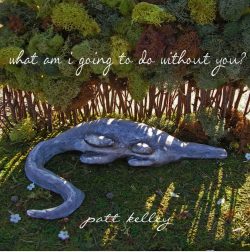
Asterix and the Griffin (volume 39)


By Jean-Yves Ferri & Didier Conrad, coloured by Thierry Mébarki, translated by Adriana Hunter (Sphere)
ISBN: 978-0-7515-8398-4 (Album HB) eISBN: 978-0-7515-8397-7

Win’s Christmas Gift Recommendation: Seasonal Sensations with Gallic Chill… 9/10

Whoops! Missed one!

As we saw a few days ago, Asterix le Gaulois has been around, amazing and amusing the planet since 1959 and become part of the fabric of French life. His exploits have touched billions of people all around the world.

For five and a half decades and for almost all of that time his astounding adventures were the sole preserve of originators René Goscinny and/or Albert Uderzo.

After nearly 15 years dissemination as weekly serials before invariably collected into book-length compilations, in 1974 the 21st saga – Asterix and Caesar’s Gift – was the first to be released as a complete, original album prior to serialisation. Thereafter each new tome was an eagerly anticipated, impatiently awaited treat for legions of devotees. The eager anxiety hadn’t diminished any when Uderzo’s handpicked replacements – scripter Jean-Yves Ferri (Fables Autonomes, La Retour à la terre) and illustrator Didier Conrad (Les Innomables, L’Avatar, Le Piège Malais, Tatum) – settled into the creative role on his retirement in 2009.

Whether an action-packed comedic romp with sneaky, bullying baddies getting their just deserts or a sly satire for older-if-no-wiser heads, these new yarns are just as engrossing as the established canon. As you already know, half of the epics take place in exotic locales throughout the Ancient World, whilst the alternating rest are set in and around Uderzo’s adored Brittany where, circa 50 BC, a little hamlet of cantankerous, proudly defiant warriors and their families resist every effort of the mighty Roman Empire to complete the conquest of Gaul. This one’s solidly of the former variety as our major cast members make it all the way to “barbaricum”: literally beyond the known world…

Although divided by its Roman conquerors into provinces Celtica, Aquitania and Armorica, the very tip of the last-named region stubbornly refuses to be properly pacified. Utterly unable to overrun this last little bastion of Gallic insouciance, the otherwise supreme Roman overlords are reduced to a pointless policy of absolute containment – even though the irksome Gauls come and go as they please…

Thus, a tiny seaside hamlet is permanently hemmed in by heavily fortified garrisons Totorum, Aquarium, Laudanum and Compendium, filled with veteran fighters who would rather be anywhere else on earth than there. The residents couldn’t care less: daily defying, frustrating and often terrorising the world’s greatest military machine by going about their everyday affairs, bolstered by magic potion brewed by resident druid Getafix and the shrewd wits and strategic aplomb of diminutive dynamo Asterix… and his simplistic, supercharged best friend Obelix. And their dog…

In Rome, Julius Caesar is in need of a diversion for his sensation seeking subjects, so when geographer Cartographus claims to have discovered a fabled griffin, the Emperor funds a huge expedition to capture it via legions of soldiers and engineers. The beast resides far to the east in the icy Sarmatian wastes, but the scholar is convinced he can snare it as he has captured a Sarmatian Amazon woman to guide them. Terrifying and seductive, Kalashnikova only sees a chance to return home…

Meanwhile, the frozen lands under discussion have welcomed some familiar friends as Asterix, Obelix and canine wonder Dogmatix escort a very ill (no, no, it’s just a cold, really!) Getafix to the yurt of Fanciakuppov. That cheery shaman had visions of Roman invaders stealing his people’s sacred animal, so his old druid pal has brought a keg of magic potion to resist the incursion. There are, however, a couple of snags…

Firstly, the tribe is proudly matriarchal, with powerful warrior women doing all the fighting. They do it fantastically well, and don’t need help from foreigners – no matter how attractive they might be! – or magic. It’s a good thing too, as local conditions soon render the potion useless and Asterix has to rely on his brains and his giant pal’s innate brawn…

The big guy is quite distracted. Primarily by Dogmatix running away to become a wolf, but also by the obvious attentions of some of the amorous Amazons…

The Roman expedition is led by seasoned centurion Intrepidus, and Cartographus (who naturally has a secret agenda in play) has brought along famed venator (animal-fighting gladiator) Vainglorius, as a specialist to tame the griffin when they find it.

Army morale is low: the commanders squabble constantly, these lands are gloomy, frozen cold, steeped in legends and packed with people and things trying to kill them. Worst of all, when they should be building forts to secure their supply lines, the men are instead fighting each other for the right to guard the prisoner. Aloof, beautiful Kalashnikova disdains and discards them all… and they love it.

When the military monsters capture Fanciakuppov, he is forced to lead the smug raiders to the secret abode of the griffin, but thanks to the hit-&-run tactics of the Gaul-enhanced war women their numbers are so severely depleted, no one thinks they’ll make it back to sunnier climes…

The mission ends in spectacular failure but they do all get to see the fabulous beast before they die…

Packed with hilarious action, genuine chills, potent punning and cartooning delights, this tale provides plenty of pokes at fake news, current affairs, conspiracy theories, a certain global retail/delivery brand, and lands many wry jabs at all sides of the battle of the sexes and role of women in societies ancient and modern.

Asterix and the Griffin is a sure win and another triumphant addition to the magically mythic Gaulish oeuvre for laugh-seekers in general and all devotees of comics.
Original edition © 2021 Les Éditions Albert René. English translation: © 2021 Les Éditions Albert René. All rights reserved.