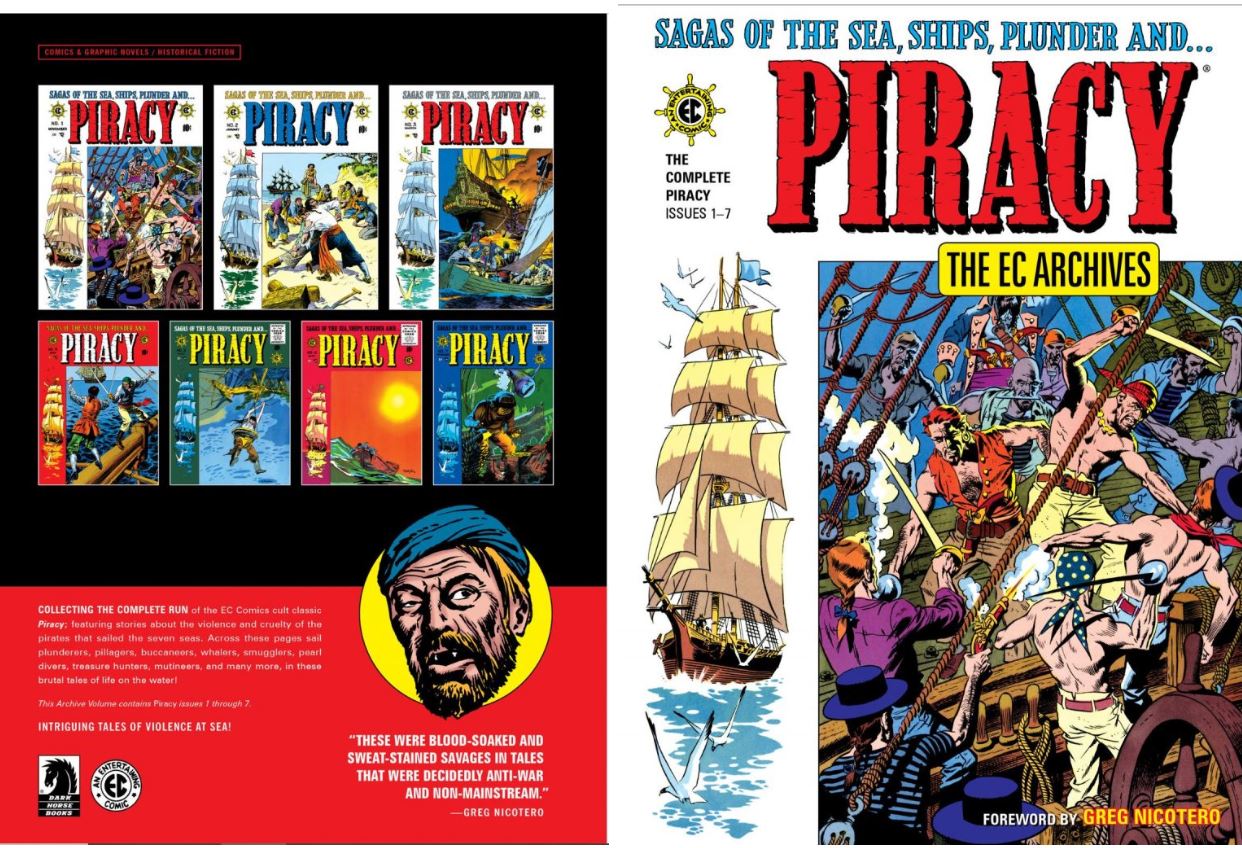
Piracy: The Complete Series 1-7 (The EC Archives Library)


By Irv Werstein, Carl Wessler, Jack Oleck, Reed Crandall, Wally Wood, Graham Ingels, George Evans, Jack Davis, Bernie Krigstein, Al Williamson, Angelo Torres & various (Dark Horse Books)
ISBN: 978-1-50670-700-6 (HB) eISBN 978-1-50670-967-3

This book includes some Discriminatory Content produced during less enlightened times.

Happy Batman Day! Let’s talk like pirates!

Haa-Haaarr! It be International Talk Like a Pirate Day and we backseat buccaneers be cunning coves ’oo prefers to sneak up on a fellow when they most expects it, especially since precious pearls like these graphical beauties never go stale… 

Legendary imprint EC Comics began in 1944 when comic book pioneer Max Gaines sold the superhero properties of his All-American Comics company to half-sister National/DC. The Inventor of Comic Books only retained Picture Stories from the Bible. His plan was to produce Educational Comics, with schools and church groups being his major target market. He latterly augmented his core title with Picture Stories from American History, Picture Stories from Science and Picture Stories from World History. Sadly, the worthy venture was already struggling when Gaines died in a boating accident in 1947.

His son William was dragged out of college and hurled into the family business where – with much support and encouragement from unsung hero Sol Cohen (who held Dad’s company together until initially unwilling Bill abandoned his dreams of a career in chemistry) – he transformed the ailing enterprise into Entertaining Comics.

After a few tentative false starts and abortive experiments, Gaines and his multi-talented associate Al Feldstein settled into a bold, impressive publishing strategy, utilising the most gifted illustrators in the field to tell a “New Trend” of stories for an older and more discerning readership. Between 1950 – 1954, EC was the most innovative, influential comics publisher in America, dominating newly reinvigorated genres of crime, horror, war and science fiction. Moreover, under the auspices of writer, artist and editor Harvey Kurtzman, the company introduced an entirely new beast: the satirical comic book.

Kurtzman was hired to supplement the workforce on EC’s horror titles but wasn’t a fan of that genre, suggesting instead a new action-adventure title. The result was Two-Fisted Tales which began with #18 as an anthology of rip-snorting, stand-alone he-man dramas. With the US deep into a military “police action” in Korea, the title quickly became a dedicated war comic, rapidly augmented by a second; Frontline Combat. Also written and edited by Kurtzman (who assiduously laid-out and meticulously designed every story), it made for great entertainment and a unifying authorial voice but was frequently a cause of friction with his illustrating artists. In keeping with the spirit of Gaines’ “New Trend”, these war stories were never bombastic, jingoistic fantasies for glory-hungry little boys, but rather subtly subversive examinations of the cost of conflict which sought to highlight the madness, futility and senseless, pointless waste of it all…

When the McCarthy-era anti-comics witch hunt of the 1950s crushed the industry and gutted EC’s output by effectively outlawing horror, crime, gore, political commentary and social criticism, Gaines & Feldstein retrenched: releasing experimental titles under the umbrella of a “New Direction”. Kurtzman’s Mad – which had defined a whole new genre, bequeathing unto Americans Popular Satire – was reconfigured into a monochrome magazine, safely distancing the outrageously brilliant comedic publication from the fall-out caused by the socio-political witch-hunt which eventually killed EC’s other titles.

Denied a soapbox to address social ills, Gaines’ new books concentrated on drama, intrigue and adventure, informed by fresh modern fascinations: either intellectual or simply mass entertainment fads. Despite still offering stunningly beautiful artwork and thoughtful writing, New Direction titles couldn’t find an audience and died within a year.

Impact, Extra!, Aces High and Valor all reflected themes of contemporary film and TV, whilst Psychoanalysis and M.D. targeted mature audiences through the growing TV phenomenon of medical dramas. Incredible Science Fiction bridged the transition from old vogue to new line-up whilst also tapping movie trends. Another fad paying off big on screen had already been seen in previous Kurtzman’s action titles: sea-going sagas from different points in history…

Piracy set sail in the Fall of 1954 (#1 was cover dated October/November) and ran for seven bi-monthly issues before being scuttled at the end of 1955. This volume of Dark Horse’s EC Archives gathers them all, re-presenting some of the most gorgeous art of the era (or ever) but with scripts apparently curtailed and bowdlerized by the newly-instituted Comics Code Authority and Gaines’ own sense of financial survival.

And yes, Watchmen fans, these are the stories Alan Moore & Dave Gibbons were referencing in that sub-strand of their dystopian masterpiece…

One last thing to remember: although it’s called Piracy, the title embraced all aspects of nautical fiction from wars, whaling and the slave trade right up to contemporary commercial affairs: mixing flamboyant sea sagas with deeper, more complex and even socially crusading maritime topics intended to equate with literary highlights like CM Forester’s Hornblower yarns, Herman Melville’s classic text and even more modern fare by Jack London or Ernest Hemingway.

Before getting underway, the fraught history of EC is outlined in Grant Geissman’s informative Introduction, offering keen insights into those times and the gifted creators involved, after which Film Producer Greg Nicotero’s Foreword provides insight into Bill Gaines’ pioneering stand against censorship…

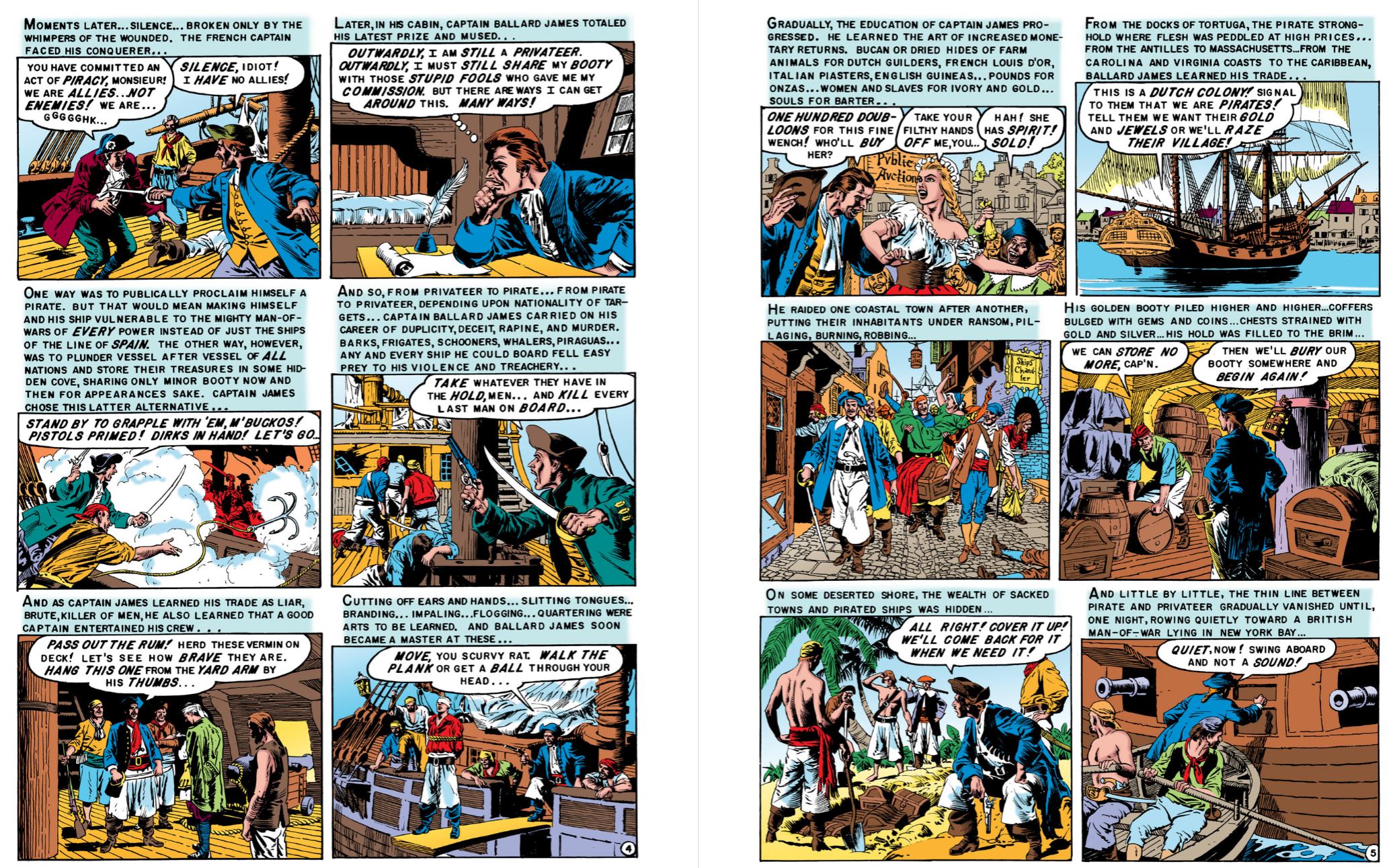
Sadly, despite diligent efforts by researchers and historians, many of these tales still have no writing credit, but that barely impacts their power to enthral as we open with a stunning Wally Wood cover. Piracy #1 opens with editorial welcome ‘Scuttlebutt’ before Reed Crandall and an author unknown detail the rise and fall of ‘The Privateer’, with patriotic Englishman Captain Ballard James gradually succumbing to temptation. Originally and exclusively targeting Spanish vessels, his battles eventually turn from his country’s survival to personal profit before he suffers a grisly, ironic comeuppance…

This collection also includes rousing house ads by EC’s finest and a particularly stirring one from Wood precedes his tale ‘The Mutineers’, with murderous marine martinet Cap’n Mathew Bollard finally driving his long-suffering crew into desperate retaliation and desertion during the last voyage of the clipper Lorna J in 1854…
Al Williamson & Angelo Torres formed a sublime artistic partnership at EC and their captivating versality is displayed in ‘Harpooned’. Also set in 1854 (for which thank the ever-beguiling concept of “only 100 years ago…”), it details how the whaling bark Eben Dodge was lost due to the growing tensions between the envious first mate and a dedicated captain who assumed his only foe was the giant sea beasts they hunted together. Prose parable ‘The Challenge’ (regarding a sea captain with an obsessive grudge against storms) and a Jack Davis-limned ad lead to the master cartoonist’s first full contribution, as ‘Shanghaied’ shares a long-anticipated reunion between a lifelong mariner and the criminal procurer who drugged and sold him into sea service a dozen years previously…

Cover-dated December 1954/January 1955, Piracy #2 opens with a Crandall cover and lead story ‘Sea Food’, wherein pirate Benjamin Medford’s ruthless predations are ended by cruel misfortune, British Naval firepower and brutal, bestial karma. Davis then returns to explore the eastern concept of ‘Kismet’ after a slave-ship’s first mate betrays his skipper and learns a lasting lesson about duty and honour…

‘Loblolly Boy’ is an historical text feature concerning tricks played on first-timers and junior seamen, after which Williamson & Torres render a modern tale of penny-pinching, deep sea treasure hunters in ‘The Shell Game’, backed up by prose piece ‘The Dive’ about a trainee’s last dry run. The issue closes with Wood’s ‘A Fitting End’, scripted by Carl Wessler and details how Edmund Drummond, Master of His Majesty’s Ship Sea Gull, allows his own innate cruelty and sense of superiority to provoke shipboard unrest even as his subordinate Jack Roark discovers an unsuspected piratical family connection.

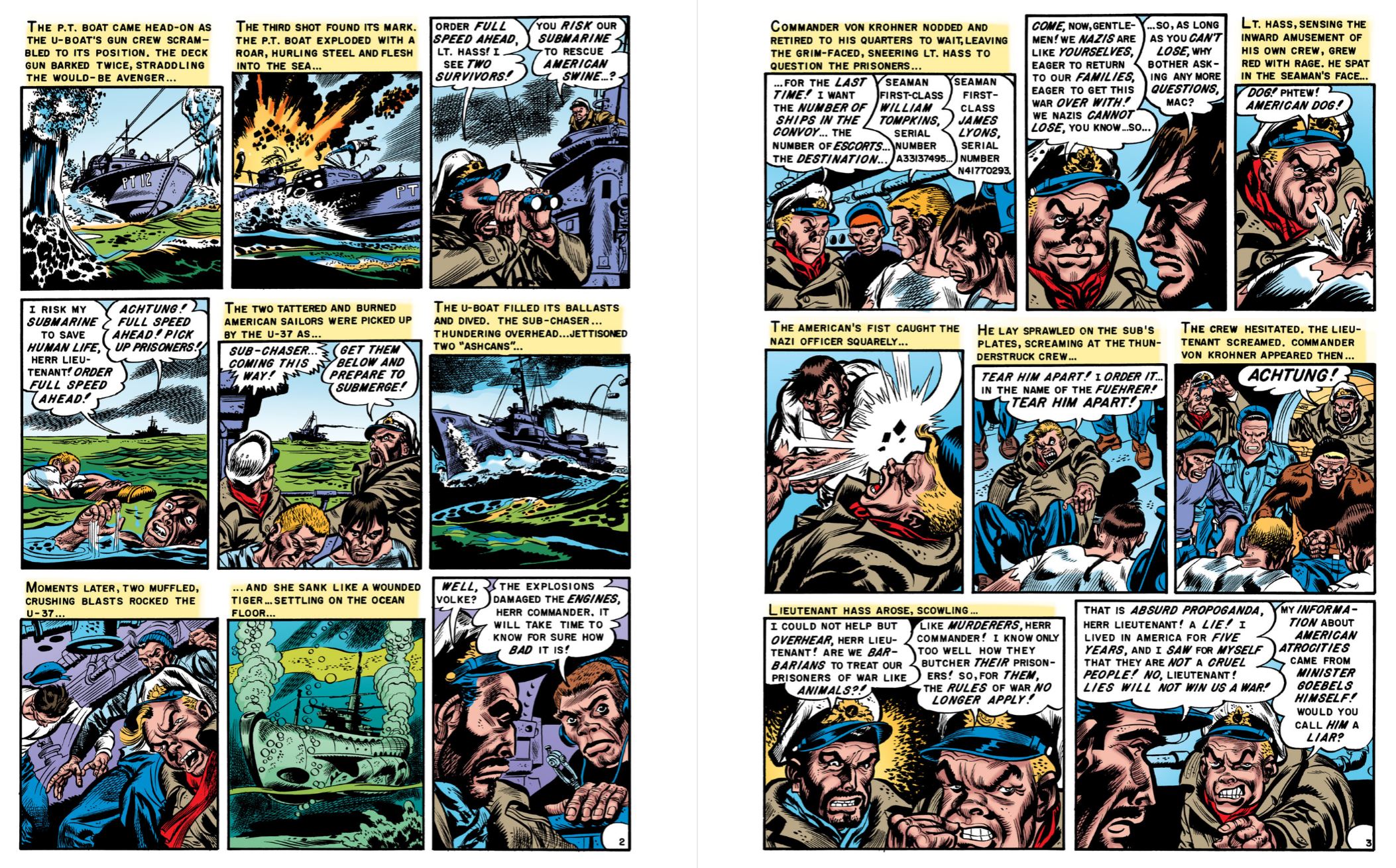
Crandall retains the cover and lead position for #3 with a compelling tale of the buccaneer who sought higher status and position than mighty ‘Blackbeard’ before ‘Scuttlebutt’ returns in the form of a letters page. Wessler & Bernie Krigstein (one of comics’ most innovative illustrators and a commercial and gallery artist) united for a psychological war drama in the style of Frontline Combat as ‘U-Boat’ reveals the lethal outcome of a battle of wills between a German submarine commander and his fanatical Nazi political officer.
Text tale ‘The Beast’ exposes romantic rivalry between tuna fishermen, preceding George Evans’ debut in ‘Mouse Trap’ wherein a 19th century sailor plucked from the seas expiates his guilt and shares his role in the ghastly fate of lost ship The Sea Spray. Wessler & Graham Ingels closed the issue with the saga of an abolitionist white man shanghaied to serve aboard a ‘Slave Ship’ and the pact he made with its “human cargo”…

Behind Piracy #4’s Crandall cover and more ‘Scuttlebutt’ letters, that dean of realism rendered the brutal tale of Cap’n Satan – Terror of the Spanish Main. This savage, satirical yarn of the ‘Pirate Master’ details his humble origins, appalling deeds and ultimate downfall… matrimony!

‘The King’s Buccaneer’ recounts in prose the career of privateer Sir Henry Morgan, after which Wessler & Evans use the war of 1812 to frame the salutary saga of a stubborn young US midshipman who wants everything done ‘By the Book’, no matter how impractical… or suicidal it may seem. A brace of house-ads for the entire New Direction Line carries us into Ingels’ illustrated mystery ‘The Sheba’ with a young sea captain taking to the bitter end his vendetta against a sailing ship he believes wants to kill him. Krigstein then realises revolutionary France for us as aristocratic rival siblings in the King’s navy ruthlessly vie for prominence and position… until the events of 1789 engulf them both with lethal results in ‘Inheritance’.
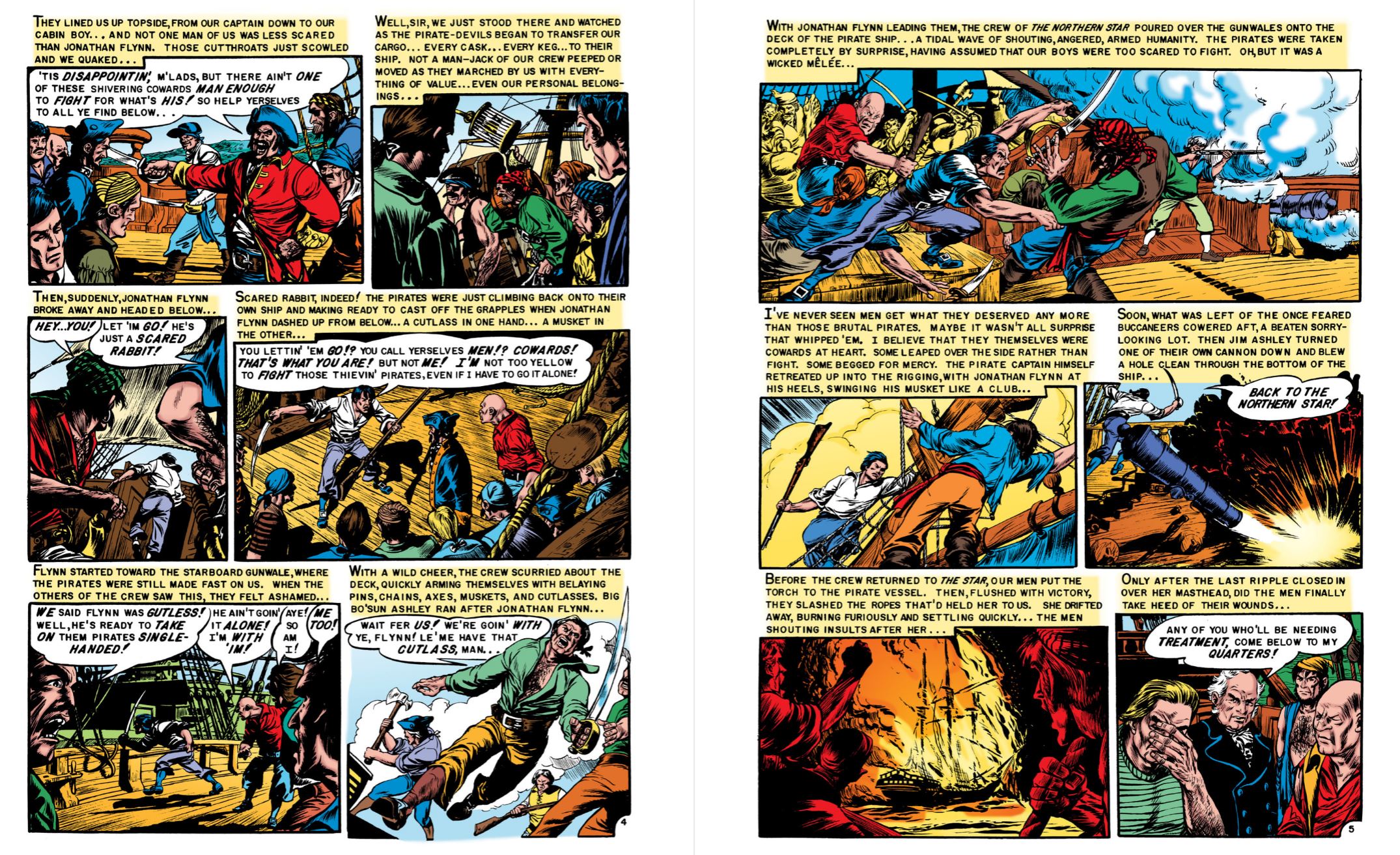
Krigstein’s cover for #5 (June/July 1955) precedes Crandall’s gorgeous re-examination of US patriotic icon ‘Jean Lafitte’, before another missives-packed ‘Scuttlebutt’ leads to Wessler & Ingels’ ‘Rag Doll’, wherein a sullen brute on an 1810 four-master repels a pirate raid almost singlehandedly, simply to reclaim the childhood totem hiding his darkest secret and greatest shame. Jack Oleck scripts Krigstein on ‘Salvage’ as ruthless seaborne profiteers learn a nasty lesson about humanity, after which snippets of sea-based new stories are recycled in prose piece ‘Breakers on the Shore’, prior to Evans closing the issue with ‘The Keg’ – a sinister yet uplifting saga of survival…

Krigstein’s stunning cover for penultimate issue #6 segues into Crandall’s chilling 17th century saga of plunder, murder and brain-shattering guilt as a drunken derelict details how he is cursed by treasures ‘Fit for a King’, as letters in Scuttlebutt lead to Wessler & Evans’ account of a junior officer deranged by denial of promotion. He then does what he does to become ‘The Skipper’ before Ingels limns the story of a merciless seal trapper who destroys an arctic village’s food supply and is driven ‘Fur Crazy’

Sir Francis Drake’s text biography ‘Sailor for Queen Bess’ precedes Davis’ tale of South Pacific schooner master Jonathan Wade, whose favourite disciplinary tactic is casting men adrift in an open boat. His inevitable breakdown leads to justice when he too is lost in ‘Solitary’

Evans drafted the iconic last cover and Crandall told his final tale here as warring corsair captains Kemp and Valdez became ‘Partners’ in piracy just long enough to get really, truly rich… before inevitably betraying each other. Text tale ‘Prologue’ follows a trainee submariner’s last test exercise before Wessler & Krigstein visit 1777’s New England, where a British fleet sworn to take Saratoga is lured to destruction ‘Up the River’ by a terrain-savvy farmer.

Incessantly harassed by his literal fishwife spouse, a weary, poverty-stricken fishing boat skipper does a selfless good deed and is blessed with ‘John’s Reward’ in a wry domestic drama drawn by Ingels, after which more postal praise in ‘Scuttlebutt’ leads to one final foray from Evans. ‘Temptation’ finds venerable Captain Dover and his young chief officer aboard a Charleston packet boat. Of course, a once-in-lifetime cargo of $2 million in gold and jewels would turn most heads and suspicion quickly leads to a bad life choice…
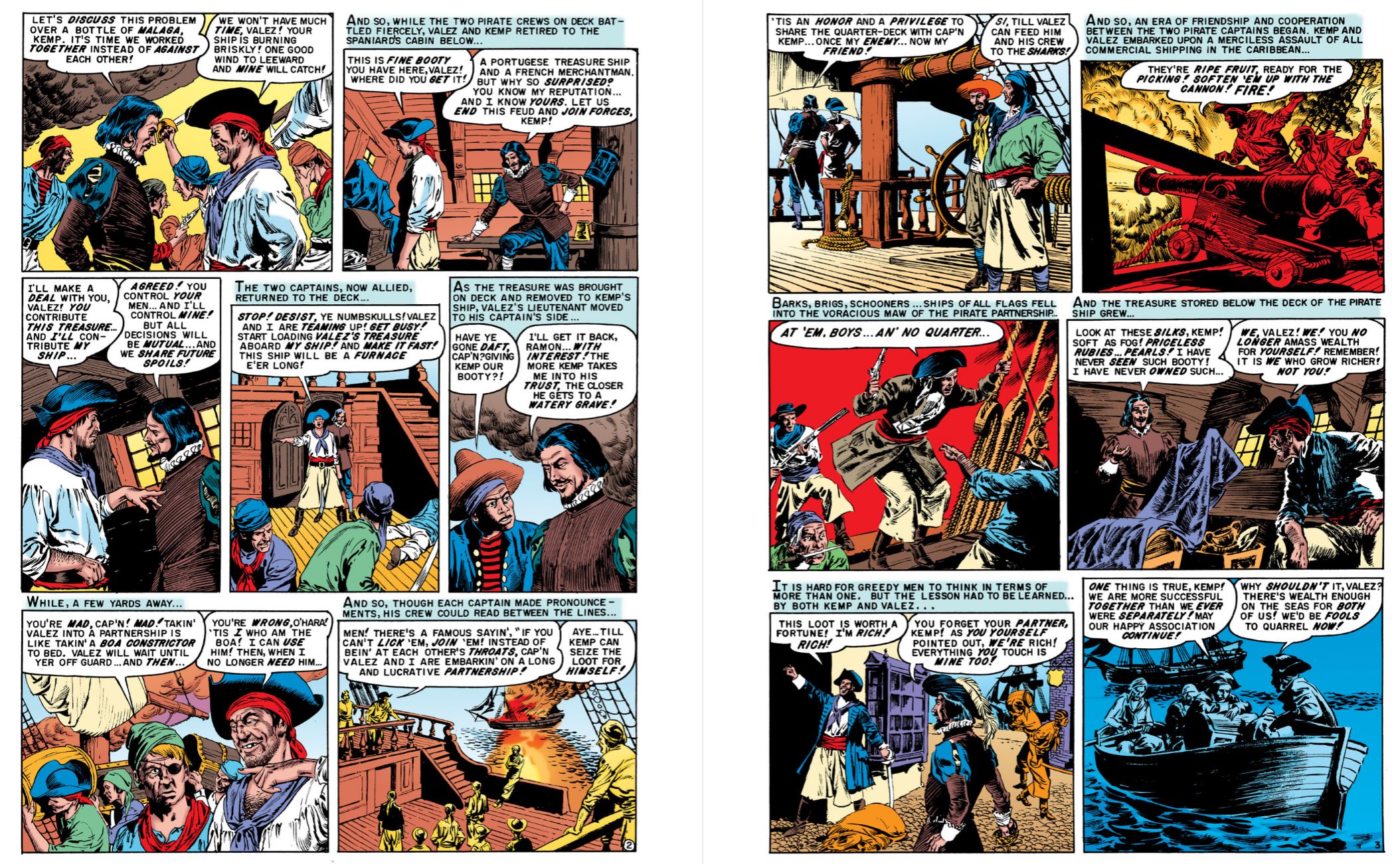
Every page here has been restored from the masterful colour guides of original colourist Marie Severin, resulting – with modern reproduction techniques – in a sequence of graphic poems of unsurpassed beauty, whilst original house ads and commercial pages from the period tantalise in a way no others could, completing a nostalgic experience unlike any other.

The New Direction was a last hurrah for the kind of literate, mature comics Gaines wanted to publish. When they failed, he concentrated on Mad magazine and satire’s gain was American comics’ loss. You can vicariously relive those times and trends, and I strongly suggest that whether you are an aged EC Fan-Addict or nervous newbie, this is a book no aficionado can afford to miss. Why not dig deep and seize these timeless treasures, Me Buckoes?
THE EC ARCHIVES: PIRACY® & © 1954, 1955, 2019 William M. Gaines Agent, Inc. All rights reserved. Introduction © 2019 Grant Geissman.
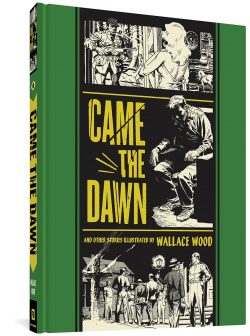
Came the Dawn and Other Stories illustrated by Wallace Wood (The Fantagraphics EC Comics artist Library volume 2)


By Wallace Wood, with Al Feldstein, Harry Harrison, Gardner F. Fox & various (Fantagraphics Books)
ISBN: 978-1-60699-546-4 (HC/Digital edition

This book includes Discriminatory Content produced in less enlightened times. This book also contains Discriminatory Content employed for dramatic effect.

EC began in 1944 when comic book pioneer Max Gaines sold the successful superhero properties of his All-American Comics company – including Wonder Woman, Flash, Green Lantern and Hawkman – to half-sister National/DC. He retained only Picture Stories from the Bible, with a plan to produce a line of Educational Comics and with schools and church groups as the major target market. Max then augmented his core title with three more in similar vein: Picture Stories from American History, Science and World History. The worthy but unsustainable project was already struggling when he died in a boating accident in 1947. His son William was eventually convinced to assume control of the family business and, with much support and encouragement from unsung hero Sol Cohen and multi-talented associate Al Feldstein, transformed the ailing enterprise into Entertaining Comics, consequently triggering the greatest qualitative leap forward in comic book history…

After a few tentative false starts and abortive experiments, Gaines settled into a bold and impressive publishing strategy, utilising the most gifted illustrators in the field to tell a “New Trend” of stories aimed at an older, more discriminating audience.

From 1950 -1954 EC was the most innovative and influential publisher in the US, dominating the genre markets for science fiction, war, horror and crime comics. The company even added a new type of title and another genre with the creation of parody magazine Mad

This second volume of the Fantagraphics EC Library is a magical and groundbreaking omnibus of horrific tales and human dramas displaying the astounding artistic expertise of Wallace Allan Wood: one of the greatest draughtsmen our art form has ever produced.

Woody was a master of every aspect of the business. He began his career lettering Will Eisner’s Spirit strip, moved into pencilling and inking and latterly, publishing. After years working all over the comics and syndicated strip industries, as well as in legitimate illustration, package-design and other areas of commercial art, he devised the legendary T.H.U.N.D.E.R. Agents franchise and even created one of the first adult independent comics with Witzend as the 1960s closed.

The troubled genius carried the seeds of his own destruction, however. Woody’s life was one of addiction (booze and cigarettes), traumatic relationships, tantalisingly close but always frustrated financial security, illness and eventually suicide. It was as if all the joy and beauty in his existence stayed on the pages and there was none left for real life.

Although during his time with EC Wood became the acknowledged and undisputed Master of Science Fiction art in America, he was equally adept, driven and accomplished in the production of all genres. This powerful collection concentrates on some of his best early crime, horror and suspense tales and includes all the evocative, emotionally-charged social dramas (lovingly dubbed “Preachies”) which Feldstein & Bill Gaines devised to address hot-button issues and challenge the smugly hierarchical status quo of post-war triumphalist America.

These strident, still truly shocking morality plays viciously jabbed at the nation’s dark underbelly, attacking prejudice, police corruption, drug abuse, sexual attitudes, racism, institutionalised intolerance and all manners of hypocrisy. It’s no stretch to consider that these tales, more than any other childhood influence, probably shaped the resurgent liberal attitudes which blossomed as the future “Flower Power” generation reached their majority a decade later. They certainly riled the powers that be who made sure that when the Comics Code Authority was established all such dangerously seditious fare was kept well away from the kiddies…

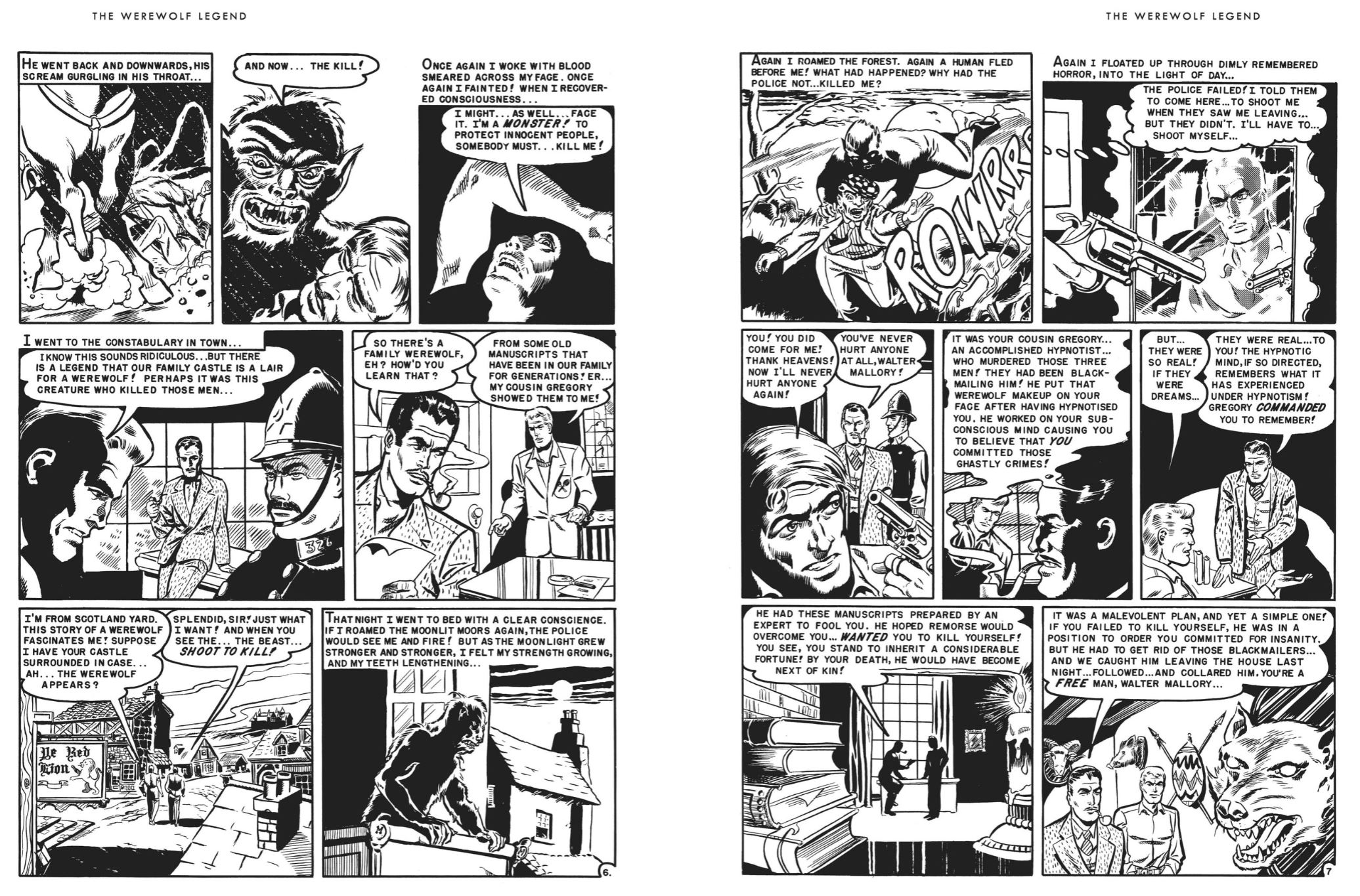
The stories are re-presented here in stark yet lavish monochrome, with supplementary interviews, features and dissertations, beginning with Bill Mason’s ‘Come the Stories’ weighing the yarns included here with forensic discipline. Then the pictorial parade picks up with rather pedestrian scam caper in ‘The Werewolf Legend’ (Vault of Horror #12 April/May 1950) as an innocent man is convinced he’s a ravening monster. It was scripted by prolific and ubiquitous Gardner Fox, one of Gaines senior’s greatest assets and discoveries. The pencils are by cartoonist Harry Harrison (Stainless Steel Rat, Make Room! Make Room!, The Technicolor Time Machine, Bill, the Galactic Hero) and inked by Wood. Although Harrison found his greatest fame as a prestigious prose author in later years, he was a major player in the comics biz during the 1950s and had worked with Wood as a jobbing production team since they’d met at the Cartoonists and Illustrators school in 1948.

For Haunt of Fear #15 the trio concocted legend of lethal legerdemain ‘The Mad Magician’, whilst an anonymously-authored enigma of ‘The Living Corpse’ (Crypt of Terror #18) edged closer to truly supernatural shenanigans as another illusionist took things too far in pursuit of his craft…

Fox scripted and Harrison pencilled ‘The Curse of Harkley Heath’ in VoH #13, wherein a gothic triangle of greedy heirs come to unpleasant, untimely ends after a will is read, after which Wood began handling all the art chores, starting with ‘Horror-Ahead!’ in HoF #16 (July/August 1950) when rival curio collectors endure a jungle jaunt in search of shrunken skulls and end up the only way they possibly could…

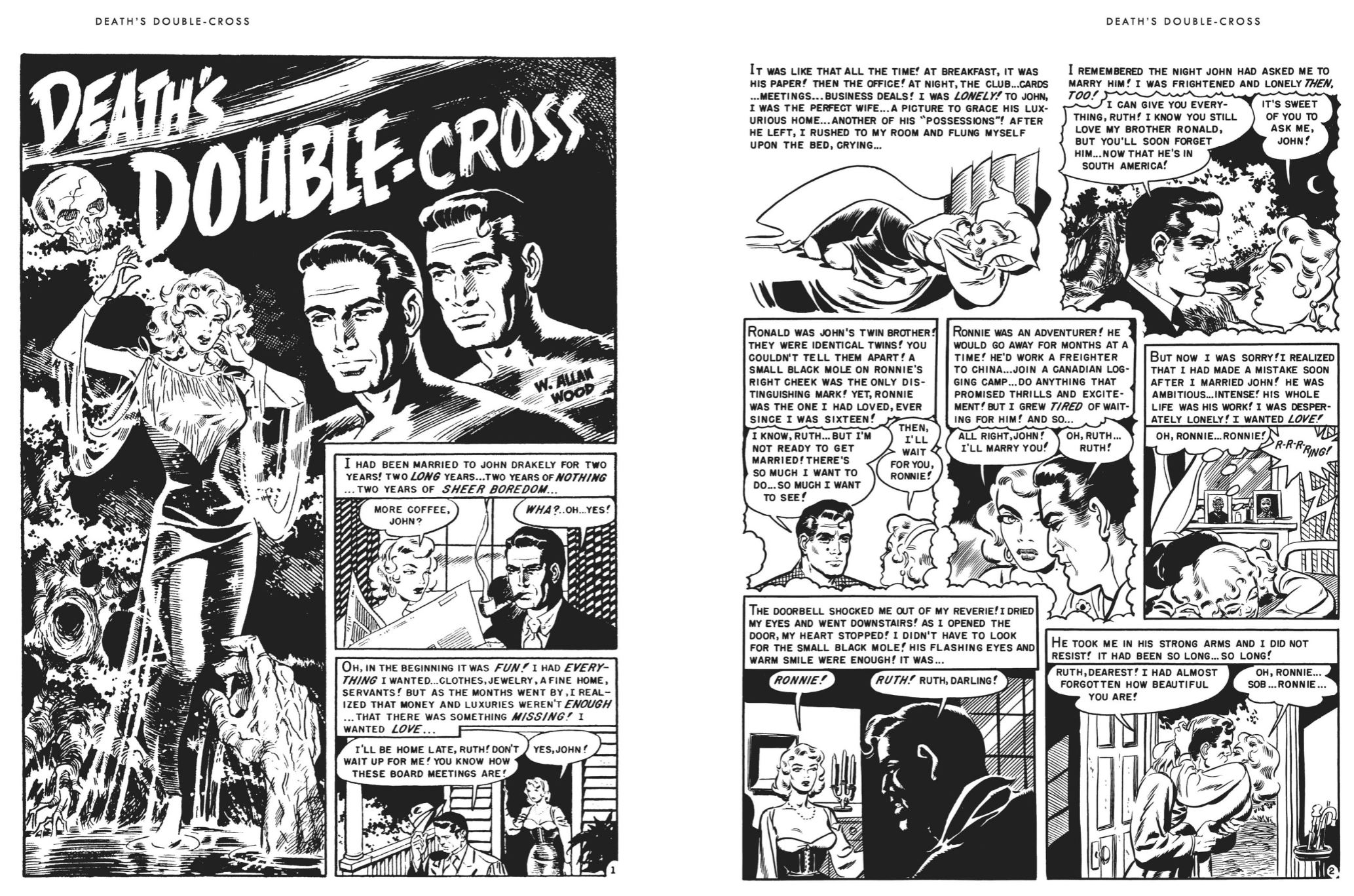
A Noir-tinged new era began when Al Feldstein began scripting for Woody. ‘Death’s Double-Cross’ – from the sublimely mature Crime SuspenStories #1 (October/November 1951) offers the twisted tale of a woman cheating on her husband with his twin brother in a moody masterpiece reminiscent of James M. Cain. Naturally it quickly turns into a nightmare that won’t end pretty…

Fox delivered a final shot in ‘The Man from the Grave’ from HoF #4, which saw a dissolute craftsman commit gruesome murder for his art… and live to regret it in desperate luxury and a relentless, compulsive paroxysm of over-work, before Feldstein’s ‘Terror Ride!’ (Tales From the Crypt #21) finds young lovers who soon regret being the last couple to ride a decrepit Amusement Park’s Old Mill boat attraction. Feldstein’s epic run of stories fill most of this tome and continue in a yarn from Haunt of Fear #5, where Wood’s dark imagination and gift for  rendering grotesques is expertly exploited in ‘Horror in the Freak Tent!’ Here a cruel carnival owner who mercilessly mistreats his exotic employees finally receives a macabre measure of justice…

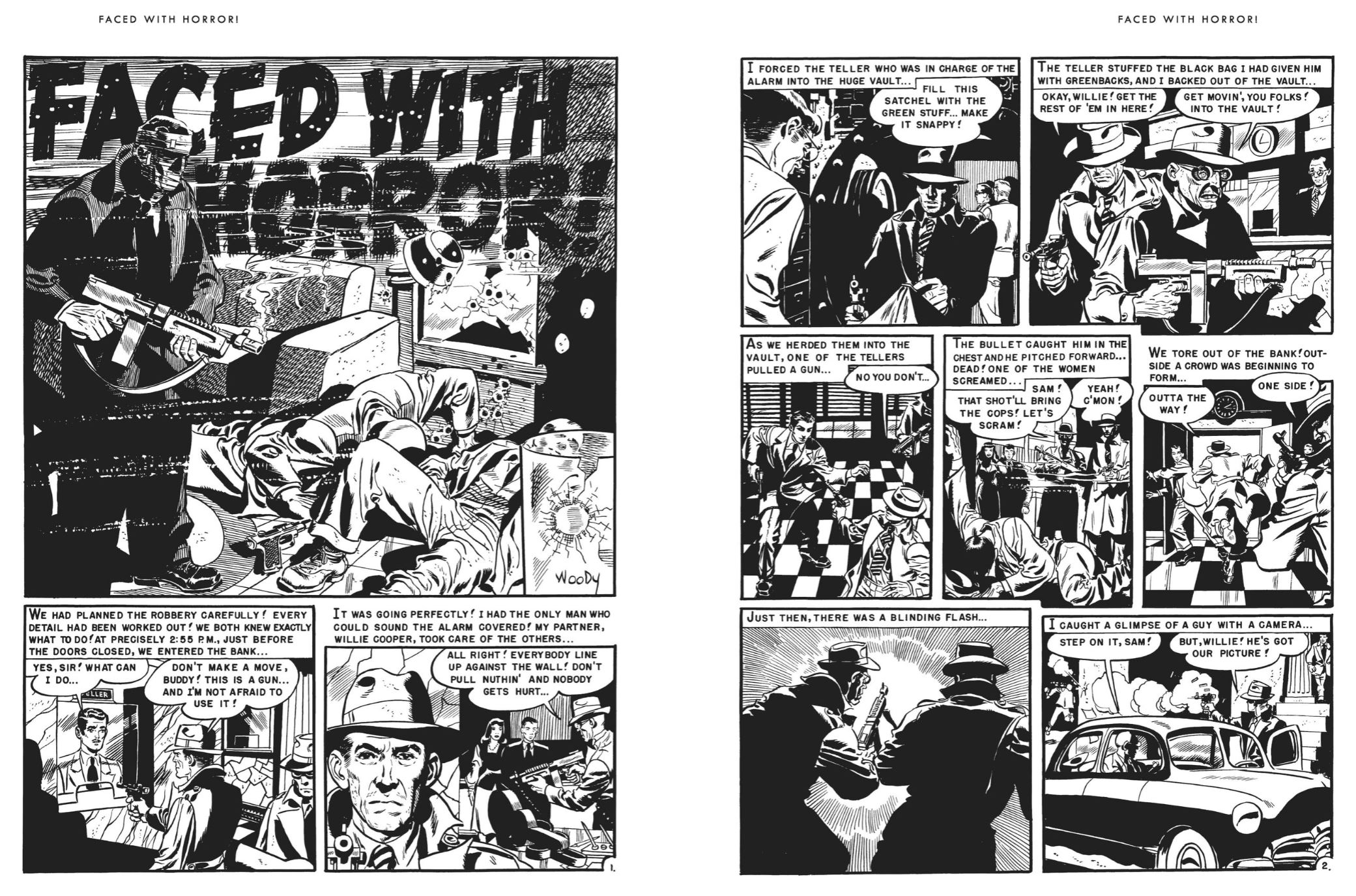
Crime SuspenStories #3 then provides a fearsome farrago of betrayal and vengeance when two fugitive bandits are ‘Faced With Horror!’ after picking the wrong plastic surgeon to sort out their public notoriety problems, whilst ‘So They Finally Pinned You Down!’ (HoF #6) follows a troubled soul who can’t understand why he’s always stumbling over dead women…

The macabre mayhem concludes with two tasty titbits from Tales From the Crypt #24 & 25, beginning with a classic philandering-murderer-gets-his-come-uppance saga in ‘Scared to Death!’, after which a baroque body-switching melodrama concerning a cunning crone and a lovely young thing compels a bewildered husband to conclude ‘Judy, You’re Not Yourself Today!’

The remainder of this potent volume is comprised of those controversial conscience-rending polemical passion-plays and human dilemmas Gaines called Preachies, opening with ‘The Guilty!’ as seen in Shock SuspenStories #3 (June/July 1952), which sees a typical small town enflamed by the murder of a young white girl. The Sheriff knows the black kid in his jail is guilty and is just as keen as the mob to spare the State the cost of a trial and takes steps to ensure it too.

… And that’s when the girl’s white boyfriend confesses…

Although stridently moralising and rather heavy handed by contemporary standards, these stories are the very bedrock of EC’s well-deserved reputation as the crusading creators of America’s very first adult comics for mature readers. Moreover, these ugly truths were gloriously draped in so very beautiful clothes, with Wood’s incredible illustrations inspired by the fiercely impassioned scripts, soaring to unparallelled heights of sensitivity with gut-wrenching impact.

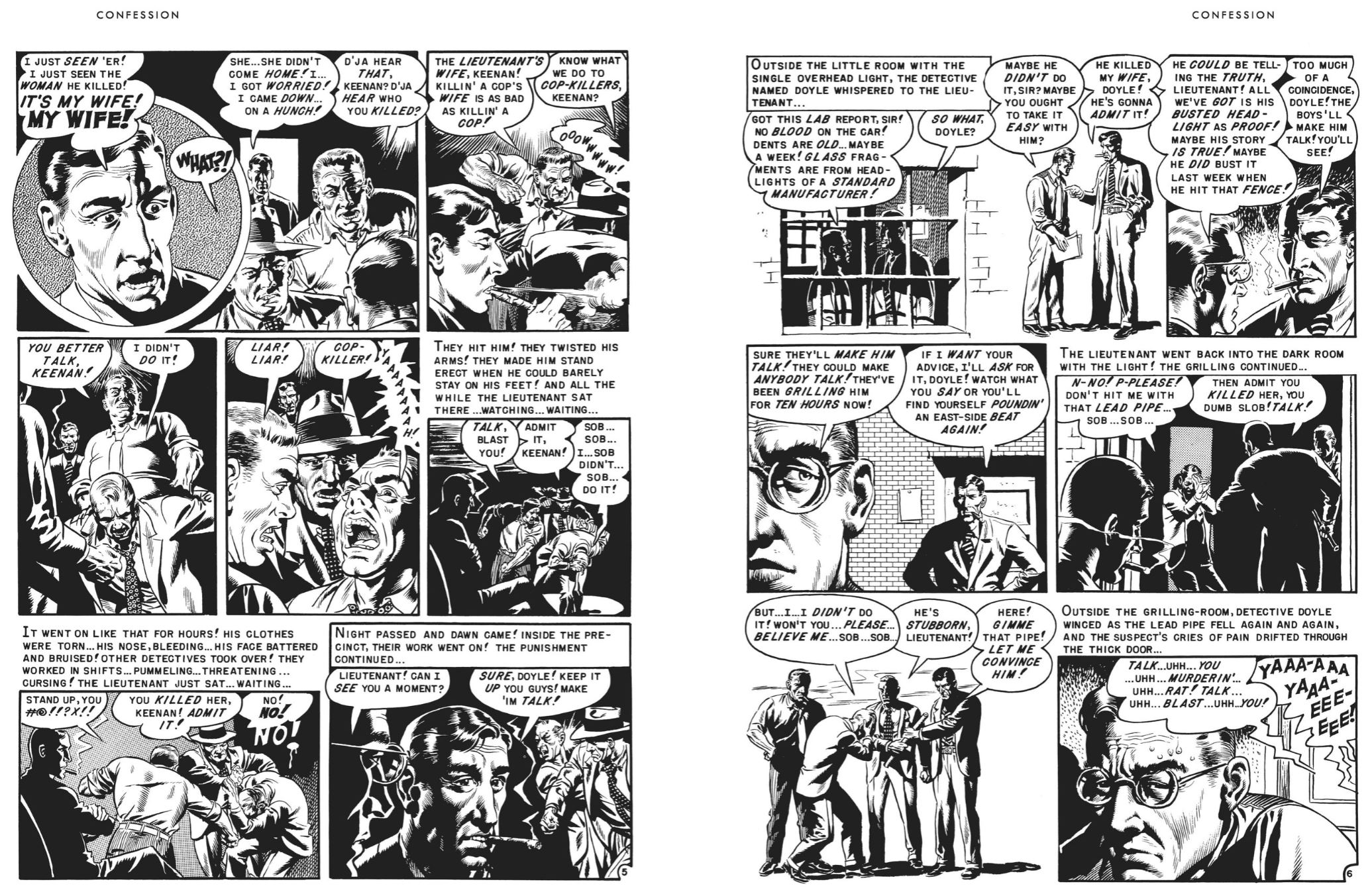
Shock SuspenStories #4 took the cultural campaign further in a sordid tale of the innocent witness relentlessly beaten into a ‘Confession’ by cops determined to capture a hit-&-run driver who’d killed their Lieutenant’s wife. So why then, is the grieving officer’s car all banged up and covered in blood? Sheer, old-fashioned anti-Semitism fuels the ‘Hate!’ of a quiet little town and leads to the death of a family too stubborn to be warned. Imagine instigator John Smith’s surprise when his appalled mother tells the entire town that he was adopted and what his true origins are. Shock SuspenStories #6’s ‘Under Cover!’ combines the local Klan chapter’s campaign of punishment-floggings for miscegenation with the end of a crusading reporter who tries to expose the scandal. Tragically, he forgot that there might be almost anybody under those pointy hoods…

In #7 ‘The Bribe’ reveals how even the most honest and dedicated of civil servants can be pushed into abandoning his principles – especially with a loving daughter, her upcoming wedding and crushing society pressure hitting him so hard…

Even today ‘The Assault!’ is potentially the most contentious tale here, exposing how a small town girl with salacious appetites callously guards her precious but precarious reputation by framing an old man for her “rape”. In typical tone for those times, her lie ultimately and inevitably causes two deaths, after which eponymous ‘Came the Dawn!’ from Shock SuspenStories #9 offers a superb  example of Greek tragedy in modern dress. Here a lonely backwoods hermit finds a beautiful naked woman in his cabin and, after a night of mutual passion with the girl of his dreams, discovers that an inmate fitting her description has escaped from the nearby asylum. Only after he’s locked his dream girl outside out does he discover that she’s not the only mysterious blonde lost in the forest…

Far less emotionally loaded but equally devastating is the darkly introspective ‘…So Shall Ye Reap!’ (Shock SuspenStories #10) which sees a penitent, angry young man contemplating every hypocritical act of his pompously pious parents before reaching his own moment of judgement prior to ‘In Gratitude’ launching a simply breathtaking assault on the nation’s double standards after a wounded soldier comes home to a hero’s welcome. However, he savagely turns on his friends and family when he finds out what they’ve done to the “coloured man” who saved his life…

More quirky crime-caper than social commentary, ‘Fall Guy’ (Shock SuspenStories #12) follows the doomed decade that saw upstanding citizen Danny Jansen steal a fortune to please a greedy girl far out of his league only to spend ten years in jail paying for it. Surprisingly, she waited all that time for him, but wasn’t best pleased when he couldn’t remember how to retrieve “their” ill-gotten gains…

A campaign of hate to drive out a man who foolishly admitted to being part-Negro ends in suicide and a sense of smug satisfaction when the bigot-in-charge boasts of his success to the local doctor in ‘Blood-Brothers’ (Shock SuspenStories #13). Imagine the vile cross-burner’s surprise when the aged medic reveals the source of the transfusion which had long-ago saved the happy hate-monger’s life. Next, ‘The Whipping’ (scripted by Feldstein & Gaines for Shock SuspenStories #14) returns to scandalmongering territory, when a dutiful daughter defies her racist father and starts dating an Hispanic boy. Dad doesn’t call it that, and the outrageous steps he and his pure-white buddies take to end the affair horrifically backfire…

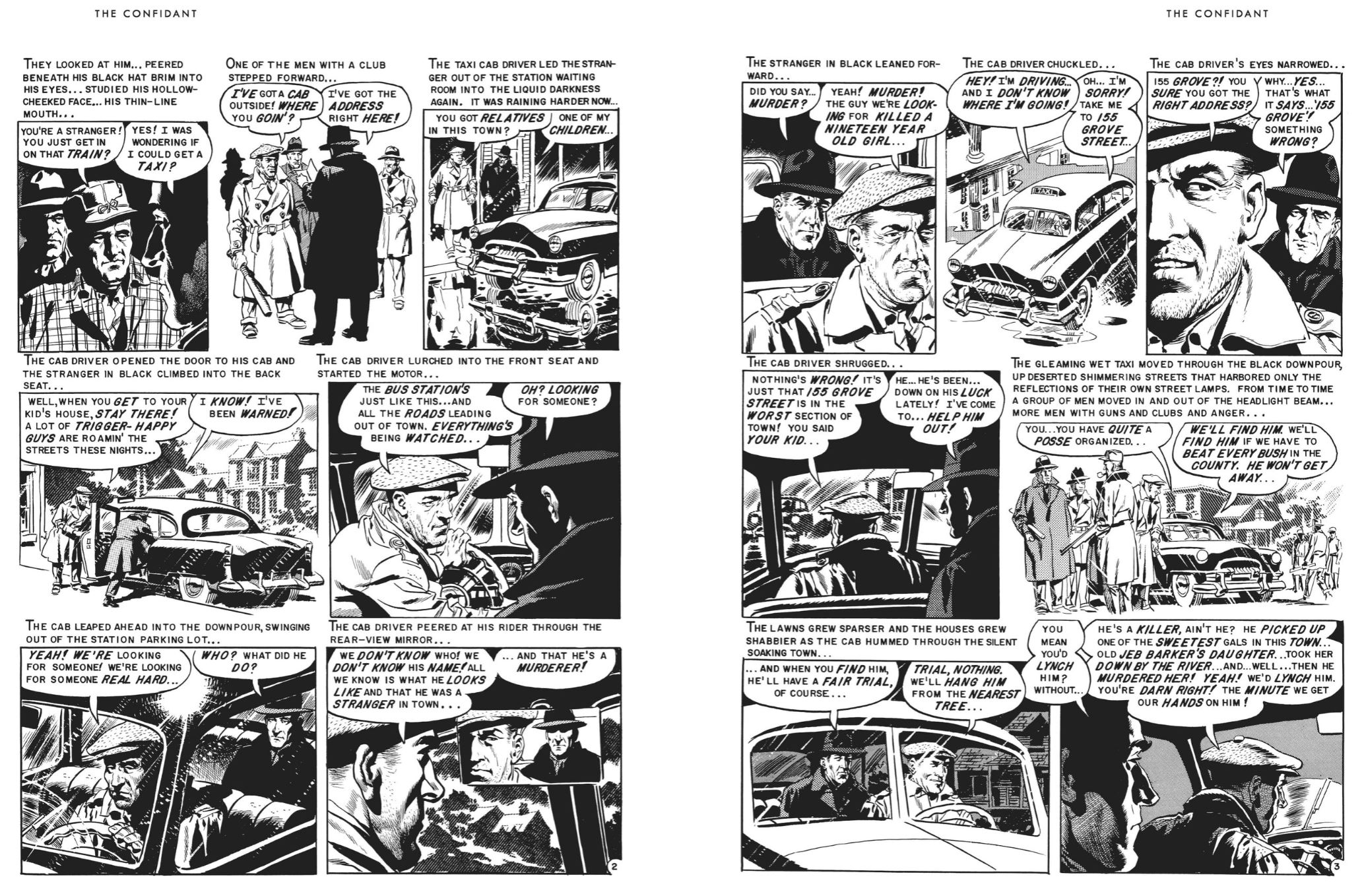
The last tale reprinted here is ‘The Confidant’ (Feldstein, Gaines and Wood from Shock SuspenStories #15, June/July 1954), created at a moment in time when public outcries against comics was reaching its fevered peak. It deals with mob-justice and sees an entire town baying for the blood of a newcomer who they “know” has murdered a young girl. Then, when a dark stranger arrives searching for one of his children, the unofficial posse jump to a wrong conclusion with tragic and irreparable consequences…

Please forgive any deliberate vagueness on my part here: the point is to make you want to read these poignant. shocking stories and I don’t want to devalue their impact or spoil your otherwise assured enjoyment…

A detailed history of Woody the flawed genius is provided by historian S.C. Ringgenberg in prose piece ‘Wallace Wood’ after which this truly beautiful book is closed by ‘Behind the Panels: Creator Biographies’ compiled by Arthur Lortie & and Bill Mason before Ted White’s ‘Crime, Horror, Terror, Gore, Depravity, Disrespect for Established Authority – and Science Fiction Too!: ‘The Ups and Downs of EC Comics: A Short History’ offers a comprehensive rundown of the entire EC phenomenon.

The short, sweet, cruelly limited EC back catalogue has been revisited ad infinitum in the decades since its demise. Those amazing yarns changed not just comics but also infected the larger world through film and television to convert millions into dedicated devotees still addicted to New Trend tales. Whether you are an aged EC Fan-Addict, a nervous newbie, or simply a mere fan of brilliant stories and sublime art, Came the Dawn is a book no sane and/or sensible reader can afford to be without.
This edition © 2012 Fantagraphics Books, Inc. All comics stories © 2012 William M. Gaines Agent, Inc., reprinted with permission. All other material © 2012 the respective creators.

Today in 1904 British cartoon colossus Reg Parlett (Just Jake, Billy Bunter, Mowser, countless assorted strips for Merry and Bright, Funny Wonder, Radio Fun, Film Fun, Knockout, Buster, Valiant, Lion, Whizzer and Chips, Cor!!, Whoopee!, Jackpot, Wow!) was born, sharing the day with Golden age letterer Betty Bentley (Superman, Batman, Starman) in 1916; artist/illustrator/inker Dave Hunt (Transformers, Avengers, Amazing Spider-Man, Superboy and the Legion of Super-Heroes, Wonder Woman, DC Comics Presents) in 1942; Belgian creator Luc Cromheecke (Taco Zip, Tom Carbon & Roboboy) in 1961; writer/letterer John Layman (Chew, Thundercats, Marvel Zombies vs. The Army of Darkness) in 1969 and writer/moviemaker Kevin Smith (Clerks, Chasing Amy, Daredevil: Guardian Devil, Green Arrow, Batman: The Widening Gyre, Batman: Cacophony, Jay and Silent Bob) in 1970.

Belgian master storyteller François Craenhals (Karan, Fantômette, Chevalier Ardent, Les 4 As, Pom et Teddy) died today in 2004.