Demeter & Persephone: Spring Held Hostage – A Greek Myth


By Justine & Ron Fontes, Steve Kurth & Barbara Schulz (Graphic Universe)
ISBN: 978-1-58013-318-0,     978-0-82256-570-3

The heroic tales and legends of older cultures have, for centuries formed an integral part of children’s educational development – and a good thing too. These days though, those magnificently inspiring and memorably visual yarns are as likely to be disseminated in graphic novel form as through the illustrated prose books which had such a formative influence on my early days.

Demeter & Persephone: Spring Held Hostage was released in 2007, one self-contained tome in a larger series which also retold in comics other Hellenic myths such as the Labours of Hercules, Jason’s journey with the Argonauts as well as other cultures’ founding fables like Isis & Osiris or King Arthur.

Packaged as full-colour, 48 page, card-cover booklets they – hopefully – introduced a wealth of kids to the magical riches of human imagination.

They also read very well as comics in their own right.

All religious stories are devised to explain away contemporary unsolved questions and unknowable mysteries. The liturgical lesson retold here was one people’s attempt to rationalise the progress of the seasons and the man-made miracle of agriculture, opening in the paradisiacal golden age of ‘A Winterless World’ where, thanks to the joyful bounty of the goddess Demeter, plants bloomed all year long and the Earth was bathed in perpetual warmth. The harvest goddess’ greatest joy was her glorious daughter Persephone, offspring of one of Zeus’ constant infidelities with any deity, supernatural creature or mortal he took a fancy to…

The supreme god ruled over the skies and Earth whilst his brothers Poseidon and Hades controlled the seas and underworld respectively. However, when the dolorous, lonely Lord of the Dead saw Persephone he wanted her for his wife – and callous, unthinking Zeus told him to just steal her and take her down to ‘The Dark Domain’ he ruled…

Despite her plight, Demeter’s daughter found a great deal that was admirable about Hades and his vast kingdom of judgement, punishment and reward. However, knowing how perilous her fate was, Persephone refused to eat anything that her embarrassed abductor offered, knowing that to do so would bind her to him forever…

In the bright lands above, Demeter frantically searched for her child. Discovering how Persephone had been taken, the Harvest Goddess pleaded with Zeus who refused to intervene, prompting her to abandon the pantheon’s home on MountOlympus. She wandered the Earth as ‘A Worried Mother’ and in the guise of a broken old woman became the nurse to Prince Demophoon of Eleusis, infant son of King Celeus.

Months passed whilst Demeter neglected the world’s lush abundance, defiantly ignoring the desperate pleas of man and god alike. Plants withered and starvation gripped the Earth, and on Olympus the crisis at last forced Zeus to act. He despatched messenger god Hermes to the underworld to negotiate with Hades and a compromise was reached.

‘The Seeds of Change’ saw a now reluctant Persephone leave the abductor she had come to care for. In all that time she had eaten nothing but as they parted she swallowed a few pomegranate seeds from a fruit Hades offered as final gesture…

Even whilst back in the clean air above, this caused great consternation as their consumption gave Hades a legitimate claim to Persephone. Moreover, she had come to love him but as her mother refused to be separated from her, her marriage to Hades would have doomed mankind to starvation.

‘The Pomegranate Problem’ was only solved by Rhea, mother of all gods, who suggested that the lovers should marry but that Persephone must spend two thirds of each year with her mother who would then cause the world’s plants to germinate, blossom, grow and ripen. After that the daughter would spend four months with her husband in the underworld, with Earth consequently becoming temporarily cold, dark and bleakly barren…

Satisfied with the solution but plagued by guilt, Demeter eventually returned to Eleusis where the baby Demophoon had grown to manhood. Here she taught her human charge the secrets of cultivation and plant improvement and the prince travelled the Earth, sharing his divinely-bestowed knowledge of agriculture to a grateful and eager humanity…

Engrossing, dynamic, pretty and blessed with a light touch, this splendid introduction to mythology is designed for kids with a reading age of nine or above – that’s Year 4, I suspect – and also contains a full glossary, a Further Reading and relevant websites list, and an index as well as fact-features on Creating Demeter & Persephone and biographies of the creators.
© 2007 Lerner Publishing Group, Inc. All rights reserved.

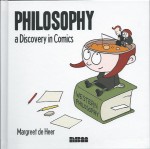
Philosophy – A Discovery in Comics


By Margreet de Heer with Yiri T. Kohl (NBM)
ISBN: 978-1-56163-698-3

There’s no use denying it: Annual Gift-Giving Season isn’t far off and it’s never too early to think of the ideal item for that troublesome family/friend unit. So here’s something that might fit the bill for any argumentative soul fed up with socks, pants and pen-sets…  

It has long been a truism of the creative arts that the most effective, efficient and economical method of instruction and informational training has been the comic strip.

Advertising mavens have for over a century exploited the easy impact of words wedded to evocative pictures, and public information materials frequently use sequential narrative to get hard messages over quickly and simply. Additionally, since World War II, carefully crafted strips have been constantly used as training materials in every aspect of adult life from school careers advice to various branches of military service – utilising the talents of comics giants as varied as Milton Caniff, Will Eisner (who spent decades producing reams of comic manuals for the US army and other government departments), Kurt Schaffenberger and Neil Adams.

These days the educational value and merit of comics is a given. Larry Gonick in particular has been using the strip medium to stuff learning and entertainment in equal amounts into the weary brains of jaded students with such tomes as The Cartoon History of the Universe, The Cartoon History of the United States and The Cartoon Guide to… series (Genetics, Sex, Computers, Non-Communication, Physics, Statistics, the Environment and more).

Japan uses a huge number of manga text books in its schools and universities and has even released government reports and business prospectuses as comic books to get around the public’s apathy towards reading large dreary volumes of public information.

So do we, and so do the Americans.

I’ve even produced one or two myself.

Now the medium has been used to sublimely and elegantly tackle the greatest and most all-consuming preoccupation and creation of the mind of Man…

Margreet de Heer was born in 1972 into a family of theologians and despite some rebellious teen forays to the wild side of life – fascinatingly covered in the ‘Know My Self’ section of this fabulous graphic primer – studied Theology for 9 years at the University of Amsterdam. After graduating in 1999 she decided to become a cartoonist – and did – but also worked at the wonderful comics and cool stuff emporium/cultural icon Lambiek in Amsterdam.

Whilst there she collaborated with industry expert Kees Kousemaker on a history of Dutch comics before becoming a full-time professional in 2005, with commissions in publications as varied as Yes, Zij aan Zij, Viva Mama, Flo’, Jippo, Farfelu and NRC.Next.

In 2007 she began a series of cartoon philosophical reports for the newspaper Trouw, which prompted a perspicacious publisher to commission a complete book on this most ancient of topics. Filosofie in Beeld was released in 2010 and translated into English by NBM this year as Philosophy – a Discovery in Comics.

This gloriously accessible tome, crafted by a gifted writer with a master’s grasp of her subject, opens with the core concept ‘What is Thinking?’ examining the processes of mind through a number of elegantly crafted examples before moving onto ‘Who Do We Think We Are?’

Those paradigms of ‘Self-Awareness’, ‘Logical Thinking’, ‘Language’, ‘Symbols’, ‘Abstract Thinking’ and ‘Humor’ are captivatingly covered before the history and cognitive high points of civilisation are disclosed with ‘The Foundation of Western Philosophy’.

This potted history of ‘Dualism’ relates the life stories, conceptual legacies and achievements of ‘Socrates’ and the ‘Socratic Discourse’, his star pupil ‘Plato’ and the universal man ‘Aristotle’, all winningly balanced with a balancing sidebar autobiography in ‘Know My Self’ plus some cogent observations and a few comparisons with the Eastern philosophy of ‘Unity’…

‘Medieval Philosophy’ deals with the influence of the Christian Church on ‘Augustine’ and ‘Thomas Aquinas’, the “Great Thinkers” of early Europe, examining the warring concepts of ‘Free Will’ and ‘Predestination’ and exploring the lives of ‘Erasmus’ and ‘Humanism’, ‘Descartes’ and his maxim ‘Cogito Ergo Sum’ and ‘Spinoza’ whose consummate faith-based dictum was ‘Know Thyself’…

The charming, beguiling foundation course continues with ‘What is Reality?‘ bringing us up to the modern age with ‘And Now’ with another brilliantly clever diversion as de Heer includes the ‘Personal Philosophies’ of families and friends.

Her husband – and this book’s colourist – Yiri bases his outlook on the incredible life of outrageous comedian ‘George Carlin’, her aged friend Gerrit looks to ‘Nietzsche’, mother-in-law Yolanda modelled herself on Cambridge lecturer and intellectual ‘George Steiner’ whilst De Heer’s little brother Maarten prefers to shop around picking up what he needs from thinkers as varied as ‘Aldous Huxley’ to cartoonist ‘Marten Toonder’ as well as bravely putting her money where her mouth is and revealing her own thoughts on Life, the Universe and Everything and asking again ‘What Do You Think?’…

This is a truly sharp and witty book – and the first of a trilogy that will also deal with Religion and Science – which splendidly reduces centuries of contentious pondering, violent discussion and high-altitude academic acrimony to an enthralling, utterly accessible experience any smart kid or keen elder would be happy to experience. Clear, concise, appropriately challenging and informatively funny Philosophy – A Discovery in Comics is a wonder of unpretentious, exuberant graphic craft and a timeless book we can all enjoy.

© @2010 Uitgeverij Meinema, Zoetermeer, TheNetherlands. English translation © 2012 Margreet de Heer & Yiri T. Kohl.

Win’s Christmas Gift Recommendation: Perfect for anybody with a brain or heart… 9/10