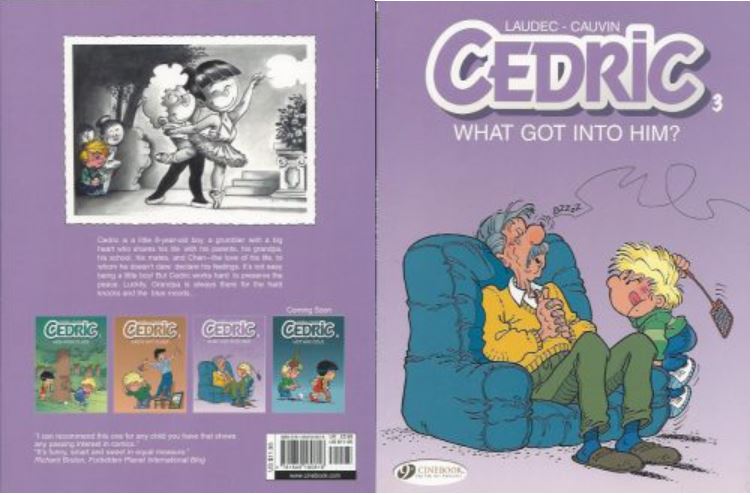
Cedric volume 3: What Got Into Him?


By Laudec & Cauvin with colours by Leonardo & translated by Erica Jeffrey (Cinebook)
ISBN: 978-1-84918-081-8 (Album PB/Digital edition)

Raoul Cauvin (26 September 1938-19 August 2021) was one of Europe’s most successful comics scripters. Born in Antoing, Belgium in 1938, by 1960 he was working in the animation department of publishing giant Dupuis after studying Lithography. Happily, he quickly discovered his true calling was writing funny stories and began a glittering, prolific career at Le Journal de Spirou.

With Salverius, he conceived the astounding successful Bluecoats, and dozens more award-winning series like Sammy, Cupidon, Les Femmes en Blanc, Pauvre, Lampil Boulouloum et Guiliguili, and Agent 212: cumulatively comprising well over 240 separate albums.

His collaborator on superbly witty kid-friendly family strip Cédric was Italian-born, Belgium-raised Tony de Luca, who studied electro-mechanics and toiled as an industrial draughtsman before making his own break into bandes dessinée.

Following fanzine efforts in the late 1970s as “Laudec”, he landed soap-style strip Les Contes de Cure-la-Flute at Le Journal de Spirou in 1979. He traded that for a brace of war-time serials (L’an 40 in 1983 and March Noir et Bottes à Clous in 1985) whilst working his way around the comic’s other strips. In 1987, he joined Cauvin on the first Cédric shorts. From then on it was child’s play…

We have Dennis the Menace (the Americans have their own too, but he’s not the same) whilst the French-speaking world has Cédric: an adorable, lovesick rapscallion with a heart of gold and an irresistible penchant for mischief. He’s also afflicted with raging amour…

Collected albums – 34 thus far – of variable-length strips (ranging from a ½ page to half a dozen) began appearing in 1989, and the lad remains amongst the most popular and best-selling in Europe, as is the animated TV show spun off from the strip.

… A little Word to the Wise: this is not a strip afraid to suspend silly yoks in deference to a little suspense or even near-heartbreak. The bonny boy is crushingly smitten with Chen: a Chinese girl newly arrived in class and so very far out of his league, leading to frequent and painful confrontations and miscommunications.

Harking back to 2011 and first continentally released in 1992 as Cédric 5: Quelle mouche le pique? – this third Cinebook translation opens with ‘A Pebble in the Shoe’: a moving and uplifting generational collaboration as Grandpa tells his daughter’s son stories of a dearly-departed wife that has the eavesdropping household (and you, too, if you have any shred of heart or soul) in emotional tatters…

We return to big laughs as a dose of unwelcome homework results in ‘A Big Fat Zero’ whilst ‘A Lousy Story’ details the pros and cons of a school nit epidemic before pester power is deployed to secure an addition to the household in ‘Man’s Best Friend’.

The crusty elder statesman of the family learns a painful lesson as ‘Grandpa Takes a Turn’ sees the creaky reactionary suckered into chaperoning a school dance, after which little Cedric has a beguiling and potentially life-altering experience when his adored Chen marches through town in the uniform of ‘The Majorettes’

Grandpa and Cedric unite to shame Dad into purchasing ‘The Board that Skates’ but it’s every man for himself when the kid comes cadging cash in ‘You Wouldn’t Have a 20?’, whilst ‘Out of Sight, Out of Mind’ playfully shows that although the boy’s love for Chen is all-abiding and true, it isn’t necessarily reciprocated…

When Chen’s mother accidentally prangs Dad’s car, Cedric goes violently berserk until the families have demonstrably agreed détente and rapprochement is reached via ‘An Amicable Arrangement’  before the pesky pup accidentally boosts his hard-pressed papa’s earning potential through inadvertent confidence trickery in ‘Business is Business’.

‘Jealousy’ rears its ugly head when Chen begins ballet classes and literally jumps into the arms of Cedric’s bitterly despised romantic rival The Right Honourable Alphonse Andre Jones-Tarrington-Dupree – with catastrophic repercussions for all concerned – whilst ‘Short of Breath’ sees the whole family play a mean but hilarious trick involving Dad’s birthday cake…

‘Solemn Communion’ wastes a much-needed opportunity to salve Cedric’s already-tarnished soul when the boy’s first Catholic sacrament ceremony devolves into a drunken debacle for the attending adults, after which we come full circle as amorous memories are tickled and ‘The Quarrel’ resumes after Cedric inquires how Mum and Dad got together. Happily, everything returns to bittersweet tears when the old man is asked for more reminiscences of Grandma Germaine in moving finale ‘Remember, Gramps…’

Rapid-paced, warmly witty, and not afraid to explore sentiment or loss, the exploits of this painfully keen, bemusingly besotted rascal are a charming example of how all little boys are just the same and infinitely unique. Cedric is a superb family strip perfect for youngsters and old folk alike…
© Dupuis 1992 by Cauvin & Laudec. All rights reserved. English translation © 2011 Cinebook Ltd.

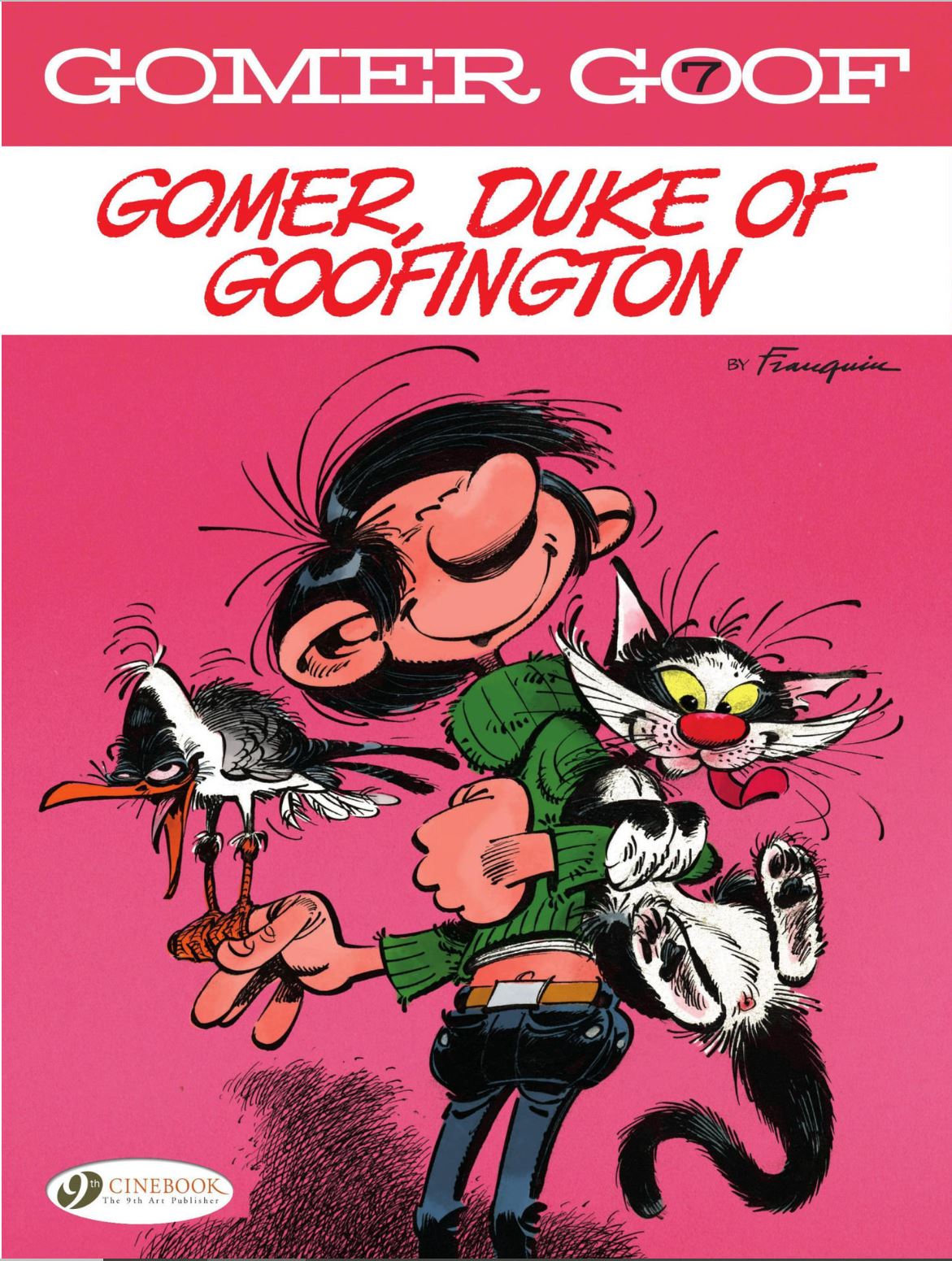
Gomer Goof volume 7: Gomer, Duke of Goofington


By Franquin, with Roba, Bibi and various: translated by Jerome Saincantin (Cinebook)
ISBN: 978-1-84918-590-5 (PB Album/Digital edition)

Like so much in Franco-Belgian comics, it all started with Le Journal de Spirou, which debuted on April 2nd 1938, with its iconic lead strip created by François Robert Velter AKA Rob-Vel. In 1943, publisher Dupuis purchased all rights to the comic and its titular star, and comic-strip prodigy Joseph Gillain (Jijé) took the helm for the redheaded kid’s further exploits as the magazine gradually became a cornerstone of European culture.

In 1946, Jijé’s assistant André Franquin was handed creative control. Graduating from gag vignettes to extended adventure serials, he introduced a broad and engaging supporting cast of regulars as well as phenomenally popular wonder beast The Marsupilami. Debuting in 1952 (in Spirou et les héritiers) that critter eventually became a spin-off star of screen, plush toys, console games and albums in his own right.

Franquin crafted increasingly fantastic and absorbing Spirou sagas until a final resignation in 1969. Over two decades he had enlarged the feature’s scope and horizons, until it became purely his own. In almost every episode, fans met startling and memorable new characters like comrade/rival Fantasio, crackpot inventor Count of Champignac and even supervillains. Spirou & Fantasio evolved into globetrotting journalists visiting exotic places, exposing crimes, exploring the incredible and clashing with bizarre and exotic arch-enemies.

Throughout it all, Fantasio remained a full-fledged – albeit fictional – Le Journal de Spirou reporter who had to pop into the office between cases. Sadly, lurking there was an accident-prone, big-headed junior in charge of minor jobs and dogs-bodying. He was Gaston Lagaffe – Franquin’s other immortal creation…

There’s a long tradition of comics personalising fictitiously mysterious creatives and the arcane processes they indulge in, whether it’s the Marvel Bullpen or DC Thomson’s lugubrious Editor and underlings at The Beano and Dandy – it’s a truly international practise.

Occasional asides on text pages featured well-meaning foul-up/office gofer “Gaston” (who debuted in #985, February 28th 1957). He grew to be one of the most popular and perennial components of the comic, whether as a guest in Spirou’s cases or his own strips and faux reports on editorial pages.

In terms of actual schtick and delivery, older readers will recognise favourite beats and timeless elements of well-intentioned self-delusion as seen in Benny Hill and Jacques Tati and recognise recurring situations from Some Mothers Do Have ’Em or Mr Bean. It’s slapstick, paralysing puns, infernal ingenuity and invention, pomposity lampooned and no good deed going noticed, rewarded or unpunished…

As previously stated, Gaston/Gomer draws a regular pay check (let’s not dignify or mis-categorise what he does as “work”) from Spirou’s editorial offices: reporting to journalist Fantasio, or complicating the lives of office manager Léon Prunelle and other, more diligent staffers, all whilst effectively ignoring those minor jobs he’s paid to handle. These include page paste-up, posting (initially fragile) packages and editing readers’ letters… and that’s the official reason why fans’ requests and suggestions are never answered…

Gomer is lazy, over-opinionated, ever-ravenous, impetuous, underfed, forgetful and eternally hungry, with his most manic moments all stemming from cutting work corners and stashing or consuming contraband nosh in the office. This leads to constant clashes with colleagues and draws in seemingly unaffiliated bystanders like traffic cop Longsnoot and fireman Captain Morwater, as well as simple passers-by who should know by now to keep away from this street.

Through it all our office oaf remains eternally affable, easy-going and incorrigible. Only three questions really matter here: why everyone keeps giving him one last chance, what can gentle, lovelorn, increasingly hot Miss Jeanne possible see in the self-opinionated idiot and will angry capitalist/ever-outraged financier De Mesmaeker ever get his perennial, pestiferous contracts signed?

In 1971, Gaston – Le cas lagaffe was the ninth European compilation and in 2020 became Cinebook’s seventh translated compilation: again focussing on non-stop all-Franquin comics gags in single- page bursts, but regrettably reducing the strip count from the original 54 to 44. Here our well-meaning, overconfident, overly-helpful know-it-all/office hindrance invents more stuff making life unnecessarily dangerous. These include a carrot-shotgun to refresh and fortify rabbits as they evade hunters, personal weather control, a too-fast collapsible bike and jet-powered mail delivery system, but he also accidentally ruins his image and work-avoiding record by providing a scratch solution to keep the studio active and productive during a major power cut…

Despite resolute green credentials and leanings, Gomer is colour-bind to the problems his antiquated automobile cause, even after his attempts to soup up the fuel injection result in the world’s most potent blue dye which constantly escapes from the battered exhaust pipe as an all-consuming cobalt cloud.

Many strips feature his doomed love affair with and manic efforts to modify and mollify the accursed motorised atrocity he calls his car. Sadly, the decrepit, dilapidated Fiat 509 is more in need of a merciful execution than his many well-meant engineering interventions for countering its lethal road pollution and failure to function. Now it also confirms his outlaw status with the gendarmerie – quite literally – with many moments of floating “blue flu”…

As he concentrates of making motoring faster and more fun if not actually safer, Gomer’s big heart swells to encompass more animal pals. He adopts a feral cat and black-headed gull to accompany illicit studio companions Cheese the mouse and goldfish Bubelle, but their hyperactive gluttonous presences generate much chaos, especially whenever benighted business bod De Mesmaeker turns up with more crucial contracts for poor Prunelle to sign. Their residence even triggers a shift in work attire, with safety superseding style as a prerequisite…

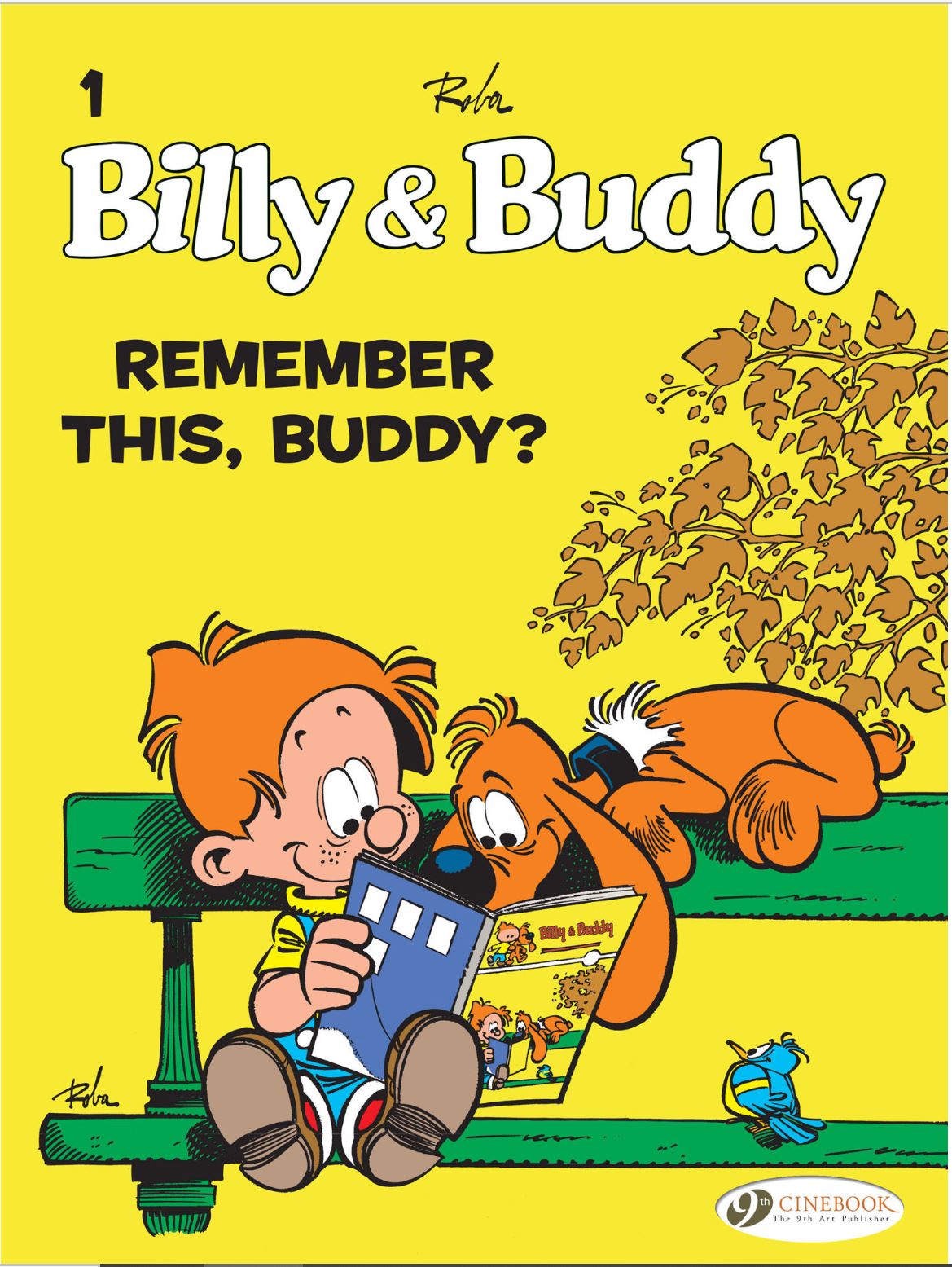
Fresh strands of anarchic potential are explored during the organisation of events for Spirou creators like Lambil (Bluecoats) and Roba (Billy & Buddy), with Gomer wearing mascot costumes and paying heavily for it. Then there’s the arrival of Mr. Bacus. He’s an auditor for Dupuis, resolved to find financial fault and cut calamitous costs, but he’s far too curious for an office where the gofer stashes weird science prototypes, arcane chemical concoctions and a manic menagerie able to shred chairs and open sardine tines with a bash of the beak. At least he learns why redecorating costs are so high and frequent…

Gomer’s chum and opposite number Jules-from-Smith’s-across-the-street is a like-minded soul and born accomplice, ever-eager to slope off for a chat and a confirmed devotee of Gomer’s methods of passing the time whilst at work. He is always ready to help, as here when assisting in transporting an out-of-control cactus from Aunt Hortense’s home to the office. It doesn’t fit there either, but at least has plenty of fresh victims to puncture and terrify…

In his spare time Gomer continues his dream of revolutionising kite-flying, but again has trouble with Christmas after the office plays host to the live turkey he rescued last year…

Far better enjoyed than précised or described, these strips allowed Franquin and occasional co-scenarists and idea providers like Roba, Bibi, Michel, Yvan Delporte & Jidéhem (AKA Jean De Mesmaeker: just one of many in-joke analogues who populate the strip) to flex their whimsical muscles and even subversively sneak in some satirical support for their beliefs in pacifism, environmentalism and animal rights. These gags are sublime examples of all-ages comedy: wholesome, barbed, daft and incrementally funnier with every re-reading.

Why haven’t you Goofed off yet?
© Dupuis, Dargaud-Lombard s.a. 2009 by Franquin. All rights reserved. English translation © 2020 Cinebook Ltd.

XIII volumes 3 & 4 – All the Tears of Hell and SPADS


By William Vance & Jean Van Hamme, coloured by Petra (Cinebook)
ISBN: 978-1-8491-8051-1 (Album PB/Digital Tears of Hell) 978-1-84918-058-0 (Album PB/Digital SPADS)

One of the most consistently entertaining and popular adventure serials in Europe, XIII was created by writer Jean Van Hamme (Wayne Shelton, Blake and Mortimer, Lady S.) and artist William Vance while working on numerous strips like Bruce J. Hawker, Marshal Blueberry, Ramiro, Bob Morane and more.

Born in Brussels in 1939 Van Hamme is one of the most prolific writers in comics. After academically pursuing business studies he moved into journalism and marketing before selling his first graphic tale in 1968.

Immediately clicking with the public, by 1976 he had also branched out into novels and screenwriting. His big break was the monumentally successful fantasy series Thorgal for Le Journal de Tintin magazine. He then cemented his reputation with mass-market bestsellers Largo Winch and XIII as well as more cerebral fare such as Chninkel and Les maîtres de l’orge. Van Hamme has been listed as the second-best selling comics author in France, ranked beside the seemingly unassailable Hergé and Uderzo.

Born in Anderlecht, William Vance was the comics nom de plume of William van Cutsem, (September 8th 1935 – May 14th 2018). After military service in 1955-1956 he studied art at the Académie Royale des Beaux-Arts and promptly became an illustrator of biographic features for Le Journal de Tintin in 1962. His art is a classical blend of meticulous realism, scrupulous detail and spectacular yet understated action. In 1964 he began maritime serial Howard Flynn (written by Yves Duval) before graduating to more popular genre work with western Ray Ringo and espionage thriller Bruno Brazil (scripted by Greg).

Further success followed when he replaced Gérald Forton on science fiction classic Bob Morane in Femmes d’Aujourd’hui, (and later Pilote and Le Journal de Tintin).

Constantly working on both serials and stand-alone stories, Vance’s most acclaimed work was his collaboration with fellow Belgian Van Hamme on a contemporary thriller based on Robert Ludlum’s novel The Bourne Identity

XIII debuted in 1984, originally running – to great acclaim – in prestigious comics anthology Le Journal de Spirou. A triad of albums were rushed out – simultaneously printed in French and Dutch editions – before the first year of serialisation ended.

The series was a monumental hit in Europe – although publishing house Dargaud were initially a little slow to catch on – but has fared less well in its many attempts to make the translation jump to English, with Catalan Communications, Alias Comics and even Marvel all failing to maximise the potential of the gritty mystery thriller. That all changed when Cinebook took over. To date the original series and most spin-offs have seen print…

The grand conspiracy saga of unrelenting mood, mystery and mayhem opened in The Day of the Black Sun when an old beachcomber found a body. The human flotsam had a gunshot head wound and was near death when Abe and his wife Sally found him. She discovered a key sewn into his clothes and the Roman numerals for thirteen tattooed on his neck. The remote hideaway offered little in the way of emergency services, but their alcoholic, struck-off surgeon friend managed to save the stranger…

As he recuperated, a complication became apparent. The patient – a splendid physical specimen clearly no stranger to action or violence – had suffered massive, irreversible brain trauma. Although increasingly sound in body he had completely lost his past. Language, muscle memories, even social and reflexive conditioning all remained, but every detail of his life-history was gone…

They named him Alan after their own dead son – but hints of the intruder’s lost past explosively intruded when hitmen attacked the beach house with guns blazing. Alan lethally retaliated with terrifying skill, but too late. In the aftermath he found a photo of himself and a young woman on the killers and traced it to nearby Eastown. Desperate for answers and certain more killers were coming, the human question mark headed off into unimaginable danger to hopefully find the answers he craved.

The picture led to a local newspaper and a crooked cop who recognised the amnesiac but said nothing. The woman in the photo was Kim Rowland, a local widow recently gone missing. Alan’s key opened the door of her house. The place had been ransacked but a thorough search utilising his mysterious talents turned up another key and a note warning someone named Jake that The Mongoose” had found her…

Alan was ambushed by the cop and newspaper editor Wayne. Calling him “Shelton”, they demanded the return of a large amount of missing money…

Alan/Jake/Shelton reasoned the new key fitted a safe-deposit box and bluffed the thugs into taking him to the biggest bank in town. Staff there called him Shelton, but when his captors examined the briefcase in Shelton’s box, a booby trap detonated. Instantly acting, the mystery man expertly escaped and eluded capture, holing up in a shabby hotel room, pondering again what kind of man he used to be…

Preparing to leave, he stumbled into a mob of armed killers and in a blur of lethal action escaped, running  into more heavies led by a Colonel Amos. This chilling executive referred to his captive as “Thirteen”, claiming to have dealt with his predecessors XI and XII in regard to the “Black Sun” case…

Amos very much wanted to know who Alan was, and offered shocking titbits in return. The most sensational was film of the recent assassination of American President, William B Sheridan, clearly showing XIII was the lone gunman…

Despite the amnesiac’s heartfelt conviction that he was no assassin, Amos accused him of working for a criminal mastermind, and wanted that big boss. The interrogator failed to take Alan’s instinctive abilities into account and was astounded when his prisoner leapt out of a fourth floor window…

The fugitive headed back to Abe’s beach, but more murderers awaited; led by a mild-seeming man Alan inexplicably knew was The Mongoose. The criminal overlord expressed surprise and admiration: he thought he’d killed Thirteen months ago…

Following an explosion of hyper-fast violence leaving the henchmen dead and Mongoose vanished but vengeful, Alan regretfully hopped a freight train west towards the next stage in his quest for truth.

His journey of discovery took him to the army base where Kim Rowland’s husband was stationed, where enquiries provoked an unexpected and violent response resulting in his interrogation by General Ben Carrington and his sexily capable aide Lieutenant Jones.

They’re from the Joint Chiefs of Staff, know an awful lot about black ops units and have proof their memory-challenged prisoner is in fact their agent: believed-deceased Captain Steve Rowland

After testing the amnesiac’s abilities Carrington drops him off in Rowland’s home town of Southberg to pursue his search for his missing wife, but the prodigal’s return to his rat’s nest of a family rekindles long-simmering passions and jealousies. The entire town seems to want Rowland’s blood and before long he’s the target of an assassination attempt and victim of a diabolical murder-plot. Despite Carrington and Jones’ last-minute intervention Alan/Steve is framed for murdering his father, and grabbed by a furious posse.

Gripping third instalment All the Tears of Hell (originally 1986 European album Toutes Les larmes de l’enfer) opens with Steve Rowland undergoing the worst kind of psychiatric care at the Plain Rock Penitentiary for the Criminally Insane. Despite drugs and shock treatments, his progress at the Maximum Security Facility is negligible. Young Dr. Ralph Berger seems amenable enough but elderly martinet Dr. Johansson’s claims of seeking a cure for his amnesia are clearly no more than a proselytising, judgemental sadist’s justifications for inflicting pain.

Meanwhile in Washington DC, Carrington and Jones have met with Colonel Amos who has a strange request and troubling new information. His investigations have revealed that the amnesiac in the desert hell of Plain Rock has undergone plastic surgery and his army records have been altered. Steve Rowland is definitely not Steve Rowland…

Moreover, Amos has information proving that the plotters who had the President killed are still active and their amnesiac assassin is the only link and hope of finding them. Acting on her own initiative, Jones decides it’s time she took a hands-on approach to the problem…

Meanwhile, anxious and isolated Not-Rowland has a visitor who galvanises him out of his electro-chemically induced fugue-state. The Mongoose gloatingly informs the prisoner that his days are numbered…

Deep within the corridors of power, Colonel Amos informs Carrington his investigations have resulted in a name. He has solved the mystery of XIII and the man they are actually dealing with is former soldier and intelligence operative Ross Tanner.

Probably.

Knowing time is limited, Rowland/Tanner opts for escape and decides to take along the kid who shares his cell. It’s as if he’s forgotten they’re in a maximum security facility for criminal maniacs, but he’s painfully reminded of the fact when sweet little Billy starts killing again as soon as they’re clear of the detention wing…

Recaptured and restricted to the medical section, XIII is helpless when the Mongoose’s inside man makes a move. Luckily, Jones has also inserted herself in a position where she can do the most good…

Spectacularly busting out of the prison, “Rowland” and the mystery-woman race into the desert, somehow avoiding a massive manhunt before vanishing without trace. Later Amos and Carrington confer over the disappearance, but one already knows exactly where the fugitive is. Now, with another new name, the warrior without a past and his new powerful allies lay plans to take the fight to their secret enemy…

To Be Continued…

XIII: SPADS
First released in Europe in 1987, SPADS is the fourth complex and convoluted chapter in the saga, opening with a more concise visual recap than I’ve just given, before kicking the plot into high gear as the race to replace murdered President Sheridan hots up. The contenders are Old Boy Network hack and former Vice President Joseph Galbrain battling Sheridan’s glamorous and idealistic younger brother Walter: latest scion of a venerable dynasty of leaders…

Amos’ diligent investigation is relentless. After exhuming many bodies, he can confidently claim to know who Tanner really is, but when the search leads him into a trap that kills his assistant and incapacitates him, he starts to wonder if he’s tracking a target or being led onto a bullseye…

Elsewhere, in a green hell of sweat and testosterone, Ross Tanner is making no friends as he trains to join elite combat unit SPADS (Special Assault and Destruction Squads). He doesn’t fit in and is always causing trouble. It’s as if he’s there under false pretences…

When Amos and Judge Allenby confront Carrington at the Pentagon with news that Tanner is also an alias for an as yet unknown operative, the reaction is explosive. Soon after, special aide Lieutenant Jones goes AWOL…

Back in the Bayou, the man everybody is hunting has made a fresh advance into uncovering his occluded past. Sergeant Betty served with the real Rowland and knows he didn’t die at the time and in the manner official reports describe. Before she shares the details, however, she has an itch that needs scratching…

That cosy conversation is curtailed by camp commander Colonel McCall, who tells the undercover operative that he’s being transferred out in the morning by direct order of General Carrington. With his chance to solve his personal mystery evaporating, XIII settles a few outstanding scores before sneaking into Betty’s quarters…

Amos and Allenby meanwhile have not been idle, and the former is certain he has at last gleaned the actual identity of multi-named XIII, but when they visit a certain grave they walk into another ambush and a well-placed mole is forced to break cover…

As Amos is plucked from the firefight by the last person he expected to see, a continent away Tanner’s liaison gets even more dangerous when another Mongoose mole interrupts, trying to kill them both. Happily, Carrington’s back-up agent is well placed to save them and they all flee together, unaware their escape vehicle has been boobytrapped and sabotaged…

Amos by now is securely ensconced in a palatial hideaway, being feted by a coterie of political heavyweights who finally reveal the truth about all the men Ross Tanner is and isn’t. They explain the incredible reason for the smoke-&-mirrors operation and earth-shattering stakes…

To Be Continued…

XIII is one most compelling, multi-layered mystery adventures ever conceived, with subsequent instalments constantly taking the restless human enigma two steps forward, one step back, stumbling through a world of pain and peril whilst cutting through an interminable web of past lives he seemingly led. Rocket-paced and immensely inventive, this is a series no devotee of action sagas and conspiracy thrillers will want to miss.
Original edition © Dargaud Benelux (Dargaud-Lombard SA), 1986, 1987 by Van Hamme, Vance & Petra. All rights reserved. This edition published 2010 by Cinebook Ltd.

Benny Breakiron volume 1: The Red Taxis


By Peyo, with backgrounds by Will: translated by Joe Johnson (Papercutz/NBM)
ISBN: 978-1-59707-409-4 (HB/Digital edition)

Pierre Culliford was born in Belgium in 1928 to a family of British origin living in the Schaerbeek district of Brussels. An admirer of the works of Hergé and American comics in Mickey, Robinson and Hurrah!, he developed his own artistic skills, but war and family bereavement forced him to forgo further education and find work.

After toiling as a cinema projectionist, in 1945 he joined C.B.A. animation studios, where he met André Franquin, Morris and Eddy Paape. When the studio closed, he briefly studied at the Brussels Academy of Fine Arts before moving full-time into graphic advertising. In his spare time he submitted comic strips to the burgeoning post-war comics publishers. The first sale was in April 1946: Pied-Tendre, a tale of American Indians which saw print in Riquet, the comics supplement to the daily L’Occident newspaper. Further sales to other venues followed and in 1952 his knight found a permanent spot in Le Journal de Spirou. Retitled Johan et Pirlouit, the strip prospered and in 1958 introduced a strange bunch of blue woodland gnomes called Les Schtroumpfs.

Culliford – now using the nom de plume Peyo – would gradually turn those adorable little mites (known to us and most of the world as the Smurfs) into an all-encompassing global empire, but before being sucked onto that relentless treadmill, he still found time to create a few other noteworthy strips such as the titanic tyke on view here today.

In 1960, Benoit Brisefer – AKA Benedict Ironbreaker (Steven Sterk in Dutch) – debuted in LJdS #1183 (December 1960). With some slyly added tips of the beret to Siegel & Shuster’s Superman (check out that cover, fanboys!), what gently unfolds are wry bucolic romps of an extraordinary little lad living a generally quiet life in an unassuming little French – or maybe Belgian? – town.

Quiet, well-mannered and a bit lonely, Benny is the mightiest boy on Earth: able to crush steel or stone in his tiny hands, leap huge distances and run faster than a racing car. He is also generally immune to all physical harm, but his only real weakness is that all his strength deserts him whenever he catches cold… which he does with frightening ease and great frequency…

Benny never tries concealing his powers but somehow the adults never catch on. They usually think he’s telling fibs or boasting, and whenever he tries to prove he can bend steel in his hands the unlucky lad gets another dose of the galloping sniffles!

Most kids avoid him. It’s hard to make friends or play games when a minor kick can pop a football like a soap bubble and a shrug can topple trees...

Well-past-it Brits of my age and vintage might remember the character from weekly comics in the 1960’s. As Tammy Tuff – The Strongest Boy on Earth – and later as both Benny Breakiron and Steven Strong – our beret-wearing wonder appeared in Giggle and other periodicals from 1967 onwards.

With Peyo’s little blue cash-cows taking up ever larger amounts of his concentration and time, other members of his studio assumed greater responsibilities for Benoit as years passed. Willy Maltaite (“Will”), Gos, Yvan Delporte, Françoise Walthéry and Albert Blesteau all pitched in, and Jean Roba created many eye-catching LJdS covers. However, by 1978 the demands of the Smurfs were all consuming and all the studio’s other strips were dropped.

You can’t keep a good super-junior down though and, after Peyo’s death in 1992, his son Thierry Culliford & cartoonist Pascal Garray revived the strip, adding six more volumes to the eight generated by Peyo and Co. between 1960 and 1978.

Thanks to US publisher Papercutz, some – but not yet all! – of the gloriously genteel, outrageously engaging power fantasies are available to English-language readers again, both as robust full-colour hardbacks and eBooks, and this initial exploit begins in sedate micro-metropolis Vivejoie-la-Grande, where the sweet kid goes about his solitary life, doing good deeds in secret and being as good a boy as he can.

However, his sense of fair play is outraged when aging taxi driver Monsieur Dussiflard becomes the target of a dirty tricks campaign by new company Red Taxis. When he and the incensed cabbie challenge the oily company CEO in his flashy high-rise office, Benny is shooed away and the elderly driver vanishes.

Suspicions aroused, Benny investigates and is attacked by thuggish Red Taxi employees. Only after thrashing and humiliating the goons does Benny realise that he still doesn’t know where Dussiflard is, so he retroactively throws the fight…

Just as he is imprisoned with his fellow abductee, the worst happens and the bombastic boy comes down with a stinker of a cold! Helpless as any other 8-year old, he’s stuffed in a crate with the codger cabbie and loaded onto a freighter headed to the Galapagos Islands…

With all opposition ended, the Boss and his Red Taxi stooges begin the final stage of a devilish plot, utterly oblivious to the dogged determination of Benny – who escapes the ship and an alluring tropical paradise, impatiently waits for his cold to clear up and none too soon sets off on a race against time, the elements and his own woefully-lacking knowledge of geography if he is to stop the ruthless criminals…

A superbly sweet and sassy spoof and fabulously winning fantasy of childhood validation and agency, The Red Taxis offers a distinctly Old World spin to the notion of superheroes and provides a wealth of action, thrills and chortles for lovers of astounding adventure and incredible comics excellence.
© Peyo, 2013 – licensed through Lafig Belgium. English translation © 2013 by Papercutz. All rights reserved.

Tex: The Lonesome Rider


By Claudio Nizzi & Joe Kubert. English adaptation by Pete Carlsson & Philip R. Simon (Dark Horse)
ISBN: 978-1-61655-620-4 (HB) eISBN: 978-1-63008-169-0

One of the most popular western strips ever created, Tex premiered in September 1948, brainchild of writer Gian Luigi Bonelli and artist Aurelio Galleppini. Very much an Italian synthesis of classic Hollywood western fare, the strip is both mythically traditional and unflinchingly dark in a way US material wasn’t until the advent of “spaghetti westerns” in the 1960s. Gosh, I wonder if there’s some kind of connection there?

Bonelli was a prolific writer of books, articles, screenplays and comics for over 50 years and Galleppini eventually dropped a prestigious career as a book illustrator to draw approximately 200 issues of Tex and 400 hundred covers.

Comics featuring Tex Willer and his legendary allies Kit Carson, Kit Willer and Tiger Jack have been exported far and wide for decades, scoring big not only across Europe, but also in Brazil, Finland, Turkey, India and elsewhere. Guest artists for specials have included Ivo Milazzo, Jordi Bernet and the masterful Joe Kubert.

Kubert was born in 1926 in rural Southeast Poland (which became Ukraine and – if tyranny wins – might well be Outer Russia by the time you read this). When he was two his parents emigrated to America where he grew up a proud Brooklyn kid. They also encouraged him to draw from an early age and the precocious prodigy began a glittering career at the start of the Golden Age, before he was even a teenager.

Working and learning at the Chesler comics packaging “Shop”, MLJ, Holyoke and assorted other outfits, he began his close association with National/DC in 1943. A canny survivor of the Great Depression, Joe also maintained outside contacts, dividing his time and energies between Fiction House, Avon, Harvey and All-American Comics, where he particularly distinguished himself on dazzling originals The Flash, Hawkman, Wildcat and Doctor Fate.

In the early Fifties he and school chum Norman Maurer were the creative force of publishers St. Johns: creating evergreen caveman Tor and launching the 3D comics craze with Three Dimension Comics.

Joe never stopped: freelancing for EC’s Two-Fisted Tales, Avon’s Strange Worlds, Lev Gleason Publications & Atlas Comics until 1955 when, with the industry imploding, he took a permanent position at DC, only slightly diluted whilst he illustrated the contentious and controversial newspaper strip Tales of the Green Berets (1965-1968). From then, he split his time drawing Sgt. Rock and other features, designing covers and editing DC’s line of war comics. He also drew plenty of westerns – such as DC’s incarnation of Firehair, Tomahawk and Son of Tomahawk. At the time most people retire, he opened and ran (employing a host of new funnybook superstars beside many of his fellow comics veterans) a comics school when not creating a host of superb, hard-hitting mature reader graphic novels such as Fax from Sarajevo, Jew Gangster and Yossel: April 1943. The Joe Kubert School of Cartoon and Graphic Art still trains and mentors the coming generation of arts industry giants…

Hugely popular and venerated in Europe, Kubert stretched his wings in 2000 by adding Tex to his list of achievements in a project written by Claudio Nizzi for Sergio Bonelli Editore’s premier imprint Tex Albo Speciale/Texone.

Nizzi began writing comics in 1963, and authored many popular series – like Larry Yuma, Captain Erik and Rosco & Sonny – before heading to Bonelli in 1983 to craft stories of Mr. No, Nick Raider and Tex.

As is the case with all such long-lived action icons, the working premise of this Western Wonder is devilishly uncomplicated. Outlaw Tex Willer clears his unjustly besmirched name and joins the Texas Rangers. He marries an Indian maiden and becomes honorary chief of the Navajo “Eagle of the Night” after she dies.

Over years, Tex travels far and wide dispensing justice and encounters every kind of peril you might have seen in western films. However, like any great comics character, he also has a few outlandish arch-enemies such as evil prestidigitator Mefisto, piratical foreign prince Black Tiger and malign master of disguise Proteus.

After being published to great success and acclaim in Italy in 2001 as The Four Killers, this particular tale was made available to English speakers in 2015; packing the entire pulse-pounding saga into one fearsome fable of electrifying energy and dogged determination.

Following an informative and appreciative Foreword by co-translator/letterer Pete Carlsson, the drama opens with the aging lawman approaching the remote farm of his old friends the Colters. He will not get there in time…

On finding the family’s slain and defiled bodies, doctored to appear victims of an “injun” outrage, Tex reads trail signs and deduces the killers are three white men and a renegade Indian, and resolves to arrest them. At this stage, he is ready to let the law judge them. However, after being ambushed and thrown him off a cliff, the miraculously still living manhunter is ready to do whatever is necessary…

When the killers split up, the patiently remorseless peacekeeper becomes repeatedly snared in webs of brutal violence the quartet spin around themselves. Many more will die before justice is finally served…

Raw, primal and visually grandiose, Tex: The Lonesome Rider is a stripped-down epic of the genre in the manner of Unforgiven and Once Upon a Time in the West: a graphic masterclass in civilisation triumphing over chaos and greed, played out in a pitiless arena shaped by Big Sky Country aesthetics and with iconic scenery honed by a matchless craftsman into a major player and contributor to the story.

This is The Western at its most potent, pure and powerful: perhaps the best and credible cowboy comic you’ll ever see…
© 2001, 2005, 2015 Sergio Bonelli Editore. Licensed through Panini SpA All rights reserved.

The Last Musketeer


By Jason, coloured by Hubert and translated by Kim Thompson (Fantagraphics Books)
ISBN: 978-1-56097-889-3 (TPB/Digital edition)

Jason is secretly John Arne Saeterrøy: born in Molde, Norway in 1965 and an overnight international cartoon superstar since 1995 when his first graphic novel Lomma full ay regn (Pocket Full of Rain) won that year’s Sproing Award (Norway’s biggest comics prize).

He won another Sproing in 2001 for the series Mjau Mjau and in 2002 turned almost exclusively to producing graphic novels. A global star among the cognoscenti, he has won many major awards.

Jason’s breadth of interest is wide and deep: comics, movies, music, high literature and pulp fiction all feature equally with no sense of hierarchy and his puckish mixing and matching of his inspirational sources always produces a picture-treatise well worth a reader’s time.

As always, this visual/verbal bon mot unfolds in his beguiling, sparse-dialogued, pantomimic progressions with enchantingly formal page layouts rendered in the familiar, minimalist evolution of Hergé’s Claire Ligne style: solid blacks, thick lines, settings of seductive simplicity augmented here by a beguiling palette of stark pastels and muted primary colours. This delicious caper is one of his best yarns ever and even spawned a prequel…

The Last Musketeer is an epic rife with his signature surrealism; populated with his quirkily quotidian cast of darkly comic anthropomorphic regulars, and downplaying his signature themes of relationships and loneliness to produce a wild action-adventure for a charmingly macabre cast of bestial movie archetypes and lost modern chumps to romp through.

With hues from much missed triple-threat Hubert, our brief full-colour thriller opens with a drunk in a Paris bar. He claims to be legendary musketeer Athos, still alive after four centuries. And he actually is.

The contemplative warrior dreams of past glories and inseparable old comrades but things aren’t the same anymore. However, as he muses on a bench, destructive balls of energy rain down on the city and Athos realises he is needed again and might just have one last adventure in him…

Despite failing to get the old gang back together, Athos persists in his quest and, after fighting a couple of green-skinned invaders, induces them to take him to their world. All too soon, he is making friends, battling the flamboyantly evil King of the Red Planet, helping a Princess of Mars foment an Earth-saving revolution and re-encountering an enemy from home he had long forgotten…

And we’re all still here so he must have triumphed in the end…

Outrageously merging the worlds of Alexander Dumas with Edgar Rice Burroughs, whilst gleefully borrowing Flash Gordon’s props and work ethic, The Last Musketeer is a superbly engaging pastiche that is pure nostalgia and pure Jason.

Jason is instantly addictive and a creator every serious fan of the art form should move to the top of the “Must-Have” list.
All characters, stories and artwork © 2007 Jason. All rights reserved.

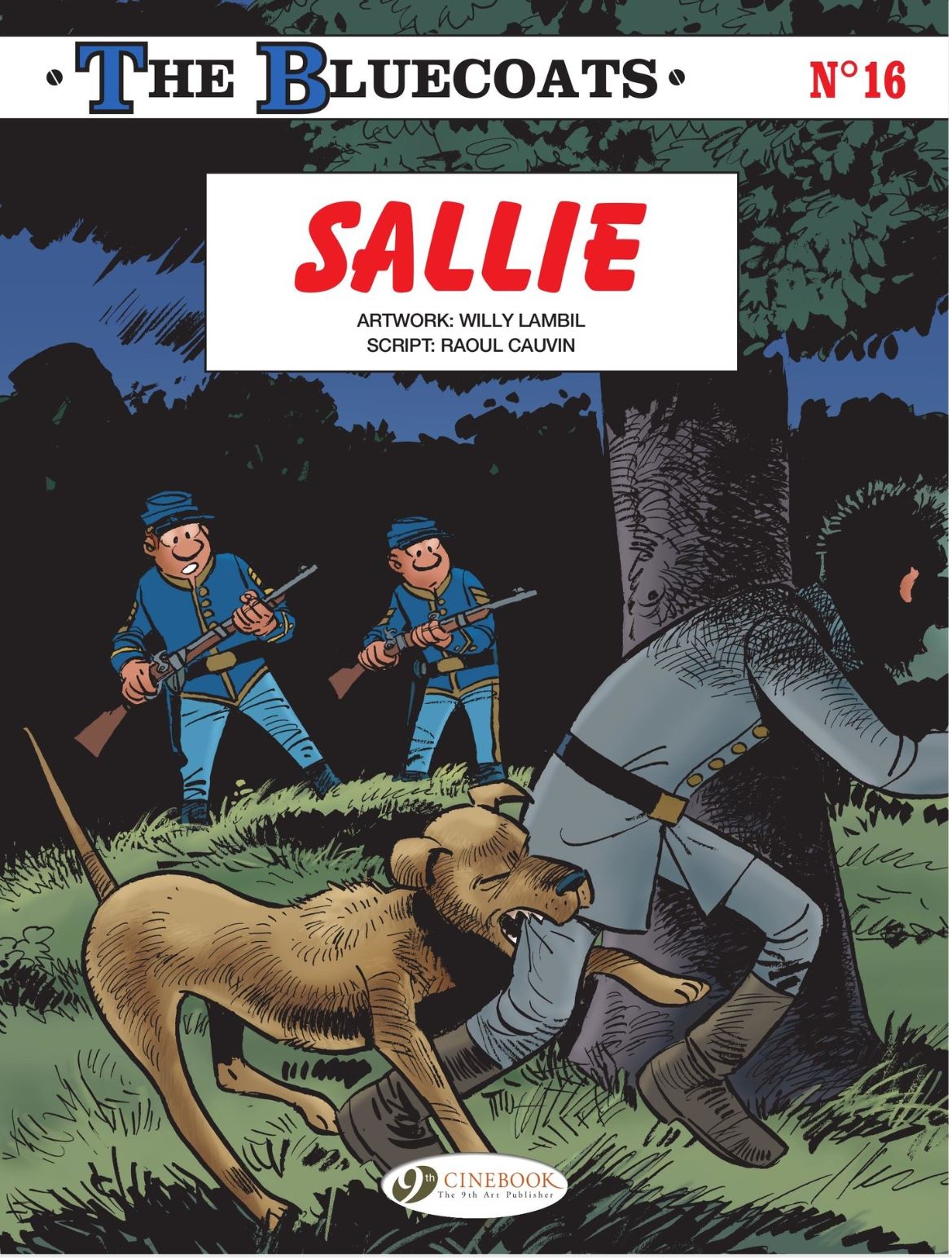
The Bluecoats volume 15: Bull Run


By Willy Lambil & Raoul Cauvin, translated by Jerome Saincantin (Cinebook)
ISBN: 978-1-80044-061-6 (Album PB/Digital edition)

Devised by Louis “Salvé” Salvérius & Raoul Cauvin – who scripted the first 64 volumes until retirement in 2020 – Les Tuniques Bleues (and/or Dutch-language iteration De Blauwbloezen) debuted at the end of the 1960s: created to supplant the irreplaceable Lucky Luke when that laconic maverick defected from weekly anthology Le Journal de Spirou to rival publication Pilote.

From its first sallies, the substitute strip swiftly became hugely popular: one of the most popular bande dessinée series in Europe. In case you were wondering, it is now scribed by Jose-Luis Munuera and the BeKa writing partnership and we’re up to 66 tomes…

Salvé was a cartoonist of the Gallic big-foot/big-nose humour school, and after his sudden death in 1972, successor Willy “Lambil” Lambillotte gradually adopted a more realistic – yet still overtly comedic – tone and manner. Lambil is Belgian, born in 1936 and, after studying Fine Art in college, joined publishing giant Dupuis in 1952 as a letterer.

Born in 1938, scripter Cauvin was also Belgian and – before entering Dupuis’ animation department in 1960 – studied Lithography. He soon discovered his true calling was comedy and began a glittering, prolific writing career at Le Journal de Spirou.

In addition, he scripted dozens of long-running, award winning series including Cédric, Les Femmes en Blanc and Agent 212: more than 240 separate albums. Les Tuniques Bleues sold alone has over 15 million copies… and counting. Cauvin died on August 19th 2021, but his vast legacy of barbed laughter remains.

Here, designated The Bluecoats, our long-suffering protagonists are Sergeant Cornelius Chesterfield and Corporal Blutch; worthy, honest fools in the manner of Laurel & Hardy: hapless, ill-starred US cavalrymen defending America during the War Between the States.

The original format offered single-page gags set around an Indian-plagued Wild West fort, but from second volume Du Nord au Sud, the sad-sack soldiers were situated back East, perpetually fighting in the American Civil War.

All subsequent adventures – despite often ranging far beyond the traditional environs of the sundered USA and taking in a lot of genuine and thoroughly researched history – are set within the timeframe of the Secession conflict.

Blutch is your run-of-the-mill, whinging little-man-in-the street: work-shy, mouthy, devious and ferociously critical of the army and its inept orchestrators and commanders. Ducking, diving, deserting whenever he can, he’s you or me – except at his core he’s smart, principled and even heroic… if no easier option is available.

Chesterfield is big and burly, a professional fighting man and proud career soldier of the 22nd Cavalry who passionately believes in patriotism and the esprit-de-corps of the Military. He is brave, never shirking his duty and hungry to be a medal-wearing hero. He also loves his cynical little troll of a pal. They quarrel like a married couple, fight like brothers but simply cannot agree on the point and purpose of the horrendous war they are trapped in: a situation that once more stretches their friendship to breaking point in this cunningly conceived instalment.

Coloured by Vittorio Leonardo, Les Tuniques Bleues – Bull Run was originally serialised in Le Journal de Spirou (#2558-2562) during 1987 and collected into another mega-selling album before the year was out. The 27th continental album, it was Cinebook’s 15th translated Bluecoats album.

Bull Run offers the creators’ trenchant and bitterly hilarious account of the infamous and calamitous first full clash between North and South, which took place on July 21st 1861, in Prince William County, Virginia. That was only 30 miles from national capital Washington DC, near the city of Manassas, from which the Confederates derived their own name for the debacle – the Battle of First Manassas.

A story within a story, it’s the account of what just happened as told by one who survived the debacle sharing confidences with a new recruit who can’t understand why nobody will speak of it…

Safely hidden away Blutch starts talking, telling how before any fighting began, President Lincoln’s generals gave the leader bad advice and pompous assurances, and a publicity campaign to recruit volunteers was badly administered. Moreover, the crisis fostered a festival atmosphere and civilians flocked to the proposed battleground to see the spectacle…

It was certainly impressive. The Union forces included not just American infantry, cavalry and artillery, but also many foreign contingents and brigades: Crimean Zouaves, Italian Garibaldians, Bavarians, Croats, Cossacks, Chinese and more. What a pity nobody drilled them in taking orders in English…

Still angry from being tricked into joining up, Blutch was already wary and could not bear to see the eagerness on the face of his glory-struck comrade Chesterfield. That’s why – when the call came from on high – he broke the habit of a lifetime and volunteered to join the proud few called on to serve drinks and refreshments to the spectators and upper ranks…

Already class divisions had appeared: the cavalry were expressly ordered not to speak to foot soldiers. That would prove catastrophically crucial as the battle unfolded and messages could not be passed…

Most telling of all, the Confederate forces were well-trained, well-disciplined and did not overconfidently consider the battle a foregone conclusion…

With carnage and confusion everywhere, Blutch’s deepest convictions are completely confirmed, and the jolly adventure becomes a complete rout, made all the worse for death-or-glory Chesterfield, who is ignominiously saved from capture or worse by his sneaky pal’s ungentlemanly behaviour and dirty tricks. That’s why the sergeant never talks about Bull Run…

Painfully cleaving to the bald facts of history, this episode is far darker than most, with the underlying horror leavened by a narrative distancing that allows ridiculously surreal black comedy and bitter satire to blossom constantly.

Combining pointedly seditious polemic with stunning slapstick, Bull Run mordantly manipulates the traditions of war stories to hammer home the point about the sheer stupidity of war and crushing cruelty of arrogant elitism. These yarns weaponise humour, making occasional moments of shocking verity doubly powerful and hard-hitting. Funny, thrilling, beautifully realised and eminently readable, Bluecoats is the best kind of war-story and Western: appealing to the best, not worst, of the human spirit.
© Dupuis 1987 by Lambil & Cauvin. All rights reserved. English translation © 2021 Cinebook Ltd.

The Left Bank Gang


By Jason, coloured by Hubert, translated by Kim Thompson (Fantagraphics Books)
ISBN: 978-1-56097-742-1 (TPB/Digital edition)

Jason is secretly John Arne Saeterrøy: born in Molde, Norway in 1965 and an overnight international cartoon superstar since 1995 when his first graphic novel Lomma full ay regn (Pocket Full of Rain) won that year’s Sproing Award (Norway’s biggest comics prize).

He won another Sproing in 2001 for the series Mjau Mjau and in 2002 turned almost exclusively to producing graphic novels. Now a global star among the cognoscenti he has won seven major awards from such disparate regions as France, Slovakia and the USA.

Now his latest novella is released, rife with his signature surreality: populated with cinematic, darkly comic anthropomorphs and featuring more bewitching ruminations on his favourite themes of relationships and loneliness, viewed as ever through a charmingly macabre cast of bestial movie archetypes and lost modern chumps.

In this full-colour tract – originally released in France as Hemingway – Jason sets his quirkily-informed imagination into literary overdrive: postulating what might have been at a moment of intense intellectual cross-pollination.

It’s Paris in the 1920s: émigrés F. Scott Fitzgerald, Ezra Pound, James Joyce and Ernest Hemingway are all struggling to make their marks on the world – and most especially on the other artistic Men and Women of Destiny congregated in the enclave of creative excellence that has grown up around the Latin Quarter. Wannabe cartoonists, their own meagre efforts seem paltry and trivial in comparison to the masterful comic books produced by Faulkner or Dostoyevsky, whilst true artists such as Jean-Paul Sartre and Man Ray all seem to have no trouble with their medium or message…

Worst of all, Scott thinks something is bothering Zelda: she might even be cheating on him…

The disaffected Young Turks are uniformly plagued by nightmares of the past and frustrated dreams of mediocre futures with everyday life relentlessly coming at them demanding vile money just to stay alive and keep on fruitlessly toiling.

… And then Hemingway says it: why not just rob a bank?

Blending literary pretention and modern creative mythology with the iconography and ironic bombast of Reservoir Dogs is a stroke of genius no one else could pull off. As always, this visual/verbal bon mot unfolds via Jason’s beguiling, sparse-dialogued, pantomimic progressions with enchantingly formal page layouts rendered in the familiar, minimalist evolution of Hergé’s Claire Ligne style; solid blacks, thick lines and settings of seductive simplicity augmented here by a stunning palette of stark pastels and muted primary colours.

Jason’s work always jumps directly into the reader’s brain and heart, always probing the nature of “human-ness” by using the beastly and unnatural to ask persistent and pertinent questions. Although the clever sight-gags are less prominent here his repertory company of “funny-animal” characters still uncannily depict the subtlest emotions with devastating effect, proving again just how good a cartoonist he is.

This wry mis-history lesson is strongly suggested for adults but makes us all to look at the world through wide-open childish eyes. Jason is instantly addictive and a creator every serious fan of the art form should move to the top of the Must-Have list.
All characters, stories and artwork © 2007 Editions de Tournon-Carabas/Jason. All rights reserved.

Moomin volume 7 – The Complete Lars Jansson Comic Strip


By Lars Jansson (Drawn & Quarterly)
ISBN: 978-1-77046-062-1 (HB) eISBN: 978-1-77046-554-1

Tove Jansson was one of the greatest literary innovators and narrative pioneers of the 20th century: equally adept at shaping words and images to create worlds of wonder. She was especially expressive with basic components like pen and ink, manipulating slim economical lines and patterns to realise sublime realms of fascination, whilst her dexterity made simple forms into incredibly expressive and potent symbols and, as this collection shows, so was her brother…

Tove Marika Jansson was born into an artistic, intellectual, basically bohemian Swedish family in Helsinki, Finland on August 9th 1914. Father Viktor was a sculptor and mother Signe Hammarsten-Jansson a successful illustrator, graphic designer and commercial artist. Tove’s brothers Lars – AKA “Lasse” – and Per Olov became respectively an author/cartoonist and art photographer. The family and its close intellectual, eccentric circle of friends seems to have been cast rather than born, with a witty play or challenging sitcom as the piece they were all destined to inhabit.

After extensive and intensive study (from 1930-1938 at the University College of Arts, Crafts and Design, Stockholm, the Graphic School of the Finnish Academy of Fine Arts and L’Ecole d’Adrien Holy and L’Ecole des Beaux-Arts, Paris), Tove became a successful exhibiting artist through the troubled period of the Second World War.

Brilliantly creative across many fields, she published the first fantastic Moomins adventure in 1945. Småtrollen och den stora översvämningen (The Little Trolls and the Great Flood or latterly and more euphoniously The Moomins and the Great Flood) was a whimsical epic of gentle, inclusive, accepting, understanding, bohemian misfit trolls and their strange friends…

A youthful over-achiever, from 1930 to 1953 Tove worked as an illustrator and cartoonist for Swedish satirical magazine Garm: achieving some measure of notoriety with an infamous political sketch lampooning the Appeasement policies of European leaders by depicting Hitler in nappies. She was also highly in-demand for many magazines and children’s books, and had started selling comic strips as early as 1929.

Moomintroll was her signature character. Literally.

The lumpy, big-eyed, gently adventurous romantic goof began life as a spindly sigil next to her name in her political works. She called him “Snork” and claimed she had designed him in a fit of pique as a child – the ugliest thing a precocious little girl could imagine – as a response to losing an argument with her brother about Immanuel Kant.

The term “Moomin” came from her maternal uncle Einar Hammarsten who attempted to stop her pilfering food when she visited, warning her that a Moomintroll guarded the kitchen, creeping up on trespassers and breathing cold air down their necks. Snork/Moomin filled out, became timidly nicer – if a little clingy and insecure – acting as a placid therapy-tool to counteract the grimness of the post-war world.

Initially The Moomins and the Great Flood made little impact, but Jansson persisted – as much for her own edification as any other reason – and in 1946 Kometjakten (Comet in Moominland) was published. Many commentators regard the terrifying tale a skilfully compelling allegory of Nuclear Armageddon. You should read it now… while you still can…

When it and third illustrated novel Trollkarlens hatt (1948, Finn Family Moomintroll or occasionally The Happy Moomins) were translated into English in 1952, their instant success prompted British publishing giant Associated Press to commission a newspaper strip about her seductively sweet and sensibly surreal creations.

Jansson had no misgivings or prejudices regarding strip cartoons and had already adapted Comet in Moominland for Swedish/Finnish paper Ny Tid. Mumintrollet och jordens undergäng Moomintrolls and the End of the World – was a popular feature, so she readily accepted the chance to extend her eclectic family across the world. In 1953, The London Evening News began the first of 21 Moomin strip serials to captivate readers of all ages.

Jansson’s involvement in the cartoon feature ended in 1959, a casualty of its own success and a punishing publication schedule. So great was the strain that towards the end she recruited brother Lars to help. He then took over, continuing the strip until 1975. His tenure as sole creator continues here…

Liberated from the strip’s pressures, Tove returned to painting, writing and other creative pursuits: making plays, murals, public art, stage designs, costumes for dramas and ballets, a Moomin opera and 9 more Moomin-related picture-books and novels, as well as 13 books and short-story collections strictly for grown-ups.

Tove Jansson died on June 27th 2001. Her awards are too numerous to mention, but just consider: how many modern artists get their faces on the national currency?

Lars Fredrik Jansson (October 8th 1926 – July 31st 2000) was just as amazing as his sister. Born into that astounding clan twelve years after Tove, at 16 he started writing – and selling – novels (nine in total). He also taught himself English because there weren’t enough Swedish-language translations of books available for his voracious reading appetite.

In 1956, he began co-scripting the Moomin newspaper strip at his sister’s request: injecting his own brand of witty whimsicality to ‘Moomin Goes Wild West’. He had been Tove’s translator from the start, seamlessly converting her Swedish text into English. When her contract with The London Evening News expired in 1959, Lars Jansson officially took over the feature, having spent the interim period learning to draw and perfectly mimic his sister’s cartooning style. He had done so in secret, with the assistance and tutelage of their mother Signe. From 1961 to the strip’s end in 1974, he was sole steersman of the newspaper iteration of trollish tails.

Lasse was a man of many parts: other careers including writer, translator, aerial photographer and professional gold miner. He was the basis and model for the cast’s cool kid Snufkin

Lars’ Moomins was subtly sharper than his sister’s version and he was far more in tune with the quirky British sense of humour, but his whimsy and wry sense of wonder was every bit as compelling. In 1990, long after the original series, he began a new career, working with Dennis Livson (designer of Finland’s acclaimed theme park Moomin World) as producers of Japanese anime series The Moomins and – in 1993 with daughter Sophia – on new Moomin strips…

Moomintrolls are easy-going free spirits: natural bohemians untroubled by hidebound domestic mores and most societal pressures. Moominmama is warm, kindly tolerant and capable but perhaps overly concerned with propriety and appearances, whilst devoted spouse Moominpappa spends most of his time trying to rekindle his adventurous youth or dreaming of fantastic exploits.

Their son Moomin is a meek, dreamy boy with confusing ambitions. He adores their permanent houseguest the Snorkmaiden – although that impressionable, flighty gamin much prefers to play things slowly whilst hoping for somebody potentially better to come along…

The seventh oversized (310 x 221 mm) monochrome hardback compilation gathers serial strip sagas #26-29, and opens with Lars firmly in charge and puckishly re-exploring human frailties and foibles via a sophisticate poke at the shifting political climate…

Craftily casting cats among pigeons, 26th escapade ‘Moomin the Colonist’ finds armchair adventurer Moominpappa resenting the advent of the annual hibernation and rashly listening to his bookish boy, who has been reading about colonisation…

Soon he has packed up the family and a few close friends and set out to conquer fresh fields and pastures new. With Mymble and Little My, Mrs Fillyjonk, her daughters and a cow in tow, the eager expansionists head off across the frozen land and don’t stop until they reach a tropical desert island where they start setting up a new civilisation combining the best of the old world with lots of fresh ideas on how society should be run…

Sadly, their neighbours from back home have sneakily copied the Moomin movement and before long the new continent is embroiled in a passive-aggressive, slyly competitive struggle for control, with scurrilous reprobate Stinky and his pals playing the bad guys behind the Palm Tree Curtain…

Following the mutual collapse of colonialism, outrageous satire gives way to wicked sarcasm as ‘Moomin and the Scouts’ recounts how energetic Mr Brisk’s passion for the outdoor life, badges and bossing children envelopes the instinctively sedentary Moomins and unleashes all kinds of disruptive chaos. With scouts running wild amongst the trees it just seems easier to join them rather than seek to beat them and let nature disrupt the movement from within…especially after Moomin starts hanging around with Miss Brisk’s Girl Guides and the generally dismissive Snorkmaiden feels oddly conflicted…

The perils of property and stain of status upsets the orderly life of the clan when Moominpappa unexpectedly comes into a major inheritance in ‘Moomin and the Farm’. Grievously afflicted by a terrible case of noblesse oblige, the family uproot themselves and retire to stately Gobble Manor to perpetuate the line of landed gentry on a modern working arable and pastoral estate.

Adapting to wealth and property is one thing and even accommodating the legion of ancestral ghosts is but another strand of Duty, but the effort of taking on and even perpetuating centuries of unearned privilege proves far too weighty a burden for all concerned… before the increasingly untenable situation typically corrects itself…

Back in their beloved house and rearranging furniture, a dropped chest disgorges an ancient map and triggers another wild dreamers’ quest in ‘Moomin and the Gold-fields’…

Unable to refuse adventure when it’s dangled in front of their exuberant noses, father and son are soon trekking the wilds and digging random holes thanks to the supremely unclear chart, and before long the entire valley is afflicted with gold rush fever.

With law, common decency and even good manners abandoned to greed as the sedate dell becomes a boisterous and sordid boom town, all Moominmama can do is maintain her dignity and wait for the madness to pass…

This deceptively barbed and edgy compilation closes with ‘Lars Jansson: Roll Up Your Sleeves and Get to Work’ by family biographer Juhani Tolvanen, extolling his many worthy attributes and more besides…

These are truly magical tales for the young, laced with the devastating observation and razor-sharp mature wit which enhances and elevates only the greatest kids’ stories into classics of literature. These volumes – both Tove and Lars’ – comprise an international treasure trove no fan of the medium – or carbon-based lifeform with even a hint of heart and soul – can afford to be without.
© 2012 Solo/Bulls except “Lars Jansson: Roll Up Your Sleeves and Get to Work” © 2011, 2012 Juhani Tolvanen. All rights reserved.

Hãsib & the Queen of Serpents – A Thousand and One Nights Tale


By David B (NBM)
ISBN: 978-1-68112-162-8 (HB/Digital edition)

David B. is a founder member of the groundbreaking strip artists conclave L’Association and has won numerous awards including the Alph’Art for comics excellence and European Cartoonist of the Year.

Born Pierre- Françoise “David” Beauchard on February 9th 1959, he began his comics career in 1985 after studying advertising at Paris’ Duperré School of Applied Arts. His seamless blending of Primitivism, visual metaphor, high and low cultural icons – as seen in such landmarks as Babel, Epileptic and Best of Enemies: A History of US and Middle East Relations utterly reinvigorated and rejuvenated the visual aspect of European sequential art.

This offering from NBM – available as an oversized (312 x 235 mm) full-colour hardback and digitally – takes us into primal storytelling country to examine the very nature of the process by referencing one of the most potent and primal story sources in human history.

One Thousand and One Nights (or more commonly The Arabian Nights) is an anonymous aggregation of folk stories from many cultures of the Middle Eastern Fertile Crescent. Its root material traces back to Arabic, Greek, Jewish, Persian, Turkish, South Asian, and West, Central and North African folklore. It was/they were first translated into English in 1706 as The Arabian Nights’ Entertainment, and has fired western and European imaginations ever since. The one constant throughout every iteration is the framing sequence wherein wily bride and imminent murder victim Scheherazade tells her new husband and supreme ruler Shahryar a story to postpone her own execution.

In this stunning graphic tour de force, rendered in vivid colours and sublimely reminiscent of oriental shadow-theatre puppet shows, that tenuous relationship sets the scene. If you’re old enough to remember – or wise enough to have discovered since – Oliver Postgate & Peter Firmin’s Noggin the Nog, think of that in full HD (with the imagination turned up to 11!).

Here and now – on the 422nd night – the captivating captive Scheherazade begins the tale of a sage named Daniel: a man who had not yet sired a son…

He roamed the world and lost almost everything before his wife finally fell pregnant. Due to the will of God, Daniel died before the birth but not before delivering a potent prophecy. His boy would be called Hasib Karim al-Din. Educated and adventurous, he would eventually inherit all that Daniel cherished: long pent away in a mysterious chest…

Hasib grew up to be an apprentice but – lazy and lacking ambition – fell in with a band of unscrupulous woodcutters. One day, after finding a golden hoard of honey in a deep cavern, the lumberjacks abandoned their comrade, leaving him to the tender mercies of a scorpion who lured him into the clutches of the fabulous and terrifying Serpent Queen.

Deep under the earth, Hasib feared for his life and soul but, in exchange for his own sorry life-story, the Queen began telling him a tale of a king of far-off Banu Isra’il

That saga leads into another and another and yet another (teeming with battles and journeys and princes and wanderers and monsters and wonderful creatures) and we are carried along on a sea of fable and incidence: an interwoven series of nested stories each concealing the next, like layers on an onion and every one peeled back to expose a new hero or fool.

This seemingly endless progression has a point and purpose, however, and just when the whimsical tension can be stretched no tighter, the tale-telling tide turns and each episode miraculously resolves! Thus we move small steps closer to Hasib and his long-deferred inheritance…

Or so says Scheherazade as she weaves her own spellbinding yarn…

Bold, vivid and graphically mesmerising, this enthralling progression of history, myth and imagination is a wry and loving examination of the act of telling stories.
© 2015-2016 Gallimard Jeunesse. © 2018 NBM for the English translation.