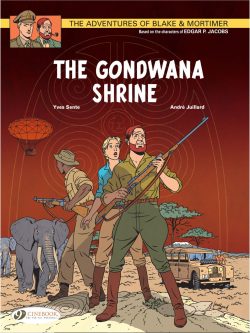
The Adventures of Blake and Mortimer volume 11: The Gondwana Shrine


By Yves Sente & André Juillard, coloured by Madeleine DeMille & translated by Jerome Saincantin (Cinebook)
ISBN: 978-1-84918-094-8 (Album PB/Digital edition)

Win’s Christmas Gift Recommendation: Blockbuster Thrills No Movie Can Match… 9/10

Edgar P. Jacobs devised one of the greatest heroic double acts in pulp fiction: pitting his distinguished scientific adventurers Professor Philip Mortimer and Captain Francis Blake against a daunting variety of perils and menaces in a sequence of stellar action-thrillers blending science fiction scope, detective mystery suspense and supernatural thrills. The magic was made perfect through his stunning illustrations, rendered in the timeless, infinitely accessible Ligne Claire style which had made intrepid boy-reporter Tintin a global sensation.

The Doughty Duo debuted on 26th September 1946: gracing the pages of the very first issue of Le Journal de Tintin: an ambitious international anthology comic with editions in Belgium, France and Holland. It was edited by Hergé, with his eponymous, world-famous star ably supplemented by new heroes and features for the rapidly-changing post-war world.

Blake and Mortimer are the graphic personification of Britain’s sadly lost and blighted Bulldog Spirit: and worthy spiritual successors to Sherlock Holmes, Allan Quatermain, Professor Challenger, Richard Hannay and all the other intrinsically decent stalwarts of lost Albion and valiant champions with direct connections to and allegiance beyond shallow national boundaries…

Following decades of fantastic exploits, the series apparently ended with the 11th album. The gripping contemporary adventure had been serialised between September 1971 and May 1972 in LJdT, but after Les trois Formules du professeur Sato: Mortimer à Tokyo was completed, Jacobs abandoned his story due to failing health and personal issues.

Edgard Félix Pierre Jacobs died on February 20th 1987, having never returned to the extended adventure. Concluding volume Les trois Formules du professeur Sato: Mortimer contre Mortimer was only released in March 1990, after the Jacobs family and estate commissioned veteran cartoonist Bob de Moor to complete the tale from the originator’s pencils and notes.

The long-postponed release led to re-release of the earlier volumes, and was followed in 1996 by new adventures from two separate creative teams hired by the Jacobs Studio who would henceforth produce complete books rather than weekly serials.

The first was L’affaire Francis Blake by Jean Van Hamme & Thierry “Ted” Benoit which settled itself into a comfortably defined, familiar 1950s scenario for a rousing tale of espionage and double-dealing. Controversially, it omitted the elements of futuristic fiction and fringe science which had characterised Jacobs’ tales and focused on the suave MI5 officer rather than bombastic, belligerent boffin and inveterate scene-stealer Mortimer…

The same was broadly true for the follow-up release, published in 1999, although references to the space race and alien infestation did much to restore those fantasy credentials in Yves (XIII, Le Janitor, Thorgal) Sente & André (Bohémond de Saint-Gilles, Masquerouge, Arno, Mezek) Juillard’s La machination Voronov.

The latter team eventually won the plum job of detailing the early days and origins of the lads in Les Sarcophages du 6e Continent, Tome 1: La Menace universelle and Les Sarcophages du 6e Continent, Tome 2: Le Duel des Esprits. The albums were the 16th and 17th published exploits of the peerless pair: a boldly byzantine epic spanning decades and stretching from India under the Raj to Cold War Europe and deep beneath Antarctic ice…

The tale revealed how Blake and Mortimer first met in India before WWII: introducing Philip Angus Mortimer, his tragic first love and diabolical maniac scientist Emperor Ashoka before jumping to 1958 when the resurrected villain’s incredible technology and Soviet subversion threatened the entire world…

Battling the menace, Mortimer clashed again with despised arch nemesis Olrik who had become a crucial but unwilling tool in Ashoka’s scheme. Olrik’s previous susceptibility to the telecephalscope of Professor Septimus (see The Yellow M) made him an ideal candidate for Ashoka’s ultimate weapon: a system capable of turning cerebral energy into planet-spanning power affecting electrical devices, heavy machinery and solid objects with tremendous force.

In the final accounting, as a secret Antarctic base collapsed around them, the bitter foes abandoned their bodies to fight as pure unleashed mental entities in the planet’s ether, before being restored to their mortal frames as everything fell apart and Gondwana Base vanished in a welter of fire and ice.

Mortimer was evacuated with moments to spare, leaving the enemy to his well-deserved fate…

Released in 2008 but chronologically occurring some months after Mortimer was rescued from the ice and Ashoka’s mind machines, Le sanctuaire du Gondwana opens in drought-parched Africa as German scholar Professor Ulrich Heidegang explores the Ngorongoro crater and discovers something truly beyond comprehension. He barely escapes with his life but his sanity is shattered. Nevertheless, he presents to the global media an artefact that will forever change the history of humanity…

Months later in London, Professor Mortimer is still being treated by Dr. Mark Levy for the aftereffects of his out-of-body experience. Suffering headaches, vision problems, mood swings, and still partially amnesiac, he’s slowly rebuilding his life and relationships with the aid of captain Francis Percy Blake – who has returned to his job with MI5 – and other close friends.

Especially helpful in recovering his old life is Mortimer’s assistant Nastasia Wardinska and landlady/housekeeper Mrs Benson but the doctor still won’t allow him to return to work…

Nastasia is particularly keen to resume research. When the Antarctic citadel was destroyed, volcanic action unearthed manufactured artefacts that have since been determined as being over 350 million years old and constructed of a currently-impossible amalgam of diamond-sheathed gold!

After consulting with Blake and the copious notes for his long-delayed and postponed memoires, Mortimer opts to use his enforced leisure time to solve the mystery. Blake and old colleague Labrousse are already investigating the Antarctic site, so the Professor plans an oblique approach…

Using current geological theory and recent reports collated by archivist Mr Stone of the Daily Mail as the basis of his research, the Prof will explore another region of the world that was connected to Antarctica 350 million years ago. Rather callously rekindling an old romance with celebrated ethnologist and archaeologist Sarah Summertown, he then leads a small team to the Olduvai Gorge in Africa, which Stone’s incredible memory has pinpointed as the source of an amazing scoop: an ancient artefact with markings of diamond and gold…

None of the enthralled explorers are aware that all their efforts are being closely monitored and steered by a mysterious stranger…

Soon all the preliminaries are done and Mortimer’s team are interviewing Heidegang in his hospital room in Nairobi. The explorer has been driven mad by his experiences: hearing voices and talking of Lycaon beast-men and pre-human civilisations on a single supercontinent. He does, however, reveal the location of his find…

Whilst the searchers set out for the Ngorongoro crater, the story shifts to the mysterious stalker, who is revealed as the presumed-dead Olrik. Stalking the party, he organises a deadly squad of ne’er-do-wells, surveilling their spectacularly eventful safari as it endures incredible hardships and tragedy and striking just as they make contact with the hidden remnants of an immortal super-race who claim to be the Guardians of Gondwana…

The story then shifts into turbulent top gear as many disparate plot-strands stunningly converge and a single shocking revelation discloses the true history and ownership of Earth whilst exposing one of the heroes as anything but…

It all leads to a ruthless resumption of the duel between Olrik and Mortimer and the staggering intervention of Earth’s unseen overlords, who remove the annoyances and leave them to sort out their immediate issues elsewhere…

Binding many vivid facets of the heroes’ prestigious past exploits and achievements into a vibrant sci fi romp, this epic extravaganza blends antediluvian mystery with a savage vendetta to create a rousing quest yarn that delight fans of many genres.

These Cinebook editions also include previews and tasty teaser excerpts for other albums – Atlantis Mystery by Jacobs, and Sente & Juillard’s The Voronov Plot – plus a biographical feature and chronological publication chart of Jacobs’ and his successors’ efforts.

Gripping and fantastic in the truest tradition of pulp sci-fi and Boy’s Own Adventures, Blake and Mortimer are the very epitome of dogged heroic determination; never failing to deliver grand, old-fashioned thrills and spills in timeless fashion and with astonishing visual punch.
Original edition © Editions Blake & Mortimer/Studio Jacobs (Dargaud-Lombard S.A.) 2008, by André Juillard & by Yves Sente. All rights reserved. English translation © 2011 Cinebook Ltd.
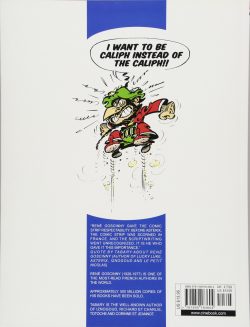
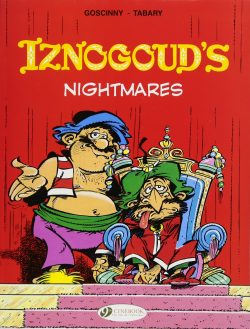
Iznogoud’s Nightmares


By Goscinny & Tabary translated by Jerome Saincantin (Cinebook)
ISBN: 978-1-84918-360-4 (Album PB)

For the greater part of his too-short lifetime (1926-1977) René Goscinny was one of – if not the – most prolific and most-read writers of comic strips the world has ever seen. He still is.

Among his most popular comic collaborations are Lucky Luke, Le Petit Nicolas and, of course, Asterix the Gaul, but there were so many others, such as the dazzling, dark deeds of a dastardly usurper whose dreams of diabolical skulduggery perpetually proved to be ultimately no more than castles in the sand…

Scant years after the Suez crisis, the French returned to those hotly contested deserts when Goscinny teamed with sublimely gifted Swedish émigré Jean Tabary (1930-2011) – who numbered Richard et Charlie, Grabadu et Gabaliouchtou, Totoche, Corinne et Jeannot and Valentin le Vagabond amongst his other hit strips – to detail the innocuous history of imbecilic Arabian (im)potentate Haroun el-Poussah.

However, it was the strip’s villainous foil, power-hungry vizier Iznogoud who stole the show – possibly the conniving little imp’s only successful coup…

According to the Foreword in this very special collection, the very notion of the series came from a throwaway moment in Les Vacances du Petit Nicolas, but – once it was fully formed and independent – Les Aventures du Calife Haroun el Poussah was created to join the roster in Record, with the first episode appearing in the January 15th 1962 issue. An assured if relatively minor hit, the strip jumped ship to Pilote – a comics periodical created and edited by Goscinny – where it was artfully refashioned into a starring vehicle for the devious little ratbag who had increasingly been hogging all the laughs and limelight.

Like all great storytelling, Iznogoud works on multiple levels: for youngsters it’s a comedic romp with adorably wicked baddies invariably hoisted on their own petards and coming a-cropper, whilst older, wiser heads can revel in pun-filled, witty satires and marvellously accessible episodic comic capers. Just like our Parliament today. That latter aspect is investigated in this collection of short episodes…

This same magic formula made its more famous cousin Asterix a monolithic global success and – just like the saga of the indomitable Gaul – the irresistibly addictive Arabian Nit was originally adapted into English by master translators Anthea Bell & Derek Hockridge, who made those Roman Follies so very palatable to British tastes. Always the deliciously malicious whimsy was heavily dosed with manic absurdity, cleverly contemporary cultural critiques and brilliantly delivered creative anachronisms which serve to keep the assorted escapades bizarrely fresh and hilariously inventive. However, like so many comics inventions, the series grew beyond its boundaries and this volume re-presents a sidebar series that began as a s statement and grew into a separate second career for the vindictive viper…

Insidious anti-hero Iznogoud is Grand Vizier to affable, easy-going Caliph of Ancient Baghdad Haroun Al Plassid, but the sneaky little toad has loftier ambitions, or – as he is always declaiming – “I want to be Caliph instead of the Caliph!”…

The retooled series launched in Pilote in 1968, quickly growing into a massive European hit, with 31 albums to date (carried on by Tabary’s children Stéphane, Muriel & Nicolas after his passing in 2011); his own solo comic; a computer game; animated film, TV cartoon show and a live-action movie.

When Goscinny died in 1977, Tabary started scripting his own sublimely stylish tales (from the 13th album onwards), gradually switching to book-length complete adventures, rather than the compilations of short, punchy vignettes which typified the collaborations.

In October, 1974, whilst the shifty shenanigans were unfolding to the delight of kids, its sandy-struck star began moonlighting: pulling double duty as a commentator and critic of real-world politics and social issues in a French newspaper. Some of the best and least dated have been resurrected here.

Published in 1979 by Editions de la Séguinière, Les Cauchemars d’Iznogoud was the 14th collection, gathering material from Le Journal du Dimanche and appears here with the usual introductory page of key characters plus an annotated text section offering political clarity and historical context. Each entry is presented as a short strip highlighting a contemporary issues seen through the wry lens of a Vile Vizier, offering a wry and raucous roster of advisory lectures with the sagacious schemer pausing his campaign to seize power from his oddly oblivious Lord and Master in favour of blessing all us proles with his wisdom and ruling acumen.

Deftly detailing how to deal with labour disputes, union demands, social unrest, unruly clergymen, domestic and foreign policy, the environment, cost-of-living crises, energy security, sporting links with pariah states, diversity, sectarianism and segregationism, and so much more, here the Caliph-in-waiting explains how to maintain a popularity and power in ancient but oh-so-contemporary Baghdad as well as the modern world…

Trust me, it’s far funnier than I’ve made it sound and all the usual magic and madness is apparent as the Vizier asks and answers questions posits potential policy in ‘If I were Minister of Labour…’, ‘If I were Minister of Energy…’ or ‘…Waste Management…’, ‘…the Interior…’, ‘…the Army…’, ‘…of Students…’, ‘…of Police…’, ‘ … the Anti-Gang Unit…’, ‘…of Negotiators…’, ‘…of Censorship…’, ‘…of the Economy…’ ‘…of Industry…’, and ‘If I were President of the Judges Union…’

Many strips are general in nature rather than addressing a specific “hot topic”, but still deliver hilariously acerbic and excoriating satirical points in bulletins like ‘If I were a Carpet Seller…’, ‘If I were Minister of Wishes…’, ‘If I dined with ordinary people…’, ‘If I were Minister of Divorce…’, ‘If I were Minister of Quality of Life…’, ‘If I spoke officialese…’ ‘ ‘If I were Minister of Compromise…’, ‘If I were Minister of Holes…’, ‘If I were Minister of Tolls…’, ‘If I were Minister of Prison Guards…’, ‘If I were the usurper…’, ‘If I were Minister of Freezing…’, ‘If I were going on holiday…’ (a popular a pressing duty of Prime ministers everywhere and one our own British bosses are world leaders in), as well as ‘If I were Secretary of Non-Smoking…’ and ‘If I were a UN Delegate…’

There is even a particularly scary sub-strand of episodes pondering – with menaces – ‘If I were your Caliph/King/Inheritor/Guess What?’

What’s truly daunting and trenchant is just how many of these strips are still painfully relevant right now, with the darker side of sport, white & greenwashing, nepotism, cronyism and even sexual politics all poked with a very sharp stick (which is, coincidentally, my suggested solution for dealing with our 21st century ruling rascals and feather-bedding incompetents) in tales such as If I were Minister of Labour…’, ‘ ‘…of Racing…’, ‘…of Football…’, or even ‘If I were the one in charge of their “happiness”…’, If I were the Impaler…’, If I were on an official visit…’ and ‘If I were Minister of Ladies of the Night…’

Although the farcical eternal battle with his own hereditary superior is surrendered to the exigencies of a topical tone, the cast of regulars and legendary locales are still happily extant here with bumbling, long-suffering henchman and strong-arm crony Wa’at Alahf’ acting as sounding board and straight man and Caliph Haroun al Plassid acting as the oblivious powers that be in a panoply of short, sharp shockers blending un-realpolitik with world weary cynicism in a pun-punctuated comedy of errors, riddled with broad slapstick and craftily convoluted conniving…

Just such witty, fast-paced hi-jinks and craftily crafted comedy set pieces have made this addictive series a household name in France where “Iznogoud is now an acceptable general term for a certain type of politician: over-ambitious, unscrupulous, sans-gravitas and frequently a little short in the height department…

When first released in Britain during the late 1970s (and again in 1996) these tales made little impression, but certainly in today’s fervid climate of fustercluckery, these brisk and brutal, wonderfully beguiling strips have found an appreciative audience among today’s more internationally aware, politically jaded comics-and-cartoon savvy Kids Of All Ages…

…And journalists and Hansard, and Polit-Wonks, and dictators and…
Original edition © 2012 IMAV éditions by Goscinny & Tabary. All rights reserved. English translation 2017 Cinebook Ltd.

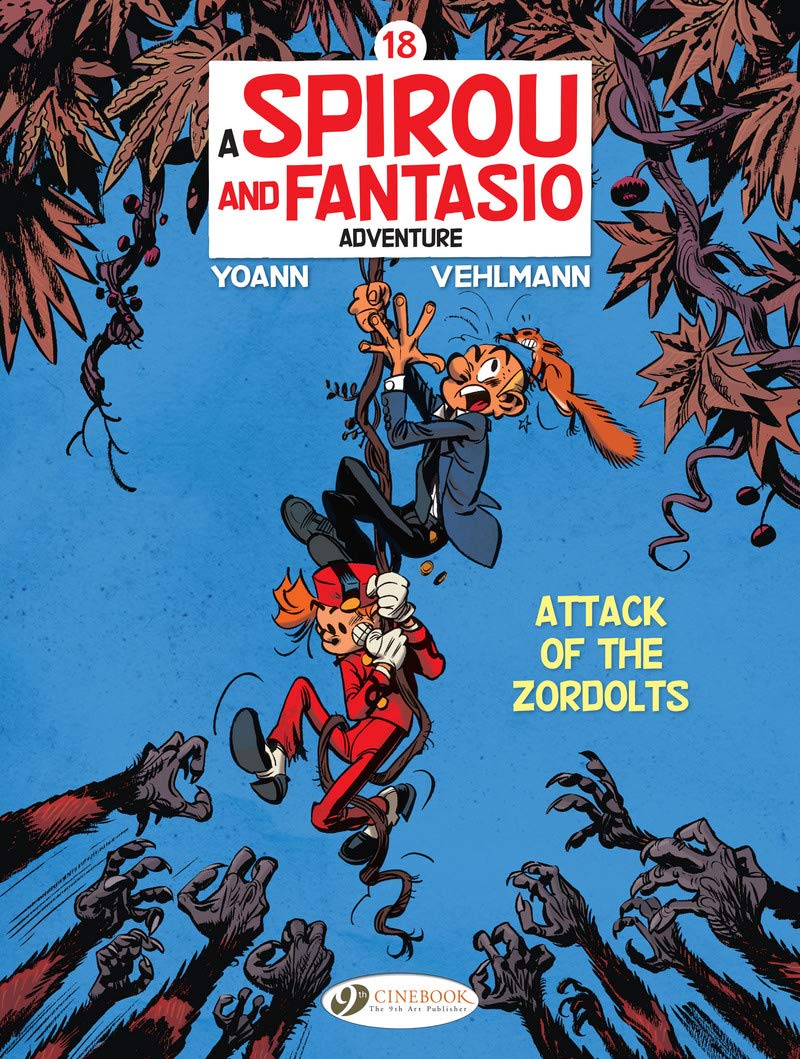
Spirou & Fantasio volume 18: Attack of the Zordolts


By Yoann & Vehlmann, designed by Fred Blanchard, colored by Hubert & translated by Jerome Saincantin (Cinebook)
ISBN: 978-1-80044-022-7 (Album PB/Digital edition)

Win’s Christmas Gift Recommendation: Manic Mirth and Mad Melodrama… 9/10

Spirou (which translates as both “squirrel” and “mischievous” in the Walloon language) was created by French cartoonist Françoise Robert Velter AKA Rob-Vel for Belgian publisher Éditions Dupuis in response to the phenomenal success of Hergé’s Tintin at rival outfit Casterman.

Soon-to-be legendary weekly comic Le Journal de Spirou launched on April 21st 1938 with a rival red-headed lad as lead feature in an anthology which bears his name to this day. The eponymous hero was a plucky bellboy/lift operator employed in the Moustique Hotel – a sly reference to the publisher’s premier periodical Le Moustique. His improbable adventures with pet squirrel Spip gradually evolved into far-reaching, surreal comedy dramas.

Spirou and his chums have spearheaded the magazine for most of its life, with a phalanx of truly impressive creators carrying on Velter’s work, beginning with his wife Blanche “Davine” Dumoulin who took over the strip when her husband enlisted in 1939. She was assisted by Belgian artist Luc Lafnet until 1943, when Dupuis purchased all rights to the property, after which comic-strip prodigy Joseph Gillain (Jijé) took the helm.

In 1946, his assistant André Franquin assumed the creative reins, gradually ditching the well-seasoned short gag vignettes in favour of epic adventure serials. He also expanded the cast, introducing a broad band of engaging regulars and eventually creating phenomenally popular magic animal Marsupilami.

Franquin was followed by Jean-Claude Fournier who updated the feature over nine stirring adventures tapping into the rebellious, relevant zeitgeist of the times: offering tales of environmental concern, nuclear energy, drug cartels and repressive regimes.

By the 1980s the series seemed outdated and lacked direction. Three different creative teams alternated on the feature, until it was overhauled and revitalised by Philippe Vandevelde (writing as Tome) and artist Jean-Richard Geurts AKA Janry. They adapted, referenced and in many ways returned to the beloved Franquin era.

Their sterling efforts revived the floundering feature’s fortunes, generating 14 wonderful albums between 1984 and1998. As the strip diversified into parallel strands (Spirou’s Childhood/Little Spirou and guest-creator specials A Spirou Story By…), the team on the core feature were succeeded by Jean-David Morvan & José-Luis Munuera. Then Yoann & Vehlmann took over the never-ending procession of amazing adventures…

Multi-award-winning French comics author Fabien Vehlman was born in 1972, began his comics career in 1996 and has been favourably likened to René Goscinny. He’s best known for Green Manor (illustrated by Denis Bodart), Seven Psychopaths with Sean Phillips, Seuls (drawn by Bruno Gazzotti and available in English as Alone), Wondertown with Benoit Feroumont and Isle of 1000,000 Graves with Jason.

He assumed the writing reins on Spirou and Fantasio in collaboration with Yoann. beginning with the book on review here – 2010’s Spirou et Fantasio – Alerte aux Zorkons.

Yoann Chivard was born in October 1971 and was drawing non-stop by the age of five. With qualifications in Plastic Arts and a degree in Communication from the Academy of Fine Arts in Angers, he became a poster and advertising artist whilst dabbling in comics. His creations include Phil Kaos and Dark Boris for British Indie publications Deadline and Inkling, Toto l’Ornithorynque, Nini Rezergoude, La Voleuse de Pere-Fauteuil, Ether Glister and Bob Marone and he has contributed to Trondheim & Sfar’s Donjon. In 2006, Yoann was the first artist to produce a Spirou et Fantasio one shot Special. It was scripted by Vehlmann…

Cinebook have been publishing Spirou & Fantasio’s exploits since 2009, alternating between the various superb reinterpretations of Franquin and earlier efforts from the great man himself. When Jijé handed Franquin all responsibilities for the strip part-way through Spirou et la maison préfabriqué (LJdS #427, June 20th 1946), the new guy ran with it for two decades; enlarging the scope and horizons until it became purely his own. Almost every week fans would meet startling new characters such as staunch comrade and rival Fantasio or crackpot inventor and Merlin of mushroom mechanics Pacôme Hégésippe Adélard Ladislas de ChampignacThe Count of Champignac

Spirou and Fantasio became globe-trotting journalists, travelling to dangerously exotic places, uncovering crimes, exploring the fantastic and clashing with a coterie of exotic arch-enemies such as Fantasio’s deranged and wicked cousin Zantafio and that maddest of scientists, Zorglub.

This old school chum and implacable rival of Champignac is an outrageous Bond movie-flavoured villain who constantly targets the Count. A brilliant engineer, his incredible machines are far less dangerous than his mesmerising mind-controlling “Zorglwave” and an apparently unshakable desire to conquer Earth and dominate the solar system from a base on the Moon…

This tale opens with the seemingly reformed plotter stealing some of Champignac’s most incredible mushroom-based miracles and triggering a massive mutational event in and around the bucolic generally placid hamlet of Champignac-in-the-Sticks.

The first Spirou and Fantasio hear of it is a desperate cell phone call from Pacôme, who has just reappeared after weeks amnesiac and missing. Driving back from a promotional tour, our heroes race across country only to find the placid region is now an armed camp, with soldiers in biohazard gear brutally decontaminating villagers.

The little valley has become a monstrous alien jungle dominated and transformed by weird and incredible plant/animal/fungus creatures, but neither they nor the military – who are keen on immediately nuking the geographical atrocity – can stop our dedicated reporters sneaking in to find their friends.

On locating the Count and his two new chums – hot Swedish science students Astrid and Lena – the lads learn that the brave new world is an accident and hideous side effect of Zorglub’s latest scheme, and that he’s sorrier than anyone at the state of the local environment.

He’s certainly keen enough on fixing the problem…

Other than the fact that everything wants to eat everything else, and that many of the human locals seem comfortable and accustomed to the changes, the main problem seems to be a rapidly proliferating and aggressive form of beast man. The jungle is now a superfast evolutionary Petri dish with everything in it part of an arms race to out-compete all rivals. These brutish bipeds have for some reason evolved immunity to Zorglub’s Zorglwave by having oodles of aggression and not enough intellect. They are ravening, unstoppable Zordolts…

Not sure what’s happening, but resolved to stop the Army bombing the village before foiling Zorglub, everybody works frantically together and succeeds in part one of the plan, but when the jests are repelled and the Zordolts stopped by Champignac’s newly-liberated dinosaur they find the villain vanished.

By the time Champignac has worked his mushroom magic in reverse and restored most of the status quo, the Master of the Z ray is long gone. If our heroes could look up high enough, they might see him well on his way to the moon with Astrid in Lena in tow and about to set his Great Masterwork in motion…

To be Continued…

Rocket-paced, action-packed, compellingly convoluted and with just the right blend of perfectly blending helter-skelter excitement and sheer daftness, Attack of the Zordolts is a terrific romp to delight devotees of easy-going adventure.

Stuffed with an astounding array of astonishing hi-tech spoofery, riotous chases and gazillions of sight gags and verbal ripostes, this exultant escapade is a fabulous fiesta of angst-free action and thrills. Readily accessible to readers of all ages and drawn with beguiling style and seductive energy and wit, this is pure cartoon gold, truly deserving of reaching the widest audience possible.

Buy it for you, get another for the kids and give copies to all your friends…
Original edition © Dupuis, 2010 by Vehlmann, Yoann, Blanchard & Hubert. All rights reserved. English translation 2021 © Cinebook Ltd.

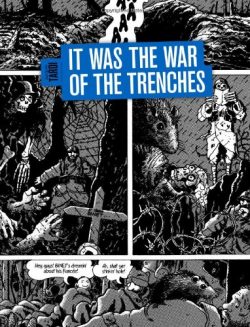
It Was the War of the Trenches & Goddam This War!


By Tardi with Jean-Pierre Verney, translated by Kim Thompson & Helga Dascher (Fantagraphics Books)
ISBN: 978-1-60699-353-8 (HB Trenches) & 978-1-60699-582-2 (HB Goddam)

For years I’ve been declaring that Charley’s War the best comics story about The Great War ever created, but, while I’m still convinced of that fact, there’s a strong contender for the title in the astonishing award-winning conception C’était la guerre des tranchées by cartoonist Jacques Tardi. It began publication in France in 1993 and was released as an English edition by Fantagraphics in 2010. Three years later it was supplemented by an even more impressive and heart-rending sequel.

Credited with creating a new style of expressionistic illustration dubbed “the New Realism”, Tardi is one of the greatest comics creators in the world, blessed with a singular vision and adamantine ideals, even apparently refusing his country’s greatest honour through his wish to be completely free to say and create what he wants.

He was born in the Commune of Valence, Dróme in August 1946 and subsequently studied at École Nationale des Beaux-Arts de Lyon and the prestigious Parisian École Nationale Supérieure des arts Décoratifs before launching his career in comics in 1969 at the home of modern French comics: Pilote.

From illustrating stories by Jean Giraud, Serge de Beketch and Pierre Christian, he moved on to Westerns, crime tales and satirical works in magazines like Record, Libération, Charlie Mensuel and L’Écho des Savanes whilst also graduating into adapting prose novels by Louis-Ferdinand Céline and Léo Malet.

The latter’s detective hero Nestor Burma became the subject of all-new albums written and drawn by Tardi once the established literary canon was exhausted leading, in 1976. to the creation of Polonius in Métal Hurlant and a legendary, super-successful star turn. Les Aventures Extraordinaires d’Adéle Blanc-Sec is an epic period fantasy series which initially ran in the daily Sud-Ouest. The series numbers ten volumes thus far and is still being added to.

The passionate auteur has also crafted many unforgettable anti-war stories – Adieu Brindavoine, Le Fleur au Fusil, Le trou d’obus and more – examining the plight of the common soldier, and has written novels, created radio series, worked in movies, and co-created (with writer Jean Vautrin) Le Cri du Peuple – a quartet of albums about the Parisienne revolt of the Communards.

Whilst his WWI creations are loosely inspired by the experiences of his grandfather, his 2012 graphic novel Moi René Tardi, prisonnier de guerre au Stalag IIB revealed the experiences of his father, a POW in the second conflict to ravage France in a century.

Far too few of this master’s creations are available in English (barely 20 out of more than 50) but, thanks to NBM, iBooks and Fantagraphics, we’re quickly catching up…

An unquestionable masterpiece and international multi-award winner, It Was the War of the Trenches begins with Tardi’s forthright Foreword detailing his process and motivations, plus a copious and chilling Special Thanks page, before a cartoon catalogue of humanity’s greatest folly unfolds.

These interlinked and cross-fertilising vignettes are about people not causes or battles or the fate of nations, with each tale linking to others: comprised of epigrammatic, anecdotal observations of the war as experienced by ordinary soldiers. The saga first saw print in A Suivre before being stitched together as a patchwork quilt of endurance, complaint, venality, misfortune, bravery, cupidity and stupidity, all informed primarily by family stories, but always verified and augmented by focussed research.

As the pages proceed, a litany of injustice and abiding horror unfolds as scared, weary, hopeless, betrayed and crazy men of every type suffer constant pressure, relentless ennui, physical abuse and imminent death…

Seeking and succeeding in bring those appalling experiences to life, Tardi forensically displays the constant shelling, awful weather, death in the skies and in the mud plus every possible variation in between them as an ever-changing roster of reluctant warriors wait for the end. They think of past lives and wasted chances and what turn of fate brought them to this muddy hole in the ground…

Especially poignant are those twists of luck that so often place supposed enemies together against the War itself, but always brief friendships end abruptly and badly, with the only winners being death and guilt and shame…

This is a book no one could read and sustain any vainglorious illusion of combat and honour as noble inspirations. This is a story that begs us all to stop war forever…

In 2013, after more than a decade of meticulous research and diligent crafting, It Was the War of the Trenches was finally supplemented by a sequel…

Translated as a potent and powerful hardback edition in full colour and moody, evocative tonal sequences, this pictorial polemic was originally released as six newspaper-format pamphlets entitled Putain de Guerre! From there it was collected in two albums and came to us as Goddamn This War!, tracing the course of the conflict through the experiences of an anonymous French “grunt”.

At once lucky, devious and cynically suspicious enough to survive, he is a tool used to relate the horrific, boring, scary, disgusting and just plain stupid course of an industrialised war managed by privileged, inbred idiots who think they’re playing games: restaging Napoleon’s cavalry campaigns, but this time as seen from the perspective of the poor sods actually being gassed and bombed and shot at…

Divided into five chapter-years running from ‘1914’ to ‘1919’ (as the global killing didn’t stop just because the Germans signed an Armistice in 1918 – just ask the Turks, Armenians, Russians and other Balkan nations forgotten when hostilities officially ended), the narration is stuffed with the kind of facts and trivia you won’t find in most history books. as our frustrated and disillusioned protagonist staggers from campaign to furlough to what his bosses call victory, noting no credible differences between himself and the “Boche” on the other side of the wire, but huge gulfs between the men with rifles and the toffs in brass on both sides…

This staggeringly emotional testament is backed up and supplemented by a reproduction of ‘The Song of Craonne’ – a ditty so seditious that French soldiers were executed for singing it – and a capacious, revelatory year-by-year photo-essay by historian, photographer and collector Jean-Pierre Verney. His World War I: an Illustrated Chronology chillingly shows the true faces and forces of war and is alone worth the price of admission…

It Was the War of the Trenches (C’était la guerre des tranchées) © 1993 Editions Casterman. This edition © 2010 Fantagraphics Books.
Goddamn This War! (Putain de Guerre!) © 2013 Editions Casterman. This edition © 2013 Fantagraphics Books.

Darwin’s Diaries volume 1-3: The Eye of the Celts, Death of a Beast & Dual Nature


By Eduardo Ocaña & Sylvain Runberg, coloured by Tariq Bellaoui, translated by Jerome Saincantin (Cinebook)
ISBN: 978-1-84918-095-5 (v1 Album PB/Digital edition), 978-1-84918-110-5 (v2 Album PB/Digital), 978-1-84918-144-0 (v3 Album PB/Digital)

In the eternal quest to be entertained, humans have always searched far and wide. The capacity and desire to scare ourselves thus employs a vast landscape of genres and locales as well of all time and space. It also tempts us into mixing and mashing history, imagination and fanciful speculation…

Here’s a fabulously fitting idea for fantastic Scientific Romance in the grand manner of Professor Challenger, courtesy of French writer Sylvain Runberg (Conquests; Watchdogs Legion; On Mars; Orbital) and Spanish illustrator Eduardo Ocaña (Messiah Complex, Full Tilt Boogie, Les Bâtisseurs): an enthralling triptych begun in 2010 which – despite slipping off everyone’s radar – has stood the test of time.

In England, Victoria is Queen, and her mighty nation will soon be an empire. It is, however, not at peace, and former explorer and controversial naturalist Charles Darwin is asked by Prime Minister Lord Palmerston to undertake a delicate mission in the North. It is not for his current field of expertise, but rather his early – and now – classified endeavours into the field of crypto-zoology. Not long ago, Darwin had quietly looked into the existence of mythical things: Almases, Sasquatch, Werewolves and other “clawed ones”…

The region he is despatched to is the site of railway construction, but recently the navvies, their horses and even a company of soldiers have been butchered by some beast. Darwin must go there and pacify the populace whilst ruling out any possibility that the culprit is of unknown origins…

The first minister also hints that as well as the lure of fresh knowledge, the savant should also consider that local entrepreneurial grandee Sir Howard Dickinson would be grateful enough to fund any future travels Darwin might be considering…

The scientist readily accepts – but not for the reasons expected – and is soon in York, met by forthright suffragist Suzanne Dickinson and Indian manservant Rajiv. Once ensconced in the Blue Moors hotel (her father’s latest acquisition), Darwin opens his investigation, with the suspiciously curious and hands-on Miss Dickinson always in attendance.

He finds her a superb companion. Highly educated and competent, she has been schooled in medicine and business is and acquainted with prestigious thinkers like John Stuart Mill and emancipators such as Emily Davies and Barbara Leigh Smith

Upon examining the remains of the victims, Darwin stakes his reputation on the premise that a great tiger is loose in the wooded region. Neither his sponsors nor the striking navvies give that theory much credence, and that night, a shepherd and his dog are added to the death register. Locals begin voicing opinions that the culprits must be the weird Welsh cult led by self-professed holy man Cadell Afferson. He says he’s a druid in touch with ancient forces…

Meanwhile, Darwin’s gentlemanly facade seems to slip. When returned to the Blue Moor, he sinks into depravity, getting drunk, fighting with local bullies and availing himself of local harlot Louise Stuart. As he becomes a beast, the one he’s hunting attacks again, butchering soldiers, sabotaging the work site and apparently perishing in a massive explosion.

Suzanne is unable to refrain from commenting on the scientist’s condition when she fetches him next morning, but Darwin doesn’t care after hearing that military martinet Captain Sanders has recovered the creature’s corpse…

Originally published in 2010 as Les carnets de Darwin 1 – L’oeil des celtes, this period drama ripples with suppressed tension as it sets up a classic confrontation between man and monster to delight every thriller fan.


The suspense spectacularly escalates in second volume Death of a Beast (La mort d’une bête) as the press gets wind of the news that Mr. Darwin has discovered a creature previously unknown to science. Panic grips York, but rail construction recommences, thanks to the foreman’s unique methods of negotiation. As esteemed researcher and weary soldiers seek more evidence, Druid Cadell stirs the pot, warning that ancient gods will judge their actions…

Darwin believes his job nearly done, but as he dines with the Dickinsons, fresh tragedy sparks more bloodshed. When a little girl is found eviscerated, furious, terrified townsfolk turn on the druids and a brutal riot is only quashed by ruthless military intervention…

Far from that madding crowd, the scientist is amazed at his host’s familiarity with legends of shapeshifting creatures, and even more so by Suzanne’s other passion. She runs educational workshops for townswomen, teaching them to read and count and even honest trades. Her greatest joy is anticipating  the festival she and dowager Virginia Wilson have organised: Yorkshire’s first Feminist Convention…

Eventually Darwin and the soldiers are able to convince the citizens the child’s death is not due to a new beast or the Celts in the forest, but arrogant, affronted Afferson swears to take vengeance. He does possess some secret knowledge, but when he summons what really prowls the moors and forests, his mistaken belief that he is in control costs everyone dearly…

Meanwhile, in York, Darwin again gives in to his own beast and nearly dies due to it, but a horror has been roused to vicious action and whatever he truly is cannot hope to stand against it…

Blending socio-political intrigue with an immensely devious mystery where nothing is as it seems, this episode offers hints of far more at play and at stake than anyone previously suggested. Stay tuned for a big, big finish…


Closing chapter Dual Nature – formerly Les carnets de Darwin 3 – Double nature – moves from chilling canter to full galloping charge as fear and frenzy grip town and country, and mutilated bodies pile up. Captain Sanders informs Darwin that the investigation is done, and that Palmerston has decided the terror is the work of enemy agents set on destabilising the nation, and has sent further military personnel to mop up. Prudent and cautious, the PM has also despatched a renowned professional hunter, in case these sinister plotters instigators have indeed unleashed trained animals as part of their plan…

Sadly, effete dandy and aristocratic butcher Sir Rillons – and his entourage of privileged hangers-on – are merely the first to discover that what is actually loose is a pack of monstrous killers faster and stronger than any ever recorded before – and easily as smart as human beings…

In the aftermath of a bloody debacle, the drama reaches a messy crescendo as Darwin is abducted by the beasts and his own secret fully exposed. However, the ultra-macho monsters – distracted by and determined to crush the unnatural women demanding equal rights at their ridiculous convention – have not reckoned on uncanny hidden allies even the biologist himself is unaware that he has and ultimately, fang, claw and unnatural selection determines the outcome…

Murderous madcap mayhem and far from historically robust, this yarn is a crazily delicious feast of gory fun to charm every horror fan: a pure treat to gorge on and digest at your leisure.
© Editions du Lombard (Dargaud-Lombard SA) 2010 by Sylvain Runberg & Eduardo Ocaña. All rights reserved. English translation © 2011, 2012, 2013 Cinebook Ltd.

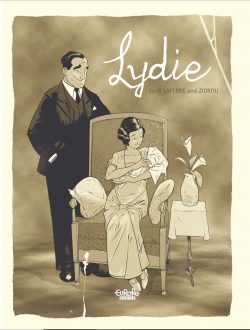
Lydie


By Zidrou & Jordi Lafebre, translated by Mercedes Claire Gilliom (Europe Comics)
No ISBN: digital edition only

Win’s Christmas Gift Recommendation: Lyrical, Lovely, Unforgettable… 10/10

It’s the season for spirits and spectres and we all love a good, healthy scare, but it’s wise to remember that ghost stories aren’t just about revenge, unfinished business or unreasoning irrational terror. So often, what’s at play is feeling of duty and ineffable loss…

As you’d expect, our Continental cousins are exceeding adept at exploring humanity’s softer sides through the medium of comics, and Lydie is a masterclass in emotive, evocative, ruthlessly sensitive storytelling to delight our senses by quietly affirming our better natures.

Be warned though: this tale is funny, heartwarming and sad. No one (at least nobody even borderline human) will scoff or sneer if you need tissues to get you to the end.

Lydie was originally released in 2012, courtesy of empathetically enthralling scripter Zidrou (Benoît Drousie) and illustrator Jordi Lafebre. Drousie is Belgian, Brussels born in 1962 and until 1990 a school teacher – prior to quitting marking books to instead make them. His primary successes include school dunce series L’Elève Ducobu, Petit Dagobert, Scott Zombi, La Ribambelle, Le Montreur d’histoires, African Trilogy, Shi, Léonardo, a revived Ric Hochet and so many more. His most celebrated and beloved stories are the Les Beaux Étés sequence (translated by Europe Comics as Glorious Summers) – and this stand-alone saga. Both are illustrated by Spanish artist Jordi Lafebre.

The sublimely gifted illustrator and art teacher was born in Barcelona in 1979 and has been a comics professional since 2001 – initially for magazines like Mister K, where he limned Toni Font’s El Mundo de Judy. Lafebre found regular work at Le Journal de Spirou, creating the romance Always Never and collaborating with Zidrou on La vieille dame qui n’avait jamais joué au tennis et autres nouvelles qui font du bien, and La Mondaine.

Even for such gifted creators and in-tune collaborators, Lydie is something special: A combination of semi-tragic feel-good fable and genteel working class ghost story, this is a beguiling confection dealing out potent emotional punches one after another – so be braced with plenty of hankies. Nevertheless, it still manages to find the good and the laudable in us, even in the lowest moments and worst of aspects of our natures: enrobing what should be crushing tragedy in the uplifting actions of a community looking out for all of its members, no matter how flawed or forgotten they might become…

It starts sometime in the last century with a little enclave of an ordinary district in the kind of town that used to be everywhere. The crowded cul-de-sac of Baron Van Dick Court is a tiny, independent world of its own, where everyone knows everyone – and most of their personal business. However, since kids will be kids, when a little bit of mischief occurred, the place became irrevocably and foreverafter “Mustachioed Baby Court”…

The denizens live piled up on each other and are a typical bunch: hard-working, industrious, painfully practical and all eking out a living as best they can, but one night something rather extraordinary happens…

It truly started some time earlier. Down in the backyard, poor, hard-up Victor Lefort was again forced to destroy his cat’s beautiful kittens, even as upstairs Doctor “Fables” Fabian was failing to save a baby. Perhaps it was for the best. Distressed mother-to-be Camille Tirion is painfully simpleminded, and had been cruelly taken advantage of by some vile anonymous sinner, so what possibly life could her child have had?

Camille – and her poor father Augustin – were subject of much gossip in the local general store/bar. Despite being a train driver and often away overnight, he has done his best raising his afflicted daughter all on his own… at least until this…

Camille’s mother also died in childbirth and now cruel fate has struck the family again…

The event affects everyone in the Court and many parents must explain to their own children how – if not why – Camille’s baby has gone and must live in a tiny wooden box under the ground in the church graveyard…

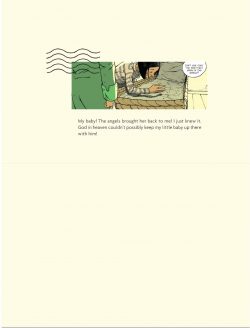
However, once all the necessary ceremonies have taken place and life in the Court moves back towards normal, something happens. It begins when Augustin finds his bereft child crumpled under the little statue of the Madonna that’s been overlooking the court for who knows how long, and continues the next day when Camille dashes joyously into the store, ecstatically telling all inside that her baby has come back.

Of course, little Lydie is invisible now…

Her joy is infectious, and no one wants to disabuse the poor simpleton of her fanciful notion, but things take a stranger turn after the feral and prolific delinquent Ayhard brothers brutally tease the “new mother “and her swaddled, intangible infant. When aged Madame Paris helps distraught Camille comfort the latest addition to the Court, the community rallies around, and before long even the most curmudgeonly dweller in Mustachioed Baby Court is playing along: from crusty shopkeeper Théophile Lefort to acid-tongued sot Madame Malisse. The priest is even cajoled into performing a special baptism for the unseen infant…

…And gradually, with everyone contributing to the fantastic lie for decades, it all seems to come fantastically true…

From this point on, the story takes on a life of its own too, so please for the sake of soul and all the lost joy modern life has stripped from you, find and read this glorious fable dedicated to the miraculous strength of imagination, power of love and irresistible force of humanity united in a grand cause…
© 2018 DARGAUD BENELUX (Dargaud-Lombard s.a.) – Jordi Lafebre and Zidrou. All rights reserved.

Rork: The Ghosts


By Andreas, coloured by Isa Cochet and translated by Montana Kane (Europe Comics)
No ISBN: digital edition

Born in January 1951, Andreas Martens is an incredibly versatile artist from East Germany (and from a time when that meant another country, not a different location). He trained at the Academy of Fine Arts in Düsseldorf and the Saint-Luc Institute/comics school in Brussels. His work appeared in college magazine Le 9e Rêve, À suivre, Heavy Metal and Le Journal de Tintin where – in conjunction with his teacher Eddie Paape – he created the seminal Udolfo.

Relocating to France, Andreas adapted the works of Francois Rivière (collected in 1980 as Révélations Posthumes) and produced a graphic edition of Charlotte Brontë’s Jane Eyre for Je Bouquine.

Stand-alone works include La Caverne du Souvenir, Coutoo, Dérives and Aztèques, but his reptation was earned through gripping original series such as Raffington Detective, Cyrrus, Arq and others. His entire oeuvre is steeped in classical style, draped in period glamour and drenched in visual tension. Many are thematically linked. However, before all these, he created one of the most stylish and memorable “Challengers of The Unknown” in horror fiction: enigmatic psychic savant Rork.

His pale and moody period hero, (who first appeared in Le Journal de Tintin in 1978) draws on the tone, time and sometimes even “homaged” content of dark-fantasists August Derleth, H. P. Lovecraft and especially the Carnacki stories of William Hope Hodgson. Spiritual nomad Rork wanders the world and great beyond, unravelling mysteries and discovering startling wonders, not for fame or glory, but because he must…

In the early 1990s Dark Horse Comics serialized his adventures in their superb anthology of European comics Cheval Noir, and those translations formed the basis of a little seen or remarked upon series of albums from NBM.

After too long in absentia – that’s past Neverland, a little to the left of Narnia but not as far as The House on the Borderland – the mystic marvel returned in 2017, courtesy of digital-only publishing collective Europe Comics who kicked off what I still hope will be a complete revival by translating into English the final book in the sequence.

Released in 2012, Les fantômes is a prequel tale, regarded by devotees as volume #0, despite its being preceded by seven spooky tomes and crossovers with other Andreas concepts…

By this time, readers had learned that the snowy-haired enigma was a wizard from another dimension, compelled to solve supernatural mysteries even as he sought the secret of his own origins: twin quests that carried him all over creation and into scary battles beside many of the author’s other uncanny warriors of justice…

In this tale – vividly coloured by Isa Cochet (and I make this point as most Rork exploits have appeared in starkly stunning monochrome, in the manner and style of visual pioneers Bernie Wrightson and Jim Starlin) – the wanderer is consulted by Samuel, who has been the channel by which unquiet spirits informed the living of missing (and ultimately dead) persons…

Somehow linked to trees and forests, phantoms came to him ,and Samuel made his living helping others until the day he met Daphne and her son Cary. These living seekers’ search for a husband and father was for greed, not love or closure, and soured the diviner’s relationship with his ghosts. Now decades later, Samuel convinces Rork to intercede for him…

It’s not all altruism, though. The haughty, stubborn finder has been compelled to seek aid since ruthless treasure hunter Tryan has begun to threaten torture and worse unless Samuel uses his gifts to unearth hidden wealth. However, when the white wizard uses his own ability to converse with the departed, he hears a subtly different story and realizes he’s being played for a fool…

Andreas is fascinated by levels of reality and states of comprehension, so Rork tales always come layered with allegorical symbolism, abstract interpretation and trenchant pictorial clues pointing towards deeper meaning. As this story progresses, the mage draws Samuel into verbal duels whilst gradually removing him from the arcadian forests that harbour his ghosts: leading them to an arid desert of the American west where a godlike being offers hints to a greater truth, and where sinister pursuer Tryan falls into a cunning trap…

Ultimately, Rork divines the truth beneath strata of lies and self-deception and the mystery of Samuel is revealed for all to see…

For me, a great comic strip begins with the simple line. The greatest drawing is always about the power of black against white. Colour enhances but it seldom creates in our business. Andreas is one of the best line artists in the modern business so I’m delighted to confirm that there’s a stunning ‘Rork Gallery’ of seven breathtaking images closing his book.

Exotic, eccentric, chilling and lyrically beguiling, the traditional mysticism and otherworldly dread of these tales is a heady and captivating brew, especially with the intense, linear illustration and stark design of Andreas to mesmerize and shock your widened eyes.

Come see for yourselves why this series should be at the top of the list of books to re-release…
© 2017 ÉDITIONS DU LOMBARD (DARGAUD-LOMBARD S. A.) – ANDREAS. All rights reserved.

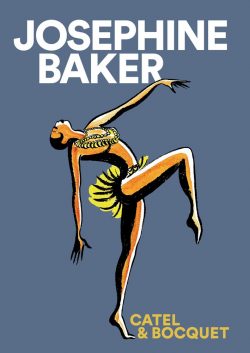
Josephine Baker


By Catel & Bocquet, translated by Edward Gauvin (SelfMadeHero)
ISBN: 978-1-91059-329-5 (TPB/Digital edition)

Win’s Christmas Gift Recommendation: The Story of an Actual Wonder Woman… 9/10

Here’s a rather short review of an astonishingly eventful life celebrated in a superbly expansive, compellingly detailed account from two of the best graphic biographers working in the field. As I’m always implying, my Less is your More, and this is one story you’ll want to appreciate fresh and full-on, so just buy it and be done. You won’t be sorry and will have a revelatory time…

Born Freda Josephine McDonald on June 3rd 1906 in St Louis, Missouri, the black icon, free spirit and symbol of self-determination who called herself Joséphine Baker was no scholar or schemer, but used her innate gifts as a dancer and entertainer to survive horrific acts of random racist violence and ultimately escape her origins as a despised second class citizen in the land of her birth.

A forceful, irrepressible, warm-hearted optimist with colossal empathy and a relentless sense of humour, Baker’s drive and willingness to take chances carried her to the peak of European sophistication and culture: rubbing shoulders with royalty and the cream of global creative intelligentsia: everyone from Picasso and Man Ray to Le Corbusier and Hemingway, Max Reinhardt, Buñuel, Cocteau, Colette, Pirandello, Georges Simenon and so many glittering others.

She was a vedette, singer, dancer, actress, movie star, civil rights activist, paramount artistic inspiration and – during WWII – an actual spy and French resistance operative working for future President Charles de Gaulle, as well as a ferocious defender of animals and devoted mother. Above all else, she was an entertainer par excellence…

Here, Baker’s incredibly eventful life is traced from cradle to grave in black-&-white vignettes, concentrating on her achievements, family life and relationships, seen through her progress from exploitable bit player to media sensation “La Baker”: Queen of Paris in the Jazz Age.

Her astounding energy, creativity and resolve to succeed was only exceeded by her adoration of children, secret acts of charity and unfailing ability to love men who were bad for her, but her legacy was almost erased in the years after she stopped working. Countless comeback attempts and financial troubles followed.

Perhaps she was never truly in earnest but pursuing the means to a greater end. Due to her inability to have children and immense fellow feeling for the downtrodden, Josephine had turned her post war years into an incredible social experiment, gathering orphans from many devastated countries into a single loving family… her multinational, multi-ethnic Rainbow Tribe

All that achievement, accomplishment, unprofitable charity, disillusionment and ultimate abandonment by the august and wealthy in her own country (both of them!) led to Josephine fading from history until relatively recent times, but now she is being reclaimed by a world which could really benefit from her example…

Baker’s international fame led to frequent and painful attempts to reclaim her birth nation’s attention. Eventually – in 1937 – she renounced her American citizenship to become officially French. In later years she tried to help America’s fight against Segregation, but was shunned by both side of that struggle. At the end, as economic woes, life and ongoing illness plagued her final years, she found a few unexpected friends in powerful women like Brigitte Bardot and her final years were spent in Monaco, a guest of equally constrained and misused female icon Grace Kelly. Josephine Baker died on 11th April 1975.

Her public and private lives coalesce in this chronological dramatised narrative from award-winning graphic novelist Catel Muller (Ainsi soit Benoîte Groult, Adieu Kharkov, Lucie s’en soucie, Le Sang des Valentines) and crime novelist, screenwriter/biographer/comics writer José-Louis Bocquet (Métal Hurlant, Sur la ligne blanche, Mémoires de l’espion, Panzer Panik, Anton Six), who in their other collaborations have also explored the lives of Kiki de Montparnasse and Olympe de Gouges (…and we’ll get to them in the fullness of time).

Entertaining, enthralling, informative, and continually sparking explosions of aggrieved but justified outrage on Baker’s behalf, the book is supplemented by a vast supporting structure of extras, beginning with a heavily illustrated and highly informative ‘Timeline for Josephine Baker’, incorporating pivotal events in her public and private lives. It’s further augmented by ‘Biographical Notes’: 55 character portraits in prose and sketch form of the historical figures with supporting roles feature in this epic saga, plus as an essay on ‘The Rainbow Tribe’ by her son/historical consultant Jean-Claude Bouillon-Baker. Also included are a Bibliography and Filmography for further study.

If you love history, comics, justice triumphant or just great stories, you really need to set some records straight and read this book.
© Casterman 2021. All rights reserved.

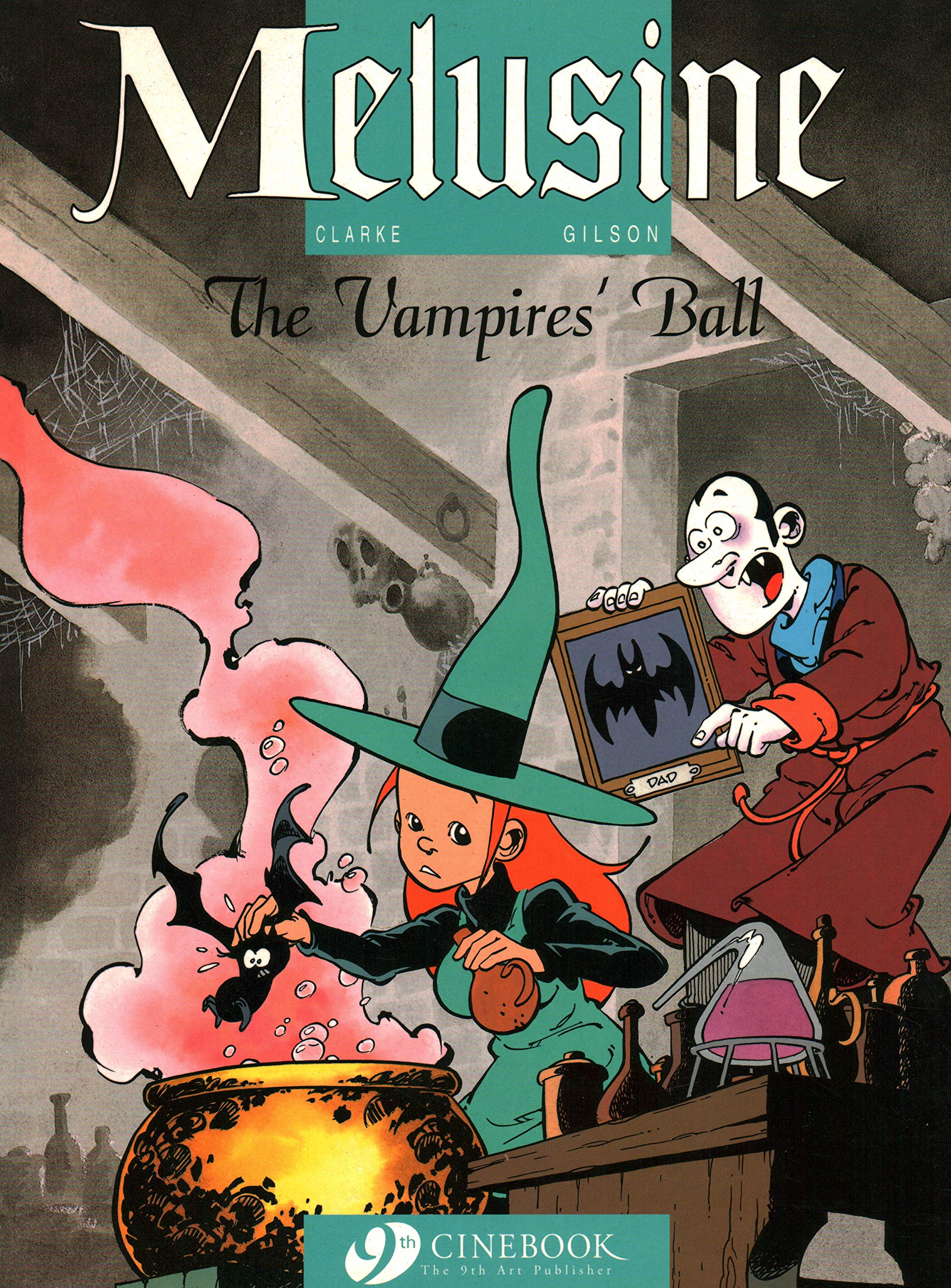
Mélusine volume 3: The Vampires Ball


By Clarke & Gilson, coloured by Cerise and translated by Jerome Saincantin (Cinebook)
ISBN: 978-1905460694 (Album PB/Digital edition)

Witches – especially cute and sassy teenage ones – have a long and distinguished pedigree in fiction. One of the most engaging first appeared in legendary Belgian magazine Le Journal de Spirou in 1992. Mélusine is actually a sprightly 119-years old and spends her days – and many nights – working as an au pair/general dogsbody to a most ungracious family of haunts and horrors inhabiting a vast monster-packed, ghost-afflicted chateau. It pays her bills whilst she diligently studies to perfect her craft at Witches’ School…

The long-lived much-loved feature is presented in every format from one-page gag strips to full-length comedy tales, all riffing wickedly on supernatural themes and detailing her rather fraught life, filled with the demands of the appallingly demanding master and mistress of the castle and even her large circle of exceedingly peculiar family and friends.

The strip was devised by writer François Gilson (Rebecca, Cactus Club, Garage Isidore) and cartoon humourist Frédéric Seron – AKA Clarke – whose many features for the all-ages LJdS and acerbic adult humour publication Fluide Glacial include Rebecca, Les Cambrioleurs, Durant les Travaux, l’Exposition Continue… and Le Miracle de la Vie.

Under pen name Valda, Seron also created Les Babysitters and as Bluttwurst Les Enquêtes de l’Inspecteur Archibaldo Massicotti, Château Montrachet, Mister President and P.38 et Bas Nylo.

A former fashion illustrator and nephew of comics veteran Pierre Seron, Clarke is one of those insufferable guys who just draws non-stop and is unremittingly funny. He also doubles up as a creator of historical and genre pieces such as Cosa Nostra, Les Histoires de France, Luna Almaden and Nocturnes – apparently he is free from the curse of having to sleep…

Collected editions began appearing annually or better from 1995, with the 27th published in 2019. Thus far five of those have transformed into English translations thanks to the fine folk at Cinebook.

Originally released on the Continent in 1996, Le bal des vampires was the second Mélusine album, setting the scene delightfully for newcomers as the majority of content is comprised of 1- or 2-page gags starring the sassy sorceress who makes excessive play with fairy tale and horror film icons, conventions and themes.

When brittle, moody Mélusine isn’t being bullied for her inept cleaning skills by the matriarchal ghost-duchess running the castle, ducking cat-eating monster Winston, dodging frisky vampire The Count or avoiding unwelcome and often hostile attentions of horny peasants and over-zealous witch-hunting priests, the domestic enchantress can usually be found practising spells or consoling and coaching inept, un-improvable and lethally unskilled classmate Cancrelune.

This sorry sorceress-in-training is a sad case: her transformation spells go awfully awry, she can’t remember incantations and her broomstick-riding makes her a menace to herself, any unfortunate observers and even the terrain and buildings around her…

At least Mel’s boyfriend is a werewolf, so he only troubles her a couple of nights each month…

This turbulent tome features the regular procession of slick sight gags and pun-ishing pranks but also features some longer jocular jaunts such as the fate of a rather rude knight in armour, a brush with what probably isn’t a poltergeist in the Library and Mel’s unfortunate experience with daunting dowager Aunt Adrezelle’s patented Elixir of Youth…

Wrapping up a barrage of ghostly gaffes, ghastly goofs and grisly goblin gaucheries is the sordid saga of the eternal elite at their most drunkenly degenerate, as poor Mélusine is not only expected to organise and cater ‘The Vampires’ Ball’ but has to stick around and handle the explosive clean-up for those especially intoxicated Nosferatus who tend to forget why the revelry has to die down before dawn…

Wry, sly, fast-paced and uproariously funny, this compendium of arcane antics is a great taste of the magic of European comics and a beguiling delight for all lovers of the cartoonist’s art. Read before bedtime and don’t eat any hairy sweets…
Original edition © Dupuis, 2000 by Clarke & Gilson. All rights reserved. English translation 2007 © Cinebook Ltd.

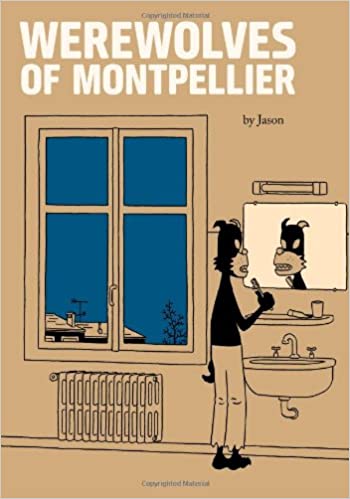
Werewolves of Montpellier


By Jason, translated by Kim Thompson (Fantagraphics Books)
ISBN: 978-1-60699-359-0 (HB/Digital edition)

Jason is secretly John Arne Saeterrøy: born in Molde, Norway in 1965 and an overnight international cartoon superstar since 1995 when his first graphic novel Lomma full ay regn (Pocket Full of Rain) won Norway’s biggest comics prize A Sproing Award.

He won another in 2001 for the series Mjau Mjau and by 2002 was almost exclusively producing graphic novels. Now a global star, he has won many more major awards from such disparate regions as France, Slovakia and the USA.

Rife with his signature surreality, this novella was first released in 2010; populated with cinematic, darkly comic anthropomorphs and featuring more bewitching ruminations on his signature themes of relationships and loneliness, viewed as ever through a charmingly macabre cast of bestial movie archetypes and lost modern chumps.

Here he focuses on the hollow life of expatriate Swede Sven, a purposeless artist who has gravitated into a stagnant, romance-lite existence in a provincial French town. Sven fritters away his days just like his close friend Audrey – another listless intellectual looking for the right lady to love.

The only thing quickening his pulse these days is the occasional nocturnal foray over the rooftops: burglarizing houses dressed as a werewolf. Unfortunately, Montpellier already has a genuine lycanthrope community and they don’t look kindly upon gauche parvenus intruding into their world with criminal cosplay…

This post-modern short-&-spooky fable unfolds in Jason’s beguiling, sparse-dialogued, pantomimic progressions delivering resonances of Hitchcock’s bubbly comedy-thrillers, quirkily blended with Bergman’s humanist sensibilities. The enchantingly formal page layouts are rendered in his minimalist evolution of Hergé’s Claire Ligne style: solid blacks, thick lines and settings of seductive simplicity augmented here by a stunning palette of stark pastels and muted primary colours.

Jason’s work always jumps directly into the reader’s brain and heart, deftly probing the nature of “human-ness” by using the beastly and unnatural to ask persistent and pertinent questions. Although the clever sight-gags are less prominent here, his repertory company of “funny-animal” characters still uncannily displays the subtlest emotions with devastating effect, proving again just how good a cartoonist he is.

This comic tale is best suited for adults but makes us all to look at the world through wide-open childish eyes. Jason is instantly addictive and a creator every serious fan of the medium should move to the top of the “Must-Have” list. Buy, borrow or even steal it if you must, but be aware that actions have consequences… even for faux monsters…
© 2010 Jason. All rights reserved.