
Asterix Omnibus volume 5: Asterix and the Cauldron, Asterix in Spain & Asterix and the Roman Agent


By Goscinny & Uderzo, translated by Anthea Bell & Derek Hockridge (Orion Books)
ISBNs: 978-1-44400-488-5 (HB); 978-1-44400-490-8 (PB)

One of the most-read comics series in the world, the collected chronicles of Asterix the Gaul have been translated into more than 100 languages since his debut in 1959, with animated and live-action movies, TV series, assorted games, toys and even a theme park outside Paris (Parc Astérix, if you’re planning a trip…) spinning off from his hilarious exploits.

More than 325 million copies of 34 Asterix books have sold worldwide, making his joint creators France’s bestselling international authors.

The diminutive, doughty potion-powered champion of Gallic Pride was created by two of the art form’s greatest proponents, writer René Goscinny & illustrator Albert Uderzo and although their inspirational collaborations ended in 1977 with the death of the prolific scripter, the creative wonderment still continued until relatively recently from Uderzo and assistants – albeit at a slightly reduced rate.

The wonderment works on multiple levels: ostensibly, younger readers revel in the action-packed, lavishly illustrated comedic romps where sneaky, bullying baddies get their just deserts whilst we more worldly readers enthuse over the dry, pun-filled, sly satire, especially as enhanced for English speakers by the brilliantly light touch of translators Anthea Bell & Derek Hockridge, who played no small part in making the indomitable Gaul and his gallant companions so palatable to the Anglo-Saxon world. (Me, I still delight in a divinely delivered “Paff!” as much as any painfully potent pun or dryly searing jibe…)

The stories were set on Uderzo’s beloved Brittany coast, where a small village of warriors and their families resisted every effort of the Roman Empire to complete the conquest of Gaul, or alternately, anywhere in the Ancient World, circa 50BC, as the Gallic Gentlemen wandered the fantastic lands of the Empire and beyond…

When the heroes were playing at home, the Romans, unable to defeat this last bastion of Gallic insouciance, resorted to a policy of containment. Thus, the little seaside hamlet is permanently hemmed in by the heavily fortified garrisons of Totorum, Aquarium, Laudanum and Compendium.

The Gauls don’t care: they daily defy the world’s greatest military machine simply by going about their everyday affairs, protected by the magic potion of resident druid Getafix and the shrewd wits of the rather diminutive dynamo and his simplistic, supercharged best friend…

Firmly established as a global brand and premium French export by the mid-1960s, Asterix the Gaul continued to grow in quality as Goscinny & Uderzo toiled ever onward, crafting further fabulous sagas; building a stunning legacy of graphic excellence and storytelling gold.

Asterix and the Cauldron was the 13th saga, originally running in Pilote #469-491 throughout 1968 before being first translated into English in 1976.

It’s a convoluted tale of treachery, felony and dishonour as fellow Gaulish chieftain Whosemoralsarelastix – a cunning and conniving Roman collaborator – convinces the reluctant but big-hearted Vitalstatistix to guard the occupied cliff-top community’s treasury from Imperial tax collectors.

Despite knowing how untrustworthy the scoundrel is, Gaul must help Gaul and the rogue’s huge onion-soup cauldron, stuffed with his people’s golden Sestertii, is placed under the stewardship of the village’s greatest hero and most trustworthy warrior: Asterix.

However, that night, as a great inter-village feast is consumed, somebody cuts their way into the guard hut and steals the glittering contents of that mighty tureen. Of course, dodgy Whosemoralsarelastix wants his money back and the noble Vitalstatistix is honour-bound to replace the stolen horde and disgraced Asterix is banished until he can refill the empty cauldron with gold…

Trusty Obelix refuses to turn away from his friend and joins the quest, which first takes them to the garrison of Compendium, where the wily warrior intends to refill the empty churn with some of the gold the occupiers have been regularly collecting from Gauls.

Unfortunately, Caesar has been experiencing some cash-flow problems of his own and not only has he been rushing the takings to Rome, he hasn’t even paid his soldiers for months…

With disharmony, mutiny and strike action imminent among the legions, Asterix and Obelix realise they must look elsewhere for their loot.

Even their old acquaintances the pirates are cash-strapped – and all-too-soon traditionally thrashed – so the doughty duo must seek their fortune at the grand market in Condatum, briefly and disastrously becoming boar merchants, paid street boxers, actors and charioteers, before turning to crime and planning a bank robbery…

Even here our two just men fare badly. In desperation, they decide to rob Caesar’s tax collector, but Asterix discovers a strange thing. Not only has destitute Whosemoralsarelastix somehow paid his taxes, but the coins deposited smell of onion soup…

With realisation dawning, Asterix visits the cliff-dwelling villagers for a little chat and a mighty reckoning…

Rich with slapstick action and cutting commercial satire (for example the tax collector is a caricature of France’s then Finance Minister Valéry Giscard d’Estaing), this hilarious crime caper is a glorious example of dry yet riotous adventure comedy.

Astérix en Hispanie promptly followed (during 1969 and in Pilote #498-519) in France and was translated into English as Asterix in Spain two years later. It recounts how a valiant group of Iberian warriors are similarly holding-out against Caesar’s total conquest of that proud nation.

Chief Huevos Y Bacon is the noble warrior leading the resistance, but when his haughty son Pepe is captured, all seems lost. Fearing reprisal or rescue, the Romans hastily despatch the hostage lad to the garrison at Totorum, under the oversight of brutish Spurius Brontosaurus. He has no idea what the “pacified” Gauls of the area are like and has his hands more than full contending with the appallingly behaved and inspirationally vicious young prince…

When his guards encounter Gauls in the great forest, they are easily overwhelmed by playful Obelix. Asterix takes Pepe back to the village where – following an ill-advised and painful attempt by Brontosaurus and the legion to reclaim him – our heroes decide to return him to his father.

Most pertinent and urgent in reaching this decision is the spoiled brat’s obnoxious behaviour…

Brontosaurus has pragmatically decided the kid is perfectly safe with the Gauls, and, unaware of their planned jaunt to Hispania, smugly returns to his post. Meanwhile, after their mandatory encounter with pirates, Asterix, Obelix and faithful mutt Dogmatix make their leisurely way through the scenic countryside (offering many trenchant asides regarding the then popular French passion for Spanish touring holidays), until a chance encounter in an inn reveals to the General Brontosaurus how close they are to undoing all his plans.

Venal but no coward, the Roman joins their excursion party, captures Asterix and steals the Gaul’s magic potion: planning to destroy Huevos Y Bacon’s resistance once and for all. However, Obelix, Pepe – and Dogmatix – have a plan to spectacularly save the day…

Full of good-natured nationalistic pokes and trans-national teasing, liberally served up with raucous hi-jinks and fast-paced action, this is another magical titbit of all-ages entertainment.

During 1970, Pilote #531-552 serialised La Zizanie. It translates as “strife”, but on making the jump to English in 1972, became the far less evocative Asterix and the Roman Agent. The tale featured more homeland insecurity as Caesar, under attack by the Roman Senate over the indomitable, unconquerable Gauls, deploys his greatest weapon: a double-edged sword named Tortuous Convolvulus, whose every word and gesture seems to stir ill-feeling and conflict in all who meet him.

Where Force of Arms has failed perhaps this living manifestation of disharmony and dissent might forever fracture the Gauls’ unshakable comradeship and solidarity with dose of Roman entente dis-cordiale…

On the crossing, just two minutes with the conniving Convolvulus has the brotherhood of pirates at each other’s throats, and, even while discussing plan with Aquarium’s commander Felix Platypus, the agent’s unique gift sows dissonance and violence, so when he finally enters the village it’s not long before the high-spirited and fractious Gauls are at war with each other…

Women are cattily sniping at each other, traders are trading blows and even Asterix and Obelix are on the outs. But that’s not the worst of it: somehow the idea has gotten around that their sharp little champion has sold out to the Romans…

With unrest abounding and abundant, the Romans soon have the secret of the magic potion too (or do they?) but ingenious Convolvulus hasn’t reckoned on two things – the sheer dimness of Imperial troops and the invaluable power of true friendship – leaving Asterix and Obelix a way to overcome their differences, turn the tables and once more save the day.

At last, the agent provocateur is forced to realise that sometimes one can be too smart for one’s own good…

Brittle, barbed and devilishly sharp, this yarn was reputedly based on lingering ill-feeling following an internal power-struggle at Pilote which almost cost editor Goscinny his job. The original title for the tale transliterates as “The Ill-feeling” or “The Dissension”. Seen through the lens of 40 years of distance, however, all that can be seen now is stinging, clever, witty observational comedy and magnificently engaging adventure, and surely that’s what matters most?

Asterix sagas are always stuffed with captivating historical titbits, soupcons of healthy cynicism, singularly surreal situations and amazingly addictive action, illustrated in a magically enticing manner. These are perfect comics that everyone should read over and over again.
© 1968-1970 Goscinny/Uderzo. Revised English translation © 2004 Hachette. All rights reserved.

Adventures of Tintin: The Seven Crystal Balls and Prisoners of the Sun


By Hergé & various; translated by Leslie Lonsdale-Cooper & Michael Turner (Egmont)
ISBNs: 978-0-82885-071-1 (HB Crystal Balls)
978-1-40520-624-2 (PB Crystal Balls)
978-1-40520-813-0 (HB Sun)
978-1-40520-625-9 (PB Sun)

Georges Prosper Remi – known universally as Hergé – created a true masterpiece of graphic literature with his astounding yarns tales of a plucky boy reporter and his entourage of iconic associates.

Singly, and later with assistants including Edgar P. Jacobs, Bob de Moor and the Hergé Studio, Remi completed 23 splendid volumes (originally produced in brief instalments for a variety of periodicals) that have grown beyond their popular culture roots and attained the status of High Art.

It’s only fair, though, to ascribe a substantial proportion of credit to the many translators whose diligent contributions have enabled the series to be understood and beloved in 38 languages. The subtle, canny, witty and slyly funny English versions are the work of Leslie Lonsdale-Cooper & Michael Turner.

On leaving school in 1925, Remi worked for Catholic newspaper Le Vingtiéme Siécle where he fell under the influence of its Svengali-like editor Abbot Norbert Wallez. The following year, the young artist – a passionate and dedicated boy scout, produced his first series: The Adventures of Totor for monthly Boy Scouts of Belgium magazine.

By 1928, Remi was in charge of producing the contents of the parent paper’s children’s weekly supplement Le Petit Vingtiéme while discontentedly illustrating The Adventures of Flup, Nénesse, Poussette and Cochonette when Abbot Wallez urged the artist to create an adventure series. Perhaps a young reporter who would travel the world, doing good whilst displaying solid Catholic values and virtues?

And also, perhaps thereby highlighting and exposing some the Faith’s greatest enemies and threats…?

Having recently discovered the word balloon in imported newspaper strips, Remi decided to incorporate this simple yet effective innovation into his own work. He would produce a strip both modernistic and action-packed.

Beginning in early January 1929, Tintin in the Land of the Soviets appeared in weekly instalments, running until May 8th 1930. Accompanied by his garrulous dog Milou (Snowy to us Anglophones), the clean-cut, no-nonsense boy-hero – a combination of Ideal Good Scout and Remi’s own brother Paul (a soldier in Belgium’s army) – would report back all the inequities of the world, since the strip’s prime conceit was that Tintin was an actual foreign correspondent for Le Petit Vingtiéme…

The odyssey was a huge success, assuring further – less politically-charged and controversial – exploits to follow. At least that was the plan…

During the Nazi Occupation of Belgium, Le Petit Vingtiéme was closed down. Hergé was compelled to move his popular strip to daily newspaper Le Soir (Brussels’ most prominent French-language periodical, appropriated and controlled by the Nazis). He diligently toiled on for the duration, but following Belgium’s liberation was accused of collaboration and even being a Nazi sympathiser.

It took the intervention of Belgian Resistance war-hero Raymond Leblanc to dispel the cloud over Hergé, which he did by simply vouching for the cartoonist and by providing the cash to create a new magazine – Le Journal de Tintin – which Leblanc published and managed. The anthology comic swiftly achieved a weekly circulation in the hundreds of thousands.

Begun in conquered Belgium and running in daily instalments, Les Sept Boules de Cristal began in December 1943 but was abruptly shelved when the Allies arrived in September 1944. Hergé, tarred as a collaborator, was unable to work for two years. When he was cleared the story resumed, serialised in Le Journal de Tintin from September 26th 1946 to April 22nd 1948

In 1943 the artist had met Edgar P. Jacobs, who became his assistant. They began with this extended adventure-tale which is now divided into eerie thriller The Seven Crystal Balls and grandiose epic Prisoners of the Sun. These dates seem odd but once again the Nazi conquest holds the answers.

For Belgium. Liberation day was September 3rd 1944. When the occupiers fled, workers on Le Soir were arrested as potential collaborators or Nazi sympathizers and the newspaper was closed down. For the two years they were under suspicion, Hergé, Jacobs and Alice Devos spent their time adapting old Tintin adventures for release as colour albums. The Seven Crystal Balls remained unfinished and unpublished until Raymond Leblanc stepped in.

Anthological Le Journal de Tintin continued the tale before completing the saga with Le Temple du Soleil. During this period, Jacobs left Hergé when the artist supposedly refused him a by-line for his work. At that time, Jacobs was also producing his own science-adventure masterpiece Blake and Mortimer which also featured in the weekly Tintin.

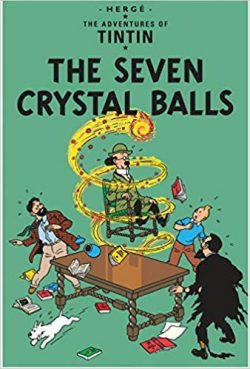
The Seven Crystal Balls sees affable old soak Captain Haddock returned to family manse Marlinspike Hall where he is adjusting (poorly) to his new-found wealth, and the prospect of exasperating Professor Cuthbert Calculus as his house-guest.

When Tintin and Snowy visit, a trip to the theatre embroils them all in a baffling enigma wherein the survivors of the South American Sanders-Hardiman Expedition all successively fall into comas due to an Incan curse and some rather suspect strangers. Tintin soon determines someone more solid than ethereal is causing the tragedies, but even he can’t stop the attacks, and soon he and his friends are also on the mysterious malefactor’s “to-do” list…

When Calculus is abducted from under their very noses, Haddock gives up his life of luxury and resumes adventuring once more, determined to help Tintin rescue their friend and solve the mystery.

Giving chase. they narrowly miss the villains at a seaport but still have a chance to beat the ship carrying Calculus if they board a sea-plane for Peru…

This is classic hairsbreadth storytelling. The pace is spellbinding and the ever-present slapstick actually serves to heighten the tension of the chase. The tale ends on a cliff-hanger, which is only right and proper. Still, imagine how you’d have felt all those decades ago when the conclusion was months away…


The helter-skelter drama continues in as, in the Port of Callao, Tintin and Haddock anxiously await the arrival of the freighter Pachacamac. However, when it arrives, suspected of carrying their kidnapped friend Cuthbert Calculus, the vessel flies a plague-pennant. There is Yellow Fever aboard and nobody can approach her!

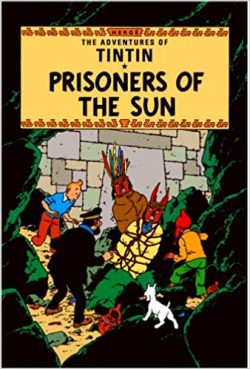
And so begins Prisoners of the Sun, epic conclusion of the maddening mystery of Inca curses and the doomed Sanders-Hardiman Expedition to South America…

Suspecting a trick, Tintin sneaks aboard and finds the Professor, only to be driven away by gunfire. After telephoning Haddock, he chases the abductors, leaving the Captain and inept detectives Thompson and Thomson to catch up if they can. The chase takes them deep into the beautiful, rugged country where they finally reunite, only to become the target of many murder attempts, and other methods of dissuasion.

Undaunted, Tintin and Haddock continue their trek towards the mountains, and are befriended by Zorrino, a young lad who risks his own life to help them cross valleys, mountain-ranges and jungles, dodging death from both beasts and men, until they are all finally captured by the last remnants of a lost, wondrous and deeply cautious civilisation…

This is an epic staggering in scope and breathtaking in execution. Whether drawing a battle, choreographing a pratfall or delineating a golden temple, the clean precise line of the art and the simplified colour palette makes every panel “realer-than real”, whilst the captivating imagination of the storytelling makes this a truly graphic narrative.

These are two of the best comic adventures of all time and they demand a place on every fan’s bookshelves.

The Seven Crystal Balls: artwork © 1948, 1975 Editions Casterman, Paris & Tournai.

Text © 1962 Egmont UK Limited. All Rights Reserved.

Prisoners of the Sun: artwork © 1949, 1977 Editions Casterman, Paris & Tournai.
Text © 1962 Egmont UK Limited. All Rights Reserved.

Bluecoats volume 1: Robertsonville Prison


By Lambil & Raoul Cauvin, translated by Erica Jeffrey (Cinebook)
ISBN: 978-905460-71-7

The mythology of the American West has never been better loved or more honourably treated than by Europeans. Hergé was a passionate devotee, and the range of incredible comics material from Tex Willer to Blueberry, Yakari to Lucky Luke display over and over again our fascination with all aspects of that legendary time and place.

Les Tuniques Bleues or Bluecoats began at the end of the 1960s, visually created by Louis “Salvé” Salvérius and scripted by Raoul Colvin – who has also written the succeeding 62 volumes of this much-loved Belgian comedy western series. The strip was created on the fly to replace the aforementioned Lucky Luke when the gunslinger defected from prominent weekly anthology Le Journal de Spirou to rival comic Pilote, and is one of the most popular series on the Continent.

After its initial run, Bluecoats graduated to the collected album format (published by French publishing powerhouse Dupuis) that we’re all so familiar with in Un chariot dans l’OuestA Wagon in the West – in 1972).

Salvé was an artist proficient in the Gallic style of big-foot/big-nose humour cartooning, and when he died suddenly in 1972 his replacement Willy “Lambil” Lambillotte gradually leavened the previous broad style with a more realistic – but still comedic – illustrative manner. Lambil is Belgian, born in 1936, and after studying Fine Art, joined Dupuis as a letterer in 1952.

In 1959 he created Sandy – about an Australian teen and a kangaroo – later self-parodying it and himself with Hobby and Koala and Panty et son kangaroo as well as creating the comics industry satire ‘Pauvre Lampil’.

Belgian writer Raoul Cauvin was born in 1938 and, after studying Lithography joined Dupuis’ animation department in 1960. His glittering and prolific writing career began soon after. Almost exclusively a humourist and always for Le Journal de Spirou, other than Bluecoats he has written at least 22 other long-running and award-winning series – more than 240 separate albums. Bluecoats alone has sold in the region of 20 million copies.

The protagonists are Sergeant Cornelius Chesterfield and Corporal Blutch, a hopeless double act of buffoons in the manner of Laurel and Hardy, or perhaps Abbot & Costello or our own Morecambe & Wise: two hapless and ill-starred cavalrymen posted to the wilds of the arid frontier.

The first strips were single-page gags based around an Indian-plagued Wild West fort but with the second volume Du Nord au Sud (North and South) the sorry soldiers went back East to fight in the American Civil War (this scenario was retconned in the 18th album Blue retro which described how the everyman chumps were first drafted into the military).

All subsequent adventures, although ranging all over the planet and taking in a lot of genuine and thoroughly researched history, are set within that tragic conflict.

Blutch is your average little man in the street: work-shy, reluctant and ever-critical of the army – especially his inept commanders. Ducking, diving, deserting when he can, he’s you or me – except sometimes he’s quite smart and heroic if no other easier option is available. Chesterfield is a big man, a career soldier, who has bought into all the patriotism and esprit de corps. He is brave, never shirks his duty and wants to be a hero. He also loves his cynical little pal. They quarrel like a married couple, fight like brothers and simply cannot agree on the point and purpose of the horrendous war they are trapped in…

Robertsonville Prison, the first release in the series from Cinebooks, is actually the sixth French volume. Available in paperback and digital formats, it’s loosely based on the actual Confederate-run Andersonville Prison compound in Georgia. It finds the irascible, inseparable pair captured after a calamitous battle and interned with many other Union soldiers. However, these two aren’t prepared to stay put – albeit for vastly differing reasons – and a series of increasingly bold and bonkers escape ploys eventually result in a crazy but appropriate reversal of fortunes…

The secret to the unbelievable success of Les Tuniques Bleues is that it is an anti-war comedy like M.A.S.H. or Catch 22, cleverly pitched at a young and less cynical audience. Historically authentic, uncompromising in terms of portrayed violence but always in good taste, the attitudes expressed by our oafish, down-to-earth anti-heroes never make glorious war anything but arrant folly and, like the hilarious yet insanely tragic war memoirs of Spike Milligan, these are comedic tales whose very humour makes the occasional moments of shocking verity doubly powerful and hard-hitting.

Fun, informative, beautifully realised and tellingly worthy, Bluecoats is the kind of battle book that any parent would be happy to let their children read – if they can bear to let go of it themselves…
© Dupuis 1975 by Lambil & Cauvin. English edition © 2008 Cinebook Ltd. All Rights Reserved.

Papyrus volume 2: Imhotep’s Transformation


By Lucien De Geiter, coloured by Colette De Geiter: translated by Luke Spear (Cinebooks)
ISBN: 978-1- 905460-50-2

Once you get a certain taste in your mind you just can’t stop – well I can’t – so here’s another all-ages Euro-classic saga just not available through American funnybooks these days – although you can now get it digitally…

British and European comics have always been happier with historical strips than our cousins across the pond (a pugnacious part of me wants to say that’s because we have so much more past to play with – and yes, I know they’re responsible for Prince Valiant, but it’s an exception, not a rule) and our Franco-Belgian brethren in particular have made an astonishing art form out of days gone by.

The happy combination of past lives and world-changing events blended with drama, action and especially broad humour has resulted in a genre uniquely suited to beguiling readers of all ages and tastes. Don’t take my word for it – just check out Asterix, Adèle Blanc-Sec, The Towers of Bois-Maury, Iznogoud or Thorgal to name the merest few which have made it into English, or even our own much missed classics such as Olac the Gladiator, Dick Turpin, Heros the Spartan or Wrath of the Gods …all long overdue for collection in mass market album form and on the interweb-tubes….

Papyrus is the spectacular magnum opus of Belgian cartoonist Lucien de Gieter. It began in 1974 in the legendary weekly Le Journal de Spirou, running to 35 albums, plus a wealth of merchandise, a television cartoon show and a video game.

The plucky “fellah” (look it up) was blessed by the gods and gifted with a magic sword courtesy of the daughter of crocodile-headed Sobek. His original brief was to free supreme Horus from imprisonment in the Black Pyramid of Ombos and thereby restore peace to the Two Kingdoms. More immediately however the lad was also charged with protecting Pharaoh’s wilful and high-handed daughter Theti-Cheri – a princess with an unmatchable talent for finding trouble…

De Gieter was born in 1932 and, studied at Saint-Luc Art Institute in Brussels, before going into industrial design and interior decorating. He made the logical jump into sequential narrative in 1961, first through ‘mini-récits’ inserts (fold-in, half-sized-booklets) for Spirou, of his jovial little cowboy Pony, and later by writing for established regulars as Kiko, Jem, Eddy Ryssack and Francis.

He then joined Peyo’s studio as inker on Les Schtroumpfs – AKA The Smurfs – and took over the long-running newspaper strip Poussy.

In the mid-1960s he created South Seas mermaid fantasy Tôôôt et Puit even as Pony was promoted to the full-sized pages of Spirou, so De Gieter deep-sixed his Smurfs gig to expand his horizons producing work for Le Journal de Tintin and Le Journal de Mickey.

From 1972-1974 he assisted cartooning legend Berck on Mischa for Germany’s Primo, whilst putting the finishing touches to his new project. This creation would occupy his full attention – and delight millions of fervent fans – for the next 40 years.

The annals of Papyrus encompass a huge range of themes and milieus: blending boys-own adventure with historical fiction and interventionist mythology, gradually evolving from traditionally appealing “Bigfoot” cartoon content towards a more realistic, dramatic and authentic iteration. Throughout, these light fantasy romps depict a fearlessly forthright boy fisherman favoured by the gods as a hero of Egypt and friend to Pharaohs.

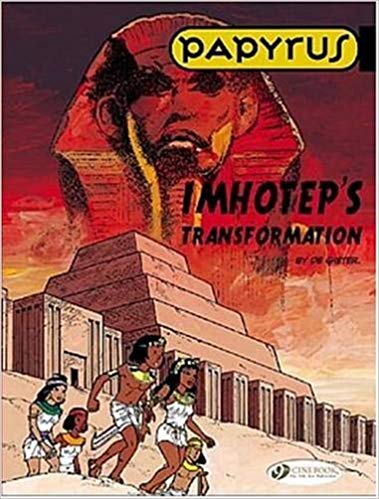
Imhotep’s Transformation was the second Cinebook translation (and 8th yarn, originally released in 1985 as La Métamorphose d’Imhotep): opening with our hero and his one-legged friend Imhotep (no relation) paddling a canoe through the marshes of the Nile.

The peaceful idyll is wrecked when Theti-Cheri and her handmaidens hurtle by in their flashy boat, but the boys don’t mind as they have a message for the princess.

The new holy statue of her father has arrived from the Priests of Memphis and the daughter of Heaven is required at the ceremony to install it at the pyramid of Saqqara before the annual “Heb Sed” King’s Jubilee.

As the girls and boys race back, an old peasant is attacked by a crocodile. Diving after him, Papyrus wrestles the reptile away and is about to kill it when Sobek appears, beseeching him to spare it.

On the surface Theti-Cheri and her attendants are ministering to the aged victim and the princess can’t help noticing how he bears an uncanny resemblance to her dad…

By the time they all reach the pyramid, the monumental task of hauling the statue into place is well under way, but suddenly blood begins pouring out of the monolith’s eyes. Terrified workers panic and the colossal effigy slips, crashing to destruction. The populace are aghast and murmurs of curses and ill omens abound…

Rather than running away, Imhotep heads for the rubble and discovers the statue’s head is hollow. Moreover, inside there is a dead dwarf and a smashed flask which had held blood…

Papyrus is in the royal compound where the recent events have blighted the anticipation of the court. During Heb Sed, the Pharaoh has to run around the sacred pyramid three times and fire his bow at the four corners of the kingdoms to prove his fitness to rule, but now it appears the gods have turned against their chosen emissary on Earth…

Papyrus is not so sure and when he tries to speak to a royal server the man bolts. Giving chase, the lad is in time to prevent the attendant’s murder, but not his escape.

And then a cry goes up: Pharaoh has been poisoned…

Knowing there is no love lost between the Memphis Priests of Ptah and the loyal Theban clerics doctoring the fallen king, Papyrus warns of a possible plot, but has no proof. What is worse, Chepseska, leader of the Memphis faction, is of royal blood too and will inherit if Pharaoh is unable to complete the Heb Sed ritual…

As loyal physicians and priests struggle to save their overlord’s life, Theti-Cheri remembers the old man in the swamp. If only the crocodile bite has not left him too weak to run…

The doughty dotard is willing to try and also knows of a wise woman whose knowledge of herbs can cure Pharaoh, but ruthless Chepseska is on to the kids’ ploy and dispatches a band of killers to stop Papyrus and Imhotep.

The gods, however, are behind the brave lads and after the assassins fall to the ghastly judgement of Sobek, the boys rush an antidote back to Saqqara, only to fall into the lost tomb of Great Imhotep, first Pharaoh, builder-god and divine lord of the Ibis.

With time running out for his distant descendent, the resurrected ruler rouses himself to administer justice for Egypt and inflict the punishment of the gods upon the usurpers…

This is an amazing exploit to thrill and astound fans of fantastic fantasy and bombastic adventure. Papyrus is a brilliant addition to the family-friendly pantheon of continental champions who marry heroism and humour with wit and charm, and anybody who has worn out those Tintin or Asterix volumes would be wise beyond their years in acquiring these classic chronicles tales.

…And Cinebook would be smart to keep on translating these magical yarns, too…
© Dupuis, 1985 by De Gieter. All rights reserved. English translation © 2008 Cinebook Ltd.

Valerian – The Complete Collection volume 4


By J.-C. Méziéres & P. Christin with colours by E. Tranlé: translated by Jerome Saincantin (Cinebook)
ISBN: 978-1-84918-391-8

Valérian: Spatio-Temporal Agent first took to the skies and timestream in 1967 in the November 9th edition of Pilote (#420): in an introductory tale which ran until February 15th 1968. Although a huge hit, graphic album compilations only began with second tale – The City of Shifting Waters – as the creators concerned considered the first yarn more a work-in-progress and not quite up to their preferred standard.

You can judge for yourself by getting hold of the first hardcover compilation volume in this cinematic tie-in sequence. Or you can consider yourself suitably forward-looking and acquire one of the eBook editions…

The groundbreaking series followed a Franco-Belgian mini-boom in science fiction comics triggered by Jean-Claude Forest’s 1962 creation Barbarella. Other notable hits of the era include Greg & Eddy Paape’s Luc Orient and the cosmic excursions of Philippe Druillet’s Lone Sloane, which all with Valérian in the vanguard – boosted public reception of the genre and led, in 1977, to the creation of dedicated fantasy periodical Métal Hurlant.

Valérian and Laureline (as the series became) was a light-hearted, wildly imaginative time-travel adventure-romp (a bit like Doctor Who, but not really so much), drenched in wry, satirical, humanist and political social commentary. The star – at least initially – was an affable, capably unimaginative by-the-book cop tasked with protecting universal timelines and counteracting paradoxes caused by casual, incautious or criminally minded chrononauts…

In the course of that debut escapade, Valerian picked up impetuous, sharp-witted peasant lass Laureline, who originated in the 11th century before becoming our hero’s assistant and deputy. In gratitude for truly invaluable assistance, he brought her back to the 28th century super-citadel and administrative capital, Galaxity, where the feisty firebrand took a crash course in spatiotemporal ops before accompanying him on his cases…. luckily for him.

This fabulous fourth oversized hardback compendium – also available digitally – once again boasts a wealth of text features, beginning with Stan Barets’ deconstructive assessment ‘Whimsical Stories with Strong Themes…’ More follows with further discourse, all supplemented with photos sketches, designs and reference material in ‘Towards the End of History?’, ‘Constantly Renewed Questions’ and retrospective overview ‘Châtelet Station: A Great Spatial and Temporal Shift’. Glittering prizes are assessed in ‘The Consecration of Angoulême’ and are followed by ‘Space Grunts’: a short complete war story from Metal Hurlant, highlighting the creative highpoints and methodology of author/illustrator Méziéres before the main event kicks off…

The opening shot in the series’ first truly extended saga, Châtelet Station Destination Cassiopeia, was originally serialised in the monthly Pilote (#M47 to M50: 21st March to June 27th 1978) before being collected later that year as 8th album Métro Châtelet Direction Cassiopée. The story concluded in follow-up album Brooklyn Line Terminus Cosmos which happily follows…

It all begins with the partners far apart in time and space. Laureline pensively journeys to the fabulous Cassiopeia system, just for once enjoying the many wonders of space as she travels at sub-light speed through the phenomenally populous yet cosmically fragile region.

Her trip to Solum is broken up by many stopovers as she cautiously gathers snippets of gossip which cohere to reveal an unsettling trend: subtly voiced concerns that some merchants are pushing strange and dangerous technologies on buyers extremely unsuited to possess them…

Although separated by centuries and light-years, Laureline and Valerian are enjoying impossibly intimate contact. Thanks to Terran ingenuity – and recent neurosurgeries – the partners are telepathically linked and sharing information on the mission.

His mission is playing out in Paris of 1980, where Valerian idly observes the variety of human types frequenting the café he impatiently haunts; constantly reminded how little he knows or understands the people and history of his birthworld.

Things aren’t helped by the volubly affable, infuriatingly unrushed and always tardy Mr. Albert. Galaxity’s man-in-the-moment is a sort of human X-Files: investigating, sifting and collating incalculable amounts of data on everything Fringe, Strange or Whacky which occurs in the 20th century he has adopted as a home-away-from-home.

Breaking contact with Laureline, Valerian learns from the verbose nerd that appalling, monstrous manifestations have been terrorising the world and now this city’s subway system. Sensing action at last, the impulsive hero rushes to the site of the latest occurrence, abandoning Albert to follow up on something which has piqued the elder’s scholarly curiosity. Both are blithely unaware that a suspect band of not-so-ordinary Parisians with similar interests are mere metres ahead of them…

What Valerian confronts is a horrific thing out of the inferno, but even it is not immune to the futuristic weaponry he’s carrying in kit form. All he has to do is assemble it before being eaten…

In the aftermath, Albert acts quickly to extract the wounded hero from hospital before doctors and cops start asking too many of the right questions. Later, over a luxurious dinner, the epicurean investigator shares a sheaf of files and clippings of monster and UFO sightings which only hint at why Valerian is stuck in a temporal backwater whilst his partner is covering colossal Cassiopeia alone…

Synching up again later despite constant headaches, Valerian hears Laureline tell of the incredible inhabitants of Solum and her candid interview with the living memory of the race, as well as sundry other wonders before contact is explosively ended by a phone call from Albert warning him that he is being watched…

After deftly dodging his tail, Valerian receives a most distressing communication from Laureline. Her pleasant chat with the memory of Solum has uncovered news of a planet which long ago endured a similar plague of mysterious manifestations. It doesn’t exist anymore…

Therefore, she’s off to incomprehensibly vile universal garbage dump Zomuk in pursuit of another promising lead, but before Val can warn her to stay away from the junk world, mind-contact is lost…

At that 20th century moment, Val and Mr. Albert are embarking on a bus ride to rural wetland idyll Doëre-la Rivière in search of marsh-monsters and dragons, only to surprisingly discover no accommodation available in the usually dead-in-the-off-season resort.

All rooms have been taken by scientists working for W.A.A.M (World American Advanced Machines): a mega-corporation in contention with the ubiquitous multinational Bellson & Gambler.

Both companies keep cropping up in Albert’s files of the weird and unexplained…

Soon the mismatched spatio-temporal operatives are trudging through acres of misty mire, encountering young Jean-René who offers to lead them to the infamous monster everybody is searching for.

When they find the Brobdingnagian beast, only Valerian’s disintegrator saves their lives. They quickly return to Albert’s paper-&-scrap-packed Paris flat, where the quirky researcher decides its time his impatient young colleague meets the secret source: a bizarre modern mystic and seer named Chatelard who cannily points out affinities between the manifestations met so far and the classical ancient concept of The Four Elements…

He also points out that one could call highly ranked corporate businessmen the “hidden high priests of today’s world”, whilst mentioning that a pretty blonde woman from abroad recently offered him a lot of money for the same insights…

Later, as Albert sifts through the precious papers, reviewing all he has on Bellson & Gambler, frantic Valerian finally re-establishes contact with Laureline, just as she concludes an epic struggle against ghastly odds and enters a hidden shrine to gaze upon fantastic representations of Four Elemental Forces which underpin the universe…

Once again contact is broken and in a petulant rage the astral adventurer storms out into the Parisian night. Utterly oblivious to the fact that he is being followed by enigmatic figures in an expensive automobile, he accepts a lift from a pretty girl in a sports car…

To Be Concluded…

Bold, mind-boggling and moodily mysterious, this splendid change of pace accentuates the deadly dangers which underscore this astonishingly imaginative series; eschewing the usual concentration on witty japery and politico-philosophical trendiness in favour of mounting suspense, bubbling paranoia and stark suspense with mesmerising effect…

Brooklyn Line Terminus Cosmos was the tenth Cinebook translation: originally serialised in Pilote #M70 – M73 (March to June 1980) before being released as an album.

After a full recap the story resumes some relative hours later as Laureline finally wakes her slumbering, cosmically distant partner. She is psychically aware of the woman sleeping beside him and takes great pleasure in razzing him on his conquest “in the line of duty”…

Fun over, Laureline imparts crucial information: the puissant yet debased ancients of Zomuk now seemingly worship two strange new godlike beings and are sharing with them the awesome power of Elemental artefacts they have preserved for centuries. Sadly, she suspects the lordly strangers are far from divine and have extremely venal – if not outright criminal – motives for their attentiveness.

Moreover, when the deities started squabbling over the potent offerings, the native Zoms start smelling rats too…

As Laureline tracks the impostors deep into a region dominated by astral pirates and fugitives, Valerian returns to his new companion, suspicious that she also is not what she seems…

He’s not wrong. The highly competent Miss Cynthia Westerly is highly placed in one of the corporations pursuing the uncanny phenomena plaguing Paris, but is oblivious to the fact that the big oaf she thought safely seduced and abandoned is actually following when she heads for the Pompidou Centre to attempt capture of the next Elemental manifestation.

As he trails her, Valerian becomes aware that her rivals are in pursuit and plays a very deft trick to throw them all off guard…

Rendezvousing with Albert, the Spatio-Temporal Agent gets his hands on the surprisingly compact “Creature of Air and Dreams” before anybody else, but the brief contact leaves him changed and damaged…

As Albert hustles him away, Valerian slips into tenuous contact with Laureline but the communication is oddly garbled, since his consciousness is simultaneously wandering the timelines: glimpsing events from his past and many which have yet to occur…

His bewildering loss of temporal continuity continues even as Albert drags the dazed hero onto a jet, heading for a final confrontation with the warring corporate cliques. The entire journey is punctuated with bizarre visions which Laureline is forced to share, and on arrival in New York Albert takes the debilitated agent to see an old friend: aged Kabbalah scholar Schlomo Meilsheim who has some ideas on a remedy for the increasingly escalating condition…

The situation has not gone unnoticed by the voracious corporations either. With their grand schemes of profitable new proprietary energy sources threatened, they have instigated a mass convocation of every fringe scientist, modern mystic, seer, religious nut and new age quack in the country: a last-ditch attempt to regain control of those elemental forces currently tormenting Valerian…

Naturally Schlomo is invited too and brings his friends along to the desolate, snow-swept reaches of Brooklyn. When Val wanders off, terse communication with Laureline reveals the truth about his latest visions and the dangers she’s been battling single-handed in pursuit of the faux gods.

Now as Elementals catastrophically manifest amongst the massed mystics, she enacts a bold plan to cut off the problem at source; severing the uncanny connection between devastating forces devised by the Zoms and its unfortunate link to unwary, unhappy 20th century Earth…

Sly, subtle, brilliantly mind-boggling and moodily mysterious, this sharp saga is a trans-time tale of subtle power, dripping with devilish wit, but no matter how trenchant, barbed, culturally aware or ethically crusading, Valerian and Laureline yarns never allow message to overshadow excitement or entertainment. This is one of the most memorable romps you could ever imagine and there’s even better to come…

Les Spectres d’Inverloch originally appeared in Pilote #M110-117, (spanning July 1983 to February 1984) and opens here as Laureline enjoys the comforts of a palatial manor in Scotland, somewhere at the tail end of the 20th century. Unflappable dowager Lady Charlotte is a most gracious host and happily shares every benefit of life in Clan McCullough, even though her young charge can’t help but wonder why she has to cool her heels with the old biddy in this odd time and place…

Once again, the Spatio-Temporal partners-in-peril are separated by eons and light years. Valerian is at the other end of everything: impatiently stuck on water-world Glapum’t, trying to capture a hulking aquatic beast who easily defies his every stratagem. Finally, once brute force, commando tactics and super-science have all proved ineffectual, the frustrated agent tries bribery. Naturally, the tasty morsels he offers are heavily drugged…

However, as he carries the second phase of his orders, a real problem crops up. Valerian can’t establish contact with Galaxity…

Far ago and elsewhere, London is enduring a paralysing wave of industrial actions. The strikes are particularly galling to volubly affable, infuriatingly unrushed and always tardy Mr. Albert. Galaxity’s 20th century information gatherer/sleeper operative is trying to get to Scotland, but wonders if he’s ever going to get out of the English capital…

On far-flung Rubanis, dictatorial secret police chief Colonel Tlocq is having a duel of wits with the engagingly ruthless data-brokers known as the Shingouz. Naturally, the spymaster is utterly outmanoeuvred by the devious little reptiles who gleefully take off with the secret they required. All-in-all, they are rather enjoying working for Earth…

Way back in West Virginia, Lady Charlotte’s husband Lord Seal is consulting with the CIA. The dapper Briton is a past master of “tradecraft” and remains unperturbed even after reviewing the terrifying situation facing both Communist Bloc and Free World. Something is making all persons in charge of nuclear weapons – politicians and military alike – go mad. There have been numerous near-misses and even a couple of swiftly hushed-up actual disasters on both sides of the Iron Curtain. Moreover, the Americans have got hold of strange little devices used to cause the insanity. Somebody is deliberately trying to spark atomic Armageddon…

Only the veteran spy’s swift actions prevent the entire assembly going the same way, when a concealed insanity-gadget goes off during their top-secret meeting…

As Seal jets off home, the scene switches to Galaxity. The super-city, impregnable bastion of human dominance, is deserted. Only its supreme master remains, and as the fortress and Terran empire start dissolving into nothingness, he makes a desperate jump into time…

On a clear autumn afternoon, Lady Charlotte and Laureline are enjoying the view from Castle Inverloch’s rear windows when the immaculate, lovingly-manicured-for-centuries lawns are wrecked by the crash-landing of a Shingouz shuttle. Naturally, the visitors are granted every gracious vestige of hospitality, even after Lord Seal arrives in flamboyantly bombastic fashion and sees what’s become of his beloved grass…

Aplomb and grace under pressure alone cannot account for the elderly couple’s acceptance, and when Albert pops in and Valerian shows up – much to the detriment of what remains of the lawns – it becomes clear that the elderly gentry know much more about the workings of the universe than everybody else in this century…

Even the previously-captive Glapumtian – who likes to be called “Ralph” – has a part to play in the baffling, pre-ordained proceedings.

What exactly that means starts to become clear after Lord and Lady Seal introduce their outré guests to the legendary ghost of Inverloch. Valerian usually just calls him “boss”…

Soon the Spatio-Temporal Agents are being made painfully aware of a monumental threat to the universe which has already unmade the events leading to the birth of Galaxity and the Terran Empire and which now poses a threat to all that is…

To Be Concluded…

Smart, subtle, complex and frequently hilarious, this sharp trans-time tale beguilingly lays the groundwork for an epic escapade. This is one of the most memorable romps Méziéres & Christin ever concocted, and heralded the start of a whole new way to enjoy the future…

The Wrath of Hypsis concludes a landmark tale and marks a turning point in the ongoing epic. Initially every Valérian adventure began as a serial in Pilote before being collected in album editions, but after this adventure from 1985, the publishing world shifted gears. From the next tale and every one thereafter, the mind-bending sagas were released as all-new complete graphic novels. The switch in dissemination affected all popular characters in French comics and almost spelled the end of periodical publication on the continent…

One clarification: canonically, “Hypsis” is counted as the twelfth tale, due to the collected albums being numbered from The City of Shifting Waters: the second actual story but the first to be compiled in book form. When Bad Dreams was finally released as a European album in 1983, it was given the number #0.

Les Foudres d’Hypsis originally appeared in Pilote #M128-135, (January to September 1985): an action-packed yet trenchant romp resetting a growing paradox that had been slowing building since The City of Shifting Waters…

In previous volume The Ghosts of Inverloch, Galaxity was eradicated from reality by agents unknown, leaving only the Chief of the Spatio-Temporal Service to plunge back in time to 1986: the chronal crisis-point which triggered the disaster.

Spatio-Temporal partners-in-peril Valerian and Laureline joined him by extremely convoluted paths after gathering a trio of Shingouz traders and affable, aquatic super-mathematician Ralph from different eras and galactic backwaters.

They all met up at Inverloch Castle, far from escalating petty crises and a mounting unrest afflicting Earth that would soon peak with the melting of the polar ice-caps, destruction of modern human civilisation and consequent birth-pangs of Galaxity.

The Scottish citadel was home to British intelligence supremo Lord Seal, his brilliant wife Lady Charlotte and guest Mr. Albert. This distinguished, exceptional band had gathered to prevent Earth’s devastation but Galaxity’s sudden disappearance added even greater urgency to the mission…

The tale continues here as the strange crew review the worsening situation. Nuclear powers across Earth are experiencing inexplicable, potentially fatal malfunctions. Alien objects keep appearing in random locations and – thanks to the extraterrestrial input of Seals visitor’s – they can now lay blame upon the machinations of Hypsis: an enigmatic planet constantly perambulating from system to system, quadrant to quadrant…

Seal’s contacts have narrowed down the potential crisis point to one of a number of ships in the Arctic. Soon the odd allies are covertly heading north in British weather ship HMS Crosswinds…

Thanks to Ralph’s talents and growing friendship with a pod of Orcas, the maritime search is gradually narrowed down and before long Crosswinds closes in on a quaint schooner named Hvexdet… and none too soon.

The time-displaced Chief has locked himself in his cabin, Valerian is wracked by nightmares of vanished Galaxity and numerous doomed Earths whilst the gambling-addicted Shingouz have almost won or traded everything aboard ship not bolted down or welded on…

Cornering the Hvexdet in a field of pack ice, dauntless Captain Merryweather gives orders to ram, spooking the schooner into blasting off into space and instituting devastating retaliation. It’s what the Chief has been waiting for. With Crosswinds sinking and the crew heading for the lifeboats, he orders Valerian, Laureline, Seal, Albert, the Shingouz and Ralph to join him in the astroship: following the invaders’ flight to find nomadic Hypsis…

Pursuit is erratic and convoluted until Valerian has the idea of linking Ralph to the ship’s systems to predict Hvexdet’s final destination. It works perfectly and before long the astroship touches down on a strange, rocky world with immense towers dotting the landscape.

And that’s where things get really strange as Valerian learns why Earth was scheduled for nuclear meltdown, meets the incredible true owners of the troubled birthplace of humanity and watches in astonishment as Albert, Laureline and the Shingouz negotiate an unbelievable deal which saves Earth, but not (necessarily) his beloved and much-missed home Galaxity…

Astute fans will realise that this ripping yarn was writer Pierre Christin and artist Jean-Claude Méziéres’ way of rationalising the drowned Earth of 1986 (as seen in 1968 adventure The City of Shifting Waters) with the contemporary period that they were now working in. It also gave them an opportunity to send Valerian and Laureline in a new direction and uncharted creative waters…

To Be Continued…

Smart, subtle, complex and frequently hilarious, these sharp trans-time tales beguilingly blend outrageous satire with blistering action, and deft humour with cosmic apostasy: utterly reenergising what was already one of the most thrilling sci fi strips in comics. The Wrath of Hypsis and its successors are the most memorable romps Méziéres & Christin ever concocted, heralding the start of a whole new way to go back to the future…

These stories are some of the most influential comics in the world, timeless, thrilling, funny and just too good to be ignored. The time is now and there’s no space large enough to contain the sheer joy of Valerian and Laureline, so go see what all the fuss is about right now…
© Dargaud Paris, 2017 Christin, Méziéres & Tran-Lệ. All rights reserved. English translation © 2018 Cinebook Ltd.

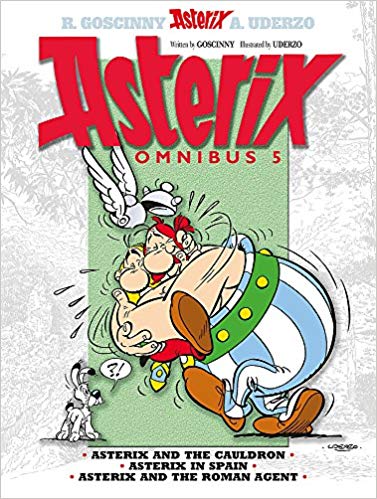
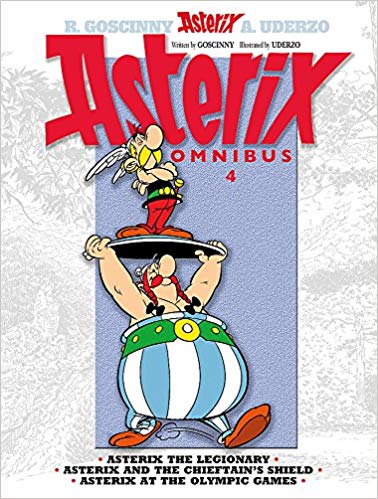
Asterix Omnibus volume 4: Asterix the Legionary; Asterix and the Chieftain’s Shield; Asterix at the Olympic Games


By René Goscinny & Albert Uderzo, translated by Anthea Bell & Derek Hockridge (Orion)
ISBN: 978-1-44400-428-1 (HB)                    978-1-44400-487-8 (PB)

Asterix the Gaul is one of Europe’s – more specifically France’s – most exciting and rewarding contributions to global culture: a cunning little paragon of the underdog spirit who resists the iniquities, experiences the absurdities and observes the myriad wonders of Julius Caesar’s Roman Empire with brains, bravery and a magic potion bestowing incredible strength, speed and vitality. The savvy smarts are all his own…

One of the most-read comics in the world, his chronicles have been translated into more than 100 languages (including Latin and ancient Greek for educational purposes); with 14 live-action and animated movies, 55 board and video games and even into his own theme park (Parc Astérix, near Paris).

More than 370 million copies of 37 Asterix books have sold worldwide, making Goscinny & Uderzo France’s bestselling international authors.

The diminutive, doughty hero was created by two of the art-form’s greatest masters, René Goscinny & Albert Uderzo who were already masters of the form and at the peak of their creative powers. Although their perfect partnership ended in 1977 with the death of the terrifying prolific scripter Goscinny, the creative wonderment still continues – albeit at a slightly reduced rate of rapidity.

Asterix launched in 1959 in the very first issue of Pilote (with a teaser premiere page appearing a week earlier in a promotional issue #0). The feature was a massive hit from the start. Initially Uderzo continued working with Charlier on Michel Tanguy, (Les Aventures de Tanguy et Laverdure), but soon after the first epic escapade was collected as Astérix le gaulois in 1961, it became clear that the series would demand most of his time – especially as the incredible Goscinny never seemed to require rest or run out of ideas (after the writer’s death the publication rate dropped from two books per year to one volume every three to five).

By 1967 the strip occupied all Uderzo’s time and attention. In 1974 the partners formed Idéfix Studios to fully exploit their inimitable creation and when Goscinny passed away three years later Uderzo was, after much effort, convinced to continue the adventures as writer and artist, producing a further ten volumes.

Like all great literary classics, the premise works on multiple levels: younger readers enjoying an action-packed, lavishly illustrated comedic romp of sneaky, bullying baddies getting their just deserts whilst crustier readers enthuse over the dry, pun-filled, sly and witty satire, enhanced for English speakers by the brilliantly light and innovative touch of master translators Anthea Bell & Derek Hockridge who played no small part in making the indomitable Gaul so palatable to the Anglo-Saxon world. (Personally, I still thrill to a perfectly delivered punch in the bracket as much as a painfully swingeing string of bad puns and dry cutting jibes…)

Asterix the Gaul is a cunning underdog who resists the iniquities, experiences the absurdities and observes the myriad wonders of Julius Caesar’s Roman Empire with brains, bravery and a magic potion. The stories were set on the tip of Uderzo’s beloved Brittany coast around the year 50 BCE, where a small village of redoubtable warriors and their families resist all efforts of the Roman Empire to complete their conquest of Gaul. Unable to defeat these Horatian hold-outs, the Empire resorts to a policy of containment and the little seaside hamlet is perpetually hemmed in by the heavily fortified garrisons of Totorum, Aquarium, Laudanum and Compendium.

The Gauls don’t care: they daily defy the world’s greatest military machine by just going about their everyday affairs, protected by a magic potion provided by the resident druid and the shrewd wits of a rather diminutive dynamo and his simplistic best friend…

Firmly established as a global brand and premium French comics export by the mid-1960s, Asterix the Gaul continued to grow in quality as Goscinny & Uderzo toiled ever onward, crafting further fabulous sagas; building a stunning legacy of graphic excellence and storytelling gold.

In late 1966 they began Asterix the Legionary (running in Pilote #368-389), which was later adapted as half of the plot for the movie Asterix Vs Caesar (the other album incorporated into the animated epic being Asterix the Gladiator).

This clever romp introduced the destabilising concept of true romance to the doughty hero and his prodigious pal Obelix as, whilst boar hunting in the great forest around their unconquerable village, they encounter the fabulously beautiful Panacea picking mushrooms.

The little darling has freshly returned to the village after years away in Condatum, and the sheltered Obelix is instantly smitten. Dazed and confused by the only force that could ever affect him, the gentle giant is teased by Asterix and venerable druid Getafix, but innocently undaunted, Obelix begins bringing the oblivious lass a succession of inappropriate presents…

When the befuddled buffoon finds Panacea crying, he dashingly volunteers to mend her woes. Tragically for him, the problem is a boyfriend named Tragicomix, who has been pressed into military service with the Roman Army…

Where other men would take advantage of the hopeless situation, Obelix, afflicted with True Crush, determines to make her happy and rushes off to rescue her lost beau. Ever faithful, Asterix and diminutive canine companion Dogmatix accompany the big oaf… to keep him out of trouble…

In Condatum, they discover Tragicomix has already been shipped out to Africa where Caesar battles fellow Roman Scipio in a clandestine Civil War. Asterix realises the only way to find Tragicomix is to enlist in the Roman Army, too…

In Basic Training they meet a motley assortment of fellow recruits – all gently-contrived national stereotypes – allowing for a broad bombardment of friendly ethnic comedy and graphic accent humour. There was Neveratalos the Greek, Goths Allegoric and Hemispheric, Gastronomix from Belgium, Selectivemploymentax the Briton and poor Ptenisnet the Egyptian, who doesn’t know the language and thinks he joined a holiday package tour…

After lashings of their unique brand of anarchy disrupting regulation army life, Asterix, Obelix and crew ship out to Africa. When they arrive, the war is going badly for Caesar, but more importantly, Tragicomix has gone missing: believed captured by Scipio’s forces…

With magic potion in hand, Asterix, Obelix and Dogmatix take matters in hand…

A hilariously engaging yarn with delicious overtones of the iconic British comedy Carry On Sergeant, this action-packed farce is big on laughs but harbours a bittersweet core that will tug at the heartstrings of young and old alike…

Asterix and the Chieftain’s Shield (originally entitled Le bouclier arverne) was the 11th epic outing for the Greatest French Hero of Them All: debuting in Pilote #399 and running until #421 in 1967. It acts as a tongue-in-cheek patriotic history lesson and opens years before the usual setting of Asterix tales as Gaulish over-chief Vercingetorix surrenders to Caesar at the Battle of Alesia. This he does by throwing down his weapons and armour at the Conqueror’s feet. It’s the start of a lengthy running gag…

Such is the shame of the defeated Gauls that the location of the clash is excised from their memories. Now, nobody remembers where Alesia was…

After the battle, the accoutrements lay where they fell until a greedy Legionary stole the Great Shield, subsequently losing it in a game of dice. From there, the legendary buckler passes through many scurrilous hands before fading into legend…

Jumping to “modern” times, in the village of indomitable Gauls Chief Vitalstatistix is terribly ill: a sedentary life of over-indulgence has ruined his liver and since Getafix’s druidic potions can’t help him, he has to go to the spa town of Aqua Calidae (Arverne) for a rest-cure and diet.

It isn’t all bad though, since his forthright wife Impedimenta has to stay behind….

As a chief he needs an honour guard and Asterix, Obelix and Dogmatix are happy to accompany him, especially as the chief uses the journey to test all the inns and taverns en route. Once there though, the warriors’ robust consumption and boisterous high jinks appals all the dieting dignitaries and impatient patients, so Asterix and Obelix are summarily kicked out of the Health Resort.

Footloose and fancy-free, the boys tour the local countryside of Gergovia, idly trying to find the lost site of Alesia until they encounter Roman envoy Noxius Vapus and his cohort. After indulging in their favourite sport of Roman-bashing, the lads befriend local merchant Winesandspirix – a veteran of Alesia – while Noxius hightails it to Rome to tell Caesar the Gauls are revolting…

({   } This space provided for you to fill in your own joke)…

Set on putting the Gauls in their place and reminding them who’s boss, Caesar determines to hold a Roman Triumph with the shield of Vercingetorix as the centrepiece. He’s none too happy when he discovers it’s been missing for years…

And thus begins the second stage of this hilariously thrilling detective mystery as the Romans frantically hunt for the missing artefact and Asterix and Obelix set out to thwart them at every turn…

No prizes for guessing which faction succeeds and who scurries home in defeat and disgust in this marvellously slapstick saga with a delightfully daft twist ending…

Asterix at the Olympic Games first appeared weekly in Pilote #434-455, serialised in 1968 to coincide with and capitalise upon the Mexico City Games. The translated British album was released four years later, just before the 1972 Munich Olympiad.

The Romans of Aquarium garrison are in an ebullient mood. Their comrade Gluteus Maximus has been selected to represent Rome at the Greeks’ Great Games in Olympia. Centurion Gaius Veriambitius is happy too, because he knows if Gluteus wins, they can both write their ticket in Rome…

It all starts to go horribly wrong when the Roman superman is bested and humiliated by Asterix and Obelix whilst training in the Great Forest. His confidence shattered, Gluteus returns to Aquarium and only regains a modicum of his old form when Veriambitius reminds him that the potion-fuelled Gauls won’t be at the Games…

Meanwhile, the men of the village have decided to go to Olympia and have a go themselves…

There follows an uproarious and nigh-scandalous sequence of events as the unbeatable Greeks try to placate their Roman overlords; the Latin competitors undergo the tortures of the arrogant damned to cheat, wheedle and somehow exclude the all-conquering Gauls, whilst the basically honest and honourable Asterix devises a cunning yet fair way to beat the politically motivated, greed-inspired “sportsmen” and still uphold the best traditions and ideals of the Olympic Games.

Guess who wins…

Spoofing package tours, obnoxious tourists, self-serving sports authorities and doping scandals in equal proportion, this sparkling escapade features some of Uderzo’s most inspired art as he recreates the grandeur and glory of the Ancient World whilst simultaneously graphically lampooning the haughty elites of the Sporting World, the Military and Politics. A genuine classic far more valuable than any medal and a bit sturdier than laurel leaf crowns…

Asterix volumes are always stuffed with captivating historical titbits, soupcons of healthy cynicism, singularly surreal action and splendidly addictive adventure, illustrated in a magically enticing manner. These are perfect comics that everyone should read over and over again.
© 1967-1969 Goscinny/Uderzo. Revised English translation © 2004 Hachette. All rights reserved.

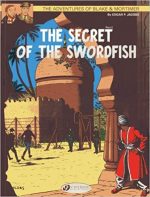
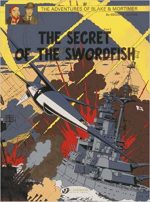
The Adventures of Blake and Mortimer: The Secret of the Swordfish


By Edgar P. Jacobs, coloured by Philippe Biermé & Luce Daniels, translated by Jerome Saincantin (Cinebook)
ISBNs: 978-1-84918-148-8, 978-1-84918-161-7 and 978-1-84918-174-7

Belgian Edgard Félix Pierre Jacobs (1904-1987) is rightly considered one of the founding fathers of the Continental comics industry. Although his output is relatively meagre when compared to some of his contemporaries, the iconic series he worked on formed the basis and backbone of the art-form in Europe, and his splendidly adroit, roguish and impeccably British adventurers Blake and Mortimer, created for the first issue of Le Journal de Tintin in 1946, swiftly became a staple of post-war European kids’ life the way Dan Dare would in Britain in the 1950s.

Edgar P. Jacobs was born in Brussels, a precocious child who began feverishly drawing from an early age but was even more obsessed with music and the performing arts – especially opera. He attended a commercial school but – determined never to work in an office – pursued art and drama following his graduation in 1919.

A succession of odd jobs at opera-houses – scene-painting, set decoration, acting and singing as an Extra – supplemented his private performance studies, and in 1929 Jacobs won a Government award for classical singing. His proposed career as an opera singer was thwarted by the Great Depression, however, as the arts took a nosedive following the stock market crash.

Picking up whatever stage work was going – including singing and performing – Jacobs switched to commercial illustration in 1940. Regular employment came from the magazine Bravo. While illustrating short stories and novels, he famously took over the syndicated Flash Gordon strip, after the occupying German authorities banned Alex Raymond’s quintessentially All-American Hero and left the publishers desperately seeking someone to satisfactorily complete the saga.

Jacob’s Stormer Gordon lasted less than a month before being similarly sanctioned by the Nazis, after which Jacobs created his own epic science-fantasy feature in the legendary Le Rayon U: a milestone in both Belgian comics and science fiction adventure.

The U Ray was a huge hit in 1943 and scored big all over again a generation later when Jacobs reformatted the original “text-block and picture” material to incorporate speech balloons and re-ran the series in Le Journal de Tintin with subsequent releases as a trio of graphic albums in 1974.

I’ve read differing accounts of how Jacobs and Tintin creator Hergé got together – and why they parted ways professionally, if not socially – but as to the whys and wherefores of the split, I frankly don’t care. What is known is this: whilst creating the weekly U Ray, one of Jacob’s other jobs was scene-painting, and during the staging of a theatrical version of Tintin and the Cigars of the Pharaoh Hergé and Jacobs met and became friends. If the comics maestro was unaware of Jacob’s comics output before then, he was certainly made aware of it soon after.

Jacobs began working on Tintin, colouring the original monochrome strips of The Shooting Star from newspaper Le Soir for a forthcoming album collection. By 1944, Jacobs was performing similar service for Tintin in the Congo, Tintin in America, King Ottokar’s Sceptre and The Blue Lotus. By now, he was also contributing to the illustration as well, on extended epic The Seven Crystal Balls/Prisoners of the Sun.

Jacob’s love of opera made it into the feature as Hergé (who loathed the stuff) teasingly created bombastic Bianca Castafiore as a comedy foil and based a number of bit players (such as Jacobini in The Calculus Affair) on his long-suffering assistant.

After the war and liberation, publisher Raymond Leblanc convinced Hergé, Jacobs and a number of other creatives to work for his new venture. Launching publishing house Le Lombard, he also started Le Journal de Tintin, an anthology comic edited by Hergé, with editions in Belgium, France and Holland starring the intrepid boy reporter and a host of newer heroes.

Beside Hergé, Jacobs and writer Jacques van Melkebeke, the comic featured Paul Cuvelier’s Corentin and Jacques Laudy’s ‘The Legend of the Four Aymon Brothers’. Laudy had been a friend of Jacobs’ since they worked together on Bravo, and the first instalment of epic thriller serial ‘Le secret de l’Espadon’ starred a bluff, gruff British scientist as well as an English Military Intelligence officer closely modelled on Laudy: Professor Philip Mortimer and Captain Francis Blake…

The story ran from issue #1 (26th September 1946 to 8th September 1949): cementing Jacobs’ status as a star in his own right. In 1950, with the first 18 pages slightly redrawn, Le secret de l’espladon V1 (The Secret of the Swordfish) became Le Lombard’s first album release; with the concluding part published three years later. The volumes were reprinted nine more times between 1955 and 1982, with an additional single complete deluxe edition released in 1964.

In 1984 the story was reformatted and repackaged in English translation as three volumes with additional material (mostly covers from the weekly Tintin added to the story as splash pages) as part of a European push to win some of Britain’s lucrative Tintin and Asterix market, but failed to find an audience and ended after seven volumes.

Happily, Cinebook have successfully introduced us to the dashing duo – albeit after publishing the later adventures first – and you can revel in the wonderment in either paperback album or eBook formats…

Hergé and Jacobs purportedly suffered a split in 1947 when the former refused to grant the latter a by-line on new Tintin material, but since they remained friends for life and Jacob’s continued to produce Blake and Mortimer for the Belgian weekly, I think it’s fair to say that if such was the case it was a pretty minor spat.

I rather suspect that The Secret of the Swordfish was simply taking up more and more of the brilliant, diligent artist’s time and attention…

The U Ray also provided early visual inspiration for Blake, Mortimer and implacable nemesis Colonel Olrik, who bear a more than passing resemblance to heroic Lord Calder, Norlandian boffin Marduk and viperous villain Dagon from that still lauded masterwork – one that is also well overdue for translation…

One minor word of warning: by having the overarching enemies of mankind be a secret Asiatic “Yellow Peril” empire of evil, there’s some potential for offence – unless one actually reads the text and finds that the assumed racism is countered throughout by plenty of “good” ethnic characters and “evil” white folk…


The Secret of the Swordfish Part 1 – Ruthless Pursuit

The incredible journey begins with ‘The Incredible Chase’ as a secret army in the Himalayas prepares to launch a global Blitzkrieg on a world slowly recovering from its second planetary war. The wicked Basam Damdu, Emperor of Tibet, has assembled an arsenal of technological super-weapons and the world’s worst rogues such as insidious Colonel Olrik in a bid to seize control of Earth.

However, a bold British-Asian spy has infiltrated the hidden fortress and surrenders his life to get off a warning message…

In England, physicist and engineer Philip Mortimer and MI5 Captain Francis Blake discuss the worsening situation at an industrial installation where the boffin’s radical new aircraft engine is being constructed. When the warning comes that the war begins that night, the old friends swing into immediate action…

As the super-bombers rain destruction down on all the world’s cities, Mortimer’s dedicated team prepares his own prototype, the Golden Rocket, for immediate launch, taking off just as Olrik’s bombers appear over the desolate complex. Despite heavy fire, the Rocket easily outdistances the rapacious Imperial forces, leaving ruined homes in its wake as the fleeing Britons fly into a hostile world now brutally controlled by Basam Damdu…

Whilst seeking to join British Middle East resistance forces who have another prototype super-plane, teething troubles and combat damage create tense moments in the fugitives’ flight. When the Rocket is attacked by a flight of jets, the test ship’s superior firepower enables it to fight free, but only at the cost of more structural deterioration.

Failing now, the Rocket goes down in the rocky wilds between Iran and Afghanistan. Parachuting free of the doomed Rocket, Blake, Mortimer and the crew are machine-gunned by pursuing Empire jets and only three men make it to the ground safely…

After days of struggle Blake, Mortimer and the indomitable Jim are cornered by Iranian troops who have joined Olrik’s forces. Sensing disaster, the Britons hide the plans to Mortimer’s super-plane but one of the Iranians sees the furtive act. When no one is looking – especially his superiors – Lieutenant Ismail hurriedly scoops up the documents, but misses one…

Under lock and key and awaiting Olrik’s arrival, the prisoners are accosted by Ismail, who sees an opportunity for personal advancement which the Englishmen turn to their own advantage. Denouncing him to his superiors, Blake instigates a savage fight between Ismail and his captain. During the brief struggle Jim sacrifices himself, allowing Blake and Mortimer to escape with the recovered plans. Stealing a lorry, the desperate duo drive out into the dark desert night…

Followed by tanks into the mountain passes, the ingenious pair trap their pursuers in a ravine just as hill partisans attack. The Imperial collaborators are wiped out and, after exchanging information with the freedom fighters, the Englishmen take one of the captured vehicles to a distant rendezvous with the second Rocket. Lack of fuel forces them to stop at a supply dump where they are quickly discovered.

By setting the dump ablaze the heroes escape again, but in the desert Olrik has arrived and finds the sheet of notes left behind by Ismail. The cunning villain is instantly aware of what it means…

Fighting off aerial assaults from Empire jets and streaking for the mountains, Blake and Mortimer abandon their tank. Forced to travel on foot, they at last reach the meeting point where British-trained Sergeant Ahmed Nasir awaits them. The loyal Indian served with Blake during the last war and is delighted to see him again, but as the trio make their way to the target site, they become aware that Olrik has already captured their last hope…

Only temporarily disheartened, the trio use commando tactics to infiltrate Olrik’s camp, stealing not the heavily-guarded prototype but the villainous Colonel’s own Red-Wing super-jet. Back on course to the British resistance forces, the seemingly-cursed trio are promptly shot down by friendly fire: rebels perceiving the stolen plane as another enemy target…

Surviving this crash too, the trio are ferried in relative safety by the apologetic tribesmen to enemy-occupied town Turbat, but whilst there a spy of the Empire-appointed Wazir recognises the fugitive Englishmen. When Nasir realises they are in trouble, he dashes to the rescue but is too late to prevent Mortimer from being drugged.

Sending the loyal Sergeant on ahead, Blake tries frantically to revive his comrade, even as Imperial troopers rapidly mount the stairs to their exposed upper room…

To Be Continued…

This Cinebook edition includes a tantalising preview of the next volume as well as stand-alone adventure The Yellow “M”, plus biographical features and chronological publication charts.


Volume 16: The Secret of the Swordfish Part 2 – Mortimer’s Escape

This second instalment carries the tale to the next epic level, as the frantic action resumes with soldiers bursting into an empty chamber before being themselves attacked by the Khan. After a bloody firefight the Englishmen emerge from their cunning hiding place and flee Turbat, which has been seized by a furious spur-of-the-moment rebellion.

Unknown to the fugitives, devious spy Bezendjas is hard on their heels and soon finds an opportunity to inform Olrik. With the city in flames and fighting in every street, the callous colonel abandons his own troops to pursue Nasir, Blake and Mortimer into the wastes beyond the walls…

On stolen horses the heroes endure all the ferocious hardships of the desert, but cannot outdistance Olrik’s staff-car. After days of relentless pursuit, they reach the rocky coastline and almost stumble into another Empire patrol. Whilst ducking them, Blake nearly falls to his doom…

Narrowly escaping death, the trio continue to climb steep escarpments and it is dusk before the Intelligence Officer realises that he has lost the precious plans and documents they have been carrying since fleeing England…

Realising that somebody must reach the British resistance at their hidden Eastern base, the valiant comrades split up. Blake and Nasir continue onwards whilst Mortimer returns to the accident site. Finding the plans is a stroke of sheer good fortune, immediately countered by an ambush from Olrik’s troops. Despite a Herculean last stand, the scientist is at last taken prisoner but only after successfully hiding the lost plans…

Three months later, Olrik is called to account in the exotic city-fortress of Lhasa. Basam-Damdu’s ruling council are unhappy with the Colonel’s lack of progress in breaking the captive British scientist, and even more infuriated by a tidal-wave of sabotage and armed rebellion throughout their newly-conquered territories. Even Olrik’s own spies are warning him that his days as an agent of the Yellow Empire are numbered…

Given two days to make Mortimer talk, the Colonel returns to his base in Karachi just as another rebel raid allows Nasir to infiltrate the Empire’s HQ. Blake is also abroad in the city, having joined British forces in the area…

With less than a day to act, the MI5 officer rendezvous with a British submarine and travels to a vast atomic-powered secret installation under the Straits of Hormuz. Here, the Royal Navy are stoically preparing for a massive counter-attack on the Empire. With raids liberating interned soldiers all the time, the ranks of scientists, technicians and soldiers are swelling daily…

Meanwhile, Nasir has his own desperate plan to free Mortimer, who is still adamantly refusing to talk of the mysterious “Swordfish” Olrik’s agents continually hear rumours of…

Aware of his danger and the Sergeant’s efforts, Mortimer instead cunningly informs Nasir of the lost plans’ location, even as the impatient Emperor’s personal torturer arrives from Lhasa…

Always concerned with the greater good, Blake and a commando team secure the concealed plans and are met by Nasir who has been forced from Karachi after realising Bezendjas has recognised him. It appears that time has run out for their scholarly comrade…

Mortimer, however, has taken fate into his own hands. When the devious doctor Sun Fo begins his interrogation, the Professor breaks free and escapes into the fortress grounds during an earth-shattering storm.

Trapped in a tower with only a handgun, he is determined to sell his life dearly, but is rescued by Blake and Nasir in a Navy Helicopter. Using the storm for cover, the heroes evade jet pursuit and an enemy naval sweep to link up with a British sub and escape into the night…

To Be Concluded…

This edition includes a preview of the next volume and excerpts from stand-alone saga S.O.S. Meteors, plus the usual biography features.


Volume 17: The Secret of the Swordfish Part 3 – SX1 Strikes Back!

After three years of stunning intrigue, mystery and action, E.P. Jacobs’ groundbreaking saga of a battle for world peace and universal liberty concluded in a spectacular duel below the Earth and in the skies of the embattled world. SX1 Strikes Back! is a tension-drenched race against time as Blake, Mortimer and the shattered dregs of Great Britain’s military forces prepare for a last-ditch strike using the Professor’s greatest inventions to win freedom for the oppressed peoples of Earth…

The final chapter opens with a stunning reprise of past events – cunningly compiled from a succession of six full-page illustrations (presumably original covers from weekly Le Journal de Tintin) – after which a daring commando raid liberates a trainload of British prisoners.

Brought to a fabulous subterranean fortress, the assorted scientists and engineers discover an underground railway, factory, armaments-facilities and even an atomic pile, all furiously toiling to complete the mysterious super-weapon dubbed “Swordfish”.

The former prisoners readily join the volunteers, blithely unaware that supremely capable scoundrel Olrik is amongst them in devilish disguise…

Days pass and as preparations for the Big Push produce satisfactory results, a series of disastrous accidents lead to one inescapable conclusion: there is a saboteur in the citadel…

Eventually Olrik becomes overconfident and Mortimer exposes the infiltrator in a crafty trap, but after a fraught confrontation the Colonel escapes after almost causing a nuclear catastrophe. Fleeing across the seabed, the harried spy narrowly avoids capture by diver teams and a hungry giant octopus…

The flight takes its toll upon Olrik and he barely reaches land alive. Luckily for him, Bezendjas has been checking out the region of coastline and finds the exhausted villain trapped in his stolen deep-sea suit. After a lengthy period, the dazed desperado recovers and delivers his hard-won information. Soon, Imperial forces are converging on the British bastion…

As air and sea forces bombard the rocky island and sea-floor citadel, Olrik dispatches crack troops to break in via a concealed land entrance, resulting in a staggering battle in the depths of the Earth.

They were almost in time…

After months of desperate struggle, Mortimer and his liberated scientists have rushed to complete the incredible Swordfish: a hypersonic attack jet with uncanny manoeuvrability and appallingly destructive armament.

Astoundingly launched from beneath the sea, the sleekly sinister plane single-handedly shoots the Empire jets out of the skies before sinking dozens of attacking ships. Ruthlessly piloting SX1 is Francis Blake; and even as he wreaks havoc upon the invading force, he is joined by SX2 -a second, equally unstoppable super-jet…

Soon the Yellow Empire is in full retreat and a squadron of Swordfish is completed. With the once-occupied planet in full revolt, it’s not long before Lhasa gets a taste of the flaming death it callously inflicted upon a peaceful, unsuspecting and now extremely vengeful world…

They are only just in time: the insane and malignant Emperor is mere moments away from launching a doomsday flight of atomic missiles to every corner of the planet he so briefly owned…

This Cinebook edition also includes fascinating illustrated essay ‘Jacobs: 1946, The Swordfish, starting point of a masterful work’, first seen in The World of Edgar P. Jacobs, a tantalising preview of later epic The Oath of the Five Lords (by Yves Sente & André Juillard) plus a biographical feature and chronological publication chart of Jacobs’ and his successors’ efforts.

Gripping and fantastic in the truest tradition of pulp sci-fi and Boy’s Own Adventures, Blake and Mortimer are the very epitome of dogged, heroic determination; always delivering grand, old-fashioned Blood-&-Thunder thrills and spills in timeless fashion and with astonishing visual punch.

Despite an epic body count and dated milieu, any kid able to suspend modern mores and cultural disbelief (call it alternate Earth history or bakelite-punk if you want) will experience the adventure of their lives… and so will their children.
Original editions © Editions Blake & Mortimer/Studio Jacobs (Dargaud – Lombard S.A.) 1984, 1985, 1986 by E.P. Jacobs. All rights reserved. English translation © 2012, 2013 Cinebook Ltd.

Bram Stoker’s Dracula


By Bram Stoker & Fernando Fernández (Catalan Communications/Del Rey Books)
DLB: 18118-1984 (Catalan) ISBN: 978-0-34548-312-6 (Del Rey)

Here a gloriously OTT example of Anglo-European collaboration long overdue for reconsideration and another go-round. I don’t mean anything by it; I’m just saying…

Multi-disciplinary Spanish artist Fernando Fernández began working to help support his family at age 13 whilst still at High School. He graduated in 1956 and immediately began working for British and French comics publishers.

In 1958 his family relocated to Argentina and whilst there he added strips for El Gorrión, Tótem and Puño Fuerte to his ongoing European and British assignments for Valentina, Roxy and Marilyn.

In 1959 he returned to Spain to begin a long association with Fleetway Publications in London, producing mostly war and girls’ romance stories.

During the mid-1960’s he began to experiment with painting: selling book covers and illustrations to a number of clients, before again taking up comics work in 1970, creating a variety of strips (many of which found their way into US horror magazine Vampirella), the successful comedy feature ‘Mosca’ for Diario de Barcelona and educational strips for the publishing house Afha.

Increasingly expressive and experimental as the decade passed, Fernández produced ‘Cuba, 1898’ and ‘Círculos’ before, in 1980 beginning his science fiction spectacular Zora y los Hibernautas for the Spanish iteration of fantasy magazine 1984. It eventually made it into English in Heavy Metal magazine as Zora and the Hibernauts.

He then adapted this moody, Hammer Films-influenced version of Bram Stoker’s Dracula for the Spanish iteration of Creepy, before (working with Carlos Trillo) moving on to mediaeval fantasy thriller La Leyenda de las Cuatro Sombras , after which he created Argón, el Salvaje and a number of adaptations of Isaac Asimov tales in Firmado por: Isaac Asimov and Lucky Starr – Los Océanos de Venus.

His last comics work was Zodíaco begun in 1989, but mounting heart problems soon curtailed the series and he returned to painting and illustration. He passed away in August 2010, aged 70.

For his interpretation of the gothic masterpiece under review here, Fernández sidelined the expansive, experimental layouts and lavish page design that worked so effectively in Zora and the Hibernauts for a moodily classical and oppressively claustrophobic, traditional page construction, trusting to his staggering mastery of colour and form to carry his luxuriously mesmeric message of mystery, seduction and terror.

The story is undoubtedly a familiar one and the set pieces are all executed with astounding skill and confident aplomb as, in May 1897, English lawyer Jonathan Harker is lured to the wilds of Transylvania and horror beyond imagining wherein an ancient bloodsucking horror prepares to move to the pulsing heart of the modern world.

Leaving Harker to the tender mercies of his vampiric harem, Dracula travels by schooner to England, slaughtering every seaman aboard the S.S. Demeter and unleashing a reign of terror on the sedate and complacent British countryside…

Meanwhile, in the seat of Empire, Harker’s fiancée Mina Murray finds her flighty friend Lucy Westenra fading from troublesome dreams and an uncanny lethargy which none of her determined suitors, Dr. Jack Seward, Texan Quincy P. Morris and Arthur Holmwood – the future Lord Godalming – seem capable of dispelling…

As Harker struggles to survive in the Carpathians, in Britain, Seward’s deranged but impotent patient Renfield claims horrifying visions and becomes greatly agitated…

Dracula, although only freshly arrived in England, is already causing chaos and disaster, as well as constantly returning to the rapidly declining Lucy. His bestial bloodletting prompts her three beaux to summon famed Dutch physician Abraham Van Helsing to save her life and cure her increasing mania.

Harker survived his Transylvanian ordeal, and when nuns summoned Mina she rushed to Romania where she married him in a hasty ceremony to save his health and wits….

In London, Dracula renews his assaults and Lucy dies, only to be reborn as a predatory child-killing monster. After dispatching her to eternal rest, Van Helsing, Holmwood, Seward and Morris – joined by recently returned and much-altered Harker and his new bride – resolve to hunt down and destroy the ancient evil in their midst, following a chance encounter in a London street between the newlyweds and the astoundingly rejuvenated Count…

Dracula, however, has incredible forces and centuries of experience on his side and having tainted Mina with his blood-drinking curse flees back to his ancestral lands. Frantically, the mortal champions give chase, battling the elements, Dracula’s enslaved gypsy army and the monster’s horrific eldritch power in a race against time lest Mina finally succumb forever to his unholy influence…

Although the translation to English in the Catalan version is a little slapdash in places – a fact happily addressed in the 2005 re-release from Del Rey – the original does have the subtly enhanced benefit of richer colours, sturdier paper stock and a slightly larger page size (285 x 219mm as opposed to 274 x 211mm) which somehow makes the 1984 edition feel more substantial. This would all be irrelevant if a digital edition were available…

This breathtaking oft-retold yarn delivers fast paced, action-packed, staggeringly beautiful and astoundingly exciting thrills and chills in a most beguiling manner. Being Spanish, however, there’s perhaps the slightest hint of brooding machismo, if not subverted sexism, on display and – of course – plenty of heaving, gauze-filtered female nudity which might challenge modern sensibilities.

Nevertheless, what predominates in this Dracula is an overwhelming impression of unstoppable evil and impending doom.

There’s no sympathy for the devil here – this is a monster from Hell that all good men must oppose to their last breath and final drop of blood and sweat…

With an emphatic introduction (‘Dracula Lives!’) from noted comics historian Maurice Horn, this is a sublime treatment by a master craftsman that all dark-fearing, red- blooded fans will want to track down and savour.
© 1984, 2005 Fernando Fernández. All rights reserved.

Moomin: The Complete Tove Jansson Comic Strip volume 2


By Tove Jansson (Drawn & Quarterly)
ISBN: 978-1-897299-19-7

Tove Jansson was one of the greatest literary innovators and narrative pioneers of the 20th century: equally adept at shaping words and images to create worlds of wonder. She was especially expressive in pen and ink, manipulating slim economical lines and patterns to realise sublime realms of fascination, whilst her dexterity made simple forms into incredibly expressive and potent symbols.

Tove Marika Jansson was born into an artistic, intellectual and practically bohemian Swedish family in Helsinki, Finland on August 9th1914. Her father Viktor was a sculptor, her mother Signe Hammarsten-Jansson: a successful illustrator, graphic designer and commercial artist. Tove’s brothers Lars and Per Olov became a cartoonist/writer and photographer respectively. The family and its close intellectual, eccentric circle of friends seems to have been cast rather than born, with a witty play or challenging sitcom as the piece they were all destined to act in.

After intensive study from 1930-1938 (University College of Arts, Crafts and Design, Stockholm, the Graphic School of the Finnish Academy of Fine Arts and L’Ecole d’Adrien Holy and L’Ecole des Beaux-Arts, Paris) Tove became a successful exhibiting artist through the troubled period of the Second World War.

Intensely creative in many fields, Jansson published the first fantastic Moomins adventure in 1945: Småtrollen och den stora översvämningen (The Little Trolls and the Great Flood or latterly and more euphoniously The Moomins and the Great Flood): a whimsical epic of gentle, inclusive, accepting, understanding, bohemian, misfit trolls and their strange friends…

A prodigy and constant over-achiever, from 1930-1953 Tove worked as an illustrator and cartoonist for the Swedish satirical magazine Garm, achieving some measure of notoriety with an infamous political sketch of Hitler in nappies that lampooned the Appeasement policies of Chamberlain and other European leaders in the build-up to World War II.

She was also an in-demand illustrator for many magazines and children’s books and had started selling comic strips as early as 1929.

Moomintroll was her signature character. Literally.

The lumpy, gently adventurous big-eyed romantic goof began life as a spindly sigil next to her name in her political works. She called him “Snork” and claimed she had designed him in a fit of pique as a child – the ugliest thing a precocious little girl could imagine – as a response to losing an argument about Immanuel Kant with her brother.

The term “Moomin” came from her maternal uncle Einar Hammarsten who attempted to stop her pilfering food when she visited by warning her that a Moomintroll guarded the kitchen, creeping up on trespassers and breathing cold air down their necks. Snork/Moomin filled out, became timidly nicer – if a little clingy and insecure – acting as a placid therapy-tool to counteract the grimness of the post-war world.

The Moomins and the Great Flood was relatively unsuccessful but Jansson persisted, probably as much for her own edification as any other reason, and in 1946 second book Kometjakten (Comet in Moominland) was published. Many commentators have reckoned the terrifying tale a skilfully compelling allegory of Nuclear destruction. Just about time to read that again, I fear…

When it and her third illustrated novel Trollkarlens hatt (1948, Finn Family Moomintroll or occasionally The Happy Moomins) were translated into English in 1952 to great acclaim, it prompted British publishing giant Associated Press to commission a newspaper strip about her seductively sweet and sensibly surreal creations.

Jansson had no misgivings or prejudices about strip cartoons and had already adapted Comet in Moominland for Swedish/Finnish paper Ny Tid.

Mumintrollet och jordens undergäng Moomintrolls and the End of the World was a popular feature so Jansson readily accepted the chance to extend her eclectic family across the world.

In 1953 The London Evening News began the first of 21 Moomin strip sagas which promptly captivated readers of all ages. Tove’s involvement in the cartoon feature ended in 1959, a casualty of its own success and a punishing publication schedule. So great was the strain that towards the end she had recruited her brother Lars to help. He took over, continuing the feature until its end in 1975.

Free of the strip, Tove returned to painting, writing and her other creative pursuits, generating plays, murals, public art, stage designs, costumes for dramas and ballets, a Moomin opera and another 9 Moomin-related picture-books and novels, as well as 13 books and short-story collections strictly for grown-ups.

Her awards are too numerous to mention but consider this: how many modern artists – let alone comics creators – get their faces on the national currency? She died on June 27th 2001.

Her Moomin comic strip has been collected in 7 Scandinavian volumes and the discerning folk at Drawn & Quarterly translated them into English for your – and especially my – sheer delight and delectation.

This second oversized (312 x 222mm) monochrome hardback compilation commences with ‘Moomin’s Winter Follies’ wherein the rotund, gracious and deeply considerate young troll has an accident on ice which prompts the family to begin their preparations for the winter’s hibernation.

However, after these efforts lead to nothing but petty disaster, boldly unconventional Moomin Pappa decides that tradition isn’t everything and decrees that they shall all stay awake for the icy months ahead…

The family and their many friends are soon bedevilled by the obnoxiously enthusiastic Mr. Brisk who cajoles the easy-going Moomins to indulge in his abiding passion for winter sports. The results are painful and far from impressive, but the ruggedly athletic Brisk does turn the head of the overly romantic and lonely Mymble…

As usual, the object of her affections is blithely oblivious, caring only for the upcoming Winter Games, but when beauteous Snorkmaiden also begins to succumb to Brisk’s physical charms, Moomin is compelled to take up ski-jumping to win back her attention.

When that goes poorly, he is tempted into contemplating murder until cooler heads, his own gentle nature and the onset of spring produces a milder and more suitable solution…

Moomins are placid free spirits, bohemians untroubled by hidebound domestic mores and societal pressures. Mamma is warm and capable but overly concerned with propriety and appearances, whilst Pappa spends most of his time trying to rekindle his adventurous youth or dreaming of fantastic journeys.

However, when prideful snobbish Mrs. Fillyjonk moves in next door, her snooty attitudes unfavourably affect the entire family, resulting in the hiring of ‘Moomin Mamma’s Maid’.

The search for a suitable servant results in disruption and discontent before the dour, distressed and doom-obsessed Misabel – along with her direly depressed dog Pimple – begin to further blight the formerly happy household.

Misabel suffers from secrets and a persecution complex, and when Fillyjonk goes missing a detective starts hanging around, adding to the general aura of anxiety until Moomin Mamma shakes herself out of her status-induced funk and starts a campaign to cheer up and change the latest additions to her wildly imaginative, but oddly welcoming, home…

‘Moomin Builds a House’ sees Mymble’s eccentrically forgetful but fruitful mother come to visit, inflicting her latest batch of wild and wilful youngsters – 17, or thereabouts – on the normally compassionate and understanding trolls.

The children are, to put it mildly, little monsters: destructive, practical joking arsonistic hellions who would put the Belles of St. Trinian’s to shame and to rout…

Soon, impressionable Moomin is driven out of his home and – egged on by the worst of the brood Little My – attempts to build his own house in the woods.

Possessing none of Moomin Pappa’s artisan or craft skills, the lad’s efforts are far from satisfactory but nonetheless his flighty paramour Snorkmaiden soon joins him, intent on making the shaky edifice their romantic hideaway. Sadly, with Little My still around, their best laid plans quickly come unstuck…

This utterly incomparable and heartwarming box of graphic delights concludes with a brilliantly satirical salutary romp as ‘Moomin Begins a New Life’, wherein an itinerant thinker enters the valley, sharing his secret recipe for “How to be Happy”.

The Prophet is remarkably convincing and, seeing how his pronouncements and suggestions have changed the lives of all their friends and neighbours, the graciously impressionable Moomins try to adjust their behaviour to maximise their joy, unaware that they are already as happy and content as anyone can be…

With the entire locality blissed out, the well-intentioned Prophet then convinces the constable to release all the folk in jail, allowing mischievous trickster and scofflaw Stinky to resume his prankish shenanigans…

After convincing Moomin Pappa to set up an illicit still producing hard liquor – which incites Snorkmaiden to run off with another young man – Stinky then convinces desolate, deserted Moomin to turn to the dark side by becoming a glamorous highwayman and jewel thief to win her back.

Having spread malice and disorder, Stinky’s next stunt is badly misjudged as he invites a puritan, fire-and-brimstone rival philosopher dubbed the Black Prophet to come and save all the sinners…

Thankfully, as the rival Prophets’ war of words escalates, Moomin Mamma at last reaches the end of her patience and intervenes…

Wrapping up the Wild Things wonderment is short essay ‘Tove Jansson: To Live in Peace, Plant Potatoes, and Dream’: a comprehensive biography and commentary by Alisia Grace Chase PhD celebrating the astound achievements of this genteel giant of literature.

These are truly magical tales for the young laced with the devastating observation and razor-sharp mature wit which enhances and elevates only the greatest kid’s stories into classics of literature. These volumes are an international treasure and no fan of the medium – or biped with even a hint of heart and soul – can afford to be without them.
© 2007 Solo/Bulls. All other material © its creators. All rights reserved.

Iznogoud volume 2: The Caliph’s Vacation


By Goscinny & Tabary, translated by Anthea Bell & Derek Hockridge (Cinebook)
ISBN: 978-905460-61-8

During his lifetime (1926-1977) René Goscinny was one of the most prolific, and is still one of the most read, writers of comic strips the world has ever seen. Among his most popular series are Lucky Luke, Le Petit Nicolas and, of course Asterix the Gaul.

In 1962, scant years after the Suez crisis, the French returned to the deserts when Goscinny teamed with Jean Tabary to produce imbecilic Arabian potentate Haroun el-Poussah but it was the villainous foil, power-hungry vizier Iznogoud, that stole the show – possibly the conniving little devil’s only successful scheme.

Les Aventures du Calife Haroun el Poussah was created for Record with the first instalment appearing in the January 15th issue. A modest success, it was transferred to Pilote: a magazine created and edited by Goscinny where it was remodelled to give more emphasis to the scurrilous little weasel who had increasingly stolen the show.

With the emphasis shifted to the shifty shrimp, the revamped series – retitled Iznogoud – commenced in Pilote in 1968, becoming a huge favourite, with 29 albums to date, a long-running TV cartoon show and even a live action movie in 2005.

When Goscinny died in 1977, Tabary took over writing the strip, moving to book-length complete tales, rather than compilations of short punchy stories that typified their collaborations.

Like all the best storytelling, Iznogoud works on two levels: as a comedic romp of sneaky baddies coming a cropper for younger readers, and as a pun-filled, witty satire for older, wiser heads, much like its more famous cousin Asterix – and also translated here by the master translators Anthea Bell & Derek Hockridge who made the indomitable little Gaul so very palatable to the English tongue. Here their famed skills conjure up the best, wackiest – and least salacious – bits of the legendary Carry On films…

Iznogoud is Grand Vizier to Haroun Al Plassid, Caliph of Ancient Baghdad, but the sneaky little toad has loftier ambitions, or as he is always shouting “I want to be Caliph instead of the Caliph!”

The vile vizier is “aided” – that’s sarcasm, that is – in his schemes by bumbling and extremely reluctant assistant Wa’at Alahf… Available in printed and eBook editions, this second delightful translation from Cinebook (which was originally third Dargaud album Les vacances du calife from 1968), opens the daft duo’s latest campaign of insurrections with ‘Summer Vacation or Never Say Die.’ As the holidays come ’round again, the vizier persuades the Caliph to forego his usual Summer Palace in favour of a quiet bed-sit by the seaside, where an unwary ruler could easily drown or be buried in the sand or lost at sea or be eaten by sharks or…

As expected, plans go painfully awry and it’s back to Baghdad for ‘Good Sports in the Caliphate’ as a hapless magician/weatherman accidentally creates enough snow in the desert to open a ski resort. It doesn’t take much – it never does – to convince Haroun to sample the chilly thrills of skiing, snowboarding, crevasses and avalanches, but as usual it’s not the Big Chief who sustains any crippling injuries.

The vacation theme continues with ‘The Caliph’s Cruise’ but, after booking passage for Haroun with the unluckiest sea captain alive, the vile vizier doesn’t get off the ship quickly enough and the selection of cannibals, monsters, savages and sea creatures the voyagers encounter find him a far more suitable subject for their unique attentions…

The vengeful comeuppances conclude in ‘Lihkwid’s Bottle or the Bottle of Lihkwid’ as a travelling merchant provides an infallible elixir that will transform the affable potentate into a louse – but only if Iznogoud can trick him into drinking all three gallons of the foul-tasting stuff…

Snappy, fast-paced slapstick and painfully punny word-play abound in these mirthfully infectious tales, and this series is a household name in France; where the title has even entered common usage as a term for a certain type of politician: over-ambitious, unscrupulous – and often of diminutive stature.

When first released here in the 1970s, Iznogoud made little impression but hopefully this snazzy new incarnation of gloriously readable and wonderfully affordable comedy vignettes can finally find an audience among today’s more internationally aware comics-and-cartoon savvy British Kids of All Ages.

I’m already one of them: How about you…?
© 1968 Dargaud Editeur Paris by Goscinny & Tabary. All Rights Reserved.