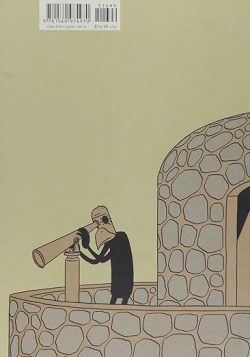
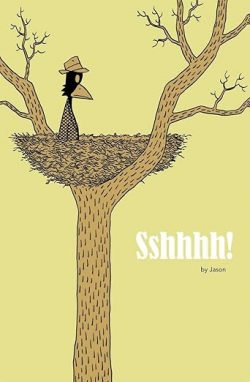
Sshhhh!


By Jason (Fantagraphics Books)
ISBN: 978-1-56097-497-0 (TBB/Digital edition)

This book includes Discriminatory Content produced for dramatic and comedic effect.

Born this day in 1965 in Molde, Norway, John Arne Sæterøy is known globally by his enigmatic, utilitarian nom de plume. The shy & retiring draughts-scribe started on the path to international cartoon superstardom in 1995, once first graphic novel Lomma full ay regn (Pocket Full of Rain) won Norway’s biggest comics prize: the Sproing Award. Prior to that, he had contributed to alternate/indie magazine KonK whilst, from 1987, studying graphic design and illustration at Oslo’s Art Academy, before going on to Norway’s National School of Arts. After graduating in 1994, three years later he founded his own comic book Mjau Mjau, citing Lewis Trondheim, Jim Woodring and Tex Avery as his primary influences and constantly refining his style into a potent form of meaning-laden anthropomorphic minimalism.

Moving to Copenhagen Jason worked at Studio Gimle alongside Ole Comoll Christensen (Excreta, Mar Mysteriet Surn/Mayday Mysteries, Den Anden Praesident, Det Tredje Ojet) and Peter Snejbjerg (Den skjulte protocol/The Hidden Protocol, World War X, Tarzan, Books of Magic, Starman, Batman: Detective 27). His efforts were internationally noticed, making waves in France, The Netherlands, Slovenia, Spain, Germany and other Scandinavian countries as well as the Americas. He won another Sproing in 2001 – for self-published series Mjau Mjau – and from 2002 turned nigh-exclusively to producing graphic novels, winning even more major awards.

Jason’s breadth of interest is wide and deep: comics, movies, animated cartoons, music, high literature and pulp fiction all feature equally with no sense of rank or hierarchy. This puckish and egalitarian mixing and matching of inspirational sources always and inevitably produces picture-treatises well worth a reader’s time.

Over a succession of tales Jason built and constantly employed a repertory company of stock characters to explore deceptively simplistic milieux based on classic archetypes of movies, childhood entertainments, historical and literary favourites. These all role play in deliciously absurd and surreal sagas centred on his preferred themes of relationships and loneliness. In latter years, Jason returned to such “found” players as he built his own highly esoteric universe, and even has a whole bizarre bunch of them “team-up” or clash…

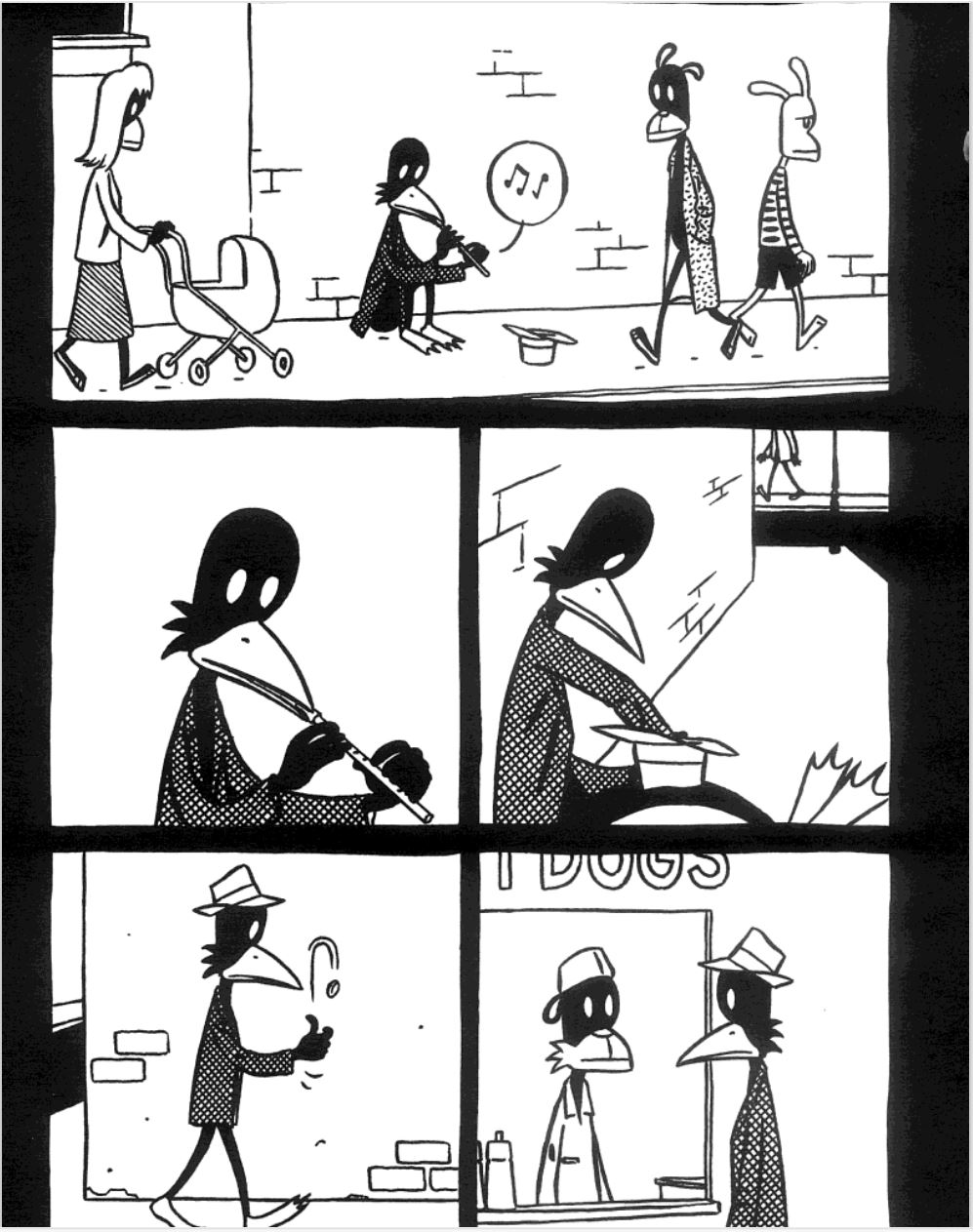
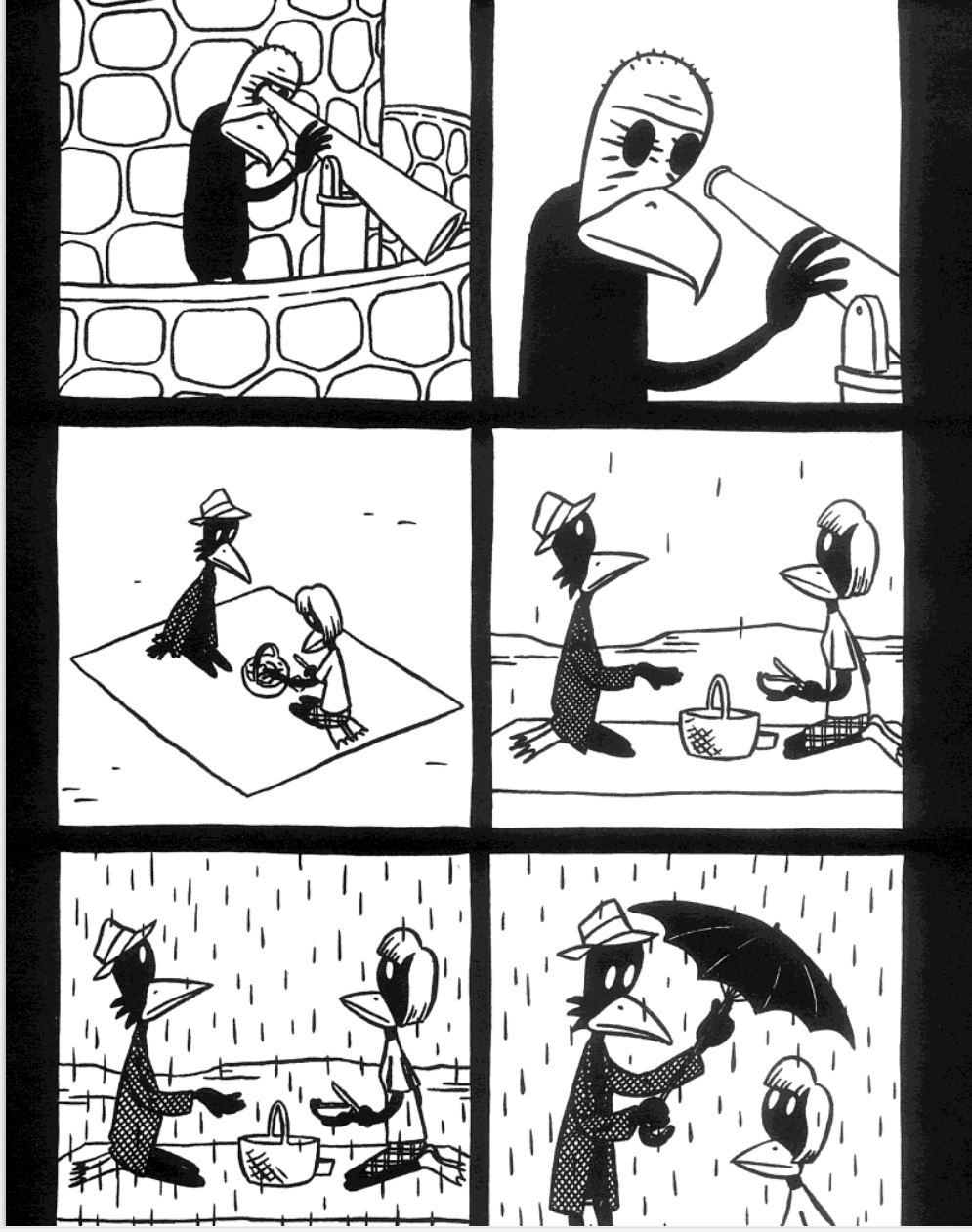
As always, visual/verbal bon mots unfold in beguiling, sparse-dialogued, or even as here silently pantomimic progressions, with compellingly formal page layouts rendered in a pared back stripped-down interpretation of Hergé’s Claire Ligne style: solid blacks, and thick outlines dominating settings of seductive monochrome simplicity augmented by a beguiling palette of stark pastels and muted primary colours.

The majority of his tales brim with bleak isolation, swamped by a signature surreality: largely populated with cinematically-inspired, darkly comic, charmingly macabre animal people ruminating on those inescapable concerns whilst re-enacting bizarrely cast, bestial movie tributes.

A perfect example of his oeuvre is ‘Sshhhh!’: a deliciously evocative, extended romantic melodrama created without words; the bittersweet tale of boy-bird meeting girl-bird in a world overly populated with spooks and ghouls and skeletons. The archetypes and cartoon critters are similarly afflicted by far more harsh demons: loneliness and regret.

Of course, it’s not just that. It’s also boy-bird loses girl-bird to death, other men, his own inadequacies and the vagaries of parenthood. It’s about how money fixes nothing and how Death is ever at your elbow and can be – quite frankly – a bit of a nuisance. It’s sex and death and discontentment and bloody ungrateful kids; aliens; being invisible; miserable vacations; disappointing locations: guys who are sexier than you and The Devil…

… And birds-nests…

Jason’s work always jumps directly into the reader’s brain and heart, always probing the nature of “human-ness” by visually invoking the beastly and unnatural to ask persistent and pertinent questions. Although clever sight-gags are less prominent here, his repertory company still uncannily display the subtlest emotions with devastating effect, proving again just how good a cartoonist he is.

This comic tale is best suited for adults but makes us all look at the world through wide-open childish eyes. Jason is instantly addictive and a creator every serious fan of the medium should move to the top of the “Must-Have” list. Don’t even wait for a physical copy, buy a digital edition ASAP, just so you can see immediately what all the fuss is about…
All characters, stories and artwork © 1998, 1999, 2008 Jason. All rights reserved.

Moomin volume 9 – The Complete Lars Jansson Comic Strip


By Lasse Lars Jansson (Drawn & Quarterly)
ISBN: 978-1-77046-157-4 (HB) eISBN: 978-1-77046-556-5-

Today 25-years ago in Helsinki Lars Fredrik Jansson died. His work and that of his sister lives on.

Tove Jansson was one of the greatest literary innovators and narrative pioneers of the 20th century: equally adept at shaping words and images to create worlds of wonder. She was especially expressive with basic components like pen & ink, manipulating economical lines and patterns into sublime realms of fascination, whilst her dexterity made simple forms into incredibly expressive and potent symbols. So was her brother…

Tove Marika Jansson was born into an artistic, intellectual and rather bohemian Swedish family in Helsinki, Finland on August 9th 1914. Patriarch Viktor was a sculptor and mother Signe Hammarsten-Jansson a successful illustrator, graphic designer and commercial artist. Tove’s brothers Lars AKA “Lasse” and Per Olov became – respectively – an author and cartoonist, and an art photographer. The family and its close intellectual, eccentric circle of friends seems to have been cast rather than born, with a witty play or challenging sitcom as the piece they were all destined to inhabit.

After extensive and intensive study (from 1930-1938 at the University College of Arts, Crafts and Design, Stockholm, Graphic School of the Finnish Academy of Fine Arts and L’Ecole d’Adrien Holy and L’Ecole des Beaux-Arts, Paris), she became a successful exhibiting artist through the troubled years of WWII.

Brilliantly creative across many fields, she published her first Moomins fable in 1945. Småtrollen och den stora översvämningen (The Little Trolls and the Great Flood – latterly and more euphoniously The Moomins and the Great Flood) was a whimsical epic of gentle, inclusive, accepting, understanding, bohemian misfit trolls and their strange friends…

The term “Moomin” came from maternal uncle Einar Hammarsten who tried to stop Tove pilfering food when she visited by warning that a Moomintroll guarded the kitchen, creeping up on trespassers and breathing cold air down their necks… you can check out our other reviews such as Christmas Comes to Moominvalley for how the critter became a mega franchise and proto-mythology. Here and now, let’s discuss how Lars got involved…

More popular with each successive book, global fame loomed. And in 1952 Finn Family Moomintroll/The Happy Moomins was translated into English to great acclaim, prompting British publishing giant Associated Press to commission a daily newspaper strip starring the seductively sweet & sensibly surreal creations. Jansson had no misgivings or prejudices about strip cartoons as she had already adapted Comet in Moominland for Swedish/Finnish paper Ny Tid. Mumintrollet och jordens undergäng/Moomintrolls and the End of the World was hugely popular and she welcomed the chance to extend her eclectic family’s range. In 1953, The London Evening News began the first of 21 Moomin strip sagas which captivated readers of all ages. Tove Jansson’s involvement in the cartoon ended in 1959, a casualty of its own success and the punishing publication schedule. So great was the strain that she had already recruited brother Lars to help. He quietly took over, continuing the feature until its close in 1975. His tenure as sole creator officially began with the sixth collection in this series and reaches its penultimate volume here…

Liberated from cartooning pressures, Tove returned to painting, writing and other pursuits: generating plays, murals, public art, stage designs, costumes for dramas and ballets, a Moomin opera and 9 more Moomin-related picture-books and novels, as well as 13 books and short-story collections strictly for grown-ups. She died on June 27th 2001, with awards too numerous to mention, and her face on the national currency…

Lars Fredrik Jansson (October 8th 1926 – July 31st 2000) was almost as amazing as his sister. Born into that astounding overachieving clan 12 years after Tove, at 16 he started writing – and selling – his own novels (nine in total). He also taught himself English because there weren’t enough Swedish-language translations of books available for his voracious reading appetite. In 1956 at his sister’s request he began co-scripting the Moomin strip: injecting his own witty whimsicality to ‘Moomin Goes Wild West’. He had been Tove’s English language translator and sense-reader from the start, seamlessly converting her Swedish into text and balloons even the British could grasp.

In 1959, when her contract with The London Evening News expired, Lars officially took over, having spent the interim period learning to draw and perfectly mimic his sister’s art style. He had done so in secret, assisted and tutored by their mother Signe Hammarsten-Jansson. From 1961 to strip’s end in 1974, Lars was sole steersman of trollish tabloid tails (I fear that could be much misconstrued these days…).

“Lasse” was a man of many parts. Other careers included aerial photographer, professional gold miner, writer and translator. He was basis and model for ultimate cool kid Snufkin and his Moomins exploits were subtly sharper than his sister’s version: far more in tune with the quirky British sense of humour. Nevertheless, his whimsically wry sense of wonder was every bit as compelling. In 1990, long after the original series, Lasse began a new career, working with Dennis Livson (designer of Finland’s acclaimed Moomin World theme park) as producers of anime series The Moomins and, with daughter Sophia Jansson in 1993, on new Moomin strips…

Moomintrolls are easy-going free spirits: polite modern bohemians untroubled by hidebound domestic mores but under Lars, increasingly diverted and distracted by societal pressures. Moominmama is warm, kindly tolerant and capable, if perhaps overly concerned with propriety and appearances, whilst her devoted spouse Moominpappa spends most of his time trying to rekindle his adventurous youth or dreaming of fantastic journeys. Their darling son Moomintroll is a meek, dreamy boy with confusing ambitions who adores – and moons over – permanent houseguest the Snorkmaiden – although that impressionable, flighty gamin prefers to play things slowly whilst awaiting somebody potentially better…

A particularly acerbic affair, this 9th monochrome compilation revisits serial strip sagas #34-37, and opens with Lars in full charge as confusion blooms with the arrival of cinematic thespians and sundry other playactors all concerned with immortalising a ‘Damsel in Distress’.

Sadly our happy family and most of Moominvalley are utter neophytes regarding the miracles of the moving image and understandable initial confusion soon grows into envy, dangerous jealousy, unleashed ambition and when Moominpappa leaps to a wrong conclusion, frustrated heroism and vigilantism once the old stalwart spots ladies tied to railway tracks and caped mustachio-twirling figures lurking about…

No soon does that furore die down than domestic strife manifests as ‘Fuddler and Married Life’ finds the androgynous collector and equally ambiguous new spouse Jumble exploit everyone’s goodwill and happy wishes to unwisely expand their personal button collection into a rapacious runaway commercial enterprise that soon leaves them homeless and straining the good will of all around them. Luckily, Moominmamma is on hand to take over babysitting chores whilst the drama sorts itself out…

Rampant unchecked capitalism gone mad is also the order (to go) of the day in ‘Sniff’s Sports Shop’ as the exceptionally shy and nervous critter inherits a thriving activities emporium from an uncle whose sole previous contact was a monthly stipend for staying the full length of the valley away from him…

Moomin is there to support Sniff’s crash course in commercial enterprise and unwise quest for a game or endeavour he can take up as his very own, but the escalating chaos inevitably ends in tizzies, higgledy-piggledy behaviours, embarrassment and injury, before the sporting mogul wisely calls it a day…

Concluding proceedings is the sorry salutary saga of ‘Mymble’s Diamond’ wherein the impulsive, impressionable, incurable romantic shows everyone the flashy ring she’s been given by latest flame Rinaldo, and certain tongues begin wagging once again…

Soon the valley is afire with stridently expressed opinions and mounting certainty that “something should be done”, but what and to whom and – for pity’s sake – why?

A cautionary tale exploring the power of gossip and apparently irresistible need for some to judge others, here is a perfect example of cartoons’ power for cultural commentary and social satire, and a splendid place to pause and think quietly for a moment…

This compilation again closes with a closer look at the creator in ‘Lars Jansson: Roll Up Your Sleeves and Get to Work’ courtesy of family biographer Juhani Tolvanen, extolling his many worthy attributes…

These are utterly, adorably barbed tales for the young, laced with the devastating observation and razor-sharp mature wit which enhances and elevates only the greatest kids’ stories into classics of literature. These tomes – both Tove & Lars’ – are an international treasure trove no fan of the medium – or carbon-based lifeform with even a hint of heart and soul – can afford to be without.
© 2013 Solo/Bulls. “Lars Jansson: Roll Up Your Sleeves and Get to Work” © 2011/2013 Juhani Tolvanen. All rights reserved.

Yoko Tsuno volume 19: The Astrologist of Bruges


By Roger Leloup, coloured by Beatrice of Studio Leonardo & translated by Jerome Saincantin (Cinebook)
ISBN: 978-1-80044-130-9 (Album PB)

This book includes Discriminatory Content produced in less enlightened times.

On September 24th 1970, “electronics engineer” Yoko Tsuno began her troubleshooting career as an indomitable intellectual adventurer. Her debut in Le Journal de Spirou was realised in “Marcinelle style” cartoonish 8 page short ‘Hold-up en hi-fi’ but although she is still delighting readers and making new fans to this day, her action-packed, astonishing, astoundingly accessible exploits quickly evolved into a highpoint of pseudo-realistic fantasies numbering amongst the most intoxicating, absorbing and broad-ranging comics thrillers ever created. Her globe-girdling mystery cases and space-&-time-spanning epics are the brainchild of Belgian maestro Roger Leloup who launched his own solo career in 1953 after working as studio assistant/technical artist on Hergé’s Adventures of Tintin.

Compellingly told, sublimely imaginative and – no matter how implausible the premise of an individual yarn – always firmly grounded in hyper-authentic settings underpinned by solidly-constructed, unshakably believable technology and unswerving scientific principles, Leloup’s illustrated escapades were at the vanguard of a wave of strips revolutionising European comics. Very early in the process, he switched from loose illustration to a mesmerising nigh-photo realistic style that is a series signature. That long-overdue sea-change in gender roles and stereotyping heralded a torrent of clever, competent, brave and formidable women protagonists taking their rightful places as heroic ideals and not romantic lures, consequently elevating Continental comics in the process. Such endeavours are as engaging and empowering now as they ever were, none more so than the travails of Miss Tsuno.

Her first outings (the aforementioned, STILL unavailable Hold-up en hi-fi, and co-sequels La belle et la bête and Cap 351) were mere introductory vignettes prior to epic authenticity taking a firm grip in 1971 when the unflappable problem solver met valiant but lesser (male) pals Pol Paris and Vic Van Steen. Instantly hitting her stride in premier full-length saga Le trio de l’étrange (in LJdS’s May 13th edition), from then on, Yoko’s efforts encompassed explosive exploits in exotic corners of our world, sinister deep-space sagas and even time-travelling jaunts. There are 31 European bande dessinée albums to date, with 19 translated into English thus far, albeit – and ironically – none of them available in digital formats…

Initially serialised in LJdS #2923 to 2943 and spanning April 20th to September 7th 1994, L’astrologue de Bruges became the 20th collected Yoko Tsuno album that same year. Following chronologically on from The Rhine Gold, it weaves a tale of Earth-bound archaic mystery as our tireless troubleshooter visits a living historical treasure trove for answers to a contemporary conundrum…

Walking the scenic canals of Bruges – “the Venice of the North” – Yoko strikes up a fortuitous conversation with a painter who is actually a very open-minded archaeologist and imaginative historian. Tsuno is there to meet another artist; one who has painted her portrait in local period dress. She thinks it’s from magazine photos of her, but Mr. Jos knows much of the confounding Jan Van Laet who has contacted Yoko, and none of what he knows is good…

Jos shows her the quiet passages and waterways of a renaissance city barely altered since the 16th century and offers to stay close during her interview with Van Laet: a man he seriously considers to be in league with the Devil…

Soon after her interview with the extremely off-kilter portraitist begins, Tsuno begins to agree with that assessment as Van Laet seeks to convince her that he captured her image from life, not photos, and that she had posed for him in 1545 Anno Domini. Her doubts take a hard knock when he also reveals ancient pictures and sketches of her with her friend Monya and foster daughter Morning Dew.

That’s when Van Laet’s patron and master the Marquis of Torcello joins the interview, claiming Yoko has lived since those Renaissance days afflicted by amnesia. Incensed and threatening, he also accuses her of holding his property: a vial containing an elixir of youth and another carrying the secret of a deadly biological super-weapon bottled by legendary, infamous natural philosopher, astrologer and alchemist Zacharius..

Escaping by hurling herself out of a window to be plucked from a canal by Mr. Jos, Yoko is pretty sure she knows the How if not Why of this situation. After all, Monya is a cherished comrade who was born in the far future and possesses a working time machine…

Resolved to learn everything and foil Torcello & Van Laet’s scheme to reintroduce the Black Death to the modern world, Yoko recruits steadfast comrades Pol & Vic to join her, Monya and Dew in an era of pestilence, intrigue, Inquisitions and ongoing Wars of Religion. She has no choice over the child… the painting already incontrovertibly proves Dew was present and in just as much danger as everyone else…

Mr Jos is vital in the planning and reconnaissance stages of the proposed mission. He now owns the fantastic house occupied by the undying villain in 16th century and allows Yoko access to all its many levels of subterranean cellars and workshops, and provides access to clothing of the era. Monya delivers everything else needed and during a terrific storm the party nervously head back to a time of terror and travail…

Befriending poverty-stricken flower seller Mieke on arrival, the time travellers are soon embroiled in an ongoing and escalating calamity involving Zacharius’ deranged-but-brilliant apprentice Balthazar, a scheme stripping churches of gold and portraitist Van Laet’s insidious human trafficking business selling his poor but honest models to the rich men who purchase his paintings. The true threat though is always Torcello who wants to spread doom and destruction in every era and gets his big chance after capturing Monya and stealing her Time Shifter…

The monster’s fate is someone else’s boon, however, as the doomed brief encounter of flirtatious Pol and meek Mieke suddenly grows into something much greater and happier ever after…

As ever, the most assured assets of these edgy endeavours are astonishingly authentic settings, benefitting from Leloup’s diligent research and meticulous attention to detail. A magnificently complex twisty thriller with doomsday overtones, displaying our valiant troubleshooter and her team triumphant in a taut, tense thriller of time bending terror, The Astrologist of Bruges is tense, moody, slow-burning, deviously twisted and potently plausible: a fable confirming how smarts and combat savvy are pointless without compassion, integrity and a sense of moral responsibility.
Original edition © Dupuis, 1994 by Roger Leloup. All rights reserved. English translation 2024 © Cinebook Ltd.

Rails on the Prairie – Lucky Luke Adventure vol. 32 & The Bluefeet are Coming! – Lucky Luke Adventure vol. 43


Lucky Luke volume 25: Rails on the Prairie
By Morris & Goscinny, translated by Jerome Saincantin (Cinebook)
ISBN: 978-1-84918-104-4 (Album PB/Digital edition)

Lucky Luke volume 43 – The Bluefeet are Coming!
By Morris, translated by Jerome Saincantin (Cinebook)
ISBN: 978-1-84918-173-0 (Album PB/Digital editions)

These books include Discriminatory Content produced in less enlightened times.

Today in 2001 we said “adios!” to one of the true masters of our industry and art form. Happily, his legend lives on in the form of his most significant creation.

A precocious, westerns-addicted, art-mad kid, well off and educated by Jesuits, Maurice de Bevere was born on December 1st 1923 in Kortrijk, Belgium. A far from illustrious or noteworthy scholar – except in all the ways teachers despise – Maurice later sought artistic expression in his early working life via forays into film animation before settling into his true vocation. While working at the CBA (Compagnie Belge d’Actualitiés) animation studio, “Morris” met future comics superstars Franquin & Peyo, and worked for weekly magazine Le Moustique as a caricaturist. Morris quickly became one of la Bande des quatre – The Gang of Four – comprising Jijé, Will and old comrade Franquin: leading proponents of a loose, free-wheeling artistic style known as the “Marcinelle School” which dominated Le journal de Spirou in aesthetic contention with the “Ligne Claire” style favoured by Hergé, EP Jacobs and other artists in Le Journal de Tintin.

In 1948, said Gang (all but Will) visited America, befriending many US comics creators and sightseeing. Morris stayed for six years, meeting fellow traveller René Goscinny, scoring some work from newly-formed EC sensation Mad and making copious notes and countless sketches of the swiftly vanishing Old West. That research would resonate on every page of his life’s work.

Working solo, albeit with occaisonal script assistance from his brother Louis De Bevere until 1955, Morris produced nine albums of affectionate sagebrush parody and comedic cinematic homage before formally uniting with Goscinny, who became the regular wordsmith as Luke attained the dizzying heights of superstardom, commencing with Des rails sur la Prairie which began in weekly  LJd S on August 25th 1955. The collected album was first released for Christmas in 1957, the ninth in the series, and was follewed by Morris’ final solo tale Alerte aux Pieds Bleus/The Bluefeet are Coming! in 1958.

Lucky Luke Rails on the Prairie

Doughty, rangy, and dashingly dependable Lucky Luke is a likable, imperturbable, implacably even-tempered cowboy do-gooder who can “draw faster than his own shadow”. He amiably ambles around a mythic, cinematically informed Old West, having light-hearted adventures on his petulant, stingingly sarcastic wonder-horse Jolly Jumper. Over nearly nine decades, his exploits in Le Journal de Spirou (and from 1967, in rival periodical Pilote) have made the sharp shooter a legend of stories across all media and monument of merchandising.

His exploits have made him one of the bestselling comic characters in Europe (83 collected albums plus around a dozen spin-offs and specials – totalling over 300 million books in at least 33 languages), with all the spin-off toys, computer games, puzzles, animated cartoons, TV shows and live-action movies that come with that kind of popularity.

The rapid pace and seeming simplicity of these spoof tales means older stories can generally sit quite comfortably alongside newer material crafted for a more modern readership. Here, material from Le Journal de Spirou #906-929 – originally spanning 25th August 1955 to 2nd February 1956 – was collected in November 1957 as ninth album Des rails sur la Prairie: the first epic result of a grand partnership.

Although initially uncredited, it was cowritten by Morris and fellow euro-expat/US tourist Goscinny: auguring an astounding creative partnership to come. Goscinny produced 45 albums with Morris before his death in 1977, from whence Morris continued both singly and with fresh collaborators. Before all that, though, this wild & woolly transitional delight offers a far more boisterous and raw hero than we’re used to, highlighting the sunnier side of a mythic western scenario. Moreover, it ends with the first incidence of Lucky riding into the sunset singing “I’m a poor, lonesome cowboy”…

When track-laying for the Transcontinental Railroad stalls, outraged train moguls demand action. Dead Ox Gulch, Nebraska becomes a crunch point of construction confrontation. Constant hold-ups are actually caused by a traitor at home back East. Although a board-member in good standing, Black Wilson is secretly sabotaging the project to protect his other business: a stage coach company…

He contracts the nefarious Wilson Boys to keep up their bad work, even as a laconic stranger rides into town. Before long, the newcomer is assuredly spearheading the march of progress and civilisation simply by foiling every dirty trick the gang can conceive…

Once renewed efforts have moved beyond town and onto the prairie and the rails inch ever closer to California, a train carries Lucky, passengers and the navvies further westward, negotiating and stymying hostile natives, greedy townships and the still-active Wilson boys’ shady tactics and stratagems.

Ultimately, Black Wilson takes personal charge and boards a stagecoach westward to destiny. Despite his every trick, though, the showdown between spoiler and visionary is a foregone conclusion…

Fast funny, episodic and enthralling, these early exploits are a big old hoot in the tradition of Destry Rides Again or Support Your Local Sheriff, superbly set up and laid out by a master storyteller, and make a wonderful introduction to a unique genre for modern kids who might well have missed the romantic allure of the Wild West that never was.

The Bluefeet are Coming! Lucky Luke volume 43

Au Continent, the populace has a mature relationship with comics, according them academic and scholarly standing as well as nostalgic value and the validation of acceptance as an art form. That even applies to challenging material such as seen in Alerte aux Pieds Bleus: Morris’s final solo effort until Goscinny passing in 1977. A tribute to all the purest western tropes and leitmotifs, it too offers a rowdier, boldly raw hero in transition, just hitting his stride and strutting his stuff, but also relies heavily on the cliches and narrative shortcuts of that earlier era, particularly in the depiction of other cultures and races appearances and customs for comedic intent. I can only apologise for my ancestors and ask that you read with an open mind: after all, Morris was simply exploiting longstanding filmic and comics influences. If I was really desperate, I might also say that his utilsation of comedy in these stereotypes may have helped challenge the status quo…

Lucky Luke debuted in autumn 1946: catapulted sans name or title into rolling gag vignettes in the French edition of multinational publication Le Journal de Spirou, before appearing (with a name) in Christmas Annual L’Almanach Spirou 1947. Then his comic serial ‘Arizona 1880’ opened in the December 7th 1946 comic; and no one has ever looked back…

He first appeared in Britain syndicated to weekly comic Film Fun and again in 1967 in Giggle where he was renamed Buck Bingo. In all these venues – as well as numerous attempts to follow the English-language successes of Tintin and Asterix albums – Luke hung a trademark cigarette insouciantly from his lip, before in 1983 Morris, no doubt amidst pained howls and muted mutterings of “political correctness gone mad” (oooh! That’s what “woke” must mean!!) substituted a strand of straw for the dog-end, which garnered him an official tip of the hat from the World Health Organization…

Morris died in 2001, having drawn 70 Lucky adventures, plus spin-off tales of Rantanplan (“dumbest dog in the West” and a charming spoof of cinema canine Rin-Tin-Tin), with a posse of talented creators taking over the franchise.

The most successful attempt to bring Lucky Luke to our shores and shelves comes from Cinebook (who rightly restored the foul weed to his lips on the interior pages if not the covers), but sensibly took their own sweet time bringing the oldest, most potentially controversial tales to market. As serialised in LJdS #938 – #957, Alerte aux Pieds Bleus is certainly one of those…

A procession of linked gags sees Morris pile on and kick hard familiar themes and scenarios as the town of Rattlesnake Valley welcomes wanderer Lucky. The lone rider is just in time to save super-superstitious sheriff Jerry Grindstone from sneaky gambler and professional cheat Pedro Cucaracha whose plans to fleece the old codger result in his painful and shameful eviction from civilisation. Of course, the scoundrel had tried to rob and blow up the bank on his way out…

Chased into the desert, the scurvy Mexican then gulls the alcoholic Great Chief of the local Bluefeet Indians into laying siege to the town, tempting the old warrior with promises of unlimited booze…

Old Parched Bear is happy to oblige, and soon the town is forming a militia, telegraphing for the cavalry and setting up barricades. As food and water grow scarce profiteering proliferates, with Lucky and Jerry battening down the hatches and bolstering morale for a long and dangerous defence of their lives and loved ones…

Against that framework of classic movie moments there are rich slapstick pickings as spies, crossdressers, raids & counter-raids and devious secret weapons all build to a bombastic finale, with Pedro and Parched Bear attempting all manner of nefarious invention to get respectively vengeance and more “firewater”…

… And then, when it’s almost too late, the Cavalry arrive… just after the deployment of late arriving support from the Greenfeet and Yellowfeet branches of the family of First Nations. It can only end in catastrophe unless Lucky can contrive a solution…

Daft and Spectacular in equal amounts, this is perhaps a tale for older kids who have gained a bit of historical perspective and social understanding, although the action and slapstick situations are no more contentious than any old movie…
© Dargaud Edituer Paris 1971 by Morris. © Lucky Comics. English translations © 2011, 2013 Cinebook Ltd.

The Sky Over the Louvre


By Bernar Yslaire & Jean-Claude Carrière, translated by Joe Johnson (NBM Comics Lit/Louvre: Musée du Louvre Éditions)
ISBN: 978-1-56163-602-0 (HB)

Joyeux 14 juillet! – or if you’re being a leetle pickeeHappy Bastille Day, mes braves!

Well over a decade ago the prestigious Louvre gallery in Paris began an intriguing, extremely rewarding collaboration with the world of comics, resulting in wealth of modern art treasures – translated bande dessinée made available to English readers courtesy of those fine folks at NBM.

The second release was 2012’s Le Ciel Au-Dessus du Louvre which we know as The Sky Over the Louvre – a lush and beautiful, oversized hardback graphic novel exploring the origins and philosophical underpinnings of France’s national art collection, whilst simultaneously peeling back the motivations and ambitions of the twisted visionaries who steered – or maybe simply rode – the human wave of Chaos deemed “the Terror” of the French Revolution: the catalyst for the gallery’s very existence.

These tales were produced in close collaboration with the forward-looking authorities of the Musée du Louvre, but this is no gosh-wow, “Night-at-the-Museum”, or thinly-concealed catalogue of contents from a stuffy edifice of public culture. Rather, here is an intense, informative, insightful and gripping glimpse into the price and power of art as engine of change and agent of obsession.

Jean-Claude Carrière was born on September 17th 1931, studied at the École normale supérieure de Saint-Cloud and wrote a novel before becoming an actor and one of France’s greatest screen writers. He assisted Jacques Tati and wrote the novelisations of his films, before going on to work with Luis Buñuel (for 19 years), scripting such classics as Diary of a Chambermaid, Belle de Jour, The Discreet Charm of the Bourgeoisie, That Obscure Object of Desire and many more. Other notable credits include work with directors such as Milos Forman, Louis Malle, Andrzej Wajda, Nagisa Oshima and others on iconic films like The Tin Drum, Danton, The Return of Martin Guerre, Max, Mon Amour and The Unbearable Lightness of Being, although three generations of British television viewers will probably revere him most for his adaptation of the Adventures of Robinson Crusoe (starring Robert Hoffmann and featuring that iconic theme-tune) which ran on BBC 1 at tea time from 1965 to about 20 minutes ago.

His approximately 80 screenplays, plus essays, fiction, translations and interviews led to countless awards and accolades including two Oscars – in 1963 for Heureux Anniversaire and an Honorary lifetime achievement Academy Award in 2014. Carrière died on February 8th 2021. In his spare time he had also written comics, particularly with legendary clown/gag writer Pierre Étaix and Bernard Yslaire…

Belgian born Bernard Yslaire (AKA Bernard Hislaire, Sylaire) began his career in 1978, drawing kiddie’s strip ‘Bidouille et Violette’ for Le Journal de Spirou before creating historical epic Sambre in 1986. He was one of the first creators to fully embrace the potential of the internet with his online strip Mémoires du XXe ciel / XXe ciel.com (Memories of the XXth Sky). In 2006 he produced the moving doomed romance Sky over Brussels, and since Le Ciel Au-Dessus du Louvre has largely left comics to concentrate on digital projects.

The Sky Over the Louvre compellingly dramatizes history, focussing on revolutionary artist Jacques-Louis David and close associate Maximilien de Robespierre (who dubbed himself “The Incorruptible”) as they plan how to replace religion, monarchy and the Old Art with something unique and truly worthy of their revolution. David and his School (Drouais, Greueze, Girodet and students Serangeli and Gérard) have taken residence in the old Louvre Palace, where past kings left their grandiose aggregation of treasures when they vacated Paris for Versailles. Here the Revolutionary council aspires to create a new aesthetic and new thought for their New Society…

Jules Stern is a 13-year-old wanderer from the Black Sea, roaming Paris’ dangerous streets in search of his mother, and claiming to have an appointment with David. On the 15th Fructidor, Year 1 (8th August 1793 for those of us not wedded to the Republic’s new calendar) the angelic lad confronts the artist just as he is inaugurating the Louvre as the first Museum of the Nation: dedicated to public ownership of art and the notion of beauty as a revolutionary ideal. Later, they meet again and Robespierre forms a hostile opinion of the child, although David is clearly fascinated by the headstrong, beautiful boy…

As high-minded idealism of the Revolution’s early days dissolves into factional in-fighting, Robespierre and David become increasingly concerned with the spiritual and aesthetic, determined to excise and replace every vestige of the old regime and society. They seek images and concepts to embody their cause and plan a festival to the concept of Reason, but all across France backsliding and foreign invasion threaten their progress. In September 1793 the Convention (ruling body and parliament of the Republic) decrees “Terror to be the order of the day”…

Blood, betrayal and horror rule the streets as David, from his apartments in the Louvre, begins work on a brace of pivotal works: The Supreme Being and The Death of Joseph Bara. It is difficult to assess which causes him the most grief and triggers his ultimate downfall…

The Incorruptible is becoming increasingly more arrogant and ruthless, desperate for revolutionary images that will fire and inspire the masses. He presses David to produce the ultimate physical representation of the conceptual spirit of the New France – a vision of its Supreme Being – but as time goes by and no image emerges, one too many people whisper that what Robespierre actually requires is a portrait of himself…

Far less troublesome should be The Death of Joseph Bara: a boy who became First Martyr of the Revolution, and one scheduled to become the nation’s uniting icon. However, David’s obsession with Jules Stern brings more trouble, when Robespierre objects to the boy being selected as the model for Bara the Myth…

Nobody baulks The Incorruptible for long, but the obsessive nature of the creative impulse is insurmountable. Eventually Robespierre can only achieve his ends by sending Jules to the guillotine. Incredibly, not even death separates the artist from his model…

Set solidly in the very heart of a moment of epochal historical importance, this is a stunning, utterly compelling tale of humanity at its wildest extremes, when grand ideals wedded themselves to the basest on bestial impulses, yet from that Yslaire & Carrière have crafted a magnificently realised tale laced with staggering detail and addictive emotion.

With extra features including biographies and a listing of the actual artworks woven seamlessly into the narrative, this is a truly magical book no aficionado of the medium, lover of history or student of human nature should miss…
© 2009 Futuropolis/Musée du Louvre Éditions. © 2011 NBM for the English translation by Joe Johnson. All rights reserved.

Lucky Luke volume 24: The Judge


By Morris & Goscinny, translated by Jerome Saincantin (Cinebook)
ISBN: 978-1-84918-045-0 (Album PB/Digital edition)

This book includes Discriminatory Content produced in less enlightened times.

Doughty, rangy, and dashingly dependable cowboy Lucky Luke is an imperturbable, implacably even-tempered do-gooder who can “draw faster than his own shadow”. He roams the mythic, cinematically fuelled Old West in light-hearted adventures astride his petulant, stingingly sarcastic wonder-horse Jolly Jumper. Over nine decades, his exploits in Le Journal de Spirou (and from 1967, in rival periodical Pilote) have made the sharpshooter a legend across all media… and a monument of merchandising.

Working solo with occasional script assistance from his brother Louis, Morris – AKA Maurice de Bévère – produced 10 albums worth of affectionate and thrilling sagebrush parody before formally uniting with René Goscinny, who became regular wordslinger with Des rails sur la Prairie (Rails on the Prairie) commencing in Le Journal de Spirou on August 25th 1955. Morris & Goscinny literarily rode together on another 44 albums as Luke scaled the dizzying heights of superstardom. The partnership continued after the six-gun straightshooter switched teams in 1968, transferring to Goscinny’s own magazine Pilote with classic comedy thriller La Diligence (The Stagecoach).

Our laconic volunteer lawman’s trailblazing travails often draw on actual western history as much as movie mythology and he regularly interacts with noteworthy figures, as well as even odder fictional folk as his authors incessantly explore and refine key themes of classic cowboy films – plus some uniquely European notions and interpretations. The happy wanderer is not averse to being a figure of political change and Weapon of Mass Satire… as in this primal, heavily history-affronting affair…

First published continentally in December 1959, Le Juge was the 13th European album and Morris & Goscinny’s fourth official outing together, opening – after a terse background note on the real Judge Roy Bean – with Lucky as a literal cowboy ferrying a herd of prime steers from Austin, Texas to Silver City, New Mexico. The relatively uneventful cattle conveyance sadly stalls when, ignoring the advice that “there ain’t no law west of the Pecos”, Lucky stops at Langtry: a growing town on that legendary river that is ruled by saloon keeper/self-appointed Judge Roy Bean, who with his trained bear Joe rides roughshod over the citizenry whilst making himself incomprehensibly rich by exploiting an old law book he possesses. Through a system of carefully mis-applied court fines, bribes, indentured servitude and judicious hangings, the charismatic rogue is a virtual king who finally bites off more than he can chaw after impounding Lucky’s herd and subjecting him to a bogus trial (for rustling his own cattle) that ends with the hero sentenced to hang…

Escaping at gunpoint, Luke suddenly hatches a plan after travelling gambler Bad Ticket hits town and decides to set up in opposition to Bean with his own saloon, bad booze, sham trials and crooked scams…

Craftily striving to balance the scales of injustice, Lucky at first aids newcomer Bad Ticket in the war of law and lore. However, as Bad Ticket swiftly proves to be even less honourable and more devious than Bean, Luke switches sides – albeit almost too late – as the new judge turns on him and also sentences the citizens to string him up…

Opting for the devil he knows, Lucky recruits exiled loser Roy Bean – and Joe – to help him reclaim the town for decency and, with the rascally reprobate actually trying to make amends and (in his own way) atone for past sins and misdemeanours, sets Langtry back on the path to peace and progress. Of course that means much fighting, running, shenanigans & hijinks, insane alliances and a unique day in court for all concerned, in a case utterly unique to the annals of jurisprudence…

These youthful forays of an indomitable hero offer grand joys in the wry tradition of Destry Rides Again, Support Your Local Sheriff, or, dare I say it, John Milius & John Huston’s misunderstood 1972 demi-classic The Life and Times of Judge Roy Bean. Superbly executed by master storytellers, this is a wonderful introduction to a unique genre for modern kids who might well have missed the romantic allure of the Wild West that never was…
© Dargaud Editeur Paris 1971 by Morris. © Lucky Comics. English translation © 2010 Cinebook Ltd.

A Spirou and Fantasio Adventure: In the Clutches of the Viper (volume 22)


By Yoann & Fabien Vehlmann, designed by Fred Blanchard & coloured by Hubert: translated by Jerome Saincantin (Cinebook)
ISBN: 978-1-80044-162-0 (Album PB/Digital edition)

This book includes Discriminatory Content produced in less enlightened times. This book also includes Discriminatory Content included for comedic and literary effect.

Boyish hero Spirou (which translates as both “squirrel” and “mischievous” in the Walloon language) was created by French cartoonist Françoise Robert Velter AKA Rob-Vel. This was before World War II for Belgian publisher Éditions Dupuis, in response to the phenomenal success of Hergé’s Tintin at rival outfit Casterman. Soon-to-be legendary weekly comic Le Journal de Spirou launched on April 21st 1938 with a rival red-headed lad as lead feature in an anthology which bears his name to this day. The eponymous hero was a plucky bellboy/lift operator employed in the Moustique Hotel – in reference to the publisher’s premier periodical Le Moustique. The bellboy’s improbable adventures with pet squirrel Spip gradually evolved into far-reaching, surreal comedy dramas.

Spirou and his chums helmed the magazine for most of its life, with a cohort of truly impressive creators carrying on Velter’s work, beginning with his wife Blanche “Davine” Dumoulin who took over the strip when her husband enlisted in 1939. She was assisted by Belgian artist Luc Lafnet until 1943, when Dupuis purchased all rights to the property, after which comic-strip prodigy Joseph Gillain (Jijé) took the helm. In 1946, his assistant André Franquin assumed the creative reins: gradually ditching the well-seasoned short gag format in favour of epic adventure serials. He also expanded the cast, introducing a broad band of engaging regulars such as reporter Fantasio, phenomenally popular magic animal Marsupilami, master of mushroom Pacôme Hégésippe Adélard Ladislas de Champignac (the Count of Champignac) and one of the first strong female characters in European comics. Renamed Cellophine for Cinebook’s English translations, rival journalist Seccotine – of the tabloid The Moustic – became a regular foil and plays a key role in this very modern thriller…

Franquin was followed by Jean-Claude Fournier who updated the feature over nine stirring sagas tapping into the rebellious, relevant zeitgeist of the times: tales of environmental concern, nuclear energy, drug cartels and repressive regimes. By the 1980s, however, the series seemed outdated and lacking direction, so three separate creative teams alternated on it. Eventually overhauled and revitalised by Philippe Vandevelde (writing as Tome) and artist Jean-Richard Geurts AKA Janry. Adapting, referencing and in many ways returned to the beloved Franquin era and ethos, the strip found its second wind.

Their sterling efforts revived the floundering feature’s fortunes, generating 14 wonderful albums between 1984 and 1998. When the strip diversified into parallel strands (Spirou’s Childhood/Little Spirou and Guest-Creator Specials A Spirou Story By…), the team on the core feature were succeeded by Jean-David Morvan & José-Luis Munuera. Then Yoann & Vehlmann took over the never-ending procession of amazing adventures…

Multi-award-winning French comics author Fabien Vehlman was born in 1972, began his comics career in 1996 and has been favourably likened to René Goscinny. He’s probably still best known for Green Manor (illustrated by Denis Bodart), Seven Psychopaths with Sean Phillips, Seuls (drawn by Bruno Gazzotti and available in English as Alone), Wondertown with Benoit Feroumont and Isle of 1,000,000 Graves with Jason.

Yoann Chivard was born in October 1971 and drawing non-stop by age five. With qualifications in Plastic Arts and a degree in Communication from the Academy of Fine Arts in Angers, he became a poster/advertising artist whilst just dabbling in comics. His creations include Phil Kaos and Dark Boris for British Indie publications Deadline and Inkling, Toto l’Ornithorynque, Nini Rezergoude, La Voleuse de Pere-Fauteuil, Ether Glister and Bob Marone and he has contributed to Trondheim & Sfar’s Donjon. In 2006, Yoann was the first artist to produce a Spirou et Fantasio one shot Special. It was scripted by Vehlmann…

As globe-trotting journalists, Spirou and Fantasio regularly voyage to dangerously exotic places, uncover crimes, explore the fantastic and clash with exotic archenemies like Fantasio’s deranged and wicked cousin Zantafio and maddest of Mad Scientists, Zorglub. In 2011 one adventure (vol. 20 The Dark Side of the Z) saw Zorglub abduct them to the Moon where Spirou became a werewolf in a resort playground for the ultra-super-rich. It’s also – as we see here – where they first met their most insidious, pitiless and realistic supervillain…

As Spirou & Fantasio – dans les griffes de la vipère this cautionary tale from 2013 was the 53rd collected album in a series collectively approaching a landmark 100 volumes…

As Spirou chills out at a collectors market he meets excitable fan Annie: an adventure-hungry child determined to a roving reporter one day. The shy hero’s ego boost soon takes a hard knock however, as news comes that their magazine is being sued for inciting violence in children. The day in court is a disaster as seductive, bellicose lawyer Miss Jones, hired by affronted parents, makes the troubleshooters look like monsters, runs rings around Fantasio’s counsel and wins a million Euros in compensation from the deflated defendants. With ruin staring them in the face, the shocked wanderers wonder what they can do next. Miraculously, Spirou gets a visitation from his greatest hero…

Based on LJdS co-star Jean Valhardi, “Detective-Explorer” Gil Braveheart was downcast Spirou’s inspiration when he was growing up, and has again come to the rescue, offering to find a new investor to save the magazine…

He soon puts S&F in touch with an investment fund that will pay the parents off and fund continued publication, but as the heroes foolishly breeze past all the pages of a vast contract, Spirou sees old frenemy Cellophine being threatened by two very burly men-in-suits. All her efforts though cannot stop the lads signing on with the Viper Corporation…

Now paid incomprehensible amounts of money every month, Spirou and Fantasio initially flounder before simply giving it away to charities and good causes, but soon become bored as exploits and adventures apparently dry up. Soon after, Braveheart invites Spirou to visit Viper’s higher ups in their paradisical Marmalade Islands super resort and at last the canny crusader wises up. He’s blindly strolled into the most devious trap ever devised…

Again confronting one of the idle, petty super-rich magnates he’d met and disrespected on the Moon, Spirou realises all the power of money has been utilised to neutralise his friends and allies, obtrusively surveille his entire life and manipulate him into contractually and legally surrendering all aspects of his own life. He’s a brand of the corporation now and will do what he’s told when he’s told to, just like all the other heroes the top plutocrat has spitefully obtained in his constant search for meaning and validation and to counter his overwhelming boredom…

Trapped in a gilded cage and denied nothing except liberty, autonomy, fresh thrills and fun, Spirou refuses to bow to the admittedly heavenly, sybaritic life. Even sad broken Gil Braveheart’s admonishments can’t stop him making a bid for freedom, evading all the bugging tech and brutal heavies money can buy by recruiting brave Annie to act as his long-distance agent…

And then, after much preparation Spirou makes his break and the chase is on all over the Earth, but as the reporter seeks sanctuary, his flight across the globe and the way Viper treats ordinary people begins to inspire long-corrupted heroes and a way is found to reverse the intolerable situation. It’s not legal but it is unassailable and unstoppable…

Rocket-paced, action-packed, compellingly convoluted and with just the right blend of absurdity and helter-skelter excitement, In the Clutches of the Viper is a wry romp that is also genuinely terrifying, capturing the zeitgeist of modern concerns about the power of unchecked wealth and influence – and lawyers! This is pure cartoon gold, truly deserving of reaching the widest audience possible.
© Dupuis 2013, by Vehlmann, Yoann. All rights reserved. English translation © 2025 Cinebook Ltd.

The Man Who Shot Lucky Luke


By Matthieu Bonhomme: and translated by Montana Kane/Jerome Saincantin (Europe Comics/Cinebook)
ISBN: 978-1-80044-063-0 (Cinebook PB Album/Digital edition)

Lucky Luke was created in 1946 by Belgian animator, illustrator and cartoonist Maurice de Bévère (AKA “Morris”), first riding out in Le Journal de Spirou that summer sans any title or banner, and only in the French-language edition. His official launch came with Christmas Annual L’Almanach Spirou 1947, before beginning his first weekly serial adventure – ‘Arizona 1880’ – in December 7th 1946’s multinational weekly issue.

Doughty, rangy, and dashingly dependable, the cowboy is an implacably even-tempered do-gooder who can “draw faster than his own shadow”, amiably ambling around a mythic, cinematically realised Old West on his petulant, stingingly sarcastic wonder-horse Jolly Jumper in light-hearted adventures. Ever since that natal moment, his exploits in LJdS – and, from 1967, in rival periodical Pilote – have made the sharpshooter a legend of stories across all media and monument of merchandising.

Working solo with occasional script assistance from his brother Louis, Morris produced 10 albums worth of affectionate and thrilling sagebrush parody before formally uniting with René Goscinny, who became regular wordslinger with Des rails sur la Prairie (Rails on the Prairie), which commenced in LJdS on August 25th 1955. They literarily rode together on another 44 albums whilst Luke attained dizzying heights of superstardom. The partnership continued when the six-gun straight-shooter switched teams, transferring to Goscinny’s own magazine Pilote with La Diligence (The Stagecoach). When Goscinny died, Morris continued both singly and with fresh collaborators. The dream team’s last ride was 1986’s La Ballade des Dalton et autres histoires/The Ballad Of The Daltons and Other Stories.

Ultimately the grand originator invited an inspiring passel of legacy creators to step in: luminaries like Achdé & Laurent Gerra, Benacquista & Pennac, Xavier Fauche, Jean Léturgie, Jacques Pessis and more, who all took their own shots at the lovable lone rider. Morris died in 2001, having drawn fully 70 adventures, plus an assortment of sidebar and spin-off sagebrush sagas such as the one we’re scrutinising today. Since 2016 Julien Berjeaut, AKA Jul (Silex and the City) has handled the tall tale telling…

Lucky is one of the top-ranked comic characters in the world, having generated 94 albums (if you count spin-off series like Kid Lucky and Ran-Tan-Plan, and artist’s specials) with sales well north of 300 million in 33 languages. That renown has translated into a mountain of merchandise, toys, games, animated cartoons, TV shows and live-action movies and even commemorative exhibitions. No theme park yet, but you never know…

Our taciturn trailblazer’s travails draw on western history as much as movie mythology and regularly interact with historical and legendary figures as well as even odder fictional folk as he re-explores and refines key themes of classic cowboy films – as well as some uniquely European notions and interpretations. As previously hinted, the happy wanderer is not averse to being a figure of political change and Weapon of Mass Satire …but not in this primal, purely-classic-western-influenced outing. Here the entire premise is played dead straight…

We Brits first encountered Lucky Luke in the late 1950s, syndicated to weekly comic Film Fun, and again in 1967 in Giggle, where he blazed trails as Buck Bingo. In all these venues – as well as in numerous attempts to capitalise on the English-language success of Tintin and Asterix albums from Brockhampton and Knight Books – Luke had a trademark cigarette hanging insouciantly from his lip. In 1983 Morris – no doubt amidst both pained howls and muted mutterings of political correctness gone mad – substituted a piece of straw for the much-travelled dog-end, which garnered him an official tip of the hat from the World Health Organization. The classic snout is notionally back here and plays a large part in how an uncharacteristically grim saga unfolds…

Scion of an artistic family, Matthieu Bonhomme received his degree in Applied Arts in 1992, before learning the comics trade working in the atelier of western and historical comics specialist Christian Rossi. Le Marquis d’Anaon was Bonhomme’s first regular series, running from 2002-2008, after which he began writing as well as illustrating a variety of tales from L’Age de Raison, Le Voyage d’Esteban, and others.

When invited to craft his own take on a comics megastar, in 2016 he delivered L’Homme qui tua Lucky Luke: a wry but strictly serious pastiche of the parody western pioneer that successfully answered the question “what if they dropped all the funny bits and (mostly) played the hero as straight as the classic cinema fare he’s usually spoofing?” The gimmick clearly hit a cord as he was asked back and in 2022 released second shot Wanted: Lucky Luke, which we’ll get to another day…

The result was first translated in 2016 by digital-only comics collective Europe Comics (which I’m referencing here today) but the tale is also available as part of the Cinebook Lucky Luke Library available both on paper and in pixel pictures. The Man Who Shot Lucky Luke is a deliciously enticing drama with notes and references to many US western movies anyone over 40 has seen – usually beside a parent or grandparent – that tips its Stetson to the glory days of shoot-‘em-ups. You can play spot the movie reference on your own time, but yes, it’s notionally based on The Man Who Shot Liberty Valance, with hints of The Big Country, 1957’s Gunfight at the OK Corral and more…

One cold, wet night, a lone rider ambles into sleazy, dying mining outpost Froggy Town. The dank muddy dump is hardly welcoming, as it still reels from a recent robbery that took away the last of the gold the mines seem to contain, Moreover, the taking of those few nuggets by a mysterious Indian left beloved stagecoach driver Bob dead in the dust…

Tired, hungry and desperate for a smoke, the legendary good-guy gunslinger is inexplicably provoked by incompetent sheriff James Bone and his lethal, brooding brother Anton, and only coughing, slowly expiring veteran shootist Doc Wednesday is able to defuse what might have become another tragedy.

Fed and watered, Luke’s luck seems to be turning, but even the little metropolis can’t supply all his needs. There’s no tobacco to be had at any price since the robbery…

Moreover, the dogged, reputation-obsessed brothers conspire to get Lucky out of the way and Luke, still thwarted in every attempt to get some tobacco, tetchily starts to feel the Bone boys aren’t quite right in the head… and he hasn’t even met big brother Steve yet…

In that diagnosis he’s not wrong, and the assessment is even more true of their miner father. Big shot Pa Bone founded Froggy Town with his first big strike, runs roughshod over the townsfolk, literally rules his sons with a rod of iron and is desperate to save the place from fading away as the precious ore peters out…

Luke’s reputation prompts a citizens committee to appoint him to investigate the robbery/ murder, hoping to catch the enigmatic Indian and recover the gold, but the Bone boys sabotage his every effort, even confiscating his gun and Jolly Jumper and “losing” them… and that’s before old flame Laura Legs shows up, betrothed to Anton…

Distracted, jonesing for a smoke and outwitted at every turn, Luke is even framed for the crime after Pa Bone suddenly saves the town by “finding” more gold, but the tissue of lies is starting to tear. When the old man shoots Luke – in the back – the tragedy sparks a lynch mob and the true finally emerges, but far too late for some…

Not without humour – but not the raucous slapstick Luke’s readers are used to – this is a beguiling tribute to traditional western tales, asking Europe’s most famous cowboy to play against type and the trick works perfectly. If you ever wondered what Lucky would be like as a straight Gallic-framed hero like Blueberry or Red Dust (in Comanche) this is the book for you…
© 2016 – LUCKY COMICS – Bonhomme. All rights reserved. English translation © 2021 Cinebook Ltd.

Yoko Tsuno volume 18: The Rhine Gold


By Roger Leloup, coloured by Studio Leonardo & translated by Jerome Saincantin (Cinebook)
ISBN: 978-1-80044-093-7 (Album PB)

This book includes Discriminatory Content produced in less enlightened times.

On September 24th 1970, “electronics engineer” Yoko Tsuno began a career as an indomitable intellectual adventurer in Le Journal de Spirou in “Marcinelle style” cartoonish 8 page short ‘Hold-up en hi-fi’. She is still delighting readers and making new fans to this day, in action-packed, astonishing, astoundingly accessible adventures numbering amongst the most intoxicating, absorbing and broad-ranging comics thrillers ever created.

Her globe-girdling mysteries and space-&-time-spanning epics are the brainchild of Belgian maestro Roger Leloup who properly started his own solo career in 1953 after working as studio assistant/technical artist on Hergé’s Adventures of Tintin.

Compellingly told, sublimely imaginative and – no matter how implausible the premise of an individual yarn – always firmly grounded in hyper-realistic settings underpinned by authentic, unshakably believable technology and scientific principles, Leloup’s illustrated escapades were at the vanguard of a wave of strips revolutionising European comics. Very early in the process, he switched from loose illustration to a mesmerising nigh-photo realistic style that is a series signature. That long-overdue sea-change in gender roles and stereotyping heralded a wave of clever, competent, brave and formidably capable female protagonists taking their rightful places as heroic ideals and not romantic lures; elevating Continental comics in the process. Such endeavours are as engaging and empowering now as they ever were, none more so than the travails of Miss Tsuno.

Her first outings (the aforementioned but STILL unavailable Hold-up en hi-fi, and co-sequels La belle et la bête and Cap 351) were mere introductory vignettes before epic authenticism took hold in 1971 when the unflappable troubleshooter met valiant but lesser (male) pals Pol Paris and Vic Van Steen. Instantly hitting her stride in premier full-length saga Le trio de l’étrange (starting in LJdS’s May 13th edition), from that point on, Yoko’s cases encompassed explosive exploits in exotic corners of our world, sinister deep-space sagas and even time-travelling jaunts. There are 31 European bande dessinée albums to date, with 19 translated into English thus far, albeit – and ironically – none of them available in digital formats…

Initially serialised in LJdS #2841 to 2861and spanning September 23rd 1992 – 10th February 1993 as L’Or du Rhin, The Rhine Gold chronologically follows deep space saga The Exiles of Kifa, with our tireless troubleshooter planting her feet firmly back on terra firma in familiar territory.

Revisiting Germany and old friend/occasional partner in crimefighting Ingrid Hallberg (The Devil’s Organ, On the Edge of Life, Wotan’s Fire) Yoko’s scheduled meeting in Cologne Cathedral abruptly catapults her headlong into industrial chicanery, political intrigue and murder, as well as a return engagement with devious billionaire war criminal/arch enemy Ito Kazuki (Daughter of the Wind).

When a woman is drugged and assaulted in the crypt, her last words before unconsciousness are “no police”, “Bahnhof” and “Rheingold”. Yoko and Ingrid instantly assist, and after getting her anonymously into hospital, discover Minako Yasuda is a Japanese interpreter… who came to the cathedral with burglary tools, handguns and plastic explosives!

Trading handbags with the victim, and pinching her car, Ms. Tsuno rashly assumes her identity, and from obscure clues she and Ingrid retrace the victim’s steps to the vast Haupt Bahnhof rail terminus… and finally deduce the incredible secret of code phrase Rheingold…

In pursuit of justice and answers, Yoko stumbles into a top secret conclave of unsavoury types convened to ride a very special luxury train from Cologne to Koblenz and ultimately Pfalz Grafenstein castle. Behind the “business jolly” is ruthless technocrat entrepreneur and family foe Ito Kazuki, who long ago defamed Yoko’s father Seiki.

The plutocrat is all apologies now: revealing he is merging his interests with German rivals, selling his newest world-changing super-weapon and retiring. However, many nefarious, potentially harmful details still need to be ironed out or erased. The clandestine rail conference is a way avoid press and government scrutiny whilst smoothing the transition and identifying pitfalls, but it also brings many opportunities for sabotage from foes and false friends.

Seemingly repentant, Kazuki implores Yoko to formally replace Miss Yasuda. She grudgingly accepts, not for the small fortune he offers for 36 hours as his secretary/translator, or his assurances that he has changed. Rather, she thinks how many innocents could be harmed by all the explosives she did not find in the package she recovered, and is convinced that, despite his frankness, the billionaire is still hiding something…

Thus, with overtones of Murder on the Orient Express, a story of betrayal, butchery and double cross unfolds. As Yoko, Kazujki’s sketchy staff and his pride-&-joy – AI computer/samurai robot Koshi – all hunt a killer amongst an elite passenger list including two disbarred doctors with the same name, rogue CIA and KGB operatives and eager Euro-capitalists, there are also indications that one of Kazujki’s inner circle is a Japanese agent. It’s a good thing Yoko has maximised her advantages by getting Pol hired as a waiter/attendant. It doesn’t prevent her being attacked again, but his support is welcome after Yoko is mysteriously “rewarded” with hidden files and documents giving fresh clues to what’s actually going on…

With the first attempt on her life spectacularly taking place even before the train leaves the station, and the utter conviction that Kazuki is playing his own game, the first murder inevitably occurs aboard the train and the terrors and tribulations continue all the way to Pfalz Grafenstein where the survivors cautiously gather.

It’s not what anyone expected or anticipated, but Yoko now has all the answers. All she has to do is escape the castle and save the rest of the passengers – who have all sought to go their own ways – and foil the last trick of the cunning mastermind behind all the chaos and carnage…

Blending high finance and wicked crimes with tecno-dread, killer robots, death rays, evil twins, deadly doppelgangers and humanity’s fascination with precious metal, The Rhine Gold displays our valiant troubleshooter triumphant in a taut, tense thriller of cutthroat corporate espionage and relatively mundane real-world menace. Once more, malevolence proves inadequate in the face of Yoko Tsuno’s passionate humanity, bold imagination and quick thinking…

Moodily-paced, deviously twisted and terrifying plausible, this tale reemphasises how smarts and combat savvy are pointless without compassion, and as ever, the most potent asset of these edgy exploits is astonishingly authentic settings, as ever benefitting from Leloup’s diligent research and meticulous attention to detail. The Rhine Gold is a magnificently wide-screen thriller, utterly enthralling and surely appealing to any fan of blockbuster action, felonious fantasy and gobsmacking derring-do.

…And Steam trains too, if that especially floats your boat…
Original edition © Dupuis, 1991 by Roger Leloup. All rights reserved. English translation 2022 © Cinebook Ltd.

Buck Danny volumes 2 & 3: The Secrets of the Black Sea & Ghost Squadron


By Francis Bergése & Jacques de Douhet; colours by Frédéric Bergése: translated by Jerome Saincantin (Cinebooks)
ISBN: 987-1-84918-018-4 (Album TPB – Black Sea) 987-1-905460-85-4 (Album TPB – Ghost Squadron)

This book includes Discriminatory Content produced during less enlightened times.

Buck Danny premiered in Le Journal de Spirou in January 1947 and continues soaring across assorted Wild Blue Yonders to this day. The strip describes the improbably long yet historically significant career of the eponymous Navy pilot and his wing-men Sonny Tuckson and Jerry Tumbler. As one of the world’s last aviation strips the series has always closely wedded itself to current affairs, from the Korean War to Afghanistan, the Balkans to Iran…

The US Naval Aviator was created by Georges Troisfontaines whilst he was Director of Belgian publisher World Press Agency and realised by Victor Hubinon before being handed to multi-talented scripter Jean-Michel Charlier, then working as a junior artist. Charlier’s fascination with human-scale drama and rugged realism had been first seen in such “true-war” strips as L’Agonie du Bismark (The Agony of the Bismarck – published in LJdS in 1946). Charlier and René Goscinny were co-editors of Pistolin magazine from 1955-1958 and subsequently created Pilote in 1959. When they, with fellow creative legend Albert Uderzo, formed the Édifrance Agency to promote the specialised communication benefits of comic strips, Charlier continued scripting Buck Danny and did so until his death. Thereafter his artistic collaborator Francis Bergése (who had replaced Hubinon in 1978) took complete charge of the All-American Air Ace’s exploits, working with other creators like Jacques de Douhet.

Like so many artists involved in aviation storytelling, Bergése (born in 1941) started young with both drawing and flying. He qualified as a pilot whilst still a teenager, enlisted in the French Army and was a reconnaissance flyer by his twenties. At age 23 he began selling strips to L’Étoile and JT Jeunes (1963-1966), after which he produced his first aviation strip – Jacques Renne for Zorro. This was followed by Amigo, Ajax, Cap 7, Les 3 Cascadeurs, Les 3 A, Michel dans la Course and more. Prior to 1983, Bergése was a jobbing artist on comedies, pastiches and WWII strips until he won the coveted job of illustrating globally syndicated Buck Danny with 41st yarn ‘Apocalypse Mission’.

Bergése even found time in the 1990s for episodes of a European interpretation of British icon Biggles before finally retiring in 2008, passing on the reins (control? Joystick? Nope, absolutely not that last one) to illustrators Fabrice Lamy & Francis Winis and scripter Frédéric Zumbiehl. Thus far – with Zumbiehl, Jean-Michel Arroyo & Gil Formosa all taking turns at the helm – the franchise has notched up 60 albums and a further 10 spin-off tomes…

Like all Danny tales, these Cinebook editions are astonishingly authentic: breezily compelling action thrillers. Back in 1994, Buck Danny #45: Les secrets de la mer Noire, delivered a suspenseful, politically-charged action yarn which became the second Cinebook volume, blending mindboggling detail and technical veracity with good old-fashioned blockbuster derring-do.


The Secrets of the Black Sea

In-world, it’s 1991 and the dying days of the Soviet Empire. When a submarine incident occurs, the American Chief of Naval Operations dispatches Buck to the newly open Russia of “Glasnost and Perestroika” to ascertain the true state and character of the old Cold War foe. All but ordered to become a spy, Buck is further perturbed by his meeting with ambitious Senator Smight, a US dignitary supposed to be his contact and cover-story on the trip to heart of Communism…

Buck is an old acquaintance and recurring target of the KGB and knows that no matter what the official Party Line might be, many Soviet Cold Warriors have long and unforgiving memories…

No sooner does he make landfall than his greatest fears are realised. Shanghaied to a top secret Russian Naval super-vessel, Buck knows he’s living on borrowed time,: but his death is apparently only a pleasant diversion for the KGB renegade in charge, whose ultimate plans involve turning back the clock and undoing every reform of the Gorbachev administration; gleefully anticipating how the key component to the diabolical scheme will be a conveniently dead American spy in the wrong place at the right time…

Of course, the ever-efficient US Navy swings into action, resolved to rescue their pilot, clean up the mess and deny the Reds any political victory, but there’s only so much Tumbler & Tuckson can do from the wrong side of the recently re-drawn Iron Curtain. Luckily, Buck has some unsuspected friends amongst the renegades too…

Fast-paced, brimming with tension, packed with spectacular air and sea action and delivered like a top-class James Bond thriller, The Secrets of the Black Sea effortlessly catapults the reader into a dizzying riot of intrigue, mystery and suspense in a superb slice of old-world razzle-dazzle that enthrals from the first page to the last panel and shows just why this brilliant strip has lasted for so long.


Ghost Squadron

This third sitting offers more of the same fantasy realpolitik in a contemporary war setting. First published in 1996 as Buck Danny #46 L’escadrille fantôme and still a family affair with Frédéric Bergése adding colours to papa’s pictures. It’s 1995 and, above shattered Sarajevo, Tuckson and pioneer female fighter pilot Cindy McPherson patrol as part of the UN Protection Force. UNProFor is the West’s broad but criminally ineffectual coalition to stop various factions in the region butchering each other, but fails hard, big and often…

The overflight takes a dark turn when Cindy’s plane is hit by Serb rockets in contravention of all the truce rules. Incensed, Tuckson peels off to open up with machine gun fire without obtaining the proper permissions. Subsequently nursing McPherson’s burning plane back to their carrier in the Baltic, Sonny doesn’t care how much trouble he’s in, but rather than facing a Court Martial, the impetuous lad’s punishment is rather unique…

Called to interview with the Admiral, the pensive pilot expects at the very least to be thrown as food to the skipper’s vile dog O’Connor, but instead meets enigmatic Mr. Tenderman before being seconded to a top secret “Air Force/Navy Coordination” mission. Wise confidante Buck, meanwhile, is gone, part of an op to locate an unexplained radar echo in an area supposedly neutral and empty…

After wishing Cindy a fond farewell and hinting at his big CIA secret posting, Sonny ships out by helicopter, landing at Prevesa Airbase in Greece. Bewilderment is replaced with terror and rage once he unpacks and discovers O’Connor has stowed away in his kit. Now stuck with the infernal, nastily nipping mutt, Sonny’s screams draw an old friend into his room: maverick test pilot/old partner in peril Slim Holden. That inveterate rulebreaker also has no idea what they’ve been roped into…

Next day the conundrum continues as they and a small group of pilots – also with no idea of why they’re here or where they’re going – are shipped to a secret base in the mountains. After the military’s usual “hurry up and wait” routine, the wary fliers are greeted by a familiar face…

Buck is introduced as Colonel Y by grimly competent General X, and assigns each pilot a number from 1 to 16. The only thing they know is that all have committed serious breaches of military discipline and will have the record wiped clean once the mission is over. Moreover, as long as they’re here, they will refer to each other only by their code numbers…

Awaiting them are unmarked F-16s without radios. They are to train on the jets in preparation for an unspecified single task under the strictest security conditions, until finally apprised of their specified purpose. Days of exhausting preparation and pointless speculation are almost disrupted when an unidentified MiG-29 buzzes the base at extremely low altitude. Although Buck rapidly pursues, the quarry eludes him, but only after the chase reveals their so-secret base as being covertly observed by a radar station on the Albanian border…

With no viable options, Buck returns and training resumes at full pace. Inevitably, the regimen results in fatality. With the warning of more to come before strafing and low-level bombing runs end, the practicing goes on. Rumours mount over what the actual targets of their illicit ground-attack squadron might be…

Back at the official war zone, tensions mount when US Navy F-18s are shot down over Bosnia – apparently by a flight of unidentified jets. At the hidden base, Buck’s security overflights still register radar tracks from an unknown source. Buck and General X have no idea which of the many warring factions might be operating the MiGs and/or mobile radar unit, but have no choice except to proceed with their original plan. They might be far more concerned if they realised that one of the downed – official – combatants was McPherson…

As the situation worsens, word to go is given and the unofficial spectre squadron finally learn what they’re expected to do: take out the armoured concentrations and artillery emplacements relentlessly bombarding Sarajevo. In the face of increasingly obvious NATO and UN impotence, it has been decided that the Pan-Serbian aggressors must be taught a hard lesson about keeping their word regarding cease-fires…

The Ghost squadron’s mission is unsanctioned on paper, with no radio contact and disabled ejector seats. Moreover, they all have permission to respond in kind to any attack – even by American forces…

As the doomed pilots roar across the Adriatic to their targets, the Navy mission to rescue or recover their downed reconnaissance pilots proceeds, and an ever-vigilant AWACS plane picks up the inexplicable bogeys heading for Sarajevo. Of course, they reach the only conclusion possible…

When Major Tumbler and his Flight are despatched after the mystery jets, an inconclusive dogfight leads him to suspect the nature and identities of some of his targets, but after breaking off hostilities the officially sanctioned Navy planes are ambushed by MiGs from a third faction.

Things look grim until NATO support arrives in the form of French Mirages and British Tornados. As the ghosts fly on to complete their punishment run, in the mad scramble behind them Tumbler tracks a MiG that has had enough, and accidentally exposes a hidden Bosnian hangar housing a phantom flight of their own. Sadly, they see him too…

The CIA covert mission is a success and massive catalyst. In the aftermath, planes from many surrounding nations tear up the skies, and in the confusion, Tumbler makes his way from landing point to the MiG base, discovering old enemy and maniac mercenary Lady X running the show. He also learns that a beloved comrade may well be a traitor in her employ, but resolves to save his friend and let the chips fall where they may…

A stunning all-action riot of righteous revenge that grips from the start and only gets more intense, Ghost Squadron confirms just why this brilliant series has endured for generations. Complex politics, intrigue, personal honour and dastardly schemes all seamlessly blend into a breakneck thriller suitable for older kids of all ages, and especially for boys of all ages and gender, the Adventures of Buck Danny is one long, enchanting tour of duty no comics fan, armchair Top Gunner or couch adrenaline-junkie can afford to miss.

Bon chance, mes braves et Chocks Away!
© Dupuis, 1994, 1996 by Bergése. English translation © 2009, 2012 Cinebook Ltd. All rights reserved.