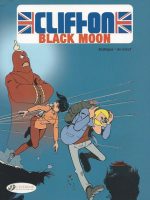
Clifton volume 4: Black Moon


By Rodrigue & de Groot, coloured by Liliane Denayer, translated by Luke Spear (Cinebook)
ISBN: 978-1-905460-30-4

An infallible agent of Her Majesty’s assorted security forces, Clifton was originally devised by Raymond Macherot (Chaminou, Les croquillards, Chlorophylle, Sibylline) for the weekly magazine Tintin. The doughty exemplar of Albion debuted in December 1959, just as a filmic 007 was preparing to set the world ablaze and get everyone au fait with espionage…

After three albums worth of strip material – compiled and released between 1959 and 1960 – Macherot left Tintin for arch-rival Spirou and his comedic crime-buster forlornly floundered.

Tintin revived him at the height of the Swinging London scene and aforementioned spy-boom, courtesy of Jo-El Azaza & Greg (Michel Régnier). These strips were subsequently collected as Les lutins diaboliques in French and De duivelse dwergen for Dutch-speakers in 1969.

Then it was back into retirement until 1971 when first Greg – with artist Joseph Loeckx – took his shot. He toiled on the True Brit until 1973 when Bob De Groot and illustrator Philippe “Turk” Liegeois fully regenerated the be-whiskered wonder. They produced ten tales after which, from 1984 on, artist Bernard Dumont (AKA Bédu) limned from De Groot’s scripts before eventually assuming the writing chores as well. The series concluded in 1995.

…But Not For Long…

In keeping with its rather haphazard Modus Operandi and indomitably undying nature, the Clifton experience resumed yet again in 2003, crafted now by De Groot & Michel Rodrigue for four further adventures. Although the humorous visual vein was still heavily mined in these tales, the emphasis was subtly shifted and the action/adventure components strongly emphasised…This one, Black Moon, was originally released in 2004 as Lune noire – Clifton: the 22nd of 25 to date and Rodrigue & De Groot’s second collaboration…

Bob de Groot was born in Brussels in 1941, to French and Dutch parents. As a young man he became art assistant to Maurice Tillieux on Félix, before creating his own short works for Pilote. A rising star in the 1960s, he drew 4 × 8 = 32 L’Agent Caméléon where he met Philippe “Turk” Liegeois and consequently began making a slow transition from artist to writer. Together they created Archimède, Robin Dubois and Léonard and eventually inherited Raymond Macherot’s moribund Clifton.

In 1989 de Groot – with Jacques Landrain – devised Digitaline, a strong contender for the first comic created entirely on a computer, and co-created Doggyguard with Michel Rodrigue, even whilst prolifically working with the legendary Morris on both Lucky Luke and its canine comedy spin-off Rantanplan.

He’s still going strong with strips such as Leonard in Eppo, Père Noël & Fils and Le Bar des acariens (both published by Glénat) and much more.

Michel Rodrigue really, really likes Rugby. He was born in Lyon in 1961 and eventually pursued higher education at the National School of Fine Arts, where he also studied medieval archaeology.

From 1983-85 he was on the French Rugby team and in 1987 designed France’s mascot for the World Cup. He made his comics debut in 1984 with sports (guess which one) strip Mézydugnac in Midi Olympique. After illustrating an adaptation Edmond Rostand’s Cyrano de Bergerac in 1986 he and collaborator Jean-Claude Vruble produced a volume of La Révolution Française, scripted by Patrick Cothias.

Rodrigue then joined Roger Brunel on Rugby en B.D., Du Monde dans la Coupe!, Concept, Le Rugby en Coupe and La Foot par la Bande.

For Tintin he drew Bom’s Les Conspirateurs and produced Rugbyman, the official monthly of the French Rugby Federation, amongst a welter of other strips. Along the way he began scripting too, and, after working with de Groot on Doggyguard joined him on the revived Clifton.

He also remains astonishingly creatively occupied, working on Ly-Noock with André Chéret, Brèves de Rugby, La Grande Trambouille des Fées for René Hausmann, Futurama comics, Cubitus with Pierre Aucaigne, and many more…

So who’s our hero?

Pompous, irascible Colonel Sir Harold Wilberforce Clifton is ex-RAF, a former officer with the Metropolitan Police Constabulary and recently retired from MI5. Typically, he has a great deal of difficulty dealing with being put out to pasture in rural Puddington and takes every opportunity to get back in the saddle, assisting the Government or needy individuals as an amateur sleuth whenever the opportunity arises.

Sadly, he is also all too keenly aware that he is generally the only truly competent man in a world chockfull of blithering idiots…

In this relatively recent offering the accent is heavily on blistering adventure and sinister intrigue – albeit with a liberal dosing of political satire tipped in – and begins at the end with the murder of Clifton in a seedy hotel in North Korea.

Photos of his bloody corpse are leaked to the press and soon cause a terrific commotion in the secret Headquarters of MI-5. Veteran warhorse and ultra-capable spymaster Colonel Donald Spruce cannot believe the evidence of his eyes and neither can any of his appalled staff…

Agent Brian begins translating the text and recounts how British subject “Marmaduke Brent” was chased by persons unknown through the town of Ptang-Kong before being machine gunned to death. With no other information available all the devastated agents can do is arrange for the body of their fallen former comrade to be shipped home…

To Spruce falls the unenviable task of informing Clifton’s fiery, frequently befuddled housekeeper Mrs. Partridge of the tragedy…

A few days later, with great ceremony a British transport picks up the coffin and the exotic widow escorting it to its final destination. With the plane safely in the air, she quickly opens the box and lets Clifton out before his oxygen supply is exhausted…

Battered and groggy, the old war horse begins reviewing the convoluted path which led to this fine turn of events…

Was it only a month ago that he and the ravishing Miss Jade were approached by Spruce to clandestinely follow the Prime Minister’s idiot nephew Hank to North Korea and infiltrate the bizarre and avaricious Black Moon Cult which had somehow changed an annoying chinless wonder and embarrassing idiot into a blithering nincompoop and danger to the prestige of the nation?

Of course the valiant old soldier accepted the mission, but neither he nor Jade could have known how devious was their masked leader The Great Tralala, how well-established, ambitious and deadly his cult was, nor that they were already a clandestine nuclear power with the entire world in their sights…

Still, with nothing to lose and a world to save, Clifton naturally had to do his utmost…

Fast-paced, action packed and sporting set pieces and a body count that would put James Bond and SPECTRE to shame, Black Moon is a cleverly contrived light romp that will astound and delight blockbuster addicts and comes with a smart line in sardonic social commentary to please every fun-loving sucker for satire.
Original edition © Les Editions du Lombard (Dargaud-Lombard) 2004 by Rodrigue & De Groot. English translation © 2007 Cinebook Ltd.


Lucky Luke Volume 8 Calamity Jane


By Morris & Goscinny, translated by Pablo Vela (Cinebook)
ISBN: 978-1-905460-25-0

Lucky Luke is seventy years old this year: a rangy, good-natured, lightning-fast quick-draw cowboy who roams the fabulously mythic Old West on his super-smart and stingingly sarcastic horse Jolly Jumper, having light-hearted adventures and interacting with a host of historical and legendary figures of the genre.

He’s probably the most popular Western star in the world today. His unbroken string of laugh-loaded exploits has made him one of the best-selling comic characters in Europe (82 albums selling in excess of 300 million copies in 30 languages at the last count), with spin-off toys, computer games, assorted merchandise, animated cartoons and even a passel of TV shows and live-action movies.

He was created in 1946 by Belgian animator, illustrator and cartoonist Maurice de Bévère (“Morris”) for L’Almanach Spirou 1947 of Le Journal de Spirou (the Christmas Annual), before springing into his first weekly adventure ‘Arizona 1880’ on December 7th 1946.

Prior to that, Morris had met future comics super-stars Franquin and Peyo while working at the CBA (Compagnie Belge d’Actualitiés) cartoon studio and contributing caricatures to weekly magazine Le Moustique. He quickly became one of “la Bande des quatre” (Gang of Four) comprising creators Jijé, Will and Franquin: all leading proponents of the loose, free-wheeling art-style dubbed the “Marcinelle School” which dominated Spirou in aesthetic contention with the “Ligne Claire” style used by Hergé, EP Jacobs and other artists in rival magazine Tintin.

In 1948 said Gang (all but Will) visited America, meeting US creators and sightseeing. Morris stayed for six years, meeting fellow tourist René Goscinny, scoring some work from newly-formed EC sensation Mad whilst making copious notes and sketches of the swiftly vanishing Old West.

That research resonates on every page of his life’s work.

A solo act until 1955, Morris produced another nine albums worth of affectionate parody before formally partnering with Goscinny, who became his regular wordsmith. Lucky Luke rapidly attained the dizzying heights of superstardom, commencing with ‘Des rails sur la Prairie’ (Rails on the Prairie), which began serialisation in Spirou with the August 25th of 1955. In 1967 the six-gun straight-shooter changed horses in midstream, transferring to Goscinny’s own magazine Pilote with ‘La Diligence’ (The Stagecoach).

Goscinny & Morris produced 45 albums together before the author’s death in 1977, after which Morris continued both singly and with fresh collaborators. Morris passed away in 2001, having drawn fully 70 adventures, plus beginning spin-off adventures for Rantanplan (“dumbest dog in the West” and a charming spoof of cinema canine Rin-Tin-Tin).

The immortal franchise was left to fresh hands, beginning with Achdé, Laurent Gerra, Benacquista & Pennac who have produced another ten tales to date.

Curiously, apart from the initial adventure, Lucky (to appropriate a quote applied to the thematically simpatico Alias Smith and Jones) “in all that time… never shot or killed anyone”. He did however smoke, like all the cool cowboys did…

Lucky Luke was first seen in Britain syndicated to weekly comic anthology Film Fun, then reappeared in 1967 in Giggle, renamed Buck Bingo. In all these venues – as well as the numerous attempts to follow the English-language successes of Tintin and Asterix albums from Brockhampton and Knight Books – Luke had a trademark cigarette hanging insouciantly from his lip, but in 1983 Morris, no doubt amidst both pained howls and muted mutterings of “political correctness gone mad”, substituted a piece of straw for the much-travelled dog-end, which garnered him an official tip of the hat from the World Health Organization.

Unquestionably, the most successful attempt at bringing Lucky Luke to our shores and shelves is the current incarnation. Cinebook (who have rightly restored the foul weed to his lips on the interior pages, if not the covers…) have translated 58 albums thus far. Calamity Jane was their eighth, still readily available both on paper and as an e-book edition.

It was first published Continentally in 1967: the 30th European offering and Goscinny’s twenty-first collaboration with Morris. It’s also one of the team’s better tales, blending historical personages with the wandering hero’s action-comedy exploits and as such it’s a slice of Horrible Histories-tinged Americana you can’t afford to miss.

It all begins with our hero taking a welcome bath in a quiet river, only to be ambushed by a band of Apaches spoiling for a fight. Their murderous plans are ruined by a bombastic lone rider who explosively drives off the raiders in a hail of gunfire before stopping to laugh at the embarrassed Luke. His cool, confidant rescuer is tough, bellicose, foul-mouthed, tobacco-chewing and infamous: although born Martha Jane Cannery most folk just call her Calamity Jane…

She’s becomes more amenable after learning who Luke is and over coffee and a scratch meal, mutual respect develops into real friendship. Recounting her (remarkably well-researched) history she learns in return why Luke is in the region: someone has been supplying the Indians with guns just like the ones that almost killed him earlier…

Keen to help, Calamity joins Lucky and they ride into frontier town El Plomo and another little crisis. The saloon prefers not to serve ladies… until Jane convinces them to change the policy in her own unique manner.

The glitzy dive is owned and operated by unctuous, sleazily sinister August Oyster who instantly suspects that legendary lawman Luke is there because of his own underhand, under-the-counter activities…

As the cowboy heads off to check in with the sheriff, Calamity gets into games of chance and skill with the sleazy Oyster and his hulking henchman Baby Sam, swiftly causing an upset by winning his hotel and saloon. Happily, Lucky is back on the scene by the time the grudging grouse has to officially hand over his money-making venture.

Flushed with success, the new proprietor starts making changes and no man cares to object to the Calamity Jane Saloon and Tearoom (Reserved for Ladies). They’ll happily buy her beer and whiskey too, but not even at gunpoint will they eat her crumpets…

Oyster and Baby Sam are frantic, however: the saloon was crucial to their side business selling guns to renegade Apaches and they have to get it back before increasingly impatient Chief Gomino takes matters into his own bloodstained hands…

Still hunting for the gunrunners and pretty certain who’s behind the scheme, Luke is constantly distracted by the petty acts of sabotage and even arson plaguing Calamity, but even as he finds his first piece of concrete proof, Oyster instigates his greatest distraction yet: organising the haughtily strait-laced Ladies Guild of El Plomo to close down the insalubrious saloon and run its new owner out of town…

Never daunted, Luke calms his tack-spitting pal down and deftly counterattacks by sending for an etiquette teacher to polish rough diamond Jane enough to be accepted by the ferocious and militant guildswomen. It is the greatest challenge urbane and effete Professor Robert Gainsborough (an outrageously slick caricature of British superstar actor David Niven) has undertaken and his eventual (partial) success leaves him a changed and broken man…

Stymied at every turn, the panicking August Oyster is soon caught red-handed by the vigilant vigilante, but it is too late. Frustrated and impatient, Gomino has decided to raid the town in broad daylight and seize his long-promised guns and ammo from their hiding place.

The terrifying marauders however have not reckoned on the steely fighting prowess of Lucky Luke and the devil woman they superstitiously call “Bang! Bang!”…

Cleverly barbed, wickedly witty and spectacularly playing with the key tropes of classic sagebrush sagas, this raucous romp is another grand escapade in the comedic tradition of Destry Rides Again and Support Your Local Sheriff, superbly executed by master storytellers as a wonderful introduction to a venerable genre for today’s kids who might well have missed the romantic allure of an all-pervasive Wild West that never was…

Also included here is a photo pin-up of the actual Martha Jane Cannery in her gun-toting prime and, in case you’re worried, even though the interior art still has our hero drawin’ on that ol’ nicotine stick, trust me, there’s very little chance of any reader craving a quick snout (or crumpets wild west style), but quite a strong likelihood that they’ll be addicted to Lucky Luke albums…
© Dargaud Editeur Paris 1971 by Goscinny & Morris. © Lucky Comics.

Angel Claws (Limited Edition)


By Moebius & Jodorowsky, translated by Thierry Nantier (Humanoids)
ISBN: 978-1-59465-012-3

Like vaudeville and comedy, the world of comics has been blessed with some incredible double-acts: seasoned professionals capable of astounding works individually but in close combination, fuelling and feeding each other until elevated to a sublime peak of invention and application.

You’ll have your own candidates, but for me Joe Simon & Jack Kirby, Goscinny & Uderzo, Lee & Kirby, Kazuo Koike & Goseki Kojima and RosiÅ„ski & Van Hamme all resonate as individual masters who respond to certain collaborations and combinations with unmatched brilliance…

One of European comics most impressive and controversial pairings was always Moebius & Jodorowsky and this recently revived dark confection is possibly their most daring and audacious co-creation…

Born in Tocopilla, Chile in 1929, Alejandro Jodorowsky Prullansky is a filmmaker, playwright, actor, author, world traveller, philosopher, spiritual guru and comics writer.

The acclaimed polymath is most widely revered for such films as Fando y Lis, El Topo, The Holy Mountain, Sante Sangre, The Rainbow Thief, The Dance of Reality and others, plus his vast and influential comics output, which includes Anibal 5, Le Lama blanc, Aliot, The Meta-Barons, Borgia, Madwoman of the Sacred Heart and so many more, created with many of South America and Europe’s greatest artists.

His decade-long collaboration with Moebius on Tarot-inspired fantasy epic The Incal (1981-1989) completely redefined and reinvented what comics could aspire to and achieve.

Acclaimed for violently surreal avant-garde films, loaded with highly-charged, inspired imagery – blending mysticism and what he terms “religious provocation” – and his spiritually-informed fantasy and science fiction comics, Jodorowsky is also fascinated by humanity’s inner realms and has devised his own doctrine of therapeutic healing: Psychomagic, Psychogenealogy and Initiatic massage.

He remains fully engaged and active in all these creative areas to this day.

Jean Henri Gaston Giraud was born in the suburbs of Paris on May 8th 1938 and raised by grandparents after his mother and father divorced in 1941. In 1955, he attended Institut des Arts Appliqués and became friends with Jean-Claude Mézières who, at 17, was already selling strips and illustrations to magazines such as Coeurs Valliants, Fripounet et Marisette and Spirou. Giraud apparently spent most of his college time drawing cowboy comics and left after a year.

In 1956 he travelled to Mexico, staying with his mother for eight months, before returning to France and a full-time career drawing comics, mostly westerns such as Frank et Jeremie for Far West and King of the Buffalo, A Giant with the Hurons and others for Coeurs Valliants in a style based on French comics legend Joseph Gillain AKA “Jijé”.

Between 1959-1960 Giraud spent his National Service in Algeria, working on military service magazine 5/5 Forces Françaises before returning to civilian life as Jijé’s assistant in 1961, working on the master’s long-running (1954-1977) western epic Jerry Spring.

A year later, Giraud and Belgian writer Jean-Michel Charlier launched the serial Fort Navajo in Pilote #210, and soon its disreputable, anti-heroic lead character Lieutenant Blueberry became one of the most popular European strips of modern times.

In 1963-1964, Giraud produced a numerous strips for satire periodical Hara-Kiri and, keen to distinguish and separate the material from his serious day job, first coined his pen-name “Moebius”.

He didn’t use it again until 1975 when he joined Bernard Farkas, Jean-Pierre Dionnet and Philippe Druillet – all devout science fiction fans – as founders of a revolution in narrative graphic arts created by “Les Humanoides Associes”.

Their groundbreaking adult fantasy magazine Métal Hurlant utterly enraptured the comics-buying public and Giraud again wanted to utilise a discreet creative persona for the lyrical, experimental, soul-searching material he was increasingly driven to produce: series such as The Airtight Garage, The Incal and the mystical, dreamy flights of sheer fantasy contained in Arzach…

To further separate his creative twins, Giraud worked his inks with a brush whilst the dedicated futurist Moebius rendered his lines with pens. After a truly stellar career which saw him become a household name, both Giraud and Moebius passed away in March 2012.

Griffes D’ange was first published in 1994, during a period when the deeply spiritual Moebius was especially concerned with purging, honing and redefining his creative soul and artistic vision. One result of his divinations was this collation of sexually hyper-charged images accompanied – as was the earlier collaboration Claws of the Cat – by evocative poetic musings from his brother-in-graphic exploration Jodorowsky…

Stunning monochrome plates – rendered in stark monochrome lines – counter-pointed and augmented by terse, challenging, intentionally disturbing descriptive statements reveal the innermost workings of a recently-bereaved young woman who throws aside all pretences of convention to embark on a quest of personal discovery and awakening. Where the search takes her is the stuff of dreams and nightmares…

Fetishistic, scary, sexually explicit, deeply symbolic, confrontationally transformative and – as previous stated – reportedly a therapeutic exercise for the creators, Angel Claws is a stunning assault on the senses and traditional mores and morality to appal and delight in equal amounts… depending, of course, upon what your own upbringing brings to the feast…

Available as an oversized (406 x 305 mm) hardcover coffee table tome and in digital editions, this is a visual milestone no consenting adult connoisseur of comics should miss.
Angel Claws and its logo are ™ Les Humanoides Associes SAS Paris (France). English version © 2012 Humanoids, Inc., Los Angeles (USA). All rights reserved.

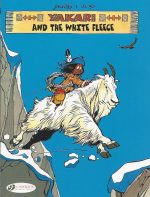
Yakari and the White Fleece


By Derib & Job, coloured by Dominique, translated by Erica Jeffrey (Cinebook)
ISBN: 978-1-84918-055-9

In 1964 Swiss journalist André Jobin founded a new children’s magazine entitled Le Crapaud à lunettes. He then wrote for it under the pseudonym Job. Three years later he hired fellow French-Swiss artist Claude de Ribaupierre who opted for the pen-name “Derib”. His own career began when he joined Studio Peyo (home of Les Schtroumpfs), as an assistant working on Smurfs strips for the weekly Spirou. Together, Jobin and de Ribaupierre crafted the splendid Adventures of the Owl Pythagore before striking pure comics gold a couple of years later with their next collaboration.

Launching in 1969, Yakari detailed the life of a young Oglala Lakota boy on the Great Plains; sometime after the introduction of horses by the Conquistadores and before the coming of the modern White Man.

Overflowing with gentle whimsy and wholesome suspense, the beguiling strip explores a captivating, bucolic existence at one with nature and generally free from strife. For the sake of our entertainment however the seasons are punctuated with the odd crisis and generally resolved without fame or fanfare by a little Sioux lad who is smart, compassionate, brave… and able to converse with all animals…

Derib – equally excellent in both enticing, comically dynamic “Marcinelle” cartoon style yarns and with devastatingly compelling meta-realistic action illustrated action epics – went on to become one of the Continent’s most prolific and revered creators.

It’s a crime that such groundbreaking strips as Celui-qui-est-né-deux-fois, Jo (the first comic on AIDS ever published), Pour toi, Sandra and La Grande Saga Indienne) haven’t been translated into English yet, but we remain in a state of hopeful anticipation…

Many of his most impressive works over the decades have featured his beloved Western themes, magnificent geographical backdrops and epic landscapes, and Yakari is considered by most fans and critics to be the feature which catapulted him to deserved mega-stardom.

Originally released in 1984, Yakari et la toison blanche was the eleventh European album and Cinebook’s lucky 13th, but chronology and continuity addicts won’t suffer unless they are of a superstitious turn of mind since this tale is both stunningly simple and effectively timeless; offering certain enjoyment from a minimum of foreknowledge…

The tribe are nomadic; perpetually moving with the seasons and this tale opens as they make camp at the base of a mighty mountain range. Two warriors leave to round up wild mustangs but as they scale the lower ranges, over-eager Bold Crow ignores an omen and is attacked by a golden eagle. The diving raptor knocks him from his pony and, while he lies stunned, snatches away his medicine pouch and personal talisman.

Playfully scaling the rocks nearby, Yakari, Rainbow and blustering Buffalo Seed see Watchful Snake bringing comatose Bold Crow back and rush to see what has happened…

Even medicine man He Who Knows cannot wake the fallen hunter, and Yakari is worried that somehow his own totem Great Eagle has caused the tragedy. Determined to intercede on the fallen warrior’s behalf and recover the stolen pouch, Yakari sets off to climb the mountain on his wondrous pony Little Thunder.

Eventually, though, even the wonder horse can no longer keep his footing and after conferring with a helpful elk and a timid clan of marmots the little lad heads on alone, always aiming for the highest peak where the eagles live…

Nearing the top Yakari spots the giant bird of prey and with some relief realises it is not his adored Great Eagle who has caused the injury to Bold Crow’s spirit. Before he can decide what to do next however, the bold boy is distracted by strange sounds and sees a herd of mountain sheep playfully butting heads.

From his vantage point the weary boy can see his people far below and for miles around. It’s the only thing that saves him as the weather suddenly changes and an ice storm hits. Unable to climb down in the tempest, he heads for a cave higher up the rock face and frantically scrabbles in. With snow pounding down he crawls as far as he can through the darkness and falls asleep in the withering cold…

He awakes alive, surprised and gloriously warm, to find himself at the centre of a huge heap of smiling, fleecy mountain goats. Over breakfast he tells the welcoming family of his quest. They too have reason to be wary of the great raptor, as it has been know to menace newborn kids and generous Broken Horn offers to guide him as close as she can…

Sadly even carrying Yakari, they cannot get close enough to the inaccessible eagle’s eyrie and have to retreat. Rather than admit defeat however, the lad has a plan, but it all rests upon his ability to weave and braid the fleeces shed by his new friends into a certain form…

Now all that remains is to regain the summit, brave the hunter’s lair and survive the inevitable counterattack, but at least thanks to a last-minute arrival, the goats are not his only allies in the deadly heights…

Always visually spectacular, seductively smart and happily heart-warming, Job’s beguiling script again affords Derib a splendid opportunity to go absolutely wild with the illustrations; creating a dizzying, breathtaking scenario which only makes his eventual victory even more unlikely until it actually happens…

The exploits of the valiant voyager who speaks with beasts and enjoys a unique place in an exotic world is a decades-long celebration of joyously gentle, marvellously moving adventure, honouring and eulogising an iconic culture with grace, wit, wonder and especially humour.

These seductive sagas are true landmarks of comics and Yakari is a strip no parent or fan of graphic entertainment should ignore.
Original edition © Le Lombard (Dargaud- Lombard S.A.) 2000, by Derib + Job. English translation 2010 © Cinebook Ltd.

XIII volume 3: All the Tears of Hell


By William Vance & Jean Van Hamme, coloured by Petra (Cinebook)
ISBN: 978-1-84918-051-1

One of the most consistently entertaining and popular adventure serials on the European scene, XIII was created by author Jean Van Hamme (Wayne Shelton, Blake and Mortimer, Lady S.) and illustrator William Vance (Bruce J. Hawker, Marshal Blueberry, Ramiro).

Van Hamme was born in Brussels in 1939 and is one of the most prolific writers in comics. After pursuing business studies he moved into journalism and marketing before selling his first graphic tale in 1968. Immediately clicking with the public, by 1976 he had also branched out into prose novels and screenwriting. His big break was monumentally successful mixed-genre fantasy series Thorgal for Tintin magazine but he truly cemented his reputation with mass-market bestsellers Largo Winch and XIII as well as more cerebral fare such as Chninkel and Les maîtres de l’orge. In 2010 Van Hamme was listed as the second-best selling comics author in France, ranked between the seemingly unassailable Hergé and Uderzo.

William Vance is the bande dessinée nom de plume of William van Cutsem. He was born in 1935 in Anderlecht and, after military service in 1955-1956, studied art at the Académie Royale des Beaux-Arts. He became an illustrator of biographic features for Tintin in 1962. His persuasive illustrative style is a classical blend of meticulous realism, scrupulous detail and spectacular yet understated action.

In 1964 he began maritime adventure serial Howard Flynn (written by Yves Duval) before graduating to more popular genre work with western Ray Ringo and espionage thriller Bruno Brazil (scripted by “Greg”). Further success followed when he replaced Gérald Forton on science fiction classic Bob Morane in Femmes d’Aujourd’hui and latterly Pilote and Tintin.

Although working broadly and constantly on serials and stand-alone stories, Vance’s signature achievement is his lengthy collaboration with fellow Belgian Van Hamme on this contemporary thriller loosely based on Robert Ludlum’s novel The Bourne Identity…

XIII premiered in 1984, originally running in Spirou to great acclaim. A triad of albums were rushed out – simultaneously printed in French and Dutch editions – before the first year of serialisation ended.

The series was a monumental hit in Europe but has fared less well in its many attempts to make the translation jump to English, with Catalan Communications, Alias Comics and even Marvel all failing to find an audience for the epic mystery thriller.

The grand conspiracy saga of unrelenting mood, mystery and mayhem opened in The Day of the Black Sun when an old beachcomber found a body. The human flotsam had been shot in the head and was near death when old Abe‘s wife examined the near-corpse. She discovered a key sewn into his clothes and the Roman numerals for thirteen tattooed on the victim’s neck. Their remote hideaway offered little in the way of emergency services, but their alcoholic, struck-off surgeon friend was able to save the stranger…

As he recuperated a complication became apparent. The patient – a splendid physical specimen clearly no stranger to action or violence – had suffered massive irreversible brain trauma and although increasingly sound in body had completely lost his mind.

Language skills, muscle memories, even social and reflexive conditioning all remained, but every detail of his life-history was gone…

Abe and Sally named him “Alan” after their own dead son – but hints of the intruder’s lost past explosively intruded when hitmen invaded the beach house with guns blazing. Alan lethally retaliated with terrifying skill, but too late…

In the aftermath he found a photo of himself and a young woman on the killers and traced it to nearby Eastown. Desperate for answers and certain more killers were coming, the human question mark headed off to confront unimaginable danger and hopefully find the answers he craved.

The picture led to a local newspaper and a crooked cop who recognised the amnesiac but said nothing…

The woman in the photo was Kim Rowland, a local widow recently gone missing. Alan’s key opened the door of her house. The place had been ransacked but a thorough search utilising his mysterious talents turned up another key and a note warning someone named Jake that “The Mongoose” had found her…

He was then ambushed by the cop and newspaper editor Wayne. Calling him “Shelton” they demanded the return of a large amount of missing money…

Alan/Jake/Shelton reasoned the new key fitted a safe-deposit box and bluffed the thugs into taking him to the biggest bank in town. The staff there also knew him as Shelton, but when his captors examined the briefcase in Shelton’s box a booby trap went off. Instantly acting, the mystery man expertly escaped and eluded capture, holing up in a shabby hotel room, pondering again what kind of man he used to be…

As he prepared to leave he stumbled into a mob of armed killers. In a blur of lethal action he escaped and ran into another gang led by a Colonel Amos. This chilling executive referred to his captive as “Thirteen”, claiming to have dealt with his predecessors XI and XII in regard to the “Black Sun” case…

Amos very much wanted to know who Alan was, and offered some shocking titbits in return. The most sensational was film of the recent assassination of the American President, clearly showing the lone gunman was XIII…

Despite the amnesiac’s heartfelt conviction that he was no assassin, Amos accused him of working for a criminal mastermind, and wanted that big boss but failed to take Alan’s instinctive abilities into account and was astounded when his prisoner leapt out of a fourth floor window…

The fugitive headed back to the beach where he was found but more murderers awaited; led by a mild-seeming man Alan inexplicably knew was The Mongoose. The mastermind expressed surprise and admiration: he thought he’d killed Thirteen months ago…

Following an explosion of hyper-fast violence which left the henchmen dead and Mongoose vanished but vengeful, the mystery man regretfully hopped a freight train west towards the next stage in his quest for truth…

His journey of discovery took him to the army base where Kim Rowland’s husband was stationed. His enquiries provoked an unexpected and violent response resulting in his interrogation by General Ben Carrington and his sexily capable aide Lieutenant Jones.

They’re from the Joint Chiefs of Staff, know an awful lot about black ops units and have proof that their memory-challenged prisoner is in fact their agent: believed-deceased Captain Steve Rowland…

After testing the amnesiac’s abilities Carrington then drops him off in Rowland’s home town of Southberg to pursue his search for his missing wife, but the prodigal’s return to his rat’s nest of a family rekindles long-simmering passions and jealousies. The entire town seems to want Rowland’s blood and before long he’s been made the target of an assassination attempt and victim of a diabolical murder-plot…

Despite Carrington and Jones’ last-minute intervention Alan/Steve is framed for murdering his father and grabbed by a furious posse…

This third gripping instalment (originally seen in Europe as Toutes Les larmes de l’enfer in 1986) opens with Steve Rowland undergoing the worst kind of psychiatric care at the Plain Rock Penitentiary for the Criminally Insane. Despite drugs and shock treatments, his progress at the Maximum Security Facility is negligible. Young Dr. Ralph Berger seems amenable enough but all elderly martinet Dr. Johansson‘s claims to be seeking a cure for his patient’s amnesia are clearly no more than a proselytising, judgemental sadist’s justifications for inflicting pain…

Meanwhile in Washington DC, Carrington and Jones have met with Colonel Amos who has a strange request and troubling new information. His investigations have revealed that the amnesiac in the desert hell of Plain Rock has undergone plastic surgery and his army records have been altered. Steve Rowland is definitely not Steve Rowland…

Moreover, Amos has information proving that the plotters who had the President killed are still active and their amnesiac assassin is the only link and hope of finding them. Acting on her own initiative, Jones decides it’s time she took a hands-on approach to the problem…

Meanwhile, anxious and isolated Not-Rowland has a visitor who galvanises him out of his electro-chemically induced fugue-state as the Mongoose gloatingly pops in to inform the prisoner that his days are numbered…

Deep within the corridors of power, Colonel Amos informs Carrington that his further investigations have resulted in a name. He has solved the mystery of XIII and the man they are actually dealing with is former soldier and intelligence operative Ross Tanner.

Probably…

Knowing his time is limited, Rowland/Tanner opts for escape and decides to take along the kid who shares his cell. It’s as if he’s forgotten they’re in a maximum security facility for criminal maniacs, but he’s painfully reminded of the fact when sweet little Billy starts killing again as soon as they’re clear of the detention wing…

Recaptured and restricted to the medical section, XIII is helpless when the Mongoose’s inside man makes his move. Luckily Jones has also inserted herself in a position where she can do the most good…

Spectacularly busting out of the prison, “Rowland” and the mystery-woman then race into the desert, somehow avoiding a massive manhunt before vanishing without trace. Some time later Amos and Carrington confer over the disappearance, but one of them knows exactly where the fugitive is.

Now, with another new name, the warrior without a past and his new powerful allies lay plans to take the fight to their secret enemy…

To Be Continued…

XIII is one most compelling and convoluted mystery adventures ever conceived, with subsequent instalments constantly taking the questing human enigma two steps forward, one step back, stumbling through a world of pain and peril whilst cutting through an interminable web of past lives he seemingly led…

Fast-paced, clever and immensely inventive, XIII is a series no devotee of mystery and murder will want to miss.
Original edition © Dargaud Benelux (Dargaud-Lombard SA), 1986 by Van Hamme, Vance & Petra. All rights reserved. This edition published 2010 by Cinebook Ltd.

Clifton volume 3: 7 Days to Die


By Turk & De Groot, translated by Luke Spear (Cinebook)
ISBN: 978-1-905460-08-3

Seeing ourselves through other’s eyes is always a salutary experience and our Continental cousins in the comics biz are especially helpful in that respect as regards the core characteristics of being British

For some inexplicable reason most of Europe’s comics cognoscenti – most especially the French and Belgians – seem fascinated with us. Maybe it’s a shared heritage of Empires in Decline and old cultures and traditions in transition? An earlier age would have claimed it’s simply a case of “Know your Enemy”…

Whether we look at Anglo air ace Biggles, indomitable scientific adventurers Blake and Mortimer, the Machiavellian machinations of Green Manor or the further travails of Long John Silver, the serried stalwarts of our Scepter’d Isles cut a dashing swathe through the pages of Europe’s assorted strip-magazines and albums.

Clifton was originally devised by child-friendly strip genius Raymond Macherot (Chaminou, Les croquillards, Chlorophylle, Sibylline) for iconic Tintin Magazine; a doughty True Brit troubleshooter who debuted in December 1959, just as a filmic 007 was preparing to set the world ablaze…

After three albums worth of material – compiled and released between 1959 and 1960 – Macherot left Tintin for arch-rival Spirou and his eccentric comedy crime-fighter forlornly floundered until Tintin brought him back at the height of the Swinging London scene and aforementioned spy-boom, courtesy of Jo-El Azaza & Greg (Michel Régnier).

These strips were subsequently collected as Les lutins diaboliques in French and De duivelse dwergen for Dutch-speakers in 1969.

Then it was back into retirement until 1971 when first Greg (in collaboration with artist Joseph Loeckx) took his shot; working until 1973 when writer Bob De Groot and illustrator Philippe “Turk” Liegeois fully revived the be-whiskered Brit for the long haul. They produced ten tales of which this – 7 jours pour mourir from 1979 – was the fourth.

From 1984 on, artist Bernard Dumont – AKA Bédu – limned De Groot’s scripts before eventually assuming the writing chores as well, until the series at last concluded in 1995.

…But Not For Long…

In keeping with its rather haphazard Modus Operandi and indomitably undying nature, the Clifton experience resumed yet again in 2003, crafted by De Groot & Michel Rodrigue for four further adventures; a grand total of 25 to date.

The setup is deliciously simple: pompous, irascible Colonel Sir Harold Wilberforce Clifton, ex-RAF, former Metropolitan police Constabulary and recently retired from MI5, has a great deal of difficulty dealing with being put out to pasture in rural Puddington. He thus takes every opportunity to get back in the saddle, occasionally assisting the Government or needy individuals as an amateur sleuth.

Sadly for Clifton – as with that other much-underappreciated national treasure Captain Mainwaring in Dad’s Army – he is too keenly aware that he is usually the only truly competent man in a world full of blithering idiots…

This particular tale however strays somewhat from well-trodden humour paths and indulges in some frantic action and sinister suspense bombastic whilst still resolutely going for comedy gold.

In this third translated Cinebook album – first seen in 2005 – the Gentleman Detective is notably absent as the tale opens in London at the secret Headquarters of MI-5. Veteran warhorse and ultra-capable spymaster Colonel Donald Spruce is having a little bit of a crisis…

A battled-scarred survivor of simpler times, Spruce longs for one last field mission, but is instead swamped with petty admin nonsense. That all changes in an instant as the computer boffins in charge of Betty – latest in the line of “Thinkover” super-calculators – discover a little problem.

In the age of automation, Betty controls every aspect of physical eliminations for the agency. It is an infallible electronic assassination expediter. Information on a target is fed in and Betty commences a contract, contacting outside agents to do the dirty work and providing all the details they will need to complete the commission. No hostile has ever lasted more than a week when Betty is concerned: she provides efficiency, expediency, economy and utter deniability…

Except now the harassed technos are enduring a severe tongue-lashing from Spruce who has noticed that the latest print-out is retired agency star and his old chum Harold Wilberforce Clifton. As Spruce fumes and fulminates the abashed boffins try to explain that the process is irreversible. They can’t contact the contractors to cancel the hit. Clifton is as good as dead…

With no other choice the Colonel frantically phones the retired agent and gives him the bad news. Our hero, unwilling to bow out gracefully, immediately goes on the run, using all his cunning and years of tradecraft to stay one step ahead of his faceless hunters. His stalkers however are seasoned professionals too and luck more than guile is the only thing saving him from an increasingly spectacular succession of devastating “accidents”…

Thematically far darker than previous tales, 7 Days to Die is nevertheless stuffed with hilarious moments of slapstick and satire to balance some pretty spectacular action set-pieces as frantic flight, devious disguise and even coldly calculated counterattack all fail to deter the implacable assassins. However as the climax approaches Clifton and Spruce individually come to the same stunning conclusion: this selection by Betty might not have been an accident after all…

Visually spoofing the 1970s’ original era of Cool Britannia and staidly stuffy English Mannerism with wicked effect, these gentle thrillers are big on laughs but also pack a lot of trauma-free violence into the eclectic mix. Delightfully surreal, instantly accessible and doused with serous slapstick à la Jacques Tati and deft, daft intrigue like Carry On Spying or Morecambe & Wise’s The Intelligence Men, this romp rattles right along offering readers a splendid treat and loads of to think about.
Original edition © 1979 Le Lombard (Dargaud-Lombard S. A.) by De Groot & Turk. English translation © 2005 Cinebook Ltd.

Spirou & Fantasio volume 10: Virus


By Tome & Janry, translated by Jerome Saincantin (Cinebook)
ISBN: 978-1-84918-297-3

Spirou (which translates as both “squirrel” and “mischievous” in the Walloon language) was created by French cartoonist François Robert Velter under his nom-de-plume Rob-Vel. The inspirational invention at the request of Belgian publisher Éditions Dupuis in direct response to the phenomenal success of Hergé’s Tintin for competing outfit Casterman.

Not long after, soon-to-be legendary weekly comic Spirou launched (on April 21st 1938) with Rob-Vel’s red-headed rascal as the lead of the anthology which bears his name to this day.

The eponymous star was originally a plucky bellboy/lift operator employed by the Moustique Hotel (a wry reference to the publisher’s premier periodical Le Moustique) whose improbable adventures with pet squirrel Spip gradually grew into high-flying, far-reaching and surreal action-comedy dramas.

Spirou and his chums have spearheaded the magazine for most of its life, with a phalanx of truly impressive creators carrying on Velter’s work, beginning with his wife Blanche “Davine” Dumoulin who took over the strip when her husband enlisted in 1939. She was assisted by Belgian artist Luc Lafnet until 1943 when Dupuis purchased all rights to the property, after which comic-strip prodigy Joseph Gillain (“Jijé”) took the helm.

In 1946 Jijé’s assistant André Franquin assumed the creative reins, gradually sidelining the long-established brief, complete gag-vignettes in favour of epic adventure serials, introducing a wide and engaging cast of regulars and eventually creating phenomenally popular magic animal the Marsupilami to the mix.

Franquin continued crafting increasingly fantastic Spirou sagas until his abrupt resignation in 1969 and his tenure is remembered for the wealth of weird and wonderful players and villains he added to the cast. As well as comrade, rival and co-star Fantasio and perennial exotic arch-enemies such as Zorglub and Fantasio’s unsavoury cousin Zantafio, a particular useful favourite was crackpot inventor and modern-day Merlin of mushroom mechanics Pacôme Hégésippe Adélard Ladislas, the Count of Champignac (and sly tribute to an immortal be-whiskered druid dubbed Getafix…)

Franquin was succeeded by Jean-Claude Fournier who updated the feature over the course of nine stirring yarns tapping into the rebellious, relevant zeitgeist of the times: tales of environmental concern, nuclear energy, drug cartels and repressive regimes.

However, by the 1980s the series was looking a tad outdated and directionless. Three different creative teams then alternated on the feature, until it was at last revitalised by Philippe Vandevelde – writing as Tome – and artist Jean-Richard Geurts AKA Janry, who adapted, referenced and in all the best ways returned to the beloved Franquin era.

Their sterling efforts began with the tale under review here and quickly revived the floundering feature’s fortunes. They contributed thirteen more wonderful albums to the canon between 1984 and 1998, and allowed the venerable strip to diversify into parallel strands (Spirou’s Childhood/Little Spirou and guest-creator specials A Spirou Story By…).

Tome & Janry were followed on the core feature by Jean-David Morvan & José-Luis Munuera, and in 2010 Yoann & Vehlmann took over the never-ending procession of astounding escapades…

Cinebook have been publishing Spirou & Fantasio‘s exploits since 2009, alternating between Tome & Janry’s superb reinterpretations of Franquin and earlier triumphs by the great man himself. This tenth release is officially the cartoon crimebusters’ 33rd collected caper.

Originally serialised in Spirou #2305-2321 in 1982 and subsequently released as an album in 1984, this epic episode begins as a shady figure cases an icebreaker just back from the Antarctic. For some reason the HK Glacier has been placed in stringent quarantine and the observer – soon revealed as enquiring reporter Fantasio – discovers why as he trips over a very sick-looking mariner sneaking off the vessel.

It is old enemy and unscrupulous pirate John Helena – AKA “the Moray” – and he has been infected with a highly contagious disease…

In fact, it’s so virulent anyone in close proximity suffers from allergic attacks, even without contracting the primary sickness…

Knowing he’s on to something big, Fantasio rings partner-in-peril Spirou and has his comrade bring down a van to sneak Helena through the cordon of armed government troops. Safely ensconced in a chapel, the Moray tells them of Isola Red, a top-secret lab in the polar wastes where scientists are working with thousands of different viruses and exactly how he got infected with one of them. He completes his tale of woe by demanding that they take him to Count Champignac – the only man alive who can save him… and the world…

The fungal phenomenon is naturally up to the task but his proposed remedy is both complex and risky and involves the dauntless duo infiltrating Isola Red to use the cached toxins there as part of the cure. What the valiant adventurers don’t know is that the chateau is already under covert observation by a thoroughly shady-looking third-party…

Moreover and meanwhile, in a prestigious government building the mastermind behind everything is dispatching his own clean-up team to make the growing problem go away entirely…

Soon Spirou and Fantasio – with the rapidly declining Helena in tow in a hazmat suit – are touching down at Russian base Mirnov-Skaya. Spip is with them but also has to wear an isolation outfit since the vindictive little tyke couldn’t resist taking a bit of the Moray…

The camp is the last official outpost of civilisation and its gregarious commander Captain Sergeiev is delighted to offer every assistance to reach the secret base somewhere deep in the icy interior. After all, the polar explorer is an old friend of the well-travelled inventor Count Champignac…

After a few embarrassing moments of hilarity, the heroes set off as an official rescue party in borrowed snow-cats, with the camp doctor Placebov, hulking guide/driver Nadia Tovarich and even Sergeiev’s action-loving pet seal Vasily along for the ride. The desperate first-responders are sadly unaware that their unknown adversary’s money has bought a traitor who now rides along with them…

Things seem completely hopeless when the mastermind’s clean-up squad explosively ambush the convoy but the killers too are in the dark: they have been followed by yet another interested party…

Although the assassins are soon driven off, it seems they have done enough: the partial cure Spirou was carrying is wrecked and Helena’s suit is breached. They are all now probably exposed to the virus’s full effects…

Back in Europe, Champignac has been making some waves and his efforts, combined with certain journalistic endeavours, have brought low the hidden mastermind and a government official running a clandestine biological weapons plant at the bottom of the world. With the news still breaking, the Count, a military taskforce and a horde of reporters all set off for Antarctica…

In the meantime the doomed heroes have pushed on to Isola Red, in a hopeless attempt to find some miracle cure. What they encounter is truly shocking but does point the way to a solution to all their problems.

Unless of course, the freshly-reinforced mercenary clean-up squad kills them all first…

Blending rambunctious slapstick, riotous chases and gallons of gags with thrills, spills and – wait for it – chills; this is a terrific tale packed with laughs and superb action, deftly wielding a potently satirical anti-war, anti-capitalist message.

Fast-paced and exuberant, Virus is a joyous yet suspenseful romp happily accessible to readers of all ages and drawn with beguiling style and seductively wholesome élan. Catch it if you can…
Original edition © Dupuis, 1984 by Tome & Janry. All rights reserved. English translation 2016 © Cinebook Ltd.

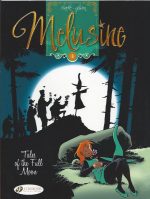
Melusine volume 5: Tales of the Full Moon


By Clarke & Gilson, coloured by Cerise; translated by Jerome Saincantin (Cinebook)
ISBN: 978-1-84918-212-6

Witches – especially cute, sassy and/or teenaged ones – have a splendidly long pedigree in all branches of fiction, and one of the most seductively engaging first appeared in venerable Belgian comics-magazine Spirou in 1992.

Mélusine is actually a sprightly 119-year-old neophyte sorceress diligently studying to perfect her craft at Witches’ School. To make ends meet she spends her off-duty moments days working as au pair and general dogsbody to a most shockingly disreputable family of haunts and horrors inhabiting and infesting a vast, monster-packed, ghost-afflicted chateau at some chronologically adrift, anachronistically awry time in the Middle-ish Ages…

Episodes of the long-running, much-loved feature are presented in every format from one-page gag strips to full-length comedy tales; all riffing wickedly on supernatural themes and detailing Mélusine’s rather fraught existence. Our magic maid’s life is filled with the daily indignities of skivvying, studying, catering to the appalling and outrageous domestic demands of the master and mistress of the castle and – far too occasionally – schmoozing with a large and ever-growing circle of exceedingly peculiar family and friends.

The strip was devised by writer François Gilson (Rebecca, Cactus Club, Garage Isidore) and cartoon humorist Frédéric Seron, AKA Clarke whose numerous features for all-ages Spirou and acerbic adult humour publication Fluide Glacial include Rebecca, Les Cambrioleurs, Durant les Travaux, l’Exposition Continue… and Le Miracle de la Vie.

Under the pseudonym Valda, Seron also created Les Babysitters and as “Bluttwurst” Les Enquêtes de l’Inspecteur Archibaldo Massicotti, Château Montrachet, Mister President and P.38 et Bas Nylo.

A former fashion illustrator and nephew of comics veteran Pierre Seron, Clarke is one of those insufferable guys who just draws non-stop and is unremittingly funny. He also doubles up as a creator of historical and genre pieces such as Cosa Nostra, Les Histoires de France, Luna Almaden and Nocturnes. He has obviously been cursed by some sorceress and can no longer enjoy the surcease of sleep…

Collected Mélusine editions began appearing annually or better from 1995 onwards, with the 24th published in 2015 and another due this year. Thus far five of those have shape-shifted into English translations…

Originally released in October 2002, Contes de la pleine lune was Continentally the tenth groovy grimoire of mystic mirth and is again most welcoming: primarily comprised of single and 2-page gags starring the sassy sorceress which delightfully eschew continuity for the sake of new readers’ instant approbation…

When brittle, moody, over-stressed Melusine isn’t being bullied for her inept cleaning skills by the matriarchal ghost-duchess who runs the castle, ducking cat-eating monster Winston, dodging frisky vampire The Count or avoiding the unwelcome and often hostile attentions of horny peasants and over-zealous witch-hunting priests, our saucy sorceress can usually be found practising her spells or consoling and coaching inept, un-improvable and lethally unskilled classmate Cancrelune.

Unlike Mel, this sorry enchantress-in-training is a real basket case: her transformation spells go awfully awry, she can’t remember incantations and her broomstick-riding makes her a menace to herself, any unfortunate observers and even the terrain and buildings around her…

As the translated title of this (fifth) Cinebook offering suggests, Tales of the Full Moon dwells on demolishing fairy fables and bedevilling bedtime stories but also gives a proper introduction to Mel’s best friend Krapella: a rowdy, roistering, mischievous and disruptive classmate who is the very image of what boys want in a “bad” witch…

This tantalising tome is filled with narrative nostrums featuring the usual melange of slick sight gags and pun-ishing pranks; highlighting how our legerdemainic lass finds a little heart’s ease by picturing how one day she’ll have her very own Prince Charming.

Sadly, every dream ends – usually because there’s a mess that needs cleaning up – but Melusine absolutely draws the line when Cancrelune and even her own sweetness-&-light Fairy cousin Melisande start hijacking her daydreams…

This fusillade of fanciful forays concludes with eponymously titled, extended episode Tales of the Full Moon wherein Melusine is ordered to read a bedtime story to the Count’s cousin’s son: an obnoxiously rambunctious junior vampire named Globule who insists on twisting her lovely lines about princesses and princes into something warped and Gothic… and that’s before Cancrelune starts chipping in with her own weird, wild suggestions and interjections …

Wacky, wry, sly, infinitely inventive and uproariously funny, this compendium of arcane antics is a terrific taste of European comics wonderment: a beguiling delight for all lovers of the cartoonist’s art. Read well before bedtime – or you’ll be up laughing all night …
Original edition © Dupuis, 2002 by Clarke & Gilson. All rights reserved. English translation 2014 © Cinebook Ltd.

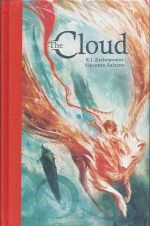
The Cloud


By K. I. Zachopoulos & Vincenzo Balzamo (Archaia)

ISBN: 978-1-60886-725-7

Writer Kostas Zachopoulos clearly has a great grip on classic themes and tropes. His previous comics releases – Mon Alix, The Fang, Mr. Universe, Misery City – have all memorably tweaked and refreshed horror, crime and other genres but his latest offering might well take him into the reading mainstream in a masterful fantasy saga of love, loss, search and renewal.

Imagine The Never Ending Story with sharp edges and harsh consequences or – if you’re an older, better-read aficionado of the extraordinary – remember the buzz you got the first time you read one of Ursula Le Guin’s Earthsea stories or a Jack Vance tale of the Dying Earth…

The tone and topic of those wonderful modern legends ripple through this phenomenally enticing hardback tome, illustrated in a gloriously magnificent progression of painted pages by award-winning newcomer Vincenzo Balzamo (Immortal, Revenge: the Secret Origin of Emily Thorne), offering one more magical myth for modern questers to admire and covet.

In the far future the world has endured its final disaster and been radically changed by mankind’s sins. The entire globe is girdled in insulating, isolating, all-encompassing vapour walls which cut off the people who remain from each other and the strange new things that have evolved to roam the foggy vastnesses. The human survivors of the ancient catastrophe known as the Shine cling to high places in small communities eking out their pointless lives well aware that above the clouds roam ruthless pirates and slavers…

One day – which seemed like any other – a wild little boy exuberantly rode his giant flying wolf – named Cloud – through the roiling foggy blanket. He was on a quest and touched down at a mountain top citadel, seeking something in the skybound city. The boy was searching for a Wish in a Stone and, although the wise men claimed to know nothing of it, a beggar in the elevated street gave him sage advice. The enshrouded elder advised the carefree wanderer that to secure a wishing stone from the Great Before, he first needed to locate The Writer…

Finding the sagacious fool was not as difficult as convincing him to help, but the boy had travelled far and found a great treasure the garrulous savant was prepared to trade for the incredible Dandelion Stone…

This news caused the child’s mind to spiral back to the tragic last time he had seen his father but more advice from the babbling scribe brought him back to the present. Grasping the stone the boy took his leave only to have the precious prize snatched from his hands by a nimble thief. His pell-mell pursuit eventually resulted in the bandit’s capture, but the cornered foe was only a little girl who claimed her need for the wish was greater than his own.

The boy’s momentary confusion ended when both girl and Dandelion Stone were swept up in the nets of the constantly marauding sky-pirates and the chase was on again…

The Cloud is a superb picaresque odyssey through an incredible world of fantastic throwback kingdoms and floating islands, as our hero makes amazing new allies and mints fresh myths at every brief stopover. Most importantly as the boy gets ever closer to his heart’s desire – coincidentally liberating enslaved races and gradually unpicking the muddled history of the Before Time – he learns of the forces that have subtly manipulated him and realises there is a way to bring the tired, benighted Earth into the light, but only at a terrible price…

Epic, sweeping, enchantingly bemusing and drenched in potent tragedy, this is a sheer delight no fantasy fan should miss.
™ and © 2016 Kostas Zachopoulos & Vincenzo Balzamo. All rights reserved.

The Cloud will be released 20th July 2016.

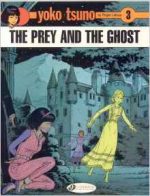
Yoko Tsuno: the Prey and the Ghost


By Roger Leloup translated by Jerome Saincantin (Cinebook)
ISBN: 978-1-905460-56-4

Sublime scientific investigator Yoko Tsuno debuted in Spirou in September 1970 and is still going strong. As detailed by Roger Leloup, the astounding, all-action, excessively accessible exploits of the slim, slight Japanese techno-adventurer are amongst the most intoxicating, absorbing and broad-ranging comics thrillers ever created.

The phenomenal magnum opus is an expansively globe-girdling, space-&-time-spanning series devised by another monumentally talented Belgian maestro. Roger Leloup began his solo career after working as a studio assistant on Herge’s Adventures of Tintin. Compellingly told, superbly imaginative and – no matter how fantastic the premise of any individual yarn – always solidly grounded in hyper-realistic settings underpinned by authentic, unshakably believable technology and scientific principles, his illustrated epics were the forefront of a wave of strips changing the face of European comics in the mid-1970s.

This gentle revolution featured the rise of competent, clever and brave female protagonists, all taking their places as heroic ideals beside the boys and elevating Continental comics in the process. Happily, most of their exploits are as timelessly engaging and potently empowering now as they ever were, and none more so than the trials and tribulations of Yoko Tsuno.

Her very first outings – Hold-up en hi-fi, La belle et la bête and Cap 351 – were brief introductory vignettes before the superbly capable engineer and her valiant but less able male comrades Pol Paris and Vic Van Steen properly hit their stride with premier full-length saga Le trio de l’étrange which began in 1971 with Spirou‘s May 13th issue…

In the original European serialisations, Yoko’s exploits alternated between explosive escapades in exotic corners of our world and sinister deep-space sagas with the secretive, disaster-prone alien colonists from Vinea but, for the majority of the English translations thus far, extraterrestrial encounters have been generally sidelined in favour of epically intriguing Earthly exploits such as this sinister, spectrally-inspired crime caper…

There have been 27 European albums to date. This tale was first serialised in 1981 (in Spirou #2244-2264) and collected the following year as 12th volume La Proie et l’ombre. Due to the quirks of publishing it reached us Brits as Yoko’s third Cinebook outing: a suspenseful modern gothic thriller challenging the barnstorming boffin’s courage, resourcefulness and fundamental beliefs…

Yoko and Pol are driving through Scotland on a Highlands road as the afternoon lengthens into evening when they are forced into a ditch by a young woman throwing herself at their car. The dishevelled creature is being pursued by a pack of hounds and gang of men, but Yoko’s horror is momentarily quelled when the leader of the pursuers explains that poor Cecilia is mad…

The deranged waif begs the strangers to save her, but when her guardian Sir William – the local Laird – arrives, further answers emerge. The poor lass believes she is visited by her dead mother…

Yoko and Pol accept an invitation to stay at the castle, but stay behind to repair their vehicle before joining the party. As they change the tyre a stranger approaches, offering another side to the strange family history. An author, scientific ghosthunter and debunker, the anonymous newcomer relates how 15 years previously Cecilia’s mother Mary chose Sir Brian over another ardent suitor. The rejected swain was a self-proclaimed sorcerer named Mac Nab who prophesied the newlyweds would both die violently and that their daughter would perish before reaching her majority…

When Brian died in a strange accident, his brother William took the seat and married the grieving widow. Mary went mad when Cecilia was five and was killed in a riding accident.

In the intervening years William has tried everything to ensure the last part of the curse would never come to pass, but now at twenty, the daughter seems to have gone the way of her tragic mother. Moreover, reports abound that the sorcerer is still alive, hiding on the estate to ensure his prediction’s completion. When Yoko and Tsuno finally reach the castle they are bristling with theories and suspicions, but steadfastly refuse to give any credence to supernatural forces…

As the household convenes for supper, the visitors are astounded to find Cecilia completely recovered: almost a completely different woman, whose only problems are a short temper and tendency to forget things…

The meal is strained and fractious and ends early. Strangely tired and oddly clumsy, Yoko retires to bed but her sleep is disturbed after a veiled woman in black lures her out into the castle halls before disappearing. All that is left of her is an empty gown.

Baffled Yoko heads back upstairs and lets herself into Cecilia’s locked room. The strange girl is now eager to see her; quitting her painting to examine the dress which she claims belonged to her mother. As they talk, the women glance out of a window and Yoko sees a ghostly figure on a far parapet. It looks exactly like the portrait of deceased, tragic Mary…

Giving chase – and carefully noting that every door seems to open for her – Yoko races across the castle grounds in rapid pursuit with Cecilia trying to keep up. The chase ends in the ruins of an abbey where the technologist passes right through the apparition and realises her suspicions have been confirmed.

Even though she is unaware that sinister eyes are watching her, Yoko is pretty convinced that she knows what’s going on now…

The next day she deftly continues her investigations and makes her preparations to expose a criminal conspiracy years in the making, but has she made the foolish mistake of underestimating her opponents and incorrectly deducing who’s actually behind the murderous scheme?

Complex, devious and subtly suspenseful, this fresh take on an old plot bristles with clever clues for the attentive reader to pick-up on and delivers a splendidly crafty conclusion, once more affirming Yoko Tsuno as top flight troubleshooter, at home in all manner of scenarios and easily able to hold her own against the likes of James Bond, Modesty Blaise, Tintin or other genre-busting super-stars: as triumphantly capable facing swindlers and murderers as aliens, mad scientists or unchecked forces of nature…

As always the most effective asset in these breathtaking tales is the astonishingly authentic and staggeringly detailed draughtsmanship and storytelling, which superbly benefits from Leloup’s diligent research and meticulous attention to detail.

The Prey and the Ghost is a brilliant mystery; which will appeal to any devotee of Holmes, Marple, Castle or Scooby-Doo.
Original edition © Dupuis, 1982 by Roger Leloup. All rights reserved. English translation 2008 © Cinebook Ltd.