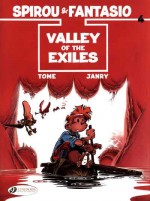
Spirou & Fantasio volume 4: Valley of the Exiles


By Tome & Janry, colour by Stephane De Becker & translated by Jerome Saincantin (Cinebook)
ISBN: 978-1-84918-157-0

For the majority of English-speaking comic fans Spirou might be Europe’s biggest secret. The phenomenally long-lived character is a rough contemporary – and shrewdly calculated commercial response – to Hergé’s iconic Tintin, whilst the comic he has headlined for decades is only beaten in sheer longevity and manic creativity by our own Beano.

Conceived in 1936 at Belgian Printing House Éditions Dupuis by boss-man Jean Dupuis, his proposed new magazine targeted juvenile audiences and launched on April 21st 1938; neatly bracketed in the UK by DC Thomson’s The Dandy (4th December 1937) and The Beano (July 30th 1938). In America a small comicbook publisher was preparing to release a new anthology entitled Action Comics…

Spirou was to be edited by 19 year-old Charles Dupuis and derived its name from the lead feature, which described the improbable adventures of a plucky Bellboy/lift operator employed at the glamorous Moustique Hotel (a sly reference to the publisher’s premier periodical Le Moustique).

Spirou the hero – whose name translates as both “squirrel” and “mischievous” in the Walloon language – was realised by French cartoonist François Robert Velter under his pen-name Rob-Vel for his Belgian bosses in response to the phenomenal success of Hergé’s carrot-topped boy reporter Tintin – a guaranteed money-spinning phenomenon for rival publisher Casterman.

The eponymous magazine launched with the plucky Bellboy (and his pet squirrel Spip) as the leads in an anthology weekly which bears his name to this day; featuring fast-paced, improbable cases which gradually evolved into astonishingly addictive high-flying surreal comedy dramas.

Spirou and his pals have reigned supreme in the magazine for most of its life, with a phalanx of truly impressive creators continuing Velter’s work – beginning with his wife Blanche “Davine” Dumoulin, who took over the strip when her husband enlisted in 1939. She was aided by Belgian artist Luc Lafnet until 1943 when Dupuis purchased all rights to the feature, after which comic-strip prodigy Joseph Gillain (“Jijé”) took over, introducing current co-star and foil Fantasio to the mix.

Somewhere along the way Spirou & Fantasio switched to journalism, becoming globe-trotting reporter and photographer, continuing their weekly exploits in unbroken four-colour glory. In 1946 Jijé’s assistant André Franquin assumed the creative reins, adding a phenomenally popular magic animal dubbed Marsupilami to the cast (first seen in Spirou et les héritiers in 1952 and now a solo-star of screen, plush toy store, console games and albums all his own), crafting increasingly fantastic tales until 1969.

Franquin was in turn succeeded by Jean-Claude Fournier who updated the feature over nine stirring adventures which tapped into the rebellious, relevant zeitgeist of the times with tales of environmental concern, nuclear energy, drug cartels and repressive regimes.

Even so, by the 1980s the boy Spirou seemed outdated and without direction; three different creative teams began alternating on the serial, until it was at last revitalised by the authors of the adventure under review here.

Philippe Vandevelde – writing as Tome – and artist Jean-Richard Geurts, best known to lovers of Bande dessinées as Janry, revisited, adapted and referenced the beloved Franquin era, reviving the feature’s fortunes and resulting in fourteen wonderful albums between 1984 and 1998. This one, from 1989 and originally entitled La vallée des bannis‘Valley of the Banished’ – was their ninth (and the 41st chronological collection of the evergreen adventurers).

Once their tenure concluded Tome & Janry’s departed and both Lewis Trondheim and the team of Jean-Davide Morvan & Jose-Luis Munuera took over, bringing the official album tally to fifty (there also are a bunch of specials, spin-offs and one-shots, official and otherwise) before in 2009 Fabien Vehlmann & Yoann (Yoann Chivard) were announced as the new “Keepers of the Flame”…

Valley of the Exiles! concludes the excellent two-part escapade (which began in Running Scared) with the roving reporters retracing the steps and uncovering the whereabouts of two explorers who had vanished in 1938 whilst attempting to climb a mountain and discover a legendary lost valley in the inscrutable, isolated Himalayan nation of Yurmaheesun-shan…

Since 1950 that tiny nation had been subject to repeated invasions by rival super-powers and was currently a hotbed of rebellion, insurgency and civil war, but Spirou and Fantasio were utterly determined to solve the ancient mystery.

Thus they linked up with renowned eccentric Dr. Placebo: world renowned authority on medical condition Spasmodia Maligna and a man convinced that the only cure for the condition – prolonged, sustained and life-threatening synchronous diaphragmatic flutters (hiccups to you and me) – is to be scared out of one’s wits.

He sponsored a “medical” mission to find the lost valley and thus the lads, Spip and five disparate, desperate perpetual hiccup-sufferers crept across the Nepalese border despite the most diligent attentions of military overlord Captain Yi.

That formidable martinet was tasked with keeping all foreigners – especially journalists – out of the occupied country as it underwent enforced pacification and re-education, but thanks to native translator Gorpah (a wily veteran guide who once proved invaluable to another red-headed reporter, his little white dog and a foul mouthed-sea captain!) the daring band were soon deep in-country.

Only minutes behind were Yi’s troops in tanks, armoured cars and attack helicopters – which naturally provided plenty of opportunities for the annoyingly obnoxious singultus flutterers to be satisfactorily terrified – but there was still little evidence of a breakthrough cure…

Just as the fugitives found their first clue as to the site of the lost valley they were taken captive by native rebels. With still no hiccup cure found the beleaguered explorers attempted a daring later escape, but even as they all piled into a lorry a monumental storm broke out…

When one of their pursuer’s vehicles plunged over a cliff, the valiant escapees formed a human chain to rescue the driver but Spirou and Fantasio were washed away and lost in the raging flash flood …

In The Valley of the Exiles! the story resumes with the battered, weary duo entombed deep within a Himalayan mountain. Slowly, blindly they grope their way towards a faint light and emerge through ancient, barbaric idol’s head into the very place they’ve been seeking…

Utterly enclosed by peaks the Valley is an idyllic paradise, but its very isolation has led to the development of a number of truly unique species of flora and fauna. There are colossal carnivorous water lily-pads, ferociously determined man-eating turtles, electric geckoes, the seductive Hammock Flytrap and many more bizarre and potentially lethal creatures.

The one that most imperils the lost boys however is the diminutive Manic Midgie – a mosquito-like bug that carries the disease “raging hostiliasis”. Not long after one bites Fantasio, poor Spirou realises that his best friend has become a homicidal maniac determined to kill him and everything else in range…

The deranged lad soon goes completely off the deep end, and only luck and a handy itching-powder boxing glove plant prevents the reporter’s gory demise…

Wounded, hunted by his best friend and perhaps the only human in the apparently inescapable enclosed wilderness, near-despondent Spirou and Spip begin to explore their incredible prison and find a rough shack: proof that at some time other humans had been there.

Further investigation reveals it to be the last resting place of the lost explorers Siegfried and Maginot. The mystery of the 1938 expedition is solved – even though Spirou has no way of filing this scoop!

More worryingly, Maginot’s copious notes on the creatures of the valley offer some grim hypotheses as to the nature of the nature in this fantastic hidden gorge: creatures inimical to both the body and mind of man. Plants that cast illusions, murderous mammals that mimic harmless life, bugs whose bite produces madness…

Crazed beyond imagining – and burbling hilarious, fourth-wall breaking nonsense – Fantasio is determinedly hunting his old friend and the frantic chase drives the limping hero deep into a hidden temple where he uncovers the secret of a fantastic lost civilisation of Backik: a race banished by Mongol conquerors /to this distant valley. The reluctant settlers lived just enough for the manic-midgies to bring their unlucky lives crashing down into doom and disaster…

As Spirou lurches through the eerie tombs of the fallen Backiks Fantasio ambushes him and is ready to finish off his former friend when a mysterious figure attacks…

Some time later Spirou awakens in the warming sunlight of the valley, with deranged Fantasio securely bound beside him. Resolved to escape this fantastic trap and get his crazy pal back to civilisation and medical assistance, our red-headed hero begins to explore his best options only to feel the terrifying sting of a mosquito…

Packed with oodles of action and a host of incredible surprises and revelations, Valley of the Exiles is a truly splendid escapade, with thrills, chills, spills, a mountain of choice comedy moments and eccentric, surreal mysteries to keep readers spellbound.

This refreshingly engaging, lightly-barbed, action-adventure is a breath of fresh air in a marketplace far too full of adults-only carnage, sordid cheesecake titillation, testosterone-fuelled breast-beating, teen-romance monsters and cloying barbarian fantasy. Easily accessible to readers of all ages and drawn with all the beguiling style and seductively enticing élan which makes Asterix, Lucky Luke, The Bluecoats and Iznogoud so compelling, this is another cracking read every bit as deserving of household name-hood as those series… yes, even that other red-headed kid with the white dog…
Original edition © Dupuis, 1989 by Tome & Janry. All rights reserved. English translation 2013 © Cinebook Ltd.

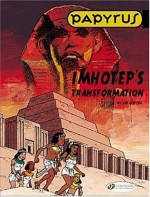
Papyrus volume 2: Imhotep’s Transformation


By Lucien De Geiter, coloured by Colette De Geiter & translated by Luke Spear (Cinebooks)
ISBN: 978-1- 905460-50-2

Once you get a certain taste in your mind you just can’t stop – well I can’t – so here’s another all-ages sword & sandals saga just not available through American funnybooks these days.

British and European comics have always been happier with historical strips than our cousins across the pond (a pugnacious part of me wants to say that’s because we have so much more past to play with – and yes, I know they’re responsible for Prince Valiant, but it’s an exception, not a rule) and our Franco-Belgian brethren in particular have made an astonishing art form out of days gone by.

The happy combination of past lives and world-changing events blended with drama, action and especially broad humour has resulted in a genre uniquely suited to beguiling readers of all ages and tastes. Don’t take my word for it – just check out Asterix, Adèle Blanc-Sec, The Towers of Bois-Maury, Iznogoud or Thorgal to a name few which have made it into English, or even our own much missed classics such as Olac the Gladiator, Dick Turpin, Heros the Spartan or Wrath of the Gods …all long overdue for collection in album form.

Papyrus is the spectacular magnum opus of Belgian cartoonist Lucien de Gieter. It began in 1974 in the legendary weekly Spirou, running to more than 30 albums, plus a wealth of merchandise, a television cartoon show and a video game.

The plucky “fellah” (look it up) was blessed by the gods and gifted with a magic sword courtesy of the daughter of crocodile-headed Sobek. His original brief was to free supreme Horus from imprisonment in the Black Pyramid of Ombos and thereby restore peace to the Two Kingdoms. More immediately however the lad was also charged with protecting of Pharaoh’s wilful and high-handed daughter Theti-Cheri – a princess with a unmatchable talent for finding trouble…

De Gieter was born in 1932 and, studied at Saint-Luc Art Institute in Brussels, before going into industrial design and interior decorating. He made the logical jump into sequential narrative in 1961, first through ‘mini-récits’ inserts (fold-in, half-sized-booklets) for Spirou, of his jovial little cowboy ‘Pony’, and later by writing for established regulars as Kiko, Jem, Eddy Ryssack and Francis.

He then joined Peyo’s studio as inker on ‘Les Schtroumpfs’ – AKA The Smurfs – and took over the long-running newspaper strip ‘Poussy’.

In the mid 1960s he created South Seas mermaid fantasy ‘Tôôôt et Puit’ even as Pony was promoted to the full-sized pages of Spirou, so De Gieter deep-sixed his Smurfs gig to expand his horizons producing work for Tintin and Le Journal de Mickey.

From 1972-1974 he assisted cartooning legend Berck on ‘Mischa’ for Germany’s Primo, whilst putting the finishing touches to his new project. This creation would occupy his full attention – and delight millions of fervent fans – for the next forty years.

The annals of Papyrus encompass a huge range of themes and milieus, blending boys-own adventure with historical fiction and interventionist mythology, gradually evolving from traditionally appealing “Bigfoot” cartoon content towards a more realistic, dramatic and authentic iteration, through light fantasy romps starring a fearlessly forthright boy fisherman favoured by the gods as a hero of Egypt and friend to Pharaohs.

Imhotep’s Transformation is the second Cinebook translation (and 8th yarn, originally released in 1985 as La Métamorphose d’Imhotep) opening with Papyrus and his one-legged friend Imhotep (no relation) paddling a canoe through the marshes of the Nile.

The peaceful idyll is wrecked when Theti-Cheri and her handmaidens hurtle by in their flashy boat, but the boys don’t mind as they have a message for the princess.

The new holy statue of her father has arrived from the Priests of Memphis and the daughter of Heaven is required at the ceremony to install it at the pyramid of Saqqara before the annual “Heb Sed” King’s Jubilee.

As the girls and boys race back an old peasant is attacked by a crocodile. Diving after him Papyrus wrestles the reptile away and is about to kill it when Sobek appears, beseeching him to spare it.

On the surface Theti-Cheri and her attendants are ministering to the aged victim and the princess can’t help noticing how he bears an uncanny resemblance to her dad…

By the time they all reach the pyramid the monumental task of hauling the statue into place is well under way, but suddenly blood begins pouring out of the monolith’s eyes.

The terrified workers panic and the colossal effigy slips, crashing to destruction. The populace are aghast and murmurs of curses and ill omens abound.

Rather than running away Imhotep heads for the rubble and discovers the statue’s head is hollow. Moreover, inside there is a dead dwarf and a smashed flask which had held blood…

Papyrus is in the royal compound where the recent events have blighted the anticipation of the court. During Heb Sed the Pharaoh has to run around the sacred pyramid three times and fire his bow at the four corners of the kingdoms to prove his fitness to rule, but now it appears the gods have turned against their chosen emissary on Earth…

Papyrus is not so sure and when he tries to speak to a royal server the man bolts. Giving chase the lad is in time to prevent the attendant’s murder, but not his escape.

And then a cry goes up: Pharaoh has been poisoned…

Knowing there is no love lost between the MemphisPriests of Ptah and the loyal Theban clerics doctoring the fallen king, Papyrus warns of a possible plot, but has no proof. What is worse, Chepseska, leader of the Memphis faction, is of royal blood too and would inherit if Pharaoh was unable to complete the Heb Sed ritual…

As loyal physicians and priests struggle to save their overlord’s life, Theti-Cheri remembers the old man in the swamp. If only the crocodile bite has not left him too weak to run…

The doughty dotard is willing to try and also knows of a wise woman whose knowledge of herbs can cure Pharaoh, but ruthless Chepseska is on to the kids’ ploy and dispatches a band of killers to stop Papyrus and Imhotep.

However, the gods are behind the brave lads and the after the assassins fall to the ghastly judgement of Sobek, the boys rush an antidote back to Saqqara, only to fall into the lost tomb of Great Imhotep, first Pharaoh, builder-god and divine lord of the Ibis.

With time running out for his distant descendent, the resurrected ruler rouses himself to administer justice for Egypt and inflict the punishment of the gods upon the usurpers…

This is another epic and amazing exploit which will thrill and astound fans of fantastic fantasy and bombastic adventure. Papyrus is one more brilliant addition to the family-friendly pantheon of continental champions who marry heroism and humour with wit and charm, and anybody who has worn out those Tintin or Asterix volumes would be wise beyond their years in acquiring these classic chronicles tales.

© Dupis, 1985 by De Gieter. All rights reserved. English translation © 2008 Cinebook Ltd.

Papyrus volume 1: The Rameses’ Revenge


By Lucien De Geiter, translated by Luke Spear (Cinebooks)
ISBN: 978-1- 905460-35-9

British and European Comics have always been keener on historical strips than our American cousins, and the Franco-Belgian contingent in particular have made an art form out of combining the fascinations of past lives with drama, action and especially broad humour in a genre uniquely suited to beguiling readers of all ages and tastes.

One ideal example of this is the long-running Papyrus by Belgian cartoonist Lucien de Gieter, which began in Spirou in 1974. It subsequently spawned more than 30 collected albums, a wealth of merchandise, a TV cartoon series and a video game through its progression of light fantasy adventures starring a simple child fisherman favoured by the gods who became the hero of Egypt and a friend to Pharaohs.

De Gieter was born in Etterbeek, Belgium on September 4th 1932 and, after attending Saint-Luc Art Institute in Brussels, worked as an industrial designer and interior decorator before moving into comics in 1961.

Initially he worked on inserts (fold-in half-sized-booklets known as ‘mini-récits‘) for Spirou, such as the little cowboy ‘Pony’, and produced scripts for established Spirou creators such as Kiko (Roger Camille), Jem (Jean Mortier), Eddy Ryssack and Francis (Bertrand) before joining Peyo’s (Pierre Culliford) studio as inker on ‘Les Schtroumpfs’ – which you’ll know as The Smurfs – and soloed on long-running newspaper comic cat strip ‘Poussy’.

After creating mermaid strip ‘Tôôôt et Puit’  in 1966 and seeing Pony graduate to the full-sized pages of Spirou in 1968, De Gieter relinquished his Smurfs gig, but kept himself busy producing work for Tintin and Le Journal de Mickey. From 1972-1974 he assisted Flemish cartooning legend Arthur Berckmans (AKA Berck) on comedy science-fiction series ‘Mischa’ for the German Rolf Kauka Studios magazine Primo, whilst he prepared the creation which would occupy his full attention – and millions of avid fans – for the next four decades.

The stories of Papyrus encompass a vast range of themes and milieus, blending boys-own adventure with historical fiction and living mythology, gradually evolving from a traditionally welcoming and inclusive “Bigfoot” cartooning content towards a more realistic, dramatic and authentic iteration.

That’s not a concern in this first Cinebook translation as The Rameses’ Revenge (actually the seventh collected album, originally released in 1984 as La Vengeance des Ramsès) finds Papyrus en route to the newly finished temple at Abu-Simbel on a royal barge, part of a vast flotilla destined to commemorate the magnificent Tomb of Rameses II.

The worthy peasant had been given a magic sword by the daughter of crocodile-headed god Sobek to free Horus from imprisonment in the black pyramid of Ombos and restore peace to the Two Kingdoms – but that’s a tale for another tome. The lad was also charged with being lifelong protector of wilful Pharaoh’s daughter Theti-Cheri …

Here his sedate Nile journey is plagued with frightful dreams but good friend Imhotep tells him not to worry. Nevertheless the boy hero consults a priest and is deeply worried when the sage declares the dreams are a warning…

That tension only grows when headstrong, impatient Theti-Cheri informs him that she has permission to go on ahead of the Pharaoh’s retinue in a small, poorly-armed skiff. Unable to dissuade her, Papyrus is ordered to remain behind. The Princess and Imhotep are blissfully unaware that a member of her small guard has been replaced by a sinister impostor…

The vessel is well underway before they discover Papyrus has stowed away, but before the furious girl can have him thrown overboard, the boat is hit by an impossibly sudden storm and attacked by a pair of monsters.

Although the boy hero drives them away with his sword, Theti-Cheri sees nothing, having been knocked out in the storm. Still seething, she refuses to believe him or Imhotep and orders them onward to Abu-Simbel. The next morning Papyrus and the guards are missing…

Pressing on anyway, the Princess and her remaining attendants reach the incredible edifice only to be seized by the band of brigands who have captured it. They want the enormous treasure hidden within the sprawling complex and already hold Papyrus prisoner.

If Theti-Cheri or the hostageTemple Priests don’t hand it over the boy will die horribly…

The repentant Princess cannot convince the clerics to betray their holy vows, however, and in desperation declares that she will hand herself over instead. Appalled and moved by her noble intention, High Priest Hapu determines that only extreme measures can avenge the bandits’ sacrilegious insult and calls on mighty Ra to inflict the vengeance of the gods upon them…

The astounding, spectacular, terrifying result perfectly concludes this initial escapade and will thrill and delight lovers of fantastic fantasy and bombastic adventure. Papyrus is another superb addition to the all-ages pantheon of continental champions who combine action and mirth with wit and charm, and anybody who has worn out the Tintin and Asterix collections would be well rewarded by checking out these epic tales.

© Dupis, 1984 by De Gieter. All rights reserved. English translation © 2007 Cinebook Ltd.

Valerian and Laureline book 4: Welcome to Alflolol


By Méziéres & Christin, with colours by E. Tranlé and translated by Jerome Saincantin (Cinebook)
ISBN: 978-1-84918-087-0   (Dargaud edition) 2-205-06573-4

Valérian is the most influential science fiction comics series ever drawn – and yes, that includes even Buck Rogers, Flash Gordon, Dan Dare and Judge Dredd.

Although to a large extent those venerable strips defined and later re-defined the medium itself, anybody who has seen a Star Wars movie or that franchise’s overwhelming homages, pastiches and rip-offs has been exposed to doses of Jean-Claude Méziéres & Pierre Christin’s brilliant imaginings (which the filmic phenomenon has shamelessly plundered for decades): everything from the character and look of alien races and cultures to the design of the Millennium Falcon and even Leia‘s Slave Girl outfit …

Simply put, more carbon-based life-forms have experienced and marvelled at the uniquely innovative, grungy, lived-in authentic futurism and light-hearted swashbuckling rollercoaster romps of Méziéres & Christin than any other cartoon spacer.

The groundbreaking series followed a Franco-Belgian mini-boom in fantasy fiction triggered by Jean-ClaudeForest’s 1962 creation Barbarella.

Valérian: Spatio-Temporal Agent launched in the November 9th, 1967 edition of Pilote (#420) and was an instant hit. In 1977 the fervour surrounding Greg & Eddy Paape’s Luc Orient and Philippe Druillet’s Lone Sloane, combined with Valérian‘s popularity led to the creation of an adult graphic sci-fi blockbuster – Métal Hurlant.

Valérian and Laureline (as the series eventually became) is a light-hearted, wildly imaginative time-travelling, space-warping fantasy teeming with wry, satirical, humanist action and political commentary, starring – in the early days at least – an affable, capable yet unimaginative by-the-book cop tasked with protecting the official universal chronology by counteracting paradoxes caused by incautious time-travellers.

When Valérian travelled to 11th century France in the initial tale ‘Les Mauvais Rêves (‘Bad Dreams’ and still not translated into English yet), he was rescued from doom by a fiery, capable young woman named Laureline whom he brought back to 28th century super-citadel and administrative capital of the Terran Empire, Galaxity.

The indomitable lass subsequently trained as a Spatio-Temporal operative and began accompanying him on all his missions.

Every subsequent Valérian adventure until the 13th was initially serialised weekly until ‘The Rage of Hypsis’ concluded, after which further yarns were solely published as all-new complete graphic novels. The whole spectacular saga resolved and ended in 2010.

Welcome to Alflolol originally ran in Pilote #631-652 (December 1971-May 11th 1972) and follows the Spatio-Temporal agents as they depart from Technorog, a desolate industrial planet whose vast resources are crucial to the running of human civilisation. So vital in fact that Galaxity sends her best agents just to inspect it every now and then…

As the S-T agents carefully negotiate the immense forcefield and asteroid belt that envelope the harsh and ferociously capitalistic factory world, Laureline is repeatedly possessed by an uncanny force. The fit also leads the couple to an immense ship which has foundered between the rocks and energy screen.

Investigating the vessel, which is purposely open to hard vacuum, Laureline again lapses into a glowing coma and eerily drifts towards a family of incredibly powerful yet rustically affable alien primitives sitting on the hull of their ship.

Valerian, closely following behind, prevents a terrible accident to his companion and is warmly greeted by the strangers, who explains that the eldest of the beings is very ill and in her throes has locked minds with his female. If they’re not careful, both could die…

Garrulous, easygoing Argol agrees to let Valerian treat the problem, and his wife Orgal telekinetically transports the Earthlings, her entire family and their pet Gumun back to the S-T astroship in mere moments. Soon Terran technology has saved both the human and alien and Argol settles back to explain what has happened…

The wanderers are naively friendly and immensely long-lived – like all their species – and are just returning to their homeworld Alflolol from an amusing perambulation through space. However since their departure – 4,000 Earth years ago – somebody has moved in…

Despite the Governor of Technorog’s protests, Galaxity law is clear and the Alflololians must be allowed back on their planet.

However the wheedling plutocrat – secure in his job’s importance to the empire – realises he doesn’t have to hand over the keys, just make room for the five meekly polite cosmic gypsies, who simply cannot grasp the concept of business and don’t understand why anybody would put up lots of flimsy, ugly buildings and spoil the hunting……

As Valerian allows the businessmen to walk all over the aliens’ rights, Laureline goes berserk: arguing for Argol’s family and indulging in a little light-hearted sabotage because the gentle giants won’t do it for themselves…

She needn’t bother though: their mere presence and incredible abilities are enough to disrupt the Governor’s precious productivity, especially when they get bored of sterile human accommodations and return to their ancestral ranges…

The real crisis only begins when the rest of the nomadic Alflololians return: one hundred separate ships full of natives protected by law and fully entitled to reclaim their homes.

The humans aren’t leaving, however, and soon the Governor has begun herding the wanderers onto a reservation and demanding they work if they want to eat.

Big mistake…

Socially aware and crusading, this is one of the earliest comics tales to catch the 1970s wave of ecological awareness and still ranks amongst the very best to explore the social iniquities which beset indigenous peoples at a time when most European ex-empires were still divesting themselves of their colonial possessions.

The theme of Capitalism versus Native Culture and the eternal struggle between territorial imperatives, moral rights and holy profit have seldom been dealt with in such an effective, sardonic and hilarious surreal manner. Ending on an outrageous twist, the story has lost none of its wit and punch forty years later.

And of course there’s the usual glorious blend of astounding action, imaginative imagery and fantastic creatures to leaven the morality play with space-operatic fun-filled, visually breathtaking and stunningly ingenious wide-eyed wonderment…

Between 1981 and 1985, Dargaud-Canada and Dargaud-USA published a quartet of these albums in English (with a limited UK imprint from Hodder-Dargaud) under the umbrella title Valerian: Spatiotemporal Agent and this tale was the third release, translated then by L. Mitchell.

Although this modern Cinebook release boasts far better print and colour values and a more fluid translation, total completists might also be interested in tracking down those 20th century releases too…
© Dargaud Paris, 1972 Christin, Méziéres & Tran-Lệ. All rights reserved. English translation © 2012 Cinebook Ltd.

Zombillenium: Volume 1: Gretchen


By Arthur de Pins (NBM)
ISBN: 978-1-56163-734-8

I’m feeling a zeitgeist coming on: seditiously mature and subversively ironic takes on classical movie monster madness presented as horror-comedies in the manner of the Addams Family (or assorted Tim Burton features in the vein of Corpse Bride) to be enjoyed by older kids as well as imaginative grown-ups.

Latest candidate for the swift-swelling category is a superb and deliciously arch Franco-Belgian cross between films like Hotel Transylvania and Igor and such graphic narrative masterpieces as Boneyard, Rip M.D. and especially The Littlest Pirate King which combine pop-cultural archetypes with smart and sassy contemporary insouciance.

Arthur de Pins is a British-born French filmmaker, commercial artist and Bande Dessinées creator whose strips – such as the adult comedy Peccadilloes (AKA Cute Sins) and On the Crab – have appeared in Fluide Glacial and Max.

Zombillénium began serialisation in Spirou #3698 (2009) and has filled three albums to date courtesy of Dupuis – the first of which has just been released in English thanks to Canadian publisher NBM.

Rendered in a beguiling animated cartoon style, the saga opens with a morose hitchhiker in a hoodie, having no luck at all getting a ride. Eventually Aton is picked up by a vampire and skeleton who offer to take the dejected 5000-year old mummy back to the unique theme park which employs – and in fact owns – them all…

Zombillenium is a magical entertainment experience celebrating all aspects of horror and the supernatural, where families can enjoy a happy day out rubbing shoulders with werewolves and witches and all manner of bogeymen. Of course, they wouldn’t laugh so much if they knew all those monsters were real…

Bloodsucking Francis  and bony Sirius are still heatedly trying to talk the deceased Egyptian -who walked because he was fed up working the cotton-candy concession for what seemed like eternity – out of thumbing all the way back to Cairo when a moment’s inattention leads to their car mowing down a distracted pedestrian.

The mortal is a goner, and without a moment’s hesitation Park Director Francis Von Bloodt takes a bite and finds his new confectionery seller…

The reasons Aurelian Zahner wasn’t paying attention were many. His wife was cheating on him, and took their child away. He had just tried to rob a bar in broad daylight. His gun had somehow turned into a banana. Worst of all, the odd young British woman with the enigmatic smile had told him to grow up before glowing blue and making everybody in the bar forget him…

Later he saw her at Zombillenium, after the giant werewolf bit him too, saying the place had enough vampires already. Things got a bit hazy after that, what with Francis disagreeing and biting him some more.

Her name was Gretchen and she was a witch and she had finally stopped the wolf and the bat biting him in some bizarre game of tit-for-tat…

With nobody quite sure what kind of monster he now was, Aurelian signed his contract, was given the induction tour by Aton – who considered himself a bit of a joker – and set to work selling the sticky stuff to the oblivious punters…

At least they were oblivious until a little old lady smuggled in her little doggie and triggered a bizarre and barely concealable transformation in the terrified Zahner that took even the most venerable and jaded monsters by surprise…

Despite the incredible power of the Zombie trade union, the only way out of a Zombillenium contract is the True Death, and Francis is actually in the process of terminating Aurelian when a call from the park’s enigmatic owner inexplicably gives the hapless fool another chance…

Slowly Zahner adapts to his new indentured (un)life, with Gretchen – who is “only” an intern at the park – finding time to show him the ropes and bring him up to speed in this most inhospitable working environment. Moreover the conditions are about to get much worse: Zombillenium is one of the least profitable theme-parks in the world and the Board are threatening to make some draconian changes…

For some reason the Zombie shop stewards blame Aurelian and are determined to drive him out. A slim ray of hope lights up the mixed-up monster newbie’s life however, when Gretchen tells him her life-story, reveals what he has become and explains what she is really doing at the Park.

The big boob has no idea what and how much she still hasn’t told him…

Sly, smart, sexy and hilarious, Zombillenium achieves that spectacular trick of marrying slapstick with satire in a manner reminiscent of Asterix and Cerebus the Aardvark, whilst easily treading its own path. This is going to a big breakout comics series and you’ll curse yourself for missing out.

So don’t…
© Dupuis 2010.

Blue is the Warmest Color


By Julie Maroh, translated by Ivanka Hahnenberger (Arsenal Pulp Press)
ISBN: 978-1-55152-514-3

There is already a large amount of chatter about the film Blue is the Warmest Color. Since winning the Palme d’Or at the 2013 Cannes Film Festival there will be much more. Sadly the buzz around the big screen interpretation – it is not an adaptation – will almost certainly concentrate on the excessive and prolonged lesbian sex scenes (decried and disowned by graphic novel author Julie Maroh) rather than the story.

We do comics here and, despite the undisputed boost a media-sensational movie provides, it’s the words and pictures on paper that matter to me and hopefully to you too…

And what a wonderful marriage they make in Maroh’s moodily pensive exploration of prejudice and acceptance in a straightforward but devastating coming-of-age love story.

Le bleu est une couleur chaude was first published in France by Glénat in 2010, five years after Maroh originally began the tale as a 19-year old student studying Visual Arts and Lithography/Engraving at the Institut Saint-Luc and Académie Royale des Beaux-Arts (Brussels).

The collected album won the fan-determined Fnac-SNCF Essential prize (Audience Award) at the 2011 Angoulême International Comics Festival, subsequently garnering many more international accolades.

The story opens as Emma returns to a house she was unceremoniously banished from decades ago. Beloved Clementine is dead, but her last wish was that her one true love have her journals; books which described the thoughts and fears, ambitions and dreams of a confused 15-year old girl who struggled to accept her nature in a toxic school and home environment where loving someone of your own sex was considered an abomination…

Emma stays overnight in a home scarred by tragedy and steeped in tension, repentance and still-undispelled animosity, reading of how, in 1994, fraught and frantic high schooler Clementine saw a girl with blue hair and just couldn’t forget her…

This is a beautiful, simple and evocative story about how two very young people fell in love and what eventually happened to them. It’s not polemical or declamatory and doesn’t have points to score. That the Romeo and Juliet are both female is sublimely irrelevant except in the ways and manners it shaped the problems the lovers had to overcome…

Depicted alternately in a beguiling wash of misty full colour and stark dichromatic tones, the images are subdued and enthralling, not dynamic or overblown, and although there are some explicit love scenes, they are vital to the tale’s context and utterly subsumed by the overwhelming tide of elegiac sadness, political and social turmoil and doom-laden mystery which permeates the proceedings.

This is a masterful and compellingly human story that will astound lovers, loving grown-ups and all lovers of comics narrative.

Yes, there is a movie, but for pity’s sake read this first…

English Language edition © 2013 Arsenal Pulp Press. First published in French as Le bleu est une couleur chaude by Julie Maroh © 2010 Glénat Editions. All rights reserved.
Blue is the Warmest Color will be released on September 12th 2013.

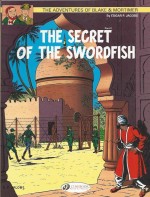
The Adventures of Blake and Mortimer: The Secret of the Swordfish Part 1 – Ruthless Pursuit


By Edgar P. Jacobs, coloured by Philippe Biermé & Luce Daniels translated by Jerome Saincantin (Cinebook)
ISBN: 978-1-84918-148-8

Belgian Edgard Félix Pierre Jacobs (1904-1987) is rightly considered one of the founding fathers of the Continental comics industry. Although his output is relatively meagre when compared to some of his contemporaries, the iconic series he worked on formed the basis and backbone of the art-form in Europe, and his splendidly adroit, roguish and impeccably British adventurers Blake and Mortimer, created for the first issue of Le Journal de Tintin in 1946, swiftly became a staple of post-war European kids’ life the way Dan Dare would in Britain in the 1950s.

Edgar P. Jacobs was born in Brussels, a precocious child who began feverishly drawing from an early age but was even more obsessed with music and the performing arts – especially opera. He attended a commercial school but, determined never to work in an office, pursued art and drama following graduation in 1919.

A succession of odd jobs at opera-houses – scene-painting, set decoration, working as an acting and singing extra – supplanted his private performance studies, and in 1929 Jacobs won an award from the Government for classical singing. His proposed career as an opera singer was thwarted by the Great Depression, however, as the arts took a nosedive following the global stock market crash.

Picking up whatever stage work was going, including singing and performing, Jacobs switched to commercial illustration in 1940. Regular employment came from the magazine Bravo; as well as illustrating short stories and novels, he famously took over the syndicated Flash Gordon strip, after the occupying German authorities banned Alex Raymond’s quintessentially All-American Hero and left the publishers desperately seeking someone to satisfactorily complete the saga.

Jacob’s ‘Stormer Gordon’ lasted less than a month before being similarly sanctioned by the Nazis, after which Jacobs created his own epic science-fantasy feature in the legendary Le Rayon U, a milestone in both Belgian comics and science fiction adventure.

The U Ray was a huge hit in 1943 and scored big all over again a generation later when Jacobs reformatted the original “text-block and picture” material to incorporate speech balloons and re-ran the series in Tintin with subsequent releases as a trio of graphic albums in 1974.

I’ve read differing accounts of how Jacobs and Tintin creator Hergé got together – and why they parted ways professionally, if not socially – but as to the whys and wherefores of the split I frankly don’t care. What is known is this: whilst creating the weekly U Ray, one of Jacob’s other jobs was scene-painting, and during the staging of a theatrical version of Tintin and the Cigars of the Pharaoh Hergé and Jacobs met and became friends. If the comics maestro was unaware of Jacob’s comics output before then he was certainly made aware of it soon after.

Jacobs began working on Tintin, colouring the original black and white strips of The Shooting Star from newspaper Le Soir for a forthcoming album collection. By 1944 he was performing a similar role on Tintin in the Congo, Tintin in America, King Ottokar’s Sceptre and The Blue Lotus. By now he was also contributing to the illustration as well, on the extended epic The Seven Crystal Balls/Prisoners of the Sun.

Jacob’s love of opera made it into the feature as Hergé (who loathed the stuff) teasingly created the bombastic Bianca Castafiore as a comedy foil and based a number of bit players (such as Jacobini in The Calculus Affair) on his long-suffering assistant.

After the war and liberation, publisher Raymond Leblanc convinced Hergé, Jacobs and a number of other creatives to work for his new venture. Launching publishing house Le Lombard, he also started Le Journal de Tintin, an anthology comic with editions in Belgium, France and Holland edited by Hergé, starring the intrepid boy reporter and a host of newer heroes.

Beside Hergé, Jacobs and writer Jacques van Melkebeke, the comic featured Paul Cuvelier’s ‘Corentin’ and Jacques Laudy’s ‘The Legend of the Four Aymon Brothers’. Laudy had been a friend of Jacobs’ since they worked together on Bravo, and the first instalment of the epic thriller serial ‘Le secret de l’Espadon’ starred a bluff, gruff British scientist and an English Military Intelligence officer (closely modelled on Laudy): Professor Philip Mortimer and Captain Francis Blake…

The initial storyline ran from issue #1 (26th September 1946 to 8th September 1949) and cemented Jacobs’ status as a star in his own right. In 1950, with the first 18 pages slightly redrawn, Le secret de l’espladon V1 (The Secret of the Swordfish) became Le Lombard’s first album release; with the concluding part published three years later. These volumes were reprinted nine more times between 1955 and 1982, with an additional single complete deluxe edition released in 1964.

In 1984 the story was reformatted and repackaged in English translation as three volumes with additional material (mostly covers from the weekly Tintin added to the story as splash pages) as part of a European push to win some of the lucrative Tintin and Asterix market here, but failed to find an audience and ended after seven volumes. Now happily Cinebook has released the tale – albeit after publishing the later adventures first…

Hergé and Jacobs purportedly suffered a split in 1947 when the former refused to grant the latter a by-line on new Tintin material, but since the two remained friends for life and Jacob’s continued to produce Blake and Mortimer for the Belgian weekly, I think it’s fair to say that if such was the case it was a pretty minor spat.

I rather suspect that The Secret of the Swordfish was simply taking up more and more of the brilliant, diligent artist’s time and attention…

The U Ray also provided early visual inspiration for Blake, Mortimer and implacable nemesis Colonel Olrik, who bear a more than passing resemblance to the heroic Lord Calder, Norlandian boffin Marduk and viperous villain Dagon from that still lauded masterwork – one also well overdue for translation…

One minor word of warning: by having the overarching enemies of mankind be a secret Asiatic “Yellow Peril” empire of evil, there’s some potential for offence – unless one actually reads the text and finds that the assumed racism is countered throughout by an equal amount of “good” ethnic people and “evil” white folk…

The incredible journey begins with ‘The Incredible Chase’ as a secret army in the Himalayas prepares to launch a global Blitzkrieg on a world only slowly recovering from its second planetary war. The wicked Basam Damdu, Emperor of Tibet, has assembled an arsenal of technological super-weapons and the world’s worst rogues such as the insidious Colonel Olrik in a bid to seize control of the entire Earth.

However a bold British-Asian spy has infiltrated the hidden fortress and surrenders his life to get off a warning message…

In England, physicist and engineer Philip Mortimer and MI5 Captain Francis Blake discuss the worsening situation at an industrial installation where the boffin’s radical new aircraft engine is being constructed. When the warning comes that the war begins that night, the old friends swing into immediate action…

As the super-bombers rain destruction down on all the world’s cities, Mortimer’s dedicated team prepares his own prototype, the Golden Rocket, for immediate launch, taking off just as Olrik’s bombers appear over the desolate complex. Despite heavy fire, the Rocket easily outdistances the rapacious Imperial forces, leaving ruined homes in its wake as the fleeing Britons fly into a hostile world now brutally controlled by Basam Damdu…

Whilst seeking to join British Middle East resistance forces who have another prototype super-plane, teething troubles and combat damage create tense moments in the fugitives’ flight. When the Rocket is attacked by a flight of jets the test ship’s superior firepower enables it to fight free but only at the cost of more structural deterioration. Failing now, the Rocket goes down in the rocky wilds between Iran and Afghanistan. Parachuting free of the doomed Rocket, Blake, Mortimer and the crew are machine-gunned by pursuing Empire jets and only three men make it to the ground safely…

After days of struggle Blake, Mortimer and the indomitable Jim are cornered by Iranian troops who have joined Olrik’s forces. Sensing disaster, the Britons hide the plans to Mortimer’s super plane but one of the Iranians sees the furtive act. When no one is looking – even his superiors – Lieutenant Ismail hurriedly scoops up the documents but misses one…

Under lock and key and awaiting Olrik’s arrival, the prisoners are accosted by Ismail, who sees an opportunity for personal advancement which the Englishmen turn to their own advantage. Denouncing him to his superiors, Blake instigates a savage fight between Ismail and his Captain. During the brief struggle Jim sacrifices himself, allowing Blake and Mortimer to escape with the recovered plans. Stealing a lorry, the desperate duo drive out into the dark desert night…

Followed by tanks into the mountain passes, the ingenious pair trap their pursuers in a ravine just as hill partisans attack. The Imperial collaborators are wiped out and, after exchanging information with the freedom fighters, the Englishmen take one of the captured vehicles and head to a distant rendezvous with the second Rocket, but lack of fuel forces them to stop at a supply dump where they are quickly discovered.

By setting the dump ablaze the heroes escape again, but in the desert Olrik has arrived and found the sheet of notes left behind by Ismail. The cunning villain is instantly aware of what it means…

Fighting off aerial assaults from Empire jets and streaking for the mountains, Blake and Mortimer abandon their tank and are forced to travel on foot until they reach the meeting point where a British-trained native Sergeant Ahmed Nasir is waiting for them. The loyal Indian served with Blake during the last war and is delighted to see him again, but as the trio make their way to the target site they become aware that Olrik has already found it and captured their last hope…

Only temporarily disheartened, the trio use commando tactics to infiltrate Olrik’s camp, stealing not the heavily guarded prototype but the villainous Colonel’s own Red-Wing super-jet. Back on course to the British resistance forces, the seemingly-cursed trio are promptly shot down by friendly fire: rebels perceiving the stolen plane as just another enemy target…

Surviving this crash too, the trio are ferried in relative safety by the apologetic tribesmen to the enemy-occupied town of Turbat, but whilst there a spy of the Empire-appointed Wazir recognises Blake and Mortimer. When Nasir realises they are in trouble he dashes to the rescue but is too late to prevent Mortimer from being drugged.

Sending the loyal Sergeant on ahead Blake tries frantically to revive his comrade, even as Imperial troopers rapidly mount the stairs to their exposed upper room…

To Be Continued…

Gripping and fantastic in the best tradition of pulp sci-fi and Boy’s Own Adventures, Blake and Mortimer are the very epitome of True Brit grit and determination, always delivering grand old-fashioned Blood and Thunder thrills and spills in timeless fashion and with staggering visual verve and dash. Despite the high body count and dated milieu, any kid able to suspend modern mores and cultural disbelief (call it alternate earth history if you want) will experience the adventure of their lives… and so will their children.

This Cinebook edition also includes a tantalising preview of the next volume as well as stand alone adventure The Yellow “M”, plus a biography feature which offers a chronological publication chart and publishing order of the Cinebook release dates.

Original editions © Editions Blake & Mortimer/Studio Jacobs (Dargaud – Lombard S.A.) 1984 by E.P. Jacobs. All rights reserved. English translation © 2012 Cinebook Ltd.

Goddamn This War!


By Tardi & Jean-Pierre Verney, translated by Helga Dascher (Fantagraphics Books)
ISBN: 978-1-60699-582-2

For years I’ve been declaring that Charley’s War was the best story about the Great War ever created and, while I’m still convinced of that fact, there’s a strong contender for the title in the astonishing award-winning conception C’était la guerre des tranchées by cartoonist Jacques Tardi which was first published in France in 1993 and released as an English edition by Fantagraphics in 2010.

And now It Was the War of the Trenches! has been supplemented by an even more impressive and heart-rending notional sequel…

Credited with creating a new style of expressionistic illustration dubbed “the New Realism”, Tardi is one of the greatest comics creators in the world, blessed with a singular vision and adamantine ideals, even apparently refusing his country’s greatest honour through his wish to be completely free to say and create what he wants.

He was born in the Commune of Valence, Drôme in August 1946 and subsequently studied at École Nationale des Beaux-Arts de Lyon and the prestigious Parisian École Nationale Supérieure des arts Décoratifs before launching his career in comics in 1969 at the home of modern French comics: Pilote.

From illustrating stories by Jean Giraud, Serge de Beketch and Pierre Christian, he moved on to Westerns, crime tales and satirical works in magazines such as Record, Libération, Charlie Mensuel and L’Écho des Savanes whilst graduating into adapting prose novels by Louis-Ferdinand Céline and Léo Malet.

The latter’s detective hero Nestor Burma became the subject of all-new albums written and drawn by Tardi once the established literary canon was exhausted and led in 1976 to the creation of Polonius in Métal Hurlant and the legendary Les Aventures Extraordinaires d’Adèle Blanc-Sec – an epic ongoing period fantasy adventure series which ran in the daily Sud-Ouest. The series numbers ten volumes thus far and is still being added to.

The passionate creator has also crafted many crushingly anti-war books and stories (Adieu Brindavoine, C’était la guerre des tranchées, Le trou d’obus and more) dealing with the plight of the common soldier, written novels, created radio series, worked in movies, and co-created (with writer Jean Vautrin) Le Cri du Peuple – a quartet of albums about the Parisienne revolt of the Communards.

Whilst his WWI creations are loosely inspired by the experiences of his grandfather, his 2012 graphic novel Moi René Tardi, prisonnier de guerre au Stalag IIB reveals the experiences of his father, a POW in the second conflict to ravage France in a century.

Far too few of this master’s creations are available in English (barely a dozen out of more than fifty) but, thanks to NBM, iBooks and Fantagraphics, we’re quickly catching up…

A lavish and subtle hardback in full colour and moody, evocative tonal sequences (originally released as six newspaper-format pamphlets as Putain de Guerre! then collected in two albums), Goddamn This War! traces the course of the conflict through the experiences of an anonymous French “grunt” lucky, devious and cynically suspicious enough to survive; relating the horrific, boring, scary, disgusting and just plain stupid course of an industrialised war managed by privileged, inbred idiots who think they’re playing games and restaging Napoleon’s cavalry campaigns, as seen from the perspective of the poor sods actually being gassed and bombed and shot at…

Divided into five chapter-years running from ‘1914′ to ‘1919’ (the global killing didn’t stop just because the Germans signed an Armistice in 1918 – just ask the Turks, Armenians, Russians and other Balkan nations forgotten when the shooting officially stopped), the narration is stuffed with the kind of facts and trivia you won’t find in history books as our frustrated and disillusioned protagonist staggers from campaign to furlough to what his bosses call victory, noting no credible differences between himself and the “Boche” on the other side of the wire, but huge gulfs between the men with rifles and the toffs in brass on both sides…

Moreover this staggeringly emotional testament is backed up and supplemented by a reproduction of ‘The Song of Craonne’ – a ditty so seditious that French soldiers were executed for singing it – and a capacious, revelatory year-by-year photo-essay by historian, photographer and collector Jean-Pierre Verney. His World War I: an Illustrated Chronology chillingly shows the true faces and forces of war and is alone worth the price of admission…
Goddamn This War! (Putain de Guerre!) © 2013 Editions Casterman. This edition © 2013 Fantagraphics Books.

Lost Cat


By Jason, translated by Kim Thompson (Fantagraphics Books)
ISBN: 978-1-60699-642-3

Jason is secretly John Arne Saeterrøy: born in Molde, Norway in 1965 and an overnight international cartoon superstar since 1995 when his first graphic novel Lomma full ay regn (Pocket Full of Rain) won that year’s Sproing Award (Norway’s biggest comics prize). He won another Sproing in 2001 for the series Mjau Mjau and in 2002 turned almost exclusively to producing graphic novels. He is a global star among the cognoscenti and has won many major awards from all over the planet.

The stylised artwork is delivered in formalised page layouts rendered in a minimalist evolution of Hergé’s Claire Ligne style, solid blacks, thick outlines and settings of seductive simplicity – augmented here by mesmerising hints in earth-tones which enhance the hard, moody, suspenseful and utterly engrossing world of the France of Cinema Verité.  Jason’s work always jumps directly into the reader’s brain and heart, using beastly and unnatural players to gently pose eternal questions about basic human needs in a soft but relentless quest for answers.

That you don’t ever notice the deep stuff because of clever gags and safe, familiar “funny-animal” characters should indicate just how good a cartoonist and storyteller he is. This would be a terrific yarn even without Jason’s superbly understated art, but in combination with his dead-on, deadpan pastiche of The Big Sleep and other movies, the result is narrative dynamite.

This latest hardback gem sees the artist’s return to full length tales (160 pages) after a few years producing shorter album-style pieces, and in Lost Cat Jason lends his uniquely laconic anthropomorphic art-stylings to a surprisingly edgy, delicious tale of lost loves, scurrilous misdeeds and uncanny sinister secrets.

This a scarily evocative romantic puzzle with its roots in Raymond Chandler mysteries, tipping a slouched hat to Hollywood Noir, B-Movie sci-fi and psychologically underpinned melodramas, with Jason’s traditionally wordless primal art supplemented by sparse and spartan “Private Eye” dialogue and enhanced to a macabre degree by solid cartooning and skilled use of silence and moment.

This sly and beguiling detective story opens as seedy shamus Dan Delon, a specialist in tawdry divorce cases, sees a poster about a lost cat and, after accidentally finding the missing moggy, returns it to the solitary, sombre yet oddly alluring bookshop proprietor Charlotte.

The two lonely people enjoy a coffee and stilted conversation before Dan departs, but in his head his calm, pleasant night with the quiet lady continues to unfold…

Life goes on, but even after taking on a big case – tracking the lost nude painting of a rich man’s long-gone inamorata – Delon just cannot get Charlotte out of his mind. Despite knowing better, the detective inserts himself into the staid, sedate woman’s life and slowly realises that their pleasant evening together was a complete tissue of lies.

Moreover, his grail-like quest for the truth leads the dowdy gumshoe into deadly danger and shocking revelations of Earth-shaking consequences…

Utilising with devastating effect that self-same quality of cold, bleak yet perfectly harnessed stillness which makes those Scandinavian crime dramas such compelling, addictive fare, Lost Cat resonates with the artist’s favourite themes and shines with his visual dexterity, disclosing a decidedly different slant on secrets and obsessions, in a tale strictly for adults which nonetheless allows us to look at the world through wide-open young eyes.
All characters, stories and artwork © 2013 Jason. All rights reserved.

Asterix and the Great Divide, Asterix and the Black Gold, Asterix and Son


By Uderzo, translated by Anthea Bell & Derek Hockridge (Orion Books and others)
ISBNs: 978-0-75284-773-3, 978-0-75284-774-0 and 978-0-75284-775-7

Alberto Aleandro Uderzo was born on April 25th 1927, in Fismes, on the Marne, son of Italian immigrants. As a child reading Mickey Mouse in Le Pétit Parisien he dreamed of becoming an aircraft mechanic and showed artistic flair from an early age. Albert became a French citizen when he was seven and found employment at 13, apprenticed to the Paris Publishing Society, where he learned design, typography, calligraphy and photo retouching.

When WWII broke out he spent time with farming relatives in Brittany and joined his father’s furniture-making business. Brittany beguiled and fascinated Uderzo: when a location for Asterix’s idyllic village was being mooted the region was the only choice.

In the post-war rebuilding of France Uderzo returned to Paris and became a successful artist in the country’s burgeoning comics industry. His first published work, a pastiche of Aesop’s Fables, appeared in Junior, and in 1945 he was introduced to industry giant Edmond-François Calvo (whose own masterpiece The Beast is Dead is long overdue for a new edition…).

The tireless Uderzo’s subsequent creations included the indomitable eccentric Clopinard, Belloy, l’Invulnérable, Prince Rollin and Arys Buck. He illustrated Em-Ré-Vil’s novel Flamberge, worked in animation, as a journalist and illustrator for France Dimanche, and created the vertical comicstrip ‘Le Crime ne Paie pas’ for France-Soir. In 1950 he illustrated a few episodes of the franchised European version of Fawcett’s Captain Marvel Jr. for Bravo!

An inveterate traveller, the prodigy met Rene Goscinny in 1951. Soon fast friends, they decided to work together at the new Paris office of Belgian Publishing giant World Press. Their first collaboration was in November of that year; a feature piece on savoir vivre (how to live right or gracious living) for women’s weekly Bonnes Soirée, after which an avalanche of splendid strips and serials poured forth.

Jehan Pistolet and Luc Junior were created for La Libre Junior and they produced a western starring a Red Indian who eventually evolved into the delightfully infamous Oumpah-Pah. In 1955 with the formation of Édifrance/Édipresse, Uderzo drew Bill Blanchart for La Libre Junior, replaced Christian Godard on Benjamin et Benjamine and in 1957 added Charlier’s Clairette to his portfolio.

The following year later, he made his debut in Tintin, as Oumpah-Pah finally found a home and a rapturous audience. Uderzo also drew Poussin et Poussif, La Famille Moutonet and La Famille Cokalane.

When Pilote launched in 1959 Uderzo was a major creative force for the new magazine collaborating with Charlier on Tanguy et Laverdure and launching with Goscinny a little something called Asterix…

Although Asterix was a massive hit from the start, Uderzo continued working on Les Aventures de Tanguy et Laverdure, but soon after the first adventure was collected as Astérix le gaulois in 1961 it became clear that the series would demand most of his time – especially as the incredible Goscinny never seemed to require rest or run out of ideas.

By 1967 the strip occupied all Uderzo’s time and attention, so in 1974 the partners formed Idéfix Studios to fully exploit their inimitable creation. When Goscinny passed away three years later, Uderzo had to be convinced to continue the adventures as writer and artist, producing a further ten volumes until 2010 when he retired.

After nearly 15 years as a weekly comic strip subsequently collected into compilations, in 1974 the 21st tale (Asterix and Caesar’s Gift) was the first to be published as a complete original album before being serialised. Thereafter each new release was a long anticipated, eagerly awaited treat for the strip’s millions of fans…

According to UNESCO’s Index Translationum, Uderzo is the tenth most-often translated French-language author in the world and the third most-translated French language comics author – right after his old mate René Goscinny and the grand master Hergé.

More than 325 million copies of 34 Asterix books have sold worldwide, making his joint creators France’s best-selling international authors. There is even the tantalising yet frightening promise of a new volume sometime this October by replacement creative team Jean-Yves Ferri and Didier Conrad…

One of the most popular comics features on Earth, the collected chronicles of Asterix the Gaul have been translated into more than 100 languages since his debut, with twelve animated and live-action movies, TV series, assorted games, toys, merchandise and even a theme park outside Paris (Parc Astérix, naturellement)…

So what’s it all about?

Like all the best stories the premise works on more than one level: read it as an action-packed comedic romp of sneaky and bullying baddies coming a cropper if you want or as a punfully sly and witty satire for older, wiser heads. We Brits are further blessed by the brilliantly light touch of master translators Anthea Bell & Derek Hockridge who played no small part in making the indomitable little Gaul so very palatable to English tongues.

More than half of the canon occurs on Uderzo’s beloved Brittany coast, where, circa 50 B.C., a small village of cantankerous, proudly defiant warriors and their families resisted every effort of the mighty Roman Empire to complete the conquest of Gaul. The land had been divided by the conquerors into the provinces of Celtica, Aquitania and Amorica, but the very tip of the latter just refused to be pacified…

The remaining epics occur in various locales throughout the Ancient World, where the Garrulous Gallic Gentlemen visited every fantastic land and corner of the civilisations that proliferated in that fabled era…

When the heroes were playing at home, the Romans, unable to defeat the last bastion of Gallic insouciance, futilely resorted to a policy of absolute containment. Thus the little seaside hamlet was permanently hemmed in by the heavily fortified garrisons of Totorum, Aquarium, Laudanum and Compendium.

The Gauls couldn’t care less: daily defying the world’s greatest military machine simply by going about their everyday affairs, protected by the magic potion of resident druid Getafix and the shrewd wits of the diminutive dynamo and his simplistic, supercharged best friend Obelix…

Firmly established as a global brand and premium French export by the mid-1960s, Asterix the Gaul continued to grow in quality as Goscinny & Uderzo toiled ever onward, crafting further fabulous sagas; building a stunning legacy of graphic excellence and storytelling gold. Moreover, following the civil unrest and nigh-revolution in French society following the Paris riots of 1968, the tales took on an increasingly acerbic tang of trenchant satire and pithy socio-political commentary…

By the time this edition was released Goscinny had been gone for three years and Uderzo soldiered on alone…

Asterix and the Great Divide was the 25th volume, released in 1980 as Le Grand Fossé, which was in many ways something of departure and a stylistic compromise.

In another Gaulish village internecine strife is brewing. Political rivals Cleverdix and Majestix have split the sleepy hamlet down the middle with an election for chief which ended in a dead tie. They then made the figurative literal by having a huge trench dug through the centre of town, cutting the place in two, with the population resolved into uncompromising Leftists and stubborn Rightists…

It’s a tragedy in many ways, with friends and families split into feuding camps, but the most heartrending separation concerns dashing Histrionix, son of Leftist Cleverdix and his one true love Melodrama, daughter of Majestix. Their warring sires refuse to concede or compromise and that simmering Cold War has frustrated their children’s happiness forever…

The lover’s pleas cannot move either deadlocked party leader and the intolerable situation is further exacerbated by the insidious, coldly calculating advisor to Majestix who secretly eggs on the old warrior for his own purposes.

Wily toady Codfix‘s latest idea is to get their Roman overlords to intervene, installing Majestix as sole ruler by force. In return Codfix would be given Melodrama in marriage. Of course that would make him next in line for the ruler’s position. Codfix is both patient and ambitiously far-sighted…

When Melodrama learns of the plan she immediately informs Histrionix and the prince tells Cleverdix – who knows full well he cannot resist the overwhelming might of the Romans. The former soldier then remembers an old war-buddy who still successfully resists the conquerors. His name is Vitalstatistix…

As Histrionix heroically dashes to the village of Indomitable Gauls – he does everything heroically – Codfix has gone to the local garrison with his request. Centurion Umbrageous Cumulonimbus however, has his own problems: discipline is lax and the soldiers are grumbling because of the menial chores they are forced to perform. Codfix has the perfect solution. If the Romans put Rightist Majestix in charge they could take the pacified Leftists as slaves…

In the meantime Histronix has returned with Vitalstatistix’ best men. Asterix, Obelix and Getafix the Druid are discussing the matter with Cleverdix when Roman soldiers arrive. Codfix however has overstepped himself and underestimated the nobility of Majestix…

The doughty Rightist refuses to let any Gaul be enslaved – even political opponents – so the uncaring Romans grab him and his followers instead. Impressed with his rival’s integrity, Cleverdix accepts Asterix’ offer of assistance and our heroes infiltrate the garrison as volunteer slaves using an elixir that revitalises the body but causes a touch of amnesia…

Having fun by exploiting these new Romans’ ignorance of their true identities, the heroes feed the imprisoned Gauls soup fortified with the Druid’s strength potion before Asterix and Obelix lead a mass breakout which soon finds the prisoners back in their divided hamlet but no closer to an amicable resolution.

And both sides know that the Romans will soon come, eager for revenge…

Codfix has wisely stayed with the garrison and found the last of Getafix’ elixir, left behind during the liberation. When he sneaks back into the village he also discovers a fresh batch of power-potion whipped up in advance of the impending attack and steals it.

The next day the Gauls wake to find the invaders marching upon them, fortified by the elixir which has erased the punishing memory of their recent defeat, and super-charged by the power potion.

Left with nothing but Obelix and Gaulish courage, the villagers unite to fight and fall with honour but are astonished when a bizarre series of transformations wrack the potion-powered Romans. It takes a long time to become a Druid and apparently the first thing you learn is to never mix potions…

Codfix has used the distraction to kidnap Melodrama. Demanding ransom and safe passage he has not reckoned on Histrionix’ determination, Asterix’ ingenuity or Obelix’ strength and – after a climactic confrontation involving our luckless Pirates – gets what’s coming to him…

With the Romans routed and Codfix suitably punished, Cleverdix and Majestix settle their differences with a traditional Gaulish duel after which someone else becomes chief of the reunified village. The former divide is transformed into an appropriate symbol of their unity and life goes on happily…

Asterix and the Great Divide was devised by Uderzo as a critique on current affairs and metaphorical attack on the Berlin Wall which had, since 1961, split the city physically, Europe symbolically and the world ideologically. His earnest tale was more dramatic and action-oriented than previous Asterix fare, with the regulars frequently reduced to subordinate roles, but for all that there are still cunning laughs and wry buffoonery in welcome amounts.


Asterix and the Black Gold (L’Odyssée d’Astérix) debuted in 1981 and again saw Asterix and Obelix undertake a long voyage into the unknown, rife with bold adventure and underpinned by topical lampooning and timeless swingeing satire.

The 26th saga begins with a brace of wild boar demonstrating that they were canny opponents for the voracious Obelix. Whenever the gigantic Gaul spotted these particular pigs in his daily hunts they would evade him by leading him to the nearest Roman patrol. The only thing Obelix loved more than eating pork was bashing Romans…

Back in RomeJulius Caesar is livid. He’s just received news that the insufferable, indomitable Gauls have been training wild boars to lead Roman patrols into Gaulish ambushes…

The raging ruler’s continued attempts to end the aggravating resistance always fail and in a fit of fury he charges his chief of the Roman Secret Service M.I.VI (geddit?) with ending his galling Gallic grief – or else…

M. Devius Surreptitius has just the man for the job. Dubbelosix is of Gaulish-Roman extraction and has, by persistence and deviousness, qualified as a Druid. He is charming, wily, debonair and comes with a host of cunning hidden gadgets – and he’s also the spitting image of Sean Connery…

Dispatched on a mission to stop the French resisting, Dubbelosix is secretly working with his boss M to supplant Caesar, but also harbours ambitions to rule Rome alone …but first he has to destroy the infernal Gauls. His chance comes almost as soon as he arrives in that little village…

Getafix is in a near-panic. The Druid has been eagerly awaiting the arrival of Phoenician merchant Ekonomikrisis who is bringing a vital ingredient for the magic potion which keeps the Romans at bay. When the ship at last arrives and the peddler apologises for forgetting the fabled rock oil, the highly strung Getafix has a fit and passes out.

Luckily a young Druid dubbed Dubbelosix is passing and, after a minor skirmish with a Roman patrol, accompanies Asterix and Obelix back to their comatose friend…

The spy might be a double agent but he knows his stuff and soon cures the ailing Getafix, who explains that the generally useless black ooze from the Middle East is vital to the potion: without a fresh supply they are all doomed.

When Asterix and Obelix – and faithful hound Dogmatix, of course – volunteer to obtain some of the crucial rock oil, Dubbelosix insists on going with them. But as they commandeer the Phoenician’s ship for the emergency mission, Getafix clandestinely warns Asterix to watch the too-good-to-be-true young Druid…

Expediting matters by selling off Ekonomikrisis’ wares at prices nobody – even Pirates – dares refuse, our heroes make their way to Mesopotamia, unaware that Dubbelosix, using his unique messaging service, has briefed Caesar and M to stop the ship at all costs.

After a succession of military vessels are sent to the bottom of the Mediterranean by the joyfully belligerent Gauls, the Ruler of the World is forced to change tactics and blockade all ports to prevent Asterix and Obelix from disembarking.

With time running out, Ekonomikrisis eventually sneaks the Gauls and Dubbelosix ashore in distant Judea and the trio travel overland to Jerusalem where they are befriended by the locals who have no love for the Romans. The oppressors are always just one step behind the voyagers, though. It is as if someone is telling them every time they alter their plans…

After a memorable night in a village called Bethlehem, the Hebrews’ attempt to smuggle the Gauls into Jerusalem is sabotaged by Dubbelosix. However the Middle Eastern garrisons have never seen fighters like Asterix and Obelix and the doughty heroes escape, leaving the scurrilous double agent behind.

With time running out at home and no word of the fate of their friends the Gauls are hidden by friendly merchants, and learn that the Romans have seized and burned all the rock oil in the city – and probably the entire region. Their only chance to secure some of the previously worthless black goo is to get it from the source – in Babylon, where it just seeps out of the ground…

Assisted by brave, helpful guide Saul ben Ephishul (a loving visual tribute to Uderzo’s deeply-missed partner René Goscinny, who was Jewish) Asterix and Obelix undertake another perilous journey into the deep desert, frolicking in the Dead Sea and encountering a procession on fanatical tribes all warring on each other for long-forgotten reasons in a savage lampoon of modern Middle East strife…

Eventually though, the Gauls are completely lost; waterless and without hope under the scorching sun. However when little Dogmatix starts digging in the sand, the resultant oil gusher provides more than enough to buoy up their hopes and they battle on to rendezvous with Ekonomikrisis for a frantic return to Gaul.

Unfortunately, Dubbelosix has tracked them down again and has one last trick to play…

This return to the style and format of classic collaborations features hilarious comedy set-pieces, thrilling drama and a bitingly gentle assault on the madness of keeping ancient feuds alive, the intransigence of religious tensions and the madness of recurring oil crises; lampooning ideologies and dogmas whilst showing how great it is when people can just get along.

Fast, furious and funny-with-a-moral, this is one of the artist/author’s very best efforts and even manages a double-shock ending…


Asterix and Son was released in 1983, the 27th saga and another unconventional step off the well-worn path as it touched on a rather touchy subject…

One particularly fine morning in the Village of Indomitable Gauls Asterix and Obelix awake to discover someone has left a baby in a basket on their doorstep. Nonplussed and bewildered they try to care for the infant – much to the horror of the local cows who would be delighted to provide sustenance if milked in a normal manner – but human tongues in the village are beginning to wag…

Things only get worse after the feisty tyke develops a taste for magic potion and somehow keeps finding new supplies of it…

Determined to clear his name and find the boy’s real parents, Asterix begins his investigations at the four Roman Garrisons, even as Crismus Cactus, Prefect of Gaul begins a suspiciously sudden emergency census of the local villages…

Hyper-charged on potion, the baby keeps getting out and following Asterix and Obelix, who discover that the Romans seem to be looking for one child in particular…

After a painful encounter with our heroes, Crismus Cactus retires to his villa where a VIP from Rome is waiting. Marcus Junius Brutus is Caesar’s adopted son and is most insistent that the mystery baby is found and turned over to him – even if he has to raze all Gaul to achieve his aim…

The infant in question is still causing trouble for the villagers and Brutus marshals an army near the isolated hamlet, successfully confirming the child’s location with a rather inept spy. The kid’s treatment of the intruder prompts Asterix to seek out a nanny, but as the village women are still suspicious and condemnatory, he hires a rather unsavoury stranger named Aspidistra for the task…

This causes even more vicious tongue-wagging amongst the Gaulish women, who assume the worst of both her and Asterix. Inexplicably nobody notices the ferocious childminder’s astonishing resemblance to the Prefect of Gaul…

Unfortunately once Crismus has successfully infiltrated the village he can’t get out again, and spends a punishing time amusing the infant horror until his nerve breaks. Out of patience, Brutus then attacks with the full might of Rome, torching the village and bombarding it with catapults.

As the men tank up on potion and counterattack, the village women head for the beach, but Brutus, willing to sacrifice his entire army, is waiting and grabs the baby…

As soon as the Roman Legions are crushed Asterix and Obelix return and discover what has occurred. Filled with rage they set off in deadly pursuit and save the child just in time for his real mother and father to arrive. Two of the most powerful people in the world, they are extremely angry with somebody…

Laced with a dark and savage core, this rollicking rollercoaster ride combines tragedy with outrageous slapstick, transforming historical facts into a compelling comedy-drama that is both delightful and genuinely scary in places…

Stuffed with sly pokes and good-natured joshing, featuring famous caricatures to tease older readers whilst the raucous, bombastic, bellicose hi-jinks and fast-paced action astounds and bemuses the younger set, these tales all celebrate the spectacular illustrative ability of Uderzo and prove that the potion-powered paragon of Gallic Pride was in safe and steady hands.

If you still haven’t experienced this sublime slice of French polish and graphic élan there’s no better time than now…
© 1980-1983 Goscinny/Uderzo. Revised English translation © 2002 Hachette. All rights reserved.