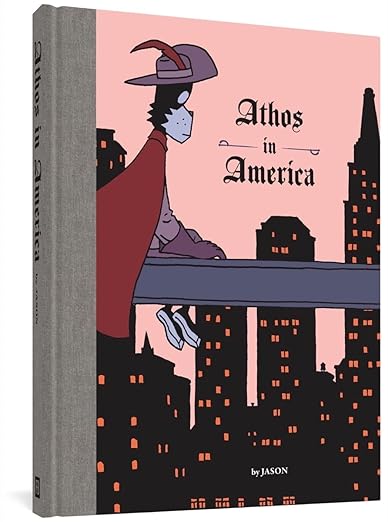
Athos in America


By Jason, coloured by Hubert, translated by Kim Thompson (Fantagraphics Books)
ISBN: 978-1-60699-478-8 (HB/Digital edition)

This book includes Discriminatory Content produced for dramatic, comedic and ironic effect.

Born in 1965 in Molde, Norway, John Arne Sæterøy is known globally by his enigmatic, utilitarian nom de plume Jason. The shy & retiring draughts-scribe started on the path to international cartoon superstardom in 1995, once first graphic novel Lomma full ay regn (Pocket Full of Rain) won Norway’s biggest comics prize: the Sproing Award. Prior to that, he had contributed to alternate/indie magazine KonK whilst, from 1987, studying graphic design and illustration at Oslo’s Art Academy, before going on to Norway’s National School of Arts. After graduating in 1994, three years later he founded his own comic book Mjau Mjau, citing Lewis Trondheim, Jim Woodring & Tex Avery as primary influences, and constantly refining his style into a potent form of meaning-mined anthropomorphic minimalism.

Moving to Copenhagen Jason worked at Studio Gimle alongside Ole Comoll Christensen (Excreta, Mar Mysteriet Surn/Mayday Mysteries, Den Anden Praesident, Det Tredje Ojet) and Peter Snejbjerg (Den skjulte protocol/The Hidden Protocol, World War X, Tarzan, Books of Magic, Starman, Batman: Detective 27). His efforts were internationally noticed, making waves in France, The Netherlands, Slovenia, Spain, Germany and other Scandinavian countries as well as the Americas. He won another Sproing in 2001 – for self-published series Mjau Mjau – and from 2002 turned nigh-exclusively to producing graphic novels, and won even more major awards.

Jason’s breadth of interest is wide and deep: comics, movies, animated cartoons, music, literature and pulp fiction all feature equally with no sense of rank or hierarchy. This puckish and egalitarian mixing and matching of inspirational sources always and inevitably produces picture-treatises well worth a reader’s time. Over a succession of tales Jason built and constantly re-employed a repertory company of stock characters to explore deceptively simplistic milieux based on classic archetypes of movies, childhood entertainments, historical and literary favourites. These all role-play in deliciously absurd and surreal sagas centred on his preferred themes of relationships and loneliness. In latter years, Jason returned to such “found” players as he built his own highly esoteric universe, and even has a whole bizarre bunch of them “team-up” or clash…

As always, visual/verbal bon mots unfold in beguiling, sparse-dialogued, or even as here silently pantomimic progressions, with compellingly formal page layouts rendered in a pared back stripped-down interpretation of Hergé’s Claire Ligne style: solid blacks, and thick outlines dominating settings of seductive monochrome simplicity augmented by a beguiling palette of stark pastels and muted primary colours.

The majority of his tales brim with bleak isolation, swamped by a signature surreality: largely populated with cinematically-inspired, darkly comic, charmingly macabre animal people ruminating on those inescapable concerns whilst re-enacting bizarrely cast, bestial movie tributes.

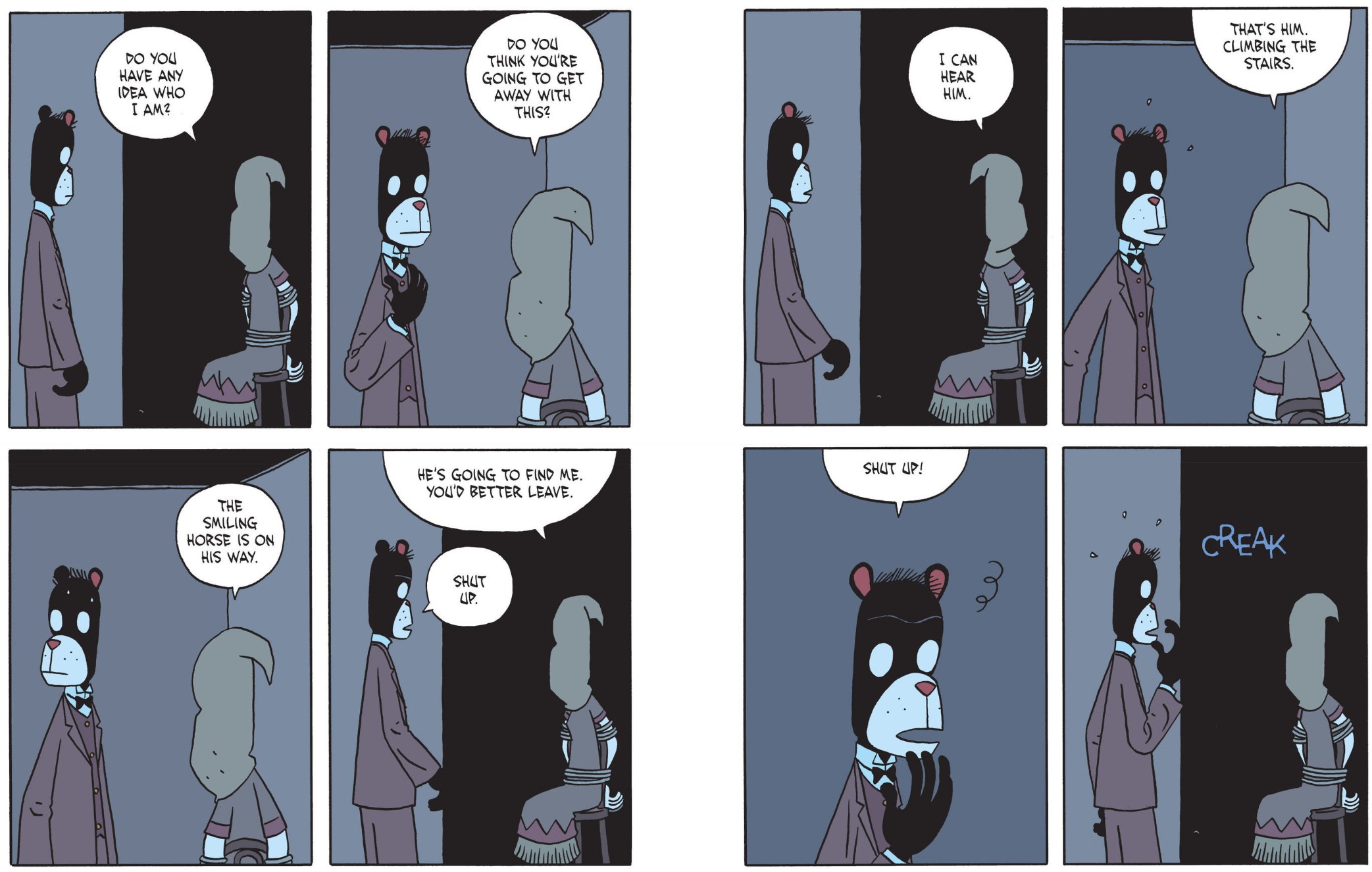
This perfect example of his oeuvre is something of a prequel and available as a sturdily comforting hardback or exalted eBook edition: a mild torrent of subtle wonderment that opens with understated crime thriller ‘The Smiling Horse’, wherein the last survivor of a kidnap team endures decades of tense anticipation before their victim’s uncanny avenger finally dispenses long-deferred justice.

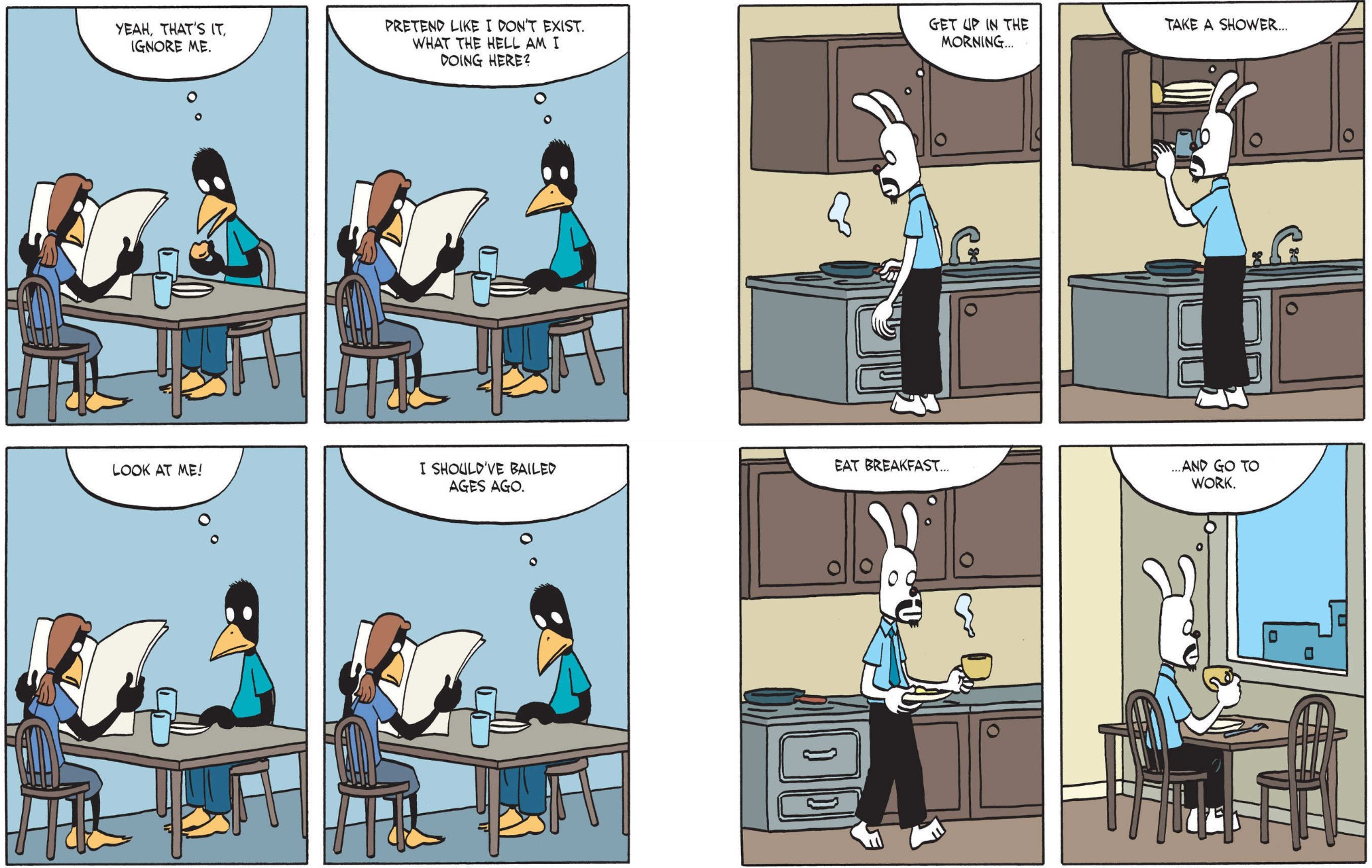
Jason then examines his own life, career and romantic failings with harsh, uncompromising detail in ‘A Cat from Heaven’ whilst B-Movie Sci Fi informs ‘The Brain That Wouldn’t Virginia Woolf’ as a scientist spends years killing women whilst looking for a body that won’t reject the mean-spirited, constantly carping head he keeps alive in his laboratory, before ‘Tom Waits on the Moon’ inexorably draws together a quartet of introspective, isolated loners into a web of fantastic horror. Still they spend too much time thinking not doing so they get what they deserve…

A cunning period gangster pastiche rendered in subdued shades of red and brown, ‘So Long, Mary Anne’ depicts a decent woman helping a vicious escaped convict flee justice. After they snatch a hostage, the “victim” soon begins to exert an uncanny influence over the desperate killer, but is she just wicked or is there a hidden agenda in play?

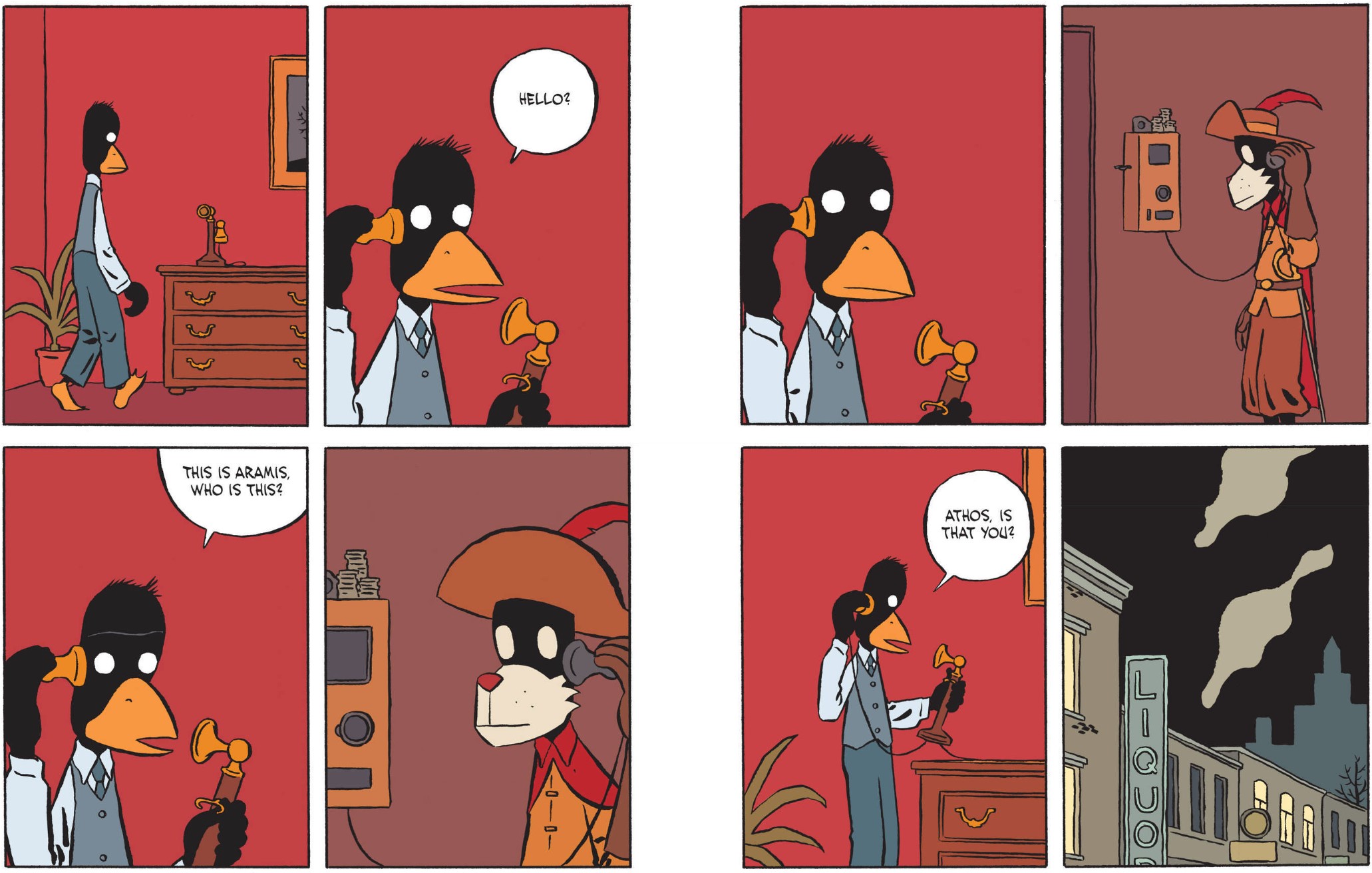
Most welcome attraction here is eponymous final story ‘Athos in America’. This is a fabulously engaging “glory days” yarn, acting as a prequel to the author’s spellbinding graphic romp The Last Musketeer. That epic detailed the final exploit of the dashing Athos, who met his end bravely and improbably after 400 years of valiant adventure. But what was he doing in the years before that tragic denouement?

A guy walks into a bar… It’s America in the 1920s and the oddly-dressed Frenchman starts chatting to Bob the barman. As the quiet night unfolds the affable patron relates how he came to America to star in a movie about himself and his three greatest friends. Sadly, after he enjoyed a dalliance with the Studio’s top star, things quickly started to go wrong…

Effortlessly switching back and forth between genre, milieu and narrative pigeonholes, this grab-bag of graphic goodies again proves that Jason is a creative force in comics like no other: one totally deserving as much of your time, attention and disposable income as possible.
All characters, stories and artwork © 2011 Jason. All rights reserved.

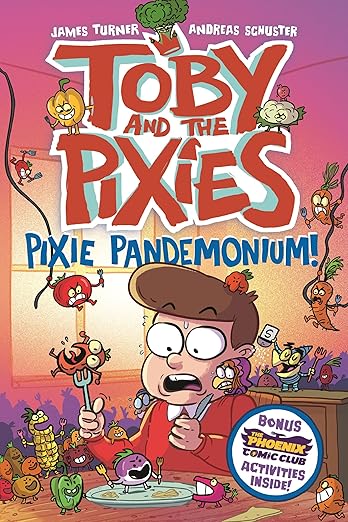
Toby and the Pixies: volume 3: Pixie Pandemonium!


By James Turner & Andreas Schuster (David Fickling Books)
ISBN: 978-1-78845-355-4 (TPB)

Way back in January 2012, Oxford-based David Fickling Books made a rather radical move by launching a traditional anthology comics weekly aimed at under-12s. It revelled in reviving the good old days of picture-story entertainment intent whilst embracing the full force of modernity in style and content.

To this day each issue features humour, adventure, quizzes, puzzles and educational material in a joyous parade of cartoon fun and fantasy. The Phoenix has successfully established itself as a potent source of children’s entertainment because, like Beano and Dandy, it is equally at home to boys and girls, and HAS mastered the magical trick of mixing amazingly action-packed adventure series with hilarious humour strip serials such as this one. Most of the strips have also become graphic collections; just like this one…

Crafted by the exceedingly clever James Turner (Star Cat, Super Animal Adventure Squad, Mameshiba, The Unfeasible Adventures of Beaver and Steve) and Canadian cartoonist/designer/animator Andreas Schuster (KLARA AND ANTON in PRIMAX Magazine), Toby and the Pixies began in January 2020 as I Hate Pixies and, once out of the compost bag of creative wonders, just wouldn’t stop. Those first forays were remastered and released as Toby and the Pixies: Worst King Ever! and follow-up fun folio Best Frenemies charting the course of a nerdy boy at a nice school – until it all goes wrong…

Unappreciated, anxious 12-year-old Toby Cauldwell was resigned to and content with his meagre, second-rate friends, dedicated personal bullies, negative charisma levels and functional classroom invisibility at Suburbiton High School, but began rapidly shedding his appallingly uncool reputation the day after his electric-toaster-obsessed Dad ordered him to sort out their unruly, out-of-control back garden…

That’s when Toby discovered that wild, jungle-like urban wilderness was – unbeknownst to any mortal – the camouflaging screen for a fabulous fey realm. The ethereal, moist and rather mucky enclave had endured unseen in the green shambles of the Cauldwell backyard for countless ages. Now – thanks to an inept and inadvertent act of emancipation triggered by Toby kicking an unfortunately placed plaster garden gnome – the status quo forever altered. A tool of fate, the reluctant lad was instantly elevated to the position of supreme overlord, by dint of accidently yet totally obliterating the sitting tyrant. It was only for a hidden kingdom of magical morons, but they were really happy to be shot of their previous mad, mean, magical master….

As interpreted by the former King’s advisors – Royal Druid Mouldwarp, wise(ish) Lore Keeper/Potion Master Gatherwool and Toadflax (she eats stuff) – deliberate or otherwise, despatching King Thornpickle made Toby new absolute monarch. Pixie law also stated said ruler could do anything they wanted… a prospect so laden with responsibility that it made Toby weep with terror…

Just coming to terms with MAGIC actually existing, and that the ever-present freaky, anarchic imps can do it whilst still being absolute idiots and morons was awful enough, without also still having to survive school’s normal horrors. Thankfully, as the little odds and sods increasingly impinged and impacted on Toby’s life, education and prospects, they also turned school upside on a daily basis, and Toby’s fellow outcast Mo soon discovered the shocking secret of their existence. And he thought it was BRILLIANT!

In the short term, it actually made things worse but now, apart from constant teasing and perpetual whining pleas to visit the magic kingdom, there is a fellow human King Toby can moan at. Two actually, as snarky bully Steph also soon discovered the secret and has since proved to not be quite as awful as she might be…

That’s good because knowledge is a dangerous, trouble-causing thing, particularly as the Pixies are now everywhere and Toby’s succession triggered many problems: especially when magic-slime wielding Princess Sugarsnap – daughter of Thornpickle and rightful heir to a job Toby really, really doesn’t want – started a war to take back the throne Toby absolutely doesn’t want…

This third fondly foetid foofaraw opens with a chance to get reacquainted with key regulars Toby, Mo, Steph, Toadflax, Gatherwool & Mouldwarp in a comprehensive double page intro. Then it’s back to school and off the deep end (or is it?) in ‘Chapter 1: Off Sick’ as Toby is confined to bed with a cold. Typically, his loyal subjects think magic is the answer, but they couldn’t be more wrong… or destructive…

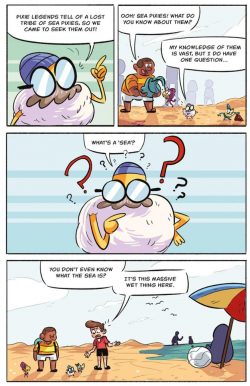
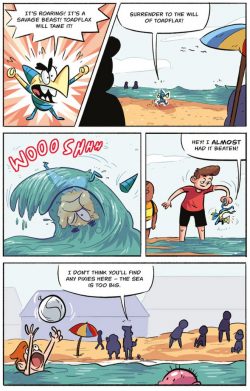
‘Chapter 2: On Holiday’ finds Mr. Cauldwell attending a seaside toaster convention and “thoughtfully” leaving his son and Mo on the beach all day. The King thought he was going to have a pixie-free rest but his Royal Champion (that’s Mo. Keep up!) has kindly brought the Advisors along. They’ve never seen the sea before but think there must be sea pixies they can declare war on if they find them. That ends in frustration but they do discover the narcotic rush power of limitless sugar as delivered by candyfloss…

A systemic examination of each Advisor begins with ‘Chapter 3: Toadflax Day’ as the luckless little omnivore tries to celebrate her birthday in peace and with a minimum of injury, but still falls victim to cruel prankish fate, after which ‘Chapter 4: The Dentist’ finds Toby trapped in the dreaded gob-surgery with his extremely curious courtiers aware of his anxiety but not sure how magic can help. It doesn’t stop them trying though, with terrifying results…

‘Chapter 5: Mouldwarp’s Day’ unearths the pocket Druid’s secret desire to be a mighty – and adored – hero of the Realm, but his dreams are crushed in Gatherwool’s agenda to celebrate King Toby’s 100th visit to the Kingdom and gift the human with the nation’s most dangerous and deadly arcane artefacts. What could possibly go wrong?

Of course, it’s not just royal duties that stress Toby out. Ordinary school interactions are also a nightmare, which is why, after saying something really stupid he truly wished he hadn’t, the junior Cauldwell accepts the use of a pixie enchantment to erase that embarrassing moment. ‘Chapter 6: Time Cape’ only serves to remind him that no matter how bad a situation seems, it can always be amplified to near-cosmic armageddon by a little mucky mud magic…

In ‘Chapter 7: Bixenjammer’ Toby, despite all his past experiences, allows the Advisors to distract him from his homework with tales of the pixies’ ultimate nemesis. Happily his subsequent search for it turns up nothing, after which ‘Chapter 8: Talking to Vegetables’ sees the King foolishly accept the power to communicate with beasts only to find Gatherwool has confused the Fruit of Animal Communication with the equivalent Vegetable version. Barracked and besieged by the contents of fridge and fruit bowl, it takes mere moments to spark a retaliatory war with outraged groceries and only sheer luck saves Toby and the rest of meat world…

‘Chapter 9: Gatherwool’s Day’ reveals the depths of the Lore Keeping Potion Master’s devotion as he undertakes enlarging his beloved monarch to colossal proportions, despite every effort of everyone else to convince him he should check or at least ask first, before Romance fills the air in ‘Chapter 10: Crushed’ after Toby becomes besotted by French foreign exchange student Josephine. The milestone occurs just as the pixies are undertaking similar outreach by inviting demonic Boggart exchange student Grax’norx’ng’kk to observe their way of life. Everyone loves Love and is eager to help, but Toby – and Toadflax – really should have refused all offers to help…

‘Chapter 11: Logically Speaking’ finds Mo and his liege lord asked to advise on a trade logistics problem involving transport of grain, chickens and foxes – with predictably disastrous results – and then joining the school newspaper staff. When the pixies are introduced to the concept of journalism, ‘Chapter 12: No News’ proves their version, utilising a Magic Parchment of Truth to alter reality to match what’s been written, is far more tempting and satisfactory. Thankfully, Steph keeps her wits as Toby succumbs to his unleashed dark side and the status quo is restored before the universe ends…

Somehow, unconfident Toby lands a major part in a school theatrical production, and foolishly accepts aid from Gatherwool to calm his stage fright in ‘Chapter 13: Play Time’. Of course the resultant chaos only adds to the performance but ‘Chapter 14: It’s Snow Joke’ has far more serious repercussions after the Advisors animate the snowmen built by gleeful innocent kids – and Toby & Mo. Apparently, even happy chilly manmade ice folk can dream of world conquest…

The story portion pauses on an early seasonal saga as the pixies share their own Christmas traditions in ‘Chapter 15: A Blimpmas Carol’ whilst test-traumatised Toby humbugs all and sundry in his nervous flurry of revision. When Mo introduces the Advisors to a certain classic book, the stage is set for some life- and attitude-changing ghost action and time travel, but these are the pixies in the pilot seat and you know it won’t go as planned…

Wrapping up the fungal fun and mucky madness is a bunch of pages of related activities: a swathe of features offered under the aegis of the Phoenix Comics Club. Bring paper, pencils and you to a compact online course in all aspects of comic strip creation supervised by Andreas Schuster who helms an activity section that includes ‘Let’s Draw a Pixie!’, ‘A Square Pixie!’ ‘A Circle Pixie!’ ‘An Oval Pixie!’ ‘Expressions!’ ‘Noses!’ ‘Glasses!’ ‘Hair!’ Ideas for Hats!’ ‘Yoghurt Pots!’ ‘A Broken Cup!’ ‘Foam Darts!’ ‘Leaves!’ ‘Pinecones!’ ‘Raccoons!’ ‘Snow Pixies!’ ‘Desert Pixies!’ and ‘Jungle Pixies!’ which ends on an extensive plug for the Phoenix Comics Club website complete with instant access via a QR code.

Toby and the Pixies is a joyous concatenation of nonsense no lover of laughs and lunacy should deprive themselves of and a feast of yuckky yoks all kids will gleefully consume. What are we all waiting for?
Text and illustrations © The Phoenix Comic 2025. All rights reserved.

Toby and the Pixies: volume 3: Pixie Pandemonium! is published on 11th September 2025 and available for preorder now.

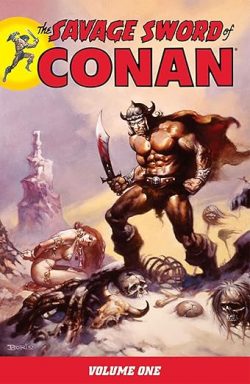
Savage Sword of Conan volume 1


By Robert E. Howard, Roy Thomas, John Jakes, Lin Carter, Barry Windsor-Smith, John Buscema, Pablo Marcos, Gil Kane, Neal Adams, Jim Starlin & Al Milgrom, Alfredo Alcala, Tony DeZuñiga, Alex Niño, Vince Colletta, Steve Gan, Tim Conrad, Yong Montano, Jess Jodloman, “The Tribe”, Rudy Mesina, Freddie Fernandez, Sonny Trinidad, & various (Dark Horse Books)
ISBN: 978-1-59307-838-6 (TPB)

This book includes Discriminatory Content produced in less enlightened times.

During the 1970’s the American comic book industry opened up after more than 15 years of cautiously calcified publishing practises that had come about as a reaction to the censorious oversight of the self-inflicted Comics Code Authority: a publishers’ oversight body created to keep the product wholesome after the industry suffered their very own McCarthy-style Witch-hunt during the 1950s. One of the first literary hardy perennials to be revisited was Horror/Mystery comics and from them came the creation of a new comics genre. Sword & Sorcery stories had been undergoing a prose revival in the paperback marketplace since the release of softcover editions of Lord of the Rings in 1954 and, by the 1960s, revivals of the two-fisted fantasies of Edgar Rice Burroughs, Otis Adelbert Kline, Fritz Lieber and so many more were making huge inroads into buying patterns across the world. Moreover, the old masters had been constantly augmented by modern writers. Michael Moorcock, Lin Carter and many others kickstarted their prose careers with contemporary versions of man against mage against monster. Even so, the undisputed overlord of the genre was Robert E. Howard with his 1930s pulp masterpiece Conan of Cimmeria.

Gold Key had notionally opened the field in 1964 – and created a cult hit – with Mighty Samson. Then in 1966 came Clawfang the Barbarian’ in Thrill-O-Rama #2. Both steely warriors battled in post-apocalyptic technological wildernesses, but in 1969 DC dabbled in previously code-proscribed mysticism with Nightmaster (Showcase #82 -84), following on from the example of CCA-exempt Warren horror anthologies Creepy, Eerie & Vampirella. Marvel tested the waters with barbarian villain – and Conan prototype – Arkon in Avengers #76 (April 1970) and the same month went all-out with short supernatural thriller ‘The Sword and the Sorcerers’ in their own watered-down horror anthology Chamber of Darkness #4.

Written by Roy Thomas and drawn by fresh-faced Barry Smith (a recent Marvel find just breaking out of the company’s still-prevalent Kirby house-style), the tale introduced Starr the Slayer – who also bore no small resemblance to the Barbarian-in-waiting…

Conan the Barbarian debuted with an October 1970 cover-date and – despite some early teething problems, including being cancelled and reinstated in the same month – the comic-strip adventures of Howard’s primal hero were as big a success as the prose yarns they adapted. Conan became a huge hit: a pervasive brand that prompted new prose tales, movies, TV series, cartoon shows, a newspaper strip and all the other paraphernalia of global superstardom.

And American comics changed forever.

In May 1971, Marvel moved into Warren’s territory for a second time, after an abortive attempt in 1968 to create an older-readers, non-Comics Code monochrome magazine: Spectacular Spider-Man. Now, Savage Tales offered stories with stronger tone, mature sexual themes, less bowdlerised violence and partial nudity… and no superheroes. It was the perfect place to introduce Futuristic Femizon Thundra and the macabre Man-Thing whilst offering more visceral vignettes starring the company’s resident jungle-man Ka-Zar and red-handed slayer Conan

The anthology had an eventful reception and the second issue didn’t materialise until October 1973 under the aegis of Marvel’s parent company Curtis Distribution. Conan starred in the first five issues before spinning off into his own adult-oriented monochrome magazine which debuted in August 1974. Free of all Code-mandated restrictions, The Savage Sword of Conan became a haven for mature storytelling, with top flight artists queuing up to flex their creative muscles.

In 2007, after acquiring the license to publish Conan comics, Dark Horse began gathering Marvel’s Savage Sword canon in a series of 500+ page Essentials-style volumes. Today these stories are mostly available in heavy, costly macho-man-testing Omnibus editions too, but still not any kind of digital edition. Why, Crom? Why?

This first titanic tome – also available as an eBook – collects pertinent material from Savage Tales #1-5 and Savage Sword of Conan #1-10: collectively covering May 1971 through February 1976; a period when the unwashed lout was swiftly becoming the darling of the comics world, and chief scribe Roy Thomas was redefining what American comics could say, show and do…

It all starts here with a much-reprinted classic.

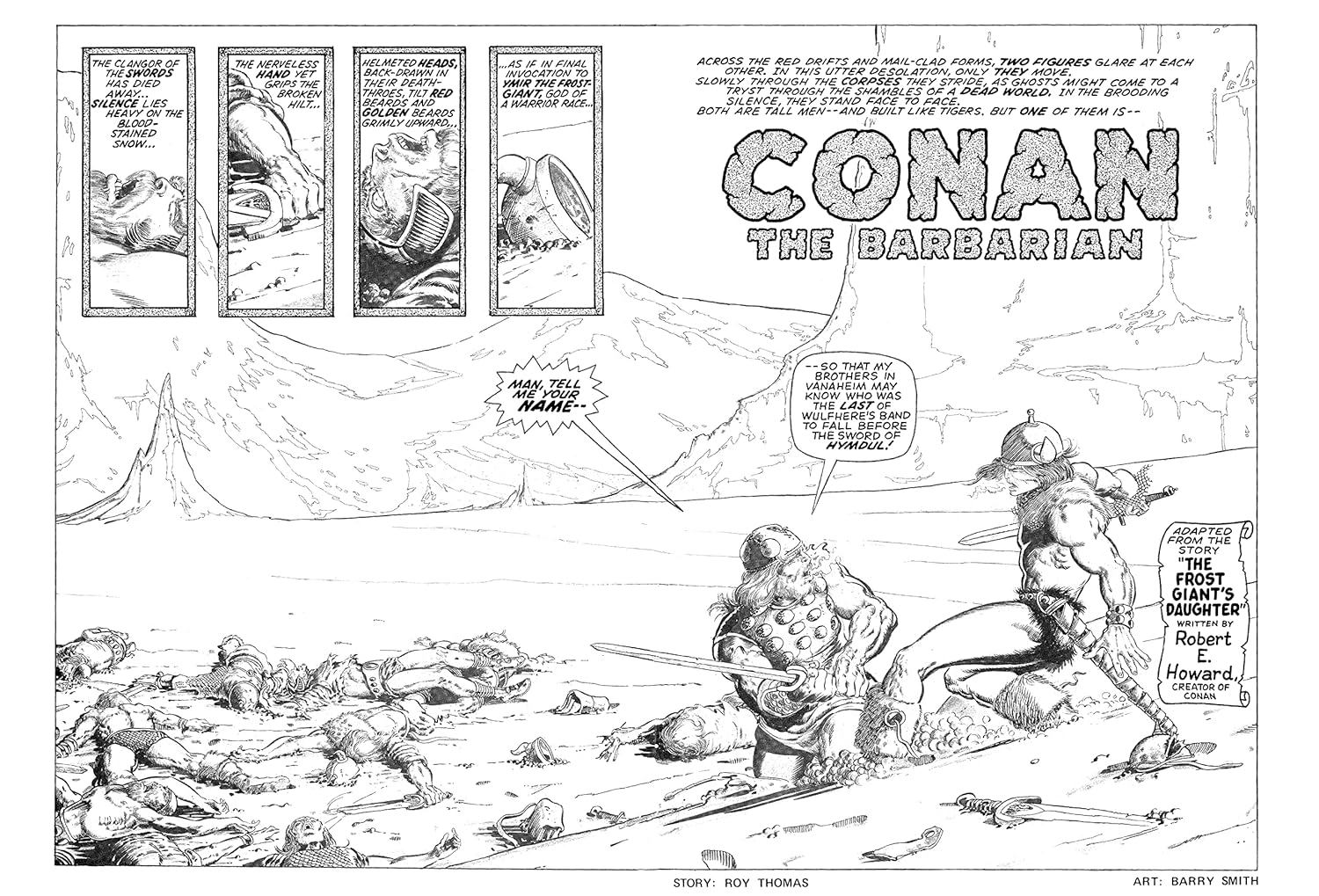
‘The Frost Giant’s Daughter’ is a haunting, racy tale written by Howard, originally adapted in line and tone by Barry Smith for Savage Tales #1. It was later coloured – and adulterated – for the all-ages comic book (#16) as it detailed how a lusty young Cimmerian chased a naked nymph into the icy winter and found himself prey in a trap set by gods or monsters…

By the time Savage Tales returned after a two-year hiatus, Barry Windsor-Smith had pretty much left comics but had agreed to illustrate ‘Red Nails’ one day if he could do it his way and at his own pace. The eventual result was an utter revelation, moody, gory, soaked in dark passion and entrancing in its savage beauty. With some all-but-invisible art assistance from Pablo Marcos this journey into the brutal depths of obsession and the decline of empires is the perfect example of how to bow out at the top of one’s creative game.

The adaptation began in ST #2 as Conan and pirate queen Valeria survive a trek through scorching deserts to fetch up in a vast walled city. Stealing inside they find immense riches casually ignored as the last members of the tribes of Tecuhlti and Xotalanc pick each off or wait for the monsters infesting the place to take them. All too soon, the visitors are embroiled in a simmering, oppressive war of extinction. The third issue completed the ghastly epic as the slow conflict between rival branches of a decadent race explodes into a paroxysm of gore and aroused monsters…

Savage Tales #4 (May 1974) held a brace of tales. ‘Night of the Dark God’ was limned by Gil Kane, Neal Adams, Marcos & Vince Colletta from Howard’s tale The Dark Man. It revealed how Conan came hunting abductors of his childhood first love and found them just as a terrify mystery idol began exerting its own malefic influence on a hall full of already-enraged warriors…

‘Dweller in the Dark’ was Smith’s swansong and saw the wandering warrior become a plaything for lascivious Queen Fatima of Corinthia. Her lusts were matched only by her jealousy, however, and it wasn’t long before she had turned against Conan and tried to feed him to the monster lurking below the city…

The fifth and final Conan appearance in Savage Tales was ‘Secret of Skull River’: a wryly laconic yarn Thomas adapted from a John Jakes plot, illustrated by Jim Starlin & Al Milgrom. The barbarian sell-sword is hired to remove a wizard whose experiments are polluting a town. The reward lusty Conan claims for his murderous services surprises everybody…

From there it was only a short jump to his own mature-themed starring vehicle, but although Savage Sword starred Conan it was initially a vehicle for numerous barbarian themed yarns – such as a serialised reprinting of Gil Kane’s epic Blackmark – and other Howard properties such as Bran Mac Morn or Red Sonja. Those aren’t included here, but are well worth searching out too…

The SSOC experience opens with the first issue and ‘Curse of the Undead-Man’ by Thomas, John Buscema & Marcos, adapted from Howard’s short story Mistress of Death. Here Conan encounters old comrade Red Sonja amongst the fleshpots of “The Maul” in Zamora’s City of Thieves before falling foul of sorcerer Costranno: a mage for whom being chopped to mincemeat is only a minor inconvenience…

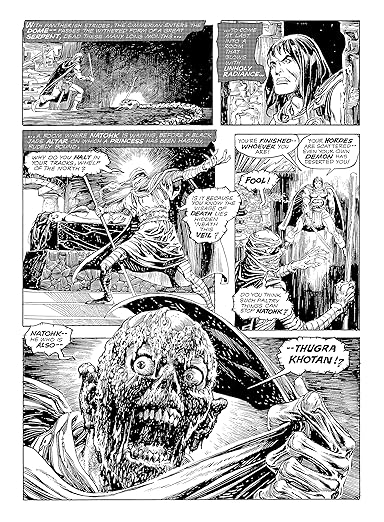
Thomas wrote all SSOC Conan material included here: blending adaptations of Howard’s stories – Conan’s and his other fearsome fighting men as well – and such successor authors as Lin Carter or L. Sprague de Camp with original tales. A stunning visual tour de force, ‘Black Colossus’ in #2 was illustrated by Buscema & Alfredo Alcala; detailing how antediluvian priest Natohk returns from death to imperil the kingdom of Princess Yasmela… until stalwart general Conan leads her armies to a victory against armed invaders, uncanny occultism and a legion of devils.

SSOC #3 contributed two tales, beginning with Buscema & Marcos’ ‘At the Mountain of the Moon-God’ with Conan high in Yasmela’s court and attempting to head off the kingdom’s annexation from encroaching neighbours and encountering mountain-dwelling bandits and a demon pterosaur. The issue concluded with ‘Demons of the Summit’ – an adaptation of Bjorn Nyberg & de Camp’s People of the Summit – turned into comics by Thomas & Tony DeZuñiga as an encounter with more high-living brigands brings the Cimmerian into conflict with a dying race of wizards who want his latest curvy companion to mother their next generation…

Issue #4 features Howard’s ‘Iron Shadows on the Moon’, realised by Buscema & Alcala. Having lost a war whilst leading a Kozak horde, Conan flees into the Vilayet Sea with escaped slave Olivia after killing enemy general Shah Amurath. On an uncharted island they then encounter ancient statues which come to life at the moon’s touch. The bloodthirsty horrors fall upon a band of pirates watering on the island and after leading them to victory against the supernatural fiends Conan manoeuvres himself into the captain’s role and begins a life of freebooting piracy…

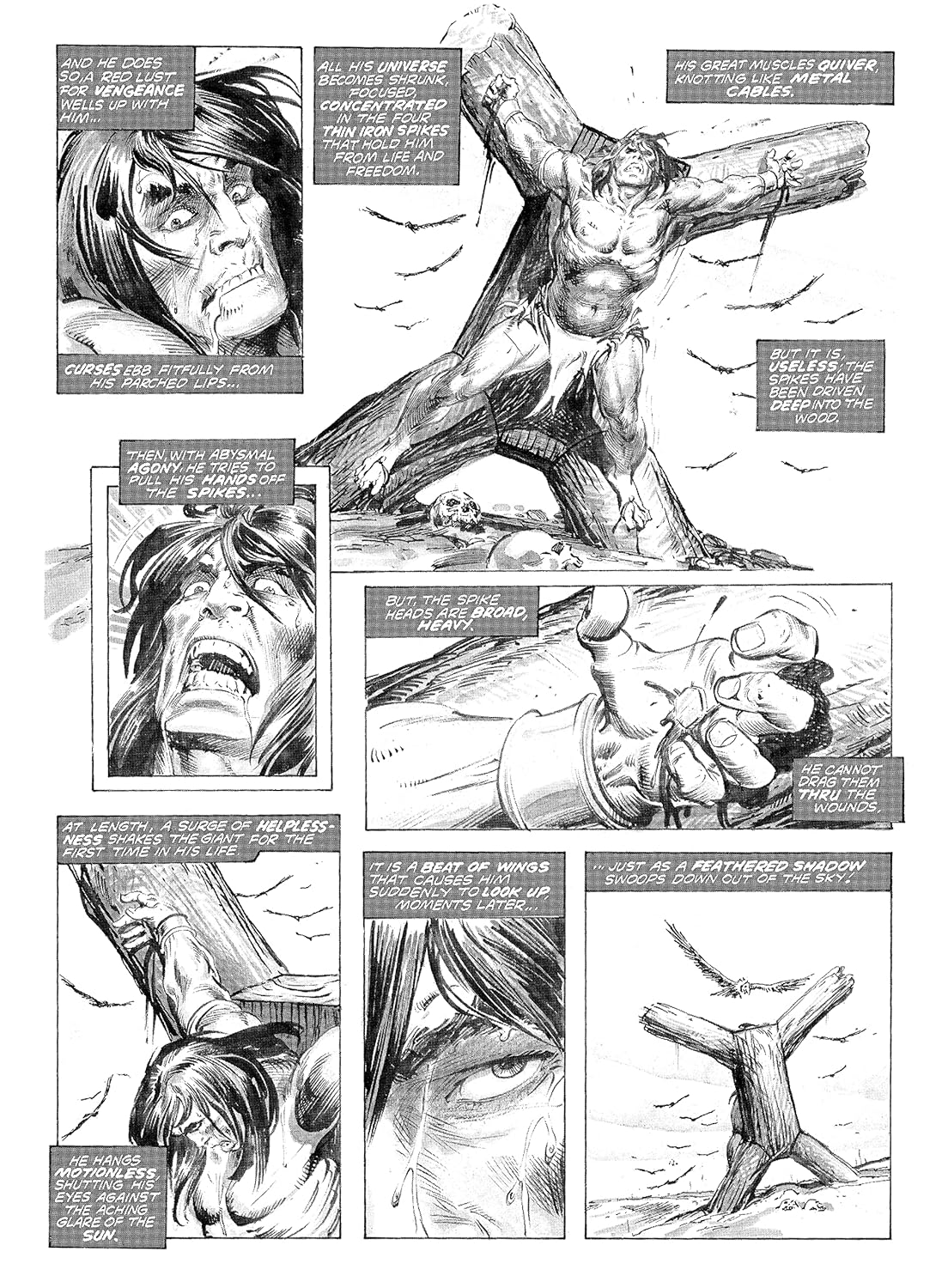
Howard’s ‘A Witch Shall Be Born’ took up most of Savage Sword of Conan #5. Illustrated by Buscema and The Tribe – a loose association of Marvel’s Filipino art contingent (DeZuñiga; Steve Gan; Rudy Mesina; Freddie Fernandez and others) it saw virtuous Queen Taramis replaced by her demonic twin sister Salome, who debauches and ravages the kingdom of Kauran whilst her accomplice Constantius has her guard captain Conan crucified. After (almost) saving himself, the Cimmerian recuperates with desert-raiding Zuagirs, and after ousting their brutal chieftain Olgerd Vladislav returns to save Taramis and revenge himself upon the witch…

The epic is balanced by two shorter tales in the next issue. ‘The Sleeper Beneath the Sands’ is a Thomas original limned by Sonny Trinidad revealing how Olgerd encounters a caravan of clerics en route to pacify an elder god buried since time immemorial beneath the desert. The rejected bandit-lord senses a chance for revenge but soon regrets allowing the beast to wake and luring Conan into its path…

Howard’s Celtic reincarnation thriller ‘People of the Dark’ is radically adapted by Thomas and stunningly illustrated by master stylist Alex Niño next as, in modern times, Jim O’Brien plots to kill rival Richard Brent to win the hand of Eleanor. However, a fall into an ancient cavern transports the would-be killer into antediluvian prehistory where – as Conan – he battles the debased descendants of things which were once men. In that forgotten hell a burden is placed upon him and, once returned to the present, O’Brien faces another monster and pays a millennial debt…

‘The Citadel at the Center of Time’ by Thomas, Buscema & Alcala in #7 finds the Cimmerian leading desert-raiding Zuagirs and attacking a caravan only to be confronted by a sabretooth tiger. After despatching the wanton killer, Conan learns from the surviving merchants of a great ziggurat with vast riches and only attendant priests to guard them. Ever-needful of loot to placate his greedy followers, Conan leads an expedition against the eerie edifice but soon finds himself captured and offered up as a sacrificial tool to time wizard Shamash-Shum-Ukin and battling dinosaurs, beasts and brutes from many ages before finally settling his score with the time-meddler…

SSOC #8 offered many short sharp shockers beginning with ‘The Forever Phial’, illustrated by Tim Conrad doing his best Windsor-Smith riff. Here immortal wizard Ranephi desires to end his interminable existence and manipulates a certain barbarian into helping him out. The main part of the issue continues Thomas & Kane’s adaptation of Howard’s King Conan novel The Hour of the Dragon, which had begun in Giant-Size Conan but foundered as Marvel ended their oversized specials line. Inked by Yong Montano, ‘Corsairs Against Stygia’ resumes the tale with shanghaied King Conan leading a slave revolt on the ship he’s been abducted upon. Back in Aquilonia, a cabal of nobles backed by Stygian wizard Thutothmes has usurped his throne…

Having taking control of the ship Conan opts to infiltrates the evil empire to rescue the stolen talisman known as the Heart of Ahriman and end the conflict…

Wrapping up this segment is Lin Carter’s evocative poem ‘Death Song of Conan the Cimmerian’ adapted by Thomas and Jess Jodloman…

Issue #9 offered another new tale by Thomas & Marcos as Conan’s Zuagirs raid another priest-packed caravan and come under the diabolical influence of a small statue with great power. ‘The Curse of the Cat-Goddess’ corrupts, divides and promises many great things: causing the doom of many brothers in arms before the iron-willed Cimmerian ends its seductive threat. The adaptation of The Hour of the Dragon concludes in this hefty tome’s final chapter as SSOC #10 reveals how ‘Conan the Conqueror’ (rendered by Buscema & The Tribe) sneaks into Stygian capitol Khemi to defeat snake-worshipping priests, immortal vampire queen Akivasha and Thutothmes’ inner circle, before stealing back the Heart of Ahriman and heading home to occupied Aquilonia to destroy wizard king Xaltotun and his human lackeys, and reclaim his stolen throne…

With a painted covers gallery – reproduced only in black-&-white here – by Buscema, Marcos, John Romita, Adams, Boris Vallejo, Mike Kaluta, Niño, Frank Magsino, Frank Brunner & Bob Larkin and pin-up/frontispiece art by Marcos, Adams & Esteban Maroto, this weighty collection provides a truly epic experience for all fans of thundering mystic combat and esoteric adventure.

If the clash of arms, roar of monsters, unwise gloating of connivers and destruction of empires sets your pulse racing and blood rushing, this titanic tome is certainly your cup of mead. There are plenty of Thrones in peril, but this all-action extravaganza of sex, slaughter, snow, sand and steel is no Game. Get it and see what real intrigue and barbarism look like…
Savage Sword of Conan® and © 2007 Conan Properties International, LLC. All rights reserved.

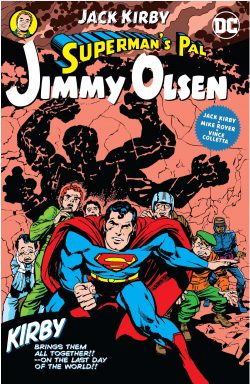
Superman’s Pal Jimmy Olsen by Jack Kirby


By Jack Kirby, Vince Colletta & Mike Royer, with Murphy Anderson, Neal Adams, Al Plastino & various (DC Comics)
ISBN: 978-1-84576-746-4 (TPB/Digital edition)

This book includes Discriminatory Content produced in less enlightened times.

For nearly nine decades, Superman has provided excitement, imagination and fun in more or less equal amounts. Although unnamed, since Action Comics #6 (November 1938), a red-headed, be-freckled plucky kid worked alongside Clark Kent & Lois Lane and enjoyed a unique and special relationship with the Metropolis Marvel.

We saw him called by his first name in Superman #13 (November/ December 1941). Jimmy Olsen became a major player on The Adventures of Superman radio show from its debut on April 15th 1940: someone for the hero to explain stuff to for the listener’s benefit and the closest thing to a sidekick the Man of Tomorrow ever needed. That partnership transferred to the comics. Following a string of hit movie chapter plays, when the similarly titled television show launched in the autumn of 1952, it was a monolithic hit and co-star Jimmy was in constant attendance. Thus, National Periodicals began cautiously expanding their precious franchise with new characters and titles. First up was the gloriously charming, light-hearted escapades of an impetuous, naïve but capable Daily Planet cub reporter/photographer forever onward saddled with the cognomen Superman’s Pal. Jimmy Olsen, which launched in 1954 carrying a September/October cover date. For 20 years the comic blended action, adventure, wacky comedy, fantasy and science fiction in the gentle, wry, exceedingly popular manner scripter Otto Binder had perfected in the 1940s at Fawcett Comics on the magnificent Captain Marvel.

Over those years, one of its most popular plot-themes (and most fondly revered and referenced today by Baby-Boomer fans) was the unlucky lad’s appalling talent for being warped, mutated and physically manipulated by fate, aliens and even his supposed friends. Latterly, however, Leo Dorfman had begun the process of remaking Jimmy as a more competent action hero and serious investigative journalist in tune with the rebellious era when the worlds of DC forever altered on the pages of what was then considered one of their least appreciated and poorest-selling titles.

According to fan myth & legend, none of it apparently mattered when Jack Kirby – hot from making Marvel the top company in the business – took over. By all popular accounts, he had asked for DC’s worst performing title to prove what he could do, and used it to spearhead a wave of changes whilst adapting grand schemes his old employers were too timid to countenance on their pages…

Jack’s first issue was #133, cover-dated October and on sale from August 25, 1970.

Jack Kirby (28th August 1917 – 6th February 1994) was – and, more than three decades after his death, remains – the most important single influence in the history of American comics. There are innumerable accounts of and testaments to what the man has done and meant, and you should read all of those if you are at all interested in the bones and breath of our medium. Kirby was a man of vast imagination who translated big concepts into astoundingly potent, instantly accessible symbols, thereby creating an iconography for generations of fantasy fans. If you were exposed to Kirby as an impressionable child, you were his for life. To be honest, that probably applies at whatever age you jump aboard the “Kirby Express”…

Synonymous with larger-than-life characters and vast cosmic imaginings, he was an astute, spiritual man who lived through poverty, prejudice, gangsterism, The Great Depression and World War II. He experienced Pre-War privation, Post-War optimism, Cold War paranoia, political cynicism and the birth and death of peace-seeking counter-cultures, but always looked to the future while understanding human nature intimately. Beginning his career in the late 1930s, it took a remarkably short time for Jack and creative collaborator Joe Simon to become the wonder-kid dream-team of the newborn comic book industry. Together they produced a year’s worth of influential monthly magazine Blue Bolt, dashed off Captain Marvel Adventures #1 for overstretched Fawcett, and – after Martin Goodman appointed Simon editor at Timely Comics – launched a host of pivotal characters including Red Raven, Marvel Boy, Mercury/Hurricane, The Vision, Young Allies and million-selling mega-hit Captain America. When Goodman failed to honour his financial obligations, Simon & Kirby were snapped up by National/DC, who welcomed them with open arms and a fat chequebook.

Bursting with ideas these staid industry leaders were never really comfortable with, the pair were initially an uneasy fit. Awarded two moribund strips to play with until they found their creative feet, they turned around both Sandman and Manhunter virtually overnight and, once safely established and left to their own devices, switched to the “Kid Gang” genre they had pioneered at Timely. Joe & Jack created wartime sales sensation Boy Commandos and Homefront iteration The Newsboy Legion before being called up to serve in the war they had been fighting on comic pages since 1940. Once demobbed, they returned to a very different funnybook business, and soon after left National to create their own empire…

S&K ushered in the first age of mature American comics – not just by inventing the Romance genre, but with all manner of challenging modern material about real people in extraordinary situations, only to see it all disappear again in less than eight years. Simon & Kirby had established their own publishing house, creating comics for far more sophisticated readerships, but found themselves in a sales downturn and awash in public hysteria generated by an anti-comic book pogrom. Their small stable of magazines – generated for an association of companies known as Prize, Crestwood, Pines, Essenkay and Mainline Comics – blossomed and as quickly wilted when the industry contracted throughout the 1950s, but had left future generations fascinating ventures such as Boys’ Ranch, Bullseye, Crime Does Not Pay, Black Magic, Boy Explorers, Fighting American and the entire genre of Romance Comics…

Hysterical censorship fever spearheaded by US Senator Estes Kefauver and opportunistic pop psychologist Dr. Frederic Wertham led to witch-hunt Senate hearings. Most publishers caved, adopting a castrating self-regulatory straitjacket of draconian rules and guidelines. Crime & Horror titles produced under the aegis and emblem of the Comics Code Authority were sanitised, anodyne affairs in terms of mature themes, political commentary, shock and gore even though the market’s appetite for suspense and the uncanny was still high. Crime comics vanished as adult sensibilities challenging an increasingly stratified and oppressive society were suppressed. Salaciousness, suspense and horror were dialled back to the level of technological fairy tales and whimsical parables…

Simon left the business for advertising, but Jack soldiered on, taking his skills and ideas to safer, more conventional, less experimental companies. As the panic abated, he returned to DC Comics, working on bread-&-butter anthological mystery tales and revamping Green Arrow (at that time a back-up feature in Adventure Comics and World’s Finest Comics) whilst concentrating on a passion project: newspaper strip Sky Masters of the Space Force.

During this period Kirby also re-packaged a superteam concept that had kicked around in his head since he and Joe closed their innovative, ill-timed ventures. At the end of 1956, Showcase #6 premiered Challengers of the Unknown and following three further test issues they won their own title with Kirby crafting the first eight. Then a dispute with Editor Jack Schiff exploded and the King was gone…

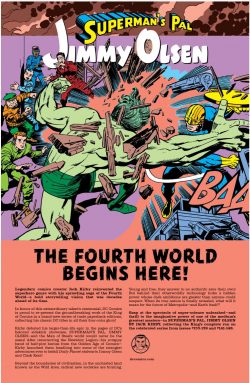
He found fresh fields and an equally hungry new partner in Stan Lee at the ailing Atlas Comics outfit (AKA once mighty Timely Comics), launching and spearheading a revolution in comics storytelling. However, after just over a decade of a continual innovation and wonderment, Kirby felt increasingly stifled. His efforts had transformed a dying publisher into industry-leader Marvel, but success had left him trapped in a profitable rut. Thus, he moved back to DC to generate another tidal wave of sheer imagination and pure invention. The result was experimental adult magazines Spirit World & In the Days of the Mob followed by a stunning reworking of Superman’s Pal Jimmy Olsen – and by the time he had finished, all DC continuity. The latter was a prelude to his landmark Fourth World Saga comprising interlinked and contemporaneous titles Forever People, New Gods & Mister Miracle: the very definition of something game-changing and too far ahead of its time…

Incidentally, on many levels Jimmy was an ideal match for the King and not an incongruous display of breast-beating or do-or-die audition. Olsen was an idealistic, heroic young man in the thick of the incredible at all times, and Kirby had a long history with such boy heroes. He and Joe Simon had invented the comic book “kid gang” subgenre and for the next two years Kirby revived it with a new take on The Newsboy Legion… albeit interlaced with a future-embracing backstory, and aspirational wonder, rather than the poverty, privation and ongoing war of survival embodied by the Forties iteration…

In last non-Jack issue, Jimmy had been abducted by gangsters convinced he knew Superman’s secret identity, before battling a soviet champion for sovereignty of a floating island (as you do…) but everything abruptly changed with Superman’s Pal Jimmy Olsen #133. Suddenly readers were thrown into a bravely strange new world where, out of nowhere, extremely shady incoming Daily Planet owner Morgan Edge gifts Jimmy with a fantastic supercar – the “Whiz Wagon” – and demands that he and his previously unseen pals ‘The Newsboy Legion!’ (actually the “New Newsboy Legion” comprising the sons of Tommy, Big-Words, Gabby & Scrapper, with the addition of African-American, scuba diving addict Flipper Dipper) deliver an exclusive scoop on a strange counterculture movement living in the wilds outside Metropolis. The mysterious subjects are all weird hippie-types and don’t trust anyone over age 25, so he needs youth and experience…

However, the one who can’t be trusted is Edge himself. He has undisclosed connections to crime combine Intergang and a chilling stone-faced alien called Darkseid

After very publicly surviving an assassination attempt, Clark Kent goes into hiding allowing Superman to take off after Jimmy and the boys as they probe a fantastic unsuspected region dubbed the Wild Area. Here Olsen survives trial by combat to become leader of futuristic biker gang The Outsiders, and is sucked into their quest for meaning by hunting a moving mountain inhabited by techno-pacifists “The Hairies”

Linking up with the Man of Steel as tremors rock the organically grown refuge city of Habitat, Jimmy and the Newsboys chase the ultimate test of existence alongside all the other motor nomads, unaware that pal Superman already knows the secret they’re all seeking. What Jimmy isn’t aware of is that Edge has boobytrapped the Whiz Wagon to satisfy his master’s desire to destroy what might the next step in human evolution and a threat to his own schemes…

Although Kirby and Inker Vince Colletta put their hearts and souls into the job, and despite Publisher Carmine Infantino’s promise of strict non-intervention, meddling with the concept began early with regular Superman art staff redrawing Superman and Jimmy’s faces. We’ll never know what they tried to do to the overall story arc…

Without pause for breath, exposition or recap Superman’s Pal Jimmy Olsen #134 saw Jimmy and his biker wild bunch catch up to monstrous mechanised white whale ‘The Mountain of Judgement!’ after astoundingly taking out Superman with weapons casually discarded by inveterate tinkerers the Hairies. Thankfully, Edge’s bomb is easily defused by the techno-hippies who all share an incredible secret – one Superman is fully aware of. In short order Jim and the lads are briefed on “The Project”: the US government’s cracking of the human genome and extensive duplication and experimentation of life forms. This has already resulted in cloning the deceased, mass-producing soldiers and staff and, most incredibly, meddling with/reconfiguring chromosomal structure to create new life forms: “D.N.A.liens” like the pacifist techno-wizards called Hairies…
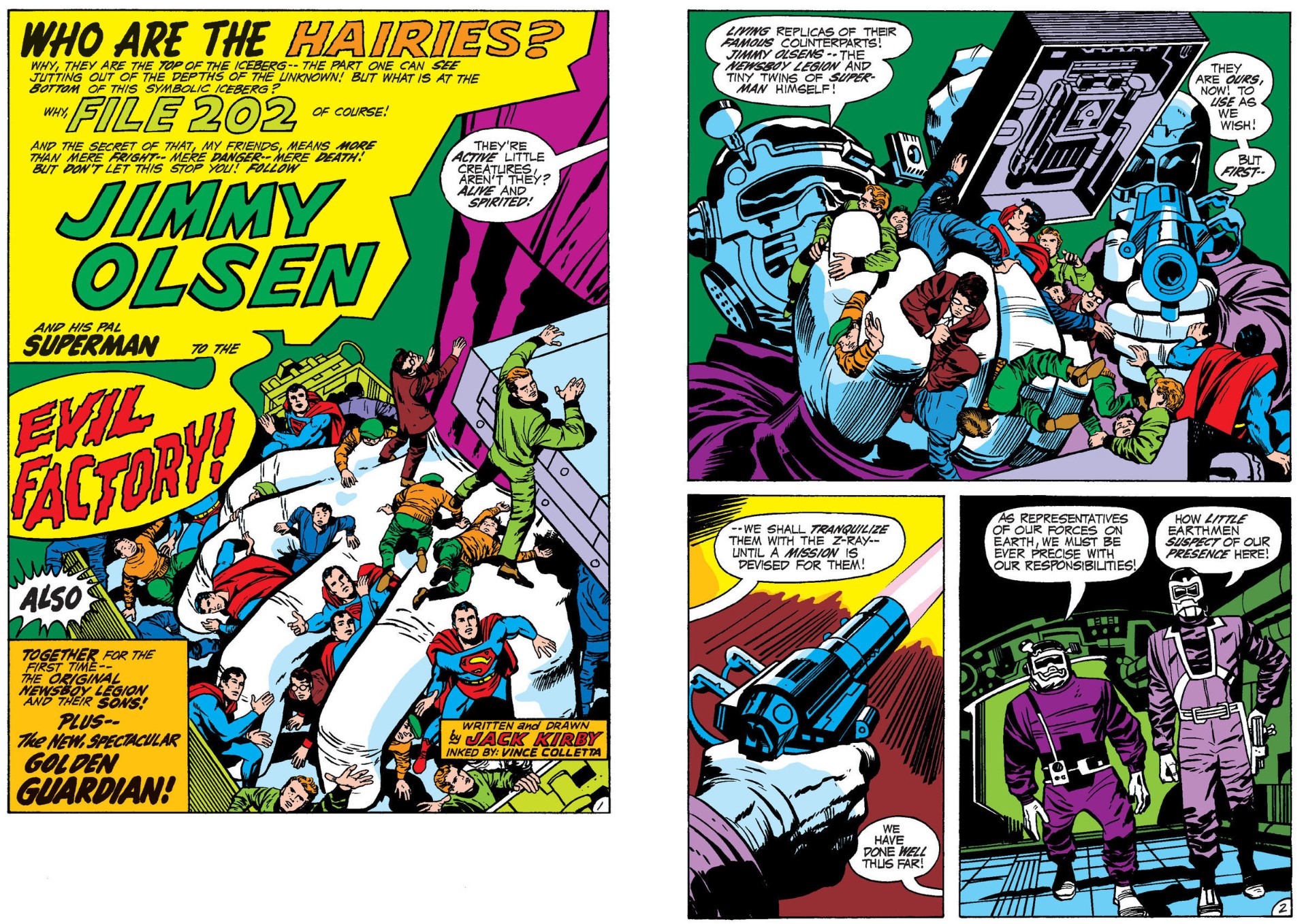
Moreover, the Project is run by none other than slum-kids made good the original Newsboy Legion!

Although commonplace now, the notion of cloning was practically unknown in 1970 and Kirby took the idea and ran with it: blending eternal questions about Life itself with Spy Fi tropes, gansterism and Bond movie settings, all packed with freaks and monsters and underpinned by a constant threat posed by a mysterious mastermind and his own experimental devils. The inspired auteur was also pulling out all the stops visually and his experimental concepts were backed up by equally innovative art and photo collages.

In SPJO #135 we meet Simyan & Mokkari, whose raid on the Project’s genetic storehouse provides raw material to constantly reproduce wilder and wilder versions of our heroes in their own hidden ‘Evil Factory!’ Being utterly without restraint or ethical scruple, their goal of destroying the Project for Darkseid is well-advanced, and – as previously stated – Jimmy’s genes are a particularly promising medium for random transformations…

Their control of what they make is less impressive however, and a superstrong, giant Jimmy infused with Kryptonite is teleported without a plan into the Project simply to save Simyan & Mokkari being killed by their own experiment. Although it almost kills Superman and his pal, the day is saved by the Senior Newsboys’ passion project – a new iteration of their murdered WWII superhero patron Jim Harperthe (Golden) Guardian – in concluding, action-packed background-filling expository chapter ‘The Saga of the D.N.A.liens!’ (cover-dated March 1971 and leading into the launch of Kirby’s opening Fourth World titles Forever People and New Gods #1. We’ll be covering those and final plank Mister Miracle later in the year).

With the scene set, Jimmy’s further exploits are generally Fourth World adjacent: a forge and funnel for concepts linking Superman to the ongoing narrative of Gods and Armageddons whilst exploring Mankind’s dangerous tendencies and corruptible natures. In Superman’s Pal Jimmy Olsen #137, as the Newsboys and Jimmy learn more about their own (utterly non-consensual) contributions to the Project (without their knowledge Scrapper has been mass-produced as soldiers and guards in different sizes from six feet to six inches, and innumerable Gabbys man switchboards and communications consoles!) the Evil Factory strike again.

As Jimmy meets The Project’s emergent telepath/resident D.N.A.lien Dubbilex, elsewhere Darkseid demands results and Simyan & Mokkari unleash another Olsen variant on the hidden science citadel. Gifted with astounding strength and uncanny energy powers ‘The Four-Armed Terror!’ has been bred to feed on nuclear radiation and carves a wave of destruction that extends into the Wild Area on its path to the Project’s atomic power plant. Superman and the boys are easily disposed of and discarded, with the crisis escalating even further after Simyan & Mokkari lose control of all the other quadra-killers and beam the entire rampaging herd into the subterranean Project’s tunnels, forcing Superman to pull out all the stops to get free and save everything in cataclysmic closing chapter ‘The Big Boom!’
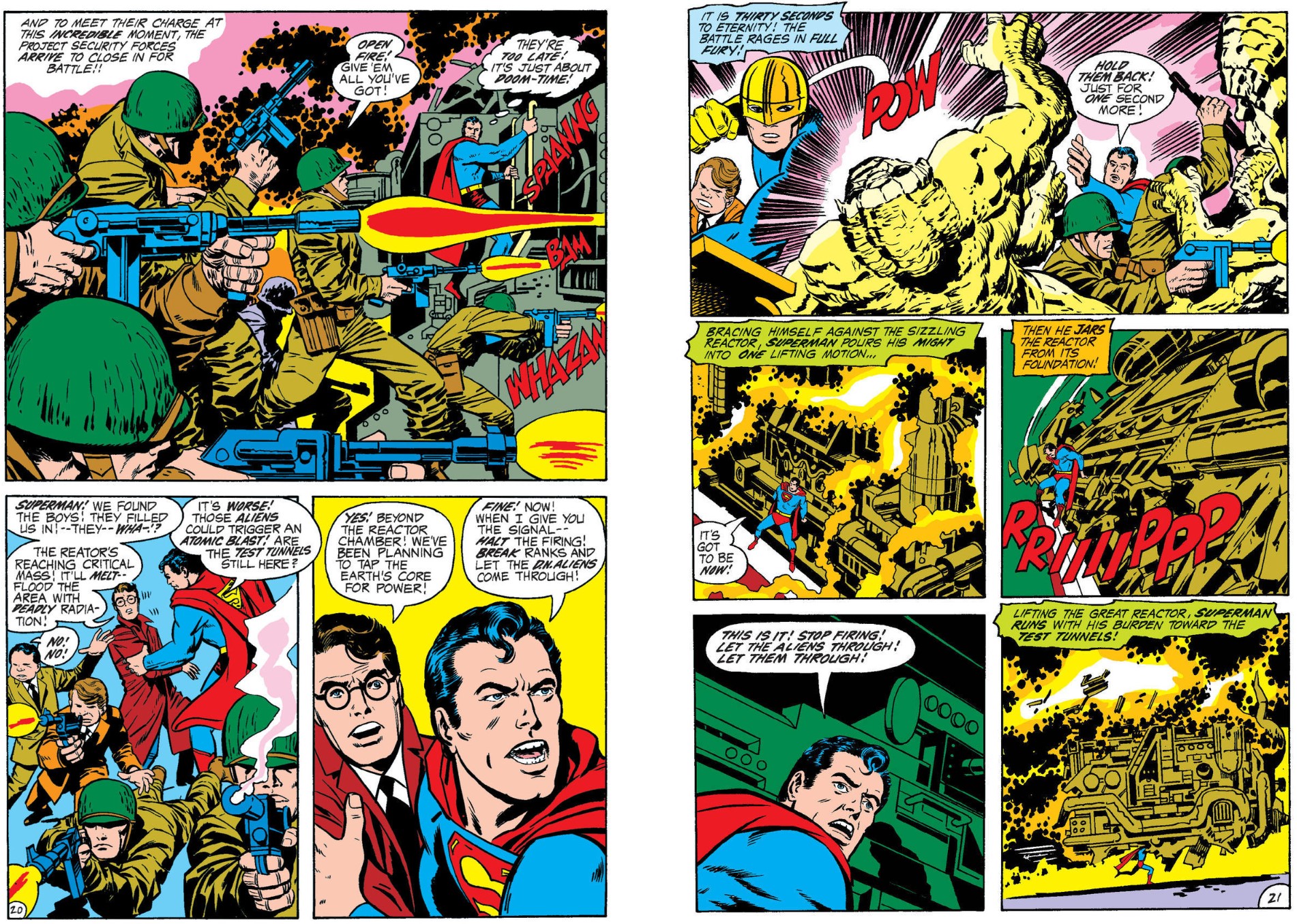
Despite those promises of non-interference, DC editors and promotional staff perpetually sought to “goose up” the Kirby flagship title. Always a team player, the King acquiesced to a guest-appearance by currently-hot comedian Don Rickles and oddly – in the manner of Marmite – it either worked uproariously or appalled readers. I thought it was a genuine hilarious hoot. Further undercutting the narrative, the saga was bifurcated by a reprint 80-Page Giant of pre-Kirby Olsen escapades in SPJO #140 and not included here.

Nevertheless #139 and 141 ( July’s ‘The Guardian Fights Again!!!’ and September’s ‘Will the Real Don Rickles Panic?’) is a compelling tale of Edge’s unfolding evil, Intergang’s growing influence and the creeping menace of Darkseid, who allows his tech to be used to send Clark Kent into hyperspace destined for Apokolips whilst Jimmy and the Golden Guardian are poisoned by slow-acting incendiary poison Pyro-Granulate: a slow death that will turn them into human torches unless they find an antidote. Slowing them down is equally doomed Galaxy Broadcasting staffer Goody Rickles whom Edge wants gone because he looks like the star Edge wants to sign up… and is really, really annoying…
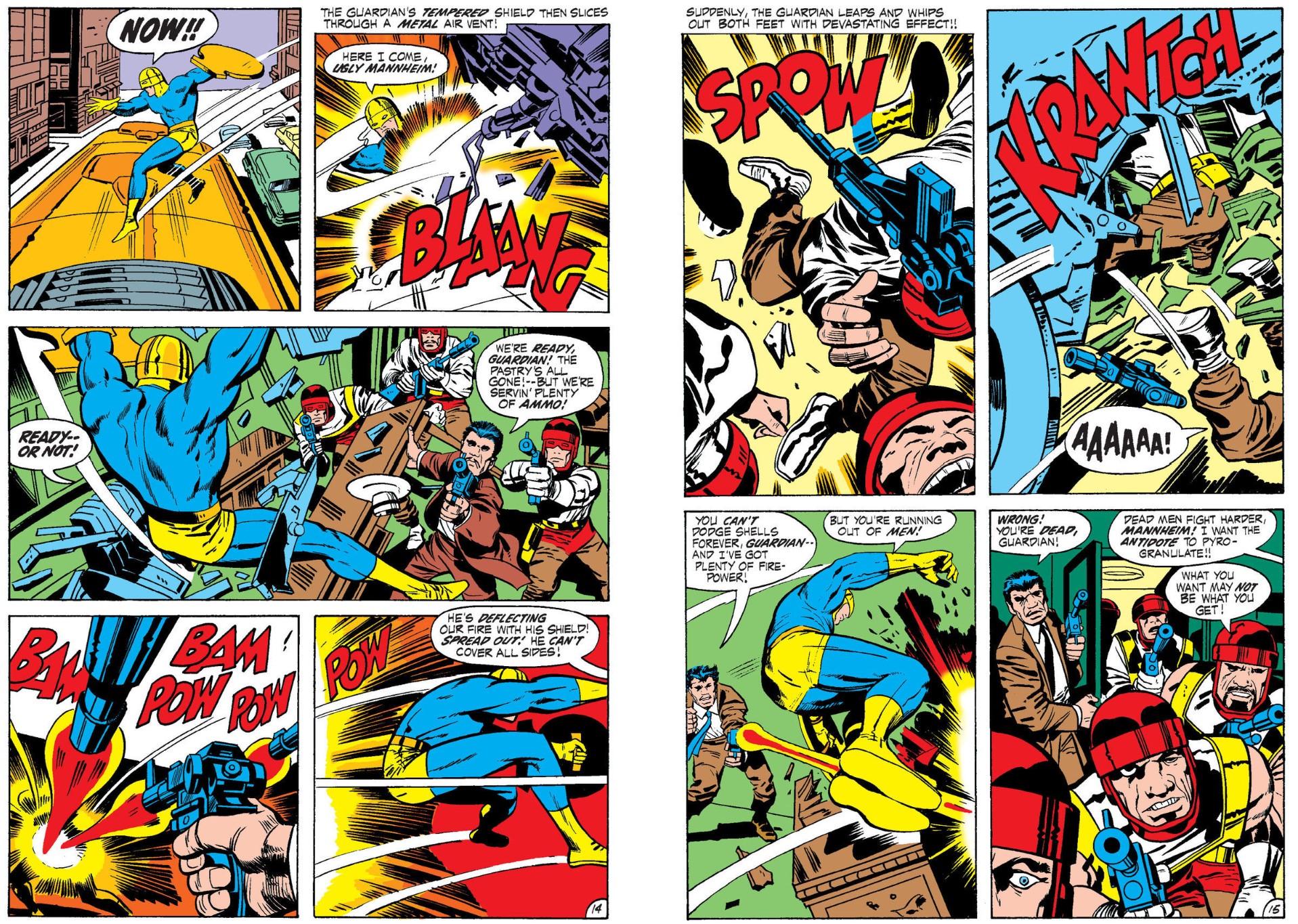
With Kent saved from a modern hell by New God Lightray, Kirby next addressed the rise in horror and supernatural tales via another two-parter that began in #142 with ‘The Man from Transilvane!’ Here, apparent vampire Count Dragorin and his wolfman assistant Lupek target and “turn” Edge’s PA Laura Conway in their desperate hunt for long-missing mad scientist Dabney Donovan: a planetologist who apparently built worlds in his laboratory and shaped civilisations by screening movies in their skies. Like all sensible scientists, Donovan planned to end his research project on a certain day and set up programmed measures involving his ‘Genocide Spray!’ with no consideration of the beings he had made and discarded… but Jimmy and Superman certainly did…

Elsewhere, the Newsboy Legion had their own case, one that again led to Intergang but also the thug who murdered the original Jim Harper/Guardian…

In SPJO #142, Kirby began adding short background-enhancing vignettes and here 2-pager ‘Strange Stories of the D.N.A. Project!! “Hairie” Secrets Revealed!!!’ offered a glimpse of the techno-hippies and their Mountain of Judgment, whilst the next issue added drama to fact-finding as ‘Strange Stories of the D.N.A. Project!! The Alien Thing!!!’ details the terrifying results of creating the first non-human clone…

More much-needed laughs underpin a return to and imminent ending of Olsen’s involvement with the Evil Factory and Apokolips after Edge sends the lads to Britain on a snipe hunt to find and film ‘A Big Thing in a Deep Scottish Lake!’ in Superman’s Pal Jimmy Olsen #144 (cover-dated December 1971). Sadly, it’s just another baroque attempt to kill the pesky, interfering kids, but Edge’s delightfully outré assassins are not up to the task and actually facilitate the Whiz Wagon wonders finally finding the long-sought Evil Factory…

Back in Metropolis, as Superman, the Guardian and Dubbilex visit a discotheque and accidentally uncover a connection to the Project and the New Gods, the back of the book discloses ‘Strange Stories of the D.N.A. Project! – The Torn Photograph!’, hinting that not all the mysteries of the top secret base were created by modern scientists…

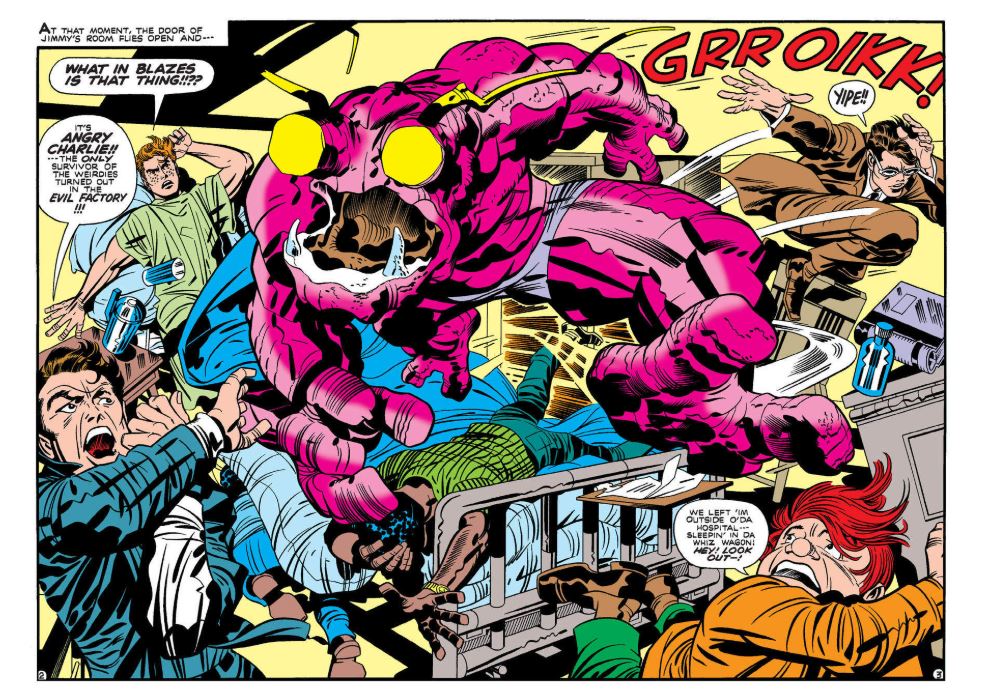
Jimmy at last gets transformed himself as the Newsboys encounter a menagerie of uncanny creatures in ‘Brigadoom!’ (#145, January 1972) before falling victim to Simyan & Mokkari’s tender ministrations. Unfortunately for them, reverting Olsen to primal revenant ‘Homo Disastrous!’ opens the door to chaos and their own destruction, even if it does add a (semi-) friendly monster to the team in affable escapee “Angry Charlie”

Issue #146 also added a little lore to Superman’s personal canon after ‘Tales of the DNA Project! Arin the Armored Man!!!’ reveals how the geneticists found a way to safeguard the man of Steel’s precious and potential deadly cell cultures and decoded genetic structure from potential abuse…

An issue later, heavily-edited down from his original idea, and inked by Mike Royer rather than Colletta, SPJO #147 saw ‘A Superman in Supertown!’, completing a plot thread begun in Forever People #1, wherein the one-&-only Man of Tomorrow accidentally ends up amongst his “own kind” on paradise planet New Genesis, only to realise he cannot rest until his work is done. An example of that carries over into Kirby’s final issue as Jim, the Newsboys and Angry Charlie head across the Atlantic for a confrontation with Morgan Edge and are abducted in mid-air by purely earthborn menace Professor Victor Volcanum.

Incongruously backed up by one last revelatory episode of ‘Tales of the DNA Project – Genetic Criminal’ with cloned killer Floyd “Bullets” Barstow apparently answering the question of whether evil is an inherited trait, the tale of a Victorian-era supergenius who made himself immortal by distilling the essence of volcanoes wrapped up Jimmy’s Kirby-Era. Volcanum had ended a lengthy period of solitude and isolation by attacking the modern world with robots, death-rays and an advanced flying gondola in his efforts to become ‘Monarch of All He Subdues!’ (SPJO #148, April 1972). His first mistake was capturing the Whiz Wagon riders, but when Highfather of New Genesis graciously dropped Superman into his ongoing campaign, the writing was on the wall.

Of course it had been for Jack for some while. Happy to be deprived of the poison chalice of the committee-mindset governing every aspect of all Superman titles, the King soldiered on with his original intention of creating a timeless saga of celestial drama, passion and mind-bending scope – but there too he would be ultimately thwarted and frustrated. Basically and as was always the case, management wanted New and Different, but didn’t like or understand it when they got it…

Almost overnight and in one broad flourish, Kirby had created one of the most powerful concepts in comic book history. His Fourth World inserted a whole new mythology into the existing DC Universe and blew the developing minds of a generation of readers and especially those who would become the next generation of creators. Who know what could have happened if the publishers had had a little more courage, patience and vision?

Kirby instinctively grasped the fundamentals of pleasing his audience and always diligently struggled against the appalling prejudice regarding the comics medium – especially from industry insiders and professionals who despised the “kiddies world” they felt trapped in. After his grandiose, controversial editorially unappreciated Fourth World was cancelled immediately prior to his long-planned grand finale, Kirby explored other projects that would stimulate his own vast creativity yet still appeal to a market growing ever more fickle. These included supernatural stalwart The Demon, traditional war stories starring established DC team The Losers, OMAC: One Man Army Corps and even a new metaphysically mighty Sandman – co-created with old pal Joe Simon and his biggest hit since science fictional survival saga Kamandi. However, although ideas kept coming (Atlas, Kobra, a new Manhunter and Dingbats of Danger Street), once again editorial disputes took up too much of his time. Reluctantly, he left again, choosing to believe in promises of more creative freedom elsewhere…

As early as 1974, worn down by a lack of editorial support and with his newest creations inexplicably tanking, Kirby considered returning to Marvel, but – ever the consummate professional – scrupulously rode out his contract and carried out every detail of an increasingly onerous, emotionally unrewarding DC contract. The Demon was cancelled after 16 issues and he needed another title to maintain his Herculean commitments (legally obliged to deliver 15 completed pages of art and story per week!): Kamandi – The Last Boy on Earth had found a solid and faithful audience. It also provided further scope to explore big concepts as seen in thematic companion OMAC. Both series granted Kirby’s darkest assumptions and prognostications free rein, and his “World That’s Coming” has proved far too close to the World we’re frantically trying to fix or escape from today…
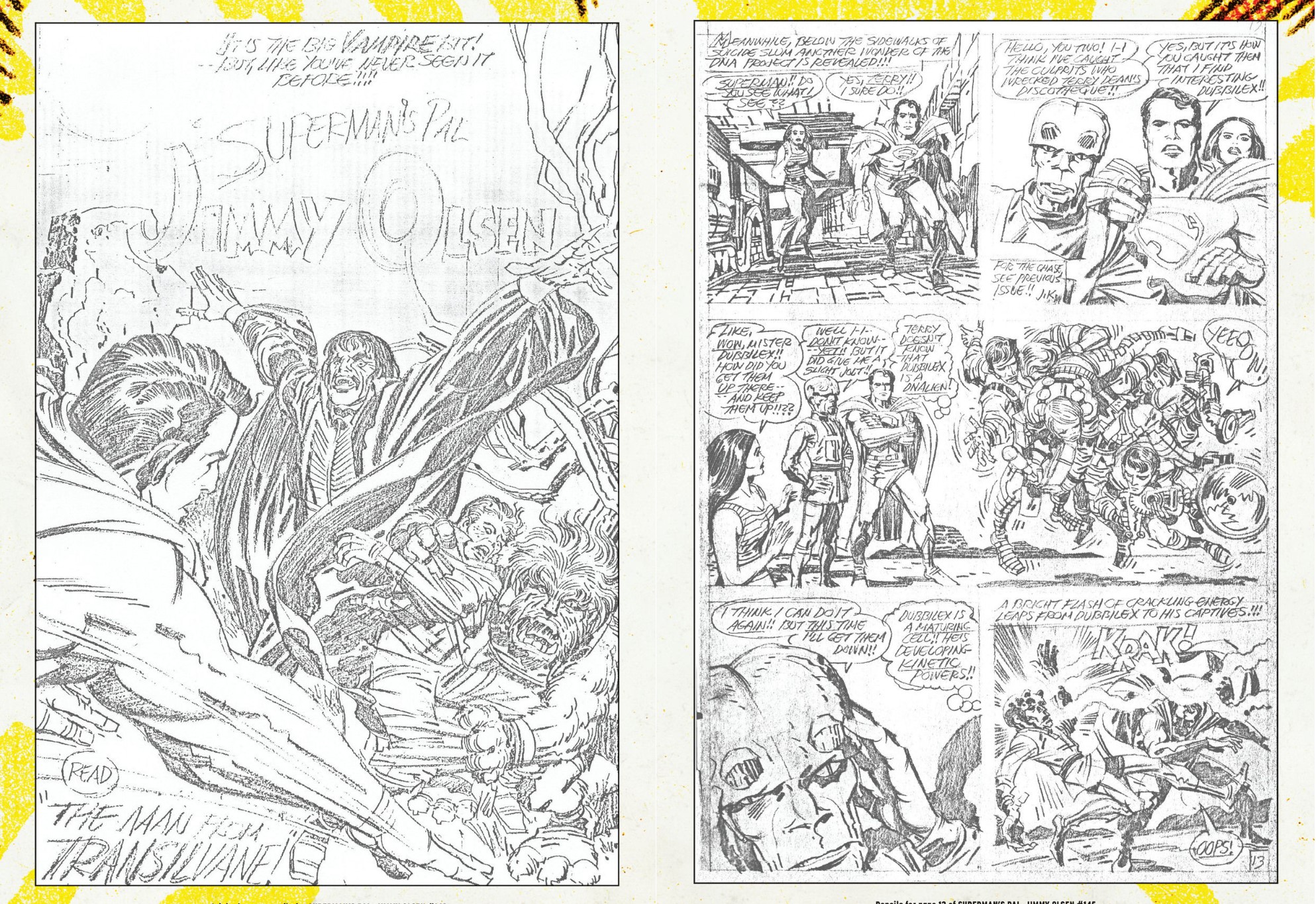
It’s hard to see these stories – supplemented in this edition by ‘Mother Box Files’ culled from 1986’s Who’s Who: The Definitive Directory of the DC Universe #16 and glorious pages of pencils featuring ‘The Art of Jack Kirby’ – isolated from the original Fourth World titles, and to be honest Jimmy plays a back seat role in most of the tales here. When not driving, being chased by or turned into assorted monsters, he’s Superman’s sounding board and supervising adult for the new Newsboy Legion, but at least he’s treated as a clever and competent active player rather than charming directionless idiot…

Once Kirby left the book things changed slowly. The Newsboys and Angry Charlie stuck around for a while and characters like The Guardian, Morgan Edge and the Project became fundamentals of the Superman universe and continuity. The ongoing continuity repercussions of Kirby’s passing were mostly addressed in, of all places, Superman’s Girlfriend Lois Lane, so much as I’d like otherwise, there’s little chance of seeing collected curated editions of those…

Here though is Kirby at his finest and most iconoclastic, doing what he always did: telling stories of wonder, verve and unparalleled imagination. What more could you possibly want?
© 1970, 1971, 1972, 1986, 2019 DC Comics. All Rights Reserved.

Carl Barks died today in 2000. If you want to learn about him, our most recent review of his magic can be found here.

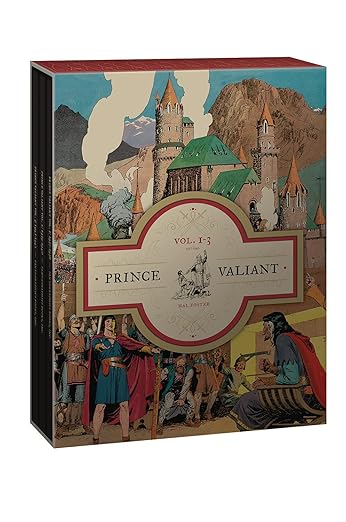
Prince Valiant volumes 1-3 Gift Box Set


By Hal Foster (Fantagraphics Books)
ISBN: 978-1 68396-072-0 (boxed set)

Individual volume ISBNs: 978-1-60699-141-1 (HB vol. 1), 978-1-60699-348-4 (HB vol. 2), 978-1-60699-407-8 (HB vol. 3)

This book includes Discriminatory Content produced in less enlightened times.

Today, way back in 1892, a god of comics was born. His work will never die.

Rightly reckoned one of the greatest comic strips of all time, the majestic, nigh-mythical saga of a king-in-exile who became one of the greatest warriors in an age of unparalleled heroes is at once fantastically realistic and beautifully, perfectly abstracted – an indisputable paradigm of adventure fiction where anything is possible and justice always prevails. It is the epic we all want to live in. However, on one thing let us be perfectly clear: Hal Foster’s Prince Valiant is not historical. It is far better and more real than that.

Possibly the most successful and evergreen fantasy creation ever conceived, Prince Valiant in the Days of King Arthur launched on Sunday 13th February 1937, a glorious weekly, full-colour window not onto the past but rather onto a world that should have been. It followed the tempestuous life of a refugee boy driven by invaders from his ancestral homeland of faraway Thule who persevered and, through tenacity, imagination and sheer grit, rose to become one of the mightiest heroes of the age of Camelot.

As depicted by the incomprehensibly gifted Foster, this noble scion would, over decades, grow to mighty manhood in a heady sea of wonderment: roaming the globe and siring a dynasty of equally puissant heroes whilst captivating and influencing generations of readers and thousands of creative types in all the arts. There have been films, cartoon series and all manner of toys, games and collections based on the feature – one of the few newspaper strips to have lasted from the thunderous 1930s to the present day (well over 4600 episodes and STILL counting) and, even in these declining days of newspaper cartooning, it still claims over 300 American papers as its home.

Foster produced the strip, one spectacular page a week until 1971 when, after auditioning such notables as Wally Wood and Gray Morrow, Big Ben Bolt artist John Cullen Murphy was selected to draw the feature. Foster carried on as writer and designer until 1980, after which he fully retired and Murphy’s son took over scripting duties. In 2004 Cullen Murphy also retired (he died a month later on July 2nd) but the strip soldiered on under the extremely talented auspices of artist Gary Gianni and writer Mark Schultz prior to Thomas Yeates settling in and conquering one more exotic land by making it onto the worldwide web.

The first three exquisite oversized hardback volumes (362 x 268mm) are happily still available as a monumental gift set nobody could resist. They reprint, in glorious colour spectacularly restored from Foster’s original printer’s proofs, the princely pristine Sunday pages cumulatively spanning February 1937 to 20th December 1942: six years of formative forays comprising an impressive saga which promised much and delivered so much more than anybody could have suspected during those dim, distant and dangerous days…

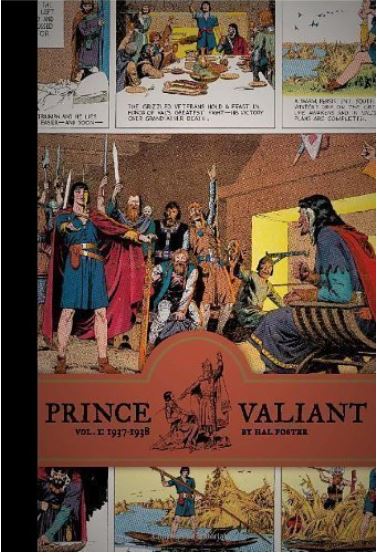
Volume 1 opens with editor Brian M. Kane’s informative picture/photo-packed potted history of ‘Harold Rudolf Foster: 1892-1982’, after which Fred Schreiber conducts ‘An Interview with Hal Foster’ as first seen in Nemo: The Classic Comics Magazine (1984). Additionally, after the Arthurian epic exploits of our quintessential swashbuckling hero, this initial tome is rounded off by Kim Thompson’s discourse on the many iterations of reprints over the years and around the world in ‘A History of Valiants’

The actual action-packed drama commences in distant Scandinavia as the King of Thule, his family and a few faithful retainers dash for a flimsy fishing boat, intent only on escaping the murderous intentions of a usurper’s army. Their voyage carries them to the barbarous coast of Britain and into battle against bands of wild men before they secure a safe point in the gloomy fens of East Anglia. After many hard fights they reach an uneasy détente with the locals and settle into a harsh life as regal exiles. Prince Valiant is but 5 years old when they arrive, and his growing years in a hostile environment toughen the heir, sharpen his wits and give him an insatiable taste for mischief and adventure. He befriends a local shepherd boy and together their escapades include challenging the marauding ancient dinosaurs which infest the swamp, battling a hulking man-brute and bedevilling a local witch. In retaliation the hag Horrit predicts that Val’s life will be long and packed with incredible feats… but always tainted by great sorrow. All that, plus a constant regimen of knightly training and scholarly tuition befitting an exile learning how to reclaim his stolen kingdom, make the lad a veritable hellion…

Everything changes when his mother passes away. After a further year of intense schooling in the arts of battle, Valiant leaves the Fens, and makes his way in the dangerous lands beyond. Whilst sparring with his boyhood companion, he unsuspectingly insults Sir Launcelot who is fortuitously passing by. Although that noble warrior is sanguine about the cheeky lad’s big mouth, his affronted squire attempts to administer a stern punishment… and is rewarded with a thorough drubbing. Indeed, Launcelot has to stop the Scion of Thule from slitting the battered and defeated man’s throat. Moreover, although he has no arms, armour, steed or money, Valiant swears that he too will be a Knight…

Luck is with the Pauper Prince. After spectacularly catching and taming a wild stallion, his journey is interrupted by gregarious paladin Sir Gawain who shares a meal and regales the wide-eyed lad with tales of chivalry and heroism. When their alfresco repast is spoiled by robber knight Sir Negarth – who unfairly strikes the champion of Camelot – Val charges in. Gawain regains consciousness to find the threat ended, with Negarth hogtied and his accomplice skewered…

Taking Val under his wing, wounded Gawain escorts the lad and his prisoner to Camelot, although their journey is delayed by a gigantic dragon. Val kills it too – with the assistance of Negarth – and spends the rest of the trip arguing that the rogue should be freed for his display of gallantry. Val is still stoutly defending the scoundrel at the miscreant’s trial before King Arthur, and is rewarded by being appointed Gawain’s squire. Unfortunately, he responds badly to being teased by the other knights-in-training and soon finds himself locked in a dungeon whilst his tormentors heal and the remaining Knights of the Round Table ride out to deal with an invasion of Northmen…

Whilst the flowers of chivalry are away, a plot is hatched by scheming Sir Osmond and Baron Baldon. To recoup gambling debts, they capture and ransom Gawain, but have not reckoned on the dauntless devotion and ruthless ingenuity of his semi-feral squire. Easily infiltrating the bleak fortress imprisoning the hero, Valiant liberates his mentor through astounding feats of daring and brings the grievously wounded knight to Winchester Heath and Arthur…

As Gawain recuperates, he is approached by a young maiden. Ilene is in need of a champion and – over his squire’s protests – the still gravely unfit knight dutifully complies. Val’s protests might have been better expressed had he not been so tongue-tied by the most beautiful girl he has ever seen. The quest to rescue Ilene’s parents is delayed when an unscrupulous warrior in scarlet challenges them, intent on himself possessing the lovely maiden. Correctly assessing Gawain to be no threat, the Red Knight does not live long enough to revise his opinion of the wild-eyed boy who then attacks him…

Leaving Ilene and re-injured Gawain with a hermit, Valiant continues on alone to Branwyn Castle, recently captured by an “Ogre” who terrorises the countryside. Through guile, force of arms and diabolical tactics the boy ends that threat forever. This is an astonishing tour de force of graphic bravura no fan could ever forget. Aspiring cartoonist Jack Kirby certainly didn’t: he recycled Val’s outlandish outfit used to terrorise the Ogre’s soldiers into the visual basis for his 1972 horror-hero Etrigan the Demon

Having successfully routed the invaders and freed Ilene’s family, Val begins earnestly courting the grateful girl, but his prophecy of lifelong misery seems assured, however, when her father regretfully informs him that she is promised to Arn, son and heir of the King of Ord. Even before that shock can sink in, Valiant is called away again. Ailing Gawain has been abducted by sorceress Morgan le Fey, who is enamoured of the knight’s manly charms…

When Val confronts her, le Fey drugs him with a potion and the Prince endures uncounted ages in her dungeon before escaping. Weak and desperate, he makes his way to Camelot and enlists Merlin in a last-ditch ploy to defeat the witch and save his adored mentor. In the meantime, events have progressed, and Val’s bold plans to win Ilene are derailed when invitations to her wedding arrive at Camelot. Initially crushed, the resilient youth determines to travel to Ord and challenge Prince Arn for her hand. Their meeting is nothing like Val imagined but, after much annoying interference, he and the rather admirable Arn finally engage in their oft-delayed death-duel, only to be again distracted when news comes that Ilene has been stolen by Viking raiders…

What follows is another unparalleled moment of comics magnificence as Valiant sacrifices everything for honour, gloriously falls to superior forces, wins possession of Flamberge (the legendary Singing Sword which is brother to Excalibur), is captured and then reunited with Ilene… only to lose her again to the cruellest of fates…

After escaping from the Vikings and covering himself with glory at the Lists in Camelot – although he doesn’t even realise it – the heartsick, weary Prince returns to his father in the melancholy Anglian fens, again encountering ghastly Horrit and nearly succumbing to fever. When he recovers months later, he has a new purpose: he and his faithful countrymen will travel to Thule and rescue the nation from the cruel grip of usurper Sligon. Unfortunately, during the preparations, Valiant discovers his region of Britain has been invaded by Saxons and is compelled by his honour to race to Camelot and warn Arthur first…

To Be Continued…


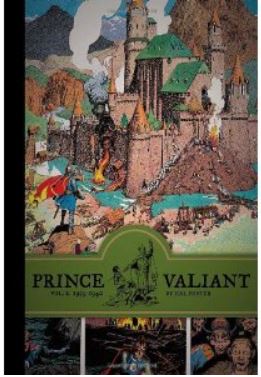
Volume 2 reprints perfectly-restored Sunday pages from January 1st 1939 to 29th December 1940, following Sir Gawain’s extremely capable squire as he rushes to warn Camelot of invasion by rapacious Saxons via vast Anglian Fens. Here Thule’s Royal Family have hidden since being ousted from their Nordic Island Kingdom by the villainous usurper Sligon. After a breathtaking battle which sees Saxons repulsed and the battle-loving boy-warrior knighted upon the field of victory, Valiant begins a period of globe-trotting. This carries him through the fabled lands of Europe just as the last remnants of the Roman Empire are dying in deceit and intrigue.

Firstly, Val revisits Thule and restores his father to the throne, narrowly escaping the alluring wiles of a conniving beauty with an eye to marrying the Heir Apparent. Quickly bored with palaces, peace and plenty, the roving royal wildcat then encounters a time-twisting pair of mystical perils who show him the eventual fate of all mortals. Sobered but not daunted, he makes his way towards Rome, where he will become unwittingly embroiled in the manic machinations of the Last Emperor, Valentinian. Before that, however, Val is distracted by an epic feat that would have struck stunning resonances for the readership at the time. With episode #118 (14th May 1939) Val joins the doomed knights of mountain fortress Andelkrag, who, alone and unaided, hold back the assembled might of the terrifying hordes of Attila the Hun: a terror who is currently decimating the civilisations of Europe and now marshals his forces to wipe out its last vestige.

With Hitler & Mussolini hogging headlines and Modern European war seemingly inevitable, Val shares the Battle of Decency and Right against untrammelled Barbarism. His epic struggle and sole survival comprise one of the greatest episodes of glorious, doom-fated chivalry in literature…

After the fall of the towers of Andelkrag, Valiant makes his way onward to diminished Rome, picking up a wily sidekick in the form of cutpurse vagabond Slith and is once more distracted and delayed by dastardly Huns. The indomitable lad resolves to pay them back in kind, gathering dispossessed victims of Hunnish depredations and forging them into a resistance army of guerrilla-fighters: the Hun-Hunters. Thereafter he liberates vassal city Pandaris, driving back the invaders and their collaborator allies in one spectacular coup after another.

Valiant eventually reunites with equally action-starved Round Table companions Sir Tristram and Sir Gawain to make further fools of the Hun, who have lost heart after the death of their charismatic leader Attila (nothing to do with Val, just a historical fact). When Slith falls for a warrior princess, the Knights leave him to a life of joyous domesticity and move ever on…

An unexpected encounter with a giant and his unconventional army of freaks leads to the heroes inadvertently helping a band of marshland refugees from Hunnish atrocity, before establishing the nation-state of Venice. Then, at long last – and after a side-trip to the fabulous city of Ravenna – the Courtly trio cross the fabled Rubicon and plunge into a hotbed of political tumult. Unjustly implicated in a web of murder and double-dealing, the knights barely escape with their lives and split up to avoid pursuit. Tristan heads back to England and a star-crossed rendezvous with comely Isolde, Gawain takes ship for some fun in Massilia and Valiant, after an excursion to the rim of fiery Vesuvius, boards a pirate scow for Sicily and further adventure.

To Be Continued…


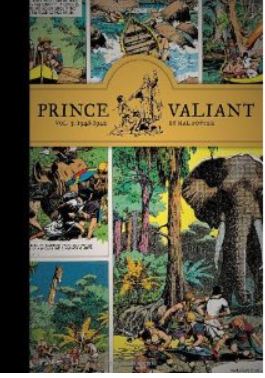
Volume 3 of the most successful and evergreen fantasy creation ever conceived offers the Sunday pages from January 5th 1941 to 20th December 1942, but only after erudite foreword ‘Modestly, Foster’ by Dan Nadel. The illustrated action opens in the shadow of flaming Vesuvius as Val’s vessel is attacked by self-proclaimed Sea-King Angor Wrack. Even the ferocious warrior-prince’s martial might is insufficient against insurmountable odds and the young Lord is captured and enslaved, his fabled Singing Sword confiscated by the victorious pirate.

Thus begins an astonishingly impressive chapter in the hero’s history. Val becomes a galley slave, escapes and washes up, starving and semi-comatose on the lost shores of the Misty Isles. Delirious, he glimpses his future wife Queen Aleta when she re-provisions his boat before casting him back to the sea’s mercies. The Misty Isles are secure only because of their secret location and the noble girl has broken a great taboo by sparing the shipwrecked lad. Replenished but lost, Val drifts helplessly away but resolves that one day he will discover again the Misty Isles and the enigmatic Aleta…

Eventually he is picked up by more pirates, but overwhelms the captain and takes charge. Finding himself in the island paradise of Tambelaine courting the daughters of the aged King Lamorack, Val encounters Angor Wrack again, but fails to recover the Singing Sword, precipitating an extended saga of maritime warfare and spectacular voyaging across the Holy Land from Jaffa to Jerusalem. The vendetta results in both Angor and Val being taken by Arab slavers, but the Prince nobly allows Wrack to escape whilst he battles Bedouin hordes…

Enslaved in Syria, even Val’s indomitable will and terrifying prowess are insufficient to his need so he seduces his owner’s daughter to effect an escape, only to stumble into a marital spat between the region’s greatest necromancer and his tempestuous bride.

Reaching Jerusalem, Val finally regains his beloved sword and settles his scores with Angor Wrack before determining to return to the hidden Misty Isles, but once again falls afoul of the pirates infesting the region. After incredible hardships, he is reunited with Aleta before fate drags them apart once more. Despondent, he departs alone – but not for long though, as on reaching Athens Val meets far-larger-than-life Viking raider Boltar: a Falstaff-like rogue and “honest pirate”. Together they rove across the oceans to the heart of the African jungles. On securing a huge fortune, their Dragonship reaches Gaul and Val is finally reunited with Gawain, and, after settling a succession of generational feuds between knights and defeating a seductive maniac, the paladins at last return to Britain courtesy of Boltar. This is just in time to be dispatched by Arthur to the far North. The King needs to scout Hadrian’s Wall and see if it can still keep belligerent Picts out. Unfortunately, libidinous Gawain abandons Val and the lad is captured by Caledonian wild-men and their new allies – a far nastier breed of Vikings intent on conquering England…

Tortured nigh unto death, the Prince is saved by the ministrations of Julian – a Roman warrior who has seemingly safeguarded the wall for centuries. And when he is recovered, Prince Valiant begins to inflict a terrible and studied revenge upon his tormentors…

To Be Continued…

Rendered in an astoundingly lovely panorama of glowing images, Prince Valiant is a lyrical juggernaut of stirring action, exotic adventure and grand romance; blending realistic fantasy with sardonic wit, and broad humour with unbelievably dark violence. Here closing text feature ‘Too Violent for American Dog Lovers’ reveals censored panels and changes editors around the world inflicted upon the saga during this period.

Beautiful, captivating and utterly awe-inspiring, Foster’s magnum opus is a World Classic of storytelling, something no adventuresome fan can afford to be without.

Volume 1: All comics material © 2009 King Features Syndicate except Tarzan page, © 2009 ERB Inc. All other content and properties © 2009 their respective creators or holders.
Volume 2: © 2009 King Features Syndicate. All other content and properties © 2009 their respective creators or holders.
Volume 3: © 2011 King Features Syndicate. All other content and properties © 2011 their respective creators or holders. All rights reserved throughout.
Gift Set © 2017 King Features Syndicate. Published by Fantagraphics Books.

Mighty Thor Epic Collection volume 9: Even an Immortal Can Die (1977-1979)


By Len Wein, Roy Thomas, Roger Stern, Bill Mantlo, Don Glut, Don Thompson, Maggie Thompson, Walter Simonson, John Buscema, Sal Buscema, Alan Kupperberg, Wayne Boring, Val Mayerik, Jim Starlin, Virgilio Redondo, Rudy Nebres, Tony DeZuñiga, Tom Palmer, Ernie Chan, Joe Sinnott, Klaus Janson, Chic Stone, Pablo Marcos & various (Marvel)
ISBN: 978-1-3029-4868-9 (TPB/Digital edition)

This book includes Discriminatory Content produced in less enlightened times.

Once upon a time, disabled physician Donald Blake took a vacation in Norway, only to stumble into an alien invasion. Trapped in a cave, he found an ancient walking stick which, when struck against the ground, turned him into the Norse God of Thunder! Within moments, he was defending the weak and smiting the wicked. Months swiftly passed, with the Lord of Storms tackling rapacious extraterrestrials, Commie dictators, costumed crazies and cheap thugs, but these soon gave way to a vast kaleidoscope of fantastic worlds of incredible, mythic menaces, tackled by an ever-changing cast of stalwart immortal warriors at his side…

Whilst the ever-expanding Marvel Universe had grown ever-more interconnected as it matured through its first decade, with characters literally tripping over each other in New York City, the Asgardian heritage of Thor and the soaring imagination of Jack Kirby had most often drawn the Thunder God away from mortal realms into stunning, unique landscapes and scenarios.

However, by the time of this power-packed compendium, the King was long gone – or more accurately enacting his Second Coming – technically Third, and definitely Second Return to the House of (mostly his) Ideas – and only echoes of his groundbreaking presence remained. John Buscema had visually made the Thunder God his own over interceding years, whilst a succession of scripters had struggled with varying success to recapture the epic scope of Kirby’s vision and Stan Lee’s off-kilter but comfortingly compelling faux-Shakespearean verbiage…

Spanning June 1977 to February 1979, this power-packed compilation re-presents The Mighty Thor #260-280, Annuals #6 & 7 and Marvel Preview #10 in a panoply of unceasing stellar adventure spanning time and space and well-explored regions.

Previously, embattled Asgardians had survived another invasion only to learn their divine Liege Lord Odin had gone missing. Having exhausted every avenue of location available, son-&-heir Thor – prompted by vague hints from all-knowing but hostile spirit Mimir – departed to search distant galaxies for a “Doomsday Star” …

Aboard starfaring dragonship Starjammer, the Thunderer, Lady Sif and Warriors Three Fandral, Hogun and Volstagg (solar) sail off, leaving the beleaguered Eternal Realm under Balder the Brave’s stewardship, albeit ably assisted by his dark inamorata Karnilla the Norn Queen. Now in the wake of travail, torment and cruel misunderstanding, and accompanied by the Recorder (a Rigellian AI robot guide), ‘The Vicious and the Valiant’ sees the interstellar questors finally locate the Doomsday Star.

Scripted by writer/editor Len Wein with Walter Simonson (inked by Tony DeZuñiga) making his first major artistic contributions to the mythology, the interstellar quest’s end coincides with an attack on far-distant Asgard where Balder and Karnilla resist an invasion helmed by arch-traitors Enchantress and Executioner. As the voyagers strive to reach a hostile planet with a strict and extreme no-visitors policy, #261 expands the scope and intensifies the action as the questers falter before ‘The Wall Around the World!’ (inked by Ernie Chan): a terrifying global-scaled construct comprised of the power-drained husks of dead gods.

Resolute and determined the seekers push on, learning Odin has been captured and gradually diminished and consumed by energy-leeching “Soul-Survivors” whose civilisation subsists on stolen divine lifeforce. As they valiantly strive to save their sovereign, the roving Asgardians learn to their cost that ‘Even an Immortal Can Die!’ (#262, limned by Simonson & DeZuñiga).

Thankfully, ‘Holocaust and Homecoming!’ proves Odin both wily and still potent as the heroes’ ferocious clash and hard-won victory results in a weary, wounded pantheon returning to Asgard, only to find it taken over by Loki and his cohort of treacherous allies. With Odin in a coma – and ultimately abducted again – covert civil war erupts between the newly restored champions and the city citizens Loki has subverted. ‘Thou Shalt Have No Other Gods Before Me!’ sees the sinister scheme exposed, but not before Loki unleashes ultimate weapon The Destroyer against his adoptive brother…

Inked by Joe Sinnott, #265’s ‘When Falls the God of Thunder…!’ sees Loki losing control of his ultimate sanction, and once again, everyone survival hinges on the determination of Thor and his valiant resistance to chaos, until #266’s ‘…So Falls the Realm Eternal!’, where Wein, Simonson & DeZuñiga show the Thunderer at his indomitable best, holding Loki at bay and off balance until the Warriors Three rescue and revive an extremely unhappy All-Father…

This saga presaged a change of narrative focus but before that Roger Stern, Sal Buscema & Klaus Janson craft ‘Thunder in the 31st Century!’ (as first seen in Thor Annual #6 December 1977). A riot of time-busting mayhem commences with Thor plucked from contemporary Manhattan: accidentally summoned to the time period of the original/future (time travel tenses suck!) Guardians of the Galaxy by a cyborg maniac named Korvac. The immortal god-warrior briefly joins Vance Astro, Charlie 27, Yondu, Nikki, Martinex and Starhawk in bombastic battle against super-powered aliens to thwart the sinister cyborg’s scheme to become master of the universe. At the conclusion, Thor returns to his own place and time, unaware how Korvac would reshape the destiny of reality itself in coming months…

The collaborations of Wein and Simonson had already shaken the title out of its conceptual doldrums; as the big change approached they went into overdrive and an seemingly backward direction. After All-Father Odin was kidnapped, drained like a battery and died, he was rescued, resurrected and restored to an Asgard riven with conspiracies. Conquered by old enemies, Thor faced ultimate weapon The Destroyer before triumphantly saving everything. In #267 (January 1978, Wein, Simonson & DeZuñiga) we see the hero bound ‘Once More, To Midgard!’, following a rare moment of filial fondness rather than the usual arguments with Dad. Thor has been missing for quite some time and his absence has left Don Blake’s life in tatters until old colleague Dr. Jacob Wallaby arranges a job with Stark International’s Free Clinic. That good deed leads to more chaos as deranged super-criminal Damocles ruthlessly raids the hospital’s radiation lab in search of synthetic cobalt to power his new super-gun. Before Blake can react, the smash-&-grab attack is done, leaving furious Thor to pursue the murderous madman, aided by Damocles’ guilt-fuelled sibling Bennett Barlow. He pays a heavy price for his civic service in concluding clash ‘Death, Thy Name is Brother!’

The concentration on Earthly scale and situations continues in #269 as ‘A Walk on the Wild Side!’ sees a mysterious mastermind contract mechanistic mercenary Stilt-Man to secure a certain high-tech package. A raft of deadly upgrades prove pointless after the Thunderer stumbles upon the heist in the skies over Manhattan, but Thor has far more trouble facing the plotter’s power-packed partner Blastaar in middle chapter ‘Minute of Madness… Dark Day of Doom!’

The triptych of terror terminates in Thor #271 as, with the aid of Tony Stark, Nick Fury (I), S.H.I.E.L.D. and The Avengers, the Storm Lord meets the true architect of destruction and imminent global domination in orbit ‘…Like a Diamond in the Sky!’ This epic includes cameos from Shang-Chi, Spider-Man, The Hulk, Human Torch, Nova, Daredevil and many more Marvel stalwarts; serving as a big celebratory send-off for Wein & Simonson, whilst signalling a major change of direction.

Mighty Thor #272 saw the return of Roy Thomas, John Buscema & Tom Palmer depicting ‘The Day the Thunder Failed!’ as the hero shares moments of humiliating childhood defeat with a crowd of fannish kids. The incidents were all adapted from classical mythology and served as an appetiser to a mega-saga in the making, with TV reporter Harris Hobbs (who visited Asgard way back in Journey into Mystery #123) making Thor an offer he cannot help but refuse…

Still channelling tales from the Eddas – specifically about how Ragnarok would end the reign of the Aesir/Asgardians – #273 is set ‘Somewhere… Over the Rainbow Bridge!’ Although the journalist’s pleas to film a TV special in the Home of the Gods is sternly rebuked and rejected, wicked Loki has his own plans and smuggles in Harris and his film crew, triggering the beginning of the long-prophesied end…

If you haven’t actually read the original myths, go do that. It will make you appreciate these clever riffs on the theme so much more as the secret history of Asgard and Odin’s plots are exposed in #274. With Loki on the loose, the story of how the All-Father sacrificed his eye to fiery seer Mimir for knowledge of the future is revealed, as are the dirty bargains Odin made to forestall inevitable, inescapable doom. As Sif leads home the long-missing goddesses of Asgard, mortal cameraman Roger “Red” Norvell beholds the Thunder God’s raven-haired beloved and is gripped by uncontrollable desire. Another prerequisite of The End then occurs as Loki orchestrates Balder’s death in ‘The Eye… and the Arrow!’

In #275 ‘A Balance is Struck!’ when Odin uses all his power to suspend the dying God of Light in a timeless state, pausing the Ragnarok countdown. Loki, meanwhile, uses ancient spells and his adoptive brother’s Belt of Strength and Iron Gloves (created when the Prince was a child to help control and wield mighty Mjolnir) to become a new, very different Thor. The newcomer even seizes the mystic hammer from its enraged rightful owner as he beats the thunder god and abducts Sif, declaring in #276 ‘Mine… This Hammer!’

Red is barely aware he has killed his best friend for power. Loki and Death Goddess Hela rouse all Asgard’s enemies to march on their hated foes as ‘Time of the Trolls!’ seems to indicate doomsday has finally fallen. However, the forces of evil are not the only devious schemers with an endgame in view, and a monstrous plan is exposed whereby the All-Father seems to cheat the powers of prophecy and trick Ragnarok by creating a false Thor to die in place of Asgard’s true saviour. All it required was timing, boldness and a few necessary sacrifices…

With veteran Thor inker Chic Stone applying his stylish lines, #278 heralds ‘At Long Last… Ragnarok?!’ as all plots and perils converge with reality – the Nine Realms portion of it at least – battling fate to a draw as the apocalypse is deferred a while longer… but only after another tragic, valiant and ultimately futile demise. In the aftermath, the trueborn Odinson cannot abide what has been done in his name and sunders all contact with his scheming sire.

The split is genesis to an even more momentous and spectacular saga postponed here for a crucial sidebar seen in Thor Annual #7 (1978) wherein Thomas, Simonson & Ernie Chan here detail a forgotten “first contact” moment triggered by the reactions to Balder’s “death” due to Loki’s machinations to trigger Ragnarok. When Thor reluctantly consults hostile prophet Mimir, the flaming seer of the Well of Wisdom instead emphasises how untrustworthy Odin is and illustrates his point by sharing of an event the Thunderer cannot remember even though it was one of his most significant exploits…

Tale within a tale ‘And Ever… The Eternals!’ reviews the creation of and war between Asgardian and Greek pantheons – which Thor readily recalled – before going on to disclose how the proud prince had continued seeking new mortal worshippers. Roaming Midgard doing heroic deeds, he had encountered and barely defeated a monstrous mind-controlling horror dubbed Dromedan. Moving on, in what would be later called Central America, he meets another – unsuspected – god-like race: Polar Eternals Ajak, Druig, Valkin and Virako.

Thor then reexperiences how he was informed that Midgard was a laboratory preserve of incredible super-gods from space: “Celestials” who had genetically modified proto-hominids to create humanity, Eternals and horrific predatory Deviants. These subspecies had battled for ownership of Earth in wars spanning the length of human existence…

Confronted by such sheer heresy and baffled by obvious nonsense, Thor learns now that his new friends were as treacherous as any god or mortal, with all knowledge of Celestials excised after he and the Eternals defeated a resurgent Dromedan and horde of Deviants and Mutates. Mindwiped, he returned to Asgard, oblivious to the fact that Space Gods would periodically return to judge the progress of their three-pronged project… as indeed they were doing at that very moment under a colossal gleaming dome in Earth’s Andes mountains…

When Kirby’s series debuted in 1976, we met anthropologist Professor Daniel Damien and daughter Margo, whose explorations revealed giant aliens had visited Earth in ages past: sculpting hominid beasts into distinct sentient species: Human Beings; genetically unstable Deviants and god-like superbeings who called themselves Eternals. Moreover, those Space Gods had occasionally returned to check up on their experiment.

Over 19 issues and an Annual, the series avoided true contact with Marvel continuity as modern mankind’s military and moneyed movers-&-shakers dealt with the politics and panic of a world-shattering event. Ikaris (son of Valkin and Virako), Margo, Ajak, Sersi, Makkari, Zuras, Thena, Sprite and Druig fought and foiled Deviants Kro, Brother Tode, Dromedan, Ransak & Karkas, with humanity terrified in the background and under the microscope as The Fourth Host of Celestials hovered above the world in a city-sized ship, pondering final judgement: a process that would take 50 years.

Never a comfortable fit with the rest of the Marvel Universe – only S.H.I.E.L.D. ever really got involved – The Eternals further embodied Kirby’s fascination with Deities, the immensity of Space and potential of Supernature through the lens of very human observers. Once the series ended, Kirby moved on and other creators eagerly co-opted his concepts (with mixed success) into the company’s mainstream continuity…

In Mighty Thor #279 (cover-dated January 1978) the new quest is briefly diverted as Don Glut, Alan Kupperberg & Pablo Marcos detail how the Thunderer’s latest exile to Earth prompts more reminiscing and “untold tale” ‘A Hammer in Hades!’ Long ago, a chance encounter with pre-goddess first love Jane Foster led to her imprisonment in the underworld and Thor flew right into an ambush organised by Loki, Grecian death god Pluto and super-troll Ulik, but still proved more than even that trio of terror could handle…

Still preparing to confront the relatively undiscovered Fourth Host, Thor is again forestalled in #280 where Thomas, Wayne Boring & Tom Palmer pastiche DC’s Annual JLA/JSA summer team-ups with ‘Crisis on Twin Earths!’ after Superman-analogue Mark Milton/ Hyperion of the Squadron Supreme requests Thor’s assistance on his own alternate Earth. Sadly, the evil Hyperion of the Squadron Sinister manages to replace his goody-goody doppelganger and a shattering battle erupts before order and dimensional stability is restored…

This titanic tome ends on a rare treat stemming from the period’s growing love-affair with fighting fantasy. Cover-dated Winter 1977, Marvel Preview #10 was a monochrome magazine in Marvel’s mature-oriented line: free of Comics Code scrutiny and (ostensibly) the strictures of shared continuity. Although MP was an anthology/showcase title, other periodicals in the Marvel Magazine Group included off-kilter features like Howard the Duck, Rampaging Hulk and Tomb of Dracula.

Thor the Mighty almost joined that elite roster in 1975, and nearly three full issues were prepared for a barbarian Thunder God vehicle before the plug was pulled. As a result, much material was sitting in drawers when the decision came to use one lead tale and a thematic back-up in the try-out title. Another story had already been modified and published as Thor Annual #5 (for which see Marvel Masterworks Thor #15)…

Behind a painted Ken Barr cover, frontispiece by Jim Starlin and illustration plates from Virgilio Redondo and Rudy Nebres, ‘Thor the Mighty!’ was scripted by Wein, and rendered by Starlin & DeZuñiga, telling of a time long past when Odin sent his rowdy sons Thor and Loki on a quest to secure a mystic Crystal of Blood threatening to erase all existence. The mission pitted his sons against seductive sorceresses, trolls ogres, giants, dragons and – as ever – each other…

The lusty yarn was backed up by an exploit of Hercules The Prince of Power when he was still half-human and sailing with Jason as an Argonaut. Here, courtesy of Bill Mantlo & Val Mayerik, the shipmates faced constant, mythologically-tinged peril on ‘The Isle of Fear!’ – but nothing like the political intrigue engineered by corrupt sponsor King Kreon of Pylos

Following a Nebres pinup and never attained next issue ad, a bonus section offers the letters page editorial from Thor #272, Thomas’ editorial from Thor Annual #7, the cover to Marvel Index #5 by Tom Conrad, the Franc Reyes Contents page and contemporary house ads.

The tales gathered here may lack the sheer punch and verve of the early years but certainly prove that after too long calcified, the Thunder God was again moving to the forefront of Big Idea Comics Storytelling. Fans of ferocious Fights ‘n’ Tights fantasy will find this tome stuffed with intrigue and action, magnificently rendered by artists dedicated to making new legends. This a definite must-read for all fans of the character and the genre.
© 2023 MARVEL.

Superman The Golden Age Sundays volume 1: 1943-1946


By Jerry Siegel and “DC Comics”, Wayne Boring, Jack Burnley, Stan Kaye, Ira Snappin, &various (IDW/DC Comics)
ISBN: 978-1-61377-797-8 (HB)

This book includes REALLY Discriminatory Content produced in less enlightened times and under the madness of war.

The comic book industry would be utterly unrecognisable without Superman. Jerry Siegel & Joe Shuster’s bold and unprecedented invention was fervidly adopted by a desperate and joy-starved generation and quite literally gave birth to a genre… if not an actual art form.

The Man of Tomorrow was shamelessly copied, adapted by countless inspired writers and artists for numerous publishers, spawning an incomprehensible army of imitators and variations within three years of his summer 1938 debut.

Yes, 87 YEARS… and still counting!

The intoxicating blend of breakneck, breathtaking action and triumphal wish-fulfilment expressed by the early Action Ace expanded to encompass cops-&-robbers crimebusting, socially reformist dramas, science fiction/fantasy, romance, comedy and, once war in Europe and the East also engulfed America, absorbed and reinforced patriotic relevance for a host of gods, heroes and monsters, all dedicated to profit through exuberant, eye-popping excess and vigorous dashing derring-do. Superman was master of the world and whilst transforming and dictating the shape of the fledgling funnybook industry, relentlessly expanded into all areas of entertainment media.

We might think of the Cleveland boys’ iconic invention as the epitome and acme of comic strip creation, but the truth is that very soon after his debut in Action Comics #1 the Man of Steel was a fictional multimedia monolith in the same league as Popeye, Tarzan, and Sherlock Holmes. Diehard comics fans regard our purest, most enduring icons in primarily graphic narrative terms, but the likes of Batman, Spider-Man, The Avengers and their hyperkinetic ilk long ago outgrew four-colour origins to become fully mythologized modern media creatures, instantly recognised in mass markets across all platforms and age ranges. Far more people have viewed or heard the Man of Steel than have ever read his comics.

However, his globally syndicated newspaper strips reached untold millions, and by the time of his 20th anniversary – at the very start of what we know as the Silver Age of Comics – he had been a thrice-weekly radio serial regular and starred in a series of astounding animated cartoons, as well as two films and a novel by George Lowther.

Superman was a perennial wellspring for toy, game, puzzle and apparel manufacturers and had just ended his first smash live-action television serial. In his future were many more shows, a stage musical, many blockbuster movies and almost seamless succession of games, bubblegum cards and TV cartoons beginning with The New Adventures of Superman in 1966 and continuing ever since. Even superdog Krypto got in on the small-screen act…

However, in his formative years the small screen was simply an expensive novelty for many. The Action Ace achieved true mass market fame through a different medium: one not that far removed from his print origins.

Although pretty much a spent force these days, for the majority of the last century newspaper strips were the Holy Grail all American cartoonists/graphic narrative storytellers hungered for. Syndicated across the country – and frequently the world – they might be seen by millions if not billions, of readers and were generally accepted as a more mature and sophisticated form of literature than comic books. At that time it also paid far better, and rightly so. Some of the most enduring and entertaining characters and concepts of all time were created to lure readers from one particular paper to another and many of them grew to be part of a global culture. Flash Gordon, Dick Tracy, Buck Rogers, Blondie, Charlie Brown and many more escaped humble and tawdry newsprint origins to become meta-real: existing in the minds of earthlings from Albuquerque to Zanzibar. Some still do…

After years lost in obscurity, almost all of Superman’s early newspaper strip exploits are at last available to aficionados and the curious newcomer in tomes such as this one, compiled under the auspices of the Library of American Comics. Showcasing the tough transitional period when Shuster’s diminishing eyesight overlapped Siegel’s military service and other minds and hands increasingly steered their super-baby the full colour strips here cover episodes #184 – #353, covering May 9th 1943 to August 4th 1946.

The daily Superman newspaper comic strip launched on 16th January 1939, supplemented by the full-colour Sunday page from November 5th of that year. Initially crafted by Siegel & Shuster and an ever-growing studio – Paul Cassidy, Leo Nowak, Dennis Neville, John Sikela, Ed Dobrotka, Paul J. Lauretta & Wayne Boring – the mammoth, relentless task required the additional talents of luminaries like Jack Burnley and writers Whitney Ellsworth, Jack Schiff & Alvin Schwartz, especially as the draft deprived DC and McClure of those talented gentlemen. Managed by the McClure Syndicate, the feature ran continuously from 1939 until May 1966, appearing at its peak in more than 300 daily and 90 Sunday newspapers, boasting a combined readership of more than 20 million. When the Christopher Reeve Superman film franchise began, a second newspaper strip did too, starting in 1978 as The World’s Greatest Superheroes before becoming simply Superman. It folded in 1985. The combined series totalled almost 12,000 newspaper strips, but I strongly suspect that no matter how good the new movie is, the parlous state of newspaper publishing won’t be able to support a fresh tabloid iteration. I would love to be wrong…

For most of the war years Wayne Boring and Jack Burnley handled the visuals. Seigel was called up in 1943, as were Sikela and Nowak, and scripts were anonymously generated in-house at DC. When Burnley began his Starman comic book series, Boring (working for DC/National, not Shuster’s Superman Studio) was back on Sundays, with inker Stan Kaye signing up for the long haul, reinforced by steadfast Ira Snappin filling narrative boxes and word balloons throughout.

For reasons covered in previous collections, Superman was generally stuck on the home front as ordinary US fighting men proudly got blown up and maimed, but as the war progressed, those high-minded and pragmatically framed (editorial) edicts began to slip. Let’s face it, even the youngest readers knew Superman could have ended the conflict in hours but, like USO tours, the Man of Steel’s job was entertainment not solutionising. Thus, at least initially, content remained carefully curated tales of emotional dilemmas, romances and pedestrian criminality rather than muscle-flexing bombast, utilising mystery, fashion, wit and satire as substitutes for bludgeoning action…

Following affable appreciation in ‘An Introduction’ by Mark Waid, weekly wonderment commences in all its vibrant glory at the height of hostilities. Sadly, individual serial stories are untitled, so you’ll just have to manage with my meagre synopses of individual yarns; and it’s important to note that during this time Seigel finally left for boot camp and a number of often anonymous scribes were pulled in to take his place…

We open with Burnley rendering a serial saga as 4F reporter Clark Kent is assigned to follow and write on the experience of “Model Air Cadet” Dave Cooper as he progresses through training. Naturally, the proposed series presents a perfect opportunity for spies to deliver a shattering propaganda coup, but even after sneaky Nazi uber-strategist Eyeglasses takes charge of a sustained but continually failing campaign of sabotage, character assassination, framing and attempted murder, somehow Dave gets ever nearer to his goal of serving his country as an American Airman without ever knowing how much Superman helped…

With Boring at the drawing board a whole new concept took over the Sunday strip from August 15th as the Action Ace – responding to mail from servicemen overseas – sets up wish-fulfilment service ‘Superman’s Service for Servicemen’.

Apparently based on genuine GI letters from service people reading the strip wherever they were stationed, the following weeks and months found the hero scanning a postcard and then making a wish come true. These included flying soldiers across the world to get the most out of 24-hours passes; playing cupid; chasing off Home Front wolves and solving other “Dear John…” crises; checking for infidelity (he even helps WACs confirm that their far-deployed lovers are staying true!); crushing an invasion of sabotage-intent Gremlins infesting Metropolis and getting one Pacific-stranded soldier home in time for Christmas… and the birth of his first child…

Ranging far and wide, Superman delivers a kangaroo to an officer’s little girl; delivers late or lost mail to every stranded warrior; helps women decide which branch of the auxiliary services they should volunteer for; tracks down four separated pals lost on different missions; handles the KP duties for an entire army camp; supplies a busload of burlesque entertainers for joy-strapped GIs; assuages nervous mothers’ concerns on the lack of luxury in service barracks; criss-crosses oceans to facilitate marriages; retrains square pegs in over their heads; mediates service legal disputes; helps one lonely soldier enlist his pet pooch and much, much more…

Naturally, any enemy shipping, aviation, ordnance or personal encountered during these humanitarian sorties did not fare well at the mighty hands of the Man of Steel, such as a second sneak attack of 200 Japanese bombers seeking to ambush embattled troops and a similar land-based assault on our boys. Eventually as newspaper time catches up with real-world events, Superman acts as escort to flighty Sally Wilshire as she witnesses first-hand the D-Day landing and beyond…

Sadly, not included here is an oddment of publishing history and doctrine that will hopefully make it to future editions. In 1943, McClure – concerned that circulation might dip if Superman did not appear regularly – urged DC to create a spin-off feature. The abortive result was Lois, Lane, Girl Reporter. Intended as filler for emergencies, a trial run of 12 strips ran above Superman Sunday pages in the Cleveland Plain Dealer, sporadically between  October 24th 1943 and February 27th 1944, but are not seen here…

Back on the Superman Service, the ultimate expression of the service was when the Wonder of the Age astoundingly grants the wish of arrogant Japanese Major Saki Sukiyaki, and turns a planned propaganda triumph for the foe into a spectacular victory for democracy…

After more than a year, as the war staggered to its conclusion, continuity drama returned to Superman, albeit still laced with contemporary themes. Strip #263 (November 12th 1944) began a tale exploring the traumas of being demobilised as Clark encounters old pal Elmer Kronk, whose casual reaction to a string of near-lethal accidents is most disturbing…

Reinstating Superman’s service for servicemen – with a side-order of civilian reintegration – took the feature into the last year of the conflict with the emphasis very much on mopping up and going home, but boasts one last bizarre hurrah spanning #279-282 (March 4th – 25th 1945) as Adolf Hitler, Joseph Goebbels, and rest of the insane inner circle use the service to invite the literal Übermensch to a conference where he can take up his natural place as one of them…

Then Lois exploits her relationship for a private service. Having been a volunteer ambulance driver, she wants the Action Ace to visit and cheer up disabled servicemen. That’s easy enough to accomplish but the hero runs with the idea and organises an entire support organisation from those women no longer employed as war workers, but it’s a big job with some weird turns in store. Before long the Man of Tomorrow is finally battling Japanese soldiers in the skies over the Pacific, before heading home to help a young man struggling with uninformed parents and a massive case of “battle fatigue”, and another poor soul who somehow mislaid the army’s cash payroll…

Although the war against Japan ended with unconditional surrender on August 14th 1945 – and officially on September 2nd – preprepared stories kept coming that kept affairs on a strictly martial note. In #306 (September 9th) the failing militarists instigated a scheme to create their own superman with crudely hilarious (by 1940s standards) results, before Superman played matchmaker to a marriage-hungry war-hero seeking a “Dream Girl” to wed…

A sign of changed times came at last with episode #317 (November 25th 1945) as a thematic reset looked forward by looking back. Here, a much enhanced and expanded origin saga began with Jor-El & Lara accepting doom on Krypton, infant Kal-El’s flight to Earth, childhood in Smallville and Clark’s first days at the Daily Planet and nights as Superman…

Clearly the stars were his destination, and the new year brought a new direction. With #326 (27th January 1946) a return to contemporaneity saw the deep thinker Professor Vern build a Rocketship and drag Lois to Saturn with him. Thankfully, when the voyage inevitably hits trouble, Superman is able to follow and rescue them from a thousand perils and the solicitude of oppressive mega civilisation Suprania. It’s a close-run thing though, as fabulous High Queen Arda really likes the Kryptonian and isn’t married at the moment…

A return to Earth in every way prompts a human-scaled story of mystery, murder and romance amongst circus folk as the Man of Tomorrow must navigate a happy course between rivals Sadface the Clown and high wire artist Breakstone as they bring acrimony and woe to Warnum & Wailey’s 3-ring extravaganza whilst battling without let or restraint for the love of comely aerialist Carlotta

Happily, Lois & Clark are there to adjudicate, referee, spot the deathtraps and reap the headlines in a Big Top thriller comprising episodes #339-353 (28th April – 4th August 1946)…

Although that one concludes on a happy note, generally it’s all To Be Continued

Superman: The Golden Age Sunday Pages 1943-1946 is the first of three huge (312 x 245mm), lavish, high-end hardback collections starring the earliest and always transitional Man of Tomorrow. It’s an inexpressible joy to see these “lost” stories, offering a far more measured, domesticated and comforting side of America’s most unique contribution to world culture. It’s also a pure delight to see some of the hero’s most engaging yesterdays. Join me and see for yourself…
Superman ™ & © 2013 DC Comics. All rights reserved. The Library of American Comics is a trademark of The Library of American Comics LLC. All rights reserved. SUPERMAN and all related characters and elements are trademarks of DC Comics.

Ka-Zar Marvel Masterworks volume 2


By Mike Friedrich, Steve Gerber, Carol Seuling, Ross Andru, Don Heck, Dan Adkins, Jim Starlin, Marie Severin, Werner Roth, George Tuska, Paul Reinman, Mike Royer, Bob Brown, Sal Buscema, Gene Colan & various (Marvel)
ISBN: 978-1-3029-0966-6 (HB/Digital edition)

This book includes Discriminatory Content produced in less enlightened times.

There are quite a few comics anniversaries this year. Some of the most significant will be rightly celebrated, but a few are going to be unjustly ignored. As a feverish fanboy wedged firmly in the past, I’m again abusing my privileges and advising an encounter with something old, nigh forgotten but definitely worth a soupçon of your time and energies…

IT’S A JUNGLE OUT THERE! …and apparently everywhere else, too…

Retconned from a pulp hero and latterly comics B-Lister from the early days of Timely comics, primal white jungle god Ka-Zar most accurately stems from 1965 where he stole the show in a dinosaurs & mutants yarn in X-Men #10.

Beginning as a cheeky Tarzan tribute act relocated to a lost world in a realm of swamp-men and dinosaurs, Ka-Zar eventually evolved into one of Marvel’s more complex – if variable – characters. Fabulously wealthy heir to one of Britain’s oldest noble families, his bestest friend is “sabretooth tiger” Zabu and his wife is feisty environmental-crusader Shanna the She-Devil. His dad was apparently a mad scientist, his brother a homicidal super-scientific modern day pirate. Kevin Reginald, Lord Plunder is perpetually torn between the clean life-or-death simplicity of the wilds and bewildering constant compromises of modern civilisation.

The primordial paragon is arguably Marvel’s oldest star, having begun life as a prose star, boasting three issues of his own pulp magazine between October 1936 and June 1937. They were authored by Bob Byrd – a pseudonym for publisher Martin Goodman or one of his retinue of staff writers. Goodman latterly shoehorned him into his speculative venture: new-fangled comic book Marvel Comics #1 (October 1939), where he lurked alongside fellow pulp line graduate The Angel, Masked Raider, Human Torch and Sub-Mariner

In the sixties, when Ka-Zar reappeared he was all rowdy, reimagined and renovated by Jack Kirby for X-Men #10 (cover-dated March but actually on sale from January 5th), and it was clear the uncrowned Sovereign of the Savage Land was destined for bigger and better things. However, for years all we got was guest shots as a misunderstood foe du jour for Daredevil, Sub-Mariner, Spider-Man, and The Hulk.

In 1969 he got his shot as a lone wolf starring in Marvel Super-Heroes. Later that year – after Roy Thomas & Neal Adams used him so effectively in their X-Men run (issues #62-63) – Ka-Zar was awarded his own giant-sized title, reprinting most of his previous appearances. However, the reruns oddly bracketed all-new stories of Hercules and The Angel (the new one from X-Men not the costumed detective of the 1940s). That same month, his first solo series began in a split book entitled Astonishing Tales

Gathering material from Astonishing Tales #17-20, Shanna the She-Devil #1-5, Ka-Zar (volume 2) #1-5 and Daredevil #110-112, spanning cover-dates December 1972 through August 1974, this sequel compilation volume begins with reminiscences from Mike Friedrich and Carole Petersen-Sueling in two separate (but equal) Introductions.

Previously, Ka-Zar & Zabu’s idyllically brutal lives hunting dinosaurs and battling aliens, gods, wizards and lost civilisations in the Savage Land had been turned on its head with the arrival of apparently irresistible S.H.I.E.L.D. agent Barbra “Bobbi” Morse (who becomes costumed spy/Avenger Mockingbird many years from now) and aging biologist Dr. Wilma Calvin. Their quest for a Super-soldier formula dragged the wild man across continents to Florida and into conflict with Advanced Idea Mechanics (A.I.M.), the Man-Thing, super-mercenary Gemini and, on reaching New York City, drug lord dope peddler The Pusher…

Increasingly enamoured of Morse, Ka-Zar opts to give the modern world another go, but increasingly comes to despise the greed, the dirt, the greed, the callous brutality and the sheer greed of civilisation, especially after encountering the drug crisis first hand…

Culture clash conflict resumes with ‘Target: Ka-Zar!’ as crafted by Friedrich, Dan Adkins & Frank Chiaramonte for April 1973’s Astonishing Tales #17. Here, the Jungle Lord’s impatience and discontent are magnified when AIM again tries to snatch Calvin’s prototype serum, employing gunmen on the ground and ultimately super-mercenary Gemini to humiliatingly grab the formula from S.H.I.E.L.D.’s helicarrier and making Ka-Zar and Zabu look like idiots in the process…

Pride stung and mad as hell, the wild man follows Gemini to earth and falls into an ambush laid by his brother Parnival and backed up by his pet alien monster. Hired by AIM to secure the serum the Plunderer has the upper hand when ‘Gog Cometh!’ since the childlike colossus is lethally loyal and can teleport on command. He/it is also growing larger every minute…

The saga spirals out of control as Ka-Zar wins a rematch with Gemini but loses the serum sample to The Plunderer who heads for Manhattan whilst in Land’s End, England, another strand of the search for super-soldiers culminates with AIM scientist Professor Victor Conrad surviving a gun battle with S.H.I.E.L.D. agents by taking his own medicine…

Back in the USA, late-arriving Bobbi Morse and Zabu give the blonde barbarian a lift to Manhattan in time to channel the end of King Kong, as the ever-enlarging Gog runs amok with the local landmarks before confronting its destiny on top of the city’s tallest building, even as, far below, the strictly human clashes result in triumph for the forces of right and wonders of chemistry…

With the serum recovered and his honour upheld, the Noble Savage realises that – other than Bobbi – there is nothing about civilisation that please him, but as he ponders that and pines for the Savage Land, one last loose thread needs tying off as a new threat seizes control of AIM and seeks redress for past sins. Inked by Jack Abel, and with Jim Starlin stepping in to complete the episode begun by Adkins, AT #19 reveals ‘…And Men Shall Name Him… Victorius!’ as Conrad abducts agent Morse to obtain S.H.I.E.L.D.’s version of the formula that made him an unstoppable warrior. When Ka-Zar & Zabu track him down he rejects taking the serum himself and attacks the scientist, Gemini and brother Parnival in all his purely human might and main…

Marie Severin, Werner Roth & Frank Giacoia wrap up the run as Astonishing Tales # 20 (October 1973) depicts ‘The Final Battle!’ before Ka-Zar returns to his (un)natural environment and a new solo title, pausing only to crush his assembled foes turn down a job with Nick Fury and briefly regret losing Bobbi to the Big City….

Before that new beginning though, there’s a slight chronological sidestep to introduce a soon-to-be-crucial character who came and went with little fanfare a few months previously. As the costumed cohort craze subsided with the close of the Sixties, Stan Lee & Roy Thomas looked into creating a girl-friendly boutique of female stars written by women.

Opening shots in this act of liberation were Claws of the Cat by Linda Fite, Marie Severin & Wally Wood (who at least knew how to draw them) and Night Nurse by Jean Thomas & Win Mortimer. Both #1’s were cover-dated November 1972 and despite impressive creative teams none of these fascinating experiments lasted beyond a fifth issue, although a third shot was kept from limbo by some judicious teamwork. The caregiver vanished for decades and the feline fury mutated into Tigra, the Were-Woman in Giant-Size Creatures #1 (July 1974), and even though their experimental comrade stuck around, the general editorial position was upheld… “books starring chicks don’t sell…”

Contemporary jungle queen – possibly the last hurrah of an extremely popular genre subset in Fifties comic books – Shanna the She-Devil #1 was created by Carole Seuling, Steve Gerber & George Tuska, and on sale from 29th August with a December 1972 cover date.

Inked by Vince Colletta, Shanna the She-Devil #1 debuted in a touching and troubled tale, detailing how the gun-hating daughter of Africa-based American game warden Gerald O’Hara became a vet in Manhattan. Wrapped in a contemporary framing sequence, ‘Shanna the She-Devil!’ recalls her origin whilst stalking ruthless poachers ravaging a game preserve in modern-day Africa.

The clash and her capture prompt memories of how, decades previously, she had fled that verdant world of casual slaughter to save lives… and how a moment of casual atrocity by “fun-loving” American gun nuts in the zoo where she worked led to the death of all its big cats bar two panther cubs she saved and fled to Africa with…

Recreating herself as guardian of nature, rearing the kittens Ina & Biri and training her body to the peak of physical readiness and unarmed combat prowess, Shanna O’Hara became a legend to the local peoples, a trusted and valuable ally to game warden Patrick McShane and a nemesis to all interlopers endangering the balance of nature or disrupting its uncompromising harmony…

Two months later Sueling, Ross Andru & Colletta exposed ‘The Sahara Connection!’ as Shanna acquiesces to the desperate requests of S.H.I.E.L.D. agent Jakuna Singh and uses her gifts and cats to crush drug-peddling human traffickers El Montano and Abdullah after which ‘The Moon of the Fear-Bulls!’ finds her fighting the murderous thralls of a lost Minoan colony sacrificing entire African villages to their lost gods and current chief Phobotauros: a maniac with an unsavoury secret…

Gerber scripted Seuling’s plot for #4 as ‘Cry… Mandrill!’ introduced one of Marvel’s wildest mutants. Searching for her vanished father, Shanna inadvertently unravels a conquest plot to subjugate three emerging African nations by the ape-visaged maniac with the power to control women – except apparently Shanna… usurped and captured, Mandrill scores one minor victory by admitting Gerald O’Hara is his hostage…

The series abruptly folded with #5 cover-dated August 1973, but as we’ll see here later, the She-Devil carried on via judicious team-ups and eventually scored a continuance of solo sagas in matured-themed monochrome magazine Savage Tales.

Here and now, Gerber, Andru & Colletta reveal ‘Where Nekra Walks – Death Must Follow!’ as Jakuna Singh, S.H.I.E.L.D. and FBI agent Amos Duncan request Shanna’s participation in dismantling the still-active organisation of Mandrill’s enthralled women: a task necessitating a quick consult with mutant advisor Professor Charles Xavier

The trail then leads to barbarous ceremonies held by the villain’s top subordinate, a brutal superstrong mutant who stokes hatred to feed on the emotion and augment her powers. Directing all her loathing at Shanna makes Nekra physically unbeatable, but being angry all the time is no help if your opponent can stay calm and clear-headed…

Cover dated January 1974, Ka-Zar #1, (volume 2, and on sale from September 25th 1973) boasted the adventurer’s ‘Return to the Savage Land!’, courtesy of Friedrich, Paul Reinman & Mike Royer, and teasingly saw Shanna in a cameo as the victim du jour.

Being parachuted in by S.H.I.E.L.D. was the last modern convenience Kevin Plunder would stomach. Within minutes he was back battling behemoths in his furry underwear and announcing his return to all the primitive tribes, but Ka-Zar was blithely unaware that a new menace lurked. Evil necromancer Malgato, the Red Wizard sought power and control and used the Jungle Lord’s most despised enemy Maa-Gor the Man-Ape to carry out his schemes. These almost come together after a brief history of Ka-Zar’s kingdom, when a pteranosaur ambush leads to our stalwart hero being held for sacrifice beside a strikingly beautiful red-headed woman in a leopard-skin bikini…

Don Heck & Jack Abel limned the catastrophic conclusion and ‘The Fall of the Red Wizard!’ as faithful Zabu comes to the rescue, unleashing utter chaos, routing the wizard and latterly proving the mage and his mission were never what they seemed…

Issue #3 played out on the ‘Night of the Man-God!’ as Maa-Gor, humiliated again by the puny human, undertakes a trek to the mutagenic Region of Mists and gets boosted far up the evolutionary ladder. Transformed into a telepathic wonder, he still clings to his hatred of Ka-Zar and psychically connects to old X-Men villain El Tigre, drawing him to the Savage Land to trap his foe. The ambush succeeds, but only until Bobbi Morse shows up intent on settling unresolved issues. Battling the villains and stopping Man-God’s plans to despoil the wild sanctuary is a welcome break for both unhappy lovers but the battle carries over into #4, albeit broken here by a fabulous maps section entitled ‘Ka-Zar Presents The Savage Land’

Plotted by “Bullpen West”, written by Friedrich and illustrated by Heck & Royer, ‘Into the Shadows of Chaos!’ sees Ka-Zar and all his allies crushed as the Man-God broadcasts global threats of extinction, before distracting himself by resurrecting his dead Man-Ape kin to destroy his most despised foe. The issue concludes with a Royer pin-up of ‘Ka-Zar’s Lair!’ before Mike Esposito inks the epic downfall of the monster in #5’s ‘A Man-God Unleashed!’ wherein a desperate Jungle monarch – and Bobbi – trash the anthropoidal zombies and Maa-Gor falls victim to his own doubts…

Ka-Zar would soon experience a complete change of outlook and genre, but the saga of Shanna and Mandrill carried on in series scripted by Gerber. Here, an excerpt from Daredevil #109 and longer extract from Marvel Two-in-One #3, bring DD, Black Widow, The Thing and, briefly, Captain America into the ongoing war with a sinister terrorist group…

In DD #109 (by Gerber, Bob Brown & Heck), Foggy Nelson’s radical student sister Candace tells Matt Murdock of a plot by criminal gang Black Spectre to steal government printing plates. En route to stop the raid the Scarlet Swashbuckler is intercepted by The Beetle and this brutal interference allows the sinister plotters to abscond with the prize. Even as the exoskeleton-clad thugs break away in Manhattan, in San Francisco Natasha Romanova is attacked by Nekra, Priestess of Darkness, who tries to forcibly recruit her into Black Spectre.

After defeating the Beetle, DD meets Africa-based champion Shanna O’Hara, unaware the fiery American ex-pat is seeking bloody vengeance against enemies who have attacked Foggy, Natasha and the US economy… and murdered her father…

Marvel Two-in-One #3 (Gerber, Sal Buscema & Joe Sinnott) peeped ‘Inside Black Spectre!’ as destabilising attacks on prosperity and culture foment riot in the streets of the beleaguered nation. Following separate clue trails, Ben Grimm joins the Man Without Fear to invade the cabal’s aerial HQ, before they are improbably overcome soon after discovering the Black Widow has defected to the rebels…

Reprinted in full, DD #110 (Gerber, Gene Colan & Frank Chiaramonte) sees perfidious plot ‘Birthright!’ expose Black Spectre as an exclusively female-staffed group, personally led by pheromone-emitting male mutant Jerome Beechman AKA Mandrill. One of the earliest “Children of the Atom”, he endured years of appalling abuse and rejection until he met equally ostracised Nekra. Once they realised their combined power, they swore to make America pay…

Brown & Jim Mooney drew ‘Sword of the Samurai!’ in #111, with DD & Shanna attacked by a formidable Japanese warrior, even as the She-Devil discloses her tragic reasons for hunting Nekra and Mandrill. When she too is taken by Black Spectre – who want to dissect her to discover how she can resist Mandrill’s influence – DD is attacked again by an outrageously powerful sword-wielding Silver Samurai

Triumphing over impossible odds, the Man Without Fear infiltrates the cabal’s flying fortress in #112 to spectacularly conclude the insurrection in ‘Death of a Nation?’ (Colan & Frank Giacoia), which finds the mutant duo seemingly achieving their ultimate goal by desecrating the White House and temporarily taking (symbolic) control of America… But only until Shanna, freshly-liberated Natasha and the fighting mad Man Without Fear marshal their utmost resources…

With covers throughout by Adkins, John Romita, John Buscema, Gil Kane, Frank Brunner, Frank Giacoia, Jim Steranko, Joe Sinnott, Ron Wilson and Colan, this remarkably collegiate collection concludes with tantalising treats including house ads, cover sketches by Romita, original art by Brunner, Heck, Abel and Royer plus a truly copious creator biographies section…

Boldly bombastic if sometimes madly muddled, brilliantly escapist and crafted by some of the biggest and best in comics, these wild rides and riotous romps are timeless fun from the borderlands of Marvel’s endless universe: a fabulous excursion to forgotten worlds you’ll want to treasure forever…
© 2018 Marvel Characters, Inc. All rights reserved.

Superman: The Secrets of the Fortress of Solitude


By Jerry Siegel, Jerry Coleman, Roy Thomas, Jerry Ordway, Roger Stern, Mark Schultz, Geoff Johns & Richard Donner, John Sikela, Wayne Boring & Stan Kaye, Ross Andru & Romeo Tanghal, John Statema, George Peréz, Mike Mignola, Curt Swan, Brett Breeding, Doug Mahnke & Tom Nguyen, Phil Jimenez & Andy Lanning & various (DC Comics)
ISBN: 978-1-4012-3423-2 (TPB)

This book includes Discriminatory Content produced in less enlightened times.

Superman is comics’ champion crusader: the hero who heralded and defined a genre. In the decades since his spectacular launch in April 1938 (cover-dated June), one who has survived every kind of menace imaginable. With this in mind it’s tempting and very rewarding to gather up whole swathes of his prodigious back-catalogue and re-present them in specifically-themed collections, such as this fun but far from comprehensive chronicling of someone who’s become his latter-day Kryptonian antithesis: a monstrous militaristic madman with the same abilities but far more sinister values and motivations.

For fans and creators alike, continuity can be a harsh mistress. These days, when maintaining a faux-historical cloak of rational integrity for the made-up worlds we inhabit is paramount, the greatest casualty of the semi-regular sweeping changes, rationalisations and reboots is those terrific tales which suddenly “never happened”.

The most painful example of this – for me at least – was a wholesale loss of the entire charm-drenched mythology which had evolved around Superman’s birthworld in the wonder years between 1948 and 1986. Happily, DC post Future State/Infinite Frontier/other recent publishing events are far more inclusive, all-encompassing and history-embracing…

Silver Age readers buying Superman, Action Comics, Superman’s Girlfriend Lois Lane, World’s Finest Comics and Superman’s Pal Jimmy Olsen (not forgetting Superboy and Adventure Comics) would delight every time some fascinating snippet of information was revealed. We spent our rainy days filling in the incredible blanks about the lost world through the delightful and thrilling tales from those halcyon publications.

Thankfully DC was never as slavishly wedded to continuity as its readership and understood that a good story is worth cherishing. This captivating compilation gathers material from

Superman #17: Action Comics #241 & 261; Action Comics Annual #2; Superman Man of Steel #100 and Superman and His Incredible Fortress of Solitude All New Collector’s Edition/DC Special Series #26 spanning 1942 to 2000, and focusing on landmark, rare, and notionally non-canonical tales of his astounding home-away-from-home/Super Mancave: all crafted by some of the countless gifted writers and artists to have contributed to the mythology of the Man of Tomorrow over the years.

Without preamble we open with Jerry Siegel & John Sikela’s ‘Muscles for Sale!’ (from Superman #17, cover-dated July/August 1942) which offered the very first revelation that the ultra-busy champion of the weak had built himself a little retreat. Here, located in a remote US mountain, the Action Ace enjoyed some Me-time in his new “Secret Citadel”, exercising, letting off super-steam and wandering about his Trophy Room before battling a mad mesmerist turning ordinary citizens into dangerously overconfident louts, bullies and thieves…

Then, an era later and after the Metropolis Marvel had become a small screen star, the Silver Age officially began with Action Comics #241 cover-dated June 1958. Scripted by Jerry Coleman and limned by Wayne Boring & Stan Kaye ‘The Super-Key to Fort Superman’ is a fascinating, clever puzzle-play guest-featuring Batman as an impossible intruder vexes, taunts and baffles the Man of Steel in his most sacrosanct sanctuary: a place packed with fascinating wonders for Space Age kids…

February 1960 offered a classic return to the icy palace in ‘Superman’s Fortress of Solitude!’ (Action Comics #261 by Siegel, Boring & Kaye) as linked but previously untold anecdotes detail the secret history of the citadel of wonders to foil a cunning criminal plot against the indomitable hero…

Next, from 1981 and in its 64-pages + covers entirety, is an epic time travel excursion catered and curated by Roy Thomas, Ross Andru & Romeo Tanghal, and only previously seen in film-inspired oversized tabloid treat Superman and His Incredible Fortress of Solitude All New Collectors Edition (DC Special Series #26). A cunning excuse to revisit past stories and glories and enjoy a room-by-room meander, ‘Fortress of Fear!’ finds the Man of Steel scouring his vast domicile for a clue to prevent the imminent explosive demise – 59 minutes and counting! – of his second homeworld! He’s also planning on thoroughly chastising mystery villain Dominus for risking all of humanity for simple vengeance…

Co-crafted by Jerry Ordway, John Statema, George Peréz, Mike Mignola, Roger Stern, Curt Swan & Brett Breeding, ‘Memories of Krypton’s Past’ (Action Comics Annual #2 1989) was a way-station moment in an absolutely epic endeavour wherein the post-Crisis on Infinite Earths Superman finally learned why he was the last and only Kryptonian.

Previously. when trapped in a pocket dimension he had been forced to execute three super-criminals who had killed every living thing on their Earth and were determined to do the same to ours. Although given no choice, Superman’s actions plagued him, and on his return his subconscious caused him to stalk the streets in a fugue-state dealing out brutal justice to criminals in the guise of Gangbuster. When finally made aware of his schizophrenic state, Kal-El banished himself before he could do any lasting harm to Earth.

For months the exile roamed space, losing his abilities (deprived of Sol’s rays his powers quickly fade), before being enslaved by tyrant Mongul and forced into gladiatorial games on giant battle-planet Warworld…

Not seen here is the aftermath of those revelations wherein Superman overthrows the despot, liberates the hordes of the Warworld and returns to Earth with the most powerful device in Kryptonian history…

Closing the vacation trips comes the last chapter of another extended epic as first seen in Superman: Man of Steel #100 (May 2000). In Mark Schultz, Doug Mahnke & Tom Nguyen’s ‘Creation Story’, semi-retired inventor hero John Henry Irons AKA Steel and his brilliant niece Natasha continue their battle against electronic packrat cult the Cybermoths: foiling the theft of future tech. Their efforts and resultant struggle happily lead to a brand new extra-dimensional opportunity for the astounded and late-arriving Caped Kryptonian as a freshly discovered pocket dimension discovered by Steel is filled and repurposed with the last Kryptonian remnants of the original Fortress of Solitude. Sadly, the astounding architectural feat draws rapacious Cybermoths and their anarchic queen Luna into action again, with neither Superman nor his engineering associates aware that a horrifying old enemy is behind her repeated attempts to seize this new citadel in a “Phantom Zone”…

No trip is complete without a little keepsake, and here we finish with double page cutaway diagram spread ‘Secrets of the Fortress of Solitude’ by Geoff Johns, Richard Donner, Phil Jimenez & Andy Lanning, taken from Action Comics Annual #10 in 2007. Be assured, should you ever get lost in the astounding arctic sanctuary, this should keep you out of the Interplanetary Zoo and well away from the Phantom Zone portal.

You’re welcome…
Copyright 1942, 1958, 1960, 1981, 1989, 2000, 2007, 2012 DC Comics. All Rights Reserved.

DC Finest: Team-Ups: Chase to the End of Time


By Bob Haney, Cary Burkett, Martin Pasko, Dave Michelinie, Len Wein, Cary Bates, Steve Englehart, Paul Levitz, Jim Aparo, José Luis García-López, Murphy Anderson, Curt Swan, Dick Dillin, Joe Staton, Rich Buckler, Don Newton, Romeo Tanghal, Frank McLaughlin, Frank Chiaramonte, Dick Giordano, Jack Abel, Bob Smith & various (DC Comics)
ISBN: 978-1-79950-082-7 (TPB)

This book includes Discriminatory Content produced in less enlightened times

Here’s another stunning and timely compilation comprising the best of vintage comics; one more astounding and epic DC Finest edition. These weighty, full colour treasure troves are chronologically curated themed tomes highlighting past glories from the company that invented superheroes and so much more. Sadly, they’re not yet available digitally, as were the last decade’s Bronze, Silver and Golden Age collections, but we live in hope…

As you’ve probably noticed, a big part of superhero fiction involves interacting – if not always uniting – with other costumed stars. Every producer, purveyor and publisher of Fights ‘n’ Tights fare employs and exploits the concept of allied action and chums in conflict, with apparently every consumer insatiably coveting them and more of the same. With The Man of Steel and a whole bunch of super-suited & booted associates happily and profitably cavorting across big screens everywhere now, let’s look at a few of his past collaborations… and while we’re at it, peek at some of his best pal’s other playmates at the same time…

From the moment a kid first sees his second superhero the only thing he/she wants is to observe how the new gaudy gladiator stacks up against the first. From the earliest days of the comics industry – and according to DC Comics Presents first editor Julie Schwartz, it was the same with the pulps and dime novels that preceded it – we’ve wanted our idols to meet, associate, battle together (and if you follow the Timely/Marvel model, that means against each other) far more than we want to see them trounce their archenemies in a united front…

The concept of team-up comic books – an established star pairing or battling (usually both) with less well-selling company characters – was far from new when DC awarded their then-biggest gun (it was the publicity-drenched weeks before the release of Superman: The Movie and Tim Burton’s Batman was over a decade away) a regular arena to share adventures with other stars of their firmament, just as Batman had been doing since the middle of the 1960s.

The Brave and the Bold began in 1955 as an anthology adventure comic featuring short tales of period heroes: a format mirroring contemporary movie fascination with historical dramas. Written by Bob Kanigher, issue #1 led with Golden Gladiator, the Silent Knight and Joe Kubert’s now legendary Viking Prince. From #5 the Gladiator was increasingly alternated with Robin Hood, and manly, mainly mainstream romps carried the title until the end of the decade when the burgeoning costumed character revival saw B&B transform into a try-out vehicle like sister publication Showcase.

Brave and the Bold #25 (August/September 1959) debuted Task Force X: Suicide Squad, followed by Justice League of America (#28), Cave Carson (#31) and Hawkman (#34). Since only the JLA hit first time out, there were return engagements for the Squad, Carson and Hawkman. Something truly different appeared in #45-49 with science fictional Strange Sports Stories before B&B #50 triggered a new concept that once again truly caught reader imaginations.

It paired superheroes Green Arrow and Martian Manhunter in a one-off team-up, as did succeeding issues: Aquaman and Hawkman in #51, WWII wonders Sgt. Rock, Captain Cloud, Mme. Marie and the Haunted Tank in #52 and Atom with Flash in #53. The next team-up – Robin, Aqualad & Kid Flash – swiftly evolved into the Teen Titans. After Metal Men/the Atom and Flash/Martian Manhunter, new hero Metamorpho, the Element Man debuted in #57-58. Then it was back to superhero pairings with #59, and although no one realised it at the time this particular conjunction (Batman & Green Lantern) would be particularly significant. Soon the book would become a vehicle for Batman team-ups…

With the 1978 release of Superman The Movie it was time to reward the Man of Tomorrow with a similar dedicated publication, although in truth, the Action Ace had already enjoyed the sharing experience once before, when World’s Finest Comics briefly ejected the Caped Crusader and Superman paired with a coterie of heroes including Flash, Robin, Aquaman, Teen Titans, Vigilante, Dr. Fate and others (i#198-214; cover-dated November 1970 to October/November 1972) before the traditional status quo was re-established.

This superb all action collection intriguingly re-presents the first 14 star-studded monthly DC Comics Presents releases and the equivalent contemporary issues of The Brave and the Bold – #141-155). These together collectively span May/June 1978 through October 1979. We open with B&B and resident creators Bob Haney & Jim Aparo, so before the off here’s some background.

Robert Gilbert Haney, Jr. was born on 15th March 1926, growing up in Philadelphia listening to radio dramas and serials, and reading newspaper strips like Prince Valiant and Flash Gordon. Higher education at Swathmore College led to service in the US Navy. He was one of the lucky ones to survive The Battle of Okinawa relatively unscathed.

Follow up studies at Columbia University led to a Master’s degree, after which Haney began a prolific storytelling career by writing a slew of popular novels under a number of noms de plume. In 1947, he moved sideways into comic books, beginning with racy tale ‘College for Murder’ in Harvey Comics’ Black Cat #9 (cover-dated January 1948). From then until 1955 he freelanced for various publishers like Fawcett, Hillman, Standard and St. John on genre tales packed with action, grit and wit.

When anti-comics witch-hunts in the 1950s led to a bowdlerising, self-inflicted Comics Code, Haney shifted gears and began an almost exclusive position as a scripter at DC/National Comics, initially for the war comic division. His first sale was ‘Frogmen’s Secret’ in All American Men of War #17 (January 1955), and he scripted the very first Sgt Rock story in 1959, and countless more for all the combat titles.

Immensely versatile, he wrote for every genre division from licensed to humour, western to superhero and for titles including Blackhawk, Adventures of Rex the Wonder Dog, Sea Devils, Tomahawk, Challengers of the Unknown, Superman’s Pal Jimmy Olsen, My Greatest Adventure, Doom Patrol, Aquaman, Hawkman, Space Ranger, Green Arrow, Deadman, The Unknown Soldier, and the very first Batman team-up in The Brave and the Bold #59. For decades the book would be his personal playground and where he delivered his take on most of the company’s vast pantheon…

Haney co-created the Teen Titans, Metamorpho, Eclipso, Enchantress (in Strange Adventures), Aquagirl, Cain of The House of Mystery and the Super-Sons, but ultimately his style began to clash with DC’s changing teen demographic. Happily, he had also been working in animation since the mid-1960s, scripting episodes of The New Adventures of Superman and The Superman/Aquaman Hour of Adventure TV shows; and in the 1980s, DC’s loss was cartoon kids’ gain. Haney worked extensively on new shows including Karate Kat, Silverhawks and ThunderCats, as well as producing books of general fiction and consumer journalism. Ultimately, rapprochement with a new DC management saw Haney return to comics for nostalgia-tinged titles including Elseworlds 80-Page Giant #1 (August 1999); Silver Age: The Brave and the Bold #1 (July 2000); and – posthumously published –Teen Titans Lost Annual #1 (March 2008).

Haney died on November 25th 2004, in La Mesa, California.

Taking his cues from news headlines, popular films and proven genre-sources, Haney continually produced gripping yarns that thrilled and enticed, with no need for more than a cursory nod to an ever-more-onerous continuity. Anybody could pick up an issue of B&B and be sucked into a world of wonder. Consequently, these tales are just as fresh and welcoming today, their themes and premises just as immediate now as then. Moreover, Jim Aparo’s magnificent art is still as compelling and engrossing as it always was.

James N. Aparo (August 24th 1932 – July 19th 2005) was a true but quiet giant of comic books. Self-taught, he grew up in New Britain Connecticut, and, after failing to join EC Comics whilst in his 20s, slipped easily into advertising, newspaper and fashion illustration. Even after finally becoming a comics artist he assiduously maintained his links with his first career. For most of his career he was a triple-threat, pencilling, inking and lettering his pages. In 1963 he began drawing Ralph Kanna’s newspaper strip Stern Wheeler, and three years later was working on a wide range of features for go-getting visionary editor Dick Giordano at Charlton Comics. Aparo especially shone on the minor company’s licensed top gun The Phantom. In 1968 when Giordano was lured away to National/DC he brought his top performers (primarily Steve Ditko, Steve Skeates and Aparo) with him. Aparo began a life-long association with the company where legends live illustrating and reinvigorating moribund title Aquaman – although he also continued with The Phantom until his duties grew with the addition of numerous short stories for the monolith’s burgeoning horror anthologies and revived 1950s supernatural champion The Phantom Stranger.

Aparo went on to become a multi award-winning mainstay of DC’s artistic arsenal, with stellar runs on The Spectre, The Outsiders and Green Arrow, but his star was always and forever linked to Batman’s.

In B&B #141’s ‘Pay – Or Die!’ that relationship and the artist’s versatility shines as Black Canary helps Batman quash The Joker’s byzantine extortion scheme.

Fast-paced, straightforward, done-in-one dramas almost by definition, these quick treats were perfect introducer tales and seldom carried over, but in #142, ‘Enigma of the Death-Ship!’ sees Aquaman and wife Mera battle the Dark Knight to suppress a family secret, before the sordid trail of a covert Gotham drug lord leads to the most respected man in America in the next issue, with Cary Burkett collaborating with Haney for conclusion ‘Cast the First Stone’ as manic crime-crusher The Creeper confronts his mentor and finds even the most esteemed hero can have feet of clay…

The brave, bold portion of our entertainment pauses here to allow the Metropolis Marvel his moment to shine with a debut 2-part thriller from DC Comics Presents #1 & 2 (July/August & September/October 1978), featuring Silver Age Flash Barry Allen, who had also been Superman’s first co-star in that aforementioned World’s Finest Comics run. ‘Chase to the End of Time!’ and ‘Race to the End of Time!’ by scripter Marty Pasko & utterly astounding José Luis García-López inked by Dan Adkins, rather reprises that selfsame WF tale. Here warring alien races trick both heroes into speeding relentlessly through the time-stream to prevent Earth’s history from being corrupted and destroyed. As if that isn’t dangerous enough, nobody could predict the deadly intervention of the Scarlet Speedster’s most dangerous foe, Professor Zoom, the Reverse-Flash, but the heroes sort it all out in the end…

In B&B #144 Haney& Aparo deliver a magical mystery tale of ‘The Arrow of Eternity’ as Caped Crusader and Emerald Archer head back in time to Agincourt and foil a wicked plot by time-tamperer the Gargoyle, whilst in DCCP #3, David Michelinie’s tantalising pastiche of classic Adam Strange/Mystery in Space thrillers results in a modern masterpiece for García-López to draw and ink in ‘The Riddle of Little Earth Lost’. Here Man of Two Worlds and Man of Steel foil the diabolical cosmic catastrophe scheme of deranged ex-tyrant Kaskor to transpose, subjugate and/or destroy Earth and light-years distant planet Rann.

Courtesy of Haney & Aparo, The Phantom Stranger and Batman face ‘A Choice of Dooms!’ pursuing voodoo crime lord Kaluu in B&B #145 whilst DCCP #4 welcomed Len Wein to script the superb ‘Sun-Stroke!’ for García-López, as Man of Steel and madly-malleable Metal Men join forces to thwart solar-fuelled genius I.Q. and toxic elemental menace Chemo after an ill-considered plan to enhance Earth’s solar radiation exposure provokes a cataclysmic solar-flare…

Haney and guest artists Romeo Tanghal & Frank McLaughlin switch worlds and times in B&B #146 as the Batman of World War II assists faceless superspy the Unknown Soldier in stopping Nazi assassin Count von Stauffen from murdering America’s top brass and greatest scientists to sabotage the nation’s most secret weapon project, whereas modern day Sea King Aquaman is embroiled in ‘The War of the Undersea Cities’ (by Wein, Paul Levitz & Murphy Anderson) in DCCP #5.

This time, Superman must step in after Aquaman’s subjects in Poseidonis re-open ancient hostilities with the mer-folk of undersea neighbour Tritonis, home of the caped Kryptonian’s college girlfriend Lori Lemaris. Fortunately, cooler heads prevail when the deadly Ocean Master is revealed to be meddling in their sub-sea politics…

Supergirl enjoyed her first ever B&B Bat team-up. She had previously paired with Wonder Woman in #63, in the outrageously-dated and utterly indefensible ‘Revolt of the Super-Chicks!’ but here in #147 however, Burkett & Aparo’s ‘Death-Scream from the Sky!’ sees her and the Gotham Guardian save the world from extermination by satellite and shady surprise super villain Dr. Light

A DCCP two-parter opens with ‘The Fantastic Fall of Green Lantern’ (Levitz, Curt Swan & Francisco Chiaramonte) in #6 which sees the Man of Steel briefly inherit the awesome power ring after Hal Jordan falls in battle against his female antithesis Star Sapphire. Although triumphant against her, “Green Superman” is subsequently ambushed by warriors from antimatter universe Qward leading to ‘The Paralyzed Planet Peril!’ (#7 by Levitz, Dick Dillin & Chiaramonte) wherein those bellicose aliens seek to colonise Earth… until robotic AI hero Red Tornado swirls in to the rescue.

Back in B&B, Good Cheer mingles with Drama as ‘The Night the Mob Stole X-Mas!’ delivers seasonal fluff by Haney pencilled by Joe Staton, with Aparo applying his overpowering inks to a tale of cigarette smugglers and aging mafioso, with Plastic Man helping to provide a mandatory Christmas miracle. The disbanded Teen Titans briefly reform in #149 for Haney & Aparo’s ‘Look Homeward, Runaway!’ to help Batman hunt and redeem a kid gang moving from petty crime to the big leagues after which in DCCP #8, ‘The Sixty Deaths of Solomon Grundy’ (Steve Englehart & Murphy Anderson) teams Swamp Thing with Action Ace. At this time the bog-beast still believed he was a transformed human and not an enhanced plant, and Alec Holland searches the sewers of Metropolis for a cure to his condition, only to stumble onto a battle between the Man of Steel and the mystic zombie who was “born on a Monday”…

Anniversary event The Brave and the Bold #150 was celebrated with a pairing that was both old hat and never seen before. Haney & Aparo’s ‘Today Gotham… Tomorrow the World!’ commemorates the landmark anniversary with an extended tale of Bruce Wayne’s abduction by terrorists and the undercover superhero who secretly shadows him. No hints here from me…

In that other caped crimebuster’s book, Pasko returns to script Staton & Jack Abel’s ‘Invasion of the Ice People!’ in #9, wherein Wonder Woman assists in repelling an arctic assault by malign disembodied intellects whist in B&B #151, The Flash becomes prey and appetiser for a predatory haunt feeding off patrons at Gotham’s hippest nightspot… and Batman barely breaks the spell at the ‘Disco of Death’ (Haney & Aparo). Another 2-part tale commences with DCCP #10’s ‘The Miracle Man of Easy Company’ (Cary Bates, Staton & Abel), as a super-bomb blasts Superman back to WWII and a momentous if amnesia-tainted meeting with indomitable everyman soldier Sgt. Rock. However before the Caped Kryptonian returns home to battle a brainwashed and power-amplified Hawkman in #11’s ‘Murder by Starlight!’ (Bates, Staton & Chiaramonte) there’s an intriguing interruption. B&B #152 splits the saga as Haney & Aparo reveal ‘Death Has a Golden Grab!’. Here mighty mite The Atom helping the Gotham Gangbuster stop a deadly bullion theft.  Chronologically #153 – courtesy of Burkett, Don Newton & Bob Smith – then sees Red Tornado help Batman survive old school greed and the hi-tech ‘Menace of the Murder Machines’ before DCCP #12 arranged a duel between the Man of Steel and New God Mister Miracle in ‘Winner Take Metropolis’ by Englehart, Richard Buckler & Dick Giordano.


B&B #154 finds Element Man Metamorpho treading ‘The Pathway of Doom…’ to save former girlfriend Sapphire Stagg and help Batman disconnect a middle eastern smuggling pipeline, prior to the brave, bold portion of our entertainment coming to a close with #155’s ‘Fugitive from Two Worlds!’ as Haney & Aparo detail Green Lantern Hal Jordan clashing with the Dark Knight over jurisdiction rights regarding an earthshaking alien criminal.

Closing this perfectly curated portion of comics history is another two-part tale spanning centuries as Levitz scripts an ambitious epic limned by Dillin & Giordano that begins with ‘To Live in Peace… Nevermore!’ When the Legion of Super-Heroes visit the 20th century they must prevent Superman saving a little boy from alien abduction to preserve the integrity of the time-line. It doesn’t help that the lad is Jon Ross, son of Clark Kent’s oldest friend and most trusted confidante. Furious and deranged by loss, Pete Ross risks the destruction of reality itself by enlisting the aid of Superboy to battle his older self in ‘Judge, Jury… and No Justice!’, but achieves only stalemate and a promise from the Man of Tomorrow to somehow make things right…

This titanic tome offers a tantalising snapshot of combined A-lister capers and demonstrates the breadth of DC’s roster of lesser stars in punchy, pithy adventures acting as a perfect shop window and catalogue of legendary fascinating characters – and creators. It also delivers a delightful variety of self-contained, satisfying entertainments ranging from the merely excellent all the way to utterly unmissable. DC Finest: Team-Ups is an ideal introduction to the DC Universe for every kid of any age and passport to Costumed Dramas of a simpler, more inviting time.
© 1978, 1979, 2025 DC Comics. All Rights Reserved.