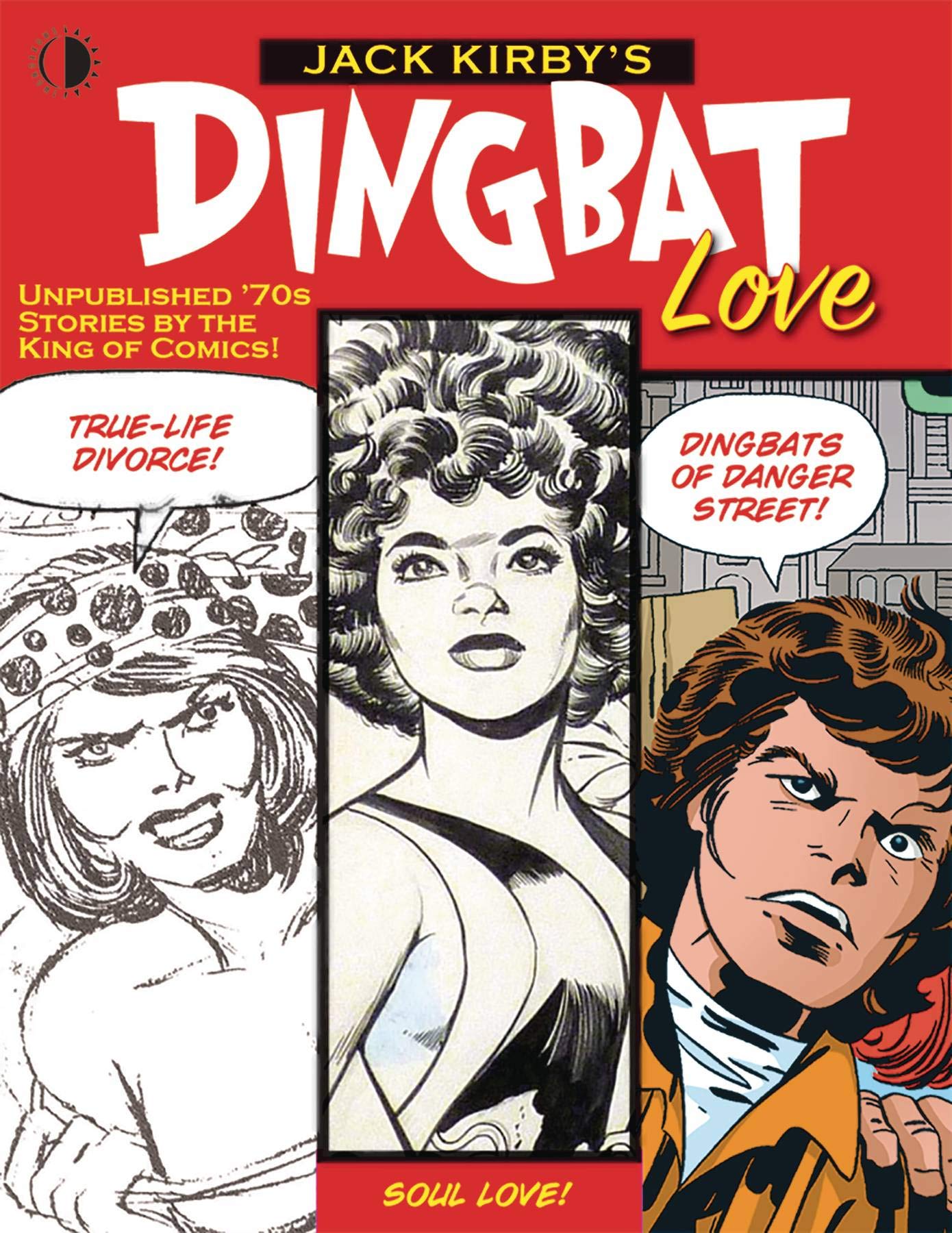
Jack Kirby’s Dingbat Love – Unpublished ’70s Stories by the King of Comics


By Jack Kirby, Vince Colletta, Tony DeZuñiga, Mike Royer Alex Ross, & D. Bruce Berry, with John Morrow, Mark Evanier, Steve Sherman, Jerry Boyd & various (TwoMorrows Publishing)
ISBN: 978-1-60549-091-5 (HB)

Win’s Christmas Gift Recommendation: Lost Chances Revisited and Reassessed… 9/10

Jack Kirby was – and remains, long after his passing – the master imagineer of American comics. His collected works provide a vast and rich trove of astounding narrative delights for any possible occasion. Famed for larger-than-life characters and gigantic, cosmic imaginings, Kirby was an astute, spiritual man who had lived through poverty, gangsterism, the Great Depression, World War II and the rise and stall of the Space Age. He’d seen and survived Post-War optimism, Cold War paranoia, political cynicism and birth and death of peace-seeking counter-cultures. Above all else, he was open-minded and utterly wedded to the making of comics stories on every imaginable subject impacting the human condition, but faced resistance every step of the way…

On returning from valiant service in WWII, Jack – reunited with creative partner Joe Simon – resumed a stellar comics partnership and began producing genre material for older audiences. “S&K” famously invented the genre of Romance comics, adding a fresh strand to a canon already spanning every subject imaginable. We know Kirby mostly for reinventing superheroes, but this book of “might-have-beens” asks a powerful and – for proponents of the medium and art form – distressing question: how far would Jack have imagined and pioneered if he’d been supported in his experiments rather than continually undercut and sandbagged?

Kirby always understood the fundamentals of pleasing an audience and toiled diligently to combat the appalling prejudice about the word-&-picture medium – especially from insiders and professionals who despised the “kiddies’ world” they felt trapped in. During the 1950s, changing tastes, dog-whistle politics and an anti-crime, anti-horror witch-hunt quashed the mature end of the US comics industry, and under a doctrinaire, self-inflicted conduct code, publishers stopped innovating and embraced more anodyne fare. This holding pattern saw the demise of many smaller publishers and persisted until the rebirth of superheroes…

From 1956, after he and Simon closed their own studio, Jack rejoined a dying outfit using the name “Atlas”. Kirby partnered with Stan Lee on science fiction, mystery, war and western anthologies and, when superheroes were revived, swiftly changed the world with a salvo of bold new concepts and characters that revitalised – if not actually saved – the comics business.

However, after little more than a decade, costumed characters began to wane again as public interest in the supernatural grew. With books, television and movies all exploring “The Unknown” in gripping and stylish new ways, the Comics Code Authority sought to slacken its censorious chokehold on horror titles, hoping to save the industry from implosion when the superhero boom busted. Enduring increasing editorial stonewalling and creative ennui at Marvel, in 1970 Kirby (after breaking ground with a few horror shorts for the House of Ideas’ new anthology titles) accepted a long-standing offer from arch rival DC Comics…

Promised freedom to innovate, one of the first projects he tackled was an entirely new full-colour, slick paper magazine format carrying material targeting adult readerships. However, backtracking almost immediately, DC’s powers-that-be incrementally cut a wide prospectus of fresh ideas and titles for “The Speak-Out Series” to a brace of pulp paper, monochrome magazines: In The Days of The Mob and Spirit World – and even let those wither after a single issue of each.

For the full story of how that worked out, you can read Mark Evanier’s acerbic article in this glorious oversized (227 x 280 mm) hardback compilation. He was there and knows a lot of the secrets. There’s also commentary from his editorial studio partner who was also part of the sabotaged project that could have forced American comics to grow up a generation earlier than they did. He closes this tome with ‘Speaking Out – An Afterword by Steve Sherman’…

Dingbat Love combines lost stories and unseen art with a history of how it all went wrong. There’s even a reconstruction from extant material and informed deduction of how one of Kirby’s proposed gamechangers might have looked, but we open with ‘A Foreword, Looking Back’ by ultimate fan John Morrow and a discussion of the proposed big gun launch in ‘True Life Divorce’ – an Introduction by Mark Evanier offering background and context.

The remaining comics material intended for True-Life Divorce follows as happily-married Kirby explored the contentious hot button topic of marriage and separation. All his proposed titles were intended to be collaborative projects with The King starting each for other writers and artists to continue, but throughout the creative process DC insisted their superstar creator carry the bulk of the output: a herculean task even for the legendarily prolific auteur.

‘”The Ladies Man”’ – by John Morrow’ then explores Kirby’s women characters, beginning in the era when Emancipation gave way to Liberation and over half the planet started finding powerful role models addressing their lives and experiences. As with the Romance revolution of 1947, Kirby’s goal was to make comics women would read and a rough plan of the contents of True-Life Divorce #1 precedes a magazine where marriage counsellor Geoffrey Miller would share case details of his clients. Racy, thought-provoking but never salacious, the surviving results here are pencilled tale ‘The Maid’ and partially-inked (by Vince Colletta) ‘The Twin’.

Morrow then discusses a breakthrough story that derailed everybody in ‘The Missing Model’ which featured a black woman and her problems with two men. It’s followed by her tragically incomplete tale in 7 pages of 10 (again inked by Coletta) detailing the choices she was forced to make in ‘The Model.’ This particular story caused a storm at DC, as the publishers saw a way to enter the growing and vibrant market of publications for African Americans at a time when comic book sales were in a brutal decline…

More on that later, but here True-Life Divorce #1 finishes with the all-pencilled drama of ‘The Other Woman’ after which ‘And Now… Mike Royer’ discusses a rare snippet probably intended for a second issue and inked for this book by Kirby’s most effective and dedicated embellisher. ‘The Cheater’ is printed with each pencilled page beside Royer’s inked one.

The result of DC’s interest in “The Model” led to the company pressuring Kirby to create a romance magazine for black readers, based on recent ethnocentric style magazines Jet and Ebony.

Although Kirby reluctantly agreed to the project, he again urged the editors to hire young and/or black creators for the prosed periodical alternatively dubbed Soul Romance or Soul Love – and with as little success. Here in ‘A Little Love for Soul Romance’, John Morrow provides a brief history of comic books aimed at African Americans (including Negro Romances and Negro Heroes) and discussion of creators of colour and a critical assessment by black writer Jerry Boyd in ‘Let Your Soul… Love!’ precedes a bold and brave experiment: ‘Soul Love #1 Facsimile Edition.’

With a few willing accomplices, Morrow uses Kirby’s delivered stories for the book to create a reasonable draft of what the King always intended: a glossy paper, full colour magazine with faux ads and editorial content such as ‘Equal Rights Aren’t Wrong’ supporting his comic tales. Inked by Tony DeZuñiga and Colletta these include ‘Fears of a Go-Go Girl!’, ‘Diary of a Disappointed Doll!’, ‘Dedicated Nurse!’, ‘Old Fires!’, and unembellished tale The Teacher’, all fronted by a painted cover by Alex Ross based on a Kirby rough. The project ended ignominiously and was unceremoniously shelved when DC’s sales and distribution team killed it, citing no reasonable way to reach black markets and stores…

‘Another Introduction by Mark Evanier’ details those scary days when comic books almost died as an industry and the febrile period when DC demanded its creators create a wave of new titles and concepts to combat Marvel flooding newsstands with reprint comics. Kirby and Joe Simon responded with a number of books and ideas (and numerous completed stories) but when the company backtracked most of the initial outings (Atlas, Manhunter, The Green Team, The Dingbats of Danger Street, The Outsiders) were bundled into new try-out title 1st Issue Special with Kirby’s Kobra radically retooled before later release. Only their collaboration on a new Sandman was judged sufficient to publish eventually running six issues.

Simon’s The Green Team and Kirby’s The Dingbats of Danger Street were both modern takes on the Golden Age “Kid Gang” concept that had paid such huge dividends with their Young Allies, Boy Commandos, Newsboy Legion, Boys Ranch and Boy Explorers series, and are fully detailed in Morrow’s essay/commentary ‘Danger Street’s Back Alleys’.

Their only official appearance in pre-Crisis on Infinite Earths continuity was in 1st Issue Special #6 (September 1976), with Royer inking a bizarre and hilarious revival of the subgenre starring four multi-racial street urchins (Good Looks, Non-Fat, Krunch and Bananas) united for survival and annoying the heck out of cheesy thugs and surreal super threats like Jumping Jack and The Gasser as well as local cop Lt. Mullins…

You’ll need to see DC’s 1st Issue Specials for that yarn, but it transpires – for complex reasons you’ll learn when you buy this book (heck, buy ‘em both!) – that at least two – and perhaps 4 more – full stories were readied at the time. Here, what would have been the second and third outings have been inked by Royer and show in full colour the King layer on drama and tragedy to what appeared to be a comedy feature as ‘The Dingbats of Danger Street #2’ sees Good Looks go dark and hunt professional killer ‘Snake-Meat’ for the oldest reason imaginable: ‘Vengeance’…

These stories incorporate glorious multi-page foldouts breathtaking in their graphic shock-value and offer original art reproductions of the first story and page layouts for later ones…

Bruce Berry-inked ‘The Dingbats of Danger Street #3’ focuses on Krunch in a disturbing exploration of child abuse, family exploitation and reasons for runaways by introducing Uncle Birdly and ‘The Dark, Dark, Cellar!’ where he expects to hear his charges ‘Scream, Baby Scream!’…

Packed with unseen art pages, promotional materials, sketches. notes and photos, and compiling work commissioned then cancelled this a wonderful treat for fans but regrettably, not a book you can read digitally yet, but hope springs eternal…

Decades after his death Jack Kirby remains a unique and uncompromising artistic force of nature: his words and pictures an unparalleled, hearts-&-minds grabbing delight no comics lover could resist. If you’re not a fan or simply not prepared to see for yourself what all the fuss has been about then no words of mine will change your mind.

That doesn’t alter the fact that Kirby’s work from 1937 to his death in 1994 shaped the entire American scene and indeed the entire comics planet – affecting the lives of billions of readers and thousands of creators in all areas of artistic endeavour for generations. He’s still winning new fans and apostles, from the young and naive to the most cerebral intellectuals. Jack’s work is instantly accessible, irresistibly visceral, deceptively deep whilst simultaneously mythic and human. And that’s all of us, right?

Wherever your tastes take you, his creations will be there ready and waiting.
Jack Kirby’s Dingbat Love editorial package © 2019 TwoMorrows Publishing. Soul Love cover painting © 2019 Alex Ross. Introductions © 2019 Mark Evanier. Afterword and photos © 2019 Steve Sherman. “Let Your Soul… Love!” © 2019 Jerry Boyd. True-Life Divorce, Soul Love, Dingbats of Danger Street and all other DC Comics characters ™ & © DC Comics. All Rights Reserved. All other characters and properties used ™ &/or © their respective rights owners and holders.
Mighty Thor Omnibus volume 1


By Stan Lee & Jack Kirby, Larry Lieber, Robert Bernstein, Joe Sinnott, Al Hartley, Don Heck, Chic Stone, Frank Giacoia, Vince Colletta & various (MARVEL)
ISBN: 978-0-7851-8835-3 (B/Digital edition)

Win’s Christmas Gift Recommendation: A Yule Jewel of Great Import… 9/10

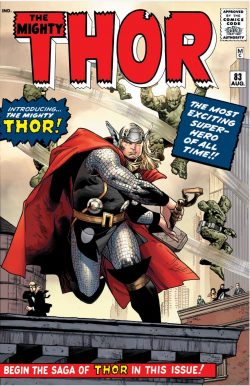
Even more than The Fantastic Four, The Mighty Thor was the arena in which Jack Kirby’s restless fascination with all things Cosmic was honed and refined through dazzling graphics and captivating concepts. The King’s string of power-packed signature pantheons began in a modest little fantasy/monster title called Journey into Mystery where – in the summer of 1962 – a tried-and-tested comic book concept (feeble mortal transformed into god-like hero) was revived by the fledgling Marvel Comics to add a Superman analogue to their growing roster of costumed adventurers.

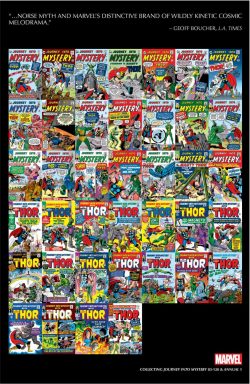
This monumental tome re-presents the pioneering Asgardian exploits from JiM #83-120 and Journey into Mystery Annual #1, spanning cover-dates August 1962 to September 1965 in a blazing blur of innovation and seat-of-the-pants myth-revising and universe-building.

It is lettered throughout by unsung superstars Art Simek, Sam Rosen, Ray Holloway, Terry Szenics and Martin Epp and sadly an anonymous band of colourists. As well as a monolithic assortment of nostalgic treats at the back, this mammoth tome is dotted throughout with recycled Introductions by Stan Lee, taken from the earlier Marvel Masterworks editions and includes editorial announcements and ‘The Hammer Strikes!’ newsletter pages for each original issue to enhance overall historical experience…

The eternal Edda unfolds with the lead feature of Journey into Mystery #83 (August 1962) which saw a brawny bold warrior jostle aside the regular roster of monsters, aliens and sinister scientists in a brash, vivid explosion of verve and vigour. The initial exploit follows disabled American doctor Donald Blake who takes a vacation in Norway only to encounter the vanguard of an alien invasion. Fleeing, he is trapped in a cave and finds an old, gnarled walking stick. When in his frustration he smashes the stick into a huge boulder obstructing his escape, his puny frame is transformed into the Norse God of Thunder, Mighty Thor!

Officially plotted by Stan Lee, scripted by his brother Larry Lieber and illustrated by Kirby and inker Joe Sinnott (at this juncture a full illustrator, Sinnott would become Kirby’s primary inker for most of his Marvel career), ‘The Stone Men of Saturn’ is pure early Marvel: bombastic, fast-paced, gloriously illogical and captivatingly action-packed. The hugely under-appreciated Art Simek was the letterer and logo designer.

It was clear that they whey were making it up as they went along – not in itself a bad thing – and that infectious enthusiasm shows in the next adventure. ‘The Mighty Thor Vs. the Executioner’ is a “commie-busting” tale of its time with a thinly disguised Fidel Castro wasting his formidable armies in battle against our hero.

The tale introduced Blake’s nurse Jane Foster: at this point a bland cipher adored from afar by the Norse superman’s timid alter-ego. The creative team settled as Dick Ayers replaced Sinnott, and with #85’s ‘Trapped by Loki, God of Mischief!’, the final element fell into place with the “return” of a suitably awesome arch-foe – the hero’s half-brother. This evil magician and compulsive trickster escaped divine incarceration and his first thought was to bedevil Thor by causing terror and chaos on the world of mortals he was so devoted to.

Here, a new and greater universe was revealed with the first tantalising hints and glimpses of the celestial otherworld and more Nordic gods…

JiM #86 introduced another recurring villain. Zarrko, bristling at the sedentary ease of 23rd century life, travels to 1962 to steal an experimental “C-Bomb”, forcing the Thunderer into a stirring sortie through time and inevitable clash with super-technology ‘On the Trail of the Tomorrow Man!’ With his return, Blake became a target of Soviet abductors: the sneaky spies even managed to make Thor a ‘Prisoner of the Reds!’ before he eventually emerged unscathed and triumphant…

JiM #88 saw ‘The Vengeance of Loki’ as the malevolent miscreant uncovered Thor’s secret identity and naturally menaced Jane whilst ‘The Thunder God and the Thug’ offered drama on a human scale as a gang boss runs riot over the city and roughshod over a good woman’s heart, giving the Stormbringer a chance to demonstrate his sympathetic side by crushing Thug Thatcher and freeing poor abused Ruby from his influence.

Issue #90 was an unsettling surprise as the grandeur of Kirby & Ayers was replaced by the charming yet dynamism-free art of Al Hartley, who illustrated Lee & Lieber’s stock alien-invasion yarn ‘Trapped by the Carbon-Copy Man!’ A month later the Storm Lord took on ‘Sandu, Master of the Supernatural!’, with Sinnott pencilling and inking a thriller starring a carnival mentalist who – augmented by Loki’s magic – came catastrophically close to killing our hero. Sinnott limned JiM #92’s ‘The Day Loki Stole Thor’s Magic Hammer’ – scripted by Robert Bernstein over Lee’s plot – which moved the action fully to Asgard for the first time as Thor sought to recover his stolen weapon after Loki ensorcelled the magnificent mallet. Kirby & Ayers momentarily returned for Cold War/Atom Age thriller ‘The Mysterious Radio-Active Man!’ Again scripted by Bernstein it sees “Mao Tse Tung” unleash an atomic assassin in retaliation for Thor thwarting China’s invasion of India. Such “Red-baiting” fare was common for early Marvel, but their jingoistic silliness can’t mar the eerie beauty of the artwork. With this tale, rangy, raw-boned Thor completed his slow metamorphosis into the husky, burly blonde bruiser who dominated any panel he was in.

Sinnott returned for the next three (somewhat pedestrian) adventures. ‘Thor and Loki Attack the Human Race!’, ‘The Demon Duplicator’ and ‘The Magic of Mad Merlin!’, but these mediocre tales of magic-induced amnesia, science-generated evil doppelgangers and an awakened ancient mutant menace were the last of an old style of comics. Stan Lee took over scripting with Journey into Mystery #97 and a torrent of action wedded to soap opera melodrama began a fresh style for a developing readership.

‘The Lava Man’ in #97 was drawn by Kirby, with subtly textured inking by Don Heck adding depth to the tale of an invader summoned from subterranean realms to menace humanity at the behest of Loki. More significantly, a long running rift between Thor and his stern father Odin was established after the Lord of Asgard refused to allow his son to love mortal Jane.

This acrimonious triangle was a perennial subplot attempting to humanise Thor, because already he was a hero too powerful for most villains to cope with.

Most importantly, this issue launched a spectacular back-up series. ‘Tales of Asgard – Home of the Mighty Norse Gods’ gave Kirby a vehicle to indulge his fascination with legends. Initially adapting classic tales but eventually with all-new material particular to the Marvel pantheon, he built his own cosmos and mythology, which underpinned the company’s entire continuity. This first saga, scripted by Lee and inked by George Bell (AKA Jack’s Golden Age collaborator George Roussos), outlined the origin of the world and the creation of the World Tree Yggdrasil.

‘Challenged by the Human Cobra’ introduced the serpentine villain (bitten by a radioactive cobra, would you believe?) in a tale by Lee & Heck, whilst Kirby – with them in attendance – offered ‘Odin Battles Ymir, King of the Ice Giants!’: a short, potent fantasy romp which laid the groundwork for decades of cosmic wonderment of years to come.

The format held for issues #99 & 100 with the lead story (first 2-parter in the run) introducing the ‘Mysterious Mister Hyde’ – and concluding a month later with ‘The Master Plan of Mr. Hyde!’ The modern yarn featured a contemporary chemist who could transform into a super-strong villain at will who framed Thor for his crimes whilst in primordial prehistory Kirby detailed Odin’s war with ‘Surtur the Fire Demon’, and latterly (with Vince Colletta inking) crafted an exploit of the All-Father’s so different sons in ‘The Storm Giants – a Tale of the Boyhood of Thor’ (Paul Reinman inks). As always, Lee scripted these increasingly influential histories…

Breaking for another recycled Lee Introduction, the modern myth-making resumes with JiM #101 (entirely inked by Roussos) which saw Kirby finally assume pencilling on both strips. In ‘The Return of Zarrko, the Tomorrow Man’ Odin halves Thor’s powers for disobedience just as the futuristic felon abducts the Thunderer to conquer the 23rd century. Another 2-parter, it’s balanced by another exuberant tale of boy Thor. ‘The Invasion of Asgard’ sees the valiant lad fight a heroic rearguard action introducing a host of future villainous mainstays such as Rime Giants and Geirrodur the Troll.

Epic conclusion ‘Slave of Zarrko, the Tomorrow Man’ is a tour de force notable for Chic Stone’s debut as inker. To many of us dotards, his clean, full brush lines make him The King’s best embellisher ever. The triumphant futuristic thriller is balanced by brooding Reinman-inked short ‘Death Comes to Thor!’ as the teen tyro faces his greatest challenge yet. Two women who would play huge roles in his life premiered in this 5-pager: young goddess Sif and Hela, Queen of the Dead.

Lee, Kirby & Stone introduced more memorable misanthropes in ‘Menaced by The Enchantress and The Executioner!’: ruthless renegade Asgardians resolved to respectively seduce and destroy the warrior prince in the front of JiM #103 whilst the rear revealed ‘Thor’s Mission to Mirmir!’ and how the gods created humanity. That led one month later to a revolutionary saga when ‘Giants Walk the Earth!’.

At last Kirby’s imagination was given full play as Loki tricks Odin into visiting Earth, and subsequently liberates ancient elemental enemies Surtur and Skagg, the Storm Giant from Asgardian bondage to ambush the absent All-Father…

This cosmic clash saw noble gods battling demonic devils in a new Heroic Age, with the greater role of the Norse supporting cast – especially noble comrade-in-arms Balder. This was reinforced by a new Tales of Asgard backup feature focussing on individual Gods and Heroes. ‘Heimdall: Guardian of the Mystic Rainbow Bridge!’ was first, with Heck inking.

Issues #105-106 teamed two old foes in ‘The Cobra and Mr, Hyde!’ and ‘The Thunder God Strikes Back!’: another continued story stuffed with tension and spectacular action, proving Thor was swiftly growing beyond the constraints of traditional single issue adventures. Respective back-ups ‘When Heimdall Failed!’ (Lee, Kirby & Roussos) and ‘Balder the Brave’ (Lee, Kirby & Colletta) further fleshed out the Asgardian pantheon deviating by more and more from the classical Eddas and Sagas.

JiM #107 premiered a petrifying villain ‘When the Grey Gargoyle Strikes!’: a rare yarn highlighting the fortitude of Dr. Blake rather than the Thunder God who was increasingly reducing his own alter-ego to an inconsequentiality. Closing the issue, the Norn Queen debuted in ‘Balder Must Die!’: a quirky reinterpretation of myth by Kirby & Colletta.

After months of manipulation, the God of Evil once again took direct action in ‘At the Mercy of Loki, Prince of Evil!’, With Jane Foster a victim of Asgardian magic, the willing assistance of new Marvel star Doctor Strange made this a captivating team-up must-read, whilst ‘Trapped by the Trolls!’ (Colletta inks) showed the power and promise of tales set solely on the far side of the Rainbow Bridge as Thor liberates Asgardians from subterranean bondage.

Journey into Mystery #109 was another superb infomercial adventure and a plug for a recent addition to the Marvel roster. ‘When Magneto Strikes!’ pits Thor against the X-Men’s greatest foe and his Brotherhood of Evil Mutants in a cataclysmic clash of fundamental powers, but you couldn’t really call it a team-up since the heroic mutants are never actually seen. Tantalising hints and cropped glimpses are fascinating teasers now, but the kid I then was felt annoyed not to have seen these new heroes – Oh! wait… maybe that was the point?

Young Thor feature ‘Banished from Asgard!’ is an uncharacteristically lacklustre effort as Odin and Thor enact a devious plan to trap a traitor in Asgard’s ranks. This issue also saw the launch of the letters page The Hammer Strikes and a Special Announcements Section, all included from here on for your delectation…

By #110 the ever-expanding world of Asgard was fully established: a mesmerising milieu for Thor’s earlier adventures and exotic setting for fresh wonders all hinting at a forthcoming era of cosmic fantasy to run beside the company’s signature Manhattan-based superhero sagas. ‘Every Hand Against Him!’ (Lee, Kirby & Stone) combines both, as Loki has earthly miscreants Cobra and Mr. Hyde kidnap and wound nigh unto death Thor’s mortal beloved Jane, even as Odin again overreacts to Thor’s affections for the human.

Following a stunning Kirby & Stone Thor Pin-up, and balancing that tension-drenched clash of Good and Evil, is a crafty vignette of Young Thor describing ‘The Defeat of Odin!’ in an old and silly plot sweetened by breathtaking battle scenes. It’s followed by another Lee Introduction before the concluding clash with Cobra & Hyde redefining ‘The Power of the Thunder God!’ With a major role for Balder the Brave and further integrating “historical” and contemporary Asgard in a spellbinding epic of triumph and near-tragedy, it’s complimented by a Loki Pin-up and precedes a fable co-opting a Greek myth (Antaeus if you’re asking) as ‘The Secret of Sigurd!’ (inked by Colletta).

Journey into Mystery #112 gave readers what they had been clamouring for with ‘The Mighty Thor Battles the Incredible Hulk!’: a glorious gift to all those fans who perpetually ask “who’s stronger…”? Arguably Kirby & Stone’s finest collaborative moment, it details a private duel that apparently appeared off-camera during a free-for-all between in The Avengers #3 when the heroes battled Sub-Mariner and the eponymous Green Goliath. The raw aggressive power of that clash is balanced by an eagerly anticipated origin in ‘The Coming of Loki!’ (Colletta inks): a retelling of how Odin adopts the baby son of Laufey, the Giant King.

In #113’s ‘A World Gone Mad!’ the Thunderer – after saving the Shining Realm from invasion – again defies Odin to court Jane:  a task made hazardous by the return of the Grey Gargoyle. A long-running plot strand – almost interminably so – was the soap-opera tangle caused by Don Blake’s love for his nurse – a passion his alter ego shared. Sadly, the Overlord of Asgard could not countenance his son with a mortal, in another heavy-handed example of that acrimonious triangle.

The mythic moment at the back then exposed ‘The Boyhood of Loki!’ (inked by Colletta), a pensive, brooding foretaste of the villain to be, before JiM #114 opened a 2-part tale starring a new villain of the kind Kirby excelled at: a vicious thug who suddenly lucked into overwhelming power.

‘The Stronger I Am, The Sooner I Die!’ finds Loki imbuing hardened felon Crusher Creel with the ability to duplicate the strength and attributes of anything he touches, but before Creel endures ‘The Vengeance of the Thunder God’ (inked by Frank Giacoia as “Frankie Ray”) we’re graced with another Asgardian parable – ‘The Golden Apples!’…

Issue #115’s back-up mini-myth ‘A Viper in our Midst!’ sees young Loki clandestinely cementing relations with the sinister Storm Giants, before a longer Thor saga began in #116, with Colletta becoming regular inker for both lead and support features. ‘The Trial of the Gods’ disclosed more aspects of Asgard as Thor and Loki undertake a brutal ritualised Trial by Combat, with the latter cheating at every step, after which ‘Into the Blaze of Battle!’ finds Balder protecting Jane even as her godly paramour travels to war-torn Vietnam seeking proof of his step-brother’s infamy.

These yarns are supplemented by stellar novellas ‘The Challenge!’ and ‘The Sword in the Scabbard!’, wherein Asgardian cabin-fever informs an official Quest instituted to expose a threat to the mystic Odinsword, the unsheathing of which will destroy the universe…

Journey into Mystery #118’s ‘To Kill a Thunder God!’ ramps up the otherworldly drama as Loki, to cover his tracks, unleashes an ancient Asgardian WMD – The Destroyer. When it damages the mystic hammer of Thor and nearly kills The Thunderer in ‘The Day of the Destroyer!’, the God of Mischief is forced to save his step-brother or bear the brunt of Odin’s anger.

Meanwhile in Tales of Asgard The Quest further unfolds with verity-testing talisman ‘The Crimson Hand!’ and ‘Gather, Warriors!’ as a band of literally hand-picked “Argonauts” join Thor’s flying longship in a bold but misguided attempt to forestall Ragnarok…

With The Destroyer defeated and Loki temporarily thwarted, Thor returns to America and then Asgard ‘With My Hammer in Hand…!’ only to clash once more with the awesome Absorbing Man in the start of another multi-part saga that will continue in the next volume…

However, before that bombastic battle there’s not only the next instalment of the Asgardian Argonauts who boldly ‘Set Sail!’ but also the superb lead story from Journey into Mystery Annual #1, wherein in undisclosed ages past the God of Thunder fell into the realm of the Greek Gods for a landmark heroic hullabaloo ‘When Titans Clash! Thor vs. Hercules!’

This incredible all-action episode is augmented here by a stunning and beautiful double-page pin-up of downtown Asgard – a true example of Kirby magic – plus one last Lee Intro essay.

There’s a relative paucity of bonus material here but it’s all first rate: including unretouched original artwork, house ads and a full run of covers from Marvel Tales #1, 3-27 and Special Marvel Edition #1-2 from the 1960s where his early exploits were first reprinted. Closing the section is the cover art for this collection by Olivier Coipel, Mark Morale & Laura Martin.

These early tales of the God of Thunder show the development not only of one of Marvel’s core narrative concepts but, more importantly, the creative evolution of perhaps the greatest imagination in comics. Set your common sense on pause and simply wallow in the glorious imagery and power of these classic adventures and revel in what makes comic book superheroes such a unique experience.
© 2022 MARVEL.

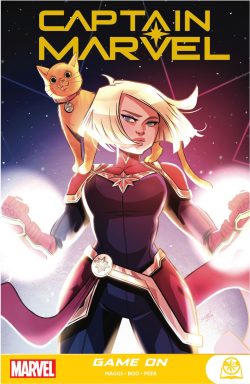
Captain Marvel: Game On (Marvel Action Captain Marvel)


By Sam Maggs, Sweeney Boo, Mario Del Pennino, Isabel Escalante, Brittany Peer, Heather Breckel & various (MARVEL)
ISBN: 978-1-3029-5115-3 (TPB/Digital edition)

Win’s Christmas Gift Recommendation: Total Entertainment Perfection… 10/10

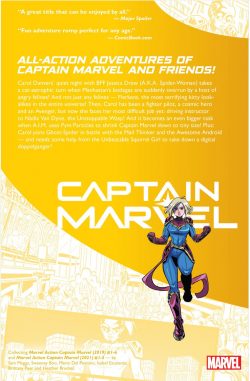
In 2003 the House of Ideas instituted a Marvel Age line: an imprint to update classic original tales and characters for a new, young readership. The enterprise remodelled in 2005, reduced to core titles Marvel Adventures: Fantastic Four and Marvel Adventures: Spider-Man. The tone and look mirrored the company’s burgeoning TV cartoon franchises, in delivery if not name. Supplemental series including Super Heroes, The Avengers, Hulk and Iron Man chuntered along merrily until 2010 when they were cancelled. In their place new volumes of Marvel Adventures: Super Heroes and Marvel Adventures: Spider-Man debuted. Since then a wealth of material crafted for more innocent audiences (often TV and movie affiliated) has been crafted under the umbrella of “Marvel Action”. This mega compilation – gathering together three earlier collections comprising Marvel Action Captain Marvel (2019) #1-6, and Marvel Action Captain Marvel (2021) #1-5 – offers a bonanza of role models for girl readers and furious fun-filled thrills for all lovers of light hearted superhero silliness and mayhem. And that’s most of us, right?

Written throughout by Sam Maggs (The Unstoppable Wasp: Built on Hope, Tell No Tales, Marvel’s Spider-Man) Carol Danvers steps up as premier super-doer of Earth beginning with a tale of cats breaking newsreaders and other stuff.

Illustrated by Sweeney Boo and colourist Brittany Peer, it opens with ‘Big Flerken Deal’, as Kree colonisers gather up and weaponize all those scattered fluffy house pets with interdimensional voids in their mouths. It should have been a secret but their tech also affected cats on Erath, triggering the weirdest, cutest assault New York ever experienced…

Happily Captain Marvel and Spider-Woman were having a girls-night-in and were ready for action, even if it did lead to Carol being abducted to the little sweeties’ new homeworld and another insane battle in ‘Don’t Be Flerken Ridiculous’.

Some last-minute assistance from her BFF and tagalong Chewie (that’s Carol’s own house-flerken as seen in films and mainstream comics), Star-Lord and the Guardians of the Galaxy show up, and everything finally ends well for all but the Kree in ‘I’m Flerken Out!’…

MACM #4-6’s ‘Bug Out!’ co-starred The Unstoppable Wasp (Nadia Van Dyne) and begins with the secret teenaged daughter of Hank Pym getting driving lessons from Carol. Of course things go awry – they’re using Tony Stark’s favourite sports car after all – when Advanced Idea Mechanics attack, trapping them at miniscule height and unable to use Carol’s powers without blowing up the city – and maybe the world…

Forced to ‘Hive It Your Way!’, Carol and Nadia invade AIM and uncover “Operation Roadkill”: a plot to destroy all superheroes using stolen Pym Particles. Incensed at being used as a trial run and using The Wasp’s Genius In action Research Labs (G.I.R.L.) associates as technical support and the Unbeatable Squirrel Girl as back-up, the ticked off team of ‘Queen Bees!’ target AIM Supreme Scientist Monica Rappaccinii, shatter her plan and save themselves from exploding before “fixing” Tony’s wheels and riding off into the sunset…

Although the title ended there, Marvel Action Captain Marvel restarted in 2021. That volume opens with Mario Del Pennino, Isabel Escalante & Heather Breckel rendering ‘Look at Meme Now!’ and ‘Do Androids Meme of Electric Sheep?!’ as a chance meeting with Ghost Spider Gwen Watson intersects with The Mad Thinker hijacking social media to program kids into being his mind slaves. Sadly, that workforce now includes almost every teen metahuman in the world, but those are mere distractions as the Thinker’s Awesome Android uses the crisis to go sentient and go solo…

With order restored, and Carol (a little) more computer literate, Captain Marvel faces a realty crunching crisis as Sweeney Boo & Brittany Peer return for 3-part thriller ‘Game On!’ as a mystery opponent traps Earth’s Strongest Hero in a constantly-shifting cyberspace whilst her allies can only watch and wait…

With covers and variants by Brianna Garcia, Sara Pitre-Durocher, Yasmín Flores Montañez, Karen Hallion, Megan Levens & Charlie Kirchoff, Nicoletta Baldari, Gretel Lusky, Kaela Lash, Nicole Goux, this is a star bright and breezy procession of witty and wonderful all ages escapades to delight and enthral, and inevitably inspire.
© 2023 MARVEL.

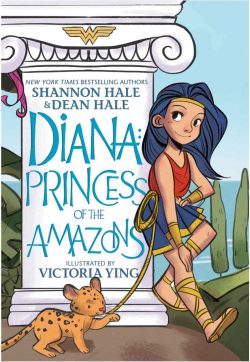
Diana: Princess of the Amazons


By Shannon Hale & Dean Hale, illustrated by Victoria Ying with Lark Pien, Dave Sharpe & various (DC Comics)
ISBN: 978-1-91422-406-5 (TPB/Digital edition)

Win’s Christmas Gift Recommendation: Myth Making Gift Giving… 9/10

In recent years DC opened up its shared superhero universe to generate Original Graphic Novels featuring its stars in stand-alone adventures for the demographic inappropriately dubbed Young Adult. To date, results have been rather hit or miss, but when they’re good, they are very good indeed.

They’ve been especially scrupulous producing material catering to girls and other previously neglected comics minorities, tapping into the communal history and mystique of the DCU and always visiting aspects of youthful rebellion and growing independence.

Here – crafted by Shannon Hale (Rapunzel’s Revenge, The Princess in Black, Squirrel Girl, Princess Academy, Ever After High, Real Friends) & Dean Hale (Rapunzel’s Revenge, The Princess in Black, Squirrel Girl), illustrator, author and animator Victoria Ying (Big Hero 6, Moana, Meow!, Not Quite Black and White) colourist Lark Pien and letterer Dave Sharpe – is a tale of the earliest icon women in comics ever had: Earth’s most recognisable Female Heroic Ideal.

Wonder Woman is the acme of female role models. Since her premier she has permeated every aspect of global consciousness, becoming not only a paradigm of comics’ very fabric but an affirming symbol to women everywhere. In whatever era you observe, the Amazing Amazon epitomises a perfect balance between Brains and Brawn and, over decades, has become one of a rarefied pantheon of literary creations achieving meta-reality.

Her origins have been common cultural currency for so long and assimilated by so many generations that it’s a given the story can now be massaged and reinvented to accommodate and address any readership – just like all the best fairy tales.

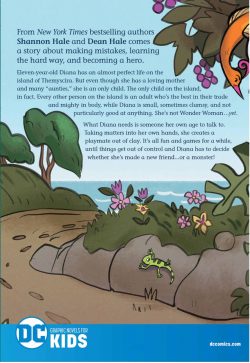
Diana: Princess of the Amazons opens on the paradisical island of Themyscira: home of immortal Hellenic warriors called Amazons. They are mighty and wise and each is millennia old, happily ruled by their Queen Hippolyta. A few years prior to this tale she was blessed with a daughter. Diana is smart, courageous and inquisitive, spending her days learning from her thousands of “aunties”, playing with the vast number of animals inhabiting the land, exploring and having fun. Of course, as the only child on an isolated island, there’s no one to have all that fun with…

When she little everybody paid her attention and sought to share Diana’s life, but now that she’s nearly a teenager she often feels in the way of grown up stuff. It’s like she’s always in trouble… too old and simultaneous still too young for anything…

Then one day, Auntie Lyssa reminds Diana how Hippolyta moulded a baby out of clay and the gods and goddesses breathed life into it. More out of boredom than anything else, Diana heads to the beach and using clay, sand and surf tries ‘Making a Friend’ She isn’t surprised that it doesn’t work, but a little later meets the almost-breathing fruits of her labours when someone follows her…

The sand creature calls herself Mona and wants to be friends but refuses to let adults see her. Slowly, Mona becomes a covert but constant presence in Diana’s life, but that comes at a cost. There’s a flaw in her and an exciting wildness, leading to ‘Cutting Class on Themyscira’ and even wilful mischief. The princess should be ashamed of herself – but increasingly isn’t…

When one prank goes awry, Diana desperately wants to make amends and earn back her mother’s respect, and Mona hints that she should demonstrate her warrior prowess…

Of course the island is a paradise and no heroic deeds are possible there. All the Amazons’ martial training is because they are tasked with guarding Doom’s Doorway: the entrance to a hell dimension where the gods have imprisoned all the monsters of mythology. Thankfully ‘Only an Amazon’ can even turn the key holding the horrors in check.

With the incessant cajoling voice of her only friend in her ears, Diana makes the biggest mistake of her life…

However, with Hell unleashed and her aunties losing a savage battle against unholy terrors, she soon proves why she is ‘The Best of Us’: making hard decisions, exposing the truth of Mona and ultimately facing death to make things right again…

A superb example of a beloved character living up to her full potential, this is a sublime and rousing romp proving heroism comes in all manner of packages and affirming everyone can be the hero.

If further proof were required, this book also contains an enchanting extended excerpt from Zatanna and the House of Secrets to hammer home the point by entertaining the heck out of you and leaving you wanting more…
© 2020 DC Comics. All Rights Reserved.

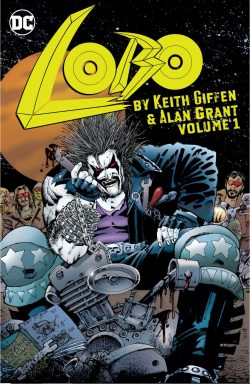
Lobo by Keith Giffen & Alan Grant volume 1


By Keith Giffen & Alan Grant with Simon Bisley, Christian Alamy, Denys Cowan, Kevin O’Neill & various (DC Comics)
ISBN: 978-1-4012-7477-1 (TPB/Digital edition)

Win’s Christmas Gift Recommendation: ’Tis the Season To Be Fragged… 8/10

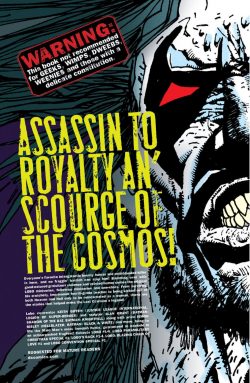
Lobo is an incredibly powerful, inescapably violent, perpetually drunken thug afflicted with a love of space dolphins, an utter disregard for all other life and an unshakable moral code hard for anyone else to grasp. The obnoxious, overbearing, unsanitary intergalactic bounty hunter was first seen in Omega Men #3, cover-dated June 1983. He then cropped up all over the DC universe, even becoming a mainstay of the popular L.E.G.I.O.N. series: indentured by cunning stunt as a (sort of) peacekeeper to the intergalactic commercial police force run by Vril Dox, “son” of one multiversal iteration of cosmic super-villain Brainiac.

He had his own monthly title for a few years as well as multiple miniseries and specials, and was a popular candidate for inter and cross-company team-ups. He’s even been a repeat offender on screen in both live action and animated iterations. In-world, the name Lobo roughly translates as “he who devours your entrails and enjoys it”. Despite being pretty much a one trick pony and increasingly an exercise in outrageous graphic excess, this unstoppable, anarchic force-of-nature exploded in popularity in the decade following debut. He was exactly what many fans wanted.

This collection reprints Lobo #1-4; The Lobo Paramilitary Christmas Special; Lobo’s Back #1-4; Lobo: Blazing Chain of Love; Lobo Convention Special and material from Who’s Who in the DC Universe, collectively spanning all of infinity via cover-dates November 1990 to September 1993.

Without any kind of fair warning, this bloodbath of poor taste and shocking excess opens with initial Limited Series Lobo #1-4: ‘The Last Czarnian’. The skeevy brute always prided himself on being the final survivor of his planet, but here finds to his horror and disgust that he missed someone when he slaughtered his entire race. That lucky survivor is his old fourth grade teacher Miss Tribb, who has unbelievably and unwisely written an unauthorized tell-all biography of “the Main Man” who was her least favourite pupil ever…

Forbidden by his own honour-code from killing her, he must instead escort the snippy snarky old baggage to Dox at L.E.G.I.O.N. HQ with every nut-job in the universe pursuing them, hell-bent on killing one or other or preferably both of them. Subdivided into ‘Part One: Portrait of a Psychopath’, ‘Part Two: Lord of the Dance’, ‘Part Three: Spell or Die’ and ‘Part Four: The Last Last Czarnian’, this blistering bonkers baroque barbarity is plotted and laid out by Giffen, scripted by Grant and outrageously limned by hip headbanger Simon Bisley as colourist; Lovern Kindzierski and letterer Todd Klein aid and abet the cartoon carnage. As usual, despite all the forces ranged against him, The Main Man has the last – albeit misspelled – word…

The Lobo Paramilitary Christmas Special (January 1992) follows with Giffen, Grant, Bisley, Kindzierski and Gaspar Saldino expediting ‘The Lobo Xmas Sanction’ as cash-strapped parents of far-too-many brats look to save on end of year expenses and learn how a certain unsavoury soul and his dog Dawg were hired by The Easter Bunny to take out his biggest rival in the holiday icon game: Santa Claus. The elves were no real problem but old man Kringle was a harder nut to crack and left a surprise Lobo never anticipated…

Beginning in May 1992, and coloured by Danny Vozzo, Lobo’s Back #1-4 comprised ‘The Final Fragdown’, ‘Heaven is… a 4-Letter Word’, ‘If the Jackboot Fits…!’ and ‘The War in Heaven’ then details his return to the private sector after L.E.G.I.O.N. implodes and how he dies trying to bring in the infamous Loo, the most dangerous being in the universe.

What follows is an outrageous, darkly hilarious, blood-soaked spin on a venerable old tale (you’ve probably seen the Bugs Bunny cartoon classic) as Lobo makes himself persona non grata in every aspect of the afterlife. When both Heaven and Hell discover that the Main Man is too much to handle, there’s only one place to go and that’s back here, but nobody said it had to be in his original body…

Fans and the spiritually attuned will want to see what this creative team does with comic guest stars loke The Demon and General Glory and a host of pantheons and holy folk of all denominations…

Behind a cover by Dan Brereton, Lobo: Blazing Chain of Love sees artist Denys Cowan, colourist Noelle Giddings and letterer “Tanya” Klein join Giffen & Grant to explore the Main Man’s other main interest, only to encounter a forced shortage of willing babes of negotiable affection…

You’d think that’s the kind of problem relentless remorseless violence couldn’t fix. You’d be wrong…

This yarn will confound all your expectations as it is in fact a potent, brilliantly-conceived argument for safe sex crafted at the height of the fightback against HIV/AIDS, leading directly into our final furious foray… against Comics fandom itself…

The Lobo Convention Special – with the much-missed Kev O’Neill delivering another inimitable illustration masterclass, and Digital Chameleon adding hues to the queues at ‘Lobo-Con’ – is blackly comedic, ironic, sardonic and manic, as it depicts and cruelly deconstructs the people it depends upon. After skewering the great, good and especially unwashed of the industry, it all ends in carnage but begins with Lobo looking to replace his copy of the Death of Superman and heading to a convention packed with the kind of fanboys we’re all absolutely certain are FAR WORSE than we are…

The carnage concludes with info pages from Who’s Who in the DC Universe…

At the height of his popularity the Main Man of Mayhem was a publisher’s dream. There was actual baying from fans and speculators for more product and a largely new and receptive audience which hadn’t seen the unleashed potential of grown up comics. These tales for (im)Mature readers aren’t to everybody’s taste, but Giffen & Grant’s wickedly sharp scripts gave Bisley (assisted by Christian Alamy) and later artists scope for breathtakingly memorable art sequences, and sometimes just going wild is as rewarding as the most intricately balanced craftwork and plot-building.

All that being said, if you’re in the right mood, his kind of gratuitous mayhem can be wonderfully entertaining and has much to recommend it if vicious, sardonic slapstick pushes your buttons. Comics excess at its finest.
© 1990, 1991, 1992, 1993, 2018 DC Comics. All Rights Reserved.

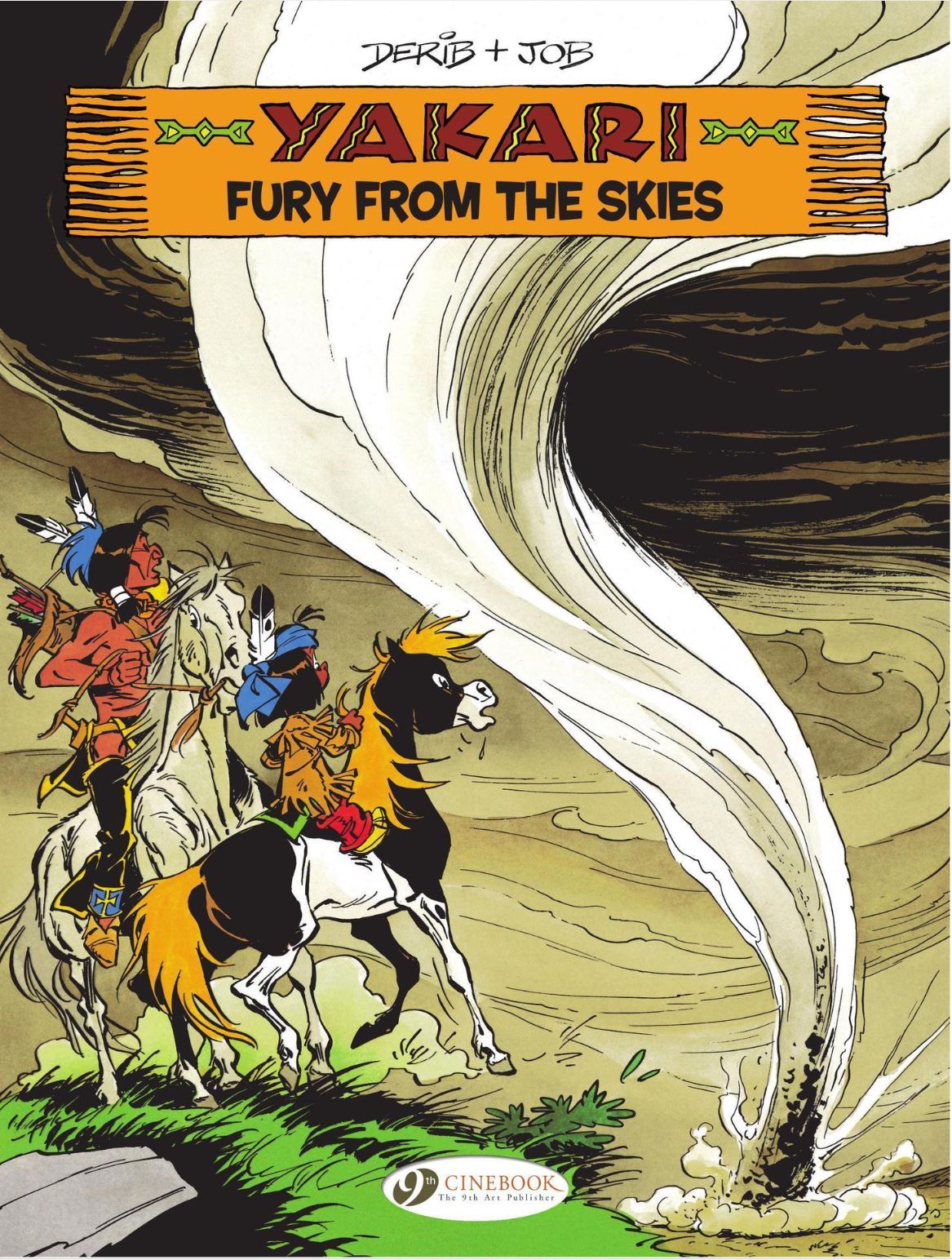
Yakari volume 21: Fury From the Skies


By Derib & Job, coloured by Dominique and translated by Jerome Saincantin (Cinebook)
ISBN: 978-1-80044-019-4 (Album PB/Digital edition)

Win’s Christmas Gift Recommendation: Another Kind of Wonderful Life… 9/10

In 1964 children’s magazine Le Crapaud à lunettes was founded by Swiss journalist André Jobin, who then wrote for it under the pseudonym Job. Three years later he hired fellow Franco-Swiss artist Claude de Ribaupierre AKA “Derib”. The illustrator had launched his own career as an assistant at Studio Peyo (home of Les Schtroumpfs): working on The Smurfs strips for venerable weekly Le Journal de Spirou. Thereafter, together they created the splendid Adventures of the Owl Pythagore before striking pure comics gold a few years later with their next collaboration.

Derib – equally au fait with enticing, comically dynamic “Marcinelle” cartoon style yarns and devastatingly compelling meta-realistic action illustrated action epics – went on to become one of the Continent’s most prolific and revered creators. It’s a crime such groundbreaking strips as Buddy Longway, Celui-qui-est-nà-deux-fois, Jo (first comic to deal with AIDS), Pour toi, Sandra and La Grande Saga Indienne) haven’t been translated into English yet, but we still patiently wait in hope and anticipation…

Over decades, much of Derib’s stunning works have featured his beloved Western themes: magnificent geographical backdrops and epic landscapes. Yakari is considered by fans and critics to be the strip which led him to his deserved mega-stardom. Debuting in 1969, self-contained episodes trace the eventful, nomadic life of a young Oglala Lakota boy on the Great Plains, with stories set sometime after the introduction of horses (by colonising Conquistadores) but before the coming of modern Europeans.

The series – which also generated two separate animated TV series and a movie – is up to 42 albums thus far: a testament to its evergreen vitality and brilliance of its creators, even though originator Job moved on and Frenchman Joris Chamblain took on the writing in 2016.

Abundant with gentle whimsy and heady compassion, Yakari’s life is a largely bucolic and happy existence: at one with nature and generally free from privation or strife. For the sake of dramatic delectation however, the ever-changing seasons are punctuated with the odd crisis, generally resolved without fuss, fame or fanfare by a little lad who is smart and brave – and who can, thanks to a boon of his totem guide the Great Eagle, converse with animals…

In 1996, La fureur du ciel was the 22nd European album, but as always, the content and set-up are both stunningly simple and sublimely accessible, affording new readers total enjoyment with a minimum of familiarity or foreknowledge required…

Fury from the Skies is painfully topical as Yakari’s wandering people are moving into lands occupied by buffalo after an eventful winter. The spring sun has brought further problems with oppressive heat and tempers fray when the adults start arguing. Medicine man He-Who-Knows wants to stop and set up camp, but Yakari’s father Bold Gaze chooses to follow his wise son a little further on. The action incenses self-appointed leader Bold Crow and magnifies bad feeling in all the riders…

As Yakari’s parents ride on, the boy is unhorsed by a plague of biting bugs, but his painful embarrassment is as nothing to the distress of his former companions as they set up camp. Old pals Slow Motion and Eyes-Always-Shut have their own ways of dealing with debilitating heat and ravenous flies, but for the rest – even children Rainbow and Buffalo Seed – stress and petty bickering looks like igniting a war, and He-Who-Knows fears big trouble ahead…

Those worries are confirmed when the sky is suddenly filled with fleeing ravens ahead of a monstrous whirlwind that smashing through, devasting the camp, scattering the tribe and injuring helpless humans and their animals. By the time Yakari and his parents return to the demolished campsite, their shocked friends are in a daze with Slow Motion bewailing the disappearance into the clouds of his large lazy friend. The Medicine Man is also gone, and Bold Crow harshly decrees the search party he forms should seek the wise one, not the fat, sleepy one…

Of course, Yakari has his own ideas and – riding his sarcastic steed Little Thunder – sets off to learn what happened to Eyes-Always-Shut. The answer is astonishing and quite troublesome, but at least the lad has a still-stunned camp dog and some very helpful wild turkeys to help him solve a very tricky and potentially dangerous puzzle.

With the big guy recovered, Yakari can turn his attention to finding out what happened to He-Who-Knows, before the adults all go crazy. They had depended on the wise man for years and are beginning to panic and lash out. This task is far more difficult and requires a long journey over spectacularly-realised terrain, some assistance from the Great Eagle himself and literally changing horses in mid-stream before the boy wonder can save the shaman and his world…

Yakari is one of the most unfailingly absorbing and entertaining all-ages strips ever conceived and should be in every home, right next to Tintin, Uncle Scrooge, Asterix and The Moomins. It’s never too late to start reading something wonderful, so why not get back to nature as soon as you can?
Original edition © Derib + Job – Editions du Lombard (Dargaud – Lombard s. a.) – 2000. All rights reserved. English translation 2023 © Cinebook Ltd.

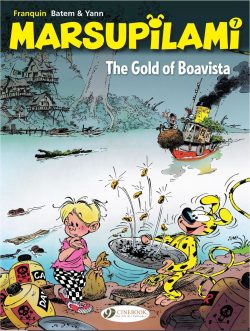
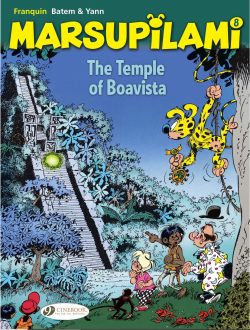
Marsupilami volumes 7 & 8: The Gold of Boavista & The Temple of Boavista


By Yann & Batem, coloured by Cerise and translated by Jerome Saincantin (Cinebook)
ISBN: 978-1-80044-069-2 (Album PB/Digital edition Gold)
ISBN: 978-1 80044-099-9 (Album PB/Digital edition Temple)

Win’s Christmas Gift Recommendation: Mad Monkeyshines with Gallic Aplomb… 9/10

One of Europe’s most popular comic stars is an eccentrically irascible, loyally unpredictable, super-strong, rubber-limbed ball of explosive energy with a seemingly infinite elastic tail. The frantic, frenetic Marsupilami is a wonder of nature and icon of European entertainment originally spun-off from another immortal comedy adventure strip…

When Andre Franquin began crafting eponymous keystone strip Spirou for eponymous flagship publication Le Journal de Spirou, he quickly abandoned the previous format of short complete gags to pioneer longer adventure serials, and began introducing a wide and engaging cast of new characters.

For 1952’s Spirou et les heritiers, he then devised a beguilingly boisterous South American critter and tossed him like an elastic-arsed grenade into the mix. Thereafter – until resigning in 1969 – Franquin constantly added the bombastic little beast to Spirou’s increasingly incredible escapades…

Marsupilami popped up constantly: a phenomenally popular wonder animal who inevitably grew into a solo star of screen, toy store, console games and albums all his own. In 1955 a contractual spat with Dupuis saw Franquin sign up with publishing rivals Casterman for Le Journal de Tintin: collaborating with René Goscinny and old pal Peyo whilst creating raucous gag strip Modeste et Pompon.

Franquin and Dupuis patched things up within days, and he went back to Le Journal de Spirou. In 1957, he co-created Gaston Lagaffe, but was still legally obliged to carry on his Tintin work too. From 1959, writer Greg and background artist Jidéhem assisted, but over the next decade Franquin reached his Spirou limit. In 1969 he quit for good, taking his mystic yellow monkey with him…

Plagued by bouts of depression, Franquin passed away on January 5th 1997, but his legacy remains: a vast body of work that reshaped European comics. Moreover, having learned his lessons about publishers, Franquin retained all rights to Marsupilami and in the late 1980’s began publishing his own adventures of the rambunctious miracle-worker.

He recruited old comrade Greg as scripter and invited commercial artist/illustrator Luc Collin (AKA Batem) to collaborate on – and later monopolise – art duties for the new adventures. In recent years, the commercial world triumphed again and – since 2016 – the universes of Marsupilami and Spirou have reconnected, allowing the old firm to participate in shared exploits of a world created and populated by Franquin.

Graced with a talent for mischief, the Marsupilami is a deviously ingenious anthropoid inhabiting the rainforests of Palombia. One of the rarest animals on Earth, it speaks a language uniquely its own and has a reputation for making trouble and sparking chaos. The species is rare and is fanatically dedicated to its young. Sometimes that takes the form of “tough love”. This behaviour frequently extends to any humans it encounters and “adopts”…

The first of two books telling one tale, L’or de Boavista was released in October 1992. The seventh of 33 solo albums, it was followed a year later by concluding volume Le Temple de Boavista, combining into an edgily gripping comedy drama with much dark and scary social activism underpinning the usual hairy hijinks.

It opens in Palombian capital Chiquito, where children are going missing. No one cared when it was orphans and homeless urchins, but it’s quite different when Donald Maxwell-Trent plays truant and is abducted off the street. He’s spoiled, rich and the son of the US Ambassador…

Tragically, that means nothing to the ruthless thugs who need a constant supply of kids his size and age to work at an illegal, highly polluting goldmine in the jungle upriver. The toxic mess and mercury-made mire these Garimpeiros are creating has incensed and outraged the Marsupilami who now deems them his worst enemies ever…

After another of the yellow terror’s night attacks, overseer Solaria – a slightly older boy with an agenda of his own – helps Donald, now cruelly called “Gordito” by his malnourished comrades, to escape into the green hell. The older boy is only interested in freedom, wealth and returning to the undiscovered tribe he was stolen from, but from his cough may have waited too long to make his break…

Soon brutal gang boss Ingo is in hot pursuit, but his party’s progress is severely hampered by the stalking Marsu – whenever the golden beast isn’t clandestinely helping the fugitives. The furious furry (called by Polombians “El diablo”, and “La catestrofe amarilla”) is then instrumental in linking up the lads with an acceptable resident human…

Transplanted animal trainer Noah keeps his menagerie of friends on a river boat. Appalled by what Solario tells him, Noah resolves to stop the mining but that confrontation does not work out as planned and soon they are all fleeing for their lives up the dreaded Rio Boavista into lethal, legend-drenched “Spatoolah Territory” with dozens of killers on their collective tails…

To Be Concluded…


The dark drama heads into even wilder regions with The Temple of Boavista as relentless pursuit drives our heroes ever deeper into unexplored locales of the mighty tributary. Thankfully the hidden people they meet are mostly friendly, but their heightened state of fear is not ended for long. That night the jungle reverberates with horrific laughter emanating from a gargantuan edifice almost reclaimed by centuries of encroaching trees and vines…

The building is an ancient Zygomaztec temple and in its lee are some very nasty tomb robbers. Zoltan and Zorrino plan on stealing Noah’s floating zoo to carry their latest haul, but haven’t reckoned on the alliance of kids and tribal people, nor whatever is making the dire noises wracking the night with sinister sounds.

… And that’s before Ingo’s Garimpeiros and utterly fed up and furious Marsupilami get involved, or morose millionaire Harold “Buster” Stonelove and his safari guide Rhode Island Smith show up. These “ugly Americans” are looking for the secret of laughter and believe the raucous ruins can supply their answer, when they should be watching the yellow critter with the elastic tail and bad attitude…

As all the competing factions calamitously converge on the temple interior, a remarkable answer to the mirth mystery emerges and in a storm of giggling terror everybody gets jut what they deserve…

These eccentric exploits of the garrulous golden monkey are moodily macabre, furiously funny and pithily pertinent, offering engagingly riotous romps and devastating debacles for wide-eyed kids of every age all over the world. Fancy channelling your inner El Diablo and joining in the fun? It all starts with Hoobee, Hoobah Hoobah…
Marsupilami: The Gold of Boavista Original edition © Dupuis 1992, by Batem & Yann
Marsupilami: Temple of Boavista Original edition © Dupuis, Dargaud-Lombard s.a. 1993, by Batem & Yann, Franquin. All rights reserved. English translations © 2022 Cinebook Ltd.
© Marsu Productions 1992. All rights reserved. English translation © 2022 Cinebook Ltd.

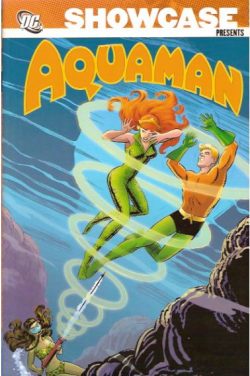
Showcase Presents Aquaman volume 3


By Bob Haney, Nick Cardy, Sal Trapani, Leo Dorfman & Pete Costanza & various (DC Comics)
ISBN: 978-1-4012-2181-2 (TPB)

We’re counting down to what augurs to be another Christmas movie megahit for DC, so let’s take a look at the lengthy history of page, screen, game and giant mutated seahorse…

Aquaman was one of a handful of costumed adventurers to survive the superhero collapse at the end of the Golden Age; a rather nondescript and genial guy who solved maritime crimes and mysteries when not rescuing fish and people from sub-sea disasters. Created by Mort Weisinger and Paul Norris, he first launched in More Fun Comics #73 (1941). Strictly a second stringer for most of his career he nevertheless continued on beyond many stronger features, illustrated by Norris, Louis Cazaneuve, Charles Paris, and latterly Ramona Fradon who drew every adventure from 1954 until 1960.

When Showcase #4 rekindled the public’s taste for costumed crimefighters with the advent of a new Flash, DC updated its small band of superhero survivors, especially Green Arrow and Aquaman. Records are incomplete, sadly, so often we don’t know who wrote what, but after the revamp fuller records survive and this third black and white collection starring the King of the Seven Seas has only two creative credit conundrums.

Now with his own title and soon to be featured in the popular, groundbreaking cartoon show Superman/Aquaman Hour of Adventure, the Finned Fury seemed destined for super-stardom. These joyously outlandish tales, reprinting issues #24-39, a Brave and the Bold team-up with The Atom (# 73) and a scarce-remembered collaboration from Superman’s Pal Jimmy Olsen #115 comfortably and rapturously mark the end of the wholesome, affable hero, laying groundwork for a grittily innovative run from revolutionary editor Dick Giordano and hot new talents Steve Skeates, Jim Aparo and Neal Adams…

Those are a treat for another time, but there’s entertainment a-plenty here beginning with Aquaman #24 (November/December 1965) by an uncredited author (Dave Wood, George Kashdan or Jack Miller are strong possibilities) and regular artistic ace Nick Cardy.

In ‘Aquaman: Save Our Seas!’, the titanic tussle with maritime malcontent The Fisherman found the new parents (the Sea King and Mera were the first 1960s superheroes to marry and have kids) almost fatally easily distracted when an alien plot threatens to destroy Earth’s oceans, whilst in #25, ‘The Revolt of Aquaboy!’ by Bob Haney & Cardy sees an ancient Chinese sorcerer rapid-age the proud parents’ newborn into a spiteful ungrateful teenager as part of a plot to subjugate the sunken city of Atlantis.

The entire world went spy-crazy in the first half of the Swinging Sixties and anonymous acronymic secret societies popped up all over TV, books and comics. With #26 (March/April 1966), Aquaman joined the party when seconded by the US government (even though absolute ruler of a sovereign, if somewhat soggy, nation) to thwart the sinister schemes of the Organisation for General Revenge and Enslavement in the still surprisingly suspenseful ‘From O.G.R.E. With Love!’

With Haney & Cardy firmly ensconced as creative team, thrilling fantasy became the order of the day in such power-packed puzzlers as #27’s ‘The Battle of the Rival Aquamen’ – wherein alien hunters unleash devious duplicates of the Sea King and his Queen – before #28’s ‘Hail Aquababy, New King of Atlantis!’ introduces rogue American geneticist Dr. Starbuck. He seeks to steal the throne with subtle charm, honeyed words… and a trained gorilla and eagle modified to operate underwater…

Archenemy Orm the Ocean Master returns to attack America – and the world – in tense undersea duel ‘Aquaman, Coward-King of the Seas!’, which also provides some startling insights into the hero and villain’s shared shadowy pasts as well as the requisite thrills and chills, after which ‘The Death of Aquaman’ proves to be a guest-star-studded spectacular of subterfuge, double-cross and alien intrigue. The very much alive Sea King then finds himself a fish trapped out of water when ‘O.G.R.E. Strikes Back!, attacking the United Nations!

Ocean Master’s obscured family connections clearly struck a chord with readers as he returns in #32 to unleash the ancient leviathan ‘Tryton the Terrible’ whilst the troublesome teenagers get a tacit acknowledgement of their growing importance with the introduction of Aqua-Girl in ‘Aqualad’s Deep-Six Chick!’ (stop wincing; they were simpler, more obnoxious times and the story itself – about disaffected youth being exploited by unscrupulous adults – is a perennial and worthwhile one).

Aquaman #34 featured another evil doppelganger ‘Aquabeast the Abominable’, typifying a new, harsher sensibility in storytelling. Even though the antagonists were still generally aliens and monsters, from now on they were far meaner, scarier aliens and monsters…

The Sea King teamed up with Justice League of America compatriot The Atom in The Brave and the Bold # 73 (August/September 1967) to tackle a microscopic marauder named ‘Galg the Destroyer’ in a taut drama written by Haney and illustrated by always impressive and vastly undervalued Sal Trapani, before returning to his home-title and another deadly clash with Ocean Master and ruthless nemesis Black Manta. Never afraid to tweak the comfort zone or shake up the status quo, Haney’s excellent tale ‘Between Two Dooms!’ epitomises the growing darker sensibilities of the title, resulting in all Atlanteans losing their ability to breathe underwater, leaving Aquaman’s subjects virtual prisoners in their own sub-sea city for years to come…

Now a TV star, Aquaman went from strength to strength as Haney & Cardy pulled out all the creative stops on such resplendent battles tales as ‘What Seeks the Awesome Three?’ – pitting the hero against mechanistic marauders Magneto (no relation), Claw and Torpedo-Man – and chillingly prophetic eco-drama ‘When the Sea Dies!’, due in no small part to villains Ocean Master and The Scavenger.

Closing out his volume are two more dark thrillers and a classic guilty pleasure. Firstly, Aquaman #38 introduced a relentless, merciless vigilante who accidentally set his sights on the Atlantean Ace in ‘Justice is Mine, Saith the Liquidator!’, before ‘How to Kill a Sea King!’ tells a tragic tale of an alien seductress set on splitting up the Royal Couple. The era and this collection end with a charming treat from scripter Leo Dorfman and artist Pete Costanza taken from Superman’s Pal Jimmy Olsen #115 (October 1968).

The greatest advantage of these big value monochrome compendia was the opportunity they offered, whilst chronologically collecting a character’s adventures, to include crossovers and guest spots from other titles. When the star is as long-lived and widely travelled as Aquaman, that’s an awful lot of extra appearances for a fan to find, so the concluding tale here – taken from a title cruelly neglected by today’s fans – is an absolute gold-plated bonus…

‘Survival of the Fittest!’ sees the mystical Old Man of the Sea attempt to replace Aquaman with the far more pliant cub reporter: never realising the lad is made of far sterner and more decent stuff than the demon could possibly imagine…

DC has a long, comforting history of genteel, innocuous yarn-spinning delivered with quality artwork. Haney & Cardy’s Aquaman is an all-but-lost run of classics worthy of far more attention than they’ve received of late. It is a total pleasure to find just how readable they still are. With tumultuous sea-changes in store for the Sea King, the comics industry and America itself, the stories in this book signal the end of one glorious era and the promise – or threat – of darker, far more disturbing days to come.
© 1965-1968, 2009 DC Comics. All Rights Reserved.

Daydreams and Nightmares – The Fantastic Visions of Winsor McCay (second edition)


By Winsor McCay & various (Fantagraphics Books)
ISBN: 978-1-56097-569-4 (TPB/Digital editions)

Win’s Christmas Gift Recommendation: Picture Perfect… 10/10

Winsor McCay was a cartoonist and animator best known for Little Nemo in Slumberland. There was of course, so much more to him and this retrospective touches on the man whilst displaying a glorious abundance of his many graphic marvels.

Born in Spring Lake, Michigan, on 26th September, 1869 (or maybe 1871 in Canada: records differ) Zenas Winsor McCay was a brilliant and hugely successful cartoonist and animator who worked on newspaper illustrations, strips and political panels from 1898 until his untimely death in 1934.

This collection (a remastered release of a 1998 celebration) offers up some sublime examples of his many oeuvres. Following a Foreword by Gary Groth and context-packed biographical preface ‘The Dream Master’ by Richard Marschall, the man himself relates what we need to know in his own words thanks to 1927 essay ‘From Sketchbook to Animation by Winsor McCay’ and a 1926 letter to fellow artisan Clare Briggs (Danny Dreamer, Mr. and Mrs.) ‘On Being a Cartoonist’ before we begin a magical trawl through a magnificent career…

Spanning 1989 to 1903 – when McCay signed with The New York Herald publisher James Gordon Bennett – ‘Chapter One: Early Magazine Work’ offers political broadsides, early editorial diatribes in pictorial form, social commentary and pure illustration pieces, albeit gradually trending towards his later fascination with fantastic architecture and parlous prognostications of cultural collapse, before ‘Chapter Two: Newspaper Fantasy Illustrations’ focusses on wry speculative futurism – a popular topic of periodical publication back then…

Encompassing 1904-1924, ‘Chapter Three: Midsummer Daydreams and Other Comic Strips’ offers timeless examples of his ceaseless cartoon endeavours including A Pilgrim’s Progress, Poor Jake, Midsummer Daydreams/Daydreams, It Was Only a Dream, The Dreams of a Lobster Fiend, The Faithful Employee, He’s One of Those Telephone Lobster Fiends, And Then – Kerchoo! – He Sneezed!, Everyone Has Met That Well Known Character, Mr. Duck, and Rabid Reveries but sadly omits Jungle Imps, Dull Care, The Man from Montclair, Mr. Bosh, Hungry Henrietta and It’s Nice to be Married…

On October 15th 1905 the most important children’s strip in the world debuted in the Sunday Herald but Little Nemo in Slumberland had precursors and indeed a mature-reader rival. ‘Chapter Four: Dream of the Rarebit Fiend’ explores the many variations and iterations penned (and inked) from 1904 to 1913. Tireless McCay had conjured up visions for adult readers of The Evening Telegram, initially entitled Dream of the Rarebit Fiend. The editor, wishing to distance the feature from other strips, required McCay to use a pen-name, and he complied, signing the strips “Silas”, reputedly after a local garbage cart driver.

Where Nemo was a beautifully clean formal and surreal fantasy of childish imagination, Fiend displayed a creepy, subdued tension resonant with the fears and worries of its adult audience. Black, cruel and often outright sick humour pervades the series combining monstrous destruction and expressionist trauma. Even root causes of otherworldly nightmares were salutary. Each self-contained episode (18 reproduced here) and disturbing sequence of unsettling or terrifying, incredibly realistic images was the result of overindulgence; usually in late night toasted cheese treats!

Every anxiety from surreal terror to social embarrassment was grist for the fantasist’s mill and startling perspectives, bizarre transformations and uncanny scenes – always immaculately rendered – made the strip hugely successful and well-regarded strip in its day.

In 1906, American film pioneer Edwin S. Porter created a landmark 7-minute live action special-effects movie entitled The Dream of a Rarebit Fiend and the Edison company produced a cylinder recording with the same name the following year – played by the Edison Military Band. McCay himself produced four animated shorts in 1916-17: Dream of a Rarebit Fiend; Dreams of The Rarebit Fiend: The Pet, Dreams of The Rarebit Fiend: The Flying House and Dreams of The Rarebit Fiend: Bug Vaudeville, and despite his many other later successes returned to the feature sporadically over the years. Between 1923 – 1925 he revived it as Rarebit Reveries, officially attributing the strip to his son who signed the panels Robert Winsor McCay, Jr.

An artist hugely in-demand then and revered today, from 1903 to 1906 McCay invented many other all-ages cartoon works and ‘Chapter Five: Sunday Excursions’ highlights one of most enduring and inventive with 18 episodes of Little Sammy Sneeze, before the linear lunacy ends with his speculations on the world, its people and impending dystopias in ‘Chapter Six: Sermons on Paper’ with 54 stunning tableaux full-page rendered between 1913-1934, shaped by war and other disasters depicting so very many ways humanity could end and so few where we stop our species’ extinction event…

Although working far more than a century ago McCay still affects all aspects of graphic narrative produced ever since and his visions are more pertinent now than in his own lifetime. A darker side of an absolute master of our art form, this is work you must see and cannot miss.
Daydreams and Nightmares © 2005 Fantagraphics Books.

Alone in Space – A Collection


By Tillie Walden (Avery Hill Press)
ISBN: 978-1-910395-58-5 (HB/Digital edition)

Win’s Christmas Gift Recommendation: A Time of Wonders to Be Reseen… 10/10

Transitions are important. In fact, they are life changing. But so can be looking to where we just came from. In this superb compilation you can see some of how the amazing Tillie Walden got to where she is now.

We usually attribute wisdom and maturity in the creative arts to having lived a bit of life and getting some emotional grit in our wheels and sand in our faces, but – at least in terms of age – that’s not the case for the Texas-raised pictorial raconteur, whose beguiling string of releases include On a Sunbeam, Clementine, Spinning and Are You Listening?

Walden is still a relative newcomer – albeit a prolific one – who has garnered heaps of awards and acclaim. Whether through fiction or autobiographical works (frequently both at once), she can engender feelings of absolute wonder, combined with a fresh incisive view and measured, compelling delivery in terms of both story and character. Her artwork is sheer poetry.

Following an erudite and recapitulating Introduction by Warren Bernard the comics begin with a breakthrough moment. The remarkably adept neophyte auteur began her rise with Ignatz Award-winning debut graphic novel The End of Summer. Compelling and poignant, it is a family drama fantasy, chillingly reminiscent of Nordic literary classicists like Henrik Ibsen, Astrid Lindgren or Tove Jansson, thematically toned like Brian Aldiss’ Helliconia novels whilst visually citing Dave Sim’s Cerebus collections High Society & Church & State.

Most impressive is the fact that The End of Summer was crafted in 2015 as a side-project whilst Walden was finishing her First-Year major assignment at the Center for Cartoon Studies in White River Junction, Vermont. There are further treats from that time at the back of this epic collection, which also include this story’s prequel ‘Lars and Nemo’.

Like everything Walden creates, this is a story I hesitate to describe because it’s a beguiling immersive experience that doesn’t need me spoiling it for you. Get it, read it, tell a friend.

What I will say is this: in distant place servants and staff rush to seal a colossal, cathedral-like palace. Winter is coming and the palatial bunker will be closed off for three years…

In that oppressive atmosphere, frail prince Lars and his twin sister Maja become increasingly aware of the tensions and quirks afflicting their large family.

Lars’ failing physicality has made him a quiet, introspective and fatalistic observer, whilst his dependence on Nemo – a gigantic housecat acting as companion and living, loving wheelchair – mark him as a marginalised target for siblings Olle, Per, Nikolaus and Hedda. As time passes and the children seek ways to amuse themselves, increasingly unstable Per seems to find the oppressive isolation and vast scale of the palace as well as the disinterest and suppressed tensions of the adults incomprehensibly claustrophobic.

Before long, the dooms and disasters Lars is obsessed with start to manifest, leading to tragedy and terror…

Beautifully illustrated in monochrome tones, with Brobdingnagian perspectives shaping every panel, this saga of an opulent yet cold House of Secrets, shielding a broken family from the elements but not themselves and each other, is a superb examination of humanity at its best and worst.

Walden followed up on her Ignatz Award-winning debut with this fluffy yet barbed coming-of-age tale. Part Sweet but not Calorific, I Love This Part deliciously pictorializes life-changing happy, introspective, contemplative and aspirational moments between two schoolgirls who have found each other. Shared dreams, idle conversations, disputes and landmark first steps, even fights and break-ups are seen and weathered.

Novelty, timidity, apprehension, societal pressure and even some unnecessary shame come into it, but generally it’s just how young people learn to love and what that that can entail…

Apart from the astoundingly graceful and inviting honesty of the tale, the most engaging factor is the author’s brilliant dismissal of visual reality. These interactions are backdropped by wild changes in dimension and perspective, abrupt shifts in location and landscape and shots of empty spaces, all adding a sense of distance and whimsy to very familiar proceedings.

Walden is a great admirer of Little Nemo so fellow afficionados will feel at home even if some might experience the odd sensation of disorientation and trepidation. Like being in love, I suppose…

A City Inside is another seamlessly constructed marriage of imagination and experience to unflinching self-exploration, constructing a perfect blend of autobiography and fantasy into a vehicle both youthfully exuberant and literary timeless.

Opening in a therapy session, the story delves intimately into a woman’s past, from isolated southern days to bold moments of escape – or is that simply drifting away? – in search of peace and a place to settle. We all leave home and then grow up, and here that transition is seen through a tentative alliance with an idealised first love. It fumbles and fails thanks to the dull oppression of the Happy Ever After part that no fairy tale ever warns you about…

Eventually life builds you into the being you are – hence the symbolism of a vast internal metropolis – and life goes on, or back, or away, or just somewhere else. That’s pretty much the point…

Supremely engaging, enticingly disturbing and ultimately utterly uplifting, this shared solo voyage to another county is a visual delight no lover of comics can possibly resist. Apart from the graceful honesty on show, the most engaging factor is the author’s inspired rearrangement of visual reality. These dictate mood and tone in a way a million words can’t, supplying a sense of grace and wistful whimsy to the affair.

You’d have to be bereft of vision and afflicted with a heart of stone to reject these comic masterpieces, but for many even more rewarding is a glimpse at how that narrative acumen developed.

Rounding out this epic tome is a wealth of Comics by Tillie Walden Aged 16-20 Years Old: all accompanied by author’s commentary to foster understanding or highlight points of interest. From 2013, ‘Glare’ details a childhood spat before 2014’s ‘My Name Is…’ acts as an introduction to a new student whilst the same year sees the artist dabble with colour on a visit to ‘Slumberland’…

Scale and compression inform visual experimentation in 2014’s ‘Cramped’, ‘Journal Entry’ and ‘The Graduate’ after which 2015’s growth opens with longer works and a tribute to major influence ‘Ghibli’ followed by evocative breakthroughs ‘Lost Trees’ and ‘Dreaming’. That same year looking back to childhood spawned oppressive fancy ‘Sun in My Eyes’ and graduation piece ‘In the Palm of Your Hand’…

In 2016 rapid fire soliloquy ‘The Weather Woman’ led to aforementioned prequel ‘Lars and Nemo’ (don’t read it first, okay?) and Walden’s first trip to space in ‘Alive’ ending with a reflective slice of visual verity in ‘What it’s Like to be Gay in an All Girls Middle School’.

Rounding out the candid review is course project delight ‘Q & A’ and fantasy moment ‘The Fader’ (2018) segueing into a stunning Gallery section of promotional prints, posters, variant book covers, and bookplates.

Superbly engaging, shockingly nuanced and movingly beautiful, these works are pure comics magic no lover of the artform should miss.
© Tillie Walden 2021. All rights reserved.