
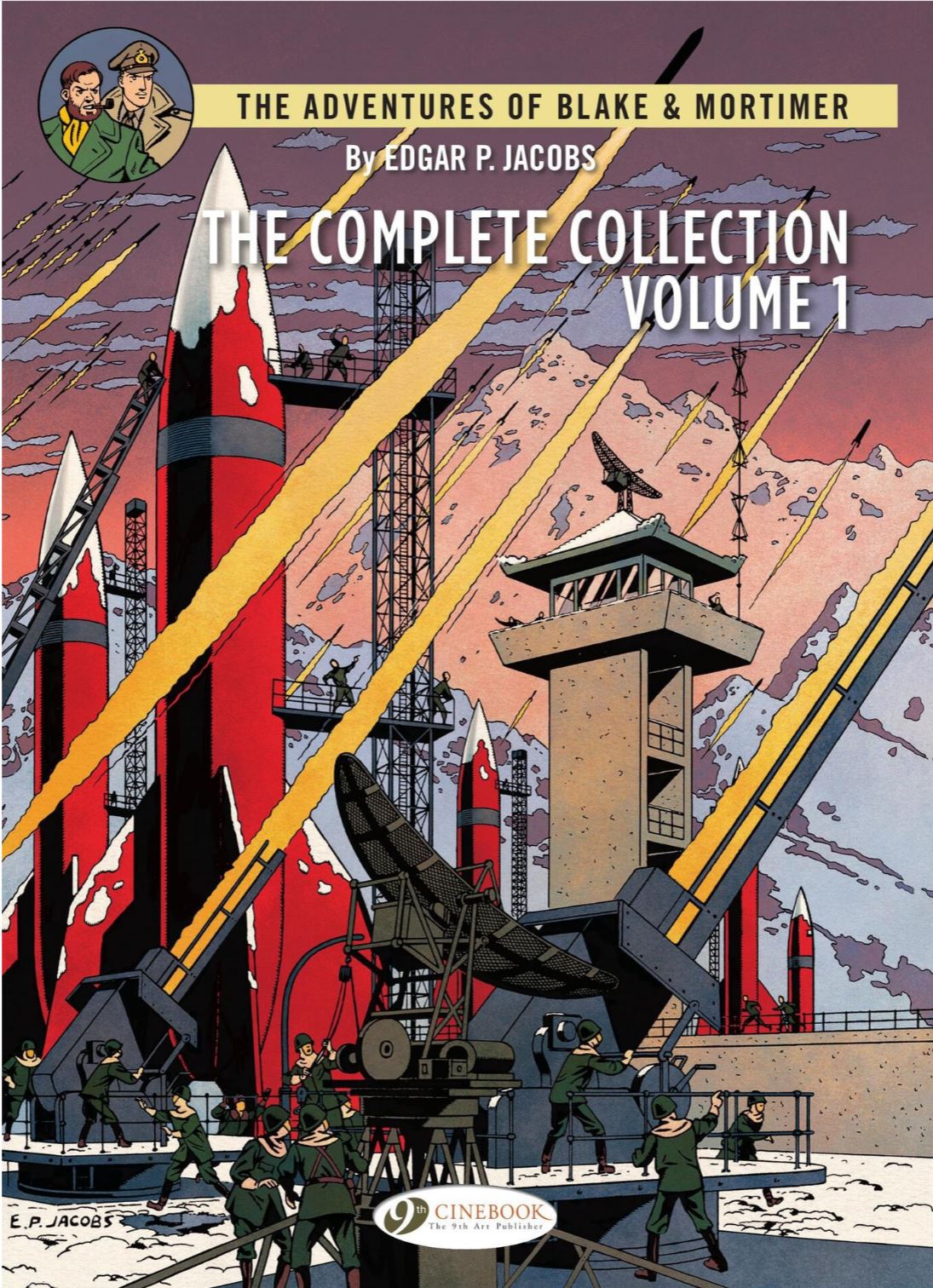
By Edgar P. Jacobs, coloured by Philippe Biermé & Luce Daniels, with material by Brieg F. Haslé & Nicolas Thibaudin, translated by Jerome Saincantin (Cinebook)
ISBN: 978-1-80044-147-7 (Album HB), 978-1-80044-776-9 (Digital edition)
This book includes Discriminatory Content produced during less enlightened times.
Today in 1946, the European post war comics revolution began with the release of multi-national anthology periodical Le Journal de Tintin. This strip was the Other big draw of those early years and remains one of my all-time favourites…
Le Journal de Tintin launched on 26th September 1946, and evolved through the post-war Years to become a benchmark of quality comics storytelling. Initially “the magazine for the Youth from 7 to 77” was intended to create longform stories for later book publication by serialising stories in increments – a method still used to this day. It sold in a number of countries and regions in their own languages, initially combining new material with recycled and modified episodes of previous Tintin tales, before moving to all new material. Publication ceased in 1993, with the 29th June edition.
For the first three years LJdT was home to an astounding unfolding epic that enthralled the readership. The first of so many, The Adventures of Blake and Mortimer were converted into books which been tweaked over decades and are presented complete in this single volume, which gathers The Secret of the Swordfish part 1 The incredible Chase; Part 2 Mortimer’s Escape; and Part 3 SX1 Strikes Back, and includes fascinating background features by Brieg F Haslé and Nicholas Thibaudin…
Belgian Edgard Félix Pierre Jacobs (1904-1987) is rightly regarded as one of the founding fathers of the Continental comics industry. Although his output was relatively scant compared to some of his contemporaries, the iconic series he created formed the basis and foundation of the art form in Europe, and his splendidly adroit, roguish yet impeccably British adventurers Blake and Mortimer – from the premiere issue of Le Journal de Tintin onwards – became a staple of post-war European kids’ life, the way Dan Dare would in Britain across the 1950s.
E.P. Jacobs was born in Brussels, a precocious child who began feverishly drawing from an early age but was even more obsessed with music and the performing arts – especially opera. He attended a commercial school but, determined never to work in an office, pursued art and drama following his graduation in 1919. A succession of odd jobs at opera-houses; scene-painting, set decoration, acting and singing as an Extra supplemented his private performance studies, and in 1929 Jacobs won a Government award for classical singing. Sadly, his proposed career as an opera baritone was ended by the Great Depression, as the Arts sector took a nosedive following the stock market crash.
Picking up whatever stage work was going (including singing and performing) Jacobs segued into commercial illustration in 1940 and regular employment came from the magazine Bravo. While illustrating short stories and novels, Jacobs famously took over the syndicated Flash Gordon strip after occupying German authorities banned Alex Raymond’s quintessentially All-American Hero. This left the publishers desperately seeking someone to satisfactorily complete the saga., but Jacobs’ Stormer Gordon lasted less than a month before being similarly sanctioned by the Nazis. Thus Jacobs created his own epic science-fantasy feature in the legendary Le Rayon U: a milestone in both Belgian comics and science fiction adventure. The U Ray was a huge hit in 1943 and scored big all over again a generation later when Jacobs reformatted the original “text-block & picture” material to incorporate speech balloons before re-running the serial in Le Journal de Tintin, with subsequent releases forming a trio of graphic albums in 1974.
There are conflicting accounts of how Jacobs and Tintin creator Hergé got together and why they parted ways professionally, if not socially, but as to the whys and wherefores of the split, I frankly don’t care. What is known is this: whilst crafting the weekly U Ray, one of Jacob’s other jobs was scene-painting, and during the staging of a theatrical version of Tintin and the Cigars of the Pharaoh, Hergé and Jacobs met and became friends. If the comics maestro was unaware of Jacob’s comics output before then, he was certainly made aware of it soon after. Jacobs began working on Tintin, colouring the original monochrome strips of The Shooting Star from newspaper Le Soir for a forthcoming album collection. By 1944, Jacobs was performing similar service for Tintin in the Congo, Tintin in America, King Ottokar’s Sceptre and The Blue Lotus. By now, he was also contributing to the illustration as well, on extended epic The Seven Crystal Balls/Prisoners of the Sun.
Jacob’s love of opera made it into the feature as Hergé (who loathed the stuff) teasingly created bombastic Bianca Castafiore as a comedy foil and based numerous bit players (like Jacobini in The Calculus Affair) on his long-suffering assistant. After the war and liberation, publisher Raymond Leblanc convinced Hergé, Jacobs and other creatives to work for his new venture. Launching publishing house Le Lombard, he also started Le Journal de Tintin, an anthology comic. Edited by Hergé, with various language editions in Belgium, France and Holland starring the intrepid boy reporter plus a host of newer heroes.
Beside Hergé, Jacobs and writer Jacques van Melkebeke, the comic also featured Paul Cuvelier’s Corentin and Jacques Laudy’s ‘The Legend of the Four Aymon Brothers’. Laudy had been a friend of Jacobs’ since they worked together on Bravo, and the first instalment of foreboding epic thriller serial Le secret de l’Espadon starred a bluff, gruff British scientist Professor Philip Mortimer as well as an English Military Intelligence officer who was closely modelled on Laudy: Captain Francis Blake.
The complete serialised saga ran from issue #1 (26th September 1946 to September 8th 1949): and confirmed Jacobs’ status as a star in his own right. In 1950, with the first 18 pages slightly redrawn, Le secret de l’espladon V1 (The Secret of the Swordfish – The Incredible Chase) became Le Lombard’s first album release; with the concluding part published 3 years later. Those volumes were reprinted nine more times between 1955 – 1982, with an additional single complete deluxe edition released in 1964. In 1984 the story was reformatted and repackaged in English translation as 3 volumes with additional material (mostly covers from the weekly Tintin added to the story as splash pages). It was part of a European push to win some of Britain’s lucrative love of Tintin & Asterix, but ended after seven volumes, having failed to find an audience. Happily, Cinebook successfully reintroduced us to the dashing duo – albeit after publishing later adventures first – and you can revel in their wonderment in either paperback album or eBook formats. Or in this Complete edition…
Hergé & Jacobs purportedly suffered a split in 1947 when the former refused to grant the latter a by-line on new Tintin material, but since they remained friends for life and Jacob’s continued to produce Blake and Mortimer for the Belgian weekly, I think it’s fair to say that if such was the case it was a pretty minor spat. I suspect The Secret of the Swordfish was simply taking up more and more of the brilliant, diligent artist’s time and attention…
The U Ray also provided early visual inspiration for Blake, Mortimer and implacable nemesis Colonel Olrik, who bear more than passing resemblances to heroic Lord Calder, Norlandian boffin Marduk and viperous villain Dagon.
One minor word of warning: by having the overarching enemies of mankind be a secret Asiatic “Yellow Peril” empire of evil, there’s potential for offence – unless one actually reads the text and finds that the presumed implicit racism is countered throughout by plenty of “good” ethnic characters and “evil” white folk. And remember the ultimate enemy Olrik could pass for a British stockbroker or political party candidate any day of the week…
This complete edition offers the entire epic in one almighty go and is sublimely supplemented by factual and contextual gold, mined by Brieg F. Haslé and Nicolas Thibaudin.

Delivered as The Secret Notebooks of Blake, Jacobs, and Mortimer, fun facts are broken down into engaging preparatory dossiers, divided by year and packed with candid preparatory material, designs and sketches. For 1946 we see a Synopsis of the first book; meet Jacobs ‘In his own words’; share ‘Mortimer’s Confidences’ and go ‘Behind the Scenes’ to examine extraordinary ‘Jacobsian Machines’ with ‘The Golden Rocket’. Then ‘Emblematic Characters’ reviews Olrik and we see ‘What Lies Behind a page’ with narrative techniques deconstructed in ‘The Third Word War Live… on Radio!’ before the initial episode begins…
The Secret of the Swordfish Part 1 – The Incredible Chase
Humanity’s next world war begins with ‘The Incredible Chase’ as a unknown army hidden in the Himalayas prepares to launch a global Blitzkrieg on a world slowly recovering from its second planetary conflagration. Wicked Basam Damdu, Emperor of Tibet, has assembled an arsenal of technological super-weapons and the world’s worst rogues such as insidious Colonel Olrik in a bid to seize control of Earth. However, a bold British-Asian spy has infiltrated the hidden fortress and surrenders his life to get off a warning message.
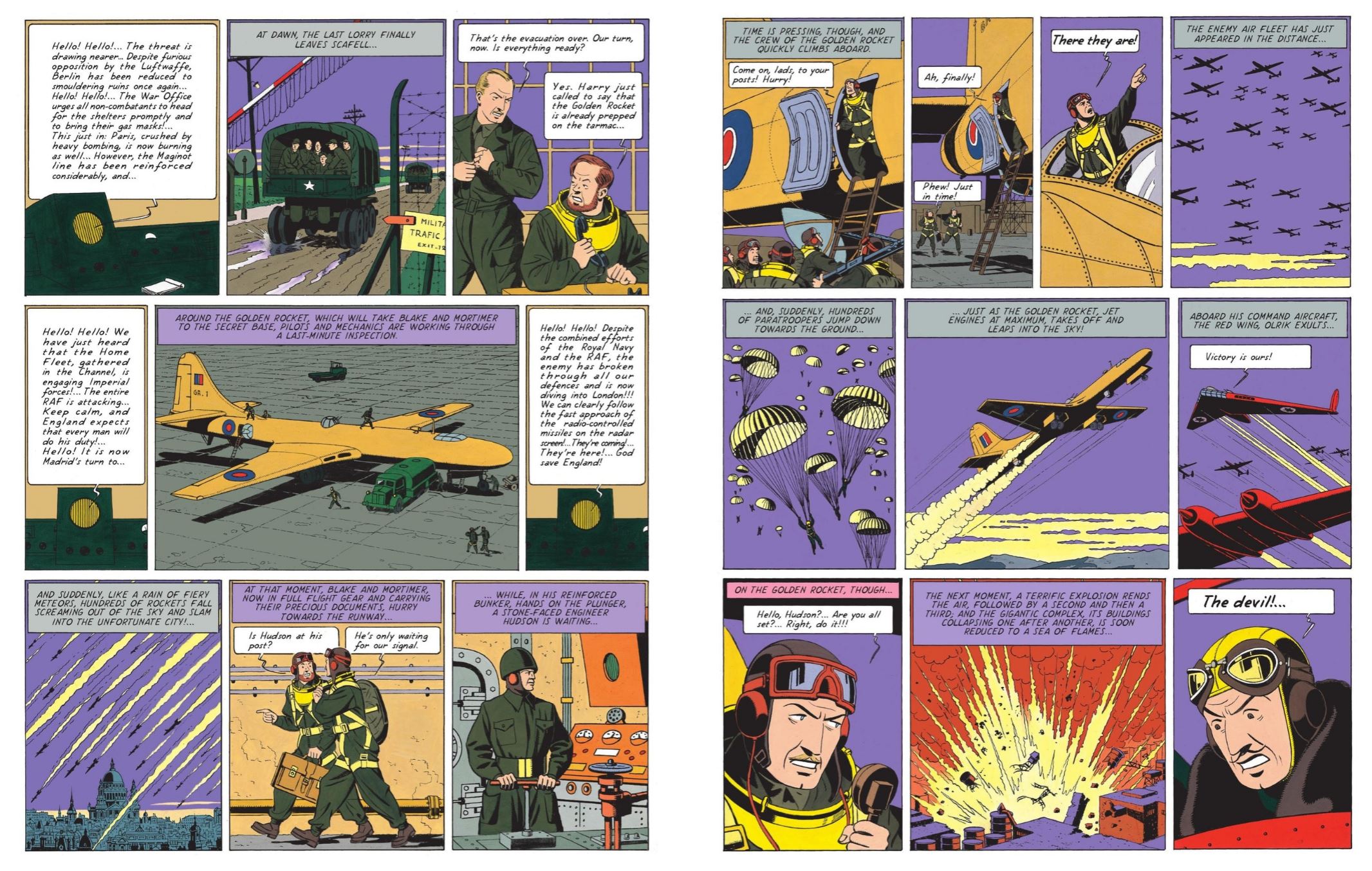
In England, physicist and engineer Philip Mortimer and MI5 Captain Francis Blake discuss the worsening situation at an industrial installation where the boffin’s radical new aircraft engine is being completed. When warning comes that the war begins that night, the old friends swing into immediate action. As super-bombers rain destruction down on all the world’s cities, Mortimer’s dedicated team prepares his own prototype, the Golden Rocket, for immediate launch, lifting off just as Olrik’s bombers appear over the desolate compound. Despite heavy fire, the Rocket easily outdistances rapacious Imperial forces, leaving ruined homes in its wake and the fleeing Britons flying into a hostile world now controlled by brutal maniac Basam…
Whilst attempting to join British Middle East resistance forces who possess another prototype super-plane, teething troubles and combat damage create tense moments in the fugitives’ flight. When the Rocket encounters a flight of jets, the test ship’s superior firepower enables it to fight free, but only at the cost of more structural deterioration. Fully failing now, the Rocket goes down in the rocky wilds between Iran and Afghanistan. Parachuting free of the doomed ship, Blake, Mortimer and the crew are machine-gunned by pursuing Empire jets…
Only three men make it to the ground safely and after days of struggle Blake, Mortimer and the indomitable Jim are cornered by Iranian troops who have joined Olrik’s forces. Sensing disaster, the Britons hide the plans to Mortimer’s super-plane, but one of the Iranians sees the furtive act. When no one is looking – especially his superiors – Lieutenant Ismail hurriedly scoops up the documents. Somehow, he misses one…
Under lock & key and awaiting Olrik’s arrival, the prisoners are accosted by Ismail, who sees opportunity for personal advancement which the Englishmen turn to their own advantage. Denouncing him, Blake instigates a savage fight between Ismail and his captain. During the brief struggle Jim sacrifices himself, allowing Blake & Mortimer’s escape with the recovered plans. Stealing a lorry, the desperate duo drive out into the dark desert night.
Followed by tanks into mountain passes, the wily pair trap their pursuers in a ravine just as hill partisans attack. The Imperial collaborators are wiped out and – upon trading information with the freedom fighters – the Englishmen take a captured vehicles to a distant rendezvous with the second Golden Rocket. Lack of fuel forces them to stop at a supply dump where they are quickly discovered, but by setting the dump ablaze, the heroes escape again. In the desert Olrik has arrived and found a sheet of notes left behind by Ismail. The cunning villain is instantly aware of what it means…
Fighting off aerial assaults from Empire jets and streaking for the mountains, Blake & Mortimer abandon their tank. Forced to travel on foot, they at last reach the meeting point where British-trained Sergeant Ahmed Nasir awaits them. The Indian served with Blake during the last war and is delighted to see him again, but as the trio make their way to the target site, they become aware that Olrik has already captured their last hope…
Only temporarily disheartened, the trio use commando tactics to infiltrate Olrik’s camp, stealing not the heavily-guarded prototype but the villainous Colonel’s own Red-Wing super-jet. Back on course to the British resistance forces, the seemingly-cursed fugitives are shot down by friendly fire: rebels perceiving the stolen plane as another enemy target.
Surviving this crash too, they are ferried in relative safety by apologetic tribesmen to enemy-occupied town Turbat. Whilst hiding, a spy of the Empire’s newly-appointed Wazir recognises the Englishmen. When Nasir realises they are in trouble, he dashes to the rescue but is too late to prevent Mortimer from being drugged. Sending the loyal Sergeant on ahead, Blake fights frantically to revive his comrade, even as Imperial troopers rapidly mount the stairs to their exposed upper room…
To Be Continued…
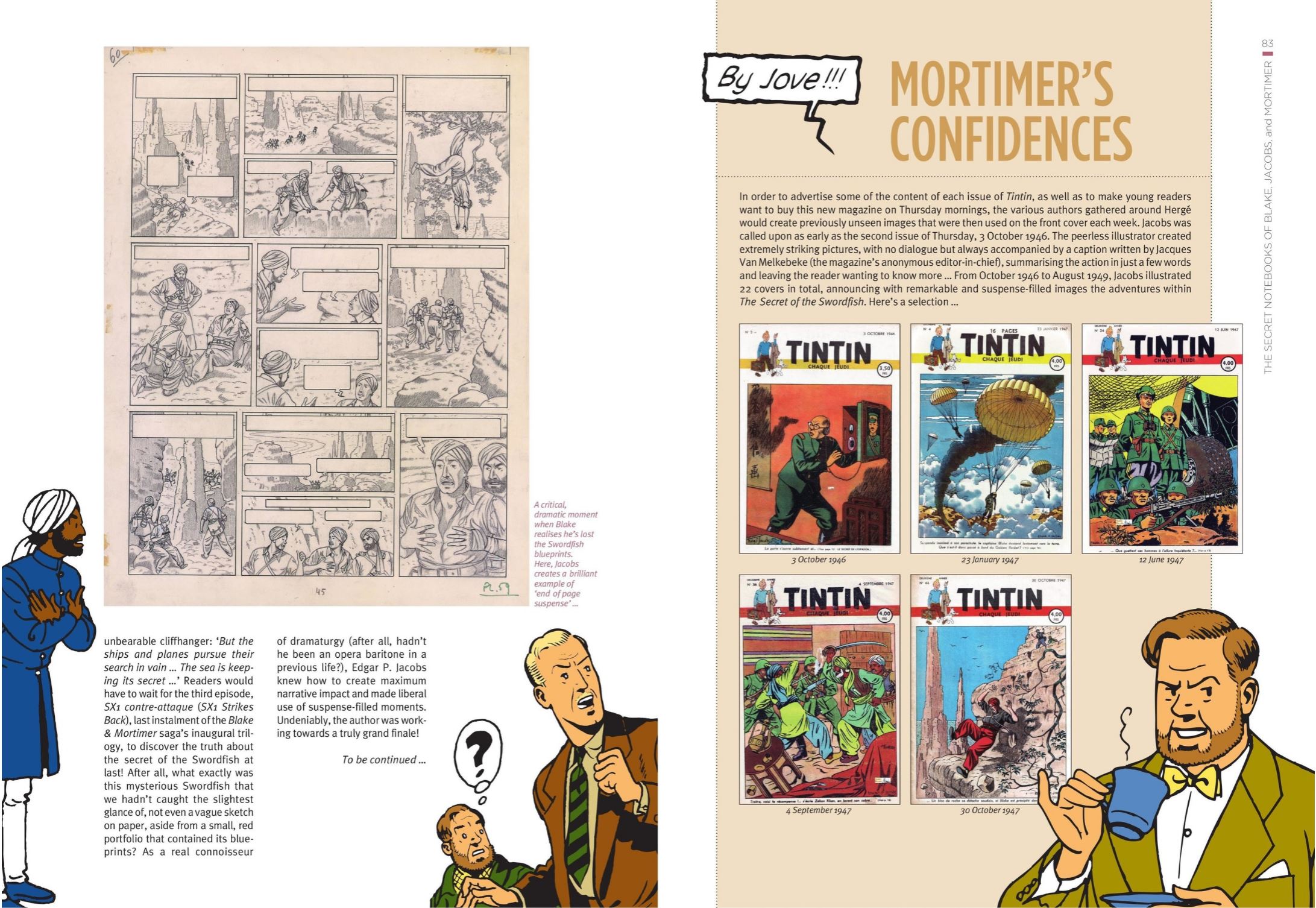
But only after Section 1947 offers more bonus material infilling the making of the tale. Here The Secret Notebooks… contribute another volume Synopsis while ‘In his own words’ concentrates on successor scripter Jean Van Hamme before Mortimer’s confidences reviews pertinent covers. ‘Behind the scenes’ focuses on the wide-ranging locations of the tale; Jacobsian Machines highlights ‘The Red Wing’ and Emblematic Characters explores the antecedents of arch villain Basam Damdu, whilst What Lies Behind a page and Setting The Mood delve into how Mortimer’s imprisonment is expressed, prior to the saga resuming…
The Secret of the Swordfish Part 2 – Mortimer’s Escape
This second instalment escalates the tale to another epic level, as the frantic action resumes with soldiers bursting into an empty chamber before being themselves attacked by the Khan. After a bloody firefight our heroes emerge from their cunning hiding place and flee Turbat, which has been seized by a furious spur-of-the-moment rebellion. Unknown to the fugitives, devious spy Bezendjas is hard on their heels and soon finds an opportunity to inform Olrik.
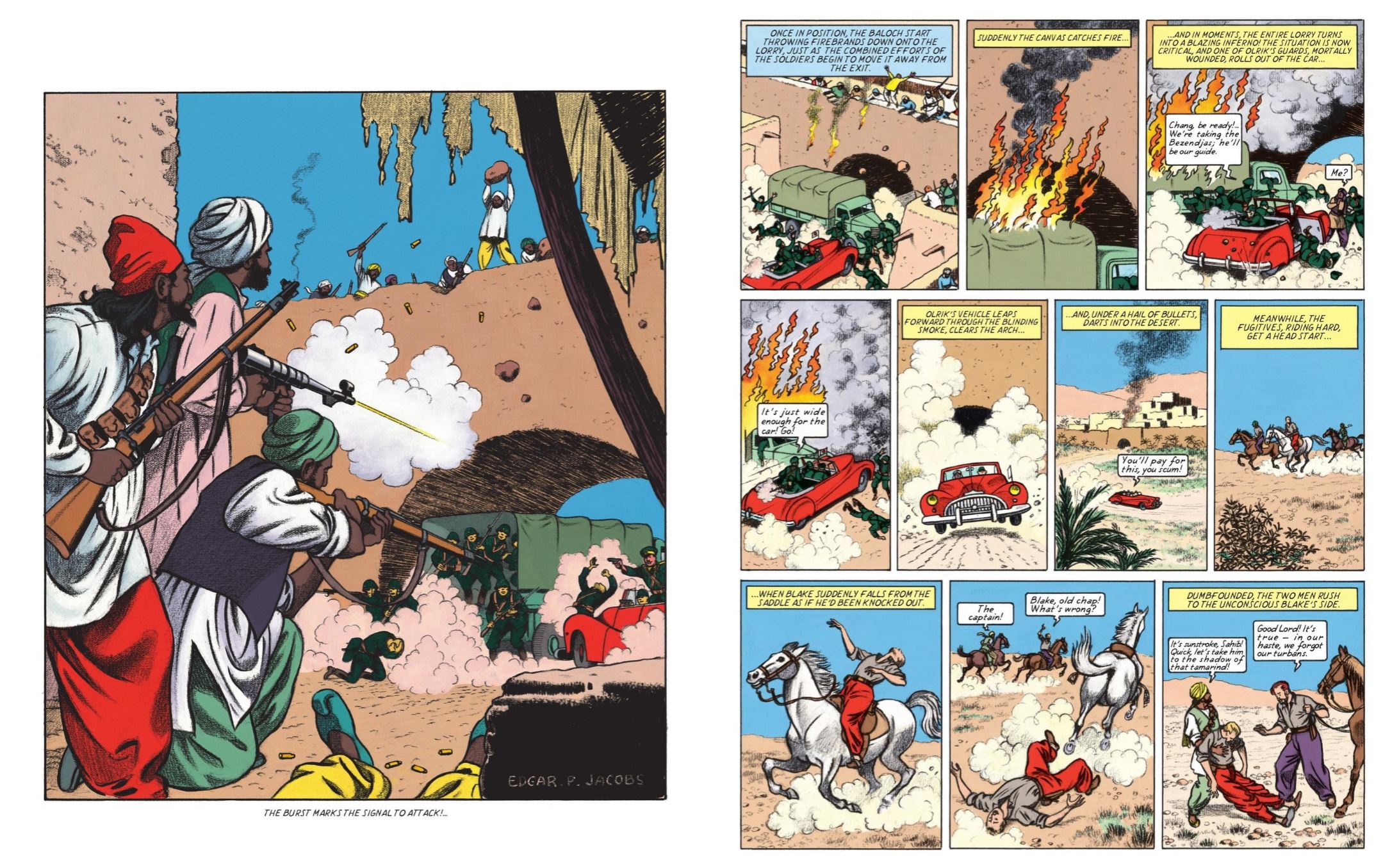
With the city in flames and fighting in every street, the callous colonel abandons his own troops to pursue Nasir, Blake & Mortimer into the wastes beyond the walls. On stolen horses the heroes endure all the ferocious hardships of the desert, but cannot outdistance Olrik’s staff-car. After days of relentless pursuit, they reach the rocky coastline and almost stumble into another Empire patrol. Whilst ducking them, Blake nearly falls to his doom…
Narrowly escaping death, the trio continue to climb steep escarpments and it is dusk before the Intelligence Officer realises that he has lost the precious plans and documents they have been carrying since fleeing England. Realising that someone must reach British resistance forces at their hidden Eastern base, the valiant comrades split up. Blake and Nasir continue onwards whilst Mortimer returns to the accident site. Finding the plans is a stroke of sheer good fortune, immediately countered by an ambush from Olrik’s troops. Despite a Herculean last stand, the scientist is taken prisoner, but only after successfully hiding the lost plans…
Three months later, Olrik is called to account in the exotic city-fortress of Lhasa. Basam-Damdu’s ruling council are unhappy with the Colonel’s lack of progress in breaking the captive British scientist, and even more infuriated by a tidal-wave of sabotage and armed rebellion throughout their newly-conquered territories. Even Olrik’s own spies are warning that his days as an agent of the Yellow Empire are numbered…
Given two days to make Mortimer talk, the Colonel returns to his base in Karachi just as another rebel raid allows Nasir to infiltrate the Empire’s HQ. Blake is also abroad in the city, having joined British forces in the area…
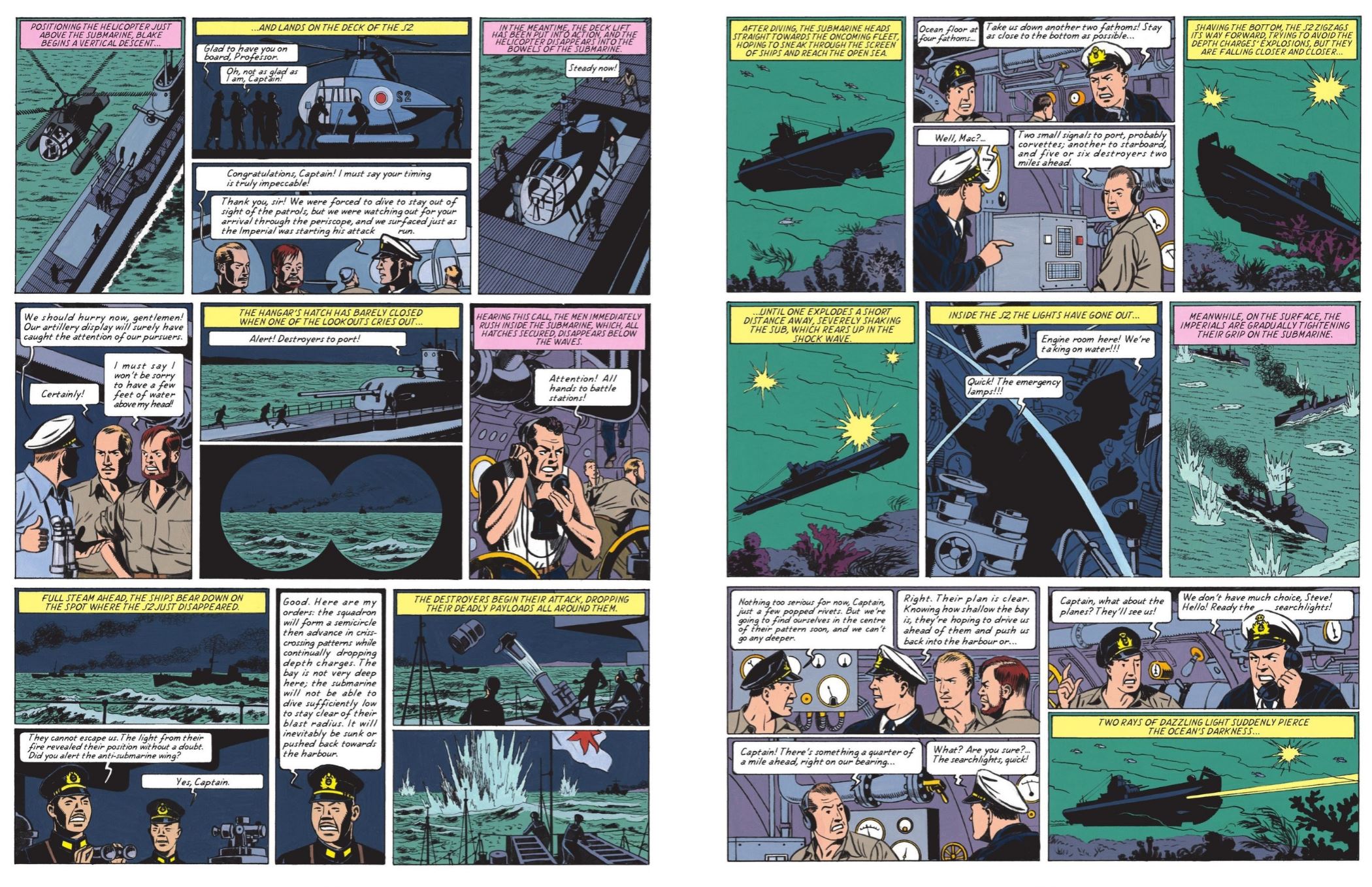
With less than a day to act, the MI5 officer rendezvous with a British submarine and travels to a vast atomic-powered secret installation under the Straits of Hormuz. Here, the Royal Navy are stoically preparing for a massive counter-attack on the Empire. With raids liberating interned soldiers all the time, ranks of scientists, technicians and soldiers are swelling daily.
Meanwhile, Nasir has his own desperate plan to free Mortimer, still adamantly refusing to talk of the mysterious “Swordfish” Olrik’s agents continually hear of…
Aware of his danger and the Sergeant’s efforts, Mortimer instead cunningly informs Nasir of the lost plans’ location, even as the impatient Emperor’s personal torturer arrives from Lhasa.
Always concerned with the greater good, Blake and a commando team secure the concealed plans and are met by Nasir who has been forced from Karachi after realising Bezendjas has recognised him. It appears that time has run out for their scholarly comrade…
Mortimer, however, has taken fate into his own hands. When the devious doctor Sun Fo begins his interrogation, the Professor breaks free and escapes into the fortress grounds during an earth-shattering storm. Trapped in a tower with only a handgun, he is determined to sell his life dearly, but is rescued by Blake and Nasir in a Navy Helicopter. Using the storm for cover, the heroes evade jet pursuit and an enemy naval sweep to link up with a British sub and escape into the night…
To Be Concluded…
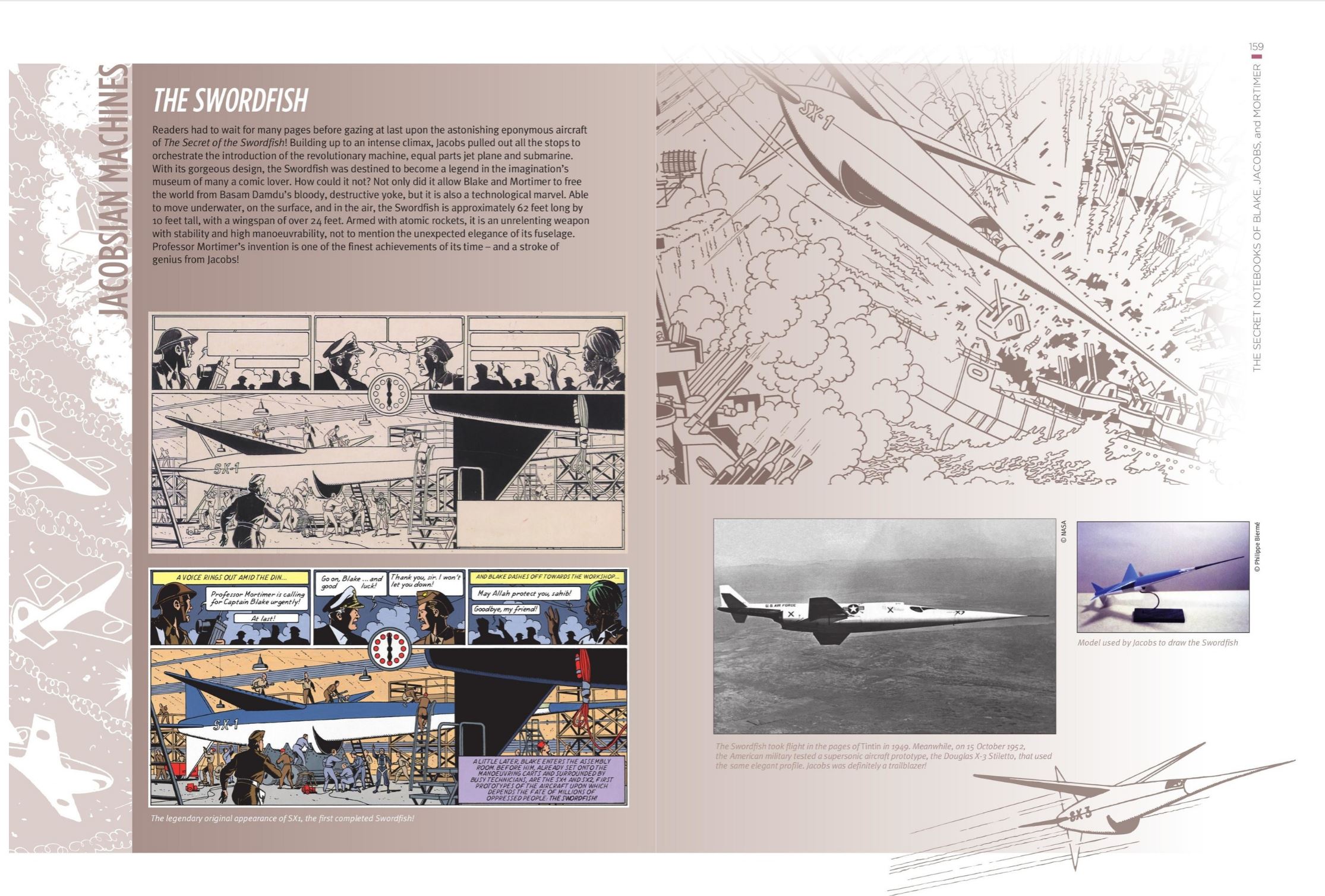
Haslé & Thibaudin conclude The Secret Notebooks of Blake, Jacobs, and Mortimer with 1949 providing more bonus material reconstructing the embattled world. A Synopsis and overview includes In his own words spotlighting Philippe Biermé (President of the Edgar P. Jacobs Foundation) and successor artist Ted Benoit before Mortimer’s confidences considers more historical inspirations for story characters, Behind the scenes reviews more iconic covers and reformatting the serial for book publication; Jacobsian Machines shares design secrets of The Swordfish and Emblematic Characters denounces Razul the Bezendjas. What Lies Behind a page and Setting The Mood concludes the briefing with a closer look at key scene The Spider Crab Pit before the saga concludes with The Secret of the Swordfish Part 3 – SX1 Strikes Back!
After three years of stunning intrigue, mystery and action, E.P. Jacobs’ groundbreaking saga of a battle for global peace and universal liberty concluded in a spectacular duel beneath the Earth and all-out war in the skies of the embattled world. SX1 Strikes Back sees a tension-drenched race against time as Blake, Mortimer and the shattered dregs of Britain’s military forces prepare for a last-ditch strike using the Professor’s greatest inventions to win freedom for the oppressed peoples of Earth…
It opens with a stunning reprise of past events – cunningly compiled from six full-page illustrations (original covers from weekly Le Journal de Tintin), before a bold commando raid liberates a trainload of British prisoners. Brought to a fabulous subterranean fortress, the assorted scientists and engineers discover an underground railway, factory, armaments-facilities and even an atomic pile, all furiously toiling to complete the mysterious super-weapon dubbed “Swordfish”. The P.O.W.s readily join the volunteers, blithely unaware that supremely capable scoundrel Olrik is amongst them in devilish disguise…
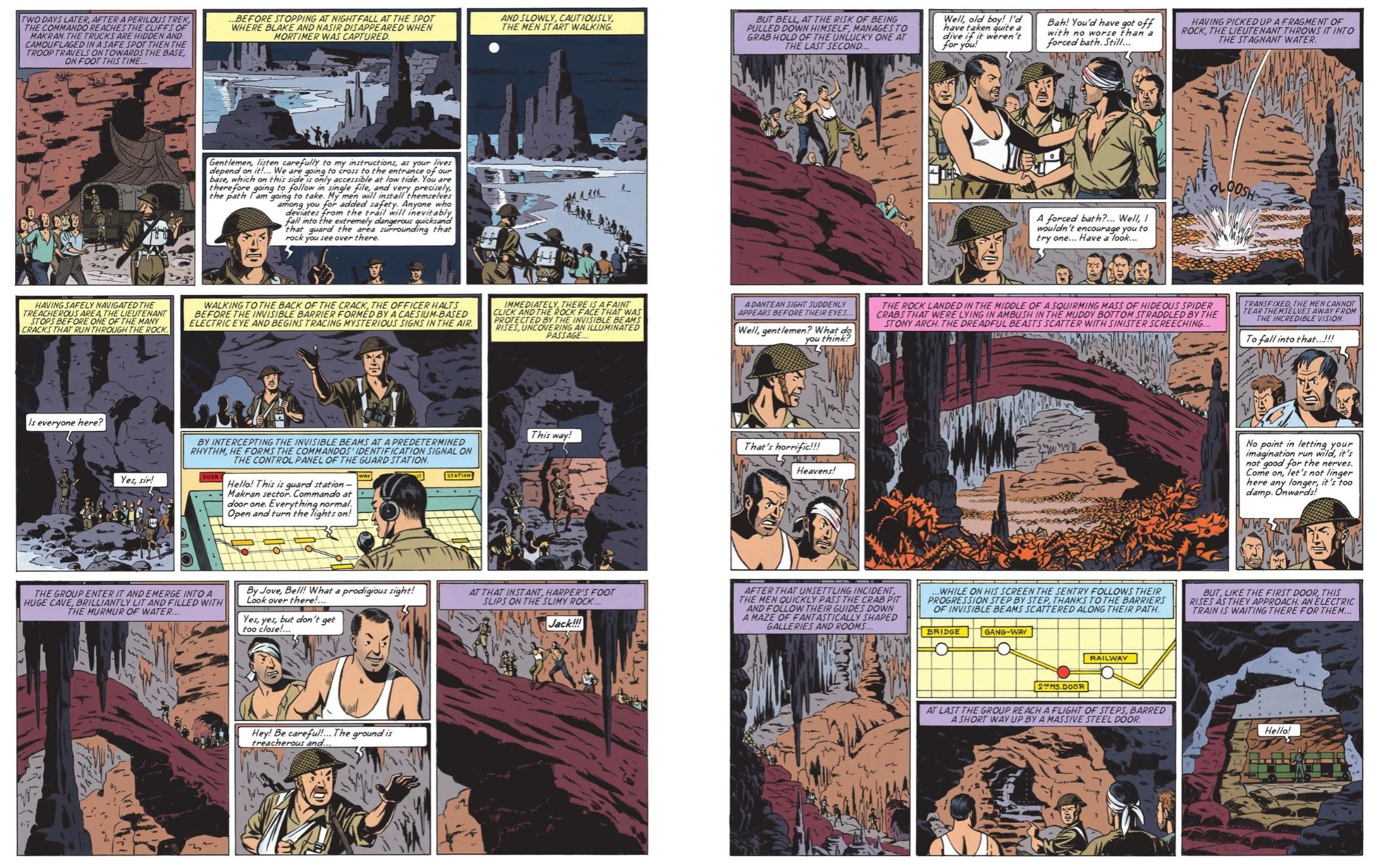
Days pass and as preparations for the Big Push produce satisfactory results, a slew of disastrous accidents lead to one inescapable conclusion: there is a saboteur in the citadel…
Eventually Olrik grows overconfident and Mortimer exposes the infiltrator in a crafty trap. However, in a fraught confrontation the Colonel escapes after almost causing a nuclear catastrophe. Fleeing across the seabed, the harried spy narrowly avoids capture by diver teams and a hungry giant octopus! The flight takes its toll upon Olrik and he barely reaches land alive. Luckily for him, Bezendjas has been checking out that region of coastline and finds the exhausted scoundrel trapped in his stolen deep-sea suit. After a lengthy period, the dazed desperado recovers and delivers his hard-won information. All too soon, Imperial forces are converging on the British bastion.
As air and sea forces bombard the rocky island and sea-floor citadel, Olrik dispatches crack troops to break in via a concealed land entrance, resulting in a staggering clash in the depths of the Earth.
They were almost in time…
After months of desperate struggle, Mortimer and his colleagues have rushed to complete the incredible Swordfish: a hypersonic attack jet with uncanny manoeuvrability and appallingly destructive armament. Astoundingly launched from beneath the sea, a sleekly sinister plane single-handedly shoots the Empire jets out of the skies before sinking dozens of attacking ships. Ruthlessly piloting SX1 is Francis Blake; and even as he wreaks havoc upon the invading force, he is joined by SX2: a second, equally unstoppable super-jet…
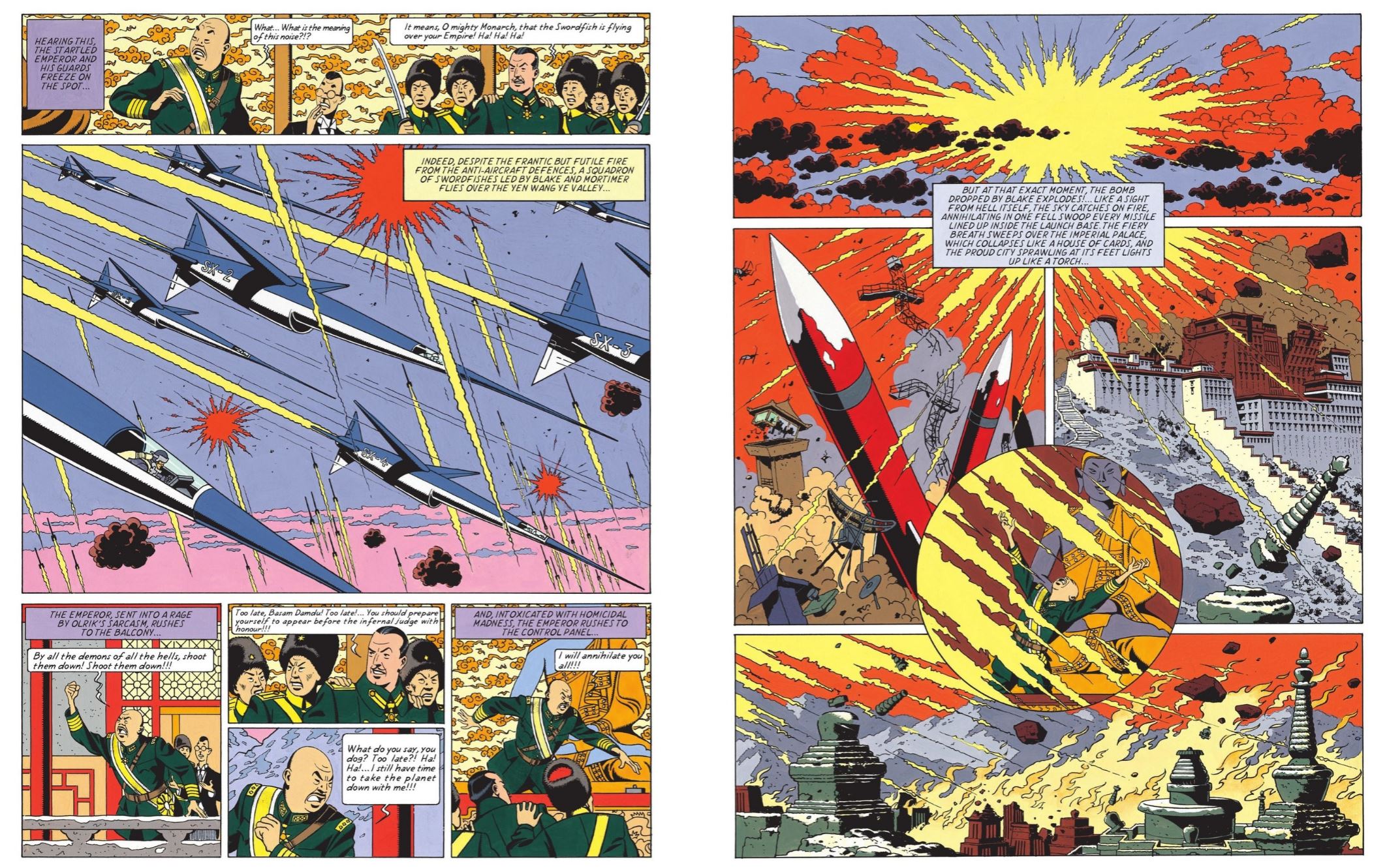
Before long the Yellow Empire is in full retreat. A squadron of Swordfish is completed and with the once-occupied planet in full revolt, Lhasa soon tastes the flaming death it callously inflicted upon a peaceful, unsuspecting and now extremely vengeful world. They are only just in time: the insane and malignant Emperor is mere moments away from launching a doomsday flight of atomic missiles to every corner of the planet he so briefly owned…
This Cinebook Complete edition also includes fascinating illustrated essay ‘Jacobs: 1946, The Swordfish, starting point of a masterful work’, first seen in The World of Edgar P. Jacobs, plus a biographical feature and chronological publication chart of Jacobs’ and his successors’ efforts.
Gripping and fantastic in the truest tradition of pulp sci-fi and Boy’s Own Adventures, Blake and Mortimer are the very epitome of dogged determination; always delivering grand, old-fashioned heroic Blood-&-Thunder thrills & spills in timeless fashion and with astonishing visual punch. Despite an epic body count and dated milieu, any kid able to suspend modern mores and cultural disbelief (call it alternate Earth history or Bakelite-Punk if you want) will experience the adventure of their lives – and so will their children.
Original editions © Éditions BLAKE & MORTIMER/Studio Jacobs (Dargaud – Lombard S.A.) 1984, 1985, 1986 by E.P. Jacobs. Cahier Hachette© Éditions BLAKE & MORTIMER/Studio Jacobs (Dargaud – Lombard S.A.) 2012, Brieg F. Haslé et Nicolas Thibaudin. All rights reserved. English translation © 2024 Cinebook Ltd.
Win’s Christmas Gift Recommendation: Spot On Epic Retro-Wonderment… 10/10