
The Complete Calvin and Hobbes

By Bill Watterson (Andrews McMeel)
ISBN: 978-0-74074-847-9 (HB boxed set) 978-1-44943-325-3 (PB boxed set)

Win’s Christmas Gift Recommendation: The Absolute Epiphany of Joyous Delight… 10/10

Almost any event big or small is best experienced through the eyes of a child – and better yet if he’s a fictional waif controlled by the whimsical sensibilities of a comic strip genius like Bill Watterson.

Calvin is the child in us all; Hobbes is the sardonic unleashed beast of our Aspirations; no, wait… Calvin is this little boy, an only child with a big imagination and a stuffed tiger that has become his common sense and moral sounding board…

No; Calvin is just a lonely little boy and Hobbes talks only to him. That’s all you need or want.

An immediate best-selling strip and perennial award-winning critical hit running from November 18th 1985 through December 31st 1995, Calvin and Hobbes came and went like a bright, soft comet and we’re all the poorer for its passing. In the decade of its existence, the strip redefined depictions of the “Eyes of Wonder” which children possess, and made us mere adults laugh, and so often cry too. Its influence shaped a generation of up-and-coming cartoonists and comicbook creators.

We all wanted a childhood like that pesky kid’s; bullies, weird teachers, obnoxious little girls and all. At least we can – and still do – revisit…

The Daily and Sundays appeared in more than 2,400 newspapers all over the planet and – from 2010 – reruns have featured in over 50 countries. There were 18 unmissable collections (selling well in excess of 45,000,000 copies thus far), including the fabulous complete boxed set edition in both soft and hard cover formats I’m plugging today. Yes, it’s a comparatively expensive item but I gloat over my hardback set almost every day and cannot count the number of times I’ve dipped into it over the years.

Unlike most of his fellows, Watterson shunned the spotlight and the merchandising Babylon that generally follows a comic strip mega-hit. He dedicated all his spirit and energies into producing one of the greatest testaments to childhood and the twin and inevitably converging worlds of fantasy and reality anywhere in fiction. All comics purists need to know is that the creator cites unique sole-auteur strips Pogo, Krazy Kat and Peanuts as his major influences and all mysteries are solved…

Calvin is a hyper-active little boy growing up in a suburban middle-American Everytown. There’s a city nearby, with museums and such, and a little bit of wooded wilderness at the bottom of the garden. The kid is smart, academically uninspired and utterly happy in his own world. He’s you and me. His best friend and companion is stuffed tiger Hobbes, who – as I might have already mentioned – may or may not be actually alive. He’s certainly far smarter and more ethically evolved than his owner…

And that’s all the help you’re getting. If you know the strip you already love it, and if you don’t you won’t appreciate my destroying the joys of discovery. This is beautiful, charming, clever, intoxicating and addictive tale-telling, blending awe, bliss and laughter, socially responsible and wildly funny.

After a miraculous decade, at the top of his game Watterson retired the strip and himself, and though I bitterly resent it, and miss it still, I suppose it’s best to go out on a peak rather than fade away by degrees. I certainly respect and admire his dedication and principles.

I cannot imagine any strip fan – or indeed, parent – living life without Calvin and Hobbes. Imaginative, dazzling, unforgettably captivating, these are some of the best cartoons ever crafted. You should have them in your house.

Usually I plug a specific item – and I am here too – but today’s lesson is really a big thank you and heartfelt recommendation for an iconic strip and its brilliant creator.

I normally shy away from excessively priced items too, but in this case (not a pun, no matter how much I want it to be) the expense is worth the outlay. This is a set of books to summon up glorious childhood memories, meant to be read lying on the floor with kids and pets and snacks all jostling for the best vantage point.

The entire Calvin and Hobbes canon is still fully available in solo volumes and so is this aforementioned wrist-cracking box set, but not, sadly, in a digital edition yet. You can, however, enjoy digital dollops of this graphic milestone if so inclined by going to gocomics.com/calvinandhobbes. They are also available online through the Andrews McMeel Uclick platform, so there’s no reason for you not to make this brilliant example of our art form a permanent part of your life. And you’ll thank me for it, too…
© 1989, 2005, 2012 Universal Press Syndicate. All rights reserved.

Conan the Barbarian Epic Collection volume 1: The Coming of Conan 1970-1972


By Roy Thomas & Barry Windsor-Smith, with John Jakes, Gil Kane & various (Marvel)
ISBN: 978-1-3029-2555-0 (TPB)

Win’s Christmas Gift Recommendation: Because We Believe in Blockbusters… 9/10

During the 1970’s the American comic book industry opened up after more than 15 years of cautious and calcified publishing practises that had come about as a reaction to the censorious oversight of the self- inflicted Comics Code Authority. This body was created to keep the publishers’ product wholesome after the industry suffered their very own McCarthy-style Witch-hunt during the 1950s.

One of the first genres revisited was Horror/Mystery comics and from that sprang pulp masterpiece Conan the Cimmerian, via a little tale in anthology Chamber of Darkness #4, whose hero bore no little thematic resemblance to the Barbarian. It was written by Roy Thomas and drawn by Barry (now Windsor-) Smith, a recent Marvel find, and one who was gradually breaking out of the company’s all-encompassing Jack Kirby house-style.

Despite some early teething problems – including being cancelled and reinstated in the same month – the comic book adventures of Robert E. Howard’s brawny warrior soon became as big a success as the revived prose paperbacks which had heralded a world flowering in tales of fantasy and the supernatural.

After decades away, the brawny brute recently returned to the Aegis of Marvel. Subtitled “the Original Marvel Years” (due to the character’s sojourn with other publishers and intellectual properties rights holders), this bombastic tome of groundbreaking action fantasy yarns re-presents the contents of Conan the Barbarian #1-13 plus that trailblazing short story, cumulatively spanning April 1970 to January 1972.

Digitally remastered and available as a trade paperback or digital formats, these absorbing arcane adventures sparked a revolution in comics and a franchising empire in my youth, and are certainly good enough to do so once again.

The drama begins most fittingly with a classic map of ‘The Hyborean Age of Conan’ plus an accompanying quote I’m sure every devoted acolyte already knows by heart…

Set in modern America, ‘The Sword and the Sorcerers’ primes the pump with the tale of a successful writer who foolishly decides to kill off his most beloved character Starr the Slayer: a barbarian so beloved that he has taken on a life of his own and is determined to do whatever is necessary to keep it…

After that we are catapulted back in time approximately 12,000 years into a forgotten age of wonders as writer Thomas broadly follows Howard’s life path for young Conan, beginning with the still teenaged hero’s meeting with a clairvoyant wizard who predicts his regal destiny (‘The Coming of Conan’ inked by Dan Adkins), through brief but brutal enslavement in ‘The Lair of the Beastmen’ (inked by Sal Buscema), before experiencing a minor Ragnarok in ‘The Twilight of the Grim Grey God!’

An aura of lyrical cynicism grows to balance the wealth of mystical menaces and brooding horror as the wandering youth becomes a professional thief and judge of human foibles in ‘The Tower of the Elephant’. Conan’s softer side is revealed in issue #5 after meeting the bewitching ‘Zukala’s Daughter’ (inked by Frank Giacoia) and liberating a wizard-plagued town. Buscema returned for ‘Devil Wings over Shadizar’, wherein the warrior tackles a welter of antediluvian terrors and both Adkins & Sal B applied their pens and brushes to expose ‘The Lurker Within’ – based on Howard’s magnificent The God in the Bowl – after which tomb-raider Conan crushes zombies and dinosaurs in ‘The Keepers of the Crypt’ (inked by Tom Palmer and Tom Sutton)

Thomas’s avowed plan was to closely follow Conan’s literarily-established career from all-but boyhood to his eventual crowning as King of Aquilonia, adding to and adapting the prose works of Howard and his posthumous collaborators on the way. This agenda led to some of the best, freshest comics of the decade. The results of Barry (not-yet-Windsor-) Smith’s search for his own graphic style led to unanimous acclaim and many awards for the creative duo.

By issue #9 the character had taken the comics world by storm and any threat of cancelation was long gone. ‘The Garden of Fear’ – adapted by Thomas & Smith, with inks by Sal B from Howard’s short story – features a spectacular battle with a primordial survivor in a lost valley before the wanderer returns to big city life, and learns too late to ‘Beware the Wrath of Anu!’

This god-slaying bout is mere prelude to another classic Howard adaptation, ‘Rogues in the House’: an early masterpiece of action and intrigue benefitting from a temporary doubling in page count.

‘Dweller in the Dark’ is an all-original yarn of monsters and maidens, notable because artist Smith inked his own pencils, and indications of his detailed fine-line illustrative style can be seen for the first time. An added bonus in that issue was a short back-up yarn by Thomas & Gil Kane with “Diverse Hands” called in to ink ‘The Blood of the Dragon!’ which tells of a very different Hyborian hero getting what he deserves…

Fantasy author John Jakes plotted the final tale in this initial outing as ‘Web of the Spider-God’ offers a sardonic tale of the desert with the surly Cimmerian battling thirst, tyranny pompous priests and a big, big bug in a riotous romp finished off by Thomas, Smith & Buscema.

Adding value to the treasury is a vast bonus section which includes pencilled cover art (used and unused), Thomas’ original script breakdowns annotated by the artist, extracts from Marvelmania (the company’s in-house fanzine), unused illustrations, house ads and Marvel bulletin items, cover roughs, concepts and finished art by Marie Severin & Gil Kane, John Jakes’ plot synopsis and many pages of original art from the tales collected herein.

Also on show are cover galleries of the Marvel Books reprint paperback line and the Conan Classic comics series – all by Windsor-Smith – plus even before-&-after alterations demanded by the Comics Code Authority on the still contentious and controversial title.

These re-mastered epics are a superb way to enjoy some of American comics’ most influential and enjoyable blockbuster moments. They should have a place on your bookshelf.
© 2020 Conan Properties International, LLC (“CPI”).

Leaf


By Daishu Ma (Fantagraphics Books)
ISBN: 978-1-60699-853-3 (HB)

Win’s Christmas Gift Recommendation: Perfectly Confirming Life and Liberty 9/10

Sequential Art – or “comics” as I stubbornly prefer to think of it – is generally typified as a marriage of text with a series of illustrations designed to tell a story and impart a mood, but it’s always been a nebulously open-ended venture with little time for hard and fast rules and happy to avoid definition.

For instance if a story has an overabundance of words in too few pictures, the result is little more than illustrated prose, but if you go the other way and minimise, or even completely exclude words, what you have is the absolute zenith in comics communication. And more often than not, it’s the best writers who use the least verbiage, whether they illustrate the story or not…

Daishu Ma is a Chinese cartoonist, artist and designer working in Barcelona. This, her first graphic novel Leaf, rapidly joined a rarefied band of international illustrative icons (Jim Woodring, Jason and our own Raymond Briggs being regularly amongst the most prominent) who frequently eschew and transcend the printed word and strictures of graphic narrative, allowing methodically crafted imagery to establish scenes, define characters, create nuance and carry a tale.

…Or rather here, a politically-edged, industrially-condemning eco-parable, since her sublime, meticulous and astonishingly beguiling pencil-tone art – enhanced by smartly applied splashes of mood-enhancing pastel colour – exposes a blandly bleak industrial environment on the brink of eradicating the last vestiges of the natural world…

This is a story you must experience for yourself so let’s content ourselves with the basic facts: when a young man on an excursion finds a fallen leaf which pulses with an uncanny, comforting radiance he covertly takes it back to the ever-sprawling city.

His teeming conurbation, bustling office of employment and even extremely basic, always empty apartment are all drab and dolorous despite the plentiful supply of monopolistic artificial lights and he realises that what he’s found is something special, even inspirational.

Increasingly obsessed, he roams the bustling city, seeking someone who can explain what he hides in his home. The revelatory journey takes him to unsuspected, people-packed enclaves of joy, wonder and despondency and into many folks’ lost memories of better times, when he encounters a young woman who has dedicated her life to understanding the rapidly vanishing flora of the world and a strangely timid old man who seems to know all the secrets of light-making…

And once the finder obsessively follows a convoluted trail to a hidden truth, how can he not risk everything in a bold act to change his overcrowded, oppressive, unhappy world?

Entrancing, subtle and seductive in a purely primal manner, Leaf offers a vision of hope for all lovers of beautiful simplicity and natural wonder.
© 2015 Daishu Ma. All rights reserved.

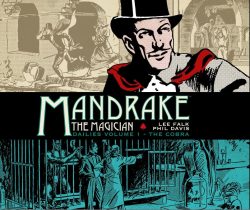
Mandrake the Magician: The Hidden Kingdom of Murderers – Sundays 1935-1937


By Lee Falk & Phil Davis (Titan Books)
ISBN: 978-0-85768-572-8 (HB)

Win’s Christmas Gift Recommendation: Because We Believe in Magic… 10/10

Regarded by many as the first superhero, Mandrake the Magician debuted as a daily newspaper strip on 11th June 1934. An instant hit, it was soon supplemented by a full-colour Sunday companion page which launched on February 3rd 1935.

Creator Lee Falk had actually sold the strip to King Features Syndicate years earlier as a 19-year old college student, but asked the monolithic company to let him finish his studies before dedicating himself to it full time. With his schooling done, the 23-year old master raconteur settled in to begin his life’s work: entertaining millions with his astounding tales.

Falk – who also created the first costumed superhero in moodily magnificent mystery man The Phantom – spawned an actual comicbook subgenre with his first creation. Most publishers of the Golden Age boasted at least one (and usually many more) nattily attired wonder wizards amongst their gaudily-garbed pantheons; all roaming the world making miracles and defeating injustice with varying degrees of stage legerdemain or actual sorcery.

Characters such Mr. Mystic, Ibis the Invincible, Sargon the Sorcerer, and an assortment of “…the Magicians” such as Zanzibar, Zatara, Kardak and so many, many more, all borrowed heavily and shamelessly from the uncanny exploits of the elegant, enigmatic white knight who graced the pages of the world’s newspapers and magazines.

In the Antipodes, Mandrake was a stalwart regular of the Australian Women’s Weekly, and also became a cherished star in the UK, Italy and Scandinavia. Over the years he has been a star of radio, movie chapter-serials, a theatrical play, television and animation as part of the cartoon series Defenders of the Earth. With that has come the usual merchandising bonanza of games, toys (including magic trick kits), books, comics and more…

Falk worked on Mandrake and “The Ghost who Walks” until his death in 1999 (even on his deathbed he was laying out one last story) but he also found time to become a playwright, theatre producer and impresario, as well as an inveterate world-traveller.

A man of many talents, Falk drew the first few weeks himself before uniting with sublimely imaginative cartoonist Phil Davis, whose sleekly understated renditions took the daily strip – and especially these expansive full-page Sunday offerings – to unparalleled heights of sophistication: his steady assured realism the perfect tool to render the Magician’s mounting catalogue of wondrous miracles…

Those in the know are well aware that Mandrake was educated at the fabled College of Magic in Tibet, thereafter becoming a suave globe-trotting troubleshooter, always accompanied by his faithful African partner Lothar and beautiful, feisty companion (and eventually, in 1997, bride) Princess Narda of Cockaigne, solving crimes and fighting evil. Those days, however, are still to come as the comics section opens in this splendidly oversized (315 x 236 mm) full-colour luxury hardback – and digital equivalents – with ‘The Hidden Kingdom of Murderers’ (which ran from February 3rd to June 2nd 1935) as the urbane Prince of Prestidigitation and his herculean companion are approached by members of the international police to help expose a secret society of criminals and killers acting against the civilised world from their own hidden country.

After officer Duval is assassinated, Mandrake and Lothar – accompanied by panther woman Rheeta and surviving cop Pierce – embark upon a multi-continental search which, after many adventures, eventually brings them to a desolate desert region where they are confronted by bloody-handed Bull Ganton, King of Killers.

With the master murderer distracted by Rheeta, Mandrake easily infiltrates the odious organisation and quickly begins dismantling the secret society of two million murderers. By the time Ganton wises up and begins a succession of schemes to end Mandrake, it’s too late…

That deadly drama concluded, Mandrake and Lothar head to India to revisit old haunts and end up playing both peacemaker and cupid in the ‘Land of the Fakirs’ (running from June 9th to October 6th).

When Princess Jana, daughter of Mandrake’s old acquaintance Jehol Khan is abducted by rival ruler Rajah Indus of Lapore, the Magician ends his mischievous baiting of the street fakirs to intervene. In the meantime, Captain Jorga – who loves Jana despite being of a lower caste – sets off from the Khan’s palace to save her or die in the trying…

After many terrific and protracted struggles, Mandrake, Lothar and Jorga finally unite to defeat the devious and duplicitous Rajah before the westerners set about their most difficult and important feat; overturning centuries of tradition so that Jorga and Jana might marry…

Heading north, the peripatetic performers stumble into amazing fantasy after entering the ‘Land of the Little People’ (13thOctober 1935 to March 1st 1936), encountering a lost race of tiny people embroiled in a centuries-long war with brutal cannibalistic adversaries. After saving the proud warriors from obliteration, Mandrake again plays matchmaker, allowing valiant Prince Dano to wed brave and formidable commoner Derina who fought so bravely beside them…

With this sequence illustrator Davis seemed to shake off all prior influences and truly blossomed into an artist with a unique and mesmerising style all his own. That is perfectly showcased in the loosely knit sequence (spanning 8th March to 23rd August 1936) which follows, as Mandrake and Lothar return to civilisation only to narrowly escape death in an horrific train wreck.

Crawling from the wreckage, our heroes help ‘The Circus People’ recapture and calm the animals freed by the crash, subsequently sticking around as the close-knit family of nomadic outcasts rebuild. Mighty Lothar has many clashes with jealous bully Zaro the Strongman, culminating in thwarting attempted murder, whilst Mandrake uses his hypnotic hoodoo to teach sadistic animal trainer Almado lessons in how to behave, but primarily the newcomers act as a catalyst, making three slow-burning romances finally burst into roaring passionate life…

Absolutely the best tale in this tome and an imaginative tour de force which inspired many soon-to-be legendary comicbook stars, ‘The Chamber into the X Dimension’ (30th August 1936 to March 7th 1937) is a breathtaking, mind-bending saga starting when Mandrake and Lothar search for the missing daughter of a scientist whose experiments have sent her literally out of this world.

Professor Theobold has discovered a way to pierce the walls between worlds but his beloved Fran never returned from the first live test. Eager to help – and addicted to adventure – Mandrake and Lothar volunteer to go in search of her and soon find themselves in a bizarre timeless world where the rules of science are warped and races of sentient vegetation, living metal, crystal and even flame war with fleshly humanoids for dominance and survival.

After months of captivity, slavery, exploration and struggle our human heroes finally lead a rebellion of the downtrodden fleshlings and bring the professor the happiest news of his long-missing child…

Concluding this initial conjuror’s compilation is a whimsical tale of judgement and redemption as Mandrake uses his gifts to challenge the mad antics of ‘Prince Paulo the Tyrant’ 14th (March 14th – 29th August 1937).

The unhappy usurper stole the throne of Ruritanian Dementor and promptly turned the idyllic kingdom into a scientifically created madhouse. Sadly, Paulo had no conception of what true chaos and terror were until the magician exercised his mesmeric talents…

This epic celebration also offers a fulsome, picture-packed and informative introduction to the character – thanks to Magnus Magnuson’s compelling essay ‘Mandrake the Magician Wonder of a Generation’ – plus details on the lives of the creators (‘Lee Falk’ and ‘Phil Davis Biography’ features) plus a marvellous Davis pin-up of the cast to complete an immaculate confection of nostalgic strip wonderment for young and old alike.
Mandrake the Magician © 2016 King Features Syndicate. All Rights Reserved. “Mandrake the Magician Wonder of a Generation” © 2016 by Magnus Magnuson.

Melusine volume 2: Halloween


By Clarke (Frédéric Seron) & Gilson, coloured by Cérise and translated by Erica Jeffrey (Cinebook)
ISBN: 978-1-905460-34-2 (Album PB)

Teen witches have a long and distinguished pedigree in fiction and one of the most engaging first appeared in venerable Belgian magazine Le Journal de Spirou in 1992.

Mélusine is actually a sprightly 119 year-old who spends her days working as an au pair in a vast, monster-packed, ghost-afflicted chateau whilst diligently studying to perfect her craft at Witches’ School…

The long-lived feature offers everything from one-page gag strips to full-length comedy tales on supernatural themes detailing her rather fraught life, the impossibly demanding master and mistress of the castle and her large circle of exceedingly peculiar family and friends.

Collected editions began appearing annually or better from 1995, with the 27th published in 2019 and hopefully more to come. Thus far five of those have transformed into English translations thanks to the fine folk at Cinebook.

The strip was devised by writer François Gilson (Rebecca, Cactus Club, Garage Isidore) and cartoon humourist Frédéric Seron – AKA Clarke – whose numerous features for all-ages LJdS and acerbic adult humour publication Fluide Glacialinclude Rebecca, Les Cambrioleurs, Durant les Travaux, l’Exposition Continue… and Le Miracle de la Vie.

Under pseudonym Valda, Seron also created Les Babysitters and, as Bluttwurst, Les Enquêtes de l’Inspecteur Archibaldo Massicotti, Château Montrachet, Mister President and P.38 et Bas Nylo.

A former fashion illustrator and nephew of comics veteran Pierre Seron, Clarke is one of those insufferable guys who just draws non-stop and is unremittingly funny. He also doubles up as a creator of historical and genre pieces such as Cosa Nostra, Les Histoires de France, Luna Almaden and Nocturnes and apparently is free from the curse of having to sleep…

Halloween – available in paperback and in digital formats – was the eighth European-released Mélusine album, originally released in 2001, and gathers a wealth of stunning seasonally sensitive strips. This makes it a great place for newcomers to start as the majority of the content comprises one or two-page gags starring the sassy sorceress who – like a young but hot Broom Hilda – makes excessive play with fairy tale and horror film conventions and themes. Not that what she looks like should make a (witch’s) wit of difference, but hey, it’s comics and it’s France…

When brittle, moody Melusine isn’t being bullied for her inept cleaning skills by the matriarchal ghost-duchess who runs the castle, or ducking cat-eating monster Winston and frisky vampire The Count, she’s avoiding the attentions of horny peasants, practising her spells or consoling and coaching inept, un-improvable and lethally unskilled classmate Cancrelune.

Mel’s boyfriend is a werewolf so he only bothers her a couple of nights a month…

Daunting dowager Aunt Adrezelle is always eager and happy to share the wisdom of her so-many centuries but so, unfortunately, is family embarrassment cousin Melisande, who spurned the dark, dread and sinisterly sober side of the clan to become a Fairy Godmother; all sparkles, fairy-cakes, pink bunnies and love. She’s simplicity, sweetness and light itself in every aspect, so what’s not to loathe…?

This turbulent tome riffs mercilessly on the established motifs and customs of Halloween, where kids fill up to lethal levels on sweets and candies, monsters strive to look their worst, teachers try to keep the witches-in-training glued to their books and grimoires even as their over-excitable students experiment most unwisely on what to do with pumpkins – including how to grow, breed or conjure the biggest ones – whilst the fearfully pious local priest and his human flock endeavour to ruin all the magical fun…

Even Melisande gets in on the party atmosphere in her own too-nice-to-be-true manner, lightening the happy shadows with too much sunshine and saccharine before the collection ends with the extended eponymous ‘Halloween’, wherein Melusine and Cancrelune learn the true meaning of the portentous anniversary when they inadvertently join creaking, clacking cadavers of the Risen Dead as they evacuate their graves on their special night to fight and drive away for another year the Evil Spirits who haunt humanity…

Wry, sly, fast-paced and uproariously funny, this compendium of arcane antics is a great taste of the magic of European comics and a beguiling delight for all lovers of the cartoonist’s art. Read before bedtime and don’t eat any hairy sweets…
Original edition © Dupuis, 2000 by Clarke & Gilson. All rights reserved. English translation 2007 © Cinebook Ltd.

World of Warcraft: Comic Collection Volume One


By Raphael Ahad, Robert Brooks, Matt Burns, Christie Golden, Micky Neilson, Andrew Robinson, Antonio Bifulco, Linda Cavallini, Sebastian Cheng, Alex Horley, David Kegg, Ludo Lullabi, Miko Montilló, Nesskain, Suqling, Emanuele Tenderini & various (Blizzard Entertainment/Titan Books)
ISBN: 978-1-95036-613-2 (HB Blizzard Entertainment) 978-1-78909-646-0 (HB Titan Books)

World of Warcraft is a Massive Multiplayer Online Role-Playing Game (MMORPG) that began in 2004. It’s very popular.

If you needed to look up any part of that paragraph, this might not be the book for you – although if you’re a fantasy fan with a penchant for convoluted sagas and love of bombastic comics art, it might be worth sticking around to the end of the review.

Like Tolkein’s Middle Earth, Game of Thrones or other complex invented environments, WoW is more about worldbuilding and made-up history than individual heroes like Conan or Elric excelling and triumphing. Here variety is the spice of life (and Unlife, Orc-kind, wizards, Dwarves, Gnomes, automata etc). This collection of tales – originally an online supplement and enticement to the game – might feel a little formulaic, but that’s pretty much the point…

These lavish auxiliary tales were all released between 2014- 2018 as World of Warcraft: Warlords of Drainor, World of Warcraft: Legion, and World of Warcraft: Battle for Azeroth: moody, action-heavy and suspenseful vignettes, packaged as digital comics miniseries specifically linked to one of the eight Expansion Packs released to sustain that frantic MMORPG mythmaking momentum.

First freshly arrayed in Warlords of Draenor as ‘Gul’Dan and the Stranger’ (by Micky Neilson & Alex Horley), the opening yarn reveals bloodshed brewing, whilst ‘Blackhand’ (Robert Brooks & Horley) details the fate of the feared and fabled Doomhammer, before ‘Blood and Thunder’ (Raphael Ahad, Cynthia Hall & Horley) offers some historical context with the origins of mighty warrior the Iron Wolf…

Legion opens with Matt Burns & Ludo Lullabi’s ‘Magni: Fault Lines’ as the daughter of the venerable King under the Mountain awakens him to meet the growing crisis facing the dwarves. Meanwhile, Night Elves are having a few difficulties with monstrous Gul’Dan in ‘Nightborne: Twilight of Suramar’ (Burns & Lullabi) whilst the animalistic tribes are called to action in ‘Highmountain: A Mountain Divided’ (Brooks & David Kegg) before the humans of Stormwind Keep survive a royal assassination attempt, inspiring King Wrynn to mobilise in Brooks & Nesskain’s ‘Anduin: Son of the Wolf’…

It ends with reports from the Battle for Azeroth, as a repentant mage reassesses her life choices in ‘Jaina: Reunion’(Andrew Robinson, Linda Cavallini & Emanuele Tenderini) before wandering Dwarf-King ‘Magni: The Speaker’ (Burns & Suqling) endures a moment of existential crisis…

Steve Danuser, Christie Golden, Robinson, Antonio Bifulco & Sebastian Cheng detail the past and futures of ‘Windrunner: Three Sisters’ after which the gathering storms pause with the salutary tale of ‘Mechagon’ (by Burns & Miko Montilló), proving you should watch what you wish for even if you’re a dedicated master smith like Kervo the Explorer…

Garnishing all the drama and mayhem, the book also offers a vast selection of production art – from preliminary designs and roughs to full finished pages – in a Sketchbook section.

Gathered into a lavish luxury hardback that just screams “Christmas gift”, these adventures won’t be everyone’s goblet of grog, but for those who covertly yearn to resolve their daily annoyances with a honking great Warhammer or dismemberment spell, this should be subject of your very next quest…
World of Warcraft: Comic Collection © 2020 Blizzard Entertainment, Inc. All Rights Reserved.

Stigmata


By Lorenzo Mattotti & Claudio Piersanti (Fantagraphics Books)
ISBN: 978-1-60699-409-2 (HB)

It’s rather hard not to think that it’s the end of days at the moment, and naturally that’s affecting what I’m reading. You too, I expect.

In that spirit, here’s a book you simply must read before you die, and if you already have, it truly stands another go.

In his latest magnificent endeavour, Lorenzo Mattotti is a giant of European graphic narrative with a back catalogue of truly stunning confections. In 1999 he teamed with novelist and screenwriter Claudio Piersanti for the first of two potent yarns (the other being the still untranslated Anonymes): to produce one of the most powerful and memorable examinations of religious experience with Stigmata.

This impressive hardback (still no digital edition yet) describes the Job-like trials and tragedies of a brutal, alcoholic shipwreck of a man pushed beyond the brink of tolerance and sanity. The pariah finds a kind of peace and resolution, but unlike his Old Testament antecedent, what begins in misery with nothing, only proceeds to forfeit even his last remaining graces. By the end of his travails, the sinner has found precious little knowledge or understanding, but some sort of peace…

Drunken, brutal, dissolute, middle-aged and heading nowhere, the last thing he needed was holes in his hands that bled but wouldn’t heal. Already despised and feared, the lonely bum works at a bar, but the wounds and the blood upset even those gin-soaked sots. Moreover, people follow him, thinking he possesses some divine secret or power to heal…

Eventually he snaps, wrecking the bar and confronting the vicious gangster who runs it… Some folks call him “the Saint”. He doesn’t think it’s funny…

As the city becomes even more savage and ugly, he takes off; tracking down an uncle who worked in a carnival. When he finds the travelling show his uncle is gone – arrested for stealing – but the Carnies accept him and he strikes up a romance with the vivacious Lorena. Even working as a handyman, his bleeding hands interfere, but the canny show-people turn it to their advantage, setting him up in a booth dispensing piety and miracle from his shabby, tawdry “House of Blessings.”

Travelling from town to town, he finds a kind of contentment, but eventually the Carnies’ secret sideline of burglary brings police attention. When his old gangster boss tracks him down and delivers a hideous punishment, he destroys the Stigmatic’s last shred of hope and Lorena’s life forever.

And then the storm hits… a tempest of Biblical proportions that changes everything…

Brooding, compelling and rendered in a cacophony of swirling miasmic lines, this fearsome modern parable is a fierce interrogation of faith and destiny asking uncompromising and uncomfortable questions about the price of Grace and the value of belief. Are these trials, so like Job’s cruel yet purposeful tests, the tough love of a benevolent father, the whims of a despicable devil or the random vagaries of an uncaring fate?

Stigmata is a grotesque and beautiful metaphysical rollercoaster with existential angst and blind faith gripping each other’s philosophical throats and squeezing really, really hard. No rational reader or mature comics fan can afford to miss this dark shining delight.
© 2010 Lorenzo Mattotti & Claudio Piersanti. All rights reserved.

Papyrus volume 5: The Anger of the Great Sphinx


By Lucien De Geiter: colours by Georges Vloeberghs & translated by Erica Jeffrey (Cinebook)
ISBN: 978-1-84918-115-0 (Album PB)

Papyrus is the rapturously beguiling masterwork of Belgian cartoonist Lucien de Gieter. It premiered in 1974 in legendary weekly Le Journal de Spirou, running to 35 albums and consequently spawned a wealth of merchandise, a television cartoon show and a video game.

De Gieter was born in 1932 and studied at Saint-Luc Art Institute in Brussels before going into industrial design and interior decorating. He made the jump into sequential narrative in 1961, first through ‘mini-récits’ (fold-in, half-sized booklets) inserts for Spirou, starring his jovial cowboy Pony, and later by writing for art-star regulars such as Kiko, Jem, Eddy Ryssack and Francis.

He later joined Peyo’s studio as inker on Les Schtroumpfs (The Smurfs) and took over the long-running newspaper strip Poussy.

In the 1960s, De Gieter launched mermaid fantasy Tôôôt et Puit whilst Pony was promoted to the full-sized pages of Spirou, thereafter deep-sixing the Smurfs to expand his horizons by going to work for Le Journal de Tintin and Le Journal de Mickey.

From 1972-1974 he assisted cartooning legend Berck on Mischa for Germany’s Primo, whilst he perfected his newest project: a historical confection which would occupy his full attention and delight millions of fervent fans for the following four decades.

The annals of Papyrus encompass a huge range of themes and milieux, mixing Boy’s Own adventure with historical fiction, fantastic fantasy and interventionist mythology: the epic yarns gradually evolving from traditional “Bigfoot” cartoon style and content towards a more realistic, dramatic and authentic iteration. Moreover, each tale readily blends light fantasy escapades with the latest historical theories and discoveries.

Papyrus is a fearlessly forthright young fisherman favoured by the gods who quickly rises to become a hero of Egypt and friend to Pharaohs. As a youngster the plucky Fellah was singled out and given a magic sword courtesy of the daughter of crocodile-headed Sobek.

The youthful champion’s first task was to free supreme deity Horus from imprisonment in the Black Pyramid of Ombos, thereby restoring peace to the Double Kingdom, but his most difficult and seemingly never-ending duty is to protect Pharaoh’s wilful, high-handed and insanely danger-seeking daughter Theti-Cheri – a princess with an astounding knack for finding trouble…

Avaliable in paperback and digital editions, The Anger of the Great Sphinx is the fifth Cinebook translation (20th album of the series and originally released in 1997 as La Colère du grand Sphinx); a spooky testing of faith through vile supernatural villainy, all eventually thwarted by unflinching daring and honest devotion…

The eerie escapade opens when restless Papyrus discovers the princess sleepwalking in the corridors of Pharaoh’s great Palace in Memphis. Cautiously following, he trips over court jester Puin. By the time he recovers his feet, Theti-Cheri has seized a waiting chariot and hurtled into the dark desert beyond the gates. Extremely alarmed, the lad leaps astride Puin’s phenomenally intelligent donkey Khamelot and rushes after her…

In the bleak wastes, Papyrus is attacked by a living sandstorm threatening to end the line of Pharaohs, but successfully drives it off with his magic sword, just as terrified Puin catches up. As the sun rises, they see they’re near the venerable complex of pyramids and Re Harmakhis, Guardian of the Horizon. The mighty monuments and the Great Sphinx are all but buried under the eternally shifting sands…

Nervous Puin wants to return to the city, leaving such great concerns to Pharaoh and the gods, but Papyrus refuses to abandon the mesmerised princess who can be seen between the paws of the great statue. As he approaches, the stone beast roars that Theti-Cheri now belongs to him because her father has broken an ancient pact to keep the sands from covering him and his temples.

As assign of his dissatisfaction, the princess will die at sunset…

Desperate for a solution, our hero agrees to give the insidious sandstorm his magic sword if it will save the princess and the swirling devil advises the lad to find Anty, the Divine Ferryman and seek passage to the Island of the Gods where he can petition the Divinities for merciful intervention…

Dashing to the Nile with Puin and Khamelot in hot pursuit, Papyrus matches wits with the duplicitous Ferryman – a conniving talking crocodile boat with a grudge against the boy from previous encounters.

Once again, the rogue vessel tries to cheat and bamboozle the boy. Whilst ostensibly taking the trio to the gods’ home, Anty plies the humans with a hallucinogenic drink – resulting in a stunning and baroque display of the author’s spectacular imagination and artistic virtuosity – before leaving them unconscious in a bed of reeds.

Here they are discovered by trio of sibling dotards – dubbed Pepi I, Pepi II and Pepi III – who minister to them. They are in turn saved by Papyrus when bullying brigands try to rob their hovel. The elders are fishermen now, but once they were paid by Pharaoh to keep the Sphinx and pyramids clear of sand. In recent years though they appear to have been forgotten…

With horror the boy realises they have been left back near the Sphinx and the day is fast fading. With ho hope left of gaining the gods’ aid, he rushes off to find Anty and teach the conniving Ferryman the error of his wicked ways before returning to hand his wonderful sword over to the smugly triumphant sandstorm…

At his most despondent moment, through the roaring sand Papyrus sees the Pepis. The elderly janitors have organised the entire village: young and old alike are toiling amid the storm to clear the Sphinx for the sake of their beloved princess.

When Khamelot inadvertently reminds the frantically labouring peasants of a tried-and-true – albeit noxious – way to dampen down the swirling grains and make them more manageable, the furiously screaming storm devil is at last beaten and blows away…

In the quiet still morning, the Sphinx is again free from obstruction and obscurity, but Papyrus is heartbroken to see that it is all too late.

Carrying the corpse of Theti-Cheri into the desert he denies his faith, screaming at the gods who have been so unfair… and they answer, revealing the foolish mistake the passionate, impatient lad has made…

With the princess joyously restored and Re Harmakhis gleaming in all his golden glory, Pharaoh at last arrives in a blare of trumpets to reaffirm his dynasty’s obligations and devotion to the gods, elevating the three Pepis to the exalted station of Eternal Guardians of the Sphinx. The newly appointed opponents of the shifting sands have recently taken possession of a certain magic sword and gratefully return it to the boy who restored their family fortunes…

Epic, chilling, funny, enthralling and masterfully engaging, this is another amazing adventure to thrill and beguile lovers of wonder from nine to ninety-nine, again proving Papyrus to be a sublime addition to the family-friendly pantheon of continental champions who wed heroism and humour with wit and charm, and anybody who has worn out those Tintinand Asterix albums would be wise beyond their years to add these classic chronicles to their dusty, well-beloved bookshelves. Let’s hope Cinebook will soon resume translating the rest for our eager eyes…
© Dupuis, 1997 by De Gieter. All rights reserved. English translation © 2012 Cinebook Ltd.

The Kurdles


By Robert Goodin (Fantagraphics Books)
ISBN: 978-1-60699-832-8 (HB)

The power of strip and picture books is that they can jump right through your eyes, bombarding but bypassing your brain and lodging straight into your heart. If you don’t believe me, just read Sock Monkey: Into the Deep Woods, A Wish for Wings That Work, Usagi Yojimbo, The Moomins and the Great Flood, Bone, Copper, The Squickerwonkers, Pogo or The Velveteen Rabbit.

In fact, read them anyway. You can never read enough.

You should also add to that list this splendidly eerie, all-ages cartoon tale from illustrator and animator Rob Goodin (Duckman, The Wild Thornberries, American Dad!) which blends – in the best tradition of the genre – crippling loneliness, astounding wonder and the finding of a new family; all delivered in a gloriously illustrated, magnificently oversized (305 x 222 mm) full-colour hardback tome that will take your breath away. It just as much a menace to respiration if you consume digitally, so you might do that too…

When little Ellie starts acting up again, poor Sally Bear gets flung out the car window on a cold, rainy night and left in the wilds to rot.

The trenchant little toy is made of far sterner stuff, however and, picking herself up, gamely wanders the terrifying great outdoors, narrowly avoiding doom and destruction from assorted beasts and natural hazards.

Battered and bedraggled, Sally eventually finds her way deep into a swamp where a bizarre conurbation exists. More accurately, one of the denizens of Kurdleton finds her, dragging the bedraggled bear back to a band of little weirdoes who extend jolly hands of friendship the damaged bear is too proud and standoffish to accept with any grace at all…

Claiming all she needs are directions back to the road, Sally is nevertheless soon embroiled in the jovial strangers’ ongoing crisis: their magnificent dwelling has contracted a strange malady and is growing hair and eyes…

Soon a case of Casa Pilosa – an infamous “Disease of the American Home” – is diagnosed. This house is coming alive…

That’s all the plot you get, and you’ll thank me for that when you see for yourselves this fabulously moving, suspensefully thrilling and wryly funny fractured fable of outcasts banding together into a potently different modern family.

Bold, beguiling and beautiful, The Kurdles is the kind of book you will remember forever.
The Kurdles © 2015 Robert Goodin. This edition © 2015 Fantagraphics Books, Inc.

Vowels


By Skye Ogden (Gestalt Publishing)
ISBN: 978-0-9775628-1-7 (PB)

I’ve long admitted my love for comics in black & white and frequently expressed my admiration for creators who can tell a tale in utter silence, without benefit of text, and this lavish and splendid digest sized (212 x 144mm) paperback is one of my favourite examples of the form.

Created by Australian cartoonist, designer and illustrator Skye Ogden, Vowels is a phenomenally engaging sequence of five linked fables which mesmerically examine aspects of the human condition, all played out in an oddly welcoming, if harsh, desert landscape that houses hulking cavemen and their suitably formidable women, adorable lizards, wide eyed aliens and, latterly, extremely unpleasant invading soldiery…

This is one of those books you’ll thank me for staying non-specific about, so I’ll only go so far as to say that ‘a’ is a broadly comedic chase vignette starring those aforementioned dawn people and the unlucky reptile, whilst ‘e’ introduces a diminutive alien wanderer to the happy, hirsute couple before following the unhappy voyager into a most peculiar afterlife and rebirth…

In ‘i’ the little guy’s distant relatives take the stage in a bustling marketplace for a dose of Romeo and Juliet frustration and tragedy before overwhelming, abiding loss is expressively characterised in ‘o’, after which the fascinating, universally accessible discussion on the nature of existence concludes with the brutal horrors of war, occupation and vengeance…

Depicted in a beguiling, timelessly engaging cartoon style, deliciously reminiscent of the legendary Vaughn Bode and employing all the devastatingly expressive, pantomimic artifices of Charlie Chaplin, Vowels is a masterpiece of the cartoonist’s craft where life, death, love, hate, jealousy, obsession, protectiveness, greed, raw naked aggression and cruelty are pared down to the bone and graphically, forensically explored in a manner which only makes us hungry for more.

Deeply enticing, appealingly slick and intoxicatingly addictive, Vowels is an irresistible torrent of purely visual drama and which will delight all aficionados of the medium who value comics for their own sake, and don’t need a route map or score card to enjoy themselves. And it’s long overdue to be revived and rediscovered. In my alphabet, that rates a great big oooooo….
© 2007 Skye Ogden. All rights reserved.