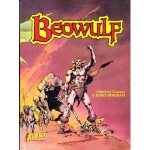
Beowulf – First Graphic Novel #1


By Jerry Bingham, with Ken Bruzenak (First Comics)
ISBN: 978-0-915419-00-5

The mid-1980s were a great time for comics creators. It was as if an entire new industry had opened up with the proliferation of the Direct Sales market and dedicated specialist retail outlets; new companies were experimenting with format and content, and punters had a bit of spare cash to play with. Moreover much of the “kid’s stuff” stigma had finally abated and the country was catching up to the rest of the world in acknowledging that sequential narrative might just be an actual art-form…

Consequently many new companies began competing for the attention and cash of punters who had grown accustomed – or resigned – to getting their four-colour kicks from DC, Marvel Archie and/or Harvey Comics. European and Japanese styled material had been creeping in but by 1983 a host of young companies such as WaRP Graphics, Pacific, Eclipse, Capital, Now, Comico, Dark Horse, First and many others had established themselves and were making impressive inroads.

New talent, established stars and fresh ideas all found a thriving forum to try something a little different both in terms of content and format. Chicago based First Comics was an early frontrunner, with Frank Brunner’s Warp, Mike Grell’s Starslayer and Jon Sable and Howard Chaykin’s Landmark American Flagg!, as well as an impressive line of titles targeting a more sophisticated audience.

In 1984 they followed Marvel and DC’s lead with a line of impressive, European-styled over-sized graphic albums featuring new and out-of-the-ordinary comics sagas (see Time Beavers, Mazinger and two volumes of Time2 to see just how bold, broad and innovative the material could be). The premier release was a stunning and subsequently award-winning (1985 Kirby Award for Best Graphic Album) fantasy epic by Jerry Bingham.

Beowulf is a thrilling, compulsive and intensely visceral visualisation of the Anglo-Saxon epic poem committed to parchment sometime between the 8th and 11th century AD, and recently the subject of many screen iterations and interpretations (from The 13th Warrior to the three “straight” Beowulf movies in 1999, 2005 and 2007 and even the outrageously fun Outlander from 2008).

Need a plot summary? In the far North noble King Hrothgar built a mighty Mead-hall for heroes, but incurred the malignant enmity of the monster Grendel who would raid the citadel and slaughter some of the noble warriors every night. After twelve years of horror a valiant band of heroes led by Beowulf, Prince of the Geats, came to their aid seeking glory and battle…

The clash of Beowulf and Grendel is spectacularly handled as is the succeeding exploit wherein the stalking Horror’s demon mother comes seeking revenge, dragging Beowulf to her hideous lair beneath an icy lake, but the most effective and moving chapter is the very human-scaled Twilight of the Gods as, after fifty years of ruling his Geatish kingdom, aged Beowulf goes to his final glorious battle, dying heroically whilst destroying a ravening firedrake which threatens to eradicate his people: the only proper end for a Northman hero…

Bingham’s raw and fiercely realistic art-style perfectly captures the implacable sense of doom and by employing Prince Valiant‘s text and picture format he imparts the tale with a grandeur often as mythic as Hal Foster’s masterpiece, whilst leaving the art gloriously free of distracting word-balloons.

Letterer/calligrapher Ken Bruzenak’s particular facility perfectly enhances the artistic mood by carefully integrating captions filled with Bingham’s free-verse transliterations of the original 3182 long-poem into this classic interpretation of the epic. This is a wonderful and worthy piece of work that will delight any fan of the medium.

And for a perfect all-ages prose telling of the timeless tale I also heartily recommend Rosemary Sutcliff’s magnificent Beowulf: Dragonslayer: first released in 1961 and captivatingly illustrated by Charles Keeping;  it is still readily available and one of the books that changed my life.
© 1984 First Comics, Inc. All rights reserved.
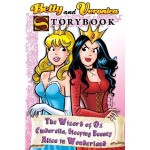

Betty and Veronica Storybook: Archie & Friends All-Stars Series volume 7


By Dan Parent, Rick Koslowski & Jim Amash (Archie Comics)
ISBN: 978-1-879794-60-3

Archie Andrews has been around for nearly seventy years: a good-hearted lad lacking common sense and Betty Cooper the pretty, sensible girl next door, with all that entails, who loves the ginger goof. Veronica Lodge is a rich, exotic and glamorous debutante who only settles for our boy if there’s nobody better around. She might actually love him too, though. Despite their rivalry, Betty and Veronica are firm friends. Archie, of course, can’t decide who or what he wants…

Archie’s unconventional best friend Jughead Jones is Mercutio to Archie’s Romeo, providing rationality and a reader’s voice, as well as being a powerful catalyst of events in his own right. That charming triangle (+ one) has been the foundation of decades of cartoon magic. Moreover the concept is eternally self-renewing…

Adapting seamlessly to every trend and fad of the growing youth culture, the host of writers and artists who’ve crafted the stories over the decades have made the “everyteen” characters of mythical Riverdale a benchmark for youth and a visual barometer of growing up.

In this collection, reprinting tales from 1995-2009, the warring gal-pals and extended cast of the small-town American Follies are plunged deep into whimsy and fable as writer/artist Dan Parent reinterprets classic fairytales and popular classics like a New World Crackerjack Christmas Panto (and boy, will that reference baffle anybody not British and/or under thirty), providing wry and often outright hilarious takes on the eternal nature and magic of young love…

Dotted with funny fashion page pin-ups such as ‘Storybook Style’ and ‘Bewitching Beauties’, lovely cover reproductions and behind-the-scenes commentaries, the wild whimsy begins with ‘Betty in Wonderland’ (inked by Jim Amash) wherein the ever-helpful Miss Cooper gives up a date with Archie to babysit for a neighbour in need. Letting her imagination run wild, her bedtime reading of the Lewis Carroll classic repopulates the tale with some very familiar faces…

Especially effective are science nerd Dilton as the sagacious caterpillar and Jughead and mean Reggie as Tweedle-Dee and Tweedle-Dum. However picturing Veronica as the vicious Blood-red Queen of Hearts might have been a little too close to the truth…

‘Sleeping Betty’ is another enchanting retelling as baby Princess Betty is cursed by the evil fairy Veronica to fall into a deep sleep on her sixteenth birthday. To thwart the hex the little princess was sent away to be raised in secret, but Veronica’s reach is long… Luckily there’s a red-headed prince hanging around…

‘There’s No Place Like… Riverdale’ (inked by Rich Koslowski) transports Betty and her little cat Carmel to a fantastic land over the rainbow where she lucks into some highly desirable Ruby Sneakers. To get home she needs unconventional help in the unappealing shapes of Archie the Scarecrow, Tin Man Jughead and the Cowardly Reggie, so it’s a good thing that Veronica is less a Wicked Witch and more a sorcerous spoiled brat…

The last tale in this collection is ‘Cinderellas’ (Amash inks again) as both girls find themselves helpless drudges working for an evil new mom and dreaming of a prince to whisk them away. Despite the sabotaging antics of mean stepsister Cheryl Blossom and a pretty second-rate Fairy Godmother, Cideronica and Cinderbetty overcome all odds and go to the Ball. In the slipper-sampling aftermath, thanks to some deft plotting, both girls get a happy ending…

Charming and clever, these tales are a marvellous example of why Archie has been unsurpassed in this genre; providing decades of family friendly fun and wholesome teen entertainment. Moreover, aspiring creators will also delight in the closing Sketch Book section of this collection which provides a fascinating glimpse of Parent’s original pencilled art in 9 pages culled from the preceding stories.

© 2010 Archie Comics Publications, Inc. All rights reserved.

Richard Corben Complete Works volume 1: Underground


By Richard Corben and various (Catalan Communications)
ISBN: 978-0-87416-018-5

Although he has only infrequently strayed into the comicbook mainstream, animator, illustrator, publisher and cartoonist Richard Corben is one of America’s greatest living proponents of sequential narrative: a stunningly accomplished artist and unique, uncompromising stylist who grew out of the independent counterculture commix of the 1960s and 1970s to become a globally revered, multi-award winning creator.

He is best known for his mastery of the airbrush and delight in sardonic, darkly comedic horror and science fiction tales.

Born in Anderson, Missouri in 1940, he graduated from the Kansas City Art Institute with a Fine Arts degree in 1965 and found work as an animator. At that time, the Underground Commix revolution was just beginning as a motley crew of independent-minded creators across the continent began making and publishing stories that appealed to their rebellious, pharmacologically-enhanced sensibilities and unconventional lifestyles. Most of them were hugely influenced either by 1950s tales from EC Comics or Carl Barks’ Duck tales – and occasionally both.

Corben started the same way, producing the kind of stories that he would like to read, in as variety of small-press publications including Grim Wit, Slow Death, Skull, Fever Dreams and his own Fantagor often signed with his affectionate pseudonym “Gore”. As his style matured and his skills developed Corben’s work increasingly began to appear in more professionally produced venues. He began working for Warren Publishing in 1970 with tales in Eerie, Creepy, Vampirella, Comix International and laterally, the aggressively audacious adult science fiction anthology 1984. He also famously re-coloured a number of reprinted Spirit strips for the revival of Will Eisner’s the Spirit magazine.

In 1975 Corben submitted work to the French phenomenon Métal Hurlant and subsequently became a fixture in the magazine’s American iteration Heavy Metal where his career really took off. Soon he was producing stunning adult fantasy tales for a number of companies, making animated movies, painting film posters and producing record covers such as the multi-million-selling Meatloaf album Bat Out of Hell. He never stopped producing comics but always stuck to his own independent projects with collaborators such as Harlan Ellison, Bruce Jones and Jan Strnad.

This regrettably out-of-print collection of those early strip efforts, translated from a European edition by Jim Lisle, features a rather inaccurate introduction by Luis Vigil but boasts a dynamic collection of raw, powerful and wickedly sardonic and whimsical suspense tales in the EC vein that graphically display the artist’s rapid, radical creative development beginning with ‘Heirs of Earth’ (1971), a post-apocalyptic tale of love and cannibalism.

Corben’s infamous signature-stylisation includes lots of nudity, graphic violence and near grotesquely proportioned male and female physiques, none of which are apparent in the tantalisingly low-key spoof ‘Alice in Wanderlust’; an early skit by long-term co-creator Jan Strnad, after which ‘Horrible Harveys House’ (1971) tells an intriguing tale of young lust when film student Jarvis talks his stacked and rather easy girlfriend Zara into visiting an abandoned house to make an “art-movie”. Turns out the place isn’t completely empty after all…

From 1970, ‘Twilight of the Dogs’ is a classic sting-in-the-tale saga as Earth’s last surviving free men uncover some rather unfortunate facts about the aliens who conquered them whilst ‘Gastric Fortitude’ displays another side of love. ‘The Dweller in the Dark’ (from a story by Herb Arnold) is an early exploration of Corben’s fascination with and facility for depicting lost civilisations, wherein rain-forest dwellers Bo Glan and Nipta break taboo to explore a dead city only to fall foul of rapacious, invading white men and ancient things far worse…

All the previous yarns were reproduced in black and white: ranging from pen-line to airbrushed monochrome tones but worlds-within-worlds alien romance ‘Cidopey’ reveals its tragic twist in full colour, as does ‘For the Love of a Daemon’ which shows inklings of the artist’s later airbrush expertise in a boisterous black comedy of Barbarians and hot naked babes in distress.

Jan Strnad also wrote the dark dystopian ‘Kittens for Christian’, a moody post-cataclysm thriller with chilling echoes of Corben’s later graphic novel Vic and Blood (an adaptation and extension of Harlan Ellison’s “A Boy and his Dog”) before this volume concludes on a light and colourful note in the artist’s 1973 collaboration with Doug Moench: ‘Damsel in Dragon Dress’: a gleeful witches brew of fantasy, fairytale foible – a saucy cautionary tale on the unexpected dangers of drug abuse…

Richard Corben is a groundbreaking and rightfully renowned figure in our art-form and the fact that so much of his work is currently unavailable in English is a disgrace. Not only are his early works long overdue for a definitive re-issue but all his rude, riotous, raucously ribald revels need to be re-released now. Until that time stay tuned…
© 1970, 1971, 1972, 1973, 1985 Richard Corben. © 1985 Catalan Communications. All rights reserved.

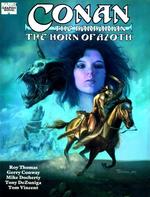
Conan the Barbarian: The Horn of Azoth – A Marvel Graphic Novel


By Roy Thomas, Gerry Conway, Mike Docherty, Tony DeZuniga & Tom Vincent (Marvel)
ISBN: 978-0-87135-639-0

During the 1970′s, in response to a global downturn in superhero sales, and rise in interest in all things supernatural, the American comic book industry opened up after more than fifteen years of cautious and calcified publishing practices. These had come about as a reaction to the scrupulously-censorious oversight of the self-inflicted Comics Code Authority: A body created by publishers to police their product and keep it palatable and wholesome after the industry suffered their very own McCarthy-inspired Witch-hunt during the 1950s. Thus instead of crime comics – the other big casualty of the CCA – the first genre to be revisited was Horror/Mystery comics and from that came the pulp masterpiece Conan the Cimmerian.

Sword & Sorcery prose stories had undergone a global renaissance in the paperback marketplace since the release of soft-cover editions of Lord of the Rings (first published in 1954), and the 1960s saw the resurgence of the two-fisted fantasies of Edgar Rice Burroughs, Otis Adelbert Kline and Fritz Lieber, whilst many modern writers such as Michael Moorcock and Lin Carter kick-started their careers with contemporary versions of man, monster and mage. Indisputably the grand master of the genre was Robert E. Howard.

Marvel Comics tested the waters in early 1970 with a little tale called ‘The Sword and the Sorcerers’ (from the horror anthology Chamber of Darkness #4) whose hero Starr the Slayer bore no small resemblance to the Barbarian. It was written by Roy Thomas and drawn by young Englishman Barry Smith, a recent Marvel find, and one who was just breaking out of the company’s Kirby house-style.

Despite some early teething problems, including being cancelled and reinstated in the same month, the comic-strip adventures of Robert E. Howard’s characters were as big a success as the prose yarns. Conan became a huge success: a mega-brand that saw new prose tales, a TV series and cartoon show, a newspaper strip and most importantly a Major Motion Picture in 1982.

…And it all largely stemmed from the vast range of comics initiated by Thomas, Windsor-Smith (as he became) and the excellent succession of comics creators that followed.

Thomas was a huge fan of the prose material and took great pains to adapt the novels and short stories into the graphic canon, but he was also one of the top writers in his field and much of the franchise’s success devolves from his visceral grasp on the character, which makes this particular graphic novel of particular interest.

After the success of the first film Thomas and fellow Marvel stalwart Gerry Conway were invited to write the second movie script.  How they did and why their script was accepted and never made is textbook Hollywood (I know whereof I speak: buy us a drink one day and I’ll tell you my own tales of Tinsel Town Tactics) and makes a fascinating introduction to this tome; but the upshot was at the end of the protracted process the scripters had a brilliant Conan yarn that everybody loved but that wasn’t going to be Conan the Destroyer. This meant of course, that with a little wheeler-dealing and a few secured permissions it could be returned to the artform that spawned it…

Thus “King of Thieves” became the superb savage thriller ‘The Horn of Azoth’ and opens with the itinerant Barbarian earning a crust pit-fighting in Shadizar the Wicked until he runs afoul of a local Magistrate – to the legislator’s lasting regret. The burly brigand is captured by the city guard but escapes the dungeons with the aid of a beautiful young witch. Together they flee the city with her giant bodyguard and it transpires that she needs Conan to help her fulfil a dark and ancient prophecy. Of course she tells him it’s to help unearth a fabulous treasure…

Locating the lost fortress and broaching its defences are child’s play for a bandit like the Cimmerian, but the mages within prove an unexpected obstacle and the little band is soon augmented by a boy-wizard with his own hidden agenda and an Amazonian Nubian warrior princess as they all converge on a distant rendezvous with fate.

It’s soon clear that everybody is lying to Conan as warring factions struggle to awaken or re-inter antediluvian god Azoth. Whoever wins the world is equally imperilled and unless he works a miracle Conan is collateral damage in a cosmic war that has been brewing for eons…

With brawny battles, warring wizards and enough suspense to choke a mastodon, this action-packed yarn is rip-roaring fantasy fare, brimming with supernatural horrors, wild women and spectacular titanic clashes, cannily recounted by immensely talented creators at the top of their form. Especially effective is Mike Docherty’s supremely illustrative art, ably enhanced by Tony DeZuniga’s smooth inking and Tom Vincent’s lush colours.

Still available, this is a another magnificently oversized tale (produced in the European Album format with glossy white pages 285mm x 220mm rather than the standard US proportions of 258 x 168mm) that provides another heady swig of untrammelled joy for lovers of the genre and fans of the greatest hero ever to swing a sword or plunder a tomb…
© 1990 Conan Properties Inc All Rights Reserved.

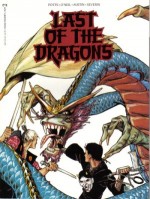
Last of the Dragons – A Marvel Graphic Novel


By Carl Potts, Denny O’Neil, Terry Austin, Marie Severin & James R. Novak (Marvel)
ISBN: 0-87135-335-0

During the 1980s Marvel was an unassailable front-runner in the American comicbook business, outselling all its rivals and increasingly making inroads into the licensed properties market that once went to the Whitman/Dell/Gold Key colossus. Much of their own superhero stable might have become cautious and moribund, but the company was expanding into many other arenas.

When the direct sales market began Marvel started its own creator-owned, rights-friendly fantasy periodical in response to the success of Heavy Metal which in turn led to a blossoming of many bold but comparatively low-selling titles in a host of varied genres.

From that ground breaking Epic Illustrated magazine comes this gloriously absorbing East-meets-West period fantasy (beginning with #15, October 1982 through #20 at the end of 1983) by then-newcomer Carl Potts who plotted and pencilled the tale for scripter Denny O’Neil, inker Terry Austin and colourist Marie Severin to finish and Jim Novak to inscribe.

Collected in 1988 under the Epic Comics imprint and released in the extravagantly expansive European Album format (a square high-gloss page of 285 x 220mm rather than today’s elongated and parsimonious 258 x 168mm) which delivered so much more bang-per-buck, The Last of the Dragons did its part to popularise the now over-exposed Japanese cultural idiom – but it still reads superbly well…

‘The Sundering’ opens in 19th century Japan as aged master swordsman Masanobu meditates in the wilderness until a young warrior disturbs his contemplation by attacking a basking dragon. The magnificent reptiles are gentle, noble creatures but the samurai is hungry for glory and soon wins his bloody trophy…

After the arrogant victor has left Masonobu meets Ho-Kan, a young priest and caretaker of the Dragons. The youth is filled with horror and misery at the brutal sacrilege, but worse is to come for the tearful cleric. As he returns to the temple he stumbles upon a faction of his brother monks secretly conditioning young forest Wyrms, training them to deny their true natures and kill on command…

‘The Vision’ finds Ho-Kan returned to the temple too late: the aggressive monk Shonin has returned from a voyage to the outer world and has reached the conclusion that the Dragons must be used to preserve Japan from insidious change threatened by the encroaching white man’s world. In fact he has already been training the beasts.

When the elders object Shonin’s followers massacre the monks and set out for the wilds of America where they will breed and train hordes of killer lizards under the very noses of the enemy. Few escape the slaughter, but Ho-Kan is one and he will stop the madness somehow…

In a meditative vision he sees Takashi: a half-breed boy whose Christian sailor father abandoned him. The outcast boy was eventually adopted by a ninja clan and became a great fighter. Somehow he holds the key to defeating Shonin…

In ‘The Departure’ Ho-Kan hires the ninjas to stop the warmongering monks but, when he also tries to enlist Masanobu, Shonin’s acolytes capture him. Under torture he reveals all and the wicked clerics then trick the sword-master into fighting the ninjas for them. After killing all but Takashi the monks thereafter invite Masanobu to join them on their journey to the West. The elderly swordsman has no idea that the beasts he guards are hopelessly degraded monsters now.

In ‘The Arrival’ the monks and their hidden cargo take ship for California, unaware that a half-cast crewman has enlisted on a closely-following ship. Takashi the last ninja is bound in his duty and hungry for vengeance. He will not be denied…

When they disembark on a remote bay on the American coast the priests’ intention of slaughtering the sailors and Masanobu goes awry when one of the baby dragons escapes. In the ensuing melee the aged swordsman realises the true state of play and flees into the forests.

The Native American tribes of the Californian forests are helpless before the martial arts and war-dragons of Shonin in ‘The Meeting’ until they meet Takashi – hot on the trail. He defeats and then joins with them. As Takashi and the assembled braves stalk the monks they encounter Masanobu who is also determined to end this dishonourable travesty once and for all…

All of which results in a tumultuous and stirring climax in ‘The Decision’ as all the disparate faction meet to forever decide the fate of a nation, the nature of a species and the future of heroes…

This is a magically compelling tale for fantasy fans and mature readers: an utterly delightful cross-genre romp and one more masterful tale to add to the “why is this out of print?” list.
© 1982, 1983, 1988 Carl Potts. All Rights Reserved.

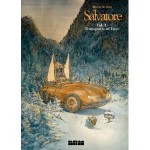
Salvatore volume 1: Transports of Love


By Nicolas de Crécy, colour by Ruby & Walter, translated by Joe Johnson (NBM)
ISBN: 978-1-56163-593-1

Salavatore is a car mechanic: an absolute wizard with all things mechanical but a grumpy sod who dislikes customers so much he built his garage on the peak of a mountain to discourage them. However he is just so good that they come anyway, prepared to put up with the grief and his attitude, if only he would fix their ailing vehicles… and besides, Salvatore has a secret he needs peace and quiet for…

Nicolas de Crécy has released more than thirty albums since he began working in 1990, both one-off books such as Journal d’un fantôme, Escales, Plaisir de myope and La Nuit du grand méchant loup and series/serials such as Léon la came, Monsieur Fruit and Salvatore; the first two of which comprise the artfully arch little romance under review here.

Salvatore is a dog with a lot of pain in his life but has struggled on, buoyed by his artisan’s dedication and sensibility which makes him such an exceedingly good mechanic. One day the tragically short-sighted widow Amandine pulls into his frosty, mountaintop garage with a suspicious knocking in her car engine and his life changes for ever.

As well as practically blind, Amandine is heavily pregnant with twelve piglets (not unknown for a sow of her breed) and something softens within the cold canine. Offering her the unexpected hospitality of his fondue lunch, Salvatore nevertheless succumbs to his one weakness – “borrowing” a surplus part from her vehicle for his great project.

The little dog has a dream and is prepared to sacrifice his principles to achieve it: he once loved and lost a bitch named Julie who moved to South America. Since then he has devoted all his spare time to building a fantastic vehicle to follow her and where undoubtedly, love will reunite them forever…

His super-car is almost ready: the last part necessary can be picked up on the way; all he has to do is reach an understanding with its current owner – a perfectly reasonable bull named Jerome.

Amadine however, has not quite left his life: a practically sightless, heavily pregnant lady should never be trusted to drive a small family runabout down a snow-capped mountain slope…

Her chaotic and magnificently slapstick journey leaves her and the car stranded many kilometres away atop a Parisian rooftop where she prematurely delivers her dozen babies. Horribly one little piggy goes missing on the way to hospital, and one fine day that stray waif will have a huge impact on Salvatore’s fate…

Originally released in 2005 as Transports Amoureux (beautifully coloured by Ruby) ‘Transports of Love’ seamlessly segues here into the second album, Le Grand Départ or ‘The Grand Departure’ with tints and hues provided this time by Walter.

Finally en route to his dream in the almost perfect Julie-Mobile Salvatore has hit a snag. Jerome might be an amenable type but the wife who just divorced him is not. She took the car – including that desperately needed final component – as part of the settlement and had it dismantled as an art installation – or possibly just out of spite.

Amadine meanwhile has broken out of hospital with her eleven piglets, driven by maternal hormones to find her missing baby. The lost cherub has fallen into odd circumstances, amongst sewer scum, political activists and a seductively dark and twisted catwoman siren of the underworld…

Hard-pressed by his defrayed desire for his distant Julie, Salvatore’s ethics have degenerated to the point where he is contemplating fraud and outright theft to get that vagrant last part: luckily he has allied himself with a mysterious and peculiarly moralistic tiny little mute man with a facility for computer science. Perhaps together they can find a way to ease true love’s path…

Surreal and joyously whimsical, but with a delightfully dark edginess, the multi-award winning cartoonist de Crécy has revolutionised French comics with such popular and groundbreaking works as Période glaciaire (released in English as Glacial Period) and this hypnotically addictive sophisticated fable is undoubtedly destined to be just as successful.

Funny, gently adventurous, subversively satirical and yet filled to bursting with empathy and pathos, this beguiling yarn will schmooze itself into your head and make itself too comfortable for you to remove…

© 2005 Dupuis, by de Crécy, Ruby. © 2006 Dupuis, by de Crécy, Walter. English edition © 2010 NBM. All rights reserved.

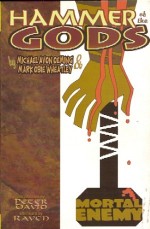
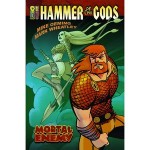
Hammer of the Gods: Mortal Enemy


By Michael Avon Oeming & Frank Cho, (Image/IDW)
Image ISBN: 978-1-58240-271-0, IDW ISBN: 978-1-60010631-6

Mythology has always inspired our fantasies and is never far from our popular culture: just take a look at TV shows like Hercules: the Legendary Journeys and Supernatural or books and films such Clash of the Titans and Percy Jackson and the Lightning Thief which again reinvented and expanded the ancient tales for a new generation.

At the turn of this century all-rounder Michael Avon Oeming re-imagined the Norse tales which had already been so thoroughly exploited by Marvel (and even tangentially by DC in the splendid Arak, Son of Thunder series) to produce an outrageously addictive post-modern take in the five issue miniseries Hammer of the Gods. He was thoroughly aided and abetted by co-plotter, inker, letterer and colourist Mark Wheatley – a veteran comics maker who has been criminally undervalued for decades (see for example the staggeringly impressive Breathtaker to glean what I mean).

The lands of the far North are hard and cold and unforgiving, just like the gods that rule over them. In ‘Hammer of the Gods’ a peasant couple stand the deathwatch for their newborn son who will not survive the night, when a stranger comes seeking shelter from the icy storms. She is welcomed even though old Tyr and Gerda have nothing…

Delighted to finally find mortals who keep the old ways of hearth and hospitality the fierce warrior woman rewards them by blessing their child. He will live, growing strong and wise. Moreover he will possess the strength of the gods so long as he never wields a weapon. Knowing he will thrive the couple finally name their boy: “Modi” which means both Courage and son of Thorr…

The boy grows strong enough to topple trees with a blow and carve wood without a blade and becomes devout in the worship of the Thunder God he is named for. Because he will not fight the other village children constantly pick on him, but Modi is patient as well as strong…

When mature he becomes a globe-girdling explorer. After years he returns to his birthplace only to find the village destroyed by giants and monsters that have escaped from bleak Jotunheim to plague the Earth. Realising his beloved deities have done nothing to save his family or people, Modi swears a mighty oath and denounces the gods forever. Easily slaying the Frost Giant which destroyed his village, Modi pledges to walk the world until he has made the negligent gods pay for abandoning the devoted charges in their care…

Modi’s epic voyages begin in ‘Entrance to Valhalla’, as he roams the cold world destroying beasts and devils, recruiting like-minded men to his crusade. Soon he leads an army of hardened warriors embittered and disillusioned by the disdain and delinquency of their gods.

United together they eradicate the magical horror that plagues mankind, but it is never enough: what Modi wants is a confrontation with the gods themselves…

In ‘Falling For Gods!’ he first battles and then allies himself with Skögul, a fallen Valkyrie who shares his opinions, but when the trickster god Loki also tries to join them she preaches caution. Why would any overlord of Asgard offer them a free pass to Valhalla and their longed-for meeting with the absentee immortals? They refuse the overture and wander the world together, growing ever closer as they seek another way to storm the stronghold of the gods…

Eventually they find a way and enter Asgard for ‘The Final Battle’ only to receive a terrible shock: the magic hammer of Thorr has lost its power and the gods are old and broken men, helpless before the constant onslaught of the giants and demons of Ragnarok.

Much as he despises gods Modi hates giants more and soon he is whittling the frozen horde down to size, but even his might is not inexhaustible. Only a miracle can save him and all the lands of humanity…

This is a rousing rollercoaster ride of sheer adventure beautifully illustrated and magically compelling, with just the right touch of worldly cynicism and passionate mystery to fire up any reader who thinks they’ve seen all that can be done with these hoary old themes.

The book (which was re-issued by IDW in 2009) also includes text pieces from Peter David, WWE star Raven, Oeming and Wheatley, plus development sketches, front and back cover designs, pencil drafts, privately commissioned artworks and cover images and illustration art by Adam Hughes, Frank Cho and Dave Johnson.

™ Michael Avon Oeming and © 2002, 2009 Michael Avon Oeming & Mark Obie Wheatley. All Rights Reserved.

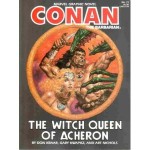
Conan: The Witch Queen of Acheron – Marvel Graphic Novel #19


By Don Kraar, Gary Kwapisz, Art Nichols & others (Marvel)
ISBN: 0- 87135-085-8

During the 1970′s the American comicbook industry opened up after more than fifteen years of calcified publishing practices maintained by the scrupulously-censorious oversight of the self-inflicted Comics Code Authority: A body created by publishers to police their product and keep it palatable and wholesome after the industry suffered their very own McCarthy-style witch-hunt during the early 1950s.

One of the first genres to be revisited was Horror/Mystery comics and from that came the creation of a new comics genre. Sword & Sorcery stories had been undergoing a prose revival in the paperback marketplace since the release of soft-cover editions of Lord of the Rings in 1954 and, by the 1960s, revivals of the two-fisted fantasies of Edgar Rice Burroughs, Otis Adelbert Kline, Fritz Lieber and others had been augmented by many modern writers such as Michael Moorcock and Lin Carter who kick-started their prose careers with contemporary versions of man against mage. The undisputed overlord of the genre was Robert E. Howard with his 1930s pulp masterpiece Conan of Cimmeria.

Gold Key had opened the field in 1964 with Mighty Samson, DC dabbled with Nightmaster in Showcase #82 -84 in 1969 whilst Marvel tested the waters with barbarian villain Arkon in Avengers #76 (April 1970) before going all-out with short tale ‘The Sword and the Sorcerers’ in horror anthology Chamber of Darkness #4.

Written by Roy Thomas and drawn by fresh-faced Marvel find Barry Smith, the tale introduced Starr the Slayer – who bore no small resemblance to the Barbarian in waiting…

Conan the Barbarian debuted with an October 1970 cover-date and despite some early teething problems, including being cancelled and reinstated in the same month, the comic-strip adventures of Howard’s primal hero were as big a success as the prose yarns that led the global boom in fantasy and the supernatural. Conan became a huge success: a pervasive brand that saw new prose tales, movies, a TV series and cartoon show, a newspaper strip and all the other paraphernalia of success.

Here the peripatetic Soldier-of-Fortune is enjoying some boisterous down-time in the flesh-pots of Belverus when the gold he’s spending like water comes to the attention of wicked Prince Tarascus. The coins are over three thousand years old and the ambitious ruler wants to know how a common sell-sword got hold of artefacts from a dead civilisation famed as the wealthiest in the world.

After spectacularly beating up most of the Prince’s Guard Conan passes out dead drunk and awakens in the infamous Tower of Pain. The Prince absolutely refuses to believe Conan’s tale of finding the gold on a dying man, who left them to him in return for a decent burial, so to avoid further torture Conan drags Tarascus, his hot-blooded wife Demetzia and a cohort of soldiers to the site of the long-dead city state in search of the fabled Treasure Mines of Acheron’s legendary Queen Xaltana…

Simply looking for a chance to escape, the Cimmerian inadvertently leads the rapacious army of gold-grubbers to a remote mountain range where they encounter a very unfriendly lost tribe of savages who claim to be the last Acheronians, who ambush and decimate Tarascus’ force.

Conan and the survivors’ headlong flight leads them to the lost mine which miraculously also houses the mythic Tomb of Xaltana, but Tarascus’ jubilation at the potential wealth of the discovery is marred by his advisors and engineers’ suspicions. Who ever heard of tomb that was locked and barred from the outside, as if to hold something in rather than keep robbers out…?

Nobody can safely tell a Prince of Nemedia what do however, so with the still-captive Conan in tow the tomb is broached… and all Hell hungrily breaks loose…

The Witch Queen of Acheron is classic rip-roaring pulp fare, chockfull of all the visceral elements that first propelled the barbarian to popular acclaim, written by veteran fantasy scripter Don Kraar (best known as the writer of the Tarzan newspaper strip for thirteen years as well as TRS properties for DC and a number of Hyborian epics for Marvel) and realised by artists Gary Kwapisz & Art Nichols, coloured by Julianna Ferriter and lettered by Janice Chiang.

Stuffed with two-fisted action, dripping with tension and loaded with the now-mandatory scantily-clad damsels, this worldly-wise, delightfully cynical horror-thriller produced in the European Album format (crisp and glossy white pages 285mm x 220mm rather than the customary US comicbook proportions of 258 x 168mm), perfectly revives the raw energy of the original tales and will provide untrammelled pleasures for lovers of the genre and fans of the greatest hero of the Hyborian Age.
© 1985 Conan Properties, Inc. Conan the Barbarian and all prominent characters are TM Conan Properties Inc. All Rights Reserved.

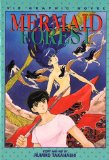
Mermaid Forest


By Rumiko Takahashi, translated by Matt Thorn (Viz)
ISBN: 978-1-56931-047-5

Rumiko Takahashi is one of the most successful comics creators of all time and indisputably the best selling woman in the field (170 million volumes – and rising – of her assorted inventions sold to date) with many awards to her name.

Born in 1957, she enrolled in a manga school whilst at university and began producing Dōjinshi (self-published stories) in 1975, under the tutelage of Manga genius Kazuo Koike. Three years later she sold her first professional story; the award-winning science fiction comedy Urusei Yatsura (34 volumes). Her next big series was rom-com Maison Ikkoku (15 volumes) and she continued both series simultaneously until 1987, whilst also producing a vast array of extremely popular short stories and mini-series.

In 1984 she tried something new: an occasional sequence of interlinked gothic-love horror short-stories that would become known as the Mermaid Saga which appeared at uneven intervals over the next decade.

In 1994 Viz Communications began collecting and translating the nine graphic novelettes for the English speaking world, and this first volume presents the first three in a stunning display of visual virtuosity and macabre menace.

‘A Mermaid Never Smiles’ begins in a remote rural village in modern Japan as beautiful maiden Mana calls out petulantly to her servants. Meanwhile miles away a derelict young man wanders aimlessly, searching for something. His name is Yuta and there’s something rather odd about him…

Mana’s attendants are all women and they are waiting for something. When one performs a unique sacrifice the assembled harridans decree that Mana is ready at last for her great purpose…

When Yuta stumbles into the village he is swiftly killed by the old ladies but doesn’t stay dead for long. Escaping from his grave Yuta confronts the women and rescues the far from grateful Mana, who has no idea that she has been farmed like a veal calf by her sevants, with but one purpose…

On the run Yuta explains the legend of Mermaids: eating their flesh can, if one is fortunate, impart immortality and invulnerability. More common is the slow transformation into ghastly monsters, called “Lost Souls”. Most likely though, is a swift and very painful death from the malignant meat…

Years ago Yuta unwittingly consumed mermaid flesh and has spent half a lonely millennium seeking a cure to his lonely un-aging existence. An old wise-woman told him the only solution was to find a live mermaid and ask her for a method to end his interminable life.

However he has cause to regret his wish when he discovers that all the old women are aged mermaids and Mana has been bred for years as a means by which they can regain the lost youth. Horrified and reluctantly heroic Yuta knows he must foil the plan at all costs – but it won’t be easy or pretty…

‘The Village of the Fighting Fish’ takes us back centuries to Feudal Japan and two island communities at war. Eking out their harsh existence with occasional piracy, the fisher-folk of Toba are being slowly squeezed by their ruthless rivals on Sakagami Island. Moreover, the Tobans leader is dying and his valiant daughter O-Rin is having trouble filling his sandals…

She thinks nothing of it when a dead body washes up; that’s just a sign of the times, but when the corpse comes back to life the sinister, manipulative wife of the Sakagami chieftain seeks him out. It appears she too is hunting for a mermaid, just like the un-killable stranger Yuta…

With a ruthless agenda of her own Isago stirs the bubbling pot of tension until war is inevitable, just as the restless wander Yuta dares to dream that he might risk loving again, but once more the terrible lure of mermaid flesh and supernatural longevity prove to be more curse than blessing and horrifying bloodshed is the inevitable result…

We return to contemporary Japan for the concluding tale as Mana and Yuta find an isolated village near deep woods and stop their wandering for the night. However the naive girl is utterly unaware of the modern world and walks into a near fatal accident.

Taken to the local cottage hospital the severely injured girl mysteriously goes missing, and when Yuta discovers the woodland called the ‘Mermaid Forest’ he fears the worst. His investigations uncover yet another tragic family destroyed by the mermaid curse that has tainted so many lives…

Kindly old Dr. Shiina has kept a dark secret for decades and now, with the girl Mana, he hopes to correct an ancient wrong, but no-one who has tasted mermaid flesh has ever ended happily and as Yuta hopelessly battles yet more Lost Soul horrors, the undying hero knows that this time will be no different…

This bleak supernatural tale of jealousy, twisted love and dark devotion is a spectacular and oppressive epic of understated horror, beautifully realised and movingly effective. One of the best mature manga tales ever produced, it can – and should – be read by older kids too, but please be aware that Japanese social conventions regarding casual nudity are not the same as ours and if you don’t want to see naked bodies you should read something else.
© 1994 Rumiko Takahashi/Shogakukan, Inc. All rights reserved.

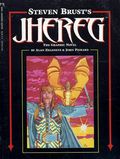
Steven Brust’s Jhereg – A Marvel Graphic Novel


By Steven Brust, adapted by Alan Zelenetz & John Pierard (Marvel)
ISBN: 978-0-8713-5674-1

In the early 1980s Marvel led the field in the development of high quality original graphic novels: mixing out-of-the-ordinary Marvel Universe tales, new series launches, creator-owned properties, movie adaptations and even the occasional licensed asset, such as the adaptation of the fantasy fiction favourite under review here.

Released in lavishly expansive packages (a squarer page of 285 x 220mm rather than the now customary elongated 258 x 168mm) which felt and looked instantly superior to the standard flimsy comicbook no matter how good, bad or incomprehensible the contents might be.

Jhereg, by Steven Brust was first published in 1983, the first of three novels (Jhereg, Yendi and Teckla, later collected as The Book of Jhereg omnibus) starring Vlad Taltos, an assassin-for-hire on the magic-drenched world Dragaera. The setting was faux-feudal with castes, guilds, brotherhoods and covens all rubbing silk-draped shoulders with fantastic creatures and incredible alien forces.

Unlike the other Families and Noble Clans, the House of Jhereg is a brotherhood of unaffiliated individuals elevated to Noble status due solely to ability not merit or bloodline. The house does scut-work and unseemly tasks – originally for the Emperors but now also for selected clientele. They take their name from the predatory jhereg: a venomous dragon-like flying lizard with near-human intellect, telepathic abilities and the power of teleportation.

The graphic adaptation, published under Marvel’s Epic imprint in collaboration with groundbreaking graphics packager Byron Preiss Visual Publications, opens with the grimly efficient Vlad Taltos plying his trade with the help of his jhereg familiar and best friend Loiosh.

When a Jhereg potentate of the ruling Organization Council offers him the biggest commission of his life Vlad’s greed and caution are tweaked in equal amounts.

A member of the inner circle has embezzled millions in funds and although they would like the money back, what the overlords really want is a very public example made. Moreover, in a society where immortality is commonplace and resurrection just a matter of who you know, the council need the Lord Leareth permanently deceased with absolutely no chance of revivification…

Taking the gig, Vlad sets his resources – human, alien and mystical – into locating the thieving absconder and soon finds him holed up in the worst possible place: as an honored guest of powerful Dragonlord Morrolan in his floating castle, cynically using the nobility’s Code of Hospitality to stay safe and unmolested.

Not every member of the clan is happy with the situation and the assassin has a powerful ally in young Aliera, Morrolan’s cousin, and a puissant sorceress in her own right.

Time is running out but Vlad and Loiosh have hatched a cunning plan…

The high fantasy trappings and milieu will delight fans of the genre but the real delight of this colourful, imaginative romp is the plain and simple fact that even with all the witchcraft and weirdness on display, at its heart this is a classy, hard-boiled, private eye thriller dressed up in fantastic fancy-dress: sly, dry, funny, impressively adult and breathtakingly fast-paced… and there’s never been an ethnic-buddy/sidekick like that smart-aleck flying iguana…

Zelentz’s adaptation rockets along, perfectly blending de rigueur tough-guy inner monologue with the land-of-miracles setting and John Pierard’s full-colour artwork is especially appealing – lush, bold, bright and satisfyingly reminiscent of Howard Chaykin’s painted narratives.

An enticing, appetising change of pace for the usual comics crowd, this sorcerous saga might well win a few fans amongst the dedicated Fights ‘n’ Tights fraternity too.
© 1990 Byron Preiss Visual Publications, Inc. Introduction © 1990 Steven Brust. Original novel Jhereg © 1983 Steven Brust. All Rights Reserved.