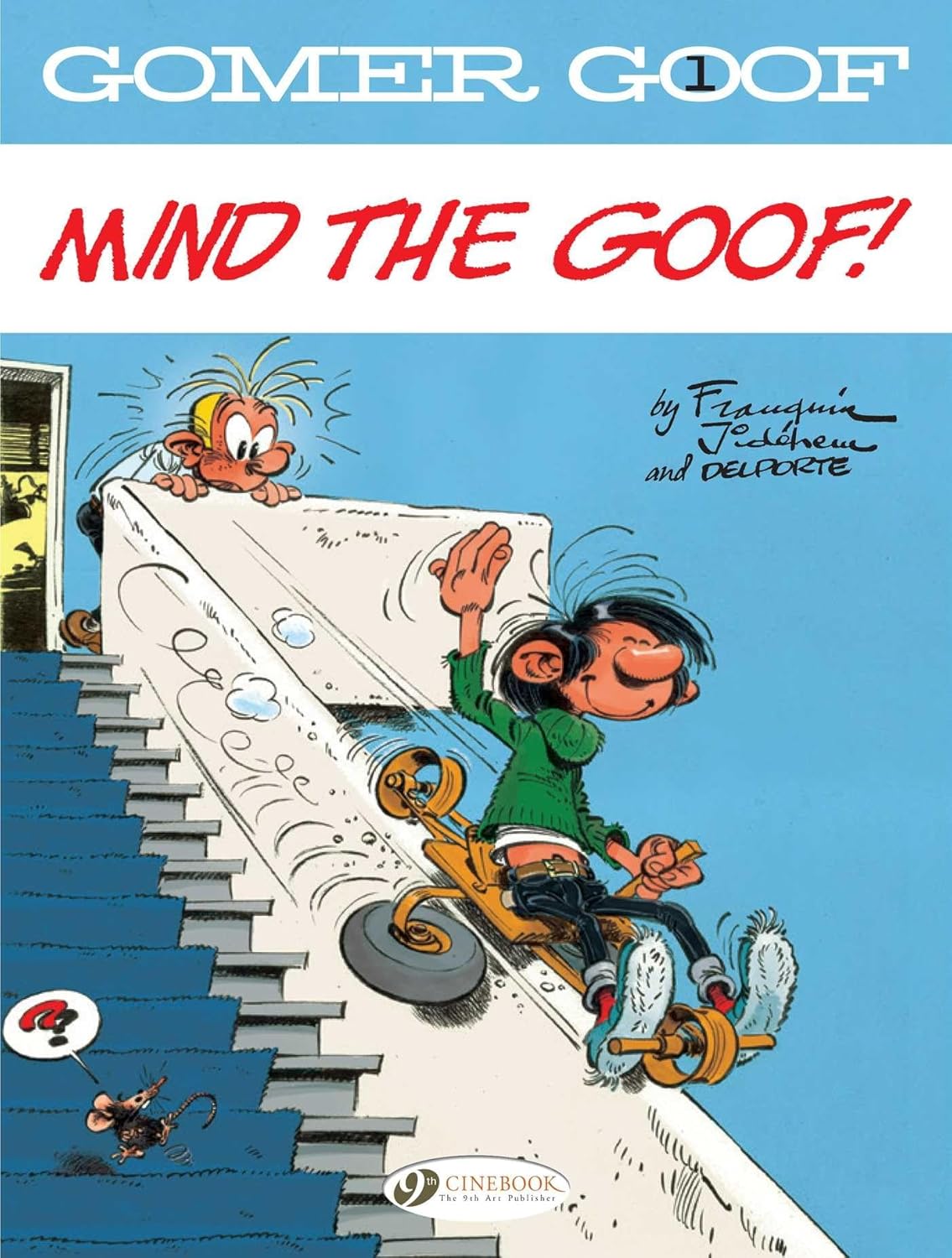
Gomer Goof volume 1: Mind the Goof!


By André Franquin, Delporte & Jidéhem: translated by Jerome Saincantin (Cinebook)
ISBN: 978-1-84918-358-1 (Album TPB/digital edition)

This book includes Discriminatory Content produced during less enlightened times and some used for dramatic and comedic effect.

Born in Etterbeek, Belgium on January 3rd 1924, André Franquin began his astounding career in the golden age of European cartooning. In 1946, as assistant to Joseph “Jijé” Gillain on top strip Spirou, he inherited sole control of the keynote feature, and creating countless unforgettable characters like Fantasio and The Marsupilami. Over two decades Franquin made the strip purely his, expanding its scope and horizons, as co-stars Spirou & Fantasio – with hairy Greek Chorus Spip the squirrel – became globetrotting troubleshooters visiting exotic places, exposing crimes, exploring the incredible and clashing with bizarre, eccentric arch-enemies. Throughout all that, Fantasio remained a full-fledged – albeit entirely fictional – reporter for Le Journal de Spirou, popping back to base between assignments. Regrettably, ensconced there like a splinter under a fingernail was an arrogant, accident-prone office junior. He was Gaston Lagaffe; Franquin’s other immortal – or peut-être unkillable? – conception…

There’s a hoary tradition of comics personalising fictitiously back-office creatives and the arcane processes they indulge in, whether it’s Marvel’s Bullpen or DC Thomson’s lugubrious Editor and underlings at The Beano and Dandy; it’s a truly international practise. Somehow though, after debuting in LJdS #985 (February 28th 1957), the affable dimwit grew – like one of his own monstrous DIY projects – beyond all control. Whether guesting in Spirou’s sagas or his own strips/faux reports for the editorial pages, Lagaffe became one of the most popular and ubiquitous components of the comic he was supposed to paste up.

In initial cameos or occasional asides on text pages, well-meaning foul-up and ostensible studio gofer Gaston lurked and lounged amidst a crowd of diligent toilers until the workshy slacker employed as a general assistant at LJdS’s head office became a solid immovable fixture. Ultimately the scruffy bit-player shambled into his own star feature…

In terms of schtick and delivery, older readers will recognise favourite beats and elements of well-intentioned helpfulness wedded to irrepressible self-delusion as seen in Benny Hill or Jacques Tati vehicles and recognise recurring riffs from Only Fools and Horses and Mr Bean. It’s blunt-force slapstick, using paralysing puns, fantastic ingenuity and inspired invention to mug smugness, puncture pomposity, lampoon the status quoi? (and that’s British punning, see?) and ensure no good deed goes noticed, rewarded or unpunished…

As previously stated, Gaston/Gomer can be seen (if you’re very quick or extremely patient) toiling at Le Journal de Spirou’s editorial offices. At first he reported to Fantasio, but as pressure of work took the hero away, the Goof instead complicated the lives of office manager Léon Prunelle and other harassed and bewildered staffers, all whilst effectively ignoring any tasks he’s paid to actually handle. These notionally include page paste-up, posting packages, filing, clean-up, collecting stuff inbound from off-site and editing readers’ letters – the reason why fans’ requests/suggestions are never acknowledged or answered…

Gomer is lazy, hyperkinetic, opinionated, ever-ravenous, impetuous, underfed, forgetful and eternally hungry: a passionate sports fan, self-proclaimed musician maestro and animal lover whose most manic moments all stem from cutting work corners, stashing or consuming contraband nosh in the office or inventing the Next Big Thing. This situation leads to constant clashes with colleagues and draws in notionally unaffiliated bystanders like increasingly manic traffic cop Longsnoot and fireman Captain Morwater, plus ordinary passers-by who should know by now to keep away from this street.

Through it all, the obtuse office oaf remains affable, easy-going and incorrigible. Only three questions matter: why everyone keeps giving him one last chance, what does gentle, lovelorn Miss Jeanne see in the self-opinionated idiot, and will perpetually-outraged and accidentally abused capitalist financier De Mesmaeker ever get his perennial, pestiferous contracts signed?

If you’re old, new to this and yet experiencing a dose of déjà vu, it might be because the big idiot appeared in a 1970s Thunderbirds annual, rechristened Cranky Franky. Perhaps they should have kept the original title…
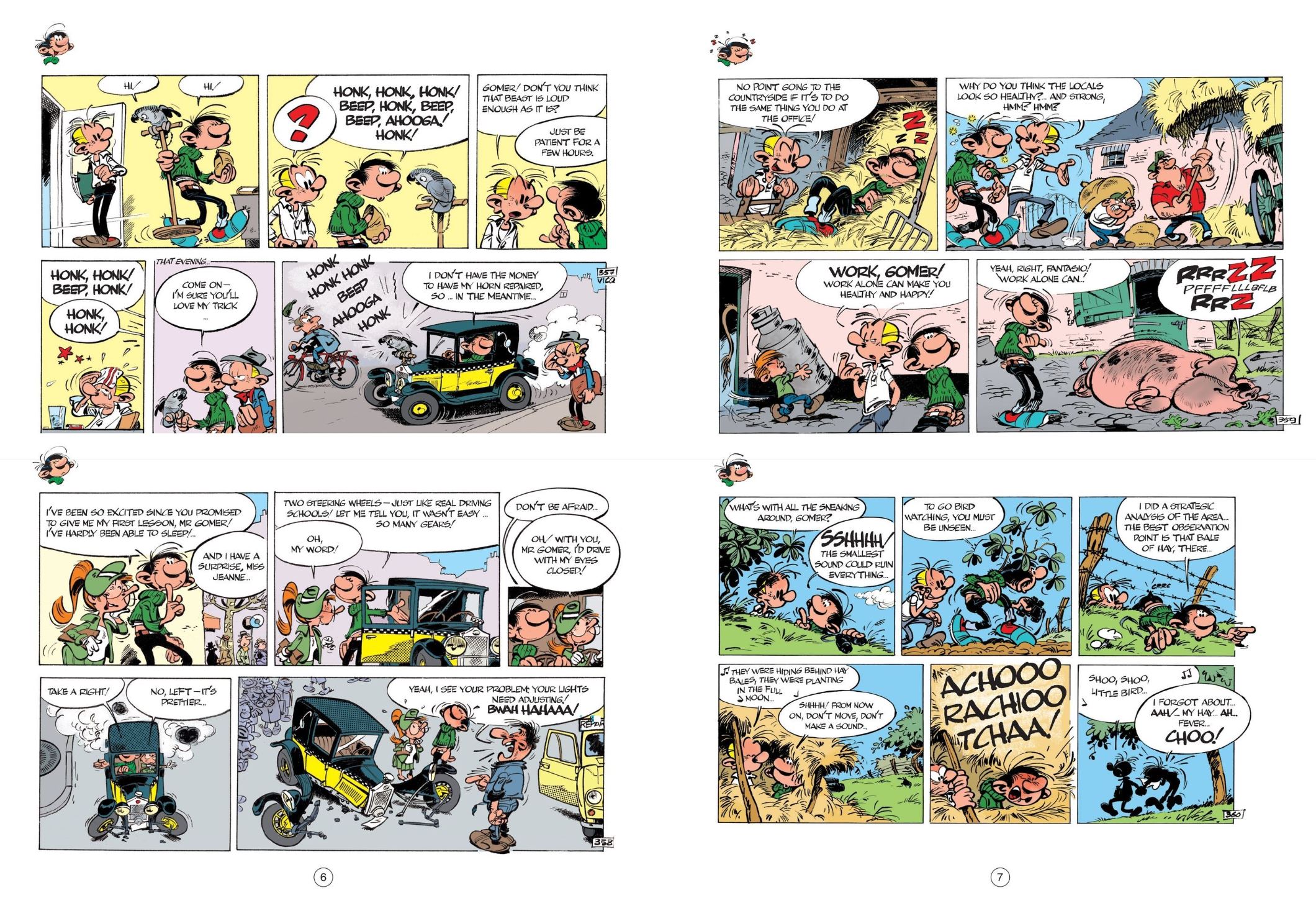
This premier compilation consists of half-page shorts and comedic text story “reports” from the LJdS’s editorial page before ultimately unleashing full episodes of madcap buffoonery. As previously stated Gomer is employed (let’s not dignify his position by calling it “work”) at the Spirou offices, reporting to go-getting Fantasio and foolishly left in charge of minor design jobs like paste-up and reading readers’ letters and general dogs-bodying. He’s lazy, opinionated, forgetful and eternally hungry. Many of his most catastrophic actions revolve around cutting corners and caching illicit food in the office…

Following 26 short, sharp two-tier gag episodes – involving Gomer’s office innovations, his hunt for food, assorted pets and livestock, sporting snafus and his appallingly decrepit and dilapidated Fiat 509 auto(barely)mobile – the first of numerous prose vignettes ‘On the Line’ exposes the fool’s many delusional attempts to become an inventor. Other text forays – punctuated by more pint-sized gag-strips – follow. These comedy briefs include ‘More Than One String to his Bow’, ‘Police Report’, ‘Open Letter to Mr De Mesmaeker’ (Jean De Mesmaeker being the real name of collaborator and background artist Jidéhem and taken for the self-important businessman who became Gomer’s ultimate foil), ‘Winter Stalactites’, ‘Red vs Blue’, ‘Noise Pollution’, ‘Presence of Mind’, ‘Gomer’s stethoscope’, ‘The Firebug Fireman’, ‘Gas-powered bicycle’ and ‘Definitely-not-surreptitious advertising’.
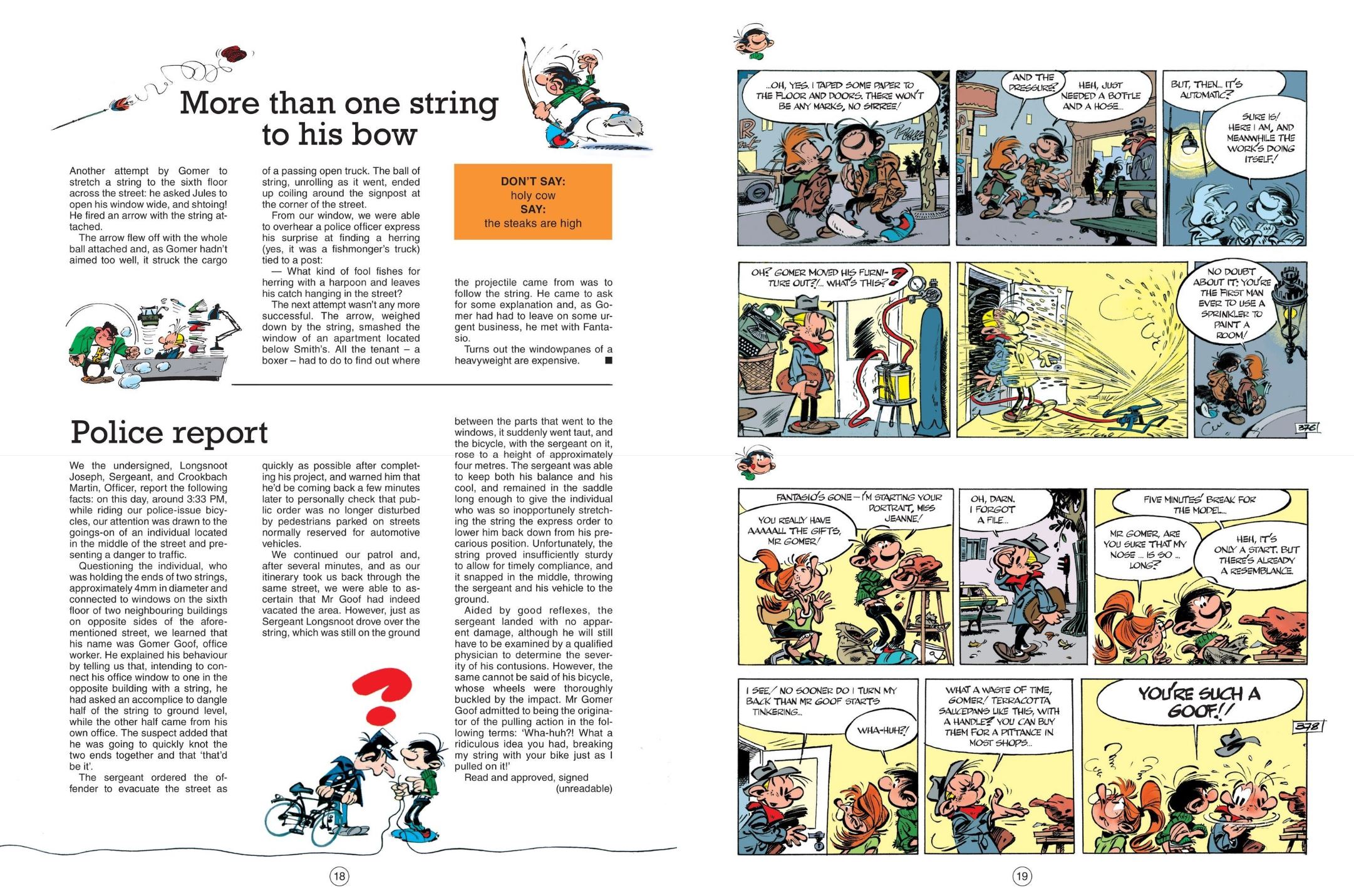
The print then gives way to a long-running procession of half-page strips with our editorial idiot causing a cataclysm of cartoon chaos.

Further prose pieces slip into extended continuity when Fantasio embargoes all canned food (potentially explosive and always a bio-hazard) and Gomer applies all his dubious ingenuity to beating the ban in ‘The tin wars’, ‘Ticking tin bombs’, ‘Diary of a War correspondent’ and ‘Blockade’ before one final strip flurry brings the hilarity to temporary pause…
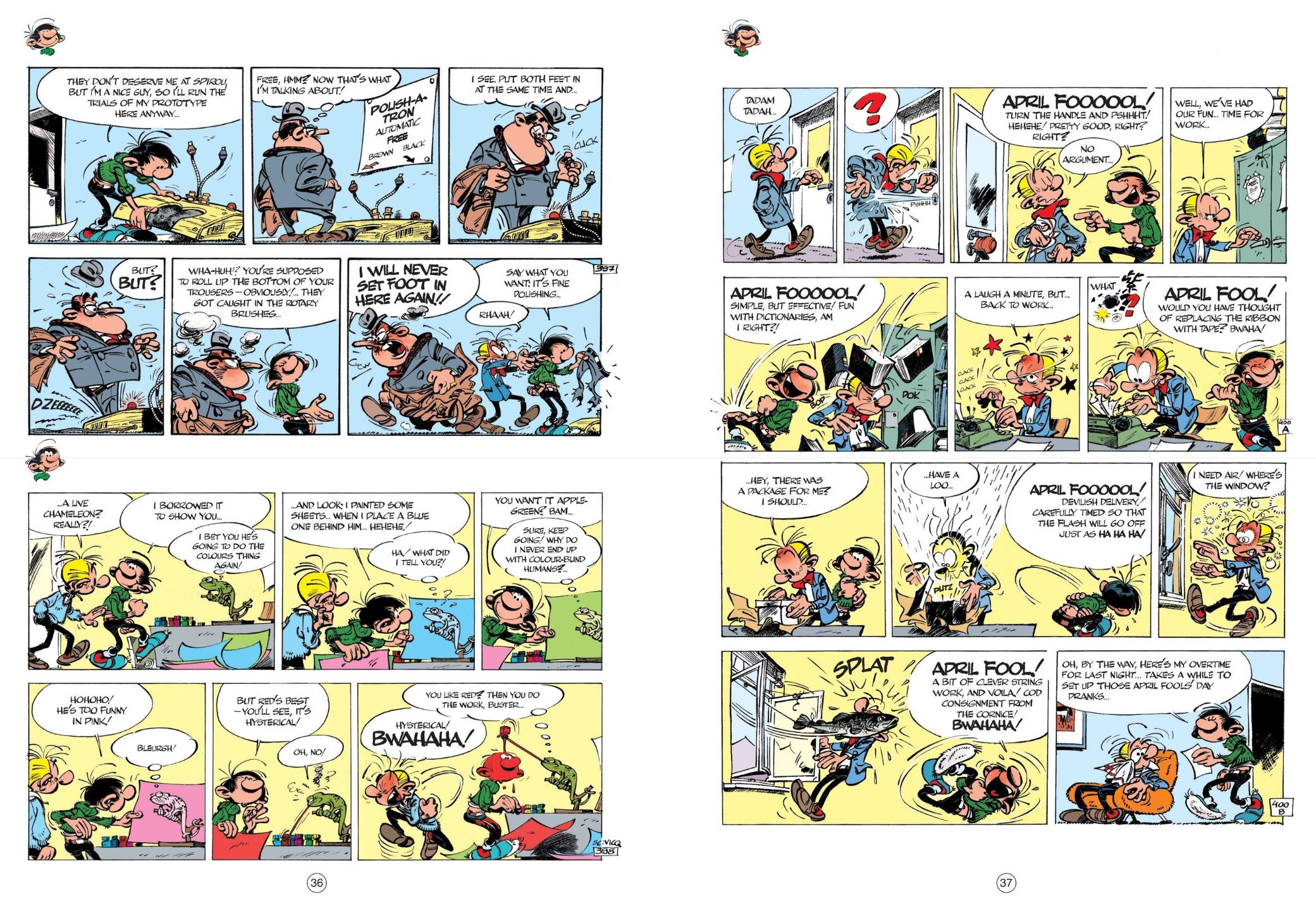
Far better enjoyed than précised or described, these strips allowed Franquin, fellow scenarist Yvan Delporte and Jidéhem to flex their whimsical muscles and subversively sneak in some satirical support for their political beliefs in pacifism and environmentalism, but at their core remain supreme examples of all-ages comedy: wholesome, barbed, daft and incrementally funnier with every re-reading.

So why not start now?
© Dupuis, Dargaud-Lombard s.a. 2017 by Franquin. All rights reserved. English translation © 2017 Cinebook Ltd.

Today in 1907, comic strip god Milton Caniff was born, as was – in 1913 – John Carter of Mars illustrator John Coleman Burroughs. Ditto Japanese teacher/political cartoonist Taizo Yokoyama (Pu-san, Eheh) in1917. Reading wise, André Franquin’s Gaston Lagaffe debuted in 1957.

If there was a February 29th this year, tomorrow we’d be commemorating the birth of Italian superstar Paolo Eleuteri Serpieri (Druuna) in 1944 and the launch of Bil Keane’s The Family Circus in 1960… but we don’t so we ain’t.
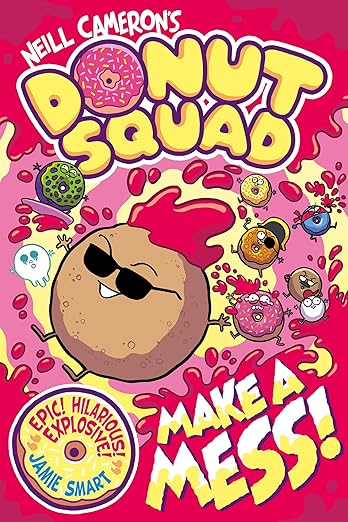
Neill Cameron’s Donut Squad: Make a Mess! (Book 2)


By Neill Cameron & various (David Fickling Books)
ISBN: 978-1-78845-358-5 (Digest TPB Standard edition), 978-1-78845-408-7 (Waterstones edition)

Had enough to eat yet? Do You Like Donuts?

Only you can truly answer that question, but if you’re undecided, and dangerously unaware of the ramifications of indecision, then rowdy raconteur and inestimable art fiend Neill Cameron has another batch of artisanal, edibly-edifying arguments you might want to consider before deciding, all jam-packed into a manic new compendium of strips, activities and artificially-sweetened exploits starring a bargain box of comics champions cherrypicked from modern British periodical treasure trove The Phoenix.

Since debuting in 2012 and just like Beano, Dandy and other perennial childhood treasures, the wonderful weekly has masterfully mixed hilarious comedy with enthralling adventure serials… and frequently in the same scintillating strip. Everybody braced in? Got your snacks? Napkins? Right then, let’s go…

Crafted by Cameron (Mega Robo Bros, Freddy, Tamsin of the Deep, How to Make Awesome Comics, Pirates of Pangea), a unique team of toothsome adventurers reconvene here in world much improved by an absence of bagels. As enny fule kno, bagels are the arch enemy of Donuts and probably all Life…

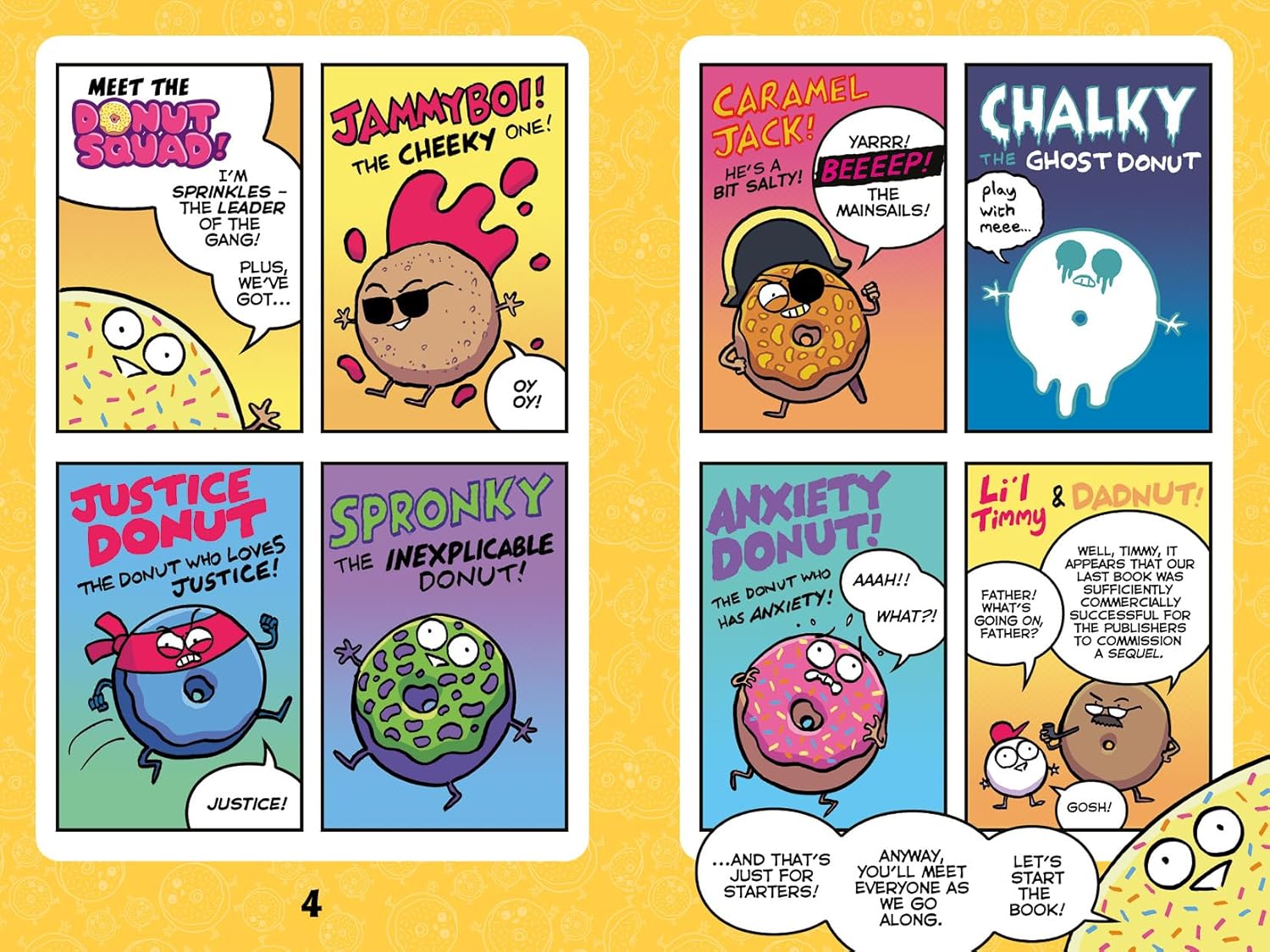
Moreover, there are fresh additions to the team we met in volume 1 (Donut Squad Take over the World! May 2nd 2025) besides commander-in-chief Sprinkles, accident prone Jammyboi, Chalky (the ghost of a murdered Victorian Donut), violent vigilante Justice Donut, nerve-wracked Anxiety Donut, piratical Caramel Jack! (he’s a little bit salty!), Dadnut & Li’l Timmy, and utterly unknowable and incomprehensible Spronky! who will make themselves known in good time…

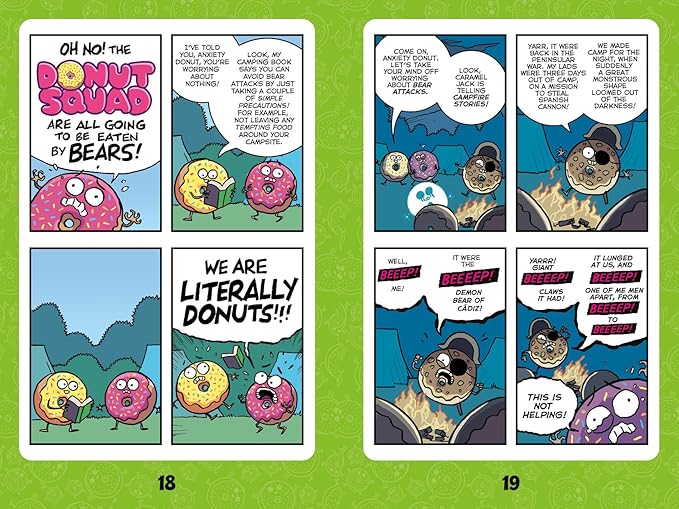
First though we indulge in some ‘Fun Times with Sprinkles’ and the rest, prior to a passionately resolute ‘No Bagels.’ Public Service Announcement, leading us all into an extended exploit in ‘The Great Outdoors’ involving camping, campfires and being eaten by bears…

Ruggedly individualistic, the assorted flavourites (said it. Not proud.) generally work in solo vignettes that combine to make a full package but all pitch in for regular features such as the ads for merch like the ‘Official Donut Squad Camping Gear!’ which here include Tents, Backpacks and High-Power Bear Tranquiliser Guns, and are sensibly, accommodatingly backed up by ‘Hot New Donut Flavours for Summer!’ How about Piña Coladonut!, Choco Banana! or Sweat and Suncream! – or even Cool Cool Mango!, Watermellon Baller and Seagull Beaks!?

If you don’t mind me asking, how big are your nuts? Are you man enough to handle Omega Gargantunut, Gargantunut Titan, Extinction Level Gargantunut, Gargantunut: Nemesis? Steve thinks he is but significant other Janet just thinks he’s full of himself…

No matter how rich they might sound they are as nothing compared to Daddy Billions! – The Richest Donut in the World! If you’re not sure we can direct you to ‘Ask your Mother!: with Mumnut & Li’l Timmy’ episodes before meeting the new guys. These ‘Meatynuts!’ include ‘Spicyboi!’, ‘Beefychunks!’, ‘Crazy Mayonnaisey!’ and ‘Ham Alan’, who shares his extensive backstory before we explore ‘Sweet-Meat Fusion Donuts’ like ‘Chocolate-Frosted Beef’, ‘HAMnJAM!’ or ‘Caramel Sausage!’

A barrage of parental queries season ‘Great Moment’s in Donut History’ and ‘Classic of World Donut Cinema’, and intermittent silhouette games commence with ‘Name That Donut’, supported by more merch such as Donut Squad Caps!, Water Bottles!, Plutonium Enrichment Plants!, Hoodies, Cushions and Autonomous Humanoid Robots!, prior to everyone from Beefychunks to the entire afterlife getting a go at answering dear Timmy’s questions…

Regular features like ‘Donut-Related Conspiracy Theories!’ and ‘It’s Spronky!’ vie for attention with new treats like ‘Do You Like Cheese Donuts? Introducing Tasty Bob!, Nordic Helga and Camemboi!’ and ‘The Life of Michael’ plus ‘Donutiquette – DOs and DON’Ts of POLITE DONUT EATING’, ‘Extreme Donut Eating!’ and ‘Great Figures of History Who Were Secretly Donuts’..

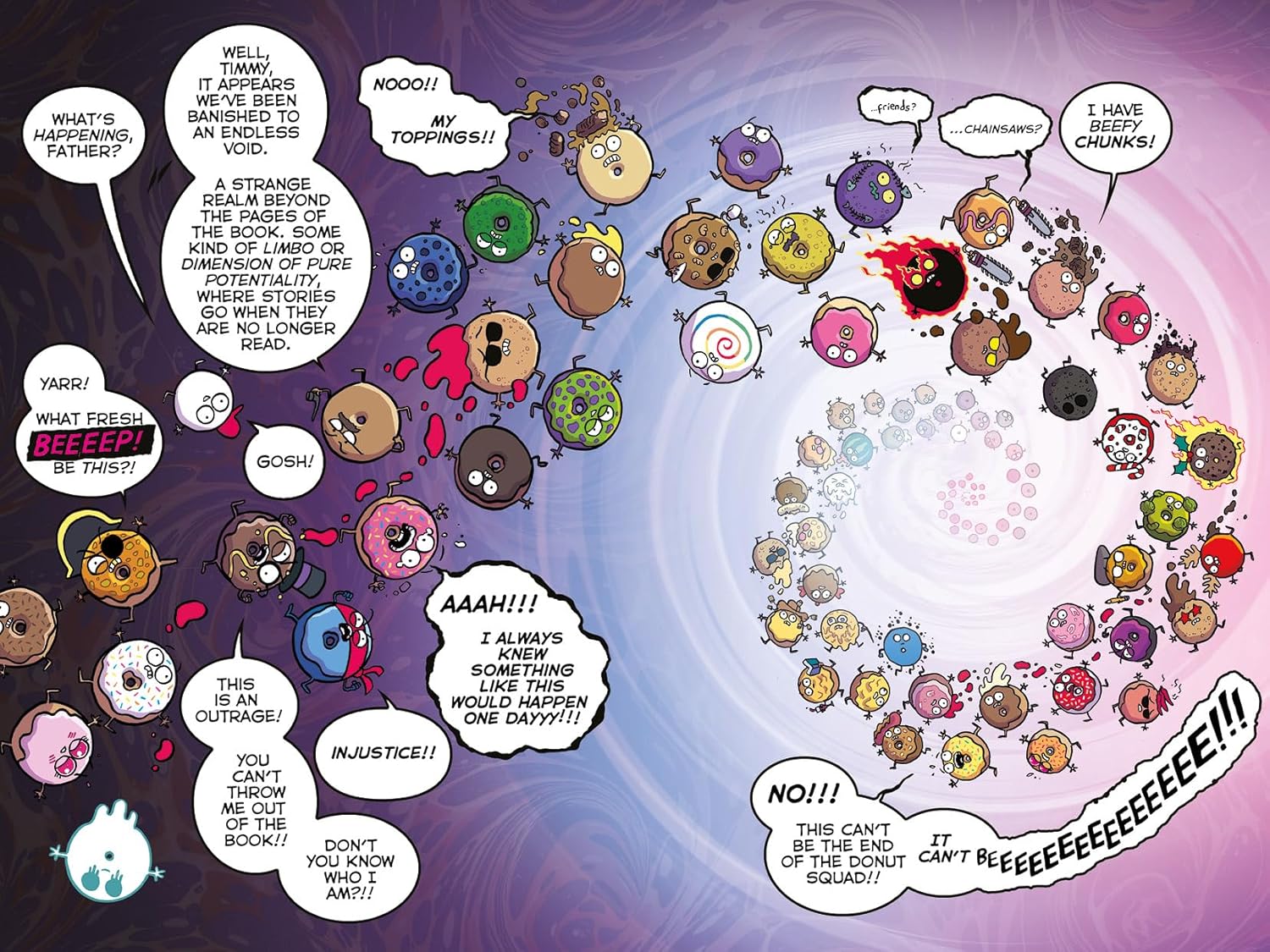
Of course all this is fine but – following the lengthy saga of ‘The Totally Normal Humans’ – things get a bit weird and very nasty as all the long-banished Bagel Battalion break free of their extradimensional jail in THE VOID and attempt to take over the book by invading its gutters!

They succeed too…

Having whetted your appetite you’ll need to buy the book to see what happens next, but be warned, the bready brutes broke out by infiltrating the activity section at the rear, with Cameron’s ‘Phoenix Comic Club’ art classes on How to Draw ‘Sprinkles!’, ‘…Anxiety Donut!’, ‘…Justice Donut!’, ‘…Caramel Jack!’, and all the others caught up in the conflict…

Smart, witty, laugh out loud weird and utterly bonkers, this seemingly piecemeal treat cunningly connects a whole bunch of stuff kids love without knowing why, but which totally bewilders us oldsters and keeps us in our place. Devious, eccentric and captivating, the sugar rush is guaranteed and if you get toothache it’s from laughing not quantum confessions…

Moreover, as all the best books and movies say: DONUT SQUAD WILL RETURN…
Text and illustrations © Neill Cameron 2026. All rights reserved.

Neill Cameron’s Donut Squad: Take Over the World! is scheduled for UK release on January 1st 2026 and is available for pre-order now; or wait until next year and get it tomorrow while walking off all those donuts and bagels…

Today in 1956 Nexus co-creator and Kirby fan Steve Rude was born. In 1965 Dirty Plotte auteur Julie Doucet arrived, but the day also commemorates major losses. In 1978 graphic genius Basil Wolverton went to his long-anticipated reward, and in 2005 inimitable Maurice (The Perishers) Dodd told his last joke. While talking of newspaper strips that changed lives, December 31st 1995 also saw Bill Watterson’s final Calvin and Hobbes episode. Sigh.

You know where to look by now, so perhaps do that between all the “auld lang synes” and dry white whines.

Ruins (Paperback Edition)


By Peter Kuper (SelfMadeHero)
ISBN: 978-1-914224-18-8 (TPB/Digital edition)

Multi award-winning artist, storyteller, illustrator, educator and activist Peter Kuper was born in Summit, New Jersey in 1958, before the family moved to Cleveland, Ohio when he was six. Growing up there he (briefly) met iconic Underground Commix pioneer R. Crumb and at school befriended fellow comics fan Seth Tobocman (Disaster and Resistance: Comics and Landscapes for the 21st Century, War in the Neighborhood, You Don’t Have to Fuck People Over to Survive).

As they progressed through the school system together, Kuper & Tobocman caught the bug for self-publishing. They then attended Kent State University together. Upon graduation in 1979, both moved to New York and whilst studying at Brooklyn’s Pratt Institute and The Art Students League created – with painter Christof Kohlhofer – landmark political art/comics magazine World War 3 Illustrated. Separately and in conjunction, in comics, illustration and via art events, Kuper & Tobocman continued championing social causes, highlighting judicial and cultural inequities and spearheading the use of narrative art as a tool of activism.

Although a noted and true son of the Big Apple now and despite brushing with the comics mainstream as Howard Chaykin’s assistant at Upstart Associates, most of Kuper’s singularly impressive works are considered “Alternative” in nature, deriving from his regular far-flung travels and political leanings. Moreover, although being about how people are, much of his oeuvre employs cityscapes and the natural environment as bit players or star attractions.

When not binding his own “Life Lived in Interesting Times” into experimental narratives – such as with 2007’s fictively-cloaked Stop Forgetting To Remember: The Autobiography of Walter Kurtz – or bold yarns like Sticks and Stones (2005), Kuper created The New York Times’ first continuing strip (1993’s Eye of the Beholder) and regularly adapts to strip form literary classics like Upton Sinclair’s The Jungle (1991), Conrad’s Heart of Darkness (2019), Kafka’s short stories  Give It Up! (1995) and Kafkaesque (2018) as well as longer works like The Metamorphosis (2003), all while creating his own unique canon of intriguing graphic novels and visual memoirs.

Amongst the so many strings to his bow – and certainly the most high-profile – was a brilliant stewardship of Mad Magazine’s beloved Spy Vs. Spy strip, which he inherited from creator Antonio Prohias in 1997, and he also chases whimsy in children’s books like 2006’s Theo and the Blue Note or experimental exercise The Last Cat Book (1984: illustrating an essay by Robert E Howard). Whenever he travelled – which was often – he made visual books such as 1992’s Peter Kuper’s Comics Trips – A Journal of Travels through Africa and Southeast Asia. Three years later he undertook a bold creative challenge for DC’s Vertigo Verité imprint: crafting mute, fantastically expressive thriller/swingeing social commentary The System.

Kuper’s later comics – all equally ambitious and groundbreaking – had to make room for his other interests as he became a successful commercial illustrator (Newsweek, Time, The Nation, Businessweek, The Progressive, Rolling Stone, The New Yorker, Entertainment Weekly and more), lecturer in Graphic Novels at Harvard, a teacher at Parsons School of Design and The School of Visual Arts and – since 1988 – co-Art Director of political action group INX International Ink Company. Translated into many languages, he has built a thriving occupation as a gallery artist exhibiting globally and scored a whole bunch of prestigious Fellowships and Educational residencies as a result.

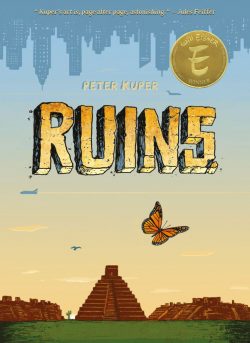
He still finds time to pursue his key interests – such as contributing to benefit anthology Comics for Ukraine: Sunflower Seeds and cultivates a lifelong passion for entomology. This hobby infused 2015’s fictionalized autobiographical episode Ruins: an Eisner Award winning tome now available again in an enthralling trade paperback edition.

A passionate multilayered tale of crisis, confrontation and renewal infused by his ecological concerns, political leanings, rage against authoritarianism and love of Mexico, it draws from the same deep well as 2009’s Diario De Oaxaca: A Sketchbook Journal of Two Years in Mexico. Between 2006 and 2008, Kuper, his wife and young daughter lived in Oaxaca, absorbing astounding historical and cultural riches, beguiling natural wonders, hearty warmth and nonjudgemental friendliness. They also witnessed how a teacher’s strike was brutally and bloodily suppressed by local governor/dictator Ulises Ruiz Ortiz – AKA “URO” – in a series of events with a still heavily disputed death toll scarring the region and citizens to this day.

Part travelogue, part natural history call to arms and paean to the culture of Oaxaca, Kuper’s tale details a marriage in crisis played out against a disintegrating crisis of governance. Recently unemployed, socially withdrawn and emotionally stunted museum illustrator/bug lover George finally capitulates and voyages to the Mexican dreamland his wife Samantha has been pining for since before they met. Under the aegis of a sabbatical year taken to write a book on pre-conquest Mexico, she has dragged him out of ennui and churlish career doldrums to a place where he can indulge his abiding love of insects, if not her…

For Samantha, it’s a return to a paradisical place and magical time, albeit one where she loved and lost her first husband. That’s not the sole cause of growing friction between the increasingly at odds couple. The lengthy trip’s overt intention of reuniting them falters as she is drawn deeply into stories of how the Conquistadors destroyed Mesoamerican cultures they found and highlights parallels to her own plight. There are other earthier distractions she just can’t shake off too…

Slowly, George’s intransigence melts as he meets people willing to tolerate his ways, see beyond his shell, and share the history, geology, geography and serenely easy-going culture that eventually penetrates his crusty exterior. All manner of distracting temptations – like the infinite variety of cool bugs! – are endless and constant as he makes friends and finds healthier ways to express himself. He even tries to renew his constrained relationship with Samantha, but there will always be one impossible, impassable barrier to their future happiness…

… And then they’re caught up in the Teachers’ strike and extra-judicial methods Governor URO employs to end it even as George achieves the milestone life goal he never thought possible and visits the Michoacan forest where Monarchs come to breed and die.

… And finds it expiring from human intrusion…

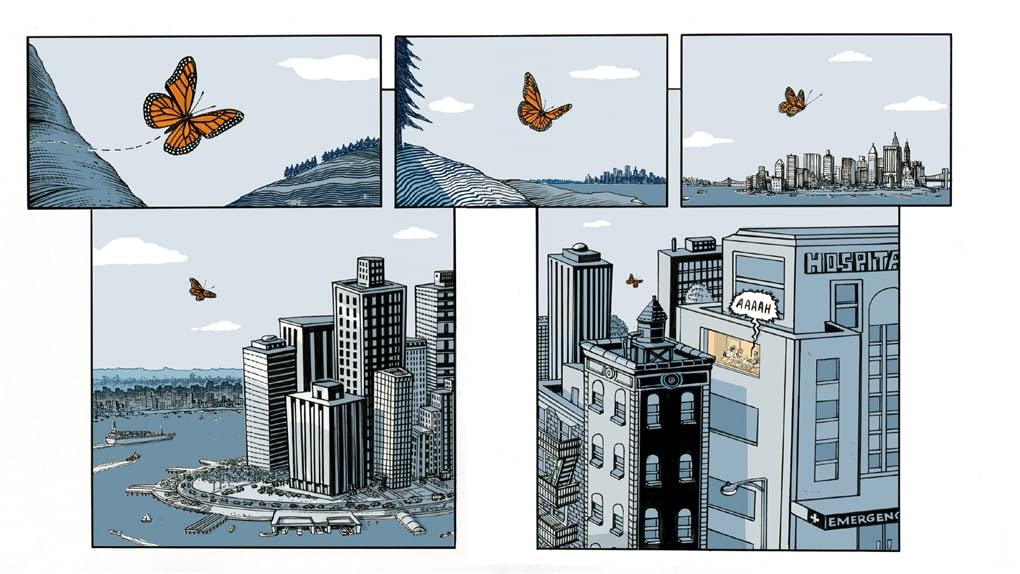
Acting as thematic spine and tonal indicator for the unfolding story, each chapter follows – with snapshot scenes of changing, degrading landscapes – the epic flight of a lone Monarch butterfly, from its start in Canada, across America to the forest’s lepidopteran devotee George ostensibly left his comfort zone home to see.

With overtones of Peter Weir’s film The Year of Living Dangerously (and Christopher Koch’s novel too), Ruins layers metaphor upon allegory, distilling political, ecological and personal confrontation into a powerfully evocative account of people at a crossroads. Inspirationally visualised in a wealth of styles by a true master of pictorial narrative and classic drama, this new paperback edition also includes an ‘Afterwords’ where the author adds context to the still ongoing saga of the civil war crime underpinning his story.

Clever, charming, chilling and compulsively engrossing, this delicious exercise in interconnectivity is a brilliant example of how smart and powerful comics can and should be.
© Peter Kuper 2015. All rights reserved.