Moon Girl and Devil Dinosaur volume one: BFF


By Brandon Montclare, Amy Reeder, Natacha Bustos, Tamra Bonvillain & various (Marvel)
ISBN: 978-1-3029-0005-2 (TPB/Digital edition)

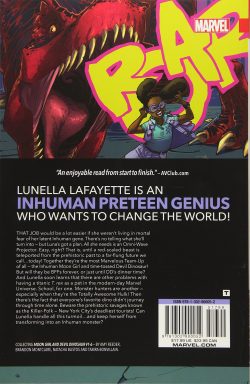
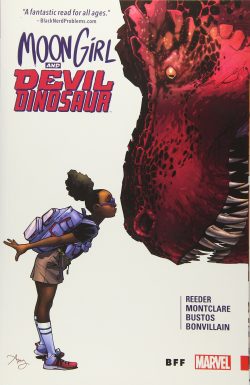
The Marvel Universe is absolutely stuffed with astounding young geniuses but Lunella Lafayette is probably the most memorable you’ll ever meet. Very young, very gifted and proudly black, she lives with her parents on Manhattan’s Lower East Side when not attending Public School 20 Anna Silver on Essex Street.

Thanks to her obsessive interest in astronomy and alien races the other kids mockingly call her “Moon Girl” whilst the brilliant, bored 4th grader’s teachers universally despair because she already knows so much more than they do…

It’s a hassle, but Lunella actually has bigger problems. Time is running out and her numerous applications to specialist schools such as the Fantastic Four’s Future Foundation have all gone unanswered. The situation needs resolving as it’s pretty important and urgent. Lunella has – correctly – deduced that she carries dormant Inhuman genes, and the constantly moving mutagenic Terrigen Cloud recently released into Earth’s atmosphere (see both the Infinity and Inhumanity events) could transform her into a monster at any windswept moment…

Thanks to her investigations, she’s an expert in advanced and extraterrestrial technology, and her quest for a cure or Terrigen-deterrence procedure sees her perpetually sneaking out past bedtime in search of gadgets and detritus left behind after frequent superhero clashes around town…

That impetus reaches its hope-filled climax when her handmade detectors locate a discarded Kree Omni-Wave Projector in opening chapter ‘Repeat After Me’…

At some unspecified time in Earth’s distant prehistory, various emergent species of hominids eked out a perilous existence beside the last of the great lizards and other primordial giants. At one particular key moment, a wide-eyed innocent of the timid yet clever Small Folk saved a baby tyrannosaur from ruthless pre-human hunters the Killer Folk.

They had already slaughtered its mother and siblings with cunning snares and were merrily torturing the little lizard with blazing firebrands – which turned its scorched hide a livid, blazing red – before Moon Boy intervened…

Under the roaring light of a blazing volcano, boy and beast bonded, becoming inseparable companions. It was soon apparent the scarlet saurian was no ordinary reptile: blessed with uncanny intelligence and unmatchable ferocity, Devil became an equal partner in a relationship never before seen in the world. It did not, however, prevent the duo becoming targets for ruthless Killer Folk leader Thorn-Teeth who now slaughters and sacrifices beasts and Small Folk to a mystic “Nightstone”. A more advanced observer might remark on how much it resembles a Kree Omni-Wave Projector…

When Moon-Boy steals the dread talisman, he is savagely beaten near to death even as – in a gym class on Essex Street – Coach Hrbek confiscates and accidentally activates a fancy doodad Lunella’s been playing with instead of paying attention to getting fit.

Lights flash, time shreds and universes collide. A hole opens in space and a pack of bizarre monkey men shamble into modern New York. Arriving too late in the antediluvian valley, Devil Dinosaur thunders straight through the portal, intent on avenging his dying comrade…

Arriving in an impossibly confusing new world, Devil understandably panics. After causing much chaos and carnage, the bombastic beast sniffs little Lunella and snatches her up…

A mad chase ensues in ‘Old Dogs and New Tricks’ as deeply confused Devil marauds through Manhattan with outraged Lunella unable to escape or control the ferocious thunder lizard.

Meanwhile, the Killer Folk rapidly adapt to the new environment. Hiding out and observing everything occurring in the Yancy Street Subway Station, they soon prove the old adage about primitive not meaning stupid. Within days they have grasped the fundamentals of English and new concepts like money and clothes, as well as the  trickier notions of “gangs” and “protection rackets”…

Most importantly, Thorn-Teeth remembers that when they arrived, one of the hairless Small Folk was holding his Nightstone…

In ‘Out of the Frying Pan’, Moon Girl is having little luck ditching the overly-attentive, attention-attracting Torrid T-Rex. Tragically, when she finally does, the Killer Folk grab her and the Omni-Wave…

Their triumph is short-lived, since the lizard’s superior sense of smell summons Devil to the rescue, although, in the resulting melee, the precious device is lost. Growing grudgingly fond of the colossal critter, Lunella stashes Devil in her super-secret lab underneath PS 20, but when a spot of student arson sets the school ablaze, her hideaway is exposed and Devil bursts up through the ground to rescue kids trapped on an upper floor…

The fracas also unfortunately attracts the kind of superhero response Lunella has been dreading. ‘Hulk + Devil Dinosaur – ‘Nuff Said’ sees smug, teenaged Gamma-powered Avenger Amadeus Cho butt in with his bulging muscles and inability to listen to reason…

Poor Devil is no match for the Totally Awesome Hulk, forcing Moon Girl to intervene with some her own inventions. Across town, the Killer Folk – proudly carrying the Nightstone – deal with the last obstacle to their supremacy in the Yancy Street criminal underworld…

The Battle of PS 20 reaches its inevitable conclusion and Cho confiscates Devil Dinosaur, leaving Lunella thoroughly grounded and (apparently) behaving like a normal little girl in ‘Know How’.

Of course, it’s all a trick and as soon as everybody is lulled into complacency Moon Girl kits herself out with more devious gadgetry and busts Devil out of the Top Secret Wing of the Natural History Museum. She’s on a tight deadline now: her weather-monitoring gear confirms the Terrigen Cloud is rolling back towards Manhattan…

The spectacular jailbreak results in a ‘Eureka!’ moment coinciding with the Killer Folk consolidating their grip on the streets and using the Omni-Wave to capture Moon Girl. It also results in Lunella’s mother discovering who broke a dinosaur out of jail, and she furiously heads to the school for a reckoning with her wayward child…

The final conflict sees our little warrior at last victorious over the Killer Folk, albeit too late. As Moon Girl and Devil Dinosaur roar in triumph on the rooftops, Lunella realises she is trapped outside with the Terrigen cloud descending. Her time and opportunity to create a cure has come and gone…

To Be Continued…

Collecting Moon Girl and Devil Dinosaur #1-6 from January to June 2016, this compelling, immensely entertaining romp is crafted by writers Brandon Montclare & Amy Reeder, with art from Natacha Bustos, colours by Tamra Bonvillain and letters from Travis Lanham. With a cover and variants gallery from Trevor Von Eeden, Pascal Campton, Paul Pope, Jeffrey Veregge & Pia Guerra, this addictively engaging yarn affords non-stop fun: a wonderful all-ages Marvel saga that is as fresh, thrilling, moving and hilariously funny now as it ever was.

Moon Girl and Devil Dinosaur: BFF is the kind of tale to lure youngsters into the comics habit and a perfect tool to seduce jaded older fans back into the fold…
© 2016 Marvel Characters, Inc. All rights reserved.

Thor Volume One


By Dan Jurgens & John Romita Jr., Klaus Janson, with Howard Mackie, Scott Hanna, & various (MARVEL)
ISBN: 978-0-7851-4632-2 (TPB/Digital edition)

In the middle of 1962, Stan Lee and Jack Kirby launched their latest offbeat superhero creation in anthology monsters-and-mysteries title Journey into Mystery #83. The tale introduced meek, disabled American doctor Donald Blake who took a vacation in Norway only to encounter the vanguard of an alien invasion. Fleeing in terror, he was trapped in a cave and found an old, gnarled walking stick. When, in helplessness and frustration, he smashed the cane into a huge boulder obstructing his escape, his insignificant frame was transformed into the hulking and brawny Norse God of Thunder, Thor!

The series grew from formulaic beginnings battling aliens, commies and cheap thugs into a vast, breathtaking cosmic playground for Kirby’s burgeoning imagination with Journey into Mystery inevitably becoming the Mighty Thor. After years of celestial adventuring, the peculiarities and inconsistencies of the Don Blake/Thor relationship were re-examined – as well as his doomed romance with his nurse Jane Foster – and all was finally clarified and explained regarding how an immortal godling could also be frail Don Blake.

The epic saga took the immortal hero back to his long-distant youth, ultimately revealing that the mortal surgeon was no more than an Odinian deception: a living shell designed to teach the Thunder God humility and compassion…

Time passed, Kirby left and the Thunderer’s fortunes waxed and waned. During the troubled mid-1990’s the title vanished, culled with The Avengers, Iron Man, Captain America and Fantastic Four and subcontracted out to Image creators Jim Lee and Rob Liefeld during 1996-1997 in a desperate attempt to improve sales after Marvel’s apocalyptic Onslaught publishing event.

In 1998 Heroes Return and Heroes Reborn saw those properties rejoin the greater Marvel Universe, relaunched with brand new first issues with the Thunder God reappearing a few weeks later. In July, Mighty Thor volume 2 launched, and this compendium gathers #1-8, plus Peter Parker, Spider-Man #2 spanning July 1998 to February #1999.

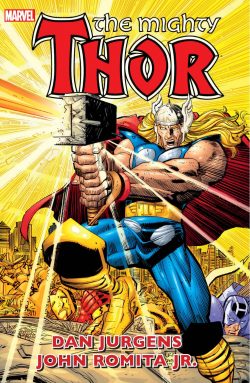
It begins with ‘In Search of the Gods’ by Dan Jurgens, John Romita Jr. & Klaus Janson and finds the Thunderer back on Midgard after more than a year away from the home cosmos, and instantly involved in a desperate hostage situation.

Acting immediately, he ends the crisis only to discover the perpetrator is the now-powerless Guardian God Heimdall. In the recently relaunched Avengers #1, Thor had found Asgard devastated and deserted and now that shocking mystery has been further compounded on Earth…

Elsewhere, Death Goddess Hela and Volla the Prophetess conspire in anticipation of cosmic calamity and desires reaching fruition, even as a military shipment goes badly wrong at New York’s docks where EMT/paramedic Jake Olsen gets the call to assist…

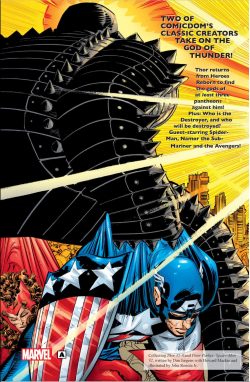
Before leaving Heimdall with (now) Doctor Jane Foster, Thor and the sentinel Asgardian explored shattered Asgard again, inadvertently liberating an unknown horror from ancient captivity, but that is forgotten as the docks situation worsens and Thor joins the hard-pressed Avengers in battling reawakened Odinian ultimate weapon The Destroyer

Despite the best efforts of the World’s Mightiest Heroes, the carnage is shattering and people die. People like Olson… and Thor…

Thor’s story nevertheless continues as his journey to Hela’s realm is interrupted by disturbing new cosmic entity Marnot who claims the Thunderer’s soul and returns it to the living world, bound to equally-miraculously resurrected Olsen in a revival of the spell that created Don Blake and just in time to stop The Destroyer. However, the new-old arrangement will prove to be a true ‘Deal with the Devil!’

Reborn as ‘God and Man’ in #3, the Storm Lord again walks the Earth – but only as the dormant-until-summoned alter-ego of another frail mortal host with a painfully complex personal life. It makes battling the sea-monsters of beguiling sea-goddess Sedna beside former Avenger Namor the Sub-Mariner a far from friendly reunion in ‘From the Ashes’ and leads to Mjolnir rebelling after Thor’s take-charge personality overrules Olsen’s legal authority when the Thunderer compels the paramedic to perform illegal surgery to save a life in ‘Heroes’

The wreckers of Asgard and Marnot have all been manoeuvring in the background throughout and following a flashback to Asgardian childhood ‘What’s a God to Do?’ finds Thor edging closer to the truth after another pointless clash with best pal Hercules. Once the dust has settled, Thor finds his people have been framed for attacking Olympus even as in Asgard the fate of the vanquished All-Father is revealed. However,  the ‘Deception’ has proven effective and Thor and Hercules are attacked by the entire outraged Hellenic pantheon…

The true architects of most of this mayhem are a pantheon of previously unknown Dark Gods – Perrikus, Adva, D’Chel, Slottoth, Tokkots and Majeston Zelia – so powerful that they have managed to take possession of the fallen Fabled Realm, constantly attack Thor since his return to Asgard and now bar him entirely from reaching his sundered home…

This initial collection concludes with a stellar crossover between hammer-hurler and webspinner as Thor #8 sees the Thunder God encounter Spider-Man when Tokkots goes on an Earthly rampage of destruction in ‘…and the Home of the Brave!’ before being spectacularly defeated and despatched to enslaved Asgard in ‘Plaything of the Gods’ (Peter Parker, Spider-Man #2, by Howard Mackie, Romita Jr. & Scott Hanna).

An all action, rocket-paced return to comic book basics, this revival includes a wealth of covers and variants by Romita Jr., Janson & Hanna, and, whilst perhaps not to everyone’s taste (it’s woefully short of anything even approaching a funny moment) is a blistering epic to delight the Fight’s ‘n’ Tights faithful, with the artwork undeniably some of the best of the modern Marvel Age. If you want your pulse to pound and your graphic senses to swim, this is the ideal item for you.
© 1998, 1999, 2010 Marvel Characters, Inc. All rights reserved. Digital version © 2020 MARVEL

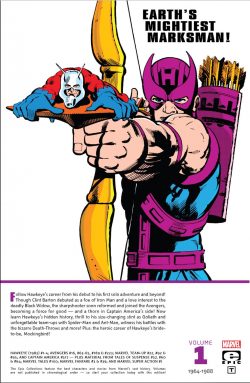
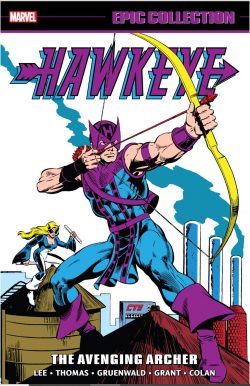
Hawkeye Epic Collection volume 1: The Avenging Archer 1964-1988


By Stan Lee & Don Heck, Roy Thomas, Len Wein, Steven Grant,  Mark Gruenwald, David Michelinie, Mike Friedrich, J.M. DeMatteis, Scott Edelman, Roger Stern, Charlie Boatner, Jack Kirby, Gene Colan, Sal Buscema, John Byrne, Carmine Infantino, Greg LaRoque, George Evans, Jimmy Janes, Paul Neary, Joe Staton, Dick Ayers, Mike Netzer, Trevor Von Eeden, Eliot R. Brown & various (MARVEL)
ISBN: 978-0-7851-3723-8 (TPB/Digital edition)

Clint Barton is probably the world’s greatest archer: swift, bold, unerringly accurate and augmented by a fantastic selection of multi-purpose high-tech arrows. Other masked bow persons are available… including a young, female Hawkeye…

Following an early brush with the law and as a reluctant Iron Man villain, Barton reformed to join the Mighty Avengers, serving with honour and distinction, despite always feeling overshadowed by his more glamorous, super-powered comrades.

Long a mainstay of Marvel continuity and probably Marvel’s most popular B-list hero, the Battling Bowman has risen to great prominence in recent years, boosted by his film and television incarnation.

This brash and bombastic collection – available in paperback and digital formats – re-presents breakthrough miniseries Hawkeye #1-4, the major early appearances from Tales of Suspense #57, 60, 64 and momentous moments from The Avengers #16, 63-65, 189, 223: supplemented by outings in Marvel Team-Up #22, 92, 95; Captain America #317 and pertinent material from Marvel Tales #100; Marvel Fanfare #3, 39 and Marvel Super Action #1, all chronologically covering September 1964 to August 1988. It should be noted that some of these tales feature his occasional wife and partner Mockingbird

It naturally begins with a blockbusting debut from Tales of Suspense #57. In ‘Hawkeye, the Marksman!’ by Stan Lee & Don Heck – as the villainous Black Widow resurfaces to beguile an ambitious and frustrated former carnival performer-turned-neophyte-costumed vigilante. She convinces him to attack her archenemy Iron Man and, despite a clear power-imbalance, the amazing ingenious archer comes awfully close to beating the Golden Avenger…

Natasha Romanoff (sometimes Natalia Romanova) was a Soviet Russian spy who came in from the cold to become one of Marvel’s earliest female stars. She started life as a svelte, sultry honey-trap during Marvel’s early “Commie-busting” days, periodically targeting Tony Stark and battling Iron Man. She was subsequently redesigned as a torrid, tights-&-tech super-villain before defecting to the USA, falling for an assortment of Yankee superheroes – including Hawkeye, Daredevil and Hercules – and enlisted as an agent of S.H.I.E.L.D., setting up as a freelance do-gooder before joining (and occasionally leading) The Avengers.

Tales of Suspense #60 (December 1964, by Lee, Heck & Dick Ayers) featured an extended plotline with Stark’s “disappearance” leading to Iron Man being ‘Suspected of Murder!’. Capitalizing on the chaos, lovestruck Hawkeye and the Widow again attacked the Armoured Avenger, but another failure led to her being recaptured and re-educated by enemy agents…

Abruptly transformed from fur-draped seductress into gadget-laden costumed villain, she resurfaced in #64 (April 1965 by Lee, Heck & Chic Stone), again steering the bewitched bowman into attacking her enemy. Her final failure led to huge changes…

Most importantly, one month later, Avengers #16 saw the superstar team split up following climactic battles against Zemo and the Masters of Evil. Laid out by Jack Kirby & embellished by Ayers, ‘The Old Order Changeth!’ introduced a dramatic change of concept for the series. As Lee increasingly wrote to the Marvel’s unique strengths – tight continuity and strongly individualistic characterisation – he found juggling individual stars in their own titles in addition to a combined team episode every month was almost impossible…

As Captain America and substitute sidekick Rick Jones fight their way back to civilisation, the Avengers institute changes and seek out their own replacements. The big-name stars resigned making way for three erstwhile villains: Quicksilver, the Scarlet Witch and Hawkeye, all reformed, reenergised and hungry for redemption…

The Straightshooter became a mainstay and backbone of the team, but in Avengers #63, survived a battle epiphany that triggered a big change after returning from a mission in Wakanda.

Beginning a 3-part tale illustrated by Gene Colan & George Klein ‘And in this Corner… Goliath! saw Barton abandon the arrow schtick in favour of true super-powers as Roy Thomas finally gave the enigmatic Avenger an origin.

The first chapter was part of a broader tale: an early crossover experiment intersecting with the 14th issue of both Sub-Mariner and Captain Marvel, wherein a coterie of cerebral second-string villains combined to conquer the world by stealth…

Within the Avengers portion of proceedings, Hawkeye revealed his civilian identity for the first time. He was ex-circus performer Clint Barton and shared his origins before forsaking bow and trick-arrows to become a size-changing hero using Pym particles. He then adopted the now-vacant name Goliath to save the Black Widow.

In #64’s ‘Like a Death Ray from the Sky!he reluctantly reunited with his mobster brother Barney Barton and led the team against a terror satellite scheme cooked up by Egghead before #65 (inked by Sam Grainger) saw him attacked by his old enemy/mercenary mentor the Swordsman in ‘Mightier than the Sword?

Jumping to June 1974 – a time when the archer pursued a solo career – Marvel Team-Up #22 (by Len Wein, Sal Buscema & Frank Giacoia) unleashes ‘The Messiah Machine!’ as Battling Bowman and Amazing Spider-Man frustrate deranged computer Quasimodo’s ambitious if absurd mechanoid invasion of Earth.

Cover-dated February 1979, reprint title Marvel Tales #100 concealed ‘Killers of a Purple Rage!’: a new short tale by Scott Edelman, Michael Netzer & Terry Austin which finds time-displaced Two-Gun Kid and Hawkeye battling each other and then mind controlling menace Killgrave the Controller

Avengers #189 (November 1979, by Steven Grant, John Byrne & Dan Green) then reveals how official reservist Hawkeye get a day job at Cross Technological Enterprises in ‘Wings and Arrows!’ Before long, he’s earning every penny as the new security chief by battling alien avian interloper Deathbird

For Marvel Team-Up #92 (April 1980) Grant, Carmine Infantino & Pablo Marcos reunite Archer and Arachnid after a new iteration of Mr. Fear steals CTE technology and almost cripples the heroes with ‘Fear!’ after which vigilante activist El Águila raids the corporate citadel in a tight tale from Marvel Fanfare #3 (July 1982). Crafted by Charlie Boatner, Trevor Von Eeden & Josef Rubinstein, ‘Swashbucklers’ at last opens Hawk’s eyes to what his bosses are truly like and what they do with their discoveries…

Cover-dated September 1982, Avengers #223 talked ‘Of Robin Hoods and Roustabouts’. Devised by David Michelinie, Greg LaRocque, Brett Breeding & Crew, it saw reinstated Avenger Clint Barton join Ant-Man Scott Lang, when he and daughter Cassie attend a circus and stumble into a clash with skills-mimic Taskmaster to extricate an old friend from the maniac’s clutches and influence.

Hawkeye was always a team player and unlucky in love, but that was all about to change. In the interests of complete clarity, this collection pops briefly back to 1976 for some classy comics context and the first (costumed) appearance of occasional wife and frequent paramour Bobbi “Mockingbird” Morse as first seen in January 1976.

Preceded by a Howard Chaykin frontispiece from monochrome Marvel Super Action #1, former Ka-Zar romantic interest Dr. Barbera Morse was reinvented by Mike Friedrich, George Evans & Frank Springer in ‘Red-Eyed Jack is Wild!’ Adopting unwieldy nomme de guerre Huntress, skilled combat operative Morse devotes herself to cleaning up corruption inside S.H.I.E.L.D., no matter what the cost…

Huntress became Mockingbird in Marvel Team-Up #95 (July) in a smart thriller by Grant, Jimmy Janes & Bruce Patterson. ‘…And No Birds Sing!’ ended the long-extant S.H.I.E.L.D. corruption storyline as Morse invited Spider-Man to join forces and expose the true cancer at the heart of America’s top spy agency…

All this was laying the groundwork for something truly game-changing…

Written and drawn by the hugely underrated and much-missed Mark Gruenwald, assisted by inkers Brett Breeding & Danny Bulanadi and running from September-December 1983, Hawkeye #1-4 was one of Marvel’s earliest miniseries and remains one of the very best and most eventful adventures of the Ace Archer. Much like the character himself, this project was seriously underestimated when first released. Most industry pundits and the more voluble fans expected very little from a second-string hero drawn by a professional writer. Guess again, suckers!

 ‘Listen to the Mockingbird’ sees Clint still moonlighting as security chief for electronics corporation CTE when he captures a renegade S.H.I.E.L.D. agent. She reveals that his bosses are all crooks, secretly involved in shady mind-control experiments.

After some initial doubts, in ‘Point Blank’ Barton teams with the svelte and sexy super-agent to foil the plot, gaining in the process a new costume and an instant rogues’ gallery of archfoes such as Silence, Oddball and Bombshell by third chapter ‘Beating the Odds’

As the constant hunt and struggle wears on, Barton succumbs to – but is not defeated by – a life-changing physical injury leading to permanent disability. He also impetuously marries in explosive conclusion ‘Till Death us do Part…’ wherein the sinister mastermind behind everything is finally revealed and summarily dealt with.

In those faraway days both Gruenwald and Marvel Top Gun Jim Shooter maintained that a miniseries had to deal with significant events in a character’s life, and this bright and breezy, no-nonsense, compelling and immensely enjoyable yarn certainly kicked out the deadwood and re-launched Hawkeye’s career.

In short order from here the bowman went on to create and lead his own team: The West Coast Avengers, gained a regular series in Solo Avengers/Avengers Spotlight and his own titles, consequently becoming one of the most vibrant and popular characters of the period and today as well as a modern-day action movie icon…

However, there are still treats to share

Next here is fun foray from Captain America 317 (May 1986) by Gruenwald, Paul Neary & Dennis Janke. In ‘Death-Throws’ Hawkeye and Mockingbird hunt circus-themed villains and their boss Crossfire with the Sentinel of Liberty reduced almost to a spectator and proud dad watching the kids grow up…

The comics wonderment concludes with a little-seen story from Marvel Fanfare #39 (August 1988). Courtesy of J.M. DeMatteis, Joe Staton & Kim DeMulder, ‘The Cat’s Tale’ finds the Ace Archer seriously off his game until taken on a vision-quest by Navajo shaman Jesse Black Crow to confront the predatory feline spirit that is poisoning his existence…

Packed with terrific tales of old-fashioned romance, skulduggery and derring-do, this book comes with extras including the Gil Kane cover to Marvel Triple Action #10, text articles on the Hawkeye miniseries from Marvel Age #6; the event’s 1983 house ad by Gruenwald & Brett Breeding and the covers and introduction from the 1988 TPB collection (and three subsequent re-releases), plus text pieces from Archie Goodwin, & Gruenwald.

Also on view are contemporaneous info pages from the Official Handbook of the Marvel Universe, about Hawkeye, Mockingbird, Death-Throws, Ringleader, Oddball, Bombshell, Tenpin and KnickKnack, plus diagrammatic cutaways by Eliot R. Brown, detailing the secrets of ‘Hawkeye’s Skymobile’, ‘Hawkeye’s Quiver and Bows’ and ‘Mockingbird’s Battle-Staves’.

This is a no-nonsense example of the straightforward action-adventure yarns that cemented Marvel’s reputation and success and a collection to enhance any Fights ‘n’ Tights fans’ place of honour on the bookshelf.
© 2021 MARVEL.

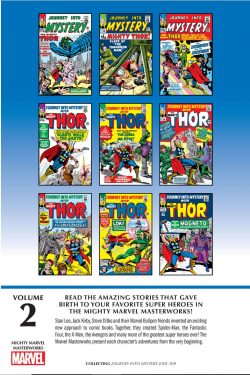
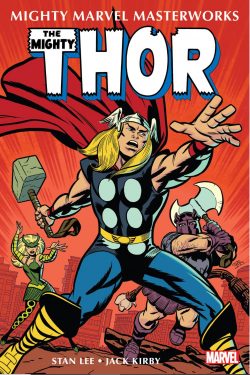
Mighty Marvel Masterworks volume 2: The Invasion of Asgard


By Stan Lee & Jack Kirby, with Chic Stone, George Roussos, Vince Colletta, Paul Reinman, Don Heck & various (MARVEL)
ISBN: 978-1-3029-3442-2 (PB/Digital edition)

These stories are timeless and have been gathered many times before, but today I’m once again focussing on format. The Mighty Marvel Masterworks line launched with economy in mind: classic tales of Marvel’s key creators and characters re-presented in chronological publishing order. It’s been a staple since the 1990s, but always in lavish, hardback collectors editions. These editions are cheaper, on lower quality paper and – crucially – smaller, about the dimensions of a paperback book. Your eyesight might be failing and your hands too big and shaky, but at 152 x 227mm, they’re perfect for kids. If you opt for the digital editions, that’s no issue at all…

Even more than The Fantastic Four, The Mighty Thor was the arena in which Jack Kirby’s boundless fascination with all things Cosmic was honed and refined through his dazzling graphics and captivating concepts. The King’s plethora of power-packed signature pantheons began in a modest little fantasy/monster title called Journey into Mystery where – in the summer of 1962 – a tried-and-true comicbook concept (feeble mortal transformed into god-like hero) was revived by the rapidly resurgent company who were not yet Marvel Comics: adding a Superman analogue to their growing roster of costumed adventurers.

Cover-dated August 1962, Journey into Mystery #83 saw a bold costumed Adonis jostling aside the regular fare of monsters, aliens and sinister scientists in a brash, vivid explosion of verve and vigour. The initial exploit followed disabled American doctor Donald Blake who took a vacation in Norway and encountered the vanguard of an alien invasion. Fleeing, he was trapped in a cave where he found an old, gnarled walking stick. When, in frustration, he smashed the stick into the huge boulder blocking his escape, his puny frame was transformed into the Norse God of Thunder!

Plotted by Stan Lee, scripted by his brother Larry Lieber and illustrated by Kirby and inker Joe Sinnott (at this juncture a full illustrator, Sinnott would become Kirby’s primary inker for most of his Marvel career), that introduction was pure primal Marvel: bombastic, fast-paced, gloriously illogical and captivatingly action-packed. It was the start of a new kind of legend and style of comics’ storytelling…

Spanning February to October 1964, this gloriously economical full-colour paperback tome – also available in eFormats – revisits pioneering Asgardian exploits from JiM #101-109 in a blur of innovation and seat-of-the-pants myth-revising and universe-building…

Lee had taken over scripting with Journey into Mystery #97, the issue that launched a spectacular back-up series. Tales of Asgard – Home of the Mighty Norse Gods gave Kirby a vehicle to indulge his fascination with legends and began by adapting classic traditional tales before eventually switching to all-new material shaped for Marvel’s pantheon. Here, Kirby built his own cosmos and mythology, which would underpin the company’s entire continuity.

Journey into Mystery #101 featured ‘The Return of Zarrko, the Tomorrow Man!’ and sees Odin halve Thor’s powers for wilful disobedience, just as the futuristic felon abducts the Thunder God to help him conquer the 23rd century. A two-parter (with the first chapter inked by George Roussos), it was balanced by another exuberant tale of the boy Thor.

‘The Invasion of Asgard!’ sees the valiant lad fight a heroic rearguard action whilst introducing a host of future villainous mainstays such as the Rime Giants, King Geirrodur and Trolls.

‘Slave of Zarrko, the Tomorrow Man!’ is a tour de force epic conclusion most notable for the introduction of Chic Stone as inker. To many of us oldsters, his clean, full brush lines make him The King’s best embellisher ever. This triumphant futuristic thriller is counterbalanced by brooding short  from ancient history. ‘Death Comes to Thor!’ has the teen hero face his greatest challenge yet, with two women who would play huge roles in his life introduced in this brief 5-pager; young goddess Sif and Hela, Queen of the Dead.

On a creative roll, Lee, Kirby & Stone next introduced ‘The Enchantress and the Executioner’ ruthless renegade Asgardians determined to respectively seduce or destroy the warrior prince at the front of JiM #103 whilst the rear detailed ‘Thor’s Mission to Mirmir!’, disclosing how the gods created humanity. That led one month later to a revolutionary saga in the present day lead feature when ‘Giants Walk the Earth!’

For the first time, Kirby’s imagination was given full rein after Loki tricks Odin into visiting Earth, only to release in his absence, ancient elemental enemies Surtur and Skagg, the Storm Giant from eternal Asgardian bondage.

This cosmic clash depicted noble gods battling demonic evil in a new Heroic Age, and the greater role of the Norse supporting cast – especially noble warrior Balder – was reinforced by a new Tales of Asgard strand focussing on individual Gods and Heroes. Inked by Don Heck, ‘Heimdall: Guardian of the Mystic Rainbow Bridge!’ was first, highlighting the mighty sentinel’s uncanny senses and crucial role in defending the realm from its foes…

JiM #105-106 saw the teaming of two old foes in ‘The Cobra and Mr, Hyde!’ and ‘The Thunder God Strikes Back!’: another continued story packed with tension and spectacular action, and proving Thor was swiftly growing beyond the constraints of traditional single issue adventures. The respective back-ups ‘When Heimdall Failed!’ (Lee, Kirby & Roussos) and ‘Balder the Brave’ (inked by Vince Colletta) further fleshed out the back-story of an Asgardian pantheon deviating more and more from those classical Eddas and Sagas kids had to plough through in schools.

A petrifying villain premiered ‘When the Grey Gargoyle Strikes!’ in Journey into Mystery #107: a rare yarn highlighting the fortitude of Dr. Blake rather than the power of the Thunder God, who was increasingly reducing his own alter-ego to an inconsequentiality. Closing the issue, the Norn Queen debuted in a quirky reinterpretation of the classic myth in ‘Balder Must Die!’ illustrated by Kirby & Colletta.

After months of manipulation, the God of Evil once again attempted direct confrontation with his despised step-sibling in ‘At the Mercy of Loki, Prince of Evil!’ With Jane Foster a helpless victim of Asgardian magic, the willing assistance of new Marvel star Doctor Strange made this a captivating team-up read, whilst ‘Trapped by the Trolls!’ (Colletta inks) showed the power and promise of tales set solely on the other side of the Rainbow Bridge as Thor liberates enslaved Asgardians from subterranean bondage.

Bringing down the curtain on this increasingly cosmic carnival, Journey into Mystery #109 was another superb adventure masquerading as a plug for recent addition to the Marvel roster.

‘When Magneto Strikes!’ pits Thor against the X-Men’s archfoe in a cataclysmic clash of fundamental powers, although you could hardly call it a team-up since the heroic mutants are never actually seen. The tantalising hints and cropped glimpses are fascinating teasers now, but the kid I then was felt annoyed not to have seen these new heroes… oh, wait… maybe that was the point?

The Young Thor feature ‘Banished from Asgard’ is an uncharacteristically lacklustre effort to end on, with Odin and Thor enacting a devious plan to trap a traitor in Asgard’s ranks, but the vignette hinted at much greater thrills to follow…

Rounding off the increasingly spectacular shenanigans are a gallery of original art pages and a rousing landmark house ad for the entire Marvel Comics line.

These foundational tales of the God of Thunder show the development not only of one of Marvel’s core narrative concepts but, more importantly, the creative evolution of perhaps the greatest imagination in comics. Set your common sense on pause and simply wallow in the glorious imagery and power of these matchless adventures to discover the true secret of what makes comic book superheroes such a unique experience.
© 2022 MARVEL.

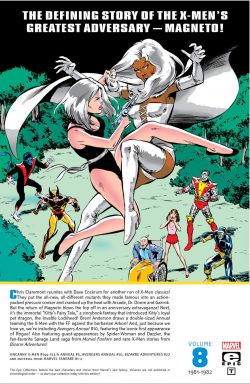
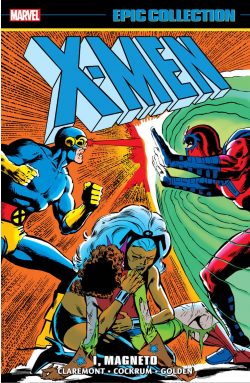
X-Men Epic Collection volume 8: I, Magneto (1981-1982)


By Chris Claremont, Jo Duffy, Bob Layton, Dace Cockrum, Michael Golden, Brent Anderson, Paul Smith, Jim Sherman, Bob McLeod, John Buscema, George Pérez & various (Marvel)
ISBN: 978-1-3029-2952-7 (TPB/Digital edition)

In 1963, The X-Men #1 introduced Scott (Cyclops) Summers, Jean (Marvel Girl) Grey, Bobby (Iceman) Drake, Warren (Angel) Worthington III and Hank (The Beast) McCoy: unique students of Professor Charles Xavier. Their teacher was a wheelchair-bound telepath dedicated to brokering peace and integration between the masses of humanity and the emergent off-shoot race of mutants dubbed Homo superior; considered by many who knew him as a living saint.

After eight years of eccentrically amazing adventures, the mutant misfits almost disappeared at the beginning of 1970 during another periodic downturn in superhero comics sales. Just as in the 1940s, mystery men faded away whilst traditional genres – especially supernatural yarns – dominated entertainment fields. The title returned at year’s end as a reprint vehicle, and the missing mutants became perennial guest-stars and bit-players throughout the Marvel Universe. The Beast was suitably refashioned as a monster fit for the global uptick in scary stories…

Everything changed again in 1975 when Len Wein & Dave Cockrum revived and reordered the Mutant mystique via a brand-new team in Giant Size X-Men #1. Old foes-turned-friends Banshee and Sunfire joined one-shot Hulk hunter Wolverine and original creations Kurt Wagner (a demonic German teleporter codenamed Nightcrawler), African weather “goddess” Ororo Monroe – AKA Storm, Russian farmboy Peter Rasputin (who transformed into a living steel Colossus) and bitter, disillusioned Apache superman John Proudstar who was cajoled into joining the makeshift squad as Thunderbird.

The revision was an instant hit, with Wein’s editorial assistant Chris Claremont assuming the writer’s role from the second story onwards. The Uncanny X-Men reclaimed their comic book with #94, which soon became the company’s most popular – and highest quality – title.

After Thunderbird became the team’s first fatality, the survivors slowly bonded, becoming an unparalleled fighting unit under the brusquely draconian supervision of Cyclops. Cockrum was succeeded by John Byrne and as the team roster changed, the series scaled even greater heights, culminating in the landmark Dark Phoenix storyline which saw the death of arguably the book’s most beloved, imaginative and powerful character.

In the aftermath, team leader Cyclops left but the epic cosmic saga also seemed to fracture the groundbreaking working relationship of Claremont & Byrne. Within months they went their separate ways: Claremont staying with mutants whilst Byrne went on to establish his own reputation as a writer with series such as Alpha Flight, Incredible Hulk and especially his revolutionary reimagining of The Fantastic Four

This comprehensive compilation is an ideal jumping-on point, perfect for newbies, neophytes and old lags nervous over re-reading these splendid yarns on fragile, extremely valuable newsprint paper. It celebrates a changing of the guard as the mutants consolidated their unstoppable march to market dominance through high-quality storytelling Seen here are issues #144-153 of the (latterly re-renamed “Uncanny”) X-Men; X-Men Annual #5, Avengers Annual #10 and material from Bizarre Adventures #27 and Marvel Fanfare #1-4, spanning April 1981-September 1982.

Scripted by Claremont and illustrated by Brent Anderson & Joseph Rubenstein the drama resumes with X-Men #144 as ‘Even in Death…’ finds heartbroken wanderer Scott Summers (who quit after the death of Jean Grey) fetching up in coastal village Shark Bay before joining the crew of a fishing boat.

Trouble is never far from Cyclops, however, and when captain Aletys Forester introduces him to her dad, Scott must draw upon all his inner reserves – and instinctive assistance of macabre swamp guardian Man-Thing – to repel crushing, soul-consuming psychic assaults from pernicious demon D’spayre, who has made the region his personal torture garden…

Cockrum returned to the team he co-created in #145, joining Claremont & Rubinstein in an extended clash of cultures as ‘Kidnapped!’ sees the X-Men targeted by Doctor Doom, thanks to the machinations of deranged assassin Arcade.

With Storm, Colossus, Angel, Wolverine and Nightcrawler invading the Diabolical Dictator’s castle, a substitute-squad consisting of Iceman, Polaris, Banshee and Havoc are despatched to the killer-for-hire’s mechanised ‘Murderworld!’ to rescue family and friends of the heroes, all previously kidnapped by Arcade. In the interim, Doom has defeated the invading X-Men of his castle, but his cruel act of entrapping claustrophobe Ororo has backfired, triggering a ‘Rogue Storm!’ that could erase the USA from the globe…

Issue #148 opens with Scott and Aletys shipwrecked on a recently reemergent island holding the remnants of a lost civilisation, but the main event is a trip to Manhattan for 13-year-old X-Man Kitty Pryde, accompanied by Storm, Spider-Woman Jessica Drew and Dazzler Alison Blair. That’s lucky, since nomadic mutant empath Caliban calamitously attempts to abduct the child in ‘Cry, Mutant!’ by Claremont, Cockrum & Rubinstein…

A major menace resurfaces in #149 to threaten the shipwrecked couple, but the active X-Men are too busy to notice, dealing with resurrected demi-god Garokk and an erupting volcano in ‘And the Dead Shall Bury the Living!’ before all the varied plots converge in #150 (October 1981). Before that, though, there’s a crucial diversion that will affect and reshape the X-Men for years to come.

Crafted by Claremont, Michael Golden & Armando Gil, ‘By Friends… Betrayed!’  comes from Avengers Annual #10: seemingly closing the superhero career of Carol Danvers AKA Ms. Marvel. Powerless and stripped of her memories, Danvers is rescued from drowning by Spider-Woman, even as mutant shapeshifter Mystique launches an attack on the World’s Mightiest Superheroes to free her Brotherhood of Evil Mutants from jail.

It’s revealed that Danvers’ mind and abilities have been permanently stolen by a power-leaching teenager dubbed Rogue and in the aftermath of the assembled heroes defeating Mystique, the Avengers learn a horrific truth: how they had inadvertently surrendered their comrade Carol into the grip of a manipulative villain acting as the perfect husband…

Returning to the X-Men, the anniversary issue delivers extended epic ‘I, Magneto’ seeing the merciless, malevolent master of magnetism threaten all humanity. with Xavier’s team helpless to stop him… until a critical moment triggers an emotional crisis and awakening of the tortured villain’s long-suppressed humanity…

Claremont, Anderson & Bob McLeod then craft riotous intergalactic wonderment in X-Men Annual #5’s ‘Ou, La La…Badoon!’ When the Fantastic Four help an alien fugitive stranded in Manhattan they are in turn targeted by unsavoury, invisible lizard-men. Only Susan Richards escapes, fighting her way to Westchester to enlist the aid of the X-Men: combat veterans well acquainted with battling aliens.

The rescue mission starts with a stopover in the extradimensional realm of Arkon the Magnificent where the Badoon have already triumphed and where, amid much mayhem, the liberators overthrow the invaders and provide salvation for three worlds…

Chronologically adrift but sacrificed to a cohesive reading order, the contents of Marvel Fanfare #1-4 follow. Published between March and September 1982, the astounding saga was an elite yarn designed to launch a prestige format showcase of Marvel characters and talent. The new title featured slick paper stock, superior printing (all standard today) and a rolling brief to promote innovation and bold new directions.

Under Al Milgrom’s editorial guidance, numerous notable tales from exceptional creators were published, but cynical me – and not just me – soon noticed that many of those creators were ones who had problems with periodical publishing and couldn’t make fixed deadlines…

These day’s that’s nothing to shout over: comics come out when they do and editors have no real power to decree otherwise, but in the 1980s it was big deal, because printers booked a project for a pre-specified date, and charged punitive fees if publishers didn’t get product in on time. That’s why inventory tales were created: fill-ins that sat in a drawer until a writer blew it or an artist had his work eaten by the dog. Sometimes the US Mail simply lost completed stuff in transit…

Scripted by Claremont, and also including Milgrom’s humorous ‘Editor-Al’ intro pages, Savage Land was collected in 1987 and again in 2002: uniting Spider-Man, Ka-Zar and a grab bag of X-Men in a spectacular return to that primordial paradise: an antediluvian repository beneath the South Pole where fantastic civilisations and dinosaurs fretfully co-exist.

Illustrated and coloured by Golden, it begins with a ‘Fast Descent into Hell!’ when distraught Tanya Anderssen tries to find her missing lover, last seen in that lost world. Disturbingly, the missing man is Karl Lykos, a troubled soul addicted to feeding on mutants and likely to become ghastly humanoid pteranosaur Sauron. Tanya’s only hope of saving him was via Warren Worthington III – publicly infamous as former/occasional X-Man The Angel.

The billionaire’s reluctant expedition to the Savage Land ultimately includes an embedded news team from the Daily Bugle, including photographer/trouble magnet Peter Parker, who quickly stumbles across a band of native evil mutants planning to conquer the outer world by creating mutant hybrids from human victims – like Spider-Man

Second chapter ‘To Sacrifice my Soul…’ has Spidey and local hero Ka-Zar, the Jungle Lord, join forces to crush the mutation plot, inadvertently unleashing Sauron on the sub-polar world.

Golden’s stylish easy grace gave way to the slick, accomplished method of Dave Cockrum, & Bob McLeod for ‘Into the Land of Death…’ as X-Men Wolverine, Colossus, Nightcrawler and Storm join Angel to thwart the diabolical dinosaur man and his malign mutant allies, before legend-in-training Paul Smith – assisted by inker Terry Austin – stepped in to finish the epic in grand style and climactic action in ‘Lost Souls!’

We then pop back to November 1981 for X-Men #151 wherein Jim Sherman, McLeod & Rubinstein welcome back Cyclops and wave Kitty goodbye in ‘X-Men Minus One!’

Due to the manipulations of White Queen Emma Frost, the teenager’s parents withdraw their daughter from Xavier’s school to enrol her in the Massachusetts Academy which covertly operates as the Hellfire Club’s training camp for young recruits. However, the sinister scheme is even deeper than the X-Men fear, as telepath Frost switches bodies with Storm to further her plan to eradicate the mutant heroes.

What nobody seems to realise is that although Frost has gained Ororo’s weather powers, her victim now has her appearance, loyal henchmen and psionic powers. Despite the deployment of terrifying robotic Sentinels, the plot spectacularly fails in closing instalment ‘The Hellfire Gambit’, illustrated by McLeod & Rubinstein…

Cockrum was back for #153, adding layers of whimsy to the usual angst and melodrama as ‘Kitty’s Fairy Tale’ sees the X-Mansion under reconstruction and the teen back where she belongs. As repairs continue, she tells bedtime stories to Colossus’ baby sister Illyana: using her teammates as inspiration, she spins a beguiling yarn of fantastic space pirates…

The action closes with the contents of monochrome “mature-reader” magazine Bizarre Adventures #27 (July 1981) sharing untold tales under the umbrella heading of ‘Secret Lives of the X-Men’

Preceded by editorial ‘Listen, I Knew the X-Men When…’ and ‘X-Men Data Log’ pages by illustrated by Cockrum, these are offbeat solo tales of our idiosyncratic stars, opening with Phoenix in ‘The Brides of Attuma’ by Claremont, John Buscema & Klaus Janson. Here the dear departed mutant’s sister Sara Grey recalls a past moment when they were abducted by an undersea barbarian and even then Jean proved to be more than any mortal could handle…

That’s followed by Iceman vignette ‘Winter Carnival’ by Mary Jo Duffy, Pérez & Alfredo Alcala, wherein Bobby Drake is embroiled in a college heist with potentially catastrophic consequences, before ‘Show me the way to go home…’ (Bob Layton, Duffy, Cockrum & Ricardo Villamonte) pits Nightcrawler against villainous teleporter the Vanisher in a light-hearted trans-dimensional romp involving warrior women, threats to the very nature of reality and gratuitous (male) nudity…

Extras include original art pages by Cockrum, Rubinstein, Anderson & McLeod; Cockrum’s cover to fanzine The X-Men Chronicles; Byrne & Austin’s cover for the X-men parody issue of Crazy (#82, January 1982) and John Buscema’s 1987 Savage Land collection.

For many fans these tales comprise a definitive high point for the X-Men. Rightly ranking amongst the greatest stories Marvel ever published, they remain supremely satisfying, groundbreaking and painfully intoxicating: an invaluable grounding in contemporary fights ‘n’ tights fiction no fan or casual reader can afford to ignore.
© 2021 MARVEL.

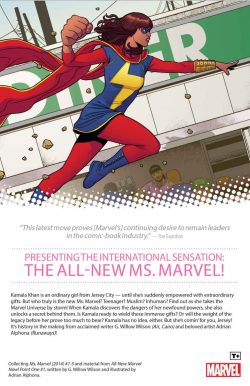
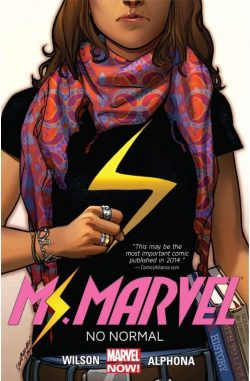
Ms. Marvel volume 1: No Normal


By G. Willow Wilson, Adrian Alphona, Ian Herring, VC’s Joe Caramagna & various (MARVEL)
ISBN: 978-0-7851-9021-9 (TPB/Digital edition)

In a comic book title, the soubriquet “Marvel” carries a lot of baggage and clout, and has been attached to a wide number of vastly differing characters over many decades. In 2014, it was inherited by comics’ first mainstream first rank Muslim superhero, albeit employing the third iteration of pre-existing designation Ms. Marvel.

Career soldier, former spy and occasional journalist Carol Danvers – who rivals Henry Pym in number of secret identities, having been Binary, Warbird, Ms. Marvel again and ultimately Captain Marvel – originated the role when her Kree-based abilities first manifested. She experienced a turbulent superhero career and was lost in space when Sharon Ventura became the second, unrelated Ms. Marvel. She gained her powers from the villainous Power Broker, and after briefly joining the Fantastic Four, was mutated by cosmic ray exposure into a She-Thing

Debuting in a sly cameo in Captain Marvel (volume 7 #14, September 2013) and bolstered by a subsequent teaser in #17, Kamala Khan was the third to use the codename. She properly launched in full fight mode in a tantalising short episode (All-New MarvelNow! Point One #1) chronologically set just after her origin and opening exploit.

That aforementioned origin saga unfolded in #1-5 of Ms. Marvel (volume 3), and forms the majority of this first collection of light-hearted all-ages adventure originally published between cover-dates April-August 2014.

Collaboratively conceived by editors Sana Amanat and Stephen Wacker, the character was realised by writer and journalist G. Willow Wilson, (Mystic: The Tenth Apprentice, Cairo, Air, The Butterfly Mosque, Alif the Unseen) and illustrator Alphonse Alphona (Uncanny X-Force, Captain Britain and MI13, Runaways) with additional design input from Jamie McKelvie (Suburban Glamour, Long Hot Summer, Young Avengers, The Wicked + the Divine, Phonogram, Rue Britannia), who jointly recast the classic origin and setting of Spider-Man for a new age. The entire epic was coloured by Ian Herring and lettered by VC’s Joe Caramagna.

Kamala Khan is a teenager living in Jersey City. Just across the Hudson river lies Manhattan, and the superhero geek frequently enjoys a distant ringside seat to the constant wonders that occur there.

As a Pakistani American growing up Muslim she has her share of daily dramas at Coles Academic High School and elsewhere, but life is generally pretty good. She has good friends like Bruno and Kiki (Nakia), petty annoyances like golden girl Zoe Zimmer and jock Josh or even her loving family. They don’t really understand her obsession with computers, social media and especially with making superhero fan fiction – especially as Kamala is getting older now and needs to start thinking seriously about her future…

Miss Khan’s stolid suppressed status quo abruptly changes in ‘Meta Morphosis’ on the night she breaks a parental embargo and sneaks out to attend a party. Any potential enjoyment is marred by guilt, apprehension and Zoe and Josh, but the real shock comes on the way home when the city is enveloped in a strange fog that causes Kamala to collapse.

During earlier mega-crossover blockbuster Infinity, mad Titan Thanos invaded Earth and clashed with the Inhumans and battled their King Black Bolt to a standstill. As a last resort the embattled sovereign crashed sky-floating city Attilan onto New York and into the Hudson, releasing the Hidden People’s mutagenic Terrigen Mist into the atmosphere.

As it traversed the globe, the gas cloud triggered mutation in millions, proving that Human and Inhuman were not different species and that dormant Inhuman genes reposed everywhere, unsuspected by humankind. All those susceptible to the contaminant either died or metamorphosed into new beings via body-altering cocoons…

Attilan’s crash happened mere hours before and now Kamala is unconscious on a Jersey City street, wracked by bizarre hallucinations of the Avengers and particularly her absolute favourite hero Carol Danvers…

On awakening, she has to smash her way out of a strange shell. When the mists and dust clear Khan is astounded to see she is no longer a “little brown girl” but big, blonde, busty and white. In fact, she looks exactly like the original Ms. Marvel…

In ‘All Mankind’ while experimenting – and puking – Kamala realises she is constantly shapeshifting and body-morphing, but her shock and terror recede after seeing Zoe in danger. Without thinking, Kamala responds to save the Mean Girl, albeit in a manner everybody thinks pretty gross…

Fed up with adventure, Kamala heads home, and is relieved to somehow revert to normal while climbing in her bedroom window. Sadly, ultra-conservative older brother Aamir and her parents are waiting…

‘Side Entrance’ sees Zoe milking her celebrity moment as the media descend on Jersey and Kamala frantically researches her powers – with disastrous results. Desperate to find some way to control them she is spiralling until Bruno comes to her rescue by being held up at his afterschool job. Once again leaping into action as “Carol Danvers”, Kamala learns it’s not that easy a career, after being shot and reverting to her natural form in ‘Past Curfew’

With a certified genius like Bruno on board, Kamala finally understands what she can do and devises her own costume and alter ego, just as the city is targeted by a genuine – but so weird – supervillain, leading the new Ms. Marvel into the wilds to hunt down an exploitative mastermind running troubled teens as his soldiers.

Brimming with confidence, the neophyte hero is unprepared for the deadly mechanical monsters of The Inventor, a brutal showdown with that invisible crook’s gang or the even worse trial of keeping secrets from her increasingly concerned and bewildered family in closing chapter ‘Urban Legend’

The initial story arc won the 2015 Hugo Award for Best Graphic Story – the first of many glittering critical acknowledgements – and is followed here by that aforementioned teaser tale from All-New MarvelNow! Point One #1.

Crafted by Wilson, Aphona, Herring & Caramagna, ‘Garden State of Mind’ finds the hero diverted by a marauding trash monster-bot and late for a major family social gathering…

And thus began a meteoric rise for the new hero. Kamala Khan would steal hearts and minds, become a shining example and become a major player in monumental publishing events such as Last Days, Secret Wars, Secret Empire, Civil War II, Generations and Outlawed, whilst joining or leading teams like the All-New All-Different  Avengers, Champions, and Secret Warriors and inheriting the lead role in a revived Marvel Team-Up title.

Her role as positive role model cannot be overstated – how many female or Muslim superheroes can you think of, or have ever had their own American TV series?

That success is completely due to the comics stories which perfectly marry action and drama to powerfully engaging view of home life, stuffed to the brim with humour and happy moments, rather than the relentless bleakness of so many superhero sagas.

Colour plays a powerful part in telling these tales, subtly supplementing the ostensibly cartoonish art of Adrian Alphona into suitably tense dramatic fare without ever losing the vivacity and charm of the comedic undertones, so especial kudos to Ian Herring for his impressive and sensitive efforts here…

Similar congratulations to letterer Joe Caramagna for handling a rather dialogue-heavy script (absolutely necessary to capture the brilliant interplay and byplay of the teens and parental generation packing G. Willow Wilson’s extremely engaging and beguiling script).

Wrapping up this volume is a covers & variant gallery by Sara Pichelli & Justin Ponsor, McKelvie & Matthew Wilson, Salvador Larocca & Laura Martin, Arthur Adams & Peter Steigerwald, Jorge Molina, Annie Wu and a fascinating look at Alphona’s ‘Sketchbook’ of character designs and ‘inks to color process’.

Still fresh, funny, thrill-drenched and utterly absorbing, the saga of this Ms. Marvel is something you need to see over and over again.
© 2017 Marvel Characters Inc. All rights reserved.

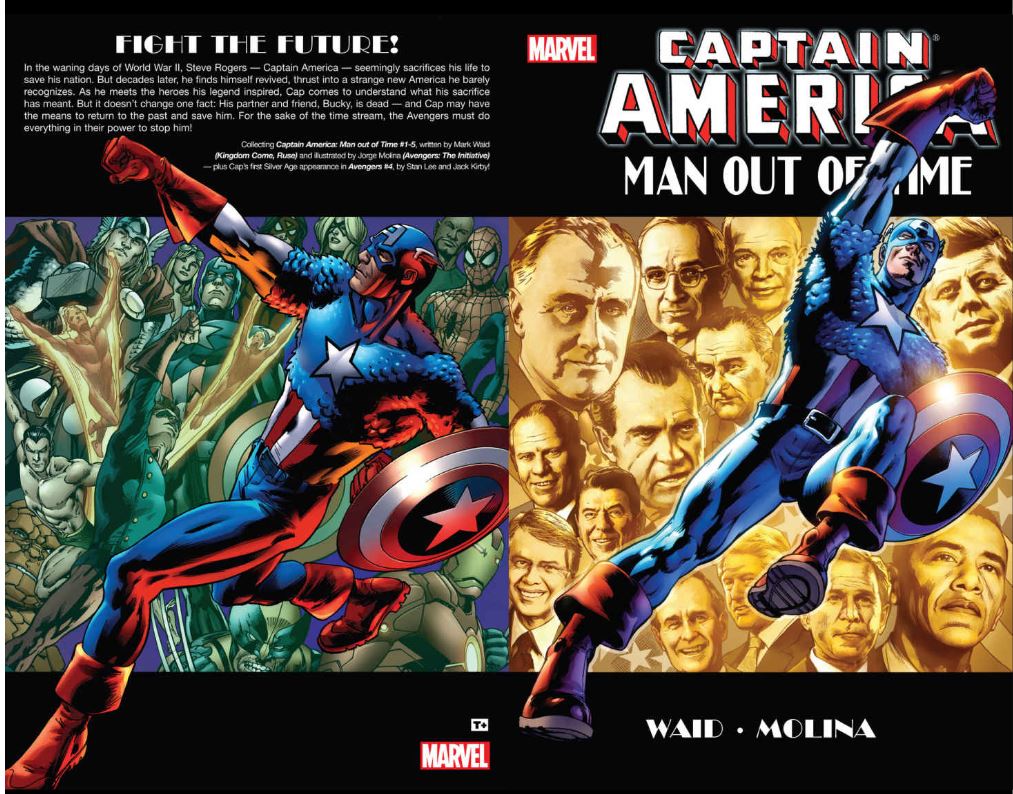
Captain America: Man Out of Time


By Mark Waid, Jorge Molina, Karl Kesel & Scott Hanna (MARVEL)
ISBN: 978-0-7851-5128-9 (HB/Digital edition) 978-1-84653-487-4 (UK TPB)

One of the pivotal moments in Marvel Comics history occurred when the Mighty Avengers recovered a tattered body floating in a block of ice (#4, March 1964) and resurrected World War II hero Captain America. This act followed the return of the Sub-Mariner in Fantastic Four #4 and completed a bridge back to the years of Timely and Atlas Comics. With it, newly-minted Marvel Comics Group confirmed and consolidated a solid, concrete, potential-packed history: evoking an enticing sense of mythic continuance for the fledgling company and instantly granting it the same cachet and enduring grandeur of market leader National/DC.

In 2010, after years of conflicting continuity (and with a movie coming) Marvel tasked fan-favourite writer Mark Waid with updating those pivotal events and early future-shocked days for the contemporary world. Of course, that modern milieu was the year 2000, not 1964…

This captivating re-interpretation and updating collects 5 issue miniseries Captain America: Man Out of Time (November 2010-April 2011) and opens in the dying days of the war as Steve Rogers and Bucky Barnes are officially removed from the European frontline. Their destination is England and an appointment with doom-laden destiny…

After the world goes fiery red and then black, the Sentinel of Liberty is stunned to awaken in tomorrow’s world before reacting automatically and uncompromisingly to meeting this World’s Mightiest Heroes…
Waid, perfectly complimented by artists Jorge Molina, Karl Kesel & Scott Hanna, wisely leaves the classic adventures largely unchanged, to concentrate on the missing, contemplative moments and personal crises confronting the uncomprehending Steve Rogers, which means readers completely unaware of the character’s comic book history and exploits could experience some confusion in places. However, the narrative, although superficially disjointed, is clear-cut enough to counter this and those interested in the fuller picture can easily fill in the gaps by perusing one of so many available reprint collections to cover the entire period featured here…

In chapter 2, the reeling hero meets former Hulk sidekick Rick Jones (an absurdly close double for the departed Bucky), gets a rapid reality check on his new home and finally accepts that there’s no way home for this Old Soldier.

Except, that’s not strictly true…
Among the many technological miracles his new allies introduce him to the embryonic science of time-travel, and even while battling threats like the Lava Men and Masters of Evil, the unhappy warrior only thinks of returning to his proper place and saving his best friend…

The old adage “be careful what you wish for” never proves more true than when time-reiver Kang the Conqueror attacks: utterly overwhelming the 21st century heroes and casually dispatching Captain America back to 1945. However, the Sentinel of Liberty’s sense of duty, threat to his new allies and the unpalatable things he had forgotten about “the Good Old Days” prompt Cap into brilliantly escaping his honeyed time-trap and returning to the place and moment where he is most needed to once again save the day…

Resolute and resolved to tackle his Brave New World, Captain America is now ready to carve out a whole new legend…
I’m generally less than sanguine about updates and reboots of classic comics material, but I will admit that such things are a necessary evil as years go by, so when the deed is done with sensitivity and imagination (not to mention dynamic, bravura flamboyance) I can only applaud and commend the effort.

Balancing the reinterpretation is the classic inspiration as the book ends with Stan Lee, Jack Kirby & George Roussos’ reprinted epic ‘Captain America joins… The Avengers!’ cover-dated March 1964, and proving magic can be retooled but never replaced…

Thrilling, superbly entertaining, compelling and genuinely moving, Captain America: Man out of Time is a wonderful confection to delight and enthral old aficionados, impress new readers and should serve to make many fresh fans for the immortal Star-Spangled Avenger.
© 2010 Marvel Characters, Inc. All rights reserved.

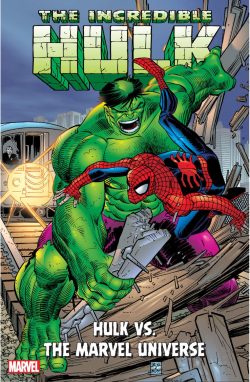
Incredible Hulk: Hulk Vs. The Marvel Universe


By Stan Lee, Jack Kirby, Roger McKenzie, Bill Mantlo, Peter David, Howard Mackie, Marie Severin, Frank Miller, Sal Buscema, Todd McFarlane, John Romita Jr., Jorge Lucas & various (MARVEL)
ISBN: 978-0-7851-3129-8 (TPB/Digital edition)

The Incredible Hulk #1 hit newsstands and magazine spinners on March 1st 1962. The comic book was cover-dated May. He was technically (excluding once-&-future Ant-Man Henry Pym) the second superhero star of the dawning Marvel Age. A few more debuted that year – so Happy Anniversary all – before the true Annus Mirabilis Atomicus (stop sniggering: it hopefully means Year of Atomic Miracles) that was 1963…

This 2008 collection was unleashed on readers due to the World War Hulk event. Reprinted here are Fantastic Four #25-26, Journey into Mystery #112, Tales to Astonish #92-93, Daredevil #163, Incredible Hulk #300 & 340, Peter Parker: Spider-Man #14 and Hulk Vs. Fin Fang Foom cumulatively spanning cover-dates April 1964 to February 2008.

With the Big Green Galoot and his chartreuse cousin both making new screen appearances this year, it seems sensible to take another look at the original Marvel antihero’s irascible interactions with his fellow power-packed pals. First, though…

Bruce Banner was a military scientist caught in a gamma bomb detonation of his own devising. As a result of ongoing mutation, stress and other factors caused him to transform into a giant green monster of unstoppable strength and fury.

After an initially troubled few years the irradiated idol finally found his size-700 feet and a format that worked, becoming one of young Marvel’s most popular features. After his first solo-title folded, Hulk shambled around the slowly-coalescing Marvel Universe as guest star and misunderstood miscreant of the moment, until a new home was found for him in “split-book” Tales to Astonish: sharing space with fellow maligned misanthrope Namor the Sub-Mariner, who proved an ideal thematic companion from his induction in #70.

This book is for every fan (isn’t that all of us?) that asked eternal question “who would win if…?” and we open without preamble on an early landmark as Fantastic Four #25 (April 1964) sees a cataclysmic clash that had young heads spinning then and ever since.

The Hulk’s own title had folded after six issues, and he joined debuting solo star assemblage The Avengers, before explosively quitting in #2: joining Namor’s assault on them in #3. That globe-trotting romp delivered high energy thrills and one of the best battle scenes in comics history but you’ll need to go elsewhere to see it.

Here and now, it’s 3 months later and Stan Lee, Jack Kirby & George Roussos use FF #25 to establish an evergreen tradition – the first of many instances of ‘The Hulk Vs The Thing’.

Accompanied by FF #26’s concluding episode ‘The Avengers Take Over!’, the is an all-out Battle Royale as the disgruntled man-monster searches Manhattan for former sidekick Rick Jones, with only an injury-wracked Fantastic Four to curtail his destructive rampage.

A definitive moment in the character development of The Thing, the action ramps up when a rather stiff-necked and officious Avengers team horns in, claiming jurisdictional rights on “Bob” Banner – this tale is plagued with pesky continuity errors that haunted Lee for decades – and his Jaded alter ego. Notwithstanding bloopers, this is one of Marvel’s key moments and still a visceral, vital read.

The second chapter of the Hulk’s career began in Tales to Astonish #59 (September 1964) as his became co-star to fading property Giant-Man – soon to be replaced by Marvel’s Man from Atlantis – whilst the Green Goliath’s guest star career continued unabated. Next up is a perfect example of that pulling power: the lead story in Journey into Mystery #112 (January 1965) where ‘The Mighty Thor Battles the Incredible Hulk!’

The Hulk and Mighty Thor share their 60th anniversary and whether in print, in animations or in blockbuster movies, that eternal question has been asked but never answered to anyone’s satisfaction whenever applied to the modern iteration of the age-old mythic war between gods and monsters. This tale is the first of many return engagements: a glorious gift to every fight fan and arguably Kirby & Chic Stone’s finest artistic moment, detailing a private duel between the two super-humans that occurred during that free-for-all between Earth’s Mightiest, Sub-Mariner and Ol’ Greenskin back in Avengers #3. The raw power of that tale is a perfect exemplar of what makes the Hulk work as a returning foe and yardstick of heroism and determination of those unlucky enough to battle him.

Technical aside: I’m reviewing the digital release and here that blistering bout is followed by JIM #112’s Tales of Asgard back-up ‘The Coming of Loki!’ by Lee, Kirby & Vince Colletta. I suspect you won’t find it in the physical copies of this book…

In Tales to Astonish #92 (June 1967) Lee, superb Marie Severin & Frank Giacoia promised a ‘Turning Point!’, depicting Banner hunted through a terrified New York City as prelude to his alter ego clashing with an incredible opponent in the next issue. Back then, Hulk didn’t really team-up with visiting stars, he just got mad and smashed them. Such was certainly the case as he became ‘He Who Strikes the Silver Surfer’: ironically driving off a fellow outcast who held the power to cure him of his atomic affliction.

There’s a big leap to March 1979 next as Daredevil #163 sees Matt Murdock offer the fugitive Banner sanctuary before the tormented scientist again loses his eternal struggle to suppress the monster inside. Inevitably, the forgone conclusion is the Man without Fear outclassed and punching up before getting creamed to save New York from the Hulk in ‘Blind Alley’ by Roger McKenzie, Frank Miller & Josef Rubinstein, after which we hurtle to Incredible Hulk #300 (cover-dated October 1984) and the end of an epic run by scripter Bill Mantlo and illustrator Sal Buscema. The Hulk had gone from monster outcast to global hero and Banner’s intellect had overridden the brute’s simplistic nature, but now, thanks to the insidious acts of dream demon Nightmare, banner was gone leaving only a murderous, mindless engine of gamma fuelled destruction to ravage New York City.

Inked by Gerry Talaoc, extended epic ‘Days of Rage!’ saw the unstoppable monster easily defeat every superhero in town before being exiled to another universe…

Of course, he came back and was mostly restored, but radical change remained a constant. October 1984’s Incredible Hulk #340 was highpoint in a game-changing run by Peter David and sensation-in-waiting Todd McFarlane. The Hulk was notionally de-powered and returned to the grey-skinned cunning brute of his first appearances just in time for a savage rematch with Wolverine in ‘Vicious Circle’. That inconclusive bout segues here to another battle with another shared-birthday boy.

The wondrous crawler was wracked with agonising ‘Denial’ (Peter Parker: Spider-Man #14, February 2000, by in Howard Mackie, John Romita Jr. & Scott Hanna) in a mismatched clash that occurred with Peter Parker reeling in shock and grief, believing his wife Mary Jane and baby daughter had died in a plane crash. All he had left was great responsibility and something to hit…

We end on a raucously rowdy light-heartedly cathartic note with a modern take on the classic monster battles motif. One-shot Hulk vs Fin Fang Foom #1 (February 2008) was by Peter David, Jorge Lucas & Robert Campanella, revealing an “untold tale” of the early Kirby-era with the gamma goliath headed to the far north in time to see a dragon decanted from the ice.

Parody pastiche ‘The Fin from Outer Space’ is a furious flurry of fisticuffs and fantastic force unleashed with the sole intent of making pulses pound…

With covers from Kirby – with Roussos and Stone, Marie Severin & Giacoia, Miller & Rubinstein, Bret Blevins, McFarlane & Bob Wiacek, Romita Jr. and Jim Cheung, John Dell & Justin Ponsor, this is a straightforward, no-nonsense, all-battle bill of fare no Fights ‘n’ Tights fan could have the strength to resist. Grab it if you can!
© 2020 MARVEL.

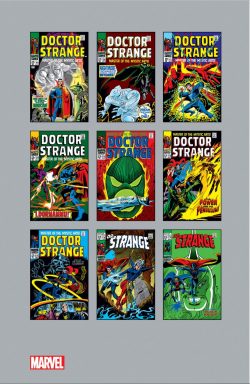
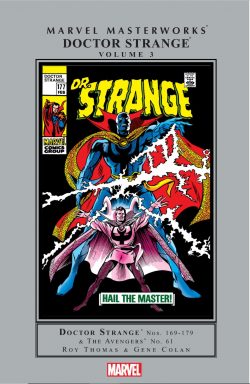
Doctor Strange Marvel Masterworks volume 3


By Roy Thomas, Gene Colan, Dan Adkins, Tom Palmer, John Buscema, George Klein & various (Marvel)
ISBN: 978-0-7851- (HB/Digital Edition)

When the budding House of Ideas introduced a warrior wizard to their burgeoning pantheon in the summer of 1963, it was a bold and curious move. Anthologically, bizarre adventures and menacing aliens were still incredibly popular, but most dramatic mentions of magic or the supernatural (especially vampires, werewolves and their equally eldritch ilk) were harshly proscribed by a censorship panel which dictated almost all aspects of story content.

Almost a decade after a public witchhunt led to Senate hearings on the malign influences of words and pictures in sequence, comic books were ferociously monitored and adjudicated by the draconian Comics Code Authority. Even though some of the small company’s strongest sellers were still mystery and monster mags, their underlying themes and premises were almost universally mad science and alien wonders, not necromantic or thaumaturgic horrors.

Companies like ACG, Charlton and DC – and the remnants of Atlas/pre-Marvel – got around the edicts against thaumaturgical thrills and chills by making all reference to magic benign or even humorous… the same tone adopted by massively popular TV series Bewitched a year after Doctor Strange debuted.

That eldritch embargo probably explains writer/editor Stan Lee’s low key introduction of Steve Ditko’s mystic adventurer: an exotic, twilight troubleshooter inhabiting the shadowy outer fringes of society.

Capitalising on of the runaway success of The Fantastic Four, Lee had quickly spun off the youngest, most colourful member of the team into his own series, hoping to recapture the glory of the 1940s when The Human Torch was one of the company’s untouchable “Big Three” superstars. Within a year of FF #1, long-lived anthology title Strange Tales became home for the blazing boy-hero (from #101, cover-dated October 1962), launching Johnny Storm on a creatively productive but commercially unsuccessful solo career.

Soon after, in Tales of Suspense #41 (May 196), latest sensation Iron Man battled a crazed scientific wizard dubbed Doctor Strange, and with the name successfully and legally in copyrightable print (a long-established Lee technique: Thorr, The Thing, Magneto, The Hulk and others had been disposable Atlas “furry underpants monsters” long before they became in-continuity Marvel characters), preparations began for a truly different kind of hero.

The company had already devised a quasi-mystic troubleshooter for an short run in Amazing Adventures (volume 1 #1-4 & #6 spanning June-November 1961).

The precursor was balding, trench-coated savant Doctor Droom – later retooled as Doctor Druid when his exploits were reprinted in the 1970s. He was a psychiatrist, sage and paranormal investigator tackling everything from alien invaders to Atlanteans (albeit not the ones Sub-Mariner ruled). He was subsequently retro-written into Marvel continuity as an alternative candidate for Stephen Strange‘s ultimate role as Sorcerer Supreme…

After a shaky start, the Master of the Mystic Arts became an unmissable icon of the cool counter-culture kids who saw, in Ditko’s increasingly psychedelic art, echoes and overtones of their own trippy explorations of other worlds. It might not have been the authors’ intention but certainly helped keep the mage at the forefront of Lee’s efforts to break comics out of the “kids-stuff” ghetto…

After the originator abruptly left the company at the height of his fame and success in early 1967, the feature went through a string of creators before Marvel’s 1968 expansion allowed a measure of creative stability as the mystic master won his own monthly solo title in neat moment of sleight of hand by assuming the numbering of Strange Tales. Thus, this enchanting full colour compilation gathers Doctor Strange #169-179 plus a crossover from Avengers #61, spanning cover-dates June 1968 to April 1969. It also sagely includes every issue’s stunning cover – a gallery of wonders from Dan Adkins, Gene Colan, John Buscema and Barry (not yet Windsor) Smith.

Previously, Dr. Stephen Strange had entered and escaped the terrifying dimension of imagination; defeated Scientist Supreme Yandroth; learned the origin of the his mentor The Ancient One and lost his extradimensional lover Clea to the outer infinities. Now a new era dawned for the mystic master just as Big Things were happening at Marvel…

In 1968, after more than a decade under a restrictive and limiting retail contract, The House of Ideas secured a new distributor and explosively expanded with a tidal wave of titles. Twin-featured “Split-Books” such as Strange Tales were divided: replaced by full-length solo series for the cohabiting stars. For the Master of the Mystic Arts, that meant a bit of rapid resetting…

Following an Introduction from sole scripter Roy Thomas, sorcerous super-shenanigans resume with a reworking of the Mage’s origins.

Extrapolating and building upon the Ditko masterpiece from Strange Tales #115, ‘The Coming of Dr. Strange’ by Thomas & Dan Adkins details how he was once America’s greatest surgeon. A brilliant man, yet greedy, vain and arrogant, he cared nothing for the sick except as a means to wealth and glory. When a self-inflicted, drunken car-crash ended his career, Strange hit the skids.

Fallen as low as man ever could, the debased doctor overheard a barroom tale leading him on a delirious odyssey – or, perhaps more accurately, pilgrimage – to Tibet, where a frail, aged mage changed his life forever. Eventual enlightenment through daily redemption transformed Stephen the derelict into a solitary, dedicated watchdog at the fringes of humanity, challenging every hidden danger of the dark on behalf of a world better off not knowing what dangers lurk in the shadows.

The saga also featured his first clash with the Ancient One’s other pupil Mordo revealing how Strange thwarted a seditious scheme, earning the Baron’s undying envious enmity…

The expanded exploration of the transformation from elitist, dissolute surgeon into penitent scholar and dutiful mystic guardian of humanity neatly segues into another clash with a lethally persistent foe as ‘To Dream… Perchance to Die!’ (#170) finds the Ancient One trapped in a coma thanks to the malevolent lord of dreams. To wake his master, Strange impetuously enters the astral realms and defeats Nightmare on his own terms and turf after which #171 introduces someone who will become a key creator in the mystic’s career.

Pencilled by eventual inker supreme Tom Palmer, with Adkins supplying finishes, ‘In the Shadow of… Death!’ sees Strange lured away from Earth by news of long-lost Clea. To facilitate a rescue mission, the sorcerer unthinkingly calls on English associate and sometimes arcane ally Victoria Bentley, unaware or uncaring of her romantic feelings for him.

Their trek through the outer deeps of The Realm Unknown is fraught with deadly traps and peril, but does locate missing Clea… after Bentley is captured and Strange ambushed by his most powerful and hate-filled foe…

A magical creative team formed for Doctor Strange #171 as Gene Colan signed on for an astoundingly experimental run with Palmer handling inks. Humanity is endangered by ‘…I, Dormammu!’ as the Dark God reveals he has orchestrated many recent attacks designed to weary and de-power Earth’s magical champion. The gloating fiend shares how his apparent destruction battling conceptual being Eternity in fact resulted in transdimensional exile and the subjugation of a demonic race dubbed Dykkors: now his eager and willing foot-soldiers ready to ravage the realms of Mankind. The Dark Despot has even suborned his hated sister and former foe Umar the Unspeakable to his scheme…

As always, Dormammu has underestimated the valour and ingenuity of Stephen Strange. ‘…While a World Awaits!’ the monstrous conqueror leads a demonic army through the Doorway of Dimensions, leaving the human mage time to liberate Clea and Victoria, and engage the fearsome forces in a mystic delaying tactic that once again allows Dormammu to defeat himself…

As former associate Dr. Benton seeks to convince Strange to abandon his crazy charlatanry for a life of respectable medical consultancy, #174 sees the Master of the Mystic Arts helping magical Clea adapt to mundane life on Earth. However, ‘The Power and the Pendulum’ finds him accompanying secretly despondent Victoria home to England, before being diverted to a foreboding castle where weirdly flamboyant Lord Nekron has laid a devilish trap.

The crazed noble has made a bargain with hellborn Supreme Satannish, offering his soul for fame and immortality. Instead, the Lord of Lies devised a counter-offer, calling for the substitution of another mystic at the end of one year. With time running out and Strange fitted up for the switch, doom seemed inevitable, but Earth’s champion had one timely trick left to play…

The late sixties were an incredibly creative period and comics greatly benefitted from the atmosphere of experimentation. Colan used page layouts in wildly imaginative ways that stunned many readers of the time, but that same expanded vision has often been cited as the reason for the title’s poor sales. I suspect the feature’s early cancellation was as much the result of increasingly sophisticated and scary stories from Thomas, who early on tapped into the growing global fascination for supernatural horror, and urban conspiracy such as seen in #175’s ‘Unto Us… the Sons of Satannish!’ – coincidentally, the last issue to carry his original title logo.

Just like Ira Levin’s 1967 book and hit 1968 movie Rosemary’s Baby, Strange’s next case involved devil-worship in safely mundane Manhattan, working in secret to achieve diabolical aims. Deprived access to the film’s simmering sexuality and mature themes, Thomas, Colan & Palmer stuck to comic book strengths as Clea’s immigrant experience abruptly encompasses ostracization, isolation, suspicious reactions and even assault by ordinary New Yorkers. This leads her into the hands of hidden cult The Sons of Satannish, whose charismatic leader Asmodeus deals with the devil, and attempts to gain ultimate power by eradicating Strange and replacing him in #176’s ‘O Grave Where is Thy Victory?’, with a new, eerie and  abbreviated masthead.

Those aforementioned sales problems were not going away and #177’s concluding chapter ‘The Cult and the Curse’ addressed the issue in a tried and true manner. Exiled from his own existence and persona, Strange rescued Clea but could only strike back and reclaim his life by magically reinventing himself and devising a brand new look. The mask and tights of a traditional superhero were apparently the only way to outmanoeuvre Asmodeus, but sadly, not in time to stop him activating a deathbed curse to destroy the world…

The super-suited and booted modern mage needed information to proceed, and Dr. Strange #178 finds him seeking to question the other Satannish worshippers Asmodeus had callously banished. Once again hoping to exploit poor Victoria Bentley, Strange recognises her new neighbour Dane Whitman as part-time Avenger The Black Knight and his plea for aid results in an assault on  the dimension of decay-god Tiborro ‘…With One Beside Him!’

The saga finally concluded in Avengers #61 with ‘Some Say the World Will End in Fire… Some Say in Ice!’ by Thomas, John Buscema & George Klein. After Asmodeus’ recued minions reveal that the satanic cult’s failsafe spell unleashed Norse demons Surtur and Ymir to destroy the planet, Strange and Black Knight recruited The Vision, Black Panther and Hawkeye to help them save the world on two fronts…

Although the comics spellbinding ends here, also on offer is the cover of Dr. Strange #179: a Barry Smith treat from 1969 that fronted an emergency reprint of Lee & Ditko’s ‘The Wondrous World of Dr. Strange’ from Amazing Spider-Man Annual #2. It joins a House ad for the 1968 relaunch, a half dozen original art pages by Adkins, Colan & Palmer plus the cover art to #174 and 175.

The Wizard of Greenwich Village has always been an acquired taste for mainstream superhero fans, but the pioneering graphic bravura of these tales and the ones to come in the next volume left an indelible mark on the Marvel Universe and readily fall into the sublime category of works done “ahead of their time”. Many of us prefer to believe that Doctor Strange has always been the coolest of outsiders and most accessible fringe star of the Marvel firmament. This glorious grimoire is a miraculous means for old fans to enjoy his world once more and the perfect introduction for recent acolytes or converts created by the movie iteration.
© 2016 Marvel Characters, Inc. All rights reserved.

Thor Marvel Masterworks volume 16


By Len Wein, Roger Stern, John Buscema, Walter Simonson, Tony DeZuñiga, Sal Buscema & various (MARVEL)
ISBN: 978-1-3029-0358-9 (HB/Digital edition)

Once upon a time, disabled physician Donald Blake took a vacation in Norway, only to stumble into an alien invasion. Trapped in a cave, he found an ancient walking stick which, when struck against the ground, turned him into the Norse God of Thunder! Within moments, he was defending the weak and smiting the wicked.

Months swiftly passed, with the Lord of Storms tackling rapacious extraterrestrials, Commie dictators, costumed crazies and cheap thugs, but these soon gave way to a vast kaleidoscope of fantastic worlds and incredible, mythic menaces, usually tackled with an ever-changing cast of stalwart immortal warriors at his side…

Whilst the ever-expanding Marvel Universe had grown ever-more interconnected as it matured through its first decade, with characters literally tripping over each other in New York City, the Asgardian heritage of Thor and the soaring imagination of Jack Kirby had most often drawn the Thunder God away from mortal realms into stunning, unique landscapes and scenarios.

However, by the time of this power-packed compendium, the King was long gone and in fact enacting his Second Coming – technically third, but definitely Second Return to the House of (mostly his) Ideas – and only echoes of his groundbreaking presence remained. John Buscema had visually made the Thunder God his own over the interceding years, whilst a succession of scripters had struggled with varying success to recapture the epic scope of Kirby’s vision and Stan Lee’s off-kilter but comfortingly compelling faux-Shakespearean verbiage…

Spanning January-December 1977, this power-packed compilation re-presents The Mighty Thor #255-266 and Annual #6, and leads with ‘Over the Rainbow Bridge’: an engaging Introduction intriguingly illustrated  from involved illustrator and eventual redeemer of the Thor franchise – Walter Simonson.

The action opens behind the Kirby cover for Thor #255, as Len Wein & Tony DeZuñiga launch a new epic interstellar adventure in ‘Lo, the Quest Begins!’ Previously, embattled Asgard survived invasion only to learn their divine Liege Lord Odin had gone missing. Now, having exhausted every avenue of location available, Thor is compelled to search the galaxies, prompted by vague hints from all-knowing spirit Mimir of a distant destination – the Doomsday Star…

Boarding spacefaring dragonship Starjammer, Thor, Lady Sif, and Warriors Three Fandral, Hogun and Volstagg set (solar) sail, leaving a beleaguered Eternal Realm under the stewardship of Balder the Brave and his dark inamorata Karnilla the Norn Queen. However, before they even leave local space, the seekers encounter – and battle – malign aliens marooned ever since they initially fought the Storm Lord in his debut adventure…

A classic case of Marvel Misunderstanding occurs in #256 as the voyagers encounter an ancient and colossal colony ship populated by the last survivors of a civilisation that died from over-exploiting their environment. As the Asgardians are joined by Rigellian Recorder Memorax, the slowly-fading Levianons reveal how their poverty and resource-blighted existence has been further threatened by an invasive beast who takes the elderly like a ‘Lurker in the Dark!’ (Wein, John Buscema & DeZuñiga).

When the hideous Sporr also abducts recently wounded Sif, enraged Thor leads a savage counter-assault that sparks incomprehensible tragedy in concluding chapter ‘Death, Thou Shalt Die!’

Another mineral-based miscreant resurfaces in #258. ‘If the Stars be Made of Stone!’ sees the Starjammer attacked by space pirates inexplicably led by human super-villain – and early Thor foe – the Grey Gargoyle. The job is not one he wants, but as the unwilling captain conspires with the beaten-&-enslaved Asgardians for a chance to see again the Green Hills of Earth, their plot is exposed by fanatical second-in command Fee-Lon.

The brutal usurper is a truly ferocious brigand, but ultimately fights in vain to end the gods’ ‘Escape into Oblivion!’

Meanwhile in Asgard, Balder and Karnilla have been resisting an invasion helmed by arch-traitors Enchantress and Executioner. As Walter Simonson signs on beside Wein & DeZuñiga from #260, that subplot expands and intensifies even as ‘The Vicious and the Valiant’ sees the interstellar questors finally locate the Doomsday Star and falter before ‘The Wall Around the World!’ (inked by Ernie Chan).

The terrifying global construct is comprised of the power-drained husks of dead gods, but determinedly pushing on, the seekers discover Odin has been captured and slowly diminished by the energy-leeching Soul-Survivors whose civilisation subsists on stolen divine power. As they valiantly strive to save their sovereign, the Asgardians learn to their cost that ‘Even an Immortal Can Die!’ (#262, illustrated by Simonson & DeZuñiga).

Thankfully, ‘Holocaust and Homecoming!’ proves Odin is both wily and mighty as the heroes’ ferocious clash and inevitable victory results in a weary and wounded pantheon returning to Asgard to find it taken over by Loki and his cohort of treacherous allies.

With Odin in a coma – and ultimately abducted again – a covert civil war erupts between the returned champions and the city Loki has subverted. ‘Thou Shalt Have No Other Gods Before Me!’ sees a sinister scheme exposed, but not before Loki unleashes ultimate weapon The Destroyer against his step-brother in #265’s ‘When Falls the God of Thunder…!’ (inked by Joe Sinnott). As before, it’s not long before Loki loses control of his ultimate sanction…

Once again, everything hinges on the power and determination of Thor and his valiant resistance to chaos. In #266’s ‘…So Falls the Realm Eternal!’, Wein, Simonson & DeZuñiga show the Thunderer at his indomitable best, keeping Loki at bay and off kilter until the Warriors Three rescue and revive an extremely unhappy All-Father…

This saga presaged a change of focus that we’ll cover in the next volume but before then the epic entertainment concludes with ‘Thunder in the 31st Century!’ by Roger Stern, Sal Buscema & Klaus Janson from Thor Annual #6 (December 1977).

A riot of time-busting mayhem, it commences with Mighty Thor plucked from contemporary Manhattan: accidentally summoned to the time period of the original/future (time travel tenses suck!) Guardians of the Galaxy by a cyborg maniac named Korvac.

The legendary god-warrior briefly joins Vance Astro, Charlie 27, Yondu, Nikki, Martinex and Starhawk to bombastically battle super-powered aliens and thwart the sinister cyborg’s scheme to become master of the universe. At the conclusion, Thor returns to his own place and time, unaware how Korvac will reshape the destiny of reality itself in coming months…

To Be Continued…

Augmenting this volume is a blockbusting original art gallery, offering 21 pages of sketches, layouts, pencils and fully inked covers, splash and story-pages by Kirby & John Verpoorten, Buscema, DeZuñiga, Simonson, Joe Sinnott &Ernie Chan: a true treat for every art lover.

The tales gathered here may lack the sheer punch and verve of the early years but fans of ferocious Fights ‘n’ Tights fantasy will find this tome still stuffed with intrigue and action, magnificently rendered by artists who, whilst not possessing Kirby’s vaulting visionary passion, were every inch his equal in craft and dedication. In Thor’s anniversary year, this a definite and decidedly engaging must-read for all fans of the character and the genre.
© 2017 Marvel Characters, Inc. All rights reserved.