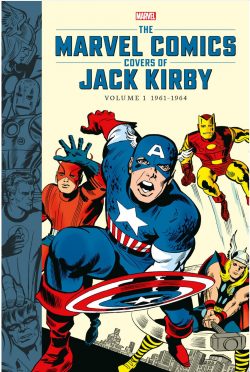
The Marvel Comics Covers of Jack Kirby volume 1: 1961-1964


By Jack Kirby, with Steve Ditko, Don Heck, Dick Ayers, Paul Reinman, Bill Everett, George Roussos, Joe Sinnott, Chic Stone, Vince Colletta, George Klein, Sol Brodsky, Al Hartley, Stan Goldberg, Art Simek, Sam Rosen & various, Introduction by Patrick McDonnell (Dark Horse Comics)
ISBN: 978-1-50673-246-6 (HB) eISBN: 978-1-50673-247-3

Today in 1917 on New York’s Lower East Side, Jacob Kurtzberg was born to Jewish-Austrian parents. He grew up to be one of the most influential and recognised artists in world history. The reason why can be read here.

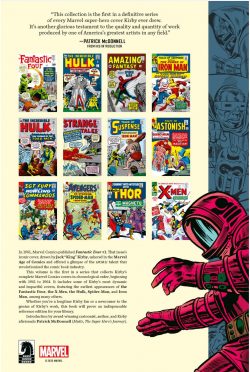
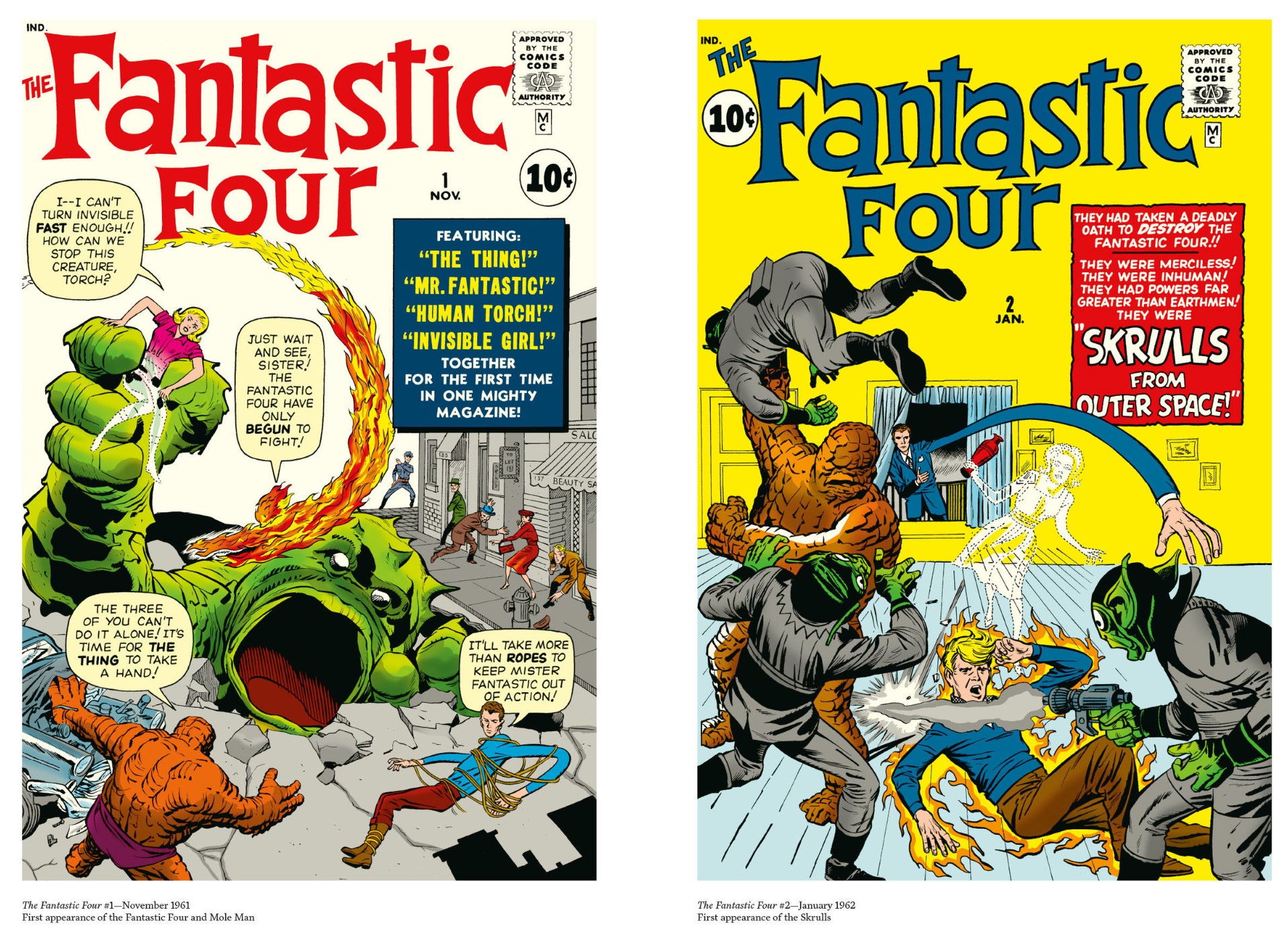
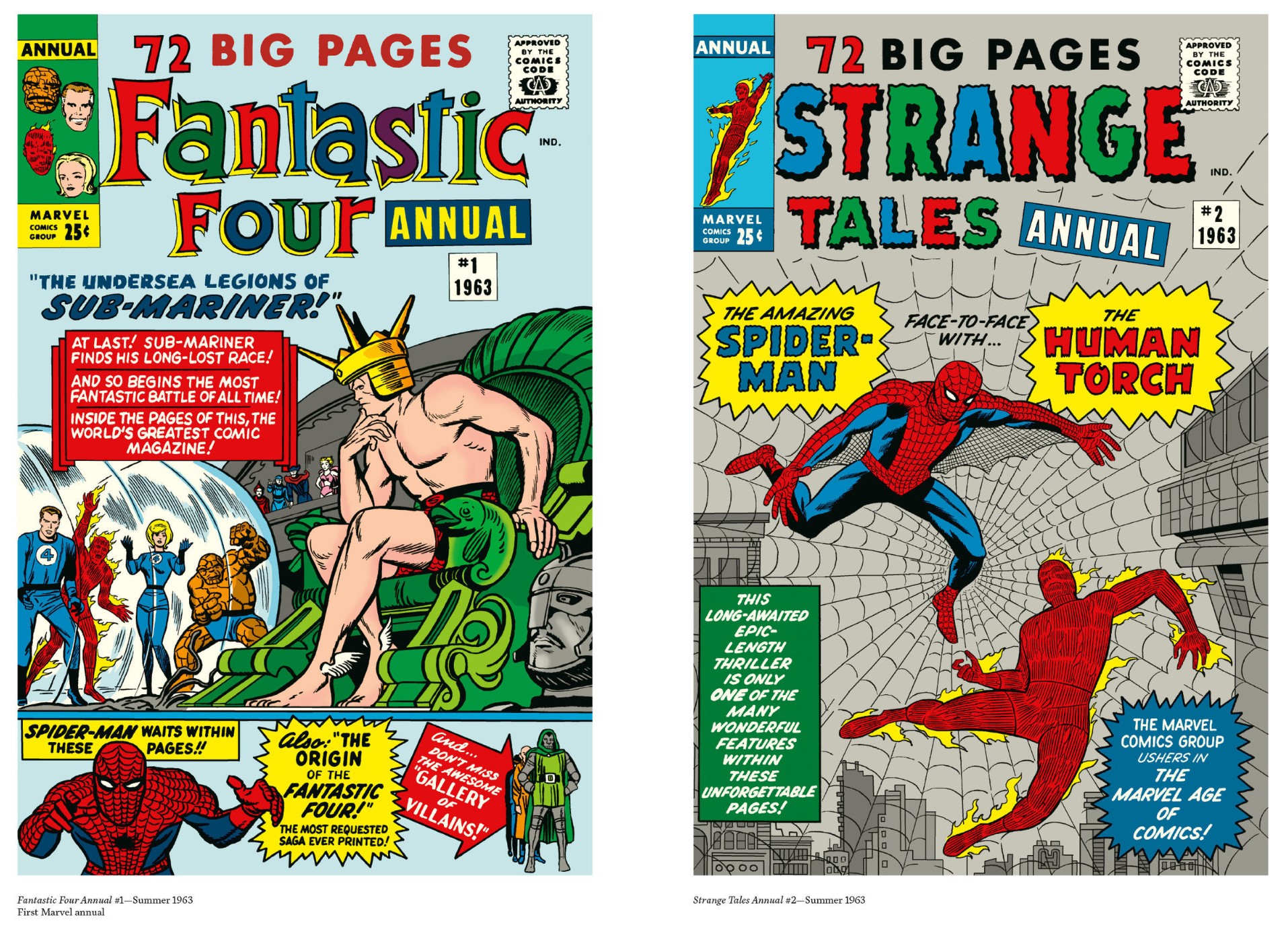
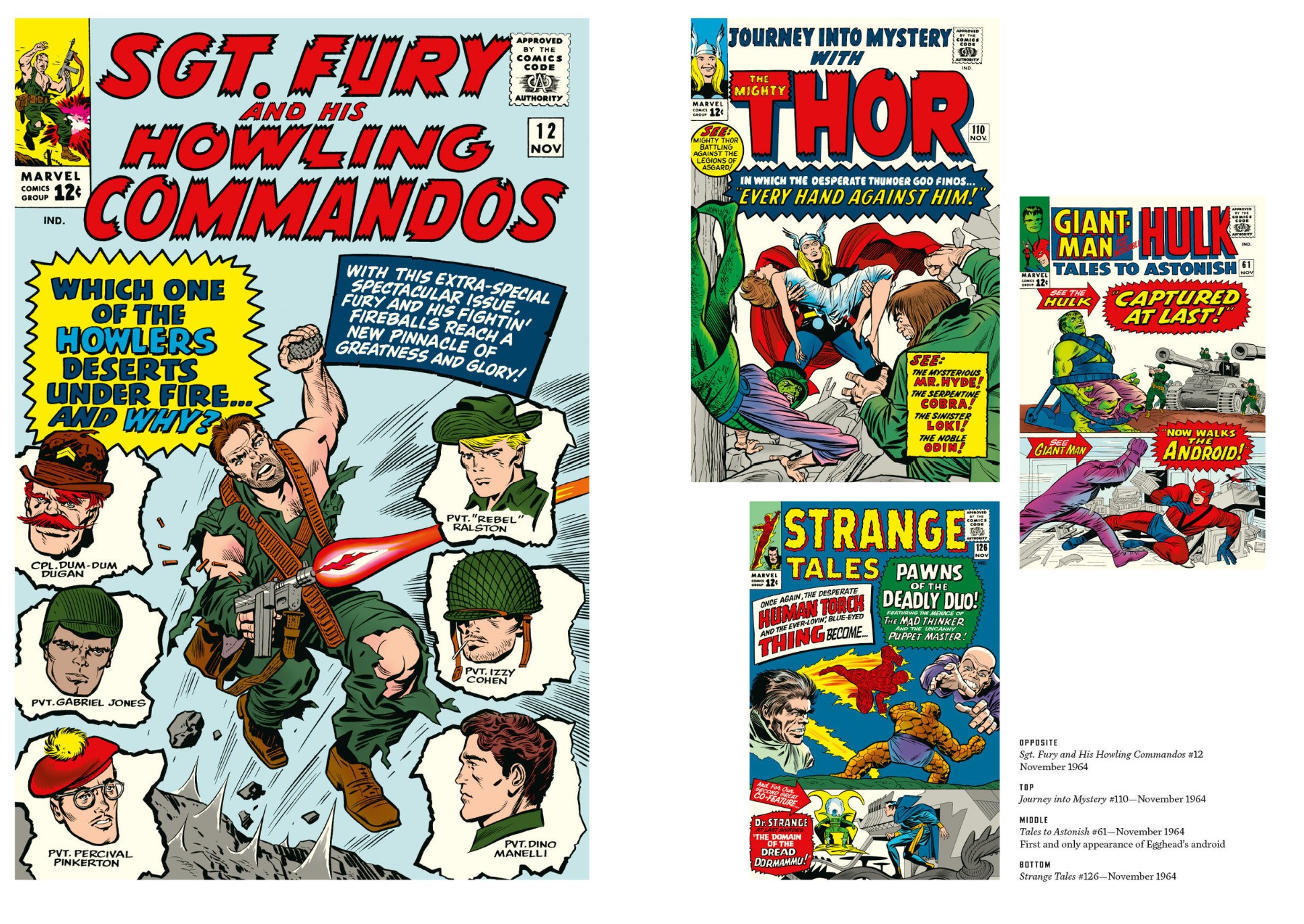
The Marvel Comics Covers of Jack Kirby chronologically collects The King’s superhero cover art in a spectacular hardcover coffee table book which simultaneously preserves the wonderment in a digital edition, thus allowing instant enlargements of any and all bits you might have glossed over or missed before…

Preceding the massive and momentous art attack comes heartfelt appreciation from Patrick McDonnell (Mutts) in his Introduction and via collector memory ‘Echoes of the King’ by Vincent Iadevaia. At the far end of the collection there’s a succinct biography and appreciation of Jack for those of you who don’t know him as well as we declining comics stalwarts do.

In between those points reside a torrent of those visual highpoints that served to introduce new and revolutionary ways of seeing and enjoying comic books. These collectively span cover-dates November 1961 to December 1964 as seen on The Avengers #1-11; Fantastic Four #1-33; Incredible Hulk #1-5; Journey into Mystery #83-111; Strange Tales #90, 101-127; Tales to Astonish #25, 27, 35-62; Tales of Suspense #39-56, 58-60; X-Men #1-8; Amazing Fantasy #15; Amazing Spider-Man #1; Sgt. Fury and His Howling Commandos #1-13; Daredevil # 1-4 plus Strange Tales Annual #2, Marvel Tales Annual #1, Fantastic Four Annuals #1-2, a few (far too few!) pre-Marvel genre covers including combat classic Battle #65, and a selection of monster book covers…

Inkers, colourists and letterers are not credited here, but that oversight is hopefully covered by us in the great big shopping list under the title…

Despite the too-tight brief – where are all the war, romance and particularly western and sci fi covers!? – this is a magnificent meander around the things that literally drew most of us into comics… that eye-grabbing first image. Jack Kirby was a master of electric storytelling, but he was also the god of the perfect moment and single pictures worth a thousand words. Look here and learn how and why…

© 2025 MARVEL.

Win’s First Christmas Gift Recommendation of the year!: Utter Acme of Visual Iconography… 9/10

Mighty Thor Epic Collection volume 9: Even an Immortal Can Die (1977-1979)


By Len Wein, Roy Thomas, Roger Stern, Bill Mantlo, Don Glut, Don Thompson, Maggie Thompson, Walter Simonson, John Buscema, Sal Buscema, Alan Kupperberg, Wayne Boring, Val Mayerik, Jim Starlin, Virgilio Redondo, Rudy Nebres, Tony DeZuñiga, Tom Palmer, Ernie Chan, Joe Sinnott, Klaus Janson, Chic Stone, Pablo Marcos & various (Marvel)
ISBN: 978-1-3029-4868-9 (TPB/Digital edition)

This book includes Discriminatory Content produced in less enlightened times.

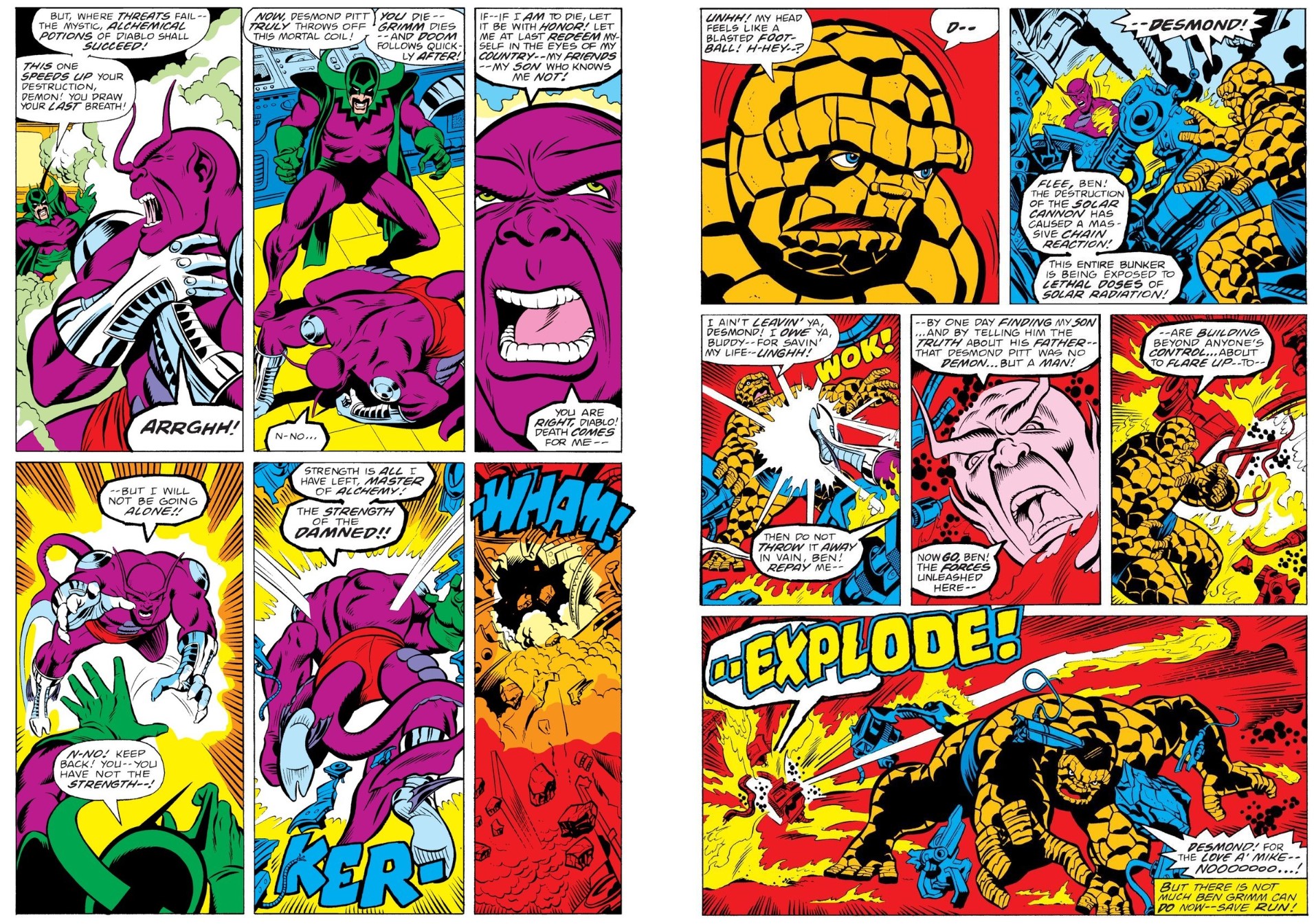
Once upon a time, disabled physician Donald Blake took a vacation in Norway, only to stumble into an alien invasion. Trapped in a cave, he found an ancient walking stick which, when struck against the ground, turned him into the Norse God of Thunder! Within moments, he was defending the weak and smiting the wicked. Months swiftly passed, with the Lord of Storms tackling rapacious extraterrestrials, Commie dictators, costumed crazies and cheap thugs, but these soon gave way to a vast kaleidoscope of fantastic worlds of incredible, mythic menaces, tackled by an ever-changing cast of stalwart immortal warriors at his side…

Whilst the ever-expanding Marvel Universe had grown ever-more interconnected as it matured through its first decade, with characters literally tripping over each other in New York City, the Asgardian heritage of Thor and the soaring imagination of Jack Kirby had most often drawn the Thunder God away from mortal realms into stunning, unique landscapes and scenarios.

However, by the time of this power-packed compendium, the King was long gone – or more accurately enacting his Second Coming – technically Third, and definitely Second Return to the House of (mostly his) Ideas – and only echoes of his groundbreaking presence remained. John Buscema had visually made the Thunder God his own over interceding years, whilst a succession of scripters had struggled with varying success to recapture the epic scope of Kirby’s vision and Stan Lee’s off-kilter but comfortingly compelling faux-Shakespearean verbiage…

Spanning June 1977 to February 1979, this power-packed compilation re-presents The Mighty Thor #260-280, Annuals #6 & 7 and Marvel Preview #10 in a panoply of unceasing stellar adventure spanning time and space and well-explored regions.

Previously, embattled Asgardians had survived another invasion only to learn their divine Liege Lord Odin had gone missing. Having exhausted every avenue of location available, son-&-heir Thor – prompted by vague hints from all-knowing but hostile spirit Mimir – departed to search distant galaxies for a “Doomsday Star” …

Aboard starfaring dragonship Starjammer, the Thunderer, Lady Sif and Warriors Three Fandral, Hogun and Volstagg (solar) sail off, leaving the beleaguered Eternal Realm under Balder the Brave’s stewardship, albeit ably assisted by his dark inamorata Karnilla the Norn Queen. Now in the wake of travail, torment and cruel misunderstanding, and accompanied by the Recorder (a Rigellian AI robot guide), ‘The Vicious and the Valiant’ sees the interstellar questors finally locate the Doomsday Star.

Scripted by writer/editor Len Wein with Walter Simonson (inked by Tony DeZuñiga) making his first major artistic contributions to the mythology, the interstellar quest’s end coincides with an attack on far-distant Asgard where Balder and Karnilla resist an invasion helmed by arch-traitors Enchantress and Executioner. As the voyagers strive to reach a hostile planet with a strict and extreme no-visitors policy, #261 expands the scope and intensifies the action as the questers falter before ‘The Wall Around the World!’ (inked by Ernie Chan): a terrifying global-scaled construct comprised of the power-drained husks of dead gods.

Resolute and determined the seekers push on, learning Odin has been captured and gradually diminished and consumed by energy-leeching “Soul-Survivors” whose civilisation subsists on stolen divine lifeforce. As they valiantly strive to save their sovereign, the roving Asgardians learn to their cost that ‘Even an Immortal Can Die!’ (#262, limned by Simonson & DeZuñiga).

Thankfully, ‘Holocaust and Homecoming!’ proves Odin both wily and still potent as the heroes’ ferocious clash and hard-won victory results in a weary, wounded pantheon returning to Asgard, only to find it taken over by Loki and his cohort of treacherous allies. With Odin in a coma – and ultimately abducted again – covert civil war erupts between the newly restored champions and the city citizens Loki has subverted. ‘Thou Shalt Have No Other Gods Before Me!’ sees the sinister scheme exposed, but not before Loki unleashes ultimate weapon The Destroyer against his adoptive brother…

Inked by Joe Sinnott, #265’s ‘When Falls the God of Thunder…!’ sees Loki losing control of his ultimate sanction, and once again, everyone survival hinges on the determination of Thor and his valiant resistance to chaos, until #266’s ‘…So Falls the Realm Eternal!’, where Wein, Simonson & DeZuñiga show the Thunderer at his indomitable best, holding Loki at bay and off balance until the Warriors Three rescue and revive an extremely unhappy All-Father…

This saga presaged a change of narrative focus but before that Roger Stern, Sal Buscema & Klaus Janson craft ‘Thunder in the 31st Century!’ (as first seen in Thor Annual #6 December 1977). A riot of time-busting mayhem commences with Thor plucked from contemporary Manhattan: accidentally summoned to the time period of the original/future (time travel tenses suck!) Guardians of the Galaxy by a cyborg maniac named Korvac. The immortal god-warrior briefly joins Vance Astro, Charlie 27, Yondu, Nikki, Martinex and Starhawk in bombastic battle against super-powered aliens to thwart the sinister cyborg’s scheme to become master of the universe. At the conclusion, Thor returns to his own place and time, unaware how Korvac would reshape the destiny of reality itself in coming months…

The collaborations of Wein and Simonson had already shaken the title out of its conceptual doldrums; as the big change approached they went into overdrive and an seemingly backward direction. After All-Father Odin was kidnapped, drained like a battery and died, he was rescued, resurrected and restored to an Asgard riven with conspiracies. Conquered by old enemies, Thor faced ultimate weapon The Destroyer before triumphantly saving everything. In #267 (January 1978, Wein, Simonson & DeZuñiga) we see the hero bound ‘Once More, To Midgard!’, following a rare moment of filial fondness rather than the usual arguments with Dad. Thor has been missing for quite some time and his absence has left Don Blake’s life in tatters until old colleague Dr. Jacob Wallaby arranges a job with Stark International’s Free Clinic. That good deed leads to more chaos as deranged super-criminal Damocles ruthlessly raids the hospital’s radiation lab in search of synthetic cobalt to power his new super-gun. Before Blake can react, the smash-&-grab attack is done, leaving furious Thor to pursue the murderous madman, aided by Damocles’ guilt-fuelled sibling Bennett Barlow. He pays a heavy price for his civic service in concluding clash ‘Death, Thy Name is Brother!’

The concentration on Earthly scale and situations continues in #269 as ‘A Walk on the Wild Side!’ sees a mysterious mastermind contract mechanistic mercenary Stilt-Man to secure a certain high-tech package. A raft of deadly upgrades prove pointless after the Thunderer stumbles upon the heist in the skies over Manhattan, but Thor has far more trouble facing the plotter’s power-packed partner Blastaar in middle chapter ‘Minute of Madness… Dark Day of Doom!’

The triptych of terror terminates in Thor #271 as, with the aid of Tony Stark, Nick Fury (I), S.H.I.E.L.D. and The Avengers, the Storm Lord meets the true architect of destruction and imminent global domination in orbit ‘…Like a Diamond in the Sky!’ This epic includes cameos from Shang-Chi, Spider-Man, The Hulk, Human Torch, Nova, Daredevil and many more Marvel stalwarts; serving as a big celebratory send-off for Wein & Simonson, whilst signalling a major change of direction.

Mighty Thor #272 saw the return of Roy Thomas, John Buscema & Tom Palmer depicting ‘The Day the Thunder Failed!’ as the hero shares moments of humiliating childhood defeat with a crowd of fannish kids. The incidents were all adapted from classical mythology and served as an appetiser to a mega-saga in the making, with TV reporter Harris Hobbs (who visited Asgard way back in Journey into Mystery #123) making Thor an offer he cannot help but refuse…

Still channelling tales from the Eddas – specifically about how Ragnarok would end the reign of the Aesir/Asgardians – #273 is set ‘Somewhere… Over the Rainbow Bridge!’ Although the journalist’s pleas to film a TV special in the Home of the Gods is sternly rebuked and rejected, wicked Loki has his own plans and smuggles in Harris and his film crew, triggering the beginning of the long-prophesied end…

If you haven’t actually read the original myths, go do that. It will make you appreciate these clever riffs on the theme so much more as the secret history of Asgard and Odin’s plots are exposed in #274. With Loki on the loose, the story of how the All-Father sacrificed his eye to fiery seer Mimir for knowledge of the future is revealed, as are the dirty bargains Odin made to forestall inevitable, inescapable doom. As Sif leads home the long-missing goddesses of Asgard, mortal cameraman Roger “Red” Norvell beholds the Thunder God’s raven-haired beloved and is gripped by uncontrollable desire. Another prerequisite of The End then occurs as Loki orchestrates Balder’s death in ‘The Eye… and the Arrow!’

In #275 ‘A Balance is Struck!’ when Odin uses all his power to suspend the dying God of Light in a timeless state, pausing the Ragnarok countdown. Loki, meanwhile, uses ancient spells and his adoptive brother’s Belt of Strength and Iron Gloves (created when the Prince was a child to help control and wield mighty Mjolnir) to become a new, very different Thor. The newcomer even seizes the mystic hammer from its enraged rightful owner as he beats the thunder god and abducts Sif, declaring in #276 ‘Mine… This Hammer!’

Red is barely aware he has killed his best friend for power. Loki and Death Goddess Hela rouse all Asgard’s enemies to march on their hated foes as ‘Time of the Trolls!’ seems to indicate doomsday has finally fallen. However, the forces of evil are not the only devious schemers with an endgame in view, and a monstrous plan is exposed whereby the All-Father seems to cheat the powers of prophecy and trick Ragnarok by creating a false Thor to die in place of Asgard’s true saviour. All it required was timing, boldness and a few necessary sacrifices…

With veteran Thor inker Chic Stone applying his stylish lines, #278 heralds ‘At Long Last… Ragnarok?!’ as all plots and perils converge with reality – the Nine Realms portion of it at least – battling fate to a draw as the apocalypse is deferred a while longer… but only after another tragic, valiant and ultimately futile demise. In the aftermath, the trueborn Odinson cannot abide what has been done in his name and sunders all contact with his scheming sire.

The split is genesis to an even more momentous and spectacular saga postponed here for a crucial sidebar seen in Thor Annual #7 (1978) wherein Thomas, Simonson & Ernie Chan here detail a forgotten “first contact” moment triggered by the reactions to Balder’s “death” due to Loki’s machinations to trigger Ragnarok. When Thor reluctantly consults hostile prophet Mimir, the flaming seer of the Well of Wisdom instead emphasises how untrustworthy Odin is and illustrates his point by sharing of an event the Thunderer cannot remember even though it was one of his most significant exploits…

Tale within a tale ‘And Ever… The Eternals!’ reviews the creation of and war between Asgardian and Greek pantheons – which Thor readily recalled – before going on to disclose how the proud prince had continued seeking new mortal worshippers. Roaming Midgard doing heroic deeds, he had encountered and barely defeated a monstrous mind-controlling horror dubbed Dromedan. Moving on, in what would be later called Central America, he meets another – unsuspected – god-like race: Polar Eternals Ajak, Druig, Valkin and Virako.

Thor then reexperiences how he was informed that Midgard was a laboratory preserve of incredible super-gods from space: “Celestials” who had genetically modified proto-hominids to create humanity, Eternals and horrific predatory Deviants. These subspecies had battled for ownership of Earth in wars spanning the length of human existence…

Confronted by such sheer heresy and baffled by obvious nonsense, Thor learns now that his new friends were as treacherous as any god or mortal, with all knowledge of Celestials excised after he and the Eternals defeated a resurgent Dromedan and horde of Deviants and Mutates. Mindwiped, he returned to Asgard, oblivious to the fact that Space Gods would periodically return to judge the progress of their three-pronged project… as indeed they were doing at that very moment under a colossal gleaming dome in Earth’s Andes mountains…

When Kirby’s series debuted in 1976, we met anthropologist Professor Daniel Damien and daughter Margo, whose explorations revealed giant aliens had visited Earth in ages past: sculpting hominid beasts into distinct sentient species: Human Beings; genetically unstable Deviants and god-like superbeings who called themselves Eternals. Moreover, those Space Gods had occasionally returned to check up on their experiment.

Over 19 issues and an Annual, the series avoided true contact with Marvel continuity as modern mankind’s military and moneyed movers-&-shakers dealt with the politics and panic of a world-shattering event. Ikaris (son of Valkin and Virako), Margo, Ajak, Sersi, Makkari, Zuras, Thena, Sprite and Druig fought and foiled Deviants Kro, Brother Tode, Dromedan, Ransak & Karkas, with humanity terrified in the background and under the microscope as The Fourth Host of Celestials hovered above the world in a city-sized ship, pondering final judgement: a process that would take 50 years.

Never a comfortable fit with the rest of the Marvel Universe – only S.H.I.E.L.D. ever really got involved – The Eternals further embodied Kirby’s fascination with Deities, the immensity of Space and potential of Supernature through the lens of very human observers. Once the series ended, Kirby moved on and other creators eagerly co-opted his concepts (with mixed success) into the company’s mainstream continuity…

In Mighty Thor #279 (cover-dated January 1978) the new quest is briefly diverted as Don Glut, Alan Kupperberg & Pablo Marcos detail how the Thunderer’s latest exile to Earth prompts more reminiscing and “untold tale” ‘A Hammer in Hades!’ Long ago, a chance encounter with pre-goddess first love Jane Foster led to her imprisonment in the underworld and Thor flew right into an ambush organised by Loki, Grecian death god Pluto and super-troll Ulik, but still proved more than even that trio of terror could handle…

Still preparing to confront the relatively undiscovered Fourth Host, Thor is again forestalled in #280 where Thomas, Wayne Boring & Tom Palmer pastiche DC’s Annual JLA/JSA summer team-ups with ‘Crisis on Twin Earths!’ after Superman-analogue Mark Milton/ Hyperion of the Squadron Supreme requests Thor’s assistance on his own alternate Earth. Sadly, the evil Hyperion of the Squadron Sinister manages to replace his goody-goody doppelganger and a shattering battle erupts before order and dimensional stability is restored…

This titanic tome ends on a rare treat stemming from the period’s growing love-affair with fighting fantasy. Cover-dated Winter 1977, Marvel Preview #10 was a monochrome magazine in Marvel’s mature-oriented line: free of Comics Code scrutiny and (ostensibly) the strictures of shared continuity. Although MP was an anthology/showcase title, other periodicals in the Marvel Magazine Group included off-kilter features like Howard the Duck, Rampaging Hulk and Tomb of Dracula.

Thor the Mighty almost joined that elite roster in 1975, and nearly three full issues were prepared for a barbarian Thunder God vehicle before the plug was pulled. As a result, much material was sitting in drawers when the decision came to use one lead tale and a thematic back-up in the try-out title. Another story had already been modified and published as Thor Annual #5 (for which see Marvel Masterworks Thor #15)…

Behind a painted Ken Barr cover, frontispiece by Jim Starlin and illustration plates from Virgilio Redondo and Rudy Nebres, ‘Thor the Mighty!’ was scripted by Wein, and rendered by Starlin & DeZuñiga, telling of a time long past when Odin sent his rowdy sons Thor and Loki on a quest to secure a mystic Crystal of Blood threatening to erase all existence. The mission pitted his sons against seductive sorceresses, trolls ogres, giants, dragons and – as ever – each other…

The lusty yarn was backed up by an exploit of Hercules The Prince of Power when he was still half-human and sailing with Jason as an Argonaut. Here, courtesy of Bill Mantlo & Val Mayerik, the shipmates faced constant, mythologically-tinged peril on ‘The Isle of Fear!’ – but nothing like the political intrigue engineered by corrupt sponsor King Kreon of Pylos

Following a Nebres pinup and never attained next issue ad, a bonus section offers the letters page editorial from Thor #272, Thomas’ editorial from Thor Annual #7, the cover to Marvel Index #5 by Tom Conrad, the Franc Reyes Contents page and contemporary house ads.

The tales gathered here may lack the sheer punch and verve of the early years but certainly prove that after too long calcified, the Thunder God was again moving to the forefront of Big Idea Comics Storytelling. Fans of ferocious Fights ‘n’ Tights fantasy will find this tome stuffed with intrigue and action, magnificently rendered by artists dedicated to making new legends. This a definite must-read for all fans of the character and the genre.
© 2023 MARVEL.

Guardians of the Galaxy Epic Collection volume 2: Quest for the Shield (1978 – 1990)


By Jim Shooter, David Michelinie, Chris Claremont, Mark Gruenwald, Jim Valentino, Roger Stern, George Pérez, Bill Mantlo, Allyn Brodsky, Ralph Macchio, Sal Buscema, Dave Wenzel, John Byrne, Mike Vosburg, Bob McLeod, Jerry Bingham, Ron Wilson, Pablo Marcos, Klaus Janson, Gene Day, Bruce Patterson, Steve Montano, Win Mortimer, Josef Rubinstein, Dan Green, Rick Bryant, Ricardo Villamonte & various (MARVEL)
ISBN: 978-1-3029-5641-7 (TPB/Digital edition)

This book includes Discriminatory Content produced in less enlightened times.

There are two distinct and separate iterations of the Guardians of the Galaxy. The films concentrated on the second, but with inescapable connections between them and the stellar stalwarts here so pay close attention. The original comic book team were freedom fighters united to defeat a reptilian invasion by aggressive aliens The Badoon a thousand years from the present. The other were a later conception: springing out of contemporary crises seen in The Annihilation publishing event.

This treasury of torrid tales gathers landmark moments of the 31st century centurions, as seen in Avengers #167-168,170-177 & 181; Ms. Marvel #23; Marvel Team-Up #86; Marvel Two-In-One #61-63 & 69 plus an almost modern half dozen issues of 1990s sensation Guardians of the Galaxy, collaboratively and episodically spanning January 1978 through November 1990.

It features a radically different set-up than that of the silver screen stars, but is grand comic book sci fi fare all the same. One thing to recall at all times, though, is that there are two teams. Never the twain shall meet…until they one day did but not here…

The resistance unit comprised Charlie-27 – a heavy-gravity miner/militia-man from Jupiter and crystalline scientist Martinex from Pluto. Both are examples of radical human genetic engineering: subspecies designed to populate and colonise Sol system’s outer planets but now possibly the last of their kinds. They were joined in the struggle by 1000-year-old Earthman Major Vance Astro and Alpha Centauri aborigine Yondu. Astro had been humanity’s first intersolar astronaut; flying alone in cold sleep to Centauri at a plodding fraction of the speed of light. When he got there 10 centuries later, humanity was waiting for him, having cracked transluminal speeds only two centuries after he blasted off…

A legion of contemporary heroes eventually helped banish the Badoon and save 31st century humanity, but peace was unsettling for the Guardians, so they flew off in search of adventure. Along the way they picked up last Mercurian Nikki and a weird space-god calling him/herself Starhawk. The radically different roster are astoundingly out of their depth as we open with an extended tour of duty beside their 20th century inspirations, courtesy of Jim Shooter, George Pérez & Pablo Marcos: embroiling the World’s Mightiest Heroes of two eras in a sprawling tale of universal conquest opening in Avengers #167-168 (April & May 1978) before – after a brief pause – resuming for #170 through 177…

Previously, a difference of opinion between Captain America and Iron Man over leadership styles had begun polarising the team. Tensions started to show in ‘Tomorrow Dies Today!’ with a reminder that in the Gods-&-Monsters-filled Marvel Universe there are entrenched and jealous Hierarchies of Power. Thus, when a new player mysteriously and clandestinely materialises in the 20th century the very Fabric of Reality is threatened. The plot begins to unravel when the Guardians of the Galaxy materialise in Earth orbit, having hotly pursued cyborg despot Korvac through time. Inadvertently setting off planetary incursion alarms, their moon-sized vessel Drydock is swiftly boarded by Avengers, where, after the customary introductory squabble, the future heroes wearily explain the purpose of their mission. Captain America had fought beside the chronal champions to liberate their home era and Thor had faced fugitive Korvac before, so peace rapidly breaks out, but even with the home team’s full resources the time travellers are unable to locate their quarry. Meanwhile on Earth, mysterious being Michael is lurking in the background. At a fashion show staged by The Wasp he compels a psychic communion with model Carina Walters and they both vanish…

Avengers #168 sees ‘First Blood’ drawn, stirring up more trouble as Federal liaison/hidebound martinet Henry Peter Gyrich starts making life bureaucratically hot for the USA’s uncooperative heroes. In Colorado, Hawkeye gets a shock as his travelling partner Two-Gun Kid vanishes before his eyes and in suburban Forest Hills, Starhawk – as Aleta (the female iteration of their shared form Aleta) – approaches a sedate residence. Michael/Korvac’s scheme consists of subtly altering events whilst secretly gathering strength in preparation for a sneak attack on the 20th century’s Cosmic Hierarchies and all revolves around not being noticed until he is too powerful to stop. However, when Starhawk confronts the future fugitive, Michael kills the intruder and instantly resurrects him/them, but without the ability to perceive the assailant or any of his works…

After a 2-issue break forced by deadline problems, Shooter, Pérez & Marcos pick up the drama in #170 with ‘…Though Hell Should Bar the Way!’ As Sentinel of Liberty & Golden Avenger finally settle their differences, in Inhuman city Attilan, former Avenger Quicksilver suddenly disappears even as dormant mechanoid Jocasta (created by malign AI Ultron to be his bride) goes on a rampage and escapes into New York City. In stealthy pursuit and hoping her trail will lead to Ultron, the Avengers stride into a fiendish trap ‘…Where Angels Fear to Tread’, but triumph anyway thanks to the hex powers of the Scarlet Witch, the assistance of pushy, no-nonsense new hero Ms. Marvel and Jocasta’s own rebellion against the metal monster who made her. However, at their moment of triumph the team are stunned to witness Cap & Jocasta wink out of existence…

Problems pile on in #172 as watchdog-come-gadfly Gyrich is roughly manhandled and captured by out-of-the-loop returnee Hawkeye and responds by rescinding the team’s Federal clearances. Thus handicapped, the Avengers are unable to warn other inactive members of the rapidly increasing disappearances as a squad of heavy-hitters rush off to tackle marauding Atlantean maverick Tyrak the Treacherous, bloodily instigating a ‘Holocaust in New York Harbor!’ (Shooter, Sal Buscema & Klaus Janson)…

Answers to the growing mystery are finally forthcoming in ‘Threshold of Oblivion!’ – plotted by Shooter, with David Michelinie scripting for Sal Buscema & D(iverse) Hands to illustrate. As vanishings escalate, the remaining Avengers (Thor, The Wasp, Hawkeye & Iron Man), with the assistance of Vance Astro, track their hidden foe and beam into a cloaked starship to liberate the ‘Captives of the Collector!’ (Shooter, Bill Mantlo, Dave Wenzel & Marcos).

After a staggering struggle, the heroes triumph and their old arch-nemesis reveals a shocking truth: he is in fact an Elder of the Universe who foresaw cosmic doom eons previously and sought to preserve special artefacts and creatures – such as the Avengers – from the inexorable but slowly approaching apocalypse. As he reveals that long-anticipated Armageddon is imminent and that he has sent his own daughter Carina to infiltrate The Enemy’s stronghold, the cosmic Noah is obliterated in a devastating blast of energy. The damage, however, is done, and the entrenched Hierarchies of Creation may have been alerted to the threat of an interloper…

Avengers #175 triggers the final countdown as ‘The End… and Beginning!’ (Shooter, Michelinie, Wenzel & Marcos) has the amassed ranks of Avengers & Guardians following clues to Michael even as the new god shares the incredible secret of his apotheosis with Carina. ‘The Destiny Hunt!’ and ‘The Hope… and the Slaughter!’ (Shooter, Wenzel, Marcos & Ricardo Villamonte) depicts the legion of champions destroyed and resurrected as Michael casually overpowers all opposition before faltering at the crucial moment for lack of one fundamental failing…

Despite being somewhat let down by the illustration after the magnificent Pérez gave way to less inspired hands like Buscema, Wenzel & Tom Morgan, and cursed by the inability to keep a regular inker (Marcos, Janson, Villamonte & Morgan all pitched in), the sheer scope of the epic nevertheless carries this tale through to its cataclysmic and fulfilling conclusion. Even Shooter’s reluctant replacement by scripters Michelinie & Mantlo as his editorial career advanced couldn’t derail this juggernaut of adventure. If you want to see what makes Superhero fiction work, and can keep track of nearly two dozen flamboyant characters, this is a fine example of how to make such an unwieldy proposition easily accessible to the new and returning reader.

Some months later Avengers #181 introduced new creative team Michelinie & John Byrne, augmented by inker Gene Day, as ‘On the Matter of Heroes!’ sees Agent Gyrich lay down the law and winnow the costumed army down to a manageable, federally-acceptable seven heroes. With the Guardians of the Galaxy soon headed back to the future, Iron Man, Vision, Captain America, Scarlet Witch, Beast & The Wasp must placate Hawkeye after he is rejected in favour of new member The Falcon – parachuted in to satisfy government affirmative action quotas…

However, before the Guardians finally depart they interact with a few more 20th century stars beginning with Ms. Marvel in ‘The Woman Who Fell to Earth’ (#23, April 1979 by Chris Claremont, Mike Vosburg & Bruce D. Patterson). When alien conqueror The Faceless One seizes control of Drydock, crusader-in-crisis Carol Danvers teams up with Vance Astro to expel the invader, after which Marvel Team-Up #86 (October 1979), shows undercover Guardians Starhawk, Nikki & Martinex stumbling over Spider-Man whilst attempting to eradicate evidence of their existence. The main threat as delineated by Claremont & Bob McLeod comes from a nefarious armaments company Deterrence Research Corporation who want to steal Drydock but the hardest part of the mission is preventing an ambitious reporter exposing the mission of the future heroes and publishing the ‘Story of the Year!’

Slightly out of chronology – but that’s time travel all over, right? – the remainder of this collection is given over to team-ups with old Guardians ally Ben Grimm, the Fantastic Four’s titanic Thing. An extended interstellar epic opens in Marvel Two-In-One #61 with ‘The Coming of Her!’ (Mark Gruenwald, Jerry Bingham & Day) as time-travelling space god Starhawk becomes involved in the birth of a female counterpart to man-made man-god Adam Warlock. The distaff genetic paragon awakes fully empowered and instantly starts searching for her predecessor, dragging Ben’s girlfriend Alicia Masters & mind goddess Moondragon (a future member of the 21st century Guardians of the Galaxy) across the solar system, arriving where issue #62 observes ‘The Taking of Counter-Earth!’ Hot on their heels, Thing & Starhawk catch Her just as the runaway women encounter a severely wounded High Evolutionary and discover the facsimile Earth built by that self-made god has been stolen…

United in mystery, the odd grouping trail the planet out of the galaxy and expose the incredible perpetrators, but Her’s desperate quest to secure her predestined, purpose-grown mate ultimately ends in tragedy as she learns ‘Suffer Not a Warlock to Live!’

Marvel Two-In-One #69 (November 1980, by Gruenwald, Ralph Macchio, Ron Wilson & Day), then finds Ben clashing with the still time-displaced Guardians of the Galaxy whilst striving to prevent the end of everything. ‘Homecoming!’ finds millennial man Vance Astro ready to endanger all of existence by trying to stop his younger self ever going into space, and making his/their life the epitome of pointless misery. With nature running wild and all New York’s heroes battling the chaos, and with Ben adding his hard-earned experience to the debate, Vance does and does not succeed…

The journey home clearly took a little while. This much reprinted saga here concludes with the first mission of the returned time-travellers in their origin era. It comes from Guardians of the Galaxy volume 1, #1-6 by rising star Jim Valentino and inker Steve Montano which were originally released almost a decade later with cover-dates/June-November 1990. Heartily embracing the notion of a full and fully-connected Marvel Universe continuity one thousand years later, the restored warriors Starhawk/Aleta, Major Vance, Charlie-27, Nikki and new leader Martinex, emerge in full fight mode in 3017 AD, battling to save the defenceless superstitious and xenophobic citizens of Courg from resource plunderers. The war is going well until the cyborg invaders unleash a super-warrior who seems familiar to the chrononauts…

‘… But Are They Ready for… Taserface!’ sees extended clashes lead to defeat and separation, at the hands of The Stark: a race who lucked into Iron Man technology in their distant past and developed it into an interstellar cult of conquest. As the Guardians resist the Stark, Yondu – long believing himself the last of his species – succumbs to despondency on learning that there is another: a female, but one who has abandoned the Spirtuality of Anthos as described in the Book of Antag…

That holy tome had inspired the team’s latest quest, and propelled them into the vast trackless void in search of a legendary artefact promising invincibility for its holder which Vance had reasoned could only be the lost shield of Captain America. Sadly, the myths around the disk had also inspired other, less nostalgic or altruistic searchers…

The saga takes a violent downturn in second chapter ‘The Stark Truth!’ as Taserface is reinforced by a cadre of super-cyborgs resulting in increased warfare and the catastrophic sundering of Aleta and Starhawk (AKA Stakar) into separates bodies. The worsening situation is soon exacerbated far, far away by the momentous meeting of Firelord – current Protector of the Universe (and extremely mellow former herald of Galactus) with another shield-seeking crew…

Force are also a disparate squad of super-powered beings from various worlds, but are ruthless bloody mercenaries, led by scheming elemental transmuter Interface who intends to use the shield to become an even bloodier, more unstoppable marauder. His team are a match for any martial power in space, consisting of old Guardians’ foe Brahl the Intangible; enigmatic Tachyon; “pink Kree” Eighty Five; mutant Zn’rx/Snark tracker Scanner; gravity-warping Broadside and outcast mutant Centauran Photon, who had rejected all of her expired race’s ideals just as they had rejected her…

On Courg, ‘Split Decision’ left both halves of Starhawk relatively unharmed, but as Aleta pitched in against the Stark, the cosmic “One Who Knows” suddenly flees the planet and as abruptly returns with a crucial ally (and future teammate) in ‘…And Then Came the Firelord!’ Soon, with Taserface maimed and the Stark reprimanded and ignominiously repelled, the reunited Guardians are following in new spaceship The Captain America II, solving ancient clues to their final destination. That is Mainframe, a sentient world inextricably linked to Earth in the long-ended Age of Heroes. Sadly Interface and Photon have deduced the same location and ‘A Force to Reckon With!’ finds the heroes and villains competing in bizarre gladiatorial combats with unguessable rules and scoring systems for the mystic prize…

The contest ends with plenty of revelations but as no one could have predicted even though ‘… And to the Victor… The Shield!’ ultimately sees Vance Astro in possession of the only other known relic of the 20th century.

The Beginning…

Supplementing these much-reprinted yarns is Valentino’s serialised text partwork The History of the Guardians of the Galaxy from #1-4, preceded by a variety of collection covers that graced earlier collections: Perez’s 1991 Avengers: The Korvac Saga accompanied by that book’s new framing sequence from Mark Gruenwald & Tom Morgan. Also here is the GotG’s only other 80’s appearance – one panel on one page of John Byrne & Al Gordon’s Sensational She-Hulk #6 (1989).

Enhancing the info levels are a burst of pages from Official Handbook of the Marvel Universe (1983) briefing us on Charlie-27, Martinex, Nikki, Starhawk, Vance & Yondu; their ship Freedom’s Lady; The Collector and Korvac, followed by their entries from OHMU (Deluxe Edition) illustrated by Al Milgrom, Elliot R. Brown, Dennis Jensen & Josef Rubinstein. Behind the scenes data comes via interviews culled from Marvel Age #86 & 88 before Valentino & Montano’s cover for Guardians of the Galaxy: Quest for the Shield original TPB and Overstreet’s Price Update by Valentino & Jeff Albrecht prior to a gallery of original art by Byrne, Day, Valentino & Montano’s and more Korvac collected covers by Pérez, John Romita, Jr., Joe Rosas, Terry Austin, Thomas Mason, John Kalisz, Tom Chu, Dave Kemp, Valentino & Matt Milla.

A bombastic, drama-drenched, star-roving romp, this is a non-stop feast of tense suspense and blockbuster action: a well-tailored, on-target tool to turn curious movie-goers into fans of the comic incarnation and another solid sampling to entice newcomers and charm even the most jaded interstellar Fights ‘n’ Tights fanatic…
© 2025 MARVEL.

Fantastic Four: Behold… Galactus! (Marvel Select Edition)


By Stan Lee, Jack Kirby & Joe Sinnott; Lee, John Buscema & Sinnott; and John Byrne & various (MARVEL)
ISBN: 978-1-3029-1887-3 (HB/Digital edition)

This book includes Discriminatory Content produced in less enlightened times.

With today’s World Premier of the latest cinematic interpretation of the “World’s Greatest Comics Magazine” (Phew!!), here’s a cool collected assemblage of the stuff we comics geeks tuned into seven decades ago – and with sequels! – to prove that it’s never too late to catch up to the really good stuff…

Cautiously bi-monthly, cover-dated November 1961, and hiding timidly amidst the company’s standard monster ‘n’ aliens fare, Fantastic Four #1 – by Stan Lee, Jack Kirby, George Klein & Christopher Rule – was crude and rough-hewn, but concealed on its pages a revolution of raw passion and uncontrolled excitement. Thrill-hungry readers pounced on it and the raw storytelling caught a wave of change starting to build in America. It and the succeeding issues changed comic books forever.

In eight short years FF became the indisputable core and most consistently groundbreaking series of Marvel’s ever-unfolding ridiculously enthralling web of creation, bombarding readers with ceaseless salvos of fresh concepts and new characters. Kirby was in his conceptual prime, unleashing his vast imagination on plot after spectacular plot. Clearly inspired, Lee scripted some of the most passionate superhero sagas that Marvel – or any publisher – had or has ever seen. Both were on an unstoppable roll, at the height of their creative powers, and full of the confidence only success brings. The King was particularly eager to see how far the genre and medium could be pushed. A forge of stunning creativity and endless excitement, Fantastic Four was the proving ground for dozens of future stars and mesmerising concepts, none more timely or apt than freewheeling cosmic wanderer and moral barometer The Silver Surfer.

Collecting every cosmic crumb of pertinent material from Fantastic Four #48-50, 120-123, and #242-244, this compendium reprints a trilogy of landmark sagas of a morally ambiguous Stellar Sentinel, his globe-gobbling master and the greatest Explorers in Humanity’s history, spanning March 1966 to July 1982. The epic opens with elucidation as Ralph Macchio offers background and appreciation in his Introduction to one the greatest comics sagas ever made prior to the tale again being told…

Although pretty much a last-minute addition to Fantastic Four #48-50’s Galactus Trilogy, Kirby’s scintillating creation quickly became a watchword for depth and subtext in Marvel’s Universe, one Stan Lee kept as his own personal toy for many years to come. The debut was a creative highlight from a period where the Lee/Kirby partnership was utterly on fire. The tale is all power and epic grandeur and has never been surpassed for drama, thrills and sheer entertainment, so you should really read it in all its glory.

Here, without further preamble, the wonderment commences with ideas just exploding from The King. Despite being only halfway through one storyline, FF #48 trumpeted ‘The Coming of Galactus!’ with the Inhumans’ saga swiftly but satisfyingly wrapped up (by page 6!) as the entire clandestine race were sealed behind an impenetrable dome called the Negative Zone (later retitled Negative Barrier to avoid confusion with the subspace gateway Reed worked on for years). Meanwhile, a cosmic entity approaches Earth, preceded by a gleaming herald on a board of pure cosmic energy…

I suspect this experimental – and vaguely uncomfortable – approach to narrative mechanics was calculated and deliberate, mirroring how TV soap operas increasingly delivered their interwoven, overlapped storylines, and used here as a means to keep readers glued to the series. They needn’t have bothered. The stories and concepts were more than enough…

‘If this be Doomsday!’ sees planet-eating Galactus setting up shop on top of the Baxter Building despite the FF’s best efforts, whilst his coldly gleaming herald has his humanity accidentally rekindled by simply conversing with The Thing’s blind girlfriend Alicia Masters. Issue #50’s ‘The Startling Saga of the Silver Surfer!’ climaxes the epic in grand manner as the Surfer’s reawakened ethical core and FF’s sheer heroism buy enough time for supergenius leader Reed RichardsMister Fantastic – to literally save the world with a boldly-borrowed Deus ex Machina gadget…

Once again, the tale ends in the middle of the issue, with the remaining half concentrating on the team getting back to “normal”. To that extent, Human Torch Johnny Storm finally enrols at Metro College, desperate to forget Inhuman lost love Crystal and his unnerving jaunts to the ends of the universe. On his first day, the lad meets imposing and enigmatic Native American Wyatt Wingfoot, who is destined to become his greatest friend…

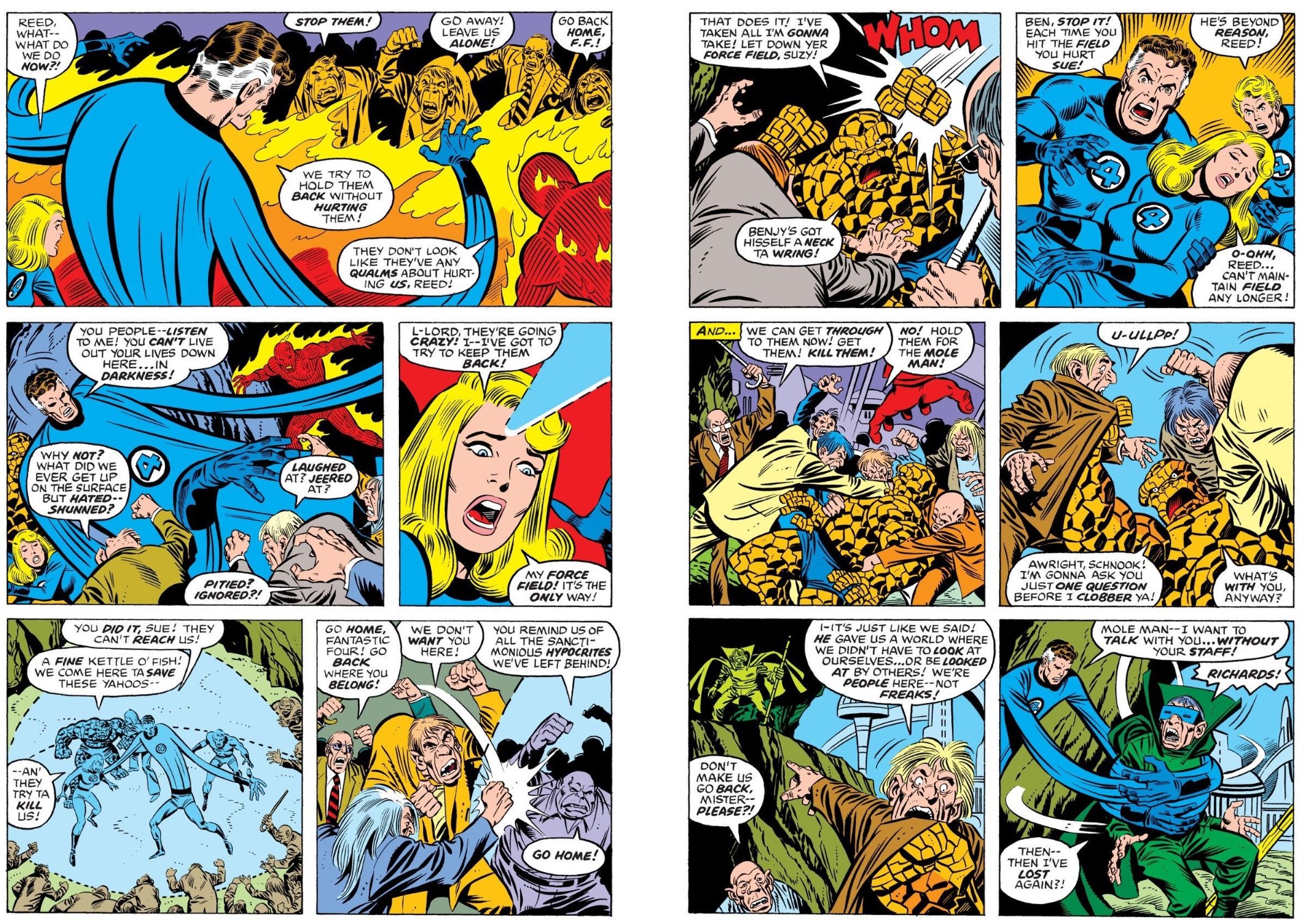
Jumping to 1972 long after Kirby had moved to DC to create his New Gods saga, revamp Superman’s Pal Jimmy Olsen and create new wonders such as Kamandi and The Demon, the Fantastic Four had carried on under Lee and a succession of more traditional illustrators. The Surfer had briefly enjoyed his own critically acclaimed but financially unhealthy title and been relegated to guest star status, especially if allegorical metaphors were required…

Joined by inker Joe Sinnott, Fantastic Four #120-123 (cover-dated March-June of that year) rather overplayed the biblical allusions for a blockbuster 4-parter. The ‘The Horror that Walks on Air!’ heralded the bellicose arrival of a seemingly omnipotent invader claiming to be an angel sent to scour and scourge Earth. Utterly unstoppable, this he does before revealing himself as the new herald of Galactus and declaring humanity doomed.

The tale vividly yet laboriously continues in ‘The Mysterious Mind-Blowing Secret of Gabriel!’ with the recently divided but now reunited quartet utterly overmatched in their resistance and only saved by the late-arriving Silver Surfer, before facing off against world-devouring ‘Galactus Unleashed’, who rampages like Godzilla through the city’s streets before an unexpected end comes and humanity survives another day thanks to Reed Richards who again outsmarts the cosmic god and prevents the consumption of ‘This World Enslaved!’

A lot can happen – and did – in ten years, and the last story here (from #242-244, May-July 1982) is another spectacular and rather revolutionary epic, as crafted by John Byrne soon after he took total creative control of the Quirky Quartet.

‘Terrax Untamed’ sees the team and Johnny’s new girlfriend Frankie Raye (who has fire powers mimicking his own) attacked by Galactus’ most recent herald – someone who quite justifiably bears them a grudge as the FF formerly dethroned him from the world he had conquered before handing him over to the Planet Devourer to use as his cosmic food-finder. Now, still possessing the “Power Cosmic” all heralds share, Terrax hits Earth like an extinction event and, after causing immense destruction across the city, uproots and maroons Manhattan Island 100 miles above the rest of the planet…

Terrax’s demand is simple and clear cut. Galactus is currently starving and depleted, so unless the FF kill him, the fugitive tyrant will drop the most populated rock on Earth with catastrophic effect…

The crisis takes a crazy turn next as the reluctant assault leads to the defeat and downfall of Terrax instead of Galactus and a surprise restoration of New York. Events evolve and go bad quickly however as the cosmic consumer runs out of power and seeks to refuel by eating the world to save himself. The question ‘Shall Earth Endure?’ is shockingly answered when an army of superheroes topple Galactus and watch aghast as the space god begins to expire…

They are even more astounded when Richards and Captain America successfully argue that they must all save his life and allow him to continue predating planets – if not necessarily civilisations – leading to triumph and, for Johnny, more tragedy in ‘Beginnings and Endings’ and a raft of star-borne consequences to come…

A perfect primer for beginners and welcome reminder for the faithful, this bombastic breviary comes equipped with plenty of art extras including cover reproductions for 1972 reprint title Marvel’s Greatest Comics #33-37 by John & Sal Buscema, Gil Kane, Frank Giacoia & Sinnott; back over art from Essential Fantastic Four vol. 3 (2007 by Kirby & Ian Hannin) and Essential Fantastic Four vol. 6 (2007 by John B & Hannin); composite cover art for 2002’s Wizard Ace Edition: Fantastic Four #48 (Mike Wieringo, Karl Kesel, Paul Mounts); the wraparound cover for 1992’s Silver Surfer: The Coming of Galactus! (Ron Lim, Dan Panosian & Mounts); Kirby & Dean White’s painted cover based on FF #49 (from Marvel Masterworks: The Fantastic Four vol. 5) and José Ladrönn’s cover for The Fantastic Four Omnibus vol. 2 HC (2007).

Completing the iconic art odyssey are the covers from Marvel Treasury Editions #21 by Bobs Budiansky & McLeod and Byrne’s cover for 1989’s Fantastic Four: The Trial of Galactus TPB.

Epic, revolutionary and unutterably unmissable, these stories made Marvel the unassailable leaders in fantasy entertainment and remain some of the most important superhero comics ever crafted. The verve, conceptual scope and sheer enthusiasm shines through on every page and the wonder is there for you to share. If you’ve never thrilled to these spectacular sagas then this book of marvels is the perfect key to another – far brighter – world and time.
© 2019 MARVEL. All rights reserved.

Fantastic Four Marvel Masterworks volume 19


By Marv Wolfman, Bill Mantlo, George Pérez, Peter Gillis, John Byrne, Keith Pollard, Sal Buscema, Joe Sinnott, Pablo Marcos, “D Hands” (Al Milgrom, Frank Giacoia, Frank Springer), Stan Lee, John Buscema, Rudy Nebres, Rick Veitch, Bob Budiansky, Bob McLeod & various (MARVEL)
ISBN: 978-1-3029-0347-3 (HB/Digital edition)

This book includes Discriminatory Content produced in less enlightened times.

As Marvel’s cinematic arm tries once again to get it right with their founding concept, expect to see a selection of fabulous FF material here culled from their prodigious paginated days…

For Marvel everything started with The Fantastic Four.

Monolithic modern Marvel truly began with eccentric monster ‘n’ alien filled adventures of a compact superteam as much squabbling family as coolly capable costumed champions. All that Modern Marvel is, company and brand, stems from that quirky quartet and the inspired, inspirational, groundbreaking efforts of Stan Lee & Jack Kirby…

Cautiously bi-monthly and cover-dated November 1961, Fantastic Four #1 – by Stan, Jack, George Klein and/or Christopher Rule – was raw and crude even by the ailing publisher’s standards; but it seethed with rough, passionate, uncontrolled excitement. Thrill-hungry kids pounced on its dynamic storytelling and caught a wave of change beginning to build in America. It and every succeeding issue changed comics a little bit more… and forever. As revealed in that premier issue, maverick scientist Reed Richards, fiancée Sue Storm, close friend Ben Grimm and Sue’s bratty teenaged brother survived an ill-starred private spaceshot after cosmic rays penetrated their ship’s inadequate shielding.

All permanently mutated: Richards’ body became elastic, diffident Sue became (even more) invisible, Johnny Storm burst into living flame and tragic Ben shockingly devolved into a shambling, rocky freak. After the initial revulsion and trauma passed, they solemnly agreed to use their abilities to benefit mankind. Thus was born The Fantastic Four – you can add your own fanfare and timpani here if you wish…

Throughout the 1960s it was indisputably the key title and most consistently groundbreaking series of Marvel’s ever-unfolding web of cosmic creation: a forge for new concepts and characters. Kirby was approaching his creative peak: unleashing his vast imagination on plot after spectacular plot, and intense, incredible new characters whilst Lee scripted some of the most passionate superhero sagas ever seen. Both were on an unstoppable roll, at the height of their powers and full of the confidence only success brings, with The King particularly eager to see how far the genre and the medium could be pushed… which is rather ironic since it was the company’s reticence to give the artist more creative freedom that led to Kirby’s moving to National/DC in the 1970s.

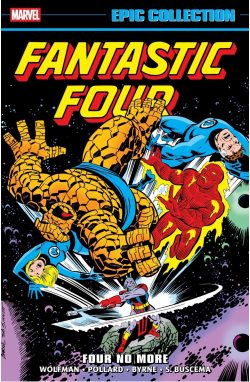
Without Kirby’s soaring imagination the rollercoaster of mindbending High Concepts lost out to traditional tales of characters in conflict, with soap opera leanings and supervillain-heavy Fights ‘n’ Tights forays abounding. With Lee & Kirby long gone but their mark very much still stamped onto every page of the still-prestigious title, this full-colour luxury compendium collects Fantastic Four #204-218 and Annual #14, spanning March 1979 to May 1980.

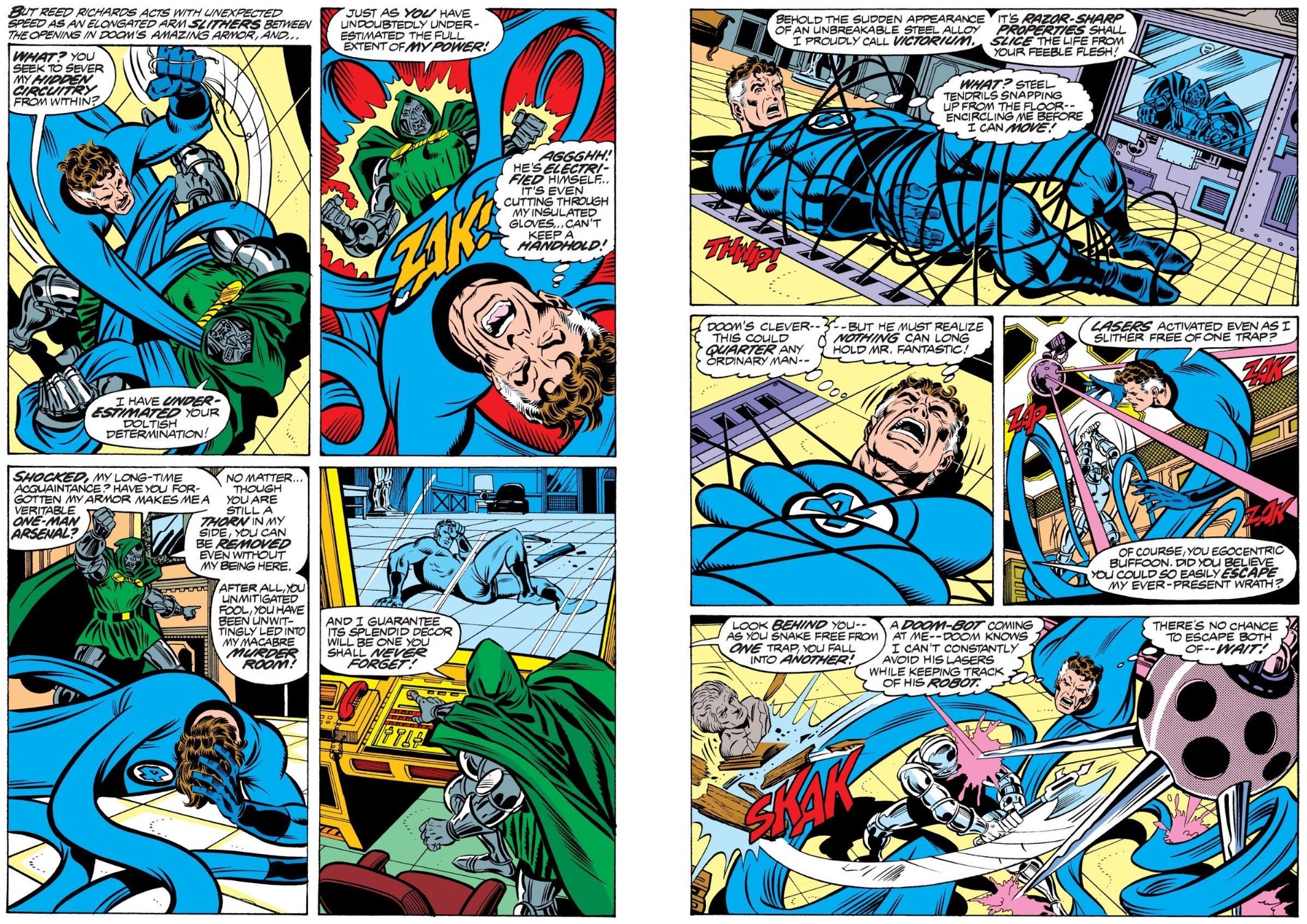
What You Should Know: After regaining his lost stretching powers in a regime-changing war against Doctor Doom, instituting the reign of Latverian leader Prince Zorba Fortunov and formally reuniting the team family, Reed Richards and the FF were attacked in their own restored Baxter Building by a mystery presence using Iron Man armour and pacified a child with out-of-control cosmic powers, before settling into some well-earned family time…

Following writer/editor Marv Wolfman’s ruminatory reminiscence in his backward-looking Introduction, the drama resumes with a return for the FF’s second oldest enemies: scurrilous shapeshifting Skrulls. In FF #204, Wolfman, Keith Pollard & Joe Sinnott address ‘The Andromeda Attack!’ as Johnny goes out gallivanting and governess/guardian/witch queen Agatha Harkness picks up little Franklin Richards. With only grown-ups in residence, Reed’s supercomputers pick up an astral anomaly, materialising an alien princess in the lab. She’s instantly followed by a Super-Skrull who blasts her before falling to the team’s counterattack. Interrogating the wounded woman, they learn she has come seeking help for her shattered world and near extinct civilisation of Xandar…

Already illicitly supported by a Watcher breaking his oath of non-intervention, the last survivors of Andromeda’s most benign culture have been reduced to a quartet of domed stations linked together and careening through space, defended only by the last of their peacekeeper Nova Corps. Now the fugitives are being targeted for extinction by rapacious Skrulls and desperately need someone’s… anyone’s… assistance…

The FF are keen to help Suzerain Queen Adora return and happy to help the Xandarians, but the Human Torch has a new girlfriend and opts to stay behind for now to woo enigmatic Frankie Ray. He’s also set on finally following up on his long postponed higher education commitments and has enrolled in specialist academic institution Security College. Naturally, Johnny promises to catch up later, but no sooner do his partners beam out to the stars than he’s attacked on campus by an old foe…

In #205, ‘When Worlds Die!’ Reed, Sue & Ben arrive with Adora at New Xandar. Finding the planetary remnants under attack by a Skrull war fleet, they join the Nova Corps to repel the assault, consequently driving closely-monitoring Skrull Emperor Dorrek insane with fury. Although Xandar’s physical resources are almost gone, he actually wants their greatest asset and treasure – a repository of their knowledge and power stored in an awesome array of superprocessors linking countless generations of expired citizens together… the Living Computers of Xandar!

Chief administrator Prime Thoran and severely wounded Nova Centurion Tanak have been holding back the storm with ever-diminishing forces, but now need the FF to turn the tide, while back at Security College, Johnny has stumbled into mystery and peril too, as a strange force seizes control of the students…

In Andromeda, his family’s first foray against the Skrulls leads to their defeat and capture. Humiliated, tortured and put on display in a cruel show trial, they are ultimately blasted with a ray that will inescapably result in ‘The Death of… The Fantastic Four!’, rapidly aging them to the end of their natural lifespans in a matter of days. Dorrek’s gleeful gloating is spoiled, however, by the arrival of his terrifying, ambitious wife Empress R’kylll, the increased resistance of the Xandarians and, inevitably, the escape of the fast-aging Fantastic Four…

Ordering all-out assaults on the battered prey, Dorrek is further frustrated by Prime Thoran who gains astounding power by merging with the Living Computers of Xandar and the arrival of a colossal ship from Earth…

Here the saga dovetails with another Wolfman series that recently ended its run on a cliffhanger. The Man Called Nova was in fact a boy named Richard Rider, a working-class nebbish in the tradition of Peter Parker, except he was good at sports and bad at learning, attending Harry S. Truman High School, where his strict dad was the principal. His mom worked as a police dispatcher and he had a younger brother, Robert, who was a bit of a genius. There were many more superficial similarities and cosmetic differences to Spider-Man. For more, you can either check out our numerous reviews or better yet, the actual comics tales, best seen in Nova Classic volumes #1-3.

The 2-year saga culminated with Nova joining despised enemies The Sphinx (last seen battling the FF and Inhumans in Fantastic Four Annual #12), Chinese superbrain-in-a-robot-body Doctor Sun, dastardly thug Diamondhead and hero-team The New Champions (The Comet, Crime-Buster and Xandarian refugee Powerhouse) aboard a pre-programmed, out-of-control spaceship hurtling towards Andromeda. Nova volume 1 ended with #25, with the unhappy crew lost in space and attacked by very angry Skrulls…

Meanwhile back at this review, the newcomers’ arrival piled on the pressure and concatenated the chaos as both the magical ancient immortal and futuristic Sino-cyborg abandoned ship, each determined to take the limitless power of Xandar’s Living Computer network for their own…

Back on Earth for #207, Wolfman, Sal Buscema & Sinnott tune in on the Torch and favourite frenemy Spider-Man as they unite to expose the scandals of Security College, deprogram its students and almost fall foul of the sheer destructive ‘Might of the Monocle!’, after which the Torch joins his team in Andromeda. Aghast at the ongoing death sentence they’re enduring, Johnny is just as helpless before ‘The Power of The Sphinx!’ (Sal B & inking cavalry “D Hands” AKA Al Milgrom and Franks Giacoia & Springer), which is boosted even further by stealing all the wisdom of the Living Computer system…

With hyper-energised Prime Thoran busy battling Skrulls, the Sphinx soon solves the eternal secrets of the universe and heads back to Earth, resolved to turn back time and prevent his agonising eons of existence even happening, whilst seeing all reality endangered, increasingly elderly Reed has only one gambit to try…

John Byrne begins his first tenure on the Fantastic Four with #209 (August 1979) as the reunited team seek to enlist the aid of cosmic devourer Galactus, pausing only long enough for Reed to construct – with Xandarian aid and resources – an all-purpose aid. The result is the Humanoid Experimental Robot, B-type, Integrated Electronics (latterly, Highly Engineered Robot Built for Interdimensional Exploration; don’cha just love nominative deterministic acronymics?).

At this time, an FF cartoon show had rejected fire hazard Johnny for a cutely telegenic robot, and Wolfman cheekily made that commercial rejection in-world canon here, dividing fans forever after, as the bleeping bot is pure Marmite in most readers eyes…

Riding the mile-long starship Nova & Co arrived in, the FF’s search takes them across the universe before leaving them ‘Trapped in the Sargasso of Space!’ to face murderous aliens determined to use the new vessel to escape their stasis hell. Meanwhile, the New Champions and Xandar’s forces prepare to face their final battle, just as impatient R’kylll divorces her husband with a single ray gun blast and changes the course of history…

Despite odd, inexplicable increasingly hazardous incidences, the FF continue ‘In Search of Galactus!’ and at last locate him, causing chaos in his colossal world-ship. Ultimately, they convince the Devourer to stop the Sphinx, but only by rescinding the vow that prevents Galactus from consuming Earth, and if the humans first bring him a new herald…

That occurs in ‘If This Be Terrax’, on a distant world enslaved by brutal despot Tyros, when the pitiless killer is painfully subdued by the heroes and converted by Galactus into a being who will rejoice in finding worlds to consume irrespective of whether civilisations will be consumed with them…

In #212, Earth trembles as the Devourer unleashes his herald to cow humanity whilst his master faces The Sphinx, but ‘The Battle of the Titans!’ is subject to mission creep when the immortal Egyptian wizard sees his new knowledge as a way to restore his own past glories. With his master fully occupied in cosmic combat, Terrax the Tamer seeks to settle scores with the humans who toppled Tyros’ kingdom, only to fall ‘In Final Battle!’ for a ploy devised by Reed and executed by H.E.R.B.I.E. It is the last hurrah as Reed joins Sue and Ben in cryo-suspension, seconds from death, barely aware that Galactus has triumphed, but at immense cost…
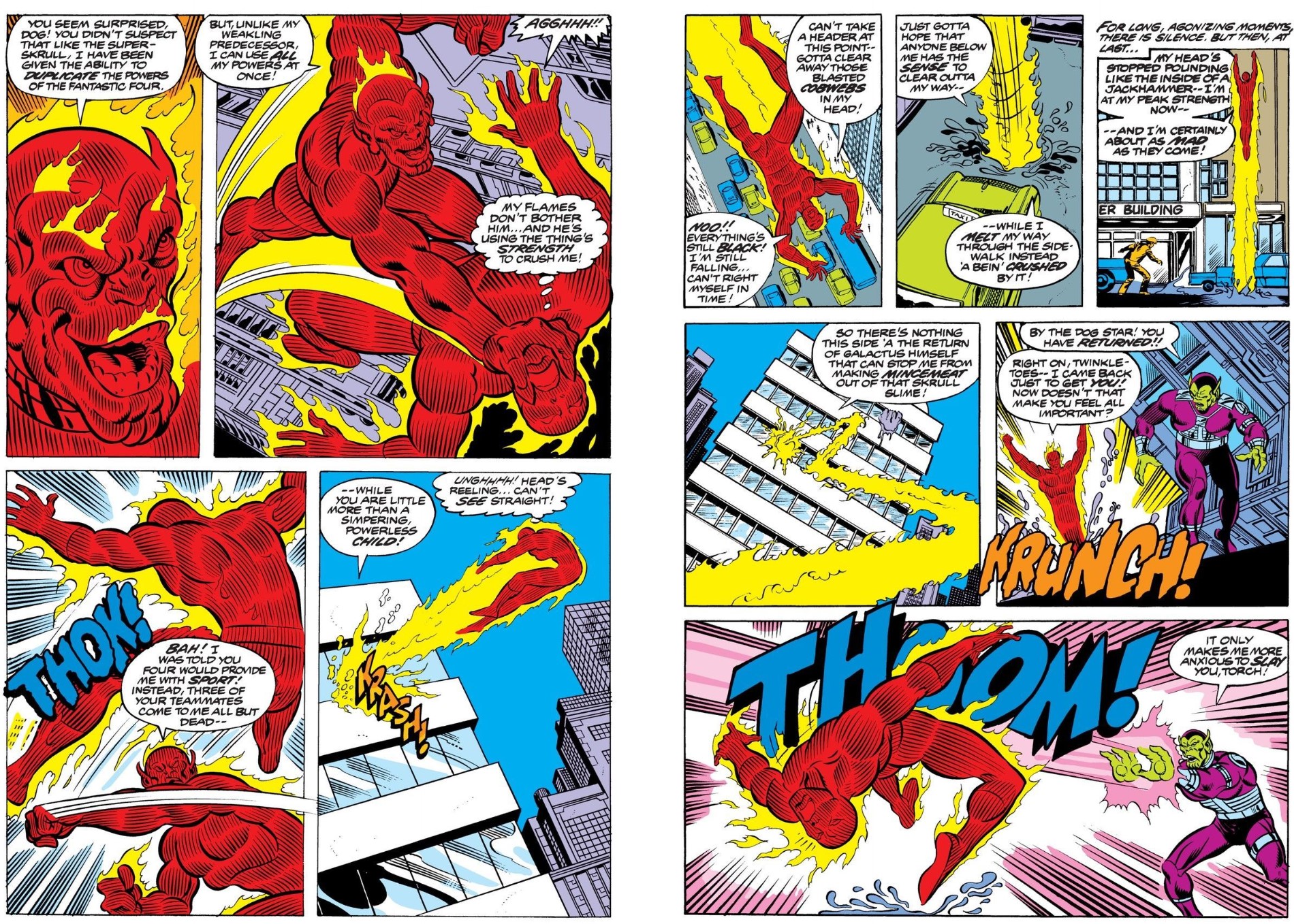
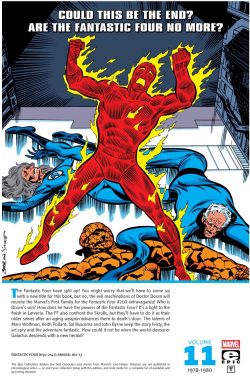
Fantastic Four #214 (January 1980) reveals ‘…And Then There Was… One!’ as Johnny frantically seeks a cure for his family. When S.H.I.E.L.D., the Avengers and others all prove helpless, a fortuitous attack by vengeful cyborg Skrull-X offers a germ of hope, but one necessitating a huge gamble: defrosting Reed and hoping he can use what the defeated alien revealed before decrepitude ends the Smartest Man on Earth…

Of course, it all works out, and a revived and even excessively rejuvenated team are in fine fettle for Fantastic Four Annual #14 as Wolfman, George Pérez & Pablo Marcos put Franklin and his nanny Agatha Harkness in the spotlight for ‘Cats-Paw!’ When magical cult Salem’s Seven abduct and brainwash the adult FF in hopes of resurrecting their master Nicholas Scratch, even the Avengers are helpless to stop the carnage unleashed, but the extra-dimensional mission of the kid and the crone is enough to set everything right…

The arcane epic is augmented by ‘A Gallery of the Fantastic Four’s Most Famous Foes!’ by Keith Pollard & Marcos, giving the lowdown on late-debuting villains and ne’er-do-wells including Invincible Man, Attuma, Gideon, Dragon Man, The Frightful Four and Quasimodo, before monthly FF #215 and Wolfman, Byrne & Sinnott reintroduce Negative Zone terror ‘Blastaar!’ who somehow escapes the antimatter universe and takes over the Baxter Building just as a reinvigorated Reed Richards is distracted by former colleague Professor Randolph James who has hyper-evolved himself to offset an otherwise fatal beating by thugs…

Sadly, his accelerator device has not advanced James’ ethical outlook, and after taking vengeance on his attackers, the future man proves that ‘Where There Be Gods!’ there be trouble, as the mental marvel aligns with Blastaar only to fall before a far greater power… angry cosmic child Franklin…

Bill Mantlo scripts #217 for Byrne & Sinnott, as ‘Masquerade!’ at last exposes the viper in the team’s midst: an inimical force responsible for most of the recent setbacks and accidents, and almost the deaths of the heroes and Johnny’s new intended girlfriend Dazzler

No spoilers here this time, but back then we all just knew who the hidden villain actually was…

This compilation concludes with the last half of an old-school saga that, for completeness, means you need to read Peter Parker, the Sensational Spider-Man #42 before enjoying the contents of FF #218. What’s not here is how ESU student Peter Parker goes on a class jaunt on a party boat and is lured into a trap by the Frightful Four (‘Give Me Liberty or Give Me Death’ by Bill Mantlo, Mike Zeck & Jim Mooney if you were wondering). The villains had broadsided the wallcrawler after new recruit Electro impersonated the Human Torch and, in the concluding chapter ‘When a Spider-Man Comes Calling!’ (cover-dated May 1980 by Mantlo, John Byrne & Joe Sinnott), the Trapster repeats the tactic to ambush the comfortably at home quartet, allowing his comrades The Wizard and Sandman to take over the Baxter Building citadel of the heroes… at least until the fighting-mad webspinner finally breaks free and launches an unstoppable counterattack…

Although that satisfactorily settles affairs for now, the bonus section opens with a lost yarn first seen in Archie Goodwin’s mature comics magazine Epic Illustrated #1 from Spring 1980. An existential dialogue between master and servant, ‘The Answer: A Tale of the Silver Surfer’ was written by Stan Lee, pencilled by John Buscema, inked by Rudy Nebres and coloured by Rick Veitch, with noble Norrin Radd seeking and failing to solve the ultimate mystery of universal existence…

With covers by Milgrom, Sinnott, Pollard, Dave Cockrum, Frank Giacoia, Walter Simonson, Byrne, Ron Wilson & Joe Rubinstein, and Rich Buckler, also on show are the covers for Marvel Treasury Editions #21 by Bobs Budiansky & McLeod; Budiansky’s pencils for the cover of F.O.O.M. #22 and the printed final result from Autumn 1978 as inked by Sinnott as well as interior features ‘HERBIE the Robot Blueprints!’ and ‘Stan Lee Presents: The Fantastic Four Cartoon Show’, plus a wave of  house ads, and a Sinnott cast pinup.

Although the “World’s Greatest Comics Magazine” never quite returned to the stratospheric heights of the Kirby era, this collection offers an appreciative and tantalising taste-echo of those heady heights and a tantalising taste of fresher thrills still to come. These extremely capable efforts are probably most welcome to dedicated superhero fans and continuity freaks like me, but will still thrill and delight the generous and forgiving casual browser looking for an undemanding slice of graphic narrative excitement – especially if this time the upcoming movie delivers on its promise…
© 2017 Marvel Characters, Inc. All rights reserved.

Silver Surfer: Parable


By Stan Lee & Möebius; with Keith Pollard & Tom DeFalco, Josef Rubinstein, José Marzan, Chris Ivy, Paul Mounts, Michael Heisler & various (Marvel)
ISBN: 978-0-7851-6209-4 (HB) 978-0-7851-0656-2 (TPB/Digital edition)

This book includes Discriminatory Content produced in less enlightened times.

As Marvel’s cinematic arm tries once again to get it right with their founding concept and by extension ultimate allegory of God and Jesus, you can safely anticipate revisiting a selection of fabulous FF and associated material as well as new collections all culled from their prodigious paginated days…

The most eclectic and enigmatic of comic book cult figures, the Silver Surfer’s saga began with the deservedly lauded and legendary introductory story. Although pretty much a last-minute addition to Lee’s plot for Fantastic Four #48-50’s Galactus Trilogy, Jack Kirby’s gleaming god-adjacent creation became a watchword for depth and subtext in the Marvel Universe, and one Lee kept as his own personal toy for many years.

Sent to find planets for star god Galactus to consume, the Silver Surfer discovers Earth, where the latent nobility of humanity reawakens his own suppressed morality. He then rebels against his master, helping the FF save the world. As punishment, Galactus exiles the star-soaring Surfer to Earth, the ultimate outsider on a planet remarkably ungrateful for his sacrifice.

The Galactus Saga was a creative highlight in a period where the Kirby/Lee partnership was utterly on fire: an adventure with all the power and grandeur of a true epic and one which has never been surpassed for drama, thrills and sheer entertainment.

That one’s not here, but it can be found in many, many other compilations. Sorry.

In 1988-1989, ‘Parable’ was released as an Epic Comics micro-series. It featured an all-new interpretation of Galactus’ initial assault on our backwards world, illustrated by legendary French artist Jean Giraud/Möebius. As with the 1978 Fireside Books/Simon & Schuster Silver Surfer by Lee & Kirby, the story was removed from general Marvel continuity, allowing a focus on the unique philosophical nature of the Surfer and his ravenous master without the added distraction of hundreds of superheroes disrupting the flow.

It’s a beautiful piece of work and another one you really should read.

Basically, when Galactus reaches Earth in search of his absconded servant and herald – a spectacular exercise in scale and visual wonder – the Silver Surfer is hiding amongst us: a vagrant living on the streets and well aware of humanity’s many failings. However, when the star-god arrives and demands (like a huge cosmic TACO-PotUS) that everyone bows down and worships him, the solitary nomad is forced to confront his creator for the sake of beings who despise him.

Driven to extreme actions by his intimate knowledge of earthlings good and bad, the Surfer instigates a conceptual and spiritual fightback which soon devolves into blistering battle against his maker. With the sky literally falling, soon the tempted and terrified world rallies as Norrin Radd exposes the cosmic blowhard as a petty opportunist and inspires humanity to reject what seems like another deal too good to be true…

Isn’t it odd how fiction so often anticipates fact?

Tacked onto the ethereal, unmissable episode – one far more in tune with Möebius’ beliefs and interests than Stan’s – is an early Marvel Graphic Novel of the regulation Marvel Universe. The Enslavers is a rather self-indulgent but oddly entertaining slice of intergalactic eye-candy featuring the legendary icon of the counter-culture generation, and once again it depicts the ex-herald of planet-devourer Galactus as a tragic saviour and Christ metaphor. Now, though, it’s not our troubled humanity but the overwhelming power of slavers from space that threatens, and there’s a lot less breast-beating and soul-searching and far more cosmic action.

The story by Stan Lee (and Keith Pollard) has a rather odd genesis. Commissioned in the early 1980s by Jim Shooter, Lee’s original plot was apparently much transformed in the eight years it took to draw. By the time it was dialogued, it was a far different beast and Lee almost jokingly disowns it in his Afterword. Nevertheless, there’s lots to enjoy for fans who don’t expect too much in this tale of love and death in the great beyond. It’s inked by Josef Rubinstein, José Marzan & Chris Ivy, coloured by Paul Mounts and lettered by Michael Heisler.

Here, after a frantic rush through cosmic gulfs, Silver Surfer Norrin Radd crashes into the home of Reed & Sue Richards, just ahead of the colossal invasion craft of monstrous Mrrungo-Mu, who has been drawn to our world by the well-intentioned but naive Nasa probe Voyager III. Norrin’s homeworld Zenn-La has already been depopulated by the pitiless space slaver and Earth is next…

Moving swiftly, and exploiting the good intentions of an Earth scientist, the Enslavers incapacitate all our world’s superbeings and prepare to enjoy their latest conquest, but they have not accounted for the vengeful resistance of the Surfer or the debilitating power of the love Mrrungo-Mu is himself slave to: for the unconquerable alien warlord is weak and helpless before the haughty aloofness and emotional distance of his supposed chattel Tnneya

Despite being – in far too many places – dafter than a bag of photonic space-weasels jonesing for disco lights, there’s still an obvious love of old, classic Marvel tales delivered at an enthusiastic pace informing these beautifully drawn pages, and the action sequences are a joy to behold. If you love cosmic adventure and can swallow a lot of silliness, this might just be worth a little of your time and money.

Altogether a very strange marriage, this is a compelling tome spanning the vast divide of comics from the ethereal and worthy to the exuberant and fun: a proper twofer you can get your teeth into…
© 1988, 1989, 1990, 2012 Marvel Entertainment Group/Marvel Characters, Inc. All rights reserved.

Captain America Epic Collection volume 7: The Swine (1976-1978)


By Jack Kirby, Don Glut, Roy Thomas, Steve Gerber, Scott Edelman, David Anthony Kraft, Sal Buscema, John Buscema, George Tuska, Steve Leialoha, Dave Cockrum, Frank Giacoia, Mike Royer, John Tartaglione, John Verpoorten, Pablo Marcos, Mike Esposito, Dan Green, Joe Sinnott, Al Gordon & various (MARVEL)
ISBN: 978-1-3029-6052-0 (TPB/Digital edition)

This book includes Discriminatory Content produced in less enlightened times.

These days, Captain America is more a global symbol of the Land of the Free and the Home of the Brave than Uncle Sam or Apple Pie ever were. Thus, I’m again exploiting a lazy obvious way to celebrate the prelude to Independence Day (for them and whichever of so many prospects TangoTacoPotUS is shopping as the next candidate for the nation’s 51st State) by recommending this blockbuster book highlighting material first seen in 1976 and beyond as said States commenced a third century of existence and still felt relatively United and travelling in generally the same direction…

Created by Joe Simon & Jack Kirby in an era of frantic patriotic fervour, Captain America was a dynamic, highly visible response to the horrors of Nazism and the threat of Liberty’s loss. However, he quickly lost focus and popularity after hostilities ceased: fading away during post-war reconstruction. He briefly reappeared after the Korean War: a harder, darker sentinel ferreting out monsters, subversives and the “commies” who lurked under every American bed. Then he vanished once more until the burgeoning Marvel Age resurrected him just in time to experience the Land of the Free’s most turbulent and culturally divisive era.

“Cap” quickly became a mainstay of the Marvel Revolution across the Swinging Sixties, but lost his own way somewhat after that, except for a glittering period under scripter Steve Englehart. Eventually, however, he too moved on and out in the middle of the 1970s.

Meanwhile, elsewhere, after nearly a decade drafting almost all of Marvel’s successes, Jack Kirby had jumped ship to arch-rival DC in 1970, creating a whole new mythology and dynamically inspiring pantheon for the opposition. Eventually, The King accepted that even he could never win against any publishing company’s excessive pressure to produce whilst enduring micro-managing editorial interference.

Seeing which way the winds were blowing, Kirby exploded back into the Marvel Universe in 1976 with a signed promise of free rein, concocting another stunning wave of iconic creations – 2001: a Space Odyssey, Machine Man, The Eternals, Devil Dinosaur (plus – so nearly – seminal TV paranoia-fest The Prisoner) – as well as drafting a wealth of bombastic covers for almost every title in the company. He was also granted control of two of his previous co-creations – firmly established characters Black Panther and Captain America – to do with as he wished. The return was much hyped at the time but swiftly became controversial since Jack’s intensely personal visions paid little lip service to company continuity. Jack always went his own bombastic way and whilst those new works quickly found many friends, his tenure on those earlier inventions drastically divided the fan base.

Kirby was never slavishly wedded to tight continuity and preferred, in many ways, to treat his stints on Cap and the Panther as creative “Day Ones”. This was never more apparent than in the pages of the Star-Spangled Sentinel of Liberty…

This sterling collection reprints Captain America and the Falcon #201-221 and Captain America Annuals #3 & 4 cumulatively spanning September 1976 – May 1978, as the King eventually moved on and a horde of lesser lights sought to shepherd the hero back to Marvel mainstream continuity…

At the end of the previous volume Kirby’s original Fighting American had saved the nation from a conclave of aristocratic oligarchs attempting to undo two hundred years of freedom and progress with their “Madbomb” (and don’t forget to check out Washington DC for the effects still extant today…). After saving the nation, the Star-Spangled Avenger reunited with his partner Sam Wilson for CA&TF #201, set in the aftermath of their struggle…

Inked by Frank Giacoia, the tone shifts to malevolent moodiness and uncanny mystery with the introduction of ‘The Night People!’: a street-full of maladjusted maniacs who periodically phase into and out of “normal” New York City, creating terror and chaos with every sunset. When Falcon and girlfriend Leila are abducted by the eerie encroachers, they are quickly converted to their crazed cause by exposure to the ‘Mad, Mad Dimension!’ the vile visitors inhabit during daylight hours. This leaves Cap and folksy new not-evil millionaire colleague Texas Jack Muldoon hopelessly outgunned when their last-ditch rescue attempt results in them all battling an invasion of brutally berserk other-dimensional beasts in ‘Alamo II!’

On bludgeoning, battle-hardened top-form, the Star-Spangled Avenger saves the day once more, but no sooner are the erstwhile inhabitants of Zero Street safely re-integrated on Earth than ‘The Unburied One!’ finds our indefatigable champions clashing with a corpse who won’t play dead. The concluding chapter reveals the cadaver has become home to an energy-being from the far future as (inked by John Verpoorten) ‘Agron Walks the Earth!’ Thankfully, not even his/its pulsating power and rage can long baulk the indomitable spirit and ability of America’s Ultimate Fighting Man…

Non-stop nightmares resume in #206 as ‘Face to Face with the Swine!’ (Giacoia inks) sees the Star-Spangled Sensation illegally renditioned by secret police to deepest Central America. Here he subsequently topples the private kingdom and personal torture ground of psychotic sadist Comandante Hector Santiago, unchallenged monarch of the prison of Rio del Muerte. Never one to go anywhere meekly, Cap escapes and begins engineering the brute’s downfall in ‘The Tiger and the Swine!!’ but soon finds the jungles conceal actual monsters. When they exact primal justice on the tormentors, Cap’s escape with the Swine’s cousin Donna Maria down ‘The River of Death!’ is interrupted by the advent of another astounding “Kirby Kreation”:‘Arnim Zola… the Bio-Fanatic!!’

Abducting Cap and Donna Maria to his living castle, the former Nazi geneticist and absolute master of radical biology inflicts upon them a horde of diabolical homunculi at the behest of a mysterious sponsor, even as elsewhere, Falcon closes in on his long-missing pal. Indomitable against every kind of shapeshifting horror, Cap strives on, enduring a terrible ‘Showdown Day!’ (with Mike W. Royer taking over inking), whilst back home Steve Rogers’ girlfriend Sharon Carter uses her resources as SHIELD’s Agent 13 to investigate wealthy Cyrus Fenton and exposes ‘Nazi “X”!’ as Zola’s sponsor and the Sentinel of Liberty’s greatest nemesis.

With his time on the title counting down, Kirby ramped up the tension in #212 as ‘The Face of a Hero! Yours!!’ sees Zola preparing to surgically insert the Red Skull into Cap’s form, triggering a cataclysmic clash which leaves America’s hero bloodied, blind, but ultimately victorious…

With the hero recuperating in a US hospital, Dan Green inked #213 as ultimate assassin ‘The Night Flyer!’ targets the recuperating Cap at the behest of unfettered capitalist villain Kligger – of the insidious Corporation – inadvertently restoring his victim’s vision in time for spectacular if abrupt, Royer-inked conclusion ‘The Power’

Narratively and chronologically adrift – and thus reading slightly out of sequence here – Captain America Annual #3 and 4 follow: wrapping up Kirby’s contributions to the career of the Star-Spangled Avenger beginning with his abruptly diverting back to business basics in a feature-length science fiction shocker which eschewed convoluted backstory and cultural soul-searching to simply pit the valiant hero against a cosmic vampire.

‘The Thing From the Black Hole Star!’ is a complication-free riot of rampaging action and end-of-the-world wonderment featuring a fallible but fiercely determined fighting man free of doubt and determined to defend humanity at all costs. It begins when farmer Jim Hendricks finds a UFO on his land and calls in a specialist he knows he can trust…

A year passes like magic in comics and one year later but immediately following here, Kirby recruits one of his earliest villain creations for ‘The Great Mutant Massacre!’: a feature- length super-shocker which again rejects accumulated history and the career confusion which typified Cap before and after Jack’s tenure for instant gratification. Here America’s Super Soldier strives against humanity’s nemesis Magneto and his latest mutant recruits Burner, Smasher, Lifter, Shocker, Slither and Peeper. This riot of rampaging action and end-of-the-world bombastic bravado pits the Sentinel of Liberty against a Homo Superior hit-squad aiming to take possession of a superpowered being whose origins are far stranger than anybody could conceive…

When Kirby moved on it left a desperate gap in the schedules. Captain America #215 saw Roy Thomas, George Tuska & Pablo Marcos respond by revisiting the hallowed origin story for the current generation with ‘The Way it Really Was!’: reiterating simultaneously the history of the heroes who had inherited the red, white & blue uniform whilst Steve Rogers was entombed in ice, and ending with our hero desperately wondering who the man beneath his mask might truly be.

For all that, #216 was a deadline-filling reprint of November 1963’s Strange Tales #114, represented here by Gil Kane’s cover and a single page framing sequence by Thomas, Dave Cockrum & Frank Giacoia. Thomas, Don Glut, John Buscema & Marcos actually began ‘The Search for Steve Rogers!’ in #217 with S.H.I.EL.D.’s record division, where the Falcon is distracted by a surprising job offer. Nick Fury (I), busy with the hunt for capitalist cabal The Corporation, asks Cap’s partner to supervise the agency’s newest project: the S.H.I.E.L.D. Super-Agents. These wonders-in-training consist of Texas Twister, Blue Streak, The Vamp and a rather mature-seeming Marvel Boy, but the squad are already deeply flawed and fatally compromised…

Issue #218 finds Cap targeted by a Corporation agent and fed data which bends his legendarily-fragmented memory back to his first thawing from the ice. Heading north to retrace his original journey, Cap spends ‘One Day in Newfoundland!’ (Glut, Sal Buscema & John Tartaglione), uncovering a secret army, an unremembered old foe and a colossal robotic facsimile of himself. One month later, ‘The Adventures of Captain America’ (Glut, Sal B & Joe Sinnott) reveals how, during WWII, Cap and junior partner Bucky were ordered to investigate skulduggery on the set of a movie serial about them, thereby exposing special effects wizard Lyle Dekker as a highly-placed Nazi spy. Now in modern-day Newfoundland, that warped and unforgiving genius has built a clandestine organisation with one incredible purpose: revealed in ‘The Ameridroid Lives!’ (inked by Tartaglione & Mike Esposito) as the captive crusader is mind-probed and dredges up shocking submerged memories.

In 1945, when he and Bucky chased a swiftly-launched secret weapon, the boy (apparently) died and Rogers fell into the North Atlantic: frozen in a block of ice until found and thawed by The Avengers. At least, he always thought that’s how it happened…

Now as the probe does its devilish work, Captain America finds that he was in fact picked up by Dekker after the spy was punished by the Red Skull and exiled for his failures. Deciding to work only for his own interests, Dekker then attempted to transfer Cap’s power to himself and it was only in escaping the Newfoundland base that Rogers crashed into the sea and fully froze…

In the Now, the vile scheme is finally accomplished: Cap’s energies are replicated in a 15-foot-tall super-android, with aging Dekker’s consciousness permanently embedded in its metal and plastic brain. However only at the peak of triumph does the fanatic realise he’s made himself into a monster at once unique, solitary and utterly apart from humanity…

The deadline problems still hadn’t eased and this episode was chopped in half, with the remainder of the issue affording Falcon a short solo outing as Scott Edelman, Bob Budiansky & Al Gordon’s ‘…On a Wing and a Prayer!’ portrays the Pinioned Paladin hunting a mad archer who has kidnapped his avian ally Redwing. The remainder of the Ameridroid saga came in #221 where Steve Gerber &David Kraft co-scripted ‘Cul-De-Sac!’, wherein the marauding mechanoid is finally foiled – by reason, not force of arms – whilst ‘The Coming of Captain Avenger!’ (Edelman, Steve Leialoha & Gordon) provides one last space-filling vignette with former sidekick Rick Jones given a tantalising glimpse of his most cherished dreams…

To Be Continued…

This tome then concludes with contemporary media moments, including John Romita’s July image from the Mighty Marvel Bicentennial Calendar 1976 and Kirby & Giacoia’s contribution to Marvel Comics Memory Album Calendar 1977 plus a sublime covers and interior pages original art gallery by Kirby, Giacoia, Romita & Verpoorten for fans to drool over.

The King’s commitment to wholesome adventure, breakneck action and breathless wonder, combined with his absolute mastery of the comic page and unceasing quest for the Next Big Thrill, always make for a captivating read and this stuff is as good as anything Jack crafted over his decades of creative brilliance.

Fast-paced, action-packed, totally engrossing Fights ‘n’ Tights masterpieces no fan should ignore and, above all else, fabulously fun tales of a truly American Dream…
© 2025 MARVEL.

Inhumans: Beware the Inhumans


By Stan Lee & Jack Kirby, Roy Thomas, Archie Goodwin, Gary Friedrich, Gerry Conway, Arnold Drake, Neal Adams, Gene Colan, Marie Severin, John Romita, Mike Sekowsky, Tom Sutton, Joe Sinnott, Vince Colletta, Syd Shores, Chic Stone, John Verpoorten, Bill Everett, Frank Giacoia, Tom Palmer, Barry Windsor-Smith & various (Marvel)
ISBN: 978-1-3029-1081-5 (TPB/Digital edition)

This book includes Discriminatory Content produced in less enlightened times.

Debuting in 1965 and conceived as yet another incredible lost civilisation during Stan Lee & Jack Kirby’s most fertile and productive creative period, The Inhumans are a subspecies of incredibly disparate (mostly) humanoid beings genetically altered in Earth’s pre-history. They consequently evolve into a technologically-advanced civilisation far ahead of and apart from emergent Homo Sapiens. The self-declared Inhumans isolated themselves from the world and barbarous dawn-age humans, first on an island and latterly in a hidden valley in the Himalayas, residing in a fabulous city named Attilan.

The mark of Inhuman citizenship is immersion in mutative Terrigen Mists which further enhance and transform individuals into radically unique and frequently super-powered beings. Inhumans are necessarily obsessed with genetic structure and heritage, worshipping the ruling Royal Family as the rationalist equivalent of mortal gods.

This compilation cumulatively spans July 1968 to January 1972, re-presenting early appearances (in whole or in part) from Marvel Super-Heroes #15, Incredible Hulk Annual #1, Fantastic Four #81-83, 95, 99 and 105, Amazing Adventures #1-10, Avengers #95, plus moments of spoofish light-relief from Not Brand Echh #12.

The Royal Family of Attilan are the hereditary aristocracy of a hidden race of paranormal beings. They comprise king Black Bolt, his paramour/cousin/eventual wife Medusa, aquatic Triton, bellicose Gorgon and subtle martial arts master Karnak, leading and representing a veritable horde of weirdly wonderful characters. Black Bolt, one of the most powerful beings on Earth, possesses phenomenal abilities but is afflicted with an uncontrollable vocal condition that makes his softest whisper a planet-shattering sonic explosion. Thus, he must never utter a sound…

In 1967 a proposed Inhumans solo series was canned before completion, with the initial episode retooled and published in try-out vehicle Marvel Super-Heroes. Written by Archie Goodwin and illustrated by Gene Colan & Vince Colletta, ‘Let the Silence Shatter!’ appeared in #15 (July 1968), revealing how the villainous Sandman and Trapster are enticed into reforming the Frightful Four after The Wizard promises Medusa a means to control Black Bolt’s deadly sonic affliction in return for her criminal services. As usual, the double-dealing mastermind betrays his unwilling accomplice, but again underestimates her abilities and intellect, resulting in another humiliating defeat…

Cover-dated October, The Incredible Hulk Annual #1 was one of the best comics of 1968. Behind an iconic Steranko cover, Gary Friedrich, Marie Severin & Syd Shores (with lots of last-minute inking assistance) delivered a passionate, tense and melodramatic parable of alienation that nevertheless was one of the most action-stuffed fight fests ever seen.

In 51 titanic pages ‘A Refuge Divided!’ saw the tragic lonely Jade Juggernaut stumble upon the hidden Great Refuge of genetic outsiders. The Inhumans – recovering from a recent failed coup by new creations Falcona, Leonus, Aireo, Timberius, Stallior, Nebulo and their secret backer (the king’s brother Maximus the Mad) – are distracted by the Hulk’s arrival and suspicion, and short tempers result in chaos. The band of super-rebels start the fight but it’s the immensely powerful Black Bolt who eventually battles the green giant to a standstill…

This is the vicarious thrill taken to its ultimate, and still one of the very best non-Lee-Kirby tales of that period.

Medusa’s little sister Crystal – and her giant teleporting dog Lockjaw – were the most visible Inhumans at that time. As girlfriend of Human Torch Johnny Storm, she was a regular in Fantastic Four and took a greater role once Susan Richards fell pregnant. In FF #81, with Sue a new mother, Crystal elects herself the first new official member of the FF and promptly shows her mettle by pulverizing incorrigible glutton-for-punishment The Wizard in the all-action romp ‘Enter… the Exquisite Elemental!’ (Lee, Kirby & Joe Sinnott).

In the next two issues, as Susan is side-lined to tend her newborn son, Crystal’s turbulent past and fractious family connections reassert themselves when cousin Maximus again attempts to conquer mortal humanity. ‘The Mark of… the Madman!’ sees the quirky quartet invade hidden Inhuman enclave Attilan to aid the imprisoned Royal Family and overcome an entire race of hypnotically subjugated super-beings before uniting to trounce the insane despot in the concluding ‘Shall Man Survive?’

Excerpted pages from FF #95 then reveal how, in the middle of a frantic battle against a super-assassin, Crystal is astoundingly abducted by her own family before the reason why is revealed in #99. All this time heartsick Johnny has been getting crazier and more despondent. He finally snaps, invading the Inhumans’ hidden home with the intention of reuniting with his lost love at all costs. Of course, everything escalates when ‘The Torch Goes Wild!’ and his rapidly following comrades find themselves in the battle of their lives…

Two months later, bi-monthly “split-book” Amazing Adventures launched with an August 1970 cover-date and The Inhumans sharing the pages with a new Black Widow solo series. The big news however was that Jack Kirby was both writing and illustrating ‘The Inhumans!’

Inked by Chic Stone, the first episode saw the Great Refuge targeted by atomic missiles apparently fired by the Inhumans’ greatest allies, prompting a retaliatory attack on the Baxter Building and pitting ‘Friend Against Friend!’ However, even as the battle raged Black Bolt was taking covert action against the suspected true culprits…

AA #3 sees our uncanny outcasts as ‘Pawns of the Mandarin’ when the devilish plotter dupes the Royal Family into uncovering a long-buried mega-powerful ancient artefact. He is, however, ultimately unable to cope with their power and teamwork in the concluding chapter ‘With These Rings I Thee Kill!’

Intercepting the flow but chronologically crucial, the first half of Fantastic Four #105 (December 1970) follows. Crafted by Stan Lee, John Romita & John Verpoorten, ‘The Monster in the Streets!’ reveals Crystal is being slowly poisoned by the constantly increasing pollutants in Earth’s air and must leave Johnny for the hermetically pure atmosphere of Attilan…

Back in Amazing Adventures #5 (March 1971), a radical change of tone and mood materialised as the currently on-fire creative team of Roy Thomas & Neal Adams took over the strip following Kirby’s shocking defection from Marvel to DC Comics. Inked by Tom Palmer, ‘His Brother’s Keeper’ then sees Maximus finally employ a long-dormant power – mind-control – to erase Black Bolt’s memory and seize control of the Great Refuge.

The real problem, however, is that at the moment the Mad One strikes, Black Bolt is in San Francisco on a secret mission. When the mind-wave strikes, the silent stranger forgets everything and as a little boy offers assistance, ‘Hell on Earth!’ (inked by John Verpoorten) begins as a simple mumbled whisper shatters the entire docks and all the vessels moored there…

As Triton, Gorgon, Karnak and Medusa flee the now utterly entranced and enslaved Refuge in search of Black Bolt, ‘An Evening’s Wait for Death!’ finds little Joey and a still-bewildered Bolt captured by a radical black activist determined to use the Inhuman’s shattering power to raze the city’s foul ghettoes.

A tense confrontation with police in the streets draws storm god Thor into the conflict during ‘An Hour for Thunder!’, but when the blood and dust settles it appears Black Bolt is dead…

Gerry Conway, Mike Sekowsky & Bill Everett assumed storytelling duties with #9 as The Inhumans colonised the entire book. Finally reaching America after an epic odyssey, the Royal Cousins’ search for their king is interrupted when they are targeted by a cult of mutants.

‘…And the Madness of Magneto!’ shows amnesiac Black Bolt in the clutches of the Master of Magnetism. He needs the usurped king’s abilities to help him steal a new artificial element. All too soon though, ‘In His Hands… the World!’ (inked by Frank Giacoia) proves that with his memory restored nothing and no one can long make the mightiest Inhuman a slave…

The series abruptly terminated there. Amazing Adventures #11 featured a new treatment of graduate X-Man Hank McCoy who rode the trend for monster heroes by accidentally transforming himself into a furry purple Beast. The Inhumans simply dropped out of sight until Thomas & Adams wove their dangling plot threads into the monumental epic unfolding from June 1971 to March 1972 in The Avengers #89-97.

At that time Thomas’ bold experiment was rightly considered the most ambitious saga in Marvel’s brief history: an astounding saga of tremendous scope which dumped Earth into a cosmic war the likes of which comics fans had never before seen. The Kree/Skrull War set the template for all multi-part crossovers and publishing events ever since. It began when, in the distant Kree Empire, the ruling Supreme Intelligence is overthrown by his chief enforcer Ronan the Accuser. The rebellion results in humanity learning aliens are among them, and public opinion turns against superheroes for concealing the threat of alien incursions…

A powerful allegory of the Anti-Communist Witch-hunts of the 1950s, the epic sees riots in American streets and a political demagogue capitalising on the crisis. Subpoenaed by the authorities, castigated by friends and public, the Avengers are ordered to disband.

Unfortunately omitted here, issue #94 entangles the Inhumans in the mix, disclosing that their advanced science and powers are the result of Kree genetic meddling in the depths of prehistory. With intergalactic war beginning, Black Bolt missing and his madly malign brother Maximus in charge, the Kree now come calling in their ancient markers…

Wrapping up the graphic thrills for this volume, ‘Something Inhuman This Way Comes…!’ (Avengers #95, January 1972) coalesces scattered story strands as aquatic adventurer Triton aids the Avengers against government-piloted Mandroids before beseeching the beleaguered heroes to help find his missing monarch and rescue his Inhuman brethren from the press-ganging Kree…

Just so you can sleep tonight, after bombastically so doing, the Avengers head into space to liberate their kidnapped comrades and save Earth from becoming collateral damage in the impending cosmos-shaking clash between Kree and Skrulls  – a much-collected tale you’d be crazy to miss…

Appended with Barry Windsor-Smith’s Medusa pin-up from Marvel Collectors’ Item Classics #21, original art by Colan & Adams, a rejected Severin cover and house ads for the Inhumans’ debut, the cosmic drama is latterly leavened with some snappy comedy vignettes.

Originating in Not Brand Echh #12 (February 1969) ‘Unhumans to Get Own Comic Book’ – by Arnold Drake, Thomas & Sutton – and ‘My Search for True Love’ by Drake & Sutton detail and depict how other artists might render the series – with contenders including faux icons bOb (Gnatman & Rotten) Krane, Chester (Dig Tracing) Ghoul and Charles (Good Ol’ Charlie…) Schlitz, before following lovelorn Medoozy as she dumps her taciturn man and searches for fulfilment amongst popular musical and movie stars of the era…

These stories cemented the outsiders’ place in the ever-expanding Marvel universe and helped the company to overtake all its competitors. Although making little lasting impact at the time they are still potent and innovative: as exciting and captivating now as they ever were. This is a must-have book for all fans of graphic narrative and followers of Marvel’s next cinematic star vehicle.
© 1968, 1969, 1970, 1971, 1972, 2018 Marvel Characters, Inc. All rights reserved.

Ghost Rider Epic Comics volume 2: The Salvation Run (1975-1978)


By Tony Isabella, Jim Shooter, Steve Gerber, Bill Mantlo, Marv Wolfman, Gerry Conway, Don Glut, Chris Claremont, Roger McKenzie, Scott Lobdell, Frank Robbins, Don Heck, Sal Buscema, George Tuska, Bob Brown, John Byrne, Gil Kane, Don Perlin, Tom Sutton, Vince Evans, Vince Colletta, Mike Esposito, Jim Mooney, Sam Grainger, Keith Pollard, Don Newton, Dan Green, Pablo Marcos, Tony DeZuñiga, Owen McCarron, Steve Gan, Phil Sheehy & various (MARVEL)
ISBN: 978-1-3029-5549-6 (TPB/Digital edition)

This book includes Discriminatory Content produced in less enlightened times.

Closely reflecting the state of their presumed readership, as the 1960s ended US comic books were in turmoil. Superheroes had dominated for much of the previous decade; peaking globally before explosively falling to ennui and overkill. Established genres like horror, westerns, science fiction and war were returning, fed by contemporary events and radical trends in moviemaking where another, new(ish) wrinkle had also emerged: disenchanted, rebellious, unchained Youth (on Motorbikes …and Drugs!) seeking different ways forward. Moreover, most of us thought that we might well all expire in a nuclear fireball at any moment. How glad I am that we’ve finally returned to those halcyon days…

Green Lantern/Green Arrow, Jack Kirby’s Jimmy Olsen, Captain America and many more took the Easy Rider option to boost flagging sales (and if you’re interested, the best of the crop was Mike Sekowsky’s tragically unfinished mini-masterpiece of cool Jason’s Quest in Showcase). Over at Marvel – a company still reeling from Kirby’s defection to DC in 1970 – canny Roy Thomas green-lit a new character combining that freewheeling, adolescent-friendly biker theme with the all-pervasive supernatural furore gripping entertainment fields.

Back in 1967, Marvel had published a western masked hero named Ghost Rider. He was a shameless, whole-hearted appropriation of the cowboy hero creation of Vince Sullivan, Ray Krank & Dick Ayers (for Magazine Enterprises from 1949 to 1955), initially utilising magician’s tricks to fight bandits by pretending to be an avenging phantom of justice.

Scant years later, with the Comics Code prohibition against horror hastily rewritten – amazing how plunging sales affect ethics – scary comics boomed back in a big way. A new crop of supernatural superheroes and monsters appeared on newsstands, supplementing the ghosts, ghoulies and goblins already infiltrating the once science-only scenarios of surviving mystery man titles.

In fact, diluting the Code ban resulted in such an avalanche of horror titles (new material plus reprints from the first boom in the 1950s), in response to the industry-wide downturn in superhero sales, that it probably caused a few more venerable costumed crusaders to – albeit temporarily – bite the dust.

Almost overnight, nasty monsters became acceptable fare for four-colour pages and, whilst a parade of pre-code reprints made sound business sense, the creative aspects of the fascination in supernatural themes was catered to by adapting popular cultural icons before risking whole new concepts on an untested public. As always in entertainment, the watchword was fashion: what was hitting big outside comics was incorporated into the mix as soon as possible. When proto-monster Morbius, the Living Vampire debuted in Amazing Spider-Man #101 (cover-dated October 1971) and the sky failed to fall in, Marvel moved ahead with a line of shocking superstars – beginning with a werewolf and a vampire – before broadening the scope with a haunted biker tapping both Easy Rider’s freewheeling motorcycling chic and a prevailing supernatural zeitgeist.

Preceded by western hero Red Wolf in #1 and the aforementioned Werewolf by Night in #2-4, the all-new Ghost Rider debuted in Marvel Spotlight #5 (August 1972) and the course of comics was changed forever…

What Has Gone Before: Carnival trick cyclist Johnny Blaze sells his soul to the devil in an attempt to save his foster-father Crash Simpson from cancer. As is the way of such things, Satan follows the letter but not spirit of his contract and Simpson dies anyway – just not from cancer. When the Dark Lord later comes for his prize, Blaze’s beloved virginal girlfriend Roxanne Simpson intervenes. Her purity prevents the Devil from claiming his due so, temporarily thwarted, Satan spitefully afflicts Johnny with a body that burns with the fires of Hell every time the sun goes down…

After months of diabolical persecution with Blaze shaming the Devil daily by using his curse to do good and save souls, everything seemed to change after what looked like Jesus Christ himself intervened to get Satan off his back, but of course nothing is ever what it seems…

Spanning cover-dates March 1975 to February 1978, and re-presenting Ghost Rider (1973) #12-28; Marvel Two-in-One #18; Daredevil (vol. 1) #138; Marvel Team-Up #58; Marvel Premiere #28 and material from 1991’s Marvel Tales (vol. 1) #255, this conflagratory compendium sees Blaze and his infernal alter ego unwillingly dragged deeper into the world of superheroes… but not for long…

Marvel Two-in-One #8 opens proceedings and also explores redemptive themes as Blaze teams with Ben Grimm – AKA The Thing – in a quirkily compelling Yuletide yarn. Crafted by Steve Gerber, Sal Buscema & Mike Esposito, ‘Silent Night… Deadly Night!’ finds the audacious Miracle Man attempting to take control of a very special birth in a modern-day stable…

In Ghost Rider #12 Tony Isabella, Frank Robbins, Frank Giacoia & Mike Esposito reveal the fate of World War I fighter ace Phantom Eagle, as Blaze tries to rescue a stranger from a ghostly aerial assault, only to learn he has inadvertently thwarted justice and helped the noble air warrior’s murderer avoid the ‘Phantom of the Killer Skies’, after which GR #13 and Isabella, George Tuska & Vince Colletta declare ‘You’ve Got a Second Chance, Johnny Blaze!’  as the terms of the hero’s on-going curse are changed again, just as the dissolute biker heads to Hollywood and a previously promised job as TV star Stunt-Master’s body-double. No sooner has he signed up, however, than Blaze becomes involved with Daredevil’s former girlfriend, fresh-faced starlet Karen Page and a bizarre kidnap plot by supervillain The Trapster. As ‘A Specter Stalks the Soundstage!’ Blaze’s revenge-obsessed nemesis The Orb returns to destroy Ghost Rider, an action yarn that spectacularly concludes with ‘Vengeance on the Ventura Freeway!’, as illustrated by Bob Brown & Don Heck.

Whilst hanging out on the West Coast, Blaze joins new superteam The Champions, but they play no part in Bill Mantlo, Tuska & Colletta’s fill-in yarn ‘Blood in the Waters’, as Ghost Rider oh, so topically tangles with a Great White Shark in the gore-soaked California surf.

A much reprinted yarn comes next courtesy of Mantlo, Robbins & Steve Gan: an attempt to create a team of terrors long before its time. Marvel Premiere #28 (February 1976) launched the initial line-up of The Legion of Monsters in ‘There’s a Mountain on Sunset Boulevard!’. When an ancient alien manifests a rocky peak in LA, Werewolf by Night Jack Russell, the macabre Man-Thing, Hollywood stuntman Johnny Blaze and living vampire Michael Morbius are drawn into a bizarre confrontation which might have resulted in the answer to  all their wishes and hopes, but instead only leads to destruction, death and crushing disappointment…

Back on track in GR #17, ‘Prelude to a Private Armageddon!’ (Isabella, Robbins & Colletta) triggers a combative and fractious reunion with The Son of Satan when fellow stunt-actor Katy Milner is possessed by a demon and only Daimon Hellstrom can help. The struggle devolves into ‘The Salvation Run!’ as Blaze races through the bowels of Hell, reliving his own traumatic past and at last learning the truth about his own personal Jesus, before finally saving the day on his own terms and merits, rescuing both Katy’s and his own much-tarnished soul in ‘Resurrection’.

All this time the mysterious subplots of Karen’s attempted abduction had percolated through GR, but now explosively boil over into Daredevil #138 as ‘Where is Karen Page?’ (by Marv Wolfman, John Byrne & Jim Mooney) exposes the extensive machinations of deceased criminal maniac Death’s-Head as merely part of a greater scheme involving Blaze, Stunt-Master, the Man without Fear and the homicidal Death Stalker. The convoluted conundrum cataclysmically climaxes in Ghost-Rider #20 with Don Perlin inking Wolfman & Byrne’s ‘Two Against Death!’

After dancing with the Devil and assorted demons for months, and dabbling with team dynamics in the Champions, instinctual loner Blaze’s move to Hollywood had sparked a far more mundane narrative methodology. His glamorous hazardous working gig had brought romantic dalliances, increased interaction with superheroes and supervillains, and more and more clashes with street level crime…

As the action opens in GR #21’s ‘Deathplay!’, Gerry Conway, Gil Kane & Sam Grainger built on the “real world” TV friendly trend as manic super thug for hire The Gladiator attacks the Delazny Studio employing Blaze, seeking a deadly weapon left by a sinister hidden foe. After spectacularly repelling the armoured assassin, Blaze does a little digging into the studio and staff only to clash with another veteran villain – The Eel – abruptly reinforced by an incensed Gladiator seeking a rematch. Thrashing them both only gets Johnny in more trouble with the cops and – on the run again – he finally faces the criminal mastermind who has orchestrated many months of woe. Unfortunately, he learns ‘Nobody Beats the Enforcer!’ (Conway, Don Glut, Don Heck & Keith Pollard)…

The secretive crime lord has his fingers dug deep into the studio and seeks ultimate power in LA, but somehow Blaze is always in his way, such as here, foiling the costumed killer’s attempt to steal a deadly ray concealed in a ring. Attempts to further integrate Ghost Rider with mainstream Marvel continuity intensify with the arrival of new scripter – and actual motorbike afficionado – Jim Shooter. With Dons Heck & Newton illustrating, ‘Wrath of the Water Wizard!’ depicts the embattled biker battling a hydrokinetic hoodlum at the Enforcer’s behest, only to be betrayed and beaten in anticipation of a blockbusting deciding clash in Shooter, Heck & Dan Green’s calamitous concluding climax ‘I, The Enforcer…!’

The end and direction change is emphasised by another crosspollinating adventure as Marvel Team-Up #58 (June 1977 Chris Claremont, Sal Buscema & Pablo Marcos) describes ‘Panic on Pier One!’ as Spider-Man is abducted by The Trapster and how, in saving the hero, damned Johnny Blaze exposes the true nature of his “powers & gimmicks”…

Cover-dated August 1977, (“The New”) Ghost Rider #25 presaged a return to wandering ways as Shooter, Heck & Tony DeZuñiga’s ‘Menace is a Man Called Malice!’ finds our infernal antihero erroneously implicated in an arson attack on a wax museum before battling a high tech madman. Blaze’s diabolical overreaction in victory signalled darkening days ahead…

Don Perlin fully began his long association with the Spirit Cyclist in #26 pencilling ‘A Doom Named Dr. Druid!’ (words by Shooter & inks by Grainger) as recently-revived and revised proto Marvel superhero Anthony Druid (who as Dr. Droom actually predates Fantastic Four #1) hunts a satanic horror and mistakenly attacks Ghost Rider. Only after beating the burning biker does the parapsychologist learn the dreadful error he’s made, but by then Blaze’s secret is exposed, his Hollywood life is ruined and the end of his safe secure life looms…

Back on the road again, Johnny heads for the Mojave desert and encounters two fellow travellers/he-man soulmates, aimless and in trouble. Palling up with disgruntled former Avengers Hawkeye and time-displaced cowboy hero Matt Hawk The Two-Gun Kid in an atypical moment of Marvel Madness crafted by Shooter, Perlin & Green. ‘At the Mercy of the Manticore!’ sees Blaze save the heroes from The Brand Corporation’s bestial cyborg monstrosity, only to drive them away when his demonic other half’s growing propensity for inflicting suffering gets out of control…

Still roaming the southern deserts, Blaze is then targeted again by his personal Captain Ahab in ‘Evil is the Orb!’ (by Roger McKenzie, Perlin, Tom Sutton, Owen McCarron & Pablo Marcos), when his vengeance-crazed rival abducts Roxie and mesmerises a biker gang into doing his vicious, petty dirty work. However, the villain hasn’t reckoned on an intervention by Blaze’s new biking buddy Brahma Bill

Although the 1970s sensationalism stops here, there’s one last yarn by Scott Lobdell, Vince Evans & Phil Sheehy (from Marvel Tales #255: November 1991, which reprinted Marvel Team-Up #58) to enjoy. ‘Shock Therapy’ explores what a dose of Blaze’s satanic Hellfire did to the Trapster and what extreme measures were taken to cure him…

This spooky compendium compounds the chilling action with a full cover gallery by Kane, Tom Palmer, Ron Wilson, Sal Buscema, Ed Hannigan, Dave Cockrum, Rich Buckler, Frank Giacoia, Nick Cardy, John Romita Sr., Gene Colan, Klaus Janson, Jack Kirby, Al Milgrom, Steve Leialoha, George Pérez, Ernie Chan and Sam Kieth and includes pertinent images from ‘The Mighty Marvel Bicentennial Calendar 1976’ by Sal B, plus covers from 1990s reprint series The Original Ghost Rider #19-20, by Sal and Mark Buckingham.

Also on view are original art covers and interior pages by Heck, DeZuñiga, Kirby, John Verpoorten, and Romita Sr. to truly complete your fear-filled fun fest.

One final note: backwriting and retcons notwithstanding, the Christian boycotts and moral crusades of the following decade (and ever since) were what compelled criticism-averse and commercially astute corporate Marvel to “translate” the biblical Satan of these tales into generic and presumably more palatable demonic creatures such as Mephisto, Satanish, Marduk Kurios and other equally naff quibbling downgrades. However, the original intent and adventures of Johnny Blaze – and spin-offs Daimon Hellstrom and his sister Satana – respectively Son and Daughter of Satan – tapped into the period’s global fascination with Satanism, Devil-worship and all things Spookily Supernatural which had begun with such epochal breakthroughs as Rosemary’s Baby (Roman Polanski’s 1968 film more than Ira Levin’s novel). Please remember in funnybook terms these aren’t your feeble bowdlerised “Hell-lite” horrors…

These tales are about the real-deal Infernal Realm and a good man struggling to save his soul from the worst of all bargains – as much as the revised Comics Code would allow – so brace yourself, hold steady and accept no supernatural substitutes…
© 2024 MARVEL.

Mighty Thor Marvel Masterworks volume 18


By Roy Thomas, Don Glut, Don Thompson, Maggie Thompson, Mark Gruenwald, Ralph Macchio, John Buscema, Keith Pollard, Walter Simonson, Alan Kupperberg, Wayne Boring, Arvell Jones, Pablo Marcos, Tom Palmer, Chic Stone, Ernie Chan, Tony DeZuñiga & various (MARVEL)
ISBN: 978-1-3029-1821-7 (HB/Digital edition)

This book includes Discriminatory Content produced in less enlightened times.

Once upon a time, disabled physician Donald Blake took a vacation in Norway, only to stumble into an alien invasion. Trapped in a cave, he found an ancient walking stick which, when struck against the ground, turned him into the Norse God of Thunder! Within moments, he was defending the weak and smiting the wicked. Months swiftly passed, with the Lord of Storms tackling rapacious extraterrestrials, Commie dictators, costumed crazies and cheap thugs, but these soon gave way to a vast kaleidoscope of fantastic worlds and incredible, mythic menaces, usually tackled with an ever-changing cast of stalwart immortal warriors at his side…

As the ever-expanding Marvel Universe grew increasingly interconnected and matured through its first decade – with characters literally tripping over each other in New York City – Thor’s Asgardian heritage and the soaring imagination of Jack Kirby most often drew the Thunderer away from mortal realms into stunning, unique landscapes and scenarios. Now as the King prepared to leave Marvel again and mostly mainstream comics entirely behind, his successors had room to play with his creations…

Spanning cover-dates January to December 1979, this power-packed compilation re-presents The Mighty Thor #279-290 and Thor Annual #7 & 8. By blending stints on Midgard with cosmic doom and whilst playing with established prophecy, inspired scribe Roy Thomas opens this tome with an engaging Introduction detailing his interest and relationship with Kirby’s other, other Marvel pantheon and discussing The King’s last great contributory concept to the House of Ideas…

Then the comics catastrophes and revelations resume with Thomas, Walt Simonson & Ernie Chan using the extra page count of Thor Annual #7 (cover-dated September 1978 and on sale from June 20th) to detail a forgotten “first contact” moment. After Balder is killed by Loki’s machinations in an attempt to trigger Ragnarok (Thor Marvel Masterworks #17), the Thunder God reluctantly consults hostile prophet Mimir. The flaming seer of the Well of Wisdom instead emphasises how untrustworthy Odin is by telling of an event Thor cannot remember even though it was one of his most significant exploits…

Tale within a tale ‘And Ever …The Eternals!’ reviews the creation of and war between Asgardian and Greek pantheons – which Thor readily recalled – before going on to disclose how the proud prince had continued seeking new mortal worshippers. Roaming Midgard doing heroic deeds, he had encountered and barely defeated a monstrous mind-controlling horror dubbed Dromedan. Moving on, in what would be later called Central America he meets another – unsuspected – god-like race: Polar Eternals Ajak, Druig, Valkin and Virako.

Thor then reexperiences how he learned Midgard was a laboratory preserve of incredible super-gods from space: “Celestials” who had genetically modified proto-hominids to create humanity, Eternals and horrific predatory Deviants. These subspecies had battled for ownership of Earth in wars spanning the length of human existence…

Confronted by such sheer heresy and baffled by obvious nonsense, Thor learns now that his new friends were as treacherous as any god or mortal, with all knowledge of Celestials excised after he and the Eternals defeated a resurgent Dromedan and horde of Deviants and Mutates. Mindwiped, he returned to Asgard, oblivious to the fact that Space Gods would periodically return to judge the progress of their three-pronged project… as indeed they were doing at that very moment under a colossal gleaming dome in Earth’s Andes mountains…

When Kirby’s series debuted in 1976, we met anthropologist Professor Daniel Damien and daughter Margo, whose explorations revealed giant aliens had visited Earth in ages past: sculpting hominid beasts into distinct sentient species – Human Beings; genetically unstable Deviants and god-like superbeings who called themselves Eternals. Moreover, those Space Gods had occasionally returned to check up on their experiment.

Over 19 issues and an Annual, the series avoided true contact with Marvel continuity as modern mankind’s military and moneyed movers-&-shakers dealt with the politics and panic of a world-shattering event. Ikaris (son of Valkin and Virako), Margo, Ajak, Sersi, Makkari, Zuras, Thena, Sprite and Druig fought and foiled Deviants Kro, Brother Tode, Dromedan, Ransak and Karkas with humanity terrified in the background and under the microscope as The Fourth Host of Celestials hovered above the world in a city-sized ship, pondering final judgement: a process that would take 50 years.

Never a comfortable fit with the rest of the Marvel Universe – only S.H.I.E.L.D. ever really got involved – The Eternals further embodied Kirby’s fascination with Deities, the immensity of Space and potential of Supernature through the lens of very human observers. Once the series ended, Kirby moved on and other creators eagerly co-opted his concepts (with mixed success) into the company’s mainstream continuity…

In Mighty Thor #279 (cover-dated January 1978) the new quest is briefly diverted as Don Glut, Alan Kupperberg & Pablo Marcos detail how the Thunderer’s latest exile to Earth results in more reminiscing and “untold tale” ‘A Hammer in Hades!’ After a chance encounter with first love Jane Foster led to her imprisonment in the underworld, Thor flew right into an ambush organised by Loki, Grecian death god Pluto and super-troll Ulik, but proved more than even that trio of terror could handle…

Still preparing to confront the Fourth Host, Thor is again forestalled in #280 where Thomas, Wayne Boring & Tom Palmer pastiche DC’s Annual JLA/JSA summer team-ups with ‘Crisis on Twin Earths!’ after Superman-analogue Mark Milton/Hyperion of the Squadron Supreme requests Thor’s assistance on his own alternate Earth. Sadly, the evil Hyperion of the Squadron Sinister manages to replace his goody-goody doppelganger and a shattering battle erupts before order and dimensional stability is restored…

One last digression came in #281 as Mark Gruenwald, Ralph Macchio, Keith Pollard & Marcos probe continuity in ‘This Hammer Lost!’ Thor prepares for his confrontation with the Celestials by time-travelling to the moment the First Host arrived. However, en route Mjolnir is snatched from him and the Thunderer ends up trapped in Limbo, confronting old foes like the Space Phantom and other chronally adrift threats before he can recover his mallet…

Ambushed and embattled, Thor then faces Time Lord Immortus and temporal tyrant Tempus before escaping in #282’s ‘Rites of Passage’, but only at the cost of one of the greatest weapons in his armoury…

Cover-dated May 1979 (and on sale from February 6th) The Mighty Thor #283 at last proclaims ‘Suddenly… the Celestials!’ as John Buscema & Chic Stone return to art duties for the opening shots of the long-anticipated clash. After a brief, crime-crushing stopover in Mexico City and another savage argument with All-Father Odin, Thor accepts that his sire is somehow complicit in the Celestials’ schemes and presses on to confront them on his own…

When the Andean dome proves utterly impenetrable fortune seems to desert the Asgardian when 2000ft tall Gammenon the Gatherer attacks him whilst seizing a circling passenger jet…

Apparently destroyed in #284, the deity has given way to Dr. Don Blake who sneaks aboard the captured pane and surreptitiously enters ‘The City of the Space Gods!’ Blake befriends Dr. Damien and constant companion Ajak who have observed the Space Gods’ mysterious works for three years now. None are aware the jet also carries an undercover S.H.I.E.L.D. agent and legendary Deviant warrior queen Ereshkigal, who has tormented humans for centuries as Hecate

Back in Manhattan and unaware of a brutal three-way firefight under the Fourth Host Dome, Ikaris, Margo and Sersi fear the truce they had brokered between the three species is unravelling, even as Thor manages to rescue the jet and its passengers. The effort leaves them all locked outside the Dome as ‘Deviants and Doormen!’ (#285 by Buscema & Stone) opens with Thor back in New York and battling philosopher/poet/gladiator Karkas – a Deviant Mutate who switched allegiance to the Eternals. The misunderstanding is quickly settled, and the warriors unite to track down missing allies Ikaris, Margo, Thena, Ransak & Sersi: a trail taking them deep below the city to an ancient Deviant citadel.

After a ferocious clash with the forces of Warlord Kro and Brother Tode in #286’s ‘Mayhem under Manhattan!’ (Thomas, Stone and new regular penciler Keith Pollard) the citadel is destroyed. Deprived of Asgardian allies, Thor travels with his new friends to the mountain home of the Eternals in hopes of finding someone to help repel the space gods and end their threatened judgement…

With additional material by Gruenwald & Macchio, ‘Assault on Olympia!’ sees Thor very much a stranger in paradise, and challenged by deviously-manipulated Eternal outlaw The Forgotten One, even as many realms away, Sif and Warriors Three Fandral, Volstagg and Hogun undertake a perilous mission for Odin, one bringing them into the deadly grip of abominable dragon Fafnir

In Olympia the duel escalates into vast brawl involving most of the Eternals, but at its height, Thor and the Forgotten One vanish to reappear miles above at the feet of prime Celestial The One Above All

Unable and unwilling to stop fighting, the ‘Fury of the Forgotten Hero!’ is only stilled when Thor downs him, but such tactics have no effect on the space god who shows the Prince of Asgard a shocking image: Odin in eons past kneeling in submission before the Third Host…

And in the Nine Realms, Sif and her allies draw closer to the All-Father’s objective, working to complete a scheme none but Odin are aware of…

Shattered by revelations of betrayal Thor is swifty banished by The One Above All, rematerialising in Olympia with The Forgotten One as the tempers begin to cool all around. Meanwhile, Odin voyages to other pantheons to call in old markers in his grand plan and Sif takes control of Asgard’s ultimate Doomsday weapon to defeat and despatch her beloved Thor when the incensed hero tries to storm the Rainbow Bridge in #289’s ‘Look Homeward, Asgardian!’ before Arvel Jones pencils the final chapter of the ongoing epic as ‘Ring Around the Red Bull!’ sees the Thunderer fortuitously crash down in Hollywood in time to save Luchador (costumed Lucha Libre wrestler) Vampiro from ruthless sadistic opponent El Toro Rojo. It’s not as simple as it sounds: the former is an Eternal and Red Bull is a brutal Deviant methodically removing long-lived immortal second stringers from the world before the final battle against the Celestials begins…

Happily Thor is enough to rebalance the odds…

To Be Continued…

Although the unfolding epic pauses here, there’s one last legendary call to battle as The Mighty Thor Annual #8 (1979) depicts ‘Thunder Over Troy!’ as Thomas, Buscema & Tony DeZuñiga (with the help of consultants Don & Maggie Thompson) bring you a refresher course in the classics – specifically The Illiad/Trojan War with a touch of the Aeneid thrown in – as young Thor and Loki are again hurled through time to ancient Greece, with the Thunderer allying with the besieged Trojans whilst his wily stepbrother played it cool as an advisor to cunning strategist Odysseus…

Repeatedly unable to save any of his newfound comrades, the callow arrogant storm god futilely attacks Zeus himself, but it’s a war of Thunder he has no chance of winning.

Augmenting this volume is a full cover gallery by Simonson, Dave Cockrum, Joe Sinnott, Pollard, Palmer, Marcos, Buscema, Bob McLeod, Al Milgrom, Bob Layton & Stone; Thomas’ editorials from The Mighty Thor Annual #7 & 8 and seven fabulous pages of original art and covers from Simonson, Chan, Sinnott, Boring, Palmer, Cockrum & McLeod.

The tales gathered here may lack the sheer punch and verve of the early years but fans of ferocious Fights ‘n’ Tights fantasy will find this tome still stuffed with intrigue and action, magnificently rendered by artists who, whilst not possessing Kirby’s vaulting visionary passion, were every inch his equal in craft and dedication, making this a definite and decidedly economical must-read for all fans of the character and the genre.
© 2019 MARVEL.