Lex Luthor: A Celebration of 75 Years


By Jerry Siegel & Joe Shuster, Bill Finger, Edmund Hamilton, Len Wein, Cary Bates, Elliot S. Maggin, John Byrne, Roger Stern, Grant Morrison, Greg Rucka, Brian Azzarello, Paul Cornell, Geoff Johns, John Sikela, Wayne Boring, Curt Swan, Jackson Guice, Howard Porter, Matthew Clark, Lee Bermejo, Frank Quitely, Pete Woods, Doug Mahnke & various (DC Comics)
ISBN: 978-1-4012-6207-5 (HB/Digital edition) 978-1- (TPB)

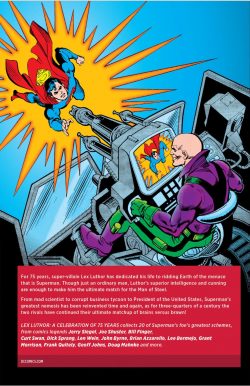
We’re all celebrating the anniversary of the ultimate superhero this year, but who’s thinking of his archenemy – the world’s first true supervillain? Time to address the balance, even if it’s actually two years until the mogul of menace is actually due his bit of candle-covered cake…

Closely paralleling the evolution of the groundbreaking Man of Steel, the exploits of the mercurial Lex Luthor are a vital aspect of comics’ very fabric. In whatever era you choose, the prototypical and ultimate mad scientist epitomises the eternal feud between Brains and Brawn and over eight decades has become the Metropolis Marvel’s true antithesis and nemesis. He’s also evolved into a social barometer and ideal perfect indicator of what different generations deem evil.

This stunning compilation – part of a dedicated series reintroducing and exploiting the comics pedigree of venerable DC icons – comes in Hardback, Trade Paperback and digital formats, sharing a sequence of snapshots detailing what Luthor is at key moments in his never-ending battle with Superman. Groundbreaking appearances are preceded by brief critical analyses of the significant stages in the villain’s development, beginning with Part I: 1940-1969 The Making of a Mastermind.

After history and deconstruction comes sinister adventure as the grim genius debuts in ‘Europe at War Part 2’ (Action Comics #23 April 1940 by Jerry Siegel & Joe Shuster). Although not included here, Action #22 had loudly declared ‘Europe at War’ – a tense, thinly-disguised call to arms for the still-neutral USA, and as the Man of Tomorrow sought to stem the bloodshed, the saga became a continued story (almost unheard of in the early days of funny-book publishing).

Spectacularly concluding in #23, Clark Kent’s European investigations revealed a red-headed fiend employing outlandish science to foment war for profit: intent on conquering the survivors as a modern-day Genghis Khan. The Man of Steel strenuously objected…

Next is ‘The Challenge of Luthor’ (Superman #4, Spring/March1940) and produced at almost the same time: a landmark clash with the rogue scientist who, back then, was still a roguish red-head with a bald and pudgy henchman.

Somehow in the heat of burgeoning deadlines, master got confused with servant in later adventures, and public perception of the villain irrevocably crystalized as the sinister slap-headed super-threat we know today. The fact that Superman was also a star of newspapers – which operated under a different inworld continuity – is widely considered the root cause of that confusion…

Siegel & Shuster’s story involves an earthquake machine and ends with Luthor exhausting his entire arsenal of death-dealing devices attempting to destroy his enemy… with negligible effect.

From Superman #17 (July 1942), ‘When Titans Clash’, by Siegel & John Sikela, depicts how the burly bald bandit uses a mystic “powerstone” to survive his justly earned execution by stealing Superman’s abilities. However, the Action Ace retains his wily intellect and outsmarts his titanically-empowered foe…

Jumping ahead 10 years, ‘Superman’s Super Hold-Up’ (by Bill Finger, Wayne Boring & Stan Kaye from World’s Finest Comics #59 July 1952) is a supremely typical duel of wits in which the Einstein of Evil renders the Metropolis Marvel helpless with the application of a devilish height- and pressure-sensitive mega explosive device… if only for a little while…

WFC #88 (June 1957 by Edmond Hamilton, Dick Sprang & Kaye) offers ‘Superman and Batman’s Greatest Foes!’ wherein “reformed” master criminals Lex and The Joker ostensibly set up in the commercial robot business. Nobody really believes them… as it happens, quite correctly!

As the mythology grew and Luthor became a crucial component of Superman’s story, the bad boy was retroactively inserted into the hero’s childhood. ‘How Luthor Met Superboy!’ (Siegel & Al Plastino in Adventure Comics #271, April 1960) details how Boy of Steel and budding genius were pals until a lab accident burned off Lex’s hair. In his prideful fury Lex blamed the Kryptonian and swore revenge…

In Finger, Curt Swan & John Forte’s ‘The Conquest of Superman’ (Action Comics #277, June 1961) the authorities parole Lex to help with an imminent crisis, only to have the double-dealer escape as soon as the problem is fixed. By the time Superman returns to Earth, Luthor is ready for him…

For October 1963, Superman #164 featured ‘The Showdown between Luthor and Superman’ (Hamilton, Swan & George Klein). The ultimate Silver Age confrontation between the Caped Kryptonian and ultimate antithesis pitted them in an unforgettable clash on devastated planet Lexor – a lost world of forgotten science and fantastic beasts – resulting in ‘The Super-Duel!’ and displayed a whole new side to the often two-dimensional arch-enemy.

Part II: 1970-1986 Luthor Unleashed previews how a more sophisticated readership demanded greater depth in their reading matter and how creators responded by adding a human dimension to the avaricious mad scientist. ‘The Man Who Murdered the Earth’ from Superman #248 (cover-dated February 1972, by Len Wein, Swan & Murphy Anderson). Here Luthor dictates his final testament after creating a Galactic Golem to destroy his sworn enemy, and ponders how his obsession caused the demise of humanity.

For Action Comics’ 45th anniversary, Superman’s two greatest foes – the other being Brainiac – were radically re-imagined for an increasingly harder, harsher world. ‘Luthor Unleashed’ in #544 (June 1983, by Cary Bates, Swan & Anderson) saw the eternal enmity between Lex and Superman lead to Lexor’s destruction and death of Luthor’s new family after the techno-terror once more chose vengeance over love.

Crushed by guilt and hatred, the maniacal genius reinvents himself as an implacable human engine of terror and destruction…

Elliot S. Maggin, Swan & Al Williamson offer a glimpse into the other motivating force in Luthor’s life, exposing ‘The Einstein Connection’ (Superman #416, February 1986) wherein a trawl through the outlaw’s life reveals a hidden link to the greatest physicist in history…

The Silver Age of comic books utterly revolutionised a flagging medium, bringing a modicum of sophistication to the returning sub-genre of masked mystery men. However, after decades of cosy wonderment, Crisis on Infinite Earths transformed the entire DC Universe, leading to a harder, tougher Superman. John Byrne’s radical re-imagining was most potently manifested in Luthor, who morphed from brilliant, obsessed bandit to ruthless billionaire capitalist as seen in the introduction to Part III: 1986-2000 Captain of Industry

The tensions erupt in ‘The Secret Revealed’ (Superman volume 2 #2, February 1987 by Byrne, Terry Austin & Keith Williams) as the pitiless tycoon kidnaps everyone Superman loves to learn his secret. After collating all the data obtained by torture and other means, the corporate colossus jumps to the most mistaken conclusion of his misbegotten life…

‘Metropolis – 900 Miles’ (Superman vol. 2 #9, September 1987 by Byrne & Karl Kesel) then explores the sordid cruelty of the oligarch who cruelly torments a pretty waitress with a loathsome offer and promise of a new life…

‘Talking Heads’ appeared in Action Comics #678 (June 1992, by Roger Stern, Jackson Guice & Ande Parks), set after Luthor – riddled with cancer from wearing a green Kryptonite ring to keep Superman at arms’ length – secretly returned to Metropolis as his own son in a cloned (young and handsome) body. Acting as a philanthropist and with Supergirl as his girlfriend/arm candy, young Luthor has everybody fooled, Sadly, everything looks like falling apart when rogue geneticist Dabney Donovan is arrested and threatens to tell an incredible secret he knows about the richest man in town…

‘Hostile Takeover’ comes from JLA #11 1997) wherein Grant Morrison, Howard Porter & John Dell opened interstellar saga ‘Rock of Ages’ with the Justice League facing a newly-assembled, corporately-inspired Injustice Gang organised by Lex and run on his ruthlessly efficient business model.

Superman, Batman, Wonder Woman, Martian Manhunter, Flash, Green Lantern and Aquaman are targeted by a coalition of arch-enemies comprising Chairman-of-the-Board Lex, Joker, Circe, Mirror Master, Ocean Master and Doctor Light, with ghastly doppelgangers of the World’s Greatest Heroes raining destruction down all over the globe.

Even with new members Aztek and second-generation Green Arrow Connor Hawke on board, the enemy are running the heroes ragged, but the stakes change radically when telepath J’onn J’onzz detects an extinction-level entity heading to Earth from deep space…

The action and tension intensify when the cabal press their advantage whilst New God Metron materialises, warning the JLA that the end of everything is approaching.

As ever, these snippets of a greater saga are more frustrating than fulfilling, so be prepared to hunt down the complete saga. You won’t regret it…

A true Teflon businessman, Lex met the millennium running for President and Part IV: 2000-Present 21st Century Man follows a prose appraisal with ‘The Why’ from President Luthor Secret Files and Origins #1 (2000, by Greg Rucka, Matthew Clark & Ray Snyder). Here the blueprint to power and road to the White House is deconstructed, with daily frustrations and provocations revealing what inspired the nefarious oligarch to throw his hat into the truly evil political ring…

The next (frustratingly incomplete) snippet comes from a miniseries where the antagonist was the star. ‘Lex Luthor Man of Steel Part 3’ by Brian Azzarello & Lee Bermejo offers a dark and brooding look into the heart and soul of Superman’s ultimate eternal foe: adding gravitas to villainy by explaining Lex’s actions in terms of his belief that the heroic Kryptonian is a real and permanent danger to the spirit of humanity.

Luthor – still believed by the world at large to be nothing more than a sharp and philanthropic industrial mogul – allows us a peek into his psyche: viewing the business and social (not to say criminal) machinations undertaken to get a monolithic skyscraper built in Metropolis. The necessary depths sunk to whilst achieving his ambition, and manipulating Superman into clashing with Batman, are powerful metaphors, but the semi-philosophical mutterings – so reminiscent of Ayn Rand’s The Fountainhead – although flavoursome, don’t really add anything to Luthor’s character and even serve to dilute much of the pure evil force of his character.

Flawed characters truly make more believable reading, especially in today’s cynical and sophisticated world, but such renovations shouldn’t be undertaken at the expense of the character’s heart. At the end Luthor is again defeated; diminished without travail and nothing has been risked, won or lost. The order restored is of an unsatisfactory and unstable kind, and our look into the villain’s soul has made him smaller, not more understandable.

Lee Bermejo’s art, however, is astoundingly lovely and fans of drawing should consider buying this simply to stare in wonder at the pages of beauty and power that he’s produced here. Or read the entire story in its own collected edition…

Rather more comprehensive and satisfying is ‘The Gospel According to Lex Luthor’ as first seen in All-Star Superman #5. Crafted by Morrison, Frank Quitely & Jamie Grant from September 2006, here an unrepentant Luthor on Death Row grants Clark Kent the interview of his career and scoop of a lifetime, after which ‘The Black Ring Part 5’ (Action Comics #894, December 2010 by Paul Cornell & Pete Woods) confirms his personal world view as Death of the Endless stops the universe just so she can have a little chat with Lex and see what he’s really like…

This epic trawl through the villain’s career concludes with a startling tale from Justice League volume 2, #31 (August 2014) as, post-Flashpoint, a radically-rebooted New 52 DCU again remade Lex into a villain for the latest generation: brilliant, super-rich, conflicted and hungry for public acclaim and approval. In ‘Injustice League Part 2: Power Players’ by Geoff Johns, Doug Mahnke, Keith Champagne & Christian Alamy, bad-guy Luthor has helped Earth from extradimensional invaders and now wants to be a hero. His solution? Make real superheroes invite him into the Justice League, which can be accomplished by ferreting out Batman’s secret identity and blackmailing the Dark Knight into championing his admission…

Lex Luthor is the most recognizable villain in comics and can justifiably claim that title in whatever era you choose to concentrate on; goggle-eyed Golden Age, sanitised Silver Age or malignant modern/Post-Modern milieux. This book captures just a fraction of all those superb stories and offers a delicious peek into the dark, unhealthy side of rivalry and competition…

This monolithic testament to the inestimable value of a good bad-guy is a true delight for fans of all ages and vintage.
© 1940, 1942, 1952, 1954, 1957, 1960, 1961, 1963, 1972, 1983, 1986, 1987, 1992, 1997, 2001, 2005, 2006, 2007, 2010, 2014, 2015 DC Comics. All Rights Reserved

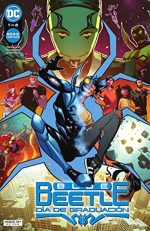
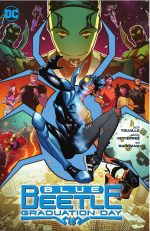
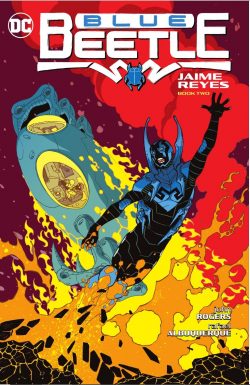
Blue Beetle: Jaime Reyes Book Two


By John Rogers, J. Torres, Keith Giffen, Justin Peniston, Rafael Albuquerque, Freddie E. Williams II, Andy Kuhn, David Baldeón, Dan Davis, Steve Bird & various (DC Comics)
ISBN: 978-1-7795-2027-2 (TPB/Digital edition)

As the most recent incarnation of the venerable Blue Beetle brand makes the jump from comic book limbo and kids’ animation reruns into live action movie madness, here’s a recent collection from the superb 36-issue run that began in 2006: one of the most delightfully light-hearted and compelling iterations of the Golden Age stalwart and still pure joy to behold…

The Blue Beetle first appeared in Mystery Men Comics #1, published by Fox Comics and cover-dated August 1939. The eponymous lead character was created by Charles Nicholas (AKA Charles Wojtkowski): a pulp-styled mystery man who was a born nomad. Over the years and crafted by a Who’s Who of extremely talented creators, he was also inexplicably popular and hard to kill: surviving the failure of numerous publishers before ending up as a Charlton Comics property in the mid-1950s.

After releasing a few issues sporadically, the company eventually shelved him until the superhero revival of the early 1960s when Joe Gill, Roy Thomas, Bill Fraccio & Tony Tallarico revised and revived the character in a 10-issue run (June 1964, February 1966). Cop-turned-adventurer Dan Garrett was reinvented an archaeologist, educator and scientist who gained super-powers whenever he activated a magic scarab with the trigger phrase “Khaji Da!”

Later that year, Steve Ditko (with scripter Gary Friedrich) utterly reimagined the Blue Beetle. Ted Kord was an earnest and brilliant young researcher who had been a student and friend of Professor Garrett. When his mentor seemingly died in action, Kord trained himself to replace him: a purely human inventor/combat acrobat, bolstered by ingenious technology. This latter version joined DC’s pantheon during Crisis on Infinite Earths, earning a solo series and quirky immortality partnered with Booster Gold in Justice League International and beyond…

Collecting Blue Beetle (volume 7) #13-25 and spanning June 2007 to May 2008 – the saga follows the hallowed formula of a teenager suddenly gifted with great powers, and reveals how some heroes are remade, not born – especially when a sentient scarab jewel affixes itself to your spine and transforms you into an armoured bio-weapon.

At the height of the Infinite Crisis, El Paso high-schooler Jaime Reyes found a weird blue jewel shaped like a bug. That night, as he slept, it invaded him and turned him into a bizarre insectoid warrior.

Almost instantly, he was swept up in the chaos, joining Batman and other heroes in a climactic space battle. Inexplicably returned home, Jaime revealed his secret to his family and tried to do some good in his hometown of El Paso but had to rapidly adjust to huge changes. Best bud Paco had joined a gang of super-powered freaks, he learned that the local crime mastermind was his other best bud Brenda’s foster-mom, and a really scary military dude named Christopher Smith AKA Peacemaker started hanging around. He claimed the thing in Jaime’s back was malfunctioning alien tech, not life-affirming Egyptian magic and that he also had an unwelcome and involuntary connection to it…

We resume this cinematically-inspired return engagement with John Rogers, Rafael Albuquerque, David Baldeón & colourist Dan Davis’ ‘Defective’. Here a benevolent (seeming) alien from an interstellar collective named The Reach introduces himself and reveals that the scarab is an invitation used to prepare endangered worlds like Earth for trade and commerce as part of a greater pan-galactic civilisation. Unfortunately the one attached to Jaime has been damaged over the centuries it was here and isn’t working properly.

The Reach envoy is a big fat liar…

The Scarab should have paved the way for a full invasion and once they discover this, Jaime and Peacemaker grasp that The Reach are the worst kind of alien invaders; patient, subtle, deceptive and stocked with plenty of space-tech to sell to Earth’s greedy governments. The only hope of defeating the marauders is to expose their real scheme to the public – which is currently too dazzled by the intergalactic newcomers’ media blitz to listen…

‘Mister Nice Guy’ (Rogers & Albuquerque) finds the Beetle teamed again with erratic Guy Gardner: a Green Lantern who knows all about The Reach and their Trojan Agenda. Here the unhappy allies must defeat the macabre Ultra-Humanite who has sold his telepathic services to the prospective new overlords.

Seeking allies and solutions, Jaime meets Superman in guest creators J. Torres & Freddie Williams Jr.’s ‘Someone to Watch Over Me’: battling electrical anti-villain Livewire before one of the DCU’s gravest menaces manifests in Rogers & Albuquerque’s startlingly powerful change of pace tale ‘Total Eclipso: the Heart’.

‘Something in the Water’ sees elemental menace Typhoon employed by The Reach to endanger a coastal city – and Bruce Wayne’s off-shore oil wells – in a clever, insightful tale packing plenty of punch, before ‘Away Game’ – with contributions from Baldeón & Davis – finds the Beetle and Teen Titans in pitched and pithy battle against the unbeatable alien biker-punk Lobo.

Weirdly whimsical Keith Giffen joins Rogers & Albuquerque next, focusing on Brenda, who has blithely lived her entire life unaware that her surrogate parental unit is El Paso’s crime boss supreme. La Dama is also a hoarder and supplier of alien, futuristic and magical weaponry. The distraught lass learns ‘Hard Truths’ when rival mob Intergang declare war: sending 50-foot woman Giganta to smash La Dama’s family to gooey pulp… until the Beetle buzzes in…

The previous tales were first collected in 2008 as Blue Beetle: Reach for the Stars and are accompanied here by most of sequel volume End Game, which finds the blue boy fighting a very secret war against the seemingly saintly visitors from the stars.

What the Green Lantern Corps already know is that The Reach are rapacious conquerors who follow near-sacrosanct ancient “strategies” to increase their empire. First a scarab converts an indigenous inhabitant into a pathfinder – a devastating marauding bug warrior – before the undetectably orbiting Reach “arrive”, offering weapons and planet-changing technologies to any who want them. And in the interim, the benefactors build world-ripper engines to eventually tear planet and remaining resources into manageable, marketable portions…

Rogers & Albuquerque set up the climactic counterstrike to Armageddon in ‘Fear to Live’, as Peacemaker is selected by a Sinestro Corps power ring due to his ability to “instil great fear”, just as Reach’s Chief Negotiator seeks to take him out. The silent invaders are terrified: desperate to learn why after countless millennia a scarab has rebelled against their infallible programming and created a disobedient, destructive maverick in Reyes.

Having finally deduced the part Peacemaker plays in the rebellion of his strategic weapon, the Negotiator infects Smith with a fully-obedient scarab and transforms him into a monstrous killer-drone. However, the terrifying “Infiltrator” is still no match for Jaime and his now sentient and liberated inner bug, especially after the yellow ring and alien Green Lantern Brik join the struggle…

Before Jaime’s meticulously constructed masterplan to save Earth gets underway, Justin Penniston & Andy Kuhn step in with a powerful tale of mistakes and consequences in #21’s ‘Ghost of a Chance’. Stepping in to quell a riot at a Federal Correctional facility, The Beetle finds the latest incarnation of The Spectre impatiently executing murderers the authorities haven’t got around to yet. Severely outmatched and deeply emotionally conflicted, Jaime needs the sage advice of his father and sorceress girlfriend Traci 13 to a get a handle on the Why as much as the How and Who of this crisis…

After almost a year of preparation, the fate of Earth is resolved in End Game parts one to four, by Rogers, Albuquerque & Majors, starting out ‘Under Pressure’ as Earth’s leaders get deeper in debt to the so-amenable Reach, whilst the Beetle and his allies – his parents, Peacemaker, Paco, Brenda and Danni Garrett (granddaughter of the first Blue Beetle) – try to expose the hidden world-ripper stations and uncover a hidden race who are far from what they seem…

The unravelling eternal strategies have sown discord amongst the Reach with Chief Negotiator’s subordinate openly displaying defiance and advocating abandoning the texts and a century of invisible sedition for total savage warfare right now. Pushed into rash action, the big boss targets the Reyes family, but too late…

‘World Tour’ reveals how Blue Beetle has already invaded their orbiting cloaked base, using a tactic and weapon the scarabs have never before used…

All too soon the boy is defeated, captured, tortured and deprived of the malfunctioning scarab designated Khaji Da. As the Negotiator sadistically gloats, he’s unaware that this was the plan: to strike from ‘Outside-In’

With Traci 13 shielding the Reyes from retaliation, Jaime and his now-sentient symbiotic scarab are methodically taking the Reach apart, provoking a rash public attack on El Paso, the abrupt exposure of the formerly-shielded Reach legions and bases and a gathering of heroes. Can it be merely coincidence that the first responders in concluding clash ‘A Little Help From…’ are Ted Kord’s closest friends and allies, Fire, Ice, Guy Gardner and Booster Gold, or that Jaime has outwitted the perfidious purveyors of illicit high technology with the most primitive methods ever devised by humanity?

… And as Jaime and Khaji Da are plucked from certain death, the rebels leave behind something that will have devastating repercussions for The Reach…

To Be Continued

With covers by Cully Hamner, and Albuquerque this is a smart, fast and joyous thrill ride to delight fans of comics and other, lesser, media forms. There are so few series combining action and adventure with all-out fun and genuine wit, or which can evoke shattering tragedy and poignant loss on command. John Rogers and his stand-ins excel in this innovative and impossibly readable saga and the art is always top notch. With the climactic final battle against the Reach only setting the scene for more and better to come, this is a second chance you probably don’t deserve but should reach out and grab onto with all you’ve got.
© 2007, 2008, 2023 DC Comics. All Rights Reserved.

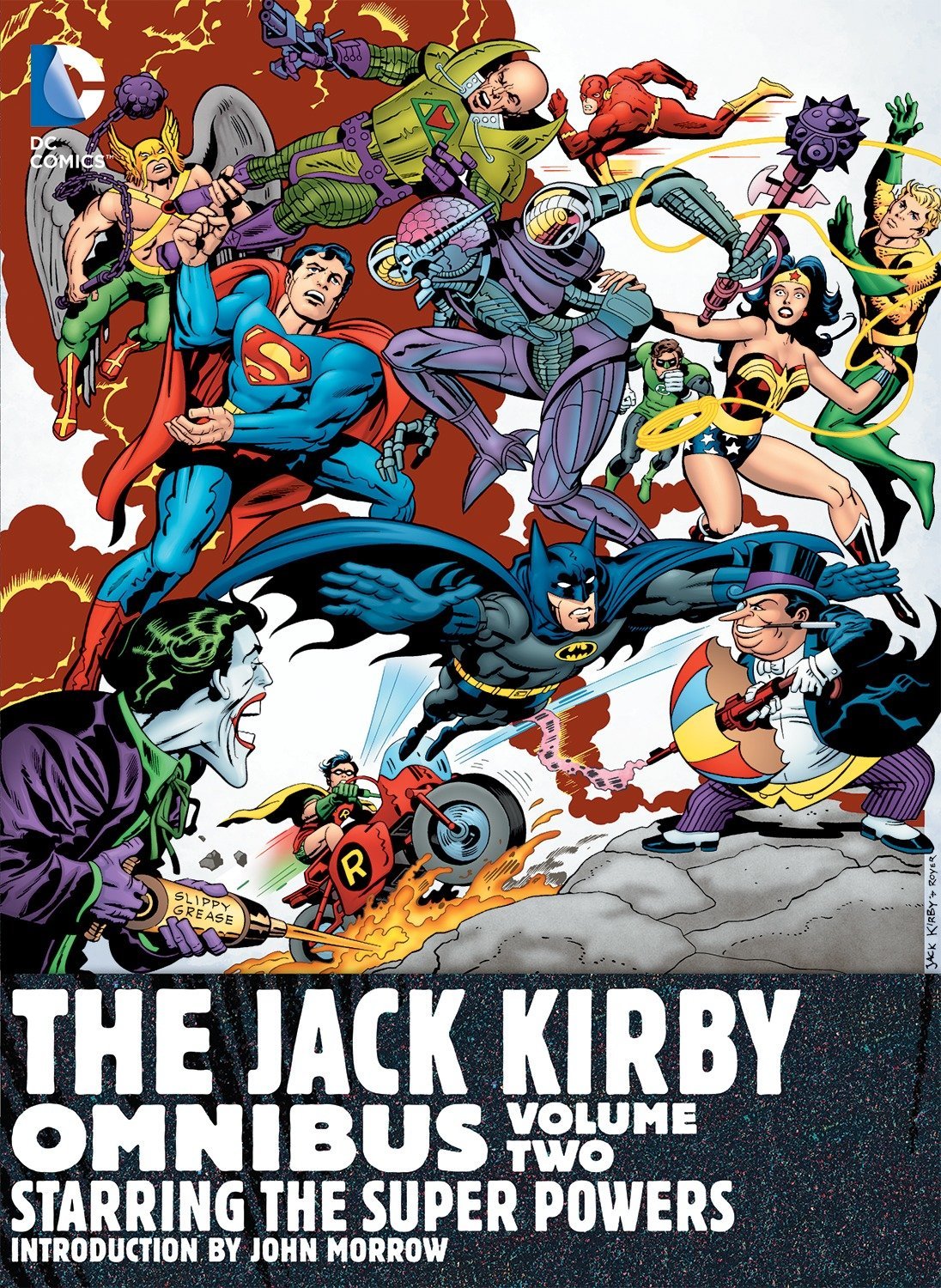
The Jack Kirby Omnibus volume 2 – starring The Super Powers


By Jack Kirby, with Mike Royer, D. Bruce Berry, Wally Wood, Pablo Marcos, Adrian Gonzalez, Greg Theakston, Alex Toth, Vince Colletta, Joe Simon, Denny O’Neil, Martin Pasko, Steve Sherman, Michael Fleisher, Joey Cavalieri, Paul & Alan Kupperberg, Bob Rozakis & various (DC Comics)
ISBN: 978-1-4012-3833-9 (HB)

Famed for larger-than-life characters and gigantic, cosmic imaginings, Jack Kirby was an astute, imaginative, spiritual man who lived through poverty, gangsterism, the Depression, Post-War optimism, Cold War paranoia, political cynicism and the birth and death of peace-seeking counter-cultures. He was open-minded and utterly wedded to the making of comics stories on every imaginable subject. He always believed that sequential narrative was worthy of being published as real books beside mankind’s other literary art forms.

History has proved him right, and showed us just how ahead of the times he always was.

There’s a magnificent abundance of Kirby commemorative collections around these days (though still not all of it, so I remain a partially disgruntled dedicated fan). This particular magnificent hardback compendium re-presents most of the miscellaneous oddments of the “King’s DC Canon”; or at least those the company still retains rights for. The licenses on stuff like his run on pulp adaptation Justice Inc. (and indeed Marvel’s 2001: A Space Odyssey comic) will not be forthcoming any time soon…

Some of the material here is also available in 2019’s absolutely monster DC Universe Bronze Age Omnibus by Jack Kirby, but since it isn’t available digitally either (yet), you’d best have strong wrists and a sturdy desk at hand for that one.

Happily, this less massive tome from 2013 is less of a strain physically or financially. It opens with pages of hyper-kinetic Kirby pencil pages and a moving ‘Introduction by John Morrow’ before hurtling straight into moody mystery with a range of twice told tales.

On returning from WWII, Kirby reconnected with long-term creative partner Joe Simon. National Comics/DC was no longer a welcoming place for the reunited dream team supreme and by 1947 they had formed their own studio. Subsequently enjoying a long and productive relationship with Harvey Comics (Stuntman, Boy’s Ranch, Captain 3-D, Lancelot Strong, The Shield, The Fly, Three Rocketeers and more) the duo generated a stunning variety of genre features for Crestwood/Pines supplied by their “Essankay”/ “Mainline” studio shop.

Triumphs included Justice Traps the Guilty, Fighting American, Bullseye, Police Trap, Foxhole, Headline Comics and especially Young Romance amongst many more: a veritable mountain of mature, challenging strip material in a variety of popular genres.

One was mystery and horror, and amongst the dynamic duo’s Prize Comics concoctions was noir-informed, psychologically-underpinned supernatural anthology Black Magic – and latterly, short-lived yet fascinating companion title Strange World of Your Dreams.

These comics anthologies eschewed traditional gory, heavy-handed morality plays and simplistic cautionary tales for deeper, stranger fare, and – until the EC comics line hit their peak – were far and away the best mystery titles on the market.

When the King quit Marvel for DC in 1970, his new bosses accepted suggestions for a supernatural-themed mature-reading magazine. Spirit World was a superb but poorly received and largely undistributed monochrome magazine. Issue #1 – and only – appeared in the summer of 1971, but editorial cowardice and backsliding scuppered the project before it could get going.

Material from a second, unpublished issue eventually appeared in colour comic books Weird Mystery Tales and Forbidden Tales of Dark Mansion, but with his ideas misunderstood, ignored or side-lined by the company, Kirby reverted to more traditional fare. Never truly defeated though, he cannily blended his belief in the marketability of the supernatural with flamboyant superheroics to create another unique and lasting mainstay for the DC universe. The Demon only ran a couple of years but was a concept later talents would make a pivotal figure of the company’s continuity.

Jack’s collaborations with fellow industry pioneer Joe Simon always produced dynamite concepts, unforgettable characters, astounding stories and huge sales, no matter what genre avenues they pursued, blazing trails for so many others to follow and always reshaping the very nature of American comics with their innovations and sheer quality.

As with all their endeavours, Simon & Kirby offered stories shaped by their own sensibilities. Identifying a “mature market” gap in the line of magazines they autonomously packaged for publishers Crestwood and Prize, they realised the sales potential of high-quality spooky material. Thus superb, eerily seminal Black Magic debuted with an October/November 1950 cover-date; supplemented in 1952 by boldly obscure psychological drama anthology The Strange World of Your Dreams. This title was inspired by studio-mate Mort Meskin’s vivid and punishing night terrors: dealing with fantastic situations and – too frequently for comfort – unable or unwilling to provide pat conclusions or happy endings. There was no cosmic justice or calming explanations available to avid readers. Sometimes The Unknown just blew up in your face and you survived – or didn’t. No one escaped whole or unchanged…

Thus, this colossal compendium of cult cartoon capers commences with DC’s revival of Black Magic as a cheap, modified and toned down reprint title.

The second #1 launched with an October/November 1973 cover-date, offering crudely re-mastered versions of some astounding classics. Benefitting from far better reproduction technology here is ‘Maniac!’ (originating in Black Magic #32 September/October 1973): an artistic tour de force and a tale much “homaged” by others in later years, detailing how and why a loving brother stops villagers taking his simple-minded sibling away. This is followed by ‘The Head of the Family!’ (BM #30 May/June 1954, by Kirby & Bruno Premiani) exposing the appalling secret shame of a most inbred clan…

DC’s premier outing ended with a disturbing tale first seen in Black Magic #29 (March-April 1954). Specifically cited in 1954’s anti-comic book Senate Hearings, ‘The Greatest Horror of them All!’ told a tragic tale of a freak hiding amongst lesser freaks…

Cover-dated December 1973/January 1974, DC’s second shot opened with ‘Fool’s Paradise!’ (BM #26, September/October 1953) as a petty thug stumbles into a Mephistophelean deal and reveals how ‘The Cat People’ (#27 November/December 1953) mesmerised and forever marked an unwary tourist in rural Spain before ‘Birth After Death’ (#20 January 1953) retold the true tale of how Sir Walter Scott’s mother survived premature burial, and ‘Those Who Are About to Die!’ (#23 April 1953) sketched out how a painter could predict imminent doom…

‘Nasty Little Man!’ (#18 November 1952) fronted DC’s third foray and gets my vote for creepiest horror art job of all time. Here three hobos discover to their everlasting regret why you shouldn’t pick on short old men with Irish accents. ‘The Angel of Death!’ (#15 August 1952) then details an horrific medical mystery far darker than mere mystic menace…

In the 1950s, as their efforts grew in popularity, S & K were stretched thin. Utilising a staff of assistants and crafting fewer stories themselves meant they could keep all their deadlines.

The ‘Cover art for Black Magic #4, June/July 1974’ swiftly segues into ‘Last Second of Life!’(Black Magic volume 1 #1, October-November 1950 and their only narrative contribution to that particular DC issue) wherein a rich man, obsessed over what the dying see at their final breath, soon regrets the unsavoury lengths he went to in finding out…

There were two in the next issue. ‘Strange Old Bird!’(courtesy of Black Magic #25 June/July 1953) is a gently eerie thriller of a little old lady who gets the gift of renewed life from her tatty and extremely flammable feathered old friend and ‘Up There!’ from the landmark 13th issue (June 1952) – the saga of a beguiling siren stalking the upper stratosphere and scaring the bejabbers out of a cool test pilot…

DC issue #6 reprises ‘The Girl Who Walked on Water!’ (BM #11 April 1952), exposing the immense but fragile power of self-belief whilst the ‘Cover art for Black Magic #7, December 1974/January 1975’ (originally #17 October 1952) provides a chilling report on satanic vestment ‘The Cloak!’ (BM #2 December 1950/January 1951) and ‘Freak!’ (also from #17) shares a country doctor’s deepest shame…

DC’s #8 revisited The Strange World of Your Dreams, beginning with “typical insecurity nightmare” ‘The Girl in the Grave!’ (#2, September/October 1952). The Meskin-inspired anthology of oneiric apparitions eschewed cheap shocks, mindless gore and goofy pun-inspired twist-ending yarns in favour of dark, oppressive suspense, soaked in psychological unease and tension over teasing…

Following up with ‘Send Us Your Dreams’ from the same source (requesting readers’ ideas for spokes-parapsychologist Richard Temple to analyse), DC’s vintage fear-fest concludes with # 9 (April/May 1975) and ‘The Woman in the Tower!’ as originally seen in SWoYD #3, (November/December 1952) detailing the symbolism of oppressive illness…

When his Fourth World Saga stalled, Kirby continued creating new material with Kamandi – his only long-running DC success – and explored WWII in The Losers whilst creating the radical, scarily prophetic, utterly magnificent Omac: One Man Army Corps, but still could not achieve the all-important sales the company demanded. Eventually he was lured back to Marvel and new challenges like Black Panther, Captain America, 2001: A Space Odyssey, Devil Dinosaur, Machine Man and especially The Eternals.

Before that though, he unleashed new concepts and even filled in on established titles. As previously moaned about, however, his 3-issue run on Justice Inc. – adapting 1930s’ licensed pulp star The Avenger – is not included here, but at least his frankly astounding all-action dalliance with martial arts heroics is…

Inked by D. Bruce Berry and debuting in all-new try-out title 1st Issue Special #1 (April 1975), ‘Atlas the Great!’ harked back to the dawn of human civilisation and followed the blockbusting trail of mankind’s first super-powered champion in a blazing Sword & Sorcery yarn.

1st Issue Special #5 (August 1975, Berry) highlighted the passing of a torch as a devout evil-crusher working for an ancient justice-cult retired and tipped his nephew – Public Defender Mark Shaw – to become the latest super-powered ‘Manhunter’, after which a rare but welcome digression into comedy manifested as ‘The Dingbats of Danger Street (1st Issue Special #6, September 1975). With Mike Royer inking, Kirby unleashed a bizarre and hilarious revival of his Kid Gang genre, starring four multi-racial street urchins united for survival and to battle surreal super threats…

Kirby – and Berry – limned the third issue of troubled martial arts series Richard Dragon, Kung Fu Fighter (August/September 1975). Scripted by Denny O’Neil, the savage shocker pits the lone warrior against an army of assassins in ‘Claws of the Dragon!’

‘Fangs of the Kobra!’ comes from Kobra #1, released with a February/March 1976 cover-date. The tale is strange in both execution and delivery, with Kirby’s original updating of Dumas’ tale The Corsican Brothers reworked by Martin Pasko, Steve Sherman and artists Pablo Marcos & Berry.

It introduces brothers separated at birth. Jason Burr grew up a normal American kid whilst his twin – stolen by an Indian death cult – was reared as Kobra, the most dangerous man alive. Sadly for the super-criminal, young adult Jason is recruited by the authorities because of a psychic connection to the snake lord: a link allowing them to track each other and also feel and experience any harm or hurt the other experiences…

When Simon & Kirby came to National/DC in 1942 one of their earliest projects was revitalising the moribund Sandman strip in Adventure Comics. Their unique blend of atmosphere and dynamism made it one of the most memorable, moody and action-packed series of the period (as you can see by reading their companion volume The Sandman by Simon & Kirby).

The band was brought back together for The Sandman #1 (cover-dated Winter 1974): a one-shot project which kept the name but created a whole new mythology. Scripted by Simon and inked by Royer, ‘General Electric’ revealed how the realm of dreams was policed by a scarlet-&-gold super-crusader dedicated to preventing nightmares escaping into the physical world. With unwilling assistants Glob and Brute, the Sandman also battled real world villains exploiting the unconscious Great Unknown. The heady mix was completed by frail orphan Jed, whose active sleeping imagination seemed to draw trouble to him.

The proposed one-off was a minor hit at a tenuous time in comics publishing, and DC kept it going, even though the originators were not interested. Kirby & Royer did produce the ‘Cover art Sandman #2, April/May 1975’ and ‘Cover art Sandman #3, June/July 1975’ before the King returned to the series with #4.

‘Panic in the Dream Stream’ – August/September 1975 – was scripted by Michael Fleisher, and revealed how a sleepless alien race attempted to conquer Earth through Jed’s fervent dreams: a traumatic channel that also allowed them to invade Sandman’s Dream Realm. The next issue (October/November 1975) heralded an ‘Invasion of the Frog Men!’ into an idyllic parallel dimension whilst the next reunited a classic art team. Wally Wood inked Jack for Fleisher’s ‘The Plot to Destroy Washington D.C.!’. Here mind-bending cyborg Doctor Spider subverted and enslaved Glob and Brute in his eccentric ambition to take over America…

Although Sandman #6 (December 1975/January 1976) was the last published issue, another tale was already completed. It finally appeared in reprint digest Best of DC #22 (March 1982). ‘The Seal Men’s War on Santa Claus’ with Fleisher scripting and Royer handling the brushwork was a sinister seasonal romp with Jed’s wicked foster-family abusing him in classic Scrooge style before the Weaver of Dreams summons him to help save Christmas from bellicose well-armed aquatic mammals…

During the 1980s costumed heroes stopped being an exclusively print cash cow. Many toy companies licensed Fights ‘n’ Tights titans and reaped the benefits of ready-made comic book spin-offs. DC’s most recognizable characters morphed into a top-selling action figure line and were inevitably hived off into a brisk and breezy, fight-frenzied miniseries.

Super Powers launched in July 1984 as a 5-issue miniseries with Kirby covers and his signature characters prominently represented. Jack also plotted the stellar saga with scripter Joey Cavalieri providing dialogue, and Adrian Gonzales & Pablo Marcos illustrating a heady cosmic quest comprising numerous inconclusive battles between agents of Good and Evil.

In ‘Power Beyond Price!’, ultimate nemesis Darkseid despatches four Emissaries of Doom to destroy Earth’s superheroes. Sponsoring Lex Luthor, The Penguin, Brainiac and The Joker the monsters jointly target Superman, Batman & Robin, Wonder Woman, The Flash, Aquaman and Hawkman

The combat escalates in #2’s ‘Clash Against Chaos’ with the Man of Steel and Scarlet Speedster tackling Luthor, whilst Aquaman and Green Lantern pummel the Penguin as Dark Knight and Winged Wonder confront a cosmically-enhanced Harlequin of Hate…

With Alan Kupperberg inking, an inconclusive outcome leads to a regrouping of evil and an attack by Brainiac on Paradise Island. With the ‘Amazons at War’ the Justice League rally until Superman is devolved into a brutal beast who attacks his former allies. All-out battle ensues in ‘Earth’s Last Stand’, before Kirby stepped up to write and illustrate the fateful finale: cosmos-shaking conclusion ‘Spaceship Earth – We’re All on It!’  (November 1984, with Greg Theakston suppling inks)…

A bombastic Super Powers Promotional Poster leads into a nostalgic reunion as DC Comics Presents #84 (August 1985) reunited Jack with his first “Fantastic Four”. ‘Give Me Power… Give Me Your World!’ – written by Bob Rozakis, Kirby & Theakston (with additional art by the legendary Alex Toth) – pits Superman and the Challengers of The Unknown against mind-bending Kryptonian villain Zo-Mar, after which the ‘Cover art for Super DC Giant S-25, July/ August 1971’ (inked by Vince Colletta) segues into the Super Powers miniseries, spanning September 1985 to February 1986.

Scripted by Paul Kupperberg the Kirby/Theakston saga ‘Seeds of Doom!’ recounts how deadly Darkseid despatches techno-organic bombs to destroy Earth, requiring practically every DC hero to unite to end the threat.

With squads of Super Powers travelling to England, Rome, New York, Easter Island and Arizona the danger is magnified ‘When Past and Present Meet!’ as the seeds warp time and send Aquaman and the Martian Manhunter back to days of King Arthur

Issue #3 (November 1985) finds Red Tornado, Hawkman and Green Arrow plunged back 75 million years in ‘Time Upon Time Upon Time!’ even as Doctor Fate, Green Lantern and Wonder Woman are trapped in 1087 AD, battling stony-faced giant aliens on Easter Island.

Superman and Firestorm discover ‘There’s No Place Like Rome!’as they battle Darkseid’s agent Steppenwolf in the first century whilst Batman, Robin and Flash visit a future where Earth is the new Apokolips for #5’s ‘Once Upon Tomorrow’, before Earth’s scattered champions converge on Luna to spectacularly squash the schemes-within-schemes of ‘Darkseid of the Moon!’

Rounding out the astounding cavalcade of wonders is a selection of Kirby-crafted Profiles pages from Who’s Who: The Definitive Directory of the DC Universe 1985-1987: specifically, Ben Boxer, the Boy Commandos, Challengers of the Unknown, Crazy Quilt, Etrigan the Demon, Kamandi, The Newsboy Legion, Sandman (the Dream Stream version from 1974), Sandy, the Golden Boy and Witchboy Klarion.

Kirby was and remains unique and uncompromising. His words and pictures comprise an unparalleled, hearts-and-minds grabbing delight no comics lover can possibly resist. If you’re not a fan or simply not prepared to see for yourself what all the fuss has been about then no words of mine will change your mind.

That doesn’t alter the fact that his life’s work from 1937 to his death in 1994 shaped the entire American comics scene – and indeed the entire comics planet – affecting the lives of billions of readers and thousands of creators in all areas of artistic endeavour for generations and is still winning new fans and apostles every day, from the young and naive to the most cerebral of intellectuals. His work is instantly accessible, irresistibly visceral, deceptively deep and simultaneously mythic and human.

He is the King and will never be supplanted.
© 1971, 1973, 1974, 1975, 1976, 1984, 1985, 1986, 1987, 2013 DC Comics. All Rights Reserved.

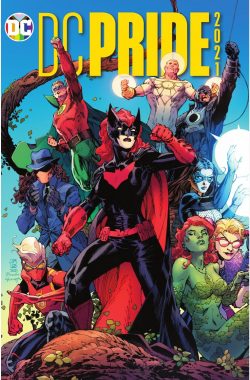
DC Pride 2021


By Vita Ayala, Sina Grace, Sam Johns, Danny Lore, Nicole Maines, Steve Orlando, Andrea Shea, Mariko Tamika, James Tynion IV, Andrew Wheeler, Stephen Byrne, Elena Casagrande, Klaus Janson, Nic Klein, Trung Le Nguyen, Amancay Nahuelpan, Slylar Patridge, Amy Reeder, Ro Stein & Ted Brandt, Lisa Sterle, Rachael Stott, Luciano Vecchio & various (DC Comics)
ISBN: 978-1-88456-804-6 (HB/Digital edition)

Since the 1960s and the birth of the Civil Rights Movement, comics have always been at the forefront of the battle for equality. Maybe more so in terms of racial issues at the start and not so much on gender disparity or sexual complexity, but now most print and screen superheroes work towards greater diversity and inclusion. The most noticeable strides and breakthroughs have come from industry leaders DC and Marvel, but maybe it’s just that more is expected of them…

In 2021, the former celebrated accumulated personal freedoms by collecting one-shot DC Pride #1 and select material from similarly-themed specials New Years Evil #1, Mysteries of Love in Space #1 and Young Monsters in Love #1 (cumulatively spanning 2018-2021), celebrating the infinite variety of interpersonal relationships focusing on LGBTQIA+ characters in the DC catalogue as interpreted by creators equally all-embracing.

The compilation – variously lettered by Aditya Bidikar, Josh Reed, Arian Maher, Becca Carey, Steve Wands, Tom Napolitano and Dave Sharpe – opens with a fulsome Foreword from Out & Proud bestselling author and comics scribe Mark Andreyko before we plunge into assorted antics…

James Tynion IV & Trung Le Nguyen begin the festivities with ‘The Wrong Side of the Looking Glass’ as Batwoman Kate Kane confronts memories of her twin sister/deranged arch nemesis Alice and how her enforced solitude after Beth Kane seemingly died may have affected her own life path, after which John Constantine meets magician Extraño in a pub and starts chatting. Gregorio de la Vega was officially DC’s first openly gay super-character, debuting in weekly megaseries Millennium #2 (January 1988) and latterly as a member of The New Guardians. For ‘Time in a Bottle’ creators Steve Orlando & Stephen Byrne pit him in a tall tale contest co-starring Midnighter and featuring queer Nazi vampire cultist Count Berlin

Vita Ayala, Skylar Patridge and colourist José Villarrubia then set lesbian cop Renee Montoya and her alter ego The Question on the trail of a missing politician in ‘Try the Girl’ whilst Mariko Tamaki, Amy Reeder & Marissa Louise have Harley Quinn & Poison Ivy spectacularly and near-lethally address their unique relationship problems in ‘Another Word for a Truck to Move Your Furniture’.

After being in the closet since the 1930s, original Green Lantern Alan Scott shares the story of his first love with openly out son Todd AKA Obsidian. As related by Sam Johns, Klaus Janson & colourist Dave McCaig, ‘He’s the Light of My Life!’ is a sweet romantic interlude balanced by ‘Clothes Makeup Gift’ – by Danny Lore, Lisa Sterle & Enrica Angiolini – a female wherein future Flash multitasks prepping for a date with a new girlfriend and taking down a Mirror Master knockoff Reflek

The Flash connection continues with reformed Rogue Pied Piper foiling and then mentoring social activist outlaw Drummer Boy in wry caper ‘Be Gay, Do Crime’ by Sina Grace, Ro Stein & Ted Brandt before DCTV superhero Dreamer makes their comic book debut in ‘Date Night’, courtesy of Nicole Maines, Rachael Stott and Angiolini.

Arch villains Monsieur Mallah and The Brain prove to gay cop Maggie Sawyer that love truly comes in all forms in Orlando & Nic Klein’s moving confrontation ‘Visibility’ after which Lobo’s troubled, long-abandoned daughter Crush learns some hard truths from the wrong role model in ‘Crushed’ by Andrea Shea and Amancay Nahuelpan Trish Mulvihill…

Harley Quinn offers her particular seasonal felicitations to Renee Montoya and Gotham City in Ayala, Elena Casagrande & Jordie Bellaire’s rendition of ‘Little Christmas Tree’ prior to a host of gay heroes attending a Pride March and forming a team of their own to battle Eclipso in ‘Love Life’ by Andrew Wheeler, Luciano Vecchio & Rez Lokus.

The combination of Aqualad Jackson Hyde, Aerie, Wink, Apollo & Midnighter, Bunker, Tasmanian Devil, The Ray, Shining Knight, Steel/Natasha Irons, Sylvan Ortega, Tremor, Traci 13, Extraño, Batwoman and Crush proved unbeatable and led to them proudly declaring themselves Justice League Queer

This award-winning collection also comes with a cover gallery including 17 variant covers for DC titles during Pride Month and featuring many other out stars, crafted by David Talaski, Brittney Williams, Kevin Wada, Kris Anka, Nick Robles, Sophie Campbell, Travis Moore & Alejandro Sánchez, Jen Bartel, Paulina Ganucheau, Stephen Byrne and Yoshi Yoshitani and closes with a screen-loaded fact feature.

‘DCTV: The Pride Profiles’ offers brief interviews, and Q-&-As of LGBTQ characters in The CW shows – including Batwoman/Ryan Wilder (played by Javicia Leslie), Dreamer (Nicole Maines), White Canary/Sara Lance (Caity Lotz), John Constantine (Matt Ryan), Thunder (Nafessa Williams) and Negative Man (Matt Bomer).

Forthright, fun, thrilling and fabulous, feel free to find and feast on these comics and stories.
© 2018, 2019, 2021, 2022 DC Comics. All Rights Reserved.

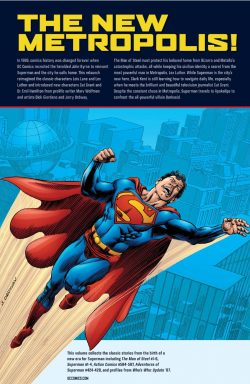
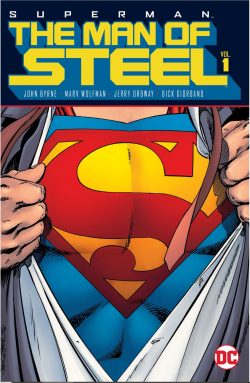
Superman: The Man of Steel volume 1


By John Byrne, Marv Wolfman, Jerry Ordway, Dick Giordano, Terry Austin, Mike Machlan, Karl Kesel & various (DC Comics)
ISBN: 978-1-7795-0491-3 (HB/Digital edition)

In 1985 when DC Comics decided to rationalise, reconstruct and reinvigorate their continuity with Crisis on Infinite Earths they used the event to simultaneously regenerate their key properties at the same time. The biggest gun they had was Superman and it’s hard to argue that the change was not before time.

The big guy was in a bit of a slump, but he’d weathered those before. So how could a root and branch retooling be anything but a pathetic marketing ploy that would alienate the real fans for a few fly-by-night Johnny-come-latelies who would jump ship as soon as the next fad surfaced? This new Superman was going to suck…

They couldn’t have been more wrong.

The public furore began with all DC’s Superman titles being “cancelled” (actually suspended) for three months, and yes, that did make the real-world media sit-up and take notice of the character everybody thought they knew for the first time in decades. However, there was method in this seeming corporate madness.

The missing mainstays were replaced by a 6-part miniseries running from October to December 1986. Entitled Man of Steel, it was written and drawn by Marvel’s mainstream superstar John Byrne and inked by venerated veteran Dick Giordano.

The bold manoeuvre was a huge and instant success. So much so that when it was first collected as a stand-alone compilation album in 1991, it became one of comics’ premiere “break-out” hits in a new format that would eventually become the industry standard for reaching mass readerships. Nowadays few people buy the periodical pamphlets but almost everybody has read a graphic novel…

From that overwhelming start the Action Ace seamlessly returned to his suspended comic book homes, enjoying the addition of a third monthly title which premiered that same month.

Superman, Adventures of Superman, and Action Comics (which acted as a fan-pleasing team-up book guest-starring other favourites of the DC Universe, in the manner of the cancelled DC Comics Presents) were instant best-sellers.

So successful was the relaunch that by the early 1990’s Superman would be carrying four monthly titles as well as Specials, Annuals, guest shots and regular appearances in titles such as Justice League.

Quite a turnaround from the earlier heydays of the Man of Steel when editors were frantic about never overexposing their meal-ticket.

In Superman’s 85th year of more-or-less consecutive and continuous publication, this collection begins with the six self-contained stories from key points in Superman’s career, newly readjusted for contemporary consumption in the wake of that aforementioned worlds-shattering Crisis.

Spanning to cover-dates October 1986 to June 1987 and re-presenting The Man of Steel #1-6, Superman #1-4, Action #584-587 and Adventures of Superman #424-428 plus relevant pages from Who’s Who: Update ‘87 #1, 3, 4 this initial herculean compilation opens with the a reprinting of Byrne’s introduction from the 1991 collection ‘Superman: A Personal View’ before the revelations unfold…

Newsstands and comic stores on July 10th 1986 welcomed a startlingly new and bleakly dystopian Krypton in #1 as ‘Prologue: From Out of the Green Dawn…’ followed the child’s voyage in a self-propelled birthing matrix to a primitive world.

Discovered by childless couple Jonathan and Martha Kent, the alien foundling spends his years growing secretly in Smallville, indistinguishable from other earthlings until strange abilities begin to gradually manifest and hint at ‘The Secret’

Eighteen years after his arrival, the boy learns of his extraterrestrial origins and leaves home to wander the world. Clark Kent eventually settles in Metropolis and we get a rapid re-education of what is and isn’t canonical as he performs his first public super-exploit, meets with Lois Lane, joins the Daily Planet and gets an identity-obscuring costume in ‘The Exposure’ and ‘Epilogue: The Super-Hero’

Lois takes centre-stage for the second issue, scheming and manipulating to secure the first in-depth interview with the new hero before losing out to neophyte colleague Kent whose first big scoop becomes ‘The Story of the Century!’

The third chapter recounts the Metropolis Marvel’s first meeting with Batman as ‘One Night in Gotham City…’ reveals a fractious and reluctant team-up to capture murdering thief Magpie. The unsatisfactory encounter sees the heroes part warily, not knowing if they will become friends or foes…

‘Enemy Mine…’ in MoS #4 expands and redefines the new Lex Luthor: a genius, multi-billionaire industrialist who was the most powerful man in Metropolis until the Caped Crime-buster appeared. When the tycoon overreaches himself in trying to suborn the hero with cash, he is publicly humiliated and swears vengeance and eternal enmity…

By the time of ‘The Mirror, Crack’d…’ in #5, Luthor is Superman’s greatest foe – albeit one who scrupulously maintains a veneer of respectability and plausible deniability. Here, Luthor’s clandestine attempt to clone his own Man of Tomorrow results in a monstrous flawed duplicate dubbed Bizarro and introduces Lois’ sister Lucy to play hapless victim in a moving tale of triumph and tragedy.

The reimagination concludes with ‘The Haunting’ as a troubled Clark/Superman returns to Smallville. Reuniting with childhood sweetheart Lana Lang – who shares his secrets and knows as much as he of his alien origins – the strange visitor finally learns of his Kryptonian origins and heritage when the long-hidden birthing matrix projects a recorded message from his long-dead parents and details their hopes and plans for him…

The shock and reaction of his foster family only affirms his dedication and connection to humanity…

John Byrne was a controversial choice at the time, but he magnificently recaptured the exuberant excitement and visually compelling, socially aware innovation which informed and galvanised Jerry Seigel & Joe Shuster’s inspired creation. Man of Steel granted a new generation the same kind of intoxicating four-colour fantasy that was the original Superman, and made it possible to be a fan again, no matter your age or prejudice. Superman had always been great, but Byrne had once again made him thrilling. Rivetingly so.

The never-ending battle recommenced on a monthly schedule with Superman volume 2 #1, where Byrne & Terry Austin reveal a ‘Heart of Stone’: presenting a new Metallo as thug John Corben is remade as a Terminator-style cyborg with a human brain and a Kryptonite heart by a deranged xenophobic scientist. The transition culminates in a deadly battle and baffling mystery portending big troubles to come. The focus then shifts to Action #584 and ‘Squatter!’ (by Byrne & Giordano) as a body-snatching mental force suborns the Metropolis Marvel and necessitates a team-up with the Teen Titans. The accent is predominantly on breakneck pace and all-out costumed conflict here…

Superman #2 (by Byrne & Austin) then describes ‘The Secret Revealed!’ as modern-day robber baron Luthor makes the biggest mistake of his life after kidnapping and torturing Kent’s first girlfriend Lana Lang

This is followed by Marv Wolfman & Jerry Ordway’s ‘Man O’War!’ and ‘Going the Gauntlet’ (Adventures of Superman #424 & 425, and inked by Mike Machlan). The drama introduces tragic Dr. Emil Hamilton and rival reporter Cat Grant to the mythology as the Action Ace battles high-tech terrorists sponsored by rogue state Qurac and proves to be no respecter of international boundaries like his pre-Crisis counterpart…

These politically and socially aware dramas would become a truer and more lasting template for the modern Man of Tomorrow after Byrne’s eventual retirement from the character…

The Phantom Stranger guests in a battle against a deadly manifestation of unquiet spirits in ‘And the Graves Give Up Their Dead…’ (Byrne & Giordano, Action #585) before the next three chapters address the Superman segment of multi-part crossover event Legends.

Byrne & Austin’s Superman #3 began with ‘Legends of the Darkside!’, as Clark Kent is abducted to Apokolips by its evil master. He escapes to become a rebel leader of the lowly “Hunger Dogs” in Adventures… #426, wherein Wolfman, Ordway & Machlan give us an amnesiac Superman on Apokolips rising ‘From the Dregs’ before the rousing yarn concludes with ‘The Champion!’ as Action Comics #586 (Byrne & Giordano) reintroduces Jack Kirby’s New Gods post-Crisis icons Orion and Lightray, just in time for a blistering battle royale beyond the stars between the Man of Steel and deadly Darkseid

Once the cosmic dust settled, it was back to the regular Never-Ending Battle, with Superman #4 introducing deranged lone gunman ‘Bloodsport!’ courtesy of Byrne & inker Karl Kesel. The merciless shooter is more than just crazy, however: some hidden genius has given him the ability to manifest wonder weapons from thin air and he never runs out of ammo…

Wolfman & Ordway generally concentrated on longer, more suspensefully dramatic character-based tales. Adventures of Superman #427-428 (cover-dated April & May 1987) took the Man of Tomorrow on a punishing visit to rogue state Qurac and an encounter with hidden alien telepaths The Circle: a visceral and beautiful tale of un-realpolitik. ‘Mind Games’ and ‘Personal Best’ combine a much more relevant, realistic slant with lots of character sub-plots featuring assorted staff and family of the Daily Planet.

The story portion of this first volume concludes with Byrne & Giordano back in Action (#587), crafting spectacle, thrills and instant gratification with ‘Cityscape!’ by teaming Superman with Jack Kirby’s Etrigan the Demon. The magic happens when sorceress Morgaine Le Fay seeks to become immortal by warping time itself…

Augmenting the Costumed Dramas are more recovered text commentaries and appreciations from earlier collections: specifically Ray Bradbury’s ‘Why Superman? Why Today?’ (1991), Wolfman’s ‘Reinventing the Wheel’ (2003) and Ordway’s ‘The Adventures of Superman’ from 2004. These are followed by the covers of earlier Superman: The Man of Steel compendia – all by Ordway – and pages taken from supplemental comics reading tool Who’s Who: Update ‘87.

Plucked from issues #1, 3, 4 are Byrne’s Amazing Grace, Bizarro, Bloodsport, Host, Lex Luthor, Krypton and Kryptonite, Lois Lane, Magpie and Metallo before a big bold pin-up of the Man of Steel ends the fun for now.

The back-to-basics approach successfully lured many readers to – and back to – the Superman franchise, but the sheer quality of the stories and art are what convinced them to stay. Such cracking, clear-cut superhero exploits are a high point in the Action Ace’s decades-long career, and these collections are the best way to enjoy one of the most impressive reinventions of the ultimate comic-book icon.
© 1986, 1987, 2020 DC Comics. All Rights Reserved.

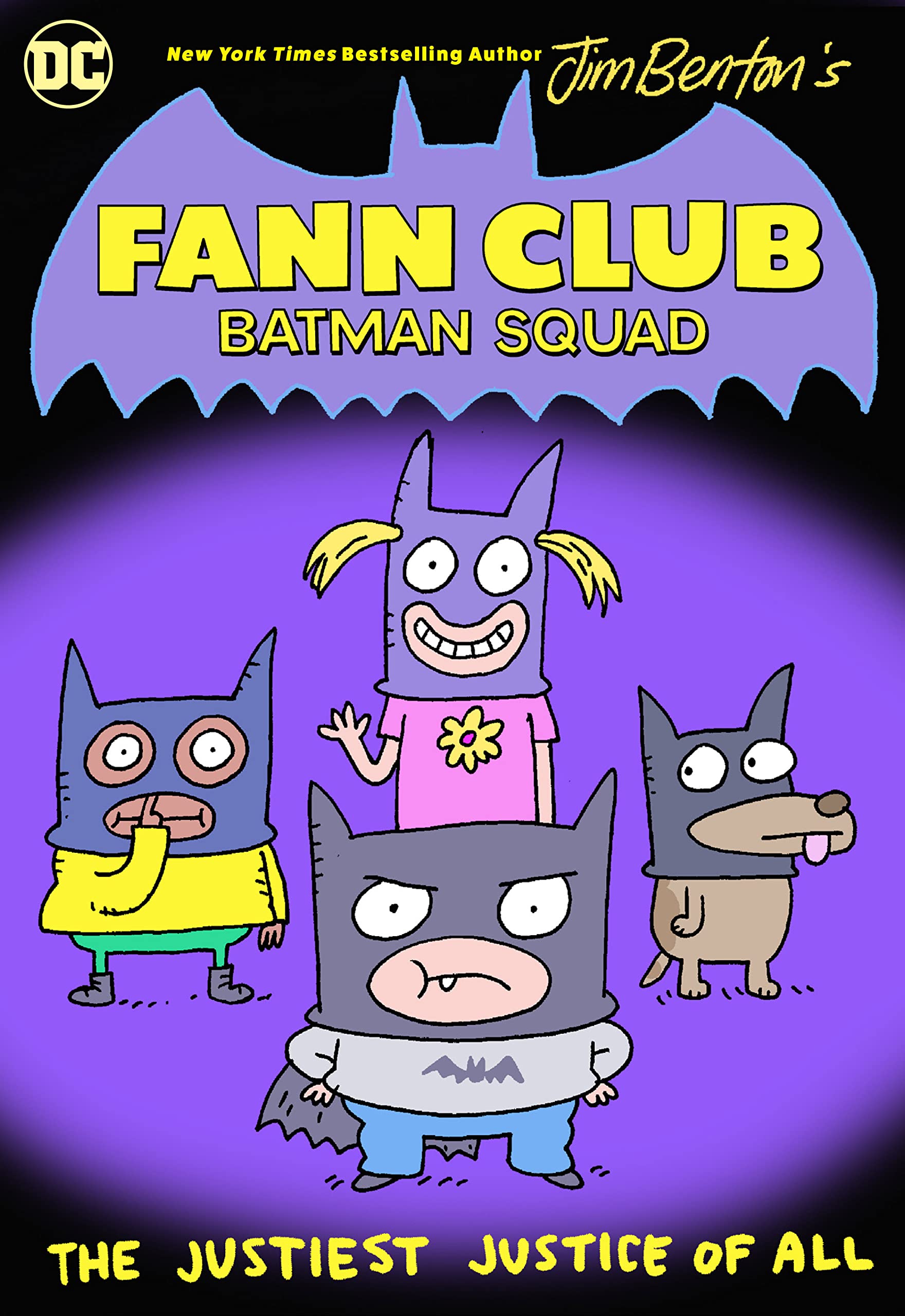
Fann Club: Batman Squad – the Justiest Justice of All


By Jim Benton (DC Comics)
ISBN: 978-1-7795-0889-8 (PB/Digital edition)

In recent years DC has opened up its vast and comprehensive shared superhero universe: generating Original Graphic Novels featuring its many stars in stand-alone adventures specifically tailored for kids and also that tricky demographic so sadly misnamed Young Adult. To date, results have been rather hit or miss, but when they’re good, they are very good indeed…

Another sublime example of the process at its best is this cheery elegy to the joys of crimefighting as channelled through the pristine but so-blinkered purview and perceptions of a youngster who believes in the process with all he’s got…

Ernest Fann is a little kid with a big imagination and a colossal passion. This drive has made him an absolute expert on Superheroes, Vengeance, Justice and The Batman, and that status comes with a necessary burden.

There is anxiety, impatience and even a motivating tragic loss – when something chewed his precious collectors’ item socks. His life is troubled by flashbacks and his sleep by the oddest dreams. It’s a mystery even his dog Westy can’t explain, whilst the neighbours’ kid and babysitter Harriet are completely oblivious to his inner life and secret…

Aware at he is probably the World’s Second Greatest Detective, he swears to share his gifts and the way of the Batman by founding… a fan club.

When willing recruits drawn by his cunning outreach arrive, he clothes them in the costumes he made and code names the (completely anonymous) strangers Night Terrier, Nightstand and Eyeshadow. He, of course, is the mighty Gerbilwing and Evil has never been more scared…

With his Batman Squad equipped it’s ‘Time to Begin: Fanning the Flames’ as their training montage shares secrets – like learning how to scowl and stand mysteriously – before going ‘On Patrol’ to note all the wickedness and mystery besetting the neighbourhood. All those little clues add up to trouble and before long Gerbilwing & Co. are unleashed when they intercept a bank robbery and uncover the true source of all the strange events…

Jim Benton began his illustration work making up crazy characters in a T-Shirt shop and designing greetings cards. Born in 1960, he’d grown up in Birmingham, Michigan before studying Fine Arts at Western Michigan University.

Tirelessly earning a living exercising his creativity, he started self-promoting those weird funny things he’d dreamed up and soon was raking in the dosh from properties such as Dear Dumb Diary, Dog of Glee, Franny K. Stein, Just Jimmy, Just Plain Mean, Sweetypuss, The Misters, Meany Doodles, Vampy Doodles, Kissy Doodles, jOkObo and It’s Happy Bunny via a variety of magazines and other venue…

His gags, jests and japes are delivered in a huge variety of styles and manners: each perfectly in accord with whatever sick, sweet, clever, sentimental, whimsical or just plain strange content each idea demanded, and his SpyDogs effortlessly made the jump to kids’ animated TV success.

He seamlessly segued into best-selling cartoon books (those are the best kind) such as Man, I Hate Cursive, Clyde, Catwad, Jop and Blip Wanna Know, Dog Butts and Love. And Stuff Like That. (And Cats) and Attack of the Stuff. It’ been 10 minutes since I started typing this, so there might be a few more published since then…

Perfectly capturing the wonder of childhood and sheer force of a kid’s unbridled imagination, Fann Club: Batman Squad is hilarious with a huge amount of heart and empathy and literally cloaked in the moody charisma of Frank Miller’s Dark Knight. The combination is utterly irresistible.

Also include is a teaser preview of ‘Young Alfred: Pain in the Butler’, but that’s not the point and can wait for its own review. Here you just need to swear your oath, kit up in your own justice gear and join The Bat Squad ASAP.

Tell them Gerbilwing said it was okay and Eyeshadow would be there to keep things safe…
© 20223 DC Comics. All Rights Reserved.

Fann Club: Batman Squad will be published on June 6th 2023 and is available for pre-order now.

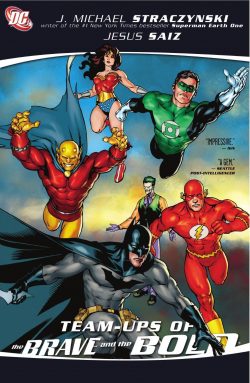
Team-Ups of the Brave and the Bold


By J. Michael Straczynski, Jesus Saiz, Chad Hardin, Justiniano, Cliff Chiang & various (DC Comics)
ISBN: 978-1-4012-2793-7 (HB) 978-1-4012-2809-5 (TPB/Digital edition)

The Brave and the Bold premiered in 1955; an anthology adventure comic featuring short complete tales starring a variety of period heroes and a format mirroring and cashing in on that era’s filmic fascination with historical dramas.

Devised and written by Robert Kanigher, issue #1 led with Roman epic Golden Gladiator, medieval mystery-man The Silent Knight and Joe Kubert’s now legendary Viking Prince. The Gladiator was soon replaced by National Periodicals/DC Comics’ iteration of Robin Hood, and the high adventure theme carried the title until the end of the decade when a burgeoning superhero revival saw B&B remodelled as a try-out vehicle like the astounding successful Showcase.

Deployed to launch enterprising concepts and characters such as Task Force X: The Suicide Squad, Cave Carson, Strange Sports Stories, Hawkman and the epochal Justice League of America, the title then evolved to create a whole sub-genre – although barely anybody noticed at the time…

That innovation was Superhero Team-Ups.

For almost a decade DC had enjoyed great success pairing Superman with Batman and Robin in World’s Finest Comics, and in 1963 sought to create another top-selling combo from their growing pantheon of masked mystery men. It didn’t hurt that the timing also allowed extra exposure for characters imminently graduating to their own starring vehicles after years as back-up features…

This was during a period when almost no costumed heroes acknowledged the jurisdiction or (usually) existence of other costumed champions. When B&B offered this succession of power pairings, they were unknowingly laying foundations for DC’s future close-knit comics continuity. Nowadays, there’s something wrong with any superstar who doesn’t regularly join every other cape or mask on-planet every five minutes or so…

The short-lived experiment eventually calcified as “Batman and…” but, for a while, readers were treated to some truly inspired pairings such as Flash and the Doom Patrol, Metal Men and Metamorpho, Flash and The Spectre or Supergirl and Wonder Woman.

The editors even achieved their aim after Robin, Kid Flash and Aqualad remained together after their initial foray and expanded into the ever-popular Teen Titans

That theme of heroes united together for a specific time and purpose was revived in 2007 for the third volume of The Brave and the Bold, resulting in many exceedingly fine modern Fights ‘n’ Tights classics, and this compilation collects issues #27-33 (November 2009 – June 2010): the first seven issues scripted by TV/comics star scribe J. Michael Straczynski.

The run of easily accessible, stand-alone tales delved into some of the strangest nooks and crannies of the DCU and opens here with ‘Death of a Hero’, illustrated by Jesús Saíz, wherein teenager Robby Reed visits Gotham City and decides to help out a Batman sorely pressed by the machinations of The Joker

The child prodigy had his own series in the 1960s as a kid who found a strange rotary device dotted with alien hieroglyphics that could temporarily transform him into a veritable army of super-beings when he dialled the English equivalents of H, E, R and O…

Here, however, after the lad dials up futuristic clairvoyant Mental Man, the visions he experiences force him to quit immediately and take to his bed…

He even forgets the Dial when he leaves, and it is soon picked up by down-&-out Travers Milton who also falls under its influence and is soon saving lives and battling beside the Dark Knight as The Star. What follows is a meteoric and tragic tale of a rise and fall…

Again limned by Saíz, B&B #28 takes us a wild trip to the ‘Firing Line’ as the Flash (Barry Allen) falls foul of a scientific experiment and winds up stranded in the middle of World War II. Injured and unable to properly use his powers, the diminished speedster is taken under the wing of legendary paramilitary aviator squadron The Blackhawks, but finds himself torn when his scruples against taking life crash into the hellish cauldron of the Battle of Bastogne and his manly, martial love of his new brothers in arms…

Brother Power, The Geek was a short-lived experimental title developed by legendary figure Joe Simon at the height of the hippy-dippy 1960s (or just last week if you’re a baby booming duffer like me).

He/it was a tailor’s mannequin mysteriously brought to life through extraordinary circumstances, just seeking his place in the world: a bizarre commentator and ultimate outsider philosophising on a world he could not understand.

That cerebral angst is tapped in ‘Lost Stories of Yesterday, Today, and Tomorrow’ when the elemental outcast crawls out of wreckage in Gotham City and clashes with Batman as they both strive to save homeless people from authoritarian brutality and greedy arsonists.

Like the times it references, this story is one you have to experience rather than read about…

Straczynski & Saíz play fast and loose with time travel in ‘The Green and the Gold’ as mystic Lord of Order Doctor Fate is helped through an emotional rough patch by Green Lantern Hal Jordan. As a result of that unnecessary kindness, the mage gets to return the favour long after his own demise at the moment the Emerald Warrior most needs a helping hand…

Illustrated by Chad Hardin & Walden Wong and Justiniano, The Brave and the Bold #31 describes ‘Small Problems’ encountered by The Atom after Ray Palmer is asked to shrink into the synapse-disrupted brain of The Joker to perform life-saving surgery. Despite his better judgement, the physicist eventually agrees but nobody could have predicted that he would be assimilated into the maniac’s memories and forcibly relive the Killer Clown’s life…

Straczynski & Saíz reunite as sea king Aquaman and hellish warrior Etrigan the Demon combine forces in a long-standing pact to thwart a revolting Cthonic invasion of ‘Night Gods’ from a hole in the bottom of the ocean before this mesmerising tome concludes with a bittersweet ‘Ladies Night’ from times recently passed, illustrated by Cliff Chiang.

When sorceress Zatanna experiences a shocking dream, she contacts Wonder Woman and Batgirl Barbara Gordon, insisting that they should join her on an evening of hedonistic excess and sisterly sharing. Only Babs is left out of one moment of revelation: what Zatanna foresaw would inescapably occur to her the next day at the hands of the Joker…

Smart, moving and potently engaging, these heroic alliances are a true treat for fans of more sophisticated costumed capers, and skilfully prepared in such a way that no great knowledge of backstory is required. Team-ups are all about finding new readers and this terrific tome is a splendid example of the trick done right…
© 2009, 2010 DC Comics. All Rights Reserved.

Superman/Batman: Saga of the Super Sons


By Bob Haney & Dick Dillin, with Dennis O’Neil, John Calnan, Ernie Chan, Rich Buckler, Kieron Dwyer & various (DC Comics)
ISBN: 978-1-4012-6968-5 (TPB/Digital edition)

Are you now old enough to yearn for simpler times?

The brilliant expediency of the Parallel Earths concept – and especially its contemporary incarnation Infinite Frontier – lends the daftest tale from DC’s vast back catalogue credibility and contemporary resonance, providing a chance that even the hippest and most happening of the modern pantheon can interact with the most utterly outrageous world concept in the company’s nigh-90-year history. It especially doesn’t hurt here, since – following the Rebirth reboot – the actual sons of the Dark Knight and Man of Tomorrow are now part of an established – and therefore “real” – DC Universe.

Thus, this collection of well-told but initially “imaginary” tales from 1972 to 1976, supplemented by some episodes from more self-conscious times, results from another earnest opportunity to make the fundamental allure of stuffy adult characters relevant to kids and teens.

Written by Bob Haney and drawn by Dick Dillin, The Super-Sons appeared without prior preamble or fanfare in World’s Finest Comics #215, (cover-dated January 1973, and hitting newsstands mid-October 1972). It was a tough time for superhero comics, but a great era for teen rebels. Those free-wheeling, easy-rider, end of the flower-power days generated a huge (and lasting) societal refocussing on “teen consciousness”, and the “Generation Gap” was a phrase on almost every lip.

It didn’t hurt that the concept was already tried and tested. Both Man of Steel and Caped Crusader had already been seen as younger versions of themselves many times over the years, and the evergreen dream of characters who would more closely resonate with youngsters never died in editors’ minds. After all, hadn’t original Boy Wonder Robin been created to give readers someone to closely identify with?

The editors – Murray Boltinoff and E. Nelson Bridwell – clearly saw a way to make their perilously old-school so-very establishment characters instantly pertinent and relevant. Being mercifully oblivious to the more onerous constraints of continuity – some would say logic – they simply and immediately generated tales of the maverick sons of the World’s Finest heroes out of whole cloth.

…And smartly-constructed, well told tales they are. Debut outing ‘Saga of the Super Sons!’ (inked by Henry Scarpelli) sees the young warriors as fully realised young rebels running away from home – on the inevitable motorcycle – and encountering a scurrilous gang-lord.

But worry not, their paternalistic parents are keeping a wary eye on the lads! Speaking as one of the original target market for this experiment, I can admit the parental overview grated then and still does, but as there were so many sequels, enough reader must have liked it…

‘Little Town with a Big Secret!’ appeared in the very next issue: another low key human interest tale, but with a science-fiction twist and the superb inking of Murphy Anderson complimenting Haney & Dillin’s tight murder-mystery yarn.

Crafted by the same team, WF # 221 (January-February 1974) featured ‘Cry Not for My Forsaken Son!’ depicting a troubled runaway boy discovering the difference between merit and worth, and the value of a father as opposed to a biological parent, after which #222’s ‘Evil in Paradise’(inked by Vince Colletta) saw young heroes voyage to an undiscovered Eden to resolve the ancient question of whether Man is intrinsically Good or Evil.

‘The Shocking Switch of the Super-Sons’ (WF #224, cover dated July-August and also inked by Colletta) took teen rebellion to its logical conclusion when a psychologist convinces the boys to trade fathers, whereas ‘Crown for a New Batman!’ provides a radical change of pace as Bruce Wayne Jr. inherits the Mantle and the Mission when dad is murdered!

Never fear, all is not as it seems, fans! This thriller – guest starring Robin – appeared in WFC #228, and was inked by Tex Blaisdell, who inked Curt Swan, on more traditional Lost Civilisation yarn ‘The Girl Whom Time Forgot’ in WF#230…

The Relevancy Era was well over by the time Haney, Dillin & Blaisdell crafted ‘Hero is a Dirty Name’ (#231, July 1975), wherein the Sons are forced to question the motivation for heroism in a thriller guest-starring Green Arrow and The Flash.

In #233’s ‘World Without Men’ (inked by John Calnan) the ever-rambling, soul-searching Super-Sons confront sexual equality issues and unravel a crazy plot to supplant human males, after which ‘The Angel with a Dirty Name’ (by the same team in June 1976’s WFC #238) offers a supervillains and monsters slug-fest indistinguishable from any other Fights ‘n’ Tights tale, before the original series fades out with December’s #242’s in ‘Town of the Timeless Killers’. Illustrated by Ernie Chua (nee Chan) & Calnan, it sees the kids trapped in a haunted ghost town and stalked by immortal gunslingers offering a rather low-key and ignominious close to a bold experiment.

Four years later in mid-March 1980, the boys surprisingly showed up in a momentary revival. Cover-dated June-July and courtesy of Denny O’Neil, Rich Buckler & Dick Giordano in WFC #263, ‘Final Secret of the Super-Sons’ shockingly revealed that the boys were no more than a simulation running on the Man of Steel’s futuristic Super Computer.

In a grim indication of how much of a chokehold shared continuity had grown into, they then escaped into “reality” anyway, accidentally wreaking havoc in a manner The Matrix movies would be proud of…

The collection concludes in a short tale by Haney & Kieron Dwyer from Elseworlds 80-Page Giant in 1999. ‘Superman Jr. is No More!’ is a charming, fitting conclusion to this odd, charming and idiosyncratic mini-saga, embracing the original conceit as it posits what would happen if Superman died and his boy was forced to take over too soon…

Supplemented with a full cover gallery by Nick Cardy, Chan, Calnan, Giordano, Ross Andru & Ty Templeton, these classic yarns are packed with potency and wit. If you’ve an open mind and refined sense of adventure, why not take a look at a few gems (and one or two clunkers) from an era where everybody read comics and nobody took them too seriously?
© 1972, 1973, 1974, 1975, 1976, 1980, 1999, 2017 DC Comics. All Rights Reserved.
Showcase Presents Doom Patrol volume 2


By Arnold Drake, Bruno Premiani, Bob Brown & various (DC Comics)
ISBN: 978-1-85768-077-8 (TPB)

In 1963 DC/National Comics converted a venerable anthology-mystery title – My Greatest Adventure into a fringe superhero team-book with #80, introducing a startling squad of champions with their thematic roots still firmly planted in the B-movie monster films of the era which had for so long informed the tone and timbre of the parent title.

That aesthetic subtly shaped the progression of the strip – which took control of the title within months, prompting a title change to The Doom Patrol with #86 – and throughout a 6-year run made the series one of the most eerily innovative and incessantly hip reads of that generation. Happy 60th Anniversary, you “Fabulous Freaks”!

No traditional team of masked adventurers, the cast comprised a robot, a mummy and a 50-foot woman in a mini-skirt, united with and guided by a brusque, domineering, crippled mad scientist, all equally determined to prove themselves by fighting injustice their way…

Two relatively recent compilations are still awaiting a third and final edition to complete the reprint run, and this monochrome tome from 2010 might have to do for some time yet.

Should you be afflicted with the curse of a completist nature, Doom Patrol: The Silver Age volume 1 spans June 1963 to May 1965, re-presenting in full colour My Greatest Adventure #80-85 and Doom Patrol #86-95, whilst Doom Patrol: The Silver Age volume 2 covers June 1965-November 1966 via Doom Patrol #96-107, The Brave and the Bold #65 and Challengers of the Unknown #48. They’re both available digitally, but should you want a comprehensive read-through, that’s going to take a little more effort than we spoiled 21st Centurians are used to…

Spanning March 1966 to their radically bold demise in the September/October 1968 final issue, this quirky monochrome compilation collects their last exploits as seen in Doom Patrol #102 to 121: a landmark run that truly deserves better dissemination…

These creepy Costumed Dramas were especially enhanced by the superb skills of Italian artist Giordano Bruno Premiani, whose comfortably detailed, subtly representational illustration style made even the strangest situation frighteningly authentic and grimly believable.

As such, he was the perfect vehicle to squeeze every nuance of comedy and pathos from the captivatingly involved and grimly light-hearted scripts by Arnold Drake who always proffered a tantalising believably world for the outcast heroes to strive in.

Those damaged champions comprised competitive car racer Cliff Steele, but only after he’d had “died” in a horrific crash, with his undamaged brain transplanted into a fantastic mechanical body – without his knowledge or permission…

Test pilot Larry Trainor was trapped in an experimental stratospheric plane and become permanently radioactive, with the dubious benefit of gaining a semi-sentient energy avatar which could escape his body to perform incredible stunts …for up to a minute at a time. To pass safely amongst men, Trainor had to be perpetually wrapped in radiation-proof bandages.

Former movie star Rita Farr was exposed to mysterious gases on location. These gave her the unpredictable, initially uncontrolled ability to shrink or grow – in part or wholly – to incredible sizes.

The outcasts were brought together by brilliant, enigmatic Renaissance Man Niles Caulder who, as The Chief, sought to mould the solitary misfits into a force for good. The wheelchair-bound savant directed the trio of solitary strangers in many terrifying missions as they slowly grew into a uniquely bonded family…

Here – now firmly established in the heroic pantheon – The Doom Patrol join fellow outsiders The Challengers of the Unknown in #102’s ‘8 Against Eternity!’: battling murderous shape-shifter Multi-Man and his robotic allies as they seek to unleash a horde of zombies from a lost world upon modern humanity

Meanwhile, super-rich Steve Dayton – who had created a psycho-kinetic superhero persona Mento solely to woo and wed Rita, met outrageous, obnoxious Gar Logan. It was disgust at first sight, but neither the ruthless, driven billionaire authority figure nor wildly rebellious Beast Boy realised how their lives would soon entwine…

Whilst a toddler in Africa, Logan had contracted a rare disease. Although his scientist parents’ experimental cure beat the contagion before they died, it left him the colour of cabbage and able to change shape at will. A protracted storyline commenced in #100 wherein the secretive, chameleonic kid revealed how he was now an abused orphan being swindled out of his inheritance by his unscrupulous guardian Nicholas Galtry. The greedy, conniving accountant had even leased his emerald-hued charge to rogue scientists…

Rita especially had empathised with Gar’s plight and resolved to free him from Galtry whatever the cost…

DP #103 held two tales, beginning with a tragedy ensuing after Professor Randolph Ormsby sought the team’s aid for a space shot. When the doddery savant mutates into flaming monster ‘The Meteor Man’ it takes the entire patrol plus Beast Boy and Mento to save the day.

‘No Home for a Robot’, continues unpacking the Mechanical Man’s early days following Caulder’s implantation of Cliff’s brain into an artificial body. The shock had seemingly driven the patient crazy as Steele went on a city-wide rampage, hunted and hounded by the police. Here, the ferrous fugitive finds brief respite with his brother Randy, before realising that trouble would trail him anywhere…

DP #104 astounded everyone as Rita abruptly stopped refusing loathsome Steve to become ‘The Bride of the Doom Patrol!’ However, her star-stuffed wedding day is almost ruined when alien arch-foe Garguax and The Brotherhood of Evil crash the party to murder the groom. So unhappy are Cliff and Larry with Rita’s “betrayal” that they almost let them…

Even whilst indulging her new bride status in #105, Rita can’t abandon the team and joins them in tackling old elemental enemy Mr. 103 during a ‘Honeymoon of Terror!’ before back-up yarn ‘The Robot-Maker Must Die’ concludes Cliff Steele’s origin as the renegade attempts to kill the mystery surgeon who had imprisoned him in a metal hell… finally giving Caulder a chance to fix a long-term malfunction in Steele’s systems…

‘Blood Brothers!’ in #106 introduces domestic disharmony as Rita steadfastly refuses to be a good trophy wife: resuming the hunt for Mr. 103 with the rest of the DP. Her separate lives continue to intersect, however, when Galtry hires that elemental assassin to wipe Gar and his freakish allies off the books…

The back-up section shifts focus onto ‘The Private World of Negative Man’: recapitulating Larry Trainor’s doomed flight and the radioactive close encounter that turned him into a walking mummy. However, even after being allowed to walk amongst men again, the gregarious pilot finds himself utterly isolated and alone…

Doom Patrol #107 began an epic story-arc concerning ‘The War over Beast Boy!’ as Rita and Steve open legal proceedings to get Gar and his money away from Galtry. The embezzler responds by commencing a criminal campaign to beggar Dayton which inadvertently aligns him with the team’s greatest foes. Already distracted by the depredations of marauding automaton Ultimax, the hard-pressed heroes swiftly fall to the murderous mechanoid as Rita is banished to a barbaric sub-atomic universe…

The secret history of Negative Man resumes with ‘The Race Against Dr. Death!’ when fellow self-imposed outcast Dr. Drew draws the pilot into a scheme to destroy the human species which had cruelly excluded them both, before Larry’s ebony energy being demonstrates the incredible power it possesses by saving the world from fiery doom.

In #108, ‘Kid Disaster!’ sees Mento diminished and despatched to rescue Rita whilst Galtry’s allies reveal their true nature before ambushing and killing the entire team…

…Almost.

Despite only Caulder and Beast Boy remaining, our exceedingly odd couple nevertheless pull off a major medical miracle: reviving the heroes in time to endure the incredible attack of alien colossus ‘Mandred the Executioner!’ whilst Larry’s ‘Flight into Fear’ at the comic’s rear proves that Drew hasn’t finished with the itinerant Negative Man yet…

DP #110 wonderfully wraps up the Beast Boy saga as Galtry, Mandred and the Brotherhood marshal one last futile attack before the ‘Trial by Terror!’ finally finds Logan legally adopted by newlyweds Mr. and Mrs. Dayton. Sadly, it’s a prelude to a titanic extraterrestrial invasion in #111, which heralds the arrival of ‘Zarox-13, Emperor of the Cosmos!’

The awesome overlord and his vanguard Garguax make short work of the Fabulous Freaks and, with all Earth imperilled, an unbelievable alliance forms, but not before ‘Neg Man’s Last Road!’ ends Trainor’s tale as the alienated aviator again battles Dr. Death, before joining a band of fellow outcasts in a bold new team venture…

Unbelievably, the uneasy alliance of the DP with The Brain, Monsieur Mallah and Madame Rouge as ‘Brothers in Blood!’ in #112 results in no betrayals and the last-minute defeat of the invincible aliens.

Moreover, although no rivalries were reconciled, a hint of romance does develop between two of the sworn foes, whilst at the back, untold tales of Beast Boy begin as ‘Waif of the Wilderness’ introduces millionaire doctors Mark and Marie Logan whose passion for charity took them to deepest Africa and into the sights of native witch-man Mobu who saw his powerbase crumbling…

When their toddler Gar contracts dread disease Sakutia, the parents’ radical treatment saves their child and grants him metamorphic abilities, but as they subsequently lose their lives in a river accident, the baby boy cannot understand their plight and blithely watches them die.

Orphaned and lonely, he inadvertently saves the life of a local chief with his animal antics and is adopted, …making of Mobu an implacable, impatient enemy…

Doom Patrol #113 pits the team against a malevolent mechanoid one-man army in ‘Who Dares to Challenge the Arsenal?’ but the real drama manifests in a subplot showing Caulder seeking to seduce schizophrenic Rouge away from the lure of wickedness and malign influence of the Brotherhood of Evil.

The issue includes another Beast Boy short as ‘The Diamonds of Destiny!’ finds two thieves kidnapping the amazing boy, just as concerned executor Nicholas Galtry takes ship for the Dark Continent to find the heir to his deceased employer’s millions…

DP #114 opens with the team aiding Soviet asylum seeker Anton Koravyk and becoming embroiled in a time-twisting fight against incredible caveman ‘Kor – the Conqueror!’ whilst Beast Boy segment ‘The Kid who was King of Crooks!’ sees toddler Gar turned into a thief in Johannesburg… until his Fagin-ish abductors have a fatal falling out…

The next issue debuts ‘The Mutant Master!’: pitting the team against three hideous, incomprehensibly powerful atomic atrocities resolved to eradicate the world which had cruelly treated them. Things might have fared better had not the Chief neglected his comrades in his obsessive – and at last successful – pursuit of Madame Rouge…

Also included is ‘General Beast Boy – of the Ape Brigade!’, wherein a Nazi war criminal is accidentally foiled by lost wanderer Gar. The madman’s loss is Galtry’s gain, however, as his search ends with the crook “rescuing” Logan and taking him back to safe, secure America…

The mutant maelstrom concludes in #116 as ‘Two to Get Ready… and Three to Die!’ features Caulder saving Earth from mutant-triggered obliteration to reap his reward in a passionate fling with the cured – but still fragile – Rouge.

The wheelchair wonder seizes centre stage in #117 as his neglect drives the team away, leaving him vulnerable to attack from a mystery man with a big grudge in ‘The Black Vulture!’, before a reunited squad deals with grotesque madman ‘Videx, Monarch of Light!’ even as the Brain challenges Caulder to return his stolen chattel Rouge. Nobody thought to ask her what she wanted, though, and that’s a fatal oversight…

Tastes were changing in the turbulent late 1960s and the series was in trouble. Superheroes were about to plunge into mass decline, and the creators addressed the problem head-on in #119: embracing psychedelic counter culture in a clever tale of supernal power, brainwashing and behaviour modification leaving the DP cowering ‘In the Shadow of the Great Guru!

An issue later they faced a furious Luddite’s ‘Rage of the Wrecker!’ when a crazed scientist declares war on technology – including the assorted bodies keeping Cliff alive…

The then-unthinkable occurred next and the series spectacularly, abruptly ended with what we all believed at the time to be ‘The Death of the Doom Patrol!’

Faced with cancellation, Editor Murray Boltinoff and creators Drake & Premiani wrapped up all the long-running plot threads as spurned Madame Rouge goes off the deep end and declares war on both the Brain and Caulder’s “children”…

Blowing up the Brotherhood, she attacks the city until the DP remove themselves to an isolated island fortress. Even there they are not safe and her forces ambush them…

Captured and facing death, Rouge offers mercy if they abandon their principles and allow her to destroy a village of 14 complete strangers in their stead…

At a time when comics came and went with no fanfare and cancelled titles seldom provided any closure, the sacrifice and death of the Doom Patrol was a shocking event for us youngsters. We wouldn’t see anything like it again for decades – and never again with such style and impact…

With the edge of time and experience on my side, it’s obvious just how incredibly mature Drake & Premiani’s take on superheroes was, and these superbly engaging, frenetically fun and breathtakingly beautiful stories rightfully rank amongst the very best Fights ‘n’ Tights tales ever told.

Even the mercilessly exploitative many returns of the team since can’t diminish that incredible impact, and no fan of the genre or comic dramas in general should consider their superhero education complete until they’ve seen these classics. Let’s hope DC wise up quickly and release that final volume soon…
© 1966, 1967, 1968, 2010 DC Comics, Inc. All Rights Reserved.

Deadman: Book Two


By Arnold Drake, Jack Miller, Bob Haney, Dennis O’Neil, Carmine Infantino, Neal Adams, George Tuska, George Roussos & various (DC Comics)
ISBN: 978-1-4012-3388-4 (TPB/Digital edition)

As the 1960s ended, a massive superhero boom became a slow but certain bust, with formerly major successes no longer able to find enough readers to keep them alive. The appetite for superheroes was paling in favour of resurgent traditional genres. One rational editorial response was to reshape costumed characters to fit evolving contemporary tastes.

Publishers swiftly changed gears with even staid, cautious DC reacting rapidly: making over masked adventurers to fit a new landscape. Newly revised, revived features included roving mystic troubleshooter The Phantom Stranger and Golden Age colossus The Spectre, whilst established genres spawned atrocity-faced WWII spy Unknown Soldier and bounty hunter Jonah Hex, western avenger El Diablo and game-changing monster hero Swamp Thing, the vanguard of a torrent of new formats, anthologies and concepts.

Moreover, supernatural themes were shoehorned into superhero titles weathering the trend-storm. Arguably, the moment of surrender and change had arrived with the creation of Boston Brand in the autumn of “The Summer of Love”, when venerable science fiction anthology Strange Adventures was abruptly retooled as the haunted home of an angry ghost…

Without fanfare or warning, Deadman debuted in #205 (cover-dated October 1967), with this second collection (of five) proving that changing times and tastes demanded different defenders. This was one champion who was infinitely adaptable…

The previous volume revealed how the ghostly grouch was born by assassination and how his picaresque journey was primary steered by youthful, idealistic iconoclast Neal Adams. He was born on June 15th 1941 at Governors Island, New York City. The family were career military and Neal grew up on bases across the world. In the late 1950s, he studied at the High School of Industrial Art in Manhattan, graduating in 1959.

As the turbulent, Sixties began, he was a budding illustrator working in advertising, ghosting newspaper strips and seeking to break into comics. Whilst pursuing a career in “real” and “commercial” art, he did pages for Joe Simon at Archie Comics (The Fly and that red-headed kid, too) before becoming one of the youngest artists to co-create/illustrate a major licensed newspaper strip (Ben Casey – based on a popular TV medical drama). The neophyte’s attempts to break in at DC were not so successful…

Comic book fascination never faded, and as the decade progressed, Adams drifted back to National/DC: creating covers as inker or penciller. His chance came via anthological war comics:,he eventually found himself at the vanguard of a revolution in pictorial storytelling…

He made such a mark that decades later, DC celebrated his contributions by reprinting every piece of work Adams ever did for them in commemorative collections. Sadly, we’re still awaiting a definitive book of his horror comics and covers, and will probably never see his sterling efforts on licensed titles like Hot Wheels, The Adventures of Bob Hope and The Adventures of Jerry Lewis. That’s a real shame: they all display his wry facility for gag staging and personal drama…

Moreover, Adams was a tireless campaigner for creators’ rights, whose efforts finally secured some long-ignored liberties and rewards for the formerly invisible stars of comic books…

Preceded by Adams’ introduction ‘Why I Chose Deadman as My Project on my Summer Vacation’ – detailing the transition from Carmine Infantino to Adams on the series and its abrupt cancellation – the afterlife of a reluctant and selfish spectral stalwart resumes with Brave & Bold #79 (August/September 1968): heralding Adams’ assumption of interior art duties on that title and launching a groundbreaking run rewriting the rulebook for strip illustration.

Written by Bob Haney, ‘The Track of the Hook’ paired the Gotham Guardian with a justice-obsessed ghost. Former trapeze artist Brand was hunting his own killer, and his earthy human tragedy elevated Batman’s costume theatrics into deeper, more mature realms of drama and action. It was probably mainstream superhero fandom’s first glimpse of the ghost…

During this period, Adams was writing and illustrating Brand’s solo stories in Strange Adventures and although his consultation of the World’s Greatest Detective bore little useful progress it had provided the lonely ghost with a true point of human contact…

As a living “Deadman”, Brand had been star attraction of Hills Circus: lover of its reluctant owner Lorna Carling, and a secret guardian for the misfits it employed. That makeshift “family” included simple-minded strongman Tiny and Asian mystic Vashnu, but also had a few bad eggs too…

One fateful night, as soon as he started his act – 40 feet up and without a net – someone put a rifle slug into Brand’s heart…

Despite being dead before he hit the ground, Brand was scared and furious. Nobody could see or hear him screaming, and Vashnu babbled on that he was the chosen of Rama Kushna – the spirit of the universe. The unbelievable hokum proved horribly true as the entity contacted him, telling Brand he would walk among men until he found his killer…

The sentence came with some advantages: he was invisible, untouchable, immune to the laws of physics and able to possess living bodies and drive them like a car. His only clue was that witnesses claimed that a man with a hook had shot him…

Outraged, still disbelieving and seemingly stuck forever in the ghastly make-up and outfit of his performing persona, Boston began a random investigation of everyone he could think of who might want him gone. Gradually, small petty miscreants and human-scaled sins gave way to a fantastic global conspiracy…

Early stories focused on people worn by Brand in episodic encounters mimicking the protagonist of contemporary TV series The Fugitive – and by extension, Victor Hugo’s Les Misérables. That search for personal justice took him all across America to the benefit of many people in crisis but, as pieces fitted together, Brand learned he had been singled out for a dark destiny…

Back in Strange Adventures # 214 (cover-dated September/October 1968). Robert Kanigher scripted To Haunt a Killer’ as Brand is seduced by loneliness into sharing the romantic experiences of Phil and his lovely girlfriend Ruth. That salacious intrusion sours once Brand discovers his new meat suit is a hitman and his overreaction almost cost innocent Ruth everything…

When Adams returns to full control in #215, the narrative arc takes a huge leap forward as ‘A New Lease on Death’ accidentally drops his killer in his lap. Witnessing a murder, Deadman trails the shooter all the way to Hong Kong where he exposes an ancient, super-advanced League of Assassins and discovers the truly trivial reason for his own extinction…

Furiously questioning ‘Can Vengeance Be So Hollow?’, Brand meets for the first time killer mystic The Sensei – a master murderer who has dealt with ghosts before and experiences the end of the Hook…

When the sinister sage executes Boston’s death-long quarry, Rama Kushna asks if a balance has been struck before capitalising on Brand’s furious negative response. Boston demands true justice for everyone and inadvertently elects himself the agent of its enactment in ‘But I Still Exist’

The drama opens Strange Adventures #216 (January/February 1969), as the grim ghost seeks to disrupt the Sensei’s next scheme: the violent erasure of a fanciful Tibetan Shangri La. Nanda Parbat is a sanctuary for the wicked where his murderous recruits and other fallen folk live in inexplicable peace, harmony and safety. Such a paradise is bad for the business of murder…

Deadman’s efforts to save the city from invasion initially falter when he flies in and suddenly becomes a living, breathing person again…

And that’s where the story ended as his Strange Adventures run ended without warning. The next issue began reprints of Adam Strange and The Atomic Knights as the title reverted to is sci fi roots…

Although his own series had stalled, Deadman stuck around as a perennial walk-on (float-on?) star in many titles, beginning with a return engagement with Batman as the year ended. The Brave & the Bold #86 (October/November 1969) found Boston Brand back in Gotham City, where a string of civilian strangers inexplicably targeted the Caped Crimebuster. The “World’s Greatest Detective” soon deduced that they were possessed by his former ally and that You Can’t Hide from a Deadman!’

Scripted by Haney, the captivating epic of death, redemption and resurrection pulled together all the floating strands from Deadman’s anticlimactic last issue in a classic clash that became a cornerstone of Bat-mythology forever after. Here, Adams’ concepts and art revealed how Nanda Parbat was under attack by the Sensei’s forces, and how Brand had been briefly brainwashed to attack the Gotham Guardian, in advance of a last-ditch defence of the holy city by the Dark Knight and Deadman’s possessed twin brother Cleveland Brand

Deadman rematerialized mere months later in a triptych of back-up tales interwoven into a larger but no-less-revolutionary Aquaman storyline (for the full story see Aquaman: Deadly Waters link please) wherein the Sea King is despatched to a Microverse by aliens working with super villain Ocean Master: a plot accidentally uncovered by Brand, when guilt drags him from a life of solid recuperation back to the intangible quest for cosmic justice…

Here, from Aquaman #50-52 (spanning March/April – July/August 1970), ‘Deadman Rides Again!’ in supplemental tales written and illustrated by Adams: a complex braided crossover as Aquaman endures bizarre threats and incomprehensible rituals in his exile realm, whilst Brand acts invisibly and intangibly to save the hero and prevent an alien invasion.

‘The World Cannot Wait for a Deadman’ sees the spirit flitting between dimensions with shapeshifting enigma Tatsinda, before parallel plots converge and complete when ‘Never Underestimate a Deadman’ sees the extraterrestrials beaten by the ghost and his new pal…

Deadman’s harrowing haunting dramas pause – for now – with another non-team-up from Challengers of the Unknown #74 (cover-dated June/July 1970). A far eerier affair tailored to the rise in supernatural terror tales, ‘To Call a Deadman’ is written by Dennis O’Neil, with George Tuska limning scenes featuring the still-breathing “Death-Cheaters”, whilst Adams illustrated those portions focussed on Brand as he imperceptibly aids them in thwarting an ethereal psychic kidnapper seeking to steal a little girl’s spirit. The chilling thriller also guest-stars hardboiled private eye Jonny Double and everyone is needed to defeat the ghastly menace…

With groundbreaking covers by Adams and Biographies of key ‘Contributors’ Adams, Haney, Kanigher, O’Neil and Tuska, this graphic grimoire perfectly captures the tone of an era in transition through a delirious run of comics masterpieces that no ardent art lover or fanatical fear aficionado can do without.
© 1968, 1969, 1970, 2012 DC Comics. All Rights Reserved.