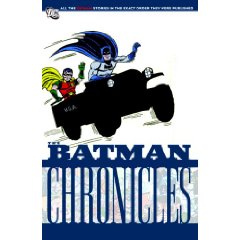
Batman Chronicles volume 7


By Bob Kane, Bill Finger, Jerry Robinson & various (DC Comics)
ISBN: 978-1-84856-176-2

This seventh volume of chronological Batman yarns covers Batman #12-13, Detective Comics #66-70 and World’s Finest Comics #7, and features adventures that were produced during the darkest days of World War II. I’m sure it’s no coincidence that many of these Golden Age treasures are also some of the best and most reprinted tales in the Batman canon. With chief writer Bill Finger at a peak of creativity and production, everybody on the Home Front was keen to do their bit – even it that was simply making kids of all ages forget their troubles for a brief while…

‘The Crime of Two-Face’, (Detective Comics #66, August 1942) by Finger, Bob Kane and Jerry Robinson, is a classical tragedy in crime-caper form as Gotham DA Harvey Kent (the name was later changed to Dent) was disfigured in court and went mad – becoming the conflicted villain who remains one of the Caped Crusader’s greatest foes.

Batman #12 (Aug/Sept 1942) follows with another four classics. ‘Brothers in Crime’ by Don Cameron and Jerry Robinson, reveals the tragic fates of a criminal family whilst the Joker returns in ‘The Wizard of Words’ by Finger, Kane Robinson and George Roussos. Jack Burnley illustrated the spectacular daredevil drama ‘They Thrill to Conquer’ and ‘Around the Clock with Batman’ recounts a typical “day in the life” of the Dynamic Duo complete with blazing guns, giant statues and skyscraper near-death experiences.

From World’s Finest Comics #7 (Fall 1942) comes an imaginative thriller ‘The North Pole Crimes!’ whilst Detective Comics #67 features the Penguin as ‘Crime’s Early Bird!’ before Two-Face’s personal horror-story continues in ‘The Man Who Led a Double Life’ from #68.

Batman #13 (Oct/Nov 1942) tugged heartstrings as ‘The Batman Plays a Lone Hand’ but was on more traditional ground when the Joker organized a ‘Comedy of Tears’ (by Jack Schiff, Kane, Robinson & Roussos), and although ‘The Story of the Seventeen Stones!’ (drawn by Burnley) is a deliciously experimental murder-mystery, the heroes slipped into comfortable Agatha Christie – or perhaps Hitchcock territory – as they tackled a portmanteau of crimes on a train in Cameron, Kane, Robinson and Roussos’ ‘Destination: Unknown!’

Joseph Greene scripted the Joker’s next escapade in the marvelous case of ‘The Harlequin’s Hoax!’ from Detective Comics #68 and this brilliant book concludes with the decidedly different threat of ‘The Man Who Could Read Minds!’ another off-beat thriller from Don Cameron that premiered in Detective Comics #70.

This wonderful series of Golden Age greats is one of my absolute favourite collected formats: paper that feels comfortingly like newsprint, vivid colours applied with a gracious acknowledgement of the power and limitations of the original four-colour printing process and the riotous exuberance of an industry in the first flush of success The tales here show the creators and the characters at their absolute peak and they’re even more readable now that I don’t have to worry if I’m wrecking an historical treasure simply by turning a page. I can only pray that other companies like Marvel, Archie and the rest follow suit.

Soon.

© 1942, 2009 DC Comics. All Rights Reserved.

Joker


By Brian Azzarello & Lee Bermejo, with Mick Gray and Patricia Mulvihill (DC Comics/Titan Books Edition)
ISBN: 978-1-84576-983-3

I’m going to voice what is probably a minority opinion here, so please be aware that this is possibly one of those books that you’ll need to make your own mind up about – but then again, aren’t they all?

Brian Azzarello and Lee Bermejo have, singly and in partnership, created some of the best and most popularly received comics tales of the last decade or so: tough, uncompromising, visually memorable yarns that explore the darkest facets of human nature, yet with a deep core of sardonic wit – thoroughly readable, always-challenging.

So a book dedicated to the grotesque antithesis and ultimate foe of the coldly logical Dark Knight would seem like the ideal vehicle for their talents and particular world-views…

The Joker is getting out of Arkham Asylum. Incredibly, the Clown Prince of Crime and undisputed ruler of all Gotham City’s rackets has been judged sane. He’s coming out, and he’s going to want his old position back. The mobsters that now run the city are terrified but resigned. He’s coming back, so somebody has to go get him…

Made Man on a downward spiral Johnny Frost volunteers to be the guy, becoming his chauffeur and bodyguard in the process. The Joker is murderous time-bomb everybody expects to explode at any moment, and as soon as he hits the City he recruits Killer Croc as his enforcer, and begins to work his way back to the top of the heap, using his reputation and horrify propensity for Baroque bloodletting the way a rattlesnake uses his tail.

Many of Batman’s rogues’ gallery (Penguin, Two-Face, Riddler and so on) are in attendance in various uncharacteristic positions of nefarious authority, and the events – narrated with growing desperation by helpless witness Johnny Frost – spiral towards an inevitable and bloody climax of madness and conflict, but I couldn’t shake the feeling that this was just another post-modern take on the classic gangster plot of a ruthless thug reclaiming his territory.

No matter how beautiful or well executed (and it is), nor how much overlap there is with the Dark Knight film (despite company denials it seems like lots to me, at least in terms of look and feel) this just does not work as Joker story. Scar-Face, Blackmask, Maxie Zeus, even a real criminal like Al Capone perhaps, but the Joker isn’t a “Goodfella” with a grudge and some gory peccadilloes: he’s the ultimate expression of random, bloody chaos, a bundle of “Impulse Issues” wrapped tight in a spiky ball of psychosis…

Apparently devised as a miniseries and “promoted” to a high-profile original hardback before release, this is a taut and nasty thriller, immaculately illustrated: but there’s very little Batman in there, and no Joker at all…

© 2008 DC Comics. All Rights Reserved.

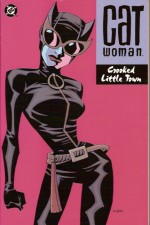
Catwoman: Crooked Little Town


By Ed Brubaker, Brad Rader, Cameron Stewart, Rick Burchett& various (DC Comics)
ISBN13: 978-1-84023-736-8

Seamlessly progressing from her reinvention in Selina’s Big Score (ISBN: 1-84023-773-3) and Catwoman: the Dark End of the Street (ISBN: 978-1-84023-567-8) the new, socially conscious defender of the underclass inhabiting Gotham City’s down-market East End District finds herself battling another gang pushing drugs in her preserve. This time however, the very guilty parties responsible seem to come from Gotham’s wealthy aristocracy. Also hungry to finger a few expensive collars is the relentless old gumshoe Slam Bradley and even Selina’s protégé Holly Robinson.

The crusade takes a dark turn when an undercover cop is murdered by his own dirty colleagues and Holly is framed for the deed. Selina and Bradley have their work cut out to survive the dirty, violent, twilight world to save the young ingénue, but behind even the artistos there’s another mastermind at work, familiar and chillingly deadly…

The four part ‘Disguises’ by Ed Brubaker, Brad Rader, Cameron Stewart and Rich Burchett is book-ended by the prequel ‘Trickle Down Theory’ and the splendidly cathartic glimpse into Selina’s past ‘Joy Ride’ (originally published as Catwoman #5-10) and complemented by the excellent and revelatory closing tale ‘The Many Lives of Selina Kyle’ by Brubaker, Michael Avon Oeming and Mike Manley, taken from Catwoman Secret Files #1.

As grim and gritty as a comic can get without become “adults only”, yet still finding room for breakneck fun and adventure, the ongoing transition from sleek, sexy cat-burglar to tarnished champion of the forgotten is a masterpiece of skillful storytelling whilst the moody, stylish art made this particular cat’s life (her fourth, I think) a series to cherish. Irresistibly readable, this is superhero shtick at its finest. Fans of caper movies, Noir thrillers and just plain literate thrill-seekers should take note…

© 2002 DC Comics. All Rights Reserved.

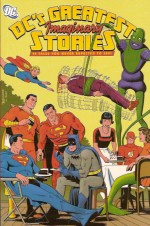
DC’s Greatest Imaginary Stories


By various (DC Comics)
ISBN13: 978-1-4012-0534-8

Alan Moore’s famous epigram notwithstanding not all comics tales are “Imaginary Stories.” When DC Editor Mort Weisinger was expanding the Superman continuity and building the legend he knew that the each new tale was an event that added to a nigh-sacred canon: that what was written and drawn mattered to the readers. But as an ideas man he wasn’t going to let that aggregated “history” stifle a good idea, nor would he allow his eager yet sophisticated audience to endure clichéd deus ex machina cop-outs to mar the sheer enjoyment of a captivating concept.

The mantra known to every baby-boomer fan was “Not a Dream! Not a Hoax! Not a Robot!” boldly emblazoned on covers depicting scenes that couldn’t possibly be true… even if it was only a comic book.

Imaginary Stories were conceived as a way of exploring non-continuity plots and scenarios devised at a time when editors believed that entertainment trumped consistency and knew that every comic read was somebody’s first …or potentially last.

This jolly tome celebrates that period when whimsy and imagination were king and stretches the point by leading with a fanciful tale of the World’s Mightiest Mortal as ‘Captain Marvel and the Atomic War’ (Captain Marvel Adventures #66, October 1946) actually hoaxes the public with a demonstration of how the world could end in the new era of Nuclear Proliferation, courtesy of Otto Binder and CC Beck.

‘The Second Life of Batman’ (Batman #127 October 1959) by Bill Finger, Dick Sprang and Charles Paris doesn’t really fit the definition either, but the tale of a device that predicts how Bruce Wayne’s life would have run if his parents had not been killed is superb and engaging all the same.

‘Mr. and Mrs. Clark (Superman) Kent!’ by Binder and the brilliant Kurt Schaffenberger, was the first tale of an occasional series that began in Superman’s Girlfriend Lois Lane #9 (August 1960), depicting the laughter and tears that might result if the plucky news-hen secretly married the Man of Steel. From an era uncomfortably parochial and patronizing to women, there’s actually a lot of genuine heart and understanding in this tale and a minimum of snide sniping about “silly, empty-headed girls”.

Eventually the concepts became so bold that Imaginary Stories could command book length status. ‘Lex Luthor, Hero!’ (Superman #149, November 1961) by Jerry Siegel, Curt Swan and Sheldon Moldoff, recounts the mad scientist’s greatest master-plan and ultimate victory in a tale as powerful now as it ever was. In many ways this is what the whole concept was made for…

No prizes for guessing what ‘Jimmy Olsen Marries Supergirl!’ (Superman’s Pal Jimmy Olsen, #57, December 1961) is about, but the story is truly a charming delight, beautifully realized by Siegel, Swan and Stan Kaye.

‘The Origin of Flash’s Masked Identity!’ (The Flash# 128, May 1962) by John Broome, Carmine Infantino and Joe Giella, although highly entertaining, is more an enthusiastic day-dream than alternate reality, and, I suspect, added to bring variety to the mix – as is the intriguing ‘Batman’s New Secret Identity’ (Batman #151, November 1961, by Finger, Bob Kane and Paris).

‘The Amazing Story of Superman-Red and Superman-Blue!’ (Superman #162, July 1963) is possibly the most influential tale of this entire sub-genre. Written by Leo Dorfman, with art from Swan and George Klein, this startling utopian classic was so well-received that decades later it influenced and flavoured the post-Crisis on Infinite Earths Superman continuity for months.

The writer of ‘The Three Wives of Superman!’ is currently unknown to us but the ever-excellent Schaffenberger can at least be congratulated for this enchanting tragedy of missed chances that originally saw print in Superman’s Girlfriend Lois Lane #51, from August 1964.

‘The Fantastic Story of Superman’s Sons’ (Superman #166, November 1964) by Edmond Hamilton, Swan and Klein is a solid thriller built on a tragic premise (what if only one of Superman’s children inherited his powers?), and the book closes with the stirring and hard-hitting ‘Superman and Batman… Brothers!’, wherein orphaned Bruce Wayne is adopted by the Kents, but cannot escape a destiny of tragedy and darkness.

Written by Jim Shooter, with art from Swan and Klein, for World’s Finest Comics # 172 (December 1967) this moody thriller in many ways signalled the end of the care-free days and the beginning of a grittier, more cohesive DC universe for a less whimsical, fan-based audience.

This book is a glorious slice of fancy, augmented by an informative introduction by columnist Craig Shutt, and bolstered with mini-cover reproductions of many tales that didn’t make it into the collection, but I do have one minor quibble: No other type of tale was more dependent on an eye-catching cover, so why couldn’t those belonging to these collected classics have been included here, too?

© 1946, 1959-1964, 1967, 2005 DC Comics. All Rights Reserved

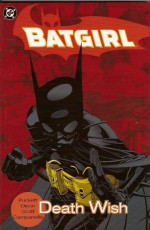
Batgirl: Death Wish


By Kelley Puckett, Chuck Dixon, Damion Scott & Robert Campanella (DC Comics)
ISBN: 978-1-84023-707-8

Here’s another chronologically complex but swift-moving, sure-footed combat classic featuring Cassandra Cain, the third and by far most competent and compelling Batgirl.

When Gotham City was devastated by an earthquake and abandoned by the US government (Batman: Cataclysm ISBN13: 978-1-56389-527-2 and Batman: No Man’s Land Volumes 1-3, ISBN 13’s: 978-1-56389-564-7, 978-1-56389-599-9 & 978-1-56389-634-7 respectively), a few heroes stayed to protect the innocent. One of these was a new, mute incarnation of Batgirl.

The crisis ended and a semblance of normality returned to the battered metropolis. The new heroine was brought under the wing of Barbara Gordon, wheelchair-bound crime-fighter Oracle (and the previous Batgirl) who now runs the Birds of Prey.

Cassandra, unable to communicate in any manner but fluent in gesture reading and body-language, was raised as an experiment by super-assassin David Cain. Her brain’s language centres opened by a telepath, Cassandra was beginning to adapt to a normal world, when she encountered Lady Shiva – the most dangerous person on Earth.

This ultimate martial artist was initially defeated but the two agreed to meet again in a year – in one final death match.

This fourth collection of tales gathers together Batgirl #17-20, 22, 23, 25, and Batgirl Secret Files #1: a seemingly disjointed array of stories that read perfectly well in this order and clearly show how the old-fashioned stand-alone story can still work in a modern milieu.

Kelley Puckett is a master of fast-paced, visual story-telling, allowing the artist to carry the tales in frenetic bursts of information in motion. Pages go by without a single word and this discipline carries the reader through the adventures at dizzying speeds. Here Damion Scott and Robert Campenella give full rein to their cinematic impulses as the new Batgirl prepares for her date with death by invading a US government spook base in search of a corrupt agent, repeatedly trips over Boy Wonder Robin as both discover they’re working the same case from opposite ends, and explores the ramifications of the death penalty – by far and away the best and most troubling tale in the book – when she intervenes in the execution of a felon she’d previously captured…

Throughout these tales (if I’m vague it’s because most of the little gems are inexplicably untitled) Cassandra’s problems with speech and inability to read are handled cleverly and with sensitivity, and when Chuck Dixon guest-scripts a telling and bitterly funny parable about families that singular McGuffin is the trigger for Batgirl to join Stephanie Brown (the hero-in-training called Spoiler) in an attempt to handle the fallout of a kidnapping gone bad.

Puckett resumes with a moody tale as David Cain returns to Gotham with a contract to kill one of the “Bat-Squad”, and in the penultimate story ‘Little Talk’ Batman and Oracle debate the young hero’s motivation in meeting Shiva again in a moody prelude to the climactic ‘I am Become Death, Destroyer of Worlds’ which features the ultimate confrontation between the two greatest martial artists on Earth – a tale full of style and surprise which still finds room to reveal a deep well of psychological subtext.

These gripping tales of flash and razzle-dazzle are picture-perfect examples of comics combat, with just the right ratio of action to plot, to keep the reader’s pulses pounding and eyes wide. Great, great stuff…

© 2001, 2002, 2004 DC Comics. All Rights Reserved.

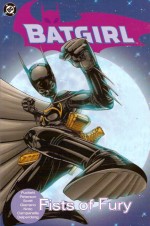
Batgirl: Fists of Fury


By Kelley Puckett, Scott Peterson, Damion Scott, Vincent Giarrano, Phil Noto & various (DC Comics)
ISBN: 978-1-84023-820-4

After Gotham City was devastated by an earthquake (Batman: Cataclysm ISBN13: 978-1-56389-527-2) it was abandoned by the US government in a prescient foretaste of what happened to New Orleans after Hurricane Katrina (see also Batman: No Man’s Land Volumes 1-3, ISBN 13’s: 978-1-56389-564-7, 978-1-56389-599-9, and 978-1-56389-634-7 respectively). From the rubble, a few heroes struggled to protect the innocent. One of these was a new incarnation of Batgirl.

The crisis ended, a semblance of normality returned to the battered metropolis, and the new heroine got her own series. Mentored by Babs Gordon, the wheelchair-bound crime-fighter called Oracle (and the previous Batgirl) who now runs the Birds of Prey, the new wearer of the cape-and-cowl is something of a problem.

Raised as an experiment by martial arts super-assassin David Cain, she could not speak or communicate in any normal manner since her language centres were over-ridden by Cain to make combat her only method of expression. An apparent runaway, she was adopted by Batman as a weapon in his never-ending battle, but the more humane Oracle has become her guardian and teacher.

Her learning disabilities alleviated by a telepath, Cassandra Cain is beginning to adapt to a normal world, but things are still skewed since she defeated Lady Shiva – the most dangerous person on Earth – in a martial arts duel. By beating someone even Batman never could, she’s forced her close circle of new friends to look at her in a different way, and the inevitable challengers for Shiva’s title are now dogging her tracks…

This third collection of tales gathers together Batgirl #15, 16, 21, and 26-28: a seemingly disjointed array of stories that actually blend together surprisingly well.

Puckett and Peterson’s scripts are always lightning paced, sparsely dialogued and both have perfect ears for the great one-liner. The art from Damion Scott, Vincent Giarrano, Phil Noto, Robert Campenella and Jesse Delperdang is light and brisk with a delightful flavour of anime – if not quite manga – about it, and three of the six untitled stories (don’t ask me why) run the range from the dramatic tale of a mad scientist’s murder ray, a boy’s desperate plea to stop his dad becoming a killer and a purely manic tie-in to the Last Laugh company crossover event (Batman: the Joker’s Last Laugh ISBN: 978-1-84576-843-0) featuring a startling battle with intangible villain Shadow Thief.

The remaining three adventures deal with the fallout of Batgirl’s defeat of Shiva (set during the time of Batman: Bruce Wayne Murderer? – ISBN-13: 978-1-56389-913-3): a fast-paced, captivating treatise on girl friends a la Thelma and Louise (or perhaps Buffy and Faith) as Robin-in-training Spoiler briefly becomes Batgirl’s best buddy to train, talk trash about dads and generally take care of Gotham in the Big Man’s absence.

Spellbinding, overwhelmingly rapid-paced and brilliantly executed, these tales are a breakneck, supercharged thrill-ride that concentrates on non-stop action yet still manages to be heavily plot-based with genuine empathy and emotional impact. A perfect book to remind you just why and how comics are so great…

© 2001, 2002, 2004 DC Comics. All Rights Reserved.

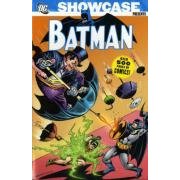
Showcase Presents Batman Volume 3


By Gardner Fox, John Broome, Sheldon Moldoff & various (DC Comics)
ISBN13: 978-1-4012-1719-8

After three seasons (perhaps two and a half would be closer) the Batman TV show ended in March, 1968. It had clocked up 120 episodes since the US premiere on January 12, 1966. The era ended but the series had had an undeniable effect on the world, the comics industry and most importantly on the characters and history of its four-colour inspiration. Most notable was a whole new super-heroine who became an integral part of the DC universe.

This astoundingly economical black and white compendium collects all the Batman and Robin yarns from Batman #189-201 and Detective Comics #359-375 (the back-up slot therein being delightfully filled at this time by the whimsically wonderful Elongated Man strip – which I really must get around to reviewing). The 33 stories here – written and illustrated by the cream of editor Julie Schwartz’s elite and extensive stable of creators – slowly evolved over the seventeen months covered here from an even mix of crime, science fiction, mystery, human interest and super-villain vehicles to a much narrower concentration of plot engines. As with the television version, costumes became king, and then became unwelcome….

It all begins with the comic-book premiere of that aforementioned new character. In ‘The Million Dollar Debut of Batgirl’ (Detective Comics #359, cover-dated January 1967) writer Gardner Fox and the art team supreme of Carmine Infantino and Sid Greene introduced Barbara Gordon, mousy librarian and daughter of the venerable Police Commissioner into the superhero limelight. By the time the third season began on September 14, 1967, she was well-established.

A different Batgirl, Betty Kane, niece of the 1950s Batwoman, was already a comics fixture but for reasons far too complex and irrelevant to mention was conveniently forgotten to make room for the new, empowered woman in the fresh tradition of Emma Peel, Honey West and the Girl From U.N.C.L.E. She was pretty hot too, which is always a plus for television…

Whereas she fought the Penguin on the small screen, her paper origin features the no less ludicrous but at least visually forbidding Killer Moth in a clever yarn that still stands up today.

An old foe not seen since the 1940s was revived for Batman #189 (February 1967). Demented psychology lecturer Jonathan Crane was obsessed by the emotion of fear and turned his expertise to criminal endeavours (in World’s Finest Comics #3 and Detective #73) before vanishing into obscurity. With ‘Fright of the Scarecrow’ he was back for (no) good, courtesy of Fox, Sheldon Moldoff and Joe Giella, as this tense psycho-drama elevated him to the top ranking of Bat-rogues. ‘The Case of the Abbreviated Batman’ (Detective #360) by the same team was an old-fashioned crime-caper with mobster Gunshy Barton pitting wits against the Gotham Guardians whilst the March Batman‘s full-length ‘The Penguin Takes a Flyer… Into the Future!’, scripted by John Broome, mixed super-villainy and faux science fiction motifs for an enjoyable if predictable fist-fest.

Editor Schwartz preferred to stick with mysteries and conundrums in Detective Comics and #361’s ‘The Dynamic Duo’s Double-Deathtrap!’ was one of Gardner Fox’s best examples, especially as it’s drawn by the incredibly over-stretched Infantino and Greene. The plot involved Cold War spies and a maker of theatrical paraphernalia; I shall reveal no more to keep you guessing when you read it. The next issue, by Fox, Moldoff and Giella, featured another eccentric scheme by the Riddler on ‘The Night Batman Destroyed Gotham City!’

Batman #191 featured two tales by Broome, Moldoff and Giella staring with ‘The Day Batman Sold Out!’, a “Hero Quits” teaser with a Babs Gordon cameo, whilst the faithful butler took centre-stage in the charming ‘Alfred’s Mystery Menu’. ‘The True-False Face of Batman’ however, (Detective #363, by Fox Infantino and Greene) was a full co-starring vehicle as the new girl was challenged to deduce Batman’s secret identity whilst tracking down the enigmatic Mr. Brains.

Fox scripted both ‘The Crystal Ball that Betrayed Batman!’ which featured an old enemy in a new guise and the Robin solo-story ‘Dick Grayson’s Secret Guardian!’ in Batman #192, for Moldoff and Giella who also handled his mystery-yarn ‘The Curious Case of the Crime-less Clues!’ in Detective #364, in which Riddler and a host of Bat-baddies again tested the brains and patience of the Dynamic Duo – or so it seemed….

Issue #365 featured ‘The House the Joker Built!’ by Broome, Moldoff and Giella which was nobody’s finest hour, but ‘The Blockbuster goes Bat-Mad!’, scripted by Fox for Batman #196, is a compensating delight, especially when accompanied by another “fair-play” mystery yarn starring The Mystery Analysts of Gotham City. ‘The Problem of the Proxy Paintings!’ is the kind of Batman tale I miss most these days: witty and urbane, a genuinely engaging puzzle without benefit of angst or histrionics.

‘The Round Robin Death Threats’ by Fox, Infantino and Greene was a tense thriller that stretched across two issues of Detective (#366 and #367 – an almost unheard of event in those reader-friendly days), a diabolical murder-plot that threatened to destroy Gotham’s worthiest citizens. The drama ended in high style with ‘Where There’s a Will… There’s a Slay!’ a chilling conclusion almost ruined by that awful title.

‘The Spark-Spangled See-Through Man!’ in Batman #195 introduced the radioactive villain Bag o’ Bones in a desperate attempt to get back to story-driven tales, though the ‘7 Wonder Crimes of Gotham City!’ (Detective #368) by the same creative team of Fox, Moldoff and Giella was a much more enjoyable taste of bygone times. Issue #196 led with a clever puzzler entitled ‘The Psychic Super-Sleuth!’ and finished well with another challenging mystery in ‘The Purloined Parchment Puzzle!’ (both by Fox, Moldoff and Giella) and Detective #369, illustrated by Infantino and Greene, somewhat reinforced boyhood prejudices about icky girls in the classy thriller ‘Batgirl Breaks Up the Dynamic Duo’ which segued directly into a classic confrontation in Batman #197 as ‘Catwoman sets Her Claws for Batman!’ by Fox, Frank Springer and Greene. This frankly daft tale is most fondly remembered for the classic cover of Batgirl and Catwoman (with Whip!!!) squaring off over Batman’s prone body – comic fans have a psychopathology all their very own…

Detective Comics #370 was by Broome, Moldoff and Giella, and related a superb thriller with roots in Bruce Wayne’s troubled youth. ‘The Nemesis from Batman’s Boyhood!’ was in many ways a precursor of later tales with an excellent premise and a soundly satisfying conclusion which proved that the needs of the TV shows were not exclusive or paramount. Gil Kane made his debut on the Dominoed Daredoll (did they really call her that? – yes they did, from page 2 onwards!) in #371’s ‘Batgirl’s Costumed Cut-ups’, a masterpiece of comic dynamism that Sid Greene could be proud of but Gardner Fox probably preferred to forget.

Batman #199’s ‘Peril of the Poison Rings’ and ‘Seven Steps to Save Face’ are much better examples of the clever plotting, memorable maguffins and rapid pace that Fox was capable of, ably interpreted by Moldoff and Giella, whilst John Broome’s ‘The Fearsome Foot-Fighters!’ weak title masked a classy burglary-yarn and the regular art team began adding mood and heavy shadow to their endeavours. This issue (Detective #370) was the first Bat-cover that legend-in-waiting Neal Adams pencilled and inked – a welcome taste of things to come…

Batman #200 (cover-dated March 196b) was written by wunderkind Mike Friedrich for Moldoff and Giella. ‘The Man Who Radiated Fear!’ featured the revitalised Scarecrow, and with the TV show dying the pre-emptive rehabilitation of the Caped Crusader began right here in a solid thriller with few laughs and lots of guest-stars.

Fox returned to top form in Detective #373, with art by Chic Stone and Greene in a tale which favoured drama over shtick in ‘Mr. Freeze’s Chilling Deathtrap!’, whilst Gil Kane returned to ramp up the tension in the brutal vengeance fable ‘Hunt for a Robin-Killer!’ (Detective #374) and Stone and Giella coped well with the extended cast of villains in Batman #201’s ‘Batman’s Gangland Guardians!’, a brilliant action-packed enigma wherein his greatest foes become bodyguards to a hero…

This volume ends with Detective #374 and Fox, Stone and Greene’s ‘The Frigid Finger of Fate’ a chilling race to catch a precognitive sniper, which more than any other story signaled the end of the Camp-Craze Caped Crimebuster and heralded the imminent return of a Dark Knight.

With this third collection from “the TV years” of Batman, concluding by the Spring of 1968, the global Bat-craze and larger popular fascination with super-heroes – and indeed the whole “Camp” trend – was beginning to die. In comics, that resulted in the resurgence of other genres, particularly Westerns and supernatural tales. With Batman it meant a renaissance of passion, terror and a life in the shadows.

Stay tuned: the best is yet to come…

© 1967, 1968, 2008 DC Comics. All Rights Reserved.

Batman Chronicles Volume 6


By Bob Kane & various (DC Comics)
ISBN13: 978-1-84576-963-5

This sixth volume of Batman, re-presented as per the original release schedule, encompasses Batman #10-11, Detective Comics #62-65 and World’s Finest Comics #5 and #6. America had entered World War II by this period and the stories – especially the patriotic covers – went all-out to capture the imagination, comfort the down-hearted and bolster the nation’s morale. One of the very best (and don’t just take my word for it – type “World’s Finest covers” into your search engine and see for yourselves – go on, I’ll wait) designed and executed by the astounding Jerry Robinson leads off this Bat-box of delights.

‘Crime takes a Holiday, (World’s Finest Comics #5, Spring, 1942) by Bill Finger, Bob Kane and Jerry Robinson, is a canny mystery yarn as the criminal element of Gotham “down tools”. Naturally it’s all part of a devious master-plan and just as naturally our heroes soon get to the bottom of it. The same creative team also produced ‘Laugh, Town Laugh!’ (from Detective Comics #62 April 1942) wherein the diabolical Joker goes on a murder-spree to prove to the nation’s comedians and entertainers who actually is the “King of Jesters”.

Batman #10 (April-May 1942) follows with another four classics. ‘The Isle that Time Forgot’ written by Joseph Greene, finds the Dynamic Duo trapped in a land of dinosaurs and cavemen, whilst ‘Report Card Blues’ also with Greene scripting, has the heroes inspire a wayward kid to return to his studies by crushing the mobsters he’s ditched school for. Robinson soloed and Jack Schiff typed the words for the classy jewel caper (oh, for those heady days when Bats wasn’t too grim and important to stop the odd robbery or two!) ‘The Princess of Plunder’ starring everyone’s favourite Feline Femme Fatale Catwoman, and the boys headed way out West to meet ‘The Sheriff of Ghost Town!’

This highly impressive slice of contemporary Americana came courtesy of Finger, Kane and Robinson, who also produced ‘A Gentleman in Gotham for Detective Comics #63, as the Caped Crusader had to confront tuxedoed International Man of Mystery Mr Baffle, and the Crime Clown again in ‘The Joker Walks the Last Mile’ (Detective Comics #64 June 1942).

Obviously he didn’t as he was cover-featured and lead story in Batman #11 (June-July 1942). Bill Finger is credited as writer for ‘The Joker’s Advertising Campaign’ as well as the other three stories. ‘Payment in Full’ is a touching melodrama about the District Attorney and the vicious criminal to whom he owes his life, ‘Bandits in Toyland’ explains why a gang of thugs is stealing dolls and train-sets and ‘Four Birds of a Feather!’ finds Batman in Miami to scotch the Penguin’s dreams of a crooked gambling empire.

There’s another cracking War cover and brilliant Bat-yarn from World’s Finest Comics #6 (Summer 1942) in ‘The Secret of Bruce Wayne!’ as Greene and Robinson provide a secret identity exposé tale that would become a standard plot of later years, and the volume ends as it began with a superb patriotic cover (this one by Jack Kirby and Joe Simon for Detective Comics #65) and a classic tale as Jack Burnley and George Roussos illustrate Greene’s poignant and powerful North Woods thriller ‘The Cop who Hated Batman!’

This tremendously inviting series of Golden Age greats is one of my absolute favourite collected formats: paper that feels comfortingly like old newsprint, vivid colours applied with a gracious acknowledgement of the power and limitations of the original four-colour printing process and the riotous exploratory exuberance of an industry in the first flush of hyper-creativity.

If only other companies such as Marvel, Archie and the rest had as much confidence in their back-catalogue as to follow suit. Who could resist economical, chronologically true collected editions of Bill Everett’s Sub-Mariner, Airboy, Dick Briefer’s Frankenstein; even Bark’s Duck stories, EC editions or CC Beck’s original Captain Marvel?

Certainly not me, and probably not you neither…

© 1941-1942, 2008 DC Comics. All Rights Reserved.
Showcase Presents Brave and the Bold Batman Team-ups Volume 3


By Bob Haney & Jim Aparo, with John Calnan (DC Comics)
ISBN13: 978-1-84856-117-5

With this third collection of Batman’s pairing with other luminaries of the DC universe (collecting in splendid black and white The Brave and the Bold issues #109-134) we find a creative team that had gelled into a perfect machine producing top-notch yarns aimed at the general readership – which would often annoy and appal the dedicated fans and continuity-obsessed reader.

Leading off is the superb supernatural thriller ‘Gotham Bay be my Grave!’ wherein the Caped Crusader and Jack Kirby’s then newest sensation the Demon battled an unquiet spirit determined to avenge his own execution after nearly a century, followed by a canny cold War adventure starring semi-regular Wildcat in his civilian guise as retired heavyweight boxing champion of the world. Although the veteran Justice Society hero was usually stationed on the alternate Earth 2 at this time no explanation was ever given for his presence on “our” planet. It used to drive the continuity-conscious fans utterly nuts!

Issue #111 boasted “the strangest team-up in history” as Batman joined forces with his greatest enemy, the Joker, for a brilliantly complex tale of cross and double cross in ‘Death has the Last Laugh!’ which may have lead to the Harlequin of Hate’s own short-run series a year later. With the next bimonthly issue B&B became a 100 Page Super Spectacular title: a much missed high-value experiment which offered an expanded page count of new material supplemented by classic reprints that turned many contemporary purchasers into avid fans of “the good old days”.

First to co-star in this new format was Kirby’s super escape artist Mister Miracle who joined the Gotham Guardian (himself regarded as the world’s greatest escapologist until the introduction of Jolly Jack’s Fourth World) in a tale of aliens and Ancient Egyptians entitled ‘The Impossible Escape!’ Issue #113 saw the return of the robotic Metal Men in a tense siege situation thriller ‘The 50-Story Killer!’ whilst Aquaman helped save the city from atomic annihilation in the gripping terrorist saga ‘Last Jet to Gotham in #114.

‘The Corpse that wouldn’t Die!’ was a different kind of drama as the Batman was declared brain-dead after an assault, and size-shifting superhero the Atom was forced to occupy his skull to complete the Caped Crusader’s “last case”. Needless to say the Gotham Gangbuster recovered in time for another continuity-crunching supernatural team-up with the Spectre in #116’s ‘Grasp of the Killer Cult’ before embarking on a ‘Nightmare Without End’ – a brilliant espionage thriller guest-starring the aging World War II legend Sgt. Rock and the survivors of Easy Company, a fitting end to the 100 page experiment.

The Brave and the Bold #118 returned to standard comic book format, if not content, as both Wildcat and the Joker joined Batman in the rugged fight game drama ‘May the Best Man Die!’. Sometime villain Man-Bat also had his own short-lived series and he impressively guested in #119’s exotic tale of despots and bounty-hunters ‘Bring Back Killer Krag’.

Possibly the most remarkable, if not uncomfortable, pairing in this volume occurred in B&B #120. Jack Kirby’s biggest hit at DC in the 1970s was Kamandi, Last Boy on Earth. Set in a post-disaster world where animals talked and hunted dumb human brutes, it proved the perfect vehicle for the King’s uncanny imagination, and ‘This Earth is Mine!’ saw Batman mystically sucked into that bestial dystopia to save a band of still-sentient human shamans in a tale more akin to the filmic “Planet of the Apes” quintet than anything found in comic-books.

The Metal Men bounced back in #121’s heist-on-rails thriller ‘The Doomsday Express’, an early advocacy of Native American rights with as much mayhem as message to it, and ‘The Hour of the Beast’ saw the Swamp Thing return to Gotham City to save it from a monstrous vegetable infestation. B&B #123 brought back Plastic Man and Metamorpho in ‘How to Make a Super-Hero’ as well as featuring a rare incidence of a returning villain: ruthless billionairess Ruby Ryder, once again playing her seductive mind-games with the pliable, gullible Elastic Ace.

Always looking for a solid narrative hook Haney spectacularly broke the fourth wall in ‘Small War of the Super Rifles’ when Batman and Sgt. Rock needed the help of artist Jim Aparo and editor Murray Boltinoff to stop a gang of ruthless terrorists. This is another one that drove some fans batty…

‘Streets of Poison’ in #125 was a solid drug-smuggler yarn with exotic locales and a lovely hostage for Batman and the Flash to deal with, and John Calnan stepped in to ink #126’s Aquaman team-up to solve the sinister mystery of ‘What Lurks Below Buoy 13?’

It was back to basics next issue as Wildcat returned to help quash a people-smuggling racket in the ‘Dead Man’s Quadrangle’ whilst #128’s ‘Death by the Ounce’ found the Caped Crusader recruiting Mister Miracle and Big Barda to help him rescue a kidnapped Shah and save a global peace treaty.

Ever keen to push the envelope, the next yarn was actually a jam-packed two-parter as #129’s ‘Claws of the Emperor Eagle’ pitting Batman, Green Arrow and the Atom against the Joker, Two-Face and a host of bandits in a race to possess a statue that had doomed every great conqueror in history. The epic, globe-trotting saga concluded with an ironic bang in ‘Death at Rainbow’s End.’

The last time Wonder Woman appeared (#105 if you recall) she was a merely mortal martial artist but in Brave and the Bold #131 she retuned in all her super-powered glory to help Batman fight Catwoman and ‘Take 7 Steps to… Wipe-Out!’

DC cautiously dipped its editorial toe in the Martial Arts craze and #132 found Richard Dragon, Kung Fu Fighter joining ‘Batman… Dragon Slayer??’, as Denny O’Neil succeeded editor Boltinoff in a rather forced and silly tale of dueling stylists and purloined historical treasures.

Normal service resumed when Deadman stepped in to deliver ‘Another Kind of Justice!’ to rum-runner Turk Bannion when his heir and murderer turns to a more modern form of smuggling. This book concludes with ‘Demolishment!’ from #134, wherein Green Lantern defects to the soviets, a la “the Manchurian Candidate” and Batman’s rescue attempt goes bad…

By taking his cues from news headlines, popular films and proven genre-sources Bob Haney continually produced gripping adventures that thrilled and enticed with no need for more than a cursory nod to an ever-more onerous continuity. Anybody could pick up an issue and be sucked into a world of wonder. Consequently these tales are just as fresh and welcoming today, their themes and premises are just as immediate now as then and Jim Aparo’s magnificent art is still as compelling and engrossing as it always was. This is a Bat-book literally everybody can enjoy.

© 1973-1977, 2008 DC Comics. All Rights Reserved.
Robin: A Hero Reborn


By Alan Grant, Chuck Dixon, Norm Breyfogle, Tom Lyle & various (DC Comics)
ISBN: 978-1-56389-029-1

No matter how hard creators try to avoid it or escape it, Batman and Robin are an inevitable pairing. The first one graduated, the second died (sort of, more or less, leave it, don’t go there) and the third, Tim Drake, volunteered and applied pester-power until he got the job…

Reprinting Batman #455-457 and the first Robin miniseries (#1-5), this volume shows how the plucky young computer whiz convinced the Gotham Guardian to let him assume the junior role in a cracking adventure yarn that has as much impact today as when it first appeared nearly twenty years ago.

‘Identity Crisis’ by Alan Grant, Norm Breyfogle and Steve Mitchell finds the newly orphaned (or as good as: his mother is dead and his dad’s in a coma) Tim Drake as Bruce Wayne’s new ward but forbidden from participating in the life of the Batman. The kid is willing and competent, after all, he deduced Batman’s secret identity before he even met him, but the guilt-racked Dark Knight won’t allow any more children to risk their lives…

However when an old foe lures the lone avenger into an inescapable trap Tim must disobey Batman’s express orders to save him, even if it means his own life… or even the new home he’s just beginning to love.

Following on the heels of that landmark saga Robin got a new costume and a try-out series. Writer Chuck Dixon, and artists Tom Lyle and Bob Smith relate the tale of the apprentice hero’s journey to Paris, ostensibly to train in secret, but which devolves into a helter-skelter race-against-time, as the murderous martial artist Lady Shiva leads the lad into a deadly battle against the Ghost Dragon Triad and Hong-Kong crime-lord King Snake for possession of a Nazi terror weapon.

There’s a breakneck pace and tremendous vivacity to this uncomplicated thriller that would rouse a corpse whilst the exotic scenarios make ‘Big Bad World’ a coming of age tale that any reader of super-hero fiction would adore.

This book is a lovely slice of sheer escapist entertainment and a genuine Bat-classic. If you don’t own this you really should.

© 1990, 1991, 1998 DC Comics. All Rights Reserved.