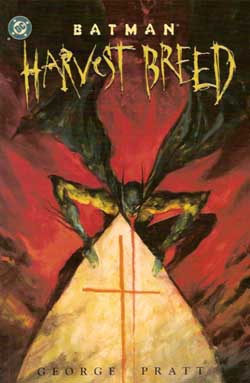
Sometimes even the best of intentions don’t quite produce a great result. Master illustrator George Pratt returned tangentially to the Vietnam War for the back story of this supernatural thriller starring the Dark Knight but the overall results are vastly below his superb par as established with the landmark Enemy Ace: War Idyll (ISBN: 978-0-9302- 8978-2).
Bruce Wayne is tortured by bloody nightmares of devils and sacrifices as a killer tries to re-enact a murder-ritual based on the points of a cross. Such ritual has been attempted many times throughout history, but on this particular occasion the stakes seem much higher – and much more personal. Only a girl named Luci Boudreaux, escapee and survivor of the Hell of Viet Nam seems to have any answers to the dilemma…
Although painted with astounding passion and skill, the story seems to have been sadly neglected and is a bit of a mess, with war veterans, voodoo priests, faith-healers, demons and an uncomfortable misunderstanding of the relationship between Batman and Commissioner Gordon muddying a rather tired old plot. If you love dark and moody style above content give it a shot but otherwise this pretty much a completist-only book.
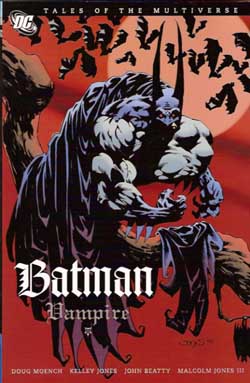
By Doug Moench, Kelley Jones, John Beatty & Malcolm Jones III (DC Comics)
ISBN13: 978-1-84576-645-0
Now that the 52 multiverse is established as “real continuity†and an accepted fact of the DC Universe, lots of discarded story concepts should be up for repackaging in the foreseeable future. This compendium collects a trilogy of tales that appeared under the Elseworlds banner in the 1990s and are now bona fide Batman stories that all began with another of those literary cross-pollinations that publishers seem so in love with.
Batman and Dracula: Red Rain is a genuinely creepy adventure of heroism and sacrifice as Dracula moves into Gotham City and the Dark Knight is forced to ally himself with “good vampires†in an attempt to stop him. Considering the title of this collected volume it’s presumably not a spoiler to reveal that he also has to sacrifice his life and his humanity before the threat to his beloved city.
This tale was a great success when it was first released in 1991; a minor gothic masterpiece, both philosophical and tension drenched, with the sleek, glossily distorted artwork of Kelley Jones and Malcolm Jones III creating a powerful aura of foredoomed predestination. It alone is well worth the price of admission
And that is a very good thing because the two sequels are ill-advised and, frankly, unwelcome and unnecessary.
Batman: Bloodstorm (1994, with the somehow more visually hygienic John Beatty replacing Malcolm Jones III as inker) sees Gotham City protected by a vampiric Batman who combines crime-fighting with dispatching those bloodsuckers who escaped the cataclysmic events of Red Rain. He is a tortured hero who struggles perpetually with his unholy thirst, but who is determined nonetheless never to drink human blood.
But when the Joker assumes command of the remaining vampires and attempts to take control of Gotham, not even the hero’s greatest friends and a lycanthropic Cat-Woman can forestall Batman’s final fate.
And yet Batman’s final rest is thwarted when the heartsick Alfred and desperate Commissioner Gordon recall the Batman from his final rest in Batman: Crimson Mist. Released in 1999, Doug Moench, Kelley Jones and John Beatty recount the grim but predictable tale of a city overrun by super-criminals since the caped Crusader went to his reward. So when his faithful manservant brings him back he is horrified to find the now corrupted hero a malevolent blood-hungry beast that plans to save Gotham by slaughtering every criminal in it. Only a bizarre alliance of good men and monstrous villains can rectify this situation before humanity itself pays the price…
These stories take the concept of Batman as scary beast to logical extremes – and beyond – but although well drawn and thoughtfully written the sequels lack the depth and intensity of the initial tale and feel too much like most sequels – just an attempt to make some more money. At least in this volume you have the real deal, so buy it and just treat the last two thirds as bonus material.
By Alan Grant & Frank Quitely (DC Comics)
ISBN13: 978-1-5638-9372-8
Way, way back in Detective Comics #198, 1953 (“Lord of Bat-Manor†drawn by the legendary Dick Sprang) Batman was left a Scottish Castle. It was later established that Bruce Wayne’s ancestors came from Scotland. Don’t ask me why that bit of ephemera remains when so very much else has been rewritten over the years but it has, and professional Scots Alan Grant and Frank Quitely used that fact to craft this slim yet gripping little thriller.
On a visit to the Auld Country, Bruce Wayne stumbles onto a quasi-Masonic plot to locate the lost treasure of the Knights Templar; that’s just the tip of the iceberg in a revenge scheme hundreds of years in the making that involves beautiful tragic women, deadly plagues, ancient super-weapons, crazed claymore-waving maniacs and good old-fashioned Heid-cases and Barm-pots…
Beautifully illustrated, deftly scripted and brilliantly skirting the line between comedy and thriller, this is pure adventurous escapism from two consummate professionals. Go and get it, bonny lads and lassies.
By Ron Marz & Igor Kordey (DC Comics/Dark Horse Books)
ISBN13: 978-1-5697-1466-9
I’m never particularly comfortable with the passion for cross-pollination that seems to obsess comics publishers. I admit that occasionally something greater than the sum of the originals does result, but usually the only outcome of jamming two different concepts into the same package is an uncomfortable and ill-fitting mess.
So I think this tale – originally a 4-issue miniseries – is a welcome example of success, and I’ll even offer a possible explanation for why.
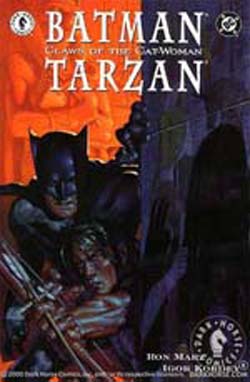
When Finnegan Dent, Great White Hunter, returns to Gotham City with artefacts from a lost city he has discovered in Africa, his sponsor and backer is delighted. But Bruce Wayne has reason to change his mind when he meets John Clayton, the English Lord known alternatively as Greystoke or Tarzan of the Apes. The two quickly discover they have a mutual interest in Justice and their own particular jungles, so when the feline Princess Khefretari tries to steal back the looted treasures of her very-much thriving civilisation she catapults the heroes into a frantic chase and dire battle against a ruthless monomaniac.
This tale invokes all the basic drives of both characters without ever getting bogged down in continuity or trivia. It is first and foremost an action adventure, full of emotional punches delivered with relentless rapidity. There are good guys and bad guys, no extraneous fripperies and plenty of cliffhanger moments before virtue triumphs and evil is punished.
In Claws of the Catwoman you need only have the most meagre grounding in either character to enjoy this simple thriller – and you will.
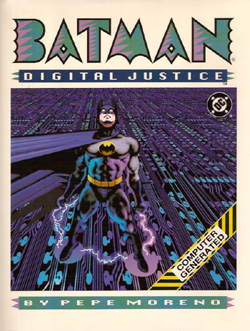
By Pepe Moreno, with dialogue by Doug Murray (DC Comics)
ISBN13: 978-1-9302-8987-4
It’s hard to credit now but not so long ago computers were a really big deal in comics. Not like today when digital colours, lettering and even drawing enhancement packages are part and parcel of the daily process of production, but simply for being the newest sort of pencil in town. Along with such products as Shatter from First Comics, and Marvel’s Iron Man: Crash (I’ll get to them another day), DC entered the market with a tale from Spanish wunderkind Pepe Moreno and their biggest gun, then riding high on the coattails of the Tim Burton Movie. So from the safe perspective of a few decades distance let’s take a look at Batman: Digital Justice.
Pepe Moreno moved America in 1977, briefly worked for Jim Warren’s Creepy, Eerie and Vampirella titles and gravitated to Heavy Metal where his short, uncompromising post-punk strips (collected in the album Zeppelin) caught the attention of Epic Illustrated editor Archie Goodwin. Generation Zero led to the graphic novels Rebel, Joe’s Air Force and Gene Kong. His growing fascination with technology led him into animation (Tiger Sharks, Thunder Cats and Silver Hawks) and eventually back to comics with this futuristic Bat-thriller.
The mid-21st Century: Gotham City has become Megatropolis, a sprawling, corrupt dystopia. Jim Gordon, honest cop and grandson of the Police Commissioner who worked with The Batman, loves his job but knows that something is very wrong with his city. The graft seems to go all the way to the top and even the ubiquitous flying robotic enforcers get more respect than the flesh and blood Force.
When his partner Lena is murdered he discovers that a computer program/virus based on the Joker’s brain patterns is the de facto ruler of the city. He adopts the identity and tactics of the fabled Caped Crusader but is still outmatched until the long-dormant Bat-Computer awakes and takes him under its digitised wing. Now with a new Robin and Catwoman he is ready for a final confrontation with The Batman’s greatest foe…
By our standards the artwork is pretty clunky, although I recall being quite impressed with it at the time, yet the real problem here is the story. This is a terribly ordinary premise that depended too much on the novelty of delivery rather than strong plot or characters, and doesn’t stand up well to the tests of time. This didn’t stop much of that premise resurfacing in the animated feature Batman Beyond: The Return of the Joker though.
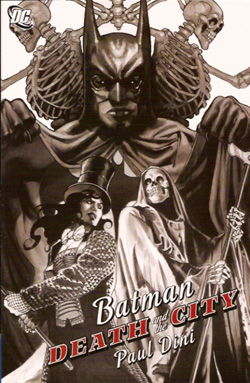
By Paul Dini & various (DC Comics)
ISBN13: 978-1-84576-673-3
The second collection of post-Infinite Crisis Batman adventures from Detective Comics (issues #827-834) presents another fine crop of tales of the Not-Quite-So Dark Knight righting wrongs in the urban sewer of Gotham City, courtesy of Paul Dini and a stalwart team of associates.
‘Double Talk’, illustrated by Don Kramer and Wayne Faucher, introduces a new and nasty Ventriloquist as the mouthpiece of the murderous Scarface, whilst ‘Sharkbite’ is an old-fashioned murder “whodunit†with reformed villain-turned-consulting-detective The Riddler racing Batman to the killer’s identity.
Stuart Moore and artist Andy Clarke combine for the excellent two-parter ‘Siege’ as a human bomb captures the entire Wayne Tower skyscraper during a peace conference, and Dini, Kramer and Faucher return for ‘Kind of Like Family’ wherein Harley Quinn struggles with her decision to go straight when Scarface and the new Ventriloquist make her an offer she just can’t refuse.
‘Triage’, by Royal McGraw and Andy Clarke brings back Silver Age villains Fox, Shark and Vulture in a chilling psycho-drama before the volume concludes with the superb ‘Trust’ as warped stage magician Ivar Loxias returns in a chilling tale of slaughter and trickery guest-starring the bewitching Zatanna by the first team of Dini, Kramer and Faucher. And wait ’til you see the twist…
These tales of a renewed and determined crime-fighter look well set to overturn the Grim Sociopath image that has dogged Batman for too long. They are fresh, thrilling and powerfully compelling adventures that will astonish long-time fans and casual browsers equally. This is the best Batman in years.
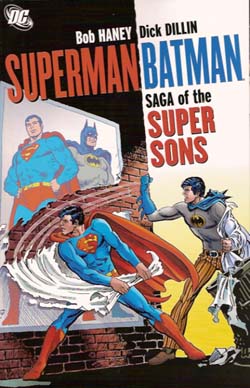
By Bob Haney & Dick Dillin (DC Comics)
ISBN13: 978-1-84576-672-6
Are you old enough to yearn for simpler times?
The brilliant expediency of the 52 concept lends the daftest tale from DC’s back catalogue credibility and contemporary resonance since there’s now a chance that even the hippest and most happening of the modern pantheon can visit/interact with the most outrageous world or concept in DC’s long history. So this collection of well told tales from the 1970s, supplemented by tales from more self-conscious times, can be reprinted with a clear continuity-conscience without even the most strident fan complaining.
Written by Bob Haney and drawn mostly by Dick Dillin, the Super-Sons appeared with no fanfare in World’s Finest Comics #215, 1972; a bad time for superhero comics, but a great era for teen rebels. The free-wheeling, easy-rider, end of the flower-power days saw a huge focus on “teen consciousness†and the “Generation Gap†was a phrase on many lips. The editors clearly saw a way to make arch-establishment characters instantly pertinent and relevant, and being mercifully oblivious to the constraints of continuity (some would say logic) simply produced tales of the rebellious teen sons of the World’s Greatest Heroes out of whole cloth.
And well constructed, well told tales they are. In “Saga of the Super Sons†(inked by Henry Scarpelli) the young heroes run away from home – on the inevitable motorcycle, natch! – and encounter a scurrilous gang-lord. But worry not, the paternalistic parents are keeping a wary eye on the lads! Speaking as someone who was the target market for this experiment, I can admit that the parental overview grated then and still does, but as there were so many sequels somebody must have liked it.
“Little Town With a Big Secret†appeared in the very next issue, another human-scale human interest tale, but with a science-fiction twist and the superb inking of Murphy Anderson. WF # 221 featured “Cry Not For My Forsaken Son!†by the same team, which showed a troubled son the difference between value and worth, and the value of a father as opposed to a biological parent. Issue #222 “Evil in Paradise†(inked by Vince Colletta) took the young heroes to an undiscovered Eden to resolve the ancient question of whether Man was intrinsically Good or Evil.
“The Shocking Switch of the Super-Sons†(WF #224, and also inked by Colletta) took teen rebellion to its most logical conclusion as a psychologist convinces the boys to trade fathers! “Crown For a New Batman!†is a definite change of pace as Bruce Jr. inherits the Mantle and the Mission when his father is murdered! But never fear, all was not as it seemed, fans! This thriller first appeared in WF #228, and was inked by Tex Blaisdell, who also inked Curt Swan, artist for the more traditional Lost Civilisation yarn “The Girl That Time Forgotâ€, from WF #230.
The Relevancy Era was well over by the time Haney, Dillin and Blaisdell crafted “Hero is a Dirty Name†(WF #231), wherein the Sons question the motivation for heroism, and in #233’s “World Without Men†(inked by John Calnan) they tackle sexual equality and unravelled a plot to supplant human males. “The Angel With a Dirty Nameâ€, by the same team (WF #238) is a villains ‘n’ monsters slug-fest indistinguishable from any other super tale, and the original series ends with WF #242’s “Town of the Timeless Killersâ€, illustrated by Ernie Chua and John Calnan, wherein the kids are trapped in a haunted ghost-town and stalked by immortal gunslingers; an ignominious close to a bold experiment.
The kids made a one-stop return in “Final Secret of the Super-Sons†by Denny O’Neil, Rich Buckler and Dick Giordano (WF #263) when it was revealed that they were a simulation running on Superman’s giant Computer. In a grim indication of how much of a chokehold shared continuity had grown into, they then escaped into “reality†anyway…
The collection concludes with a short tale by Haney and Kieron Dwyer that appeared in Elseworlds 80-Page Giant. “Superman Jr. is No More!†is a charming and fitting conclusion to this odd, charming and idiosyncratic mini-saga.
If you’re not chained to continuity why not take a look at a few gems (and one or two duds) from a era where everybody read comics and nobody took them too seriously?
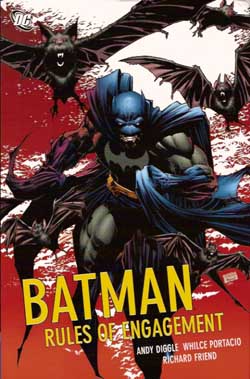
By Andy Diggle & Whilce Portacio (DC Comics)
ISBN13: 978-1-84576-619-1
Collecting the first six-part story-arc from the monthly comic book Batman Confidential, this impressive if perhaps overly-glossy high-tech adventure pits an inexperienced Batman against Superman’s arch-nemesis Lex Luthor.
During the first year of the Caped Crusader’s career, a prostitute is murdered in front of her baby, catapulting Batman into a hazy web of corruption and murder involving the US military and the shady world of corporate bidding for government contracts. Somehow at the bottom of it all is the financial monolith of Lexcorp. Can all the subterfuge, death and destruction simply be about money or has the wily billionaire another agenda?
Fast-paced, frenetic and concentrating more on gadgets and technology than mood or mystery, this sharp and shiny thriller from Andy Diggle and Whilce Portacio will perhaps delight the fans of the cinematic more than comic-book Dark Knight, but is an engrossing read for all that.
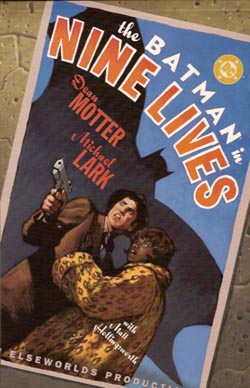
By Dean Motter, Michael Lark and Matt Hollingsworth (DC Comics)
ISBN: 1-56389-979-5
The depictions and narrative signatures of the post-war genre “Film Noir†are powerful and evocative, celebrating a certain weary worldliness as much as stark lighting and visual moodiness. As such this murky world would seem a natural milieu for Batman tales, but there are precious few that make the effort, and so very few of those successfully carry it off.
This superb alternative adventure published under DC’s Elseworlds imprint (wherein the company’s key characters are translated out-of-continuity for adventures that don’t really count) is a magnificent exception, combining the hard-boiled detective yarn with the icons of gangster movies.
1946: Selina Kyle was a woman everybody wanted, and who exploited that fact fully. When The Batman finds her ravaged corpse in the sewers, there’s no shortage of suspects. Was she murdered by a high society big-shot like Oliver Queen, Harvey Dent or Bruce Wayne, desperate to keep her quiet or was one of her more sinister consorts to blame?
Gangsters like jilted embezzler Eddie Nigma, mob-boss ‘Clayface’ Hagen, The Poker Joker, ‘The Penguin’ or even the stone-cold hit-man ‘Mr Freeze’ would have snuffed her in a instant if expedient, and seedy gumshoe Dick Grayson knows that he’d be just as expendable if he digs too deep into the private affairs of the Highest and Lowest denizens of Gotham. But somehow he just can’t let go…
Reconfiguring key figures of the Batman mythos as such recognisable archetypes, although perhaps obvious, is still a wonderfully effective way to revitalize them. The plot is as engrossing as any movie masterpiece and the human analogues of the bizarre and baroque Batman cast are just as menacing even without outlandish powers and costumes. And through it all lurks a vigilante dressed as a bat, once again the mad element of chaos that he can no longer be in his regular comic outings…
Although a pastiche of many things, Nine Lives is nonetheless a brilliant and engrossing read, blending mystery, crime-caper and sophisticated suspense thriller with moody visuals and a cynical tone that will show any naysayer that comics have as much to offer as any other creative medium. Hunt this down and make it yours!
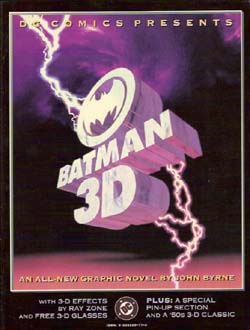
By John Byrne & various: 3-D process by Ray Zone (DC Comics)
ISBN: 0-930289-77-3
The comic-book 3-D process was invented by Joe Kubert and Norman Maurer in 1953 and fed into the wider craze in movies. It resulted in some pretty spectacular comic-books but died out pretty quickly, although it still persists and periodically resurfaces. I’ve worked on a couple of 3-D projects in my other life as an advertising free-lancer, and can honestly say it’s harder than it looks to get right, but when you do it’s utterly mind-boggling.
Having said that and acknowledging that it’s a way of enhancing the visual impact of comics it’s always gratifying when the actual story works too. This forgotten tome from 1990 is a nice example, and is only the second time John Byrne wrote Batman, and is his first full art job on the character. ‘Ego Trip’ features a solid old-fashioned murder-mystery, a helter-skelter chase, dynamic action and a deadly competition between The Joker, The Penguin, The Riddler and Two-Face with Gotham City as their playground.
Although the dialogue is a little stiff, this is still a very readable Batventure for fans of all ages with many tributes to all the best iconic features of the strip and a measured understanding of what the stereoscopic process can add. There’s also a reprint of ‘Robot Robbers’ (with art attributed to Curt Swan and Sheldon Moldoff) which originally appeared in Batman #42 in 1947. It was one of four tales turned into 3D strips for Batman Adventures in Amazing 3D Action during that first boom period in 1953, and re-released in 1966 at the height of the TV Batmania craze. It’s a wonderful science crime romp well worth reliving.