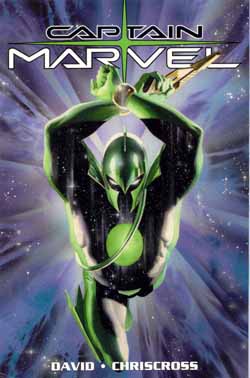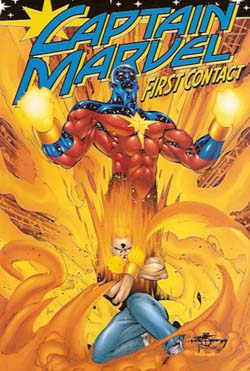
Captain Marvel: First Contact

Captain Marvel: First Contact

By Peter David, ChrissCross & various (Marvel Comics)
ISBN 0-7851-0791-6

This character has one of the most convoluted back stories in comics so if you are unfamiliar with him this might be a tad confusing for a first exposure, but light, fun super-hero comics are rare, so it is worth considering.

Captain Marvel was a soldier for a pan-galactic civilisation called the Kree. He was dispatched to Earth on a reconnaissance mission after the Fantastic Four destroyed a robotic Kree Sentinel left on Earth thousands of years previously. Adopting an Earth identity he spied on mankind but became increasingly disenchanted by Kree Imperialism and “went native”, becoming one of Earth’s greatest heroes.

Due to a cosmic accident his atoms were merged with professional sidekick Rick Jones. Only one of them could occupy space in our universe at a time, whilst the other was suspended in the anti-matter dimension called the Negative Zone. By striking together the “Nega” wristbands they each wore one could trade atoms with the other and live part of a single existence. Eventually they escaped their fate and separated. After saving the world and the universe a few times Captain Marvel died.

After his death his lover used his genetic material to create a son, named Genis (or sometimes Legacy) and he ultimately acquired the Negabands and inherited the title. He also found himself bonded to the cosmically unlucky Jones in the same situation his father had to endure – switching atoms and leading half a life. This incarnation devolves directly out of Avengers Forever (ISBN: 0-7851-0756-8) and reprints issues #0 and 1-6 of the third volume of the monthly comic – I said it was confusing, right? Now read on…

Bonded together, Jones and Genis are currently back on Earth and trying to reach an accommodation but the “Cosmically-Aware” hero is battling menaces and monsters that no-one can see, and the resultant collateral destruction is making the wrong sort of headlines. Either that or Genis is delusional and a menace himself…

There are guest appearances by The Hulk, Moondragon, Drax the Destroyer, and the Micronauts in a light-hearted and very funny string of adventures from Peter David, ChrissCross, Ron Lim, James Fry, Walden Wong, Mark McKenna and Nelson Decastro, and although this really is a treat for long-time fans with a good grounding in Marvel Minutiae, the determined neophyte might be rewarded with a hearty laugh and some angst-free thrills.

This volume includes a brief recap-cum-scorecard section so newbies might feel it’s worth a shot…

© 1999, 2000 2001 Marvel Characters, Inc. All Rights Reserved.
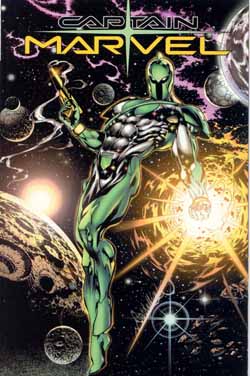
Captain Marvel: vol 2, Coven

Captain Marvel: vol 2, Coven 

By Peter David, Kyle Hotz & Ivan Reis (Marvel Comics)
ISBN 0-7851-1306-1

It’s a return to Reality for the cosmic symbionts Genis and Rick Jones after their near catastrophic brush with hyper-metaphysicality (for clarification see Captain Marvel: Nothing to Lose ISBN 0-7851-1104-2). Coven picks up a little later as a still-mad-as-a-bag-of-badgers Captain Marvel is back on Earth, only held in check by the will-power of Rick Jones. Then the man named Coven enters their lives.

A sadistic serial killer sentenced to death on Rick’s testimony, Coven unsuccessfully claims immunity from prosecution since he’s an alien and not subject to human law. After his execution he revives and begins another murder-spree, only to encounter our hero(es) fresh from being kicked out of Asgard – home of the Norse Gods – where Captain Marvel had ticked everybody off by declaring himself a better god than them and claiming squatter’s rights.

Rick, convinced his life is threatened by the resurrected murderer, is astounded when Genis unaccountably decides he wants to hear Coven’s side of things, precipitating a team-up/battle with Spider-Man, an alien invasion and a chilling lesson in inter-species Real-Politik which leaves Jones wondering just who is the monster and who the checking force?

David’s signature dark whimsy and sharp dialogue create some brilliant moments and the story is seldom predictable. The absurdist sensibilities and love of word-play sadly don’t completely solve the major problem, however, which is the seven tons of backstory needed to follow it. This is the kind of quality comic work that would win over new readers, but neophytes and civilians can’t help but be deterred by the bewildering amount of necessary research needed before starting.

© 2003 Marvel Characters, Inc. All Rights Reserved.

Captain Marvel: vol 1, Nothing to Lose

Captain Marvel: vol 1, Nothing to Lose 

By Peter David, ChrissCross, Ivan Reis & Paco Medina (Marvel Comics)
ISBN 0-7851-1104-2

This particular incarnation of the “trademark-that-must-not-die” features the son of the Kree warrior who was Marvel’s first holder of the name (after the copyright on a character held now by DC, but originally taken out by Fawcett in 1940 finally lapsed in 1968) and long-time company supporting character Rick Jones in a symbiotic relationship that echoes the heyday of those flower-power glory days. Fair warning though, despite the excellent writing and great art, if you are not at least passingly familiar with Marvel’s close continuity, this is not a series of books you want to read.

Nothing to Lose (reprinting Captain Marvel: volume 4, issues #1-6 and I told you it was confusing didn’t I?) is the story of Genis, the test-tube baby son of Mar-Vell, an alien warrior who saved the Earth and the Universe countless times before dying of cancer in the landmark Death of Captain Marvel, the company’s first ever Graphic Novel.

Artificially matured, Genis tried to emulate his father as a galaxy-spanning crusader, with mixed results, before hooking up with Rick Jones – his Dad’s original sidekick who offered the promise of real, insider insights into what made him such a hero.

When Nothing to Lose opens he is in fact, in just the same situation his father endured with the teen-aged Jones back in 1960’s. Their bodies are linked by “Nega-bands”, which are fantastically powerful alien wrist-bands, which both wear, but sadly only in turns, as they have the drawback of merging their molecular structure. This means that only one body can inhabit our universe at once, and the other is trapped in a sub-atomic pocket-universe called The Microverse, from where they can observe and communicate, but not affect us here.

Marvel also has his father’s greatest power, “Cosmic Awareness” an ability to discern everything happening everywhere at once. Sadly, and inevitably, this ability is turning Genis into a raving madman. Just knowing something bad is happening doesn’t mean that the only solution you can offer is ultimately the right one for the universe. This is tragically demonstrated when Captain Marvel stops a suicide bomber from detonating, only to see her murdered by one of her intended victims. This hopeless situation is repeated and magnified by their intervention in an alien invasion and other missions.

As the days progress Rick has to face the fact that his partner’s omniscience is more curse than blessing, and an increasing capriciousness is affecting Captain Marvel’s desire to “Do Good”. When the cosmic avenger starts taking advice from the Punisher, joins the militaristic Kree’s colonial space fleet and even kills himself (successfully but apparently not permanently) he decides that his destiny is to destroy creation, and it leads to a confrontation with a number of the universe’s most powerful conceptual entities before a new status quo can be reached.

Peter David’s blackly tongue-in-cheek examination of power and perspective has some truly chilling moments, and has a lot to say on the nature of heroism, all leavened by his absurdist sensibilities and love of comedy word-play. It is such a shame that there’s so much baggage to attend to before the casual reader can even approach it.

© 2002, 2003 Marvel Characters, Inc. All Rights Reserved.