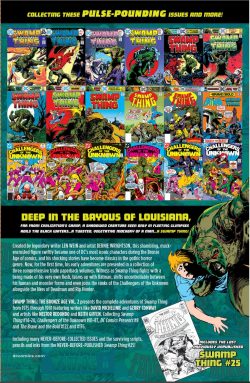
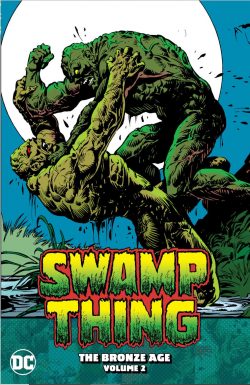
Swamp Thing: The Bronze Age volume 2


By David Michelinie, Gerry Conway, Carla Conway, David Anthony Kraft, Steve Englehart, Bob Haney, Martin Pasko, Nestor Redondo, Fred Carrillo, Keith Giffen, Michael Netzer, Murphy Anderson, Ernie Chan & various (DC Comics)
ISBN: 978-1-4012-9422-9 (TPB/Digital edition)

Win’s Christmas Gift Recommendation: Utter Moodily, Moss-Bedecked Entertainment Perfection… 9/10

The first fan-sensation of the modern era – now officially enshrined as the Bronze Age – of American comic books – Swamp Thing has powerful popular fiction antecedents and in 1972 was seemingly a concept whose time had come again. Prime evidence was the fact that Marvel were also working on a man-into-mucky, muddy mess character at the very same time.

Both Swampy and the Macabre Man-Thing were thematic revisions of Theodore Sturgeon’s classic novella It, and bore strong resemblances to a hugely popular Hillman Comics star dubbed The Heap. He/it sloshed through the back of Airboy Comics (née Air Fighters Comics) from1943 onwards and my fan-boy radar suspects Roy Thomas’ marsh-monster the Glob (from Incredible Hulk #121, November 1969 and #129, June 1970) either inspired both DC and Marvel’s creative teams, or was part of that same zeitgeist.

It should also be remembered that in the autumn of 1971 Skywald – a very minor player with big aspirations – released a monochrome magazine in their Warren Comics knock-off line entitled The Heap.

For whatever reason, by the end of the 1960s superhero comics were in another steep sales decline, again succumbing to a genre boom led by a horror/mystery resurgence. A swift rewriting of the Comics Code Authority augmented the changeover and at National/DC, veteran EC comics star Joe Orlando became editor of House of Mystery and sister title House of Secrets.

These returned to short story anthology formats and gothic mystery scenarios, taking a lead from TV triumphs such as Twilight Zone and Rod Serling’s Night Gallery.

Referencing the sardonic narrator/storyteller format of those EC horror titles, Orlando created Cain and Abel to shepherd readers through brief, sting-in-the-tail yarns produced by the best new and established creators the company could hire. Artists Neal Adams, Mike Kaluta, and especially Bernie Wrightson produced some of their best work for these titles, and the vast range of spin-offs the horror boom generated at DC.

The 12th anthology issue of the resurrected House of Secrets (#92, June/July 1971) cemented the genre into place as the industry leader. There writer Len Wein & Wrightson produced a throwaway gothic thriller set at the turn of the 19th century, wherein gentleman scientist Alex Olsen was murdered by his best friend with his corpse dumped in a swamp.

Years later, Olsen’s beloved bride – now the unsuspecting wife of the murderer – was stalked by a shambling, disgusting beast that seemed to be composed of mud and muck…

The tale struck an immediate chord with the public. That issue was the best-selling DC comic of that month, and reader response was fervent and persistent. By all accounts, the only reason there wasn’t an immediate sequel or spin-off was that the creative team didn’t want to produce one. Eventually however, bowing to interminable pressure, and with the sensible idea of transplanting the concept to contemporary America, Swamp Thing #1 appeared on newsstands in the Spring of 1972. It was an unqualified hit and instant classic…

Wein & Wrightson produced 10 issues together: an extended, multi-chaptered saga of justice and vengeance encompassing a quest for answers that was at once philosophically typical of the time and a prototype for the story-arc and mini-series formats that dominate today’s comics. They also used each issue/chapter to pay tribute to a specific sub-genre of timeless horror story whilst advancing the major plot…

When Alec and Linda Holland retreated deep into the Louisiana Bayou to work on a bio-restorative formula to revolutionise global farming, they had no idea criminal organisation “The Conclave” was after their research. Despite the best efforts of Secret Service agent Matt Cable, the lab was bombed and Linda died instantly. Alec – showered with his own formula and blazing like a torch – hurtled to a watery grave in the swamp. He did not die…

Transformed by the formula (and remember, please, this was prior to Alan Moore’s landmark re-imagining of the character) Holland transformed into a huge man-shaped thing: immensely strong, barely able to speak, and seemingly composed of living plant matter. Holland’s brain still functioned, however, and he vacillated between finding his wife’s killers and curing his own monstrous condition. Cable, misinterpreting the evidence, became obsessed with killing the beat, believing it caused the deaths of his two friends and charges…

Swamp Thing travelled the world, encountering the darkest outbreaks of classic supernature and the insatiable greed of human beasts before eventually convincing Cable of his innocence and true identity. Joined by Abigail Arcane – niece of archenemy and necromantic sorcerer Anton Arcane – they roamed a nation and world increasingly beset by uncanny terrors and macabre plots, with new allies like mystery man Bolt at their side.

Wein’s last issue was #13, having ushered in a new direction for Nestor Redondo – who replaced Wrightson with #11 – to display his own gifts and quickly become the artistic driving force.

Born in 1928 at Candon, Ilocas Sur in the American Territory of the Philippines, Redondo was influenced by US strips like Tarzan, Superman, Buck Rogers and Flash Gordon which were immensely popular in the entertainment-starved Pacific Archipelago.

Drawing from an early age, Nestor emulated his brother Virgilio – who worked as a comics artist in the young country. The Philippines became a commonwealth in 1935, and achieved full-independence from the USA in 1946, but maintained close cultural links to America.

Nestor’s parents pushed him into architecture but within a year he returned to comics. A superb artist, he far outshone Virgilio – and everybody else – in the cottage industry. His brother switched to writing and they teamed up: producing some of the best strips the Islands had ever seen, the most notable and best regarded being Mars Ravelo’s Darna.

Capable of astounding quality and incredible speed, by the early 1950s Nestor was drawing for many titles. Publications like Pilipino Komiks, Hiwaga Komiks and Espesial Komiks were fortnightly and he usually worked on multiple series simultaneously, pencils and inks. He also produced a wealth of covers.

In 1953, he adapted MGM film Quo Vadis for Ace Publications’ Tagalong Klasiks #91-92. Written by Clodualdo Del Mundo, it was serialized to promote the movie in country, and impressed MGM so much that they offered 24-year old Nestor a US job and full residency. He declined, thinking himself too young to leave home yet.

Ace was the country’s biggest comics publisher, but by the early 1960s they were in dire financial straits. In 1963 Nestor, Tony Caravana, Alfredo Alcala, Jim Fernandez, Amado Castrillo and brother Virgilio set up their own company CRAF Publications, Inc., but times were against them and publishers everywhere. Around this time, America called again, in the form of DC and Marvel Comics.

By 1972, US based Tony DeZuñiga had introduced Filipino artists to US editors. Nestor drew horror tales for House of Mystery, House of Secrets, The Unexpected, Phantom Stranger, Secrets of Sinister House, Witching Hour, Weird War Tales; Marvel’s Man-Thing; and an astonishingly lovely run on Rima the Jungle Girl (loosely adapting W. H. Hudson’s seminal 1904 novel Green Mansions), before joining Swamp Thing.

He also worked on Lois Lane and the Tarzan franchise, and in 1973 produced literary adaptations including Dracula and Dr. Jekyll and Mr. Hyde for Vincent Fago’s Pendulum Press Illustrated Classics (later reformatted as Marvel Classics Comics). In later years, he moved to Marvel to ink and eventually fully illustrate The Savage Sword of Conan.

During his DC period he was tapped to draw an adaptation of King Arthur which DC killed before it was completed (once again some pages survive and the internet is your friend if you want to see them) but did limn tabloid-sized Limited Collectors’ Edition: The Bible.

This epic bayou bonanza gathers the last of the original Swamp Thing run (#14-25), plus guest appearances from Challengers of the Unknown #81-87; The Brave and the Bold #122 & 176 and DC Comics Presents #8 (spanning cover-dates January/February 1975 to July 1981) .

Roving America during a period of political instability tainted by cultural hedonism and paranoia, Cable, Abby, Bolt and miserable misshapen Alec Holland (whom they had recently broken out of federal custody) continually stumbled into weird and deadly situations. With writer David Michelinie joining Redondo, proceedings open here with ‘The Tomorrow Children’ (ST #14, January/February 1975).

Separated again, Holland’s human helpers search for him as the depressed nomad discovers an isolated Bayou community of simple folk persecuting a family of freakish kids. Swamp Thing drives off one murderous mob, but stories of the outcast kids’ uncanny powers and the plain facts of strange accidents and mysterious disappearances won’t go away. By the time the townsfolk return to destroy the “demon children”, Holland has discovered radioactive waste is causing all the problems, but far too late to prevent tragedy or promote understanding…

Swamp Thing then falls under ‘The Soul-Spell of Father Bliss’: a seemingly serene and benign cleric with demonically disturbing notions on how to restore faith to his disinterested flock. When Cable and Abby finally find Swamp Thing, it’s not Alec Holland inside the vegetable colossus and only an ultimate sacrifice can save them and humanity from the priest’s folly…

In the awful aftermath, Bolt is captured by agents unknown and the restored Holland-Thing leads a rescue party against an old adversary. Typically, the venture is derailed by cruel fate and the monster ends up alone on tiny Kalo Pago island in the middle of a revolution. On one side is a viciously repressive military government while the rebels are led by High Priestess Laganna – who has a direct line to zombie gods.

Caught in the middle, Holland cannot stem the tide of terror on the climactic ‘Night of the Warring Dead’…

ST #17 finds Bolt a prisoner of resurrected former Conclave chief Nathan Ellery, but when Abby, Cable and Swamp Thing finally stumble into his HQ, the maniac’s mercenaries, mechanical myrmidons and global mind-control contraption ‘The Destiny Machine’ at first appear to be an unbeatable opposition. But only at first…

Fleeing the destruction they have partially wrought, the victorious heroes crash land in an idyllic hamlet filled with violently murderous old folk. Its apologetic administrator claims Serenity is an experimental “ultimate retirement facility”, but before long is revealed as a demonic  ‘Village of the Doomed’ requiring all Holland’s power to escape and exorcise…

Cover-dated October 1975, The Brave and the Bold #122 then counts down ‘The Hour of the Beast!’ Bob Haney & Jim Aparo detail the awesome spectacle of Swamp Thing’s return to Gotham City and efforts to save it from a monstrous vegetable infestation. When Holland then becomes a target for a profit crazed showman, it needs all Batman’s ingenuity to save his ally and his city…

That same month in Swamp Thing #19, Gerry Conway joined Redondo to reveal ‘A Second Time to Die’ as a very familiar muck monster prowls Florida’s Everglades and – barely sentient – is befriended elderly Seminole hermit Ho’tah Makanaw. Nearby, Abby Cable and Bolt drive into Gatorberg, seeking their lost companion and following rumours of a big green monster…

The town is far from friendly but one boy is happy to take them to the old Indian who might know something of what they’re seeking…

Events take a drastic turn when the plant giant attacks a government drilling installation even as Ho’tah reveals a magical secret and sets the stage for an incredible clash in the next issue when Swamp Thing Holland battles incredible duplicate ‘The Mirror Monster’ for all the wrong reasons and for people who don’t deserve his aid…

Although the quality of the storytelling was getting better, the times were turning against the horror medium and as Michelinie returned in #21, it was for a science fictional romp as Holland was abducted by alien collector/slaver Solus. The bitterly contested escape left the monster stranded in an American desert and captured by rogue scientists battling madness-inducing contagion in their top secret atomic weapons base. Of course, definitions of “victim” or “cure” for ‘The Solomon Plague’ depended on who was doing the diagnosing, and when the “patients” started resisting treatment Holland could only watch helplessly as nature took its course…

Another attempt at a new direction began in Swamp Thing #23 as Conway & Redondo unleashed ‘Rebirth and Nightmare’, with a mystery mastermind targeting the moss monster and despatching costumed nemeses Sabre and Thrudvang, the Earth Master, even as the lonely wander made contact with his long-lost – and never-mentioned – smarter brother Edward Holland…

Their combined efforts to concoct a cure are initially successful despite Sabre’s surprise attack, but as we all know “no good deed goes unpunished”…

Cover-dated August/September 1976, an era ended with #24 as Conway, David Anthony Kraft, Ernie Chan & Fred Carrillo all collaborated on ‘The Earth Below’ as human but still traumatised Alec Holland faces Sabre, even more costumed crazies and ultimately tectonic terror Thrudvang, all craving the bio-regenerative formula still afflicting the former plant monster…

That catastrophic cliffhanger clash was never completed as the title was cancelled without warning or fanfare, just as it was about to formally join the superhero section of the DCU. It was probably for the best. As the Vertigo imprint would prove in a later age, some champions need sophisticated darkness to properly thrive…

As for the Bronze Age, Swamp Thing became a part of the army that hung around waiting to be picked for guest shots or even a revival. With the superhero genre recovering, one old concept granted a new shot ultimately led to fresh shoots for Holland.

The Challengers of the Unknown was a bridging concept. As superheroes were being revived in 1956 here was a super-team – the first of the Silver Age – but with no powers, basic utilitarian uniforms instead of costumes and the most dubious of motives – Suicide by Mystery. They debuted in Showcase #6 (cover-dated February 1957 and on sale in early November of 1956) and followed up in #7, 11 & 12 before gaining their own title (#1-77, May 1958-January 1971, plus a reprint revival in #78-80 in 1973).

They were a huge hit and major players in their time, striking a chord that lasted for more than a decade before they finally died… only to rise again and yet again. The idea of them was stirring enough, but their situation made their success all but inevitable. Conceived by inspirational human hit-factory Jack Kirby – before his move across town to co-create the Marvel Universe – the solid adventure concept and imperfect action heroes he left behind were idealised everyman characters for the tumultuous 1960s – an era before superheroes overtook anthological genre heroes to secure a virtual chokehold on comic book pages.

Kirby had developed a brilliantly feasible concept and heroically archetypical characters in cool pilot Ace Morgan, indomitable strongman Rocky Davis, intellectual aquanaut “Prof.” Haley and daredevil acrobat Red Ryan. The Challengers of the Unknown were four (extra)ordinary mortals; heroic troubleshooter and explorers who walked away unscathed from a terrible plane crash. Already obviously what we now call “adrenaline junkies”, they communally decided that since they were all living on borrowed time, they should dedicate what remained of their lives to testing themselves and fate. The quartet would risk their lives for KNOWLEDGE and, naturally, JUSTICE.

They were joined by an occasional fifth member, beautiful (of course) scientist June Robbins in their second appearance (‘Ultivac is Loose!’ in Showcase #7, March/April 1957), and she became a hardy perennial, frequently popping up to solve puzzles, catch criminals and generally deal with aliens, monsters, mad boffins and assorted supernatural threats. Over the decade other Challengers audited this core group, but none as bizarre as those that popped in during their late 1970s resurgence…

The return began in 1976 as a try-out serial in Super-Team Family #8-10 (January-May 1977) and led to the launch of Challengers of the Unknown #81 (June/July 1977). Crafted by Conway, Michael Netzer (nee Nasser) & Bob Wiacek, it’s included here and sees the boys and June Robbins defeat an old super-foe in ‘Multi-Man’s Master Plan’. In the course of the battle, Prof is diagnosed with an appalling, life-threatening fungal infection that dictates the team heading to Perdition, Pennsylvania, with persistent wannabe hanger-on Gaylord Clayburne desperately seeking to insert himself into the rescue mission…

Older fans will know that’s where Holland first defeated a Lovecraftian horror (Swamp Thing #8): a tale fully reprised in CotU #82, as Conway, Netzer & Joe Rubinstein reveal ‘The Lurker Below’, examine the ‘Legacy of the Damned’, expose ‘The Soul Predator’ and ruthlessly respond as ‘The Lurker Rises’…

As a deranged priest seeks to manifest cancer-god M’Nagala, Keith Giffen & John Celardo take over art duties with #83 as the embattled Challs seek to close ‘Seven Doorways to Destiny’. As Prof succumbs to fungal assimilation, aid comes as Clayburne recruits human Dr. Alec Holland as a potential ‘Savior from the Swamp?’ even as ‘The Gods Crawl Closer’. Unknown to the vainly striving Challengers, the subsequent battle reverts Holland to his vegetable form, but ‘Monsters, Good and Evil’ cannot stop the ghastly devil until Holland’s ultimate sacrifice. His triumph over M’Nagala goes completely unnoticed…

Issue #84 finds the human heroes attempting ‘To Save a Monster’ called Prof Haley, but falter until the spirit of Boston Brand occupies and cures him ‘When Deadmen Walk’. In the meantime the Challs learn Holland is the Swamp Thing and seek to make amends. With unperceived aid from Brand, they track the bog beast down only to find he/it has been taken over by Multi-Man…

The threat is covertly countered by Deadman, who sticks around when the Challs offer the plant monster a place on the team, just as Challengers of the Unknown #85 introduces ‘The Creature from the End of Time!’ as ‘The Box from Beyond’ materialises in Toronto, spawning murderous ‘Monsters and Men’ and necessitating a ‘Flight into the Future’…

The team had hoped to consult legendary specialist Rip Hunter, Time Master, but learn he and his team have been missing for a decade…

Disappointed but undeterred, the Challs (minus angry quitter Red Ryan but with unsuspected stowaway Deadman) take off for 12 million AD, leaving recuperating Prof behind to face an unsuspected menace…

Penultimate issue #86 solves the mystery of Rip Hunter as the heroes encounter ‘The War at Time’s End’, whilst recap ‘The Way it Began’ restates the convoluted path and events that brought the situation about.

The dismantling of humanity’s final dystopia begins as ‘If This is Tomorrow, You Must Be Rip Hunter!’, leads to the Challenger team investigating ‘Time Times Terror’ and discovering ‘A Pit by Any Other Name’ before the saga concludes in complete chaos with #87 (June/July 1978) as the  ‘Twelve Million Years to Twilight’ pits the human heroes against mutated terrors of the dominant Sunset Lords.

In the end, the future of humanity depends on monsters ghost and primitives enacting an ‘Assault on Sunset’ to secure ‘Twilight’s Last Glimmer’, courtesy of Carla & Gerry Conway, Giffen & Celardo.

Once again, an abrupt cancellation was the reward for valorous service and all players returned home to be shelved again. This compendium closes with a brace of superhero team-ups and a lost treat for true devotees, beginning with DC Comics Presents #8 (April 1979), as ‘The Sixty Deaths of Solomon Grundy!’ by Steve Englehart & Murphy Anderson pairs bog beast with the Man of Steel. Still believing he was a transformed human and not an enhanced plant, Swamp Thing here searches the sewers of Metropolis for a cure to his condition, only to stumble onto a battle between Superman and the mystic zombie who was “born on a Monday…

Crafted by Martin Pasko & Aparo, an encore in The Brave and the Bold #176 (July 1981) reunites Batman and Swamp Thing in a convoluted tale of Bayou-based murder and frame-ups in ‘The Delta Connection’ before the previously unpublished contents of Swamp Thing #25.

With the series cancelled, in-production story ‘The Sky Above’ by Kraft, Chan & Carillo is presented here as plot, script, uncoloured cover 16 pages of layouts, the pencils and inks in a clash with Hawkman that really should have officially taken place…

Also offering covers by Redondo, Aparo, Chan, Netzer, Neal Adams, Rubinstein, Rich Buckler, Jack Abel, Frank Giacoia, Alex Saviuk, Dick Giordano, José Luis García-López and Mike Kaluta; editorial material from Challengers of the Unknown #86 and an unused cover by Rick Veitch & Michelle Madsen, this collection comprises a genuine landmark of the art form, with stories that are superb examples of old-fashioned comics wonderment, from a less cynical and sophisticated age, but with a passion and intensity that cannot be matched. And, ooh, that artwork…

If you love comics you must have his buried treasure.
© 1975, 1976, 1977, 1978, 1979, 1981, 2019 DC Comics. All Rights Reserved.
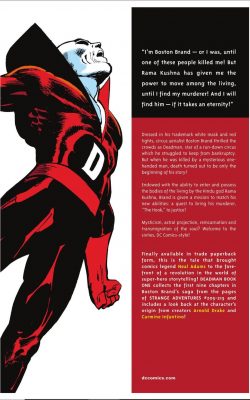
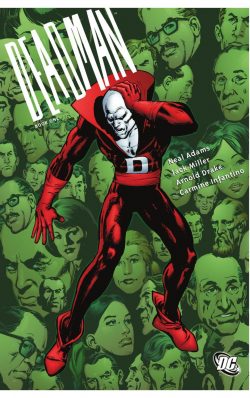
Deadman: Book One


By Arnold Drake, Jack Miller, Carmine Infantino, Neal Adams, George Roussos & various (DC Comics)
ISBN: 978-1-4012-3116-3 (TPB/Digital edition)

As the 1960s ended, a massive superhero boom became a slow but certain bust, with formerly major successes no longer able to find enough readers to keep them alive. The taste for superheroes was diminishing in favour of more traditional genres, and one rational editorial response was to reshape costumed characters to fit evolving contemporary tastes.

Publishers swiftly changed gears and even staid, cautious DC reacted rapidly: making masked adventurers designed to fit the new landscape. Newly revised and revived costumed features included roving mystic troubleshooter The Phantom Stranger and golden age colossus The Spectre, whilst resurgent traditional genres spawned atrocity-faced WWII spy Unknown Soldier and cowboy bounty hunter Jonah Hex, spectral western avenger El Diablo and game-changing monster hero Swamp Thing, spearheading a torrent of new formats, anthologies and concepts.

Moreover, supernatural themes and horror-tinged plots were shoehorned into those superhero titles that weathered the trend-storm. Arguably, the moment of surrender and change had arrived with the creation of Boston Brand in the autumn of 1967, when venerable science fiction anthology Strange Adventures was abruptly retooled as the haunted home of an angry ghost…

Without fanfare or warning, Deadman debuted in #205 with this first collection (of five) re-presenting that origin event and thereafter, pertinent contents from #206-213: cumulatively spanning cover-dates October/November 1967 to July/August 1968. The drama is preceded by Introduction ‘How Deadman Came to Life’ by originator Arnold Drake and the Foreword – ‘A Most Unusual Character’ by Carmine Infantino – each reminiscing, recapitulating and confirming just how daring and unprecedented the new kind of hero was…

Then it’s straight into eerie action with ‘Who Has Been Lying in My Grave?’ – by Arnold Drake, Carmine Infantino & George Roussos – as we attend the funeral of high wire acrobat Boston Brand: a rough, tough, jaded performer who had seen everything and masked a decent human heart behind an obnoxious exterior and cynical demeanour.

As “Deadman”, Brand was the star attraction of Hills Circus and lover of its reluctant owner Lorna Carling, as well as a secret guardian for the misfits it employed and sheltered. That makeshift “family” includes simple-minded strongman Tiny and Asian mystic Vashnu, but also had a few bad eggs too… people like alcoholic animal trainer Heldrich and chiselling carnival Barker Leary.

The aerialist kept them in line… with his fists, whenever necessary…

One fateful night, Brand almost missed his cue because of Leary and Heldrich’ antics and also because he had to stop local cop Ramsey harassing Vashnu. It would have better if he had been late, because as soon as he started his act – 40 feet up and without a net – someone put a rifle slug into his heart…

Despite being dead before he hit the ground, Brand was scared and furious. Nobody could see or hear him screaming, and Vashnu kept babbling on that he was the chosen of Rama Kushna – “the spirit of the universe”. The hokum all came horribly true as the entity astonishingly made contact, telling Brand that he would walk among men until he found his killer…

The sentence came with some advantages: he was invisible, untouchable, immune to the laws of physics and able to take possession of the living and drive them like a car. His only clue was that witnesses in the audience claimed that a man with a hook had shot him…

Outraged, still disbelieving and seemingly stuck forever in the ghastly make-up and outfit of his performing persona, Deadman’s first posthumous act is to possess Tiny and check out the key suspects. Soon the dormant Hercules finds that the cop and Heydrich are involved in a criminal conspiracy, but they definitely are not Brand’s murderers…

Eventually, the ghost learns a shocking fact: his desperation is not worth the life of anyone else and he must not let his anger put his “vessels” in harm’s way…

Second episode ‘An Eye for An Eye!’ was scripted by Drake, and was Adams’ illustrative debut. Originally inked by Roussos, here it is rather unfairly reinked by Adams and further enhanced by modern colouring techniques. I understand how the artist should have autonomy and agency in his own work, but for the sake of chronology and authenticity, I take quite a bit of umbrage on behalf of old “Inky”, whose efforts seem unfairly judged and slighted by these revisions…

That being said, the tale is a strong one and indicates a sea change in narrative style as Deadman expedites his hunt for justice. The stories henceforth focus on those who are temporarily occupied by Brand: a string of episodic encounters that mirrored the protagonist of contemporary hit TV series The Fugitive (and by extension, Victor Hugo’s Les Misérables), with an unfairly accused victim searching for personal justice all across America, to the benefit of many people in crisis.

Here, that’s young Jeff  Carling, who’s fallen in with a dangerous biker gang and is set up to pay for their crimes. He’s also Lorna’s brother, which is how Deadman gets involved in the mess, after learning the cash-strapped kid had taken out a life insurance policy on the circus star just before the Hook struck…

Having saved the kid from a perfect frame, Brand resumes his search and, as Jack Miller took over scripting in #207, is forced to ask ‘What Makes a Corpse Cry? The hunt leads him to revisit the night he saved bar girl Liz Martin from a drunken assault by her boss Rocky Manzel, but when the spook checks in, he finds Liz and boyfriend Paul being terrorised by Rocky, who coldly implies he caused the death of her last protector…

Even after using his ghost gifts to disqualify Manzel, Deadman is compelled to help the young lovers, and exposes the club owner’s criminal secret, but once again almost causes the death of his human ride…

Miller & Adams were providing a very different reading experience with innovative, staggeringly powerful art, but struggled with deadlines, and ‘How Many Ways Can a Guy Die?’ was delivered in 4 parts across Strange Adventures #208 and 209. The revelatory tale introduces Brand’s trapeze artist rival Eagle, who had tried to kill him years before, and now seeks to replace him in the circus and Lorna’s bed – whether she wants him or not…

When Deadman again borrows Tiny to dissuade the brute, Eagle threatens the gentle strongman with the same thing Brand got and the ghost is convinced his quest is almost over. However, the truth is far crueller, and when Deadman uncovers his rival’s actual scheme, the cost to Tiny and alternate vessel Pete is far too high…

The hunt stalled again, Brand finally thinks to check the official police investigation in #210’s ‘Hide and Seek’ (cover-dated March 1968). To his disgust, he finds the case is cold, with assigned detective Michael Riley dishonourably discharged from the force due to the testimony of a man with a hook…

Sensing a breakthrough, Deadman possesses Riley and, visiting the other “witness” to the former cop’s reported use of excessive force, uncovers a devious plot. Sadly, despite clearing Riley’s name, Brand misses The Hook who coldly disposes of the only man who could describe him before fleeing to Mexico…

Hot on the trail, Deadman arrives in El Campo in #211, and endures a shocking surprise in ‘How Close to Me My Killer?’ as Miller’s last story introduces wayward twin brother Cleveland Brand. Flashbacks show the sibling had plenty of motive to murder his showbiz brother, but as the tale unfolds, Boston learns he has an unsuspected niece and his people-trafficking but repentant brother needs some haunted help to save smuggled “wetback” labourers from a Texan businessman looking to whitewash his criminal endeavours…

Adams took over scripting with #212 and ‘The Fatal Call of Vengeance’ sees another change of direction, adding more conventional fantasy elements to the mix as Cleveland and his daughter Lita head north to Hills Circus.

Wearing his brother’s costume, Cleve revives the Deadman act and, in Mexico, a man with a hook sees a headline and rushes back to the USA.

Faster than any jet, Boston is already there and watches helplessly as his brother makes himself a target of the unknown killer. The phantom is also completely spooked by new lion tamer Kleigman who is rude and unfriendly and is missing his right hand…

With everyone at odds, both Boston’s returned killer and the circus family set traps with disastrous results, but in the end the Hook escapes again and it’s Tiny who’s left bleeding out from a gunshot…

This first collection concludes with a dip into the madly metaphysical as ‘The Call from Beyond!’ tests Deadman’s abilities to the limit as he enters Tiny’s consciousness to promote his recovery and break a assumed-fatal coma. Following that miracle, the restless revenant repays his debt by saving the reputation and life of Tiny’s surgeon Dr. Shasti after the medical savant is duped by murderous con artist/medium Madam Pegeen…

With groundbreaking covers by Infantino, Sekowsky, Roussos & Adams and ‘Biographies’ of the creators involved, this spectral delight perfectly captures the tone of an era in transition through a delirious run of comics masterpieces no ardent art lover or fanatical fear aficionado can do without.
© 1967, 1968, 2011 DC Comics. All Rights Reserved.

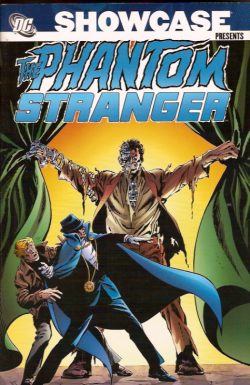
Showcase Presents The Phantom Stranger volume 2


By Bob Haney, Len Wein, Marv Wolfman, Arnold Drake, Michael J Pellowski, Steve Skeates, David Michelinie, Paul Levitz, Gerry Conway, Marty Pasko, Jim Aparo, Gerry Talaoc, Michael Kaluta, Mike Grell, Fred Carrillo, Bernard Baily, Ross Andru/Mike Esposito, Dick Dillin, Tony DeZuñiga, Bill Draut, Romeo Tanghal, Dick Giordano, Bob Layton & various (DC Comics)
ISBN: 978-1-4012-1722-8 (TPB)

The Phantom Stranger was also one of the earliest transitional heroes of the Golden Age of comics, created at the very end of the first superhero boom as readers moved from costumed crimefighters to other genres such as mystery, crime, war and western tales. A trench-coated, mysterious know-it-all, with shadowed eyes and hat pulled down low, he would appear, debunk a legend or foil a supernatural-seeming plot, and then vanish again.

He was coolly ambiguous, never conclusively revealed as man, mystic or personally paranormal. Created by John Broome & Carmine Infantino, who produced the first story in Phantom Stranger #1 (August/September 1952 – Happy Anniversary, Mystery Man!) and most of the others, the 6-issue run also boasted contributions from Jack Miller, Manny Stallman and John Giunta. The last issue was cover-dated June/July, 1953, after which he vanished.

Flash-forward to the end of 1968. The second superhero boom is rapidly becoming a bust, and traditional costumed heroes are dropping like flies. Suspense and mystery titles are the Coming Thing and somebody – probably unsung genius E. Nelson Bridwell – has the bright idea of reviving Phantom Stranger.

He was the last hero revival of DC’s Silver Age and the last to win his own title: another graduate of a star-studded later run in Showcase. After only one appearance in #80 (cover-dated January/February 1969) he returned in his own comic three months later. This time, he found an appreciative audience, running for 41 issues over seven years.

Rather than completely renovate the character, or simply run simple reprints as DC had when trying to revive espionage ace King Faraday (in Showcase #50-51), editor Joe Orlando had writer Mike Friedrich & artist Jerry Grandenetti craft a modern framing sequence around a partial reprint, and – in a masterstroke of print economy – reintroduced another lost 1950s mystery hero to pad out the comic, and provide a rationalist’s contemporary counterpoint.

Dr. Terrence Thirteen was a parapsychologist known as the Ghost Breaker. He predated the Stranger, with his own feature in Star-Spangled Comics (#122-130; November 1951-July 1952). With fiancée (later wife) Marie, the parapsychologist roamed America and the world, debunking supernatural hoaxes and catching mystic-themed fraudsters, a vocal and resolute cynic imported whole into the modern series as a foil for the Stranger.

(Follow Me… For I Am…) The Phantom Stranger launched with a May/June 1969 cover-date. By the end of 1972, the horror/mystery boom had stabilized, and was a key component of both DC and Marvel’s mainstream output, with fantasy and sword & sorcery adventurers also scoring well with fans. However, the glory days of huge comic book print-runs were gone forever. And yet, although a depleted force, superhero comics did not disappear as many older heads suspected they might, and an initially unwieldy amalgam, the horror-hero, soon became a useful crossover sales tool.

Never as common as Marvel’s burgeoning pantheon of spooky crusaders, the most successful and enduring of DC’s supernatural stalwarts were Swamp Thing and Phantom Stranger. This sequel mammoth monochrome tome concludes that impressive second incarnation, incorporating not only his crossover trips into the greater DCU, but also rare appearances that closed his career …until he was resurrected post Crisis on Infinite Earths.

Spanning April/May 1970 to Winter 1978, this collects The Brave and the Bold #89 & 98; Justice League of America #103; Phantom Stranger #22-41; DC Super-Stars #18 and House of Secrets #150, blending a popular taste for blood and horror with traditional mystery man derring-do…

The magic begins with an impressive chiller from Bob Haney, Ross Andru & Mike Esposito originally seen in Batman team-up vehicle The Brave and the Bold (#89, April/May 1970). ‘Arise Ye Ghosts of Gotham’ sees a religious sect return to the city that had driven them out two centuries previously, only to awaken the vengeful spirits of their banished ancestors until pacified by our initially squabbling heroes.

The Stranger’s rerise in Brave and the Bold (#98, October/November 1971) was a more recognisably spooky tale, superbly crafted by Haney & Jim Aparo. ‘Mansion of the Misbegotten!’ is a twist-ridden riot of demon-cults, scheming plots and contemporary-cinema styled possession carefully exploiting the global obsession with Satanism that began with Rosemary’s Baby and peaked with The Exorcist. Here the Gotham Guardian finds himself outwitted, outmatched and in dire need of assistance to foil a truly diabolical force threatening the life of his godson.

Following on is ‘A Stranger Walks Among Us!’ by Len Wein, Dick Dillin & Dick Giordano, as the haunted hero saves Halloween and the World’s Greatest Superheroes from a magical murder plot. He was consequently offered membership in the Justice League of America (in issue #103 of their comic, December 1972) but seldom made any meetings or took a turn on monitor duty…

In the same month, his solo adventures featured ‘Circle of Evil’ (Phantom Stranger #22, by Wein & Aparo), wherein a coalition of evil calling itself the Dark Circle initiates a master plan: attacking the hero through blind psychic – and notional love-interest – Cassandra Craft. At the back of the book, Ghost-Breaker Dr. Thirteen exposes another hoary hoax in Steve Skeates & Tony DeZuñiga’s ‘Creatures of the Night’. These counterpoints to eldritch adventure – although usually excellent – were rapidly reaching their sell-by date, and very soon Thirteen would be battling real monsters he couldn’t rationalize away…

‘Panic in the Night!’ in #23 saw the Stranger and Cassandra in Paris, battling analogues of the Phantom of the Opera and Hunchback of Notre Dame whilst gathering an unlikely ally for the imminent final clash with the Dark Circle. However, great as this yarn is, the real gem is the back-up feature which transformed Terry Thirteen.

‘The Spawn of Frankenstein!’ saw the discovery of an ice-entombed man-monster lead to dark personal tragedy. When Thirteen’s colleague Victor Adams attempted to revive the legendary literary beast, it resulted in his death and Thirteen’s wife Marie being beaten into a coma. Vengeance-crazed, the Ghost-Breaker resolved to hunt down and destroy the monster, utterly unaware – and perhaps uncaring – that the beast was both rational and wholly innocent of any misdeed.

Written by Marv Wolfman and illustrated by the unique talent of Michael Kaluta, this debut promised much, but the feature was plagued by inconsistency. Phantom Stranger #24 (March/April 1973) offered the epic conclusion of the Dark Circle war as the Stranger and Cassandra defrayed the ‘Apocalypse!’ in the shadow of Mount Corcovado (that’s the one with the Jesus statue “Christo Redentor” overlooking Rio de Janeiro) with old foes Tannarak and Tala, Queen of Darkness along for the spectacular and long-overdue ride…

Wolfman & Kaluta’s The Spawn of Frankenstein continued as the revived revenant opted to revenge itself upon Victor Adams for dragging him back to cruel, unwanted life by returning the favour and resurrecting the dead scientist.

A fresh tone and resumption of episodic, supernatural triage marked issue #25 as the Man in the Hat confronted a voodoo cult in ‘Dance of the Serpent’ (Wein – from an idea by Michael J Pellowski – & Aparo), whilst Kaluta ended his run on Frankenstein with another untitled tale wherein Rachel Adams (wife of the departed Victor) was kidnapped by Satanists before being rescued by the monster; leading into #26’s crossover ‘From Dust Thou Art…’

Here Wein, Wolfman & Aparo teamed the Monster and the Stranger against demons seeking earthly bodies.

The radical change was completed with the next issue as innovative horror-anthology artist Gerry Talaoc replaced the sleekly realistic Aparo (moved to The Brave and the Bold for a long career illustrating Batman), whilst journeyman mainstay Arnold Drake assumed the writer’s seat on the stranger. He introduced another long-term nemesis in deeply disturbed psychiatrist/parapsychologist ‘Dr. Zorn: Soul-Master!’

This driven meddler callously warped his patients and performed illicit experiments for the US Military-Industrialist Complex: a far more insidious and freshly contemporary threat in tune with modern mores. Thwarted but seldom defeated, he constantly returned to bedevil the Stranger.

Skeates and legendary veteran Bernard Baily (Golden Age co-creator of Hourman and The Spectre) now helmed Frankenstein, with ‘The Terror and the Compassion’ seeing the misunderstood beast stumble into a commune that is actually a demonic coven intent on blood sacrifice and raising the devil…

‘The Counterfeit Madman!’ by Drake & Talaoc saw the Stranger explore the mind of mad-dog killer Johnny Ganz. Was the young offender a true psychopath or a cunning crook pretending to be a multiple-personality sufferer? Was there another innocent victim trapped inside the killer’s skull with him? An element of moral ambiguity had been added by Drake, layering later adventures with enticing, challenging dilemmas absent from most comic fiction and only matched by Steve Gerber’s challenging work on Man-Thing.

Back-up ‘Night of the Snake God’ was a more traditional tale which continued Frankenstein’s battle against the hippie cult in a solid, if undemanding manner.

Zorn resumed his unscrupulous scientific explorations of the supernatural in PS #29’s ‘The Devil Dolls of Dr. Z!’, whilst matters barely progressed at all in ‘The Snake-God Revealed!’, which saw the Spawn of Frankenstein lose momentum – and story-space – as his strip was reduced to 6 pages. The next issue contained more contemporary chills in ‘The Children’s Crusade!’ as a modern Pied Piper lures a town’s youngsters into his charismatic cult whilst ‘Turn-about!’ concludes – and not before time – the Spawn of Frankenstein’s run.

Issue #31 (June-July 1974) offers an exotic yarn dealing with the aftermath of the Vietnam war as a disgraced US “general” smuggling drugs for a local warlord awakens a slumbering demon in ‘Sacred is the Monster Kang!’ The Stranger’s tales were usually 12-pages long at this period, but the back-up feature that originally filled up the comics – The Black Orchid – is not included in this volume.

Bill Draut, one of the Stranger’s earliest illustrators returned in #32’s ‘It Takes a Witch…!’: an old-fashioned scary whodunit, whilst superstar-in-waiting Mike Grell illustrated a Dr. Zorn vehicle guest-starring Boston Brand. In ‘Deadman’s Bluff!’, the ghost’s protracted hunt for his own murderer ended as usual in frustration, but an antagonistic partnership was established for the future…

Talaoc was back in #34 for ‘A Death in the Family!’ wherein a “clean” brother is compelled to assume control of the family business – running an organised crime mob. His guilt is further compounded when his dead sibling returns from the grave to give him some pointers. Increasingly, the Stranger was becoming a mere witness to supernatural events in his own series, so perhaps it’s no coincidence that this issue featured a return for the more hands-on Dr. Thirteen (wife Marie cured and both of them ignoring that brief stint of Frankensteinian tragedy).

‘…And the Dog Howls Through the Night!’ is another straightforward yet gripping adventure from Skeates & DeZuñiga, which had probably been sitting in a drawer for years before publication.

‘The Demon Gate’ was writer David Michelinie’s debut tale, with the Stranger targeted by derivative Dr. Nathan Seine – who wanted to siphon off the hero’s mystic energy and soul to cure his dying wife. Like ‘Crimson Gold’, a deadly African treasure hunt for Nazi treasure in #36, it briefly betokened a more active role for the immortal wanderer.

Drake & Paul Levitz scripted ‘Images of the Dead’ in Phantom Stranger #37: another highly charged moral quandary with a young artist forced to commit reprehensible crimes to earn money for his wife’s hospital bills…

Talaoc made way for fellow Filipino artist Fred Carrillo with issue #38, as Dr Seine sought to extract bitter vengeance in Levitz’s ‘The Curse of the Stalking Skull’. The new creative team brought back Boston Brand for ‘Death Calls Twice for a Deadman’: a last-ditch effort to revive dwindling sales. Also including Batman villain The Sensei, it signalled a belated return to the company’s over-arching continuity, but was too little, too late.

Deadman also co-starred in #40’s ‘In the Kingdom of the Blind’ and #41’s concluding chapter (February-March 1976) ‘A Time for Endings’ as Seine sought to bring Elder Gods to Earth using long-absent Cassandra Craft as a medium. With that tale’s finish the series ended and the Stranger all-but vanished until the winter of 1978 and a giant-sized tale from DC Super-Stars #18.

‘Phantom Stranger and Deadman’ (by Gerry Conway, Marty Pasko, Romeo Tanghal, Dick Giordano & Bob Layton) was an extended Halloween extravaganza with the supernatural champions – and Dr. Thirteen and Tala in attendance – attempting to eradicate an infestation of demons infiltrating the comic book Mecca of the season: Rutland, Vermont (long associated in both Marvel and DC titles as the only place to be on the Eve of All Hallows).

One final tale appeared a few months later in the 150th issue of House of Secrets (February-March 1978) wherein Conway & Talaoc related a generational tale of restless evil in ‘A God by any Other Name.’

Here, the Stranger and Dr. Thirteen united to complete the work of Rabbi Samuel Shulman and Father John Christian who, in the dire environs of London, 1892, had joined spiritual forces to destroy the World’s first malignant machine intellect Molloch. Sadly, those Satanic Mills had a habit of being rebuilt by greedy men…

More than most, The Phantom Stranger is a strong character and concept at the mercy of pitiless fashion. Revived as the 1960s closed on a wave of interest in the supernatural, and seemingly immune to harm, he struggled to find an audience in the general marketplace before direct sales techniques made publishing a less hit-or-miss proposition. However, blessed with a cohort of talented creators, the stories themselves have proved to be of lasting quality, and would so easily transfer to today’s television screens that I wonder why they haven’t yet (and no, that doesn’t mean animated appearances or cameos on the Swamp Thing series). Mystery, exotic locales, forbidden monsters spectacular effects, a medallion and a cool hat: C’mon, you know you’d watch it…

But until then you’ll have to thrill and scare yourselves with these fantastic tales.
© 1970, 1971, 1972, 1973, 1974, 1975, 1976, 1978, 2006 DC Comics. All Rights Reserved.

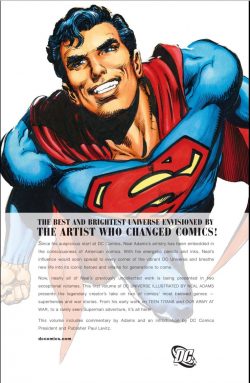
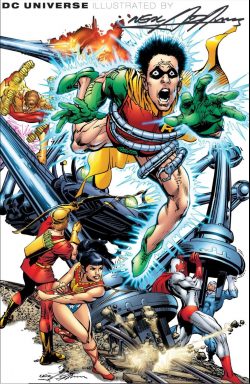
DC Universe Illustrated by Neal Adams volume 1


By Neal Adams with Dennis O’Neil, Gardner F. Fox, Robert Kanigher, Howard Liss, Hank Chapman, Len Wein, Bob Haney, Mark Evanier, Sergio Aragonés, Joe Kubert & various (DDC Comics)
No ISBN: digital only edition

As the 1960s began Neal Adams was a young illustrator who had worked in advertising and ghosted some newspaper strips whilst trying to break into comics. Whilst pursuing a career in advertising and “real art” he did a few comics pages for Archie Comics and subsequently became one of the youngest artists to co-create and illustrate major licensed newspaper strip Ben Casey (based on a popular TV medical drama series).

That comics fascination never faded, however, and Adams drifted back to National/DC, doing a few covers as inker or penciller before eventually finding himself at the vanguard of a revolution in pictorial storytelling…

He made such a mark that DC have regularly curated and reissued his work in a series of commemorative collections. This is the first of a proposed series of eBook tomes extracted from heftier physical artefacts covering the artists’ minor efforts (those not starring Batman, Deadman or “Hard-Travelling Heroes” Green Lantern/Green Arrow) in themed original publication order.

Revisiting Teen Titans #20-22 and gatherings material from Detective Comics #369; Superman #254; Justice League of America #94; Our Army At War #182, 183, 186, 240; Star Spangled War Stories #134, 144; Fanboy #5 and Amazing World of DC Comics Special Edition #1 it cumulatively embraces November 1969 through July 1999.

Following a contextualising Foreword by Paul Levitz and Adams’ thoughts in his own ‘Superheroes Foreword’ the comic dramas commence with a tale of slinky sleuth The Elongated Man who solves a bizarre theft connected to the ‘Legend of the Lovers’ Lantern’ (scripted by Gardner F. Fox from Detective Comics #369, November 1969).

We then encounter a bold triptych from Teen Titans #20-22 (March/April to June/July 1969), written by Adams and pencilled by him and Sal Amendola with inks by brush-maestro Nick Cardy – one of the all-out prettiest illustration jobs of that decade.

Completing s a long-running plot-thread of extra-dimensional invaders by endowing everything with a counterculture twist, ‘Titans Fit the Battle of Jericho’ is a spectacular rollercoaster romp deftly blending teen revolt, organised crime, anti-capitalist activism, bug-eyed monsters and cunning extraterrestrial conquerors…

Symbolic super-teens Hawk and Dove briefly join the proceedings for #21’s ‘Citadel of Fear’ (Adams & Cardy): chasing smugglers, facing evil ETs and ramping up the surly teen angst quotient whilst moving the invaders story-arc towards stunning conclusion ‘Halfway to Holocaust’ wherein the abduction of Kid Flash and Robin leads to a cross-planar climax as Wonder Girl, Speedy and a radical new ally quash the invaders forever…

Excerpts from Justice League of America #94’s ‘Where Strikes Demonfang’ – specifically pages 1, 5, 20 and 22 – tie up loose ends from the Deadman saga seen elsewhere (in Strange Adventures of the Adams Deadman collections) before a modern pin-up of ‘Ra’s al Ghul’ brings us to a delightful treat scripted by Len Wein taken from The Private Life of Clark Kent backup series.

‘The Baby Who Walked Through Walls’ comes from Superman #254 (July 1972): scripted by Len Wein and deliciously detailing how even the mighty Man of Tomorrow is no match for a toddler determined to dodge her babysitter and go exploring…

Unpublished Superman pages and thumbnails culled from ‘Amazing World of DC Comics Special Edition #1’ (February 1976) segue into a selection of public service messages starring the Caped Kryptonian – specifically ‘Justice for All Includes Children 1, 2, 6 and 7′ – and are followed by a monochrome and a full-colour v ‘9/11 Tribute’…

Self-parody changes the tone as an excerpt from Fanboy #5 (July 1999) finds Mark Evanier & Sergio Aragonés joining the master of moody in an unlikely iteration of the Daft Knight…

A ‘Batman Sketchbook’ offers preliminary doodles for Robin’s new costume, Batman roughs and Joker redesigns, culminating in finished pin-ups of all before the tone twists back to hyper-realism and a ‘War Stories Foreword’ by Neal Adams begins a chronological excursion through the artist’s combat contributions to DC canon.

All recoloured in Adam’s lush modern manner, the lean sparse sagas commence with ‘It’s My Turn to Die’ from Our Army At War #182 (July 1967), with Howard Liss scripting the tale of an officer who’s reached his emotional limit, whilst ‘Invisible Sniper’ (Liss again from OAAW #183, August 1967) tracks an embattled GI hunting an infallible enemy with a killer gimmick…

‘The Killing Ground’ (Star Spangled War Stories #134, August -September 1967) is a Robert Kanigher moment from The War That Time Forgot, with PT Boat survivors striving against a succession of seaborne antediluvian atrocities, after which ‘My Life for a Medal’ – Our Army At War #186 (November 1967, by veteran scribe Hank Chapman) – holds a shocking lesson for a glory-hungry go-getter.

A visual triumph, Joe Kubert inked hot new penciller Adams on Kanigher’s ‘Death Takes No Holiday!’ (SSWS #144, April-May 1969) as another macabre death-dealing French aviator – dressed as a skeleton – terrorised and butchered Jagdstaffel pilots at will, forcing the Kaiser’s Enemy Ace Hans von Hammer into insane action to inspire his men and cure a young flier of fear-induced madness…

War takes a weird – and socially relevant – turn as we visit the future for our concluding clash in Bob Haney’s ‘Another Time Another Place’ (Our Army At War #240, January 1972) as an elite squad meet the enemy and get a sobering surprise…

Sadly short of Adams incredible canon of covers, we wrap up with only full ‘Biographies’ as a bonus, but this beautiful book still offers a look at less often seen gems that were in many ways more informative than all the big-banner achievements of a major force in comics. Now, if only DC would sort out his horror stories and truly lost gems like Jerry Lewis, we’d all be happy…
© 1967, 1969, 1971, 1972, 1976, 1999, 2008 DC Comics. All Rights Reserved.

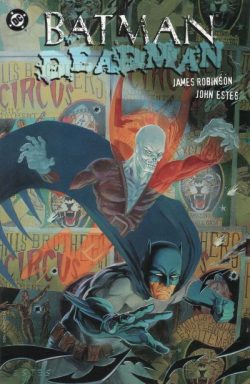
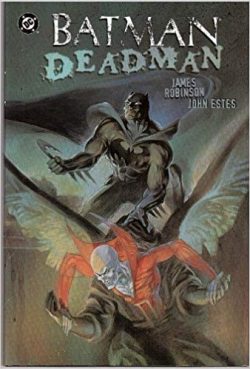
Batman/Deadman: Death and Glory


By James Robinson & John Estes (DC Comics)
ISBN: 978-1-84856-213-4 (HB)                    978-1-56389-228-8 (TPB)

Everybody thinks they know Batman but to only a select few are the secrets of assassinated trapeze artist Boston Brand also revealed. An ordinary man in a brutal, cynical world, Brand was a soul in balance until killed as part of a pointless initiation for a trainee assassin.

When the unlucky aerialist died, instead of going to whatever reward awaited him, Rama Kushna, spirit of the universe, offered him the chance to solve his own murder. That opportunity evolved into an unending mission to balance the scales between good and evil in the world. The ghost is intangible and invisible to all mortals, but has the ability to “walk into” living beings, possessing and controlling them.

Gotham City: Batman gradually regains consciousness, realising he is facing a squad of armed, trigger-happy police and holding a knife to the throat of a hostage. The scene is a nightclub-turned-charnel house and all evidence before the hero’s widened eyes indicates that he is the murderous culprit…

Suddenly clear-headed and rational, he drops his victim and escapes the SWAT teams, determined to find out what has happened since he lost consciousness. Stepping broadly out of character, Batman uses magical items taken from villainous sorcerer Felix Faust to perform an eldritch rite and snags his prime suspect, Boston Brand. Unfortunately, old comrade Deadman is not the guilty party, but does reveal that a rich man who has sold his soul to the devil is responsible for all the Dark Knight’s woes.

Meanwhile, Albert Yeats, terminally ill and imminently dying, is running for what’s left of his life, hunted by things he doesn’t know and can’t understand…

Determined to renege, Frederick Chaplin has offered another’s soul in exchange for his hellbound one, and the devil has accepted. Yeats had been chosen by the universe to reincarnate as the Messiah in his extremely imminent next life, but that can’t happen if he’s paying Chaplin’s tab in the Inferno.

Deadman has been watching over Yeats until he safely passes, but when Batman is first possessed and subsequently distracts the Ghostly Guardian with his spell, Yeats is left alone and unprotected…

Now the kid is in the wind and the heroes must find and shield him long enough to die safely: a task complicated by an entire city hunting what they still think is a murderous Bat-Maniac, whilst the real possession-killer – a phantom, satanic counterpart to Deadman called the Clown who has spread terror and death for 70 years – is loose to spread his own unholy kind of havoc…

Intriguing and pretty, but lacking much of the emotional punch of earlier Batman/Deadman pairings, Death and Glory looks great even if it feels rather dispirited and glib in its attempts to blend urban horror, all-out chase action, cod-religion and hidden histories with a millennial feel-good factor. The result is a top-rate outing for Boston Brand but a rather forced and unlikely performance from the Dark Knight.

Nevertheless, fans of both heroes will find lots to love here and Estes’ painted illustration will win the approval of most comic art lovers. This book is still available through physical and online outlets, in both paperback and hardcover editions but not yet as digital delight…
© 1996 DC Comics. All Rights Reserved.