Justice League of America: Sanctuary


By Alan Burnett, Dwayne McDuffie, Ed Benes & various (DC Comics)
ISBN: 978-1-84856-051-2

The fourth volume of the latest Justice League of America incarnation (collecting issues #17-22 of the monthly comic) sees a changing of the creative guard as the always impressive Alan Burnett splits the scripting duties with equally impeccable Dwayne McDuffie to tie-in the Worlds Greatest Heroes to a company-wide storyline that wasn’t quite a braided-mega-crossover but was more than a shared plotline.

The graphic novel (or album or trade paperback collection: take your pick) is a wonderful vehicle for a complete reading experience in an industry and art-form that has always suffered from its own greatest strength – vitality and immediacy due to being periodically published.

Simply stated: you can generate huge enthusiasm for your product if it comes out frequently (or constantly), and more so if your product shares a storyline with a congruent product. That simple maxim gave early Marvel an insurmountable advantage in the 1960s and DC, being slow to catch on is still playing Catch-Up in the cross-selling stakes.

Unfortunately that advantage becomes a hazard once these parallel sagas are bundled up into what ought to be cohesive one-off packages, i.e. books, as inevitably backstory and initiating events have to be ignored, précised or included. One day all periodical material will be downloadable on demand and I’ll go back to reviews of actual comics…

The epic in question here is Salvation Run: a miniseries which spilled over most prominently into Catwoman (see both Catwoman: Crime Pays and Catwoman: the Long Road Home), although the build-up, which saw a large number of DC super-villains seemingly vanish, was featured in a quite a number of disparate DC titles.

The chapters here were divided into the lead feature ‘Sanctuary’ parts 1-3, by Burnett, Ed Benes and inkers Sandra Hope, Mariah Benes & Ruy José, with McDuffie providing captivating character-based vignettes, before assuming full writing chores for the last two tales in this volume.

It all kicks off when a desperate gang of super criminals smashes into the JLA’s headquarters and promptly surrenders, requesting asylum. Investigation reveals that villains from the most pathetic to the most powerful are being “disappeared” and even incarceration in the League’s dungeon on the Moon is preferable to the unknown fate of their fellows.

When hard-line political animal Amanda Waller and her pet penal battalion The Suicide Squad turn up demanding the heroes hand over the bad-guys the shocking secret comes out: the US government has had enough of metahuman threats and is rounding them up, without benefit of Due Process, and deporting them to another world from which they can never return. Moreover, she’s equally prepared to trample the JLA’s human rights to get what – and who – she wants…

Full of spectacular action and telling metaphor this yarn has plenty of surprises and for best effect should be read before any of the above cited collections, as it has no real conclusion, only lots of climaxes…

McDuffie’s first tale is ‘Meanwhile, Back in the Kitchen…’ illustrated by Jon Boy Meyers & Serge LaPointe, wherein Vixen reveals a secret that might get her booted off the team to Red Arrow, Red Tornado and Green Lantern, and ‘Meanwhile, Back at Owl Creek Bridge…’, (Meyers & Mark Irwin) sees the Tornado – currently bodiless and inhabiting the team’s computer system – make a decision that could save or end his “life”. Both these short stories lay the threads for upcoming longer tales.

After the conclusion of ‘Sanctuary’ McDuffie and Ethan van Sciver pit the (Wally West) Flash and Wonder Woman against the alien insect Queen Bee Zazzala in ‘Back up to Speed’ and the book closes focusing on the Human Flame, as he joins a bevy of baddies feted by the villainous Libra in a prequel to Final Crisis. ‘The Gathering Crisis’ is illustrated by Carlos Pacheco & Jesus Merino.

Even though possibly no more than a bunch of interludes and add-ons, the sheer quality of the work collected here elevates this book above the average superhero sock-fest, and if you are a fan of the “Big Events” the room to see characters breathe and move here is a bonus of unparalleled worth.

© 2008, 2009 DC Comics. All Rights Reserved.
JLA: Tower of Babel


By Mark Waid, Howard Porter & various (DC Comics)
ISBN 1-84023-304-4

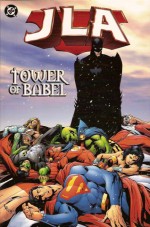
After battling every combination of ancient, contemporary and futuristic foes, the World’s Greatest Superheroes found themselves pitted against an unbeatable threat in this startling exploration of paranoia that originally ran in issues #42-46 of the monthly comic-book, and spread into JLA Secret Files #3 and JLA 80-Page Giant #1

As a taster to the main event the book begins with ‘Half a Mind to Save a World’, an intriguing take on Asimov’s Fantastic Voyage from Dan Curtis Johnson, Mark Pajarillo and Walden Wong, wherein the Atom leads a JLA team on a mission to forcibly evacuate an advanced civilisation of bacteria that have taken up residence in a small boy’s brain, but of course, the bacteria aren’t that keen on moving…

Tower of Babel begins with immortal eco-terrorist Ra’s Al Ghul’s latest plan to winnow Earth’s human population to manageable levels well underway. In ‘Survival of the Fittest’ (Waid, Porter and Drew Geraci) a series of perfectly planned pre-emptive strikes cripple the Martian Manhunter, Flash, Wonder Woman, Aquaman, Plastic Man and Green Lantern whilst Batman is taken out of the game by the simple expedient of stealing his parents’ remains from their graves.

With the Dark Knight distracted and his fellow superheroes disabled the action begins: suddenly humanity has lost the ability to read. Books, newspapers, complicated machinery instructions, labels on medicine bottles – all are now gibberish. The death toll starts to rise…

In ‘Seven Little Indians’ as the League attempt to regroup and fight back Batman realises that the tactics and weapons used to take out his allies, now including Superman, were his own secret contingency measures, designed with sublime paranoia in case he ever had to fight his super-powered friends…

Inserted next is ‘Blame’ by Dan Curtis Johnson, Pablo Raimondi, Claude St. Aubin and David Meikis from JLA Secret Files #3 which reveals how Talia, Daughter of the Demon, stole Batman’s anti-hero files and devices before Tower of Babel resumes with ‘Protected by the Cold’ as Batman leads a counter-attack despite the shock and fury of his betrayed comrades, and as the final phase kicks in and humans lose the power of speech too, the disunited team mounts a last-ditch assault on Al Ghul in ‘Harsh Words’ (illustrated by Steve Scott and Mark Propst). The same team handled the epilogue where the recovered heroes angrily seek to understand how their trusted friend could have countenanced such treachery…

The volume concludes with two thematically linked vignettes from JLA 80-Page Giant #1, ‘The Green Bullet’ by John Ostrander, Ken Lashley and Ron Boyd and ‘Revelations’ by Priest, Eric Battle and Prentis Rollins wherein Batman clears the Man of Steel of a trumped-up murder charge whilst Aquaman and Wonder Woman seek to deal with their obvious dislike and distrust of each other…

This volume (voted by multimedia reviews website IGN as number 20 on their list of the 25 greatest Batman graphic novels) is indeed one of the best Batman tales ever: a perfect, defining example of the man who thinks of everything, and is tough enough to prepare for the worst of all outcomes. As the Dark Knight was (temporarily) cast out of the League a new era began and the fans couldn’t have been happier. That’s a feeling you can share simply by picking up this startlingly impressive tale.
© 1998, 2000 DC Comics. All Rights Reserved.
JLA: volume 8 Divided We Fall


By Mark Waid & various (DC Comics)
ISBN: 978-1-84023-392-6

When Grant Morrison and Howard Porter relaunched the World’s Greatest Superheroes in 1997 the result was everything jaded fans could have asked for, but nothing lasts forever. By the time of these tales (four years later, kick-starting a new century and reprinting issues #47-54) they were gone and nearly forgotten as scripter supreme Mark Waid assumed full control of story-making and a selection of top-notch artists took turns to produce a delightful run of exciting, entertaining epics that cemented the title at the apex of everybody’s “must-read” list.

Starting off this volume is a dark fable illustrated by Bryan Hitch and Paul Neary introducing a supernatural hell-queen who makes fairytales real – but not in a good way – in ‘Into the Woods’: an extended yarn that stretches into ‘Truth is Stranger’ (with a fairyland section from J.H. Williams III and Mick Gray) before Hitch, Neary, Javier Saltares and Chris Ivy bring it all to a conclusion in the spectacular ‘Unhappily Ever After.’

That brought up the celebratory fiftieth issue, and true to tradition it was resplendent with guest artists. ‘Dream Team’ reaffirmed and revitalised the heroes – who had developed a healthy distrust of Batman – through a series of pitched battles against old foe Doctor Destiny, with art from Hitch, Neary, Phil Jimenez, Ty Templeton, Doug Mahnke, Mark Pajarillo, Kevin Nowlan, Drew Geraci and Walden Wong, which segued neatly into another End-of-Days cosmic catastrophe, as a sixth dimensional super-weapon was unleashed on our universe.

In ‘Man and Superman’ (with art from Mike S. Millar and Armando Durruthy) the extra-planar Cathexis came seeking the JLA‘s help in recapturing their rogue wish-fulfilling “Sentergy: Id”, but it had already struck, separating Superman, Batman, Flash, Green Lantern, Martian Manhunter and Plastic Man from their secret identities, rendering them into twelve incomplete and ineffectual half-men. But all was not as it seemed…

Hitch and Neary resumed the art-chores as the wishing plague devastated Earth in ‘Element of Surprise’ with one unexpected benefit in the grotesque resurrection of dead hero Metamorpho, but the prognosis was poor until the un-reformed thug Eel O’Brian (who turned over a new leaf to become the daftly heroic Plastic Man) saw which way the wind had been blowing in ‘It Takes a Thief’ and led the disjointed team’s resurgence in the apocalyptic climax ‘United we Fall.’

Any worries that Morrison’s departure would harm JLA were completely allayed by these spectacular High Concept super-sagas, and the artwork attained even greater heights at this time. This volume is one of the very best of an excellent run: if you read no other JLA book at least read this one.

© 2000, 2001 DC Comics.  All Rights Reserved.
Justice League of America volume 3: The Injustice League


By Dwayne McDuffie, Ed Benes, Mike McKone, Joe Benitez & various (DC Comics)

ISBN: 978-1-84576-887-4

The third volume of the latest Justice League of America incarnation (collecting the JLA Wedding Special and issues #13-16 of the monthly comic) starts with a light touch as the heroes prepare various events for the upcoming nuptials of team leader Black Canary and her long time beau (sorry, I simply couldn’t stop myself) Green Arrow, but tragedy and death are lurking as a team of villains ambushes and nearly kills new hero Firestorm…

Following the events of Infinite Crisis, One Year Later and 52, Superman, Batman and Wonder Woman convened as a star-chamber to reform the JLA as a force for good, and now in an eerie echo of that event Lex Luthor, the Joker and the Cheetah similarly sift the ranks of bad-guys looking to build a perfect team to destroy the World’s Greatest Superheroes…

One by one the heroes are picked off and of course things look darkest before the dawn but in most of the ways that matter this is a good old fashioned yarn given a shiny gloss of modern angst and sophistication, wrapped in the sort of bombastic action that modern readers thrive on, so you know all will end well and with terrific style.

Writer Dwayne McDuffie and rotating art teams Mike McKone & Andy Lanning, Joe Benitez & Victor Llamas and Ed Benes & Sandra Hope have concocted the kind of fights ‘n’ tights tale that kids of all ages live for, and the book also includes two short pieces to balance the action and drama.

‘A Slight Tangent’ by McDuffie, Benitez & Llamas, is a teaser to a larger, and presumably forthcoming, crossover between the League and their namesakes from the Tangent Universe (for which see also Tangent Comics volumes 1 and 2) and the book closes with the delightful character piece ‘Soup Kitchen’ wherein Red Arrow sees another kind of Christmas cheer courtesy of a sad old villain and creative team Alan Burnett and Allan Jefferson.

It’s always easy to work on a book with loads of media push and high concept momentum, but the real test is to soldier on when the spotlight turns elsewhere. With the quality of solid tale-telling on view here JLA addicts and fans of great reading clearly don’t have too much to worry about.

© 2007, 2008 DC Comics. All Rights Reserved.

JLA: Zatanna’s Search


By Gardner Fox & various (DC Comics/Titan Books)
ISBN: 1-4012-0188-1

With Julius Schwartz and John Broome writer extraordinaire Gardner Fox built the Silver Age of comics and laid the foundations of the modern DC universe. He was also a canny innovator and one of the earliest proponents of extended storylines which have since become so familiar to us as “braided crossovers.”

A qualified lawyer, Fox began his comics career in the Golden Age on major and minor features, working in every genre and for most companies. One of the B-list strips he scripted was Zatara; a magician-hero in the Mandrake mould who had fought evil and astounded audiences in the pages of Action and World’s Finest Comics for over a decade, beginning with the very first issues (to be completely accurate the latter’s premiere performance was entitled World’s Best Comics #1, but whatever the book’s name, the top-hatted and tailed trickster was there…)

Zatara fell from favour at the end of the 1940s and faded from memory like so many outlandish crime-crushers. In 1956 Editor Schwartz reinvented the superhero genre and reintroduced costumed characters based on the company’s past pantheon. Flash, Green Lantern, Hawkman and the Atom were refitted for the sleek, scientific atomic age, and later their legendary predecessors were reincarnated and returned as denizens of an alternate Earth.

As the experiment became a trend and then inexorable policy, surviving heroes such as Superman, Batman, Green Arrow, Aquaman and Wonder Woman were retrofitted to match the new world order. The Superhero was back and the public appetite seemed inexhaustible.

For their next trick Fox and Schwartz turned to the magician and presumably found him wanting. Rather than condemn him to Earth-2 they created the first “legacy hero” by having Zatara vanish from sight and introduced his daughter, set on a far-reaching quest to find him. Zatanna debuted in Hawkman #4 (October-November 1964) illustrated by the great Murphy Anderson in a tale entitled ‘The Girl who Split in Two’.

Following a mystical trail and wearing a variation of Zatara’s garb the plucky but impatient lass had divided her body and travelled simultaneously to Ireland and China, but lapsed into paralysis until Hawkman and Hawkgirl answered her distress call.

Although nobody knew it at the time she appeared next as a villain in Detective Comics #336 (February 1965). ‘Batman’s Bewitched Nightmare’ found a broom-riding old crone attacking the Dynamic Duo at the command of mutant super-threat The Outsider in a stirring yarn drawn by Bob Kane and Joe Giella.

Current opinion is that this wasn’t originally intended as part of the epic, but when the quest was resolved in Justice League of America #51 at the height of TV inspired “Batmania” a very slick piece of back writing was necessary to bring the high-profile Caped Crusader into the storyline.

Gil Kane and Sid Greene illustrated the next two chapters in the saga; firstly in ‘World of the Magic Atom’ (Atom #19, June-July 1965), wherein the Mystic Maid and Tiny Titan battled Zatara’s old nemesis the Druid in the microversal world of Catamoore, and then with Green Lantern in an extra-dimensional realm on ‘The Other Side of the World!’ (Green Lantern #42, January 1966), as the malevolent Warlock of Ys was eventually compelled to reveal further clues in the trail.

The Elongated Man was a long-running back-up feature in Detective Comics, and from #355 (September 1966, pencilled and inked by Carmine Infantino) ‘The Tantalizing Trouble of the Tripod Thieves!’ revealed how the search for a stolen eldritch artefact brought the young sorceress closer to her goal, and the search concluded in spectacular fashion with the aforementioned JLA tale ‘Z – As in Zatanna – and Zero Hour!’ (#51, February 1967).

With art from the unmatchable team of Mike Sekowsky and Sid Greene, all the heroes who aided her are transported to another plane to fight in a classic battle of good versus evil, with plenty of cunning surprises for all and a happy ending at the end. Collected here is a triumphant long-running experiment in continuity that is one of the very best adventures of the Silver Age, featuring some of the period’s greatest creators at the peak of their powers.

This slim volume also has an encore in store: after the cover gallery is a never before reprinted 10 page tale ‘The Secret Spell!’ by Gerry Conway, Romeo Tanghal and Vince Colletta, originally seen in DC Blue Ribbon Digest #5 (November-December 1980) which revealed ‘Secret Origins of Super-Heroes’ and explores the hidden history of both father and daughter in a snappy, informative and inclusive manner.

Although a little hard to find now this is a superlative book for fans of costumed heroes and would also make a wonderful tome to introduce newcomers to the genre.

© 1964, 1965, 1966, 1967, 1980, 2004 DC Comics.  All Rights Reserved.

Countdown: Arena


By Keith Champagne, Scott McDaniel & Andy Owens (DC Comics)
ISBN: 978-1-84567-867-6

Already bloated and overblown with too many plot-threads and too little discipline, the Countdown publishing event spawned a number of miniseries, crossovers and specials that did little to contribute to the drama but worked wonders with the overall level of muddle, confusion and bewilderment – not to mention producing a distressing kind of four colour snow-blindness.

The premise is as old as the hills: the villainous Monarch, who is trying to conquer the multiverse even as the 52 realities are unraveling around him, has decided to build an army from the most powerful superheroes of all those myriad worlds. To that end he has shanghaied alternate versions of Superman, Batman, Flash, Wonder Woman and all their costumed confederates from their home-worlds and made them compete against “themselves”.

Of each hero, by the end “there can be only one…” which give writer Champagne the opportunity to revisit such successful past ElseWorlds experiments as Gotham by Gaslight, Batman: Red Rain, Superman: Red Son, JSA: Liberty Files and many others as well as recent alternate venues such the Tangent Universe, the world of The Authority and the glorious DC: the New Frontier.

This tale, which was originally released as a four issue miniseries, is action-packed, vicarious and falls into the secret pit at the heart of every comics fan by attempting to answer those unholy questions “who’s strongest…?” and “who would win if…?” but if it’s that bad why am I wasting your time blathering on about it?

Two reasons really: the first is that sometimes all you really want from a comic experience is a great big fight, and this yarn has lots of those, and secondly the breathtaking carnage is drawn in spectacularly loose and engrossing fashion by one of the most stylish artists currently working in American comics. Sometimes comics are completely saved by the art and Scott McDaniel’s kinetic mastery just does that for me.

Unless you’re a story completist and you’re buying all the multifarious offshoots of Countdown I’d think long and hard about getting this book – the narrative does not even conclude here: only dovetails back into the overarching parent-tale, but if you can let niggling details like sense and logic go there’s a splendid visual treat in store for anyone who gets off on costumed character catharsis. Pick a side: I dare you…
© 2008 DC Comics. All Rights Reserved.

Underworld Unleashed


By Mark Waid, Howard Porter, Dennis Janke & various (DC Comics)
ISBN: 1-56389-447-5

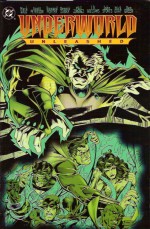
In deference to the season here’s a brief chat about one of DC’s lesser company crossover classics. Underworld Unleashed was a DC universe-wide tale in which an ancient lord of Hell returns to offer heroes and villains whatever they desire – generally manifested as a boost in powers and a new costume – in return for their souls.

The story is more about baddies than goodies and there’s a juicy role for Flash’s Rogues Gallery – especially the Trickster, but the tale wanders too far and wide and though there are a lot of nice character moments there’s some fairly dire bits too.

Moreover the tale lacks conviction and tension, the horror and carnage really doesn’t have any lasting impact, and of course the Tempter has a nasty plan-within-a-plan, but as so often before, DC shot themselves in the foot by only selectively collecting the saga into one volume.

Whereas I can grasp the need to keep a collection manageable (the original event ran to the three issue miniseries included here, 42 assorted tie-ins over three months worth of regular titles and four one-shot Specials) I find it incomprehensible that key ancillary stories can be arbitrarily ignored.

A quartet of supplementary Specials ‘Abyss: Hell’s Sentinel’, ‘Apokolips: Dark Uprising’, ‘Batman: Devil’s Asylum’ and ‘Patterns of Fear’ added a great deal to the overarching storyline yet only the first of these (beautifully crafted by Scott Peterson, Phil Jimenez, J.H. Williams, John Stokes and Mick Gray, detailing the Golden Age Green Lantern’s rescue of the DCU’s magical champions from Hell) is included here. It is a great segment but so are the ones inexplicably omitted.

The bargain-basement Faustian bargains all end well and a kind of order is restored, but this very potentially highly enjoyable tale is unfairly truncated and we’re all the poorer for it. Hopefully somebody will get around to restoring this tale to a more comprehensible state for future editions…

Ooh, that’s the doorbell.

I’m off to throw hard candies at some kids; Happy Halloween reading…
© 1995, 1998 DC Comics. All Rights Reserved.

JLA: Trial By Fire NEW EXTENDED AND REVISED REVIEW


By Joe Kelly, Doug Mahnke and Tom Nguyen (DC Comics)
ISBN 1-84023-928-X

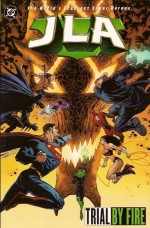
When the World’s Greatest Superheroes (see JLA: New World Order) were relaunched in 1997 the quality – and hype – were everything jaded fans could have asked for, but the glistening aura of “fresh and new” doesn’t last forever and by the time of these tales (seven years later and reprinting issues #84-89) the hard task of keeping the excitement levels stoked in a fan-base with a notoriously short attention-span was getting much harder.

Clean, clear-cut, high-concept tales had perforce given way to more involved, even convoluted storylines, and an increasing dependence on other series’ and characters’ continuity. A low point from the usually excellent Joe Kelly was this tale following the appearance of an alien telepathic presence that puts American President Lex Luthor into a brain-dead coma before assaulting the entire League.

Investigations lead to an alien incursion more than twenty thousand years ago when a monstrous presence was defeated at huge cost by a band of cavemen led by the League’s oldest foe, but it appears that the diabolical beast known as “The Burning” may not have died forever…

Going back even further in DC history it would appear that the Guardians of the Universe, immortal taskmasters of the Green Lantern Corps were involved in the creation of The Burning, and their implacable meddling may have been instrumental in the origins, rise and potential fall of one of Earth’s greatest heroes…

Plagued by cruelly debilitating visions and psychic assaults, as are a sizable portion of humanity, the heroes are desperately struggling as one of their own is possessed by the malevolent entity Fernus who is only seconds away from turning the entire world into a radioactive cinder. Can the JLA get their act together in time to prevent Armageddon? Of course they can… but not without paying a brutal, tragic price…

This is not a terrible tale: whole sections are exceptionally entertaining and the art is spectacular throughout. But it is too far-ranging and undisciplined; with so many strands to keep hold of that it loses cohesion every now and then and feels almost rushed in execution.

The JLA has a long history in all its incarnations of starting strong but losing focus, and particularly of coasting by on past glories for extended periods – and it was distressing to see such portents so soon. Luckily the New/Old Dog still had a few more tricks and a little life in it before the inevitable demise and reboot for the next generation after Final Crisis.

Worth a little of your time, but only if, and in the context of, reading the good stuff too…

© 2004 DC Comics. All right reserved.

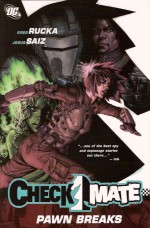
Checkmate: Pawn Breaks


By Greg Rucka, Jesus Saiz, Steve Scott & various (DC Comics)
ISBN:978-1-84576-603-0

In the aftermath of DC’s Infinite Crisis an international organisation to monitor and control meta-human affairs was developed, under the aegis of the United Nations Security Council. Originally an American agency, Checkmate had gone rogue under the telepathic influence of Maxwell Lord, and the new internationally sanctioned organisation is tasked with policing all nations, protecting them from metahuman dangers and terrorism, and also preventing “rogue” nations and regimes from weaponising their own paranormal resources.

This second tripwire-tight collection reprints issues #8-12 of the fondly remembered comic book, following as the organisation (composed of superheroes and traditional intelligence operatives) goes to absolutely outrageous lengths to place an undercover agent in the global death cult Kobra, courtesy of Greg Rucka, Jesus Saiz and Fernando Blanco.

‘Pawn 502’ is a superbly paranoid thriller with plenty of twists and turns and spellbinding action, cleverly plundering many dark and dusty corners of DC continuity for the delectation of long-term readers whilst skilfully keeping the newly initiated appraised. Crossover fans mighty like to know there’s a classy Shadowpact guest-shot included here.

Following is an intriguing tale that slips uncomfortably into the too-real world of South American death squads and rigged elections from writers Rucka, Nunzio DeFilippis and Christina Weir, pencillers Steve Scott and Cliff Richards, and inkers Nathan Messengill, Steve Bird and Art Thibert.

‘Corvahlo’ is a dark, sordid tale featuring ex-JLA-er Fire and Bat-baddie Bane which cleverly reveals that there’s a traitor in Checkmate and, as a team is sent to retrieve a witness to vote-rigging, that mystery Judas is planning to subvert or destroy the entire organisation if necessary…

This is a cool and engaging blend of genres, with the murky world of espionage coldly and logically grounding the high-flying gloss of costumed super-doers. Moody and addictive, but perhaps a little too dependent on a working knowledge of the DC universe, this is nevertheless a fabulous series of yarns for the older fan, and the spy-game milieu should guarantee a few converts from espionage devotees looking for a little something on the wild side…

© 2007 DC Comics. All Rights Reserved.

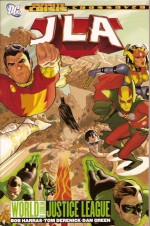
JLA: World Without a Justice League NEW REVISED AND EXTENDED REVIEW


By Bob Harras, Tom Derenick & Dan Green (DC Comics)
ISBN 1-84576-335-1

During the Identity Crisis it was revealed that not only did factions of the Justice League ignore Due Process and lobotomise (call it mind-wipe if you’re in a generous mood) some of their enemies, but when Batman objected he too had his brains scrambled by his own team-mates.

Torn apart, the League formally disbands just as the entire universe is on the verge of utter destruction. The repercussions of that betrayal poisons the relationships of these once staunch comrades, as does the revelation of an illicit affair between two of the heroes, so that when the remnants of the splintered super-hero team and a few former members more or less reunite to stop old foe the Key, they spend more time sniping at each other than dealing with the problem.

The villain has evolved from dedicated nuisance into a psionic mass-murderer, and further complicating the mess is the escape of one of the Original Seven Deadly Sins from its eternal captivity, adding to the level of destruction by inducing riots and insanity throughout the population of Gotham City. The final straw is loss of their most powerful assets halfway through the hunt as the resurrected Titan Donna Troy whisks a hastily cobbled together strike force into space to deal with the intergalactic ramifications of the Infinite Crisis.

One of the truly memorable incarnations of a venerable comics institution died with more of a whimper than a bang in this final collected story-arc (reprinting JLA #121-125) and for all the explosive action and “mano-a-mano” posturing, the result is a somewhat lacklustre postscript to a excellent series of super-hero adventures. The title was sadly lost in the huge shuffle of Infinite Crisis, and passed almost with few mourners.

Bob Harras, Tom Derenick and Dan Green did their best, but the heavy-handed shoehorning of the overweening Crisis segments destroyed the narrative flow, and any casual reader who just picks this book is just inviting a migraine if they haven’t read the other books too.

An inauspicious end to a great run, and poor use of some talented people and great characters but the “automatic rewind/reset” of Infinite Crisis and numerous ‘One Year Later’ relaunches (see 52 parts 1-4) soon made this a distant memory.

And of course, in comics, nothing stays dead for long…

© 2006 DC Comics. All Rights Reserved.