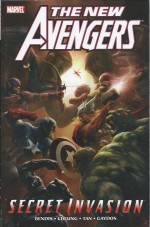
New Avengers: Secret Invasion Book 2


By Brian Michael Bendis, Billy Tan, Jim Cheung, Michael Gaydos & various (Marvel)
ISBN: 978-0-7851-2949-3

The Skrulls are shape-shifting aliens who’ve bedevilled Earth since Fantastic Four #2, and they have long been a pernicious cornerstone of the Marvel Universe. After decades of use, abuse and misuse the insidious invaders were made the sinister stars of a colossal braided mega-crossover event beginning in April 2008 and running through all titles until Christmas.

The premise of Secret Invasion is simple: the would-be alien conquerors have only just survived a devastating catastrophe which destroyed much of their empire; subsequently leading to a mass religious conversion. They are now utterly resolved and dedicated to make Earth their new holy homeworld.

To this end they have gradually replaced a number of key Earth denizens – most notably superheroes and other metahumans. When their plot is discovered no defender of the Earth truly knows who is on their side…

Moreover the cosmic charlatans have also unravelled the secrets of Earth magic and genetic superpowers, creating amped-up counterparts to Earth’s mightiest. They are now primed and able to destroy the world’s heroic champions in face to face confrontations.

Rather than give too much away, let me just say that if you like this sort of thing you’ll love it, and a detailed familiarity is not crucial to your understanding. However, for a complete experience, you will want to see the other 22 “Secret Invasion” volumes that accompany this one, although at a pinch you could get by with only the key collection Secret Invasion – which contains the 8-issue core miniseries, one-shot spin-off “Who Do You Trust?” and illustrated textbook “Skrulls” which claims to provide a listing and biography for every shape-shifter yet encountered in the Marvel Universe (but if they left any out, who could tell?).

The New Avengers segment of the saga concludes in the book, collecting issues #43-47 (September 2008 to January 2009) and offering more supplementary and sidebar insights to the main event as the Invasion progresses, focussing again on individual character pieces to propel the narrative rather than vast battles.

Scripted throughout by Brian Michael Bendis, the first tale (illustrated by Billy Tan & Danny Miki) returns to the moment which turned a cold war of suspicion and attrition into a hot shooting match after a spaceship full of what appeared to be Earth heroes crashed into the dinosaur preserve known as the Savage Land.

These returnees all claimed to be the originals, taken at various times and upon landing accused those who had been on Earth prior to their crash of being alien impostors. The most shocking example was Captain America, whom everybody saw assassinated weeks previously on prime time TV…

Whilst the Star Spangled Avenger is exposed as a Skrull a flashback reveals how potent the new Skrull strategy is, not only copying the body and powers but programming the infiltrator with false memories so that it actually believes itself to be the human hero it mimics…

These unwitting Trojan Horses have been mixed in with genuine shanghaied Terrans and eventually allowed to escape back to Earth…

With art by Tan & Matt Banning, the next sneak peek harks back to the time when Earth’s “Illuminati” – Reed Richards, Tony (Iron Man) Stark, Black Bolt, Stephen Strange, Charles Xavier and Namor, the Sub-Mariner – confronted and were consequently captured by the Skrulls.

Although the heroes eventually escaped they left behind far too many genetic secrets, and this shocking history lesson proceeds to reveal how neophyte scientist Dro’ge Fenu Edu used the mind and personality of Richards to forge the final link in the aliens’ infallible invasion plan…

Jim Cheung, Matt Dell & Jay Leisten illustrated the next chapter which intersected with publishing event House of M as deep-cover agent and invasion commander Queen Veranke found herself caught up in the reality-warping spell of the Scarlet Witch.

As that deeply troubled woman remade the world in a crazed attempt to create a mutant paradise, Veranke was forced to see things that would sharpen her resolve to eradicate humanity once the previous reality was (mostly) restored…

Tan & Banning were back for #46 as mystic gangster The Hood and his syndicate of super-criminals rescue murderous menace Madame Masque from SHIELD agents, only to discover that the high-tech lawmen are shapeshifting aliens…

As the villains struggle to decide what their role will be in the coming struggle, The Hood at last learns where his own incredible abilities come from…

The catalogue of changeling tales concludes with a Tan, Michael Gaydos & Banning art collaboration as new parents Luke Cage and Jessica Jones review how they first met when the former “Hero for Hire” commissioned actual private detective Jones to track down his estranged father.

Some heartbreaks lead to new loves but as the woman known as “Alias” gradually moved into Cage’s life, neither knew that one day it would all lead to a Skrull impersonating the Avengers’ butler, stealing their baby…

Quirky, moving, and winningly low-key, the stories gathered here are supplemented with a cover gallery from by Aleksi Briclot and a selection of landmark original covers his homages are based on, including Avengers Annual #2 by John Buscema, New Avengers: Illuminati #1 by Cheung, House of M #1 by Esad Ribic, Bring on the Bad Guys by John Romita Sr. and West Coast Avengers #1 by Bob Hall.

Although impressive and entertaining, this great Fights ‘n’ Tights tome doesn’t really stand alone, but you will also certainly benefit from checking out the collections Secret Invasion: the Infiltration, Avengers Disassembled, and Annihilation volumes 1-3, as well as the rather pivotal New Avengers: Illuminati graphic novel.

Despite the copious homework list I’ve provided, this book is still a solid action-adventure read, with plenty of human drama to balance the paranoia and power-plays: a pure guilty pleasure.
© 2008, 2009, 2011 Marvel Characters, Inc. All rights reserved.

Ultimate Comics Spider-Man by Brian Bendis volume 4


By Brian Michael Bendis, Sara Pichelli, David Marquez, Justin Ponsor & various (Marvel) ISBN: 978-0-7851-6503-3

When the Ultimate Spider-Man died, writer Brian Michael Bendis and Marvel promised that a new hero would arise from the ashes…

Marvel’s Ultimates imprint began in 2000 with a post-modern take on major characters and concepts to bring them into line with the tastes of 21st century readers – apparently a wholly different demographic from us baby-boomers and our descendents content to stick with the precepts sprung from founding talents Jack Kirby, Steve Ditko and Stan Lee… or perhaps just those unable or unwilling to deal with five decades (seven if you include Golden Age Timely tales retroactively co-opted into the mix) of continuity baggage which saturated the originals.

Of course the darkly nihilistic new universe soon became as continuity-constricted as its ancestor and in 2008 cleansing exercise “Ultimatum” culminated in a reign of terror which killed dozens of super-humans and millions of mere mortals in a devastating tsunami that inundated Manhattan courtesy of mutant menace Magneto.

In the months that followed, plucky Peter Parker and his fellow meta-human survivors struggled to restore order to a dangerous new world, but just as Spider-Man finally gained a measure of acceptance and was hailed a hero by the masses, he took a bullet for Captain America and very publicly met his end during a catastrophic super-villain showdown …

In the aftermath, child prodigy Miles Morales gained suspiciously similar powers (super-strong and fast and able to walk up walls, plus invisibility and a crippling “venom-charge”) and started out on the same deadly learning curve: coping with astounding new physical abilities, painfully discovering the daily costs of living a life of lies and realising how a crippling sense of responsibility is the most seductive method of self-harm and worst of all of possible gifts.

He was helped and hindered in equal amounts by his uncle Aaron: a career super-criminal dubbed The Prowler. Things started to go spiral out of control the night Aaron Davis died in battle with the new arachnid hero in town, but now – months later – the repercussions of the televised event have finally caught up with the boy who would be Spider-Man…

Written throughout by Bendis, this luxurious hardcover collection (re-presenting Ultimate Comics Spider-Man #16.1 and #19-25, from December 2012 to June 2013) finds the juvenile wall-crawler recovering in the aftermath of a second War Between the States.

That internecine conflict almost destroyed the Republic but has left the traumatised public in no mood to tolerate mysteries or put up with unexplained and potentially dangerous characters and vigilantes.

The action opens with jump-on tale ‘Point One’ (illustrated by David Marquez

from Ultimate Comics Spider-Man #16.1) wherein unscrupulous reporter Betty Brant uses her considerable investigative skills to establish a link between The Prowler, the second Spider-Man, the genetic experiments of Norman Osborn and a guy named Morales.

As she digs deeper and follows the brief career of the new hero, Betty not only uncovers the remains of the genegineered spider which transformed Miles, but also learns far more than she should have from disgraced Oscorp biochemist Dr. Conrad Marcus, as well as engendering the unwelcome interest of scientific monolith Roxxon Industries and a brutal, relentless monstrosity…

The main event is 4-part epic ‘Venom War’ (art by Sara Pichelli) which opens in the days following the civil war. Child prodigy Miles and best-bud/superhero trainer Ganke are back at Brooklyn Visions Academy Boarding School. Miles spends only weekends at home, and now he and his confidante are eagerly attempting to master Peter Parker‘s web-fluid formula and wrist-shooters which the inexperienced hero has recently inherited.

As a mysterious monster raids and wrecks Roxxon’s HQ, in Manhattan homicide cop and ex-SHIELD agent Mariah Hill is investigating the bloody murder of a journalist. Her interviews at the Daily Bugle all lead her to the Davis/Morales home in Brooklyn.

Marcus’ dad Jefferson Davis has become an involuntary and extremely camera-shy celebrity because of his stand against the secessionist organisation Hydra. When a film crew bursts into the family home he understandably goes ballistic and kicks them to the kerb, but his fury is futile in the face of the towering, metamorphic horror known as Venom, which chooses that moment to attack the person it accuses of being Spider-Man…

The next chapter opens seconds later as the beast lunges, and in the family home Miles suits up and springs into battle…

The clash is savage and terrifying. As the TV parasites carry on filming, Jefferson joins the severely overmatched Spider-Man only to be smashed and broken like a bug…

The Arachnid kid goes crazy but his best efforts – and the fusillade of shots from the just- arrived cops – are useless. Only after the shattered lad employs his devastating venom blasts does he succeed in driving off the amorphous atrocity…

The shocking struggle has been broadcast all over the world. Elsewhere in Brooklyn two girls cherished by the original web-spinner immediately drop what they’re doing and rush to the scene of the battle…

Many months previously, as part of the crowd of grateful strangers attending Peter Parker’s memorial, Miles and Ganke had talked to another mourner, a girl who was intimate with the murdered hero. Gwen Stacy offered quiet insights to the boy child who had just acquired his powers and then altered the course of his life forever by sharing a simple mantra: “with great power comes great responsibility”…

Now she and Mary Jane Watson arrive at the crime scene ready to share their experience in keeping secrets just as attending detective Mariah Hill reaches the conclusion that the shell-shocked boy crying on the stairs is Spider-Man…

His mother Rio Morales is in the ambulance taking Jefferson to hospital and Miles is in no state to fend off questions from an experienced SHIELD interrogator or even speak to his equally traumatised buddy Ganke, but Gwen and Mary Jane certainly are and quickly shut down the situation and terminate the interview.

As they explain all the ghastly secrets of the Venom monster and its connection to the Parker family, speculation leads the youngsters to the idea that maybe the genetic quirk which made Peter Spider-Man might be repeated in the Morales family…

Deep below their feet the shapeshifting symbiote is reconstituting. Soon it breaks out of the sewers to again consume human hosts. The consciousness in charge of the marauding terror hasn’t given up its search for Spider-Man and is all too quickly bursting into the hospital where Rio is waiting for word on her husband…

The shocking conclusion begins with news of the assault reaching Miles. Hill, convinced she is right, gives Miles crucial advice for the battle she knows his coming. By the time Spider-Man reaches the medical centre Venom is carving a bloody swathe through the patients and doctors and the consequent clash is terrifying to behold.

With bodies falling everywhere Miles eventually finds a grotesque and dreadful way to stop the beast and expose the villain within, but in the aftermath realises that the awful cost has been another person he loves…

As the ruthless boss of Roxxon now makes Spider-Man his only priority, in Brooklyn Miles wakes from a deep sleep and realises his life has changed forever. At last he understands the horror and tragedy which underpins the legend of Spider-Man. This time though, the response to a death in the family is not guilty defiance and an urge to make things right, but a crushing, total surrender…

To Be Continued…

With covers by Sara Pichelli, this is a tense, breathtaking action-packed, thriller full of the humour and drama which blessed the original Lee/Ditko tales: a controversial but worthy way to continue and advance the legend that Fights ‘n’ Tights addicts will admire and adore… © 2012, 2013 Marvel Characters, Inc. All rights reserved.

Avengers volume 1


By Brian Michael Bendis, John Romita Jr., Klaus Janson, Tom Palmer& various (Marvel)
ISBN: 978-0-7851-4501-1

Once upon a time Norman Osborn was America’s Security Czar, an untouchable “top-cop” in sole charge of a beleaguered nation’s defence and freedom, especially in regard to the USA’s costumed and metahuman community.

When the deranged former Green Goblin overplayed his hand, a coalition of outlawed champions united to defeat him and his fall from grace was staggering and total, leading to a new Age of Heroes.

As part of that resurgence, original Captain America Steve Rogers was appointed Supreme Commander of US metahuman resources and promptly set about redefining the what, who and how of the World’s Mightiest Heroes. This meant a flotilla of new teams (and titles) with Avengers volume 4 being the official spine of the comicbook franchise.

This slim yet spectacular collection gathers issues #1-6 (written by Brian Michael Bendis with art by John Romita Jr, and inkers Klaus Janson & Tom Palmer; spanning July to December 2010) and opens with the triumphant, reunited army of heroes trying to decide just who goes where and does what.

Those deliberations are rudely interrupted in ‘Next Avengers Part One’ when time-tyrant Kang the Conqueror beams in with a frantic warning. He barely opens his mouth before he’s blasted across the city by the wary, twice-shy heroes, but as they gather to press their attack the conqueror stops all hostilities by brandishing an ultimate weapon.

Iron Man Tony Stark prevents his comrades from finishing off Kang because he recognises the Dark Matter Accelerator. It’s something he thought up and swore never to build. The only way the future man can have it is if Stark made it and then gave it to him…

In the cautious ceasefire that follows Kang explains that he’s come to beg the aid of the Avengers. In the future he is one of a team that includes the children of the Avengers, united to stop life-loathing Artificial Intelligence Ultron from exterminating humanity.

They at last succeeded in destroying the mechanoid marauder but the children have now become an even greater menace. Moreover, Kang’s attempts to stop them have resulted in time itself shredding and all of reality is now collapsing…

The arrogant time-terrorist expects the Avengers to stop their errant offspring, but as Steve Rogers heads off all debate and allocates teams, back in the future Kang and his hidden allies make preparations to carry out their real scheme…

Not every past Avenger was keen to answer the call to reassemble. Simon Williams had come to believe the team had done more harm than good and threatened to stop them if they started up again. ‘Wonder Man Attacks?!!’ sees him make good on his warning as a committee of heroes track down Kree outcast Noh-Varr The Protector to make use of his expertise in time travel.

As the alien and Stark’s efforts finally bear fruit Wonder Man brutally engages the entire team and in the blockbusting battle that follows, something goes terribly wrong and an alternate Apocalypse and his horrendous Horsemen materialise, intent on ending mankind.

As the heroes swiftly mobilise to tackle the new crisis, a ‘Menace From Beyond Time’ manifests as various time-streams and realities begin to coalesce and overlap in New York City.

With All of Everything endangered, a small squad of heroes heads into the unhappy future leaving their harried comrades to hold back a tidal wave of time-tossed menaces – and the occasional misplaced hero such as Killraven and Devil Dinosaur…

Far away from now, Iron Man, Wolverine, replacement Captain America James “Bucky” Barnes and Noh-Varr witness first hand the cataclysmic war against Ultron before being ambushed by the next generation in ‘Only the Good Die Young’.

Back in their home era a multitude of past menaces – from cavemen to cowboys to cosmic devourer Galactus – are keeping the majority of Avengers busy, whilst in the foredoomed tomorrow the questing quartet are painfully discovering that they’ve been played by Kang yet again…

Full explanations are promised by an incredibly aged Tony Stark and the architect of the chronal rescue plan: Bruce Banner in his gamma-charged arch-villain persona of the Maestro…

With two Starks, an incredibly experienced Banner and new element Noh-Varr all intent on fixing the problem, the sorry story soon comes out. All of creation’s future is stuck in a temporal loop: a cosmic “Groundhog Day” with Kang interminably spent battling Ultron but now, with the odds altered by the historical Avengers, there’s a chance to make things right in one final ‘Battle for the Future’…

Of course as Thor’s clash with Galactus escalates and the assembled Avengers resolutely resist Apocalypse and his minions in the now, there may not be a past to return to…

Layers of murderous duplicity are peeled back in ‘Next Avengers Part 6: Conclusion’ as a cunning solution to the Ultron-Kang impasse is conceived but, even as reality reasserts itself and four weary heroes return home, old man Stark takes the risky chance of giving his younger self a deadly device and a portentous warning from the future…

Epic, vast in scale and overflowing with action, this a magnificently rendered tale that might bewilder new readers looking for a post-movie fix, but will delight dyed-in-the-wool Fights ‘n’ Tights fanatics. It comes with 16 covers-&-variants by Romita Jr., Janson & Dean White, John Romita Sr. & Frank D’Armata, Greg Land & Morry Hollowell, Jim Cheung & Justin Ponsor, Alan Aldridge, Phil Jimenez & D’Armata, plus a massive combined variant cover by Marko Djurdjevic.

© 2010, 2011 Marvel Characters, Inc. All rights reserved.

Black Panther: The Deadliest of the Species


By Reginald Hudlin, Ken Lashley, Paul Neary & various (Marvel)
ISBN: 978-0-7851-3342-1

Regarded as the first black hero in American comics and one of the first to carry his own series, the Black Panther’s popularity and fortunes have waxed and waned since July 1966 when he attacked the Fantastic Four as part of an extended plan to gain vengeance on the murderer of his father.

T’Challa, son of T’Chaka, was an African monarch whose hidden kingdom was the only source of a miraculous alien metal upon which the country’s immense wealth was founded. Those mineral riches – derived from a fallen meteor which struck the continent in lost antiquity – had enabled him to turn his country into a technological wonderland.

The tribal resources and the people had long been safeguarded by a cat-like human champion who derived physical advantages from secret ceremonies and a mysterious heart-shaped herb which ensured the generational dominance of the nation’s Panther Cult.

In recent years the mythology was retooled to reveal that the “Vibranium” mound had actually made the country a secret Superpower for centuries but now increasingly made Wakanda a target for subversion and incursion.

This slim, unassuming but extremely engaging Costumed Drama outing collects the first six issues of Black Panther volume 5 – April to September 2009 and was originally part of Marvel’s company-wide “Dark Reign” publishing event.

‘The Deadliest of the Species’ begins as new bride (and queen) Ororo nervously embarks on a goodwill tour. As a mutant – and far worse, an American – who has married the king, she is keenly aware of her tenuous position.

All thoughts of winning over the people are soon forgotten when T’Challa’s jet – which left only hours ago on a diplomatic mission – screams in and catastrophically crashes in the heart of the city despite all the weather goddess’ efforts to slow it down…

Unknown to all, five hours previously the Black Panther had secretly met with regal rival Namor the Sub-Mariner to hear an invitational offer from the Cabal of world-conquerors led by Norman Osborn but now the adored sovereign is near death. His formidable Dora Milaje bodyguards are gone, and once dragged from the wreckage burned and broken, T’Challa agonisingly reveals it was an ambush before lapsing into a coma…

As Queen Mother Ramonda and sister Shuri dash to the hospital, the ruling council are frantic; terrified that the assassination attempt is prelude to an invasion. Wakanda has always been ready for such assaults, but that was with a healthy Black Panther. Right now they are spiritually all but defenceless…

Even though the king is not quite dead, the Ministers advocate activating the protocols which will create a new Panther warrior… but the question is who will succeed?

Hours ago after Namor departed, a far less friendly potentate accosted T’Challa as he left the conference. Dr. Doom was also a member of the Cabal and took the Panther’s refusal to join the club very, very badly…

Back in the now, desperate meetings and Ororo’s refusal to undertake the mystic rituals result in Princess Shuri being reluctantly assigned – over the strenuous protests of her own mother – the role of Black Panther Apparent. As T’Challa’s older sister it’s a role she was destined for, but one her brother seized decades ago.

At that time she was away being schooled in the West when an invasion by American adventurer Ulysses Klaw resulted in the death of their father. With cruel circumstance demanding nothing less, the boy took the initiative, the role and the responsibility of defending his nation…

Now after years as an irrelevant spare, the flighty jet-setter is being asked to take up a destiny she neither wants nor feels capable of fulfilling. She is especially afraid of the part of the ceremony where she faces the Panther God and is judged…

T’Challa cannot reveal how the battle with Doom ended in brutal defeat and certain death had not his valiant Dora Milaje given their lives to get his maimed body back in the jet and home via auto-pilot. He is even unable to stay alive and as the world’s most up-to-date doctors slowly abandon hope, Ramonda convinces Queen Ororo to try something ancient instead…

Despite a pervasive cloak of secrecy bad new travels fast and across the continent adherents of the Panther Cult’s theological antithesis revel in Wakanda’s misfortune. The smug worshippers prepare arcane rituals to finally destroy their enemies and in a place far removed from the world, T’Challa awakes to meet his dead bodyguards once more…

In an isolated hut Queen and Queen Mother are bickering with sinister shaman Zawavari. He claims to be able to bring T’Challa back but gleefully warns that the price will be high…

Thanks to her years of training, Shuri is having no problem with the physical rigours of the Panther Protocols and foolishly grows in confidence. Far away, Wakanda’s enemies succeed in summoning Morlun, Devourer of Totems, but are unprepared for the voracious horror to consume them before turning his attention to more distant theological fodder…

And in Limbo, a succession of dead friends and family subtly and seductively attempt to convince T’Challa that his time is past and that he should lay down his regal burdens…

As Morlun makes his way to Wakanda, stopping only to destroy other petty pantheons such as the master of the Man-Ape sect, Death continues her campaign to convince T’Challa to surrender to the inevitable whilst Shuri faces her final test.

It does not end well. The puissant Panther God looks right through her ands declares her pitifully unworthy to wear his mantle or defend his worshippers. Despondent Shuri is despatched back to the physical world just as her sister-in-law arrives in Limbo, sent by Zawavari to retrieve her husband from Death’s clutches.

Ororo doesn’t want to tell her husband that this is their last meeting. The price of his passage back is her becoming his replacement…

In the real world Morlun has reached Wakanda’s borders, drawn inexorably to T’Challa’s (currently vacant) physical form, utterly invulnerable to everything in the nation’s super-scientific arsenal and leaving a mountain of corpses behind him.

With Armageddon manifesting all about them, the Royal Family and Ruling Council are out of options until sly Zawavari points out an odd inconsistency: the price for failing to become Wakanda’s living totem has always been instant death, but Shuri, although rejected, returned alive…

Realising both she and her country have one last chance, the newest Black Panther goes out to battle the totem-eater whilst in the land of the dead T’Challa and Ororo resolve to ignore the devil’s bargain and fight their way back to life.

And as the two hopeless battles proceed, Ramonda and Zawavari engage in a last-ditch ploy which will win both wars by bring all the combatants together…

Fast-paced, compelling and gloriously readable, this splendid blend of horror story, action epic, political thriller and coming-of-age tale comes with an impressive cover-&-variants gallery by J. Scott Campbell, Edgar Delgado, Michael Djurdjevic, Ken Lashley and Mitch Breitweiser.

If you don’t despise reboots and re-treads on unswerving principle and are prepared to give something new(ish) a go, there’s a lot of fun to be had in this fantastic Fights ‘n’ Tights farrago, so why not set your sights and hunt this down?
© 2009 Marvel Characters, Inc. All rights reserved.

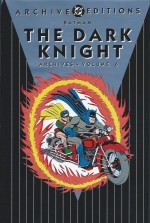
Batman: the Dark Knight Archives volume 6


By Bob Kane, Don Cameron, Bill Finger, Jack Schiff, Alvin Schwartz, Joe Greene, Mort Weisinger, Dick Sprang, Jack Burnley, Jerry Robinson & various (DC Comics)
ISBN: 978-1-4012-2547-6

Debuting a year after Superman, “The Bat-Man” (and latterly Robin, the Boy Wonder) cemented DC/National Comics as the market frontrunner and conceptual leader of the burgeoning comicbook industry.

Having established the parameters of the metahuman in their Man of Tomorrow, the physical mortal perfection and dashing derring-do of the strictly human Dynamic Duo rapidly became the swashbuckling benchmark by which all other four-colour crimebusters were judged.

This sixth lavish hardback Archive Edition volume covers Batman #21-25 and again features exploits from the height of World War II – specifically February/March 1944 to October/November 1944.

These Golden Age greats are some of the finest tales in Batman’s decades-long canon, as lead writers Bill Finger and Don Cameron, supplemented by Joe Samachson, Jack Schiff, Alvin Schwartz, Joe Greene and Mort Weisinger, pushed the boundaries of the adventure medium whilst graphic genius Dick Sprang slowly superseded and surpassed Bob Kane and Jack Burnley, making the feature uniquely his own and keeping the Peerless Pair at the forefront of a vast army of superhero successes.

The sheer creativity exhibited in these adventures proved that the ever-expanding band of creators responsible for producing the bi-monthly adventures of the Dark Knight were hitting an artistic peak which only stellar stable-mate Superman and Fawcett’s Captain Marvel were able to equal or even approach.

Moreover with WWII finally turning in the Good Guys’ favour, the escapades became upbeat and more wide-ranging…

Following a Foreword from former bat-scribe Alvin Schwartz, the Home Front began to offer a brighter – but still crime-ridden – perspective with Batman #21, an all-Sprang art extravaganza which opened with the slick Schiff-scripted tale ‘The Streamlined Rustlers’ which saw the Caped Crusaders way out West solving a devilish mystery and crushing a gang of beef-stealing black-market black hats.

Cameron then described the antics of murderous big city mobster Chopper Gant who conned a military historian into planning his capers, briefly bamboozling Batman and Robin with his warlike ‘Blitzkrieg Bandits!’ whilst Schwartz penned the delightfully convoluted romp ‘His Lordship’s Double’ which sees newly dapper, slim-line manservant Alfred asked to impersonate a purportedly crowd-shy aristocratic inventor… only to become the victim in a nasty scheme to secure the true toff’s latest invention…

It all culminates with ‘The Three Eccentrics’ (written by Joe Greene), which details the wily Penguin‘s schemes to empty the coffers of a trio of Gotham’s wealthiest misfits. The fiendish foray founders because he fails to take into account the time-sensitivity of his information and the dogged grit and ingenuity of the Gotham Gangbusters…

Batman #22 leads with ‘The Duped Domestics!’ by Schwartz, Bob Kane & Jerry Robinson wherein a select number of Gotham’s butlers are targeted by a sultry seductress looking for easy inroads to swanky houses. Despite being an old enemy of Batman’s, “Belinda” more than meets her match when Alfred becomes her next patsy…

When the little rich boy secretly takes a menial job, his generous guardian is rightly baffled but after ‘Dick Grayson, Telegraph Boy!’ (Finger, Burney & Robinson) exposes a criminal enterprise centred around Gotham Observatory, the method of his madness soon becomes clear.

Next a new solo series debuted as Mort Weisinger & Robinson launched ‘The Adventures of Alfred’ with ‘Conversational Clue!’ wherein Batman’s batman misapprehends an overheard word at the library and stumbles into a safecracking gang.

The issue concludes with ‘The Cavalier Rides Again!’ (Finger, Burnley & Charles Paris) as the Dashing Desperado mystifyingly begins bagging cheap imitations rather than authentic booty in his ongoing campaign to best the Batman…

The Joker led in issue #23 with Finger, Sprang & Gene McDonald’s eccentric thriller ‘The Upside Down Crimes!’ wherein the Harlequin of Hate turns the town topsy-turvy in his latest series of looting larcenies after which smitten Dick’s bold endeavours save classmate and ‘Damsel in Distress!’ (Cameron & Sprang) Marjory Davenport and her dad from gangster kidnappers.

Unfortunately for him, she soon has her head turned by flamboyant Robin and the Boy Wonder becomes his own rival…

Anonymously scripted but again rendered by Jerry Robinson, ‘The Adventures of Alfred: Borrowed Butler!’ found the domestic detective loaned out by Bruce Wayne to a snooty neighbour and accidentally uncovering an insider’s scheme to burgle the place.

Wrapping up this outing is another fact-packed “Police Division Story” with Batman and Robin joining the Royal Canadian Mounted Police to stop a vicious ring of fur bandits who have decided to forego robbing big city stores. Instead, the ‘Pelt Plunderers!’ (Joe Samachson & Sprang) head due north to steal directly from the trappers…

Batman #24 added a smidgen of science fiction flair and a dash of sheer whimsy to the regular mix as ‘It Happened in Rome’ (Samachson & Sprang) introduces Professor Carter Nichols who devises a method of time-travel which depends on deep hypnosis.

His first subjects are old friend Bruce Wayne and his ward who both wing back centuries for a sightseeing trip and end up saving a charioteer from race-fixers as Batmanus and Robin…

Bruce also plays a pivotal role in ‘Convict Cargo!’ (Cameron & Sprang), pretending to be an embezzler in order to expose a ring of thugs offering perfect getaways to Gotham’s white-collar criminals. Happily when the villain vacations turn out to be one-way trips, Batman and Robin are on hand to mop up the pirates responsible.

Cameron & Robinson then describe how ‘The Adventures of Alfred: Police Line-Up!’ leads the bewildered butler into trailing the wrong crook but still nabbing a mob of bad eggs before portly purveyors of peril Tweedledum and Tweedledee connive their way into the position of ‘The Mayors of Yonville!’

Their flagrant abuse of civic power dumps the Dynamic Duo into jail but still isn’t enough to keep their goldmine scam from coming to light once the heroes bust out…

This superb hardback compendium concludes with Batman #25 as opening shot ‘Knights of Knavery’ (Cameron, Burnley& Robinson) sees arch rivals Penguin and Joker join forces to steal the world’s biggest emerald and outwit all opposition, before falling foul of their own mistrust and arrogance once the Dark Knight puts his own thinking cap on.

‘The Sheik of Gotham City!’ (Schwartz, Burnley & Robinson) then sees an Arabian refugee working as a cab driver in Gotham restored to rule his usurped desert kingdom after our heroes foil an assassination attempt, whilst ‘The Adventures of Alfred: The Mesmerised Manhunter!’ (Cameron & Robinson) sees the off-duty domestic the plaything of a stage magician whilst simultaneously foiling a box office heist.

The action and suspense wrap up in spectacular style as Finger, Burnley& Robinson detail a saga of sabotage and redemption when the Dynamic Duo join the rough-and-ready electrical engineers known as ‘The Kilowatt Cowboys!’

As if the job of bringing the nation’s newest hydroelectric dam on line is not dangerous enough and a plague of thefts by murderous copper thieves isn’t cutting into productivity, most of Batman’s time is spent stopping rival wire men Jack and Alec from killing each other…

Accompanied by a stunning and iconic Sprang cover gallery and full creator ‘Biographies’, this sublime selection of classic comicbook action is a magnificent ride on the Wayback Machine to a time of high drama, low cunning and breathtaking excitement
© 1944, 2009 DC Comics. All Rights Reserved.

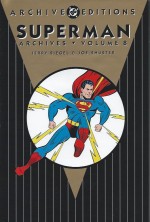
Superman Archives volume 8


By Jerry Siegel, Joe Shuster, Don Cameron, Bill Finger, Alvin Schwartz, Whitney Ellsworth, Ed Dobrotka, Sam Citron, Ira Yarbrough, George Roussos, Jack Burnley, Wayne Boring & various (DC Comics)
ISBN: 978-1-4012-2885-9

Today’s American comicbook industry – if it still existed at all – would have been utterly unrecognisable to us without Superman. His unprecedented invention and adoption by a desperate and joy-starved generation quite literally gave birth to a genre if not an actual art form.

Spawning an impossible army of imitators and variations, within three years of his 1938 debut, the intoxicating blend of eye-popping action and social wish-fulfilment which hallmarked the early Man of Steel had grown to encompass cops-and-robbers crime-busting, socially reforming dramas, science fiction, fantasy, whimsical comedy and, once the war in Europe and the East embroiled America, patriotic relevance for a host of gods, heroes and monsters, all dedicated to profit through exuberant, eye-popping excess and explosive derring-do.

In comicbook terms at least Superman was master of the world, having already utterly changed the shape of the fledgling industry. There was the phenomenally popular newspaper strip, a thrice-weekly radio serial, games, toys, as much global syndication as the war would allow and the perennially re-run Fleischer studio’s astounding animated cartoons.

Despite all the years that have passed since then, I – and so many others – still believe that superhero comics were never more apt or effective than when they were whole-heartedly combating the agents of Fascism (and yes by heck, even the dirty, doggone, Reds-Under-the-Beds Commies, who took their place in the 1960s too!) with mysterious masked marvel men in compulsive, improbable short, sharp exploits,

The most evocative and breathtaking moments of the genre always seem to occur as those gaudy gladiators soundly thrashed – and please forgive the offensive contemporary colloquialism – “Nips, Nazis and Reds”. However, even in those dark days long-ago, the young and enthusiastic creators were wise enough to augment their tales of espionage and invasion with a range of gentler, more whimsical four-colour fare. By the time of the sagas in this superb seventh Superman full-colour hardcover Archive edition – re-presenting #30-35 (September/October 1944 to July/August 1944) of the Man of Tomorrow’s solo title – the apprehension of the early war years had been replaced with eager anticipation as tyranny’s infernal forces were being rolled back on every Front.

Superman was the premier, vibrant, vital role model whose startling abilities and take-charge, can-do attitude had won the hearts of the public at home and the troops across the war-torn world.

Now, although the shooting was all but over, stirring, morale-boosting covers and stories were being phased out in favour of gentler and even purely comedic themes.

Following a funny and informative Foreword: “Look! Up in the Sky! It’s a Bird… it’s a Plane…it’s – An Imp?’ by cartoonist Evan Dorkin discussing the advent of super-foes, social change and a certain fifth dimensional jester, the action-laced whimsy begins with ‘Superman Alias Superman!’ by Don Cameron, Ira Yarbrough & Stan Kaye wherein lovelorn Clark Kent takes romantic advice from office-boy Jimmy Olsen and impersonates his own alter ego to impress Lois.

The doomed imposture is further complicated because his scathing, scoop-obsessed colleague is fully fixated on catching high society bandit Silver Foxx and has no time for Clark’s insecurities and idiocies…

The go-getting journalist was always too busy for romance back then, as can be seen in ‘Lois Lane, Girl Reporter: The Arch-Swindler’ by Cameron, Ed Dobrotka & George Roussos. In those turbulent times the interpretation of the “plucky news-hen” was far less demeaning than the post-war sneaky minx who was so popular in the late 1950s and 1960s.

Lois might have been ambitious and life-threateningly precipitate, but it was always to advance her own career, help underdogs and put bad guys away, not trap a man into marriage.

Her Superman-free exploits began in #28: a succession of 4-page vignettes offering breathless, fast-paced, screwball comedy-thrillers. In this example, spurred on by Clark’s teasing, she tracks down, is captured by and spectacularly turns the tables on murderous conman Jack Dover…

Back with the star feature, Bill Finger, Yarbrough & Roussos revealed how an ancient prophecy turns the Action Ace into ‘The King’s Substitute’ as centuries ago the ruler of tiny nation Poltavia learns that a Superman will one day deliver his country from bondage, restore a true heir and offer the people a wonderful thing called democracy…

Jerry Siegel, Joe Shuster & Yarbrough then herald the start of a new kind of adventure as ‘The Mysterious Mr. Mxyztplk’ debuts. An utterly intoxicating daffy romp introduced the 5th dimensional imp who would henceforward periodically test the Man of Steel’s ingenuity and patience in a still-hilarious perfect example of the lighter side of super-heroics.

Mxyztplk (later anglicised to Mxyzptlk, presumably to make it easier to spell?) became a cornerstone of the Superman mythos: an insufferable pixie against whom all Superman’s strength and power were useless. From then on brains were going to be as important as brawn as frustration became the Man of Steel’s first real weakness…

Superman #31 opens with crime-thriller ‘Tune Up Time for Crime’ (Finger, Sam Citron Roussos) as crooks with a deadly new sonic weapon turn out to have the scientific backing of the Metropolis’ Marvel’s oldest enemy, after which arch-whimsy reappears in ‘A Dog’s Tale’ (Finger, Citron & Roussos) when scruffy mutt Flip proudly tells his canine pals how he helped Superman crack a dognapping racket…

Cameron & Dobrotka then reveal how a gang of jewel thieves prove no match for dumb luck and journalistic moxie in ‘Lois Lane, Girl Reporter: The Aces Doonan Gang’ before Finger, Citron & Roussos close out the issue with a trip to the museum as ‘The Treasure House of History!’ finds Superman saving a noble institution from mismanagement, skulduggery and even closure whilst discovering a lost Mayan city…

In #32 ‘Superman’s Search for Clark Kent!’ (Alvin Schwartz, Dobrotka & Roussos) finds the Action Ace an invincible amnesiac after volunteering for a scientific trial and forced to track down his own other identity whilst ‘Crime on Skis!!’ (Finger, Dobrotka & Roussos) sees the restored hero debunk a malign mythical bird as no more than a cover for more pedestrian killers plaguing a ski resort.

‘Lois Lane, Girl Reporter: Monkey Business’ (Whitney Ellsworth, Dobrotka & Roussos) is another splendidly frothy concoction describing how a ventriloquist at the zoo puts the jaunty journo on the trail of a pack of pickpockets, after which the terrible Toyman resurfaces to plague Metropolis, plundering wealthy antique collectors in search of a treasure hidden since the French Revolution in ‘Toys of Treachery!’ (Cameron, Dobrotka & Roussos).

Superman #33 opened with the hero following foolish Lois into ‘Dimensions of Danger!’ (Cameron, Yarbrough & Roussos) after she road-tested a Mxyztplk spell and ended up stuck in his home realm of Zrfff. Once there the Caped Kryptonian had the opportunity to do a little mischief-making of his own…

With art by Yarbrough & Roussos ‘The Country Doctor!’ is the kind of socially aware redemptive tale Bill Finger was a master of and saw Clark Kent stuck in homey little Middletown watching aging Dr. David Brown make a difference – but little money – ministering to the poor souls around him.

The physician’s only regret was a son who preferred big city glamour cases and big city fees, but then something quite tragic happened…

Ellsworth & Dobrotka’s ‘Lois Lane, Girl Reporter: The Purloined Piggy Bank’ found her being pranked by (male) cops before turning the tables on them and crushing a crime conspiracy. The issue ends with classic mystery yarn ‘The Compass Points to Murder!’ (Finger, Yarbrough & Roussos) finding the Action Ace darting to the four corners of the globe in search of a killer who believed he’d successfully silenced a shipping fleet magnate but had left one telling clue behind…

In #25 Mort Weisinger & Fred Ray’s ‘I Sustain the Wings!’ played a crucial part in America’s attempt to address a shortfall in vital services recruitment – a genuine problem at this time in our real world – and created an instant comics classic.

Artistically Superman #34 is an all Citron/Roussos affair, whose opening shot attempted to repeat the magic formula with Cameron scripted ‘The United States Navy!’ with Clark despatched to follow three college football heroes whilst they progress – in different maritime specialisations – through the war in the Pacific.  

Then ‘Lois Lane, Girl Reporter: The Foiled Frame-Up’ (Ellsworth) sees her upset political scoundrels and expose a smear campaign after which Cameron instigates a prototype “Imaginary Tale” with ‘The Canyon that Went Berserk!’ wherein a fortune teller prompts Clark into daydreaming the prospecting adventure of a lifetime…

‘When the World got Tired!’ (Finger) then ramped up the tension when a sinister epidemic of global indolence and sloth turns out to be the work of Lex Luthor and his new alien allies…

The gaggle of Golden Age goodies conclude with the contents of Superman #35 (mostly illustrated by Yarbrough & Roussos), starting with the Cameron scripted ‘Fame for Sale!’, wherein shady cove and scurvy scoundrel J. Wilbur Wolfingham rears his conniving head once more. The magnificent pastiche of W. C. Fields as a ruthless Mr. Micawber returned like a bad penny over and again to bedevil honest folk and greedy saps and here he acted as an early kind of spin doctor/publicist for a millionaire miser, social climbing parvenu and even the Mayor of Metropolis, promising their names would be on everybody’s lips.

Of course he neglected to mention how he would accomplish the feats and drew the unwelcome attention of an always alert Action Ace…

A gang wanting to profiteer from a new medicine came to a painful end in ‘Lois Lane, Girl Reporter: The Drug Swindle’ (Cameron & Dobrotka) whilst Yarbrough & Roussos resumed their illustrative endeavours for Finger’s ‘Like Father, Like Son!’ wherein Superman cleared the name and reputation of a local politician whose enemies sought to tar him with the same scandalous brush as his supposedly criminal child, and the

‘The Genie of the Lamp!’ (scripted by Schwartz) then sees the Action Ace teach a wealthy young antique collector the difference between precious objects and people in need by masquerading as a wish-fulfilling sprite…

With stunning covers by Jack Burnley, Wayne Boring, Roussos & Kaye, plus a full ‘Biographies’ section this is another stunning selection of the stories which kept the groundbreaking Man of Steel at the forefront of comics for nearly 80 years.

As fresh and thrilling now as they ever were, these endlessly re-readable epics are perfectly situated in these gloriously luxurious Archive Editions; a worthy, long-lasting vehicle for the greatest and most influential comics stories the art form has ever produced.

So what are you waiting for…?
© 1944, 1945, 2010 DC Comics. All Rights Reserved.

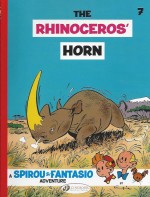
Spirou and Fantasio volume 7: The Rhinoceros’ Horn


By André Franquin, translated by Jerome Saincantin (Cinebook)
ISBN: 978-1-84918-224-9

Spirou (whose name translates as both “squirrel” and “mischievous” in the Walloon language) was created by French cartoonist François Robert Velter under the pen-name Rob-Vel for Belgian publisher Éditions Dupuis in response to the phenomenal success of Hergé’s Tintin for rival outfit Casterman.

The legendary title was launched on April 21st 1938 with a rival red-headed lad as the lead of an anthology weekly comic which bears his name to this day.

The character began life as a plucky bellboy/lift operator employed by the Moustique Hotel (a reference to publisher’s premier periodical Le Moustique) whose improbable adventures with his pet squirrel Spip eventually evolved into high-flying surreal comedy dramas.

Spirou and his associates have spearheaded the magazine for most of its life, with a phalanx of truly impressive creators carrying on Velter’s work, beginning with his wife Blanche “Davine” Dumoulin who took over the strip when her husband enlisted in 1939.

She was assisted by Belgian artist Luc Lafnet until 1943 when Dupuis purchased all rights to the feature, after which comic-strip prodigy Joseph Gillain (“Jijé”) took the helm.

In 1946 Jijé‘s assistant André Franquin assumed the reins, gradually sidelining the short, gag-like vignettes in favour of longer epic adventure serials, introducing a wide and engaging cast of regulars and eventually creating a phenomenally popular magic animal dubbed Marsupilami to the mix (first seen in Spirou et les héritiers in 1952 and now a spin-off star of screen, plush toy store, console games and albums all his own).

He crafted increasingly fantastic tales and absorbing Spirou sagas until he resigned in 1969.

He was succeeded by Jean-Claude Fournier who updated the feature over the course of nine stirring adventures which tapped into the rebellious, relevant zeitgeist of the times with tales of environmental concern, nuclear energy, drug cartels and repressive regimes.

By the 1980s the series seemed outdated and without direction: three different creative teams alternated on the feature, until it was at last revitalised by Philippe Vandevelde – writing as Tome – and artist Jean-Richard Geurts AKA Janry, who adapted, referenced and in many ways returned to the beloved Franquin era. Their sterling efforts consequently revived the floundering feature’s fortunes and resulted in fourteen wonderful albums between 1984 and 1998.

As the strip diversified into parallel strands (Spirou’s Childhood/Little Spirou and guest-creator specials A Spirou Story By…) the team on the main vehicle were succeeded by Jean-David Morvan & José-Luis Munuera, and in 2010 Yoann & Vehlmann took over the never-ending procession of amazing adventures…

Cinebook have been publishing Spirou & Fantasio’s exploits since October 2009, mainly translating Tome & Janry’s superb pastiche/homages of Franquin, but for the fifth episode (The Marsupilami Thieves), they reached all the way back to 1952 and the second appearance of the adorable wonder-beast by the great man himself.

With that brave experiment clearly having paid dividends they repeated the experiment here, but with times and taste having changed so radically felt the need to issue a heartfelt warning and carefully considered apologia regarding some content of The Rhinoceros’ Horn…

I’ll précis it here: it was sixty years ago and our attitudes to hunting, minorities and especially the modern obscenity of killing for ivory and horn have thankfully changed. Please read this book with that in mind. The publishers, of course, phrased it much better…

André Franquin was born in Etterbeek, Belgium on January 3rd 1924. Drawing from an early age, the lad only began formal art training at École Saint-Luc in 1943. When the war forced the school to close a year later, he found animation work at Compagnie Belge d’Animation in Brussels where he met Maurice de Bevere (Lucky Luke creator “Morris”), Pierre Culliford (Peyo, creator of The Smurfs) and Eddy Paape (Valhardi, Luc Orient).

In 1945 all but Peyo signed on with Dupuis, and Franquin began his career as a jobbing cartoonist and illustrator, producing covers for Le Moustique and scouting magazine Plein Jeu.

All during those early days Franquin and Morris were being tutored by Jijé who was the main illustrator at Spirou. He turned the youngsters and fellow neophyte Willy Maltaite AKA Will (Tif et Tondu, Isabelle, Le jardin des désirs) into a perfect creative bullpen known as the La bande des quatre or “Gang of Four” who revolutionised Belgian comics with their prolific and engaging “Marcinelle school” style of graphic storytelling.

Jijé handed Franquin all responsibilities for the flagship strip part-way through Spirou et la maison préfabriquée, (Spirou #427, June 20th 1946) and the lad ran with it for two decades, enlarging the scope and horizons until it became purely his own.

Almost every week fans would meet startling new characters such as comrade and rival Fantasio and crackpot inventor the Count of Champignac. Along the way Spirou and Fantasio became globe-trotting journalists, continuing their exploits in unbroken four-colour glory.

The heroes travelled to exotic places, uncovering crimes, revealing the fantastic and clashing with a coterie of exotic arch-enemies such as Zorglub and Zantafio. This particular tale saw the debut of one of the first strong, capable female characters in European comics; rival journalist Seccotine (renamed Cellophine for this translation).

In a splendid example of good practise, Franquin mentored his own band of apprentice cartoonists during the 1950s. These included Jean Roba (La Ribambelle, Boule et Bill), Jidéhem (Sophie, Starter, Gaston Lagaffe) and Greg (Bruno Brazil, Bernard Prince, Achille Talon, Zig et Puce), who all worked with him on Spirou et Fantasio.

In 1955 – around the time this story was collected into an album – contractual conflicts with Dupuis forced Franquin to sign up with rival outfit Casterman on Tintin. Here he collaborated with René Goscinny and old pal Peyo whilst creating the raucous gag strip Modeste et Pompon.

He soon patched things up with Dupuis and returned to Spirou, subsequently co-creating Gaston Lagaffe in 1957, but was obliged to carry on his Tintin work too…

From 1959 on, writer Greg and background artist Jidéhem assisted Franquin but by 1969 the artist had reached his Spirou limit and resigned, taking his mystic Marsupilami with him…

His later creations include fantasy series Isabelle, illustration sequence Monsters and bleak adult conceptual series Idées Noires, but his greatest creation – and one he retained all rights to on his departure – is Marsupilami.

Franquin, plagued in later life by bouts of depression, passed away on January 5th 1997 but his legacy remains, a vast body of work that reshaped the landscape of European comics.

The Rhinoceros’ Horn was originally serialised in two sequences in Spirou: #764-787 (Spirou et la Turbotraction) and #788-797(La corne de rhinocéros), spanning late 1952 and early 1953 before being united in hardback album La corne de rhinocéros in 1955.

The story begins with Spirou exulting over the success of Fantasio’s latest enterprise – personal helicopters worn as backpacks – but his pal is rather down in the dumps. He’s just been dressed down by his editor on The Mosquito and warned that the paper has hired a new reporter: a real go-getting hotshot…

Dejected and desperate Fantasio determines to revive his career by staging a publicity stunt: robbing the Good Bazaar Department Store…

As the rattled reporter draws up his plans and sends a warning to the store of his intentions, a colossal explosion shakes the town. Persons unknown have blown up the nearby Turbot car plant. With even more to prove now, Fantasio proceeds…

Dragged along for the ride to photograph the stunt, Spirou and Spip reluctantly join their pal in the hare-brained venture. Landing on the roof of the emporium courtesy of the petrol-powered “Fantacopters”, they deftly break in through the fire-door, Spirou recording everything with his gigantic flash camera.

Typically the lead-footed burglars make an appalling clatter and tremendous mess but no night-watchmen confront them. They’ve all been incapacitated and tied up by real robbers…

Hearing the villains approach, the lads take refuge in a wardrobe in the bedrooms department and discover an old acquaintance already there. Behring works for Turbot and was wounded in the explosion earlier. Moreover, he’s carrying blueprints for the company’s latest advancement and the burglars in the darkened store are actually bandits trying to finish him off to get them…

Handing the boys an envelope and begging them to get it to his employer Mr. Martin, the troubleshooter loses consciousness just as the nervous heroes are challenged by a shadowy figure demanding the precious prize. It’s not the bad guys however, but Fantasio’s new journalistic nemesis…

Cellophine is already streets ahead of them: she knows of the plot to steal Turbot’s revolutionary supercar. All she needs is the address Behring muttered to secure an interview with the in-hiding Martin and her next terrific scoop…

And that’s when the gun-toting bandits make their move, demanding blueprints and rendezvous address. Thankfully Spirou is still holding the camera and super-bright flashgun…

Hilariously and calamitously fleeing for their lives through the darkened store, the boys eventually make their escape via fantacopters from the top storey, allowing Cellophine to lock the bandits up on the roof before dragging Behring to safety.

The next morning the boys are in Whistleton but Martin has already fled. His note reveals nothing, but later a sinister stranger in a café advises them to surrender the blueprints and warns them not to join Martin in Bab-el-bled in North Africa.

Ignoring him and returning home, they encounter the distressingly persistent Cellophine and Spirou clues her in. Sadly the thugs have tracked them down and overhear the plans. When the boys catch a jet liner to Africa, the heavily disguised heavies are in the seats behind them…

They villains are on their tails all though the streets of Bab-el-bled, but a wig malfunction in the Souk warns Spirou they’re being followed and another hectic chase ensues.

Thinking they’ve at last shaken their pursuers our heroes go to Martin’s house only to learn he was ambushed by the bandits…

Happily the troubled Turbot exec escaped and fled further into North Africa. He’s rushing off to the M’saragba Animal Reservation but as the boys try to follow Cellophine appears and pips them to the last spot on the plane – stowed away in the baggage hold…

Forced to follow by train, it is eight days later when Fantasio and Spirou finally reach the Reserve and yet again – as the infinitely annoying Cellophine explains – they’ve just missed Martin. He was chased into the bush by the implacable bandits…

The youngsters go after him and, later that afternoon, find him just after the thugs do. Having shot Martin, the villains are smugly gloating when the sinister stranger from the café in Whistleton appears. He’s a cop and finally has enough evidence to arrest them for blowing up the factory…

They are all too late. The harassed entrepreneur has already got rid of his portion of the plans, giving them to a native friend to hide.

As Martin is carried to hospital, Spirou and Fantasio volunteer to retrieve the accursed documents but they have not reckoned on the quirky ingenuity of the chief of the Wakukus, the vastness of the reserve and the sheer bloody-mindedness of the local flora and fauna.

After days of unpleasant and painful adventures they finally locate the tribe and, following even more nerve-wracking moments convince the chief that they too are friends of Martin. That’s when the king delivers his bombshell.

Tasked with keeping safe the plans – now contained on a spool of microfilm – the wily Wakuku had his men capture a live rhino before drilling a hole in its horn and sealing the container within. He then released it back into the wild. He has no idea where it is now or even which of the 200 in the park it might be…

Determined to complete their mission, the lads spend months tracking and capturing the assorted beasts. The task becomes only slightly easier after they find a dipsomaniac white trader who sells them hunting gear and latterly, yellow paint so that they can tell the rhinos they’ve already checked from the ones so cunningly evading them…

It’s a backbreaking, heartbreaking and increasingly pointless task but only when their resolve crumbles and they brokenly give up and head for home do they find the prize in the very last place they looked…

Even the trip back is a tribulation, and eventually they collapse only to awake in a nice clean hospital with Martin and Cellophine offering to fill in the blanks on this baffling case…

Six weeks later the lads are recuperating at home when Behring shows up. He’s got a little reward for them from the grateful Turbot Company but, as usual, Cellophine is on hand to spoil it for Fantasio…

Stuffed with superb slapstick situations, riotous keystone kops chases and gallons of gags, this exuberant yarn is a true celebration of angst-free action, thrills and spills. Easily accessible to readers of all ages and drawn with all the beguiling style and seductively wholesome élan which makes Asterix, Lucky Luke, The Bluecoats and Iznogoud so compelling, this is another enduring comics treat from a long line of superb exploits, certain to be as much a household name as those series – and even that other kid with the white dog…
Original edition © Dupuis, 1955 by Franquin. All rights reserved. English translation 2014 © Cinebook Ltd.

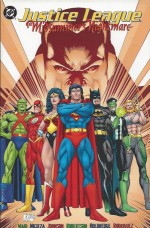
Justice League: Midsummer’s Nightmare


By Mark Waid, Fabian Nicieza, Jeff Johnson, Darick Robertson, John Holdredge, Hanibal Rodriguez & various (DC Comics)
ISBN: 978-1-56389-338-4

There are many facets that contribute to the “perfect mix” in the creation of any continuing character in comics. How much more so then, when the idea is to build a superhero team that will stand out from the seething masses that already exist?

In the mid-1990s, the iconic squad which truly ushered in the return of superheroes to comics suffered one of its periodic plunges in quality and popularity and ignominiously folded.

Of course the Justice League of America is too hallowed, venerated and valuable to fester in oblivion for any length of time and was quickly reconvened in a fresh new interpretation which quickly became the breakout book of 1997, courtesy of Grant Morrison & Howard Porter (see JLA: New World Order).

However, the scene was set for them by a strikingly exuberant miniseries which acted as a reassessment and reintroduction of the World’s Greatest Superheroes. Since the Silver Age’s greatest team-book died a slow, painful, embarrassing death, not once but twice, DC were taking no chances with their next revival and tapped Big Ideas wünderkind Morrison to reconstruct the group and the franchise.

However he was to a large extent riffing on groundwork laid by writers Mark Waid and Fabian Nicieza – as well as the impressive illustration of Jeff Johnson, Darick Robertson, John Holdredge & Hanibal Rodriguez – in a captivating no-nonsense miniseries which went a long way towards regenerating interest…

This slim sleek compilation (collecting Justice League: Midsummer’s Nightmare #1-3 from September-November 1996) opens with an effusive ‘Intro’ from Morrison before a world of confusion is revealed in ‘True Lies’ where comicbook artist Kyle Rayner struggles to meet the deadline for his assignment. He can’t understand why anybody would want to read about fictitious masked mystery men characters like Green Lantern when the entire planet is in the midst of a cosmic revolution.

All over earth humans are spontaneously developing super-powers as an inexplicable genetic “spark” triggers the next stage in evolution. Millions of superhumans are manifesting with no rhyme or reason whilst others seem doomed to remain merely mundane. It’s like a comicbook plot come to life…

Amongst the ordinary mortals left behind are reporter Clark Kent, philanthropist Bruce Wayne, schoolteacher Diana Prince, college lecturer Wally West and corporate compliance officer Arthur Curry. Elsewhere, separated by immeasurable gulfs, scientist J’onn J’onzz leads an idyllic life under the skies of Mars with his wife and daughter…

The dreams of all these mortals are troubled. They have vague, impossible recollections of beings colourful heroes in a world filled with their like, not this savage situation where selfish “Sparkers”, intoxicated with newfound power, squabble and bicker like bullies and thugs in a primarily plebeian universe…

In a hidden place, an immortal mastermind manipulates a super-villain the entire world has forgotten, using his power to reshape dreams to achieve an eons-long plan. However there’s far more to heroism than powers and each mentally diminished champion individually struggles to find the disturbing deeper truth they know has been somehow taken from them…

The spell of targeted amnesia starts to unravel when journalist Kent somehow survives being caught in a savage exchange between rival sparker gangs. Shocked back to Kryptonian normality he starts tracking down his vanished costumed contemporaries…

Elsewhere relative neophyte legacy heroes Wally and Kyle have their own epiphany moments as the second chapter ‘To Know a Veil’ finds a restored Superman and Batman systematically unravelling the sinister plot.

In a hidden sanctum Machiavellian Know Man further exploits the reality-warping gifts of his slave Doctor Destiny to create a team of sparkers specifically designed to eradicate the re-emergent heroes. Meanwhile Aquaman and Wonder Woman have united with the World’s Finest team in time to be ambushed by an army of sparkers. The battle is in no way certain until the restored Flash and Green Lantern pile in…

After the inconclusive clash the heroes realise they need their old telepathic team-mate back and hunt for J’onzz, eventually dragging the Martian Manhunter from his perfect dream of paradise regained in a bunker at Roswell. Having lost his world and family a second time, he is not in any mind to be merciful with his anonymous abductors…

The saga kicks into terminal high gear with ‘Daze & Knights’ as Know Man’s tailor-made sparker squad attacks only to fall as one before the brutal psychic assault of the furious and heartbroken Manhunter.

His mental capabilities then glean the whereabouts of their true foes from data buried by rebellious Dr. Destiny in Kyle’s subconscious and the fighting mad team race off to a final confrontation with their hidden enemy…

Fast-paced, action-packed and breathtakingly bold, this galvanic tale, pitting the greatest champion’s in DC’s pantheon against an immortal enemy whose roots stem back to the earliest days of the universe is a gloriously baggage-free romp and a splendid jumping on point for readers new and old alike, and this fantastic Fights ‘n’ Tights foray also includes a handy information section recapitulating and assessing the characters of Superman, Batman, Wonder Woman, Flash, Green Lantern, Aquaman and Martian Manhunter.
© 1996 DC Comics. All Rights Reserved.

Small Press Sundays

I started out in this game a little bit after the last Ice Age ended, making minicomics, collaborating on fanzines and concocting stripzines with fellow weirdoes, outcasts and comics addicts. Even today, seeing the raw stuff of creativity in hand-crafted paper pamphlets still gets me going in ways that threatens my tired old heart…

With that in mind here’s a selection of tantalising treats that have landed in my review tray recently…

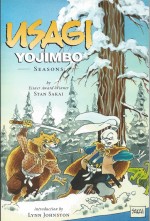
Usagi Yojimbo book 11: Seasons


By Stan Sakai (Dark Horse Comics)
ISBN: 978-1-56971-375-8

Usagi Yojimbo first appeared in Stan Sakai’s The Adventures of Nilson Groundthumper and Hermy, in 1984’s furry ‘n’ fuzzy folk-fest Albedo Anthropomorphics #1. He soon graduated to a stirring solo act in Critters, Amazing Heroes, Furrlough and Munden’s Bar back-up strips in Grimjack.

In 1955, when Sakai was two years old, the family moved from Kyoto, Japan to Hawaii. Growing up in a cross-cultural paradise he graduated from the University of Hawaii with a BA in Fine Arts, before leaving the state to pursue further studies at Pasadena’s Art Center College of Design in California.

His early forays into comics were as a letterer – most famously for the inimitable Groo the Wanderer – before his nimble pens and brushes found a way to express his passion for Japanese history, legend and the filmic works of Akira Kurosawa and his peers, inspirationally transforming a proposed story about a human historical hero into one of the most enticing and impressive fantasy sagas of all time.

And it’s still more educational, informative and authentic than any dozen Samurai sagas you can name…

Although the deliriously expansive period epic stars sentient animals and details the life of a peripatetic Lord-less samurai eking out as honourable a living as possible by selling his sword as a Yojimbo (a bodyguard-for-hire – and, while we’re at it, “Usagi” literally translates as “rabbit”), the milieu and scenarios all scrupulously mirror the Edo Period of Japan – roughly 16th and 17th century AD by our reckoning – whilst simultaneously referencing other cultural icons from sources as varied as Zatoichi to Godzilla.

Miyamoto Usagi is brave, noble, industrious, honest, sentimental, gentle, considerate, artistic, empathetic, long-suffering and conscientious: a rabbit devoted to the tenets of Bushido, he is simply unable to turn down any request for help or ignore the slightest evidence of injustice. As such, his destiny is to be perpetually drawn into an unending panorama of incredible situations.

This evocative and enticing eleventh monochrome medieval masterpiece gathers Dark Horse Comics’ Usagi Yojimbo comicbook (volume 3) #7-12, and the hue-less, line art contents of Usagi Yojimbo Color Special #4 (Green Persimmon).

Following a fondly effusive Introduction from cartoonist Lynn (For Better or For Worse) Johnston, the ever-unfolding adventure resumes with ‘The Withered Field’ as our wandering hero watches swordmaster Nakamura Koji. The former fencing instructor to Lord Hikiji wants to test himself against Ueno, head of the Surodoi School, but the master is absent and his arrogant, haughty students refuse to summon him despite the old man’s succession of victories against them all…

Usagi had also desired to test his skills but instead listens to the incredibly dexterous Koji’s tragic story. Once an important warrior of impeccable status, he was bested in a duel by an unconventional itinerant samurai who rejected the traditional forms of fencing.

Shamed by the defeat Koji took up the Warrior’s Pilgrimage, travelling the land testing and perfecting his skill whilst preparing for a rematch.

As they chat sixteen Surodoi students ambush them, resolved to excise their failure by killing the wanderers. United against the dishonourable attackers, Usagi and Koji efficiently despatch them all and the swordmaster comments on his new friend’s unique combat style…

Once, Miyamoto was simply the son of a small-town magistrate before spending years learning the Way of Bushido from a stern, leonine master who was as much hermit as teacher. The lad learned not just superior technique and tactics, but also Katsuichi‘s creed of justice and restraint which would serve him well throughout his turbulent life…

When Ueno returns he is outraged by his disciples’ presumption and further incensed after finding the bodies of his prodigal pupils. He seeks out Koji and finds him calmly walking with a rabbit ronin. Determined to restore his good name, he grants Koji the long-deferred honour of a duel…

The battle is a wonder of form, grace and precision but upon its grisly conclusion the victorious Koji turns upon Usagi. Having seen his companion fight, the swordmaster has recognised the style which defeated him so long ago and must test himself against it once more.

Unable to dissuade him, the rabbit gives his utmost but is resoundingly defeated. Koji has no intention of killing him and instead tasks Usagi with carrying a message and challenge to his reclusive sensei: the triumphant swordmaster will meet Katsuichi a year hence at a specified place to decide finally and forever whose skill is the greatest…

‘A Promise in the Snow’ then sees the rabbit rover stumble upon a robbery and prevent the death of a merchant. The trader is grievously wounded however and his little daughter Fumiye begs the ronin to carry the rapidly expiring Araki to his home a half-day’s journey away.

The task is an arduous one over avalanche-prone mountains with starving wild beasts and numbing cold sapping his energies and good intentions with every step. Despite nigh-overwhelming odds little Fumiye insistently urges Usagi on, but when he finally brings Araki to safety the rescuer receives a stunning shock…

Political intrigue blossoms once again when a wounded messenger carrying an astounding document staggers into a temple in ‘The Conspiracy of Eight’. Inside Usagi is visiting his new friend Sanshobo and is present when the priest finds a pledge signed by eight High Lords agreeing to rise up against the Shogun. The messenger wears the livery of “Shadow Lord” Hikiji and has been struck down by assassin’s arrows…

Ambitious Hikiji’s name is not amongst the signatories and his role in the scheme cannot be guessed, but Sanshobo knows that the letter will result in great bloodshed whether the conspirators, Shadow Lord or Shogun possesses it. Proof of his contention comes when a band of samurai lay siege to the temple compound, demanding the surrender of the messenger…

As snows fall and temperatures plummet, priest, postulants and ronin enact a furious defence of the sanctuary but ultimately a lone ninja steals the document and brings it to an unsuspected fourth party with her own reasons for keeping it quiet.

Neko ninja clan-chief Chizu secretly prays that this time her erstwhile ally Usagi will keep his nose out of her business …

‘Snakes and Blossoms’ offers a brace of flashback tales wherein the Yojimbo, calmly recuperating as Sanshobo’s guest, finds a moment to share some old stories with his new friend.

‘Hebi’ harks back to a time when the ronin and his crusty companion Gennosuké (an irascibly bombastic, money-mad, bounty-hunting, conniving thief-taking rhino with a heart of gold) were caught in a storm and took shelter in an almost abandoned temple. Gen had to kill a huge, vicious snake to get there but once inside things became even more dangerous as the beast’s demon wife impersonated a nun to get close enough to exact vengeance…

A far more educational parable follows as ‘The Courage of the Plum’ reveals how impulsive student Usagi learned a life-lesson from Katsuichi-sensei one cold spring just as the winter snows began to melt…

After a rousing pin-up the drama recommences with ‘Return to Adachi Plain’ (inked by Sergio Aragonés) as the perpetual nomad’s path brings him back to the battlefield where his karma was decided forever…

Mere months after completing his tutelage with Katsuichi, Usagi was recruited to the personal retinue of Great Lord Mifunė. He advanced quickly and was soon a trusted bodyguard too, serving beside the indomitable and legendary Gunichi. It was a time of great unrest and war was brewing…

In his third year of service, the castle was attacked by Neko ninja assassins and, although the doughty heroes managed to save their master, the Lord’s wife Kazumi and heir Tsuruichi were murdered. Realising ambitious rival Lord Hikiji was responsible, MifunÄ— declared war…

The epic conflict ended on the great Adachigahara Plain when MifunÄ—’s general Todo switched sides and the betrayed Great Lord fell. At the crucial moment Gunichi also broke, fleeing to save his own skin and leaving Usagi to preserve the fallen Lord’s head – and honour – from shameful desecration…

With no master to serve, Usagi became a ronin and began his endless Warrior Pilgrimage…

Far away another portentous interlude occurs as a simple peasant is saved by a dark stranger from a cruel and murderous samurai as they all shared passage between islands in ‘The Crossing’.

Jei is a veritable devil in mortal form, believing himself a “Blade of the Gods”, chosen by the Lords of Heaven to kill the wicked. The maniac makes a convincing case: when he first met Usagi the diabolical spearman was struck by lightning and still survived.

Still pursuing his crusade against evil, Jei has adopted an orphan girl Keiko to aid him, but after saving a life he then perceives it to be an evil one too – as apparently is every other passenger on the unlucky vessel…

A fascinating exploration of warrior spirit is depicted as a defeated general goes deep undercover as farmer in ‘The Patience of the Spider’. Ikeda and his most trusted lieutenants survived the fall of their Lord, adopted a peasant lifestyle and are biding their time until they can rise again to expunge their shameful defeat.

But months turn to decades and the General fully grows into his new role – perhaps too much so…

Usagi resurfaces again when a band of cutthroats at an inn initially select him as a prospective victim before switching sights to another, more affluent-seeming traveller. The rogues soon learn the error of their ways as the enigmatic Oyama Tadanori wipes them out with ease.

Later the stranger encounters Usagi and the ronin recognises ‘The Lord of the Owls’ as an infamous cursed warrior reputed to be able to see death in a person’s eyes. He is not happy to hear the taciturn figure warn him that they will meet again…

More secrets of the Conspiracy of Eight are revealed in ‘The First Tenet’ when Chizu’s deputy Kagemaru exposes her part in the incriminating letter’s theft to Hikiji’s untrustworthy facilitator Lord Hebi. Infuriatingly some wily ninja has doctored the document and the conspirators remain practically anonymous…

Later, as Hebi’s entourage is attacked by assassins, Kagemaru just happens to be nearby with a band of faithful ninjas who rapidly despatch the assailants. It’s not so much the surprise of the counterattack that routs the rogues as shock that the man who hired them is now leading the defence of Hebi…

Attention returns to the Yojimbo as he passes the devastated mansion of Lady Takagi and recalls how, in the aftermath of the Dragon Bellow Conspiracy, he, Gen and female warrior Tomoe were rushing back to inform benevolent young Lord Noriyuki that the crisis had been averted.

After battling their way past hostile forces they were offered a night’s respite by the noble lady but ‘The Obakéneko of the Geishu Clan’ was a were-beast intent on murder and worse and it took all the ronin’s might and plenty of luck to survive until daylight…

The spellbinding storytelling concludes with espionage mystery ‘Green Persimmon’ as a dying samurai of Noriyuki’s Geishu clan entrusts Usagi with a strangely glazed ceramic fruit which simply must reach the young Lord at all costs.

The fragile porcelain artefact attracts the attention of numerous thugs, cutthroats and hired killers but as the Yojimbo carves his way across the country he is unable to fathom its purpose. Only when he meets Tomoe does the Green Persimmon surrender its incredible secret…

This medieval monochrome masterwork concludes with a ‘Gallery’ of seven superb covers to wrap things up with artistic aplomb.

Despite changing publishers a few times the Roaming Rabbit has been in continuous publication since 1987, with over 30 books and collections so far. He has guest-starred in many other series (most notably Teenage Mutant Ninja Turtles and its TV incarnation) and even almost made it into his own small-screen show.

There are high-end collectibles, art prints, computer games and RPGs, a spin-off sci-fi comics serial and lots of toys. Sakai and his creation have won numerous awards both within the Comics community and amongst the greater reading public.

Fast-paced yet lyrical, informative and funny, Usagi Yojimbo also bristles with tension and thrills and frequently breaks your heart with astounding tales of pride and tragedy.

Simply bursting with veracity and verve, it is the perfect comics epic: a monolithic magical saga of irresistible appeal to delight devotees and make converts of the most hardened haters of “funny animal” stories.
© 1996, 1997, 1999, 2004 Stan Sakai. Usagi Yojimbo is a registered trademark of Stan Sakai. All rights reserved.