Justice, Volume 3

Justice, Volume 3

By Jim Krueger, Alex Ross & Doug Braithwaite (DC Comics)
ISBN13: 978-1-84576-630-6

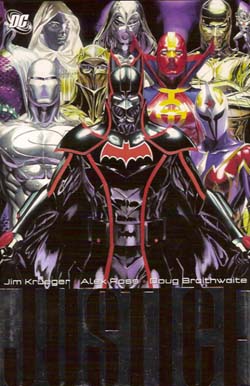
The Big Finale to the epic battle between the Super Powers of the DC universe reveals the dastardly master-plan of Lex Luthor and the alien computer intelligence Brainiac as the resurgent heroes – each clad in personalised Battle Armour (Gotta Collect ‘Em All!) – go into concerted action to save the world not just from the depredations of the desperate villains but also the now real imminent threat of nuclear destruction.

Thrilling and sumptuously fulfilling it should nevertheless have been with us a lot sooner in this overlong and meanderingly padded tale that comes so close to being great comics but instead looks like a wish list for a toy-factory or DC Direct.

I truly understand that it’s a tough commercial world and that lots of fans love the toys, gadgets, statues and what-nots that are part-and-parcel of modern comics publishing. I just worry that when peripherals begin to dictate the content of your product then you have a product that’s no longer able to sustain itself.

In this case that translates into three superb creators spending a lot of time getting it almost right, but failing to make the kind of magic that inspired them to get into the business in the first place… and surely that’s a long term goal comics can’t afford to lose or forsake?

© 2007 DC Comics. All Rights Reserved.

Justice, Volume 2

Justice, Volume 2

By Jim Krueger, Alex Ross & Doug Braithwaite (DC Comics)
ISBN13: 978-1-84576-444-9

Warning: This is the middle part of one long story. It has no beginning and it doesn’t end here.

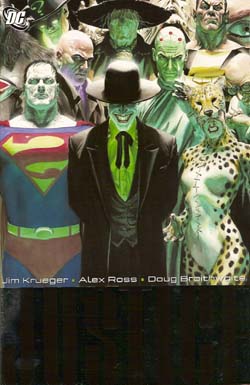
With the superheroes compromised and defeated, the lesser heroes of the DC Universe come into play as the triumphant villains divvy up their spoils. As the forces of good begin their fight back it becomes increasingly clear that Lex Luthor and Brainiac have their own agenda, and that it doesn’t include their erstwhile allies and pawns. Also, the supremely insane Joker is loose and he’s very unhappy about being excluded from the alliance of villains…

Once again this volume includes additional artwork, illustrated fact-files on the huge cast of characters and some of Doug Braithwaite’s pencilled pages before Alex Ross applied colours. Justice was originally published as a twelve issue maxi-series (this volume collects issue #5-8).

Visually spectacular, in story-terms this overly complex and convoluted tale falls far short of the halcyon material it references, possibly because the target audience is assumed to be too mature for the clear-cut simplicity of those child-friendly days and tales. There’s also a little too much of the Toys, Action Figures and Collectables catalogue about the whole affair, for my liking.

© 2006 DC Comics. All Rights Reserved.

Justice, Volume 1

Justice, Volume 1

By Jim Krueger, Alex Ross & Doug Braithwaite (DC Comics)
ISBN13: 978-1-84576-350-3

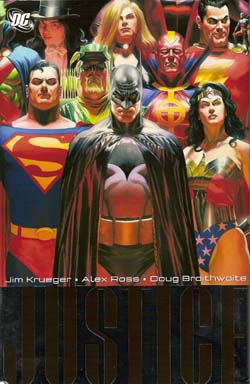
Set outside of regular DC continuity (which is much easier to do since 52 and Countdown I suppose) this tale begins with dreams of Nuclear Armageddon and the failure of Earth’s heroes to save the world. These dreams plague many of Earth’s super-villains, and overcoming a natural distrust of each other they unite under Lex Luthor to finally overcome their arch-enemies.

Not only do they hunt down and deal with Superman, Batman, Aquaman, Wonder Woman and the rest of the Justice League, but they also begin a public charm offensive, whilst changing the world in ways the heroes never have. As the deserts are made to bloom, the crippled cured and the hungry fed, the world is oblivious to the fact that their erstwhile heroes are being brutally murdered…

This first volume also contains additional artwork, illustrated fact-files on the huge cast of characters and some of Doug Braithwaite’s pencilled pages before Alex Ross applied his magic brushes.

Ross’s faux-realist painting style has carved him a unique place in modern comics and led to a number of high-profile successes. This latest project, a twelve issue maxi-series (this volume collects issue #1-4), is a tribute to the big Goodies Vs. Baddies sagas of his own childhood, both in 1970s DC Comics and also the animated Super-Friends and Challenge of the Super-Friends TV shows.

Although a beautiful and visually compelling series it could have greatly benefited from a little of the clear, clean simplicity of those long-ago stories. And while I’m kvetching, I can’t see any benefit to the faithful readership, let alone any new fans, to collect the series into three expensive hardback editions when it could comfortably and handily fit into one. If we keep treating product as artefact we’ll stop being a popular or mass medium and become just another clique market like Collector Plates or Toby Jugs…

© 2006 DC Comics. All Rights Reserved

Batman 3D

Batman 3D
Batman 3D

By John Byrne & various: 3-D process by Ray Zone (DC Comics)
ISBN: 0-930289-77-3

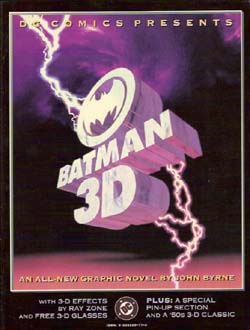
The comic-book 3-D process was invented by Joe Kubert and Norman Maurer in 1953 and fed into the wider craze in movies. It resulted in some pretty spectacular comic-books but died out pretty quickly, although it still persists and periodically resurfaces. I’ve worked on a couple of 3-D projects in my other life as an advertising free-lancer, and can honestly say it’s harder than it looks to get right, but when you do it’s utterly mind-boggling.

Having said that and acknowledging that it’s a way of enhancing the visual impact of comics it’s always gratifying when the actual story works too. This forgotten tome from 1990 is a nice example, and is only the second time John Byrne wrote Batman, and is his first full art job on the character. ‘Ego Trip’ features a solid old-fashioned murder-mystery, a helter-skelter chase, dynamic action and a deadly competition between The Joker, The Penguin, The Riddler and Two-Face with Gotham City as their playground.

Although the dialogue is a little stiff, this is still a very readable Batventure for fans of all ages with many tributes to all the best iconic features of the strip and a measured understanding of what the stereoscopic process can add. There’s also a reprint of ‘Robot Robbers’ (with art attributed to Curt Swan and Sheldon Moldoff) which originally appeared in Batman #42 in 1947. It was one of four tales turned into 3D strips for Batman Adventures in Amazing 3D Action during that first boom period in 1953, and re-released in 1966 at the height of the TV Batmania craze. It’s a wonderful science crime romp well worth reliving.

This book also features eleven 3D pin-ups from name-artists commemorating the iconic nature and history of the Caped Crusader. Alex Toth draws the hero in his autogyro from 1939, Bret Blevins and Al Williamson define the Batcave, and both Dave Gibbons and Barry Windsor-Smith give us their unique interpretations of The Joker. George Pérez draws the 1950’s Catwoman, Art Adams handles The Penguin and Mike Zeck produces Two-Face. Jerry Ordway teams Batman and Superman, Jim Aparo illustrates Rā’s Al GhÅ«l, Mike Mignola captures Man-Bat and Klaus Janson shows us the Batman of Today.

This is great little book and even if 3D is currently not in vogue, stories and art of this quality shouldn’t be ignored or forgotten.

© 1947, 1953, 1966, 1990 DC Comics. All Rights Reserved.

Mort: A Discworld Big Comic

Mort: A Discworld Big Comic

By Terry Pratchett & Graham Higgins (VG Graphics/Gollancz)
ISBN: 0-575-05699-1

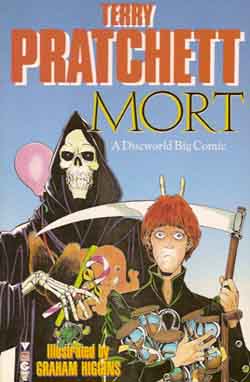
Us old codgers have always maintained that a good comic needs a good artist and this superb adaptation of Terry Pratchett’s fourth Discworld novel proves that point. The Discworld is a flat planet supported on the backs of four elephants standing on the back of a giant turtle swimming across the universe. Magic works there and the people are much too much like us. This, of course, makes it an ideal location for spleen-venting, satire, slapstick and social commentary…

Scripted by the author and brilliantly illustrated by Graham Higgins it tells a complex and darkly witty tale of Death (big grim chap, carries a scythe) and the hapless, literal-minded, sort-of-useless young goof Mort, whom he hires as his apprentice.

Of course that’s not all there is to it, with sub-plots including an orphaned princess and her dangerously ambitious guardian, Death’s vacation, the daughter he adopted and the mystery of his most peculiar servant Albert to season a very impressive spin on a very familiar myth.

Higgin’s light, dry touch adds volumes of texture to the mix and the leaden slavishness of the first graphic adaptation (The Colour of Magic – ISBN: 0-552-13945-9) is utterly forgotten in a superb mix of Pratchett’s acerbic dialogue and the artist’s deft sense of timing and comedy pacing, which is most reminiscent of Hunt Emerson.

If you have to have adaptations of great novels this is how it should be done.

Text © 1994 Terry and Lyn Pratchett. Illustrations © 1994 Graham Higgins. All Rights

Scorchy Smith: Partners in Danger

Scorchy Smith: Partners in Danger

By Noel Sickles (Nostalgia Press)
ISBN: 0-87897-029-0

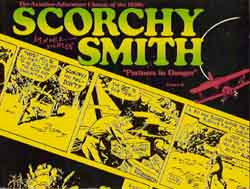
Noel Sickles had a very short and barely acknowledged career as a newspaper cartoonist. He worked as a jobbing illustrator in the features department of the Associated Press – an organisation that provided cheap high-quality filler material such as cartoons, ads, comic strips, recipes, horoscopes, puzzles: All the pages that local newspapers needed but couldn’t afford to produce themselves.

In 1934 he took over the inexplicably popular aviation strip Scorchy Smith from John Terry, who had contracted a terminal illness. The publisher’s required him to emulate Terry’s style, which he did until the artist’s death, when he was invited to make the strip his own. A driven experimenter, he replaced the scratchy cross-hatched and feathered method of Terry with a moody impressionism that used volume, solid blacks and a careful manipulation of light sources to tell his tales. He also made backgrounds and scenery an integral part of the story-telling process.

A very straight adventure series, Smith is a stout hearted, valiant Knight of the Skies, complete with trusty sidekick, ‘Heinie’, flying about and Doing Good. That’s it.

Sickles famously never worked to a plan when writing the strip, he just made it up as he went along to avoid boring himself. (For an extended exploration of his process read R C Harvey’s Meanwhile… a superb biography of Sickles’s friend and studio-mate Milton Caniff published by Fantagraphics Books ISBN: 978-1-56097-782-7).

Stories abound that the two collaborated often. Certainly Caniff admitted to helping out with deadlines and story-polishing but the bold visuals were always the product of a driven and dedicated seeker of artistic truths. The Chiaroscurist style developed by Sickles was adopted by Caniff, although he largely eschewed the lavish use of photo-mechanical dot-screens that Sickles used to create a different flavour of Black in his monochrome masterpieces.

Reprinted in this slim tome are three of the thrillers from that brief period. ‘Lafarge’s Gold’ (10th October 1935-January 30th 1936), ‘New York, N. Y.’ (January 31st 1936-March 18th 1936) and ‘Desert Escape’ (March 19th 1936- August 14th 1936) come from the very end of Sickles’s strip career, with a pretty girl swindled out of a goldmine, big-city conmen, and Tuaregs and the Foreign Legion providing the admittedly lacklustre narrative maguffins. But the bravura vivacity and artistic flair employed by Sickles to tell the tales elevate these B-Movie plots into breathtaking high art drama by the sheer magnificence of the drawing and design.

Noel Sickles left the restricted and drudge-work world of newspaper strips in 1936 for the greater challenge of higher education and eventually settled into the more appreciative and challenging magazine illustration field, making new fans in the Saturday Evening Post, Life and Readers Digest. His few months in narrative story-telling changed our entire industry, not so much with what he did but by the way he did it and who he shared his discoveries with. He is an unsung immortal, and his brief output deserves a commemorative, retrospective collection more than any other creator that I can think of. Until then lost gems like this will have to suffice.

© 1936 The A. P.

Daddy is So Far Away… And We Must Find Him!

Daddy is So Far Away… And We Must Find Him!

By Wostok & Grabowski, translation edited by Chris Watson (Slab-O-Concrete)
ISBN: -1-899866-10-9

In the last decade of the last century independent, alternative and international cartooning really took off in the UK. It’s not that it suddenly got good, it’s simply that due to the efforts of a few dedicated missionaries the rest of the country finally noticed what Europe had known for years. Graphic narrative is as much about the art and the individual as it is about the money.

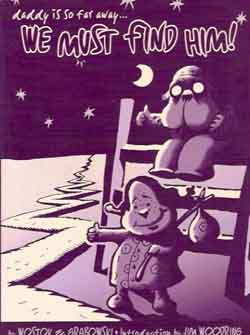
A superb case in point is this slim and eccentric tome produced in English by that much-missed Slab-O-Concrete outfit. Daddy is So Far Away… is the surreal and absorbing account of two-year old Poposhak and her faithful dog Flowers. The sad little lass stands at her mother’s grave and wonders where her father is. She sees the tip of his beard sticking out of the front door and rushes towards it despite wise Flowers’ words of caution.

She will not stop, but follows the beard, through rooms, down tunnels, across plains, under oceans and even across the Milky Way itself, finding friends and escaping monsters throughout time and space. Always that long white beard unfurls ahead of them, an enigma and a promise…

An eerie yet comforting blend of fable, bedtime story, shaggy dog tale, and vision-quest, this is a compulsive and brilliantly drawn epic more rollercoaster than narrative and encompassing the very best storytelling techniques of Eastern European animation.

Wostok and Grabowski, from the north Serbian town of VrÅ¡ac have worked together since 1992; both in the incredibly fertile Eastern European market but also internationally, and as is usually the case are criminally unfamiliar to the average comic punter. I hope you can find their work without too much trouble, because it’s well worth the effort.

© 1995-1998 Wostok, Lola & Grabowski. All Rights Reserved.

Warlord: The Savage Empire

Warlord: The Savage Empire

By Mike Grell (DC Comics)
ISBN: 1-56389-024-0

During the troubled 1970s the American comics industry suffered one of its periodic downturns and publishers cast about for other genres to bolster the flagging sales of superhero comics. By revising their self-imposed industry code of practice (administered by the Comics Code Authority) to allow supernatural and horror comics, the publishers tapped into the global revival of interest in spiritualism and the supernatural, and as a by-product opened their doors to Sword-and-Sorcery as a viable genre, with Roy Thomas and Barry Smith’s adaptation of R. E. Howard’s Conan the Barbarian an early exemplar.

DC launched a host of titles into that budding market but although individually interesting (especially the fascinating Stalker, illustrated by Steve Ditko and Wally Wood) nothing seemed to catch the public’s eye until number #8 of the try-out title First Issue Special.

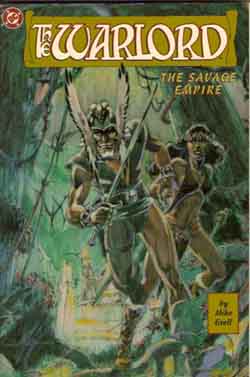
In that comic superhero artist Mike Grell launched his pastiche and tribute to Edgar Rice Burroughs’s Pellucidar – At the Earth’s Core, which after a rather shaky start went on to become, for a time, DC’s most popular title.

In 1969 Colonel Travis Morgan, a U2 spy-pilot is shot down whilst filming a secret Soviet base, although he manages to fly his plane over the North Pole before ditching. Expecting to land on frozen Tundra or pack-ice he finds himself inside the Earth, in a lush tropical Jungle populated by creatures from every era of history and many that never made it into the science books. There are also cavemen, savages, mythical beasts, barbaric kingdoms and fabulous women.

Time does not seem to exist in this Savage Paradise and as Grell’s stated goal was to produce a perfect environment for yarn-spinning, not a science project, the picky pedant would be well advised to stay away. These are pure escapist tales of action and adventure, light on plot and angst but aggressively and enthusiastically jam-packed with fun and thrills. There is a basic plot-thread to hang the stories on, but you’ll thank me for not sharing it as the real joy of these tales (reprinting that try-out and issues #1-10 and #12) is in the reading. This is a total-immersion comic experience to be felt, not considered. Go for it!

© 1975, 1976, 1977, 1978, 1991 DC Comics. All Rights Reserved.

Checkmate: A King’s Game

Checkmate: A King's GameBy Greg Rucka

& Jesus Saiz (DC Comics)
ISBN 1-84576-436-6

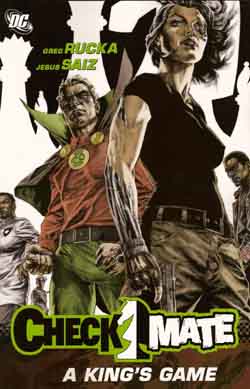
In the aftermath of DC’s Infinite Crisis an international organisation to monitor and control meta-human affairs was developed, under the aegis of the United Nations Security Council. Originally an American agency, the new Checkmate is tasked with policing all nations, protecting them from superhuman dangers and terrorism, and also preventing rogue nations and regimes from weaponising their own paranormal resources.

This first collection reprints issues #1-7 as the organisation (composed of superheroes and traditional intelligence operatives) faces the loss of their charter due to a traitor on the Security Council, all the while tracking down the death cult Kobra and investigating a suspicious facility in China.

This is a dark and engaging blend of genres from writers Greg Rucka, Nunzio DeFilippis and Christina Weir, pencillers Jesus Saiz and Cliff Richards, and inkers Bob Wiacek, Steve Bird, Dan Green and Fernando Blanco, with the murky world of espionage coldly and logically grounding the high-flying gloss of costumed super-doers. Moody and addictive, if perhaps a little too dependent on a working knowledge of the DC universe, this is worth a few moments of any serious fan’s time.

© 2006 DC Comics. All Rights Reserved.

Batman Chronicles Volume 4

Batman Chronicles Volume 4

By Bob Kane & various (DC Comics)
ISBN 10: 1-84576-618-0 ISBN 13: 978-1-84576-618-4

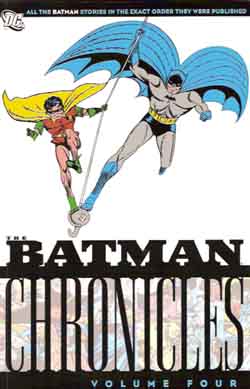
The latest chronological compilation of Batman’s crime-busting career covers May to October 1941 and features all his adventures from Detective Comics #51-55, Batman #6-7, and World’s Finest Comics #2-3. All the stories were written by unsung genius Bill Finger and the art chores were shared out between Bob Kane, Jerry Robinson and George Roussos. The World’s Finest covers were produced by Fred Wray.

Those necessary details dealt with, what you really need to know is that this is a collection of Batman tales that see the character grow into the major player that would inspire so many and develop the resilience to survive the many cultural vicissitudes the coming decades would inflict upon him and his partner, Robin.

‘The Case of the Mystery Carnival’, ‘The Secret of the Jade Box’ and ‘Viola Vane’ (Detective #51, 52 and 53 respectively) are mood-soaked set-pieces featuring fairly run-of-the mill thugs, but ‘The Man Who Couldn’t Remember!’ from WF#2 is a powerful character play and a baffling mystery that still packs a punch today.

‘Hook Morgan and his Harbor Pirates’ sees the Dynamic Duo clean up the docks and the four tales from Batman #6 (‘Murder on Parole’, ‘The Clock Maker’, ‘The Secret of the Iron Jungle‘ and ‘Suicide Beat’) range from human interest to crazed maniac to racket busting and back to the human side of being a cop, whilst Detective #54 went back to basics with the spectacular mad scientist thriller ‘The Brain Burglar’. A visit to a ghost-town produced the eerie romp ‘The Stone Idol’ (Detective #55) and World’s Finest #3 featured the first appearance of one of Batman’s greatest foes in ‘The Riddle of the Human Scarecrow’.

The volume ends with four great tales from Batman #7. ‘Wanted: Practical Jokers’ stars the psychotic Clown Prince of Crime, whilst ‘The Trouble Trap’ finds the heroes crushing a Spiritualist racket. They then head for Lumberjack country to clear up ‘The North Woods Mystery’. The last tale is something of a landmark case, as well as being a powerful and emotional melodrama. ‘The People Vs. The Batman’ sees Bruce Wayne framed for murder and the Dynamic Duo finally become official police operatives. They would not be vigilantes again until the grim and gritty 1980’s…

These are tales of elemental power and joyful exuberance, brimming with deep mood and addictive action. Comic book heroics simply don’t come any better.

© 1941, 2007 DC Comics. All Rights Reserved.