By Steven Weissman (Fantagraphics Books)
ISBN13: 978-1-56097-866-4
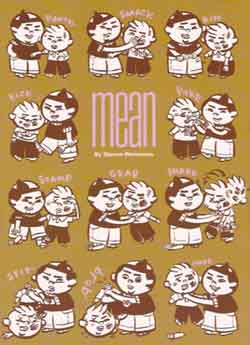
If there is such a thing as ‘Dark and Comforting’ then the weird and wicked cartooning of Steven Weissman is a perfect example. Following the success of such books as Chewing Gum in Church and Kid Firechief Fantagraphics have compiled earlier works from his self-published comic Yikes!, supplemented with other rare and even unpublished strips to create a lovely insight into the development of a truly unique graphic vision.
The 32 tales, created between 1993 to 2002, all feature his cast of peculiar children in a macabre tribute to Charles Shulz’s Peanuts strip, but are also literal embodiments of the phrase “little monstersâ€. In simple childhood romps such as ‘The See-Thru Boy’, ‘The Loneliest Girl in Town’, ‘Inevitable Time-Travel Story’, ‘No Kiss!’ and many others the bizarre cast of Li’l Bloody (a child vampire), Kid Medusa, Pullapart Boy and X-Ray Spence live an idyllically suburban 1950’s existence of school, fishing, skateboards, white picket fences, aliens, wheelchair jousting, marbles and weird science. Weissman’s seductive cast all have huge round heads and ancient bodies like graphic progeria-sufferers, but the drawing is lavish, seductive and utterly convincing.
These are great comics about kids (but categorically Not For Kids) that are a treat, a revelation and most definitely darkly comforting.
By Justin Gray, Jimmy Palmiotti, Adam Archer & Peter Guzman (WildStorm)
ISBN13: 978-1-0-84576-625-2
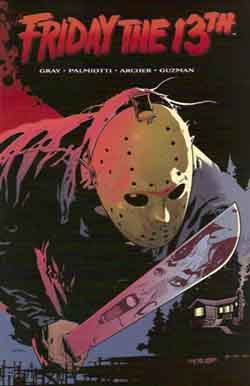
I’m not the greatest fan of modern horror movies, especially the frankly daft and usually logical-integrity free “Slasher-movieâ€. I really, really don’t mean morality here; I can be as nihilistically cynical as any hormonally drenched teen, and what guy doesn’t like vicarious nudity, gratuitous sex and gory giblets everywhere?
What I have trouble with is the creation of unstoppable, inescapable, unkillable monsters as Brands. Fear isn’t going “boo!†or making audiences jump, it’s the build-up; the piling on of tension upon anxiety till you just want it to be over. For that you need at least the possibility that the brand-name can be defeated. Without engaging that hope and desperation all you have is an ever increasing spiral of baroque stunts and shallow effects, ultimately pointless and hollow.
For example: A group of teens are hired to renovate Camp Crystal Lake, the rural paradise where so many wayward kids have been chopped into liver-sausage by the ghastly hockey-masked ghost of Jason Voorhees. They’re obnoxious and they get naked and they die grotesquely. That really all there is to it.
Accepting that I’m not the target market, this book (collecting the first six issues of the monthly comic) has credible artwork but not even the usually excellent scripting of Justin Gray and Jimmy Palmiotti can get me to engage with this disparate cast of cadavers-in-waiting. I can’t even dislike them enough to look forward to their inevitable deaths. Maybe if they were people you really want to see killed like bigots or celebrities…
Competent but limited, and absolutely and only for kids over eighteen…
By Gail Simone, & various (DC Comics)
ISBN 1-84576-564-8
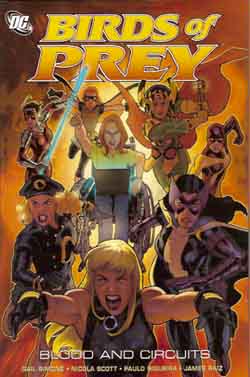
The team of crime-fighting super-women regroup only to go their separate ways in this volume (collecting issues #96-103) of adventures from the monthly DC comic-book. Black Canary has returned from her sabbatical bringing with her a young girl named Sin who was being trained as the next Shiva (a martial arts super assassin) and for whom she intends a “normal†life. However she and the rest of the team are soon drawn into a battle with troubled teen Lori Zechlin (whose alter-ego Black Alice has the ability to steal the power of any magic user on Earth) when the criminal alliance known as The Society attempts to recruit her.
Team-leader Oracle has her own problems as a new Batgirl (Oracle’s previous heroic persona, before she lost the use of her legs) is interfering in her operations, but the real threat is the vengeance-crazed gun-freak Yasemin who wants the team dead.
Eventually the pace forces the Canary to resign in order to raise Sin, so after a highly entertaining retelling of her career she leaves and Oracle redefines the team and the methodology for the anniversary 100th issue. Henceforth she will call on a broader range of female agents, defined by the missions themselves.
The first of these is to rescue seventeen year old Tabitha Brennan from a Mexican prison, where she’s being held to exert influence on her mobster turned supergrass father. This time the “Mission Impossible†team comprises Big Barda, Judomaster, Manhunter, Lady Blackhawk and Huntress but even as the plan goes typically awry a new more dangerous adversary is preparing to act against the Birds, in the form of US Government spook Katerina Armstrong – Spy Smasher, who wants the team to work for her, and who always gets what she wants…
Consistently superb, Gail Simone’s scripting (assisted here by Tony Bedard) has made this title one of the best superhero series on the market and when coupled with the wonderful artwork of such talents as Nichols Scott, Paulo Siqueira, James Raiz, Doug Hazlewood and Robin Riggs, these funny, sassy, sharp thrillers never ever disappoint.
By Donald Rooum (Freedom Press)
ISBN: 0-900384-47-6
Donald Rooum has been fighting the good, reasoned, acerbic but never strident fight for his particular political and ethical standpoint since the 1960s. He has mostly used that most devastating of weapons, the pen, to deliver his payloads of reasoned integrity. This volume is no exception.
Culled from the archives of Freedom magazine, where the Wildcat strip has run for decades, this slim volume presents a number of views of not just The Enemy, exemplified as Governments, Police, Big Business, The Church and smug know-it-alls of all nations but also some telling glances at Anarchists themselves – who, as you might suspect, are often their own worst enemies.
Crammed with magical drawing and compelling reasoning, there’s also plenty of laughs on hand and some lovely additional pages of humorous factoids on and about the subject of cats; cartoon, wild or otherwise.
Donald Rooum’s work is a cartoon connoisseur’s delight: Incisive, reasoned, beautifully illustrated and lettered, and above all, passionate and honest. Everyone, of whatever persuasion, should see what he’s saying, and how.
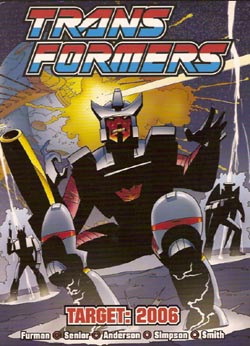
By Furman, Anderson, Senior, Simpson & Ron Smith (Titan Books)
ISBN 1-84023-510-1
The Transformers took the world by storm in the 1980’s and the monthly US Marvel comic book was a smash hit. The UK division had their own weekly comic which reprinted the American material but the scheduling mismatch quickly necessitated the creation of original material.
With the potential for continuity chaos uppermost in editorial minds this extended time-travel epic was created to enthral the kids and not step on any upcoming storylines or new toy launches. Evil Decepticon leader Galvatron travels back twenty years from 2006 to unmake his own unwanted reality by judiciously altering events, but once here he finds that the Autobots are not the only alien shape-changing robots that want to stop him…
Challenging at the time of release (in Transformers #78-88, 1986), the plot has lost a lot of its impact simply because so many films and TV shows have used it in the intervening years, but in conjunction with the taught scripting of Simon Furman and the fast-paced action and great colour artwork from veteran Ron Smith, and such then- newcomers as Jeff Anderson, Geoff Senior and Will Simpson, Target: 2006 is still a thriller with a lot of punch.
This is a great book to bring kids into comics, and I wish we had a few more like it.
By Paul Di Filippo & Jerry Ordway (America’s Best Comics)
ISBN 1-84576-298-3
It’s not all death, disaster and depravity for the super-powered police force of Neopolis, the city where every citizen is a superhuman, a god or robot or monster. Sometimes you get a day off for a staff picnic. However The Job is never far away…
When an ominous supernatural apparition appears over the city it presages an interdimensional Armageddon, but the weary cops have more than enough to deal with already as the new Mayor fires their old boss and replaces him with a paramilitary martinet who would rather issue loyalty pledges and spy on his own men than actually police the city or find the mastermind who’s drowning the robotic citizenry in a sea of circuit-frying electronic dope.
Tensions and paranoia run high and the apparition is only seconds away from destroying the universe, but will the cops even be able to do their jobs?
Set five years after the conclusion of TOP 10: Book 2 (ISBN 1-56389-876-4), this follow-up outing has great pace and ingenuity but somehow lacks the passion and humanity of Moore’s scripts. Much of the uniquely dull and dowdy feel is absent and even the superb artwork by Jerry Ordway nonetheless leans too much on the glamorously “Super†rather than the frailly “Human†side. I hate having to say something so negative about such an earnest effort, especially as its always the plaint of the old codger – but this just isn’t as good as it used to be…
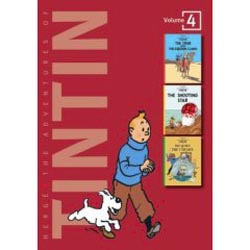
His homeland fell to the invaders in 1940, and Georges Remi’s brief military career was over. He was a reserve Lieutenant, working on The Land of Black Gold when he was called up, but the swift defeat of Belgium meant that he was back at his drawing board before the year’s end, albeit working for a new paper (since Le Petit Vingtième was closed down) and on a brand new adventure. He would not return to the unfinished ‘Black Gold’ with its highly anti-fascistic subtext, until 1949.
And so begins a superb mystery adventure as Tintin follows his lead to the sinister freighter “Karaboudjan†where he is nearly murdered before the diabolical Mate “Allan†(last seen in Cigars of the Pharaoh – Adventures of Tintin: Volume 2, ISBN 13: 978-1-4052-2895-4) shanghais him. It is whilst a prisoner that the boy reporter meets a drunken reprobate who would become his greatest companion: The ship’s inebriated Master, Captain Haddock.
Escaping together, they eventually reach the African Coast, with Haddock’s dipsomaniac antics as much a threat to the pair as the gangsters, ocean storms, and deprivation. These trials are masterpieces of comedy cartooning that have never been surpassed. Despite all odds the heroes survive sea, sands and scoundrels to link up with the military authorities. Making their way to Morocco they track down the criminals to reveal a huge opium smuggling operation. A fast-paced tour-de-force of art and action, liberally laced with primal comedy and captivating exotic locales, this is quite simply mesmerising fare.
The Shooting Star was one of the first tales to be re-issued after World War II, due no doubt to its relatively escapist plot. Originally running from 1941-1942 it is practically an old-fashioned pulp thriller. The world is gripped in terror as a fiery meteor is detected hurtling towards Earth. The apocalypse is averted only by the sheerest chance, as the heavenly body narrowly misses Earth, although when a relatively small chunk breaks off, scientists find that it contains an unknown metal of immense potential value. And so begins a fantastic race to find and claim the fallen meteorite.
A party of European scientists charters the survey ship “Auroraâ€, with Captain Haddock commanding and Tintin aboard as official Press representative. Frantically sailing north to the Pole, they discover that they are in competition with the unscrupulous forces of the evil capitalists of the Bohlwinkel Bank, whose rival expedition uses every dirty trick to sabotage or delay the scientists.
After a truly Herculean effort and by sheer dint of willpower – not to say spectacular bravery – Tintin is the first to claim their floating prize and successfully defend it from the villainous Bohlwinkel crew, but the star itself is a menace as its mysterious composition induces monstrous gigantism. Tintin and Snowy must survive assaults by mutated insects and plants before the breathtaking conclusion of this splendid tale.
When he returns home Tintin finds the model has been stolen but on visiting the first and most strident of the collectors who tried to buy it from him he discovers that the man already has an exact duplicate of the missing model. After much hurly-burly Tintin and Haddock find that Sir Francis was once a prisoner of the pirate Red Rackham, but escaped with the location of the villain’s treasure horde. Subsequently making three models of his vessel “The Unicornâ€, he placed part of a map in each and gave them to his three sons…
Someone else obviously knows the secret of the model ships and that mysterious mastermind becomes ever more devious and ruthless in his attempts to obtain the complete map. Events come to a head when Tintin is kidnapped, which is a big mistake, as the intrepid lad brilliantly turns the tables on his abductors and solves the mystery. With the adventure suitably concluded, the volume ends with our heroes ready to embark on the no-doubt perilous voyage to recover ‘Red Rackam’s Treasure’…
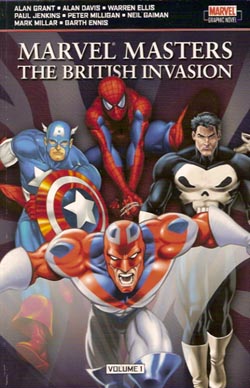
 By various (Panini Publishing UK)
ISBN13: 978-1-933160-68-9
The British Invasion was a term coined in the 1980s to describe the influx and influence of a band of creators (most with 2000AD or Warrior credentials) that began working in and revolutionising the American comic-book industry. In this context, however it’s simply a group of British creators selecting their personal favourite piece of Marvel work for collection in this book.
Writer Alan Grant chose ‘Blood on the Moors’, a Punisher tale he co-scripted with long-time collaborator John Wagner. Hauntingly illustrated by fellow Scot Cam Kennedy, it details in a great blend of action, mystery and humour the semi-supernatural exploits of another obsessive vengeance taker whose crusade intersects Franks Castle’s one man war on crime.
Alan Davis is famed as both artist and writer, and his selection is from Excalibur #61. ‘Truth and Consequence’ is a cosmic superhero romp featuring Rachel Summers in her incarnation of the celestial entity ‘The Phoenix’ battling with planet devouring Galactus only to discover the hideous truth of her own existence.
Warren Ellis is represented by one of his earliest tales for Marvel, from Hellstorm #15. ‘Cigarette Dawn’ sees the once ‘Son of Satan’ battle demons and expectations in an edgy, if perhaps dated tale illustrated by Leonardo Manco.
Peter Parker, Spider-Man volume 2, #35 provides the utterly charming ‘Heroes Don’t Cry’, written by Paul Jenkins and illustrated by Mark Buckingham & Wayne Faucher. If you already know the story you’ll understand why I refuse to say anything about this wonderful adventure other than you must read it if you haven’t. It really is that good.
Peter Milligan chose the moving and incisive character study ‘The Diaries of Edie Sawyer’ from X-Statix #10, illustrated by Philip Bond and Neil Gaiman picked the first issue of his miniseries 1602, which transposed key characters of the Marvel Universe to Elizabethan England, drawn by Andy Kubert and digitally painted by Richard Isanove.
Mark Millar selected ‘The Defenders’ from Ultimates 2, #6, a downbeat re-imagining of the Avengers, illustrated by Bryan Hitch, as his best moment, and the book concludes with the Punisher in a dark, brilliantly compelling look at Frank Castle’s childhood drawn by the legendary John Severin. ‘The Tyger’ is Garth Ennis at his absolute best, and this is a splendid conclusion to an interesting if somewhat inconsistent package, with the good heavily outweighing the not-so-hot.
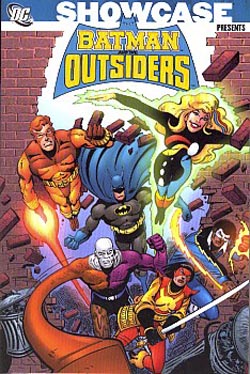
DC Showcase Presents: Batman and the Outsiders, Vol 1
By Mike W. Barr, Jim Aparo & various (DC Comics)
ISBN 10: 1-84576-669-5 ISBN 13: 978-1-84576-669-6
During the early 1980s the general trend of comics sales were in a downturn – although team-books were holding their own – and the major publishers were less concerned with experimentation than with consolidation. Many popular titles were augmented by spin-offs, a recurring tactic in publishing troughs.
Batman was the star of two and two half titles at the time, sharing World’s Finest Comics with Superman (until its cancellation in 1986) and with rotating guest-stars in The Brave and the Bold, as well as his regular spots in both Batman and Detective Comics. He was also a member of the Justice League of America. In July 1983 The Brave and the Bold was cancelled with issue #200 and in it was a preview of a new Bat-title. One month later Batman and the Outsiders debuted…
The basic premise was that the JLA was not fit for purpose; that too many problems were beyond their reach since they were hamstrung by international red tape and, by inference, too many laws. This volume collects issues #1-19, the first annual, that aforementioned preview and the New Teen Titans #37, which was the first part of a crossover between the two titles.
It all kicks off with a revolution in the European nation of Markovia (nebulously wedged into that vague bit between France, Belgium and Russia) and details a telling personal crisis when The Caped Crusader’s friend Lucius Fox goes missing in that war-torn country. As neither the US State Department nor his fellow superheroes will act, Batman takes matters into his own hands. He begins sniffing around only to discover that a number of other metahumans, some known to him and others new, are also sneaking about below the natives’ radar.
Markovia’s monarchy is threatened by an attempted coup, and is being countered by the King’s unorthodox hiring of Dr. Jace, a scientist who specialises in creating superpowers. When King Victor dies Prince Gregor is named successor whilst his brother Brion is charged with finding their sister Tara who has been missing since she underwent the Jace Process. To save his sister and his country, Brion submits to the same procedure. Meanwhile two more Americans are clandestinely entering the country…
Rex Mason, ‘Metamorpho’, is a chemical freak who can turn into any element, and he wants Jace to cure him, but Jefferson (‘Black Lightning’) Pierce is infiltrating as Batman’s ace-in-the-hole. Things go badly wrong when a ninja assassin kills the General Pierce is negotiating with, and he is blamed. Whilst attempting to rescue him Batman finds a young American girl in a bombed-out building who has fantastic light-based superpowers – and amnesia.
As Prince Brion emerges from Jace’s experimental chamber, the revolutionaries attack and not even his new gravity and volcano powers, plus the late arriving Metamorpho can stop them. Brion is shot dead and dumped in an unmarked grave whilst the Element Man joins Batman, who, encumbered by the girl, was also captured by the rebels. The heroes and Dr. Jace are the prisoners of the mysterious Baron Bedlam…
The second issue provides the mandatory origin and plans of the Baron, but while he’s talking the new heroes are mobilising. Like the legendary Antaeus, Brion (soon to be known as Geo-Force) is re-invigorated by contact with Earth and rises from his grave, whilst the girl (code-named Halo) is found by the ninja (‘Katana’) and together they invade the Baron’s HQ. Not to be outdone, the captive heroes break free and join forces with the newcomers to defeat the Baron, who now has powers of his own courtesy of the captive Jace.
As introductory stories goes this is above average, with plenty of threads laid for future development, and the tried and tested super-team formula (a few old and a few new heroes thrown together for a greater purpose) that worked so well with the ‘New X-Men’ and ‘New Teen Titans’ still proved an effective one. As always Barr is an adroit scripter and Jim Aparo, an artist who gave his all to a script, is in top form – and his skill is actually enhanced by the absence of colour in this bargain compendium.
Issue #3 began a long run of high-quality super-hero sagas with ‘Bitter Orange’ as the new team get acquainted and also stop a chemical terrorist with a hidden agenda. This is followed by that preview from The Brave and the Bold #200, a hostage crisis tale designed to tease, followed in turn by ‘One-Man Meltdown’ (Batman And The Outsiders #4) in which a radioactive villain from Batman’s past returns.
‘Death Warmed Over’ and ‘Cold Hands, Cold Heart’ tell the tale of The Cryonic Man, a villain who steals frozen body-parts and ‘The Hand That Rocks the Cradle’ is a sinister supernatural Christmas treat guest-starring possibly Aparo’s most fondly remembered character (most certainly for me) The Phantom Stranger. BATO #9 introduces a super-villain gang with ‘Enter: The Masters of Disaster!’ (the first half of a two-part tale) plus a back-up tale of Halo in ‘Battle For the Band’, written by Barr and illustrated by Bill Willingham and Mike DeCarlo. ‘The Execution of Black Lightning’ concludes the Masters of Disaster saga, and is illustrated by Steve Lightle and Sal Trapani.
Issue #11 begins ‘The Truth About Katana’ by exploring her past and the implications of her magic blade. ‘A Sword of Ancient Death!’ is by Barr and Aparo and continues with ‘To Love, Honour and Destroy’ which leads directly into #13’s impressive ‘In the Chill of the Night’, illustrated by Dan Day and Pablo Marcos, in which the desperate team must capture a dying and delusional Dark Knight.
The first Annual follows: ‘…Land Where Our Fathers Died…’ introduces a gang of ultra-patriots called the Force of July in a barbed epic written by Barr and illustrated by Jerome Moore, Alex Savuik, Jan Duursema and Rick Hoberg with Aparo on inks. This is followed by issue #14’s ‘Two by Two…’ with art by Willingham and Bill Anderson and #15’s ‘Going For the Gold’ (spectacularly illustrated by Trevor Von Eeden) a two-part thriller set at the 1984 Olympics.
‘The Truth About Halo’ begins and is inconclusively revealed in ‘…Goodbye…’ but the next two issues (#17-18) diverts to the desert for ‘We Are Dying, Egypt… Dying’ and ‘Who Wears the Crown of Ra?’ spotlighting Metamorpho, and the volume ends with another Christmas tale. ‘Who’s Afraid of the Big Red “Sâ€?’ is a powerful tale of date-rape and sexual bullying, which pits Geo-Force against Superman and in many ways is the best story in this book.
Although probably not flashy enough to cross the Fan-Barrier into mainstream popularity, this is a competent and highly readable series re-presented in an inexpensive and accessible way. An open minded new reader could do lots worse than try this example “fights’n’tights†fiction.
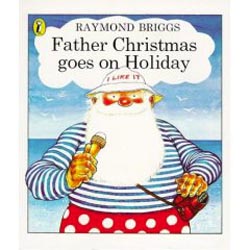
By Raymond Briggs (Picture Puffin)
ISBN 10: 0-14050-187-8 ISBN 13: 978-0-14050-187-2
Our industry seems to wilfully neglect this creator whose graphic narratives have reached more hearts and minds than X-Men or Judge Dredd ever will, but his works remain among the most powerful and important in the entire field.
In Father Christmas (ISBN 13: 978-0-14050-125-4) Briggs presented a marvellously crusty, utterly British character getting the job done, and he returned to the old fellow two years later in a much more whimsical mood.
In this 32 page sequel we find the old codger in a bit of a quandary. It’s time for his summer holidays and he doesn’t know where to go. It has to be hot. There should be good food, but nothing too fancy. No poncey, expensive hotels either, but not camping. And he doesn’t want to be recognised… And then it hits him. A touring holiday! By converting the sled into a camper van he can fly wherever he wants!
He starts off with France, which is beautiful but the food’s a little too posh – and costly, and that combined with campsite toilets… Well! It’s the last straw, though, when the kids find his reindeer and get suspicious, so it’s all aboard and off to Bonny Scotland!
This is much better, but there are still kids who recognise him, and it’s not exactly warm, so it’s away again to hot and sassy Las Vegas for some pampering before heading home, broke but refreshed, and ready again for that big night in December…
Despite being quite different in tone, the character of Father Christmas is still a warmly evocative reminder of times and persons sadly and slowly fading into history, but the real star of this book is Briggs amazingly versatile art; shifting from jolly cartoons to brilliantly powerful watercolour landscapes to sublime narrative sequences with dazzling ease. How many artists today (and tomorrow) got that first push of creative aspiration and desire from a gem like this?
This book is also available in a combined edition with its predecessor, Father Christmas.